Mount Holyoke News AN INDEPENDENT STUDENT NEWSPAPER SINCE 1917 FRIDAY, September 17, 2021
MOUNTHOLYOKENEWS.COM
Kijua Sanders-McMurtry joins Lowery Institute as a board member; brings new opportunities to Mount Holyoke students nity to bring Agnes Scott students together with students from the Atlanta University Center Consortium, which consists of the historically Black institutions of Spelman College, Morehouse When Kijua Sanders-Murtry, College and Clark-Atlanta University. Mount Holyoke’s Vice President for Eq- The day after students convened, they uity and Inclusion and Chief Diversity held a rally. Officer, was invited to join the board “We all got together and Reverend of directors for The Joseph & Evelyn Lowery — at that time he was in his 80s Lowery Institute for Justice & Human and he just wanted to sit with the stuRights in Atlanta, GA, their first in- dents — he was able to talk to the stustinct was to decline the opportunity. dents,” Sanders-McMurtry said. “[He They were afraid that this new position was] just saying ‘Don’t lose hope. You would interfere with their ability to con- know like we actually have to continue nect students with opportunities at the to fight racism, but take care of yourInstitute. selves too.’ It was really beautiful.” Prior to arriving in Western MasAfter moving to the Pioneer Valley sachusetts to to take on their work at Mount new role at the Holyoke, Sanders- “Black people have always re- College, SandersMurtry worked continsisted white supremacy, always McMurtry for Agnes Scott ued working with College, a his- resisted our own oppression, the Lowery Institorically women’s our involuntary labor and en- tute. They made it college in Decagoal to connect slavement here in the country. aMount tur, GA, less than Holyoke ten miles away There’s always been forms of students with the from the Lowery resistance. The Lowery Insti- many resources Institute. Their that the Institute tute is another, you know, or- had to offer. proximity to the o r g a n i z a t i o n ’s ganization focused on resisting “We just had headquarters and racism, white supremacy, injus- a [Mount Holypersonal connecstudent who tice — racial injustice in par- oke] tions to the Lowwas selected as ticular.” ery family led one of the [Lowthem to become a ery Institute’s] regular volunteer. Scholar-Activists - Kijua Sanders-McMurtry “The very and it comes with first event I ever a stipend, and so did with them was after Trayvon Mar- she was able to get that. She’s going tin’s murderer was released,” Sanders- to be able to work with other students McMurtry recalled. “We got together who want to organize around fighting with Reverend [Joseph] Lowery. He voter suppression,” Sanders-McMurtry asked us to bring college students to- explained. “She was selected and is getgether. We all met and he just sat with ting a stipend to work remotely with the students and we had sort of an inter- other students. It’s like a team of six of generational conversation about how to them and they work collectively in the develop an action plan to resist racism year but they get paid because it’s a together.” grant-funded position,” they said. Sanders-McMurtry remembered Furthermore, Sanders-McMurtry using this conversation as an opportu- has been able to leverage their standing MARIAM KEITA ’24 MANAGING EDITOR OF WEB & NEWS EDITOR
u
4
GLOBAL: Int’l student challenges
u
5
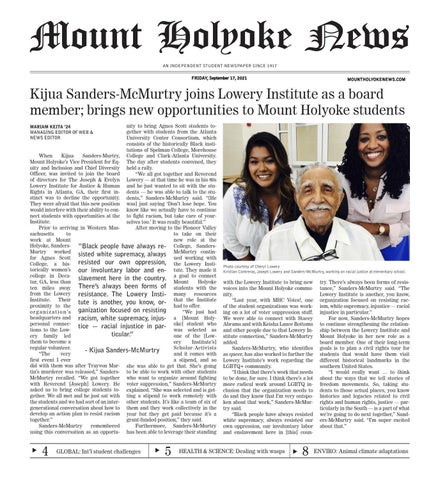
Photo courtesy of Cheryl Lowery Kristian Contreras, Joseph Lowery and Sanders-McMurtry, working on racial justice at elementary school.
with the Lowery Institute to bring new voices into the Mount Holyoke community. “Last year, with MHC Votes!, one of the student organizations was working on a lot of voter suppression stuff. We were able to connect with Stacey Abrams and with Keisha Lance Bottoms and other people due to that Lowery Institute connection,” Sanders-McMurtry added. Sanders-McMurtry, who identifies as queer, has also worked to further the Lowery Institute’s work regarding the LGBTQ+ community. “I think that there’s work that needs to be done, for sure. I think there’s a lot more radical work around LGBTQ inclusion that the organization needs to do and they know that I’m very outspoken about that work,” Sanders-McMurtry said. “Black people have always resisted white supremacy, always resisted our own oppression, our involuntary labor and enslavement here in [this] coun-
HEALTH & SCIENCE: Dealing with wasps
u
8
try. There’s always been forms of resistance,” Sanders-McMurtry said. “The Lowery Institute is another, you know, organization focused on resisting racism, white supremacy, injustice — racial injustice in particular.” For now, Sanders-McMurtry hopes to continue strengthening the relationship between the Lowery Institute and Mount Holyoke in her new role as a board member. One of their long-term goals is to plan a civil rights tour for students that would have them visit different historical landmarks in the southern United States. “I would really want … to think about the ways that we tell stories of freedom movements. So, taking students to those actual places, you know histories and legacies related to civil rights and human rights, justice — particularly in the South — is a part of what we’re going to do next together,” Sanders-McMurtry said. “I’m super excited about that.”
ENVIRO: Animal climate adaptations
2
EVENTS
September 17, 2021
Mount Holyoke News Mount Holyoke News is an independent student newspaper written by and for Mount Holyoke College students since 1917. VISIT US: www.mountholyokenews.com www.facebook.com/themhnews www.twitter.com/mtholyokenews_
EMAIL US: mhnews@mtholyoke.edu
Executive Board Editor-in-Chief Declan Langton ’22
Publisher Ali Meizels ’23
Managing Editor of Content Liz Lewis ’22
Managing Editor of Web Mariam Keita ’24
Managing Editor of Layout Rose Sheehan ’22
Business Manager Katie Goss ’23
Copy Chief Emma Watkins ’23
Human Resources Annabelle Mackson ’23
Editorial Board News
Sports
Ella White ’22, Katie Goss ’23 & Mariam Keita ’24
Gigi Picard ’22
Environmental
Catelyn Fitzgerald ’23
Arts & Entertainment Rose Cohen ’22
Graphics
Tasnia Mowla ’23, Jahnavi Pradeep ’23 & Ladin Akcacioglu ’24
Anjali Rao-Herel ’22
Copy Editors
Books
Cat Barbour ’24 & Ella Jacob ’24
Global Amelia Luo ’23 & Sophie Soloway ’23
Health & Science Zoe Greenberg ’23
Event Highlights Friday, Sept. 17 RACE AND...Dance, Part 2: Jazz with LaTasha Barnes
This workshop series allows our community, regardless of their dance experience or training, a creative mode to learn about and appreciate African diasporic cultures, whose contributions to contemporary dance are often underexplored. In a time when race is at the forefront of national conversations, RACE AND...Dance offers embodiment as a unique entrypoint for discussing race. Free and open to the Mount Holyoke community. Zoom link on Embark 4 p.m. - 6 p.m.
Meet the News
Meet members of MHN staff in all their different roles, learn about what we’ve been working on and see what role you might like to fill in the org. Free and open to Mount Holyoke students. Near Mary Lyon’s grave 5 p.m. - 6 p.m.
Photos
Rosemary Geib ’23 & Ali Meizels ’23
Opinion/Editorial
. Mount Holyoke News
Audrey Shannon ’22, Rose Sheehan ’22, Kylie Gellatly FP ’23, Lauren Leese ’23 & Ella Jacob ’24
Layout Editors
Maggie Donovan ’23 & Zoe Tang ’24
Features
Web Editors
Rebecca Gagnon ’23
Bellatrix Game Night
Come join us for our first activity night this semester! We will be having a game night hosted by our lovely VP, Sophia Smith. Bring your own games or choose from our selection. Enjoy a chill evening with fellow nerds and learn about what Bellatrix has to offer! Limited inperson seating due to covid! Free and open to Mount Holyoke students. Skinner 202 8 p.m. - 10:30 p.m.
Anika Singh ’24
Publication Guidelines Mount Holyoke News does not endorse any of the opinions or views expressed within the pages of the paper, excluding staff editorials. All content copyright of Mount Holyoke News. All rights reserved. Mount Holyoke News does not discriminate on the basis of gender, race, religion, ethnicity, sexual orientation or age.
Advertising in MHN Interest in advertising in MHN can be directed to mhnews@mtholyoke.edu for pricing and deadlines. MHN reserves the right to refuse submissions on the basis of, but not limited to, advertisements considered to be libelous, obscene, defamatory or discriminatory.
Subscriptions Mount Holyoke News is a weekly publication that prints weekly throughout the academic year. To join our mailing list, please contact the Publisher at mhnews@mtholyoke.edu.
Letters Policy Letters to the Editor appear exactly as they are sent to MHN, except for corrections to spelling, grammar and AP style. Letters cannot exceed 500 words. All letters must include the writer’s name and telephone number for verification purposes. Unsigned letters will not be printed. Names may be held upon request with the approval of the Editor-in-Chief. MHN reserves the right to decide which materials will be printed. Email submissions to mhnews@mtholyoke.edu by Sundays at 5 p.m. for publication the following week.
Saturday, Sept. 18 Vaccine Clinic #2
To meet the COVID-19 vaccination requirement for those who were unable to get or complete vaccinations prior to campus arrival, Health Services is sponsoring a “pop-up” vaccine clinic, run by a Massachusetts DPH partner, Curative Inc. The second part of this series will occur this weekend. Register on Embark. Kendade Hall 2 p.m. - 6 p.m.
MHC Soccer vs. Springfield
The Mount Holyoke soccer team will be playing this weekend — come out to support! Free and open to the Mount Holyoke community. Kendall Sports & Dance Complex, Field #2 2 p.m. - 6 p.m.
September 17, 2021
NEWS
. Mount Holyoke News
3
Five Colleges enact differing COVID-19 guidelines KATIE GOSS ’23 BUSINESS MANAGER & NEWS EDITOR
As students return to in-person classes and campuses across the country, colleges and universities have implemented COVID-19 measures to ensure the safety of students, faculty and staff. Mount Holyoke College updated students before the fall semester with new measures to follow — several of which are subject to change depending on the situation in the area and on campus. The other colleges and universities within the Five College Consortium also released their new COVID-19 policies. Although many of the same measures are followed across each of the five campuses, there are some differences between the schools. Mount Holyoke requires students to get tested twice weekly, as well as faculty and staff to either be tested once or twice weekly, depending on how much time they spend on campus. Tests are first come, first serve, with no appointments necessary. The COVID-19 test results take 24-36 hours to be sent out via email, provided the test comes back either invalid or negative. Should the test result come back positive, the person will be contacted by phone by Health Services and instructed what to do from there. Smith College, Hampshire College and Amherst College also require students to be tested twice a week, with some minor differences. At Smith, community members must make an appointment to be tested, and it is not a first come, first serve system. Smith may change their testing frequency at the end of October depending on the health status of the community at that time. At Amherst, students are assigned two days every week that they are required to get tested, with the first day being Sunday or Monday and the second day being Wednesday or Thursday. According to the Amherst COVID-19 website, they hope to move to weekly surveillance testing, if possible, after Sept. 13. The group of Mount Holyoke students currently living on Hampshire’s campus still follow Mount Holyoke’s testing policies. Although they live on Hampshire College’s campus and adhere to Hampshire’s COVID-19 guidelines, which are the same as Mount Holyoke’s, testing and other protocols are still Mount Holyoke’s responsibility. Ciara Olmstead ’22, a Mount Holyoke student living on Hampshire’s campus, said, “I think that the Hampshire and Mount Holyoke policies are fairly
similar, and so I would adhere to both … but because I am a Mount Holyoke student, all of my COVID-19 guidelines are through Mount Holyoke. I do not get any emails from Hampshire at all.” The University of Massachusetts Amherst does not require its students, faculty and staff to be tested on a regular basis. Only if they have been exposed, develop symptoms or want to be tested can they get a COVID-19 self-test kit at the University Health Services. All schools within the consortium require face masks when indoors. Although face masks are not required outdoors at any of the schools, each school enforces their mask policy if there is an outdoor event with many people. The only times people are permitted to be unmasked indoors are when they are eating at a dining hall, inside of their residence hall or in a personal office or space alone. At Amherst, students, faculty and staff must either be doublemasked or wear a KN95 mask. Natalie Glick ’23 is currently taking a class at UMass Amherst once a week with six other UMass students. “I don’t really feel uncomfortable because masks are required in the classroom at all times, and my professor does require us to leave the classroom to drink water,” Glick said. “It is a little weird how relaxed people are walking in the hallways without masks on … but I am doing what I can to protect myself and that’s all you can ask for.” With the exception of
Photos by Rosemary Geib ’23 Signs in buildings, doors and lampposts all around campus remind faculty, staff and students that face coverings are required when you are outside of your personal space.
Hampshire, outside guests are not allowed within buildings or residence halls at the schools within the consortium. Students living on campus are permitted to enter one another’s rooms if invited. At UMass Amherst, students are only allowed two guests into their room, and they must also be UMass Amherst students. The Hampshire College COVID-19 information website states, “Current students and employees of the Five Colleges (Smith, Mount Holyoke, and Amherst College, and UMass) are not considered visitors at Hampshire, as all of the institutions are requiring vaccination.” The guest restriction at Mount Holyoke is set to be lifted on Oct. 8. However, it could be kept in effect if the College deems it necessary. Travel restrictions also vary across each campus. Mount Holyoke and Hampshire currently have no travel restrictions on where students can travel, including for the upcoming breaks. Until Sept. 14, students at Smith were not allowed to travel outside of Hampshire
county unless the travel was organized by a course instructor or for extracurricular activities. They were also asked to avoid engaging in activities where masks would not be worn, such as going to bars and restaurants or attending parties. Through Sept. 13, students at Amherst were limited to only visiting the town of Amherst and were not allowed to go to restaurants or bars. Additionally, they were only allowed to travel to one of the other colleges if attending a class. Otherwise, all other travel had to be approved by the Office of Student Affairs. According to Amherst’s Information for Students, “It is possible that we will need to place restrictions on student travel during fall break, Oct. 11-12 … It is too early to say whether travel to or from campus during other breaks or events — such as Family Weekend, Homecoming and Thanksgiving — will be impacted.” With a return to campus life and in-person activities during a pandemic, these measures are subject to change or stay as they are, depending on the situation at each college’s campus and its surrounding community.
4
GLOBAL
September 17, 2021
. Mount Holyoke News
Photo courtesy of Annie Wang ’23 Many of Mount Holyoke’s international students faced unique challenges when traveling to campus for the first time since the pandemic began. This photo was taken by a student traveling back to campus from abroad.
International students face challenges when coming back to campus BY AMELIA LUO ’23 GLOBAL EDITOR
As Mount Holyoke College welcomed its students back on campus for an in-person semester, returning international students shared their experiences traveling back to campus. Some explained how traveling in the time of COVID-19 can be difficult with regards to getting vaccinated, testing, flying and moving in.
Flight and Border Control
By the end of May, Zhiqing Xu ’22, an international student from China, bought her ticket from Shanghai, China, to Kennedy Airport (with a three-hour layover in Moscow.) According to Xu, this is one of the cheapest options available. Most other tickets would cost around $3,000, which is about two to three times the price of the same flights before COVID-19. Xu did not live in Shanghai, and her parents cannot leave Zhejiang province, so she had “to go to Shanghai and the airport by [her]self.” After finally arriving at Kennedy Airport, she was detained at the customs inspection. Xu said, “Although I was mentally prepared in advance, this is the first time I was detained, so naturally I was a little scared. I sat in the seat cautiously, and began to think back to [if] I said something wrong and did something wrong, or [if] there was a problem with my documents. My mind start[ed] to wonder what would happen if I am deported. Luckily, in the end, I was not questioned and finally let go.” Ria Devani ’24, a student from Kenya, echoed Xu’s sentiment, sharing, “In terms of returning to the States, it’s a terribly long flight. We can get stopped often for ‘random selection.’ Even when you land in the States, it is still a very overwhelming and scary time. You have to go through the border control and sort things out. Everything feels very up in the air at that moment. We don’t know how things are going to turn out. Overall, it is just a very scary and stressful situation.”
Testing
Devani got her COVID test 24 hours before her flight. “I think right now, back home [ =in Kenya] they
are doing a very good job by rolling out the test for international flying,” she said. “I’ve done both the nose and the throat testing for my flight, though it is still a little unaffordable.”
couldn’t find a place to get one. Considering that I am very privileged in India, I cannot even imagine people who don’t have the access as I do,” the student said. “I feel like domestic students are very unaware of how hard it is for international students to get vaccinated.” Mount Holyoke offered vaccinations to students Vaccination In May 2020, Xu was trying to get vaccinated in her unable to get them before returning to campus on city. Describing her experience of getting the right vac- Aug. 28 and Sept. 18. “Before then, many international cination, she said, “I went directly to the place where students might not have a vaccination, especially in the vaccine is distributed and repeatedly emphasized South Asian countries like India and Nepal,” the stuthat I want to get the vaccine that is recognized by the dent continued. “It makes sense for us to be anxious WHO.” The staff who gave out the vaccine told her and scared because we’ve seen how bad it can be. It was so bad in India, there was a that the two-shot vaccine was time that we’ve lost seven memvery hard to get, and convinced her to get the one-shot vaccine “Sometimes it feels like for bers of friends and family in ten days. My family hasn’t adjusted instead. However, this vaccine these international students, to this. I feel that people haven’t is not approved by the WHO, there is no one there to help understood that what they do is and could not be recognized by not just something that affects Mount Holyoke College. “I have them and to support them.” them, but everybody.” to get my vaccination again. However, the school scheduled - Ria Devani ’24 the first dose on [Aug.] 28 before Storage and Moving In 6 p.m., but I only arrived after 9 The move-in process for p.m. that day. I was worried that Devani was generally smooth. if I don’t get vaccinated on [Aug.] 28, the school will not Before leaving campus due to COVID-19, she was let me go to class or move in,” Xu recalled. “I emailed able to secure a storage place for her belongings. “In the Health Center, but since they were processing the March, I was working at the Office of Advancement, vaccination record at that time, it took days for them and my boss at the time offered to store my stuff while to get back to me. Those were the days when I was I was away because she has an extra room in her house most anxious. I feel calmer if I have a clear answer, … that is such a blessing,” she said. “I am away for 17 regardless if it is a ‘yes’ or ‘no,’ but not knowing is the months and if I were to pay for storage service, that most uncomfortable. In the end, the school gave me a would be a lot of money and especially for low-income very detailed reply, telling me that the vaccine will not students, that option would not be attainable.” affect me, and I only need to get tested on [Aug.] 28 to In terms of getting to Mount Holyoke, Devani used move in.” her connection to alums as an international student For Devani, getting vaccinated was a different during her first year of college. “They picked me up story. “During my leave of absence, I worked at a high at the airport. I stayed at their house that night, and school. Because of that, I was able to get vaccinated. moved in the next day,” she said. “I just have the priviOtherwise in Kenya, the vaccine has not been made lege of being connected to these people who are from [available] to the public yet. It is only for essential Massachusetts, who are willing to help me. Had I not workers and people who are over the age of 50.” had those options, it would have been a very difficult A student from Delhi also talked about her ex- situation,” she shared. “Sometimes it feels like for perience of getting vaccinated. “In India, it was very these international students, there is no one there to hard to get a vaccine. I [had] to wait two months to get help them and to support them. For me, it would be them. For two months, I was constantly checking but very chaotic if I would have to rent my storage and
September 17, 2021
. Mount Holyoke News
International students reflect, cont’d
room and took off her mask, and started looking in my fridge for a snack, which is what she usually [did] before COVID-19. It makes me very nervous because she has been traveling and only had a rapid test, not a PCR test. I don’t know how to mention this to her, because it sounds so rude. It is very hard to say to people, ‘I don’t want anyone in my room,’ ‘Can you keep your mask on if you come to my room?’ or ‘Can we sit far apart when we are in the same room?’ People are upset about the fact that we have to wear a mask all the time, but I am relieved about this.” “I feel now is the most critical time because if we are not careful now, then all the hard work that people have been doing for so long can be undone,” the student said. “I’ve even become less close to a few friends because I don’t want to see them without a mask.” She also has concerns because her parents are not allowed to come to the U.S. even though they have visas. “I have several health conditions, which makes me more vulnerable. If I got really sick, then I would Photo courtesy of Annie Wang ’23 be completely by myself, because I don’t have anyone Mount Holyoke student waits to board plane en route to campus. here. It’s so hard because if the domestic students get sick, they can just go home and their parents can u CONTINUED FROM PAGE 4 help.” The student also expressed frustration with the move into Hampshire College.” amount of time with which College administration took to disclose information. “For international students, we need to start our School and Masks For Devani, being back on campus is all about try- travel plan earlier than domestic students because we have to figure out visas, plane tickets, storage, ing to adjust. “It’s been a little overwhelming. When I first came etc. All of these are expensive, so you cannot even in 2019, it was very difficult for me to adjust — both [to] change them easily. I remember that throughout the being in university and being in the States. It was very summer, I was talking to the McCulloch Center and hard for me to branch out and socialize with people. asking them what they are doing for international stuWhen COVID-19 hit, I went back home and ended up dents. It seems that the McCulloch Center has a plan, but they did not tell us in detail taking a gap year.” Devani conwhat it was. There are certain tinued, “It is supposed to be my things that we mentioned which junior year, but instead it is my I feel the College made the plan sophomore year. My friends are with domestic students in mind, they believe to be ‘not a problem.’ I feel the College made the plan now mostly juniors and seniors, and we are an afterthought. I with domestic students in mind, so I need to make that adjustand we are an afterthought. I feel ment of being a sophomore, but feel like international students it’s not so bad.” are treated like exchange stu- like international students are treated like exchange students — The student from Delhi also dents — as though we are only as though we are only here for a commented on the mask manhere for a few months.” few months.” date at the College. “I was scared She also spoke on the flimsiabout coming back to the U.S., ness of the College’s suggestions, especially because the U.S. CDC - Student from Delhi saying, “Every time I was trying has announced that you can stop to talk to the College administrawearing masks for some time, and then they changed that again when cases are tion about how hard it is for international students, going up,” the student said. “Everyone is waiting for they always replied that ‘you can always take a gap things to go back to normal completely, but people year.’ Unfortunately, this is not always a choice for us. are trying to rush it too much, especially the decision- We have to reapply for visas, for financial aid, for all makers such as the CDC and our college. I feel that if the paperwork and the embassy was closed during you try to rush things, then it might get worse before COVID-19 and we could not even apply for visas. They it gets better. It is a team effort. In the U.S., some peo- are now giving appointments to people who are on the ple don’t want to wear masks at all. It feels like even if waitlist for February of next year. So taking a gap year is not a choice for us,” the student said. “It might put we are careful, we might still be not okay.” She continued, “Even back on campus, not all peo- us in a condition where we have to take two years off ple are respectful about other people’s preferences. instead of one year. There are also cultural barriers. I They won’t ask if the other person is okay if they take am Asian, and I have Asian parents. So, if I decide to off their masks when entering their dorm. They are take a gap year, my family would never agree to this.” just assuming it is okay,” the student said. “I have a She concluded, “I just feel the College administration friend who I am very fond of, but she came into my is very ignorant as to our conditions.”
GLOBAL
5
HEALTH & SCIENCE Yellow jacket expert gives tips for dealing with wasps BY NANCY JIANG ’23 STAFF WRITER
Editor’s Note: The interview in this piece was conducted by Mariam Keita ’24 No matter how tightly you hold the cover of your take-out container as you walk from the Dining Commons, the wasps, or more precisely, the yellow jackets, always try to sneak in your boxes. Many students are concerned for their safety when eating outside, and also curious about whether it is possible to remove the yellow jackets. The potential of being stung and having an allergic reaction is also an issue. We explained our situation to the YellowJacket Experts, who are, as their name implies, a group of professionals who offer bee removal services to private homes, schools and companies. While they are located in Connecticut, they also provide services for nearby states including parts of Massachusetts, New York and Rhode Island. In response to the College’s outdoor dining policy, yellow jacket expert and phone consultant at YellowJacket Experts, Debbie Maciecki, emphasized a piece of advice: “Don’t drink soda out of a can … That’s the most dangerous thing you can do in this type of instance. Also, number two is, watch your food. I think you’ve written these down already, but just in case. Watch. Take a look at each bite in each step, take a look at it before you put it in your mouth, so that you will know if there’s anything on it.” People might have to say goodbye to drinking iced Coke outdoors, as, according to Maciecki, yellow jackets can enter cans and straws without you noticing. According to Maciecki, yellow jackets can also wedge their way into sandwiches to get at the meat inside. This is one factor that distinguishes yellow jackets from honey bees: “Honey bees are not interested in your sandwiches and your meat, but the yellow jackets are,” Maciecki said. “Obviously, you have a nest nearby,” Maciecki further commented. “The nest right now CONTINUED ON PAGE 9
u
6
OPINION/EDITORIAL
September 17, 2021
. Mount Holyoke News
California’s special election was bad politics
Photo courtesy of Flickr Gavin Newsom has been governor of California since January 2019.
BY WOODLIEF MCCABE ’23 STAFF WRITER
Editor’s Note: This Op-Ed was written before the Sept. 14 special election. On Wednesday, Sept. 14, Californians will vote in a special election with just two questions on the ballot. Should the state of California recall Democratic Governor Gavin Newsom? If so, who should replace him? The three-page list of potential replacements includes a college student, Caitlyn Jenner, a “Cannabis Policy Advisor” and Los Angeles billboard queen Angelyne, whose bubblegum pink campaign website features several music videos and a platform detailing police reform, abolition of for-profit jails and a new holiday called Bubble Bath Day. As comical as this is, the recall follows a concerning trend of weaponized electoral politics and reveals flaws in our political system and a dangerous shift in the American mindset.
This is not the first attempt to recall a governor in California, and it’s not even the first time Newsom himself has been the target of a recall, despite only being in office since 2019. It is, however, only the second time in Californian history that a recall petition has gained enough support to trigger an election. California has some of the most lax recall rules of any state: public officials can be recalled without reason, and a petition can trigger an election with signatures equal to 12 percent of the previous election’s turnout. The current petition exceeded this goal with 1.7 million signatures. This was an easy goal for the petitioners, seeing as six million Californians voted for Donald Trump in 2020. Organizers were also granted an extension due to pandemic restrictions. “Recall Newsom” booths, yard signs and bumper stickers can be seen across the state. The retired sheriff’s sergeant organizing Wednesday’s recall is a Trump-aligned Republican who previously worked on other unsuccessful petitions to recall the governor. His group, the California Patriot Coalition, opposed Newsom’s resistance to the Trump administration’s crackdown on illegal immigration. Petitions began circling in June of 2020, but in the fall, when Newsom shut down public schools — while his children attended private schools — the backlash pushed recall efforts into the limelight for many Californians. The state continued to deal with a devastating rise in COVID cases, but changing restrictions fomented anger and distrust. Then, amidst the turmoil of the presidential election, on Nov. 6, Newsom was photographed maskless at a party in a high-end restaurant. This became a major, yet hypocritical, point against Newsom, considering Republican resistance to mask mandates was already a party staple. In a month, the recall petition went from 55 thousand to nearly half a million signatures. The name of the restaurant, The French Laundry, became synonymous
with scandal. It added to dissatisfaction with Newsom, who is widely considered an opportunistic and wealthy establishment Democrat. There is little validity to this recall. Recall and impeachment are designed to protect the rights of citizens against unfair governments and violations of their rights. Newsom has committed no crimes and has done no reprehensible injustice to the people of California. This recall is another petulant response to a politician losing an election. It feels like an echo of the Jan. 6 insurrection, as does Republicans in Congress calling for Biden’s impeachment just months into his term, and calling for his resignation in the past weeks following the attacks in Kabul. The first recall petitions against Newsom were filed by political rivals who had lost — by wide margins — in the previous election. The political system in the United States is broken. Practices of checks and balances intended to keep leaders from exploiting their power have been perverted by political losers who want to take power by force. Moreover, most anti-Newsom sentiment is tied to perceived excessiveness of COVID-19 restrictions. As thousands of Californians died and hospitals had to turn patients away, Republicans led a charge to disrupt the state’s central government and replace it with someone who would “reopen” the state. The death toll meant nothing next to political points. Misinformation and the distortion of “freedom” forced a statewide election which Republicans were favored to lose. The country is unable to handle issues or policy, preferring squabbles over vote counts and blind loyalty to party and candidate. This recall was wielded against California by its own government, forcing unnecessary funds and manpower to be put into what amounts to a childish demand for a do-over. This was not a movement for freedom or the voice of some unheard minority — this was a power grab by sore losers.
CliftonStrengths undermines inclusive approach to leadership BY KATE MURRAY ’22 STAFF WRITER
Mount Holyoke prides itself on being an institution that cultivates future changemakers. There are opportunities for students to get invaluable leadership experience during their four years of college through the DEI office, Residential Life and more. For the first time since the pandemic, over a hundred student leaders came to campus early to prepare for the upcoming semester by doing a series of workshops, trainings and activities. One such activity was the CliftonStrengths test, also known as StrengthsQuest, a tool created by Gallup and used extensively by colleges, universities and workplaces to foster academic skill building, team bonding and leadership development. The assessment presents participants with 117 paired statements on opposite ends of a five-point scale, and they must choose how strongly they relate to one statement or the other — choosing “neutral” is also an option. The responses are then sorted into the 34 “CliftonStrengths themes,” of which participants are given their top five under the basic plan. The idea is that,
by “uncover[ing] the one true you,” an individual can maximize their greatest talents and contribute more positively to their work or school environment. While the intention behind an institution like Mount Holyoke utilizing CliftonStrengths sounds harmless, and even beneficial, assessments like these perpetuate the oppressive ideals of Western, white supremacist culture. Individualized development tools like this support a “one-size-fits-all” approach to leadership and ignore the ways in which social identity and lived experience determine how certain personality traits are received and valued. By weighing certain traits over others and assuming that all participants embody those characteristics in the same way, CliftonStrengths upholds a colorblind and culturally insensitive version of leadership. In an academic article, scholars Nicholas TapiaFuselier and Lauren Irwin note that the traits and talents sorted by CliftonStrengths to “maximize your infinite potential” are not universally received nor as easily embodied by everyone. “By creating a list of possible talents, based on an assessment that is more accurate for White people than people of color (Dugan
Photo by Rosemary Geib ‘23 CliftonStrengths upholds a culturally insensitive view of leadership.
2017), StrengthsQuest not only ignores race but also ignores the ways race shapes reality and lived experiences,” Tapia-Fuselier and Irwin wrote. For example, some of the CliftonStrengths themes in the “Influencing” category, such as “Self-Assurance,” “Command” and “Communication,” can be more easily embodied in academic and leadership spaces by those with racial, ethnic and other types of social privilege. In addition, expression of these traits CONTINUED ON PAGE 7
u
September 17, 2021
. Mount Holyoke News
OPINION/EDITORIAL
7
My life-saving therapy is not a plotpoint Leadership test ic moment on the job, and is brusque with Dr. Lance Sweets from the beginning. This attitude is due to a combination of the doctor’s young age and the fact that he is a psychologist. Men going to therapy is a whole different ball game; many people wrongly assume that therapy is just for depressed teenage girls and recently divorced housewives with mild drinking problems. The first interaction between Booth and Sweets is an excellent example of how men in therapy are generally portrayed in entertainment. Sweets attempts to be helpful and genuine, while Booth is stand-offish and clearly feels emasculated by the ridiculous request that he talk about what’s been bothering him. Over the course of the show, Booth and Sweets develop a very close bond and get over their differences, but that doesn’t stop the “Bones” show writers from continuing to stigmatize mental health care to create the foundation of their relationship. It’s not just teen and adult dramas, either; comedy shows are guilty of it as well. I can’t speak for its later seasons, but Netflix original “Big Mouth” had a character, Jessi, jump out of her mother’s car at an intersection after the decision was made that she would go to therapy. At the time, Jessi is in middle school and trying to cope with her parent’s divorce, but if they really wanted to have that moment, it could have been Graphic by Annabelle Mackson ’23 because she was scared to go to therapy or ashamed to ask for help — a common challenge people face — BY ANNABELLE MACKSON ’23 instead of being disgusted by the entire concept of HUMAN RESOURCES COORDINATOR & STAFF WRITER therapy. If we want to change the way young people view therapy, why do shows and movies portray it as Going to therapy. Seeing a shrink. An uncomfort- foolish and superfluous? The short answer seems to be views and money. able leather couch. Freud. Pills upon pills and a faceless person taking notes without really listening. This The reason plotlines centered around mental illness is the idea of therapists that we have been fed for seem to get so much attention is a combination of being somewhat relatable and a generations — if they’re not pedmorbid fascination with watchdling snake oil, they’ll just pump you full of medications to numb The reason plotlines centered ing someone spiral. The latter is incredibly damaging — mentally your mental illness. This is quite obviously a harmful, and incor- around mental illness seem to ill people are not made for enterrect, stereotype, and patients get so much attention is a com- tainment, and many people credit their therapists with saving their and mental health professionals bination of being somewhat lives. I know I do. The former reaalike are striving to destigmatize therapy and mental illness. How- relatable and a morbid fasci- son doesn’t necessarily have bad intentions — mentally ill people ever, the entertainment world nation with watching someone has not quite caught on. spiral. The latter is incredibly should be represented in the media they consume — but the menTelevision shows that center damaging. tal illness “aesthetic” shown in so around drama often create entire many teen dramas likely greatly storylines around a character’s contributes to people believing mental illness, or if they’re a side character, their only discernible trait is being mental- that their depression is a quirky personality trait inly ill. This is not only harmful to mentally ill people — stead of an illness as serious as any other. But producshowing them that their mental illness is what people tion companies aren’t going to stop, because for them, will see first, and not their other attributes, dehuman- any publicity is good publicity — ate-watching still izing them as a result — but it’s harmful to therapists makes money. While I have seen some promise in the as well. Much of the time, when characters are urged future of how mental illness is portrayed in entertainto go to therapy, they immediately shut down any sug- ment, I have yet to see a portrayal of a therapist that gestion of extra help, claiming it as a stupid and unnec- doesn’t make me want to tear at my hair in frustraessary idea. If they are sent to therapy, the therapist tion. I genuinely hope that this won’t be the case as portrayed is either cold, disinterested, self-obsessed, we continue to move forward with dismantling mental or flat-out incompetent. And if the therapist is repre- health stigmatization, but I don’t see change happensented well, the character in therapy is consistently ing anytime soon. In the meantime, take your meds, go to therapy and don’t be afraid to ask for help. hostile to their attempts to make a connection. For example, in the Fox crime drama “Bones,” FBI Agent Seeley Booth is sent to therapy after a traumat-
bias, cont’d u
CONTINUED FROM PAGE 6
may not be as well received by people with less social privilege, since they may struggle to be taken seriously in higher education circles and are prone to experiencing imposter syndrome. Cait Mallery ’22, an Orientation Leader who took the CliftonStrengths test during Mount Holyoke’s student leader training, echoes this sentiment. “Because the test and our discussion on strengths take a colorblind approach that does not analyze the role of race, we’re missing huge parts of the conversation on the biases in leadership development spaces. Just like everything else, our definitions of strengths like analysis, individualization and discipline are heavily based in a culture of white supremacy and ideas of who is fit to lead,” they said. Instead of using biased assessments like CliftonStrengths, institutions like Mount Holyoke can foster connection and build leadership skills through a more inclusive framework. Firstly, it is essential that academic institutions evaluate what type of leadership they are encouraging students to emulate and gain a deeper understanding of the context in which they live and work. It is crucial for institutions to actively resist the white supremacist, sexist, classist and other hegemonic roots of higher education. “Although I don’t think the test is designed with the explicit purpose of perpetuating various forms of hegemony, the uncritical use of the test without a corresponding analysis of the ways in which our ideas of leadership come from structures of whiteness does exactly that,” Mallery said. Secondly, academic institutions need to be intentional about amplifying student voices in conversations about leadership. Tapia-Fuselier and Irwin spoke to the importance of this practice, writing that “Too often, educators ignore identity and critical perspectives in leadership education because they are worried that students have yet to master foundational knowledge and will, therefore, be unprepared to engage in critical analysis.” Lived experience is just as valuable, if not more, than the so-called “foundational knowledge” that many institutions consider a prerequisite for having conversations about leadership. By focusing on the opinions and diverse backgrounds of students themselves, especially the most marginalized, college-led leadership training and skill-building will be meaningful for everyone. As an institution that holds the values of equity and inclusion in high regard, it would serve Mount Holyoke College well to abandon individualized, biased tools of leadership development in favor of centering the diversity of student experiences and examining the motivations behind their framework for leadership.
8
ENVIRONMENTAL
September 17, 2021
. Mount Holyoke News
Climate Activist Birds and other animals show signs of physical adaptation due to climate change Spotlight: Greta
Photo courtesy of WikiMedia Commons The dark-eyed junco is one of multiple species which has shown adaptations to a warming climate, including longer wings and beaks.
BY SIONA AHUJA ’24 STAFF WRITER
According to a recent study led by Sara Ryding of Deakin University in Australia and published in the Trends in Ecology & Evolution journal, warm-blooded animals are showing signs of bodily adaptations as a response to climate change. These changes, observed most prominently in birds, include an increase in beak and wing size, which creates a larger surface area that aids birds in controlling their body temperature more effectively. This phenomenon, known as Allen’s Rule, was coined by Joel Asaph Allen in 1877. It predicts that mammals’ and birds’ body surface area-to-volume ratio fluctuates according to the changes in their en-
vironmental temperatures, with higher ratios corresponding to warmer climates and vice versa. The theory behind this rule is that body extremities, like the beak or the wing in birds and ears in mammals, are the major source of exchanging heat with the environment, and larger appendages scientifically aid in greater heat loss. Ryding’s study, published on Sept. 7, 2021, comes as a confirmation of Dave Willard’s observations in 2019. Willard is a collections manager emeritus at the Chicago Field Museum, who, with the help of volunteers, has collected more than 100,000 dead birds from the city streets. These birds all died by crashing into Chicago’s high-rise buildings during migration season. Based on measurements of the specimens, the bodies of North American migratory birds appear to have shrunk over the years, while their wings have gradually become longer. Brian Weeks at the University of Michigan led a study of Willard’s data. The study’s findings suggest that the changes are in response to a warming climate, as their breeding grounds increased in temperature by one degree Celsius over the time that the study took place. The research used birds representing 52 species, out of which it found that the Australian parrot species underwent significant changes: their beaks grew from four to ten percent on average since 1871. Another notable change was in the bill size of the dark-eyed junco, which has increased notably. “It’s high time we recognized that animals also have to adapt to these changes, but this is occurring over a far shorter timescale than would have occurred through most of evolutionary time,” Ryder commented in a press release for Cell Press. She said that humans are only considering climate change and how to overcome it from their own point of view. “The climate change that we have created is heaping a whole lot of pressure on [animals],” she said. “And while some species will adapt, others will not.”
Thunberg
Photo courtesy of Flickr Greta Thunberg has been nominated for the Nobel Peace Prize.
BY HELEN GLOEGE ’23 STAFF WRITER
Swedish activist Greta Thunberg has become a household name around the world. Thunberg is famous within climate activist communities for her organizing work and calls for action against climate change. In 2018, at the age of 15, Thunberg began spending her days outside the Swedish Parliament to call for action on climate change. Initially, she was alone in her protests, until other students began to participate in similar demonstrations within their own communities. This is where her well-known slogan “Skolstrejk för klimatet” (School Strike for Climate) originated. After the December 2018 general elections in Sweden, Thunberg and others moved to striking only on Fridays. This became Fridays for Future, an organized school climate strike movement which has now taken place for almost three and a half years. In addition to inspiring many young activists, Thunberg has also been given many honors and awards, including but not limited to being Time’s Person of the Year and three consecutive nominations for a Nobel Peace Prize between 2019-21.
Over 230 medical journals call for crucial action on climate change BY HELEN GLOEGE ’23 STAFF WRITER
On Sept. 5, over 230 medical journals from across the world came together to publish a joint statement demanding “urgent action to keep average global temperature increases below 1.5 C, halt the destruction of nature and protect health.” Authors of the statement believed that action had to be taken immediately — it was not possible to wait for the COVID-19 pandemic to fade. The joint statement, which NPR referred to as “unprecedented” in a Sept. 7 article, involved prominent members of medical journals from around the world. The statement came at a crucial time for the environmental justice movement. In the coming months, there will be several conferences between countries that could result in major actions against climate change. This includes the United Nations General Assembly, which will begin its sessions for the year on Sept. 14. The assembly facilitates international col-
laboration on global issues including climate change. In October, the UN Biodiversity Conference will take place in Kunming, China. The aim of the conference is to adopt the Post-2020 Global Biodiversity Framework that will focus on international work to repair biodiversity loss. Beginning on Oct. 31, the UN Climate Change Conference, commonly referred to as COP26, will be held in Glasgow, United Kingdom. COP26 is focused on movement toward the goals of the Paris Agreement. However, as the joint statement warned, the conference is encountering barriers due to the coronavirus pandemic. COP26 is currently facing controversy due to inequitable vaccine rollout policies that will prevent delegates and activists who represent areas most affected by climate change from participating. One of the main focuses of the statement is mitigating climate change and its health impacts, in light of the strain U.S. healthcare systems are already under. During the COVID-19 pandemic, hospitals faced shortages in supplies, including beds for sick patients. Health infrastructure was also put under stress during
and immediately after Hurricane Ida, which “caused dozens of deaths across several states,” according to NPR. Some of these deaths were the result of flash flooding and inclement weather, but others came from the failures of infrastructure that was not prepared for the hurricane. The statement had nineteen authors including editors, doctors, researchers and professors, all representing a variety of different backgrounds and interests. They study and teach everything from psychiatry to neuroscience to nutrition. The authors hail from universities and scientific journals from around the world, including Pakistan, Brazil and Denmark. This international and cross-disciplinary collaboration represents the global nature of both the problems caused by climate change and their solutions. The joint statement shows an important and influential push from the participating authors and scientific journals. Upcoming climate talks and conferences may provide ways forward to mitigate and control climate change effects and avoid the worst consequences of climate change.
September 17, 2021
HEALTH & SCIENCE
. Mount Holyoke News
9
Delta variant is continued cause for concern
Graphic by Gabby Gagnon ’24
BY ANOUSHKA SINGH KUSWAHA ’24 STAFF WRITER
While students settle back into campus life, the delta variant is an increasingly large threat. Currently, the delta variant is the predominant cause of COVID-19 cases rising in the United States. According to an article published online by Yale Medicine, The delta variant is a highly contagious strain of the SARSCoV-2 virus. It was first identified in India in December 2020. It rapidly spread and dominated the virus cases of India and the United Kingdom before arriving in the U.S. in March. Delta is a cause for concern as it has once again increased a once-falling number of COVID-19 cases and
hospitalizations around the U.S. The delta variant is twice as contagious as other strains of the virus: alpha, first identified in the United Kingdom; beta, first identified in South Africa; and gamma, first identified at a Japanese airport in travelers from Brazil. In addition to the delta variant, several other strains are being monitored by the World Health Organization. One of these strains is the mu variant, which was first discovered in Colombia in January 2021 and remains pervasive in the country. Although the WHO has since identified the mu variant in over 39 countries, Anthony Fauci, director of the National Institute of Allergy and Infectious Diseases, said in a press briefing on Sept. 2 that mu is not “an immediate threat.” As of Sept. 15, over five thousand cases have been detected worldwide. A study published in the Lancet indicates that the delta variant is more likely to cause hospitalization in those who are unvaccinated in comparison to the other variants. Those who are not vaccinated are most at risk, and the highest spread and most severe cases are occurring in places with the lowest vaccination rates, such as Missouri, Nevada and Arkansas. Rising cases in these states may also be influenced by the lifting of restrictions. The delta variant is a further cause for concern as younger people — teenagers and adults under 50 — seem to be particularly at risk. Dr. Inci Yildirim, a Yale Medicine pediatric infectious disease specialist, stated in an interview for an online article for the Yale Medicine website, “delta seems to be impacting younger age groups more than previous variants.” Scientists still have much to learn about the delta variant. What is clear, however, is that the variant is twice as likely — in comparison to the alpha variant — to result in hospitalization in unvaccinated individuals. The symptoms associated with delta are slightly
different. According to Dr. Yildirim, those infected with the variant are less likely to report symptoms such as coughing and a loss of smell. A survey conducted in the U.K., which found more than 90 percent of COVID-19 cases were due to the delta variant as of September 2021, concluded that headaches, sore throat, runny nose and fever are more commonly reported symptoms. All currently FDA-approved vaccinations have been found to prevent either symptomatic disease or hospitalization from the delta variant. In August, the Biden administration stated that pending FDA approval, they will offer all fully-vaccinated Americans vaccine booster shots in an effort to control the rising number of cases and hospitalizations. This development has emerged due to the rapid spread of the delta variant and a CDC study suggesting that vaccine protection against infection is waning. Current CDC data suggests that while vaccinations are still consistently preventing hospitalizations, their effectiveness against the spread of infection is deteriorating, going from 91.7 percent to 79.8 percent in New York state as of September 2021. Nonetheless, many health officials and members of the public are debating the necessity of vaccine booster shots, especially in consideration of the desperate lack of vaccines in different parts of the world. The delta variant has also recently mutated into a subvariant, known as delta plus, which has been found in the U.S. and the United Kingdom. Delta plus has one mutation from the original delta. The mutation affects the spike protein that the virus needs in order to infect cells, which is the main target for mRNA and other vaccines. Much is unknown about the delta plus mutation, which was first discovered in India. More data is required in order to understand the rate of infection and the impact of this variant on the human population.
Dealing with the bees: advice from a yellow jacket expert, cont’d u
CONTINUED FROM PAGE 5
[is] hatching out the largest populations of the season. The highest populations arrive usually [at] the end of August, and the beginning of September. So, now is the time.” If Mount Holyoke does not interfere with the current situation at all, the number of wasps will start to decrease naturally in October. You will still see the presence of yellow jackets in November, although there will be fewer of them. They will be completely gone after Thanksgiving, but by that point the semester will be in its final weeks. Students have noticed that these wasps are commonly found around the Dining Commons, but not at other parts of the campus. Maciecki, however, pointed out that the yellow jackets will almost certainly appear at other parts of the campus in the future. Students see them mostly around Blanchard because eating outside makes them more aware of the wasps presence. To address the specific problem that Mount Holyoke students are currently facing, Maciecki suggested tracking the location of the nests and removing the
yellow jackets, in a quick, easy and organic way. Yellow jackets are typically captured alive using shop vacuums and special inline traps. After that, they are sent to freezers to induce a calmer state. Then, the wasps are sent to medical labs to help develop stinging bug allergy treatments. An alternative solution is relocating them to beekeepers. While it remains unknown whether Mount Holyoke will remove the yellow jackets, the following tips might help you reduce the risks of being stung. 1.
2.
3.
Avoid things that attract insects, which includes sweet-smelling perfumes and lotions and clothes with bright colors. Sweet foods and drinks, especially sodas and other canned beverages, are also huge attractions. Don’t make any physical contact with the yellow jackets, as they can become aggressive and may sting you. Instead, if a yellow jacket comes at you, gently move it away using a book, a piece of paper or your cupped hand. Let professionals handle the nests — don’t try to spray the yellow jackets yourself. Those who are allergic should be extremely cautious.
Photo by Ali Meizels ’23 Yellow jacket rests on a mound of fruit in a Blanchard to-go con-
10
ARTS & ENTERTAINMENT
September 17, 2021
. Mount Holyoke News
Lorde branches out with ‘Solar Power’ and releases companion EP BY EMMA WATKINS ’23 COPY CHIEF AND STAFF WRITER
“Solar Power,” the third album from New Zealand singer-songwriter Ella Yelich-O’Connor, more widely known as Lorde, is a sharp sonic departure from her earlier work. So far, “Solar Power” has been met with mixed reception from both long-time fans and critics. Released on Aug. 20, 2021, the album’s stripped-back, acoustic sound — reminiscent of pop songs from the early 2000s — ushers in a new chapter in her artistry. Much of the album’s strength lies in its differences. While her second album, “Melodrama,” was atmospheric, rich and varied in its sound, much of “Solar Power” is more lyrically strong than “Melodrama.” Many of the songs in “Solar Power” could be read like poetry; in fact, Lorde highlights the poetic quality of her lyrics through a “music box,” a recently-released piece of merchandise that contained much of the contents of a traditional CD case, but held a booklet of lyrics instead of a CD. After the emphasis Lorde placed on the return to long-form communication in her summer 2021 email updates to fans, it’s no surprise that much of the impact of “Solar Power” comes from its words. “The Path,” the album’s first track, is a reflective and reverberating ode to Lorde’s journey from teen pop sensation to twenty-something seeking solace from the spotlight. By leading with “The Path,” “Solar Power” establishes its central theme of navigating identity while moving through the phases of life. In this opening song, Lorde gestures toward her complicated relationship with her road to fame and what she found once arriving there. The chorus begins with the pop star declaring, “Now if you’re looking for a savior, well, that’s not me.” In an album that revolves around a journey into selfhood, Lorde cautions her fans against hinging too much of their faith on another person, specifically seeming to speak to celebrity culture. Ultimately, she turns to the sun to guide her and suggests that others should do the same. On “Solar Power” and “California,” the songs that could be considered the closest to musically “upbeat” on the album, Lorde paints two different pictures of a lifestyle that rejects fame. While “Solar Power” depicts the aftermath of the rejection of a more hustle-based and work-centered lifestyle, “California” takes listeners through the process of letting go of the glamor and appeal of “all the bottles / [and] all the models.” Despite its more upbeat sound, “California” provides insight into the burdens of fame that may have played a role in Lorde’s desire to distance herself from the spotlight. In her review for the Washington Post, journalist Allison Stewart expressed admiration for Lorde’s first two albums, saying
“[‘Pure Heroine’] expressed wonderment and skepticism at the lives of distant pop stars, it was a simple, personal, gorgeous album …”. She continued, “Her sophomore album, the even better ‘Melodrama,’ was a masterpiece of goth-y, sad girl maximalism.” However, voicing her disappointment with “Solar Power,” Stewart said, “ Lorde’s best feature was her wry relatability, and ‘Solar Power’ quickly gets to work erasing it.” Stewart specifically points to the line “Now the cherry black lipstick’s gathering dust in a drawer / I don’t need her anymore,” from “Oceanic Feeling,” the last track of “Solar Power.” Stewart is far from the only critic to express disappointment in Lorde’s shift in musical style with “Solar Power.” Many reviews can be summed up by saying that some fans were just not ready to see Lorde grow up and move on from the girl who was introduced to the world during the rise of “Pure Heroine,” which “debuted and peaked at No. 3 in 2013 [on the Billboard 200 chart],” according to Billboard magazine. This attachment to the sound of “Pure Heroine” may be due to nostalgia, or simply taste, but Lorde anticipated this reaction, quoted in People saying, “I think I’m still giving something that’s really digestible, but it’s my pleasure to confound.” In a positive review, Rolling Stone acknowledges the carefree sound and simpler vibe of the album. “Solar Power” is a nod to Lorde “searching for serenity in anxious times,” as perhaps the majority of us are in the midst of uncertainties presented by the pandemic and climate change. In shedding pieces of her past, yet paying homage to them in the process, Lorde finally brings her fans along on her journey of self-discovery, which her lack of social media presence left fans mostly in the dark about in the time between “Melodrama” and “Solar Power.” When listening to “Solar Power,” Lorde’s long-time fans will note lyrical references to past albums and autobiographical details,
Graphic by Anjali Rao-Herel ’22
such as mentions of wearing a cast at the Met Gala and a heartfelt tribute to her dog, Pearl, who died in 2019. These references keep the album rooted in the artist’s past, while expressing that she has grown in the years between her albums. Nearly a week ago, Lorde unexpectedly released a companion EP, “Te Ao Mārama,” titled for a phrase meaning “world of light.” The EP includes five songs from the “Solar Power” album sung in te reo Māori, an Eastern Polynesian language spoken by those indigenous to New Zealand. In an email bulletin to fans announcing the release of the EP, Lorde shared her excitement about the project and the work leading up to it. “It is my great pleasure to present TE AO MĀRAMA, a 5-song companion piece to SOLAR POWER, sung entirely in te reo Māori, the indigenous language of Aotearoa New Zealand,” she wrote. In the same email bulletin, Lorde cited “traditional Māori principles” as a main inspiration for writing an album about caring for and appreciating her home country. “There’s a word for it in te reo: kaitiakitanga, meaning ‘guardianship or caregiving for the sky, sea and land,’” she wrote. “I’m not Māori, but all New Zealanders grow up with elements of this worldview. Te ao Māori and tikanga Māori are a big part of why people who aren’t from here intuit our country to be kind of ‘magical,’ I think,” Lorde added. Lorde was quick to note her role as an unofficial cultural ambassador from New Zealand, saying, “I know I’m someone who represents New Zealand globally in a way, and in making an album about where I’m from, it was important to me to be able to say: this makes us who we are down here.” Addressing potential backlash for releasing the album in te reo Māori, Lorde told The Spinoff, “I’m white — however you want to interpret me wanting to engage with our Indigenous culture, that’s fair enough. I totally accept that, because it is really complicated. This isn’t something where I have both feet on the ground — I am a little bit out of my depth, and I’m the first to admit that, and I’m opening myself up to any response to this.” One powerful critique of the EP comes from a story from The Big Idea written by Jack Gray, a notable Māori choreographer and Artistic Director at a dance company in Auckland. “[W]ith yesterday’s album drop, I admit I was disappointed to see tokenism in full force,” Gray said. Gray went on to detail how he had been approached by Lorde’s creative team with the offer to choreograph the music videos for “Solar Power.” Gray stated that throughout this process he felt uncomfortable, and characterized much of the creative pitch as “a kaleidoscope of some shallow, self-centred, pop artist’s ponderings … [who had] little actual understanding of the way that her conCONTINUED ON PAGE 11
u
September 17, 2021
. Mount Holyoke News
FEATURES
11
Dining Commons will introduce USEFULL program in fall 2021
Photo courtesy of Alison Rogers ’12 Alison Rogers ’12 Founder and CEO of USEFULL Program pairs with MHC Dining Services to introduce eco-friendly to-go meals.
ANSLEY KEANE ’23 STAFF WRITER
During the later months of the fall 2021 semester, the Mount Holyoke Dining Commons will begin implementing a solution to the challenge of maintaining the flexibility of takeout options without creating excessive waste. Starting soon, students will be able to take their meals to-go using returnable, reusable takeout containers. This program will allow students to keep the takeout option while also reducing waste. Currently, the Dining Commons is providing single-use compostable containers for students to use, both for eating in and takeout. On Aug. 18, 2021, Dining Services announced a new to-go partnership with USEFULL. USEFULL is a takeout program that allows users to check out reusable cups and takeout containers to take their food to-go and then return the containers within a two-day window. Though the partnership was announced recently, conversations about it began a couple of years ago before being put on hold because of the pandemic. “It started with a student reaching out to me in 2018 or 2019,” Alison Rogers ’12, CEO and Founder of USEFULL, began. “Her name is Kathy [Hu], and she was a senior at the time, and she focused on the USEFULL model as part of her … senior project. So she then introduced me to [Executive Director of Auxiliary Services] Rich [Perna] … and we were kind of in the thick of conversations right as COVID[-19] hit … So we just put things on pause … and then last fall [Perna] and I reconnected to think about how to launch on Mount Holyoke.” Although takeout options offer both convenience and an added layer of safety during the pandemic, they are also wasteful and have harmful environmental effects. “What we might not realize is that paper coffee cups are lined with plastic, which makes them unrecyclable,” Rogers explained. She also described how the issue with single-use containers goes beyond adding to landfills; plastic is made from petroleum, so there is a big connection between single-use to-go containers and climate change. Compostable products also present issues because they require certain conditions to properly biodegrade, and simply throwing them away has a similar effect as throwing away plastic containers. Mount Holyoke’s new partnership with USEFULL is designed, in part, to help increase the sustainability
of the Dining Commons’ takeout program. “Last fall, at this time, we didn’t have a lot of students on this campus, but what we noticed is we were going through an awful lot of paper products, and it was pretty wasteful,” Perna explained. While the Dining Commons did offer a reusable, returnable takeout program in the spring 2021 semester, Perna noted that USEFULL’s technology could help ensure that the containers are returned promptly, which will help reduce the number of containers Dining Services will have to purchase. Perna explained that the Dining Commons needed a way to create some accountability for returning the containers. USEFULL’s technology includes a QR code on each container that students scan to check it out. After a container is checked out, users must return it within two days. USEFULL will remind students to return the containers, and it will charge them if the containers are not returned. Perna stressed that Dining Services’ goal is not to charge students. “We don’t want to charge students — but we want to get the containers back so we can get them back out without having to purchase more,” Perna explained. Additionally, the data provided by USEFULL’s technology will provide students with the ability to see the impact of this new partnership. “We can quantify impact from each student using this solution, and we can quantify impact of the whole campus. So what you’ll see once the system goes live on campus is a TV dashboard that in real-time will show the impact,” Rogers shared. Having Mount Holyoke as USEFULL’s first college partnership is an exciting moment for Rogers. “We’re so excited about it, and it warms my heart so much to have Mount Holyoke be the first mover with us,” Rogers said. During her time at Mount Holyoke, Rogers often took her meals from Blanchard, which resulted in a significant amount of waste. Rogers deemed her frequent use of takeout as hypocritical, given she was a geography major who cared deeply about the environment. However, her interest in the environment converged with a newfound interest in entrepreneurship during an internship she had during her senior year. She also cared about the environment and became interested in solving environmental problems. “I did an internship down in Holyoke for the Conservation Commission and started to get really interested in some of their environmental problems,” Rogers recalled. “Long story short, [I] got the entrepreneurial bug senior year, and it just made me feel so alive … I think I’ve always wanted to be an entrepreneur solving environmental problems with practical solutions.” For current Mount Holyoke students who might also be interested in using their ideas to solve big challenges or using entrepreneurship to positively impact the world, Rogers advised them not to be afraid of failing at first. “When USEFULL was essentially an idea [a fellow Mount Holyoke alum, Stephanie Crimmins] gave me advice: fail fast … The idea of starting small, learning, failing, iterating, refining and … going back out there to keep learning more,” Rogers said. “I also think that to be an entrepreneur, you can’t be afraid of people telling you no, and you can’t be afraid of failing, be-
cause both of those will guide you to something good,” she added. Once the USEFULL program launches later this semester, students will not only have a positive impact on the environment while still having the option to take food to-go, but they will also be able to support a member of the Mount Holyoke community in her mission to eliminate plastic waste.
Lorde reflects on the Lorde’s album, cont’d natural world in ‘Sou lar Power’ and ‘Te Ao in the videos was not well received. “From Mtypes myārama’ personal experience, the record company CONTINUED FROM PAGE 10
couldn’t have given a flying fuck about my Māoriness. And yet oh so willing to row the waka [Māori watercraft] onshore when it suited them,” the choreographer explained. Gray clarified that he is not speaking ill of the Māori who chose to work with Lorde, describing them as idealists who genuinely want the language to be respected. Gray also acknowledged that the bar is lower for Lorde as a white celebrity than it would be for a Māori individual in the same position. “Lorde gets to manifest a vision that isn’t hers. It’s a collaboration in which her celebrity-tanga is the focal point,” Gray explained. “People will justify her trying. Because a Pākeha [New Zealander of European descent] who tries is far more deserving of support than a Māori who tries.” In closing, Gray pointed to the place of privilege Lorde comes from, saying, “she won’t ever - ever - have to take anything on of the burden of Māoridom.” Journalist and lecturer Morgan Godfery responded to the backlash regarding “Te Ao Mārama.” “My sisters and I are the first generation in almost 50 generations of our family who didn’t grow up speaking te reo Māori as a first language,” he said during an interview with The Guardian. He spoke to concerns voiced by other Māori, addressing and validating the trauma of language loss and tokenism. Godfery refutes the idea that the EP is net negative, characterizing it as “a pop culture landmark we [Māori] should welcome.” In closing, he stated, “If the Māori language is to survive against [English being the dominant language, due to empire] — and the forecasts are grim — we must allow non-Māori to speak and sing [the language].” He continued, “Lorde contributed to that, and under the direction and supervision of some of our greatest language champions. As a second language speaker I recognise that as a public good.” With the release of “Te Ao Mārama,” the “Solar Power” saga feels complete. However, with Lorde setting a precedent of releasing surprise content, it seems doubtful fans will be taking their eyes off of their email inboxes any time soon in hopes of Lorde’s next big announcement.
12 COMMUNITY
September 17, 2021
. Mount Holyoke News
Game of the Week: Field Hockey and Volleyball bring victories Volleyball
BY GIGI PICARD ’22 SPORTS EDITOR
Field Hockey
On Saturday, Sept. 11, the Mount Holyoke Field Hockey team traveled to Thomas College in Maine and brought home their first victory of the season with a final score of 3-2. Margaret Robb ’22 led the Lyons with two goals while teammate Kass Lawrence ’22 sealed the victory with the final goal. “I felt that this past week was a great first win for the team,” Robb said. “In the first two quarters, we were playing well. We were intercepting passes early on which gave us multiple opportunities to penetrate the circle and get corners.” Robb hopes these successes indicate a triumphant season to come. “We will continue implementing what we did well, while improving in the areas [where] we can get better,” Robb added. “Overall, we are happy with the win but know we have more to prove to ourselves and each other.” Mount Holyoke Field Hockey will take to home turf to compete against Babson College on Saturday, Sept. 18.
Mount Holyoke Volleyball held its first tri-match on Sept. 11, when the Lyons hosted Framingham State University and SUNY Cobleskill. The Lyons played the first and third games while Framingham State and SUNY Cobleskill battled each other in the second game. The Lyons’ first match went down with a fight as Mount Holyoke fell to the Rams in five sets. In the second match, the Lyons shut out SUNY Cobleskill in straight sets for their second win of the season. Sarah Bishop ’22 recorded a team-best for the Lyons with eight kills and two digs. The team highs totaling both matches came from Marion Abeja ’23, Brayden Walden ’22, Chelsea Galicia ’22 and Barah Burns ’25. Abeja totaled 17 kills and 24 digs on the day, Walden had 54 assists and six service aces on the day and Galicia and Burns collectively had an impressive 56 digs. With these two matches, the Lyons marked their season record as 2-3. Mount Holyoke Volleyball will face off in another tri-match against host Massachusetts Institute of Technology and Salve Regina University on Sept. 18.
Photo courtesy of Mount Holyoke College Atheletics Top: Marion Abeja ’23 goes for the spike against Framingham State. Bottom: MHC Volleyball celebrates during their Sept. 11 tri-match.
c HOROSCOPES c Aug. 23 – Sept. 22
Happy Virgo season! Take some time to celebrate you this weekend. Ride the wave and let go. You don’t have to be in control all the time.
Sept. 23 – Oct. 22
Feeling unheard? Go spill your secrets to Jorge. We know you have them. We know they’re spicy. Only Jorge’s ears can handle them.
Oct. 23 – Nov. 21
Take a rest from those deep intimate relationships and try something a little more casual for a change. Text your crush and see what happens. Perhaps wave at someone in Blanch.
Nov. 22 – Dec. 21
Your wavelength has felt a little uncentered lately. It’s not too late to realign the paradigm. People want to hear your stories, just make sure you’re telling the right ones.
Dec. 22 – Jan. 19
Did you get some sleep last week like we told you to? Hopefully you did, because this week it’s time to resolve the high pressure you’ve been feeling. Make friends with your planner, buy a barometer and check your sphygmomanometer. Time to get to work.
Jan. 20 - Feb. 18
Your Saturn placement this week will guide you to find inspiration and dig deep for discipline. But don’t dig under Skinner Green, you might hit the yellow jacket nests.
Feb. 19 – March 20
Your body is a vast plateau in an unfathomably infinite space. You stretch to the ends of the Earth and through the depths of Time. Treat your body with the utmost care and respect. Look in the mirror and say to yourself, “I love you.”
March 21 – April 19
Dig around in your pockets Aries. No, there’s no loose change there, but there is plenty of change on the loose in your life. Embrace it while it lasts, steadiness is coming soon.
April 20 – May 20
You’re generally a stable person, gentle Taurus, but this week something will rock your boat. Try to ride the wave and see where it takes you. You never know how things might change.
May 21 – June 20
The balance of last week’s Libra moon has long worn off. Maybe you fell off Spider Bridge. Maybe one of your friendships is feeling a little lopsided. Either way, time to find ways to create equilibruim for yourself.
June 21 – July 22
Take a page out of Sagittarius’s book, take the plunge and tell your story. Waves of profound conversation await you this week. No more wading in the shallow end.
July 23 – Aug. 22
This week Leo clicks into connection with healer Pluto. Put away your healing crystals and your face masks and get back to the basics. The most important relationship to heal is the relationship you have with yourself.