Mount Holyoke News AN INDEPENDENT STUDENT NEWSPAPER SINCE 1917 FRIDAY, OCTOBER 8, 2021
Pioneer Valley Women’s March protests Texas Heartbeat Bill
MOUNTHOLYOKENEWS.COM
Black students at UMass face further harassment in anonymous email attacks
BY NEWS STAFF
Hundreds of protesters gathered in front of the steps of Northampton City Hall this past Saturday for the Pioneer Valley Women’s March, a demonstration intended to promote reproductive rights ahead of the Supreme Court reconvening on Oct. 4. The Northampton march was just one of over 500 similar marches across the nation this past weekend held in response to the Texas Heartbeat Bill, which came into effect on Sept. 1. The Heartbeat Bill prohibits the abortion of an embryo with a detectable heartbeat and would make it illegal to terminate a pregnancy after approximately six weeks from conception. While only enacted at the Texas state level so far, the act symbolizes a wider movement to overturn legislation protecting abortion on a national scale. Shanique Spalding, who manages mobilization and BIPOC organizing for the Planned Parenthood Advocacy Fund of Massachusetts, was one of 11 featured speakers at the march. She identified the Heartbeat Bill as having the potential to initiate a legislative domino effect across the nation. “The Supreme Court failed millions of Texans when it allowed politicians to ban abortion before most people know that they are pregnant,” Spalding said. “We cannot allow the reality of Texas to become the reality of this country.” Massachusetts law currently allows an abortion to be carried out if the pregnancy has existed for less than 24 weeks, or over that time if necessary to preserve the life of the patient or if the fetus is not viable. However, only four Planned Parenthood health centers capable of performing abortions currently exist in the state, located in Boston, Worcester, Springfield and Marlborough; the distance between the Marlborough and Springfield locations exceeds 70 miles. Unless they have access to a car, a person seeking an abortion in Massachusetts may have to rely on transportation by bus, train or ferry. Combined with additional travel costs such as lodging, the total amount of money spent just to arrive at a clinic may add up to several hundred dollars. Advocates for greater access to family planning resources at the march acknowledged the need to expand beyond just the law, with calls for greater access to healthcare and transportation to health centers. Roe v. Wade, the landmark Supreme Court case decided in 1973, recognized the right to terminate a pregnancy by abortion as a constitutionally protected freedom. However, the decision faces an uncertain
BY KATIE GOSS ’23 BUSINESS MANAGER; NEWS EDITOR
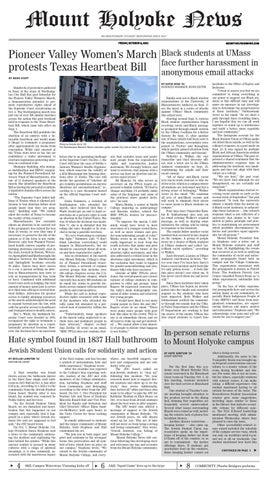
Photo by Natalie Glick ’23 The Northampton Women’s March attendees gather outside City Hall on Main St. and Crafts Ave.
future due to an upcoming challenge in the Supreme Court. On Dec. 1, the Court will hear the case of Dobbs v. Jackson Women’s Health Organization, which concerns the validity of a 2018 Mississippi law banning abortions after 15 weeks. The case will decide the question of “whether all pre-viability prohibitions on elective abortions are unconstitutional,” according to a case document hosted on the official Supreme Court website. Linda Summers, a resident of Southampton who attended the march, once believed that Roe v. Wade would put an end to legal restrictions on a person’s right to seek an abortion in the United States. She was 30 when the decision was made. Now 77, she is in disbelief that the ruling she once thought to be ironclad is facing a possible overturn. “It’s very frustrating to continue this fight,” Summers said. “I don’t think [abortion restrictions] could happen in Massachusetts, but we should be concerned about all women and their reproductive rights.” Also in attendance at the march was Mount Holyoke College’s chapter of Planned Parenthood Generation Action, a network of campus activist groups that includes over 350 college chapters across the U.S. The Mount Holyoke chapter, which currently has nearly 800 students on its email list, works to provide students across campus with menstrual products and contraceptives. While the call to defend reproductive rights resonated with some of the members who attended the rally, some felt alienated by a perceived lack of inclusivity within the march. “Unfortunately, many speakers at the march today neglected to include men and nonbinary people in their advocacy,” chapter co-chair Jojo Zeitlin ’22 wrote in an email. “MHC PPGA does not condone rhet-
oric that excludes trans and nonbinary people from the reproductive rights and reproductive justice movement. We strongly believe, and want to reiterate, that anyone with a uterus can have an abortion and deserves equal access.” Eli Mancini ’24, who serves as secretary on the PPGA board, expressed a similar outlook. “If I had to change anything, I’d probably make some of the language and some of the practices more gender inclusive,” he said. Maria Mutka, a senior at Smith College majoring in anthropology and Russian studies, echoed the MHC PPGA’s desires for intersectionality. “To improve the march, I definitely would have loved to have seen more of a younger crowd there, as well as more women and gender-nonconforming people of color,” Mutka wrote in an email. “It was really important to hear from the youth activists that spoke and gave a lot of hope for the future of the abortion rights movement, and who also addressed a critical issue in the abortions right movement, which is the exclusion that tends to happen for gender-nonconforming and nonbinary folks who have uteruses.” Outside of MHC PPGA’s attendance, the overall march saw a lower turnout of college students in comparison to older age groups. Anne Rogers ’88 expressed concerns that the rally’s main demographic consisted of older women and relatively few young people. “I would have liked to see more young people in their 20s and 30s,” Rogers wrote in an email. “There were many more people with gray hair like mine in the crowd. This issue is an immediate threat, and we all need to wake up and get motivated. ... We cannot allow a tiny minority of people to dictate what happens to our bodies.”
Emails sent out to Black student organizations at the University of Massachusetts Amherst on Sept. 17 are the latest in a series of attacks against UMass’ Black community this school year. Starting around Sept. 8, various Black student organizations began receiving racist anti-Black messages promoted through emails written by the UMass Coalition for a Better Society. By Sept. 17, after another one of these emails had been sent to the organizations, screenshots were posted to Twitter and Instagram, which quickly gained attention from the UMass community and beyond. Nefertiti A. Walker, the vice chancellor and chief diversity officer, sent a letter out to the UMass Amherst community on Sept. 23, condemning the emails and their racist content. “All of these anti-Black racist acts run in stark contrast to who we strive to be, which is a campus where all students are welcomed and feel a strong sense of belonging,” Walker wrote in the email. “We condemn all acts of anti-Black racism and will work to diminish their intent to cause harm to Black students on campus.” Four days later Chancellor Kumble R. Subbaswamy also sent out an email echoing Walker’s original message, as well as sharing some initiatives the college will be taking in response to the incidents. The emails follow another racist incident that occurred in late August on the campus. A group of people drove by a cluster of Black students at UMass Amherst and yelled “anti-Black racist epithets,” according to Walker. Zach Steward, a junior at UMass Amherst, told Boston 25 News, “‘Every year since I’ve been here there’s been a racist incident and it feels like it’s only gotten worse … it feels like this place doesn’t care about me. It has never cared about me and never will.’” Since these incidents have taken place, UMass has begun an investigation into the emails and extended support to the students who have been impacted. Both Walker and Subbaswamy notified the community through two emails that the UMass Police Department and the UMass IT Department are working to find the source of the emails. UMass has also urged students to report bias
incidents to the Office of Equity and Inclusion. “I want to assure you that we are committed to doing everything in our power to support our Black students at this difficult time and will spare no measure in our investigation to determine the perpetrator(s) of these incidents,” Subbaswamy wrote in the email. “As we chart a path through these troubling times, I am hopeful that we can all work together to stand up to intolerance and build a better, more equitable and just community.” The Instagram account for the Black Student Union at UMass spoke out about these emails, as well as the college’s response, in a post made on Sept. 23. It was signed by multiple Black and African American student organizations at UMass. The post expressed a shared sentiment that the administration’s response time in addressing the incidents was inadequate and does not align with their values as a college. “We are hurt,” the post read. “We are tired. And although we are disappointed, we are certainly not surprised.” “Black organizations started receiving racist emails as early as the second week of September,” the post continued. “It took the university almost a month from the initial anti-Black racist incidents, to acknowledge these instances … [the school’s response time] is not reflective of a university that claims to be ‘committed in policy, principle and practice to maintaining an environment which prohibits discriminatory behavior and provides equal opportunity for all persons.’” Mount Holyoke President Sonya Stephens sent a letter out to Mount Holyoke students and staff on Sept. 30, highlighting the events that occurred at as well as notifying the community of racist and antisemitic propaganda found both on campus and the Village Commons. This organization associated with the propaganda is known as Patriot Front. The Southern Poverty Law Center classified Patriot Front as “a white supremacist, nationalist hate group.” “In the face of white supremacist propaganda here and across the nation, many in our community, especially Black Indigenous People of Color (BIPOC) and those from marginalized communities, are experiencing distress and anger, anxiety and exhaustion,” Stephens said. “We acknowledge your pain and will advocate for you to support you.”
In-person senate returns Hate symbol found in 1837 Hall bathroom to Mount Holyoke campus Jewish Student Union calls for solidarity and action BY DECLAN LANGTON ’22 EDITOR-IN-CHIEF
A Nazi swastika was found drawn across the bathroom mirror in the third floor single stall bathroom in 1837 Hall on Oct. 6, just after 6:30 p.m., according to a letter to the community from the Jewish Student Union board. Shortly after it was found, the symbol was removed by Public Safety and Services. “As the Jewish Student Union Board, we are disturbed and heartbroken that this happened on our campus and, especially, that it happened in a place where Jewish students live and are supposed to feel safe,” the JSU board wrote. On Oct. 7, Mount Holyoke College President Sonya Stephens sent a letter to the community addressing the incident and explaining the hate behind the symbol. “While this ancient symbol is present in many cultures with a range of spiritual meanings, it is also commonly associated with the murderous legacy
u
4
of the Nazi regime, and has become a symbol of antisemitism, hate and white supremacy,” Stephens wrote. After the swastika was reported to the College’s bias reporting website, leaders of the JSU met with members of the College administration, including Stephens and staff from Community and Belonging, according to the letter from the JSU board. On Oct. 7, Vice President for Student Life and Dean of Students Marcella Runell Hall and Vice President for Equity and Inclusion and Chief Diversity Officer Kijua Sanders-McMurtry held open hours in the Unity Center for those seeking support. In emails addressed to students and the larger community of Mount Holyoke, both Stephens and Hall condemned the act. “We join you in both anger and grief and condemn in the strongest terms this provocation and all symbols of hate, which have no place on our campus,” Stephens wrote. “We extend to the Jewish community of Mount Holyoke College, and every-
S&E: Campus Waterways Visioning kicks off
u
6
where, our heartfelt support, our love and compassion and our solidarity with you.” The JSU board called on non-Jewish students to “step up” following this incident. “Do your research about how to support Jewish students and show up to do the work,” they wrote. Additionally, they invited all “allies and those who want to be allies” to join the JSU for Kabbalat Shabbat in Eliot House on Oct. 15 to hear from Jewish students about the best ways to offer support. The JSU board also offered a message of support to the Jewish community at Mount Holyoke. “To our Jewish peers, we will always stand up for you. This act of hate will not deter us from being a strong and loving community,” they wrote. “Jewish students, you belong at Mount Holyoke College.” Mount Holyoke News will continue following this developing story and welcomes any tips and accounts from the Mount Holyoke community.
BY HOPE SIMPSON ’24 STAFF WRITER
For the first time this academic year, Mount Holyoke SGA senate convened in the Blanchard Great room on Tuesday, Oct. 5. At this meeting, tensions mounted over the food served at Blanchard Hall. One student at Tuesday’s senate meeting brought attention to the produce served in the dining hall, claiming that vegetables are frequently served undercooked. Several other issues surrounding Blanch were raised as well, including the relative lack of gluten free breakfast choices. Another dietary restriction — keeping kosher — also came up. The Jewish Student Union representative spoke on the importance of keeping dishes not from L’Chaim off of the counter, so as not to contaminate the kosher offerings there. If students put non-kosher food on the counters, those keeping kosher cannot eat
A&E: ‘Squid Game’ lives up to the hype
u
8
what is being served. Additionally, the noise in the Tranquility Room was brought up, as frequent conversations can contribute to a louder volume of the room during breakfast and dinner. For some, this is not an issue, but for others, especially students with sensory issues, it can make eating a difficult experience. One student mentioned having to sit outside because of the noise. The Neurodiverse Student Association senator gave some suggestions, including signs similar to those in the library that indicate acceptable volume for different spaces. The SGA E-Board leadership mentioned meeting with administration Wednesday, where they planned to raise the issue. Other accessibility-related issues raised included the schedule of the campus service vans, which run only on weekdays until 8 p.m. and not at all on weekends. One student mentioned how hard this CONTINUED ON PAGE 3
u
COMMUNITY: Phoebe Bridgers performs
2
FEATURES
October 8, 2021
. Mount Holyoke News
Claying around: Tasha Elizarde ’22 starts small jewelry business BY REBECCA GAGNON ’23 FEATURES EDITOR
Raindrops trickling from clouds topped with rainbows, chains of yellow flowers and dazzling little planets are just a few of the earrings Tasha Elizarde ’22 has made and brought to the Mount Holyoke campus since she founded her small business, “Just Claying Jewelry.” Elizarde began making jewelry during the pandemic. “I started making jewelry during quarantine as a fun side gig,” she said. “I was kind of just interested in jewelry and wanting to pick up a new hobby.” She already knew people, such as some of her mentors, who made different types of jewelry independently, and she wanted to try her hand with it using polymer clay. A mentor of hers, who she described as an amazing artist, inspired her in particular. She started to create a lot of designs and then began to make the types of jewelry she wanted, specifically earrings. Like many people cultivating quarantine hobbies, Elizarde turned to the internet for guidance. “I just looked online to see how to make jewelry and polymer clay is just the easiest type, according to the internet,” Elizarde explained. “I just kind of started by reading a couple of articles and [watching] YouTube, [also] looking at a million things on Instagram and Pinterest,” she said. “It’s pretty easy to learn on your own.” Creating the earrings is a multistep process from “designing pieces, making and troubleshooting pieces that don’t always end up how you hoped, hooking and cleaning finished pieces, posting on social media and communicating with customers about sales, mailing or packaging orders and more,” Elizarde explained. The process can take anywhere from an hour and a half to 20 hours, depending on how complicated the designs are and how many she is making. Though she used to make one pair of earrings at a time, she recently stopped. “I usually mass make them, the same of one design,” she
said. Elizarde explained that her stud earrings take less time to make and she can make multiple at once, whereas her more complex earrings require a greater time commitment. Making earrings began as a way to pass time over quarantine, but as time kept passing, Elizarde’s pieces accumulated. She then ran into a conundrum; she had created many earrings, but she didn’t know what to do with them. Her sister then suggested that she begin selling the earrings online. “The first time I was selling things was actually to fundraise for [a natural disaster] that was happening in the Philippines at the time,” Elizarde said. She now sells them to both raise money for fundraisers and make money for herself. Elizarde’s small business originally operated solely out of an Instagram account, @justclayingjewelry. Many people bought her merchandise from that platform, including some Mount Holyoke students who found her account. When the school year started, she still had earrings left over, so she sat at a table outside the Dining Commons to sell them. “It was mostly a spur of the moment decision,” Elizarde laughed. “I was like, ‘I need money’ and also [it was] a fun way to be able to sell stuff [and] it was something I wanted to do.” Elizarde said that she had a pleasant experience selling her earrings, and the people who bought them were supportive and excited. “I know I sold maybe 30 or 40 pairs of earrings,” she said. Elizarde recalled how some students even asked to help her roll out the clay to make the earrings or to help her sell them. She recounted an interaction with one customer which illustrated the joy of making art people appreciate. “I sold [the customer] a pair and they immediately put them on, and [then] they walked into Blanch … when they walked out and they were like, ‘I had someone ask me … where I bought these earrings [and] I was really happy to be able to say it was from you.’” Examples of the earrings that
Photos by Tasha Elizarde ’22 Above, earrings created by Tasha Elizarde ’22 for her small business “Just Claying Jewelry,” which can be found on Instagram @justclayingjewelry.
Elizarde has made can be found on her Instagram page. Midnight moons with speckles of gold flakes, rainbow studs, earrings created to look like red knitted sweaters and little hearts swaying from side to side are some of designs highlighted on her Instagram. Elizarde hopes to expand her craft by using other materials in the future. “I want the next time I sell in-person to be with new designs using acrylic, wood and/or metal in addition to my normal clay designs,” she explained. She also would like to sell them outside of Blanch again, although she has no formal plans at
Mount Holyoke News Mount Holyoke News is an independent student newspaper written by and for Mount Holyoke College students since 1917.
Executive Board Editor-in-Chief Declan Langton ’22
Publisher Ali Meizels ’23
Managing Editor of Content Liz Lewis ’22
Managing Editor of Web Mariam Keita ’24
Managing Editor of Layout Rose Sheehan ’22
Business Manager Katie Goss ’23
Copy Chief Emma Watkins ’23
Human Resources Annabelle Mackson ’23
Editorial Board News
Science & Environmental
Catelyn Fitzgerald ’23 Zoe Greenberg ’23
Arts & Entertainment
Rosemary Geib ’23 & Ali Meizels ’23
Photos
Rose Cohen ’22, Aditi Parashar ’22 & Emma Watkins ’23
Graphics
Anjali Rao-Herel ’22
Opinion/Editorial
Copy Editors
Ella Jacob ’24, Audrey Shannon ’22, Lauren Leese ’23, Jude Barrera ’24, Max Endieveri ’25 Edith Tierney ’24, Maura Levine ’25, Zora Lotton-Barker ’25, Gusty Westaway ’22, David Nejezchleba ’22, Gemma Golovner ’25, Eleanor McCoy ’24, Hilary Vergera ’24, Kate Snyder ’25 & Meghan MacBeath ’25
Books
Cat Barbour ’24 & Ella Jacob ’24
Global Amelia Luo ’23 & Sophie Soloway ’23
Layout Editors
Features Rebecca Gagnon ’23 & Jesse Hausknecht-Brown ’25
Maggie Donovan ’23, Zoe Tang ’24, Rebeca Villatoro-Alvarez ’23, Orion Cheung ’25 & Robin Tran ’25
Sports
Web Editors
Gigi Picard ’22
making physical art, I have found that time management, budgeting, communications and organizational skills have helped me facilitate sales efficiently.” Although Elizarde loves raising money for different causes, the act of creation is why she began making earrings. “I just love making art,” Elizarde concluded. “I think making art is just cool [and] a very peaceful activity. You get to work a lot with your hands for this specific type of art, and it’s just wonderful seeing other people on campus being so excited to … wear them.”
Staff Editorial: Condemning antisemitism on our campus
Content warning: this editorial discusses antisemitism and white supremacy
Ella White ’22, Katie Goss ’23 & Mariam Keita ’24
Tasnia Mowla ’23, Jahnavi Pradeep ’23 & Ladin Akcacioglu ’24
the moment. Elizarde offered advice to those with ambitions to start a small business. “Time management is essential,” she stated. “People don’t realize how time-consuming making and selling art can be.” Her other advice is to “just start.” Elizarde explained how she was nervous to begin selling her earrings on Instagram because she was worried about getting negatively critiqued. However, it got easier once she started, and skill came with practice. “Every small business is different, so advice depends on what you are wanting to do,” she said. “For
Abby Wester ’22, Anika Singh ’24 & Zoe Tang ’24
Publication Guidelines Mount Holyoke News does not endorse any of the opinions or views expressed within the pages of the paper, excluding staff editorials. All content copyright of Mount Holyoke News. All rights reserved. Mount Holyoke News does not discriminate on the basis of gender, race, religion, ethnicity, sexual orientation or age.
Advertising in MHN Interest in advertising in MHN can be directed to mhnews@mtholyoke.edu for pricing and deadlines. MHN reserves the right to refuse submissions on the basis of, but not limited to, advertisements considered to be libelous, obscene, defamatory or discriminatory.
Subscriptions Mount Holyoke News is a weekly publication that prints weekly throughout the academic year. To join our mailing list, please contact the Publisher at mhnews@mtholyoke.edu.
Today, we reach out in solidarity with our Jewish peers and condemn the horrific incident that took place the night of Oct. 6 in 1837 Hall. Shortly after 6:30 p.m., a Nazi swastika was found drawn in the third floor single-user bathroom in the residence hall. The incident was then reported to the Jewish Student Union, Public Safety and Services and the College’s bias reporting website. As the members of the Mount Holyoke News Editorial Board, we condemn all antisemitic actions on our campus and beyond. We also encourage members of our staff and our broader community to support Jewish students in navigating this incident, and to actively disrupt, resist and report any acts of antisemitism they encounter. We call on President Sonya Stephens and the wider Mount Holyoke College administration to take actionable steps in making this community safe for students of all denominations and backgrounds. Words of solidarity, though welcome, are not enough. We urge the administration to commit resources to the support of Jewish students on campus and education about the continuing effects of antisemitism. To Jewish members of our staff and the Mount Holyoke community: we see you and we are hurting for you. We offer our support and our platform to you for any articles, letters and opinion pieces that you wish to share. “To our Jewish peers, we will always stand up for you. This act of hate will not deter us from being a strong and loving community,” the JSU board wrote in a letter to the Mount Holyoke community. To learn about how to best support Jewish students on campus, all students are invited to attend the JSU’s Kabbalat Shabbat in the Eliot House on Oct. 15 at 5 p.m. — Mount Holyoke News Editorial Board
Letters Policy Letters to the Editor appear exactly as they are sent to MHN, except for corrections to spelling, grammar and AP style. Letters cannot exceed 500 words. All letters must include the writer’s name and telephone number for verification purposes. Unsigned letters will not be printed. Names may be held upon request with the approval of the Editor-in-Chief. MHN reserves the right to decide which materials will be printed. Email submissions to mhnews@mtholyoke.edu by Sundays at 5 p.m. for publication the following week.
VISIT US: www.mountholyokenews.com www.facebook.com/mountholyokenews www.twitter.com/mtholyokenews_
Dear Mount Holyoke community,
EMAIL US: mhnews@mtholyoke.edu
OPINION/EDITORIAL 3 Debating the alt-right is counterproductive and harmful October 8, 2021
. Mount Holyoke News
Graphic by Jieru Ye ’23
BY WOODLIEF MCCABE ’23 STAFF WRITER
Content warning: this article mentions slavery, white supremacy and transphobia. Online political discourse has somehow taught us that we need to listen to every argument and that being convincing is the same as being right. Our desire for intellectual superiority blinds us to the fact that we are extending the reach of farright, fascist and neo-Nazi perspectives. Debate culture allows bigotry to be treated as logical and worthy of discussion. Vaush is one of many YouTubers known for debating members
of the alt-right and is popular with young people early in the process of engaging with leftist ideology. On his social media, Vaush has engaged with white nationalist, eugenicist “cult leader” Stefan Molyneux, Turning Point USA founder Charlie Kirk and anti-feminist alt-right associated Carl Benjamin, aka “Sargon of Akkad.” These names are popular within the “alt-right pipeline” of media that directs people to online spaces that promote white supremacy and conspiracy theories. Providing these individuals with a platform helps spread their problematic ideas to people who would otherwise have never found them. In January 2018, British public broadcasting service Channel 4 host-
ed a debate on the gender pay gap and campus protests with Jordan Peterson. Peterson is a psychology professor, YouTube personality and author who has been associated with the “intellectual dark web.” Peterson criticizes political correctness, believes that gender studies departments should be defunded, that the “masculine spirit is under assault” and that academic fields have been corrupted by “post-modernism” and “neo-Marxism.” The month following his Channel 4 appearance, Peterson gained over 107,000 followers on Twitter, and 107,000 more the next month. Even if the far-right voice “loses the debate,” sharing the content still gives them an audience — It invites counterarguments and brings traffic to their channels and pages. The practice of debating or conversing with white supremacists gives them attention, confidence and credibility. It allows people to build a community around personalities and have their beliefs reinforced whenever they see their favorite white supremacist on a podcast or a Twitch stream, even when they’re being criticized. Altright content continues to proliferate outside of debate. In an attempt to lambast these views, leftist debaters give bigots more screen time and name recognition. The reality is, some opinions don’t deserve attention. Not all ideas are worth arguing. Recently, an image of a high school student reading from a slide
titled, “Is Slavery Always Bad?” went viral on Twitter. The slide had four pros and four cons. The last con, that slavery “goes against human rights,” is placed on equal footing with the financial benefit to the enslaver. The exercise being taught in this classroom is to view all sides equally. However, if we try to look at both sides of every argument, we end up making justifications for brutality and racism. The answer to the question, “is slavery always bad?” is unequivocally yes, no matter how well-articulated the counterargument appears. We lose the true context of the subject by encouraging arguments from the other side. One of the largest problems with internet political discourse is the false association of debate skill with the effectiveness of an argument. When conservative political commentator Ben Shapiro “DESTROYS liberal student who likes big gov & free stuff” or “triggers leftist with basic biology facts” — two real titles of his YouTube videos — he isn’t making better, more logically sound arguments. Shapiro is an experienced debater who has made his career out of disagreeing with liberal and leftist politics while claiming “facts don’t care about your feelings.” The videos where he appears to come out on top against college students are just examples of his ability to repeat points he has been making for years. Shapiro and other right-wing viewers latch on to students’ stutters and poor word
choices to invalidate opposing arguments. Political discussion is boiled down into a game. Each side makes whatever argument that they can to earn smug points against the other. Each side will always leave believing that they won, and this is exactly the problem. The argument is detached from meaning. When Shapiro hosted astrophysicist Neil Degrasse Tyson on his YouTube show, Shapiro tried to argue that science was against the existence of transgender people. Tyson responded, “But where are you going with this? … What are you trying to accomplish?” As individuals, we can remove extremist voices from public discourse. De-platforming is a form of protest that seeks to remove the opportunities for offensive and hateful ideas to be spread. We often see this on campuses as protests against controversial guest speakers. At University of California Berkeley, students made headlines for mass protests against conservative pundit Ann Coulter who came to speak about immigration in 2019. De-platforming is a valuable tool to remove ideas of white supremacy and hatred from the spaces we inhabit, physically and online. Even if we think of the perfect retort, disengaging with voices of bigotry is far more effective at silencing them than playing the game they want you to. Blocking a white nationalist on Twitter does immensely more good for political discourse than hosting them on your podcast.
Comfort objects shouldn’t be a source of shame for adults BY ANNABELLE MACKSON ’23 STAFF WRITER
I love stuffed animals, and I’m almost 21 years old. I used to think that this was a sign of immaturity, but recently I’ve made it a point to reject that train of thought, because all it does is cause harm. Adults are conditioned not to seek comfort in the same things they did when they were children. Doing so generally prompts judgment, since onlookers often link it to emotional immaturity. For me, this judgment came from members of my immediate family — it was like a punch in the gut to realize that the people who are meant to understand and care for you the most think less of you because of a trivial interest. Adults have always enjoyed the silent and soft companionship of stuffed toys, and we need to stop hiding it. In a 2019 article from the Philadelphia Magazine titled: “Millennials! Get Over Your Blankies and Stuffed Animals and Grow Up Already!,” the writer, Sandy Hingston, said that she is “consumed with worry over what will happen when procreation collides with the millennials’ impetus for self-gratification if that’s the proper term to use for sleeping with a stuffed pet.” She expresses her disappointment in the outspokenness of adult stuffed animal owners, saying that “you’d think people of legal drinking age would be ashamed to write in major publications about their puerile habits.” Hingston is the personification of our fears, not only does she hate the
fact that adults own stuffed animals, but she’s also upset that we aren’t ashamed of it enough. This idea that adults who own stuffed animals are somehow infantile is ridiculous. In the United States, the only condition for adulthood is to be over the age of 18. There are no rules or restrictions about what your interests need to be after that particular birthday. Adulthood is the longest period of our lives — we might as well seek out objects to find comfort in, no matter their intended age range. Many adults agree with this sentiment, although they’re not always Graphic by Gabby Gagnon ’24 vocal about it. In 2017, Build-a-Bear Workshop commissioned a study of to healthychildren.org, a parenting over 2,000 adults that found 40 per- website created by the American cent of those polled still sleep with Academy of Pediatrics, soft things, a stuffed animal, and more than half in general, are considered “transicurrently own one. 72 percent of tional objects” in childhood psycholthese respondents planned to hold ogy. They help children make the onto their stuffed animals forever. transition from emotional depenThese people aren’t deviants from dence to independence, but adults the norm — they are the norm, and can find them useful too. During the pandemic, many they’re no less of an adult for having, in essence, a slightly more complex have turned back to their childhood toys, or collected new ones, to help pillow. There is a scientific basis for them through this stressful and unwhy adults can find stuffed animals predictable time. In 2020, the Amerso comforting, especially today. I no- ican Psychological Association did ticed an uptick of plushie consump- a study of Google searches detertion in myself and my peers after the mining what many of us had constart of the COVID-19 pandemic, and firmed from firsthand experience: that’s not a coincidence. According the pandemic caused a decline in
NEWS
Senate convenes to discuss dining options and Board of Trustees meeting, cont’d CONTINUED FROM PAGE 1
u
could be on some disabled students, who often cannot leave dorms for meals because of the inconvenient transport hours. Students also have to call Campus Safety if they need to be picked up by the accessibility van, which not all students are comfortable doing. While this issue has not yet been resolved, the senate board assured students that conversations with administrations will continue. In other news, several clubs are hosting opportunities for community involvement. The Climate Justice Coalition put up divestment flyers ahead of the Board of Trustees meeting. Students can scan the QR code on the flyers for more information. The Catholic community will be collecting food donations for local food pantries in boxes located throughout campus,
as well as donations for Afghan refugees. With fall break around the corner, the SGA will not be having a senate meeting on Tuesday, Oct. 12. For those who do not have anyone visiting at the upcoming Family and Friends Weekend, Pearsons Annex will be hosting a non-College affiliated gathering. For more information, students were directed to email Piper Hattenbach ’25 at hatte22@ mtholyoke. edu. Once the floor w a s closed for comments, the E-Board went over Commis-
sions, which will start meeting two weeks from Tuesday, as well as how to email constituents updates following each week’s meeting. The meeting closed out with a quote from Taylor Swift: “No matter what happens in life, be good to people. Being good to people is a wonderful legacy to leave behind.”
Photo by Tzav Harrel ’24
overall mental health, with anxiety in particular bearing the brunt of the Google statistics. While scientific evidence shows that having a comforting transitional object as an adult is perfectly normal, especially after a global catastrophic event, the societal idea that these individuals are unhealthily dependent on their plushies continues to permeate our brains. While the risk of a debilitating dependence on a transitional object certainly does exist, I find the idea that adults with soft toys are just overgrown repressed children quite offensive. I’m not delusional; I don’t think that having a stuffed manatee will immediately fix my life, but my goodness, does it help. In 2013, the lead researcher on a series of studies through VU University Amsterdam (VU) told the Association for Psychological Science that “even fleeting and seemingly trivial instances of interpersonal touch may help people to deal more effectively with existential concern.” At the moment, existential concern is something we’re dealing with a lot due to the continued permeation of COVID-19 and the global unrest surrounding climate change. What I found most interesting in the VU studies was the effect interpersonal touch had on the participants that had low self-esteem. When asked to estimate the price of a teddy bear, those with low self-esteem priced the bear higher than those with higher self-esteem, showing that comforting objects hold a lot more value for people who may be struggling. Additionally, the participants with low self-esteem that received a small touch to the shoulder when given the study’s questionnaire generally reported lower amounts of death-related anxiety than those that did not receive the touch. Through both of these observations, the VU researchers were able to make the connection that inanimate objects can hold the same calming properties as physical touch between individuals. As recognized in an NBC News article from 2017, millions of people in America today struggle with low self-esteem; therefore, an increase in plush toy consumption in adults isn’t really that surprising. I’m not sugarcoating my problems and I’m not in denial. The fact that something as harmless as a giraffe-shaped pillow can be perceived as evidence of my incompetence is infuriating, more so than the fact that we have to keep asking questions about whether adults should have stuffed toys in the first place. Once we reach the age of 18, we have the autonomy to make the decisions that are best for our well-being, and that includes buying stuffed animals.
Even before reaching adulthood, our generation has been instrumental in being more open to talking about mental illness than previous generations, as outlined by the American Psychological Association in 2019. If we can invoke positive change and facilitate openness around such a serious topic, then I believe we can continue to do the same with something as trivial as grown adults owning stuffed animals. To everyone still sleeping with a stuffed animal or displaying them in your dorm room window: do so proudly. We might have a lot of issues, but seeking comfort isn’t one of them.
SPORTS
Game of the Week: Tennis and Riding BY HANNAH THUKRAL ’23 STAFF WRITER
Tennis
Mount Holyoke’s tennis team traveled to Brunswick, Maine, where Bowdoin College hosted the Intercollegiate Tennis Association Northeast Regional Championships this past weekend. It was the team’s first tournament since the pandemic halted sports in March 2020. According to Shweta Kiran Cavale ’23, “The vibes of competing were definitely different and it took me a while to get acclimatized to the environment.” But despite the need to readjust, Cavale was excited to compete with “excellent players” from other colleges. Two singles, Cavale and Annika Chai ’25, as well as a doubles team, Annissa Aomaum ’22 and Vy Hoang ’24, qualified for the tournament, which featured Amherst College, Williams College, Middlebury College and Wesleyan University. Aomaum and Hoang took on Wesleyan in doubles and were stunned 8-1. Chai fell to Middlebury College 6-1, 6-1 and Cavale dropped her match against Wesleyan University 6-1, 6-0. “Tennis is a mental game,” Cavale commented. “I did have solid strokes, but I found myself giving up easily, so I need to work on that.” Head Coach Aldo Santiago CONTINUED ON PAGE 7
u
4
SCIENCE & ENVIRONMENT
October 8, 2021
. Mount Holyoke News
Miller Worley Center kicks off Campus Waterways Visioning series BY CATELYN FITZGERALD ’23 SCIENCE & ENVIRONMENT EDITOR
The Connecticut River Watershed flows from the New Hampshire-Canada border all the way to where it meets the ocean on the Connecticut coast. Towards its southern border lies Stony Brook, one of the river’s distributaries that flows through the Mount Holyoke College campus. The entirety of the Stony Brook Watershed has only four impoundments, or dams, three of which are located here on campus. The sound of rushing water under spider bridge, grassy slopes leading to trees and flowering bushes along the edge of lower lake, the docks reaching out into upper lake; these are all quintessential parts of the Mount Holyoke campus that are possible because of the dams that transform Stony Brook into its current two-lake form. To reimagine Stony Brook’s role at the college, the Miller Worley Center for the Environment and Facilities Management are hosting the Campus Waterways Visioning series throughout October, which will culminate in a new design for the campus waterway. Jenica Allen and Olivia Aguliar of the Miller Worley Center hosted virtual kickoff events for the series on Sept. 27 and 28, with students, faculty and staff in attendance. On Oct. 1, the Miller Worley Center and Facilities Management held a community visioning event in the Blanchard Hall Great Room. Upon
Photo by Liz Lewis ’22 Waterways run through the College’s campus.
entering the room, participants were handed two sets of stickers: a green set, to adhere to images they liked, and a red set, to show what they did not. The room was lined with easels that displayed various images of landscapes, rivers, lakes, outdoor classrooms and more. Passersby were asked to choose among the sets of pictures which they would like to see emulated on campus in the case that the lakes were transformed into a riverine system or if an outdoor classroom were installed. Colored dots adorned the images sporadically. Some pictures hosted clusters of red or green stickers, indicating par-
ticipants’ strong attitudes towards certain building materials, landscape maintenance techniques and waterfront access designs. The Miller Worley Center is not alone in their efforts to assess the community’s waterway preferences. A landscaping and architecture consulting firm, PLACE Alliance, was hired to help with the waterway restoration. The company will be working with the college through the visioning process, starting with evaluating community preferences and ending with anywhere from a handful to a few dozen potential courses of action for Stony Brook. In an interview with the Mount Holyoke News, Andy Bohne, Associate Principal at PLACE Alliance, explained why this initial visioning process is a key part of landscape design. “The more input we get from the community, the better the project will be for future generations,” Bohne said. He believes that campuses are meant to work best for those who use them every day, and emphasized the importance of making the design process as inclusive as possible. He is particularly excited by the unique opportunities that students in the art, technology and music sectors can bring to the project, with everything from live biological monitoring to interactive art sculptures on the table. Mount Holyoke has long been pouring resources into maintaining the lake system in its current state. Both Upper and Lower Lake are man-made. According to the Mount Holyoke Historic Atlas, they
were initially created in the early 1800s to give nearby mill operators a consistent water flow to generate power. The Historic Atlas further reports that in 1985, Upper Lake had to be entirely drained and its bottom layer of sediment and vegetation removed, a process called dredging. The next year, Lower Lake went through a similar but less invasive process called hydro-raking. The excess buildup of sediment occurred as the lakes “were trying to return to their natural state as a small stream surrounded by wetlands,” says the article. Not only was this process extremely costly, it also was damaging to the lake’s aquatic ecosystem. Other challenges to the campus waterways include pollution from the surrounding area. “There are a lot of storm water inputs that aren’t controlled,” said Bohne. When asked about the possibility of removing the dams and restoring the waterway to its original riverine state, he agreed that the initial costs of this landscape transformation would result in a self-sustaining ecosystem that would not require as much ongoing investment. Overall, the re-designing process offers an opportunity to create a campus waterway system that is more ecologically sustainable, more financially sound and fits the needs of the community in the 21st century. The COVID-19 pandemic has introduced new challenges to PLACE Alliance’s outreach efforts. Bohne commented that the waterways visioning process was intended to be-
gin in spring 2019, but was quickly undermined by the sudden switch to remote work. “For this type of outreach work, you really need to get out in front of people and talk to them,” said Bohne. The visioning event in Blanchard reflected this, with another member of PLACE Alliance positioned in the hall by the front door of the Dining Commons, talking to students as they entered for lunch and encouraging them to stop by the Great Room to do the visual survey. Despite the delays and barriers, Bohne expressed optimism about how the process has gone so far, saying that the level of “engagement from the people who have shown interest is awesome.” A third event on Oct. 6 involved focus groups convening to tour the campus and discuss possible plans for the landscape. For those who missed the first events of the visioning process, there are still many opportunities to participate. A Waterways Planning Town Hall will be held on Oct. 28 in the Morrison/ Andreola Room of the Willits-Hallowell Conference Center from 3-5 p.m., where members of the community will have the opportunity to hear the proposed designs for the campus waterways and provide feedback. Interested folks can register online through the MHC events calendar. Bohne also emphasized that PLACE Alliance and the Miller Worley Center are open to new ideas and feedback at any time from any community members interested in the project.
Google Maps plans to launch new wildfire tracking filter Climate Activist Spotlight: Vanessa Nakate BY SIONA AHUJA ’24 STAFF WRITER
Photo courtesy of WikiMedia Commons Nakate founded the Rise Up Movement.
BY HELEN GLOEGE ’23 STAFF WRITER
Vanessa Nakate is a 24-yearold Ugandan climate justice activist. Nakate began her climate activism in Dec. 2018 due to concerns around the unusually high temperatures in Uganda. She began protesting on her own outside the gates of the Parliament of Uganda in Jan. 2019 to call for the protection of the Congo rainforest, which is facing immense deforestation. Nakate founded the Youth for Future Africa, now called the Rise Up Movement, which aims to tell African climate activists’ stories. Nakate has also been working on the installation of solar panels and institutional stoves in schools to reduce the amount of firewood the schools are using. She has been a part of various climate change forums, including the COP25 and the World Economic Forum in Davos. Most recently, Nakate was in Milan for the Youth4Climate summit, which featured 400 climate activists sending their recommendations for climate change action to the COP26. At this summit, Nakate spoke of the impact of climate change on the African continent, expressing frustration around the lack of the funding that world leaders promised to nations particularly threatened by climate change to deal with the climate crisis.
The apocalyptic orange and hazy skies of the United States’ west coast serve as a reminder to the American public of the annual wildfire season, often peaking in September and October. To alert wanderers and provide relief to those affected, Google announced a plan to launch a new Google Maps filter that would show users the location of active wildfires. Vanessa Schneider, who works with Google’s crisis response team, told the Mountain West News Bureau that Google Maps would show all major fires throughout the globe. For the United States, the feature will be able to track smaller wildfires due to the data provided by the National Interagency Fire Center, a Boise-based organization and public fire database. In August 2020, a wildfire boundary map in Google Search and Maps SOS alerts was launched in the United States. Indicators like dynamic red blots and pins illustrate major fires, and their location is updated hourly by the website. Upon clicking the blazes, users are redirected to more resources, such as local emergency contacts, the acreage that has been burnt, percentage of fire containment, evacuations and road
closures. “In moments like a growing wildfire, knowing exactly where a blaze is underway and how to avoid it is critical,”Yossi Matias, vice president engineering and crisis response lead at Google, said in a Google blog post. This technological advancement comes at a critical time as wildfire conditions continue to worsen. According to the Insurance Information Institute, with 58,950 wildfires burning over 10 million acres, the fires of 2020 were the second most ferocious in the U.S. after the blazes of 1960. For 2021, AccuWeather forecasters predict “another bad fire season” with upwards of 9.5 million acres being torched. This prediction came after observing a lack of significant precipitation in the months preceding May 2021. According to the U.S. Drought Monitor, 75 percent of the Western United States underwent drought conditions in May 2021, 21 percent of which is experiencing the most severe form of drought. AccuWeather’s Senior Meteorologist Dave Samuhel also commented that this season’s wildfires would be not only active but also particularly enduring due to the dry conditions of the American West. This new wildfire layer adds on to a feature that Google debuted in California in 2019, which showed
Photo courtesy of the NRDC The new feature will track major wildfires across the glove, alterting nearby residents and hikers.
wildfire boundaries in real-time. However, the previous feature did not help users to see multiple fires burning simultaneously. The 2021 feature is a vital update since the wildfire season, especially on the West Coast, involved multiple fires breaking out at once. The data is refreshed hourly, using the National Oceanic and Atmospheric Administration’s satellites. As physical data is collected, it is analyzed by Google’s geospatial analysis platform, Earth Engine. A report on the new layer from the technology news site The Verge pointed out one flaw in the Google Map feature: it requires the user to be connected to the internet to receive updates on the fires. This is a hindrance since, at times, wildfires
threaten power lines and cell towers. Wildfires also move rapidly — often at speeds that Google’s technology may not be able to keep up with. Jessica Gardetto of NIFC’s Bureau of Land Management said that although this feature is a good tool, it is not without fault. “Because wildfires move very quickly, the Google layer may not reflect the most current fire perimeter locations and thus, the public should always monitor and work with local law enforcement and fire managers for potential evacuations and other public safety issues,” Gardetto wrote in a statement. The wildfire identification layer will roll out for Android users this coming week. iOS and desktop users must wait for it to become available in late October.
Warming temperatures bring mosquito-carried diseases north
Photo courtesy of WikiMedia Commons Mosquito populations climbed this summer.
BY HELEN GLOEGE ’23 STAFF WRITER
After a season that saw climbing mosquito populations, mosquito presence in the United States is beginning to decline. As the summer’s record-breaking heat and storms led to above-average rainfall, mosquitoes were able to proliferate successfully. Ideal conditions for mosquitoes feature rainfall that produces pools of water in which they lay their eggs, according to an Environmental Protection Agencies study published in 2021. Mosquitoes also prefer humid conditions, which will intensify as climate change worsens. According to a 2018 release from Climate Central, a climate reporting resource, for every 1 degree Fahrenheit of warming, the
humidity will increase by about four percent. A late September article from Grist reported that there had been a noticeable increase in mosquitoes this past summer, with counties across the country receiving more reports of the insects’ presence than in past years. A U.S. Global Change Research Program Climate and Health Assessment cited by an EPA report on West Nile Virus have linked climate change with an acceleration of mosquito development and increased biting rates, as warmer weather and high humidity permit them to be active for a longer time of the year. The rising mosquito populations risk increasing the spread of diseases they carry, including West Nile virus, malaria and dengue fever. Infectious disease specialist Steven Oscherwitz told Grist that, due to climate change, the West Nile virus, and other diseases carried by mosquitoes, will likely be able to reach new places as the warmer temperatures will allow them to survive. Malaria is one such disease. Nonprofits and governments have long worked to combat malaria on the global scale, with over 100 countries now certified as malaria-free by the World Health Organization. But the disease remains a serious threat — The WHO estimates that malaria killed about 409,000 people in 2019. The disease also disproportionately affects different de-
mographics — children under five years old are the most vulnerable to the disease, and the WHO’s defined African Region has the highest rates of malaria in the world by a large margin. A recent report in the Financial Times stated that due to climate change, an additional 3.6 billion people will be at risk for malaria by 2071. This is due to changes in rainfall patterns and increased humidity. Areas that have not come into contact with malaria or have eliminated it may face worse symptoms, as those who live there are less likely to have natural immunity. Even drought conditions may lead to an increase in malaria, according to an article from News Medical, as droughts cause rivers to turn into pools that provide a more optimal breeding ground for mosquitoes. West Nile Virus first appeared in the U.S. in 1999 and, according to the Centers for Disease Control, over 2,300 have died of the virus since. West Nile Virus generally doesn’t present with symptoms, but some may develop fever, headache, vomiting or a rash. An even fewer number of carriers can develop encephalitis or meningitis. West Nile Virus can also be transmitted through birds as hosts, with mosquitoes contracting the virus when they bite an infected bird. Contrary to West Nile Virus and malaria, dengue fever is spreading slower as temperatures warm. A
study published in Science Daily this July found that mosquitoes carrying the virus were immobilized three times faster than uninfected mosquitoes when exposed to warmer temperatures. The CDC calls dengue fever particularly dangerous because, in some people, it can present itself as dengue hemorrhagic fever, which causes low levels of blood platelets and plasma leakage. It also presents as dengue shock syndrome, which can cause dangerously low blood pressure. Mosquitoes and mosquito-borne diseases are likely to rise to further prominence as a public health issue within the next few years, according to a 2021 article by the Sorensen Institute published in Forbes. Despite the ongoing movement toward finding cures and lowering cases in different countries, the issue is likely to continue. There will likely be a race between the development of treatment and prevention methods and the rising rates of transmission, according to the Financial Times. In California, several techniques have already been suggested to residents to combat mosquitoes. An opinion piece in the L.A. Times recommended preventing any standing water for the mosquitoes to lay eggs in and caring for plant species that require less irrigation. Other prevention methods include limiting exposure to bites by avoiding the outdoors during dusk and dawn and using screens to prevent mosquitoes from
October 8, 2021
GLOBAL
. Mount Holyoke News
5
Trudeau claims reelection victory Social Democrats achieve narrow win in German parliamentary elections BY HILARY NG WUNT SANG ’25 STAFF WRITER
Photo courtesy of Flickr Prime Minister Trudeau was reelected on Sept. 20. Though securing a victory, his party won less than half of the seats in the House of Commons.
BY AMELIA LUO ’23 & SOPHIE MACDONALD ’25 GLOBAL EDITOR & STAFF WRITER
Justin Trudeau will remain in power after being reelected as Prime Minister in Canada’s parliamentary elections on Sept. 20. Despite claiming victory, Trudeau and the Liberal party won only 158 seats in the House of Commons, failing to pass the 170 majority line, as reported by The Guardian. According to CNN, the current Canadian government has only been in power for two years, but Trudeau called an early election starting mid-August in an attempt to win a majority based on his handling of the pandemic. Contrary to his expectation, the House of Commons came out of the election looking roughly similar to its old state, leaving Trudeau, again, with a minority government. According to AP News, members of the oppositional conservative party expressed anger with Trudeau’s decision to hold an election two years premature. In response, Trudeau claimed it would be beneficial for Canadians to have a government that supports scientific methods, as the Conservative party’s objection to lockdowns and vaccine mandates would only further endanger the nation. Iyko Day, chair of critical social thought and a Canadian citizen, commented, “Perhaps it was self-serving of Trudeau to call an election only two years after the last election, though he ultimately failed to win a majority.” “Canadian elections grant power to the [Prime Minister] to call an election, which obviously benefits the incumbent. Seventy-one percent of incumbent [Prime Ministers] have won reelection this way,” Day explained. “One could say that incumbency has advantages regardless of the power to call elections. In the U.S., incumbent presidents have
won 2/3 of reelections. Many pundits have complained that the recent election was a waste of time and money, costing 470 million Canadian dollars.” Desmond Fitz-Gibbon, associate professor and chair of history at Mount Holyoke, is also Canadian. “I grew up in a period when minority governments were fairly rare, but they have become much more com-
“Trudeau didn’t want to share power with another party, so he gambled on being able to leverage his success in managing COVID[-19] into a majority government.” – Desmond Fitz-Gibbon mon in recent years thanks to the emergence of new parties and the diversification of the Canadian electorate. Majority government, which every politician wants, gives a great deal of power to the party in control, and to the leader of that party, the Prime Minister,” Fitz-Gibbon said. “ I actually like minority governments, since they seem, to me, to force governments to consider a wider range of policies, and by nature, they tend to represent more of the electorate. Trudeau didn’t want to share power with another party, so he gambled on being able to leverage his success in managing COVID[-19] into a majority government.” Fitz-Gibbon also noted that unlike many other countries, the U.S. included, Canada doesn’t allow citizens living abroad to participate in elections. As such, he has been only observing Canadian electoral politics for fifteen years. According to data from the Angus Reid Institute, Trudeau’s approval rating has sunk to 36 per-
cent as of Sept. 21, 2021 compared to 54 percent back in July, 2020. The discomfort felt by some voters, and the unexpectedly competitive race caused a decline in the politician’s popularity. “I have always considered [Trudeau] duplicitous and contradictory. While he projects an image of being a proponent of climate justice and in solidarity with First Nations peoples, his policy says the exact opposite,” Day commented. This is exemplified in his handling of the climate crisis, Day explained. “One day he will proclaim a national climate emergency, and the next day he will throw government support behind two controversial pipeline projects that will devastate Indigenous lands and waters in western Canada,” Day said, referencing the Trans Mountain Pipeline and the Coastal GasLink pipeline, which Indigenous groups, namely the Secwemek, Wet’suwet’en, Tseil-Waututh and Squamish Nations, alongside climate activists, have been challenging for the last decade. “In 2018, Trudeau spent 4.5 billion Canadian dollars of public money to nationalize the Trans Mountain Pipeline. This action has far more environmentally devastating consequences than any action Trump took when he was in office,” Day said. This recent election triggered leadership changes in other parties. Annamie Paul, the first Black and Jewish Canadian woman to lead a federal party, and the head of the Green Party of Canada, announced her step down as the result of losing the federal election and struggling in the Green Party’s internal division, according to both the BBC and Al-Jazeera. The Conservative party and their new leader Erin O’Toole won 119 of the parliamentary seats. It was described by the BBC as being “a disappointment” for the party, since they aimed to expand their support and build a larger conservative tent.
On Sept. 26, Germany held a historically close election after chancellor Angela Merkel stepped down. Her party, the Christian Democratic Union (CDU), obtained 24.1 percent of the votes — their lowest in many generations. Still the CDU came in at only 1.6 percent less than the relative majority winner, the Social Democratic Party (SPD), as reported by The New York Times. In order to obtain a parliamentary majority, either party will have to form a coalition with the next-best winners, the Green Party and the pro-business Free Democratic Party (FDP). According to Karen Remmler, chair of German studies, this shift of more than 2 million voters from the CDU to the SPD can possibly be explained by Merkel’s leave, as well as her talent for rallying voters on a wide range of issues. Former Ambassador to the European Union and Visiting Professor of international relations Natalie Sabanadze explained, Merkel was a “formidable figure whose presence nobody could deny.” She added, “It could almost be said that Armin Laschet — her successor — is not popular because he is not her,” she continued. Another reason for the SPD’s win, Remmler asserted, is that many of its constituents used their vote as a form of protest against Merkel’s conservative policies. For example, “Bavaria’s resistance to Merkel’s asylum policies might have to do with irrational fear about losing its identity as the white ‘heartland’ of Germany,” she explained. According to Reuters, Germany has made historical steps toward progressive policy with this election: two transgender women, for exam-
ple, won seats in parliament. While there is some evidence for a leftward shift in politics in the country, the reemergence of alt-right parties such as the Alternative for Germany party (AfD) demonstrates the acute fragmentation of political ideology in the region. Although many major cities such as Berlin, Munich and Cologne all voted majority Green, states such as Saxony and Thuringia were the primary backing for the AfD, The New York Times stated. As reported by The New Yorker, Germany has often been the European center of stability, but the formation of majority coalitions has begun to cause turmoil. As asserted by Sabanadze, the Green Party and the FDP are the “kingmakers” of this situation, as their choice to form a coalition with the SPD or CDU will ultimately decide which party ends up with parliamentary control. Both runner-up parties, however, have vastly differing agendas, and the coalition talks have been predicted by The New York Times to last months. The desired majority will require a coalition of three parties or more, and the smaller parties have been reported by The New Yorker to be thinking of collaboration, Sabanadze speculated, in order to mitigate the risk of losing this rare opportunity. Finally, as maintained by Sabanadze, this election represents the end of an era. “This need for a coalition between more than two parties is a sign of the kind of political fragmentation which has not been seen by Germany in a long time,” Sabanadze said. Remmler speculated that this is a result of the increasingly diverse and nationalism-averse population in the European Union seeking non-traditional political alternatives — hence the disappearance of the volkspartei (people’s parties) of old.
Photo courtesy of WikiMedia Commons Former Chancellor of Germany Angela Merkel was the head of the Christian Democratic Union.
China attempts to limit abortions for ‘non-medical’ purposes In 2018, the birth rates of Uighurs in Xinjiang dropped to 10.69 percent compared to the roughly consistent Content warning: the following piece 15 percent from 2010 to 2017. The government’s intention to discusses abortion, forced abortion reduce abortions is mentioned in and forced sterilization. one line in an extensive plan conIn a ten-year development plan cerning reproductive health. In a released on Sept. 27, the Chinese gov- subsection containing strategies to ernment announced a commitment promote reporductive education and to reduce the number of “non-med- health, a phrase simply reads, “reduce non-medical ical” abortions abortion.” Access conducted in the country. The “When I was small, to contraceptives and sexual eduannouncement China had the single child cation were also was published alongside up- policy. This policy affect- listed among these coming educa- ed lots of people: wom- strategies. A recent centional reforms en were forced to abort sus report reflectand family-planning initiatives and were sterilized. Peo- ed a slowdown in meant to im- ple still think of it as a the yearly average rise of reproducprove the sexual nightmare.” tion in China, with health and safethe rate dropping ty of Chinese from 0.57 percent women. Howev– Anonymous senior in 2000-2010 to 0.53 er, considering percent in the last the country’s history of intrusive practices con- decade. From 2019 to 2020, the popucerning reproductive rights, includ- lation decreased by 18 percent. This ing recent allegations of forced ster- population concern has led some, ilization in Xinjiang, this vow could according to The Guardian, to link have a negative impact. As reported the recent ban on abortions to these by The Associated Press, the Chi- demographic concerns. “Rather than the abortion polinese government has been enforcing birth control, sterilization and cy, the government and society have abortion on Uighurs and other racial focused on the two-child policy and minority groups in Xinjiang in order the three-child policy,” a Chinese to restrain the Muslim population. student at Mount Holyoke College, BY MADHAVI RAO ’24 STAFF WRITER
who wished to remain anonymous for fear of harming her future professional career, explained. “Not only the abortion policy, but also the education reform that has recently attracted widespread public attention in China, serve the population policy to some extent.” In 2015, China terminated its one-child policy, originally implemented in 1979 to limit families to one child in an attempt to control overpopulation in the country. China’s population has since slowed to its lowest growth rate since 1950, leaving the country vulnerable to a demographic crisis, according to Reuters. One repercussion of the onechild policy was that individuals often decided against having children at all, according to The New York Times. In an attempt to increase the subsequently decreasing population, the government implemented the three-child policy in 2021, allowing each family up to three children. As several generations grew up with the one-child policy, most young adults in China are used to small families. In addition, with growing costs of living, people are less inclined to have larger families, according to BBC News. China has a history of physically enforcing these reproductive policies. During the years that the onechild policy was in place, “the authorities subjected countless women
to forced contraception, forced ster- place where people want to have ilization and forced abortion, espe- kids. They still need to do more to cially in the 1980s and 1990s,” as re- make the society a perfect place for ported by Human Rights Watch. pregnancy, and reducing abortions “When I was is not the way.” small, China had A plan rethe single child leased in 2011 “Changing the vow to policy. This polincluded similar three children per fami- policies concernicy affected lots of people: women ly or reducing abortions ing abortion. Feng were forced to cannot make the society a Yuan, the founder abort and were Equality, a fempregnancy-friendly place of sterilized. People inist organization still think of it as where people want to have in Beijing, told a nightmare,” a kids. They still need to do The New York Mount Holyoke “This isn’t more to make the society a Times, senior from Chia new policy. But na, who wished perfect place for pregnan- before, people to remain anonydidn’t pay attency.” mous due to fears tion to it. It’s a of retaliation in reflection of the their professional fact that, under life, explained. “The policy changed the new pressure to have children, so quickly that nowadays the gov- people have a new mentality when ernment encourages people to raise reading policies.” three children per family. Because of “The Chinese government has the economic situation where people a record of enforcing birth policies spend more and more money on chil- that blatantly violate reproductive dren’s education, raising kids has rights, such as implementing forced become an expensive project.” birth control measures and limiting The anonymous senior contin- women’s access to healthcare,” Kai ued, saying, “I understand that be- Ong, a researcher for Amnesty Chicause of the single child policy, the na, told The Guardian. “[The vow to government is facing a society with reduce abortions] could further retoo many old people and a smaller strict women’s access to sexual and working population. But changing reproductive healthcare, especially the vow to three children per family for unmarried women and same-sex or reducing abortions cannot make couples. the society a pregnancy-friendly
6
ARTS & ENTERTAINMENT
October 8, 2021
. Mount Holyoke News
Children’s games become deadly in Netflix’s ‘Squid Game’
Graphic by Anjali Rao-Herel ’22
BY ANIKA SINGH ’24 STAFF WRITER; WEB EDITOR
“Squid Game,” a South Korean horror Netflix Original series that dropped on Sept. 17, has quickly become the hottest television show streaming on the platform. It has a stellar 94 percent critic rating on Rotten Tomatoes, an 8.3/10 on IMDB and has taken the number one spot on Netflix in 90 countries. The show deserves the worldwide recognition and success it has received since its release. It possesses a suspenseful atmosphere, successfully drawing viewers in as the players navigate the games. “Squid Game” follows the life of Seong Gi-Hun (Lee Jung-Jae), an average man in South Korea who is facing a personal financial crisis. After a handsome stranger on a subway platform challenges him to a game of Ddakji, a children’s game in which
players attempt to flip over their opponent’s paper tile, Gi-Hun decides to play, enticed by a large cash sum. He soon finds himself in a tournament of children’s games — but there’s a catch. What looks like a series of innocent competitions turns into a death parade where players are murdered upon losing. The main characters of the show all face familiar financial problems. Gambler Gi-Hun finds himself in debt after being laid off from his car manufacturing job and failing at his fried chicken business. His childhood friend Sang-Woo (Park Hae Soo), who he reconnects with during the game, also finds himself in debt after making a series of bad stock investments. The show also introduces Ali (Anupam Tripathi), a Pakistani immigrant who desperately needs money after being refused his wages, and Sae-Byeok (Jung HoYeon), a refugee who is trying to get her mother out of North Korea. The
audience sees these players work together and separately as they navigate the games and fight for their survival. “Squid Game” provides its main characters with authentic backstories and encourages viewers to root for them all as they enter a deathmatch. Every character realizes this could be their one chance to receive a tremendous amount of money — 45.6 billion won, or around $38 million USD. The show’s presentation of economic inequality and the trials faced by the characters accurately represents the capitalistic 21st century. “Squid Game” flawlessly wastes no time in establishing the pace of the show in the first episode. Viewers see participants play their first children’s game, “Red Light, Green Light,” in which players try to cross a finish line, but must stop when the person in charge screams “red light.” If a player is caught moving
after the call, they are shot dead. The consequences of losing wreak havoc on the players, and this intense scene is enough to get the audience hooked for the following eight episodes. The show makes for a perfect binge-watch, partly because Director Hwang Dong-hyuk consistently ends episodes with cliffhangers, leaving viewers with no choice but to click the “Next Episode” button. Hwang Dong-hyuk provides stunning visuals with a vibrant color palette, showing colorful playgrounds juxtaposed with the gory events taking place. These visuals highlight a warm, nostalgic feeling, contrasting with the deaths that follow once players are eliminated. Fans on social media have compared the show to other survival thrillers like the Japanese animated series “Kaiji” and the Japanese Netflix series “Alice in Borderland,” which came out last year. One Reddit user wrote, “I’m only one ep-
isode into Squid Game, but I will watch more of it. It definitely feels like discount Kaiji.” Despite this critique,“Squid Game” sets itself apart from these other thrillers with its close proximity to reality. “Squid Game” masters the art of characterization and compels the audience to empathize with characters’ struggle for survival. Gi-Hun, specifically, grows on audience members as the show gradually reframes his naivety and incompetence as a lovable dopiness. Throughout the show, Gi-Hun goes down a road of self-discovery, and the audience is likely to support him through his emotional journey. “Squid Game” is a meticulous and twisted nightmare come to life, and it succeeds as an engaging thriller series. Through its compelling storytelling and multidimensional characters, it definitely has the potential to earn a place as one of the strongest shows of 2021.
Mount Holyoke dance majors discuss returning to the studio BY ADITI PARASHAR ’22 ARTS & ENTERTAINMENT EDITOR
Sashaying and pirouetting within the confines of cramped off-campus rooms became the new normal for many Mount Holyoke dance majors in March 2020, when students were sent home because of COVID-19. While many classes functioned similarly enough to the on-campus experience, the dance department saw a significant shift in their classes. The studio space, which allows students and faculty to experience community and energy through movement, was now missing from dancers’ lives. During the pandemic, professors and students had to figure out how to recreate this sense of community in a virtual environment. While dance steps and historical context of dance styles could be conveyed over Zoom, some of the joyous feelings typically expressed in the studio were absent. Julia Madonick ’22, a dance major, missed being inspired when watching her peers dance. “It’s hard to describe, but just being together as a class/community, there’s a certain energy that connects us,” Madonick said. “I can get through an entire class without saying a word to my friends, but I’m still connected to them because we are all focusing on our bodies, both individually and together.” Assistant professor of dance Shakia Barron said professors in the dance department also found it hard to remain energized during Zoom classes. “The energy was challenging,” Barron said. “I would give 300400 percent, and it was really hard to motivate them on the other side [of the screen], which, in turn, made it hard for me to feel motivated.” “It’s hard to get energy to show up, watching someone through a screen and it’s 8:30 in the morning,”
proved valuable, the two dance majors and Barron said they would not want to return to online learning. “Being able to see our huge open space that is meant to be used for movement purposes, I just want to use all of it every time I walk in the room, whether that’s jumping or running around or rolling on the floor extending my limbs to the widest range possible, it just feels good to take up space again,” Madonick said. “I feel rejuvenated, I feel excited, motivated, creative, imaginative, stimulated and inspired.” Lawson also expressed excitement over returning to the studio space. “It’s been so amazing. I’ve missed it so much. To be able to jump and feel my feet on the floor
Graphic by Sofia Savid ’24
Miranda Lawson ’22, a dance major, explained. A major hurdle for some dancers, such as Madonick, was finding a space to practice in their homes. “One of the things that was terrible about dancing on Zoom, that doesn’t really have to do with the Zoom technology portion of it, is dancing in your house or in an area that is not meant for danc[ing] means that you’re limited in how you can move, depending on objects lying around [and] people that are in the area,” Madonick said. While Zoom presented a series of challenges for dance majors, it also opened up opportunities for professors and students to adapt and grow, both individually and as a community. “Zoom allowed for an insight into students’ li[ves] that’s not really possible in a studio space,” Barron said. Since they were actively working on fostering a sense of community in
the absence of physical proximity, dance classes were able to have deep conversations, like discussing the difference between appreciating and appropriating cultures. This sense of community encouraged students to discuss facets of their lives and upbringings that Barron felt constituted a new form of connection. In terms of unexpected benefits that came from Zoom, Barron felt it allowed for a new way of community building. Madonick found the online format let them “go back to basics,” with more time to focus on technique rather than performance. “Being in [a] studio, there’s an expectation to be fully present,” Lawson said. “When you take that away, there’s only yourself to focus on, which made me feel like I could reconnect in a different way.” Though the unexpected benefits of a different kind of community and the opportunity for internal focus
without having to think of my cat or a splinter has been so great. I’m so grateful we’re back on campus.” Still, Barron said being back on campus doesn’t come without its challenges. For example, she explained that the mask mandate has caused several students to step out of her class due to breathing issues. She said that breath work is very important in dance, and to have it disrupted presents its own problems. While online and offline learning both have their benefits, Madonick explained, “The whole experience can be described in two [ways]: Zoom online dance is constricted and isolated, while in-person dance is liberating and driven by connection.”
October 8, 2021
BOOKS & SPORTS
. Mount Holyoke News
7
Identity and place: dive into the work of three Latine authors BY NGUYỄN ĐẶNG THIÊN AN ’23 STAFF WRITER
“The Latin[e] community is extremely diverse by race, gender, class background, citizenship status, country of origin and more,” Associate Professor of Latina/o Studies David Hernández said. “As such, it’s difficult for any project to represent all of these strands of Latinidad. Still, one has to try, and skilled authors pull this off all the time.” For Hispanic/Latine Heritage Month, Mount Holyoke News has compiled a list of Hispanic and Latine authors who have written extensively about the intersections of immigrant identity and mobility, femininity, gentrification and family splintering.
Valeria Luiselli
Valeria Luiselli is a Mexican-born author who is currently a Writer in Residence at Bard College in New York City. An acclaimed writer of both fiction and nonfiction, Luiselli is the author of award-winning novels “The Story of My Teeth” (2013), “Faces in the Crowd” (2011) and the essay collection “Sidewalks” (2010). Luiselli has also translated numerous testimonies of undocumented and unaccompanied children who sought asylum. Her nonfiction essay “Tell Me How It Ends: An Essay” (2016) documents the answers to 40 official questions that U.S. immigration officers would ask children to
Photo courtesy of WikiMedia Commons Valeria Luiselli (left) and her husband Álvaro Enrigue (right) at a literature conference in 2014.
determine if they are eligible to stay in the United States. Luiselli not only writes about the lives of immigrants, but also documents the idea of mobility, as her writings are often set in multiple locations. For instance, her debut essay collection “Sidewalks” takes the readers to San Michele, an island near Venice, where the protagonist embarks on a pilgrimage to the Russian poet Joseph Brodsky’s grave, to empty urban areas in Mexico City and then to New York City. In an interview with Rain Taxi, Luiselli shared that her childhood and teenage years took place in many countries: Costa Rica, South Korea, South Africa and India. The linguistic dissonance she experienced became an emotional concern for her, which
played a role in shaping her identity. Her decision to set “Sidewalks” in Mexico and to write in Spanish was to build herself into a city and culture that she felt disconnected from.
Melissa Lozada-Oliva
Melissa Lozada-Olivia is a Guatelombian (a self-ascribed portmanteau of Guatemalan and Colombian) American poet and screenwriter based in Brooklyn, New York. Her work has been featured in The Guardian, the Kenyon Review, Glamour Magazine and The Huffington Post. Lozada-Olivia’s first poetry collection, “peluda,” published in late 2017 by Button Poetry and Exploding Pinecone Press, is an invigorating insight of the intersectionality
of body policing and Latina identity through the exploration of body hair, family and friendship. The collection is an intimate snapshot of what it means to embrace body hair in a world where white beauty standards dominate. When discussing the motif of hair in this poetry collection during an interview with Sampsonia Way Magazine, Lozada-Olivia shared that she was inspired by her 16-year-old self who associated body hair with privacy. Through examining the experience of hiding body hair, the adult Lozada-Olivia expressed that “hair is always going to be something that covers you up and something that is showing who you are.” Her upcoming novel “Dreaming of You: A Novel in Verse” will be published in October 2021 under Astra House. According to Kirkus Reviews, the book resurrects Tejano pop star Selena Quintanilla. Readers are then taken on a “journey through the wasteland of fame, popular culture and femininity identity in a postcolonial world.”
Naima Coster
Naima Coster is a Dominican American writer and recipient of numerous awards, including the 2020 “5 Under 35 Honorees” by the National Book Foundation that recognizes debut fiction writers under the age of 35. She is also a prolific essayist; her essays have appeared in The New York Times, LitHub and The Fordham Observer.
Coster’s debut novel “Halsey Street” centers on a family — a Black father and a Dominican mother, striving to give their daughter, Penelope Grand, a better life amidst the gentrification of Bed-Stuy, Brooklyn. According to Vox, Coster looks at how this family is affected by the changing neighborhood, creating a sense of isolation and resentment. Coster’s most recent novel, “What’s Mine and Yours,” was published in March 2021. The book is a saga of two families — two mothers and their teenage children — intertwined with themes of race and identity denial. The novel takes place in a divided community in North Carolina, but stretches beyond its bounds to other cities such as Atlanta, Los Angeles and Paris. In a discussion with Hachette Book Group, Coster stated the setting of the novel was inspired by Coster’s experience living in these locations, especially regarding how she perceives race and her sense of belonging differently in these cities. In the interview, Coster further explored how white supremacy and social mobility can complicate racial dynamics within different communities. From heartfelt poetry to introspective novels, these three authors explore the intersection of place, identity and family relationships, as well as the topics of gender, race and immigration.
Female rage and empowerment dominate in Xiran Jay Zhao’s ‘Iron Widow’ BY HALLE WYATT ’25 STAFF WRITER
“For eighteen years, my unibrow has saved me from being sold into a painful, terrifying death,” Xiran Jay Zhao writes in their debut novel, “Iron Widow.” “Iron Widow” is not for the faint of heart. A story about a thirst for vengeance and hunger for power, brimming with the pain caused by a deeply misogynistic society, the novel is for angry girls — the girls who have been beaten down and poked just enough to snap. For anyone who is aching to break out of the claustrophobic boxes that make up our world — “Iron Widow” is a novel of catharsis, or as the endorsement quote on the cover from E.K. Johnston states, “A primal scream of a book.” Zhao, who is first generation Chinese-Canadian, gained attention last year with their viral Youtube video titled “EVERYTHING CULTURALLY WRONG WITH MULAN 2020 (And How They Could’ve Been Fixed),” which now has 2.8 million views. They have since released
fourteen more videos primarily focusing on Chinese history, culture and media inspired by it. The novel is inspired by the history surrounding Wu Zetian, China’s only female emperor, “Iron Widow” creates an alternate version of the 7th and 8th century empress, set in the far future on an alien planet plagued by violent sexism. It is the first book in its duology, the second of which will be published in 2022. In the novel’s world, the country Huaxia and an alien race called the Hunduns are locked in an ongoing war. Battles are fought along the Great Wall, with humans occupying enormous mecha-robots called Chrysalises. Each Chrysalis contains one male and one female pilot. The male pilot is meant to “power” the robot using the female pilot’s energy, killing her in the process. The elder sister of Zetian — the story’s protagonist — was one of these female pilots. After her sister’s death at the hand of her co-pilot, Yang Guang, Zetian plans for revenge. What wasn’t part of her plan was surviving it. After she publicly announces her murder of Yang Guang, the war strategists name Zetian an Iron Widow,
a female pilot who can harness the male pilot’s energy instead. To stifle her power, the strategists force her to pair with Li Shimin, who is known as the strongest Chrysalis pilot. The longer that Zetian fights at the Great Wall, even with many attempts on her life, the less logical the misogynistic pilot system seems, and the more she wants to destroy it. When it comes to displaying the brutal realities of misogyny, “Iron Widow” pulls no punches. In just the second chapter, Zhao describes in graphic detail Zetian’s forced footbinding at the hands of her grandmother when she was only a child. Due to the chronic pain that comes with the process, Zetian’s narration notes, “The pain can’t surprise me because it has never left. A lightning strike of it shoots up my legs with every step I take. Every. Single. Step.” It is a difficult section to read without feeling sick to your stomach. However, it perfectly illustrates the functionality of Huaxia’s society when it comes to female lives, while also instating a deep sadness and rage on Zetian’s behalf. While “Iron Widow” is intense, the book is not without its softer
points, including Zetian’s relationships with both Shimin and Yizhi, the latter being her longtime best friend and crush. The feature of polyamory over the traditional love triangle is a much-appreciated change of pace in the young adult genre. While some scenes between Zetian and her boyfriends, who are together themselves, create lighthearted breaks in the narrative, they also represent the romance’s purpose of breaking down traditional boxes. In a conversation between Zetian and Yizhi about her feelings for Shimin, Yizhi says, “Love isn’t some scarce resource to battle over. Love can be infinite, as much as your heart can open.” “Iron Widow” is a pure adrenaline rush that will remind the reader of their power. It’s a book for anyone who has personally felt the effects of sexism, or anyone who has ever been made to feel weak by systems that thrive on the powerlessness they create. This is a book for anyone who has ever desired to rip the patriarchy — the binary, the status quo — apart with their fingernails and light it on fire until nothing but ashes remains.
Graphic by Jieru Yu ’23
As Zetian screamed from the cockpit beside Yang Guang’s lifeless body, “You’ve been living a dream for long enough… Welcome to your nightmare!’”
Over 500 athletes submit an amicus brief in favor of reproductive rights
Photo courtesy of Flickr Above, the Women’s March in Washington in 2017, following the inauguration of Donald Trump.
BY EMILY TARINELLI ’25 STAFF WRITER
On Sept. 20, over 500 current and former athletes and coaches submitted an amicus brief to the U.S. Supreme Court. These amici, described as “current and former athletes who are, or were at some point, able to become pregnant — regardless of gender identity” urged the protection of abortion rights for the first time in history. According to WBUR, the brief was filed in light of Mississippi’s recent efforts to overturn a ruling by the 5th U.S. Circuit Court of Appeals that blocked the state from imposing an abortion ban after 15 weeks of pregnancy. The ban was in conflict with Roe v. Wade, the landmark decision that ensured people the right to an abortion . On Dec. 1, 2021, the state will be heard by the Supreme Court in an attempt to overturn Roe v. Wade. The brief documented by the Supreme Court of the United States, which contains the signatures of Olympians as well as professional, intercollegiate and high school athletes, is endorsed by the Women’s
National Basketball Players Association, the National Women’s Soccer League Players Association and Athletes for Impact. Noted signatories include two-time soccer World Cup Champion Megan Rapinoe, WNBA All-Star Layshia Clarendon and twotime Olympic swimming gold medalist Crissy Perham. In a statement cited by BuzzFeed News, Rapinoe said, “As women athletes and people in sports, we must have the power to make important decisions about our own bodies and exert control over our reproductive lives.” “Physically, we push ourselves to the absolute limit, so to have forces within this country trying to deny us control over our own bodies is infuriating and un-American and will be met with fierce resistance,” Rapinoe added. The brief expressed that “athletes must be guaranteed bodily integrity and decisional autonomy in order to fully and equally participate in sports,” noting that athletes would not be where they are today without abortion care. “All athletes — men and women — have a narrow window of time to
achieve their greatest athletic potential. This reality is magnified for women athletes for whom childbearing age coincides with their competitive peak in athletics,” the brief continued. Perham echoed this sentiment in a WBUR report, emphasizing the importance of personal choice when it comes to reproductive rights. “If [athletes] want to … continue their sport, they have that option. But if they don’t, they got to compete in the prime of their life — just like the men do,” she stated. Perham spoke from her own experience in making the decision to have an abortion. As an engaged student who had struggled through her first two years at the University of Arizona,
she realized she was pregnant at 19 years old. According to WBUR, she explained that despite her hopes to have a family with her fiance, she ultimately decided to terminate the pregnancy. “I made the very personal decision to have an abortion, which empowered me to take control of my future,” Perham said. “Others may have made a different decision in that situation, but my decision ultimately allowed me to become an Olympian, a college graduate and a proud mother today.” Recently, Texas passed a ban on abortions after six weeks of pregnancy. In response, athletes, activists and advocacy groups — including the Mount Holyoke College Planned Parenthood Generation Action orga-
nization — took to the streets on Oct. 2 in Northampton, Massachusetts to protest what is now one of the most restrictive abortion laws in the nation. Kylee Miller ’24, a board member of the PPGA, expressed her appreciation of athlete involvement in the movement for reproductive rights. “It is important for athletes, especially in college and high school, to be vocal in support of reproductive health, rights and justice since they are cornerstones of [athletic] communities,” Miller said. “We really need as many people and communities to be working on the front of reproductive rights, especially with recent abortion bans across the country.”
Game of the Week: Riding ties UMass, cont’d u
CONTINUED FROM PAGE 3
said the team “did an excellent job supporting each other throughout [their] competitive experiences.” Mount Holyoke Tennis will be competing at NEWITT at Smith College on Oct. 8. When asked about the tournament, Santiago said, “The team is ready and looking forward to the challenge.”
Riding
Mount Holyoke Riding tied for first place with University of Massachusetts Amherst for the High Point Title at last weekend’s
Muddy Brook Farm Show, hosted by Smith College. The Lyons snagged 15 of the 20 classes and amassed 36 total points. Captain Sara Hearn ’22 won the Open Flat and placed second in the Open Fences. Kristina Lester ’22 placed first in the first section of Intermediate Fences and came in second in the second section of the Limit Flat. Hearn later won the day’s title of Reserve Overall High Point Rider. Madigan Stitcher ’24 won the first section of Limit Fences and placed third in the final section of the Limit Flat. Hannah Brown ’22 placed third in the fourth section of Limit Fences and won the first sec-
tion of the Limit Flat. Stitcher and Brown squared off in a quiz bowl round which tested contestants’ knowledge of Intercollegiate Horse Shows Association rules, naming Stitcher as the day’s Reserve Limit High Point Rider. Manager Sierra Dunn ’22 won the second section of Intermediate Fences, as well as the Intermediate Flat. Dunn secured the titles of the day’s Overall High Point Rider and Intermediate High Point Rider. The riding team will be competing at the Bonnie Lea Farm for the Williams College Show on Oct. 16.
8
COMMUNITY
October 8, 2021
. Mount Holyoke News
^ HOROSCOPES ^ BY DAVID NEJEZCHLEBA ’22 & MAGGIE DONOVAN ’23 & EMMA WATKINS ’23 HOROSCOPE WRITER; COPY EDITOR & LAYOUT EDITOR; HOROSCOPE WRITER & COPY CHIEF; ARTS & ENTERTAINMENT EDITOR
Sept. 23 – Oct. 22
Jan. 20 – Feb. 18
When life gives you lemons, which it often does, you might already be sick of making lemonade. If something isn’t working in your system, Libra, you can always change it. Your methods of problem solving needn’t remain the same. Try lemon loaf instead.
Don’t let your fall break plans stress you out and tessellate your outlook. Do what YOU want to do, no need to grab your ruler and protractor to figure this one out. Keep it simple this week, Aquarius, and this week will be sensational.
Oct. 23 – Nov. 21
Here is a collection of items: a pen, a lemon, a bag of nails and a four leaf clover. You may be experiencing a creativity dryspell, so try to get the artistic ball rolling by constructing a sculpture with these items.
Nov. 22 – Dec. 21
Your outlook this week resembles a chocolate covered almond. Solid on the inside, sweet and pleasing on the outside and vaguely shaped like a teardrop. Not because you’ll be crying though, never fear, Aries! It’s just because you’re dehydrated. Go drink some water!
Ah, Scorpio, you are so anxious for your season to begin. Quit gnashing your teeth, take advantage of Libra season and shoot your shot! The scorching flame inside of you has been waiting passively, just take charge and chat up potential suitors!
The burning inside of you isn’t a flame. It’s heartburn. Learn to accurately diagnose your problems, and remember that radical honesty to yourself will prove to be invaluable this week.
Feb. 19 – March 20
March 21 – April 19
Dec. 22 – Jan. 19
It would be wise to avoid extreme textures this week. Things like sandpaper, grits and balls of matted cat hair. Prepare for major emotional overstimulation this week that has the potential to send you over the edge. Better to be safe.
April 20 – May 20
The past week sure has been toilsome, but the outlook for a restful fall break is strong. Yes, yes, imagine yourself in that Claritin commercial where everything is blurry and suddenly it is clear. This serenity and more could be yours, should you choose to accept it.
May 21 – June 20
Mercury is indeed in retrograde this week, but don’t let that stop you from fulfilling your fall break plans. You likely have many hobbies on your mind, but don’t go overboard with them. Throw yourself into something and see if it sticks — you may find a new favorite thing.
June 21 – July 22
O Cancer, you have done so much for others recently, but take this weekend to care for yourself. Take a walk, chat with a friend, prepare your favorite meal and throw on your softest clothing items — whatever you do, put yourself first.
July 23 – Aug. 22
Things have been feeling nonstop recently, dear Leo. If you find yourself energized by that, harness that energy and knock out some tedious todo items. Your future self will thank you for it. If you are utterly drained, honor that and let everything go for a while. You know yourself best.
Aug. 23 – Sept. 22
You may find yourself in some sticky situations this week, Virgo. Gooey even, if you will. You may end up in the middle of a squabble with friends, or sitting in a puddle of maple syrup or maybe you ate five Laffy Taffys at once and now you can’t open your mouth.
BY SILVIE SCHLEIN ’23 STAFF CARTOONIST
Phoebe Bridgers takes to the Leader Bank Pavilion in Boston trated her lyrics against a background of stars: an image of a broken-down house appeared as Bridgers sang, “I’ll find a new place to be from / a haunted house with a picket fence / to float around and ghost my friends.” Two
BY ALI MEIZELS ’23 PUBLISHER; PHOTOS EDITOR
Phoebe Bridgers has had a remarkable year. Following the release of her second studio album, “Punisher,” in mid2020, the 27-year-old musician gained widespread fame and multiple Grammy nominations. Bridgers spent the latter part of 2020 and the beginning of 2021 playing virtual sets on late night shows before embarking on a largely sold-out, fully outdoors in-person tour in September 2021. On Sept. 26 and 27, Bridgers played for a sold-out Leader Bank Pavilion in Boston, MA. Opening for Bridgers was the band MUNA, a trio of musicians that are not only signed to Bridgers’ record label, Saddest Factory, but are also recent collaborators. Bridgers’ first appearance of the night came when MUNA played their newly-released
of the show’s songs came from outside of Bridgers’ solo discography. Bridgers dedicated her performance of “Me & My Dog”
single “Silk Chiffon,” and Bridgers joined the band on stage for her own verse on the song. Following the rest of MUNA’s electronic, energetic set, Bridgers emerged in an all-black suit. Bridgers rotated through a set of electric guitars as she performed selected songs off of “Punisher” as well as several fan favorites from her 2017 album “Stranger in the Alps.” A series of projected animations behind Bridgers and her band illus-
to her “boys,” a reference to the supergroup boygenius that Bridgers wrote the song with. In her much-demanded encore, Bridgers played “That Funny Feeling,” a cover of a poignant and relevant song by comedian Bo Burnham. Between songs, Bridgers and her bandmates bantered about politics and famous skateboarders. Despite the heavy nature of many of Bridgers’ lyrics, the energy of the crowd was joy-
ful. This tour is Bridgers’ first time performing songs off of “Punisher” to a live audience, and she gracefully brought these lyrics — many of which are intensely meaningful to her listeners after they have provided the soundtrack to a difficult year — to life.