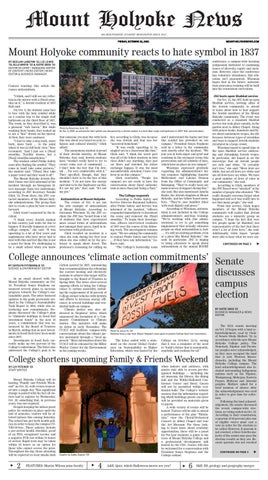
Mount Holyoke News AN INDEPENDENT STUDENT NEWSPAPER SINCE 1917 FRIDAY, OCTOBER 22, 2021
MOUNTHOLYOKENEWS.COM
Mount Holyoke community reacts to hate symbol in 1837 conference, a campus-wide learning symposium dedicated to examining issues of diversity, equity and inclusion. However, since the conference has voluntary attendance, this education isn’t guaranteed. Wiseman hopes that in the future, antisemitism awareness training will be built into the orientation curriculum.
BY DECLAN LANGTON ’22, LIZ LEWIS ’22, ELLA WHITE ’22 & KATIE GOSS ’23 EDITOR-IN-CHIEF | MANAGING EDITOR OF CONTENT | NEWS EDITOR | NEWS EDITOR & BUSINESS MANAGER
Content warning: this article discusses antisemitism. “I blink, and I still see my reflection in the mirror with a [Nazi] swastika on it,” a Jewish resident of 1837 Hall said. On Oct. 6, the student came face to face with the hate symbol while on a routine trip to the single stall bathroom on the third floor of 1837. The room, as they described it, was a pleasant “safe haven.” But while washing their hands, they looked up to see a “line” drawn on the mirror. At first, they were confused. “I had to take a step back, more back, more back … to the point where it was [a] full body view,” they recounted. “And I just see a [Nazi] swastika. Terribly drawn, but a [Nazi] swastika nonetheless.” The student called Public Safety soon after finding the symbol. “They come in [and] take some pictures,” the student said. “[Then] they take a paper towel and they wash it off.” The Mount Holyoke Jewish Student Union was first informed of the incident through an Instagram direct message from two individuals, according to JSU Secretary Natalie Glick ’23. From there, the JSU contacted members of the Mount Holyoke administration. The group then met to create a plan for how to move forward. Glick wasn’t surprised by the incident. “I think every Jewish student in this country just waits for this to happen. It literally happens at every college campus,” she said. “It was upsetting to a lot of first years and sophomores who have never had to deal with this and feel like this is not a space for them. It’s challenging to be a small school when you know
JSU hosts open Shabbat service
Photo by Rosemary Geib ’23 On Oct. 6, 2021 an antisemitic hate symbol was discovered by a Jewish student in a third floor single stall bathroom in 1837 Hall, pictured above.
that someone you may live with feels this way about you based on your religious and cultural identity,” Glick added. The anonymous student is proud of their Jewish identity. At Mount Holyoke, they said, Jewish students have “worked really hard to try to create some sort of community … I don’t hide the fact that I’m Jewish … I’m very comfortable with it.” They specified, though, that they shouldn’t have to be the face of this incident. “I do not have the energy and time to be the flagbearer on this. It’s not my job,” they said. “It’s not my job.”
her, according to Glick, was because she was Jewish and that was her “ancestral homeland.” “It was really upsetting to be singled out in a classroom like that,” Glick said. “I think the worst part was all of the fellow students in that class didn’t say anything, they just sat there and watched the entire exchange happen. It was the most uncomfortable situation I have ever been in on this campus.” Glick concluded, “People [on campus] are not ready to have the conversation about [how] antisemitism is more than just being a Nazi.”
Antisemitism at Mount Holyoke
According to Public Safety and Service Director Raymond LaBarre, after Public Safety and Service was informed of the incident, “officers responded immediately to document the scene and removed the [Nazi] swastika.” To begin their investigation, officers interviewed residents of 1837 over the course of the following week. The investigation remains open. “We are asking the community to contact Public Safety and Service … if they have any information,” LaBarre said. “The College’s leadership team
The events of Oct. 6 are not the sole example of antisemitism at Mount Holyoke. According to Giovanna Wiseman ’22, the JSU cochair, the JSU has “heard from a lot of students that have experienced more casual forms of antisemitism just amongst their peers, [and] in interactions with professors.” Glick recalled an incident in a class she took during her first year when she was called on by the professor to speak about Israel. The professor’s reasoning for calling on
The College responds
and I understand the harm and fear this symbol has provoked on our campus,” President Sonya Stephens said in a letter to the community sent shortly after the incident. “We join you in both anger and grief and condemn in the strongest terms this provocation and all symbols of hate, which have no place on our campus.” Wiseman expressed gratitude regarding the administration’s initial response, highlighting Annette McDermott and Latrina Denson from the Office of Community and Belonging. “They’ve really been our main sources of support during this,” she said. She also mentioned Amelia Ender, the Jewish chaplain at Mount Holyoke, and her fellow board members. “They’ve just handled [this] with such dignity and grace.” According to Wiseman, antisemitism is not included in the College administration’s anti-bias training. “We’re working with [the administration] to try to get something implemented that actually educates people on what antisemitism is, how … it’s still an existing problem, even at a place like Mount Holyoke,” she said. In particular, JSU is hoping to bring educators to speak about antisemitism at the annual BOOM!
On Oct. 15, the JSU held an open Shabbat service, inviting allies of the Jewish community to attend to learn about how to best support the Jewish members of the Mount Holyoke community. The event was conducted as a standard Shabbat service but took place outside, in the garden next to Abbey Chapel. Along with prayer books, handouts and flyers about antisemetic tropes, the differences between types of swastikas and ways to support Jewish students circulated in a large crowd. Wiseman hoped to spend time at the open Shabbat service addressing and debunking Jewish tropes. In particular, she honed in on the stereotype that all Jewish people are rich and white. “It certainly isn’t true,” she said. “Most Jews are white, but not all Jews are white and not all Jews here are white. We have a good number of Jews of color in our community,” she said. According to Glick, members of the JSU Board were “shocked” at the number of people who attended. “We really thought everyone forgot what happened and so it was really nice to see that many people,” she said. From this service, Glick hopes members of the Mount Holyoke community will realize that Jewish students are a minority group on campus. “I hope the fact that very few people spoke [at Shabbat] was representative of the fact that there aren’t a lot of Jews here,” she said. Additionally, Glick hopes “people were able to hear what we were say-
u
CONTINUED ON PAGE 5
College announces ‘climate action commitments’ Senate discusses campus election
BY CATELYN FITZGERALD ’23 SCIENCE & ENVIRONMENT EDITOR
In an email shared with the Mount Holyoke community on Oct. 18, President Sonya Stephens announced several plans to increase progress towards the College’s sustainability goals. The letter featured updates to the goals previously outlined in the College’s Sustainability Task Report in 2018, while also introducing new commitments. Stephens discussed the College’s plan to “eliminate holdings in fossil fuel investment funds” in the next 10 years, a commitment that was announced by the Board of Trustees in March, adding that no new investments in fossil fuels have been made since 2017. Investments in fossil fuels currently make up two percent of the College’s endowment. The letter also addressed the College’s goal to be
carbon neutral by 2037, announcing that recommendations for reforming the current heating and electricity systems to achieve this target will be brought to the Board of Trustees in Spring 2022. The letter cited several ongoing efforts to bring the College closer to carbon neutrality, including the replacement of 30 percent of College-owned vehicles with hybrids and efforts to increase energy efficiency in several buildings and residential halls on campus. Climate justice was also addressed in Stephens’ letter, which announced the formation of a Community Commitment to Climate Justice. The initiative will make its debut in early November. The CC2CJ will facilitate campus-wide conversations about the climate justice movement through a “local approach.” More information about the CC2CJ will be released by the Miller Worley Center for the Environment in the coming weeks.
BY KATIE GOSS ‘23 BUSINESS MANAGER & NEWS EDITOR
Photo by Jenny Yu ’24 Students hung a sign from Mount Holyoke’s main gates to protest College fossil fuel investments.
The letter ended with a statement on the recent Global Conference on Sustainability in Higher Education, which was hosted by the
College on October 12-14, saying that it was a reminder of the need to “build a future that is sustainable, equitable and resilient for all.”
College shortens upcoming Family & Friends Weekend when indoors and outdoors, with guests only able to access pre-designated buildings — including the art museum, the library, the dining hall and the Willits-Hallowell Conference Center and Hotel. Guests will not be permitted within residential halls. The College’s website assures that the information regarding which buildings guests can enter will be provided on materials given to guests. A wide variety of events will be hosted. Visitors will be able to attend a performance of the play “Fabulation,” view the Choral/Orchestral Concert in Abbey Chapel and tour the Art Museum. For those looking to learn more about academic opportunities, there will be a panel for Pre-Law students, a guide to the trees of Mount Holyoke College and a professional development talk hosted by the CDC. Guests will also be welcomed for a conversation with President Sonya Stephens and the College cabinet.
BY LIV PITCHER ’23 STAFF WRITER
Mount Holyoke College will be hosting “Family and Friends Weekend” on Oct. 23, with events truncated into a single day. This significant change is paired with the fact all visitors had to register by Wednesday, Oct. 20, something that, in previous years, was not required. Despite keeping the indoor guest policy for students in place until the end of semester, visitors will be allowed indoors this coming Saturday. The school has put forth health policies in order to keep the campus COVID-19-free. These policies include a pre-arrival health checklist, proof of an FDA recognized vaccine and a negative PCR test within 72 hours of arrival. Rapid tests may be taken within 24 hours as an option for those who cannot access the prior. Throughout the day, those attending will be expected to wear masks both
u
2
Graphic by Gabby Gagnon ’24
FEATURES: Martin Wilson joins faculty
u
4
A&E: Quiz: which Halloween movie are you?
u
6
The SGA senate meeting on Oct. 19 began with a land acknowledgement, read by Chair of Senate Shula Mathew ’22, in accordance with the new Mount Holyoke College policy. The Nonotuck, Nipmuc and Pocumtuc peoples were acknowledged, as they once occupied the land that is now Western Massachusetts, including the Mount Holyoke College campus. The land acknowledgement also included surrounding Indigenous nations such as the Nipmuc, Wampanoag, Mohegan, Eastern Pequot, Mohican and Abenaki peoples. Mathew asked for a brief moment of silence after the acknowledgement was read in order to give time for reflection. Following the land acknowledgement, the senate discussed the recent campus-wide elections, as voting ended on Oct. 16. According to their constitution, a quorum of 50 percent plus one of eligible voters must cast a vote in order for the election to be called. However, if quorum is not reached, a three-fourths majority of the senate may pass the election results as they are. Because quorum was not reached CONTINUED ON PAGE 5
u
S&E: ES, geology and geography merger
2
FEATURES
October 22, 2021
. Mount Holyoke News
Martin Wilson aims to inspire students through YA writing
Photo courtesy of Martin Wilson Visiting Lecturer Martin Wilson draws upon his own lived experience to prioritize LGBTQ stories.
BY LENOX JOHNSON ’24 STAFF WRITER
Content warning: this article mentions homophobia. Every Friday, Martin Wilson makes the hours-long commute from his home in New York City to the gates of Mount Holyoke College, where he teaches a class called Young Adult Fiction Writing. Wilson, a visiting lecturer in his first semester at Mount Holyoke, is aiming to cultivate an environment in which all stories can be told. Come rain or shine, Shattuck Hall is constantly buzzing with the clamor of creative minds at work. Growing up in Tuscaloosa, Al-
abama, Wilson always knew something made him different. “I refused to believe that I was gay, because, you know, I didn’t want to go to hell. I didn’t want to get beaten up,” Wilson shared. “I felt very alone. I think that feeling alone and retreating into the inner world made me a writer.” As a child, Wilson became enveloped by an unwavering devotion to reading, which he credits as the best teacher he’s ever had. It quickly grew into a medium through which Wilson could be his authentic self. As the years went by, his love for reading blossomed into a passion for writing. “There were not many visible gay people when I was young, and so I just felt more isolated,” Wilson ex-
plained. “I think having books, and TV shows and movies that portray diverse people just makes you feel more like you exist in the world.” Wilson grew up situated in the center of the Bible Belt in the late ’80s. Even in moderately large Tuscaloosa, finding a safe space proved a challenge for him. For Wilson, writing was a form of escapism. When he first picked up the pen as a teenager, story ideas poured out. Wilson finally started writing short stories in college, and an author was born. “I don’t know what drove me to do it,” Wilson said. “I always created these strange little worlds that were an escape from the world I was living in. There was a satisfaction [in] creating something and being in control.” After graduating high school, Wilson made his way to Nashville, Tennessee, to attend Vanderbilt University. In his time as an undergraduate student, Wilson churned out short fiction, investing in his writing unlike ever before. Wilson was encouraged by a professor to put everything he had into his writing, an interaction that would soon prove transformative. “I think when that teacher told me, ‘You’ll publish one day, you should go to graduate school,’ I sort of thought I could be a writer,” Wilson said. “If you write and believe in yourself, you can always call yourself a writer.”
In college, Wilson was also able to come to terms with his sexuality. This acceptance cultivated a sense of inner peace and released the creative energy within him. “I just felt like, ‘Now I can just be who I want to be,’” Wilson said. “I definitely think that change did affect my writing.” After receiving his bachelor’s from Vanderbilt, Wilson went on to graduate from University of Florida. He would later publish his novels “What They Always Tell Us” and “We Now Return to Regular Life”, both of which received positive reviews and nominations for the Lambda Literary Award in Children’s/Young Adult, an accolade for dynamic LGBTQ storytelling Wilson is currently employed by HarperCollins and has worked in publicity and book publishing for 18 years. “I feel solid in my style, but I do think it will evolve and I would like to push myself and try different things,” Wilson said. “I don’t want to turn out the same novel again and again and again. That’s not really why I write.” In Wilson’s seminar, Young Adult Fiction Writing, students are expected to produce two short pieces of fiction. The workshop focuses on the fundamentals of good writing through creative writing exercise and the analysis of published works. Wilson aims to expose his students to material that is diverse in both
style and subject matter. For Wilson, it is vital to introduce students to undiscovered works that represent a myriad of voices. Students are always encouraged to embrace the stories they have to tell. He believes, even today, representation matters and that having these stories told helps people feel less alone — especially young people. Wilson recognizes that, while strides have been made in the name of representation, there is certainly still work to be done. Ensuring progress is constantly being made in order to promote inclusion is, to Wilson, a necessary pursuit, not to be shied away from. “Even though it’s 2021 and we’ve come a long way, I still think it’s tough for teenagers who are queer, trans [and] lesbian,” Wilson explained. “Having those stories told just helps people feel less alone, especially young people.” To Wilson, a writer is someone who looks inward a little more than most people. A writer is someone who is pulled towards the otherworldly. A writer is anyone with a pen and a story to tell. “One of my favorite lines about writing is by the novelist Anne Tyler. She said, ‘I write because I want more than one life.’ That’s sort of what I like about writing, I get to have a different life, I get to escape to this place,” Wilson remarked. “When you’re young, you have to turn inward and I think the creative endeavors are really kind of nice.”
Professor Mark Shea begins new role as SAW Center faculty director BY KATE DONOVAN-MAHER ’25 STAFF WRITER
Though writing a paper or preparing a presentation can seem overwhelming, the Speaking, Arguing and Writing (SAW) center is available to help students in need, now featuring newly appointed faculty director of the center, Mark Shea. Shea, who is also a senior lecturer in the English department and the coordinator of the English for Speakers of Other Languages (ESOL) Pro-
gram, became the faculty director of SAW at the beginning of the fall 2021 semester. Shea is also. The SAW program is a peer mentoring program that pairs trained student mentors with students looking for help with writing or speaking assignments. “The goal [of the SAW Center] is not so much focused on the end product of a specific paper, but instead helping students develop their own skills to become better writers, arguers and speakers,” Shea explained. This goal also helps to
distinguish between mentors and tutors. A tutor may help with a particular assignment in a direct way, whereas mentors, as Shea put it, “[are] really there to be a sounding board for what the student is really trying to do. It’s the student’s paper … the mentor is someone there to use their experience and their listening to reflect back on what [the student is] trying to do.” Within the program, Shea works with Kimberly Jeffers, the SAW Center’s assistant director, to keep
Mount Holyoke News Mount Holyoke News is an independent student newspaper written by and for Mount Holyoke College students since 1917. Photo by Jenny Yu ’24 The Speaking, Arguing and Writing center is a peer mentoring program directed by Mark Shea.
Executive Board Editor-in-Chief Declan Langton ’22
Publisher Ali Meizels ’23
Managing Editor of Content Liz Lewis ’22
Managing Editor of Web Mariam Keita ’24
Managing Editor of Layout Rose Sheehan ’22
Business Manager Katie Goss ’23
Copy Chief Emma Watkins ’23
Human Resources Annabelle Mackson ’23
Editorial Board News
Science & Environmental
Ella White ’22, Katie Goss ’23 & Mariam Keita ’24
Catelyn Fitzgerald ’23 & Anoushka Singh Kuswaha ’24
Arts & Entertainment
Rosemary Geib ’23 & Ali Meizels ’23
Photos
Rose Cohen ’22, Aditi Parashar ’22 & Emma Watkins ’23
Graphics
Anjali Rao-Herel ’22
Opinion/Editorial
Copy Editors
Tasnia Mowla ’23, Jahnavi Pradeep ’23 & Ladin Akcacioglu ’24
Ella Jacob ’24, Audrey Shannon ’22, Lauren Leese ’23, Jude Barrera ’24, Max Endieveri ’25, Zora Lotton-Barker ’25, Gusty Westaway ’22, David Nejezchleba ’22, Gemma Golovner ’25, Eleanor McCoy ’24, Hilary Vergera ’24, Lenox Johnson ’24 Georgia Fish ’23, Callie Yosick ’25, Zoe Kaplan ’25 & Meghan MacBeath ’25
Books
Cat Barbour ’24 & Ella Jacob ’24
Global
Amelia Luo ’23 & Sophie Soloway ’23
Layout Editors
Features Rebecca Gagnon ’23 & Jesse Hausknecht-Brown ’25
Maggie Donovan ’23, Zoe Tang ’24, Rebeca Villatoro-Alvarez ’23,Orion Cheung ’25, Aditi Menon ’25 & Sophie Dalton ’25
Sports
Gigi Picard ’22
Web Editors
Abby Wester ’22, Anika Singh ’24 & Zoe Tang ’24
Publication Guidelines Mount Holyoke News does not endorse any of the opinions or views expressed within the pages of the paper, excluding staff editorials. All content copyright of Mount Holyoke News. All rights reserved. Mount Holyoke News does not discriminate on the basis of gender, race, religion, ethnicity, sexual orientation or age.
Advertising in MHN Interest in advertising in MHN can be directed to mhnews@mtholyoke.edu for pricing and deadlines. MHN reserves the right to refuse submissions on the basis of, but not limited to, advertisements considered to be libelous, obscene, defamatory or discriminatory.
Subscriptions Mount Holyoke News is a weekly publication that prints weekly throughout the academic year. To join our mailing list, please contact the Publisher at mhnews@mtholyoke.edu.
Letters Policy Letters to the Editor appear exactly as they are sent to MHN, except for corrections to spelling, grammar and AP style. Letters cannot exceed 500 words. All letters must include the writer’s name and telephone number for verification purposes. Unsigned letters will not be printed. Names may be held upon request with the approval of the Editor-in-Chief. MHN reserves the right to decide which materials will be printed. Email submissions to mhnews@mtholyoke.edu by Sundays at 5 p.m. for publication the following week.
VISIT US: www.mountholyokenews.com www.facebook.com/mountholyokenews www.twitter.com/mtholyoke-
EMAIL US: mhnews@mtholyoke.edu
the center running smoothly. He is be made at any stage in the writing responsible for the policy and prac- or preparation process, and students tices of the center, hiring mentors should not feel the need to be at the and overseeing their training. The “right” stage. A student could make training course Shea runs is a two an appointment as early in the writcredit course held in the second half ing process as brainstorming ideas, of the spring semester that all men- to as late as the very end, if the tors must complete before they are student wanted someone to check eligible to work in the SAW center. over their work. Students can even But before that, mentors must either choose a specific mentor they would apply to the program or be nominat- like to meet with, based on that mened by a faculty member, in addition tor’s major and background. Unlike a tutoring session or to completing an interview — all steps to ensure that students who go meeting with a professor, Shea emto the center receive consistent, top- phasized that meeting with a mentor “is a process of mutual learning, notch help. In addition to working at the the mentors are learning from their SAW Center, mentors also work mentees, the mentees are learnwith specific classes. In the fall se- ing from their mentors. It’s a really great collaboramester, the mentive experience.” tors are most This year, directly involved Meeting with a mentor “is the SAW center with the First a process of mutual learnYear Seminar ing, the mentors are learn- is also offering virtual meetings (FYS) program, although, as Shea ing from their mentees, and asynchronous help sessions, said, “classes up the mentees are learning alongside their and down the from their mentors. It’s a usual in-person curriculum” may also have a class really great collaborative appointments and drop-in hours. mentor. Mentors experience.” In addition to periodically meet complications due with the professor — Mark Shea to the pandemic, of the course they Shea faces anothare assigned to, and they may attend class meetings er challenge in this new position: or run workshops for students in the getting to know the sheer number of class. Since all first year students students he is now responsible for. are required to take a FYS, this helps There are roughly 50 mentors worknew students form a connection with ing for the center, and, he said, he’s a more experienced student while only “used to teaching classes where also becoming acquainted with the I know the students fairly well, fairly SAW center. According to Shea, quickly.” Despite challenging circummany first year students apply to be mentors in December of their fresh- stances, Shea finds his work extremely rewarding. He stated that man year. Shea acknowledged that, despite the work is “a really great way to the connections made in the FYS have a different type of conversation mentor program, many students are in a different setting about academic still nervous to reach out to the SAW discourse.” He is also enthusiastic Center. Nonetheless, he believes about the program.. “I want to exthat, “because it’s a peer mentoring press my excitement about the work system, it’s much less intimidating,” we are doing, and I encourage any and the process of making an ap- student to make an appointment and pointment is very straightforward. see if it works for them,” he said. “I He explained that appointments can think it’s a really great program.”
October 22, 2021
OPINION/EDITORIAL
. Mount Holyoke News
3
Child care needs public support in the United States
Graphic by Anjali Rao-Herel ’22
BY KATE MURRAY ’22 STAFF WRITER
For months, Congress has been debating an ambitious social policy bill that will assist American families in nearly every stage of life. The plan, proposed by congressional Democrats last month, involves a significant expansion of the social safety net to the tune of 3.5 trillion dollars over the next decade, from paid medical leave to universal preK. One area of the plan that has received significant attention is child care. According to The New York Times, average American families are paying significantly more for child care than their mortgages every year, which has devastating effects on their ability to afford other necessities and invest in their futures. On the whole, child care workers are being drastically underpaid at an average wage of about $12 an hour, or $24,000 a year. To make child care more affordable to American families and ensure that service providers have adequate resources, it is imperative that the government intervene and declare child welfare a public responsibility. A substantial, federally-funded economic package is the only solution that will guarantee better conditions for parents, children and laborers in the child
care industry. If passed in its current iteration, the bill will provide most families with a monthly check for $300 per child until 2022 and introduce a cap on the amount families pay for child care to no more than 7 percent of their annual income. According to Jason Deparle of The New York Times, this would cut child care costs for the average family in half. Parents that were shelling out tens of thousands of dollars every year for child care will now be able to have more freedom in their occupational choices, increase their retirement savings and have more children as a result of this lifted financial burden. While I adamantly believe that the government should support American families by substantially funding child care, the 7 percent cap is a more helpful solution than the monthly check. Even though the proposed stipend was configured by analyzing statistics on child poverty rates rather than chosen arbitrarily — led by the Center on Poverty and Social Policy at Columbia University — it effectively establishes a fiscal “worth” of children by assigning them a monetary value. Depending on their individual circumstances, some families may need more or less money per month to care for their children than others. In contrast, the 7 percent cap allows for families
of diverse financial means to invest in child care that is proportional to their income. In addition to imposing a limit on what individual families can spend on child care, I believe that the government should require private employers to have generous accommodations for employees with children. Extended and paid parental leave and flexible accommodations for employees with children should be guaranteed in all places of employment. Parents’ salaries or job standings should not be negatively impacted if they are required to bring their children to work or adjust their work schedule to accommodate their children’s needs. Additionally, private employers should subsidize child care in the form of free or discounted daycare and after-school centers. Just like health insurance and other benefits, this additional employment perk would incentivize working parents to join the workforce without having to sacrifice their child’s welfare. The bill would also guarantee that child care workers will be paid a living wage that is equivalent to the salary of public school teachers with the same credentials. According to The New York Times, most child care facilities spend 50-60 percent of their budgets on labor, so the salary increase for their employees would
allow them to hire more staff and offer higher quality resources for the children under their care. The adults who care for young children outside of their home environments play a pivotal role in their development, so it is crucial that their pay reflects the importance of their occupation. Providing child care employees with decent salaries as well as benefits like health insurance will attract more people to the industry that are passionate about the work. While some Americans may be concerned about the bill allowing the government to have too much control over their private lives, I see child care legislation as bringing more choices to families, not less. With more money and guaranteed child care in workplaces, parents will have more flexibility in the expenditure and investment of their money as well as more options for where they want to live and work. With child care currently being an individual rather than social responsibility, people may end up stuck in jobs, neighborhoods and financial arrangements that are negatively affecting their lives, just to afford the exorbitant cost of child care. Government intervention would require Americans to pay higher taxes, but this would ultimately be more affordable than paying for privatized child care without federal support.
Additionally, paying taxes to the government to fund child care does not just benefit individual families. Doing so allows all American families and children, regardless of social circumstances, to have access to adequate care and resources. Earlier this year, a child care crisis occurred in our own backyard. Mount Holyoke released a statement in February announcing that they would be closing Gorse Children’s Center within the year due to the partnership no longer being financially viable. The decision sparked outcry amongst members of the college community, especially faculty and staff members who rely on Gorse to care for their children at a discounted rate. While the decision to close the children’s center was eventually delayed for another year, the protests prompted by this incident point to the importance of adequately funding child care in the United States. In order for American families to better support their children, there must be a huge paradigm shift in the way child care is perceived and funded in this country. While some parts of the bill proposed by congressional Democrats seem more practical and beneficial than others, there is no doubt that the federal government must intervene to ensure the welfare of all children and parents.
Allies must speak up for Jewish students at Mount Holyoke BY SABRINA RAPOPORT ’25 STAFF WRITER
Content warning: this article discusses antisemitism and the Holocaust. On Oct. 6, 2021, a Nazi swastika was found in the third floor bathroom of 1837 Hall. As a Jewish student at Mount Holyoke College, I was hurt, but not shocked. This incident is living proof that antisemitism is not dead, neither on campus nor beyond. As a Jewish student, feeling unsafe in my own space is not a new concept. This incident is not the first antisemitic act to happen to the Mount Holyoke community. In 2020, after an anonymous account called @mhcpayscampoforthis posted pictures of visitors on campus, which was at the time closed, members of the South Hadley community started engaging and brought the page to light of a neo-Nazi blogger. The author of this blog, however, was not a member of the Mount Holyoke community. The danger of the situation was more remote than in the most recent act of antisemitism; the bigot who drew that symbol on the 1837 bathroom, however, is most likely not a distant figure. This could be someone who lives with us, eats with us or attends class with us. The perpetrator has demonstrated intolerance and hatred against Jewish students. No amount of Instagram posts, emails from professors or petitions can make us feel truly protected from bigotry against our people. Raven Joseph ’25, a non-Jewish
student, said, “You come to Mount Holyoke thinking it’ll be a safe space where most of the ‘bad things’ go away, so it was unexpected to see this happen in a place you call home,” Joseph said. “I still felt the instability caused by the attack although this did not happen to my community, as I empathize with my friends who it has affected,” Joseph continued. The administration, along with Public Safety, has started an investigation to find who drew the [Nazi] swastika, as announced by President Stephens in her statement released on Oct. 7. I personally applaud the initiative, but as a Jewish student, I wonder what the administration can successfully do. When most antisemitic acts are displayed online, and no true regulation can be placed over social media, my desires for action fall flat most of the time. Hopefully, this person will be caught and will endure the consequences. In reality, it feels like Jewish people are rarely heard, and while I appreciate the spotlight provided by social media, sometimes I wonder whether the sentiments are legitimate. Emma Mair ’23, co-chair of the JSU said, “In my three years at Mount Holyoke, previous antisemitic incidents have mostly occurred online largely with students reposting antisemitic infographics.” She continued, “There was an Instagram post that said that Zionists were racists and fascists and Jews should ‘get the fuck out’ of MHC. This was on an anonymous Instagram account.” These infographics, these comments and the anonymity provided by social media breeds the antago-
Photo by Declan Langton ’22 The Jewish Student Union held an open Shabbat service outside Abbey Chapel on Oct. 15, calling for allies to support and listen to Jewish students.
nizing of Jewish students. From current accusations of favoritism by the administration because of the fast response after the Nazi swastika was discovered, to photos of the symbol being shared, Jewish students cannot seem to gain support from their peers, and when they do, it is conditional. A great example of this conditional status is the JSU’s post regarding the incident in 1837. Their Instagram, as of Oct. 17, only has 515 followers, while the post informing people about the 1837 incident has 910 likes, making it the most interacted with post on the page. By Oct. 7, it seemed like almost everyone I knew had reposted this infographic, but I have heard nothing from them since. Support is not true if it is transient, rather it is a demonstration of performative activism and following
a social media wave. By only jumping on trends because you’re afraid to be criticized by your followers, you are conditional in your support, demonstrating that you will only support a movement that is beneficial to you. The true way to support Jewish students is giving them a platform, and not stopping once the issue has left your mind, because it is undoubtedly still very present for us. Here is the easiest way to support Jewish students, or any minority student for that matter: listen, then act. Don’t repost the Nazi swastika, it is unnecessary to understand the harm and it is extremely triggering for many. Don’t generalize Jewish students or promote antisemitic tropes; not all of us are supportive of Israel or come from wealth. Instead, attend the JSU’s open and informa-
tive Shabbats, avoid eating at the Kosher station during Jewish holidays and provide a safe space for your Jewish friends. As Giovanna Wiseman ’22, co-chair of the JSU said, “We are such a small minority on this campus and in the world, and we need the help of our allies to eradicate hate.” Silent allies are not any better than those who are indifferent; enabling this behavior allows for Jewish students to be in danger in their own homes. We need active allies, those who go to protests, confront their personal biases and speak out when they see antisemitism. If you see an act of bias, report it to the Office of Diversity and Inclusion on their website, https://www. mtholyoke.edu/diversity-and-inclusion/bias_incidents.
4
ARTS & ENTERTAINMENT
October 22, 2021
. Mount Holyoke News
Humor and representation shine in third season of ‘Sex Education’
BY ANIKA SINGH ’24 STAFF WRITER & WEB EDITOR
Content warning: this article mentions sexual assault. Netflix’s newest season of “Sex Education” allows viewers to feel as if they are eavesdropping on the latest gossip during a high school passing period, while also providing catharsis for the trauma that accompanies being a teenager. The third season, released on Netflix on Sept. 17, brings audiences back to some of their favorite characters from the town of Moordale. “Sex Education” has its strong points when it comes to portraying teenagers on an emotional, cultural and sexual level, even if it exhausts certain storylines and disregards promising subplots. As always, the show does not shy away from sexually explicit scenes, beginning with a montage of characters exploring their sexuality, set to “I Think We’re Alone Now” by the American power pop band The Rubinoos. This chaotic and raunchy scene sets viewers up to expect the wild ride to come. In this season, Otis Milburn (Asa Butterfield), Moordale Secondary School’s amateur sex therapist, his best friend, Eric Effiong (Ncuti Gatwa) and an ever-expanding cast of characters. This season provides an exciting overarching plot, showcasing conflict between the Moordale administration and students along with relatable teen antics, hooking viewers with the introduction of new characters and unresolved drama from Otis’s past.
“Sex Education” excels when it comes to representation, partly because it faces taboo conversations head-on. The season discusses sexual harassment from the perspective of the victim. It also embraces queer topics and even fetishes and kinks, often through the lens of literal sex education provided by Otis and his mother, Jean Milburn (Gillian Anderson), a practicing sex therapist. This season explores various problems that students at Moordale face, including Eric’s new relationship with his bully-turned-boyfriend Adam Groff (Connor Swindells) and Otis’ neverending miscommunication with his longtime romantic interest, Maeve Wiley (Emma Margaret Marie Tachard-Mackey). As these issues threaten students’ relationships and friendships, an off-putting new headmistress, Hope Haddon (Jemima Kirke), arrives at Moordale with a conservative agenda. Her immediate imposition of dated rules, such as mandatory school uniforms and a crackdown on sexually explicit art, imply that Moordale’s expressive atmosphere is in jeopardy. Against this changing setting, the show provides a nuanced outlook on gender and sexuality through the introduction of a new character — Cal (Dua Saleh), a nonbinary student who is frequently targeted by Hope for their gender identity and expression. Cal’s rebellion against the strictly gendered environment is a compelling subplot to witness. The blatant ignorance displayed by some of Cal’s peers and the new headmistress, who targets Cal’s call for inclusivity at Moordale, makes viewers root for Cal. It’s refreshing
Graphic by Laura Hinojosa ’23
to see “Sex Education” bring up everyday issues faced by nonbinary individuals, while keeping their identity relevant to the plot. We see Cal, along with their friends Jackson (Kedar Williams-Stirling) and Viv (Chinenye Ezeudu), tackle issues about sex and gender. Throughout the season, characters advocate for non-gendered bathrooms and nongendered school uniforms. With this story line, “Sex Education” establishes its willingness to interrogate the gender binary as part of its commitment to diversity. While the show succeeds in bringing up social issues, such as sexual health and societal pressures on teens, the show falls flat when it comes to developing characters’ storylines from previous seasons.
The will-they-won’t-they plotline between Maeve and Otis, which has existed since season one, is exhausting to keep up with. At the end of the second season, the pair were left to deal with a miscommunication involving a love confession from Otis via voicemail that was deleted before it reached Maeve. As their wires continue to cross, it becomes overwhelming for the audience to follow without losing interest. In addition to dragging out plotlines, the show completely sidelines several of its old subplots, such as the relationship between Otis’ exgirlfriend Ola Nyman (Patricia Allison) and the alien-obsessed Lily Iglehart (Tanya Reynolds), the fanfavorite queer couple. The neglect of this relationship illustrates how
the show’s writers prolong plotlines that should have an expiration date. Lily’s quirkiness and hobby of writing sexually explicit stories make her a target for Hope, bringing her into a more prominent role. The couple, though, barely has enough shared screen time to explore their relationship, and when they do, it is shown in passing, or only to address Ola’s uncertainty. In one scene, Ola expresses feeling invalidated by Lily devoting the majority of her time to writing erotic science fiction instead of acknowledging Ola’s emotions. Though this scene highlights their relationship, it does not make sense for their storyline. Toward the end of season two, the two appear extremely happy, alien erotica and all. This dilemma appears suddenly, confusing audiences and adding yet another plotline to a season already spread too thin. Despite the lack of focus on some characters and plotlines from previous seasons, “Sex Education” succeeds in delivering witty humor, especially coming from Jean. Jean stands out as a recurring character who lives up to her portrayal in earlier seasons, providing well-timed jokes to lighten the mood as she tries her best to make light of her difficult pregnancy. Jean’s character epitomizes “Sex Education” at its strongest, tackling difficult subjects through humor while providing quality advice. The third season of “Sex Education” has its flaws, but it makes up for them through its socially relevant plotines, strong recurring characters and its perfect mixture of humor and sentimentality.
‘No Time to Die’ says a sentimental goodbye to the longest-running Bond
Graphic by Sofia Savid ’24
BY LUCY OSTER ’23 STAFF WRITER
“No Time to Die,” the latest James Bond installment, is surprisingly emotional for an action film. The movie, which is the final Bond film to star Daniel Craig as the titular character, ups the sentimentality beyond the norms of the spy thriller genre in a fitting goodbye to the longest-running Bond. The movie follows in the steps of
classic Bond films and expands on what a Bond film can look like. “No Time to Die” opens with a scene that imitates a familiar sight from previous Bond movies — Bond, accompanied by a beautiful woman, driving his iconic Aston Martin DB5 sports car through a small European town. In these opening shots, the film nods to similar scenes in the Bond tradition, which can be found in “On Her Majesty’s Secret Service” and “Goldfinger,” to name a few. The film then identifies the woman as Madeleine
Swann (Léa Seydoux), a character from “Spectre,” the previous Bond film, and establishes that she and Bond are in a newly-formed relationship. To let go of his past and start anew in their relationship, Madeleine urges him to visit the grave of a past love of his, Vesper Lynd (Eva Green), and he complies. This influence on Bond is unusual, particularly since the character has previously been depicted as a notorious womanizer — acquiring and disposing of love interests with famous abandon. In “No Time to Die,” however, Bond seems fully in love — that is, until Vesper Lynd’s grave explodes, endangering his life. Believing that Madeleine has set him up, Bond leaves her behind on a departing train, promising that she will never see him again. “No Time to Die” isn’t all sentimentality and potential betrayal. The movie also introduces fun new characters, such as Nomi (Lashana Lynch), the new 007 of MI6, the Secret Intelligence Service of the United Kingdom. Before Bond retired, 007 was his agent code, and Nomi becoming 007 elevates her character by linking her to Bond through that iconic number. Nomi is even more sarcastic and self-assured than Bond, and, unlike many of the women in the franchise, she is clearly uninterested in him sexually. As a Black woman, Lynch’s character opens up
an exciting possibility for the Bond eleine again and even becomes a fafranchise in terms of expanding the ther figure for her young daughter. types of characters that are centered “No Time to Die” also has its in major roles. Another new charac- weak moments, putting itself at a ter, Paloma (Ana de Armas), a styl- disadvantage by not updating stanish and charming Cuban woman dard Bond tropes. Lyutsifer Safin who Bond briefly partners with on a (Rami Malek) portrays the classic mission, is the life of the movie while scarred Cold-War-esque Bond vilshe’s on screen. In one scene, Palo- lain, drawing on Cold War era tropes ma and Bond banter while engaging such as an unidentifiable vaguely in a high-stakes shoot-out, establish- Eastern European accent and, at ing her as an equal to Bond and as one point, giving a speech claiming more than just a pretty face. Both that people want to be controlled. of these women Another low moindicate a powerment for the film ful future for the later in Instead of reacting to [an] comes franchise, even the movie, when impending loss with his without Craig. Nomi requests The movie is that MI6 reinstate usual stiff upper lip, “No aware, as are the 007 agent code Time to Die” opens Bond the viewers, that this back to Bond. to sentimentality. is Craig’s last time This move places portraying Bond. her in back into Much of the film the position of a revolves around Bond coming to side character, potentially suggestterms with getting older and quit- ing there’s no possibility of a future ting MI6. The intro, accompanied by non-white-male Bond. Billie Eilish’s haunting song, also tiHow the franchise will reintrotled “No Time to Die,” demonstrates duce Bond is up in the air. Maybe this existential despair by showing Lynch’s character will be the new statues crumbling into sand. It’s as if star of the franchise after all or Bond might crumble without his ti- perhaps someone entirely new will tle as 007 as well. Instead of reacting come along. Overall, “No Time to to this impending loss with his usual Die” is an effective end to Craig’s stiff upper lip, “No Time to Die” role of Bond and leaves the franchise opens Bond to sentimentality. By the open to an exciting future. middle of the movie, he is with Mad-
Which Halloween movie should you cozy up with this weekend? BY ROSE COHEN ’22 & EMMA WATKINS ’23
A&E EDITOR | COPY CHIEF & A&E EDITOR
1. Which of these Halloween classics is your favorite? a. Tim Burton’s 1988 dark comedy, “Beetlejuice.” b. Duwayne Dunham’s 1998 Disney Channel TV movie, “Halloweentown.” c. Ivan Reitman’s 1984 supernatural comedy, “Ghostbusters.” d. Brad Silberling’s 1995 familyfriendly comedy, “Casper.”
2. It’s the week before Halloween … Do you already have your costume picked out? a. Yes, and I plan to dazzle the crowd at the party I’m hosting. b. I’ve had a group costume planned for months. We’re going to look amazing! c. If you want the answer to that, you should just take a look at my Pinterest board. d. I may just re-wear an old standby. The Beanie Baby costume in my closet has been calling my name.
3. Your crush has invited you
to a Halloween party they’re throwing. You can’t find your costume anywhere, which you’ve declared is the perfect combination of sexy and cute. What are you wearing instead?
is a must. c. Seeing people’s Halloween decorations all month long. My neighbor has ghost fairy lights! d. Stepping on crunchy leaves on my walk to class. The red ones are espe-
a. Fishnets, heels, an oversized tee and dramatic makeup — they’ll never know it took an hour to decide what to wear. b. I’ll just throw on some animal ears and call it good. c. A monochrome black ’fit, complete with some Dr. Martens. d. I have three backup costumes to choose from!
5. Don’t think too hard about this one; pick a word to describe your fall vibe! a. Sexy. b. Cozy. c. Classic. d. Wholesome.
6. You’re trying to impress your crush with a Halloween date night. What do you do?
4. What is your favorite thing about fall? a. Getting to bust out my dark red lipstick and channel “Pure Heroine”-era Lorde. b. Cozy movie nights with friends. Apple cider in cute mugs
cially thrilling.
Graphic by Jieru Ye ’23
a. Netflix and chill, baby! Lighting will be provided by my pumpkin piescented candle. b. I think a road trip to Salem, Massachusetts, could be cool. Maybe we’ll go to a museum and a cat cafe? c. I heard there’s a tarot reader coming into Northampton on Saturday. I want to ask about our future together — if we’re compatible, it
shouldn’t scare them off. d. I’m going to take them to Thirsty Mind (I want them to try my favorite fall drink— a maple iced latte with oat milk). Then, we’re going to drive to an apple orchard in Easthampton, go on a spooky hayride and come back to campus and cuddle. Did I mention I’ve caught them staring at me in Blanch recently?
7. What is your favorite Halloween treat? a. Milky Way Midnight. b. Popcorn ball with M&M’s. c. Mummy-themed cake pops. d. Candy corn.
8. What’s your favorite spooky spot on campus? a. The library’s stacks. Who knows what could happen there? b. Sunday brunch gossip sessions in Blanch. It’s nice to hear what I was up to on Saturday night! c. Wilder — I’m befriending the ghost. d. I like drinking warm beverages by Mary Lyon’s grave. I wouldn’t mind if I had a book with me. Find your results on the back (page 8) u
October 22, 2021
BOOKS
. Mount Holyoke News
5
2021 book award shortlists released, Emily Arsenault ’98 highlighting literary achievements draws from Mount Holyoke ghost stories in newly released novel
Photo courtesy of LibreArt National Book Award shortlists were released Oct. 5 and the finalists will be announced Nov. 17.
BY EDITH TIERNEY ’24 STAFF WRITER
Fall book award season is upon us, highlighting titles from this past year that, according to critics and award panelists, are worthy of praise and recognition.. Some notable book awards are the United States specific National Book Award, the Booker Prize for Fiction, the PEN/Faulkner Award and The Women’s Prize for Fiction. Every year, the panelists for each award pick books for a longlist based on nominations from publishers. They then narrow this down to a shortlist, from which they select a winner. Winners for the Women’s Prize for Fiction were announced on Sept. 8, and winners for the National Book Award and the Booker Prize will be announced in the coming weeks. The 2021 Women’s Prize for Fiction winner is “Piranesi” by Susanna Clark, a mystical brain teaser of a novel in which main character Piranesi occupies an extraordinary building called the House, which contains infinite rooms, countless statues and an ocean. His only company comes when the Other, the only living human Piranesi knows of, needs help with a science experiment. The other five books on the shortlist in 2021 for this prize were: “No One is Talking About This” by Patricia Lockwood, “The Vanishing Half” by Brit Bennet, “Unsettled Ground” by Claire Fuller, “Transcendent Kingdom” by Yaa Gyasi and “How the One Armed Sister Sweeps Her House” by Cherie Jones.
The Women’s Prize for Fiction is based in the United Kingdom. Winners receive £30,000, along with a bronze figurine called the “Bessie.” The Women’s Prize Trust, the organization that supports and organizes the Women’s Prize for Fiction, is funded by a private donor. The organization is unique in that it is also a registered charity that campaigns for women writers globally. Aside from the prize, they also provide mentoring programs, donate books and have free resources online and in bookshops to help people access contemporary women’s literature. The Booker Prize is awarded to a novel published in English in either the United Kingdom or Ireland. Each year, each author shortlisted for the Booker Prize receives £2,500, and the winner receives £50,000. The shortlist for 2021 was announced on Sept. 14, and the winner will be announced on Nov. 3 on the BBC. The shortlist is comprised of six books: “The Promise” by Damon Galgut, “A Passage North” by Anuk Arudpragasam, “No One is Talking About This” by Patricia Lockwood, “The Fortune Men” by Nadifa Mohamed, “Bewilderment” by Richard Powers and “Great Circle” by Maggie Shipstead. According to the prize’s website, the Booker Prize, also known as the Man Booker Prize, was founded in 1968 by Booker McConnall, a multinational company. This was created as the British equivalent to the Prix Goncourt, a well-known French literary prize. In 2005, The International Booker Prize was founded as
an expansion to the Booker Prize. The International Booker Prize is focused on translated fiction and works originally published outside of the United Kingdom and Ireland that have recently been published in aforementioned countries. In 2021, the International Booker Prize winner, “At Night All Blood is Black” by David Diop, was announced on June 2. The National Book Award, one of the most prestigious literary awards in the United States, according to the New York Times, is given for fiction, nonfiction, poetry, “young people’s” literature and translated literature. Each section has a panel of five judges. The shortlists, consisting of five books each, were announced on Oct. 5, and the finalists will be announced on Nov. 17. For fiction, the shortlist consists of “Cloud Cuckoo Land” by Anthoney Doerr, “Matrix” by Lauren Groff, “Zorrie” by Laid Hunt, “The Prophets’’ by Robert Jones Jr. and “Hell of a Book” by Jason Matt. The National Book Foundation, the organization that manages the National Book Award, was founded in 1989, according to their website. Previously, the National Book Awards were jointly sponsored by three literary organizations that began the tradition in 1950. Over the years, the award has had many different categories and prizes. By 1996, the award was given in fiction, nonfiction, poetry and young people’s literature. Translated fiction was added as a category in 2018, the website said. Today, the National Book Foundation has educational programming across the country, but the National Book Award remains at the forefront of their foundation. Its mission, according to the prize’s website, is “to celebrate the best literature in America, expand its audience, and ensure that books have a prominent place in American culture.” Freelance copywriter and book blogger Emma Rose Hollands wrote in a blog post, “It is the pleasure of discussing, assessing and celebrating books that brings us to the root of why literary prizes are necessary: they show us that books should be prized. Like any other form of art, books are important to cultures across the globe. They can bring about change across society and they can touch our hearts in the smallest ways.”
NEWS: Senate discusses dining hall, guest policy and Family & Friends u
CONTINUED FROM PAGE 1
for either the Class of 2025 or SGA position elections, the election went to a vote at senate, where senators could either vote to accept the results or reject them and keep voting open for another week. At the end of the meeting, it was voted that the results would be announced as they were when voting closed on Oct. 16 and that voting would not be extended another week. The community will be notified of the results 48 hours after the candidates are informed of their status. Additionally, senators were informed about dining updates in regards to concerns posed at the previous meeting. Grab ’n Go will now open at 9:45 a.m. in order to accommodate students who have a class starting at 10 a.m. More gluten-free options will be added to breakfast; however, no specifics were given as to what the expanded items would be. Reminders about respecting the Tranquility Room space and keeping non-
kosher food off the L’Chaim counter area to keep kosher at the station were given. In addition to these measures, SGA also highlighted several problems brought up at the last meeting that they have begun to address. These include the accessibility van not running on the weekends, the lack of outdoor trash receptacles and the dining hall having compostable utensils. The SGA clarified that the College’s compostable utensils supplier is currently having a supply chain issue and is unable to send its products to the College. Senate then opened the floor for any questions, comments and concerns the senators had to share. One senator stated that the dining hall’s menu did not match what they actually served on some days. In response, SGA then informed everyone that, like the utensils company, the dining hall has faced food supply issues that are out of their control, which is why menus sometimes do not correspond with the food put out. Family and Friends Weekend, beginning Oct. 23, was also discussed. Senators were reminded that guests who have signed up to
come onto campus are only allowed in pre-designated buildings and not in any residential halls. A senator mentioned that students who do not have family coming for the day can join a get-together happening at Pearson’s Annex to hang out with other students, on Oct. 23. The equestrian team will also be hosting their Sunrise Pleasure horse show all day on Oct. 23 at the Equestrian Center. The senator from the Jewish Student Union, Nina Baran ’25, thanked everyone who came to Shabbat on Oct. 15 to show their support for the Jewish community on campus. Senators were split up into their commission groups for the last 30 minutes of the meeting. Each group has a specific assigned topic or issue to focus on improving on campus, such as COVID19-related complications, dining, accessibility and anti-racism, among others. Senate meets every Tuesday from 7:30-9:00 p.m. in the Great Room in Blanchard Hall.
Photo courtesy of Rose Grant Arsenault’s novel,“When All the Girls are Sleeping,” is inspired by her time at Mount Holyoke.
BY CAT BARBOUR ’24 BOOKS EDITOR
Content warning: this article mentions suicide. “This is what it means to be a ghost. To watch all the other girls live — laugh, talk, sleep, eat, dance, study, scream — while you flicker and fade into the shadows,” an unnamed narrator declares, opening “When All the Girls Are Sleeping,” published July 13, 2021, the latest novel by Mount Holyoke alumna Emily Arsenault ’98. Arsenault was greatly inspired by Mount Holyoke College in writing this book. While the story may revolve around teenaged characters, the setting is heavily influenced by the school’s mythology and campus. “When All the Girls are Sleeping” takes readers to WindhamFarnswood Academy, a high school divided into two campuses: the girl’s only Windham and the coed Farnswood. Haley just wants to make it through her senior year in one piece, but as the anniversary of her ex-friend Taylor’s death comes around the corner, questions once again arise about whether or not her death was a suicide. After an ominous video makes Haley believe Taylor was murdered, Haley begins an investigation of her own, starting with the campus’ legend of the Winter Girl. Her search takes her from the archives of Windham, to a secret Facebook group of alums who have reported being haunted and the door of a paranormal investigator. What started as one girl’s untimely death is unveiled to be so much more. The Winter Girl, the ghost who is said to have haunted the fictitious Dearborn residence hall for over a century, is seen wearing either a white or black nightgown. She has melancholically roamed the fourth floor ever since her mysterious and early death, causing extreme stress to a handful of Dearborn residents. If this sounds similar to a few of Mount Holyoke’s ghost stories, it should. Taylor’s empty and locked room on the fourth floor after her death is inspired by the fourth floor room in Wilder that remains locked due to the room’s supposed haunting. Sarah Dearborn’s portrait, a figure of unspecified importance to the school, and its mysterious destruction mirrors the fate of Mary Mandelle’s portrait. Mandelle is the namesake of
the North and South Mandelle Hall after donating $500,000 in 1930. The Winter Girl’s Victorian nightgown was inspired by a story that circulated in Brigham during Arsenault’s first year, of a girl wearing a white nightgown, pacing in the basement and asking, “Have you seen my father?” “Ghost stories were a big part of my experience as a very new student,” Arsenault said. “I was in Pearsons [Hall first year]; I thought it was a creepy place. I mean, I liked it. I just got this creepy feeling from it … that kind of stuck in my mind as one of my very early experiences of the campus.” Arsenault also folds into the narrative other Mount Holyoke-esque imagery: the old, stately buildings looking slightly ominous in the morning fog, squirrels who are just a little too used to people for their own good and theology texts that lurk in a forgotten corner of the fourth floor of the library. Unavoidably, COVID-19 had an impact on the writing process of this novel. During the spring of 2020, Arsenault recounted, “it felt like what I [was] doing [wa]sn’t that important. I’d rather watch the news and, I don’t know, make beans for my family.” However, by summer, the work became a welcome escape. “I felt very lucky that I had something started, that I had a pretty good draft that I could play with rather than starting something new. I love revising.” Arsenault had always wanted to be an author. Her first book came out in 2009 after she spent a few years as a high school English teacher. It was a winding road to that first published work. “You know, I wrote that one book that didn’t get published,” she said. “For a while, I just kept revising it, and it took having a new idea and pursuing that instead.” Still, she expressed that these first attempts were an important experience as a young writer. “I think that is a really difficult step to take as a writer sometimes is to realize this one project that I worked hard on probably isn’t going to be published and to force yourself to step into a new project and have a new page one.” After having several new ideas and page ones, “When All the Girls are Sleeping” is Arsenault’s ninth book and her second YA novel. Emily Arsenault will be having a masked and outdoor book talk sponsored by The Odyssey Bookshop at Pearsons Hall on Oct. 28 at 7 p.m.
NEWS: JSU members on antisemitism and how to support Jewish students u
CONTINUED FROM PAGE 1
ing and respect what we were saying and take time to process it.” She continued, “It’s hard as a Jewish student to constantly have to remind people the way they are causing harm. Especially after [Shabbat], I hope people are now more cautious of what they are do-
ing.” Wiseman noted that many students might never have met a Jewish student at Mount Holyoke. “The Shabbat tonight is an opportunity for allies to come and … see actually what our religious practices are,” Wiseman said. “It’s also a place for people to take the initiative to get educated.” Students also gathered in sup-
port of Jewish students on Shabbat immediately following the incident. Though Wiseman could not attend Shabbat on Oct. 8, she was moved by images of students encircling the Elliot House. “We had this protection [from] others, which felt really nice, and it was really moving to see so many community members out there in support of us,” Wiseman said.
This incident has publicized what it is like to be Jewish at Mount Holyoke, according to Wiseman. “I’ve definitely felt like people are a bit more aware of what Jewish students’ experiences can be like,” she said. “I just hope this is a learning lesson for people to realize that antisemitism is real,” Glick said. “We’re not making this up and we’re
not being dramatic, this is a very real problem in this country, in this world and on this campus. When we say that we do not feel safe here, we’re not saying that to be dramatic and get attention, we genuinely do not feel safe here. It’s the responsibility of the community to do the work to make sure that we do feel safe here.”
6
. SCIENCE & ENVIRONMENT New earth, environment and sustainability Climate Activist studies department to launch in fall 2023 October 22, 2021
BY CATELYN FITZGERALD ’23 SCIENCE & ENVIRONMENT EDITOR
Earth-loving students of the future will not leave Mount Holyoke College with a degree in geology, geography or environmental studies, but rather earth, environment and sustainability studies. According to Chair of Environmental Studies Tim Farnham, students may join the new major starting in fall 2023. Increasing course options for students was one motive behind the decision to merge the departments, both by giving students more flexibility in how they complete their major requirements and by creating new courses that span the three disciplines. “For [environmental science], we’ve always counted a majority of the geology and geography courses for the major,” Farnham explained, adding that a number of students from the geology and geography department also take environmental science classes, such as Political Ecology. Due to the increasing collaboration between the departments, merging was a practical option, Farnham explained. For example, the departments already share a department coordinator, who facilitates intradepartmental communication. Faculty turnover also played a large role in the decision to merge, with several retirements in the three departments creating an opportunity to re-envision its direction, according to Farnham. There are currently two active ongoing searches for new faculty, one for a position as an environmental justice professor and another for a geoscientist, which
Photo by Lynn Sleiman ’24 Clapp Laboratory, above, hosts multiple science departments and labs at Mount Holyoke College.
have already received hundreds of applications. The earth, environment and sustainability studies department aims to hire five new professors within the next five years. Farnham was enthusiastic about the directions in which new hires could take the department. “We are hoping they will be young, diverse, dynamic and researching topics that will be cutting edge,” he commented, and further explained that the areas of specialty for future faculty were chosen in response to student interest. Farnham envisioned that these new professors and the courses they teach will be a cause for growth in the department, remarking that those planning the merger are expecting there to be 150 students in the new major.
Student response to the merger has been mixed. Lucy Manlick ’22, a geology and biology double major, is concerned about its implications for the integrity of the individual disciplines. “The [environmental science] major is huge,” Manlick commented. “By merging both [geology and geography] into [environmental science], they are just going to become overpowered.” Manlick added that having individual majors in the three disciplines is attractive to many students and that the merger may alienate prospective students. “It is sad that we might be losing a chunk of the scientific community,” she said. According to Manlick, the geology and geography departments have “a very historic place in the
school,” and that Mount Holyoke’s sciences are unique in their distinction. These concerns are not new to Farnham, who acknowledged, “that’s the hard part of consolidation … we lose distinction of all three departments.” To reconcile this, Farnham explained that the new major will include enough course offerings and flexibility in requirements that students can still take the majority of their classes in one discipline. Farnham added that faculty will be instrumental in maintaining depth and distinction in the more specific disciplines, saying, “the fact that our first search is for a geoscientist shows our priority in that.” The team working on planning the new department has tried to take student perspectives into account through the use of focus groups and written surveys. The department aims to release the course catalog for the new department in fall 2023, along with the requirements for the new major. Students who declare their major in environmental, geology or geography before the earth, environment and sustainability major is officially introduced will be able to complete their degree with the preexisting requirements. As it is still in the planning stages, the creation of the new department is yet to be officially announced, and there are still many opportunities for students to participate in the development of the department. To provide feedback or find more ways to get involved, students should contact the environmental science or geology and geography department chairs.
Lawsuit filed against Amplify Energy for California oil spill
Photo courtesy of Flickr Platforms Ellen and Elly, above, are close to the site of a recent oil spill off the coast of California.
BY HELEN GLOEGE ’23 STAFF WRITER
Offshore oil drilling is a common practice to remove oil from the ocean, and has led to a series of oil spills. On Oct. 1, the U.S. Coast Guard received a report of a petroleum smell off the coast of Huntington Beach, according to The Guardian. An underwater oil pipeline had cracked and was leaking oil into the ocean. The pipeline is owned by Amplify Energy based in Houston, Texas, who will likely be held as a responsible party. The exact timeline of the oil spill remains unclear, leading to an investigation into its origins by the U.S. Coast Guard. A Coast Guard official recently reported that the oil spill consisted of about 25,000 gallons, or 588 barrels, as reported by Associated Press. So far, it has also been reported by the Oiled Wildlife Care Network, that over four dozen animals were found dead due to the spill. The pipeline was shut down by Amplify Energy several hours after
control room operators were first alerted by a low-pressure alarm, according to Associated Press. The pipeline reaches between oil refineries on the coast of California, near Huntington Beach, to Platform Elly, an offshore drilling rig. After objects covered in oil and balls of tar washed up on the shores of Huntington Beach, also known as “Surf City USA,” beaches were forced to close to the public. As it dispersed through the water, oil also was reportedly found in San Diego County according to NPR. Businesses around the oil spill that rely on tourism took a hit as people weren’t allowed in the water, according to CNN. Beaches have since opened after water quality tests that were conducted by officials of the City of Huntington Beach found no oil-associated toxins in the water. Huntington Beach officials have continued to test for toxins throughout the month of October. On Oct. 12, the California Department of Justice opened an investigation into the cause of the spill and what could have been done to
prevent or minimize it. According to Jason Neubauer, the chief of investigations and analysis for the U.S. Coast Guard, a crack over one foot long was found on the pipeline, CNN reported. The gash is speculated by the U.S. Coast Guard to have been created by the anchor of a passing ship. The pipeline had also moved over 100 feet from its prior location noted in October of 2020. According to CNN, the movement indicates that a ship may have pulled the pipeline across the ocean floor. Coast Guard investigators estimate the hit happened months to a year before it was discovered. Amplify Energy has subsequently been hit with several lawsuits, the first being filed only about 48 hours from when the oil spill was discovered. Two additional classaction lawsuits were filed against the company, according to Associated Press. Neubauer and other investigators will also be looking into which ship’s anchor likely hit the pipeline and caused the crack. Those navigating the ship will also be held responsible, likely through financial means, for the spill. California’s coasts have seen devastating impacts as a result of oil spills caused by offshore drilling. California has imposed more restrictions on the offshore drilling industry than the rest of the United States. The state “hasn’t issued a new lease in state water in five decades,” and legislation to halt all future drilling in federal waters has been promoted by California’s congressional delegation, according to Associated Press. Prior action was motivated by the 1969 Santa Barbara oil spill, which prompted various pieces of environmental legislation, helping form the modern environmental movement in the United States. According to
Smithsonian Magazine, local activists in Santa Barbara took matters into their own hands through grassroots group Get Oil Out. Additional work by local activists is believed to have inspired Gaylord Nelson, a Wisconsin senator, to have a “nationwide teach-in on the environment” which inspired Earth Day. According to data from FracTracker Alliance reported in The Associated Press, California coasts have 1,200 active wells. Active wells are dangerous to health, based on information from the University of Southern California saying that active wells are likely to release hazardous air pollutants. Additionally, with the number of active wells that exist, the push to eliminate or decrease the number of wells will take a lot of time and pressure. There are also 370 unused wells and 1,300 plugged wells, or wells that have been filled with cement which no longer allows oil to come up. Residents of Huntington Beach and impacted areas have expressed anger around the recent spill. According to the Associated Press, two class-action lawsuits have been filed by Huntington Beach residents who lost business due to the oil spill. California State Senators Dave Min and Henry Stern joined actress Jane Fonda at a Laguna Beach rally on Oct. 18 to call for an end to offshore oil drilling. California Governor Gavin Newsom also echoed sentiments in favor of ending offshore drilling during a news conference on Oct. 5 at the Bolsa Chica State Beach. In addition to calls for the end of offshore drilling, legal action has been taken. Based on an article from the Orange County Register, a couple who own condominiums on the beach have filed a lawsuit against Amplify Energy.
Mount Holyoke News
Spotlight: Autumn Peltier
Photo courtesy of Flickr Autumn Peltier, 17, is the chief water commissioner of the Anishinabek Nation.
BY HELEN GLOEGE ’23 STAFF WRITER
Autumn Peltier is a 17-yearold clean water advocate. She is Anishinaabe-kwe and comes from the Wikwemikong First Nation located on Manitoulin Island in northern Ontario, Canada. According to The Guardian, Peltier’s advocacy for water rights began at the age of eight
Peltier had a speech prepared to give to Trudeau, but decided to only tell him she was “not happy with the decisions you’ve made for my people.” when she attended a ceremony at the Serpent River Reservation, where signs in the bathrooms read, “do not drink the water” and “boil advisory in effect.” She later learned from her mother that the drinking water in this community had been contaminated for 24 years, The Guardian reported. As of March 2021, 58 outstanding water advisories affect 38 First Nations communities, according to the Canadian Wildlife Federation. According to The Canadian Encyclopedia, Peltier has since become the chief water commissioner for the Anishinabek Nation, following in the footsteps of her great-aunt Josephine Mandamin, and was appointed a water protector by the Assembly of First Nations. Peltier gained national and international attention at a meeting of the Assembly of First Nations in 2017, where she was chosen to present a traditional water bundle to Prime Minister Justin Trudeau. She had a speech prepared to give to Trudeau, but decided to only tell him she was “not happy with the decisions you’ve made for my people.” In 2018, she addressed world leaders at the U.N. General Assembly on the issue of water protection. During this time, Peltier was nominated for the International Children’s Peace Prize for three successive years. This year, she was selected as a recipient of the National Conservation Award by the Canadian Wildlife Federation.
Nobel Prize in Chemistry awarded for pharmaceutical science breakthrough BY NANCY JIANG ’23 STAFF WRITER
While mRNA vaccine researchers received global attention as favorites for the Nobel Prize in Chemistry, according to Chemical and Engineering News, the prize was instead awarded to another field of research that has hugely benefited the pharmaceutical industry. On Oct. 6, the 2021 Nobel Prize in Chemistry was awarded jointly to Dr. Benjamin List and Dr. David W.C. MacMillan for their work on “asymmetric organocatalysis.” Asymmetric organocatalysis allows pharmaceutical companies
to produce drugs much more efficiently, while also being cheaper and more environmentally friendly. Many chemical reactions take several hours, or even several days. To yield a desired compound in a shorter time, chemists use molecules called “catalysts” to fast-forward those reactions without disturbing the composition of the final product. “Catalysis” means to increase the rate of a chemical reaction. “Organocatalysis” is a form of catalysis that uses an organic compound as the catalyst. Enzymes are naturally-produced organic catalysts commonly found in human bodies, facilitating numer-
ous reactions that are necessary to our daily lives. However, enzymes are large, complex, and extremely difficult to produce artificially. According to the Nobel Prize website, in List’s 1994 research, he discovered that instead of using the entire enzyme, a small molecule called proline catalyzes perfectly by itself, making the process of catalyst-synthesis much more environmentally friendly and cheap. Moreover, one chemical reaction can form two different molecules that are the same in terms of components and structure but can’t overlap, similar to how we can’t wear a left-hand glove with our right hand.
Usually, one of these molecules can serve as a drug while the other might be toxic. Therefore, the ability to drive asymmetric catalysis allows for the production of only the desired beneficial molecules instead of the toxin. On the citation database “Web of Science,” publications citing the term “asymmetric organocatalysis” have exceeded 5500 since List and MacMillan created it 21 years ago, proving its impact in the research field. Despite its name, “chemistry,” this prize has been awarded to many interdisciplinary fields in science such as biochemistry, neuroscience and materials science. In their re-
port published in 2020, named “Work honored by Nobel prizes clusters heavily in a few scientific fields,” John P.A. Ioannidis and his colleagues found that the five fields that have received over half of the Nobel prizes in Medicine, Physics and Chemistry include “particle physics [14 percent], cell biology [12.1 percent], atomic physics [10.9 percent], neuroscience [10.1%] and molecular chemistry [5.3 percent].” This variation occurs because many subfields have emerged in the fast-evolving world after Alfred Nobel established the award in 1895. Therefore, many discoveries on smaller molecules are grouped into the chemistry category.
GLOBAL & SPORTS 7 International students reflect on dining hall offerings October 22, 2021
. Mount Holyoke News
school, so they should be represented in all areas including in the dining selection”
Students offer solutions Rahman thought that if the College was to “hire someone Asian who knows Asian taste buds, the food can taste more closely to the food back home and make me and a lot of my Asian friends feel more at home in the College” Sapokta’s solution was more specific. “I think Blanchard should really make cooked, spiced vegetables more because many Hindu students cannot eat raw vegetables or plainly boiled vegetables,” she said. “So, spiced vegetables would be better for us.” But she echoed Rahman’s point as well, saying, “Though the dining workers try to replicate food for my ethnic group, it doesn’t taste the same. Maybe hiring a South Asian person would be a good idea.” Photo by Rosemary Geib ’23 Lastly, Abiakalam called for “a International students from Bangladesh, Nepal and Nigeria weighed in on Blanchard Dining Commons’ cuisine options as compared to the dishes and flavors they are used to from their home countries. representation of Africans in the food selection and a more diverse food at the Halal station. According Nepal, shares Rahman’s sentiment, not represented at all” in the din- staff that is actually aware of how BY CYNTHIA AKANAGA ’25 STAFF WRITER to Rahman, this station often has a saying that “Back home, we have ing hall. According to Abiakalam, flavorful these ethnic meals are limited variety of meal options and a spices, but after coming here, I see when she shares supposed to taste Mount Holyoke students have tendency to run out of food, leaving that everything is raw and even the her opinion with like.” “Since I’m the minority access to a dining hall with an array her dependent on “french fries and cooked things do not have spices.” other students, Mount Holyhere, I feel like I cannot of food options, ranging between the buns” to combat hunger. Being Hindu, Sapkota cannot eat “many retort that oke has developed Halal, Kosher, Global, Classics and There is a recipe box located in pork, beef and raw vegetables. For the food in MHC is an anti-racism complain with what I’m Made to Order stations. There are Blanchard which allows students to the first couple of weeks on cam- better than other action plan since getting, so I have to simmany options to cater to students’ input suggestions regarding reci- pus, she said that she and her friend colleges and [she] August 2020, statply adapt.” dietary needs. However, some first- pes and meals that they want to see cried because they were so hungry should be grateing the College’s year international students reported made in the dining hall. However, so and could not eat the food. “I eat in ful.” Abiakalam commitment “to having a hard time adjusting to the far, Rahman said, “I don’t think it’s Blanch just to survive,” she said. The continued, “This becoming an - Ramisa Tahsin food in the Dining Commons. helpful, because a lot of my friends lack of meal diversity also affects is insensitive and anti-racist comRahman ’25 have dropped recipes in there and I Sapkota’s food intake. She said she invalidates my exmunity” This plan Students react to dining options haven’t seen any of them actually be- has not eaten vegetables since mov- perience as an inpromised to tackLiving 13,219 kilometers from ing made.” In terms of feeling more ing to campus. “I do not eat raw veg- ternational student. I wasn’t raised le broad issues faced by students of home, Ramisa Tahsin Rahman ’25, represented, Rahman is resigned to etables, and even when they make with food like this and I shouldn’t be color, including expanding diversity an international student from Ban- the fact that “since I’m the minority cooked vegetables, they mix it with expected to swallow my complaints in curricula and faculty at the Colgladesh, recalled how she longs for here, I feel like I cannot complain beef or pork, which I cannot eat,” simply because it’s better than food lege. However, no statements have home-cooked meals due to the “lack with what I’m getting, so I have to Sapkota said. somewhere else.” been made regarding how these of spices” in the food in Blanchard. simply adapt.” Diamond Abiakalam ’25, a stuAbiakalam continued, stating, changes might impact or diversify Being Muslim, she is limited to the Ruby Sapkota ’25, a student from dent from Nigeria, stated, “Africa is “African students are also part of the Blanchard’s offerings.
Texas bans transgender student-athletes BY VICTORIA FAULKNER ’25 STAFF WRITER
Content warning: this article discusses transphobia. The Texas State House and Senate approved a bill restricting transgender student athletes from K-12 sports, following House sessions on Thursday, Oct. 14, and Senate sessions on Friday, Oct. 15. Filed by Representative Valoree Swanson in September 2021, House Bill 25 aims to “[require] public school students to compete in interscholastic athletic competitions based on biological sex.” The bill passed through the house 76-54, with one abstained vote. House Bill 25 is the fourth piece of legislation introduced this year that concerns transgender children in Texas. Prior legislative motions recorded by the Texas Legislature included multiple bills akin to failed House Bill 1399, which aimed to specifically restrict insurance coverage of transgender healthcare procedures. House Bill 25 does not target medical care, but requires the legal affirmation of the sex listed on the child’s birth certificate to determine which sports team they’re allowed to play on. The Texas Tribune reported that the University Interscholastic League governs all public school sports in Texas and already requires that an athlete’s gender be determined by birth-certificate sex, not gender identity. However, the UIL has previously allowed a student whose birth certificate has been changed to reflect their gender identity to play on their preferred team. The new legislation will force UIL to only allow birth certificate exceptions based on clerical error. The UIL itself has since clarified that the process for checking student birth certificates is down to the student’s school and district, and thus not under their jurisdiction. The onus being on schools and districts allows for a relatively easy transition to HB25 policy, and, as the parents of some transgender students have argued, immediately decreases the quality of life for transgender student athletes and schoolchildren alike. In collaboration with the Human Rights Campaign, two transgender youths have made video pieces speaking out against this legislation. Texas resident Adelyn, who is 12 years old, said that transgender students and people face “many misconceptions that we are bad people or that we are abominations or that
Photo courtesy of Flickr On Oct. 15, the Texas House passed a bill placing restrictions on K-12 transgender athletes.
we are sick in the head.” Another transgender student, 11-year-old Libby Gonzales, stated, “We’re just normal kids that want normal lives. But they won’t stop trying to keep us from the things that every other kid has.” The Legal Director for the HRC, Sarah Warbelow, testified before the Senate committee earlier this month, stating that “There simply is no problem posed by inclusive sports programs … the argument that transgender girls will take over sports relies on harmful, sexist stereotypes that are reinforced by the misinformation spread by opponents of equality for transgender people.” Lawmakers in Texas, and many other states with similar legislation, have focused on transgender girls with almost no attention paid to transgender boys. In Utah, lawmakers focused specifically on transgender girls out of the interest of “athletic fairness” in a similarly styled transgender sports bill to HB-25. Forbes reported a statement by Utah Senator Mitt Romney in a Senate committee hearing last January, saying, “[My granddaughters] shouldn’t be competing with people who are physiologically in an entirely different category.” Swanson said on the Senate floor on Oct. 14 that “This is all about girls and protecting them in our UIL sports.” She further said that her legislative priorities lie with the interests of cisgender women’s place in sports in a Facebook Live the day prior. In that same live session, Swanson, some of her fellow Republican legislators and members of outside organizations spread the
hashtag “#FairPlay” in reference to a supposed biological inequity currently being debated in scientific circles. This theory of inequity claims that transgender women, because of their assigned sex at birth, are naturally stronger, faster or simply physically larger than cisgender women — despite there being only a handful of scientific studies on the matter of transgender athletes, none of which have covered the topic of a potential biological advantage in K-12 sports. This idea of inequity lies at the heart of HB-25 and many other anti-transgender-athlete legislation pieces. During the session on Thursday, Democratic House Representatives questioned HB-25’s purpose, specifically cautioning about its impact on transgender children and arguing that it fails to address legitimate problems in women’s sports in Texas. Representative Celia Israel stated on the house floor, “You’re causing more pain tonight. We hope the courts will protect us, but damage has been done.” The Thursday vote took place at the end of an eighthour House session, following testimony from the LGBTQ Caucus that specifically focused on the mental and physical health impact HB-25 may have on transgender athletes. A senior policy advisor with the conservative organization Texas Values, Mary Elizabeth Castle, has referenced Title IX as reason to uphold HB-25 multiple times — including in a statement from last Thursday, prior to the Senate voting. According to the Texas Values blog, Castle said, “We now urge the Senate to pass it quickly and for this bill to be signed into law to protect girls’ Title IX rights to play on a level playing field in sports.” References to Title IX policies have become relatively common from Texas Republicans as reason to uphold HB-25, though many LGBTQ+ organizations argue Title IX is irrelevant to transgender student athletes. Adri Perez, policy and advocacy strategist with the American Civil Liberties Union of Texas, stated in a Texas ACLU press release that “This cruel bill targets an already vulnerable population, who simply want to participate in school athletics as their authentic selves. Lawmakers insist on attacking children, and forcing trans youth to fight for their own relevance by testifying at the Capitol — when they should just be kids enjoying school.” LGBTQ Nation reported that Perez said, “Texans will hold lawmakers accountable for their cruelty.”
Game of the Week: Cross Country runs in Connecticut; Soccer falls at home BY EMILY TARINELLI ’25 STAFF WRITER
Cross Country
On Saturday Oct. 16, Mount Holyoke College Cross Country traveled to Harkness Memorial State Park in Waterford, Connecticut, to compete in the Connecticut College Invitational. The Lyons raced among 26 additional teams, including top scorers Williams College (74 points), Massachusetts Institute of Technology (99 points) and Tufts University (120 points). Unlike the other teams, Mount Holyoke did not generate an overall team score and ended the competition with a DNF, meaning “did not finish.” In the 6k Caroline Grape ’22 Memorial Race, athlete Lauren Selkin ’23 led the team with a 5th place individual finish and a personal record time of 21:54.70. Selkin received numerous honors this season as a three-time New England Women’s and Men’s Athletic Conference Cross Country Runner of the Week. “It has been an exciting season, and I am honored to have … represent[ed] Mount Holyoke,” Selkin said of her achievements. She also acknowledged that her training under Cross Country Head Coach Chris Kibler has played a huge role in her accomplishments in the 2021 season. Kim Beaver ’25, who ran a personal best time of 26:16.40, described how the team dynamic of cross country motivated her to power through the competition. “We went into the race with a strategy to have MHC work in a pack to motivate each other throughout the run,” she said. Emily Hood ’24, who produced a personal record of 26:02.10, also appreciated running as a group. “What I’m most proud of is how well five of us on the team were able to run together as a pack in the sub-varsity
race, which I think really made the race a success,” Hood said. The Lyons will now move on to the NEWMAC Championship, which will be held on Oct. 30 at Nehoiden Golf Club in We l l e s l e y,
Massachusetts. Selkin said that she looks forward to competing among the best runners in the conference, and expressed her confidence in the Lyons’ future performance. Julia Burm ’25, who clocked a personal best of 28:57.60 at the invitational, beating their last 6k by over two minutes, spoke about their outlook on their upcoming meet. “We have a lot to give this championship season,” they said. “We are so close to reaching our team goals, and I think NEWMACs will be a great place to showcase our hard work this season.”
Soccer
On Saturday Oct. 16, the Mount Holyoke College soccer team was setback 9-0 at home against Babson College, which puts their record at 2-8 on the season. Midfielder Sarah Forster ’23 had two shots on goal, while Carolina Alvarez ’23, Echo Haverkamp ’24, Avery Livingston ’25 and Sonia McCollum ’25 all made single shots. The Lyons will play the Smith College Pioneers at Smith in No r t h a m p t o n , Massachusetts on Oct. 20. Graphics by Liz Lewis ’22
8
COMMUNITY
October 22, 2021
. Mount Holyoke News
^ HOROSCOPES ^ BY DAVID NEJEZCHLEBA ’22 & MAGGIE DONOVAN ’23 COPY EDITOR & HOROSCOPE WRITER | LAYOUT EDITOR & HOROSCOPE WRITER
Sept. 23 – Oct. 22
You cannot see the shadow of a flame, but light touches where danger lurks. If you thought that was cryptic, you were right. Try puzzling through the enigmas and paradoxes that come your way this week.
Oct. 23 – Nov. 21
Not much seems to be working, huh, Scorpio? You’re stuck in a rut. You’re feeling overwhelmed, unseen and like there’s no way out — kind of like a corn maze. Fitting, as that’s exactly the thing you need right now! Check out Rolling Acres Corn Maze in Southampton!
Jan. 20 – Feb. 18
Deciphering the inexplicit signals from others might feel irksome, and extracting details probably feels like pulling teeth. Have patience and understanding for those who are not open books. Now might be a good time to start a journal and do some serious reflection.
Feb. 19 – March 20
If your emotional self and rational self seem to be at war, consider drafting a peace treaty. This conflict cannot be settled easily, but you do possess the power to seek resolution. It’s time, it’s time — the one time per year full moon in Aries! Though this is an exciting time for self reflection and transformation, resist the urge to act recklessly at all costs. Settle for howling at the moon instead — you know, the safe option.
Dec. 22 – Jan. 19
If you see leaves falling in your path, you’re going the wrong way. Turn around immediately. Chaos is all around you and it is often difficult to find meaning in all the hubbub. Just like this horoscope.
Happy harvest! You put the corn in Capricorn ;)
June 21 – July 22
Water is wet. Or is it? Look below the surface for deeper insight into your troubles. Don’t take anything for granted, because the most obvious illusions are the hardest to unveil.
March 21 – April 19
Nov. 22 – Dec. 21
Listen here, Sagittarius. Halloween is just around the corner, but that doesn’t mean you should get up to evil and mischief. Take it down a notch, chill out and keep the drama to a minimum.
May 21 – June 20
The chapters in your novel are unfolding promisingly, and there you certainly hold power in your pen. Or typewriter. Prosperity and abundance seem to be in your future — just keep your eye on the prize.
July 23 – Aug. 22
Mercury is out of retrograde — rejoice, dear Leo! If you can’t seem to get your poetry to rhyme, try free verse for some time. Break from the mold, do something bold. Now is the time to try something new, different, creative — think outside the box, it’s the only thing left to do.
April 20 – May 20
Fred and Moose
Aug. 23 – Sept. 22
Stop waiting on other people. The most profound changes come from earthquakes, not erosion. Don’t be afraid to release some of that elastic strain you have in your fault lines.
Letter to the editor: Diary of a college move-in COVID-19style
BY SILVIE SCHLEIN ’23 STAFF CARTOONIST
Aug. 23, 2021 Dear Diary, Today turned out to be the worst day of my life. To think I dreamed of how perfect this day would be: posting pictures of my Pinterest-inspired dorm room, taking family photos outside of college buildings and no one crying, annoyed or absent. How naive. Hurricane Henri struck on my move-in day, delaying my flight and making everything hectic. I was alone from the moment I stepped into the airport. Having quit her job as a nurse due to trauma caused by the pandemic, my mom couldn’t afford to come with me. My plane landed at 11 a.m., but I successfully reached the College at 2 p.m. Yes, the airline lost my luggage. Yes, I cried — for what would be just the first time that day. Oh, and they found the luggage two hours later. My Uber dropped me off at the testing center. Big mistake. The College had overes-
timated how “walkable” this campus was and my dorm is apparently far away from everything. The blue cart that held my belongings became my personal enemy. After finally getting all the boxes into it by myself, I tripped and fell into the cart. Without my family, I had to depend on the seniors who helped me get a ride to my dorm. I cried a second time. In my room, I proceeded to wipe everything with disinfectant and made a hand sanitizer station right by the door. Necessities for college move-in during a pandemic. I carried all my packages from the mail center in the rain, looking like a drowned rat. I cried for the final time. By the time I was done arranging my room, it was time for dinner. My room wasn’t pretty. I did not take a picture. My eyes were still puffy from crying. One could say I had experienced an irony of my own fantasy. — Cynthia Akanaga ’25
QUIZ RESULTS: Which Halloween movie should you cozy up with this weekend? If you got mostly a’s You’re “The Rocky Horror Picture Show” You’re fun, you’re sexy and, honestly, a little disarming. You’re not everyone’s cup of tea but your friends and fans are loyal to the end. During the lunch rush in Blanch, it’s not surprising to look up and see someone’s eyes on you as you’re stopping by the sushi station. You’re the life of the party and the object of many MoHos’ affections; sometimes it goes to your head, but we all love you regardless. During class, you tend to speak your mind, even if that means getting into a bit of discourse. This semester, parties haven’t been quite your vibe, but you still manage to find someone to come home with you at the end of the night. Next time you lock eyes with someone in the Dickinson backyard, don’t be afraid to shoot your shot — let your confidence guide you.
on yourself recently, but you’re capable of more than you know. Put on some fairy lights, make some tea, take a hot shower and indulge in some much-needed self-care. You may also enjoy binge-watching some old favorite movies or TV shows, from Disney Channel Halloween classics to “Scooby-Doo” to “Gilmore Girls.” For some ultimate comfort, you might want to head to Atkins Farm and snag some apple cider doughnuts soon. Enjoy your time here, but don’t feel afraid to catch up with your family or an old friend.
If you got mostly c’s You’re “The Addams Family” Fall is your season, and you’ve been waiting for it all year. You’re not short on Halloween movies and decorations and you’re typically the person who puts candy outside your dorm room to share with your floor. This season always brings good vibes for you aesthetically, but you may be feeling the winter blues creeping in. If you got mostly b’s You might find yourself wanting to stream Adele’s new You’re “Twitches” You’re probably missing your family’s Halloween single, “Go Easy on Me,” on repeat, but don’t fall into traditions this year, so why don’t you teach them to that trap just yet — enjoy the sunny days we’ve been your friends? Who doesn’t like carving jack o’lanterns having, even if you feel it’s against your nature. You and roasting pumpkin seeds? “Twitches” is a movie like the classics, you thrive on routine and you someabout family bonds, but trust that your on-campus times find it hard to branch out and try new things. friends can become like family. You’ve been a bit hard Bask in your old favorites, but don’t be afraid to step
out of your shell this season. You’re typically drawn to people who fit into the “b” category listed above — let’s face it, you’re secretly a sucker for a softie. Let them balance you out — maybe paint a pumpkin together this weekend. If you got mostly d’s You’re “It’s the Great Pumpkin, Charlie Brown” You’ve often been described as “wholesome,” and you may have leaned way too far into the whole “smol bean” thing back in the day. We forgive you, though; it was funny for a moment. Most days, you wake up with a smile on your face and then proceed to ask your roommate if they had any fun dreams. Today, you tasked them with choosing which color butterfly clips would look best with your vibe of the day. People tend to look to you for advice or a shoulder to cry on, but you should let yourself be taken care of, too — your friends want to support you. Take some time to spend with your friends this weekend, and go to a pumpkin patch or apple orchard nearby. Really lean into the fall spirit and take a walk around Upper Lake, making sure to admire the leaves. Or, you can bake an apple pie. Or paint your nails with your loved ones — the possibilities are endless!