Mount Holyoke News AN INDEPENDENT STUDENT NEWSPAPER SINCE 1917 TUESDAY, JULY 20, 2021
MOUNTHOLYOKENEWS.COM
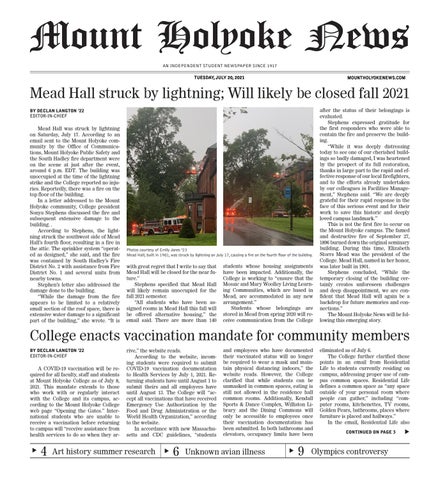
Mead Hall struck by lightning; Will likely be closed fall 2021 BY DECLAN LANGTON ’22 EDITOR-IN-CHIEF
Mead Hall was struck by lightning on Saturday, July 17. According to an email sent to the Mount Holyoke community by the Office of Communications, Mount Holyoke Public Safety and the South Hadley fire department were on the scene at just after the event, around 6 p.m. EDT. The building was unoccupied at the time of the lightning strike and the College reported no injuries. Reportedly, there was a fire on the top floor of the building. In a letter addressed to the Mount Holyoke community, College president Sonya Stephens discussed the fire and subsequent extensive damage to the building. . According to Stephens, the lightning struck the southwest side of Mead Hall’s fourth floor, resulting in a fire in the attic. The sprinkler system “operated as designed,” she said, and the fire was contained by South Hadley’s Fire District No. 2 with assistance from Fire District No. 1 and several units from nearby towns. Stephen’s letter also addressed the damage done to the building. “While the damage from the fire appears to be limited to a relatively small section of the roof space, there is extensive water damage to a significant part of the building,” she wrote. “It is
Photos courtesy of Emily Jones ’23 Mead Hall, built in 1901, was struck by lightning on July 17, causing a fire on the fourth floor of the building.
with great regret that I write to say that Mead Hall will be closed for the near future.” Stephens specified that Mead Hall will likely remain unoccupied for the fall 2021 semester. “All students who have been assigned rooms in Mead Hall this fall will be offered alternative housing,” the email said. There are more than 140
students whose housing assignments have been impacted. Additionally, the College is working to “ensure that the Mosaic and Mary Woolley Living Learning Communities, which are based in Mead, are accommodated in any new arrangement.” Students whose belongings are stored in Mead from spring 2020 will receive communication from the College
after the status of their belongings is evaluated. Stephens expressed gratitude for the first responders who were able to contain the fire and preserve the building. “While it was deeply distressing today to see one of our cherished buildings so badly damaged, I was heartened by the prospect of its full restoration, thanks in large part to the rapid and effective response of our local firefighters, and to the efforts already undertaken by our colleagues in Facilities Management,” Stephens said. “We are deeply grateful for their rapid response in the face of this serious event and for their work to save this historic and deeply loved campus landmark.” This is not the first fire to occur on the Mount Holyoke campus. The famed and destructive fire of September 27, 1896 burned down the original seminary building. During this time, Elizabeth Storrs Mead was the president of the College. Mead Hall, named in her honor, was later built in 1901. Stephens concluded, “While the temporary closing of the building certainly creates unforeseen challenges and deep disappointment, we are confident that Mead Hall will again be a backdrop for future memories and connections.” The Mount Holyoke News will be following this emerging story.
College enacts vaccination mandate for community members BY DECLAN LANGTON ’22 EDITOR-IN-CHIEF
A COVID-19 vaccination will be required for all faculty, staff and students at Mount Holyoke College as of July 8, 2021. This mandate extends to those who work with or regularly interact with the College and its campus, according to the Mount Holyoke College web page “Opening the Gates.” International students who are unable to receive a vaccination before returning to campus will “receive assistance from health services to do so when they ar-
u
4
rive,” the website reads. According to the website, incoming students were required to submit COVID-19 vaccination documentation to Health Services by July 1, 2021. Returning students have until August 1 to submit theirs and all employees have until August 13. The College will “accept all vaccinations that have received Emergency Use Authorization by the Food and Drug Administration or the World Health Organization,” according to the website. In accordance with new Massachusetts and CDC guidelines, “students
Art history summer research
u
6
and employees who have documented their vaccinated status will no longer be required to wear a mask and maintain physical distancing indoors,” the website reads. However, the College clarified that while students can be unmasked in common spaces, eating is still not allowed in the residence hall common rooms. Additionally, Kendall Sports & Dance Complex, Williston Library and the Dining Commons will only be accessible to employees once their vaccination documentation has been submitted. In both bathrooms and elevators, occupancy limits have been
Unknown avian illness
u
9
eliminated as of July 6. The College further clarified these points in an email from Residential Life to students currently residing on campus, addressing proper use of campus common spaces. Residential Life defines a common space as “any space outside of your personal room where people can gather,” including “computer rooms, kitchenettes, TV rooms, Golden Pears, bathrooms, places where furniture is placed and hallways.” In the email, Residential Life also CONTINUED ON PAGE 3
Olympics controversy
u
2
EVENTS
July 20, 2021
Mount Holyoke News Mount Holyoke News is an independent student newspaper written by and for Mount Holyoke College students since 1917. VISIT US: www.mountholyokenews.com www.instagram.com/mtholyokenews_ www.twitter.com/mtholyokenews_
EMAIL US: mhnews@mtholyoke.edu
Executive Board Editor-in-Chief Declan Langton ’22
Publisher Ali Meizels ’23
Managing Editor of Content Liz Lewis ’22
Managing Editor of Web Mariam Keita ’24
Managing Editor of Layout Rose Sheehan ’22
Business Manager Katie Goss ’23
Copy Chief Margaret Connor ’23
Human Resources Coordinator Annabelle Mackson ’23
Editorial Board News Ella White ’22 & Mariam Keita ’24
Environmental Catelyn Fitzgerald ’23
Arts & Entertainment Rose Cohen ’23
Sports Gigi Picard ’22
Opinion/Editorial Jahnavi Pradeep ’23
Copy Editors Audrey Shannon ’22 & Emma Watkins ’23
Global Sophie Soloway ’23
Layout Editor Maggie Donovan ’23 Zoe Tang ’24
Features Rebecca Gagnon ’23
. Mount Holyoke News
Event Highlights Thursday, July 22
New Student Zoom Session –– Embark & Moodle: Tips & Tricks
Learn more about two platforms that you’ll use as part of your orientation and re-orientation experience! With Embark we’ll also talk more about how to get involved at MHC. 7:00 p.m. - 8:00 p.m. EDT
Wednesday, July 28
Transitioning to Mount Holyoke: The Transfer & Frances Perkins Scholar Experience at MHC
This session is specific to new transfer students and Frances Perkins Scholars. We’ll be joined by the Academic Dean for Transfer Students and the Director of the Frances Perkins Program and Transfer Affairs as well as a few student staff members and an MHC alum. 7:00 p.m. - 8:00 p.m. EDT
Thursday, July 29
New Student Zoom Session –– Diversity, Equity and Inclusion at Mount Holyoke
Join our student leaders from ISOC, the orientation team and Community and Inclusion; the associate dean of Students for Community and Inclusion; dean of the Office of Religious and Spiritual Life; director of International Student Advising; and an MHC alum as they discuss what Diversity, Equity and Inclusion looks like at Mount Holyoke 7:00 p.m. - 8:00 p.m. EDT
Publication Guidelines Mount Holyoke News does not endorse any of the opinions or views expressed within the pages of the paper, excluding staff editorials. All content copyright of Mount Holyoke News. All rights reserved. Mount Holyoke News does not discriminate on the basis of gender, race, religion, ethnicity, sexual orientation or age.
Advertising in MHN Interest in advertising in MHN can be directed to mhnews@mtholyoke.edu for pricing and deadlines. MHN reserves the right to refuse submissions on the basis of, but not limited to, advertisements considered to be libelous, obscene, defamatory or discriminatory.
Subscriptions Mount Holyoke News is a weekly publication that will publish online-only throughout the summer of 2021. To subscribe through email, please visit the following form: https://forms.gle/VPCyskE4kMTDeDan8.
Letters Policy Letters to the Editor appear exactly as they are sent to MHN, except for corrections to spelling, grammar and AP style. Letters cannot exceed 500 words. All letters must include the writer’s name and telephone number for verification purposes. Unsigned letters will not be printed. Names may be held upon request with the approval of the Editor-in-Chief. MHN reserves the right to decide which materials will be printed. Email submissions to mhnews@mtholyoke.edu by Sundays at 5 p.m. for publication the following week.
Pioneer Valley Events Tuesday, July 27
Rachel Yoder –– Odyssey Bookshop Author Appearances
Join the Odyssey Bookshop on Crowdcast on Tuesday, July 27 at 7 p.m. for a conversation with Rachel Yoder, author of “Nightbitch.” Joining us in conversation will be author Lyz Lenz. 7:00 p.m. EDT
Thursday, July 29
Celia Jeffries –– Odyssey Bookshop Author Appearances
Join the Odyssey Bookshop on Crowdcast on Thursday, July 29 at 7 p.m. for a Book Talk with Celia Jeffries, author of “Blue Desert.” Joining us in conversation is Ellen Meeropol, author of “Her Sister’s Tattoo.” 7:00 p.m. EDT
July 20, 2021
Town votes to increase police budget BY ELLA WHITE ’22 NEWS EDITOR
“The Movement for Black Lives calls for us to … actively invest in systems that promote the wellbeing rather than the harm of Black people,” Adam Reid said at South Hadley’s annual Town Meeting on June 9, as he proposed a police budget decrease. The proposal, which would reallocate some money from the police budget to public schools, was shot down by voting members during the meeting. The proposal requested $93,288 be taken from the police budget and used for the Mosier Elementary School Stabilization Fund, a project to revitalize the school’s infrastructure. Reid, a voting member, advocated for the proposal. “This amendment, which proposes reallocation of just 2 percent of the total amount of police funding, is an opportunity not only to heed the calls of the Movement for Black Lives, but to prove that we understand a safe community will come from fair and equitable access to resources, rather than the increased policing and surveillance of our neighbors,” he said. According to Reid, the proposal emerged from the collaboration of South Hadley citizens as well as surveys of the overall town population. The Mosier Elementary School Stabilization Fund, a proposal initially introduced in 2018 to help fund repairs for the school’s air circulation and other
3
NEWS
. Mount Holyoke News
issues, was rejected on both the federal and state level. Reid, a public school teacher, stated that the group drafting the amendment felt this was where funding was most needed. The 2021 South Hadley budget for the police department was increased to $3,179,524 from $2,999,979 in 2020, an increase of more than 5 percent. About $99,000 of the 2020 budget was left unused, according to statistics reported by the South Hadley government — an amount that exceeds the proposed decrease. Despite this, the amendment was rejected by Town Meeting Members by a vote of 47 to 34. The Town Meeting is populated by 120 individuals who gather once a year to vote on South Hadley’s budget. Town Meeting Members — the only people eligible to vote on amendments like this one — are elected by the town and serve terms of two or three years, depending on the precinct they represent. At this most recent meeting, Members voted instead to increase the police budget by 3 percent and increase the school budget by 2.3 percent, according to the Daily Hampshire Gazette. As Reid pointed out, 2021 is at least the second consecutive year of significant budget increases for the police department. “We’re at a point to question why the police department is getting a funding increase, and actually being funded more than the department itself initially requested,” Town Meeting Member
Letter to the Editor: Open Letter to Mount Holyoke Community: Calls for Solidarity with Palestine
Alanna Hoyer-Leitzel said, speaking at the Town Meeting in favor of the amendment. The current police budget in South Hadley averages $180 per capita, just half of the national average. Yet South Hadley also has nearly half the rate of violent crime as the Massachusetts average; chances of being a victim of a violent crime in South Hadley are one in 588, compared to one in 305 for all of Massachusetts, according to statistics on Neighborhood Scout. On average, townships in the U.S. spend approximately 10 percent of their budgets on policing, though South Hadley spends slightly over 7 percent. Town Meeting Members, speaking against the amendment, said they did not believe the police should have any budget cuts without proof of wrongdoing. “I have not seen racism in South Hadley,” Raymond Rondeau, a resident and Town Meeting Member who says he has lived in the town for sixty years, said. “Rather than cutting the police budget or attempting to defund the police, we need to salute the police.” “There is no more reason to support the police than there is a local garbage man,” Town Meeting Member Trevor Baptiste said in response. “In fact, I would be acutely more hurt if my garbage man didn’t have the money to provide services for my community than any of us would if $93,000 didn’t go to a police officer.”
Dear Mount Holyoke community, Over the past several months, the world has watched as Palestinian homes and lives have been systematically and violently displaced by Israeli military forces. While these demolitions have been occurring for the entirety of Israel’s statehood, international protests were sparked specifically by Israeli judicial approval of home demolitions in the neighborhoods of Sheikh Jarrah and Lifta — despite international law not recognizing occupying forces as having the capacity to engage in such decisions. Despite these historic global and localized protests, this arm of Israel’s settler-colonial project has only expanded since the first forced displacements were announced in May. Today, Palestinians in Silwan face new waves of evictions and demolitions — all for the sake of the construction of a park open to Israel’s public.
Campus mask mandate lifted, cont’d CONTINUED FROM PAGE 1
u
added that the Community Center, including the Dining Commons, will now become a space where individuals who are vaccinated will be able to umask and eat. Those who are unvaccinated, not fully vaccinated or have not yet documented their vaccinations are still required to continue socially distancing when indoors. All students currently living on campus must continue to be tested twice weekly, on Tuesdays and Fridays, regardless of vaccination status. With a new blend of masked and unmasked individuals on campus, the College asked students to “respect the choices of others who each have their own unique situation.” They further added, “It is inappropriate to ask for the reason behind their choice to wear a mask.” Students with any questions or concerns about the new campus protocol are encouraged to contact the Division of Student Life.
This violent colonial expansion is not new. In fact, citizens of Sheikh Jarrah, Lifta and Silwan have all been engaged in decade-long legal and social battles for the right to remain on their own land. It is imperative to note that these legal procedures were largely funded with U.S. money. With the majority of these Israeli settler organizations receiving support from United States donors, it is clear that U.S. citizens cannot and should not separate themselves from the ongoing settler-colonial ethnic cleansing occurring in East Jerusalem and Palestine as a whole. This expansion is also not unique to these cities. 2020 saw record-breaking rates of colonial displacement in East Jerusalem; approximately 4,500 units of Israeli settlements were constructed, with 170 Palestinian structures demolished and 385 people displaced. As indiCONTINUED ON PAGE 8
u
4
FEATURES
July 20, 2021
. Mount Holyoke News
Professor Ajay Sinha explores photography and Indian dance BY REBECCA GAGNON ’23 FEATURES EDITOR
From exploring different parts of spiral galaxies to examining photographs of an Indian dancer by an American photographer, the Mount Holyoke campus is bustling with life as summer research continues. Ajay Sinha, a professor in the art history and architectural studies departments, is using the summer to continue one of his research projects, a book, with the help of architecture major Sarannya Sharrma ’23. Sinha previously taught Sharrma in one of his classes and offered her an opportunity to help him with the manuscript of his book over the summer. “[The book] basically revolves around an Indian classical dancer that brought the Indian classical dance to the West, in the 1930s, or in the … interwar period,” Sharrma explained, “and this is also when there’s a lot of cross-cultural pain … taking place between the West and the East.” “It’s a project on cross-cultural global photography,” Sinha began, “and it is centered on a group of photographs that I discovered first at the Beinecke Rare Books and Manuscripts Library at Yale University, in 2015.” Sinha’s interest began when he decided to create a teaching syllabus for Indian photography and started to research the subject. Later, while at a conference, he was able to examine a collection of South Asian photography, and this is when he came across the photographs that “zapped” him, as he recalled. Sinha then began to think about each detail of the photographs and the people involved in capturing these moments. This research planted seeds for an article. Then, as his work continued to develop, the project soon grew into a book. Sinha has spent the past six years working on this project. “The subject [of the photographs],” Sinha explained, “was this Indian dancer by the name of Ram Gopal, and the photographs were taken by an American photographer by the name of Carl Van Vechten.” Ram Gopal, born in Bangalore in 1912, was an Indian dancer who began learning the art of dance at a very young age. He was trained in the three main Indian dance styles at the time, Kathakali, Bharatanatyam and Kathak, while also being self-taught in other areas of Indian dance. Gopal is considered one of the first people to show such a variety of Indian dances to a Western audience, from whom he received rave reviews. Still, Gopal was controversial among dancers. “He’s extremely experimental,” Sharrma explained. “A lot of traditionalists did not really approve of his style of dance, because he would experiment with different dance forms, and he was a self-educated, learned elite Indian man who was … very eloquent and knowledgeable.” Carl Van Vechten was born in Iowa in 1880 and also began to explore the arts, starting with music and opera. He later began to write as a critic of dance and music while taking up photography soon after. By the 1920s, he had written several books and become involved in the Harlem Renaissance movement, a golden age for African American culture. This movement resulted in the production of works in literature,
Photo courtesy of Sarannya Sharrma ’23 This summer, Ajay Sinha (left) and Sarannya Sharrma ’23 (right) researched the introduction of classical Indian dance to the West.
theatre, music and art. Vechten supported the Harlem Renaissance through the consumption of Black arts and frequent visits to the movement’s birthplace, the Harlem neighborhood of New York City. “[He was] very involved in that one side of it,” Sinha said. “I mean, given it was the Jim Crow era, right?” To Sinha, given the racial segregation of the 1940s, Vechten was being “very provocative.” “Part of his provocation also was that he … was very interested in interracial … homosexual relations,” Sinha explained. “Imagine in the 1930s, you could be killed for that, but he was provocative both in his writing and then in photography also.” Sinha further shared how, although Vechten was an amateur photographer, he turned his apartment in Manhattan into a photo studio and invited people he knew in the arts, from musicians to dancers, to participate in photoshoots using a German 35 mm Leica camera. That is how the pictures of Ram Gopal that Sinha discovered ended up in Vechten’s collection. Sinha explained how he began to explore the relationship between Gopal, Vechten and the German camera in his book. Vechten had a fascination for the German camera, an aspect Sinha likewise explores in his work. He argues that there’s more to the situation than a simple interaction between dancer and photographer. To Sinha, the intrigue comes from “a triangulation between the photographer who’s exercising his agency and … bringing his own cultural … baggage and the dancer, who’s also bringing a kind of a cultural assumption about his body and dance with the photograph, but also the German camera that is kind of tying the two together.” Sinha expressed that the last two parts of the equation are the refraction from the camera and the visual images that result from this three-piece collaboration. Another topic Sinha covers in the book is the idea of equality. Sinha inferred that the photographs he examined offered something unique in the context of the 1930s. “The photographs are proposing equality,” Sinha explained. “I could see that the dancer is manipulating the image as much as the photographer is manipulating the image, and so [there is] this kind of tug of war that … might have happened in the photo studio. So, equalizing, but in this kind of very unstable sort of way, right, became the subject of my analysis.” Sharrma also found the ideas of the camera that Sinha discusses in the book intriguing and appreciates how he presents the concepts to the readers. “What I love about the book,” Sharrma began, “is that it’s got … a very unbiased and … a third perspective view on
how both subjects, which is the photographer and the dancer are brought together, not through their ideas, but the medium itself, which is the camera lens.” Sharrma later added how the book comprises interpretation and perception, which she believes are well laid out. Each chapter in the book consists of individual topics such as the dancer, Ram Gopal; the photographer, Carl Van Vechten; the camera itself — the exposure, or as Sinha also refers to it, the frame; and how both the photographer and the dancer interact with the camera. Sinha expressed that an interesting aspect of writing the book was exploring different interpretations of each dance move in the photograph. He explained how, with Indian dance, there is a whole vocabulary of specific hand gestures and their meanings. “It’s all body language in a way, and then in performance, in choreography, it can unfold, and there are some mimetic references.” Sinha laughed. “You know, how do you show the flight of geese or the unfolding of lotus?” With only a photograph to reference, instead of the entire dance, Sinha has had to interpret what Gopal meant by each move in the photographs rather than getting the full “narrative.” “Like Professor Sinha also mentions in the book, it’s very easy for an audience member, who knows this classical dance, to know what the dancer’s saying while he’s performing,” Sharrma explained. Through the four-minute dance, the audience watches the storyline play out as the dancer narrates. She continued, “Unlike when he’s being photographed in a studio, and that’s just one still image taken from that four-minute narrative.” At this time, the book is in the final stages of the manuscript as it approaches the fall 2021 deadline. During this point of the writing process, Sinha explained he has been looking at the manuscript as a whole one more time. He has begun to revise based on reviewers’ comments, finalizing the research and the bibliography and looking at Sharrma’s notes. Sinha also recalled he initially did not plan on having help with the manuscript, but the department was able to put some funds together for Sharrma to help him, acting as a second pair of eyes to see if there was anything he overlooked. “[Sharrma] is also a dancer of classical Indian dance,” Sinha laughed. “So how perfect could that be? She actually can look at the technical passages of the dance and look at the photographs, see what I’ve missed even in terms of content using her expertise in Indian classical dance. Isn’t that perfect?” The two meet every Monday in Amherst to discuss any notes Sharrma had on the chapters that she previously read. “I started actively reading … one or two chapters throughout the week,” Sharrma explained. “If there [is] any suggestion to be made, or any image to be omitted, or any footnote or bibliography or image reference to pin down, I do that, as well as actively read the chapter.” Sharrma explained they currently have three documents, one for the bibliography, one for footnotes and one for images. This is how they keep track of everything in the book in order not to lose the information, CONTINUED ON PAGE 9
u
July 20, 2021
. Mount Holyoke News
ARTS & ENTERTAINMENT
5
‘Hacks’ tells the story of an unlikely bond between two comediennes BY ROSE COHEN ’22 & LUCY OSTER ’23 ARTS & ENTERTAINMENT EDITOR & STAFF WRITER
In “Hacks,” the Emmy-nominated HBO Max comedy-drama released in early May, a stubborn 70-year-old veteran comedian meets her match in a self-obsessed, flannel-wearing 25-year-old humorist. The most promising part of the 10-episode series is the unlikely bond between Deborah Vance (portrayed by “Mare of Easttown” actress Jean Smart), a stand-up comic based in Las Vegas, and Ava Daniels (Hannah Einbinder), a comedy writer who has been canceled due to an off-color tweet about a gay senator. This multifaceted relationship creates an engaging show as the episodes dig into the dynamic between these two women. The show draws interest in the first episode when the CEO of the casino Deborah performs at, the Palmetto, threatens to cut back her weekend shows because he wants to appeal to a younger crowd. To help save the star’s career, Deborah’s agent sends Ava from Los Angeles to Las Vegas. “Hacks” ultimately pushes past the simplistic plotline of comedians telling jokes and becomes a tale of two artists connecting. It puts a new spin on the classic odd-couple storyline rehashed in sitcoms and romances time and time again. The two main characters grow to tolerate and even respect one another, despite the cruelty of the insults they hurl at each other at the start of their relationship.
Deborah and Ava’s not thanked her for taking the friendship parallels several time to travel to Las Vegas. well-known relationships Comebacks like this dominate seen in American media the series and leave viewers from the 20th and 21st staring wide-eyed at their centuries. The two emuscreens, wondering which late Harry and Sally from character will back down Rob Reiner’s 1989 classic, from the insult match first. “When Harry Met Sally.” In Viewers may find the duo one scene, the show even appealing because each charreplicates the iconic splitacter has a complicated relascreen phone call from tionship with their family, and the romance film. Their grows to act as a surrogate sparring brings to mind family member for the other. the characters of Michael Ava could easily be Deborah’s Scott and Dwight Shrute daughter because of her age from the American sitcom and her desire to look out for “The Office.” But unlike the Deborah. This is emphasized connections between the in a scene where Ava discovaforementioned characers Deborah’s daughter is ters, it’s difficult to identify selling unflattering pictures the nature of Deborah and Photo courtesy of WikiMedia Commons of the comedian to a celebrity Jean Smart plays Deborah Vance, Las Vegas stand-up comedian. magazine. Ava’s instinct is to Ava’s relationship. When the two comics protect Deborah and tell her meet, they initially resent one another. Once Debo- about the photographs. rah realizes Ava came unprepared for her interview, Like Deborah, Ava lives a lonely life; she has a she calls her out for not researching her. “I’m not a strained relationship with her mother, who views comfan of yours … I mean, the last thing on Earth I want to do is move to the desert to write some lame jokes CONTINUED ON PAGE 8 u for an old hack,” Ava retorts, angry that Deborah has
Britney Spears asks to be free of decade-long conservatorship
Photo courtesy of WikiMedia Commons “I’m not lying. I just want my life back. And it’s been 13 years and it’s enough,” pop artist Britney Spears told the Los Angeles court in June.
BY EMMA WATKINS ’23 STAFF WRITER & COPY EDITOR
On June 23, the long-reigning “Princess of Pop,” Britney Spears, appeared remotely in front of a Los Angeles court and asked them to end her 13-year conservatorship. According to the official website of the Judicial Branch of California, “A conservatorship is a court case where a judge appoints a responsible person or organization (called the ‘conservator’) to care for another adult (called the ‘conservatee’) who cannot care
for himself or herself or manage his or her own finances.” In this case, the conservators are Spears’ father and her attorney. Having suffered under this conservatorship for over a decade, Spears has spoken out previously, but her experiences with courts have not been positive. “I will be honest with you, I haven’t been back to court in a long time because I don’t think I was heard on any level when I came to court the last time,” Spears began. She explained that, under the conservatorship, her management has run her into the ground with rehearsals, performances and tours, and she always had to accept their requests. “I was really, really hard on myself and it was too much,” Spears said in regard to the demands she put on herself during constant touring. “I take everything I do very seriously. There’s tons of video with me at rehearsals. I wasn’t good. I was great,” Spears stated. In what Spears assumes to be retaliation against her for attempting to say no to their extreme demands during her Vegas shows in 2018, her management team changed her medication to a lithium dosage Spears explained can make one “mentally impaired if you take too much, if you stay on it longer than five months.” Spears then described feeling constantly drunk on this new medication, explaining she could not even hold a conversation and required constant monitoring by a team of nurses. Recalling a phone conversation with her father regarding her medication and supposed treatment at a “small rehab program that [Spears’ family and man-
agement would] … make up,” Spears stated that her father — one of the conservators who benefits financially from this legal designation — relished in her emotional anguish. “He loved the control to hurt his own daughter, 100,000 percent,” she said. “He loved it.” Spears compared her experience in the “rehab program” in Beverly Hills to sex trafficking, due to living against her will with the people she worked with and lacking privacy and control over her own body. If she failed to comply with her management’s schedule for her, she would not be permitted to see her children or her boyfriend, model and personal trainer Sam Asghari. Addressing possible skeptics who may not believe her shocking details of past and ongoing mistreatment by her family and management team, Spears said, “I’m not lying. I just want my life back. And it’s been 13 years and it’s enough.” One of the hearing’s revelations most shocking to the public was the news of her forced IUD. “I have an IUD inside of myself right now, so I don’t get pregnant. I wanted to take the IUD out so I could start trying to have another baby,” Spears explained. Under the conservatorship, she is prohibited from getting married or having more children. At the end of the call, Spears expressed she wished she could stay on the phone call forever, for fear of being “ganged up on and … bullied.” She continued, “I deserve to have the same rights as anybody does by having a child, a family, any of those things. And more so.”
6
ENVIRONMENTAL
July 20, 2021
. Mount Holyoke News
Unknown bird illness sweeps through United States BY CATELYN FITZGERALD ’23 ENVIRONMENTAL EDITOR
Scientists are perplexed by an unidentified illness infecting birds in multiple states across the country. Wildlife authorities in Washington D.C., Maryland, Virginia, West Virginia and Kentucky began receiving reports of diseased birds in late May. Since the initial reports, birds with similar symptoms have also been spotted in Delaware, Florida, Indiana, Ohio, Pennsylvania and Tennessee. The illness appears to primarily affect birds’ eyes, with symptoms including “closed, weeping or crusted eyes” and eye lesions, according to the Audubon Maryland-D.C. Neurological symptoms are another aspect of the disease, causing infected birds to appear lethargic and swing their head from side to side. While experts race to identify the elusive illness, authorities in the affected states are asking residents to take down bird feeders and bird baths to prevent the spread of disease. Multiple bird species have been infected with the disease, some of whom, such as the house finch and the northern cardinal, are frequent visitors to these congregate spaces. Bird baths and feeders tend to bring different species together that might not interact in the wild and thereby increase the frequency of interactions between individuals, facilitating the spread of illness. Residents in the affected states have also been advised by the National Wildlife Health Center to clean feeders with a 10 percent bleach solution after taking them down. The indiscriminate nature of the disease makes it
Photo courtesy of pxfuel U.S. residents are encouraged to take down feeders for bird protection.
more difficult to identify, as it is not specific to one geographic area or species. As of July, scientists have only been able to rule out a handful of diseases that have affected bird populations in the past, including avian influenza and West Nile virus. While it is not certain to what extent backyard feeders play a role in the spread of the illness, they have been known to contribute to past avian disease epidemics. House Finch eye disease, for example, was first observed in birds visiting backyard feeders in Maryland and Virginia in 1994. Another feeder-asso-
ciated disease, Trichomoniasis, killed up to 100,000 mourning doves in an outbreak from 1950 through 1951. Neither of these diseases have been effectively eradicated, with gatherings at feeders and bird baths allowing them to continue to spread. Feeding birds is a fun and educational activity that, when done correctly, can make for healthy birds and great entertainment. In a survey of the MHN environmental section’s Instagram following, 49 percent of respondents reported they or their family feed birds in their backyard. Given the popularity of backyard bird feeding, it is important that feeders are properly cared for to prevent the spread of disease. Feeders should keep seed dry, as moisture can facilitate the growth of harmful mold in bird seed. If a feeder is not properly ventilated or if the bird feed is highly exposed to the elements, the feed should be replaced weekly. To prevent many different bird species from congregating at the same feeders where they might pass on an illness, households should put up more than one feeder across multiple locations and include different types of seed in each. Seed hulls discarded by birds can collect moisture and grow mold as they sit on the ground, so they should be removed to prevent ground-feeding birds — like the dark-eyed junco — from becoming sick. Feeding birds is as much of a joy as it is a responsibility. Any form of wildlife feeding diverging from an animal’s natural eating habits poses risks such as spreading disease. Simple actions like taking down a bird feeder or reporting a sick bird can help halt the current disease outbreak, and if enough households follow wildlife authorities’ recommendations, it could bring the disease to a prompt end.
Climate change-driven heat waves reveal cracks in US infrastructure BY HELEN GLOEGE ’23 STAFF WRITER
Built with the climate and weather conditions of the 20th century in mind, today’s infrastructure is not adapted to the changing climate. Unprecedented heat waves in the Pacific Northwest are threatening the local infrastructure, causing warped highways, closed public transit and rolling blackouts. Local residents, many of whom lack air conditioning, are facing power outages due to the heat. There are visible impacts on infrastructure in states experiencing heat waves. In downtown Portland, Oregon, the Portland Streetcar service closed during the heatwave due to the melting of the power cables the service relies on. High-traffic roads in Everson, Washington cracked under the sweltering sun. On the other side of the U.S., New York City residents were urged to decrease their energy consumption to prevent blackouts. Cities across the United States are struggling to manage increased power consumption with ill-equipped power grids. To address a lack of air conditioning in the Pacific Northwest, cities like Portland are opening cooling centers — air-conditioned spaces set up by authorities. Cooling centers in Portland are currently open 24 hours due to concerns about high temperatures during both the day and night. The city is also opening library locations as cooling spaces to assist those ex-
periencing homelessness, those without air conditioning and the elderly. Those most vulnerable to the heat can access transportation to cooling centers as well as other resources through the local government. Cooling centers were closed last year due to the pandemic, but are now open with social distancing and masks required at the centers. The cooling centers promise no one will be turned away, according to Kate Yeiser, who works at the Multnomah County Joint Office for Homeless Services. The City of St. Louis Department of Health has reminded residents to check in on friends and neighbors during heat waves and to educate themselves on the signs of heatstroke. They additionally emphasize not leaving young children and pets in vehicles, which has already led to several fatalities this year. A local initiative, Cooldown St. Louis, helps seniors and people with physical disabilities access new air conditioning units and utilities. The program also aims to aid low-to-moderate income households. Cooling centers are only a short-term solution to a greater infrastructure issue. A major issue identified within infrastructure is the existence of heat islands. Heat islands are urban areas that experience higher temperatures than the surrounding area, because they have more structures to absorb and reemit heat than “greenspace,” or areas with trees and other vegetation. According to the U.S. Environmental Protection Agency, heat islands in the U.S. are as much as 7
Photo courtesy of pxhere New York City has asked residents to decrease electricity consumption.
degrees Fahrenheit hotter than outlying areas during the day and 5 degrees hotter at night. In Boston, most heat islands are located in low-income neighborhoods where fewer people have air conditioning or tree cover. A report by D.C.-based conservation group American Forests found neighborhoods with mostly residents of color have on average 33 percent less tree canopy than mostly white neighborhoods. It also found that neighborhoods with 90 percent or more residents living in poverty have 41 CONTINUED ON PAGE 8
u
July 20, 2021
BOOKS
. Mount Holyoke News
7
The Tolkien Society seminar focuses on diversity and inclusion
Photo courtesy of Flickr The 2021 conference featured discussion of identity in Tolkien’s works.
BY AMELIA SCARPONI ’23 STAFF WRITER
The literary organization The Tolkien Society, founded around a half-century ago, is dedicated to promoting the life and works of the British scholar and author of the high fantasy novel “The Lord of the Rings,” J.R.R. Tolkien. Since 1986, the Society has held an annual short summer conference consisting of academic talks and panel discussions on a Tolkien-related theme. The 2021 Summer Seminar, titled “Tolkien and Diversity,” was held live via Zoom on July 3 and July 4. The conference, free to the public, hosted more than 500 attendees from 42 countries. The theme of diversity received backlash from right-wing political commentators who accused the society of going “woke.” To counter the Tolkien Society’s focus on diversity, software developer Keith Casey founded a new literary organization called the Society of Tolkien. In an interview with the conservative online editorial The Daily Wire, Casey said, “Tolkien’s works are won-
derful and should be cherished and understood as he wrote them instead of twisted to fit current social fads.” The Society of Tolkien also held their conference honoring Tolkiens’ works on July 3. The newly announced seminar covered topics including “Solving Gollum’s Riddles: An Ode to Tolkien and Old English” and “Mapping Middle-earth.” The Tolkien Society recognized that the topic of diversity has steadily increased within Tolkien-related academic and literary research. According to The Tolkien Society, “It is now receiving more critical attention than ever before. Spurred by recent interpretations of Tolkien’s creations and the cast list of the upcoming Amazon show ‘The Lord of the Rings,’ it is crucial we discuss the theme of diversity in relation to Tolkien.” The seminar included themes on gender norms, heteronormative ideals, colonialism, post-colonialism and identity within Tolkien’s work. Papers presented at the conference discussed “Transgender Realities in ‘The Lord of the Rings,’” “Destabilizing Cishetero Amatonormativity in the Works of Tolkien” and “The Invisible Other: Tolkien’s Dwarf-Women and the ‘Feminine Lack.’” According to Anna Smol, Professor of English at Mount Saint Vincent University, The Tolkien Society’s summer seminars provide a space to critique and to appreciate Tolkiens’ work through a new lens. In her blog, titled “A Single Leaf,” dedicated to her teachings and research of Tolkien, Smol wrote, “What Tolkien has written has gone out into the world and, like any influential literature, it is being read, interpreted, used — for good and for ill — in various ways by readers around the globe.” She continued, “Trying to understand this about Tolkien’s work, as with any other pieces of literature, is a standard part of literary research, which leads to a better understanding of our contemporary culture.” Sara Brown, Faculty Chair of the Language and
Literature Faculty at Signum University and one of the sixteen academic presenters at the conference, explored themes of womanhood and identity in her paper, also titled, “The Invisible Other: Tolkien’s Dwarf-Women and the ‘Feminine Lack.’” Brown’s piece posits that reading Tolkien through the lens of French existentialist writer Simone de Beauvior and American philosopher Judith Butler shows the invisibility and marginalization of female characters in Tolkien’s Middle-earth legendarium. Themes from previous years have touched on myth, lore and immortality. They have included papers such as “Tolkien, The Monsters, The Middle-ages and Middle-earth,” “Life, Death and Immortality” and “Tolkien the Pagan? Reading Middle-earth through a Spiritual Lens.” As a devout Roman Catholic, Tolkien’s novels were written in the Christian tradition and full of Christian symbols; however, his intention was never to proselytize. In a letter addressed to Father Murray, a priest and family friend, Tolkien revealed, “The Lord of the Rings is, of course, a fundamentally religious and Catholic work, unconsciously so at first, but consciously in revision.” Political Editor for the conservative online publication The Federalist John Daniel Davidson believes modern scholars aren’t interested in understanding Tolkien’s work, but instead want to tear it down. In a The Federalist article, titled, “In An Affront to its Namesake, The Tolkien Society Goes Woke,” Davidson wrote, “everything that Tolkien was, and everything he wrote, is an affront to the modern secular scholar’s understanding of the world, reality, and the meaning and purpose of life.” The controversy regarding The Tolkien Society’s decision to focus on diversity and inclusion for their 2021 Summer Seminar continues to renew conversations about authorial intent versus reader interpretation and the future of academia.
Letter to the Editor, cont’d u
CONTINUED FROM PAGE 3
viduals across Palestine experience dehumanizing brutality from Israel’s occupation forces in addition to an ongoing theft of land and loss of property ownership, these numbers will only continue to grow. As tragedy after tragedy occurs in Palestine, it is important to call on the victories that Palestinian activists have won. Recently, Ghadanfar Abu Atwan, a Palestinian who was imprisoned by Israel with no charges, ended his 65-day hunger strike and fourday water strike. This strike was a protest of his arrest and was able to grant him liberation from the occupation’s prison. Abu Atwan’s strength and the persistence of the ever-growing Palestine solidarity movement overcame the apartheid state’s joke of a justice system. For many in the Mount Holyoke Community, online calls to “Save Sheikh Jarrah” represented their first time actively engaging in anti-Zionist conversations regarding Palestinian liberation. As a campus group committed to advocating for Palestinian
Solidarity, this newfound attention brought about some new hopes for tangible actions on behalf of our campus community. While news cycles and attention shift, we are calling for continued solidarity and resistance from those at Mount Holyoke College who do not want to remain complicit in one of the largest settler colonial projects we have seen in history. For inspiration, we should look to our MHC student comrades from the ’80s who protested for an end to the College’s investment in aparthied South Africa. Students advocated for divestment from the settler-colonial stronghold and the school listened. Unfortunately, the school reneged on their commitment to hold the African aparthied state accountable and secretly reinvested in the calculating colonial project once the students graduated. We ask that the Mount Holyoke News take accountability for inconsistent and sparse representation of the atrocities occurring in Palestine. With only two articles covering Zionist violence in the past year, it is no wonder that the broader Mount Holyoke community feels comfortable remaining silent as the set-
tler project continues. As an independent student newspaper, it is your responsibility to represent the opinions held by community members rather than administration or others who see pro-Palestinian advocacy as uncomfortable or not profitable. We demand that Mount Holyoke College students and administration alike take a more active role in the anti-apartheid movement of our time. We demand accountability from the College regarding their own investments in or ties with the settler state of Israel. We have seen the revolutionary results of pro-Palestine student activism within our own Five College Community. Hampshire College’s own Students for Justice in Palestine group was able to achieve full divestment from its campus, and continues to engage in liberatory education and actions. We have seen that divestment — and more — is possible, and it is our responsibility as a community to take up this fight in our own College. In solidarity, Mount Holyoke Palestinian Solidarity Group
8
GLOBAL
July 20, 2021
. Mount Holyoke News
Nigerian government bans Twitter, threatens to expand censorship reversed the general ban. Professor of politics Ali Aslam noted the Twitter ban is likely a response to the past year’s activism, commenting, “My views on social media generally are The Nigerian government announced on June 5 that platforms like Twitter can be incredible resources that the country’s citizens would no longer be able for activists. This explains why governments like Nito access Twitter. This ban followed the social media geria and Egypt before it, to name two, try to either platform’s decision to delete tweets published by Nige- ban them or shut down the internet during moments rian President Muhammadu Buhari. of unrest.” This decision from the state government follows The #EndSARS movement has indeed found a a year of historic protests in Nigeria. The #EndSARS large portion of its following through Twitter. After the movement in particular –– a initial video detailing SARS viwidespread anti-police brutalolence was released, demands ity campaign –– has attracted “My views on social media generally for justice circulated globally global attention since its reon the platform, while activare that platforms like Twitter can surgence in early October folists in the country and across lowing the publicized murder be incredible resources for activists. the world communicated their of a Nigerian citizen, Daniel This explains why governments like demands and publicized their Chibuike, by the country’s actions via trending tweets. Nigeria and Egypt before it, to name Special Anti-Robbery Squad. Weeks after the initial In the months following his two, try to either ban them or shut Twitter ban was announced, death, protests have largely down the internet during moments of the Nigerian government enbeen met with further police gaged in talks regarding furunrest.” violence and suppression from ther regulations specifically the state. impacting the country’s press. Buhari’s tweets, pubThe President’s All Progres- Ali Aslam lished on June 1, specifically sive Congress party has proaddressed these protestors posed an amendment creating in southeastern Nigeria and referenced the 1967 Ni- a code of conduct for journalists in the country. The gerian-Biafran Civil War, leading many citizens and proposed bill would allow the government to fine and activists to view the tweets as a threat of violence prosecute media producers for content deemed “fake against those voicing dissent. Although the West Afri- news.” Many in Nigeria have voiced concerns that this can regional bloc — the Economic Community of West decision, and those that might follow, will allow furAfrican States — barred the government from prose- ther repression of political dissent. cuting individuals or corporations in Nigeria for using However, Aslam noted that social media corporaTwitter since the ban was enacted, the state has not tions are powerful entities and may not be overthrown BY SOPHIE SOLOWAY ’23 GLOBAL EDITOR
Photo courtesy of Bayo Omoboriowo Nigerian President Muhammadu Buhari bans Twitter use by citizens.
so quickly, stating, “On the other side, banning a platform points to how powerless governments are to regulate these corporations. [This] suggests the ineffectiveness of leaving corporations to regulate themselves given that this role has been subordinated to keeping users engaged on the platforms and generating revenue as a result.” As courts debate the enforceability of Buhari’s Twitter ban, and as Twitter advocates for its own presence in the country, activists across Nigeria continue to demand an end to the police brutality and state repression.
‘Hacks’ reimagines the odd couple, cont’d
Greenspace, cont’d
Ava takes it as such, but as she watches clips of Deborah’s old stand-up, Ava realizes she and her boss both possess a similar hunger for career success. edy as an “unstable career.” In one scene, she tells Viewers are also encouraged to keep watching her daughter, “Okay, so now you’re a better writer the show because of the hinted romance between than God … I know that you think that everybody Ava and Deborah. At times, their banter seems unneeds to hear from you.” Ava also lacks close friends; deniably flirtatious, despite the harshness of their when she runs into some of her Los Angeles peers insults toward one another. At one point, Ava even at the Palmetto, they reject dreams of her and Deborah her request to hang out with making out. It’s impossible them. Ava assumes it’s beto tell whether Deborah cause of her tweet, until one of Ava as a possible At times, their banter seems undeni- thinks of them replies Ava was “an love interest; however, some ably flirtatious, despite the harshness of their interactions point asshole” long before her social media mistake. “The last to the possibility of a love of their insults toward one another. thing you asked me was for a story. plus one to my premiere parWatchers might be ty,” her friend explains. tempted to turn off their As the show progresses, screens after picking up on Deborah and Ava grow closer. After sending Ava the odd-couple storyline, which seems somewhat to an antique store to secure an expensive pepper predictable at this point. But “Hacks” does a fine job shaker, Deborah allows Ava to sort through and or- elevating the age-old dynamic, adding finding new ganize videos and publications featuring her past empathy for the characters. work. Deborah intends the job to be demeaning, and
u
u
CONTINUED FROM PAGE 5
CONTINUED FROM PAGE 6
percent less tree canopy than neighborhoods with 10 percent or less of the residents in poverty. The development of heat disparities across racial and socioeconomic strata may be attributed to a history of racial inequity and redlining. This is because neighborhoods with less greenspace and government spending were determined to be hazardous for loans by banks, and gradually became warmer due to that lack of greenspace. The city is currently planning on adding cooling zones in libraries within the affected neighborhoods to address heat disparities. Today’s infrastructure was not built with climate change in mind, bringing rise to calls for change. Whether this happens by adjusting current infrastructure to face new levels of heat or building cooling centers to protect human health, infrastructure changes would need to consider the needs of vulnerable communities to permanently reduce heat disparities.
July 20, 2021
SPORTS
. Mount Holyoke News
9
Sha’Carri Richardson and Laurel Hubbard face Olympic controversy
Graphic by Gabby Gagnon ’24
BY GIGI PICARD ’22 SPORTS EDITOR
The calls to cancel the Tokyo Olympic Games once more have been pushed aside. The opening ceremony of the Olympic Games is only three days away. However, there have been some twists and turns regarding who will compete in Tokyo.
Sha’Carri Richardson excluded from U.S. Olympic Team
For example, the public was stunned when 21-yearold United States women’s track star Sha’Carri Richardson was disqualified from competing in the games. The New York Times reported “gold-medal favorite” Richardson tested positive for marijuana, a banned substance, and was given a one month suspension, prohibiting her from running in the 100-meter sprint. There was a chance she would run in the 4x100 meter relay for Team USA, but the decision was made not to include her on the American team. Her suspension length was determined based on the drug not being used for performance enhancement, but as a way of coping with the recent death of her biological mother. In response to the suspension, which ends July 27, she tweeted, “I am human.” Richardson received overwhelming support across social media from celebrities, politicians, fellow athletes and her sponsor Nike. The statement from Nike read, “We appreciate [Richardson’s] honesty and accountability and will continue to support her through this time.” United States Women’s National Soccer Team star Megan Rapinoe tweeted, “This is trash. Standing with [Richardson]. This has BEEN outdated.” Retired basketball star Dwyane Wade tweeted, “But majority of y’all rule makers smoke and probably are investors in THC companies. Let’s stop playing these games.” One of the major reasons Richardson has received so much support is the opinion that marijuana is not a performance-enhancing drug. The New York Times reported that, while the World Anti-Doping Agency lists marijuana as a prohibited substance, “there’s no scientific evidence that it can make people bigger, stronger or faster athletes.” In fact, “if anything, cannabis — the scientific name for the hemp plant, from which marijuana is derived — has a reputation for decreasing athletic performance.” To further support Richardson, Wade’s spouse
Gabrielle Union tweeted a similar sentiment, saying, “Weed is great for many a thing but running faster isn’t one of them. LET HER RUN!!!” Actor and comedian Seth Rogen, well known for his marijuana use, tweeted, “The notion that weed is a problematic ‘drug’ is rooted in racism. It’s insane that Team USA would disqualify one of this country’s most talented athletes over thinking that’s rooted in hatred. It’s something they should be ashamed of.” Rogen referenced the late United States track sprinter Florence Griffith Joyner in his tweet, adding, “Also if weed made you fast, I’d be FloJo.” Congresswoman Alexandria Ocasio-Cortez tweeted: “The criminalization and banning of cannabis is an instrument of racist and colonial policy. The [International Olympic Committee] should reconsider its suspension of Ms. Richardson and any athletes penalized for cannabis use. This ruling along w/ IOC denial of swim caps for natural hair is deeply troubling.” Ocasio-Cortez co-wrote a letter in collaboration with Representative Jamie Raskin to the United States Anti-Doping Agency advocating that they overturn Richardson’s suspension. A summation of the agency’s public response stated they must follow the banned substance list provided by the World Anti-Doping Agency, including marijuana. According to the statement, Richardson’s one month ban was the minimum, and there was no chance of reversal, since she accepted her suspension. A longer suspension could have been given to Richardson if the USADA tried to reverse it, because the WADA, the International Olympic Committee or World Athletics would have appealed, and the governments of nations are uninterested in removing marijuana from the Prohibited List due to public health reasons. The agency felt it worth noting the United States government pushed the hardest for marijuana to be added to the banned substance list in 2004. Ocasio-Cortez responded further afterwards, tweeting, “We worked with [Raskin] and the Subcommittee on Civil Rights & Civil Liberties to formally ask [USADA] to end Sha’Carri Richardson’s suspension. Their decision lacks any scientific basis. It’s rooted solely in the systemic racism that’s long driven anti-marijuana laws.” In an interview with Today’s Savannah Guthrie, Richardson said, “I would like to say to my friends, my family, my sponsorship, to the haters too: I apologize. As much as I’m disappointed, I know that when I step on the track I don’t represent myself, I represent a community that has shown me great support, great love.”
Laurel Hubbard makes history as first transgender Olympic athlete
At the same time, another high-profile Olympics story was circulating in the media — that of New Zealand’s Laurel Hubbard. She will be the fourth oldest weightlifter and first transgender athlete to compete at the Olympics. Hubbard began her transition in 2012 at age 35 and did not participate in international weightlifting until after she had transitioned, though she had previously competed domestically. Now, she is seen as a medal contender in the 87 kg-plus weightlifting category. The Guardian reported that, in 2015, the International Olympic Committee adjusted their reg-
ulations, allowing for Hubbard to be included. Transgender women are now able to compete without having an orchiectomy if their testosterone level in serum is below 10 nanomoles per litre for at least 12 months. However, Hubbard’s competitors have expressed displeasure about her competing, as they believe she has an unfair advantage in sports. The Guardian quoted Belgian super-heavyweight weightlifter Anna Van Bellinghen as saying, “Anyone that has trained weightlifting at a high level knows this to be true in their bones: This particular situation is unfair to the sport and to the athletes.” Van Bellinghen claimed she supports the transgender community. The BBC reported that this isn’t the first controversy involving Hubbard, as Australia’s weightlifting federation attempted to bar her from the 2018 Commonwealth Games on the Gold Coast. Hubbard pulled out anyway due to an injury. There was another stir when she won gold at the 2019 Pacific Games in Samoa, defeating a Samoan athlete. Nevertheless, Hubbard is still supported by New Zealand Olympic Committee chief executive Kereyn Smith. “We acknowledge that gender identity in sport is a highly sensitive and complex issue requiring a balance between human rights and fairness on the field of play,” Smith said. According to the Guardian, Hubbard said, “I am grateful and humbled by the kindness and support that has been given to me by so many New Zealanders. When I broke my arm at the Commonwealth Games three years ago, I was advised that my sporting career had likely reached its end. But your support, your encouragement, and your ‘aroha’ [affection] carried me through the darkness.”
Indian dance research, cont’d u
CONTINUED FROM PAGE 4
should they need to refer back to it at any point. Although this is the first time Sinha is receiving help from a student for summer research, he expressed that trust and getting to know one another is a key part of a successful collaboration. He also noted his advice for students would be to work with professors with whom one has chemistry. This way, the collaboration becomes mutually beneficial. Sharrma’s advice would be to read a lot. “If you’re passionate about something, any topic, just start reading,” Sharrma said. “Read articles written by professors at Mount Holyoke, or the Five College Consortium. Then send them an email telling them that ‘I really liked this particular discussion topic,’ and that’s how you build a network.” Sinha later added that professors also appreciate when students reach out to them to discuss different topics. “We want your success, you know,” Sinha said. “We are invested in your success and so, you know, whatever we can do it … we will do … we root for you.”