Mount Holyoke News AN INDEPENDENT STUDENT NEWSPAPER SINCE 1917 MONDAY, JUNE 29, 2020
MOUNTHOLYOKENEWS.COM
College administrators roll out plan for distributing CARES Act funds BY SHANZE HASAN ’21 NEWS STAFF WRITER
On Monday, June 15, a few days after the College announced information regarding the Coronavirus Aid, Relief and Economic Security (CARES) Act, students who receive financial aid were notified by Student Financial Services about their eligibility for funding under the Higher Education Emergency Relief Fund. The CARES Act is a federal grant that was recently introduced in order to provide relief to individuals as well as businesses in order to combat the negative impacts of the pandemic. According to the U.S. Department of the Treasury, the $2 trillion coronavirus economic stimulus bill was passed after much negotiation and was implemented on March 27, 2020 by President Donald Trump. According to the U.S. Department of Education, HEERF was established by Congress to provide funding to colleges and universities around the nation. Mount Holyoke was awarded this funding based on the total number of Pell Grant recipients enrolled in the College by a formula devised by the U.S. Department of Education. The College will receive $794,402, which will be directly distributed to students in the form of emergency grants. “At a time when unemployment is skyrocketing, I’m glad us students are being provided with some sort of relief,” Zenia Saqib ’20 said. 2020 graduates who were enrolled through March 27 will also qualify to receive grants. These grants will range from $200 to $1,200 based on the students’ eligibility. In order to qualify for this funding, students must be enrolled as degree-seeking undergraduates, as of March 27. They must meet the Title IV Federal Financial Aid eligibility requirements, meet the minimum requirements of satisfactory academic progress and have a family contribution of less than $35,000 in the 2019-2020 academic year. The College will distribute the grants in two phases. The initial phase, around mid-June, will directly deposit a major chunk of the funding into the eligible students’ accounts via Zelle Pay. In the second phase in mid-July, after the eligible students’ needs have been met, 10 percent of the remaining funding will be allocated to those who did not receive a grant in the initial phase through an application process. Each grant applied in the second phase will not exceed $200 per student. Funds allotted to those who qualify were determined by Student Financial Services, Student Life and Diversity, Equity and Inclusion as per the government’s guidelines. Grants were allocated based on each student’s family contribution using the College’s process of Institutional Methodology. DACA and international students who would normally qualify to receive funding under the aforemenCONTINUED ON PAGE 4
u
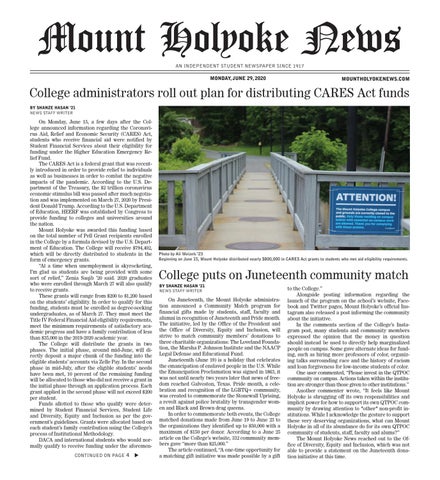
Photo by Ali Meizels ‘23 Beginning on June 15, Mount Holyoke distributed nearly $800,000 in CARES Act grants to students who met aid eligibility requirements.
College puts on Juneteenth community match BY SHANZE HASAN ’21 NEWS STAFF WRITER
On Juneteenth, the Mount Holyoke administration announced a Community Match program for financial gifts made by students, staff, faculty and alumni in recognition of Juneteenth and Pride month. The initiative, led by the Office of the President and the Office of Diversity, Equity and Inclusion, will strive to match community members’ donations to three charitable organizations: The Loveland Foundation, the Marsha P. Johnson Institute and the NAACP Legal Defense and Educational Fund. Juneteenth (June 19) is a holiday that celebrates the emancipation of enslaved people in the U.S. While the Emancipation Proclamation was signed in 1863, it was not until nearly two years later that news of freedom reached Galveston, Texas. Pride month, a celebration and recognition of the LGBTQ+ community, was created to commemorate the Stonewall Uprising, a revolt against police brutality by transgender women and Black and Brown drag queens. In order to commemorate both events, the College matched donations made from June 19 to June 23 to the organizations they identified up to $50,000 with a maximum of $150 per donor. According to a June 25 article on the College’s website, 332 community members gave “more than $25,000.” The article continued, “A one-time opportunity for a matching gift initiative was made possible by a gift
to the College.” Alongside posting information regarding the launch of the program on the school’s website, Facebook and Twitter pages, Mount Holyoke’s official Instagram also released a post informing the community about the initiative. In the comments section of the College’s Instagram post, many students and community members expressed the opinion that the money in question should instead be used to directly help marginalized people on campus. Some gave alternate ideas for funding, such as hiring more professors of color, organizing talks surrounding race and the history of racism and loan forgiveness for low-income students of color. One user commented, “Please invest in the QTPOC community on campus. Actions taken within the institution are stronger than those given to other institutions.” Another commenter wrote, “It feels like Mount Holyoke is shrugging off its own responsibilities and implicit power for how to support its own QTPOC community by drawing attention to *other* non-profit institutions. While I acknowledge the gesture to support these very deserving organizations, what can Mount Holyoke in all of its abundance do for its own QTPOC community of students, staff, faculty and alums?” The Mount Holyoke News reached out to the Office of Diversity, Equity and Inclusion, which was not able to provide a statement on the Juneteenth donation initiative at this time.
2
.
Mount Holyoke News June 29, 2020
Mount Holyoke News Mount Holyoke News is an independent student newspaper written by and for Mount Holyoke College students since 1917. VISIT US: www.mountholyokenews.com www.facebook.com/themhnews www.twitter.com/mtholyokenews_
EMAIL US: mhnews@mtholyoke.edu
Executive Board Editor-in-Chief
Managing Editor of Content
Lily Reavis ’21
Flannery Langton ’22
Copy Chief
Managing Editor of Layout
Kelsey Thomas ’21
Yasmin Andrews ’22
Managing Editor of Web Zoë Farr ’21
Editoral Board News
Letter to the Editor Voting at MHC My generation, 18-to 21-year-olds, make up the highest eligible voter population in the country, but have the lowest voting rate. Before COVID-19 took over, organizations like Student Public Interest Research Groups (PIRGs) were focusing on campaigns like the New Voters Project on college campuses to motivate students to vote. What can we do to fix this while still making sure people are voting safely? At Mount Holyoke, in 2018, our campus had a 59.9 percent voter turnout, which means that over 700 students did not vote. For our school, that is more than an entire class year! It is time for our campus to get as excited for voting as we do when we hear “Baby’s starting Mount Holyoke College in the fall.” Our international students will be affected by whatever policy or official is in office so those who have the ability to vote, should! The state of our college is unknown right now but elections will still take place in the fall even if we are virtually learning. Reach out to your local congressman about how you can vote safely in your hometown. I vote because it is my right. It is my way of having a voice at an age where I can’t run for office. Mount Holyoke is a place of inclusion and where leaders are educated so our campus should work on being the leading college with voter turnout in the Pioneer Valley.
Environmental
Kate Turner ’21, Casey Roepke ’21, & Liz Lewis ’22
Meryl Phair ’22
Arts & Entertainment
Photos
Sabryna Coppola ’22
Ali Meizels ’23 & Rosemary Geib ’23
Layout Rose Sheehan ’22
Publication Guidelines Mount Holyoke News does not endorse any of the opinions or views expressed within the pages of the paper, excluding staff editorials. All content copyright of Mount Holyoke News. All rights reserved. Mount Holyoke News does not discriminate on the basis of gender, race, religion, ethnicity, sexual orientation or age.
Letters Policy Letters to the Editor appear exactly as they are sent to MHN, except for corrections to spelling, grammar and AP style. Letters cannot exceed 500 words. All letters must include the writer’s name and telephone number for verification purposes. Unsigned letters will not be printed. Names may be held upon request with the approval of the Editor-in-Chief. MHN reserves the right to decide which materials will be printed. Email submissions to mhnews@mtholyoke.edu by Saturdays at 5 p.m. for publication the following week.
Subscription To subscribe to our independent, student-run, biweekly newsletter throughout summer 2020, sign up at: https://forms.gle/9RPZybRqNuCwqJao7
Jaxzia Perez Mount Holyoke Student Student PIRGs Summer Intern
Low voter turnout: An urgent national crisis Amid the current public health crisis and racial justice protests across the country, the U.S. is facing an additional problem: a significant decline in voter registration. According to a recent USA Today article, new voter registration is down 70 percent in comparison to this time four years ago, a substantial decrease that will have serious repercussions for the presidential elections in November. Low voter turnout among young people is not a new phenomenon, because despite being the largest age demographic in the country, people aged 18 to 29 vote at rates 30 percent lower than other age groups on average. This discrepancy needs to be addressed immediately, for young people deserve to express how a plethora of political issues uniquely impact their age group. While it is improbable that all young people across the nation will be given easy access to voting resources, outreach on college and university campuses is an effective place to start. It is key that campuses create active voting coalitions to ensure that voting is easy and safe, as well as engage students with the democratic process as a whole. It is imperative that members of the administration, faculty, staff and student organizations work together to actively promote voter registration resources and encourage students to have their opinions represented on Election Day. Young people will inherit the political decisions made by elected officials, and the effects of these decisions have the potential to drastically impact our lives, for better or for worse. We deserve to have our opinions heard. We must vote. Kate Murray Mount Holyoke Student Student PIRGs Summer Intern
3
.
Mount Holyoke News June 29, 2020
Trump’s executive order stops the government from issuing new work visas BY CASEY ROEPKE ’21 NEWS EDITOR
President Donald Trump issued an executive order to temporarily suspend new work visas on Monday, June 22. This executive order will combine with existing green card issuance restrictions to bar over 500,000 workers from entering the country, according to The New York Times. The order went into effect on June 24 and will continue through Dec. 31, 2020. In a statement to the Mount Holyoke community, Bri Rhodes, the director of international student advising for the McCulloch Center for Global Initiatives, outlined the impacts of this executive order. Rhodes wrote that Trump’s order “suspends issuance of NEW work visas for those who are currently outside of the U.S.” Rhodes continued, “There are some exceptions for some people working in health, defense or law enforcement but it’s very unclear what that means.” Dean of Faculty Jon Western also issued a statement in response to the visa suspension. He wrote, “At
this point, no member of our community is directly impacted. We continue to be in touch with all faculty and staff who hold visas and recent alums on OPT (Optional Practical Training) to share updates from our legal counsel.” According to Rhodes, this suspension of new visas will mean that international workers cannot be issued employment-based visas, although there is a “relevant exception for people seeking a J (exchange visitor) visa as a professor or a scholar.” She said there is “no direct, legal impact on students” because student visas are different from the employment-based visas affected by Trump’s order. Students who are trying to change their visa type from a student visa to a work visa are still allowed to apply. The executive order does impact the College’s relationship with international faculty. “This [order] could impair the College’s ability to recruit some international faculty, depriving students of the opportunity to learn with them,” Rhodes said. “It could make employers in general more wary of hiring international employees and reduce job opportuni-
ties for those seeking work visas.” Rhodes also spoke of the psychological effect the order may have on students. “It is inaccurate to say that the order has no impact on students,” she said. “While more than a quarter of Mount Holyoke students are international students here on student visas, many others are on a variety of visa types [which] come from mixed-status families.” Rhodes explained that, while the College was aware that an order affecting work visas was in the works since late May, no one knew what the contents would be. The College’s stance on the executive order was articulated by Western in his statement. “I want to express my profound disagreement with this executive order and the broader effort by this administration to restrict the flow of people across borders,” Western wrote. “This is antithetical to our scholarly mission and purpose which is premised on the free flow of people and ideas that are vital to the creation of knowledge and core to our commitment to global diversity and inclusiveness.”
Dean Western steps down, Prof. Dorothy Mosby to serve as interim BY KATE TURNER ’21 NEWS EDITOR
Mount Holyoke’s Vice President of Academic Affairs and Dean of Faculty Jon Western announced that he would be stepping down from both positions after his four-year term. “This has been a very difficult decision for me personally, but, particularly at this moment in history, I am looking forward to returning to my work on human rights issues around the world, completing a long-postponed writing project that is near to my heart, reconnecting with students in the classroom and, of course, spending more time with my family,” Western wrote in a letter to the College community. Professor of Spanish and Associate Dean of Faculty Dorothy Mosby will serve as interim vice president
of academic affairs and dean of faculty for a period of two years, through June 3, 2022. “[Mosby] brings to the role of dean of faculty her deep knowledge and understanding of Mount Holyoke and the life and work of its faculty, a wealth of experience in the administration of academic affairs over the last four years and fresh perspectives,” College President Sonya Stephens wrote in a letter to the community following Dean Western’s announcement. “She also brings to the work ahead her hallmark thoughtful engagement, intellectual energy, great insight and integrity, as well as a genuine concern and strong advocacy for others and for their professional success.” Beyond the statements released by Dean Western and President Stephens, the College’s communications team was unavailable for comment on the transition.
Photo by Flannery Langton ’22 Jon Western (left) and Dorothy Mosby (right) spoke at a Student Government Association Town Hall meeting in Oct. 2018. Mosby will serve as interim vice president of academic affairs and dean of faculty for two years, following Western’s recent announcement that he would step down.
COVID-19 inequitably affects people of color due to systemic racism BY FIONA HINDS ’21 HEALTH AND SCIENCE STAFF WRITER
The impact of COVID-19 has been felt across the world, but it has not been felt equally. According to the ADL article “How Systemic Racism Impacts Coronavirus Racial Disparities,” communities of color in the United States are particularly hard-hit by the pandemic due to the country’s structural racism. Structural racism is grounded in the foundation of white supremacy, shown through its presence in laws and institutions. The impacts of structural racism are brought to the surface when considering the impacts of COVID-19 on communities of color. Black, Latinx and Native American communities are more likely than white communities to have higher rates of underlying health conditions, such as asthma or diabetes, because of structural racism in the housing and health care systems. People of color are also less likely to be able to access COVID-19 testing and treatment, as setbacks due to systemic racism cause many individuals to be
uninsured or to face discrimination in the medical field. Roughly 24 percent of Black and Latinx people in the United States are employed in the service industry, compared to 16 percent of white people. These jobs put their workers at an increased risk of exposure to the virus because they cannot be performed from home and are done in spaces where social distancing is more difficult. Workers in this field are also more likely to lose their jobs, as the industry has seen many workers laid off or furloughed. The differing possible impacts of wearing a face covering have also been highlighted throughout the pandemic. In the Washington Post article “Masking while black: A coronavirus story,” the author, Damon Young, discusses how being Black and wearing a mask makes one appear to be more threatening than a white person wearing a mask, due to structural racism. Police are more likely to question or be violent towards Black men who are wearing masks in public, despite the universal necessity of wearing one due to the pandemic.
As a result of structural racism, people of color, especially Black communities, are disproportionately affected by COVID-19. According to the Brookings article “Race gaps in COVID-19 deaths are even bigger than they appear,” Black and Latinx people are at a significantly higher risk of death from COVID-19 than white people. Specifically, based on data from the Centers for Disease Control and Prevention, Black and Latinx people are more likely to die from COVID-19 than white people in every age category. For instance, Black and Latinx people between ages 44-54 are at least six times more likely to die than white people. Significantly more young Black and Latinx people contracted COVID-19 than young white people. Adjusting for age, Black people die from COVID-19 3.6 times more than white people, and Latinx people die from COVID-19 2.5 times more than white people. These statistics allude to the larger problems in American society concerning the unequal treatment of communities of color through the systems implemented to protect everyone. The pandemic is an example of where these inequalities become life or death.
4
.
Mount Holyoke News June 29, 2020
Environmental racism: ‘There is no sustainable way of living without justice,’ says head of Mount Holyoke’s environmental center BY CATELYN FITZGERALD ’23 ENVIRONMENTAL STAFF WRITER
Climate change is a global issue, seeping through every layer of the living world and impacting ecosystems across the Earth. Despite its universality, the burdens of climate change fall disproportionately on communities of color. Scientific studies have found that Black Americans are more likely than their white counterparts to be exposed to pollutants that have long-term negative health impacts. According to a 2008 study in the National Health and Nutrition Examination, Black and Mexican Americans are exposed in higher concentrations to harmful pollutants than white Americans. A study by the EPA National Center for Environmental Assessment found that Black Americans are also exposed to higher levels of particulate matter than white Americans, and that the disparities in exposure between Black and white people is more significant than the disparities based on poverty status. Hazardous waste dumps across the country are more likely to be located in communities with high minority populations. A study conducted by the United Church of Christ’s Commission for Racial Justice found that three out of every five Black and Hispanic Americans live in communities where uncontrolled toxic waste sites are present. This is a result of the intentional and unintentional neglect of communities with high minority populations. The lack of representation of people of color in town governments, which make decisions regarding zoning, waste management, and environmental concerns, leads to the neglect of these communities. Low land costs also lead to the placement of dumping sites in communities of color. Many efforts to build dumping sites and waste facilities in communities of color have been fought against by their residents, sometimes with success. Dr. Olivia Aguilar, director of Mount Holyoke’s Miller Worley Center for the Environment, points to the case of a group of high school students in Baltimore who were able to bring the construction of a waste incinerator in their community to a halt by protesting and enlisting the help of nonprofits. This win is not a common outcome, however, as these communities often lack “the political efficacy to do this with their resources,” Dr. Aguilar said. An ever-growing body of scientific knowledge is finding that Black communities are hit the hardest by the effects of climate change and pollution. This aligns with a heightened concern about climate change among people of color. Research conducted by Yale and George Mason Universities measured how the prioritization of environmental issues varies across race, finding that 57 percent of Black respondents were alarmed or concerned about climate change as opposed to 49 percent of white respondents. Despite the higher levels of concern about climate change among people of color, there is a lack of diversity in many environmental careers. Data collected by the Integrated Postsecondary Education Data System found that just under 3 percent of environmental science degrees from colleges
Graphic by Karina Wu ’21
and universities across the country were awarded to Black students. According to Green 2.0, a group that promotes inclusivity in environmental science, environmental NGOs also lack diversity, with 73 percent of full-time staff at the top 40 NGOs in America being white. The disparity between those most affected by climate change and those making decisions to solve it can be explained by the systematic barriers present in education as well as general racial inequality. The lack of diversity in environmental science education is “something that the field has been working on for at least the past decade,” Dr. Aguilar said. According to Dr. Aguilar, the environmental field is “narrowly defined by predominantly white and middle-class values” making it less than welcoming to the experiences and ideas of people of color. Even when working in the field, people of color struggle to be heard, she added. Progress has been made in the field, Dr. Aguilar said, through the use of social media for “spreading awareness and bringing attention to the kind of environmental work being done by people of color.” Minority voices can be heard with “more representation and more strength in numbers,” which is achieved when “people of color in the field are able to find each other and build a community.” At the Miller Worley Center for the Environment, their everyday work aims to portray that the field of environmental studies is for everyone, and equity and inclusion are key values of the Center. “My hope is that all of our programming attracts people of color as well as others,” Dr. Aguilar said. “I firmly believe that there is no sustainable way of living without justice and there is no real justice
without a sustainable way of living.” The Miller Worley Center strives to make all students feel welcome to their programs, but it must be acknowledged that they currently lack programs specifically meant to get students of color involved in environmental studies.
CARES funds, cont. CONTINUED FROM PAGE 1
u
tioned criteria have been advised by the College’s immigration advisors to not accept the grants as their immigration status may be affected in the near future. According to the FAQ page posted on the College’s website, international students and those ineligible for financial aid were given priority when applying for Mount Holyoke’s emergency funding. “Although I was one of the recipients of the emergency funding earlier this semester, as per federal guidelines I am not applicable for CARES funding,” Kusha Chopra ’21 said. “At a time like this, I wish international students were also provided with some sort of constant financial assistance.” While international students will not be able to receive funding under the CARES Act, those that will receive it are feeling more confident about making ends meet in the future. “The lack of employment prospects during COVID-19 has destabilized the lives of many, especially us students.” Zineb Takafi ’23 said. “This will provide students like myself a glimpse of hope during these very uncertain times.”
5
.
Mount Holyoke News June 29, 2020
How COVID-19 has impacted the environment BY MERYL PHAIR ’21 ENVIRONMENTAL EDITOR
The coronavirus pandemic has affected our environment, producing positive outcomes as well as changes that present further challenges to the preservation of our natural world. Limited travel and the slowing of economic activity have led to a reduction of air pollution and greenhouse gas emissions on a global scale. Data recorded between January and March 2020 by China’s Ministry of Ecology and Environment shows an 84.5 percent increase in days with good air quality in 337 cities in China. Improved air quality around the world has allowed cities like Jalandhar, India to see the usually obfuscated snow-capped Dhauladhar mountain range, and residents of Delhi have been able to see a blue sky during the day. An improvement in air quality is also directly connected to an improvement in public health. One recent study by Marshall Burke, a researcher at Stanford University, calculated that two months of pollution reduction in China had a subsequent effect on mortality, likely saving the lives of 4,000 children under 5 and 73,000 adults over 70. Many major cities have seen sharp drops in carbon emissions. For example, New York’s carbon monoxide emissions were reduced by almost 50 percent compared to results from 2019. Global carbon emissions were projected to be on the rise this year; however, the Global Carbon Project said they may fall as much as five percent, equivalent to a reduction of 2.5 billion tons. Currently, researchers are projecting that COVID-19 could result in the largest reduction in emissions connected to human activity since World War II. The pandemic has also offered a welcoming respite for wildlife, with many animals seen in emptied public spaces in broad daylight. Many public green spaces have also been given a rest from frequent foot travel as people have had limited engagement with the outdoors. While these initial changes are encouraging for the well-being of our earth, the pandemic has also produced some negative effects. Many environmentally friendly policies have been rolled back in the prioritization of safety measures. Restrictions on single-use plastics, such as plastic bag bans, have been lifted, and reusable cups are no longer accepted at many coffee shops. Pollution regulations have similarly been relaxed and, in some cases, forgotten altogether. Many recycling facilities have shut down, and takeout-only policies have increased the production of waste. Students staying on campus at Mount Holyoke after the coronavirus abruptly ended the spring semester experienced firsthand the effects that COVID-19 had on food consumption and waste. Michelle Dang ’22 said the Dining Commons’ hours were limited and few stations were opened. She would roam around and ask for what she wanted. “They put the food in compostable plates and bowls, like the ones used at Kosher,” Dang said. “They have a table where you can come grab plastic utensils and sauces.” Although the compostable take out items were environmentally friendly, they would still need to be
Graphic by Karina Wu ’21
thrown out daily, producing more waste, Dang said. She added that students on campus were not allowed to bring containers or traveling mugs of their own into the Dining Commons due to contamination concerns. Since the start of the pandemic, there has also been an increase in the number of single-use medical masks that have washed up on beaches, which is both an environmental and a public health concern. This has been an issue in South East Asia, particularly on the Soko Islands on the southwest coast of Lantau Island in Hong Kong. Director of Research for OceansAsia Teale Phelps Bondaroff said in an article for BIV that since February, instead of finding the usual couple of stray face masks on Soko Islands beaches, they have encountered a tonne (about 1,000 kg). “My colleague found 70 face masks along a 100-meter section of beach on Feb. 28. That was six weeks after the widespread wearing of masks (started),” Bondaroff said. In addition, international climate meetings, such as the Conference of the Parties or COP26, have been postponed as a result of the virus. These meetings are
crucial in establishing new standards to mitigate the most severe effects of climate change. Efforts of conservationists working on the ground to monitor wildlife, as well as those involved in environmental work, have similarly been halted. With the world’s attention on the pandemic, the climate crisis has been largely pushed out of the news. There are also warnings that once pandemic restrictions begin to lift and the world begins to return to its fast-paced economy, greenhouse gas emissions will skyrocket. Greenhouse emissions in China have been noted to be on the rise, with air pollution in industrial regions reaching higher concentrations in April 2020than record concentrations from April 2019. The events of the past few months have shown how intrinsically linked humans’ impact on nature is. Whether these changes are positive or negative, the global response to the coronavirus has confirmed that widespread, immediate action to fight crisis is possible. Climate change is yet another crisis on our hands that requires a similar global response.
Weekly climate news Washington Post: Racism Derails Our Efforts to Save the Planet.
New York Times: Read Up on the Links Between Racism and the Environment.
Vice: The Environmental Movement Needs to Reckon with Its Racist History.
Grist: Why Racial Justice is Climate Justice.
Vice: Why ‘Defunding the Police’ Is Also an Environmental Issue. Sierra club: What is the Green New Deal?
Vogue: Why Every Should Be Anti-Racist.
Environmentalist
Guardian: What is the Green New Deal and how would it benefit society?
6
.
Mount Holyoke News June 29, 2020
Reinvesting in marginalized communities: defund the police BY MERYL PHAIR ’21 ENVIRONMENTAL EDITOR
Calls from protesters to defund and abolish police departments have recently ignited a national uprising. Dissenters of current law enforcement establishments have amplified the need to reevaluate governmental allocation of financial resources. Defunding the police relates directly to the Green New Deal in that both propose taking money out of institutions and infrastructures harmful to communities and instead reinvesting into what enables communities to thrive. The Green New Deal is a proposal package that outlines sweeping economic plans to mitigate the worsening effects of climate change. The proposal was first introduced during the 2016 presidential election by Green Party candidate Jill Stein. It has since been revised and was reintroduced in 2019 by Representative Alexandria Ocasio-Cortez of New York and Senator Edward J. Markey of Massachusetts, gathering support from environmentalists as well as garnering criticism for the massive changes to society it would entail. The proposal demands the federal government divest the United States from fossil fuels in order to achieve massive limits on greenhouse gas emissions needed to combat climate change and meet the ambitious goals outlined by the Paris Agreement. The Green New Deal proposes achieving 100 percent clean energy by 2030; guaranteeing high-paying jobs in clean energy industries; and ensuring that clean air, clean water and healthy food are basic human rights.
“The Green New Deal will convert the old, gray economy into a new, sustainable economy that is environmentally sound, economically viable and socially responsible,” the Green Party platform website reads. Along with fiscal adjustments, the Green New Deal includes policies that would work to dismantle societal issues like economic inequality and racial injustice. By eliminating expenditures into fossil fuel companies, resources would be allocated into the development of low-income communities and communities of color with the ultimate goal of ending all forms of oppression in the United States. Calls to defund police departments are formed on similar structures of instating massive changes to society through a different investment of financial resources. Instead of funding police departments, activists are calling for budgets to be placed into community development programs and infrastructure, particularly in marginalized communities where the majority of policing and police brutality currently takes place. The U.S. currently spends about $100 billion annually on policing, but how that money is actually spent is not widely known or documented. By using that money to invest in education, health care, affordable housing and other social services and programming, communities that have long suffered from societal inequities will be given a chance to rebuild and thrive. They will also be given an equal opportunity in combating the impacts of climate change, as communities with less resources are less prepared to manage cli-
mate disasters. As the linkages between the environmental movement and racial inequality are more widely discussed, addressing defunding the police in terms of the wider economic and social reconstruction proposed by the Green New Deal has become useful for organizations like the Sunrise Movement to explain environmental racism. On June 11, the Sunrise Movement hosted an educational training on the topic over Zoom titled “Defunding the Police: What, Why, and How it Relates to the Green New Deal.” The training walked through this relationship, delving into how a disregard for Black lives and dignity is directly connected to climate concerns. The training also walked through the history of policing in America, highlighting how policing has inherently racist roots. Stressing the need for making communities work, leaders of the training emphasized the need to accept the possibility of functional societies without policing. “We need a government that is for the people,” noted Emma Sullivan ’22, a Sunrise South Hadley organizer who attended the training. “We need safe streets and neighborhoods where we stand for each other! We need real freedom for all people in America!” Environmental activists and those who advocate for social and racial justice are calling side by side for a government that puts money into communities and the planet rather than corporations and profit.
Northampton Arts Council distributes COVID-19 Artist-Relief Grant BY HIBA NAWAID ’23 ARTS AND ENTERTAINMENT STAFF WRITER
Last week, Northampton Arts Council announced that it will be distributing aid from its COVID-19 Artist Relief Grant to 120 local artists and cultural producers. An official press release stated that the council had raised $29,000 and redistributed $11,000 from its budget to the relief fund, which was initially announced in April. The allocation of funds was motivated by an input survey in which 74 local artists expressed concerns about financial losses incurred due to the cancellation of concerts, plays and art exhibitions. As a result, 120 local artists who contribute to the cultural vibrancy of Northampton, Florence and Leeds and who have been impacted by COVID-19 will each receive $330 in grants. Moreover, recipients of the Arts Council’s 2019 grant cycles have also been given a six-month extension to apply. “Artists and cultural producers play a vital role in making Northampton a great place to live and work. We want to ensure that members of our artistic community have the support they need to make it through this crisis and create beauty on the other side of it,” said Brian Foote, executive director of the Northampton Arts Council. “I’m grateful to the Northampton Arts Council Board for making the decision to allocate funds towards artist relief and to the community for an outpouring of support for local artists at this time.” The relief fund replaces the annual ArtsEZ grant cycle that the Arts Council offers. In addition to the
Photo courtesy of WikiMedia Commons In Northampton, MA, artists impacted by the coronavirus pandemic will each receive $330 in grants from the local Arts Council.
fund, the Arts Council has also set up a GoFundMe for those in the community looking to donate to local artists. The press statement further elaborated on the value of art for the Northampton community in these unprecedented times. “The board, under the leadership and vision of Executive Director Brian Foote, hopes to use art and culture to build community in this time of
isolation, to shine a light on underlying inequities in our world, and to inspire collective action and change for the betterment of each of us. This work is aligned with our commitment to equity and inclusion,” the Northampton Arts Council said on their website. Other organizations that announced similar grants for local artists include the Easthampton City Arts Council and MASS MoCA’s Assets for Artists.
7
.
Mount Holyoke News June 29, 2020
HBO makes superhero show “Watchmen” free in honor of Juneteenth BY SABRYNA COPPOLA ’22 ARTS AND ENTERTAINMENT EDITOR
Imagine a world where police wear face masks, not to protect themselves from a virus, but to hide their identities from the public. This is the case in HBO’s series “Watchmen,” adapted from a comic book of the same name. HBO made this show free to watch without a subscription from June 19 to June 21, the weekend of Juneteenth. In the very first scene, we see a small boy sitting in a movie theater and watching a silent film about Marshall Bass Reeves, a Black policeman exposing a crooked white sheriff. He looks up in adoration, but is quickly shaken out of his trance when the ceiling starts to crumble. His mother takes him outside where the viewers see a horrific scene: the 1921 Tulsa Race Massacre. The little boy escapes with a few others, but his parents do not survive the attack. He looks back on the rubble of Tulsa, holding a crying baby who escaped with him. As Slate pointed out, many Americans had not learned about this historic tragedy, likely because of its omission from public education. In 1921, Tulsa, OK, a city known for its economic success as “Black Wall Street,” was destroyed by white supremacists, killing residents of the town. On June 10, President Donald Trump announced that he would hold a rally in Tulsa, OK on Juneteeth. He did eventually move it to June 20 after public outcry, claiming he did not know the significance of the date. Even if he was ignorant of Juneteenth’s importance, the date and location would make the rally an inexcusable act of racism against Black people. The creator of the show, Damon Lindelof, said, “We agreed that the only way to [portray the Tulsa Race Massacre] with true authenticity was to not take any liberties whatsoever,” in an interview with Slate. “Everything we committed to film had to be a factual account from the actual massacre.” He also admitted that he learned about the event from Ta-Nehisi Coates’ essay, “The Case for Reparations.” Reparations also play an important part in “Watchmen.” In this alternate history, reparations have been distributed to victims of racial violence. Individuals can test their DNA to determine eligibility for reparations (only awarded to survivors of violence and their direct descendants), as well as map their family tree (many of which had been obscured by the separation of families). Poor white people in the area are upset about the allocation of wealth, and it leads to increased racism and violence in the town. This part of the show becomes complicated, especially in relation to the current protests against police brutality. In “Watchmen,” the Tulsa police force is targeted and attacked by white supremacists in their homes on Christmas Eve. This event, dubbed “White Night,” causes the senator of Oklahoma to require all police officers to wear masks while on duty to protect their identities. All of these factors bear a striking resemblance to the situations we are currently in. While the masks we wear today are to protect ourselves and others from COVID-19, police officers — especially those who hide their badges — have used them at protests to help shield their identities.
Graphic courtesy of WikiMedia Commons
“I think we’ve all accepted there’s a divide in American culture, but I never thought it would be about something like this, especially when we see all the countries that have gotten control of the spread did so when everyone wore masks,” Lindelof said. “The calculus has somehow become, ‘strong people don’t wear them, scared people do,’ which literally makes me want to never stop screaming. Fortunately, said screams are muffled by my mask.” Two principal characters in the show deal with being Black police officers. Their moral struggle with the force and its bastardization of upholding justice echoes the real-life public demand for accountability of police officers, especially regarding their treatment of Black people. One of these characters is Will (Louis Gossett Jr.), a Black police officer in New York in the 1940s, instated as one of the first Black officers of the NYPD. Driven by a desire for justice, he is crushed to discover the corruption of the force. The show also follows lead character Angela (Regina King), one of the officers attacked on White Night. The attack only cements her in her pursuit for justice, this time under the guise of Sister Night, the
titular character of a blaxploitation movie from her childhood. The unfolding connection between white supremacists and police officers is clear within the show, eerily echoing the racist actions of America’s police officers. Considering that other platforms made some of their educational content regarding the Black Lives Matter movement free without subscriptions (Netflix’s publication of “13th” on YouTube, for instance), only making this show available for 72 hours was not the most accessible choice on HBO’s part. That being said, it was an appropriate show to make available on Juneteenth, for viewers of color seeking heroes that look like them and for white viewers to learn more about the erasure of the nation’s abuse against people of color. It is also a reminder for white viewers to diversify the content we consume, not only for the purpose of educating ourselves. Continuous consumption of supporting art, culture and stories is an important part of being an ally.