Mount Holyoke News AN INDEPENDENT STUDENT NEWSPAPER SINCE 1917 MONDAY, JUNE 15, 2020
MOUNTHOLYOKENEWS.COM
Black Lives Matter mural in Washington D.C. divides opinions BY HIBA NAWAID ’23 ARTS & ENTERTAINMENT STAFF WRITER
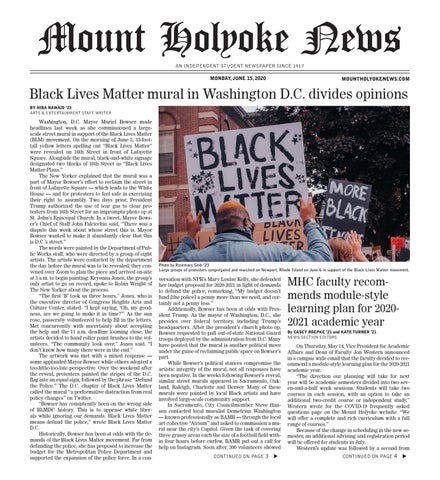
Washington, D.C. Mayor Muriel Bowser made headlines last week as she commissioned a largescale street mural in support of the Black Lives Matter (BLM) movement. On the morning of June 5, 35-foottall yellow letters spelling out “Black Lives Matter” were revealed on 16th Street in front of Lafayette Square. Alongside the mural, black-and-white signage designated two blocks of 16th Street as “Black Lives Matter Plaza.” The New Yorker explained that the mural was a part of Mayor Bowser’s effort to reclaim the street in front of Lafayette Square — which leads to the White House — and for protesters to feel safe in exercising their right to assembly. Two days prior, President Trump authorized the use of tear gas to clear protesters from 16th Street for an impromptu photo op at St. John’s Episcopal Church. In a tweet, Mayor Bowser’s Chief of Staff John Falcicchio said, “There was a dispute this week about whose street this is. Mayor Bowser wanted to make it abundantly clear that this is D.C.’s street.” The words were painted by the Department of Public Works staff, who were directed by a group of eight artists. The artists were contacted by the department the day before the mural was to be revealed; they convened over Zoom to plan the piece and arrived on-site at 3 a.m. to begin painting. Keyonna Jones, the group’s only artist to go on record, spoke to Robin Wright of The New Yorker about the process. “The first ‘B’ took us three hours,” Jones, who is the executive director of Congress Heights Arts and Culture Center, stated. “I kept saying, ‘Oh, my goodness, are we going to make it in time?’” As the sun rose, passersby volunteered to help fill in the letters. Met concurrently with uncertainty about accepting the help and the 11 a.m. deadline looming close, the artists decided to hand roller paint brushes to the volunteers. “The community took over,” Jones said. “I don’t know how many there were in the end.” The artwork was met with a mixed response — some applauded Mayor Bowser while others adopted a too-little-too-late perspective. Over the weekend after the reveal, protesters painted the stripes of the D.C. flag into an equal sign, followed by the phrase “Defund the Police.” The D.C. chapter of Black Lives Matter called the mural “a performative distraction from real policy changes” on Twitter. “Bowser has consistently been on the wrong side of BLMDC history. This is to appease white liberals while ignoring our demands. Black Lives Matter means defund the police,” wrote Black Lives Matter D.C. Historically, Bowser has been at odds with the demands of the Black Lives Matter movement. Far from defunding the police, she has proposed to increase the budget for the Metropolitan Police Department and supported the expansion of the police force. In a con-
Photo by Rosemary Geib ’23 Large groups of protestors congregated and marched on Newport, Rhode Island on June 6 in support of the Black Lives Matter movement.
versation with NPR’s Mary Louise Kelly, she defended her budget proposal for 2020-2021 in light of demands to defund the police, remarking, “My budget doesn’t fund [the police] a penny more than we need, and certainly not a penny less.” Additionally, Bowser has been at odds with President Trump. As the mayor of Washington, D.C., she presides over federal territory, including Trump’s headquarters. After the president’s church photo op, Bowser requested to pull out-of-state National Guard troops deployed by the administration from D.C. Many have posited that the mural is another political move under the guise of reclaiming public space on Bowser’s part. While Bowser’s political stances compromise the artistic integrity of the mural, not all responses have been negative. In the weeks following Bowser’s reveal, similar street murals appeared in Sacramento, Oakland, Raleigh, Charlotte and Denver. Many of these murals were painted by local Black artists and have involved large-scale community support. In Sacramento, City Councilmember Steve Hansen contacted local muralist Demetrius Washington — known professionally as BAMR — through the local art collective “Atrium” and asked to commission a mural near the city’s Capitol. Given the task of covering three grassy areas each the size of a football field within four hours before curfew, BAMR put out a call for help on Instagram. Soon after, 300 volunteers showed CONTINUED ON PAGE 3 u
MHC faculty recommends module-style learning plan for 20202021 academic year By CASEY ROEPKE ’21 and KATE TURNER ’21 NEWS SECTION EDITORS
On Thursday, May 14, Vice President for Academic Affairs and Dean of Faculty Jon Western announced in a campus wide email that the faculty decided to recommend a module-style learning plan for the 2020-2021 academic year. “The direction our planning will take for next year will be academic semesters divided into two seven-and-a-half week sessions. Students will take two courses in each session, with an option to take an additional two-credit course or independent study,” Western wrote for the COVID-19 frequently asked questions page on the Mount Holyoke website. “We will offer a complete and rich curriculum with a full range of courses.” Because of the change in scheduling in the new semester, an additional advising and registration period will be offered for students in July. Western’s update was followed by a second from CONTINUED ON PAGE 4
u
2
.
Mount Holyoke News June 15, 2020
Mount Holyoke News Mount Holyoke News is an independent student newspaper written by and for Mount Holyoke College students since 1917. VISIT US: www.mountholyokenews.com www.facebook.com/themhnews www.twitter.com/mtholyokenews_
EMAIL US: mhnews@mtholyoke.edu
Executive Board Editor-in-Chief
Managing Editor of Content
Lily Reavis ’21
Flannery Langton ’22
Copy Chief
Managing Editor of Layout
Kelsey Thomas ’21
Yasmin Andrews ’22
Managing Editor of Web Zoë Farr ’21
Editoral Board News
Environmental
Kate Turner ’21, Casey Roepke ’21, & Liz Lewis ’22
Meryl Phair ’22
Arts & Entertainment
Photos
Sabryna Coppola ’22
Ali Meizels ’23 & Rosemary Geib ’23
Layout Rose Sheehan ’22
Publication Guidelines Mount Holyoke News does not endorse any of the opinions or views expressed within the pages of the paper, excluding staff editorials. All content copyright of Mount Holyoke News. All rights reserved. Mount Holyoke News does not discriminate on the basis of gender, race, religion, ethnicity, sexual orientation or age.
Letters Policy Letters to the Editor appear exactly as they are sent to MHN, except for corrections to spelling, grammar and AP style. Letters cannot exceed 500 words. All letters must include the writer’s name and telephone number for verification purposes. Unsigned letters will not be printed. Names may be held upon request with the approval of the Editor-in-Chief. MHN reserves the right to decide which materials will be printed. Email submissions to mhnews@mtholyoke.edu by Saturdays at 5 p.m. for publication the following week.
Subscription To subscribe to our independent, student-run, biweekly newsletter throughout summer 2020, sign up at: https://forms.gle/9RPZybRqNuCwqJao7
Staff editorial: A statement on police brutality and national protests As the number of civilians protesting police brutality against Black people and people of color continues to increase, we find that we, too, cannot stay silent. The systemic police killings of countless Black Americans — including the recent murders of George Floyd, Breonna Taylor and Tony McDade — have gone unchecked for far too long, and police officers have continuously been applauded and excused for their violent and lethal actions. As the independent student newspaper at Mount Holyoke College, we stand in solidarity with protestors across the nation in their pursuit of justice and reform. We support all members of the Mount Holyoke community and beyond as they exercise their rights to free speech and assembly. We condemn the police state for its systemic racism and targeting of people of color. We acknowledge that the police state was formed to protect and uphold a white supremacist system, and as such, cannot be simply reformed; police originated as slave patrols and night watches designed to control indigenous and Black communities. We call for the meaningful allyship of white people within our organization and beyond, in the forms of donation, protest and listenership. Even as we urge our institution and our peers to take action, we must also turn inwards. Journalism has long upheld the false equivalency of “both sides-ism,” attempting to signal neutrality without fully assessing opposing truth claims or evaluating historical context. In the nationwide protests, many media publications have equivocated violence against Black bodies with property damage. They have relied on showcasing the trauma of Black bodies instead of focusing on the root causes that allow those traumas to be perpetuated. In the context of racial injustice, this kind of false objectivity is a form of violence. Our own newspaper has historically struggled in our outreach to communities of color on campus. While we wholeheartedly condemn the brutality and fascism of the police state, we acknowledge that in our reporting we have sometimes been complicit in failing to elevate BIPOC voices. We must do better and strive toward anti-racism. Times must change. We lend our unequivocal solidarity to all individuals protesting the murder of Black people and the reprehensible treatment of people of color nationwide, and those advocating for the abolition of the police state. - Mount Holyoke New Editorial Board This statement was originally published online on June 1.
3
.
Mount Holyoke News June 15, 2020
Environmental intersectionality illuminates a complex climate of protest BY MERYL PHAIR ’21 ENVIRONMENTAL SECTION EDITOR
As the world contends with a global pandemic, economic crises and racial injustice, the interconnected nature of the environmental movement to wider concerns has become more openly discussed. Protests currently embroiling cities across the U.S. were ignited in resistance to current structures and systems of oppression that have been locked into social, political and economic landscapes for centuries. Instances of racial injustice aren’t the result of a few bad apples, but rather the product of a discriminatory system. Similarly, climate change isn’t an issue of a few people not recycling, but is rooted in a systemic neglect of human rights considerations. The depth of both of these issues connects at their roots, making the push for civil rights also a push for environmental justice. An article from the Earth Institute at Columbia University published earlier this month explains that racism, classism, sexism and other oppressions are interlinked with climate and environmental problems as “environmental intersectionality.” “To be effective at combating climate change and countless other social and environmental injustices, we must acknowledge the links between the abuse of nature and people and devise strategies to protect the planet, to resist its demise — even when doing so is frightening,” Cayte Bosler stated in the article. Environmental intersectionality is of particular interest in connection to recent protests against racism and police brutality. Independent news outlet Grist published an article on June 4 which explored the connection between the response to environmental protests and to protests against police violence. The article revealed that there has been an increase in bills in the U.S. to limit protesting by increasing fines for civil disobedience. A report by Pen America, a nonprofit that does advocacy work for First Amendment rights, found that 116 bills to criminalize protesting have been proposed in state legislatures between 2015 and 2020. Out of these proposed bills, 23 have since become laws in 15 states.
Photo by Ali Meizels ’23 Protestors demanded racial justice and police abolition during a protest in Northampton, Massachusetts on June 7.
Minnesota, which has been rocked by protests after the police killing of George Floyd in Minneapolis, has seen an introduction of 10 bills from state lawmakers from 2016 through 2019 which would put legislative restrictions on the right to protest. Many community organizations protesting racial justice have been joined by prominent climate change activist groups in the past few weeks. For example, in New York, groups like Sierra Club, 350.org, the Natural Resources Defense Council, the Sunrise Movement and Extinction Rebellion have taken to the streets in support. Although these bills have not yet become laws, they were introduced as direct responses to actions taken by both racial justice and environmental advocates. Following the 2016 police killing of Philando Castile in a St. Paul suburb, protesters shut down a major highway. Afterward, a bill was proposed to make obstructing traffic on highways a misdemeanor. After environmental activists protested plans for an oil pipeline running from Alberta to Wisconsin, a bill was proposed to increase penalties for protesting near oil and gas facilities. This particular bill proposed changing trespassing on property that had an oil and gas facility to an offense of up to three years in prison and a monetary fine of $5,000. The environmental movement is a human rights and justice movement. Developments in our global conversation about human rights and dignity have opened up space for more interconnective support and advocacy.
D.C. mural controversy, continued CONTINUED FROM PAGE 1
u
up to the site. They brought along various goods to help, including rakes and blowers to remove dead grass, an airless sprayer, a generator, a turntable and a snack booth. The large-scale collective effort created heavyset black letters spelling “Black Lives Matter” leading up to the Capitol. The immediate engagement of the nation in the creation of street murals in support of Black Lives Matter illustrates the value of the murals as public art. For those that were commissioned by government officials, volunteer involvement was not mandated; the community naturally participated in and elevated the projects. Consequently, BLM street murals across the country have become symbols of collective effort in the face of injustice. The existence of the murals during the ongoing
demonstrations against police brutality memorializes this era of political movement. The cry of the mural’s slogan, its position in relation to the Trump-led White House, the calls for police defunding and the collective power of the protesters who march over them all immortalize the nationwide drive for the end of police brutality against Black people. That is, so long as the murals persist past the initial moment of protest. While Bowser’s involvement in the creation of the mural detracts from the piece’s artistic integrity, the mural — along with others across the country — still serve as a prominent marker of the historic anti-racist protests that have seized the country following George Floyd’s murder. What remains to be seen is how long the painted words will last on 16th Street and what further policy changes the BLM protests will bring around the country.
Photo by Rosemary Geib ’23 Crowds filled the streets at the Rhode Island protest, which was organized by Black Lives Matter Rhode Island.
Photo by Ali Meizels ’23 The June 7 Northampton protest was met with a heavy police presence, according to the Daily Hampshire Gazette.
Photo by Caitlin Lynch ’20 South Hadley’s Tower Theaters recently displayed signs in support of the Black Lives Matter movement.
4
.
Mount Holyoke News June 15, 2020
Module-style learning plan for 2020-2021 academic year, continued CONTINUED FROM PAGE 1 u Dean of Studies Amber Douglas on Wednesday, June 3, clarifying some specific details of the new modular semester model. As previously reported by the Mount Holyoke News, this plan came out of the Academic Planning Group, an ad hoc committee formed on April 14 consisting of administrators, faculty and students. “As (APG) was an emergency response team, it was outside of the regular faculty committee structure of college governance,” Tianhui Ng, chair of the Academic Priorities Committee and associate professor of music, said. “Once the immediate crisis was overcome, we felt it was important to realign things with our regular governance structures of the College. The Academic Planning Group was thus convened by the Academic Priorities Committee and the Office of the Dean of Faculty.” Within the APG, several models were considered. “We broke up into smaller working units to look at different models,” Renae Brodie, an APG member and chair of neuroscience and behavior, said. “We looked at a conventional full semester model, Colorado College model with even shorter segments, the Beloit (module-style) model. After intensive study by subcommittees that came back to the general committee, we spent hours discussing the individual models until we converged on the Beloit model. We put that for-
ward as a recommendation to the faculty.” “When we gathered as APG, we started by looking at different models and we formed breakout groups to look at each model,” Ng said. “In this process, I know that some of my colleagues reached out to other faculty members so that many more views than just those at the table were represented.” In a virtual town hall meeting on April 30, APG presented the module system to faculty as the leading contingency plan for the upcoming academic year. Faculty met the following week on May 6 to discuss the module system further and voted to officially recommend the system on Thursday, May 14. The proposal now advances to the Board of Trustees for a vote. According to Brodie, the faculty vote was preceded by discussion and debate. Due to the governing style of protecting the minority opinion, much of the discussion consisted of faculty members voicing their concerns with the proposal. Despite some opposition, the plan passed with over 90 percent of the faculty vote. “Even with the best-case scenarios, we know that a significant number of our students likely will need to access the curriculum remotely,” Western wrote in his email. “This model is fully accessible and inclusive for all of our students. … We will be spreading out class times and increasing our ability to manage the physical distancing that likely will be required to resume any in-person instruction safely. The broader range of class times also permits those students who cannot return to campus to access courses and learn remotely,
across many time zones, with a schedule that is manageable.” Though the module system intentionally allows for flexibility, Western reiterated that the administration plans for “a resumption of in-person on-campus instruction.” The College did not provide any further information on plans to return students to campus in the fall. “Mount Holyoke College faces serious and consequential challenges as a result of the COVID-19 pandemic. I am deeply grateful to every member of the APG for the way in which they have approached this complex task, and for the duty of care and concern they have consistently demonstrated,” President of the College Sonya Stephens wrote in a statement to the Mount Holyoke News. “While there are many details yet to be resolved, this framework enables us to plan for next academic year, and to do so in a way that will be informed by the evolving public health situation.” She continued, “This academic structure is the most equitable, accessible and inclusive approach in these circumstances. It is the model that prioritizes the academic mission of the College and the engaged learning that is our hallmark. It also supports the bestcase scenarios for a return to residential, in-person education, should that become possible.” According to Western, the APG has formed several working groups to develop the new system and will report back to the community with “full details” in early July.
Black Lives Matter protests may lead to a possible second wave of coronavirus BY FIONA HINDS ’21 HEALTH & SCIENCE STAFF WRITER
With the numerous Black Lives Matter protests across the United States, the opportunity for the spread of COVID-19 has increased, leading to the possibility of a second wave. After the death of George Floyd, protestors demonstrated in Minneapolis. The movement then spread around the country, protesting police brutality and the systemic racism that continues to harm people of color, especially Black people in the U.S. According to The New York Times article “George Floyd Protests: A Timeline,” protests have been organized in at least 140 cities and in all 50 states across the country. In an article in The Guardian titled “Is the US heading for a second wave of coronavirus infections?” David Rubin defined a second wave as a “true recurrence of widespread community transmission.” As states begin to ease restrictions and reopen, there will almost undoubtedly be an increased rate of transmission, but this does not necessarily mean a second wave will happen. Transmission can be reduced during this period if people continue to follow protocols such as wearing face masks and avoiding large gatherings. According to a USA Today article entitled “Did protests fuel COVID-19 cases? Are we already in a second wave? Your coronavirus questions, answered,” at least one protester in Tampa, Florida tested positive for the coronavirus, therefore possibly infecting other protestors. Most people who are currently attending
protests are young, which changes the impact of the virus. Young people are less likely to feel ill or require hospitalization, and therefore are less likely to be tested and counted in national coronavirus statistics. In addition, asymptomatic people can still pass the disease on to more vulnerable people. Due to fears of a second wave, many officials of cities in which where people are protesting have been urging protesters to remain home. In an article in the New York Post entitled “Data suggests George Floyd protests have not caused coronavirus spike in NYC,” Mayor Bill de Blasio urged New Yorkers to stay home
as much as possible to prevent the spread of coronavirus, as the city was one of the hardest hit locations in the United States. According to current testing, a possible spike due to protesting has not yet come. It is also important to consider that many protestors in NYC have worn face masks during demonstrations. These protests have also taken place outdoors, where it is harder for the virus to spread. The risks associated with the protesting only amplify their importance. Despite the possibility of a second wave, protestors are still out on the streets demanding justice.
Photo by Rosemary Geib ’23 Crowds chanted “Black Lives Matter,” and “Peace Love Justice” at the protest in Newport, Rhode Island, on June 6.