Mount Holyoke News AN INDEPENDENT STUDENT NEWSPAPER SINCE 1917 THURSDAY, DECEMBER 10, 2020
MOUNTHOLYOKENEWS.COM
Mount Holyoke puts on radio play, ‘Much Ado About Nothing’ BY KATIE GOSS ’23 STAFF WRITER
This semester, the film media theater department adapted to current limitations set by the COVID-19 pandemic and produced “Much Ado About Nothing.” Because the play could not be performed in person or in front of an audience, its director, Noah Tuleja, decided to produce the comedy in the style of a radio play. Tuleja, director of Rooke Theatre and assistant professor of film media theater, said that as early as May, he knew that the theater would not be able to host 100 to 150 to watch the show even if students came back to campus. With that in mind, he began to reimagine and adapt the season to avoid cancellation. Tuleja himself is a part of a professional theater company and had just finished performing a radio play over Zoom. He thought it was a good way to keep the season going while everyone involved in the production was still remote. The initial audition process was done virtually and asynchronously. Tuleja sent out a few different monologues from the play, and the actors had to record an audio clip of themselves voice-acting out the monologue. He then held a callback audition over Zoom and decided on the official cast. Typically, those who choose to audition are asked to bring a different monologue to perform onstage. Due to the time restraints and varying schedules, however, Tuleja decided to send out monologues from the same play instead and let people submit their auditions as audio recordings. Zoe Fieldman ’22, the assistant director of the radio play, saw this new audition process as an advantage from past processes. “We had so many new people audition,” Fieldman said. “I think it’s a little bit less intimidating. Instead of standing up on stage along with just two or three people in the audience, one of them being Noah [Tuleja], and giving your initial audition monologue, they got to record and send in videos.” Rehearsals also proceeded in an adapted format. “We started the re-
u
hearsal process, which was different than a normal rehearsal process,” Tuleja said. “Usually you read through the play, and then you start at the beginning of [it] … and work through the entire play, scene by scene, onstage — blocking it, staging it, talking about it. And then you get through the whole play, and it’s really rough, and you might run the whole thing, and it’s a disaster show because no one remembers what they did in Act 1 when they got to Act 5.” The cast would rehearse an act for a few days over Zoom, and then once it was ready to be recorded, they would record it a few different times before moving onto the next one. Instead of running through the whole play or multiple acts in one setting like usual, once an act was recorded and finished, they moved on and did not return to it. Every act was recorded multiple times to ensure that the final edited version of the audio would sound as good as possible. That way, if someone’s audio cut out while speaking, there would be other recordings of the same section that the sound designer, Ginger Maley ’20, could edit in to keep the act sounding smooth. Not only did the radio play deviate from the normal procedures of an onstage production, but it also changed the logistics of what actors focused on as a whole. Kylie Levy ’21, who played Benedick in the radio play, highlighted the shift from learning to employ physical characteristics to better play a character to learning to use only speech to do so. “I think a particular challenge, but one that I really enjoyed [to] sort of work through, was how to infuse Benedick’s lines with color without using your body and being in a physical space. … This really forced me to focus on the exact words I was saying and the way that [Benedick] would deliver them and [how to] evoke certain physical gestures or attributes with voice,” Levy explained. “There [are] a lot of things, from an acting perspective, that you focus on
5 FEATURES: COVID-19 holiday safety guide
CONTINUED ON PAGE 4
u
8
u
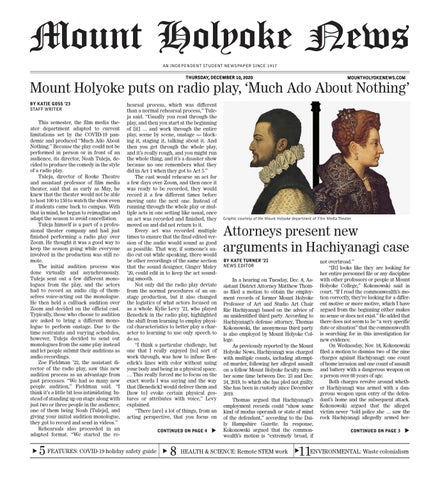
Graphic courtesy of the Mount Holyoke department of Film Media Theater
Attorneys present new arguments in Hachiyanagi case BY KATE TURNER ’21 NEWS EDITOR
In a hearing on Tuesday, Dec. 8, Assistant District Attorney Matthew Thomas filed a motion to obtain the employment records of former Mount Holyoke Professor of Art and Studio Art Chair Rie Hachiyanagi based on the advice of an unidentified third party. According to Hachiyanagi’s defense attorney, Thomas Kokonowski, the anonymous third party is also employed by Mount Holyoke College. As previously reported by the Mount Holyoke News, Hachiyanagi was charged with multiple counts, including attempted murder, following her alleged assault on a fellow Mount Holyoke faculty member some time between Dec. 23 and Dec. 24, 2019, to which she has pled not guilty. She has been in custody since December 2019. Thomas argued that Hachiyanagi’s employment records could “show some kind of modus operandi or state of mind of the defendant,” according to the Daily Hampshire Gazette. In response, Kokonowski argued that the commonwealth’s motion is “extremely broad, if
HEALTH & SCIENCE: Remote STEM work
not overbroad.” “[It] looks like they are looking for her entire personnel file or any discipline with other professors or people at Mount Holyoke College,” Kokonowski said in court. “If I read the commonwealth’s motion correctly, they’re looking for a different motive or more motive, which I have argued from the beginning either makes no sense or does not exist.” He added that there does not seem to be “a very specific date or situation” that the commonwealth is searching for in this investigation for new evidence. On Wednesday, Nov. 18, Kokonowski filed a motion to dismiss two of the nine charges against Hachiyanagi: one count of home invasion and one count of assault and battery with a dangerous weapon on a person over 60 years of age. Both charges revolve around whether Hachiyanagi was armed with a dangerous weapon upon entry of the defendant’s home and the subsequent attack. Kokonowski argued that the alleged victim never “told police she … saw the rock Hachiyanagi allegedly armed herCONTINUED ON PAGE 3
u
11ENVIRONMENTAL: Waste colonialism
u
2
EVENTS
December 10, 2020
. Mount Holyoke News
Mount Holyoke News Mount Holyoke News is an independent student newspaper written by and for Mount Holyoke College students since 1917. VISIT US: www.mountholyokenews.com www.facebook.com/themhnews www.twitter.com/mtholyokenews_
EMAIL US: mhnews@mtholyoke.edu
Executive Board Editor-in-Chief Lily Reavis ’21 Managing Editor of Content Flannery Langton ’22 Managing Editor of Layout Rose Sheehan ’22
Publisher Liz Lewis ’22 Managing Editor of Web Zoe Farr ’21 Business Manager Sarah Nam ’23
Copy Chief Kelsey Thomas ’21
Casey Roepke ’21, Kate Turner ’21 & Liz Lewis ’22
Arts & Entertainment Sabryna Coppola ’22 & Mariam Keita ’24
Final Day of Classes Health & Science
Kessh Bhasiin ’22 & Zoe Greenberg ’23
Features Sports
Gigi Picard ’22
Nina Larbi ’22 & Libby Spy ’24
Environmental Meryl Phair ’21
Books
Sidney Boker ’21
Photos
Global
Ali Meizels ’23 & Rosemary Geib ’23
Saman Bhat ’22 & Sophie Soloway ’23
Layout Editors
Hunar Anand ’21, Audrey Hogan ’21, Molly Kleinman ’21, Audrey Shannon ’22, Margaret Connor ’23, Zoe Latham ’23, Lauren Leese ’23, Rhitom Mishra ’23, Kay Brown ’24 & Ella Jacob ’24
Last day to declare ungraded option in Mod 2 or semesterlong courses
Mimi Huckins ’21 & Tishya Khanna ’23
Opinion/Editorial
Copy Editors
Happy last week of classes from the Mount Holyoke News. Here are the key events to keep in mind as finals begin and the semester comes to a close.
Friday, Dec. 11
Editorial Board News
Event Highlights
Maggie Donovan ’23, Angie Romero ’24 & Zoe Tang ’24
Web Editors
Audrey Hogan ’21, Shloka Gidwani ’22, Georgia Fish ’23 & Aarushi Sharma ’23
Publication Guidelines Mount Holyoke News does not endorse any of the opinions or views expressed within the pages of the paper, excluding staff editorials. All content copyright of Mount Holyoke News. All rights reserved. Mount Holyoke News does not discriminate on the basis of gender, race, religion, ethnicity, sexual orientation or age.
Saturday, Dec. 12 Reading Day
Sunday, Dec. 13 Examinations
Monday, Dec. 14 Examinations
Tuesday, Dec. 15 - Sunday, Jan. 3 December Recess
Monday, Jan. 4
Grades due for Mod 2 and semester-long courses
Monday, Jan. 4 - Friday, Jan. 15 Advertising in MHN Interest in advertising in MHN can be directed to mhnews@mtholyoke.edu for pricing and deadlines. MHN reserves the right to refuse submissions on the basis of, but not limited to, advertisements considered to be libelous, obscene, defamatory or discriminatory.
Subscriptions Mount Holyoke News is a weekly publication that will publish online-only throughout the fall semester 2020. To subscribe through email, please visit the following form: https://forms.gle/VPCyskE4kMTDeDan8.
Letters Policy Letters to the Editor appear exactly as they are sent to MHN, except for corrections to spelling, grammar and AP style. Letters cannot exceed 500 words. All letters must include the writer’s name and telephone number for verification purposes. Unsigned letters will not be printed. Names may be held upon request with the approval of the Editor-in-Chief. MHN reserves the right to decide which materials will be printed. Email submissions to mhnews@mtholyoke.edu by Sundays at 5 p.m. for publication the following week.
Intersession
Saturday, Jan. 16 - Monday, Jan. 18 January Recess
The Mount Holyoke News will resume full publication in the spring semester.
NEWS 3 Hachiyanagi held without bail for a year, cont’d
December 10, 2020
. Mount Holyoke News
CONTINUED FROM PAGE 1
u
self with” upon entry, according to the Daily Hampshire Gazette. Through a “well-worded question,” the “commonwealth tries to place the rock … into Professor Hachiyanagi’s hand,” Kokonowski said. He argued that, though the defendant clearly describes Hachiyanagi’s use of a fire poker and garden shears in her statement, she never mentions seeing the rock. Thomas responded, arguing that the victim reported she was struck “when she turned away from the threshold” after inviting Hachiyanagi into her home. He further stated that, as a professor of geology, the victim “knows how a rock feels,” and that the object with which she was struck “did not yield as a fist would yield to flesh.” “This attack takes place over the course of several hours with multiple weapons,” Thomas said in court. “She [the victim] might not be able to see the rock, but that’s by [Hachiyanagi’s] design.”
According to the initial incident re- the remainder of 2020 and will not resume port from Massachusetts State Trooper until at least Jan. 11, 2021, according to Geraldine L. Bresnahan, Hachiyanagi’s WBUR. Though Thomas expressed optimism alleged attack on the defendant involved “fists, rocks, garden clippers and a fire that the commonwealth would be “ready poker.” Investigators later recovered all when the court is ready” for Hachiyanagi’s trial, Kokonowski of these objects. had some doubts. An unopposed motion Through “a well-worded Kokonowski exfor the alleged victim’s ambulance records accompaquestion,” the “common- plained to Agnostini that he has been nied the defense’s motion wealth tries to place the unable to fully serve to dismiss. Franklin County Superior Court Judge rock ... into Professor his client because of COVID-19 safety proJohn Agnostini allowed Hachiyanagi’s hand.” tocols, adding that the the defense’s motion for last week of November records and said that he was the first time that expects to quickly render a decision on the commonwealth’s motion to obtain he and Hachiyanagi had held a private Hachiyanagi’s employment records. Both conversation “without having to talk on Thomas and Kokonowski were expected telephones, which I do not trust, without to review physical evidence on Wednes- having to hold up documents to the glass for my client to look at while the camera day, Dec. 9. Agnostini told both attorneys that he is trained on us.” “There are sensitive things that I expects Hachiyanagi’s trial to be a “priority” when trials begin operations again, have not given to my client, and I have according to the Greenfield Recorder. not held up to that glass,” Kokonowski Massachusetts postponed jury trials for said. “I think I have gone through all of
the documents that I’ve been given by the commonwealth. I have not been able to go through them in any … important way with my client at this point, and I’m very concerned about that. I can tell you right now that I’m not ready for trial.” “We do not know when we will be able to try a jury of 12 individuals,” Agnostini said. “It could be as early as April, May. It could be in June, July. It could be [in] September. I think it’s going to be in that time frame.” Meanwhile, Hachiyanagi continues to be held in custody without bail. As previously reported by the Mount Holyoke News, due to the Massachusetts Supreme Judicial Court’s ruling in Commonwealth v. Lougee, the commonwealth may hold pretrial defendants beyond normal time limits set by statute thanks to delays made necessary by COVID-19. Under normal circumstances, Hachiyanagi should legally have faced trial or been released within 180 days of being placed into custody — around July of 2020. Instead, she will likely spend an additional year in custody before her trial.
College to hold reunion virtually in 2021; further decisions on Commencement will be announced in February BY LIZ LEWIS ’22 PUBLISHER & NEWS EDITOR
On the evening of Wednesday, Dec. 9, the College sent out an email containing updates on the plans for Commencement and reunion 2021. With a vaccine seemingly on the way, plans may change depending on how the COVID-19 pandemic develops over the coming months. However, as COVID-19 restrictions on outdoor gatherings continue to tighten in the state of Massachusetts, an official decision on the class of 2021’s commencement ceremony has yet to be made. Over the following months, the College will continue to monitor the state of the pandemic and inform decisions based on the safety guidelines regarding in-person gatherings and travel. An official decision about Commencement 2021 will be announced by the end of this February. The Alumnae Association will hold reunion 2021 virtually on May 21 and May 22. The College will also continue to work toward holding an in-person commencement ceremony for the class of 2020 in the spring of 2022, during the class’s two-year reunion. The email also featured a letter from
the office of College President Sonya Stephens with an update on the progress of Mount Holyoke’s anti-racism action plan. Launched in August 2020, the plan aims to rework Mount Holyoke into a more consistently anti-racist institution and community. In the letter, Stephens outlined the plan’s progress this semester in the fields of “faculty and curricular actions,” “education, training and professional development,” “resources and equity,” “planning and accountability” and “understanding and acknowledging college history.” As part of a motion to hire and retain more BIPOC faculty and staff, the College has partnered with organizations including “the Southern Regional Education Board (SREB) Doctoral Scholars Program, the Liberal Arts Colleges Racial Equity Leadership Alliance (LACRELA), and the Consortium for Faculty Diversity (CFD),” according to the letter. These organizations offer ways to connect with and hire new BIPOC faculty as well as providing anti-racism resources and training for existing faculty. Furthermore, over the past semester, the College has hosted numerous anti-racism events, sessions and workshops tailored to BIPOC stu-
Photo by Ali Meizels ’23 The class of 2020 has yet to experience a graduation, creating further uncertainty around 2021’s ceremony.
dents, leaders of student organizations, faculty and staff, Health and Counseling services and the greater Mount Holyoke community. Additionally, the College has committed to providing monetary compensation for MoZone peer educators. Another key goal of the anti-racism action plan is a commitment to redistributing College resources. According to Stephens, the College has awarded over $400,000 directly to students with financial need through the Student Safety Net Fund while also funneling resourc-
es into faculty and staff training, as well as the student organizations First-Generation Network and First-Generation and Low-Income Partnership. In an effort to revisit the College’s relationship with its own history, the College has also created the History, Legacies and Memory Task Force, run by Head Archivist Leslie Fields and Chief Diversity Officer Kijua Sanders-McMurtry. Stephens also highlighted a commitment to accountability and transparency, promising further updates on the anti-racism action plan in early 2021.
4
NEWS
December 10, 2020
. Mount Holyoke News
Biden selects key members for his incoming administration
BY REHAT THUSSU ’23 & SOLEIL DOERING ’24 STAFF WRITERS
The U.S. presidential transition between President Donald Trump and President-elect Joe Biden may have lasting political implications. Biden’s victory and Trump’s refusal to concede has led to an especially volatile transfer of power. Election results have been contested before, such as in the 2000 election between George W. Bush and Al Gore, but according to Assistant Professor of Politics Adam Hilton, the 2020 election brings new sentiments. “What’s really unique about this transition is unlike in [the election of] 2000 when both sides agreed on the contested facts and recognized there was a problem. … This time it’s really just been one side that continues to insist that this isn’t over,” Hilton said. “The formal, very technical and bureaucratic measures that have to be taken by the
new president’s team to ensure a continuity of administration were being resisted.” Biden’s transition team has the responsibility of selecting an incoming administration before January’s inauguration. “The few months of the transition are when the new president really has to get the essentials in place,” Hilton explained. According to NBC, on Nov. 23, Trump finally gave clearance to the General Services Administration to allow Biden’s transition team access to federal resources. In a statement, one of Biden’s longtime transition advisers, Yohannes Abraham, claimed that the accessing of these resources was “a needed step to begin tackling the challenges facing our nation, including getting the pandemic under control and our economy back on track.” Although Trump’s actions do not serve as a full concession, they have allowed the Biden team to formally begin the transition process. Biden has already named several
people to his administration’s top roles. Antony Blinken will serve as the next secretary of state, according to The New York Times. POLITICO reported that Biden chose Jake Sullivan, a former Obama administration official, as national security adviser. Former Deputy Director of the CIA Avril Haines will serve as the director of national intelligence, making her the first woman to hold this position. John Kerry, former U.S. secretary of state, will serve in a new position as Biden’s special presidential envoy for climate or “climate czar,” an unofficial term used for senior officials who have authority over energy or climate policies. The term has not been used on a federal level since 2011. Janet Yellen, the former Federal Reserve chairwoman, will be the first woman to lead the Department of the Treasury, and Wally Adeyemo will become the first Black person to serve as deputy treasury secretary if confirmed. The article also mentioned that Cecilia Rouse, the current candidate in mind to
chair the Council of Economic Advisers, would be the first Black person to hold that position. Biden’s pick for budget chief, Neera Tanden, would be the first woman of color and Indian American to serve as the director of the U.S. Office of Management and Budget, according to ThePrint. On Dec. 8, Biden chose Democratic Representative Marcia Fudge of Ohio as secretary of the Department of Housing and Urban Development, and Obama-era Secretary of Agriculture Tom Vilsack to return to that role. “While several positions have yet to be filled, Biden’s Cabinet is shaping up to be a diverse team of highly competent leaders who are committed to tackling the various crises of our present moment,” Kate Murray ’22, a co-founder and coordinator of MHC Votes!, said. “From what I’ve seen so far, it seems as though Biden is invested in putting together a Cabinet that is more representative of the American population as well as dedicated to enacting reforms that will repair the nation.”
‘Much Ado About Nothing’ debuts as radio show in lieu of play, cont’d coming through a computer, and you’re in your room, and there are so many things around you, so I think the disadwhen you’re doing a radio play,” Tuleja vantage in that regard would be staying said. “It’s voice and text and speech, and present in the scene and reciprocating you don’t have to worry so much about the energy despite not being in person. Fieldman also spoke about trying the physical choices that you make or a lot of the things that you would do in to focus on just the speech of the play. a normal rehearsal. For me, that was Fieldman found this to be more of an important because I often find when advantage, as they have never paid so I’m rehearsing with students in a show much attention to solely the oral asat Mount Holyoke [that] the voice and pects of a play. “Because we weren’t focusing really speech thing is usually the last thing that we focus on because it’s not really on any sort of body movements or mannerisms, I would frequently kind of close my background.” “I think it really forced everybody, my eyes or sit back, turn off screens and stuff and just listen bemyself included, to look cause that was the most at the text in a way that you probably wouldn’t “You don’t have a face, important part of the just from a time perand all you hear is a rehearsal process. … That is all that anyone spective because [time] voice coming through a is going to hear,” Fieldis really all you are focusing on,” Tuleja concomputer, and you’re in man said. “It was odd tinued. your room, and there are to only be focusing on voice for me personally; All the actors so many things around that is not something I turned their camerhave a lot of practice in as off on Zoom when you.” focusing on. … I think I recording to give the tend to direct and focus audio the best chance - Kylie Levy ’21 a lot more on conveying to record smoothly. emotion through moveBecause of this, actors ment, and so it was acwere mostly reliant on speech only rather than physical cues tually really [good] for me to get a … chance to try and focus on voice alone or gestures “I know in scenes, I had to remind because it’s definitely something I’ve myself to stay super connected to who- been neglecting. So that is a silver lining ever is speaking,” Levy said. “You don’t of having to do this remotely.” Another advantage to a radio play have a face, and all you hear is a voice
u
CONTINUED FROM PAGE 1
was that the actors did not have to ing night, and everybody goes out on memorize their lines. They could keep stage and it goes as well as it goes. Then not only their scripts in front of them there’s a party, and everyone is like, but also all of the notes they had taken ‘Yay!,’ and there is this sort of camarain the margins. derie of everything coming together,” Levy said, “I remember [Tuleja] Tuleja said. “For this, the last recording would say a lot of the times when you session was just whoever happened to get notes, it’s hard to be in that scene. It was a do every single spepretty big scene; it was cific one in a take “Because we weren’t like eight people, but not because you have so focusing really on any all of the people. So you many things going on. didn’t really have that sort of body movements sort of, ‘Okay, we are all … But in this case, you have all of the notes, or mannerisms, I would done, we’ve all done our you have all of the frequently kind of close stuff together,’ and it things that you can didn’t have that kind of pinpoint and you have my eyes or sit back, turn release I think, which I the words to basically off screens and stuff and think we [expected], but guide you along.” it felt a little less celebrajust listen.” “Most of the actory that way.” tors didn’t really Fieldman was also learn their lines. They disappointed in the lack - Zoe Fieldman ’22 didn’t have to because of community. “I find we would sort of talk that I’ve made some reabout things, and they ally close friends workwould take notes on the text, which is ing on productions at Rooke,” they said. how radio plays are generally done. … “Because rehearsals can go from 7 p.m. It enabled us to do a much deeper dive to 10 p.m. normally, a few nights a week, into the text and vocal choices than you you spend a lot of time with these peoprobably would in a full production,” ple. One of the aspects I miss was that Tuleja added. bonding that happens, and I think that But according to both Fieldman and is something that is really critical for Tuleja, producing a radio play remote- productions to go well.” ly diminished the sense of community Fieldman did express that there was that the cast and crew would naturally a “good energy” surrounding the cast develop in person. “Usually, you get the whole play CONTINUED ON PAGE 13 u together, and then you have an open-
December 10, 2020
. Mount Holyoke News
ARTS & ENTERTAINMENT
Spotify warped?: Students consider algorithm BY MARIAM KEITA ’24 & ROSE COHEN ’22 ARTS & ENTERTAINMENT EDITOR & STAFF WRITER Last Tuesday, Dec. 1, the Swedish audio streaming service Spotify released their yearly Spotify Wrapped personalized experience, which tells eligible users about their top artists, top songs and total minutes listened. In order to receive Wrapped, listeners would have needed to have an account before Nov. 15, listened to at least five different musicians and 30 different tracks. Many subscribers adore the Wrapped feature. Come December, they look forward to the day that they can post about their music taste on their Instagram stories and Twitter feeds. Others are not necessarily satisfied with the endof-year summary of their listening habits. Tiwani Ariyibi ’24 was shocked to see the creator of the Broadway musical “Hamilton,” Lin-Manuel Miranda, appear among her Spotify Wrapped artists. “I really liked the movie [‘Hamilton’] and I would play [the soundtrack] a lot, but that was a phase. It lasted like a solid month and then I never went back,” Ariyibi explained. Mae Philippe-Auguste ’24 was also surprised by her Spotify Wrapped this year. “A lot of my stuff also came from my sleep playlist so I didn’t even bother posting,” Philippe-Auguste wrote in response to an Instagram story about this article. Students in the class of 2024 listened to a good deal of sad music, according to Pearl Young ’24. “People started listening to emo music that was popular when we were younger,” she said. “I saw a lot of people in our class had Mitski somewhere in [their] top 10.” Ariyibi posed one theory as to why so many people had such wistful sounds in their Wrapped this year. “In a pandemic, you can’t really see your friends or family — things that would normally bring you comfort — and you have to find new ways [of coping].” Additionally, Ariyibi explained that Spotify users are turning
to the artists that they listened to in their childhood. “I listened to a lot of Lauryn Hill [which] my mom used to play when I was younger,” Ariyibi said. Joliet Morrill ’21, who has approximately 12,000 Spotify followers and creates Spotify playlists for her TikTok followers, suggested that people are returning to their old favorites for a sense of nostalgia. “[They want to] remind themselves of a different time,” Morrill said. Since 2020 began, Morrill found that TikTok users have been requesting mood-based playlists. “I have to create a story by giving the playlist an interesting title and cover,” Morrill explained. Erica Weathers has noticed similar trends while working as a clinical social worker for Mount Holyoke College Counseling Service. “Many students that I work with use music as a way to self-soothe and relax, or distract themselves from stressful emotions and to uplift their spirits. I also have had students that struggle with ADHD listen to relaxing music in the background while they’re doing their work, which provides just enough stimulation [to] help them focus,” Weathers said. “If I had to guess about why students are listening to music from earlier stages of their lives, my best guess is that the music they listened to when they were younger can trigger positive memories and associations,” Weathers added. “The music is something that is known to them and, in that way, can bring comfort during a time of great uncertainty.” Philippe-Auguste seemed to fit into this trend of listening to old music. “I’m a theater kid, so songs from shows that I’ve been in [remind] me of my cast,” Philippe-Auguste explained. “I think it just takes you back to these good memories and people that you can’t necessarily connect with as much right now.” Ariyibi thought the comeback of childhood music related well to the year 2020. “I don’t think I can find someone who is happy about this year. Sometimes you just need music to help you cope through anything you’re going through and I think that’s why a lot of people had depressing music [in their Spotify Wrapped],” Ariyibi said.
MHN’s Top Songs of 2020 BY SABRYNA COPPOLA ’22 & MARIAM KIETA ’24 ARTS & ENTERTAINMENT EDITORS
With the end of this especially trying year drawing near, we asked the MHN staff to share one song that got them through it all. Here are the results:
“Been Away” by Brent Faiyaz “I’ll Be Your Mirror” by Lowland Hum “Talk It Up” by Sammy Rae “Symphony in Blue” by Kate Bush “Graceland Too” by Phoebe Bridgers “What Once Was” by Her’s “Runaway” (feat. Babyface) by Tiffany Young “Nude” by Radiohead “Tamagotchi” by Sea in the Sky “Shameika” by Fiona Apple
Photo courtesy of Mariam Keita Tiwani Ariyibi ’24 (@tiwani.a), a current Mount Holyoke first-year student, took to TikTok to discuss their surprising Spotify Wrapped results.
5
Check out the rest of the playlist using this QR code!
6
. GLOBAL Farmers protest agriculture reform laws in India
Photo courtesy of WikiMedia Commons Major protests erupted in India last week after the government enforced new agriculture reforms, limiting business and trade freedoms.
BY ADITI PARASHAR ’22 STAFF WRITER
Tens of thousands of farmers from around India made their way to New Delhi 11 days ago, cutting off almost all entry points into the capital, according to The New York Times. The Dilli Chalo (“Let’s go to Delhi”) march is a protest against three agricultural bills passed in September 2020 that aim to make changes to the farming system and threaten the way 146 million farmers in India do business. According to the BBC, the protesters arriving in Delhi were accosted with water cannons, tear gas and violence by many paramilitary and police forces who tried to hold them back. The reforms would change key aspects of how produce is sold, priced and stored. The new policies would replace the Mandi system in which the government heavily regulates the prices at which agricultural products can be sold. While the Indian government claims that these reforms are necessary to salvage the agriculture industry, many of those employed by the industry — 40 percent of the workforce — quickly began to protest the changes.
December 10, 2020
The government has said that the new regulations will provide opportunities for farmers, with Indian Prime Minister Narendra Modi calling it a “watershed moment.” He also said that the new laws provide farmers more autonomy to set their own prices as well as to sell directly to private businesses, reported CNN. The farmers, however, remain adamant that the new laws are anti-farmer and pro-corporation by subjecting the farmers to the free market from which they have been protected for decades. Mewa Singh, one of the many protesters, told The New York Times, “Our land is our mother. It was passed on to us from our parents, who got it from their parents, and now Modi wants to acquire it and give it away to his rich friends.” According to the Indian Express, the protesters want the government to either repeal their newly passed legislation or guarantee farmers a minimum support price for their crops by passing new legislation. The minimum support price is one of the biggest support structures to farming in India. It aims to set a guaranteed minimum price for commodities by farmers no matter the market conditions, which protects the community from fluctuations in price and imperfections in the market. Economists as well as agricultural experts have shown support for the farmers’ demand for a minimum assured price mechanism. Devinder Sharma, an independent agricultural expert, told The New York Times, “There is no evidence in the world where the market price has benefited farmers.” Additionally, farmers believe that the new laws “will open agricultural sale and marketing outside the notified Agricultural Produce Market Committee (APMC) mandis for farmers, remove the barriers to inter-state trade, and provide a framework for electronic trading of agricultural produce,” according to the Indian Express. However, since state governments will be unable to procure market fees outside of the APMC
Mount Holyoke News
market systems, farmers are afraid that this will end the current system, leaving them at the mercy of corporations that are then free to exploit them and their production capabilities. Many critics are apprehensive about how formal contractual obligations will work in the public arena due to the unorganized nature of the agriculture sector. Critics fear that farmers will be locked into contracts out of necessity and face a lack of resources for legal proceedings with major private corporations, found The Hindu. “I don’t believe anyone is buying the idea that these bills exist to help the farmers,” Kusha Chopra ’21 said. “The farmers are smart and know that the bills have been passed in Parliament to fill the never-ending greed of our dear prime minister’s friends. To leave an already complicated sector which sees so many suicides due to debt and unemployment at the hands of large corporations and [at the] behest of the free market is openly careless and foolish.” Since the farmers have arrived in Delhi, there have been a series of talks between them and the government. As of Dec. 9, no resolution has been reached. “I think it is extremely sad, not only the way the farmers are having to fight for their livelihood in a country that thrives because of them, but also the way the government and its lapdog media has tried to discredit their hardships and movement,” Shreya Nair ’22, a Mount Holyoke student from India, said. “To call peaceful protesters, who are the reason you have food on your table, terrorists and anti-national on national television has [been] a new low, even for our sell-out media outlets,” Nair added. The protesting farmers now have huge camps around Delhi’s border and are prepared to stay. They said they will not leave before the government repeals the “black law,” reported the BBC. The protesters say they are “prepared for a long battle — with trolleys full of rice and grains, and pots and pans to cook their own food,” the BBC continued.
Scotland becomes the first country to make sanitary products free BY JOCELYN ZHOU ’23 STAFF WRITER
Scotland passed the Period Products Free Provision Bill on Nov. 25, 2020, to make sanitary products free to all who need them. As The New York Times reported, under this legislation, the government will set up a countrywide initiative in collaboration with local authorities to allow anyone who needs period products to get them free of charge. The bill aims to tackle the issue of “period poverty,” which refers to the inadequate access many have to sanitary products when they need them. People who experience menstruation often regard it as a difficult experience because of poverty, homelessness, abusive relationships and some health conditions, according to The New York Times. Gender identity is also a barrier to access, as some transgender people cannot obtain sanitary products, especially given that they are statistically more likely to experience poverty, according to a report by the National
LGBTQ Task Force. According to The Guardian, these disparities have only increased during the COVID-19 pandemic. “I think this is great support for low-income [people] who can’t afford sanitary products,” Gerel Battogtokh ’21, an international relations major, said. “I believe everyone who is in need of daily necessities like disposable sanitary products should have access to it,” Jamie Day ’22 said. “Making it free will stop users from having to compromise [for] their health and overall comfort.” The Period Products (Free Provision) (Scotland) Bill requires local authorities and education providers to ensure period products are obtainable free of charge. The bill’s financial memorandum states that “it is intended to remove any barriers which stop women, girls and trans people accessing period products.” However, it will be up to local authorities to decide how and to whom these resources are made available — a discrepancy that may allow transphobia to make this distribution inaccessible. According to NPR, the Scottish government has
estimated the measure will cost 24 million pounds (about $32 million) a year. After the vote, Nicola Sturgeon, Scotland’s first minister, remarked on Twitter, “Proud to vote for this groundbreaking legislation, making Scotland the first country in the world to provide free period products for all who need them. An important policy for women and girls.” Two years ago, Scotland made another first by providing free period products in schools, colleges and universities through a government program. “This can be really a good example for other developed countries [on] how to help marginalized women. [The] next step would be free contraception products,” Battogtokh said. In response to the bill’s passage, Mount Holyoke students reflected on their experience of obtaining free sanitary products in school. “I have seen free access to sanitary products proCONTINUED ON PAGE 7
u
December 10, 2020
GLOBAL
. Mount Holyoke News
7
Cuban government refuses talks with rebel artists BY MADHAVI RAO ’24 STAFF WRITER
Cuba experienced a rare expression of dissent from the public in the 21st century on Friday, Nov. 27. About 300 artists and activists gathered outside the Cuban Ministry of Culture to protest the imprisonment of Denis Solís Gonzáles, a member of the dissenting San Isidro Movement. A few of the collected protesters who were challenging the violation of artists’ freedom of expression in the country were invited to have a dialogue with government officials. However, later in the week, the Cuban government made it clear that communication would not continue. Gonzáles was imprisoned for his comments against a police officer who broke into his home, describing him as a “chicken in uniform,” triggering protests, according to The Washington Post. On Nov. 9, Gonzáles was detained and sentenced to eight months in a maximum security prison for the crime of “contempt,” as reported by Amnesty International. Erika Guevara-Rosas, the Americas director of Amnesty, said, “No one should be imprisoned for ‘contempt’ against a public official, a provision of the criminal code that Amnesty International and other human rights organizations have consistently called on the Cuban authorities to repeal.” Gonzáles’ imprisonment was met with outrage from the rest of the SIM, a collection of artists, academics, journalists and musicians who actively resist the Cuban government. Founded in 2018 by Luis Manuel Otero Alcántara, the movement was created to fight the oppressive communist government in Cuba. Following Gonzáles’ arrest, the SIM assembled togeth-
er to protest, ultimately resulting in a hunger strike against the violation of their civil liberties. According to Al-Jazeera, on Thursday, Nov. 26, the SIM headquarters were raided by police, who cited COVID-19 restrictions. “The recent protests are remarkable, considering the authoritarian government’s tight controls on dissent,” Maahi Jaiswaal ’24, an economics and politics double major who has lived in Cuba, said. “With the little that I remember about living in Cuba, I can affirm that art and dance was a major aspect of Cuba’s rich culture. It is apt that the artists behind the art are due freedom of expression in their profession, and with the way that the world is progressing, the Cuban authorities should look into their demands before the talent has to be forcibly removed,” Jaiswaal added. The protest was attended and supported by many famous artists and performers in Cuba. Along with the release of Gonzáles and other jailed protesters, the crowd demanded the government respect their freedom of expression. This is in light of laws such as Decree 349, which prohibited artists from performing in public or private spaces without the approval of the Ministry of Culture, per a statement released by Amnesty International. The censorship decree essentially decides who qualifies as an artist and who doesn’t. Initially, the government had agreed to listen to the protesters’ demands on Nov. 27, with officials agreeing to review Gonzáles’ case and hold future talks to understand the artists’ frustrations. However, at a rally on Nov. 29, Cuban President Miguel DíazCanel described the protests as an “imperialist reality show,” saying that the protests were led by the United
Photo courtesy of WikiMedia Commons Artists and activists in Cuba gather in the capital to voice dissent.
States. The culture ministry similarly defaulted on its promise, saying it would “not meet with people who have direct contact and receive financing, logistical support and propagandistic backing from the U.S. government,” according to Reuters. Lisett Bonilla ’22, an international relations and economics double major, said of the issue, “I believe this is a crucial time for Cuban society. Freedom of expression is essential to everyone and a human right.” She went on to describe how the situation could be improved, saying, “I urge U.S. institutions to support these artists who are opposing the grip of an authoritarian system. Cuba is also going through an economic crisis and ignoring these issues can have horrible repercussions for Cuban society overall as well as its relations with the U.S.”
LRC hosts international recipe swap Scotland sanitary BY AMELIA LUO ’23 STAFF WRITER & PHOTOGRAPHER
From Dec. 1, 2020 to Jan. 15, 2021, the Language Resource Center is hosting an online recipe swap for Mount Holyoke community members to share their favorite recipes and holiday traditions. This activity will take place via a shared Google Doc, which is accessible to everyone interested. In the document, people can link or type out their recipes as well as comment on the recipes provided by others. This activity aims to encourage people to try different dishes from around the world while connecting them with different languages and cultural communities. Jean Janecki, the Language Resource Center coordinator and liaison, said, “I have been saddened by the emptiness in the LRC and missing all our students, staff and faculty that share the love for different languages and cultures. I am always looking for ways to keep our community connected and even more so now in our remote world.” Inspired by a recipe swap hosted by LITS and other colleges’ online activities, Janecki chose food as the theme of this activity. “Since food is something we have in common, I thought it would be nice to see what others enjoy around the world and even better if the dishes, stories and recipes could be shared. All MHC
students, staff and faculty are welcome to submit their recipes, along with photos, and it would be great to have some videos too,” Janecki said. Ina Dombrowski ’24, who participated in the recipe exchange, shared her recipe for Laugenbrötchen, or pretzel buns. “I was very excited to participate in the international recipe swap, especially since I love to travel, I love all kinds of food and I love learning about other cultures. I chose to share my [Laugenbrötchen] recipe since they are my go-to-bake when I’m craving some comfort food from Germany, where half of my family is from,” Dombrowski said. Due to the busy time of year, Dombrowski has yet to test out the other recipes but is excited to try them soon. “Baking and cooking things outside of my own experience and comfort zone [is] one of my hobbies, even if the recipes don’t turn out the way they were supposed to,” she said. Janecki shared that she hopes to eventually organize the recipes into a website. “When we are allowed to meet in person, [I want to] have a celebration of cultures featuring some of the dishes. I submitted the first recipe, beef empanadas since my family has an Argentine background and this is one of our favorite fiesta foods.” These recipes can be found in the Google Doc to be read or attempted as a break after or during finals.
products, cont’d
Photo courtesy of WikiMedia Commons Scottish Parliament passes Period Products (Free Provision) Bill.
u
CONTINUED FROM PAGE 6
vided in the MHC bathrooms and appreciate the College’s efforts in making sanitary products available to everyone. MHC seems to be aware of the different backgrounds of each student and [evens] the [gap] in terms of availability to resources, and I admire that,” Day said.
8
HEALTH & SCIENCE
Mount Holyoke student interns at Pfizer
Photo courtesy of Sorcha McCrohan ’21 Sorcha McCrohan ’21 interned at Pfizer Inc. this summer.
BY LILY CAO ’21 STAFF WRITER
The pharmaceutical company Pfizer Inc. has recently been in the spotlight for being the frontrunner in developing a COVID-19 vaccine. During the summer of 2020, Sorcha McCrohan ’21 –– who has long been interested in working in pharmaceuticals, nonprofit organizations and public health initiatives to prevent meningitis –– interned at Pfizer’s New York headquarters as the U.S. Trumenba marketing lead. Trumenba is the meningococcal group B vaccine developed by Pfizer. After McCrohan’s mother passed away from meningococcal disease when she was 11 years old, McCrohan became determined to raise awareness of infectious diseases through optimal protection via active vaccinations. She became an advocate for the National Meningitis Association at the age of 15 and has since been invited to speak at various pharmaceutical companies and health care symposiums. According to McCrohan, Pfizer’s Summer Student Worker Program had to transition to a virtual environment due to the pandemic. Because of this, she converted her outside garden into a temporary office space. Her final research project at Pfizer, which focused on how to increase Trumenba’s branded and unbranded consumer materials’ participatory nature, was presented to Pfizer’s U.S. Pediatric and Vaccines team. “Working at Pfizer gave me the latitude required to continue to pursue my goal of serving others by helping individuals safeguard their most precious resource: their health. I am grateful for my Pfizer colleagues who mentored me to navigate the global health market and become a part of a pharmaceutical company with a resolute commitment to improving their patients’ lives,” McCrohan said.
December 10, 2020
. Mount Holyoke News
Commemorating World HIV/AIDS Day BY ANOUSHKA SINGH KUSWAHA ’24 STAFF WRITER
Since 1988, Dec. 1 has marked World AIDS Day — the first instituted global health day. The event is an opportunity for the global community to unite in the fight against HIV/AIDS, show support for people living with HIV/AIDS and honor those who have succumbed to complications arising from one or the other. As governments around the world create plans to handle the COVID-19 pandemic, the United States reflected on its response to the ongoing HIV epidemic. The day was defined by the theme, “Ending the HIV/ AIDS Epidemic: Resilience and Impact.” Despite being identified a mere 36 years ago in 1984, more than 35 million people have died of HIV-induced immunodeficiency, commonly known as AIDS. In 2019, upwards of 690,000 people died of AIDS-related illnesses. A recent Global Fund survey found that in sub-Saharan Africa, AIDS-related deaths have increased since the COVID-19 pandemic began due to lockdowns and a diversion of resources to combat SARS-CoV-2, the COVID-19 virus. But even with these rising statistics, the prevalence of HIV/AIDS is perhaps felt less strongly in our society today due to scientific advances allowing for treatment and a better understanding of the disease. HIV originated in 1920 in the Democratic Republic of Congo. It spread to Haiti and the Caribbean before moving to New York City around 1970. It arrived on the West Coast of the United States throughout the 1970s. Health officials in the U.S. became aware of the disease in 1981 when otherwise healthy gay men in Los Angeles and New York began getting sick and dying due to illnesses that were typically associated with people with severely weakened immune systems. Initially, researchers and scientists referred to the syndrome that would later be called AIDS as “gay-related immune deficiency.” This was because the disease appeared to disproportionately affect members
of the LGBTQ+ community, especially gay men. Later it was discovered that the disease also affected intravenous drug users, who would regularly become infected by sharing contaminated hypodermic needles, and women with male sexual partners. The Centers for Disease Control and Prevention created and used the term AIDS in a report describing the disease in 1982. This was not enough to quell the use of the term “gay plague” by popular media. The usage of the term led to stigmatization and discrimination against the people who had it. This attitude persists to this day, making it difficult for those affected with HIV or AIDS to become educated about and seek treatment for the disease or the virus itself. Days such as World AIDS day seek to reverse this stigma. HIV and AIDS are often conflated; however, they are not the same. HIV is a virus that attacks the immune system and can lead to the development of AIDS, or Stage 3 HIV. AIDS is a condition that develops as a result of the severe damage to the immune system caused by HIV. Stage 3 HIV can lead to greater susceptibility to opportunistic infections such as tuberculosis and pneumonia. However, HIV does not always progress to AIDS. Treatments such as antiretroviral therapy (ART) can make the virus more manageable and reduce the risk of infecting others, but there is no cure. There are several ways for Mount Holyoke students to educate themselves on the disease and ways they can get involved in the global fight. Students can support on-campus organizations that create awareness and aim to increase education surrounding the disease, such as Planned Parenthood Generation Action. Health Services is also available as a resource for education and potential volunteering opportunities through the Peer Health Educator program. For further information, people can visit websites like https:// www.worldaidsday.org/ or https://www.aidsmemorial. org/ for more information.
Students research remotely due to COVID-19 BY CASEY ROEPKE ’21 NEWS EDITOR
When the March 2020 decision to close Mount Holyoke’s campus and move classes online went public, STEM student researchers faced a unique set of challenges. Labs were difficult to adapt to an online format, faculty could no longer teach using hands-on pedagogy and the fall module system made for intense schedules with little time between classes to absorb material. In the midst of a difficult time, however, some STEM majors have been able to maintain their outside-the-classroom learning experiences by conducting remote research with Mount Holyoke professors and science labs. Isabel McIntyre ’22, an astronomy and biology double major, and Lindsey Hands ’22, a physics major, have had the opportunity to work on a project together for Visiting Astronomy Lecturer Jason Young despite living in different states. McIntyre began researching low surface brightness galaxies in the fall of 2019, and Hands joined her on the project, researching hot dust and star formation rates in LSBs in the spring of 2020
for a brief on-campus stint before being sent home in March. “Luckily, going remote at the end of the spring and over the summer didn’t disrupt our research process too much, because it’s not as if we are working with our subjects in the lab,” Hands said. “They are actually about 100 megaparsecs [approximately 2 sextillion miles] away.” McIntyre felt that her switch into remote research was fairly smooth. “The transition to remote research worked out remarkably well for me,” she said. “On campus, we conduct our research on Linux computers. Remotely, I am able to connect to these computers through the MacBook terminal. … Our goals remained the same, but remote work added a few extra steps to our process.” Because of the nature of astronomy research — scientists do not exactly have the capacity to observe galaxies in a lab — the bulk of Hands and McIntyre’s research has been on a computer. But using technology at home has created problems of its own. CONTINUED ON PAGE 9
u
December 10, 2020
. Mount Holyoke News
HEALTH & SCIENCE
9
Due to COVID-19, students conduct research remotely, cont’d u
CONTINUED FROM PAGE 8
“The manual labor that I do is fiddling with images taken by the Sloan Digital Sky Survey and processing them with Python code,” Hands said. “A lot of the summer was spent troubleshooting how to get the data from the school computers onto my personal computer and then how to properly process it, which involves a lot of sending files back and forth from school to home. It’s easy to make a mess of files when you are constantly copying them and moving them around, [which is] a problem exacerbated by working remotely.” Another obstacle to successful and productive remote astrophysics research is collaborating with teammates. “Something that is definitely frustrating about being remote is not being able to show images to the other team members as conveniently,” Hands said. “The screenshare capability on Zoom is a huge help, but it’s still not quite as simple as literally having the person in the room with you, especially when we are looking at very subtle variations in images.” Hands also found that time zones proved challenging to navigate on her team. “Rarely is my team member in California chugging out region files at 8 a.m. their time [PST], while I am in prime grind-time at 11 a.m. [EST],” Hands said. “It’s a little silly, but research requires focus and discussion, which is hard to actually get when only one participant is working and the other is taking a break from work or working on something else or about to go to bed.” Researchers from other departments also felt the challenges of switching to remote research. Katherine Dailey ’22 conducted biochemistry research in the first fall module and found that transitioning into remote research actually caused her to change the focus of her project. “Prior to remote work, I was working on looking at the interaction between a specific protein in bacteria and RNA,” Dailey said. “When we went remote, my work shifted to looking at how our lab could use image analysis to quantify the blue [or] white levels of this bacteria. Within the experiments that our lab runs, the blue [or] white level can tell us about the level of interaction between RNA and protein or protein and protein in the experiments of our lab.” Students in the Berry Lab — where Dailey researches under the mentorship of Assistant Professor of Biochemistry Katie Berry — normally rely on hands-on experiments, like growing bacteria, to reach scientific conclusions. “Transitioning from on campus to remote meant that our entire lab had to shift our goals, because we were no longer able to be growing bacteria in the lab,” Dailey said. “Our goals became less focused on discovering particular interactions and more focused on thinking about how our lab might run better in the future and how we could use technology to help us.” Oliver Stockert ’21, another biochemistry researcher in the Berry Lab, is no longer able to continue his research project: studying a specific protein, ProQ, and its interactions with RNA binding partners in the physical lab. “The type of research I usually do is simply incompatible with remote learning,” Stockert said. “The transition to remote research was definitely challenging. Since all the projects I was working on involved me going into the lab and running exper-
iments, I had to put everything on hold and look in a different direction.” Over the summer, Stockert was able to shift his research goals and work remotely on a computational research project. Now, he is spending time writing his senior thesis. Still, he misses the in-person aspect of scientific research. “I miss being in the lab so much,” he said. “Even though research looks completely different right now, I’m so glad that I have been able to continue my work and take it in a new direction. More than anything, I am so grateful that my professor has been so supportive and has put so much effort into making remote research possible for our lab.” Although Stockert’s own lab work could not be carried out remotely, some students continued with projects requiring hands-on lab research. According to Stockert, the Berry Lab has maintained a full-time lab technician, who has the ability to run experiments in the lab to help research progress during the COVID-19 interruption. Sophie Maxfield ’21 also had to change research focuses when transitioning to remote learning. Maxfield is conducting research for a biology thesis in Professor of Biological Sciences Craig Woodard’s lab. While most of Woodard’s research students examine hormones in fruit flies, Maxfield is studying a group of Ambystoma laterale-jeffersonianum salamanders, which consist of unisexuals — females without actual species and only one set of chromosomes — and bisexuals, males and females that have two sets of chromosomes. “When sexual reproduction occurs between these two populations, their hybrid offspring can have between one and five sets of chromosomes, and these can all go on to be completely normal, healthy salamanders,” Maxfield explained. “The specific phenomenon that I’m studying has to do with the death of these hybrid embryos. Weirdly, a lot of these embryos die before the first cleavage [split] event. After the first cleavage event, however, all embryos have a much higher chance of survival and all survive at an equal rate regardless of how many sets of chromosomes they have.” Similar to some other students, the campus closure forced Maxfield to adapt. “I had to shift the focus of my research entirely,” Maxfield said. Instead of conducting hands-on research in a lab, Maxfield is writing a literature review. “I’m … essentially compiling all of the past research that’s been done on the genetics of these salamanders in order to create a basis for researchers in the future to use when they study this,” Maxfield explained. Despite the change, Maxfield is enjoying the process of writing a biology thesis, even remotely. “I would have preferred doing lab work, both because I enjoy that more and because I was hoping that my research would give me more experience working in the lab, but ultimately I’m getting a lot of practice reading scientific literature and engaging with a much wider breadth of research than I would have been if I was working in the lab,” Maxfield said. “In my thesis, I’ll be discussing how embryo development of Ambystoma complex salamanders might be affected by their genetic abnormalities, how their complicated genomes organize themselves, how they regulate gene products and how any environmental factors of the vernal pools
Photo courtesy of Berry Lab Mount Holyoke students have participated in STEM remotely this year.
and surrounding environment … might also influence their development.” For Dailey, remote research required her to develop new skills like adaptability and resilience. “Being physically on my own, working on a new project on my own, taught me so much and forced me to learn to troubleshoot on my own more than I think a lab environment ever could have,” she said. Dailey joins a growing number of STEM undergraduates with limited access to research in ideal conditions. “My work hasn’t been super focused on biochemistry all the time, which is disappointing because that is what I want to be working on,” Dailey said. “Instead, I am working more on developing Excel spreadsheets and using software — important components of scientific research, especially in this age, but not the same as growing bacteria.” Dailey’s concerns extend beyond the world of undergraduate biochemistry. “I also worry a lot about the skills that I am missing out on learning,” she added. “If I continue research in this or a related field, I worry that I will be lacking in skills that most undergrads with research experience develop.” Though frustrating, Dailey still found remote research rewarding. “I am really so very grateful for the opportunity to be able to do remote research. I feel so lucky to be able to get any sort of research experience in this time and to continue to learn more about a field that I really enjoy,” Dailey said. McIntyre was also grateful for the ability to continue research during the pandemic. “While I miss our lab on campus, I am glad that I have been able to continue research, as it is something I find fulfilling and am very interested in,” she said. “Remote research has genuinely been going much better than I’d anticipated,” Maxfield said. “In general, I’m extremely passionate about genetics and about research in general, so I’m still happy that I have the opportunity to do remote research even if it is different than I’d anticipated.” As of Dec. 3, the College has tentatively released a decision to faculty researchers which would allow residential students to conduct research in person. Many students are cautiously optimistic about their ability to return to campus research. “I would prefer to be working in my little windowless lab with more powerful computers, more monitors and more in-person communication and teamwork,” Hands said. “Modern-day approximations of lab work — and I mean literally being in a lab together — are just approximations.”
10
ENVIRONMENTAL
December 10, 2020
. Mount Holyoke News
Microplastic fibers found in world’s most remote regions
Graphic by Anjali Rao-Herel ’22 Microplastic fibers on Mount Everest in the Himalayan mountain range.
BY HELEN GLOEGE ’23 STAFF WRITER
Across remote regions of the world, microplastic fibers and polymer fragments have been found in ocean sediments, beaches around the Antarctic islands, in Arctic ice and in the tissues of living things. Microplastics have been found on Mount Everest, considered one of the most remote and pristine places in the world. Along with the discovery of microplastics, black carbon levels have been spiking, covering glaciers and snow-capped mountains in the Himalayas with fine black particles. Microplastics generally refer to pieces of plastic smaller than 5 millimeters that derive from plastic products and plastic waste. Microplastics found in the snow of Mount Everest in 2019 have set an altitude record for identification at 8,440 meters, nearly the height of the summit, which stands at 8,848 meters. In One Earth, an environmental research journal, researchers reported that they had identified 12 fibrous plastic particles in each liter of snow from the highest measurement taken at the balcony area of Everest. Particles were also found in stream water at higher altitudes and at the Everest Base Camp where 79 plastic particles were identified per liter of snow. The samples were taken by a National Geographic research team as an investigation into the impact of climate change on the world’s highest peak. The collected samples were then studied by Imogen Napper, a National Geographic expedition scientist based at University of Plymouth in the United Kingdom, which was the first time microplastics from a mountain had ever been studied. Napper was surprised to find microplastics in every single snow sample analyzed. It is theorized that the microplastics made it to Mount Everest through a climber’s gear or were blown by the wind. These microplastics were found to be mainly made of polyester followed by acrylic, nylon and polypropylene. These materials are commonly found in outdoor gear made from synthetic fibers that tend to shed trace amounts of fibers while they are worn. Visitors to Sagarmatha National Park in Nepal and the slopes of Mount Everest have steadily increased
over the decades, increasing the potential for forms of dangerous to human health because of its small size. plastic waste. In 1979, the region hosted around 3,600 Black carbon is linked with decreased visibility over a trekkers and climbers. In 2016, that number rose to distance, harming ecosystems and causing a reduction 45,000, and by 2019, the amount of climbers had in- in agricultural productivity. It also negatively impacts creased to the point that queues formed to take turns people’s overall health. Black carbon remains in the atmosphere for days to reach the summit. There has also been a significant increase in the to weeks before descending as rain or snow. When it plastic products manufactured since climbers began falls as precipitation, the black carbon darkens the taking to the slopes. About 70 years ago, companies surface of the snow and ice. This reduces the albedo, manufactured plastic products at a rate of 5 million the reflecting power of a surface, and warms the snow, tons a year, and it is estimated that in 2020, the world therefore hastening to melt. Black carbon has fine parhas already purchased 330 million tons, most of which ticles that absorb light and about a million times more in the form of single-use plastic. It is also estimated energy than carbon dioxide. It is estimated that black carbon is the second-largthat between 93,000 and 236,000 tons of plastic are floating on ocean surfaces. With this massive amount est contributor to climate change after carbon dioxide. of plastic waste, it almost seems inevitable for micro- Black carbon interacts with other components of parplastics to make their way to even the most remote ticulate matter, so it is hard to know exactly how much black carbon directly contributes to global warming. spaces of the world. A report that came out this year from a study done The presence of microplastics on Mount Everest doesn’t pose an immediate environmental threat. in 2016 by scientists at the Wadia Institute of HimaThe biggest concern facing Mount Everest and other layan Geology measured variations in black carbon Himalayan glaciers is an accelerating rate of ice loss. in Chirbasa, near the Gangotri Glacier in the Indian Surface ice at base camp in Nepal is 150 feet lower Himalayas. The study found that the monthly mean today than it was 35 years ago. Losing these glaciers concentration of black carbon was at a maximum in will significantly impact local communities. Millions May and a minimum in August. The concentrations downstream depend on the glaciers for freshwater, varied between 0.01 ug/cubic meter in the winter to and they play a role in agriculture and the vital moun- 4.62 ug/cubic meter during the summer, showing an increase of 400 times during the summer. The zone of tain tourism industry. As part of a Mount Everest expedition in 2019 by measurement was far from sources of pollution, so the measurements are critical for National Geographic in collabestablishing a baseline for poloration with other researchers, surveys were taken at the base About 70 years ago, companies lution loads and estimating the contribution of various sourccamp and surrounding area of the Khumbu Glacier. The team used manufactured plastic products at es to pollution. The study was LIDAR, a type of laser scanning a rate of 5 million tons a year, and conducted in India which is the second largest emitter of black and photogrammetry to create a it is estimated that in 2020, the carbon in the world. 3D model of the area. Based on world has already purchased 330 Another study led by the digital reconstructions of the surface of the Khumbu Glacier and million tons, most of which is in University of Alaska Southeast’s Assistant Professor of Geology 78 other glaciers nearby Everest the form of single-use plastic. It and Alaska Coastal Rainfordating back to 1962, the collectis also estimated that between est Center collaborator Sonia ed data showed that the glaciers have been consistently melting 93,000 and 236,000 tons of plas- Nagorski, along with others, since 1962 and are dwindling at tic are floating on ocean surfaces. studied the Juneau Icefield, the fifth-largest icefield in North rates over 50 percent faster than America. It is estimated that six decades ago. Scientists have two-thirds of the area will be also found ice melting at altitudes over 20,000 feet, levels where it was assumed lost by the end of the century, and by 2200, the icefield ice should remain frozen solid throughout the year. will be gone entirely. Natural mineral dust is exposed This has been explained as the glaciers thinning due by the retreating glaciers and collects on the surface. to decreased snowfall caused by rising temperatures. The glacier snow begins to melt faster as light-absorbIn addition to the Himalayas, glaciers are found to be ing particles collect throughout the summer melt seamelting in the Andes, the Rocky Mountains, the Cana- son. This creates a cycle in which the particles on the snow’s surface speed up melting, causing the particles dian Rockies and the Alps, among others. Another concern for glacial melting is the in- to become more concentrated and the snow to become creased prominence of black carbon, more common- less effective at reflecting light. The study found 40 ly known as soot. The process of burning fossil fuels times more light-absorbing particles in July compared produces carbon dioxide, carbon monoxide, volatile to May at some sites. In the case of the Juneau Icefield, organic compounds, other organic compounds and it is likely that the wind blows black carbon from forblack carbon particles. Most of the black carbon in est fires to the glaciers. There is a lack of research and information about the U.S. comes from diesel engines, biomass burning, wildfires, residential heating and industrial processes. black carbon and microplastics that prohibits a full Diesel vehicles and open biomass burning contribute understanding of the environmental impacts of the significant emissions. In other countries, black carbon pollutant. Until a time of greater comprehension, emissions tend to come from brick kilns, ovens, cook- other negative impacts on areas like agriculture and stoves and diesel vehicles. The pollutant is potentially health will continue to be discovered.
December 10, 2020
. Mount Holyoke News
ENVIRONMENTAL
11
Waste colonialism produces global environmental concerns BY SIONA AHUJA ’24 STAFF WRITER
In August 2006, a company hired by the commodity trading giant, Trafigura, offloaded large amounts of toxic waste into Abidjan, the economic center of the Ivory Coast, located on the south coast of West Africa. The vessel, the contents of which were rejected by many countries before being dumped on the Ivory Coast, was carrying 500 tons of fuel, caustic soda and hydrogen sulfide. As a result, 17 people died and thousands of locals in Abidjan contracted severe health problems with reported symptoms of burning skin and difficulty breathing. To this day, people report various skin and eye problems that they believe are related to the 2006 dumping incident. This incident is not an isolated one. Developed nations have been dumping their waste into the landfills of developing countries for decades, and have continued to do so even after economically developed countries tightened legislation surrounding waste disposal methods in the 1980s. This exploitative practice has been termed “waste colonialism.” The primary reason why developed nations export their waste lies in the development process itself.
Countries in the Global North produce hazardous substances through industrialization. Environmental justice scholars opine that reckless consumption patterns and the “rapid obsolescence of products” has led to overconsumption and large amounts of waste in the Global North while the landfills of the Global South end up paying the price, according to an article in the journal International Environmental Agreements: Politics, Law and Economics. The import countries, many of them in Africa or the Asia-Pacific region, lack the infrastructure required for proper waste management and recycling. Such mechanisms are scant and concentrated only in urban areas, which means that large rural parts of these countries dispose of imported garbage into landfills or incinerators. Organic pollutants poison areas surrounding landfills, producing fatal hazards for local wildlife and ecosystems. The toxic waste also permeates the soil, which can contaminate groundwater and crops that humans ingest, resulting in detrimental effects like cancers, diabetes, bone disease, kidney damage and liver damage. Incinerating waste releases harmful chemicals such as lead and mercury into the air. Not only does inhaling these fumes cause severe respiratory problems, but these elements are
potentially carcinogenic. More than 2 billion tonnes of non-hazardous waste is generated globally, and this number is projected to increase by 19 percent in the Global North and 40 percent in the Global South by 2050. To combat this exploitation, the Basel Convention on the Control of Transboundary Movements of Hazardous Wastes and Their Disposal, known as the Basel Convention, was set up by the United Nations in 1989. The Basel Convention seeks to establish secure standards for the transnational movement of hazardous waste. In 1995, the signatories adopted an amendment called the Basel Ban which prohibits the transfer of hazardous waste materials from developed to developing countries. The United States, one of the worst global offenders of waste production, has not yet ratified the Basel Convention so it is not legally binding. Even for member-states who have ratified it, there are significant legal loopholes that pose challenges to its goals. There is ambiguity in defining non-hazardous and hazardous waste along with what constitutes waste and non-waste. This creates a plethora of opportunities for member-states to escape the stringent CONTINUED ON PAGE 12
u
A year in review: Natural disasters in 2020 caused by climate change
Photo courtesy of Flickr In November, flash floods in the Philippines left villages under water.
BY CASEY ROEPKE ’21 NEWS EDITOR
The past year has brought a pandemic, political unrest and other chaotic events into the public experience. 2020 has also included record-breaking natural disasters that many say will only worsen with the ongoing impacts of climate change. The Mount Holyoke News reported on 2020’s worst natural disasters and environmental catastrophes, from wildfires and floods to heat waves and cyclones. Here is 2020 in review: Australia Wildfires In January 2020, wildfires burning through the Australian bush since late 2019 converged into one of the worst recorded fire seasons. The New York Times called it “calamitous,” citing drought, high winds and a heat wave — including Australia’s hottest day on record with average high temperatures of 107.4 degrees Fahrenheit — for the heightened impact. Tens of mil-
lions of acres burned throughout the continent, and 33 people died due to the fires, according to the Australian Parliament. The United Nations Association of Australia has stated that Australia is high on the list of developed countries most vulnerable to climate change. While Australia typically experiences wildfires, this season was especially destructive because climate change has already begun to increase drought and heat intensity, leading to more dangerous fire conditions. “I had anticipated the whole landscape to be blackened, but instead the line of the fire front snaked along, dividing the land,” Yasmin Andrews ’22 said in their January on-location coverage of the fires in the Mount Holyoke News. “We saw trees burning from the inside out, small flames peeking out of fallen leaves and dried out stream beds. Most alarmingly, the fire had come within 30 feet of the house, after leaving the nearby shearing shed a twisted pile of metal.” California Wildfires Residents of California and much of the Pacific Northwest also experienced record-breaking destruction from wildfires in 2020, starting in August and extending into October. In California, the August Complex wildfire was the first to burn 1 million acres in the state’s history, according to the San Francisco Chronicle, earning it the title of California’s first “gigafire.” Stanford University researchers estimated that exposure to air pollution from the smoke caused by the fires may have indirectly led to thousands more deaths in California alone and link the higher risk of burning to climate change. This came in the wake of a Southern California heat wave which reached a high of 121 degrees Fahrenheit, a new record, according to The New York Times. “You can barely see the sun,” Alexa Harbury ’24, who lives in Oregon, said to the Mount Holyoke News
in September. “For the whole of last week it was hard to tell what time of day it was, because everything just looked yellow or orange.” Philippines Floods In November 2020, areas in the Philippines within Cagayan province were exposed to flash floods that submerged whole villages underwater. The New York Times reported that rain and typhoons caused the flooding and subsequent landslides. Typhoon Goni hit the Philippines in late October with winds as high as 165 miles per hour, according to the Joint Typhoon Warning Center, which categorized it as a super typhoon. Around 70 people died as a result of the floods, and the government was compelled to deliver supplies and reinforcements to residents by air. Vietnam Typhoons 2020 has been Vietnam’s worst season for tropical storms in decades. The Mount Holyoke News previously reported that Typhoon Molave marked the fourth storm in an intense typhoon season that had already killed 130 people and destroyed over 300,000 homes. Hurricanes Hurricane Eta made landfall in Nicaragua in November as a Category 4 hurricane. With Eta, 2020 ties with 2005 for the record of having the most storms that have grown strong enough to be named, as recorded by the National Hurricane Center and the Central Pacific Hurricane Center. According to The New York Times, climate scientists have drawn a connection between global warming and more intense hurricanes. With less than a month until the end of the year, it is hard to predict what natural disasters 2020 will bring next.
12
ENVIRONMENTAL
December 10, 2020
. Mount Holyoke News
New Zealand prime minister declares climate emergency BY MERYL PHAIR ’21 ENVIRONMENTAL EDITOR
On Dec. 2, at the Parliament House, New Zealand Prime Minister Jacinda Ardern declared a climate emergency. Stating that climate change is “one of the greatest challenges of our time,” Ardern committed the nation to the development of a carbon-neutral government by 2025. Ardern implored the country to act with urgency, confirming that the motion recognizes “the devastating impact that volatile and extreme weather will have on New Zealand and the wellbeing of New Zealanders, on our primary industries, water availability, and public health through flooding, sea level rise, and wildfire.” The declaration of a climate emergency is an acknowledgment by the national government that climate change has produced a global crisis, and that the nation will be making a considerable commitment to providing resources to reduce carbon emissions. Ardern cited several actions New Zealand will take to support this declaration. She included the phasing out of the 200 coal-fired boilers currently used in public service buildings and the requirement of electric or hybrid vehicle use by the government sector, as well as the reduction of the fleet over time by 20 percent. Along with building infrastructure and crafting public policies, the declaration will secure accountability for agreements held at local to international scales, such as the Paris Agreement and the Climate Change Response (Zero Carbon) Amendment Act of 2019. The motion will also raise awareness and increase education about climate change. The declaration follows 1,855 jurisdictions in 33 countries that have already declared a climate emergency. The first governmental declaration of a climate emergency came from Darebin, a municipality in Victoria, Australia, on Dec. 5, 2016. Campaigners pushed the declaration forward with a climate emergency petition initiated earlier that May. Similar declarations in Hoboken, New Jersey, and Berkeley, California,
followed Darebin’s. On April 28, 2019, the Scottish Parliament became the first country to declare a climate emergency. Scottish First Minister Nicola Sturgeon declared a climate emergency on her government’s behalf at the Scottish National Party conference. However, some believe that the Welsh Parliament was the first to declare a climate emergency on April 29, 2019. Domestically, New Zealand’s Green Party and Māori Party supported the declared climate emergency, but the National and Act parties opposed it. Many experts have stated that the country is alarmingly behind on achieving its carbon neutrality and sustainability goals. New Zealand has seen a rise in total emissions from 1990 to 2018 by 57.16 percent. In the top 43 industrialized countries around the world, known as Annex 1 countries, 31 have seen decreases in total emissions from 1990 to 2018, while 12 have seen increases in net emissions. New Zealand ranks second in this group below Turkey at 160.63 percent. Despite the formidable future ahead, Ardern continues to make strong statements on climate and set ambitious environmental goals. “This declaration is an acknowledgment of the next generation. An acknowledgment of the burden that they will carry if we do not get this right and do not take action now,” she said on Dec. 2. “It is up to us to make sure we demonstrate a plan for action, and a reason for hope.” Ardern’s voice joins some of the highest-profile climate campaigners in the world today, including Greta Thunberg and Alexandria Ocasio-Cortez. Women all around the world, from local to international levels, are critical as to the success of proposed climate action and have emerged as vocal leaders of the sustainability movement. This is in direct contrast to the historical exclusion of women from decision-making processes of land and resource use. Climate change disproportionately affects women, particularly poor women in developing countries. “The IPCC [International Panel on Climate Change] found that gender inequalities are further exaggerated by climate-related hazards, and they result in higher workloads for women, occupational hazards indoors
and outdoors, psychological and emotional stress, and higher mortality compared to men,” Verona Collantes, an intergovernmental specialist with UN Women, said to advocacy organization Global Citizen. During natural disasters, which are becoming more severe and frequent as a result of climate change, women and children are 14 times more likely to lose their lives. Gender inequality has also been linked to environmental degradation. The United Nations Development Programme’s 2011 Human Development Report found that when gender inequality is high, environmental factors such as forest depletion and air pollution are as well. Climate change has been linked to gender-based violence, as increases in natural disasters limit access to resources, and violence against women is used to enforce gender imbalances for control of resources in these situations. Many countries have started to develop gender action plans which combine climate action with policy initiatives for gender equality. Women also play a vital part in initiating climate action because they are often in the domestic role of providing energy, water and resources to their families. Because of this, they are reportedly more likely than men to be environmentally sensitive and engage in recycling, water conservation and the use of sustainable products, according to The Guardian. In fact, many companies deliberately market sustainable products to women for this reason. In what has been coined by the market research firm Mintel as the “eco gender gap,” many environmentally friendly products are purposefully marketed to women because of stereotypes about their role in the domestic sphere. Misogyny has also been linked to climate denialism, as climate change threatens the dominant masculinity of modern industrial society. When women are in political leadership roles, they prioritize public goods that will benefit other women, such as access to clean water, infrastructure, sanitation, roads, education and health care. These traits, shown in leaders like Ardern, indicate the possibility of more environmental sustainability in future global politics.
Waste colonialism harms environmental and public health, cont’d u
CONTINUED FROM PAGE 11
controls of the Basel Convention. Until two years ago, China imported almost half of the world’s plastic waste. This ended in January 2018 when the country ceased all imports of scrap plastics and other wastes according to its “National Sword” policy, overflowing the warehouses in the U.S., Canada and Australia and leading to an estimated displacement of 111 million metric tons of plastic by 2030. Instead of improving systems and managing their wastes internally, developed nations redirected their exports to Malaysia, Vietnam and Thailand, to name a few. Managing imported waste also adds to the pile of domestic concerns developing nations face which include overpopulation, inconsistent economic growth and present pollution problems. This creates a vicious cycle of developed nations treating developing nations
as their dumping grounds and then chiding them for mismanaging their garbage. This colonial mindset was exemplified when the American-based environmental nongovernmental organization Ocean Conservancy released a report in 2015 regarding solutions to marine plastic pollution. One of the core suggestions was for Southeast Asian countries to collaborate with foreign-funded companies to build incinerators and burn their plastic waste. This recommendation was vehemently opposed by the Philippines branch of the Global Alliance for Incinerator Alternatives, which stated the effects of incinerating waste on the environment and health, especially in countries like China that are combating severe pollution. No amount of policy changes and international assistance is likely to make a difference if the Global North refuses to make a radical reduction in the production and usage of materials. “Disposable plastics are simply not possible without colonizer access to
land. The end of colonialism will result in the end of plastic disposability,” wrote Dr. Max Liboiron, an assistant professor of geography at Memorial University, in an op-ed for Teen Vogue.
Photo courtesy of Flickr Plastic waste shipped to developing countries harms ecosystems, endangers national health and damages fragile developement strategies.
December 10, 2020
. Mount Holyoke News
ENVIRONMENTAL
Thai company Chaokoh coconut milk faces allegations for unethical use of monkey labor
Denmark will end production of fossil fuels by 2050 and is no longer issuing oil and gas exploration licenses.
Photo courtesy of Pexels Monkey labor has historically been utilized in Thai coconut farming.
nut-picking monkeys makes monkey labor a murky issue. A PETA investigation into eight coconut farms found monkeys “fitted with rigid metal collars and kept chained or tethered for extended periods” and that the social animals are kept in isolation. The fangs that macaques have for self defense are also allegedly removed in some cases to protect the monkey’s owner. In a contrasting claim, Leslie Sponsel, an anthropology professor at the University of Hawaii who studies monkey-human relationships in Thailand, told NPR that he had never observed any mistreatment of monkeys, and instead likened them to the family pets of farmers. The training of animals to perform jobs, such as service animals and drug-sniffing dogs, is practiced throughout the globe, and in many cases, without controversy. PETA’s findings suggest that monkey abuse does occur in Thailand’s coconut industry, but it remains unclear whether the mistreatment of monkeys lies under the responsibility of a handful of farmers or if monkey labor itself is indicative of maltreatment. In other coconut-producing countries, such as Brazil and India, other methods of harvest are used, including platform systems, ladders and the planting of dwarf coconut trees. These strategies make the human harvesting of coconuts more efficient than the use of monkeys. PETA has developed a list of brands that do not source from coconut farms that use monkey labor for those looking to buy coconut products ethically.
‘Much Ado About Nothing’ radio play, cont’d u
CONTINUED FROM PAGE 1
that they were not initially expecting. “I thought everyone was going to be really sad about it being a radio play, especially people who are seniors who have been doing this for a while, and this is one of the last shows they will be in. I don’t want to make it sound like there was no community, and so for that, I’m grateful that actors brought a good amount of energy and dedication to this production.” Despite the challenges of creating a remote ra-
Weekly Climate News December 10, 2020 Malaysian bank CIMB announced a coal exit strategy that outlined complete withdrawal by 2040, the first major bank to do so.
BY CATELYN FITZGERALD ’23 STAFF WRITER
In recent months, multiple grocery chains, including Costco and Wegmans, have stopped selling Thailand-based Chaokoh brand coconut milk following a PETA investigation that found the use of monkey labor in several farms that supply the company. The use of monkey labor is not limited to one company but may be a widespread issue across Thailand’s coconut industry. Issues of transparency and accuracy of information lie at the heart of the controversy, as reports of the treatment of monkeys and the companies that rely on their labor vary widely. As the world’s second largest coconut exporter — Thailand exported around 70,000 tons of coconuts in 2018 — animal abuse allegations have significant implications for the future of the coconut industry. According to NPR, training pig-tailed macaques to pick coconuts is a practice that has existed in Thailand for around 400 years. Fruit is the main part of the macaques’ diet, and they are able to climb tall coconut trees with ease and drop coconuts to the ground where a farmer can collect them. For humans, coconut harvesting can be dangerous, as farmers must poke a pole with a sharp blade on the end up into the air to cut coconuts down. Multiple coconuts fall from the tree at one time and can hurt or even kill the farmer standing below. Claims regarding the scale of monkey labor vary, making the issue difficult to navigate. On one account, conservationist Edwin Wiek stated in a Public Radio International article that the use of monkey labor has declined and now makes up the smallest fraction of coconut industry production. The article also states that monkey labor is an outdated method and, as such, is mostly used on small, independent farms rather than in large operations. Yet in another account, Arjen Schroevers, who runs a school that trains monkeys to pick coconuts using nonviolent methods, told NPR that “it would be difficult to find a coconut product made in Thailand that wasn’t picked by a monkey.” There is no exact data on the prevalence of the use of monkey labor on coconut farms. Additional debate over the treatment of coco-
13
dio play, members of the cast and crew are excited to share the production. “We put a lot of hard work [in], and we had a lot of fun doing this, and I hope the people have as much fun listening to it,” Levy said. The radio play was split into three episodes, with the first episode containing Acts 1 and 2, the second episode containing Acts 3 and 4 and the third episode containing Act 5. The links to the episodes are on the Mount Holyoke website under the film media theater degree section and are available through Jan. 18, 2021.
In Brazil, climate campaigners are taking accusations against the Bolsonaro administration to the Supreme Court, claiming that deforestation of the Amazon breaches constitutional protections and international commitments. Aware of the link between dirty air and COVID-19 death rates, the Trump administration has declined to tighten industrial soot emissions. Many health experts say this decision goes against significant scientific research which proves that particulate pollution contributes to tens of thousands of premature deaths every year. The Red Cross recently announced that in 2020, American families have spent more time in emergency housing than any other year on record. Read more here. U.N. Secretary General António Guterres spoke at Columbia University on Dec. 2, where he stated that the world is nearing a “breaking point” unless leaders collaborate and begin to initiate necessary changes. “The way we are moving is a suicide in relation to the future and to all future generations,” Guterres said. The U.S. Navy is working with Hawaii to explore renewable energy technologies. As global ocean temperatures rise, falling oxygen levels in seas will leave many fish species struggling to breathe. A recent study found that noise and light pollution from humans is affecting birds, notably altering reproductive patterns.
14
OPINION/EDITORIAL
FEATURES
. Mount Holyoke News
Androgynous fashion predates Harry Styles
COVID-19 safety for the holiday season BY MIMI HUCKINS ’21 FEATURES EDITOR Photo courtesy of Wikipedia Singer Janelle Monae performs in a live concert on Feb. 6, 2009.
As the Holiday season continues and school breaks begin, COVID-19 safety is especially important. While the Holidays often mean traveling and spending time with loved-ones, limiting these actions as much as possible will save lives. It’s important to remember that these constraints are temporary and hopefully the only Holiday season we may not spend around friends and family. Fantastic news of COVID-19 vaccines has appeared within the past month, with healthcare workers and at-risk populations getting vaccinated in the very near future. These are things that we should be grateful for and will hopefully help us acknowledge that the pandemic will soon come to an end, and next year we can see our loved-ones without fear. The CDC recommends limiting your Holiday gatherings to people within your household or to celebrate virtually with others. Unfortunately, I know that a lot of college students will be traveling home, including me. Although I am traveling in-state, I am getting tested and limiting exposure to those within my own household before going home. If you are traveling far, maybe don’t. But, if you must, wear a mask, get tested before and after traveling and quarantine for 14 days or seven days with a negative test as recommended by the CDC. Also, make sure your family at home gets tested and tries to quarantine before and after you arrive! Let’s say you are traveling in-state, and when you arrive home, your parents tell you that Aunt Kathy, Cousin Mark, Grandpa Joe, your neighbor Eugene, Little Betty-Sue, and Rudy Giuliani are all coming over for a dinner party. First, let them know that almost 285,000 people have died in the United States from COVID-19 thus far, and you aren’t planning on adding to the death toll. Next, try to escape. If none of these work, wear a mask, open your windows, stay six feet apart from others and maybe seven feet from Rudy, wash your hands frequently and quarantine before and after the risky event. Also, try to end the party early by faking some sort of emergency. The best thing to do is to stay put and hope next year is better than this one. If you do go home, take responsibility and keep those around you, and yourself, safe.
December 10, 2020
BY NINA LARBI ’22 OP-ED EDITOR
Released on Nov. 24, Vogue’s December 2020 issue has sparked controversy, as the cover features British singer Harry Styles wearing a Gucci dress. Conservative commentators like Candace Owens and Ben Shapiro have voiced their disapproval of Styles’ appearance, claiming that wearing a dress is an outright attack on masculinity. Various people have come to Styles’ defense, asserting that gender roles are restrictive and clothing is genderless. As important as it is to have these conversations, I feel as though this happens every six months. Harry Styles will wear one skirt in a photoshoot or paint his nails, and media outlets and social media platforms will shoot out article after article and post after post on how he is either a traitor to masculinity or how he is the vanguard of breaking gender norms — all for one measly skirt. Whether you fall into one of those two camps — or neither — Styles has been chosen as the face of “gender-neutral fashion,” as affirmed by Priya Elan in The Guardian. Though he is a major public figure who dresses in a manner that challenges traditional Western masculinity, centering him as the sole forerunner of gender neutrality in fashion is dismissive of the various people of color that are doing the same. To answer Shapiro and Owens’ rhetorical questions on the fate of Western masculinity, men have been wearing skirts since antiquity. The link between pants and masculinity may be due to the necessity of divided legs for riding, but the strong association of the two was cemented during the 19th century in the West. Traditional masculinity hasn’t been traditional for very long. Moreover, there has been a myriad of people who have challenged conventional masculinity since, like Prince and David Bowie. The fashion world itself specifically owes much to LGBTQ+ artists of color. In the 1990 documentary “Paris is Burning,” director Jennie Livingston recorded the 1980s New York City ballroom culture and the involvement of Black and Latinx LGBTQ+ people in the scene. “Paris is Burning” provided insight into a community that was disparaged for its race, gender, sexuality and class, and has been recognized as culturally significant by the Library of Congress. The documentary’s depiction of ballroom culture heavily inspired the popular television show “Pose,” which
has been met with critical acclaim. Ballroom culture and the window “Paris is Burning” provided for mainstream audiences has roused people. The fashion industry is no exception. Though clothes are highly gendered modes of expression, fashion has always pushed the envelope regarding gender nonconformity. The Met Gala is certainly a place where gender norms can be challenged, as it is meant to be a spectacle put on by celebrities and designers for the fashion critique of the masses. The 2019 Met Gala pushed a bit more with the theme “camp.” Anna Wintour, editor-in-chief of Vogue magazine, picked the theme herself, along with the curator of the Metropolitan Museum of Art’s Costume Institute, Andrew Bolton. Celebrities showed up in a variety of colorful and over-the-top costumes. But, as Lena Waithe put it, “Black drag queens invented camp.” She continued, “Pepper LaBeija, Benny Ninja, RuPaul, all these pioneers. … I really wanted to pay tribute to them and all that they did for the culture. … They started this whole ‘camp’ thing by being overthe-top.” Despite this long historical precedent, camp was still considered groundbreaking in 2019, as well as Styles’ dress a year later. Styles’ Gucci dress certainly got more attention than is warranted in 2020, even if he is the first solo man on a Vogue cover. The Vogue issue praised him as “revolutionary” when he and many others have worn skirts and dresses before. Why is it that when Styles does it, he’s radical? Various artists of color similarly challenge gender norms but are met with heavy criticism and little praise. To be clear, Styles isn’t intentionally profiting off of femininity to give his work more intrigue. In an interview with The Guardian, he answered such claims: “Am I sprinkling in nuggets of sexual ambiguity to try and be more interesting? No.” He then went on to say, “I want things to look a certain way. Not because it makes me look gay, or it makes me look straight, or it makes me look bisexual, but because I think it looks cool.” Though he is not deliberately wearing dresses to market himself as LGBTQ+ adjacent, Styles’ brand of gender nonconformity is the most easily accepted by people because he is a white cisgender man. Many artists of color, LGBTQ+ or not, are told that they are “doing too much” when they adopt gender neutrality and subcultures like ballroom as part of their image. Prince, Jaden Smith, Janet Jackson, Janelle Monae, Young Thug and Lil Nas X have all been branded over-the-top as if they are challenging gender roles too much for their image choices. Still, Styles’ ruffled dress somehow seems to be the perfectly palatable type of nonconformity. Young Thug wore a similar pale blue ruffled dress on his “JEFFERY” mixtape cover, but it didn’t create nearly as much buzz as Styles’ Gucci number. I am happy to see that people are growing increasingly supportive of Styles’ manner of dress, but I also want to see other artists, the ones I mentioned earlier, receive that same praise. Rather than having a narrow type of “acceptable” gender nonconformity, we should seek to expand and include artists of color and their nonconforming presentation. We need to recognize the impact that people of color have had on fashion and, rather than appropriate, give credit where credit is due.
December 10, 2020
FEATURES
. Mount Holyoke News
15
Students share how they’re feeling about spring 2021
Graphic by Trinity Kendrick ’21
BY ANSLEY KEANE ’23 STAFF WRITER
Since March of this year, uncertainty about the future has become more inescapable than ever. However, in late October, Mount Holyoke students began to gain some clarity on what the spring 2021 semester could look like. On Oct. 28, Mount Holyoke College President Sonya Stephens announced in a letter to the community that up to 60 percent of the student body would be invited to return to campus — or arrive for the first time — for the spring semester, slated to begin in January 2021. On Nov. 11, interim Dean of Faculty Dorothy Mosby and Dean of Students Marcella Runell Hall communicated the complete spring 2021 plan to Mount Holyoke College community members. At the time of the announcement, about 50 percent of Mount Holyoke students applied to live on campus in the spring. Currently, this means that all students who wish to live on campus in the spring should have the opportunity to do so. Additionally, the College anticipates that most courses will be delivered remotely, though faculty will be able to hold some in-person components to their classes if they choose. Despite the partial return to school, a pandemic-era Mount Holyoke will be very different from the campus most students left in March. In order to provide a safe living environment for students, many aspects of campus life must change. These changes and restrictions are not without apprehension from students who will be returning to campus in January for the first time since March. Rebecca Kilroy ’23, who plans to live on campus this spring, shared her perspective and thoughts on the College’s spring 2021 plan. “It was a hard decision to make to go back,” Kilroy said. “I think that health and safety are actually going to be okay. A lot of other colleges were able to have a fairly safe fall semester, especially if they were small and in an isolated area like Mount Holyoke.”
Though Kilroy noted that it would be difficult to live under the restrictions, she explained that taking classes at home “doesn’t feel like college.” “I spent most of [the fall] semester living with friends, so I wasn’t living at home,” she said. “I was living with some other students, and I got almost like a normal experience. Now that I’ve been home a little longer, I think that I definitely want to get back to being with other college students,” she elaborated. Julia Berestecky ’23 has chosen not to return to campus, in part because of the challenge of living under the restrictions. “It’s an understandable plan. I understand where they’re coming from in the decisions they made. On the other hand, I think some of the decisions they made are going to be rough on the students,” Berestecky said. Berestecky noted that she does not want to live on campus this spring because “being isolated on campus … [and] not being able to see my friends in the Five Colleges and visit their campus[es] would be very hard. It would not be good for my mental health. Not everyone I know would be going back, so that would also be pretty stressful.” Berestecky added, “If I was going to college during a pandemic and living on campus, I would need a really strong support system.” While some students have chosen to take gap years or leaves of absence, Berestecky and Kilroy both decided that continuing to take classes was the best option for them. “I’ve needed classes to give me something to do and give me purpose and connection,” Kilroy explained. Berestecky added in a similar vein, “I love learning; that’s my thing. It gives me something to do. It helps take my mind off the pandemic if I’m learning.” For students who are considering living on campus this spring, Emily Carle ’21 and Maddie Migliorino ’23 created a Facebook group to give them a chance to weigh the pros and cons of campus living, both to get a sense of who else would be there and to serve as a resource to better understand the plan for the spring
semester. Carle spoke to the formation of the group, saying, “[Migliorino] actually reached out to me. … She knew that I had the gusto and guts to create … [and] promote it. I didn’t mind putting my name out there and having it attached to it,” Carle said. Discussing her ideas for starting the group, Migliorino said, “ There are a lot of people on campus that are acquaintances that I would otherwise not reach out to. Seeing them in the group is like seeing someone across Blanch.” Currently, according to Carle, she and Migliorino envision this Facebook group as a way to mitigate the confusion surrounding all of the new rules and regulations pertaining to on-campus living this spring. Once students are on campus, “the Facebook group will take on a new role than it has at the moment. Spring 2021 is unusual because we will all still be students, yet not all on campus together. None of the other student Facebook groups account for that. This means the group can function to address on-campus issues, concerns [and] questions. … I hope it can unite the student body since we will otherwise be stuck in our rooms,” Migliorino explained. Both Migliorino and Carle plan to return to campus this spring and wonder what living on campus will actually be like. For students curious about what on-campus living this spring will be like, Rachel Alldis, associate dean of students and director of residential life, shared in an interview what she wants students to know and what they can expect. “We’re really excited to have students back,” Alldis said. “With that, and given these uncertain and constantly changing times, it’s going to be really important to read the spring Community Compact,” she added. Alldis explained that a challenge for Residential Life that may not always be clear to the college community is that “those guidelines and information that we’re hearing is always changing and we have to change things [accordingly]. … We don’t want to send info out too early and then make [many] changes.” Though some students are understandably nervous about feeling lonely or isolated on campus, Alldis noted that if “we can keep our physical distance, we keep our masks on [and] we do all the things the doctors are telling us to do, our campus will create a community that is safe and secure for one another.” For students concerned about loneliness on campus, Alldis offered a piece of advice: “Give it some time.” While Alldis cannot guarantee anything, she anticipates that after the on-campus quarantine period, residential students will be able to participate in some small in-person activities. “We still value that Mount Holyoke community, and our goal in Residential Life is to give you that space to enjoy that community,” Alldis said. While there are still many unknowns about the reality of the spring semester and students’ perspectives on the plan may differ slightly, there appears to be an understanding among students that returning to campus at the current moment is challenging. As a result, campus life will look very different. Despite this, those students planning to return seem excited about the prospect of feeling that sense of on-campus community once again.
16
SPORTS
December 10, 2020
. Mount Holyoke News
Kim Ng becomes first woman to be genTeam of the eral manager in Major League Baseball week: Mount Holyoke Squash
Photo courtesy of Mount Holyoke College Athletics Mount Holyoke Squash poses for a team picture in 2019.
BY GIGI PICARD ’22 SPORTS EDITOR
The team of the week for the final edition of the semester is Mount Holyoke Squash. In their 2019-2020 season, the team finished with a record of 4-17 under Head Coach Erin Robson. Their wins were against St. Lawrence University, Bard College, Wellesley College and Vassar College. Robson entered her eighth season as head coach for Mount Holyoke in the 2020-2021 season. This year’s seniors are Emma Robson, Jennifer Mbah, Kuzivakwashe Madungwe, Nicole Lara Granados, Genesis Lara Granados and Anna Braman. Squash held virtual practices this semester and likely hopes for in-person practices in the spring. Traditionally, the team’s regular season goes from November to February, with championship tournaments in March. The Mount Holyoke News Sports section will continue to present a team of the week in the spring.
Photo courtesy of Mount Holyoke College Athletics Mount Holyoke Squash finished 4-17 in the 2019-2020 season.
Photo courtesy of WikiMedia Commons Kim Ng is the first female general manager for the Miami Marlins.
Photo courtesy of WikiMedia Commons In her new role, Ng will assist the Marlins in scouting and development.
sports programs that receive federal financial assistance. Ng has 30 years of experience in baseball beginning in 1990 as a research assistant for the Chicago It has almost been a month since Kim Ng was of- White Sox. The team hired Ng for a full-time job in ficially announced to be the next general manager for 1991. She later became the Sox’s assistant director of the Miami Marlins. This was groundbreaking news, baseball operations in 1995. Ng also became the first as Ng is the first woman to be an MLB general man- and youngest woman to present a salary arbitration ager, the first woman hired as a general manager by case in 1995 against Scott Boras, a super-sports agent, any professional men’s teams in North America, the in an attempt to save the White Sox thousands of dolhighest-ranking woman in baseball operations and the lars on then-pitcher Alex Fernandez. fifth general manager for the Marlins. She left the White Sox in 1996, where she worked Joe Frisaro from MLB.com reported that Ng will for the American League as director of waivers and be “the second person of Asian descent to lead an records. Two years later, Ng became the Yankees’ asMLB team, following Farhan sistant general manager until Zaidi, the former Los Angeles 2001. From 2002-2011, she was Dodgers GM and current presthe assistant general manag“When I got into this business, it ident of baseball operations for er of the Los Angeles Dodgseemed unlikely a woman would the Giants.” Former first lady ers. She interviewed to be the lead a Major League team, but I am Dodgers’ general manager in Michelle Obama congratulated Ng on her new position. dogged in the pursuit of my goals. ” 2005, but was turned down. Miami Marlins Chief ExNevertheless, Ng kept seeking ecutive Officer Derek Jeter opportunities to become a gen- Kim Ng said in a public statement, eral manager and interviewed “On behalf of Principal Owner with the New York Mets in Bruce Sherman and our entire 2018. ownership group, we look forward to Kim bringing a Ng’s position as the Marlins’ general manager will wealth of knowledge and championship-level experi- allow her to oversee the professional, amateur and ence to the Miami Marlins.“ He added, “Her leadership international departments and work alongside Jeter of our baseball operations team will play a major role and Vice President of Scouting and Player Developon our path toward sustained success. Additionally, ment Gary Denbo. her extensive work in expanding youth baseball and “This challenge is one I don’t take lightly,” Ng said softball initiatives will enhance our efforts to grow the about her new role. “When I got into this business, it game among our local youth as we continue to make a seemed unlikely a woman would lead a Major League positive impact on the South Florida community.” team, but I am dogged in the pursuit of my goals. My Ng studied public policy at the University of Chi- goal is now to bring championship baseball to Miami. cago, where she played softball for her entire college I am both humbled and eager to continue building the career. She even wrote her senior thesis on Title IX, winning culture our fans expect and deserve.” a law that prohibits discrimination against women in
BY GIGI PICARD ’22 SPORTS EDITOR
December 10, 2020
COMMUNITY
. Mount Holyoke News
17
^ ^ g HOROSCOPES HOROSCOPES g BY FLANNERY LANGTON ’22 LIZ LEWIS ’22 MANAGING EDITOR OF CONTENT & PUBLISHER, NEWS EDITOR
March 21 – April 19 Home stretch! Remember to stretch your legs every once in a while, outside if you can. Mornings have a lot to offer this time of year.
July 23 – Aug. 22 You are looking forward to the end of the semester. In one week, a dear friend will drive your way, bringing love and a period of calm.
Aug. 23 – Sept. 22 April 20 – May 20 Need advice for how to relax this break? Watch the birds out your window. Try painting them — they love to pose.
May 21 – June 20 Seems like you need a change of pace. Watch “The Birds.” Take a drink of water every time you see a bird.
Even if not everything is going according to plan, this weekend will pan out. Put on some music and learn to ride the soundwaves.
Sept. 23 – Oct. 22 You took on a lot this semester but your time off is coming up. Try something new every day to stay on your toes.
Oct. 23 – Nov. 21 June 21 – July 22 You should take a second to catch your breath. Listen to the Byrds album “Sweetheart of the Rodeo.” Or anything you’d like — music has your back this week.
School breaks are a great time to try wearing hats. Test out each new look in an empty Zoom room to prepare for the spring semester. Bright colors look great on you.
Nov. 22 – Dec. 21 I know you’re feeling panicked this week, but the horizon is so bright. Plan a walk in the woods after finals. Look out for the tallest trees.
Dec. 22 – Jan. 19 You’ve picked up a lot of slack this week and it’s time to reward yourself. Pick up an old hobby. Bring it to a new location — try it with different shoes.
Jan. 20 – Feb. 18 Decompression is key this week. You’ve gotten a lot done already. Try watching a show from the late 2000s to unwind.
Feb. 19 – March 20 You’re looking for courage, and it’s time to get bold. Pick an outlandish theme for your essay. Make those primary sources work for you.