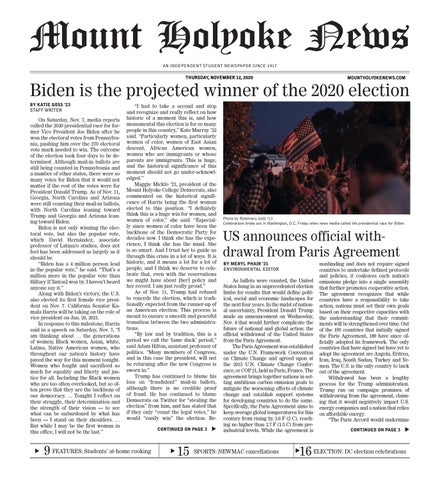
Mount Holyoke News AN INDEPENDENT STUDENT NEWSPAPER SINCE 1917 THURSDAY, NOVEMBER 12, 2020
MOUNTHOLYOKENEWS.COM
Biden is the projected winner of the 2020 election BY KATIE GOSS ’23 STAFF WRITER
On Saturday, Nov. 7, media reports called the 2020 presidential race for former Vice President Joe Biden after he won the electoral votes from Pennsylvania, pushing him over the 270 electoral vote mark needed to win. The outcome of the election took four days to be determined. Although mail-in ballots are still being counted in Pennsylvania and a number of other states, there were so many votes for Biden that it would not matter if the rest of the votes were for President Donald Trump. As of Nov. 11, Georgia, North Carolina and Arizona were still counting their mail-in ballots, with North Carolina leaning toward Trump and Georgia and Arizona leaning toward Biden. Biden is not only winning the electoral vote, but also the popular vote, which David Hernández, associate professor of Latina/o studies, does not feel has been addressed as largely as it should be. “Biden has a 4 million person lead in the popular vote,” he said. “That’s a million more in the popular vote than Hillary [Clinton] won by. I haven’t heard anyone say it.” Along with Biden’s victory, the U.S. also elected its first female vice president on Nov. 7. California Senator Kamala Harris will be taking on the role of vice president on Jan. 20, 2021. In response to this milestone, Harris said in a speech on Saturday, Nov. 7, “I am thinking about … the generations of women; Black women, Asian, white, Latina, Native American women, who throughout our nation’s history have paved the way for this moment tonight. Women who fought and sacrificed so much for equality and liberty and justice for all. Including the Black women who are too often overlooked, but so often prove that they are the backbone of our democracy. … Tonight I reflect on their struggle, their determination and the strength of their vision — to see what can be unburdened by what has been — I stand on their shoulders. … But while I may be the first woman in this office, I will not be the last.”
u
“I had to take a second and stop and recognize and really reflect on how historic of a moment this is, and how monumental this election is for so many people in this country,” Kate Murray ’22 said. “Particularly women, particularly women of color, women of East Asian descent, African American women, women who are immigrants or whose parents are immigrants. This is huge, and the historical significance of this moment should not go under-acknowledged.” Maggie Micklo ’21, president of the Mount Holyoke College Democrats, also commented on the historical significance of Harris being the first woman elected to this position. “I definitely think this is a huge win for women, and women of color,” she said. “Especially since women of color have been the backbone of the Democratic Party for decades now. I think she has the experience, I think she has the mind. She is so smart. And I trust her to guide us through this crisis in a lot of ways. It is historic, and it means a lot for a lot of people, and I think we deserve to celebrate that, even with the reservations we might have about [her] policy and her record. I am just really proud.” As of Nov. 11, Trump had refused to concede the election, which is traditionally expected from the runner-up of an American election. This process is meant to ensure a smooth and peaceful transition between the two administrations. “By law and by tradition, this is a period we call the ‘lame duck’ period,” said Adam Hilton, assistant professor of politics. “Many members of Congress, and in this case the president, will not be returning after the new Congress is sworn in.” Trump has continued to blame his loss on “fraudulent” mail-in ballots, although there is no credible proof of fraud. He has continued to blame Democrats on Twitter for “stealing the election” from him, and has stated that if they only “count the legal votes,” he would “easily win” the election. Be-
9 FEATURES: Students’ at-home cooking
CONTINUED ON PAGE 3
u
15
u
Photo by Rosemary Geib ’23 Celebrations broke out in Washington, D.C. Friday when news media called the presidential race for Biden.
US announces official withdrawal from Paris Agreement BY MERYL PHAIR ’21 ENVIRONMENTAL EDITOR
As ballots were counted, the United States hung in an unprecedented election limbo for results that would define political, social and economic landscapes for the next four years. In the midst of national uncertainty, President Donald Trump made an announcement on Wednesday, Nov. 4 that would further complicate the future of national and global action: the official withdrawal of the United States from the Paris Agreement. The Paris Agreement was established under the U.N. Framework Convention on Climate Change and agreed upon at the 2015 U.N. Climate Change Conference, or COP 21, held in Paris, France. The agreement brings together nations in setting ambitious carbon emission goals to mitigate the worsening effects of climate change and establish support systems for developing countries to do the same. Specifically, the Paris Agreement aims to keep average global temperatures for this century from rising by 3.6 F (2 C), reaching no higher than 2.7 F (1.5 C) from preindustrial levels. While the agreement is
SPORTS: NEWMAC cancellations
nonbinding and does not require signed countries to undertake defined protocols and policies, it coalesces each nation’s emissions pledge into a single assembly that further promotes cooperative action. The agreement recognizes that while countries have a responsibility to take action, nations must set their own goals based on their respective capacities with the understanding that their commitments will be strengthened over time. Out of the 195 countries that initially signed the Paris Agreement, 189 have since officially adopted its framework. The only countries that have signed but have yet to adopt the agreement are Angola, Eritrea, Iran, Iraq, South Sudan, Turkey and Yemen. The U.S. is the only country to back out of the agreement. Withdrawal has been a lengthy process for the Trump administration. Trump ran on campaign promises of withdrawing from the agreement, claiming that it would negatively impact U.S. energy companies and a nation that relies on affordable energy. “The Paris Accord would undermine CONTINUED ON PAGE 3
u
16 ELECTION: DC election celebrations
u
2
EVENTS
November 12, 2020
. Mount Holyoke News
Mount Holyoke News Mount Holyoke News is an independent student newspaper written by and for Mount Holyoke College students since 1917. VISIT US: www.mountholyokenews.com www.facebook.com/themhnews www.twitter.com/mtholyokenews_
EMAIL US: mhnews@mtholyoke.edu
Executive Board Editor-in-Chief Lily Reavis ’21 Managing Editor of Content Flannery Langton ’22 Managing Editor of Layout Rose Sheehan ’22
Publisher Liz Lewis ’22 Managing Editor of Web Zoe Farr ’21 Business Manager Sarah Nam ’23
Copy Chief Kelsey Thomas ’21
Editorial Board News
Casey Roepke ’21, Kate Turner ’21 & Liz Lewis ’22
Arts & Entertainment Sabryna Coppola ’22 & Mariam Keita ’24
Health & Science
Kessh Bhasiin ’22 & Zoe Greenberg ’23
Features Mimi Huckins ’21 & Tishya Khanna ’23
Sports
Opinion/Editorial
Environmental Meryl Phair ’21
Books
Sidney Boker ’21
Photos
Global
Ali Meizels ’23 & Rosemary Geib ’23
Saman Bhat ’22 & Sophie Soloway ’23
Copy Editors
Friday, Nov. 13
Mount Holyoke Review Publishing Party
Celebrate the Mount Holyoke Review’s very first publication. Listen to readings, appreciate art, and create community in Mount Holyoke’s literary world. Registration is required through Embark. 5:00 p.m. - 6:00 p.m. EST
Saturday, Nov. 14
Navigating your Career as an International Student Attend this annual event where you can connect with former international students from Mount Holyoke College. This dynamic group of alums will share their stories and offer advice about how to navigate your career search process as an international student. Registration is required through Handshake. Session 1: 10:00 a.m. - 11:30 a.m. EST Session 2: 7:00 - 8:30 p.m. EST
Gigi Picard ’22
Nina Larbi ’22 & Libby Spy ’24
Hunar Anand ’21, Audrey Hogan ’21, Molly Kleinman ’21, Audrey Shannon ’22, Margaret Connor ’23, Zoe Latham ’23, Lauren Leese ’23, Rhitom Mishra ’23, Kay Brown ’24 & Ella Jacob ’24
Event Highlights
Layout Editors
Maggie Donovan ’23, Angie Romero ’24 & Zoe Tang ’24
Web Editors
Audrey Hogan ’21, Shloka Gidwani ’22, Georgia Fish ’23 & Aarushi Sharma ’23
Publication Guidelines Mount Holyoke News does not endorse any of the opinions or views expressed within the pages of the paper, excluding staff editorials. All content copyright of Mount Holyoke News. All rights reserved. Mount Holyoke News does not discriminate on the basis of gender, race, religion, ethnicity, sexual orientation or age.
Advertising in MHN Interest in advertising in MHN can be directed to mhnews@mtholyoke.edu for pricing and deadlines. MHN reserves the right to refuse submissions on the basis of, but not limited to, advertisements considered to be libelous, obscene, defamatory or discriminatory.
Monday, Nov. 16
The Eliana Ortega 25th Birthday Celebration Open to the entire MHC community, attendees will learn more about the history of the Ortega and the legacy of students, faculty and staff from the Latinx diaspora at MHC, while also enjoying fun activities. Registration is required through Embark. 4:30 p.m. - 5:30 p.m. EST
Tuesday, Nov. 17
Sit in the Front Row: A Conversation with Councilperson Esmeralda Soria
Councilperson Esmeralda Soria Esmeralda (District 1 California) is the only woman on the Fresno City Council and the second Latina to ever serve on the council. Join us for a conversation about education, social justice, public service and community engagement. Registration is required through Embark. 4:30 p.m. - 6:00 p.m. EST
Living As TGNC Beyond MHC: An Alum Panel Discussion
Subscriptions Mount Holyoke News is a weekly publication that will publish online-only throughout the fall semester 2020. To subscribe through email, please visit the following form: https://forms.gle/VPCyskE4kMTDeDan8.
Letters Policy Letters to the Editor appear exactly as they are sent to MHN, except for corrections to spelling, grammar and AP style. Letters cannot exceed 500 words. All letters must include the writer’s name and telephone number for verification purposes. Unsigned letters will not be printed. Names may be held upon request with the approval of the Editor-in-Chief. MHN reserves the right to decide which materials will be printed. Email submissions to mhnews@mtholyoke.edu by Sundays at 5 p.m. for publication the following week.
Self-identified TGNC/NB/gender questioning/+ Mount Holyoke students (past and present) are cordially invited to this alum panel event. A Therapist/ College Counselor, Scientist/ STEM Person, and Professor/ Writer will speak about careers and more about building a life and navigating the world beyond college as a trans and gender nonconforming identified graduate of Mount Holyoke College. Registration is required through Handshake. 5:30 p.m. - 7:00 p.m. EST
November 12, 2020
NEWS
. Mount Holyoke News
3
Biden sweeps Electoral College and popular vote, cont’d CONTINUED FROM PAGE 1
u
cause some states, such as Pennsylvania and Michigan, initially leaned red before shifting blue, Trump is using this as an indicator that fraudulent votes were cast in order to aid Biden. “When he is winning, it’s not rigged. When he is losing, it’s rigged,” Hernández said. “He is like a child that way.” Hernández elaborated, claiming that Trump’s post-election actions are only his latest ploy to enact voter suppression. “The final act is to stop counting ballots, the post-final act is to throw out ballots that have already been cast and counted,” Hernández said. “Again, that’s just another aspect of voter suppression.” Alongside Trump, Secretary of State Mike Pompeo has also refused to recognize Biden as the future president. On Nov. 10, he said in a statement to the U.S. Department of State, “There will be a smooth transition to a second Trump administration.” His statement sparked outrage among politicians in the U.S., who have called for Trump and his administration to put an end to making claims of voter fraud without evidence and concede the election. Because the department has not communicated with American diplomats about how to discuss this election with their foreign counterparts, diplomats have also been put in an unusual position. The Trump campaign has filed several lawsuits in certain battleground states to either stop votes from being counted or have a portion of mail-in votes thrown out. In Pennsylvania, the campaign sued the state and claimed that Republican poll watchers were not able to be close enough to monitor the ballot counting at the polling location.
Photo by Rosemary Geib ’23 With Biden’s win, Kamala Harris makes history as the first Black and first female vice president of the U.S.
However, one of the lawyers admitted in the courtroom that there was “a nonzero number of people in the room.” Therefore, the case was rejected. There is a population of voters who do believe that all votes should be counted and verified before officially announcing anyone as the winner. Sandra Scarlatoiu ’22, president of the Mount Holyoke Republicans, thinks that mailin ballot votes should be verified before announcing a winner. “The ballots need to be verified before we can conclude for sure,” Scarlatoiu said. “I mean, who knows, it could very well be that Joe Biden won the presidency and such, and then in that case, Trump, I think, would then concede the election.” Scarlatoiu continued, “If Biden has won the election properly, then there
is no reason that Trump shouldn’t concede the election. I think it’s important that we wait and see what happens, that we do make sure that this election is a clean one. I mean, this is the most fundamental part of being a constitutional democracy here in the United States. If our elections are tampered with, if they don’t actually reflect the opinions of its citizens, then what else do we have in that case?” Micklo thinks that Trump’s attempts to stop the vote is an evasive strategy aimed at delegitimizing Biden’s win. “I have also seen a narrative from a lot of Trump supporters or conservatives who have said, ‘Well, you know, if Biden was legally elected, if this was a legitimate election, then sure, I would support him, because I support America,’” she explained. “It’s going to be easier
for folks to completely reject the idea that Biden is a unity candidate and adhere to bringing people together.” Along with suing states, Trump is calling for revotes in all the states that he can, especially states he was originally leading in on election night, such as Pennsylvania and Michigan. He is also calling for recounts in states that have not projected outcomes yet, like Georgia and Arizona. Although it is within a candidate’s rights to call for a recount within a certain margin, it typically does not change the outcome of a state’s winner, according to Hilton. “The research on statewide recounts, of which there has been several dozen or so over the last set of years, usually finds that recounts change the margin by on average 250 votes,” Hilton explained. “No recount has, to my mind, ever shifted the margin that Trump would need, which is where he is down by over 1,000 in some cases, and in others he is down by 5,000 or 10,000. That is why I think all of the networks felt quite comfortable calling this for Biden on Saturday.” In state level elections, an outcome within one percentage point of the margin automatically allows candidates to request a recount, but at their own expense. If the margin is within 0.25 percent, then the state will pay for the recount. In this case, the Trump campaign is paying out of pocket for the recount. “For posterity, they should recount,” Hilton said. “These official counts should be verified by independent judges. If they find against Trump, he will probably just accuse the judges of being CONTINUED ON PAGE 4
u
US pulls out of Paris accord, a reversal for climate action, cont’d CONTINUED FROM PAGE 1
u
our economy, hamstring our workers, weaken our sovereignty, impose unacceptable legal risks, and put us at a permanent disadvantage to the other countries of the world,” Trump said in a statement issued in the Rose Garden on June 1, 2017, in which he officially announced his plans to terminate U.S. ties to the agreement. According to U.N. law, a country cannot formally begin the exit process until three years after an initial agreement is made, which, for the U.S., was Nov. 4, 2016. The finalization of the notice, filed immediately by Secretary of State Mike Pompeo,
then takes a full year. One day after the 2020 U.S. presidential election, the U.S.’ withdrawal was officially confirmed by the U.N. While the withdrawal holds serious implications for the environment, the recent election of former Vice President Joe Biden is expected to significantly change climate policies enacted under the Trump administration. Biden has pledged to recommit the U.S. to the Paris Agreement immediately following his inauguration on Jan. 20, 2021, meaning the incoming Biden administration could potentially notify the U.N. of the U.S.’ intent to rejoin that day. That notification would take 30 days to become official. Crafting a realis-
tic set of proposals to meet 2030 emissions targets in advance of the next U.N. Climate Change Conference, COP 26, scheduled to take place the first two weeks of November 2021, in the U.K. will be more challenging for the incoming administration. The U.S. could also decide to remain outside of the Paris Agreement, taking on an observer status where representatives would be permitted to be present at meetings and collaborate with countries, but would not be in the officially recognized position to vote in decision-making processes. No longer committed to the coalition of nations dedicated to crafting policies and building infrastructure in response to
the ever-looming threat of global warming, U.S. absence from the pact creates significant challenges on national and international scales. The most devastating effects of climate change are disproportionately felt by developing countries that have the least impact in rising greenhouse emissions. The U.S. is one of the biggest contributors to environmental damage as the world’s wealthiest country and largest emitter of carbon emissions. As such, the U.S. bears a greater responsibility than most in curbing emissions and developing comprehensive policies that will ensure the long-term sustainability of human activity on Earth.
4
NEWS
November 12, 2020
. Mount Holyoke News
Trump refuses to concede the 2020 election to Biden, cont’d One CNN article described his latest actions as a “move, which may have made a president who is losing his powbiased or corrupt or something. But for er feel briefly powerful, [and] only adds posterity sake, the more secure, accu- to the perception that the U.S. leader is rate, certified and verified an outcome flailing his way to the exit.” Although Biden has been elected we have, the better going forward.” Before official election results were as the new president, his term will not released, it had been speculated that, officially start until Jan. 20, 2021. Thereshould Trump lose, he may bring it to fore, Trump will remain in office for the the Supreme Court, similarly to what next two months. Hilton said that some happened in Al Gore v. Bush in 2000. members of the Republican Party may Because he has secured one-third of all be worried about how Trump’s actions judicial appointments in the country, after losing the election will reflect on including seats at the Supreme Court, them in the future. “It is just not good for normal govmany are worried that his appointees may rule in favor of him even if it meant ernance for the president to resist an overturning the election results. Howev- incoming administration,” Hilton said. er, now that Biden’s victory has been an- “I think they are somewhat concerned nounced, and the Electoral College and about the president finishing out his popular vote numbers are not extreme- term in a way where he will kind of be remembered as the ly close, that doubt has worst loser in history, faded away in some voters, like Micklo. “I think it is going to be as a sore loser.” Even though Trump “I think I am no lonanother hard four years is blocking a traditionger worried about this for U.S. politics, but at al rite of passage for election being decided in the courts. It is not the same time, there are the new president and administration, close enough,” Micklo glimmers of hope here.” his Biden has not waited said. “It ultimately just on Trump to start plancomes down to the idea ning for his own changthat anyone can sue - Adam Hilton es. On Monday, Nov. 9, anyone if you have the Biden and Harris put right amount of money. Just because you’re bringing something together their own COVID-19 advisory to court doesn’t mean that a judge is go- board made up of public health officials, ing to listen to you if the claims are as doctors and current and former government officials. Biden has stated that baseless as they are right now.” Trump’s refusal to concede has he intends to work with governors and created some major roadblocks for mayors in states to set a national mask President-elect Biden and Vice Presi- mandate at the beginning of his term dent-elect Harris. Administrator of the in January. This new board and the baGeneral Services Administration Emily sic plans the new administration spoke Murphy will not ascertain the win for about on Monday came the same day Biden, currently leaving him and his drug producer Pfizer announced that growing administration without fed- their COVID-19 vaccine has shown to be eral funding or access to information more than 90 percent effective so far. “It doesn’t matter your party, your from the current administration. These are also usually a part of the conces- point of view,” Biden said in his statesion process, but it does not seem that ment on Monday. “We could save tens Trump plans to use this peaceful transi- of thousands of lives if everyone would just wear a mask for the next few tioning process anytime soon. Starting on Monday, Nov. 9, Trump months. Not Democrat or Republican became suddenly active once again, as lives — American lives.” Micklo believes that the pandemic he had not been making public statements since the announcement of is the first thing Biden and Harris have Biden’s win. He fired Mark Esper, the to address. “It might mean more shutformer secretary of defense, announced ting down and longer economic turmoil, via Twitter, after a longtime tension but dealing with the pandemic also has between the two after Esper refused to to come with more economic stimulus use the country’s military on U.S. pro- packages, and I am a little more hopeful testers this summer. Trump also stated that can happen under a Biden administhat any cabinet officials or political ap- tration,” she said. “I think the economic pointees who are found to be looking for crisis and the pandemic are extremely important day one issues.” another job will be fired. CONTINUED FROM PAGE 3
u
Photo by Rosemary Geib ’23 In the U.S., it is customary for unsuccessful presidential candidates to concede from the race. Donald Trump, who officially lost the election on Nov. 7 when Joe Biden surpassed 270 electoral votes, has yet to drop out.
Hernández talked about other day like immigration changes, a lot of the one issues. “Trump has smothered horrendous things he did with immithe asylum system,” Hernández said. gration policy, the Biden administration “These are our global responsibilities to will be able to unilaterally undo,” Hilton the world, to our neighbors, and [Biden] said. “But so long as we have divided has to fix those. So that is what I think government, I don’t think we can expect needs to be done immediately. But there a Green New Deal, the Obamacare pubare so many other things.” lic option. The rather progressive agenMurray stated her hopes for issues da proposed by the Biden ticket, I think, the new Biden administration will be will probably not come to be.” able to tackle surrounding issues of On the same topic, Murray also said, justice. “I am “A Democratic presicertainly hopdency doesn’t guaraning for tackling tee that Democratic racial justice in policies will be imple“I am thinking about … profound ways mented. Checks and that the Trump balances are really the generations of women; administration complicated, obviousBlack women, Asian, white, ly.” has certainly Latina, Native American not gone near Biden has been and, honestwomen, who throughout our assumed to be a tranly, I think the sitional president nation’s history have paved “among political sciU.S. really in the way for this moment to- ence scholars and the the last few decades hasn’t community,” night. ... While I may be the news tackled … in according to Murray. first woman in this office, I Hilton also commentan extreme will not be the last.” way,” she said. ed on this, saying that “I think we it is expected to see are starting to Harris play a largersee this is an role in the upcoming - Kamala Harris issue that a lot administration in orof Americans der to get her ready to care about very run on her own ticket deeply. It will be interesting to see how for the 2024 presidential election. ThereBiden handles that.” fore, Biden may only be a one-term Hilton thinks that Republicans will president with Harris as his successor. make it difficult for Biden to get any“I think it is going to be another thing done through Congress, especial- hard four years for U.S. politics, but at ly if they keep the Senate and possibly the same time, there are glimmers of take back the House in 2022. However, hope here,” Hilton said. “Most imporhe thinks Biden may be able to get some tantly, Trump, who I think presented a minimal work done that does not in- singular threat to American democracy, volve Congress. … will not be in the Oval Office any“Everything Trump did unilaterally, more, and that is significant.”
November 12, 2020
. Mount Holyoke News
OPINION/EDITORIAL
5
Ethical and sustainable consumption won’t solve climate change
Graphic by Anjali Rao-Herel ’22
BY NINA LARBI ’22 OP-ED EDITOR
Climate change is the slow apocalypse already underway. The planet has warmed 1 degree Celsius compared to pre-industrial times, according to the International Panel on Climate Change, threatening mass extinctions and natural disasters like wildfires and floods. Awareness of the dire situation of the planet has led to an increasing environmental consciousness in highly developed countries with a history of mass consumption like the United States. People are sitting down and asking themselves, “How can I reduce my carbon footprint?” beyond just turning the lights and
water faucet off when they are not in use. In response to the pursuit of a smaller carbon footprint, various “ethical and sustainable” brands have established themselves, making their way to consumers via social media advertisements and targeted articles on lifestyle websites. Despite the clear benefit ethical and sustainable products provide, we cannot buy our way out of a global environmental crisis. Climate change requires both top-down and bottom-up levels of change, and not just with consumer products. Overconsumption is directly leading us to impending environmental collapse, whether it be fossil fuels releasing greenhouse gases that warm the planet or consumer goods with externalities. Cheap goods, like $15 t-shirts, exchange a low price tag for poor working conditions and pollution at various points along the supply chain. In this way, both the environment and workers are paying the price for cheap goods. In overconsuming countries like the U.S., consumption is built into people’s lifestyles. Gasoline-powered cars, smartphones, toilets that flush down a stupidly large amount of water and the ubiquity of rarely recycled plastic packaging are parts of our lives. This consumption can be reduced by using hybrid or electric cars and energy efficient light bulbs, and buying a toilet that has varying flushing settings. But these modifications are either nominal in their impact or absurdly expensive for most people. Regarding lifestyle goods, consumers do have more choice and can pick a sustainable option that is neither incrementalist nor inordinately expensive. Clothes and shoes are the easiest to swap out for sustainable alternatives because they don’t require indepth research, installation or maintenance, unlike other products. Thus, a crop of “ethical” and “sustainable” brands like Everlane, Ecoalf and Veja have gained popularity, each promising a guilt-free product that neither harms workers nor excessively pollutes
the environment. Despite the attractiveness of such products, companies are still companies, and they want to sell people products. Greenwashing is a deceptive marketing tactic that makes products seem more environmentally friendly than they are; for example, using the color green on packaging and advertising that a product has “natural” qualities despite there being no clear definition of the word. Bluewashing is the formation and heavy advertisement of an agreement to comply with the United Nations Global Compact, a non-binding corporate commitment to sustainability. Brands will also proclaim their mission to work on the United Nations Sustainable Development Goals without any evidence of doing so. There are ways to check companies’ sustainability commitments, but all require synthesizing publicly available data and statements, which are often sparse or nonexistent regarding labor standards and pollution. Popular ethical and sustainable brand Everlane’s data was synthesized by the Australian application Good on You, and they found no evidence that Everlane pays a living wage in its supply chain or makes conscious efforts to reduce textile and water waste. Ultimately, green consumption is a business-as-usual model with a leaf on it. Even if companies aren’t lying about their commitments to sustainability, feigned sustainability pressures individuals to bear the burden of global environmental destruction through the singular freedom of consumer choice rather than holding large corporations and governments responsible for causing and allowing climate catastrophe. Cultural awareness of sustainability is beneficial, but it does little to remove the problem at its root, which is lax and avoidable environmental and economic policy that permits corporations to completely wring the Earth dry of its resources and mistreat workers.
Mount Holyoke students weigh in on National Novel Writing Month BY CAT BARBOUR ’24 STAFF WRITER
Both hated and revered by participants, National Novel Writing Month, known colloquially as NaNoWriMo, has drawn the attention of writers since 1999, including hundreds of thousands since 2007. In 2006, NaNoWriMo became a nonprofit dedicated to inspiring people to tell their stories. According to their mission statement, NaNoWriMo “believes in the transformational power of creativity.” The statement continues, “We provide the structure, community, and encouragement to help people find their voices, achieve creative goals, and build new worlds — on and off the page.” The challenge: Write 50,000 words in 30 days. Or, in the words of NaNoWriMo headquarters: “Your job now is not to create a manuscript that a publisher will want to sell at lemonade stands all over the country. That comes later, once you’ve done a ton of revision and rethinking. For now, your task is to create a first draft. Or in other words, to make a glorious, beautiful, breathtaking mess.”
Emily Carle ’21, Mia Kerchen ’24 and Fiona Milton ’22 each discussed their participation in NaNoWriMo with the Mount Holyoke News. Carle, while not currently participating, did so as a first-year in 2017 and was a part of the Western Massachusetts and Five College NaNoWriMo groups. She appreciated being a part of the groups and said that the motivation helped her complete 30,000 words. “With the Five College group, everyone else was a college student and so they were also dealing with … trying to take classes and write [for NaNoWriMo] and actually write for grades,” Carle said, adding, “They were truly a good support system for when I wanted to give up.” For the past three years, Kerchen has also been writing. While she has never completed the challenge, she’s been having a lot of fun writing stories. She commented that NaNoWriMo is “really intense” and compared it to “writing a small paper everyday.” Milton did finish the 50,000-word goal on her first attempt. She has participated in NaNoWriMo four times: in 2011, 2012, 2013 and 2017. She believes that “it is not about winning or writing 50K words, it is about starting to tell a story you’ve been wanting to tell.” She added, “NaNoWriMo is about writing for yourself and
no one else, so don’t let anyone tell you how many words you have to write to do it right.” Fans of NaNoWriMo are loud and proud, but so are its critics. Notably, blogs on both sides of the argument are a few years old. The dust seems to have settled, but for a while, peace was not an option. Chris Becheen, an active comical blogger, reluctantly shared his opinion on NaNoWriMo in 2016 in his post, “Nanowrimo: The Good, The Bad, And the Very Very Ugly.” In the post, he detailed his issues with the program, arguing that 50,000 words would be generously considered a novella, that participating in the competition does not make one a novelist and that the program’s idea that word count above all else matters is problematic. Additionally, he warned, “Dec 1st, the predators come out to play. They promise the moon, … preying on people’s desire to BE writers and sucking off their hard earned money by pretending that these manuscripts don’t need anything more than a copy edit to knock the socks off a publisher.” CONTINUED ON PAGE 14
u
6
GLOBAL
November 12, 2020
. Mount Holyoke News
England locks down to prevent ‘medical and moral disaster’
Photo courtesy of WikiMedia Commons England entered a national lockdown to limit the spread of COVID-19.
BY SOPHIE SOLOWAY ’23 & ADITI PARASHAR ’22 GLOBAL EDITOR & STAFF WRITER
British Prime Minister Boris Johnson announced on Oct. 31 that England will be going into its second national lockdown to help limit the spread of COVID-19. The lockdown began on Nov. 5 and is set to end on Dec. 2. According to the BBC, England had 21,915 confirmed
COVID-19 cases as of Oct. 31, bringing the total since the beginning of the pandemic to 1,011,660. In his press conference, Johnson announced that the second national lockdown was the only way England could prevent a “medical and moral disaster” for the British National Health Service, reported the BBC. Johnson also said “no responsible prime minister” could ignore figures that suggested deaths would reach “several thousand a day,” with a “‘peak of mortality’ worse than the country saw in April.” Without the lockdown in place, members of the NHS would have been forced to choose which patients would live and which would die, Johnson said. This lockdown is similar to Britain’s first national lockdown in the spring, with spaces like pubs, restaurants, gyms and nonessential shops closing for four weeks. People have also been asked to work from home if their jobs allow. However, unlike in the spring, educational institutions like schools, colleges and universities are allowed to stay open during this lockdown. Leader of the Labour Party Sir Keir Starmer supported the second lockdown while emphasizing the fact that this is a decision the Tory government “should have taken weeks ago.” The Labour Party had been pushing for a shorter lockdown weeks earlier to no avail, reported The New York Times. The Print, an Indian publication, reported that Johnson was resisting introducing nationwide restrictions, even with growing pressure. Johnson cited “disastrous” consequences for the U.K.’s finances, calling it the “nuclear” option and instead suggesting a threetiered system targeting local areas in England before announcing the new lockdown. Shanze Hasan ’21, an international relations ma-
jor, said, “While the second lockdown is important to reduce the burgeoning number of coronavirus cases, the delay due to the Johnson government’s resistance will mean a longer lockdown to counteract the rise in cases England has seen recently.” The second lockdown also has economic implications. According to The New York Times, even in the spring lockdown, Britain was much slower than its neighbors in shutting down its economy, which led to the lockdown lasting longer than initially intended. It also saw one of the worst second quarter recessions in Europe. Many opposition leaders and economists believe this delayed lockdown is the government making the same mistake again. Amman Syed ’22, an economics major, said, “The projected unemployment peak numbers have gone up and economic growth has gone down. However, a lockdown in any country would see the same results. What the U.K. needs to do is focus on how long they continue to supplement loss of income so that when the economy opens up again, the jolt to the economy is not massive.” The U.K. is not the only country in Europe with rising cases. According to NBC News, Germany and France have both documented record numbers of daily COVID-19 cases within the past week. Italy, one of the countries worst hit by the pandemic in its early stages, has also placed new restrictions on citizens in an effort to curb rising cases. The New York Times reported that the Czech Republic, Belgium, Hungary and Poland have also seen a steady increase in hospitalizations, placing Europe’s hospitals at a shortage of healthcare providers and supplies. As the U.K. enters its new lockdown, many of its neighboring countries must contend with very similar realities.
Korean Language Table teaches culture and language to students BY AMELIA LUO ’23 STAFF WRITER & PHOTOGRAPHER
This year, due to remote learning, the Korean Language Table is being hosted through Zoom. Although different from the traditional language table experience, students are adapting, finding new and innovative ways to celebrate Korean language and culture virtually. “The table’s goal is to make students more motivated in learning Korean as their second language … because sometimes it’s hard to start learning a new language,” Chloe Choi ’21, the host of the Korean Language Table, said. This is Choi’s first year working as a Korean language assistant and third year as a language tutor. “The Korean language assistant [and] tutor job is always pleasant because I can meet many students who’re interested [in] or even love the culture where I’m from,” she said. Each week, the language table has different themes. In the first module, they covered the national holidays of Korea; in the current module, they are learning more about Korea’s culture, history and geography. Choi expressed her initial worries with holding Korean Language Table on Zoom. “In the beginning,
Graphic by Anjali Rao-Herel ’22
I was a little afraid of using Zoom since I was a bit worried about … less motivation [from] students,” she said. “Fortunately, everyone is very passionate and active in the events.”
Clare Heywood ’21, who is also a Korean language mentor, sees the event as a bridge that connects a small community. “I find that it’s a very lovely way for those learning Korean at the moment or those people who have taken Korean courses at Mount Holyoke in the past to connect with the language in a small and community-based manner each week,” Heywood said. “I’m incredibly glad they’re still being held through the pandemic, and that I can continue to meet a wide array of Mount Holyoke students with similar interests as well as offer them my support as an upperclassman.” Ayesha Khalid ’23 expressed excitement about how the language table has influenced her study of Korean. “I took Intro Korean in the first module, but I am still attending Korean Language Tables in the second module,” Khalid said. “The breakout room discussions are very engaging, and it is really fun to talk about Korean culture even if our class peers are far from each other and doing it virtually. The experience is very lively and [we’re all] inclusive of each other.” “It would be even more fun if Korean Language Table takes place in person over the upcoming semesters,” Khalid added. CONTINUED ON PAGE 7
u
November 12, 2020
GLOBAL
. Mount Holyoke News
7
Mass shooting in Vienna is labeled a terrorist attack BY MADHAVI RAO ’24 STAFF WRITER
A mass shooting took place outside of a synagogue in Vienna, the capital city of Austria, on Nov. 2. A large crowd had gathered at the city center a few hours before the imposition of a nationwide lockdown against the coronavirus pandemic when the shooting occurred, according to Al-Jazeera. The gunman, Kujtim Fejzulai, 20, is said to have previously attempted to join the Islamic State terrorist organization, causing some leaders to believe that this was a terrorist attack. The shooting resulted in the deaths of four people: a German university student, a North Macedonian man and a middle-aged Austrian man and woman. The assault prompted a quick response from the Vienna police, who set up roadblocks around the city. Nine minutes after the shooting began, Fejzulai was killed by the police. There has been speculation that the shooting was premeditated and carried out by a group of gunmen, but, as reported by BBC News, the Austrian police determined that Fejzulai acted alone after inspecting the mobile phone footage taken by witnesses. Fejzulai, a citizen of both Austria and Macedonia, was arrested in 2019 and sentenced to 22 months in jail for attempting to migrate to Syria to join IS. The Islamic State has claimed responsibility for the attack without providing evidence for this claim. As reported by The New York Times, the organization has a history of falsely taking responsibility for assaults that were carried out by individuals. Assistant Professor of International Relations and Politics Christopher Mitchell echoed this reporting. “It’s actually not uncommon for terrorist groups to take credit for attacks they were not actually involved in,” he said. “Even if it later comes out that they were not involved, they get ‘free’ publicity when their claim is reported, which helps draw attention to the group and their message.” Austrian President Alexander Van der Bellen and Austria’s Chancellor Sebastian Kurtz have both condemned the shooting, which they describe as an attack
Photo courtesy of WikiMedia Commons Austrian Chancellor Sebastian Kurtz condemned the shooting and blamed the attack on Islamist terrorist groups in a national address.
Photo courtesy of WikiMedia Commons Shortly after the shooting, Vienna’s police set up roadblocks around the city. Within nine minutes, the shooter, Kujtim Fejzulai, was also killed.
on democracy, according to The Guardian. Kurtz expressed that the assault was “clearly an Islamist terrorist attack” in his address to the nation on Nov. 3. “It was an attack out of hatred — hatred for our fundamental values, hatred for our way of life, hatred for our democracy in which all people have equal rights and dignity,” Kurtz stated. “We must be aware that this is not a conflict between Christians and Muslims or between Austrians and migrants. No, this is a fight between the many people who believe in peace and those few who want war.” Chair of German and Jewish Studies at Mount Holyoke Karen Remmler described how the nature of these comments could affect the general European attitude toward migrants. “European Muslims are of course a diverse set of communities and yet they find themselves targeted after recent terrorist attacks in France and Austria, even as Muslim religious and community leaders vehemently condemn any form of violence committed by self-identified Islamist groups,” Remmler said. “When state leaders, such as Emmanuel Macron (France) or Sebastian Kurz (Austria) label the acts of terror as ‘Islamist,’ they open the gate for anti-Muslim sentiment,” she added. Remmler elaborated that the comments themselves are not to blame; rather, the use of such comments to advance a certain narrative is. “Even as Kurz and Marcron labeled the acts of terror as ‘Islamist,’ they were also quick to condemn any acts of violence toward Muslims in their countries,” she explained. “In contrast, groups on the political right are quick to use the attacks to express their anti-immigrant and anti-Muslim sentiments and call for a renewal of nationalist values and allegiances.” Mitchell seconded Remmler’s comments, detailing how these events might lead to policies that will disproportionately impact Europe’s Muslim population. “The greater danger, however, is that we see an increase in attention to a far-right narrative about the danger to Europe from a Muslim ‘other’ and and em-
phasis on an exclusionary European identity that rejects multiculturalism,” he explained. “This far-right populist trend has been an undercurrent in European politics for decades now, though such groups had seen a setback as attention had focused more on responses to the coronavirus.” Mitchell explained that groups might use these attacks as a way of advancing their message, adding, “This will not have an immediate and direct policy effect on Europe’s Muslims, though it may lead to retaliatory violence and, in the longer run, may lead to greater electoral gains for far-right groups, which would then have policy consequences.”
vw
Korean Language Table, cont’d u
CONTINUED FROM PAGE 6
Venesia Delancy ’22 hasn’t missed a single Korean Language Table since the semester started. This surprised Delancy, who said, “Given the circumstances, I’m glad we’ve been able to transform the language table into something that still engages us and the students during these times.” The virtual Korean Language Table is hosted weekly on Thursdays from 8:30 p.m. to 9:30 p.m. EST. Anyone interested in learning about Korean language or culture is welcome to join. The event is made accessible to all levels of Korean speakers, as well as people who have no background in the language at all. For the Zoom link, please contact Professor Kyae-Sung Park (kspark@mtholyoke.edu).
8
FEATURES
November 12, 2020
. Mount Holyoke News
CAs continue to create community through virtual cohorts BY REBECCA GAGNON ’23 STAFF WRITER
Throughout the fall semester, Mount Holyoke created an array of virtual events in an effort to bring its community together online. One of the College’s new ways of creating community has been the formation of the Virtual Cohorts. “Our Virtual Cohorts were really just intended to bring students together in virtual ways so they still felt that sense of community,” Associate Director of Students and Director of Residential Life Rachel Alldis said. “We do have data that shows students feel a greater sense of community in the Living Learning Communities than when they live in a residence hall.” Some of the Virtual Cohorts’ themes are based on past LLCs, like transfer, first-year, art, outdoors and more. These are made to foster a greater sense of community in a time of need. There are also Virtual Cohorts based on students’ current geographical regions. Lexy Lee ’23, the Virtual Community Ambassador for the arts cohort, shared the story of “someone who said, ‘What if we had pen pals but with artwork?’” “Because there are people who are interested in all different types of artwork,” Lee explained, “we kind of just want to create a place where we can just make … a lot of different types of art and share.”
A Virtual Community Ambassador is similar to a Community Advisor in residential halls, in that they are the leaders of the different Virtual Cohorts. The VCAs were chosen out of the students who were already hired in the spring of 2020 to work for ResLife as CAs in the fall. “They are able to do a lot of things your CA would do,” Alldis said. “They are having one-on-one conversations with the students, they are trying to bring together these smaller groups that are based on either what our LLCs are based on or regional ones. … I think it is off to a good start.” Helen Roane ’23, the VCA of the Transfer Cohort, said, “I really wanted to be a part of trying to make the [Mount Holyoke] community still exist in the virtual setting, because it is a lot harder.” “I know that it is really, really hard for people to find a community right now, especially for the people who are living at home,” Delaney Fowler ’21, the VCA of the Outdoor Adventure Cohort, said. “I know a lot of people are living either with friends in an apartment or some people on campus … and there is a community in both of those things in a way that there really isn’t when you are at home, so I really wanted to reach out to those people and try to help them feel some sense of community because it is such a big part of Mount Holyoke.” Because of the transition to remote learning
during the CA hiring process, there were a lot of uncertainties about the outcome of the application timeline. In the process of becoming a CA, one has to submit an application and complete both a group and individual interview. Normally, results would appear around February or March, but with the pandemic, the results took longer. “We [went] through [the CA hiring process] and then the pandemic happened,” Alldis stated. “Then everyone left campus and we were a little delayed on letting people know who we wanted to hire and who we didn’t, but we sat down and we figured it out. We were then ready to make offers to people and then we were like, ‘Well, we want to offer you this position but we don’t know really what is going to happen.’” “It was kind of stressful not knowing what was going on,” Lee said. “There was a period of time when I wasn’t really sure if I had the job anymore and it was a little hard. I understand that the people who were working in the offices, of course, had a lot of stress they were dealing with trying to figure out probably as well if we all had jobs still,” Lee added. Even with all of the struggles, jobs were given and received and there is now a new community available CONTINUED ON PAGE 9
u
Professor Naomi Darling awarded for excellence in architectural design BY ANSLEY KEANE ’23 STAFF WRITER
Naomi Darling, a Five College associate professor of sustainable architecture who teaches at Mount Holyoke College and the University of Massachusetts Amherst, recently won the 2020 AIA New England Merit Award for Design Excellence titled “More with Less.” Darling received the “More with Less” Merit Award for her project, the Takahashi-Harb Loft and Library. Darling converted an unfinished walk-out basement into a bright and updated one-bedroom apartment and a two-car garage into a workspace for the Takahashi-Harb couple, complete with floor-to-ceiling bookshelves. Darling attended Princeton University for her Bachelor of Science in Engineering in structural engineering and architectural design, Monash University for her Master of Fine Arts in sculpture and the Yale School of Architecture for her Master of Architecture. In addition to teaching, Darling has her own architecture and design practice, Naomi Darling Architecture, LLC. Darling became interested in architecture from a young age. “The first time I thought about [architecture] — I think I was seven or eight — I was home from school because I was sick,” she said. “My mom gave me these Victorian houses to cut out and put together, and I really liked the process of making.” Her first year of college, Darling took an architecture class she “really loved.” In an interview with the online publication Madame Architect, Darling also explained that she “loved how the [architecture] course expanded [her] way of thinking demanding thoughtful reasons for the myriad decisions that go into design.”
Photo courtesy of Sean Kernan Darling’s designs and pedagogy focus on environmental sustainability.
After she graduated from college, Darling didn’t jump right into the world of architecture. Instead, she explored pottery, sculpture and even worked as a scientist for the Sea Education Association before working at an architecture firm in Seattle in 2000. She has taught at Mount Holyoke since 2012. “I love interacting with the students,” she said. “The dynamic between students [at Mount Holyoke] is always really positive.” She explained that, in her perspective, “the built environment is one place where we can make a difference.” By showing students the fundamental principles of design, Darling said she “can make a bigger impact teaching.” The Takahashi-Harb project itself spanned from 2015 to 2018. One of the challenges Darling faced in completing the project was to make the space “not feel like a basement,” she said. She and her team put two
large windows into the loft to take advantage of the property’s beautiful views and to “bring the outside in,” she explained. “Any project that you do is very much a collaboration between the architect, the site and the clients,” she noted. Another goal of the project tied into the theme of “More with Less.” “We had a pretty tight budget for that project and we were working with just a basement. The goal was to make it into something pretty special with this tight constraint,” Darling said. She noted that it was important to “keep as much as possible, while we were adding.” In order to accomplish that, Darling explained that she and her team kept many of the existing features such as the structural posts in the former basement and garage. According to her website, Darling dressed up the existing stairway and used preexisting electrical, mechanical and plumbing systems. By not removing the features already in place, Darling was able to put more money and effort into nice finishes and windows. Additionally, this style of design allowed Darling to maintain her focus on sustainability, and she said, “by keeping what’s there, there wasn’t as much waste.” As a professor of sustainable architecture, sustainability is an important aspect of Darling’s designs and projects. However, for Darling, sustainability expands beyond just environmental. “I try to look at sustainability very holistically,” she said. She focuses on social and cultural sustainability as well. In a class Darling teaches, she emphasizes working with the natural environment. “Being attuned to where you are [is important], so you don’t need to use a lot of energy,” she explained. Additionally, Darling explained that “for a project to work, it needs to be embraced by the people in that place.”
November 12, 2020
FEATURES
. Mount Holyoke News
9
Students share what they have been cooking at home
Photo courtesy of Ava Provolo ’22 Provolo, who made this pasta, uses cooking to create routine in her life.
BY WOODLIEF MCCABE ’23 STAFF WRITER
Without the ease of dining halls and takeout, Mount Holyoke students have found themselves more responsible for their own meals than ever during the pandemic. Restaurant prices and the additional fees of food delivery services have pushed many students to start cooking for themselves. Tsela Zoksang ’24 started cooking for herself when she moved out of her parents’ house and into an apartment with a roommate. As a first-year, she has been navigating living alone without the buffer of a dorm experience. At first, she was making instant ramen and ordering takeout, but it started to add up. She realized, “Spending a lot of money on a whole bunch of groceries is probably financially unwise when I could just spend $2 here and there on little things.” However, Zoksang added, “When you have that every day, like two or three times a day, it ends up getting to be way too much. I didn’t want to be spending money so recklessly.” Grocery shopping is a very daunting task for Zoksang. She said that she is able to avoid vegetables and other perishables going bad before she could use them by making large batches of each recipe. “When you make a lot of one thing, you can just leave the leftovers in the fridge, and it will last a long time if you make a lot of it,” she said. This doesn’t mean eating the same thing all week, she clarified. Aside from being financially beneficial and time-saving, making food provides much-needed downtime. “Cooking is a pretty stress-relieving experience,” she added. Other students, like Anna Chait ’23, have been cooking since March, when they went back home after campus closed. Chait said, “I started cooking at this time in my life out of force by the pandemic, but honestly, it’s good because cooking is so important and I had been wanting to get into it for years.” Although for some students cook for themselves only temporarily in college, it can become a lifelong skill. “Cooking has given me a new life skill, and it has let me get more creative with my dishes,” Chait said. “Also, cooking has helped me to achieve a healthier and cheaper eating lifestyle.” Zoksang spoke about “pockets of control,” a con-
cept which explains ways we can find more peace of mind by creating habits and routines. It doesn’t have to be complicated, “working out or whatever it may be, reading a book a certain time in the day, just one or two things to bring a little more consistency to your life and make you feel like you’re in charge,” Zoksang said. For many students who have lost the consistency of simply leaving the house for class, making meals is a good way to reclaim a sense of time and purpose. Ava Provolo ’22, who has also been cooking since March, said that she has gained more than just cooking skills and a renewed sense of routine. “I’ve learned my strengths, how to be creative, the importance of food as being joyful. I love making homemade bread and making meals around that,” Provolo said. “Seeing people’s faces when I give them a meal or a platter of something sweet is a great moment.” Jaia Colognese ’22 has had a love of cooking since childhood, when she spent time at her parents’ Italian bakery in Rhode Island. “My parents have instilled in me an appreciation for food that is homemade and handmade,” she said. “I was taught to cook by example, mostly from watching my parents cook dinner together every night.” Cooking is a passion that she has gotten even closer to these past several months. “I spend hours in the kitchen inventing recipes or modifying ones that I come across,” she said. She finds joy in both the process and the end result. To Colognese, sharing her food “is the best part of cooking.” Still, as a college student, the recipes she inherited from her family are not always as doable as she would hope. “I grew up in a household that uses the freshest, highest-quality ingredients,” she explained. “If I want to replicate these authentic dishes that my parents and grandparents make, then I need to use these same ingredients, which are often much more expensive.” Her lifelong love of cooking has taught her as much. “I’ve learned that there’s a huge difference between fresh basil and dried, fresh versus canned tomatoes, ripe fruit versus supermarket-ripe fruit, and so on,” she said. “High-quality cheese, fruit, vegetables and meat are definitely a barrier for a student, but I try to use these ingredients because it improves the taste of the food significantly.” While the pandemic has separated many from their loved ones, mealtimes are still one of the best ways to connect with others. For some, the pandemic has brought opportunities to make these times even more personal. “Cooking and baking are my love language[s],” Provolo said. She has been experimenting with her own veggie burger recipes. Chait has been making all sorts of pescatarian meals and other meatless dishes for her partner, as well as baking, which she says has been a pastime of hers since before the pandemic. Provolo is also baking, preparing for a “12 type [of] cookie marathon” come December, as well as making a fudge and chocolate cake. Despite physical distance, some students, like Zoksang, are connecting to their families through recipes. Zoksang thinks of her father when she cooks. Her father fled Tibet to a refugee school in India where he wasn’t able to cook for himself. “Once he actually had the resources to start cooking, he always loved to,” she explained. “In Tibetan
culture, cooking and having family time for eating and drinking tea together is a big deal, and so he’s always cooked much more … than my mom did. And I always liked to help him as a kid. We’d make what’s called momo, which is like dumplings.” Provolo, who has Italian roots, also recognized the great familial bond that cooking can bring. “Food connects my family together every day at supper,” she said. “I also learned a lot about how to cook from my grandmother, who has shown me most importantly how to put love into food.” The way we feed ourselves can help us find routine in the chaotic lives we have been thrown into. We can have time to think about loved ones far away and show our appreciation for the ones we have the fortune to be close to. If you aren’t cooking with your family, friends or partner in the room, the things we add to the food and the people we share it with can still bring the warmth of a shared meal. Cooking is an incredibly meditative and productive act in a way that few others are. It also opens up room for creativity through experimentation with new ingredients and ideas. We can make mistakes and burn our food and spill everything and make huge messes. We will never not need to have meals, so why not take the time to create joy and warmth when we can? Food is filling, but cooking has the power to be fulfilling.
Virtual CAs, cont’d u
CONTINUED FROM PAGE 8
to students if they so choose. “I feel like the virtual community is really fun anyways but they will be more fun as more people want to join,” Roane said. “I think that if people are interested in joining a cohort they absolutely should,” Fower said. “None of it is mandatory – it is all sort of like you opted in. Even if you join it and you choose not to come that is fine, but I think that people shouldn’t be afraid to join just because they think they don’t have time because when you do have time, you can join. I think it might feel a little less isolating.” The deadline for joining the Virtual Cohorts was Friday, Nov. 6, but there are other ways to stay involved in the campus community. “We want the students to stay as connected as they want to stay,” Alldis said. “I really hope that they realize that Mount Holyoke is in their corner all the time. I know it doesn’t always feel that way but I wish that some people could sit in on some meetings that we have been to so they would know how much we talk about how this would impact the students and how hard it is to give them this positive experience. I just want them to know that we really are trying to do everything we can to make their lives easier and to provide the support [and the] resources that they need, and we miss them — so much.”
10
ARTS & ENTERTAINMENT
November 12, 2020
. Mount Holyoke News
Personality Quiz: Which new popular 2020 album are you? BY MARIAM KEITA ’24, PEARL YOUNG ’24, TIWANI ARIYIBI ’24 & ADIA SAMBA-QUEE ’24 ARTS & ENTERTAINMENT EDITOR & CONTRIBUTING WRITERS
B) Laid back. Chill. C) Reserved. D) Sensitive. Emotional. The mom friend. E) Creative. Indecisive. Lovable.
Whether you are currently crying over your ex or busy becoming the life of the Zoom party, this personality quiz will tell you which release from the past year will suit you best.
3. It’s a Friday night. You’ve already made plans to: A) Go on one of the many dates that you have lined up for this weekend. Being attractive is so exhausting. B) Run downtown to grab boba and Insomnia Cookies. C) Host a Zoom drinking game. D) Stay in to watch a movie and play with your cats. E) Have a recording session with your band.
1. You and a few friends are in the car on a quarantine road trip. They have the aux but you hate their music — what’s the next move? A) Take over the aux and tell them that their music taste sucks. They can thank you later — you’re saving them from themselves. B) Start singing over the music that’s playing. C) Put your headphones on and listen to your own music. Life is too short to listen to bad music. D) Nothing. You don’t want to hurt their feelings. You can always pick next time. E) Ask everyone in the car for their song requests and add them to the queue. Everybody wins! 2. Your friends would describe you as: A) The leader of the pack.
v
If you got mostly A’s:
“Ho, Why Is You Here?” by Flo Milli Others can sense your confidence as soon as you walk into a room. If it isn’t your impeccable sense of style that immediately tips them off, then it’s the way that you carry yourself. You are the best dressed in any situation, and you enjoy treating yourself to nice things. You have your life together and people are jealous of you. You don’t have time for the haters, though — you’re too busy winning at life. The oldest album on this list, Flo Milli’s “Ho, Why Is You Here?,” is a self-love album for those who already love themselves. If you’re on TikTok, you have probably spent the last several months hearing the tracks “In the Party” and “Beef FloMix” playing in the background of people’s dance videos as they exuded pure monarch energy. If you didn’t already know about this July release, well, now you know. If you got mostly B’s:
“Positions” by Ariana Grande You keep to yourself for the most part and those
4. Your friends have invited you out to a fancy 5 p.m. socially-distanced outing. What are you wearing? A) A fur coat over your most fire fit, complete with your shiniest accessories. B) Tight skirt, thigh high boots, turtleneck and your sweetest perfume. C) A bold makeup look and a head-to-toe leather fit. D) The strawberry dress. E) Whatever is comfortable. You care more about the memories you’ll make tonight. 5. You come across your friend’s partner while swiping on Tinder. You decide to: who don’t know you would describe you as quiet. They could not be more wrong! You have strong opinions but you don’t think everyone needs to know about them. You don’t like everyone in your business but you can and will tell them about themselves when needed. People turn to you when they want an honest opinion but you won’t give out unsolicited advice. If you got mostly C’s:
A) Swipe right, but only if they’re fine. B) Keep it moving. That’s all of their business and none of yours. C) Make a meme and subtweet their partner. D) Call your friend immediately and spend the rest of the day plotting with them. E) Ask their partner before assuming the worst. Maybe they just forgot to deactivate their account. 6. Which hobby did you pick up during quarantine? A) Sugar-babying. Somebody’s gotta fund this expensive taste. B) Pinterest board-making. C) Becoming TikTok famous. D) Baking. You can make a mean loaf of banana bread. E) Teaching yourself a new language, learning to play a new instrument and calling up old friends from the past. 7. Which album would you listen to all the way through with no skips? A) “The Pinkprint” by Nicki Minaj B) “Beyoncé” by Beyoncé C) “Ungodly Hour” by Chloe x Halle D) “In the Lonely Hour” by Sam Smith E) “Everything is Love” by The Carters
you as emotional, but you prefer to believe that you are in tune with your emotions. This somber and self-reflective eighth studio album will put you in the perfect headspace to sit outside thinking about your life choices and breathing in the crisp fall air. If you got mostly E’s:
“SAWAYAMA” by Rina Sawayama You’re a bad b----. You don’t care. You’re tired of people’s BS. You are mysterious. No one really knows who you are but everyone wants to. People want to learn more about you but they’re too afraid to approach you. As a result, you often go overlooked. This doesn’t bother you at all. You already know you’re the best. Why would you need someone else to tell you what you already know? Just like you, the alt-pop tracks on Sawayama’s latest album do not always get the love that they deserve.
If you got mostly D’s: “Folklore” by Taylor Swift You live every moment of your life striving to fulfill the cottagecore aesthetic. Timothée Chalamet was your white boy of the month. Your plants are your best friends and you visit art museums in your free time. Scarves can be worn on your head or as a shirt and your purse is made of wicker. Some would describe
“Made In Lagos” by Wizkid You are the life of the party and pre-pandemic, one would need only make their way to the center of the dance floor to find you. You are easily bored and always searching for new ways to express yourself. Wizkid’s latest work is a great match for your never-ending energy and attractive personality. Just like you, Wizkid’s October release has range. The album features a variety of artists across different genres, from Burna Boy and Skepta to Jr. Gong and H.E.R. As someone who is able to get along with just about anyone, the rhythmic yet relaxed tunes on “Made In Lagos” will be perfect for you. Photos courtesy of WikiMedia Commons
November 12, 2020
. Mount Holyoke News
ARTS & ENTERTAINMENT
11
‘The Queen’s Gambit’ brings glamor and tension to Cold War chess BY SABRYNA COPPOLA ’22 ARTS & ENTERTAINMENT EDITOR
Content Warning: This article discusses substance abuse, addiction and injury due to substance use. In the grip of the Cold War, a teenage girl battles to dominate international grandmasters of chess to redeem herself and prove the superiority of America over Russia. In Netflix’s adaptation of Walter Tevis’ 1983 novel “The Queen’s Gambit,” Anya Taylor-Joy plays Beth Harmon, a chess prodigy from Kentucky. The seven-episode series is intense, packed with a range of strong emotions and a surprisingly thrilling series of chess matches. Aided by the brilliant score and Taylor-Joy’s cool assurance, “The Queen’s Gambit” offers an exciting story of a girl dominating a traditionally male game. Beth’s troubled past and fraught relationships keep the audience on the edge of their seats, unable to turn away from their screens. Beth is orphaned at a young age and moves to the Methuen Home for Girls. Sent on an errand to the basement, Beth sees the janitor, Mr. Shaibel, playing chess. Eventually, he agrees to teach her how to play. Beth quickly becomes an expert, even visiting a local high school to play the entire chess team at once and easily beating them all. This marks the beginning of Beth’s journey into global chess fame, expedited by her adoption by Mrs. Wheatley (Marielle Heller), who later helps her travel the U.S. to play in tournaments. Beth continues to play internationally and eventually faces off with Russian World Champion Borgov (Marcin Dorociński). The show has even been praised in The New York Times for its accuracy regarding the details of chess, from the handling of the pieces to the historical references and real masters. Another plot point centers around the tranquilizers Beth and the other girls are given each day by the orphanage to stabilize their moods. Beth saves these tranquilizers and takes them at night to help her see an imaginary chess board on the ceiling that she can use to play and analyze games in her head. When the government forbids the use of sedative drugs on children, Beth starts to experience withdrawals, causing her to break into the infirmary and overdose on them. Beth continues to struggle throughout the series with her dependence on drugs and alcohol, battling the conviction that they enable her to be a better chess player. As a fan of Taylor-Joy after her performances in “The Witch” and “Split,” I was excited to see her in such a unique role. Her intensity was strong throughout the series, but I expected to see more moments of vulnerability, especially considering the personal losses she faces. But even with her stoicism, the dry wit and fierce determination of the character won me over. The show is visually captivating with a cool color palette and lush outfits for Taylor-Joy, culling the most glamorous trends of the 1960s. The score, written by Carlos Rafael Rivera, is excellent, bringing a sense of tension and excitement to the chess matches which feel accessible to non-chess players watching Beth learn the game. The soundtrack also features some great pop songs from the 1950s and ’60s, including the Monkees, the Kinks and Skeeter Davis’ “The End of
Graphic by:
Graphic by Anjali Rao-Herel ’22
The World.” Despite these undeniable strengths, I thought at times that the series left something to be desired. Its portrayal of Beth’s addiction seemed to lack consistency. Her use of drugs and alcohol was certainly labeled as a bad influence multiple times, but it still had a glamorous edge, reminiscent of substance portrayal in “Mad Men.” While we watched Beth sink to the lowest of lows, the dangerous effects of her substance use seemed watered down, diminishing the realities of addiction. Her apparent ability to stop her consumption of drugs and alcohol on a whim felt unrealistic, using her troubled genius and tragic past to romanticize a very real condition that nearly 21 million Americans face. The one part of Beth’s struggle with addiction that does feel realistic is the support she is given from her friends. In her matches, many of Beth’s competitors become her friends and mentors. Harry Beltik (Harry Melling) and Bennie Watts (Thomas Brodie-Sangster) both turn from fierce opponents to trusted friends who offer her guidance on her path to beat Borgov. Bennie helps her stay away from alcohol while studying for her match with Borgov. Harry pleads with her to take care of herself when he sees her at a local chess event in Kentucky. She is also helped by a friend from Methuen, Jolene (played by the fascinating newcomer Moses In-
gram). Jolene seems to find Beth at her lowest point, bringing symmetry to the show, as she was Beth’s closest friend when she first began taking pills. Knowing Beth’s history, Jolene is able to help her regain her sobriety and prepare for her final tournament in Russia. Jolene is also the only person of color in the series, which was disappointing. The existence of her international competitions seemed like an opportunity to address this, but she only seemed to face white European men, which is reflective of the pool of internationally recognized grandmasters in the 1960s. Even her competition with Borgov, like with Harry and Benny, seemed oddly friendly. Compared to all of the Cold War movies demonizing the USSR, their rivalry feels personal, not political. It is unclear if that is a reflection of the current relations between the U.S. and Russia, but it felt less like a political proxy competition than a video game’s boss battle. “The Queen’s Gambit” is visually rich and enthralling despite being fairly predictable. Taylor-Joy is charming and easy to root for. The show is cerebral and surprisingly moving at times. It also packs in quite a lot of information about the rules and history of chess. At just over seven hours, “The Queen’s Gambit” is a perfect series to binge in a weekend, especially if you’re looking to enjoy some retro fashion and watch a teenage girl from Kentucky embarrass chess masters at their own game.
12
ENVIRONMENTAL
Women’s scientific coalition proposes marine protection
Photo courtesy of WikiMedia Commons Homeward Bound is hosting the largest all-women’s expedition of Antarctica, which will study the impacts of climate change.
BY DNYANESHWARI HAWARE ’23 STAFF WRITER
Members of the largest all-women’s expedition to Antarctica, organized by women in STEM initiative Homeward Bound, have formed an all-women’s scientific coalition which is offering ways to overcome the negative impacts of climate change on the fragile Antarctic environment. The lack of women in Antarctica’s research and exploratory history makes this coalition an important step toward empowering women in scientific fields. It consists of 289 scientists and includes the European Union, Russia and the U.S. Antarctica, which houses unique species, has a highly sensitive ecosystem. Climate change, along with human activity like tourism and fishing, endangers Antarctic organisms from microscopic algae to humpback whales. Antarctica’s ecosystem mainly depends on a species of crustacean called krill, which form the basis of the continent’s food chain. Climate change and the negative externalities of human activities have resulted in shrinking sea ice and higher sea levels, leaving krill larvae unsheltered. This could destabilize the entire food chain, affecting species populations faster due to the vulnerability of the ecosystem. The western peninsula of Antarctica is one of the fastest-warming places on Earth with a temperature of 20.75 degrees Celsius. In a two-week long meeting of the Commission for the Conservation of Antarctic Marine Living Resources in October 2020, the coalition proposed the western peninsula of Antarctica as a new marine protected area. This was led by Chile and Argentina. Currently, two areas in Antarctica have marine protection: the South Orkney Islands and the Ross Sea. Marga Gual Soler, a Spanish science policy advisor, told Reuters that the protection of this peninsula “would show the international community that collective action to tackle a global problem is possible.”
November 12, 2020
. Mount Holyoke News
Climate and conflict: How climate change will worsen the crisis in Yemen BY CATELYN FITZGERALD ’23 STAFF WRITER
The ongoing war in Yemen is considered one of the most complex conflicts and worst humanitarian crises in world history. The war has raged for around six years and is driven by a myriad of political and religious conflicts. Despite its complex nature, one driving force behind the conflict is climate change. While it is not a cause of the war, climate change has acted as an additional stressor that has worsened the humanitarian crisis in Yemen. The Yemeni Civil War began in 2014 after the replacement of authoritarian leader Ali Abdullah Saleh during the Arab Spring uprising of 2011, which created political weakness and led to a growing number of disillusioned Yemenis. The newly fragile state presented an opportunity for anti-government groups to gain power and territory in support of their various interests. On one side is the Houthi movement, who oppose the Yemeni government in defense of the country’s Zaidi Shia Muslim minority, along with citizens who were disappointed with the new government. Many of these citizens now support the rebellion. On the other side is the Yemeni government, which is joined by Saudi Arabia, a majority Sunni Arab country alarmed by the rise of Houthis and their potential support from Iran. Following the start of the conflict, the Southern Transitional Council, a separatist movement supported by the United Arab Emirates, also joined the war. Conflict between these groups ravaged Yemen from all sides starting in 2014, causing over 100,000 deaths since 2015, according to the Armed Conflict Location & Event Data Project. The fighting in Yemen has recently slowed due to a ceasefire agreement known between the warring parties as the Stockholm Agreement, but the lack of a definitive end to the conflict has thrust Yemen into an indefinite humanitarian crisis. Yemeni citizens currently face extreme food and water scarcities, as well as vector-borne diseases that threaten their lives and health. The United States Agency for International Development estimates that 2 million people in Yemen are malnourished, 1.3 million of whom are children, and that the country’s water supply will be depleted in as little as 20 to 30 years. In addition to the existing stress on food and water, blockades on outside aid by both Saudi and Houthi forces have pushed the people of Yemen into a desolate state. Climate change will only worsen the current situation in Yemen. USAID’s 2016 Climate Change Risk Profile for Yemen states that the country will see an increased mean temperature, sea level rise and extreme rain patterns as a result of climate change. Increased frequency and length of drought periods will prove detrimental to Yemen’s water supply, where key aquifers like the Arabian Aquifer System, which is already being overdrawn, will be replenished less frequently. Decreasing water availability and unpredictable droughts and floods due to climate change will also damage Yemen’s agricultural sector. Nearly 40 percent of available water resources are used on agriculture, which makes up 11.4 percent of the country’s
GDP, according to USAID. Loss of such an important economic sector would add to current political instability and strife in Yemen. Sea level rise poses a threat to Yemen’s coastal regions; the country is one of the most vulnerable to coastal damage, according to USAID. Not only would loss of coastal communities hurt Yemen’s economy, but it would also displace many of its citizens. This displacement would add to the 3.6 million people already internally displaced by conflict, and such a mass internal migration could cause added instability. While there is a lack of clear evidence to support the idea, the Center for Climate and Security theorizes that water scarcity may have contributed to the rise of political unrest in Yemen, as the decline in the agricultural sector and conflicts over water may have increased recruitment opportunities for anti-government groups. Struggles over water sources will become increasingly likely in the future as water supplies diminish. Not only does climate change worsen the situation in Yemen, but the war itself has stifled efforts to combat climate change. Plans to increase Yemen’s water supply include the development of desalination plants which convert ocean water into drinking water, but there were fears that these plants may become targets for groups looking to disrupt the country’s water supply. Climate change acts as a stressor and, in some ways, a driving force behind the conflict and humanitarian crisis in Yemen. As long as both war and climate change are present in the country, the two will result in a vicious cycle with no end in the foreseeable future. In order to alleviate the suffering in Yemen, increased international effort must be made to either remove the blockades on food and water, facilitate the safe relocation of citizens in areas most vulnerable to climate change or protect efforts to increase the water supply such as desalination plants. Before any change can be made, however, widespread understanding of the links between climate change, war and human welfare must be reached.
Photo courtesy of Flickr Climate change has produced water scarcity and drought in Yemen, exacerbating other conflicts that have long besieged the nation.
November 12, 2020
. Mount Holyoke News
ENVIRONMENTAL
13
Global biodiversity conservation goals face significant challenges
Photo courtesy of pxhere.com. Global governments have failed to meet biodiversity goals, leaving ecosystems around the world facing significant plant and wildlife loss.
BY HELEN GLOEGE ’23 STAFF WRITER
A recent leaked United Nations report showed that governments have failed to meet the internationally agreed-upon 2020 goals regarding biodiversity, along with more specific goals to prevent plant and wildlife loss. In 2010, predating the Paris Accords, the Convention on Biological Diversity was held in Nagoya, Japan. This convention produced the Aichi Targets that consisted of 20 conservation goals to safeguard global biodiversity. Each nation involved was expected to meet the determined objectives by 2020. Another summit was planned for October of this year but pandemic restrictions and COVID-19-related complications forced the summit to be rescheduled for May 2021 in Kunming, China. Despite that, data currently indicates that the goals have not been fully met. Of 44 sub-targets assessed by the leaked U.N. report, 20 are ranked as poor, 19 as moderate and only five as good. The report is not final, and the full U.N. report will include suggestions on how to move forward with planned COVID-19 recovery packages expected to help meet targets. The
Weekly Climate News November 12, 2020
A community conservation initiative to revitalize mangrove forests, a resource for fish and medicines as well as a natural mosquito repellent, is financing women’s businesses in Kenya. A new research study indicates that hurricanes may be retaining surge strength once they move inland from coastal areas as a direct result of climate change.
next summit will also include a proposal to protect at least 30 percent of the world’s land and seas by 2030. The proposal comes from a coalition led by Costa Rica and France and endorsed by the U.N. secretary-general, the E.U., the U.K. and Canada, among others. Not meeting the Aichi Targets will have potentially devastating effects. If the 2020 goals are not met, it is highly unlikely that 2030 goals or any subsequent environmental goals will be met. It is also reported that nearly one-third of all emission cuts required to meet the Paris Agreement could come from nature-based solutions, meaning that not taking action in regard to biodiversity would be a significant barrier in hitting the Paris Agreement goals. Despite this outlook, several solutions could be implemented to boost maintenance of biodiversity efforts, including the encouragement of moderating meat consumption, the greening of urban areas and the protection of freshwater ecosystems. The U.N. highlights a huge funding gap that would need to be fulfilled for significant action to be taken. It is estimated that the world needs to assemble an additional $600 to $824 billion a year. While this seems like a lot of money, in 2019, international actors such as governments, businesses and philanthropic organizations spent between $124 and $143 billion a year on activities that benefit the environment. The world currently spends less than $100 billion a year on nature conservation, which is equivalent to what people spend on pet food globally, according to the head of the U.N. Development Program, Achim Steiner. $700 billion, the amount in the middle of the two monetary targets, comprises less than 1 percent of the global GDP. In comparison, $5.2 trillion is spent on fossil fuel subsidies each year. A study by the Campaign for Nature discovered that only about $140 billion a year is needed to protect 30 percent of the planet. The Organization for Economic Co-operation and Development has reported that governments spend over four times as much money on agricultural, forestry and fishery subsidies that play a role in the degradation of nature than they spend on protecting nature. It is estimated that $274-542 billion is spent on subsidies for these industries annually, and these would have to be cut by $273.9 billion annually to help close the biodiversity payment gap. The subsidies currently pay for incentives for production by companies and consumption by consumers which exacerbate biodiversity loss.
Individual countries are also committing to biodiversity efforts. Germany’s Minister of Development Gerd Muller said the country is increasing its annual investment of 500 million euros to help protect biodiversity in developing countries. Norway is planning to create a coalition to end tropical deforestation. The U.K. is vowing to double its funding to fight climate change over the next five years and is working to remove subsidies and replace them with a system that rewards environmental progress. Part of the struggle to meet biodiversity goals is because many studies fail to listen to women’s voices and account for their experiences. For example, a study of 106 small-scale fisheries worldwide ignored women who harvested invertebrates. This means that data on the total catch and species that are targeted by fishers was incomplete, affecting the outcomes of studies and conservation goals constructed from that data. The role of women in conservation and biodiversity has been historically undervalued. Globally, women tend to play key roles in managing land and resources. In many countries, women are involved in smallscale agriculture and don’t have as much of a voice as large-scale agriculture in the decision-making process of land use and access to resources. Indigenous and rural women especially tend to be marginalized in decision-making processes. Biodiversity loss burdens women and girls because it increases time spent obtaining necessary resources, which equates to time lost in generating income or pursuing an education. Research has shown that women in fishery or forest management groups create better resource governance and conservation outcomes. There is also the issue of colonial conservation, which impacts who makes decisions and funds initiatives for preserving biodiversity. This refers to the racist misconception that Indigenous peoples cannot be trusted to look over their land. About 80 percent of all of Earth’s biodiversity is in tribal territories. Recently, in Asia and Africa, governments and non-governmental organizations have been taking land from tribal people and local communities claiming it is for conservation purposes. These global issues of environmental conservation will be discussed for years to come, and with more frequency as the next environmental conventions begin in 2021.
Data from acoustic and oceanographic instruments recovered by the Norwegian Coast Guard from iced-over waters north of Alaska will provide essential information for scientists researching Arctic Ocean climate changes.
Hurricane Eta made landfall in Florida, drenching the state in torrential rain and strong winds.
A biotech startup in Singapore is making milk without animals or humans. Renewable electricity installation is on track to hit global records in 2020, according to the International Energy Agency.
Austin, Texas plans to invest $7 billion on a new transit system which will include a 31-station rail system, rapid bus routes and bike lanes. $460 million will be allocated specifically to infrastructure for enhancing walking and biking throughout the city. NASA is taking steps to prepare for potential infrastructure damage caused by rising sea levels.
14
BOOKS
November 12, 2020
. Mount Holyoke News
NaNoWriMo, cont’d Anna Maria Hong reads from new
u
CONTINUED FROM PAGE 10
NaNoWriMo also warns participants about “literary scammers.” The Terms and Conditions page reads, “If you are approached by someone wielding a too-good-to-be-true deal, please let us know, and we’ll investigate.” In line with some of Becheen’s views, even the NaNoWriMo website reminds participants that their books will be works in progress at the end of the month, stating that “The goal is 50,000 words in 30 days: not 50,000 perfect words, not even 50,000 readable words. Fifty thousand words of practicing your voice.” In 2010, Laura Miller, journalist and author of “The Magician’s Book: A Skeptic’s Adventure in Narnia,” had similar issues with the competition. She believes that the competition leaves out an important part of the writing process: reading. A common piece of advice for aspiring writers is to read and learn from those who are more experienced. With the grueling pace of the competition, combined with the hectic month it takes place in, there isn’t any time to read, Miller said. NaNoWriMo does provide some tools and support, such as writing seminars and NaNo Prep 101 to help flesh out pieces, and most participants realize that they can’t write a single draft and publish it immediately — as Carle said, “I know that publishing does not work that way.” Whether you love NaNoWriMo or despise it, the program will not stop anytime soon. The number of writers it annually attracts only grows. Starting with just 21 participants in 1999, the challenge saw 455,080 people write over 2 million words in 2019. While not every submission will turn out like “Water for Elephants” by Sara Gruen, many participate to do exactly what Milton recommends: write to tell the story they’ve always wanted to tell.
Graphic by Trinity Kendrick ’21
book, ‘Fablesque,’ at Odyssey Bookshop time in force, including my students,” Hong said. “Siren,” the first poem read, is an ode to her love of sonnets and the comfort she feels working with a confined form. It conveys the double standards and obstacles women face. “Rip out the knees of the patriarchy,” Hong read. “No one cares if you’re half-beast, if you’ve got a great rack.” She confessed she is always aiming for wit, though rage is certainly on the surface of every word. Erica Hawes ’22 tuned in from Bristol, England. “I’m a bibliophile, and the Odyssey felt like my second home,” she said. “I never left [campus] without purchasing a new book. Attending author readings and events with my friends was a weekly occurrence! Even though it’s 12 a.m. and my friends and I are all on different continents, we feel like we are back on campus together. Professor Hong is an incredible professor and her humor was not lost through Zoom.” Lawlor influenced the dialogue during the Q&A session, laughing, “I don’t want to hog all the question time.” But members of the audience weren’t shy to ask questions as the event progressed. Lawlor kicked off the Q&A with praise and curiosity about Hong’s relationship to lyrical writing and sound, asking if it has been a driving agent in her work. “I’ve been drafting these sonnets for several years. At some point I figured out that sound was smarter Photo courtesy of Cheryl McGraw than I am,” Hong responded. “Sometimes I know what Anna Maria Hong read poetry from her new collection, “Fablesque.” sound is but I don’t know what the word is. At the end of the day, I love working with the music of language.” BY AMELIA SCARPONI ’23 STAFF WRITER Her inspirations range from Sylvia Plath to Gwendolyn Brooks. One audience member asked how teaching influOn the evening of Thursday, Oct. 29, the Odyssey Bookshop welcomed Anna Maria Hong, assistant enced Hong’s writing. She admitted that she resisted teaching before discovering professor of English at Mount it was her second calling, Holyoke, to read from and speak which gave her the energy about her second poetry collec“I’m not as disciplined as I’d like and passion to write. “If you tion “Fablesque.” The collection to be. I write when I can and I try have the privilege to teach was awarded the Tupelo Press about writing, you always to make it a priority. I’ve found you Berkshire Prize for a First or think about writing,” she Second Book of Poetry in 2020. really have to work with yourself if said. Published in September, it’s something you love.” Another individual ex“‘Fablesque’ harnesses the powpressed curiosity about finder of old tales to dispel the dising the motivation to write. enchantments of women and -Anna Maria Hong “Truthfully,” Hong replied, animals in the #MeToo era,” “I’m not as disciplined as I’d according to its blurb. “The polike to be. I write when I can ems and prose pieces allude to animals real or imaginary, sometimes fantastical and and I try to make it a priority. I’ve found you really often mythical,” Hong explained at the reading. Hong have to work with yourself if it’s something you love.” Currently, Hong is working on a new collection of was joined by Andrea Lawlor, assistant professor of English at Mount Holyoke and author of “Paul Takes poetry “for her own sanity,” as well as a collection of daily meditations combining collage and prose in colthe Form of a Mortal Girl.” Though the pandemic led to the closure of campus laboration with visual artist Jill Moser. Moser is an and mandated social distancing, Zoom provided a re- abstract painter based in New York whose work is dislaxed and personal conversation between author and played in galleries and museums throughout the Unitaudience. Hong recognized the stress of the presiden- ed States, most notably in the Metropolitan Museum tial election with a bit of humor, encouraging “every- of Art. Hong ended with some words of wisdom that douone to make this a relaxing experience, lie on the floor, have a second glass of rosé or do yoga. Remember, we ble as a glimpse of reality for aspiring writers: “The can’t see you,” she laughed. “It’s been another terrible majority of my work is discarded, but there are poems week, almost crushing, but I would like to dedicate my that really fight for their lives, that still want to be first poem tonight to those who are voting for the first written.”
November 12, 2020
SPORTS
. Mount Holyoke News
15
Winter sports canceled this season Team of the BY CASEY ROEPKE ’21 NEWS EDITOR
The New England Women’s and Men’s Athletic Conference Presidents Council recently released their decision regarding winter sport competition for the 2020-2021 season. The decision to suspend championships and all conference play was made in a unanimous vote by the presidents of all 11 NEWMAC colleges, including Mount Holyoke and fellow Seven Sisters schools Smith and Wellesley. According to the NEWMAC Presidents Council’s statement on winter sports, this decision was a direct result of COVID-19-related scheduling and travel restrictions. “Due to the shift in academic calendars, specifically the later start than normal of the second term and the majority of institutions imposing restrictions of both visitors on campus and travel off campus in an effort to reduce the potential spread and exposure of COVID-19, the Presidents have unanimously decided to suspend conference play and championships for winter sports,” the statement read. Mount Holyoke student-athletes were alerted of the decision by an email from Director of Athletics Lori Hendricks ’92. According to Hendricks, the decision to lose another competitive season was “not unexpected, but still a disappointment.” This decision directly impacts Mount Holyoke’s basketball and swimming and diving teams. Mount Holyoke Swimming and Diving Head Coach Dave Allen said that the decision matched his expectations. “The swimming and diving coaches forwarded a proposal to move the [championship] meet to the end of March or April in the hopes of rescheduling the meet,” Allen said. “Unfortunately, there are so many factors and unknowns with COVID[-19], as well as the logistics to scheduling our meet, [that] it would be a real challenge to reschedule the meet.” “I definitely had been anticipating that for a while,” Swimming and Diving co-Captain Naomi Brown ’21 said. “Especially with cases rising around the country it just doesn’t seem to be realistic to have sports competitions right now.” She added that Allen had been preparing the team for the possibility of the suspension of the winter season. “The team was definitely bummed about the news, but Dave has been preparing us for all of
Photo courtesy of Mount Holyoke College Athletics Mount Holyoke swim and dive will not compete this season, along with other College teams including basketball, via NEWMAC ruling.
the possibilities for a while,” Brown said. “So it wasn’t necessarily a shock.” “I personally expected this,” Riley Hicks ’21, another one of the swimming and diving team’s co-captains, said. “Many of my teammates even assumed it was canceled before it was actually announced. Obviously, we are all very upset about this, but I had the mindset it would be canceled for the last few months so it is not shocking news.” Winter sports like swimming and diving rely on the extended fall and winter seasons to train in anticipation of NEWMAC championships, so Brown had come to terms with a disrupted senior season. “We already knew the season would be kind of wacky with not being able to be on campus,” she said. “I definitely miss being around my teammates, but I’m thankful for the time we spend together remotely on Zoom, and we’ve been using this time to grow as a team.” “We all wish we could be on campus in person, but are trying to make the best of this situation,” Hicks said. “This fall has been very difficult with a lot of new adjustments, but my team and I are hoping to be back in the spring and…able to practice and maybe have some virtual meets.” “The team is disappointed and at the same time understands the decision,” Allen said. “At this point, we are hoping to be together on the pool deck in the spring. Practicing in person as a team will be a moral[e] boost compared to our current virtual practices.” While specific teams within the College have independent freedom to hold practices and outside competitions in accordance with NCAA regulations for Division III teams and Mount Holyoke’s own health and safety measures, this decision coincides with the College’s remote fall term, which likely means winter sports will not have any in-person components. “The cancellation of athletics in the spring all together might make me not want to return at all if that is an option,” Hicks said. “I have talked to many other teammates and other athletes and many have also said that athletics is a major factor in them returning this spring.” The College will release further information about the spring 2021 term for student-athletes. The NEWMAC Presidents Council has not yet released their decision regarding spring competition.
Photo courtesy of Mount Holyoke College Athletics Mount Holyoke basketball captain Kelly Lynch ’22 greets team.
Week: Mount Holyoke Fencing
Photo courtesy of Debra Basili The Mount Holyoke fencing team during the 2019-2020 season.
BY GIGI PICARD ’22 SPORTS EDITOR
This edition’s team of the week is Mount Holyoke Fencing. The fencing team is a sports club coached by Debra Basili with approximately 20 members, including team captains Eva Volckova ’22 and Morgan Sammut ’22. Volckova explained the difference between club sports teams and varsity teams. “For many varsity teams, players must have years of experience in order to even be on the team, but with club sports, we anticipate that most people who join our club will not have prior experience,” she said. Over the course of the semester, the team meets around twice a week on Zoom, but only on the weekends. Volckova stated that on Saturdays, the team does a workout along with a “Just Dance” break. Then, on Sundays, the team does bonding activities consisting mainly of trivia, “Among Us,” skribbl.io and other online games. As stated by Volckova, the team is a tight-knit group. They stayed connected over the summer via group chat. They also had weekly trivia nights and consistent workouts multiple times a week. “Although we can’t fence each other, we spend a good portion of our workouts practicing footwork, which will put us in a great position once we are able to practice in person again,” Volckova said. Sammut said, “Going to fencing practice is something that would always cheer me up on campus. Even when I was stressed with assignments, fencing practice was always a place where I could go and everything was suddenly better.” Volckova added that the team misses each other, feeling the loss of their “Yeah yoke” chants before tournaments and their post- tournament dinners together.
16
ELECTION
November 12, 2020
. Mount Holyoke News
Capturing celebration: Biden’s victory in Washington, DC BY ROSEMARY GEIB ’23 PHOTOS EDITOR
The Associated Press declared Biden the winner in Pennsylvania at 11:25 a.m. EST on Saturday Nov. 7, pushing him over the 270 electoral votes he needed for victory. I live close to the nation’s capital, so when I heard this news, I decided to pack up my lenses and head to Washington, D.C. to see firsthand how people were reacting. When I arrived, crowds had already gathered on Black Lives Matter Plaza and in front of the White House for very lively yet peaceful celebrations and protests. People wearing masks were dancing, singing and waving American flags, pride flags and a wide variety of professional and homemade signs. Cars drove by with their windows rolled down, honking and blasting YG’s 2016 track “FDT.” As afternoon turned into dusk, more and more people flooded into the plaza, where they celebrated late into the evening. Protesters gather outside the White House, many carrying signs with messages for President Donald Trump.
Onlookers cheer on a car in a Washington, D.C. street as a passenger waves the American flag.
November 12, 2020
ELECTION
. Mount Holyoke News
17
Protesters hang signs on the fence that federal authorities built around the perimeter of the White House before the election.
People flood Black Lives Matter Plaza after the election is called on the afternoon of Nov. 7.
Two people dressed as Trump and Captain America join the celebrations on Black Lives Matter Plaza.
A man carries a sign at the National Mall.
November 12, 2020
COMMUNITY
. Mount Holyoke News
18
BY ANJALI RAO-HEREL ’22 STAFF CARTOONIST
Pumpkin cookies recipe Recipe courtesy of Anna Chait ’23 Anna Chait ’23 has always enjoyed baking, and used quarantine to practice her cooking skills. Along with whipping up meatless meals and getting creative with different dishes, Chait has found a few staple favorite recipes. Below is Chait’s homemade pumpkin cookie recipe.
Ingredients for cookies: • • • • • • • • • • • •
1 cup butter, softened 2/3 cup packed brown sugar 1/3 cup granulated sugar 1 egg 1-1 1/2 teaspoons vanilla extract 1 cup canned pumpkin 2 cups flour 1 1/2-2 teaspoons of cinnamon 1 teaspoon baking soda 1/2 teaspoon salt 1/4 teaspoon baking powder Walnuts (optional)
Ingredients for frosting:
Directions:
• • • • •
1. Preheat the oven to 350 F. 2. In a large bowl, cream butter and sugars until light and fluffy. 3. Beat in egg and vanilla. 4. Add pumpkin; mix well. 5. In a separate bowl, combine the flour, cinnamon, baking soda, salt and baking powder. 6. Gradually add to the creamed mixture and mix well. 7. Drop by rounded tablespoonfuls 2 inches apart onto greased baking sheets. 8. Bake for 8-10 minutes or until edges are lightly browned. 9. Allow cookies to cool completely. 10. In a small bowl, beat the frosting ingredients until light and fluffy. 11. Frost cookies and store in an airtight container in the refrigerator.
1/4 cup butter 4 ounces cream cheese 2 cups confectioner’s sugar 1 1/2-2 teaspoons vanilla extract Tip: I usually add 2 teaspoons of vanilla extract (especially if using imitation vanilla extract). Also, if you need more frosting but don’t want to double the recipe, you can just add more confectioner’s sugar!
Photo courtesy of WikiMedia Commons