L60+ Thermocouple Welder manufactured by Labfacility
- 26
The electric steam generator: twice the steam output as before with a significantly smaller footprint.
- 27
ATEX certified material transfer, handling up to 10,000 kg/h
VOLKMANN
CERTUSS
Sections
Editor’s Choice
&
MANUFACTURING Engineering Process Control
SPELSBERG
Why external support can save time and costs
SICK
Sick’s digital solutions portfolio provides real-time tracking and visibility for logistics with new Coriva RTLS
LANTEK
Lantek and Ikerlan work in partnership to develop agentic AI to strengthen technological capabilities which could benefit manufacturing
KOLLMORGEN
The mechatronic approach to designing motion as a system
PROMINENT
Remote control of measuring, control and metering devices
FANUC
FANUC to showcase next-gen automation & control at MACH 2026
WSCAD
Alligator Automations reduces engineering effort by 50% with WSCAD ELECTRIX AI
EMS
How advanced motion systems are helping robots tackle farming
ZEL COMPONENTS
Smarter, vetted distribution networks matter now more than ever
GHT
Strategies for improving energy efficiency in industrial heat transfer systems
BURKERT
How advanced sensing is raising the bar
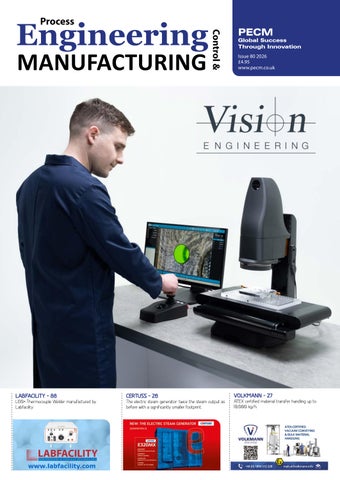
Cover photo: Vision Engineering
Turn energy costs into actionable insight.
Gain clear visibility of where, when and how energy is being used, so inefficiencies can be identified and addressed with confidence.
Data-driven efficiency improvements.
Establish accurate energy baselines to justify investment, validate change and support funding or grant applications.
Reduce waste without disrupting operations.
Monitor energy consumption non-intrusively across processes and infrastructure, without interfering with fabrication or uptime.
Move to evidence-based decisions and control.
Replace guesswork with reliable data that supports smarter operational decisions and longterm efficiency planning.
The leading source for innovators in Technology, Manufacturing and Maintenance within the Engineering & Processing industry worldwide.
Published bimonthly, a subscription to PECM magazine is essential for Process Engineers, Chemical Engineers, Instrumentation Engineers, Mechanical Engineers, Plant Engineers, Precision Engineers, Environmental Engineers & General Engineers, Companies and Organizations in the Food, Dairy, Beverage, Brewing, Semiconductor, Pharmaceutical, Biotechnology, Chemical, Oil & Gas, as well as all UK's major manufacturing units.
Every issue of the magazine contains the latest news, in-depth features, together with product innovations and case studies showing how process engineers are implementing new technologies to reduce costs and impact on the environment.
With over 158,000 readers worldwide the publication is widely read, recognized, and well respected within the Process, Engineering & maintenance industries.
A subscription to PECM magazine is the industry's 'must have' publication.
Hardcopy Edition
SUBSCRIBE TO 6 BIMONTHLY ISSUES OF PECM FOR JUST £27
• The magazine gets delivered directly to your door once every issue is published
• The quality of the hard copy enhances the reading experience
To Subscribe please call 01304 806039
Digital Edition
SUBSCRIBE TO OUR DIGITAL EDITION COMPLETELY FREE OF CHARGE
Designed for the digital age, the magazine has been created for easy viewing on all electronic devices. All our issues stored in one place: get unlimited access to our previous and future issues.
To Subscribe please visit www.pecm.co.uk/subscribe
MANUFACTURING Engineering Process Control &
The Team
EDITOR IN CHIEF
Antony Holter editor@mhmagazine.co.uk
BUSINESS MANAGER
Josh Holmes josh@mhmagazine.co.uk
SALES DIRECTOR
Jake Page jake@pecm.co.uk Tel: 01227 937174
SALES MANAGER
Martin Richardson martin@pecm.co.uk Tel: 01304 086039
Martin Holmes martin@mhmagazine.co.uk Tel: 01304 806039
DIGITAL ASSISTANT
Stacey Goodwood Tel: 01227 936971
MH Media Global Ltd. 18/20 Newington Road, Ramsgate, Kent, CT12 6EE Tel 01304 806039 l Fax: 08721 152240 l www.pecm.co.uk
ENCLOSURE ASSEMBLY
Why external support can save time and costs
For OEMs and integrators who rely on industrial enclosures to protect their devices and control systems, assembly is another task to add to the project timeline. Fitting items ranging from DIN rails and terminals through to keypads and labelling, assembly can also be a resource-intensive activity. Instead, outsourcing enclosure assembly can streamline operations, especially when it’s managed directly by the enclosure manufacturer.
Chris Lloyd, Managing Director at Spelsberg UK, explores the requirement for industrial enclosure assembly services.
The UK electronic contract assembly market is growing,
and it’s projected to rise further over the next decade, demonstrating demand for local contract assembly services. There are several key advantages to manufacturers and system integrators outsourcing the assembly of their completed product, or key constituent modules. What’s more, these benefits can apply not just to smaller manufacturers looking to scale up, but right through to larger OEMs facing pressures to balance productivity and profitability alongside resources.
A key challenge is labour cost, and recent economic data indicates that levels in the UK
have climbed to their highest on record. This reflects aspects including wage growth and higher employer contributions, putting pressure on manufacturers with in-house assembly teams. As a result, outsourcing labour on a contractual basis can be the less expensive option, whether that’s for smaller companies that don’t want the risk of taking on extra staff, or for larger organisations dealing with higher-volume production.
Resolving resource challenges
At the same time, UK manufacturers are facing the ongoing challenge of recruitment and retention. On the one hand, there’s a deficit in
SPELSBERG
Spelsberg’s qualified employees handle everything from the initial design to the final production of electrical panels, guaranteeing perfect results
the quantity of labour required in manufacturing; on the other, there’s the need for quality, which means relevant skills and experience. While assembly services can suffer from a lack of sufficient internal resource, hiring relevant, temporary expertise can be difficult. Meanwhile, manufacturers or engineering firms don’t want to utilise more skilled staff on tasks where they could be deployed more effectively to match their capabilities.
When it comes to the integration of electrical components or electronic devices within industrial enclosures, this lends itself to external support in assembly. By their nature, industrial enclosures are self-contained units, sitting on or outside a machine or system, rather than embedded and protected within. This makes their complete or partial assembly by an external team a lot more straightforward to manage from a design integration perspective.
Typical assembly requirements for an industrial enclosure include electrical terminals and DIN rails. As a further stage, assembly services can involve the installation of devices such as I/O points, controllers, sensors, user interfaces such as keypads, as well as alarms, lights, or wider output devices. Installing these components within an enclosure can also involve adding the connections, including cables and glands.
When specifying an enclosure, the most important thing is capabilities in protecting the device within, as well as the people interacting with it.
Selecting an assembly service
When selecting an outsourced service for enclosure assembly, the common routes are either contracting a specialist electronics assembler or working directly with an enclosure supplier. The primary advantage of partnering with the enclosure manufacturer, assuming that they can offer the required assembly service, is that the approach retains accountability.
Firstly, accountability with a single supplier means a faster, more efficient process that minimises the timescale by reducing the time required for transportation and administration. Secondly, it retains responsibility for both the quality and speed of assembly with the enclosure supplier. If customisation of the enclosure is also required, such as CNC machining insert points for a keypad or cable, it makes even more
For further information,
sense to keep assembly requirements with the enclosure manufacturer, as this minimises the potential for errors.
At Spelsberg UK, the in-house team comprising designers, CNC machinists, and assembly specialists is scaled to work on one-off enclosures, through to large order batches. This can extend to the assembly of switchgear and control systems, through to turn-key projects. Crucially, these integrated on-site services also enable accurate and reliable project planning with a rapid turnaround.
All-service enclosure team
When specifying an enclosure, the most important thing is capabilities in protecting the device within, as well as the people interacting with it. This housing must also be reliable, achieving the right level of protection long term. However, after an OEM designer or system integrator has ensured that these key enclosure qualities can be met, it’s important to look at how efficiently the end project can be fulfilled, which includes its assembly.
Selecting an enclosure manufacturer that can provide a high-quality design, combined with an efficient assembly service, can make an inhouse manufacturing or engineering team’s task a lot easier.
NEXT-GEN INSPECTION
VISION ENGINEERING
Vision Engineering redefines its shop-floor metrology range with the launch of the ‘Edge’ Series
Vision Engineering, a leading global manufacturer of ergonomic inspection and non-contact metrology systems, today announces the launch of Edge: a new range of compact vision measurement systems designed to bridge the gap between manual inspection and full-scale CNC automation.
Set to debut at MACH, the Edge series addresses the growing demand for high-accuracy, noncontact inspection within the precision engineering, medical device, and plastics sectors.
Precision Without the Footprint
As manufacturers move toward Industry 4.0, the traditional “quality lab” is moving onto the production floor. The Edge series is “Compact
by Design,” offering a focused 200 x 100 mm measurement envelope that fits seamlessly into high-pressure production environments where floor space is at a premium.
Scalable Automation: APEX, VISTA, and CORE
The Edge series is structured into three distinct tiers, allowing businesses—particularly second and third-tier suppliers—to scale their quality control as their production volumes grow:
• Edge APEX: The flagship 3-axis CNC system. Fully automated and
As manufacturers move toward Industry 4.0, the traditional “quality lab” is moving onto the production floor.
featuring motorised zoom, APEX is designed for high-throughput, palletized batch inspection, significantly reducing operator dependency and error.
• Edge VISTA: An automated 2-axis system with 3-axis CNC movement and motorised focus. Optimised for flat and turned parts, it features collimated lighting for precise Edge detection on complex geometries.
• Edge CORE: A manual 2 or 3-axis system designed for rapid, one-off measurements and setup checks. It’s built for the machinist who needs a “just made it, check it” solution without a steep learning curve.
Engineering-Grade Features
The Edge series isn’t just a downsized version of larger machines; it’s a ground-up redesign focused on practical productivity:
• Motorised 6.5:1 Zoom: Standard on the APEX model, this allows users to measure features of vastly different sizes on a single part without manual lens changes.
• Advanced Image Stitching: Users can capture and document features larger than the field of view (FOV), ensuring full traceability even for larger components.
• Matched Optics and Sensors: Unlike “parts bin” systems, Edge utilises specifically matched 5MP (VISTA) and 2.3MP (APEX) cameras to optimise signal-to-noise ratios and Edge-detection clarity.
Driving ROI in Challenging Markets
“With the global optical measurement market projected to nearly double by 2035, the pressure is on manufacturers to automate or be left behind,” says Stephen Sanderson, Group Product Manager at Vision Engineering. “Edge provides a structured upgrade path. Whether you are a small workshop looking to ditch manual callipers or a high-volume manufacturer needing to eliminate inspection bottlenecks, Edge delivers lab-grade precision in a shop-floor-ready package.”
For further information, please visit www.visioneng.com
SMART ASSET TRACKING
Sick’s digital solutions portfolio provides real-time tracking and visibility for logistics with new Coriva RTLS
SICK is expanding its range of digital solutions for the logistics industry with Coriva, a real-time localisation system (RTLS) for industrial applications that determines the exact position of assets such as vehicles, workpieces, materials. The sensor intelligence specialist has a wide portfolio of reliable, highperformance integrated digital technology designed to reduce errors, enhance safety, improve flow, increase visibility, and boost the security of logistics operations. Sensors, systems and software are combined into industry-ready solutions that leverage SICK’s sensor expertise, system design knowhow and extensive data capabilities.
Based on ultra-wideband (UWB) technology, Coriva is omloxcertified and is designed specifically for the localisation, tracking and
management of assets in real-time. It determines the exact position of assets such as vehicles, workpieces, materials, etc in real time for full visibility, security and traceability.
SICK empowers logistics digitalization
The recent SiTL transport and logistics show in Paris, France, saw SICK showcase its extensive and expanding portfolio of digital intralogistics solutions at its booth (Hall 7 – F160), highlighting how they deliver enhanced visibility, traceability and end-to-end tracking throughout supply chains. Suitable for large logistics companies, small businesses, production logistics operations and OEMs, SICK’s digital solutions are part of the company’s commitment to supporting customers throughout their digitalisation journey. They track the whole
logistics and production logistics process, optimising the operational performance of logistics sites with end to end tracking, cybersecurity, visibility and traceability.
SICK also recently unveiled its new Sentio IIoT platform, which brings together all its digital solutions in a single IIoT platform. Sentio enables businesses to fully integrate SICK software and hardware easily and seamlessly into their operations and control them all in one platform. Companies can run and have access to analytics, logistics and security data, connecting devices and business intelligence together in a scalable platform that can be used for all projects. Sentio offers seamless endto-end control and simple digital transformation integration for databased value creation that integrates OT and IT.
With Coriva, recorded position data of assets is used for continuous monitoring of goods movements, material flows, and fleet management. The system comprises mobile UWB tags (CorivaTag), a permanently installed infrastructure (CorivaSat) and software (CorivaEngine), which calculates the positions of the mobile devices in real-time. The recorded position data can be forwarded to an omlox hub via standardised interfaces, supporting the world’s first open standard for industrial localisation systems.
Coriva software can be operated on-premise or in the cloud and technologies such as RFID, GNSS, WPAN or LiDAR can be seamlessly integrated via the CorivaHub. CorivaHub can also be used in combination with other SICK solutions, including IdentGate, for
Coriva is omlox-certified and is designed specifically for the localisation, tracking and management of assets in real-time.
automatic identification of parcels and pallets in logistics environments, and the ALDIS RFID automated load detect ident system.
Additional products in SICK’s extensive suite of digital logistics solutions include:
• The versatile, rugged, easy-touse Inspector machine vision
system, including the AI-enabled Inspector83x
• SICK Master Data Analyzer (MDA) Vision to improve logistics flow, data quality, and accuracy
• LiDAR navigation systems and the SICK Mobile Robot Manager
Christophe Hien, Digital Solutions Leader – South West Europe, says, “At SICK we are going beyond sensors and hardware to capture and harness more of the digital opportunities and data they provide. Our digital solutions enable companies to embark upon, or enhance, their digitalisation journey, with Sentio bringing it all together in a single IIoT platform.
“Logistics operations are increasingly turning to digitalisation to improve throughput and prevent downtime. Our digital solutions, like Coriva, provide SICK expertise, quality and reliability to companies across the logistics industry. SICK offers logistics industry customers a single partner for inspection, identification and security, and we have proven expertise in automated logistics environments, with complete scalable architectures that are compatible with your existing systems.“
FOAM PUMPS THAT DELIVER
NORTHRIDGE PUMPS
Six foam concentrate transfer pumps for critical fire suppression system
Our latest case study will be diving into the world of fire suppression where we received a request from a client for a set of reliable, proven foam concentrate transfer pumps to be used in the heart of their fire suppression system.
Clearly, fire is a constant threat to the operation of any company, particularly those handling volatile substances, or working in hazardous environments.
But even with the highest levels of fire awareness and prevention throughout the business, fires can and do break out – often with catastrophic and fatal consequences.
Fire extinguishing systems are the last resort
Firefighting foam is perfectly designed to suppress fire. It’s made of a pre-mixed solution of water and foam concentrate mixed with air.
This thick substance forms a stable foam blanket which spreads out across the fuel and sticks to surfaces. The firefighting foam concentrate prevents fuel coming into contact with oxygen, effectively sealing in flammable vapours and preventing re-ignition.
It also has a strong cooling effect which lowers the fire temperature to extinguish both Class A (solids) and Class B (liquid) fires. Four key mechanisms work in conjunction to smother the fire from fuel and air, suppress vapours and smoke, cool the liquid and finally contain the fire.
We designed the pumps to be long-coupled
and baseplate mounted using a gearbox to reduce the pump head speed.
The synthetic firefighting foam concentrates are supplied from a tank to a proportioner where it’s mixed with water. This mixture is then transferred through pipes to spray heads, foam generators, pourers or monitors that direct it straight to the source of fire extinguishing it rapidly.
Firefighting foams vary in viscosity by temperature. They are also shear-thinning meaning that the faster they’re pumped the thinner
they become. At around 30 rpm the viscosity can be around 500cps, but when increased to 60 rpm the viscosity halves to 250cps.
What was our solution for this client?
The six HGP external helical gear pumps we supplied will transfer the firefighting foam concentrate at rates from 10 to 35m³/h at 12 bar. As they are positive displacement pumps, the same pressure will always be delivered to nozzles regardless of the amount of foam needed.
We designed the pumps to be longcoupled and baseplate mounted using a gearbox to reduce the pump head speed. This ensures that the high viscosity foam concentrate has time to enter the pump head, and more importantly, that the teeth within the external gear can maintain the flow.
We coupled the foam concentrate transfer pumps to a 30Kw four pole 1500rpm motor with the gearbox further reducing the pump head speed to around 450rpm. The pump head has DN65mm flanged connections.
Made from corrosion-resistant stainless steel, the pumps will transfer the foam concentrate whatever its viscosity at the flow rate required.
If you have an application requiring the smooth and consistent transfer of foam concentrate, get in touch with North Ridge Pumps to see how we can help.
www.northridgepumps.com/contact-us
In fact, we have a whole range of non-clog metering pumps which will give you incredibly precise measurement of gaseous, viscous and shear-sensitive fluids without any loss of flow.
We’re North Ridge Pumps, the UK’s largest pump supplier with over 25 years’ experience. We’re expert at specifying exactly the right pump for every client – not just an off-the-shelf, one-size-fits-all solution.
That’s probably why we’ve completed over 2,000 successful projects for clients all around the world. You can read case studies at www.northridgepumps.com
SERVICE YOU CAN TRUST
AXAIR FANS UK LIMITED
What does it mean for a fan supplier to stand up?
Jayne Jones, Head of Marketing at Axair Fans, has spent over ten years building the voice behind one of the UK’s most respected industrial fan suppliers. Here, she sets out what Standing Up is really about, and why their great service is more than marketing.
It’s great to work in a business with a genuinely strong reputation, a deep product range, and over three decades of relationships built on doing the right thing by customers. In 2023 there was something I just couldn’t shake, if the experience of working with Axair is as good as customers say it is, why weren’t we talking about it more openly?
We’d have customers tell us they’d recommended us to someone else, or that they’d been working with us for years because we just make things easy, and I kept thinking, that’s the story. Not the fan range, not the certifications, not the prices. The fact that when something gets complicated, we show up. I’d watched it happen since I’d joined the company in 2015.
That insight became the foundation for Stands Up, our second campaign that does something slightly unusual in industrial fan supply. Rather than leading with product, it leads with promise. What should a customer expect from a fan supplier? What does good look like, not just in terms of specification, but in terms of the whole experience of getting a project over the line?
For me, the answers came directly from the conversations Axair’s team were already having. Customers weren’t struggling to find fans. They
were struggling with suppliers who were slow to respond, vague in their recommendations, or absent once the order had been placed. The product was rarely the problem. Everything around it often was, I’d even watched our team go out to other suppliers’ products to troubleshoot and correct issues. Those issues weren’t even ours, yet we still stood up every time!
There’s a view of marketing that’s about telling people how great you are, we do this, we do that etc, that’s not what this is. Stands Up is about saying, here’s the standard we hold ourselves to. Here’s what you should expect from us, and everyone else really, and here’s what we’ll do when things don’t go to plan. It’s real, raw, honest, and honestly, more useful.
The campaign touches on every stage of the customer’s journey, from the speed of response to a first enquiry, to the quality of technical guidance before a purchase, to the support available long after a fan
has been installed. Each element reflects something Axair’s team already does. The campaign simply makes it visible, and in doing so, makes it a commitment rather than just a habit.
That distinction matters, anyone can say they have good service. What we wanted to do was define what that really means in practice, for the engineer chasing a spec on a Friday afternoon, for the contractor who needs stock confirmed before they can commit to a programme, for the OEM who calls six months after delivery because something’s changed on site or somethings not right in the system. Those are the moments that count. Those are the moments we built this around.
Stands Up isn’t a product launch. It’s a statement of intent, one rooted in customer need, shaped by real feedback, and designed to raise the bar not just for Axair, but for what customers should expect from any supplier in this industry.
NEXT-GEN INDUSTRIAL AI
Lantek and Ikerlan work in partnership to develop agentic AI to strengthen technological capabilities which could benefit manufacturing
Lantek, a major software company specialising in the sheet metal industry, and the Basque technology centre IKERLAN, based in Spain, are collaborating on the GALAXIA project, an R&D initiative aimed at developing an industrial agentic AI architecture.
This will be capable not only of analysing information but also of executing coordinated actions in real production environments, which could be beneficial to the sheet metal industry and other areas of manufacturing.
The GALAXIA project, supported by the Basque Government’s HAZITEK
programme, is developing a multiagent architecture which will enable organisations to retain control over their data, processes and knowledge.
The project marks progress toward technological sovereignty by promoting the local development of advanced artificial intelligence capabilities applied to industry. This approach reduces dependence on external technology platforms while ensuring control over critical data and processes.
Lantek acts as project coordinator, contributing its expertise in industrial software, advanced data exploitation and the development
of intelligent assistants applied to production processes. IKERLAN participates as technological lead, bringing its broad multi-technology capabilities and experience in intelligent systems and applied industrial research.
GALAXIA represents a conceptual shift beyond traditional conversational AI models. It moves from systems that simply respond to queries toward architectures capable of acting, coordinating tasks and operating as a structured team within production processes.
The approach is based on agentic artificial intelligence, where
specialised agents collaborate in a coordinated manner to solve complex problems. Each agent performs a specific function, whether analysis, planning, supervision or execution, and operates in synchronisation with the others to achieve a shared objective. This structure enables continuous data processing, real-time decisionmaking and a transition from a purely assistive role to the autonomous execution of complete tasks in industrial environments.
As Aizea Lojo, Head of the Artificial Intelligence and Generative AI Research Team at IKERLAN, explains, “Agentic AI works like a team of specialists coordinated to achieve a common goal.”
The platform’s design allows this coordinated-agent logic to be applied across multiple industrial sectors, facilitating scalability and technology transfer. In practice, this may translate into automatically generating a quotation upon receiving an email, triggering product replenishment in retail environments through computer vision, or assisting in the resolution of technical incidents without manual intervention in repetitive tasks.
GALAXIA represents a conceptual shift beyond traditional conversational AI models.
Jose A. Lorenzo, Data Area Manager at Lantek, underlines the strategic focus of the project: “Artificial intelligence is not intended to replace operators. Its role is to take over automatable and analytical tasks so that professionals can focus on supervision, decision-making and continuous improvement.”
GALAXIA is being developed in compliance with the requirements established by the European Artificial Intelligence Regulation (AI Act), which obliges companies to adapt their systems to new standards in security, transparency and governance. The multi-agent architecture designed by IKERLAN incorporates mechanisms that clearly define what each agent can do, in which context, and with what level of autonomy. The consortium also includes companies from strategic sectors such as Eroski, Mondragon Assembly, Goizper, Xabet, Ubikare, Lis Data and Fagor Arrasate, which are validating the technology through specific use cases.
For further information, please visit www.lantek.com
ENERGY UNDER CONTROL
Managing energy costs in an unpredictable market
Energy has become one of the most volatile and influential cost factors in modern manufacturing. With ongoing geopolitical tensions and instability in global energy markets, electricity and gas prices remain unpredictable and as a result, puts pressure on margins across engineering, process and production environments.
For manufacturers operating in energy-intensive sectors, this is no longer just a cost issue. It is a question of control.
While Net Zero targets and regulatory expectations continue to shape long-term strategy, the immediate challenge is far more practical: how to reduce energy usage without compromising output, quality or uptime.
The problem is that many organisations are still relying on high-level data such as utility bills, aggregated meter readings or estimates to make critical decisions. This provides visibility of total consumption, but not where inefficiencies actually occur.
Energy use within manufacturing is dynamic. Demand fluctuates across shifts, start-up cycles, maintenance windows and varying production loads. Without detailed, time-based insight, energy waste can remain hidden within processes, equipment or infrastructure.
This is where targeted energy monitoring is becoming essential.
By measuring energy consumption at machine, line or departmental level, manufacturers can build a
clear picture of how energy is used in real operating conditions. This allows teams to identify abnormal loads, uncover inefficiencies and understand how changes in production impact energy demand.
For engineers and operations managers, this creates immediate, practical value. Decisions around equipment upgrades, process optimisation or scheduling can be based on measured performance rather than assumption.
Energy loggers provide a simple, non-disruptive way to capture this data. Deployed across a site or on specific assets, they enable organisations to monitor voltage, current, power and power factor over time — delivering the granularity needed to take meaningful action.
In an environment where energy costs can fluctuate rapidly, this level of insight offers resilience. It allows manufacturers to respond
to changing conditions, control operational expenditure and prioritise improvements where they will deliver the greatest return.
Tinytag Energy Loggers are widely used across manufacturing, process engineering and facilities environments to support this approach. By providing reliable, realworld data, they help organisations move from reactive energy management to proactive control.
As the sector navigates rising costs and increasing regulatory pressure, one thing is clear: the manufacturers best equipped to weather the storm will be those who understand their energy use in detail, and act on it.
KEEPING THE FUTURE FLOWING
GEMÜ Valve Technology
Innovative. Customer-focused.
Passionate. As a global specialist in valve, measurement and control systems with over 60 years of experience, GEMÜ combines precision with innovative strength to deliver engineered solutions for demanding process environments.
In June, the Great Britain subsidiary will be celebrating its 45th anniversary, a milestone built on long-standing customer relationships and a commitment to reliability. Based in Warrington, with product specialists across Great Britain, the team provides expert technical support from specification and installation through to commissioning and aftersales service to help customers keep critical infrastructure flowing. Not only today but also tomorrow and beyond.
Technology leadership and pioneering spirit
GEMÜ continues to set new industry standards through technology leadership driven by customer needs. This approach is embodied in the new GEMÜ Product Generation, a modular valve platform developed using advanced manufacturing methods and designed for maximum flexibility, reliability and ease of maintenance.
The GEMÜ Product Generation includes four valve solutions and two automation components:
• GEMÜ D41 – quick-maintenance diaphragm valve with EasyLock technology
• GEMÜ S40 – pneumatic globe valve
with angle seat and straight seat designs
• GEMÜ P40 – efficient tank bottom valve with PD technology
• GEMÜ 12A0 – intelligent electrical position indicator
• GEMÜ 44A0 – multi-functional combi switchbox
Precision flow control with GEMÜ globe valves
At CHEMUK, GEMÜ will showcase the new product generation on Stand E20, alongside a working model of the GEMÜ S40 globe valve.
The pneumatically operated GEMÜ S40 is designed for the most demanding industrial applications requiring precise and stable flow regulation, including highpurity processes such as battery manufacturing and pharmaceuticals. The standardised interfaces allow wearing parts to be replaced quickly, reducing maintenance time and downtime.
The actuator design features topmounted control air connections, eliminating the need for alignment during installation. A transparent optical position indicator protects against dirt and dust, while a plastic piston sleeve improves sliding properties and reduces stick-slip behaviour—resulting in improved control accuracy and reduced wear.
For further information, please visit www.gemu-group.com
GEMU
GAS PROCESS BURNERS
High efficiency
Customised design to suit each install
Proven in a wide range of applications
Choice of burner heat inputs up to 1150 kW
Choice of operating fuels
Ideal for variable plant conditions
Larger heat input available on request
FDGA
APL technology - modulating gas and air
Ideal for variable plant conditions
Heat input range up to 1,550 kW
Choice of operating fuels
APL technology -modulating gas and air
FDC
Heat input range up to 1,550 kW
Choice of operating fuels
Packaged burner design
Up to 40:1 turndown
Our gas burner systems offer users reliable, high efficiency, process heating solutions. From design, manufacturing and supply to installation, commissioning and ongoing support, we fulfill process liquid, oven and air heating needs for both new-build and conversion projects.
IPCS WITHOUT LIMITS
SHUTTLE
How modular IPCs open up new possibilities
The demands placed on industrial IT systems are constantly evolving. A diverse range of machinery, custom interfaces, and harsh operating conditions require solutions that offer more than just standard performance – they require adaptability. Where rigid, “onesize-fits-all” systems quickly reach their limits, modular concepts are stepping in to provide future-proof scalability.
Industrial PCs (IPCs) serve as the vital link between process technology and IT. Box PCs, in particular, have long been favoured for their robustness and low-maintenance 24/7 operation. However, their greatest advantage today lies in modularity. Rather than being locked into preconfigured hardware, companies can now specify and expand their IPCs to meet exact application requirements and environmental challenges.
The Box PC series from Shuttle is a prime example of this evolution. Engineered for resilience, these systems feature reinforced aluminium and steel chassis and a fanless design for maximum reliability. Beyond their physical durability, it is their modular DNA that sets them apart. Through a wide array of expansion modules and accessories, each device can be tailored to the task at hand.
For instance, dedicated daughterboards allow for the seamless integration of additional interfaces, including serial connections, enhanced networking options, or specialised industrial communication protocols. Options
Industrial PCs (IPCs) serve as the vital link between process technology and IT.
for RF modules or a wide DC voltage range of 9–36V provide further flexibility – a critical factor in complex production environments where power sources can vary. Furthermore, versatile mounting kits ensure that these systems can be integrated into any workspace, whether mounted horizontally, vertically, or via DIN-rail.
Shuttle’s latest Box PC models push these boundaries even further. Powered by 12th-generation Intel Core processors, they combine high-performance computing with a
flexible I/O architecture designed for diverse IoT scenarios. Whether the application involves Edge AI, real-time data analysis, or highspeed image processing, the systems scale to meet the demand. With an impressive operating temperature range of -20°C to +60°C, they are as dependable in the field as they are on the factory floor.
The result is a future-proof, costeffective solution that balances high performance with bespoke customisation – a decisive advantage in today’s dynamic industrial landscape.
BPCAL02/03
Fanless operation for silent and maintenance-free use
Intel Core i7, i5 or i3 processor
MODULAR INDUSTRIAL PCS WITH A ROBUST, FANLESS DESIGN
Shuttle is offering it's second gen of very robust industrial PCs with a compact design. The complete systems from the family of Box-PCs come packed in a multi-reinforced aluminium and steel chassis. Equipped with an Intel Core i7, i5 or i3 processor, they can handle any task. Their modular design means that the functional scope and ports can be customised individually to suit the customer's wishes.
Further information at: WWW.SHUTTLE.EU
TIP: Your box PC ‒ as unique as your project! Use our product configurator and tailor your barebone perfectly to your requirements. go.shuttle.eu/Ofu4B
Supports up to 64 GB DDR5 RAM
High-speed NVMe M.2 SSD
Expandable with up to 4× LAN, 4× COM, 20× USB, DVI, VGA, DP, HDMI, LTE, Wi-Fi, DIO and more
Industrial-grade aluminium chassis
Extended temperature support from ‒20°C to +60°C (optional)
Multiple mounting options including VESA, DIN rail and ear mounts FROM £436*
HUCK FASTENERS EXPLAINED
STAR FASTENERS
The most asked questions about Huck® Fasteners
Huck® fasteners have long been a trusted solution in industries requiring high-strength, vibrationresistant fastening. These fasteners play a crucial role in ensuring structural integrity and safety in a wide range of applications and industries. Given their significance, many engineers and professionals frequently turn to search engines with technical queries about Huck® fasteners. In this article, we address some of the most commonly asked questions about these specialised fasteners.
What are Huck® fasteners?
Huck® fasteners are advanced fastening solutions designed to provide secure, high-strength joints that resist vibration and loosening over time.
What are the different types of Huck® fasteners?
Huck® fasteners come in various types, each designed for specific applications.
HuckBolts®: also known as LockBolts® are a two-piece, highstrength fastening system consisting of a pin and a collar, designed for permanent, vibration-resistant joints. They are installed using a swaging process, which eliminates the need for re-tightening, making it ideal for structural, transportation, and heavy-duty applications requiring superior strength and long-term reliability.
Huck® Blind Fasteners: are highstrength, one-sided (blind-side) fastening solutions used when access to the blindside of a joint is restricted. They provide vibration resistance, high shear strength, and consistent clamping force, making them ideal for aerospace,
Huck® fasteners have revolutionised fastening technology with their strength, durability, and vibration-resistant properties.
automotive, rail, and structural applications where reliability and quick installation are essential.
Which industries use Huck® fasteners?
Huck® fasteners are widely used across multiple industries, including: Automotive & Heavy-Duty Trucks: Common in truck chassis, suspensions, and trailers for secure, maintenance-free fastening. They can be used in anything, including defence vehicles and F1 racing cars!
Railroad & Transportation: Applied in railcar construction and track infrastructure to withstand constant vibrations.
Construction & Infrastructure: Utilised in bridges, portable buildings and large metal framed structures for strong, permanent joints.
Solar Energy: Huck® fasteners are used in solar panel mounting systems to secure structures against wind loads and environmental stress.
Wind Turbines: Huck® fasteners are used in tower assembly, nacelles, and rotor components for secure, vibration-resistant connections.
Shipbuilding & Marine: Resistant to corrosion and extreme conditions,
making them ideal for naval and commercial ships.
Manufacturing & Industrial
Equipment: Used in a multitude of production lines for durable and efficient fastening solutions.
Aerospace: Used in aircraft assembly for their lightweight strength and vibration resistance.
If there’s a fastening requirement, Huck® fasteners have a solution.
How do Huck® fasteners differ from traditional bolts?
Huck® fasteners differ from conventional bolts in several ways: Vibration Resistance: Unlike bolts and nuts that can loosen over time due to vibrations, Huck® fasteners maintain their hold, making them ideal for high-vibration environments.
Installation Speed: Huck® fasteners are installed using hydraulic, pneumatic and battery tools, making the process faster and more efficient than tightening a bolt and nut.
Structural Integrity: The swaging process of Huck® fasteners creates a permanent joint, eliminating the need for re-torquing or maintenance.
What installation tools are required to install Huck® fasteners?
Installing Huck® fasteners requires specialised tools. These tools include:
Pneumatic: Powered by compressed air, these tools are commonly used in high-volume assembly lines.
Hydraulic: Used for heavy-duty applications, providing more force for larger fasteners.
Battery-Powered: Offering mobility and flexibility for production and field applications.
Are Huck® fasteners reusable?
No, Huck® fasteners are designed to be permanent. Once installed, they cannot be removed without damaging the fastener. If disassembly is required, the fastener must be mechanically removed and replaced.
Reusing nuts and bolts can also compromises structural integrity due to thread deformation, fatigue, and reduced clamping force. Torque relaxation and material wear increase failure risks, especially in high-load or vibration-prone applications.
For safety and reliability, engineering best practices recommend new fasteners to maintain precise tension and prevent mechanical failure.
How do Huck® fasteners compare to welding?
Many industries choose Huck® fasteners over welding due to the following advantages:
Speed of Installation: Huck® fasteners can be installed in seconds, whereas welding is time-consuming.
Consistent Strength: Welds can be inconsistent due to material variations and operator skill, whereas Huck® fasteners provide uniform strength.
Safety: Welding requires specialised training and safety precautions, whereas Huck® fasteners can be installed quickly with minimal training and risk.
No Heat-Affected Zones: Welding can weaken surrounding materials, whereas Huck® fasteners maintain the integrity of the structure.
How do you select the right Huck® fastener for your application?
Choosing the right Huck® fastener depends on several factors:
Load Requirements: Determine the strength needed for the application.
Material Compatibility: Ensure the fastener material matches or is compatible with the materials being joined.
Environmental Conditions: Consider factors like corrosion resistance, temperature, and exposure to chemicals.
Accessibility: Choose between blind (one-piece) or LockBolts® (twopiece) fasteners based on assembly constraints.
What are the maintenance requirements for Huck® fasteners?
Since Huck® fasteners create a permanent joint, they require little to no maintenance. Unlike traditional fasteners, which need periodic re-tightening, Huck® fasteners maintain their strength and integrity throughout their service life. However, regular inspections of the structure in which they are used are still recommended to ensure overall safety.
Huck® fasteners have revolutionised fastening technology with their strength, durability, and vibrationresistant properties. As industries continue to seek reliable and maintenance-free fastening solutions, the demand for Huck® fasteners remains strong. Whether you’re an engineer, technician, or procurement specialist, understanding the fundamentals of Huck® fasteners can help you make informed decisions about their applications and benefits.
How can Star Fasteners help with Huck® fasteners?
Star Fasteners UK Ltd is a leading distributor and expert in Huck® fasteners, offering comprehensive support to help you make informed decisions about their applications,
benefits, and installation. Here’s how we can assist:
Expert Technical Advice: Our team provides specialist guidance on selecting the right Huck® fasteners based on load requirements, material compatibility, and environmental conditions.
Product Range & Availability: We offer a wide selection of Huck fasteners, including LockBolts®, blind fasteners, and installation tools, ensuring you get the right solution for your needs.
Installation Support: We supply pneumatic, hydraulic, and batterypowered installation tools and can provide training on proper usage for efficient and secure fastening.
Cost & Performance Optimization: We can help to identify costeffective fastening solutions while ensuring long-term reliability in high-vibration and structural applications.
After-Sales Service: We provide ongoing support, maintenance advice, and troubleshooting to ensure your fastening solutions perform optimally.
Do Star Fasteners offer a tool repair and hire service?
Tool Repair Service: We provide comprehensive maintenance and repair services for installation tools, ensuring your equipment remains in optimal condition.
Tool Hire Service: Star Fasteners offers short- and long-term tool hire options, ideal for busy periods or specific projects requiring specialised equipment. We also provide service hire tools while your equipment is under repair in our workshop.
By addressing these frequently asked questions, Star Fasteners hopes to provide valuable insights for those considering Huck® fasteners for their projects. Their superior performance and reliability make them a leading choice for industries where strength and durability are paramount.
Industry-defined
Mechanical Integrity Training
Developed and verified ‘for industry, by industry’, EEMUA 231 Mechanical Integrity courses are for i n dustrial engineers at every career stage – with reality built - in to aid efficient hands-on work with primary containment and prevent loss of hazardous substances, including with pressure systems
• Satisfy industry requirements at each competency level – Awareness, Basic application, Practitioner, Leader
• Covering: *Legislative environment *Industry good practice *WSE *Equipment design *Operational considerations *Audit *Asset condition *Test techniques *Inspection roles, process & reports *Postponement *Responses to findings *ALARP *Record keeping *Feedback *User responsibilities & competencies *Operating Limits *Decision Making
• Certificated up to 5 years – CPD-approved.
• Flexible delivery to suit Learners and companies – Blended, Live online, Classroom, E-learning, or In-house.
• Courses throughout each year available to all – free or discounted to EEMUA Members and Associates
Mechanical Integrity Practitioner Certificate (MIPC®) – part-time, blended, live online learning – on-site or on-call – 1:1s and Mentor Support –workbook builds from day-1 for immediate application on-site of EEMUA 177, 231 and 232 guidance, and the PSSR ACOP – certificated for 5 years via exam and portfolio assessment –in-depth learning for 27 weeks, flexible 4 hours per week – CPD of 110 hours The MIPC course adapts to the engineering needs of each Learner, company and site/s via a 2-hour induction (to fit work schedules ahead of the course) – learning on the next course starts 19 October 2026
Asset Integrity Leadership Certificate – blended, live online – for new and experienced Leaders –flexible learning 3 hours per week – 55 hours CPD ho – certificated – next course starts 22 February 2027
EEMUA 231 Mechanical Integrity Basics blended, online learning – at Basic application competency level – flexible 4 hours of learning per week for 3 weeks – 12 hours of CPD – certificated via exam – next course starts 28 September 2026
EEMUA 231 Mechanical Integrity e-learning – set at the Awareness level – with 1 hour of CPD – immediately available – on-demand.
EEMUA & AMPP Benelux Internal Corrosion & Cathodic Protection Seminar – Antwerp, BE – 22 October 2026
online-learning@eemua.org
+44 (0)20 7488 0801
www.eemua.org
ADAPTABLE BY DESIGN
COPRISYSTEMS
CopriSystems are certain there’s more uncertainty ahead
The ever-changing patterns of consumer behaviour, the Covid hangover, shifts in logistical strategy, the lack of available warehouse space, rental hikes, environmental agenda, geopolitical tensions and rapid technological advancements are just some of the issues businesses have faced in recent years and like many in the industrial sector, we have experienced many twists and turns.
For over 35 years’, we have been designing industrial warehouse buildings that are flexible enough to evolve with a business and versatile enough to respond to differing trends but never have we witnessed so much change in such a short space of time. Never has the flexibility and versatility of our structures been more relevant.
Our narrative has always been that fabric-covered warehouse buildings need not be a temporary solution, unless you want them to be, such is the quality of materials we use and the high standard of workmanship we expect. We design and manufacture our structures to last and certainly some are as old as the business itself. However, in this climate of uncertainty, we are finding that clients are predominantly looking for temporary solutions. Businesses are unable to look too far ahead and are therefore adopting shorter-term strategies with the anticipation of having to adapt quickly.
Frequently, customers are getting in touch with a request to dismantle their structures, modify the specification and relocate them to
to effectively manage seasonal fluctuations and minimise the cost of unused space during quieter periods.
Never has the flexibility and versatility of our structures been more relevant.
another area of the industrial site as part of a move to consolidate their ways of working. A change of usage is also commonplace and the trend for “elastic warehousing” shows no signs of fading. It looks as though the flexibility and versatility of space is going to continue to be the dominant conversation but this is where our warehouse buildings can really add value by helping businesses
Our structures are also relevant to other trends impacting the industry, including the concept of collaborative warehousing, helping businesses increase efficiency by pooling resources and reducing expenses without having to commit to a hefty rental agreement. They also make ideal, innovative microfulfillment centres and effective last-mile delivery solutions. If this ceases to be relevant, they can simply be removed and repurposed to address the next trend. In this uncertain, changeable industry, who knows what those trends might be but our structures will easily adapt to whatever is coming.
• Gain or renew your 5-year Certificates of Competence*
• Courses f for each career stage based on EEMUA 159 Edition 6
• English, Dutch, German and French language options
• Continuing Professional Development CPD / PDH
• Free or discounted for EEMUA Members and Associates
TankAssessor courses*
18-21 May 2026 – in Dutch –Rotterdam, NL
1-4 June 2026 – in French –Paris, FR
7-10 September 2026 – in English –Manchester, UK
26-29 October 2026 – in German –Live, online
TankBasics courses
8 May - 16 June 2026 – in Dutch – blended, live online
7 September - 22 October 2026 –in English – blended, live online
TankInspector courses*
14-16 September 2026 – in French –Paris, FR
28-30 September 2026 – in Dutch –Rotterdam, NL
2-4 November 2026 – in English –Manchester, UK
Tank Integrity Manager course
8-12 June 2026 – in English – Antwerp, BE
Storage Tanks e-learning On-demand – in English or Dutch
Explosive Atmospheres Seminar Live, online – 18 June 2026
More choices, information and registration at www.eemua.org
MECHATRONICS IN PRACTICE
KOLLMORGEN
The mechatronic approach to designing motion as a system
When people talk about mechatronics, it’s often framed as something futuristic — the next big leap in automation. In truth, it describes something engineers have been working toward for decades: designing machines where the mechanical, electrical, and control systems work together as one.
Arne Linder, Product Manager Drives at Kollmorgen explores the benefits and key aspects of applying a mechatronic approach to designing motion systems.
What’s changed is the level of sophistication we can now achieve, and the expectation that we should. The idea of building a machine from isolated parts, each with its own setup and software, no longer fits
how modern automation works.
A mechatronic approach instead looks at the entire system as a single organism where the motor, drive, controller, and software are not just compatible, but interconnected. Correctly applied to today’s motion systems, this concept can deliver greater precision, faster commissioning, and easier long-term support.
You can see this in how advanced machines are now designed and developed. Rather than treating electrical, mechanical, and control engineering as separate stages, they’re part of one continuous process: from virtual design and simulation to physical commissioning and maintenance. Each discipline informs the others
and the end result is a machine that moves, and evolves, as a unified system.
From components to cooperation
For a long time, setting up a servo system meant – rather ironically, for automation projects – doing everything by hand. Engineers had to enter the motor parameters into the drive manually, refer to look-up tables, and hope nothing was mistyped. Small errors in those numbers could lead to poor performance, instability, or unexpected behavior. Even something as minor as a misplaced decimal point could have catastrophic consequences and potentially even cause a motor to damage itself or rapidly overheat.
The idea of building a machine from isolated parts, each with its own setup and software, no longer fits how modern automation works.
Modern systems, such as Kollmorgen’s own SFD-M feedback device, can take much of that risk away. Today, a properly designed setup can allow the motor and drive to automatically identify and configure each other, loading the correct parameters for torque, current, and speed control without the needs for slow (and potentially incorrect) manual entry. That not only saves time, but ensures that the system performs as designed from the first test move.
This is what we think of as the first stage of mechatronic integration: getting the key elements to cooperate automatically. It may sound simple, but it represents a big step forward for commissioning and consistency. The engineer can focus less on configuration and more on the dynamics of the machine itself.
The next step is bringing that same simplicity to the control layer. Many OEMs have longstanding automation environments and communication protocols they prefer to use. That’s why many of our modern drives are built to operate agnostically, communicating across multiple industrial networks by default. For those developing entirely new systems, fully integrated environments such as the Kollmorgen Automation Suite make it possible to handle motion, PLC logic, safety, and visualization within a single workspace. It’s a practical example of mechatronics in action – combining mechanical intent and digital control in one place.
Ultimately, the value of mechatronics lies not in any one technology, but in what happens when the pieces come together.
Designing for the full machine lifecycle
One of the key aspects of mechatronics is being able to understand how components will fit together and perform as a whole. This is somewhere that modeling and simulation tools can deliver huge benefits, as they allow engineers to explore motor and drive combinations virtually, predicting performance before any hardware is deployed. Later, when motion control and PLC logic are developed in an integrated software environment, coordinated motion even can be tested and refined virtually - often before a control cabinet has even been wired.
And once the machine is operational, a well-integrated system can help to dramatically simplify maintenance and support. For example, when components from multiple vendors are stitched together, identifying the source of a fault can be timeconsuming and uncertain – the motor manufacturer says the issue must be caused by the controller, the controller supplier blames the drive, and so on.
A unified system removes that ambiguity, allowing issues to be traced and resolved quickly. It also makes upgrades and replacements more straightforward, as new components can be validated and fitted without redesigning the surrounding system.
This can also be incredibly useful in a world where engineering and production are increasingly globalized and a machine might be designed in Europe, assembled in Asia, and serviced in North America. Rather than having to ship components across the planet and perform countless validation tests every time you make a change to a design, integrated motion platforms and shared digital environments help maintain performance and consistency across those boundaries, ensuring that a design behaves the same no matter where it’s built or operated.
Bridging the mechanical and digital worlds
The ability to connect the physical and digital worlds will only become more important. The growing use of simulation and digital twins aims to bring mechanical, electrical, and control design into a single virtual environment where a complete machine can be tested and validated before a prototype is built. While experience tells us that removing physical testing entirely is unlikely to be the case, each step toward deeper integration brings us closer to incredibly optimized designs out of the box.
Ultimately, the value of mechatronics lies not in any one technology, but in what happens when the pieces come together. Machines built as unified systems are easier to develop, tune, and trust. They run more smoothly, can be maintained more easily, and adapt more readily to future needs.
That is what designing motion as a system means: treating mechanics, electronics, and control not as separate parts of a process, but as a single, cooperative whole that moves exactly as intended.
Kollmorgen SFD-M feedback device.
Combining efficiency with responsibility, GEMÜ supports the evolving energy landscape with high-quality, safe, and durable valve solutions.
Explore our robust valve range:
Abrasion & corrosion-resistant valves for mineral separation and processing.
Minimal-deadleg designs for precise electrode slurry mixing.
High chemical resistance for refining and battery recycling processes.
Custom stainless steel & PTFE solutions for battery cell production.
gemu-group.com
Ethernet
Four Serial Ports 232/4xx
Analog I/O 16/22 bit & 4-20mA
PT100/1k & TC input
Lots of example code
GPS Time Server for high security LANs
Expandable I/O
ARINC429
Remote FW updates Made in UK
From £129
KK Systems Ltd 01273 857185
SMARTER PROCESS CONTROL
PROMINENT
Remote control of measuring, control and metering devices
ProMinent, a leading global manufacturer of metering technology and water treatment, is expanding its DULCONNEX digital platform with the new Remote Control Module. The platform connects measuring, control and metering devices, enabling processes to be monitored centrally, data to be evaluated and devices to be controlled directly from a PC workstation – conveniently from a remote location.
Users can now monitor their systems from any location and intervene in a targeted manner – securely, transparently and efficiently. The new feature allows device-specific parameters to be adjusted directly from the desktop. Whether calibration or setpoint changes: processes can be controlled flexibly without having to be physically on site. This not only saves time and travel costs, but also increases operational reliability.
A key element is role-based user management. Access rights can be defined individually – from simple users to administrators. In combination with two-factor authentication, this ensures a high level of security: only authorised persons can change settings, and always within the approved limits. Every action is automatically documented – including timestamp, user name and status.
The DULCONNEX digital platform not only supports control, but also analysis: alarms provide immediate information about
Users can now monitor their systems from any location and intervene in a targeted manner –securely, transparently and efficiently.
critical conditions, dashboards display relevant key figures, and user-defined calculations detect deviations at an early stage. Reports help to document compliance and chemical consumption.
With Remote Control, DULCONNEX brings more control to process control – securely, efficiently and available at all times.
About ProMinent
The ProMinent Group is a manufacturer of components and systems for dosing technology as well as a reliable solutions partner for water treatment and digital fluid management. The group’s headquarters are located in Heidelberg. More than 3,000 employees in around 50 of its own sales and service companies, as well as 12 production sites, work every day to offer ProMinent customers customized solutions and the usual competent service.
Free CPD sessions available every other month!
Get in touch to learn more.
CPD Training Expert Speakers
At DEHN UK, we don’t just protect infrastructure — we empower professionals. Our comprehensive technical services are designed to elevate your knowledge and ensure compliance with the latest standards in:
» Lightning Protection
» Surge Protection
» Electrotechnical Regulation
» And more...
Our CPD courses are tailored for engineers, consultants, and contractors seeking to deepen their understanding of protection technologies. Delivered by industry experts, our sessions cover regulatory frameworks such as BS EN IEC 62305, BS 7671 IET 18th Edition, and Lightning as a Source of Ignition.
Our technical services and CPD help you achieve compliance and reduce risk with confidence. Delivered by our CompEx-trained team, our expert support and tailored training identify potential issues on site and equip your team with the knowledge to address them - ensuring safer, compliant and well-informed operations.
With over a century of global expertise, DEHN are the experts you can trust.
+44 7818 504 976
Sean Passant MIET Technical Manager sean.passant@dehn.co.uk
EVENTS
SMART MANUFACTURING WEEK
Bigger, bolder, smarter
Smart Manufacturing Week returns to the NEC Birmingham on 3–4 June 2026, and this year’s edition is set to raise the bar once again. As the UK’s leading gathering for manufacturing and engineering professionals, the event brings together the people, technologies and ideas shaping the future of industry, all under one roof.
With more than 136 new exhibitors joining over 250 returning brands, the scale of the 2026 event reflects both the pace of innovation across the sector and the growing demand for practical, future-focused solutions. For visitors, it offers a unique opportunity to explore the latest technologies, benchmark strategies and build meaningful connections that drive real business outcomes.
At the heart of Smart Manufacturing Week is its comprehensive content programme. Seven dedicated solution theatres will host more than 150 expert speakers, covering the full spectrum of modern manufacturing challenges and opportunities. From product innovation and digital twins to AI, industrial data and connected production, the agenda is designed to deliver both strategic insight and practical takeaways.
Key themes for 2026 include digital transformation, workforce development, sustainability and supply chain resilience. Industry leaders from organisations such as PTC, Dassault Systèmes and Epicor will share real-world applications and lessons learned, while manufacturers themselves will provide honest accounts of digital adoption, operational change and growth strategies.
Beyond the conference theatres, the show floor introduces a range of new and returning features designed to enhance engagement and networking. Highlights include the launch of Fight Fest, a high-energy robotics competition hosted within the Drives & Controls zone, and the expanded Ambassador Programme, which will facilitate deeper collaboration among influential voices in the sector.
A significant addition for 2026 is the Society of Motor Manufacturers and Traders’ Meet the Buyer programme. This initiative connects suppliers directly with automotive buyers across key areas such as electrification, sensors and connectivity, creating valuable opportunities for collaboration during a critical period of industry transition.
Smart Manufacturing Week also continues its strong commitment to the future workforce. The Student STEM Programme, taking place on Day 2, will welcome students from Year 9 through to university
level, offering hands-on activities, live demonstrations and direct engagement with employers. For exhibitors, it provides a platform to showcase career opportunities and support the next generation of talent entering the sector.
Alongside the main event, Reliabilityweb will deliver its globally recognised Certified Reliability Leader programme, equipping attendees with the tools and frameworks needed to embed reliability and asset management excellence within their organisations.
Ultimately, Smart Manufacturing Week is more than an exhibition. It is a focal point for the UK manufacturing community, bringing together innovators, decisionmakers and future leaders to share knowledge, spark ideas and accelerate progress.
With attendance continuing to grow and the industry evolving at pace, 2026 promises to be the most impactful edition yet.
EVENTS A GUIDE TO CHEMUK 2026
What’s new, what matters and where to focus
When CHEMUK returns to the NEC Birmingham on May 20–21, 2026, the exhibition will again bring together the full breadth of the UK’s chemicals, process engineering and formulated products sectors. With the entire industry ecosystem under one roof, the event goes beyond a broad overview, offering a clear alignment between policy and practice across the sector.
With more than 600 exhibitors and over 100 expert speaker sessions, the event offers a comprehensive view of the industry, structured across five dedicated show zones spanning chemicals supply, chemicals management, process and chemical engineering, laboratory R&D and formulated product manufacture.
Described by Tim Doggett, CEO of the Chemical Business Association (CBA), as the “go-to event of its kind in the UK, and arguably even in Europe, for the complete chemical supply chain”, CHEMUK brings delegates from across the UK and further afield for two days centred on the most pressing challenges the industry faces today.
From discussion to joined-up thinking
A defining development for 2026 is the introduction of multi-session stakeholder programmes. Moving beyond standalone presentations, these coordinated content streams create a more cohesive agenda, enabling deeper exploration of key issues across multiple sessions.
Contributors include the Royal Society of Chemistry, Institution of Chemical Engineers, Institution of Mechanical Engineers, Chemical Business Association and British
CHEMUK brings delegates from across the UK and further afield for two days centred on the most pressing challenges the industry faces today.
Coatings Federation, alongside UK Government participation and input from the Henry Royce Institute. Together, they bring a more joined-up perspective, linking policy, regulation and real-world implementation.
Complementing this, keynote contributions from major international suppliers including Lanxess, Merck, Nouryon and BASF will connect high-level strategy with day-to-day operational challenges, providing both strategic context and practical insight.
The issues shaping the sector
Across the programme, several themes stand out. UK REACH remains a central concern, alongside decarbonisation, the energy transition and green chemistry, all of which continue to
influence both long-term strategy and operational decision-making.
At the same time, digitalisation and the growing role of AI in process industries are gaining momentum, reflecting a wider shift towards efficiency, automation and smarter use of data across manufacturing environments.
The agenda also addresses critical regulatory and risk challenges, including PFAS, alongside broader compliance, safety and ESG considerations that are reshaping how organisations operate and invest.
A structured, navigable event
This focus is reflected across the exhibition floor, where the five show zones provide a clear framework for navigating the event.
The Chemicals Supply and Chemicals Management zones cover sourcing, distribution, logistics, storage, handling and regulatory compliance, ensuring that core supply chain functions are fully represented. The Process and Chemical Engineering zone focuses on plant, equipment, automation and operational efficiency, while the Chemicals Laboratory zone highlights advances in analytical science, testing, scale-up and innovation. Completing the picture, the Formulated Product Manufacture zone showcases downstream applications, contract manufacturing and product development.
Alongside these zones, dedicated content themes will run throughout the show. Sessions focused on home and personal care, cosmetics, and household and industrial
CHEMUK
CHEMUK can connect you directly with the partners and technologies to help you drive success in your field.
cleaning products underline the continued importance of formulation-led sectors. A strong downstream industries focus, spanning adhesives, lubricants, pharmaceuticals and agrochemicals further highlights how innovation is increasingly driven by end-use application.
For visitors, this level of segmentation provides a practical way to navigate the event, enabling buyers, formulators, engineers and decision-makers to prioritise the sessions, suppliers and technologies most relevant to their work.
Designed for meaningful connections
Beyond the conference programme, the exhibition itself continues to span the full chemicals supply chain, with exhibitors aligned across supply, technology and application. A dedicated matchmaking app, alongside expanded meeting areas, is designed to support more targeted engagement between visitors and exhibitors across the two days.
As Eleanor Gravette, Marketing Manager for CHEMUK, explains: “Whether you are sourcing critical inputs, increasing production efficiency, reviewing safety solutions or investigating cuttingedge green chemistry, CHEMUK can connect you directly with the partners and technologies to help you drive success in your field.”
Where to focus
With even greater depth, structure and integration, CHEMUK 2026 is less about breadth and more about relevance, connecting policy with practice, innovation with application, and suppliers with end users.
For further information, please visit www.chemicalukexpo.com/en/
Registration opens for the PPMA Show® 2026 EVENTS INDUSTRY MEETS AT NEC
The UK’s biggest processing and packaging machinery, robotics and industrial vision event returns to the NEC, Birmingham in September, offering visitors access to neverseen-before technologies and addressing key challenges currently facing the industry.
Organised by Automate UK, The PPMA Show® 2026 will take place from 22-24 September, bringing together professionals from across the manufacturing spectrum to showcase business-boosting technologies and offer networking opportunities, live equipment demonstrations, and tried and trusted advice from industry experts.
Scott McKenna, Chief Operating Officer at Automate UK said: “The PPMA Show® is now in its 39th year and our goal is to make it bigger and better every year to keep it relevant, educational and insightful, making it a must-attend event for the entire manufacturing industry.
“The processing and packaging and industrial vision sectors are currently facing significant challenges and in addition to providing a platform for the latest state-of-the-art technologies, we plan to help members navigate these concerns and find solutions via a series of seminars and meetand-greet opportunities.
“From labour shortages to sustainability and regulatory compliance issues and technology automation and adoption, over the course of the three-day event, the PPMA Show® will give visitors the opportunity to hear from experts
within their field and visionary keynote speakers to use their experience to strengthen and grow their operations.
“As always, attendees will have access to cutting-edge technology and solutions to optimise performance, reduce costs, and future-proof their businesses, with many of the innovations being showcased to the public for the first time,” he added.
The PPMA Show® 2026 will once again feature its Innovations Eleven showcase - a live demo theatre in which 11 selected exhibitors will launch brand-new technology directly to the audience.
With more than 350 exhibitors and 1,500 brands in attendance, The PPMA Show® 2026 is free to attend.
To register, visit: www.ppmashow.co.uk.
THE PPMA SHOW
22 - 24 September 2026 l NEC, Birmingham
The stage is set for the PPMA Show 2026, held at the NEC, Birmingham from 22 to 24 September. See over 350 exhibitors, discover the latest technologies, experience live demonstrations and meet new contacts. Scan the QR code to reserve your free pass today.
EVENTS WHERE INDUSTRY CONNECTS
The UK’s biggest Manufacturing Supply Chain Show
The Manufacturing Solutions Show stands as the UK’s leading event focused on manufacturing supply chains. It will return to the NEC Birmingham on 3-4 June, with an edition set to be its most ambitious and forward-looking yet.
Following a strong period of expansion - including an 85% rise in visitor numbers and a 30% increase in exhibitors over the past two years - the show has cemented its position as the go-to destination for subcontract manufacturing, supply chain innovation, and engineering excellence. This momentum was further recognised in March when Subcon received the Exhibition Expansion Award at the Exhibition News Annual Awards.
Bringing together more than 200 exhibitors and 6,000 visitors, Subcon offers a comprehensive showcase of the technologies, partnerships, and processes driving the future of UK manufacturing. Spanning key sectors such as aerospace, automotive, defence, energy, medical, and electronics, the event demonstrates the depth and strength of Britain’s engineering capabilities. From precision component specialists to contract manufacturers and materials experts, exhibitors are united by a shared aim: supporting OEMs and tier suppliers in building smarter, more resilient supply chains.
Subcon Exhibitors
Attending Subcon 2026 offers a valuable opportunity to connect with over 200 exhibitors from across the UK and around the world, showcasing the latest in
manufacturing capability and supply chain solutions. Exhibitors span across areas such as machining and precision engineering, fabrication and metal processing, plastics and composites, casting and forging, electronics and electrical, additive manufacturing, assembly and finishing, as well as components and parts.
CPD-Accredited Conference Programme
Alongside the exhibition, visitors can benefit from a fully CPD-accredited conference programme, featuring expert speakers from leading organisations including Airbus, Bentley Motors, Rolls-Royce and Make UK, providing insight into the trends and challenges shaping the industry.
On top of this, new for 2026, our traditional long-form workshops have been replaced with The Skills Sprint, a high-intensity conference stream designed for the time-poor professional. Every session in the Sprint is strictly curated to deliver a functional “blueprint” in 20 to 45 minutes. From rapid-fire lead generation tactics for SMEs to live cybersecurity audits and “Agentic AI” implementation guides, this isn’t about sitting in a classroom; it’s
about gaining a competitive edge and getting back to the show floor with a toolkit that can be used on Monday morning.
Networking and collaboration
The event creates a strong environment for networking and collaboration. Free networking drinks from 16:30 on 3 June are open to all attendees, while Subcon provides a more informal setting with games, refreshments and relaxed conversations. For those looking for more structured connections, the VIP buyers programme offers senior manufacturers access to exclusive networking opportunities tailored to their needs.
The Manufacturing Solutions Show Awards
Subcon 2026 goes beyond business by celebrating innovation and engagement within the sector. The Manufacturing Solutions Show Awards, taking place on 4 June, recognise outstanding achievements across the industry.
Sponsors and Partner highlights
We’re proud to partner with leading organisations across the manufacturing sector, including Smiths Metal Centres, Target Integration, TechPoint, EEPC India, Qimtek, The Manufacturing Technologies Association (MTA), the British Turned Parts Manufacturers Association (BTMA), and the GTMA, The Gauge and Tool Makers Association. Together, they bring expertise in materials, digital transformation, engineering, supply chains, and industry representation - supporting manufacturers to connect, innovate, and grow.
SUBCON
CONTROL & AUTOMATION
LIVE FANUC DRILL DEMO
FANUC to showcase next-gen automation & control at MACH 2026
At MACH 2026, industrial automation experts FANUC UK will host a LIVE on-stand demonstration of an automated drilling cell developed by Airbus and incorporating FANUC robot technology. Visitors to stand 18449 can also see first-hand a new generation of numerical control –the FANUC FS500i-A CNC – which enables complex manufacturing environments to meet high precision and adaptability demands. In addition, FANUC will showcase its in-house robot system building capabilities, highlighting the benefits of collaboration to manufacturers across a range of
industries including aerospace, defence, automotive, utilities and energy supply chains.
Collaboration in aerospace automation
The centrepiece of the FANUC UK stand at this year’s MACH exhibition is a robotic drilling system built by Airbus with the support of FANUC. The cell employs an M-800iA/60 six-axis robot, as well as a drilling effector controlled by a FANUC CNC and a mobile platform, both designed and built by Airbus. Designed for aerospace components, it has improved drilling accuracy and increased
productivity for Airbus, while freeing up human employees to work on more creative and valueadded tasks.
“There are numerous benefits to aerospace manufacturers of automating their drilling applications with the M800iA/60, including improved accuracy and repeatability, increased output and better use of personnel,” states Oliver Selby, FANUC UK’s Head of Sales. “The success of the Airbus drilling system demonstrates how important it is to collaborate with a robotics partner that will provide the right experience, knowledge,
FANUC
Airbus’ first in-house robotic drilling cell, built with FANUC, features an M-800iA/60 robot controlled by a FANUC CNC.
new FS500i-A CNC offers ultra-fast processing, high-precision control and seamless AI integration.
There are numerous benefits to aerospace manufacturers of automating their drilling applications with the M800iA/60.
training and technology to support companies to achieve their commercial aims. We look forward to demonstrating the benefits of this system to MACH visitors.”
Superior control to aid innovation
Alongside the Airbus drilling cell, the FANUC stand will also showcase the next level of numerical control.
The new generation FS500i-A CNC
is more powerful and faster than any other control system, and is poised to play a major role in automating complex manufacturing processes. Thanks to its very high computing power and new architecture, it enables increasingly complex movements to be controlled with ultra-precision and perfect synchronisation, while also supporting seamless AI integration.
In-house robot system expertise
Finally, the experienced FANUC team will be on hand to outline the importance of working with the right partner when it comes to futureproofing your manufacturing business. As well as collaborating with machine builders, system integrators and other solution providers, FANUC UK also supports end-users directly, through its flagship automation headquarters in Coventry. The company is well
equipped to offer manufacturers the entire range of automation support to support the transition to digitalisation – from initial feasibility studies and cell design, through to system building, testing and full commissioning.
“As our history of collaboration proves, the right automation partner can take your manufacturing business to the next level in terms of increasing production output, improving accuracy, ensuring quality and mitigating labour challenges. We are excited to showcase to MACH visitors the range of system building services and level of expertise we have on offer to support them.”
To discover more about how FANUC UK can futureproof your manufacturing business, visit stand 18-449 at MACH 2026, NEC Birmingham, 20-24 April 2026.
For further information, please visit www.fanuc.eu/uk/en
FANUC’s
WSCAD CUTS DESIGN TIME
Alligator Automations reduces engineering effort by 50% with WSCAD ELECTRIX AI
Alligator Automations India Pvt. Ltd., a manufacturer of end-of-line packaging automation systems, has reduced engineering effort in electrical design by around 50% by implementing WSCAD’s E-CAD solution.
The company’s ten-person electrical engineering team now uses WSCAD for creating electrical schematics, control cabinet design, and project documentation. Previously, tasks such as wire numbering, device grouping, and bill-of-materials generation had to be performed manually, resulting in project delays and an increased risk of errors. After switching to WSCAD, many of these steps are now automated, significantly improving both efficiency and design accuracy.
“Tasks that previously required manual work are now automated,” says Sagar Bhavsar, Control Engineering Manager at Alligator Automations. “Wire numbering alone now takes roughly half the time, allowing our team to focus more on complex design and optimization tasks.”
Alligator Automations develops customized automation solutions including robotic palletizing systems, packaging automation, automatic loading systems, and intralogistics conveyor technology. Projects cover the entire value chain – from design and development to manufacturing, installation, commissioning, and long-term support for customers in industries such as food & beverage, paint & cement, fertilizer &
Electrical designers at Alligator Automations rely on WSCAD‘s AI powered Electrical CAD solution. Dual-monitor setup lets the engineer view circuit diagrams and cabinet layouts side by side for greater efficiency.
petrochemicals, as well as tyre and agro industries.
“Automation projects are becoming increasingly complex while engineering timelines continue to shrink,” says Dr. Axel Zein, CEO of WSCAD. “At the same time, AI is fundamentally changing how electrical engineering is performed. By automating documentation,
verification, and knowledge retrieval, engineers can focus more on system design and optimization instead of repetitive tasks. The Alligator Automations example demonstrates how standardizing the E-CAD environment can significantly increase engineering efficiency.”
Beyond schematic creation, WSCAD supports precise 2D and 3D control cabinet layouts, automatic wire routing, and direct data transfer to cabinet manufacturing systems. This eliminates media discontinuities and reduces sources of error. AIsupported design, documentation, and multilingual translation capabilities further accelerate project delivery while ensuring compliance and data quality.
A detailed case study describing the implementation and workflows at Alligator Automations is available on the WSCAD website.
For further information, please visit www.wscad.com/us/case-study-alligator-automations/
WSCAD ELECTRIX AI 2026 – The world’s first AI-powered electrical CAD system, redefining innovation and intelligence in electrical design.
AGRI-ROBOTICS INNOVATION
How advanced motion systems are helping robots tackle farming
UK farming is undergoing a quiet revolution. Labour shortages, sustainability pressures and a growing demand for precision agriculture are pushing farms toward automation. Autonomous robots are stepping in to support tasks from seeding to harvesting, promising higher efficiency and lower environmental impact. Operating reliably outdoors, however, brings unique engineering challenges, as Dave Walsha, sales and marketing director at drive system supplier Electro Mechanical Systems (EMS), explains.
Unlike industrial robots, agricultural robots are required to perform tasks in unpredictable and extreme environments. Inconsistent terrain, mud, dust, rain and extreme temperatures are always a challenge to mechanical devices. Even small variations in the mechanical motion of the robot may have a significant impact on crop yields or quality. For example, the depth of the planted crop may be affected by a few millimetres of variation and the alignment of the crop during the harvesting process may be critical to the quality of the crop.
Initiatives such as the Agri-Robotics Regulatory Network (ARRNET) are addressing these challenges by providing guidance, testing environments and regulatory support. But at the same time, the UK’s farming workforce is ageing. According to the Department for Environment, Food & Rural Affairs, as of 2025 “40 per cent of principal farmers and holders in England were aged 65 or older”, while around 15 per cent were under 45.
With ARRNET lowering barriers to deployment and the workforce ageing, the priority is to field
agri robots that run reliably across seasons and reduce labour dependence at time critical moments such as harvest.
The core of agri-robotics
At the heart of every agricultural robot is its motion system. Motors, gearboxes and actuators translate electrical energy into controlled movement, allowing robots to navigate fields, deploy tools and interact precisely with crops.
Rather than focusing purely on individual motor specifications, engineers must evaluate how entire motion systems perform under real
operating conditions. Torque, speed, duty cycle and load handling must align with the robot’s tasks, which could vary from navigating narrow crop rows, adjusting sensor positions or controlling robotic arms during harvesting.
Advanced motion systems enable smooth, repeatable movement despite environmental stressors. This consistency is critical for maintaining accuracy, reducing mechanical wear and minimising downtime, which can directly impact productivity and operating costs.
Translating power into precision
The gearbox and actuators are crucial to efficient and reliable motor control. The quality of the gearbox is important since it reduces mechanical stress, which is essential for efficient continuous use. The linear actuators, on the other hand, provide the robot with the ability to control depth of planting, irrigation and tools.
Close integration of the components matters for a battery-driven agrirobot because it keeps motion efficient and energy loss low. This reduces heat generation and extends runtime per charge, which in turn eases stress on the battery and improves service life.
EMS supplies motors, gearboxes, linear actuators and drive electronics designed to enhance agri-robotics. Beyond supplying standard components, EMS also offers a custom design and manufacturing service, helping OEMs tailor complete motion systems to real-world agricultural requirements rather than theoretical models.
Designed for durability
For agri-robots working outdoors, longevity is just as important as
For agri-robots working outdoors, longevity is just as important as precision.
precision. Design engineers can address heat at source through careful thermal management and balanced load paths and protect assemblies with robust sealing to keep dust and moisture out during long seasons in the field. In time sensitive work such as harvesting at peak time, motion system redundancy lowers the chance that a single fault halts operations.
By addressing these factors from the outset, autonomous systems will
perform consistently throughout the farming cycle, maintaining productivity from planting to harvest while maximising energy efficiency and system life.
Investment in agri-robotics across the UK is driving a shift toward automated, data-driven farming. Systems like robotic harvesters rely on durable and energy-efficient motion solutions to perform in the field. Combining expertise with adaptable technologies to help engineers deliver practical, field-ready robots, ensuring robust motion systems remain at the heart of high-performing farming.
To learn more about EMS’ motion solutions for agricultural robotics, visit the website and speak to a member of the team.
SAFETY SYSTEMS EXPLAINED
KRAUS & NAIMER
Emergency Stop vs. Emergency Shutdown
Key Differences, Standards, and Applications
In industrial safety engineering, emergency stop and emergency shutdown are essential safety functions. Although often used interchangeably, they perform different technical roles and address different types of hazards. Understanding this distinction is vital for compliant machine design, effective risk assessment, and safe operation.
Emergency Stop
An emergency stop is designed to halt hazardous machine movements or processes as quickly as possible to prevent or reduce imminent danger.
• The machine is brought to a safe, controlled stop
• The power supply remains on initially and maybe interrupted only after standstill
• Sudden loss of power is avoided to prevent secondary hazards Emergency stops are primarily used to protect against mechanical hazards, such as rotating, moving, or crushing components.
Emergency Shutdown
An emergency shutdown is intended to eliminate electrical hazards by immediately disconnecting the power supply to a machine or system.
• Power is cut instantly
• The machine comes to an uncontrolled standstill
• This function is used when electrical risks represent the primary hazard
Emergency shutdown switch. Isolator in painted steel enclosure. IP66, 3-12 Pole, with or without aux.
The Machinery Directive 2006/42/EC requires machines to be equipped with at least one emergency stop device to protect against existing or imminent hazards.
Exceptions apply to:
• Hand held or hand guided machines
• Machines where an emergency stop would not reduce risk or could introduce additional hazards
Relevant standards, including DIN EN ISO 13850, specify that emergency operating devices must be clearly identifiable, unambiguous in function, and easily distinguishable from their surroundings.
Colour Coding and Identification
Standards emphasize rapid recognition of emergency operating devices.
• Red is specified for the actuating element
• Yellow is used as a contrasting background
This colour combination ensures reliable visibility, even in stressful situations or reduced visibility.
Typical Applications
Emergency Stop – Controlled Motion Stop
Emergency stops are used when dangerous movements must be halted without immediate power disconnection.
Example: Lathe in a workshop
Tool jams during operation. The operator presses the emergency stop button. The spindle decelerates to a stop while power remains on, reducing mechanical risk.
Emergency Shutdown – Immediate Hazard Elimination
Emergency shutdowns are applied when electrical hazards require instant power removal.
Example: Industrial robot cell
An unauthorized person enters the danger zone. Activating the emergency shutdown immediately disconnects power, halting motion and also eliminating electrical risk.
Selecting the Correct Safety Function
The choice between emergency stop and emergency shutdown must be based on a thorough risk assessment, considering the nature of the hazard, the consequences of power loss, and applicable standards. Correct alignment of safety function and risk is essential for both operator protection and regulatory compliance.
PRODUCT FOCUS:
GRIFFSERIE | HANDLE SERIES FH10
Funktions-Maschinengriff mit
Werkstoff und Oberfläche:
für Profilsysteme, rückseitige
als Zubehör lieferbar.
Zubehör Seite 56 Accessories page 56
Beschriftung auf Anfrage | Labeling on request:
Material and surface:
Handle ledge ø 30 x 1.5 mm made of stainless steel tube, material no. 1.4301, fine ground.
Housing of push-buttons made of aluminium AlMgSi 0.5; black anodized. Handle shanks made of polyamide PA
Function
•
•
Connection:
Protection
Scope
2
Durchgehende Nut in der Anschraubfläche für variablen Anschraubabstand. Continuous groove for a variable bolting distance.
www.krausnaimer.com
DCO Systems: Live performance data for steam systems
As energy saving targets and product quality requirements evolve, accurate realtime monitoring of plant and equipment becomes ever more important. But most steam trap users are still working with outof-date information collected “by hand” on long intervals. DCO Systems is working to modernise steam monitoring with costeffective monitors that eliminate work and deliver continuous real-time analysis.
Periodic inspection to real-time insights (“Time is money”)
Failing to resolve faults quickly has significant costs. Typical industry estimates are for a yearly failure rate of around 10% of traps. A UK site with 100 traps inspected annually could expect losses of nearly £16,000 from traps that fail in the year. This assumes medium size leaks, while large leaks (a “blowing trap”) are even more costly.
Working with surveys that are only undertaken periodically (often only on an annual basis) can mean that faults are not detected for many months.
Outdated fault knowledge prevents timely maintenance. A lack of timely maintenance raises the cost of steam and reduces product quality through the poor delivery of steam;
the risk of damage from water hammer also increases in the presence of failed cold traps.
Real-time knowledge of performance optimises the site maintenance routine and greatly reduces the duration of equipment fault conditions. Reducing fault time significantly reduces costs.
Better monitoring is possible
Technology advances have enabled new monitoring capabilities across all types of plant and production sites, and steam systems can very much benefit from those advances too. Better energy harvesting, as well as new sensor and communication technologies, deliver more capabilities and more functionality more easily.
The use of energy harvesting technology eliminates the restrictions of cabled and
battery powered devices. Monitors can now be on continuously, collecting more sensor data more often. This creates an unmatched depth and breadth of data on your steam systems.
Simplified deployment for quicker piloting and monitor scaling
Avoiding complicated, high-cost installations is critical to quickly deploy pilot and test projects and demonstrate the benefits of the latest monitoring technology.
Designed and manufactured in the UK, DCO Systems’ Easy Steam Trap Monitor delivers on this promise. Eliminating invasive installation work, operating independently of on-site IT infrastructure, the simplified deployment reduces time to go live and delivers benefits more quickly for a faster return on investment (ROI).
RETHINKING SUPPLY CHAINS
ZEL COMPONENTS
Smarter,
vetted distribution networks matter now more than ever
The electronic components supply landscape is changing. Given current lead times and supply chain issues, manufacturers of electronic devices can no longer assume that a single authorised channel will deliver the components they need on schedule or is the most costeffective route. Here, Chris Withers, sales director at Zel Components, an alternative electronic component distributor, explains why the old model of relying on a handful of established authorised channels has its limits.
For decades, manufacturers have been able to purchase electronic components through a set of authorised channels or direct relationships with a limited number of suppliers. That model worked when lead times were predictable and production could be planned months or years in advance.
However, things have changed. Backlogs, regional trade tensions and variable production capacity mean waiting on a single channel can now cause delays or even costly redesigns.
Just look at lead time reports from late 2025, showing lingering instability across various categories of electronic components, even as markets recover from earlier shortages. Couple this with industry analysis, and the limitations of traditional distribution channels are obvious.
In its report Electronics Supply Chain Outlook 2026: Momentum and Risk, electropages notes: “Global electronics supply chains remain highly interconnected and sensitive to external pressures. Manufacturing spans
multiple regions, relies on tightly coordinated logistics and is increasingly shaped by political and economic decisions outside traditional market forces.
“Industry analysis points to improving supply and demand alignment across several electronics
and semiconductor segments. At the same time, exposure to trade disputes and regional instability continues to introduce volatility. For OEMs and distributors, shortterm indicators may appear positive, but long-term strategies still require flexibility.”
Industry examples
The pressures on traditional distribution models are playing out across multiple sectors that rely on electronic components, and one of the most striking examples is in memory chips.
Samsung, SK Hynix and Micron have warned that shortages may persist into 2027 as capacity is prioritised for high-bandwidth AI and enterprise needs rather than mainstream products.
Contract dynamic random access memory (DRAM) pricing has also been reported to rise by as much as 30 to 60 per cent quarter-on-quarter in some segments. Meanwhile, lead times for memory used in PCs and
automotive applications are now exceeding 39-52 weeks for certain parts.
Even industries outside traditional computing must contend with component stresses. Industrial automation and IoT equipment makers still require reliable supplies of microcontrollers and mixed-signal ICs, and tooling or materials for advanced printed circuit boards (PCBs) are also under pressure as AI demand pulls capacity upstream.
Alternative distribution routes
Today, new tools and technologies are making multi-source distribution networks easier to use and more reliable, giving manufacturers real-time insight
Put simply, alternative distribution routes connect manufacturers to a broader ecosystem of verified suppliers.
into lead times, stress points and alternative options so they can plan with confidence.
Verified networks also give traceability and quality assurance. Partners are selected based on standards such as ISO 9001, IPC-A-610, IATF 16949 and AS9100, ensuring components meet critical specifications for regulated or performance-sensitive sectors.
For example, Zel Components work with a vetted network of global suppliers to support varied markets with drop-in replacements and alternative solutions. By holding local inventory in the UK, customers can access certified components quickly while maintaining regulatory and quality alignment.
Put simply, alternative distribution routes connect manufacturers to a broader ecosystem of verified suppliers. This gives engineers the visibility and assurance needed to design with confidence, reduce risk and respond quickly to fluctuating lead times and price increases.
The electronics supply landscape is therefore evolving. With traditional channels under pressure, certified distribution networks offer a more resilient, cost-optimised way for manufacturers to access electronic components, offering the flexibility, transparency and assurance the old model lacks today.
For more information on pin-forpin alternatives and ways to reduce distribution risk across current designs, visit the Zel Components website.
VOLKLEC BOOSTS UK CELLS
Volklec secures backing for next phase of UK battery industrialisation and scale-up
UK battery cell manufacturer
Volklec has secured new government backing to accelerate the company’s transition from near-term power cell production to sovereign, massscale manufacturing. The combined public and private investment will support the rapid expansion of Volklec’s UK operations, scaling from an initial 1GWh capacity to a 10GWh gigafactory.
Delivered by the Advanced Propulsion Centre UK (APC) in partnership with Innovate UK and the Department for Business and Trade (DBT), DRIVE35 is a £4 billion programme designed to support innovation, scale-up and industrial transformation across the UK’s automotive sector.
Following new backing through DRIVE35, Volklec will ramp up two critical programmes designed to industrialise and scale domestic battery cell production:
In collaboration with the UK Battery Industrialisation Centre (UKBIC) and AIH Group, Volklec will speed up development of its 1GWh domestic power cell manufacturing capabilities, facilitating earlier deployment of its British-made cells. With strategic support from Arcadis and the High Speed Sustainable Manufacturing Institute (HSSMI), Volklec will also accelerate progress towards developing the UK’s first independent 10GWh battery gigafactory.
These programmes are designed to rapidly scale UK battery production to much-needed industrial levels
and to secure the country’s longterm battery supply chain. By strengthening domestic battery manufacturing capabilities, Volklec is bridging the gap between battery innovation and industrialisation, and supporting the growing national demand for UK-made cells for the country’s most critical manufacturing sectors, including automotive, defence and aerospace.
Imran Khatri, founder of Volklec, commented: “The UK’s limited domestic battery manufacturing capacity has resulted in a severe bottleneck for UK PLC, leaving high-value sectors exposed to global supply chain volatility and restricted access to critical technologies.
“Volklec’s mission is to close this critical gap in the supply chain. By combining proven, productionready cell technology with the UK’s existing industrial infrastructure, we’re able to take a staged, de-risked approach to scale-up. This gives us a faster, more pragmatic route to domestic battery production, enabling us to deliver capability today while building towards the essential giga-scale manufacturing of tomorrow.”
Government-backed support like DRIVE35 represents a critical milestone in strengthening the UK’s industrial base and ensuring that battery production can be developed, scaled and retained onshore. Through sustained government backing and long-term strategic investment, it provides industries with the confidence and continuity required to unlock private capital, accelerate industrialisation and support the delivery of vital battery manufacturing programmes.
For more information visit: www.volklec.com
Free CPD sessions available every other month!
Get in touch to learn more.
CPD Training Expert Speakers
At DEHN UK, we don’t just protect infrastructure — we empower professionals. Our comprehensive technical services are designed to elevate your knowledge and ensure compliance with the latest standards in:
» Lightning Protection
» Surge Protection
» Electrotechnical Regulation
» And more...
Our CPD courses are tailored for engineers, consultants, and contractors seeking to deepen their understanding of protection technologies. Delivered by industry experts, our sessions cover regulatory frameworks such as BS EN IEC 62305, BS 7671 IET 18th Edition, and Lightning as a Source of Ignition.
Our technical services and CPD help you achieve compliance and reduce risk with confidence. Delivered by our CompEx-trained team, our expert support and tailored training identify potential issues on site and equip your team with the knowledge to address them - ensuring safer, compliant and well-informed operations.
With over a century of global expertise, DEHN are the experts you can trust.
+44 7818 504 976
Sean Passant MIET Technical Manager sean.passant@dehn.co.uk
£500 REPAIR GIVEAWAY
JC-Electronics launches ‘Golden Ticket’ and Buyback scheme at Smart Manufacturing Week to mark 20 years JC ELECTRONICS
At this year’s Drives and Controls Exhibition, part of Smart Manufacturing Week (NEC, Birmingham, 3-4 June 2026), JCElectronics is offering attendees the chance to win £500 off their next repair of used or obsolete industrial electronics, as it launches its new Buyback scheme.
The company, which is headquartered in Leek, the Netherlands and expanded into the UK in 2025, is also celebrating its 20th anniversary as a leading provider of refurbishment and repair services for industrial electronics.
Buyback scheme
The Buyback scheme enables businesses to dispose of surplus, obsolete or faulty industrial electronics free of charge, while also generating revenue from equipment that might otherwise be discarded.
Obsolescence in industrial products has long presented a challenge, often leading to unnecessary waste when older components are discarded prematurely. Instead of Waste Electrical and Electronics Equipment (WEEE) compliant disposal fees, businesses can now generate revenue from equipment that would otherwise be thrown away.
The JC-Electronics’ experienced team will visit customer sites to assess surplus stock, provide guidance on long-term equipment support and offer a competitive price for viable products. This removes the need for organising skips or arranging disposal, helping companies to reduce costs and streamline operations.
Visitors to Smart Manufacturing Week can enter the ‘Golden Ticket’ initiative at the JC-Electronics stand G110 for a chance to win £500 off their next repair. No purchase is necessary and the prize can be applied to any repair service.
Dan Jones, Buyer at JC-Electronics, said: “This new scheme encourages companies to explore alternative ways of managing obsolete machinery, supporting more sustainable supply chains while ensuring compliance with WEEE regulations.”
JCertified quality
With a team of 140 specialised technicians, JC-Electronics repairs, refurbishes, calibrates and tests every product to the highest standard to achieve the JCertified warranty seal. This supports effective management of the industrial electronics supply chain while delivering sustainable and cost-effective automation solutions.
Dan Jones continues: “We want to demonstrate that there is a viable alternative through the use of refurbished industrial automation spare parts. For the past 20 years, by choosing JCertified refurbished electronics, customers have reduced their consumption of water, raw materials, CO2 emissions and benefited from a two-year warranty.”
Smart Manufacturing Week is the most comprehensive gathering of manufacturing and engineering technology, services and solutions in the UK. JC-Electronics is exhibiting on stand number G110 between the 3-4 June 2026 at the NEC Birmingham.
Compact Bluetooth data loggers for smart, efficient monitoring
T&D Corporation, a global leader in wireless data logging, offers the TR4A Series with compact Bluetooth® data loggers designed for fast, flexible temperature and humidity monitoring. Using Bluetooth Low Energy, the TR4A devices enable direct data access via smartphone or tablet. Automatic data transfer and intuitive apps ensure efficient workflows and real-time visibility.
Models:
TR45: Thermocouple (-199 to 1760°C) and PT compatibility (-199 to 600°C)
With long battery life, easy setup and cloud integration
TR4A Series offers a smart, scalable solution for critical cold chain applications, e.g. food or blood transport.
Free Android and iOS apps:
TR41A: Internal sensor, -40 to 80°C, waterproof (IP67), ideal for transport and storage.
TR42A: External sensor, -60 to 155°C, splashproof (IP64), suitable for demanding environments.
TR43A: Temperature and humidity monitoring (0–55°C, 10–95% RH), perfect for indoor climate control.
• T&D Thermo – easy device setup, data download and graphing
• TR4 Report – creating PDF reports with one click
• Plus: Free cloud access www.tandd.com
• Core with color display
• Incl. touch panel
• 1,000 cd/m2 (typ.)
• WIFI, LAN, RS-485
• 4 relays
• 8 inputs
• RS-232
• 4-20 mA / 0-10 V
PROGRAMMABLE LOGIC CONTROLLER (PLC)
COMPACT PLC WITH SATELLITE DISPLAYS www.mmselectronics.co.uk
Lightning & Surge Protection Solutions
SPD Ltd and our partners have been solving problems in Lightning & Surge Protection for over 50 years. Our devices are European designed and manufactured, state of the art products, which exceed the requirements of the latest standards. With over 3000 products in our range, we are the markets Surge Protection specialists, with a device to suit every installation.
We carry out many seminars with consultants and specialist training organisations as well as attending
exhibitions and conferences both in the UK and overseas, where our knowledge is renowned. We also hold regular contractor training sessions online, some of which are live webinar sessions, where you can ask our Technical Director any questions, and some are on-demand, so can be accessed at a time to suit yourself.
If you have any questions at all please give us a call on 01484 851 747 or email info@surgedevices.co.uk.
HIDDEN WINS IN HYGIENE
TORK
Sustainability beyond the production Line
Tork, a brand of Essity - a global, leading hygiene and health company, explains how smaller sustainability initiatives can have significant impact for business. For management under pressure to reduce waste, improve efficiency and meet rising ESG expectations, sustainable approaches have evolved from fundamental considerations around raw materials and total carbon footprint.
Increasingly, attention is turning to the systems that shape operational performance across the site. For many manufacturers, sustainability is still defined by, and restricted to, more primary levers such as renewable energy changes and more effective management of processes. While these priorities remain essential and provide significant return, there are more subtle sustainability wins to be gained in day-to-day operations.
As reporting becomes more rigorous and expectations rise from customers, employees and investors, manufacturers are also being pushed to look harder at the smaller operational details that can reduce environmental impact.
Across engineering and manufacturing environments, support systems such as washrooms, wiping stations and cleaning routines are often treated as background necessities rather than strategic opportunities. Yet these are precisely the areas where unnecessary use, avoidable waste and hidden inefficiency can quietly accumulate.
For businesses built on process control, the idea that waste is waste can be reductive. Whether it comes from excess material in production
Approaching the challenge holistically can result in a more beneficial and longterm outcome.
or overconsumption in day-today operations, each waste stream requires a unique approach to improve design, tighten control and clear up visibility over how resources are used. Approaching the challenge holistically can result in a more beneficial and long-term outcome. Instead of focusing on one issue in isolation, manufacturers should take a more end-to-end view of the source of materials, volume of packaging, whether use is controlled or wasteful, how often servicing interrupts workflows, and what happens at end of life.
Suppliers can often support in answering these questions and some will offer systems or solutions to directly address ESG criteria, aligned to regulations. Tork frames sustainability around four connected areas: materials and packaging; use and waste, carbon, and hygiene for all, intended to mirror the pressures many manufacturers now face.
In practice, that can mean reducing packaging volumes, or moving to dispensing formats that help prevent overuse. It can also mean deploying higher-capacity systems that decrease refill frequency, reduce servicing time and lower transport impacts. For busy industrial sites, these seemingly small improvements will have incremental impact and can easily scale as operations and the workforce grows. A bettercontrolled hygiene system can reduce product waste, simplify maintenance routines and lower disposal volume, making sustainability easier to embed into everyday operations because the environmental benefit is matched by a business benefit.
The business case for more effective hygiene control and access to well-maintained facilities often manifests as productivity. Good provision is often discussed in terms of compliance or welfare, but it also has a direct operational benefit. If hygiene products are difficult to use or frequently empty, workers lose time, workflows are interrupted and standards can slip. Accessible, intuitive systems reduce friction and make it easier for employees to maintain good practice without unnecessary delays.
SMART EMISSIONS TECH
Introducing CODEL’s game-changing triboelectric dust monitor range
In an era where environmental regulations are tightening and industrial efficiency is non-negotiable, CODEL has launched a trio of triboelectric dust monitors tailored to meet diverse compliance and operational needs with precision and reliability.
A range engineered for precision and performance
Available now, CODEL’s Triboelectric Dust Monitor Range comprises three model families:
• DCEM 6000
A premier, QAL1-certified analyser designed for continuous emissions monitoring. It meets the stringent EN 14181 and EN 15267-3 standards, delivering exceptional accuracy and sensitivity for processes where regulatory compliance is critical.
• EnergyTech 600 Series (including ET 600 and ET 610)
A versatile mid-range option certified to EN 15859, offering real-time particulate measurement for balanced compliance and operational insight. ET 600 excels as a dust monitor, while ET 610 is optimized for early-stage filter leak detection, ideal for process control across power generation, cement, chemical, and manufacturing sectors.
• EnergyTech 300 Series
A cost-effective solution built for burst bag detection in dust extraction
CODEL’s Triboelectric Dust
Monitor Range marks a significant leap forward in the field of emissions and filtration monitoring.
systems, offering fast, reliable alerts in applications such as woodworking, mineral processing, and bulk material handling.
The Advantage of Triboelectric Technology
What sets this range apart is the proven triboelectric sensing method, known for its robustness, minimal maintenance, and accurate, real-time readings. Unlike optical devices susceptible to alignment issues, humidity, or soot, triboelectric monitors deliver dependable performance even in harsh industrial environments.
Smart, connected monitoring with CODEL Cloud
Each monitor in the Triboelectric Range integrates seamlessly with CODEL Cloud, a centralized digital hub for real-time data, reporting, and analytics. This connectivity enables proactive maintenance, enhanced compliance tracking, and improved filtration efficiency, all accessible remotely and securely.
A launch met with excitement and momentum
CODEL officially unveiled the Triboelectric Range earlier this year and received an overwhelmingly positive response from both customers and distributors. Industry feedback praised the range’s versatility, accuracy, and costeffectiveness, especially in reducing operational downtime.
Why it matters to industry
• Compliance without Compromise: Whether the project demands high-level regulatory monitoring or practical filter control, there’s a model tailored to deliver precision under the relevant standards.
• Operational Efficiency:
Access to real-time data through CODEL Cloud, issues can be addressed before escalation, reducing maintenance costs and retaining uptime.
• Future-Proofing:
Built with scalability and adaptability in mind, the Triboelectric Range supports evolving environmental standards and industry expectations.
Final thoughts
CODEL’s Triboelectric Dust Monitor Range marks a significant leap forward in the field of emissions and filtration monitoring. By pairing high-performance triboelectric sensing with innovative cloud integration, CODEL offers industrial operators agile solutions that are both future-ready and firmly aligned with regulatory demands.
CODEL’s comprehensive range of dust monitors is designed to meet every level of industrial emissions monitoring. Whether you need simple, cost-effective burst bag detection or a high-precision has a solution tailored to your application.
DCEM 6000 - Certified to EN 14181 & EN 15267-3 (QAL1) 0-7.5mg
EnergyTech 600/610 - Certified to EN15859 with mg/m3 output available.
EnergyTech 300 - Affordable solution for burst bag detection
Triboelectric sensor technology, proven method for accurate dust detection.
Direct sensing method, actual particulate concentration.
Easy installation with minimal maintenance required.
Compatible with CODEL Cloud, online real time data platform.
Scan for more
Ideal for monitoring dust within…
Industrial Manufacturing, Power Plants, Cement Plants, Dust Collectors, Chemical Manufacturing, Mining Operations, Woodworking and Sawmills, Waste Management, Recycling Plants, Power Generation, Pharmaceutical, Construction Sites
For more information and full specification
1629
TURNING UP EFFICIENCY
GLOBAL
HEAT TRANSFER
Strategies for improving energy efficiency in industrial heat transfer systems
Sustainability is no longer just a buzzword but an essential strategy for facilities managers looking to reduce operational costs and improve their environmental impact. According to the International Energy Agency (IEA), industrial heat accounts for twothirds of industrial energy demand and nearly one-fifth of global energy consumption, making it a key area for efficiency improvement. By optimising heat transfer systems, facilities managers can reduce their energy usage while driving sustainability. Here Dave Dyer, technical sales engineer at thermal fluid specialist Global Heat Transfer, outlines practical steps to achieve this.
Thermal fluid systems face multiple operational challenges beyond just energy efficiency. One critical concern is the degradation of the fluid itself, which can occur when it’s exposed to high temperatures or poorly maintained systems. Without proper preventative measures, this degradation can escalate into serious safety and environmental hazards.
Retain more, use less
Uninsulated equipment in heat transfer fluid systems can waste substantial amounts of energy, leading to higher costs. For instance, if pipes carrying heated fluids aren’t properly insulated, they lose heat to the surrounding air. As a result, the system must work harder to maintain the desired temperature, increasing both energy use and the likelihood of thermal fluid degradation.
In a heat transfer system, certain areas are particularly prone to
energy loss — such as piping and flanges. For example, flanges are joints connecting two pipes, which can allow heat to escape or even fluid to leak. Insulating these critical points prevents unnecessary heat loss, helping systems maintain consistent temperatures and reducing energy consumption.
Uninsulated equipment in heat transfer fluid systems can waste substantial amounts of energy, leading to higher costs. For example, if pipes carrying heated fluids aren’t properly insulated, they can lose heat into the surrounding air. As a result, the system works harder to maintain the desired temperature, increasing both energy use and the likelihood of thermal fluid degradation.
Research from the U.S. Department of Energy estimates that adding insulation to pipes can cut heat loss by up to 90 per cent, yielding significant cost savings over time. For maximum efficiency, using sprayed glass insulation which is non-porous
is recommended, particularly for areas within 600 millimetres of flanges. Beyond this, standard materials like a rock-based mineral fibre product can complete the insulation.
After addressing these critical areas, additional measures such as valve and strainer jackets should be considered. These removable covers are designed to fit over specific components that help further reduce heat loss and protect equipment in high-temperature environments. Once insulation is in place, how can you confirm it’s performing as expected?
This is where thermal imaging comes in. By using infrared technology, thermal imaging cameras visualise heat retention and loss across a system, offering clear comparisons before and after insulation. This not only confirms insulation effectiveness but can also guide adjustments to boiler temperatures, improving overall energy efficiency.
By addressing heat loss through targeted insulation and using tools like thermal imaging, facilities managers can achieve significant savings while moving toward sustainability. However, energy efficiency must go hand in hand with system safety.
Preparing for the unexpected
While insulation helps reduce energy loss, facilities must also be prepared for the unexpected, such as oil spills. These incidents can pose environmental hazards and disrupt operations, so basic containment measures remain essential. Regular inspection of bunded areas and ensuring pill kits are accessible, with staff trained in proper response protocols, can help minimise risk and maintain safe working conditions.
One sometimes overlooked safety measure is the use of spray guards on flanges and valves. In the event of a leak or seal failure, even a minor release can cause highpressure fluid to spray, creating hazardous conditions for personnel and increasing the risk of fire or equipment damage. Spray guards act as a vital containment solution, preventing this spray from escaping.
Modern spray guards are designed for both durability and performance, offering reliable protection while supporting compliance with international safety standards such as SOLAS regulations and the Model Code of Safe Practice IP15. These standards acknowledge that even fluids typically regarded as nonhazardous can become dangerous when released under pressure as mist or spray.
In systems using thermal fluids, where pressure and temperature are often high, spray guards offer essential protection against sudden gasket failure or unexpected leaks, helping facilities meet compliance requirements while protecting people, equipment and the environment.
Sustainability isn’t achieved overnight, but small, strategic changes can lead to transformative results.
Proper ventilation
Energy efficiency isn’t just about retaining heat, it’s also about ensuring systems operate optimally. Ventilation plays a critical role in keeping thermal fluid systems running efficiently and safely.
Expansion tanks accommodate changes in the volume of thermal fluid as it heats and cools but without proper ventilation the expansion tank gets too hot which oxides the fluid. The expansion tank vent should be piped to the ground floor into a vented dump tank. This setup adds an extra layer of safety, along with clear signage and restricted access to reduce fire risks and is located away from drains and water courses.
Inside heater rooms, airflow is essential. Installing louvre panels at different heights on walls, doors or windows ensures natural circulation of air, preventing heat buildup. For areas where structural modifications aren’t possible, electric fans or ducting can provide effective alternatives.
For indoor expansion tanks, maintaining at least a two metre clearance around the tank ensures sufficient airflow and prevents overheating.
Each of these improvements, insulation, bunding and ventilation, contribute to more sustainable operations on their own. Together, they form a comprehensive approach that balances energy efficiency and environmental responsibility.
However, implementing these measures is only the beginning. Maintenance plans like Thermocare®, provide facilities managers with the tools and expertise they need to keep systems running at peak efficiency. By regularly sampling fluids to tailor system audits, equipment lifespan can be extended, downtime can be reduced, and overall sustainability can be improved.
Sustainability isn’t achieved overnight, but small, strategic changes can lead to transformative results. Facilities managers who focus on retaining energy, preparing for the unexpected and optimising airflow not only improve their environmental impact but also ensure operational efficiency and safety. By taking these steps and partnering with a thermal fluid experts, facilities managers can build a system that’s both sustainable and cost-effective.
Visit Global Heat Transfer’s website for more insights into optimising thermal fluid systems.
* pothole) (fewer salt rock than corrosive less 80%
* friendly Environmentally (all natural/contains no urea)
* needed product less so Concentrated
* (5kg) buckets ycarr to easy in Available with scoop or 1.2kg shakers
* bags tonne covered in available Also to store outside
* restrictions storage or handling No
ECO-FRIENDLY SIGNAGE
PROJECTED IMAGE
Projected Image illuminates ‘more sustainable’ safety signage for warehousing and manufacturing facilities
Projected Image are helping warehouses and manufacturing facilities reduce their environmental footprint by shining a light on LED projected floor signage – a lowcarbon, low-waste, non-hazardous alternative to traditional painted and printed signs.
Painted and printed signage is a common safety solution used in busy environments like warehouses and manufacturing facilities across the UK. However, with more businesses focusing on sustainability, this signage is not an environmentally-friendly option.
Projected Image – who provide projected safety signage – are highlighting a ‘more sustainable’ option, which reduces reliance on environmentally-harmful materials, chemical exposure and carbon intensive processes.
“Making painted and printed safety signs typically relies on binders, pigments, solvents and additives, many of which are energy-intensive to produce, contribute to VOC (Volatile Organic Compounds) emissions and hazardous waste and expose workers to chemicals,” says Ian Spoors, Managing Director of Projected Image.
“In contrast, projected signage uses bright, clear LED light to shine safety messaging onto floors, walls and doors, eliminating the need for paints and coatings and helping to avoid use of hazardous chemicals – as well as the disposal issues associated with conventional floor markings. It is the more sustainable
The combination of durability, energy efficiency and reduced environmental impact makes projected signage a fantastic alternative for modern facilities.
option for warehousing and manufacturing facilities,” adds Ian.
On top of environmentally-harmful materials, traditional painted and printed signs often require regular reapplication due to wear, leading to repeated material use, transport and labour emissions which makes it a more carbon intensive process over time.
Alternatively, projected signage has a long operational life, reducing material waste and the need for repeated replacements.
“Painted signs typically need repainting twice a year in heavy traffic areas, whereas our projected
health and safety signage lasts approximately 50,000 hours with minimal maintenance. This means fewer site visits, less waste and a significantly lower carbon footprint over the lifetime of the installation – on top of no materials that are harmful to the environment,” adds Ian.
According to Projected Image, the LED projectors used in projected signage are highly energy-efficient, requiring around 75–80% less electricity than incandescent bulbs and 30–50% less than many fluorescents. Coupled with lowcarbon electricity or renewable energy, this efficiency reduces environmental impact.
“With less energy usage over time, projected signage significantly lowers the environmental burden associated with manufacturing, applying and disposing of traditional signage. For those focused on their sustainability measures, it’s certainly the more suitable choice,” Ian says.
Projected Image supply highperformance, IP-rated LED projectors and custom gobos, providing a complete health and safety signage solution designed for demanding industrial environments.
“The combination of durability, energy efficiency and reduced environmental impact makes projected signage a fantastic alternative for modern facilities. It helps businesses improve safety standards while supporting their wider sustainability goals,” concludes Ian.
at: www.projectedimage.com
LEACHATE SOLUTIONS
Once overlooked, now unavoidable: what you can do about it
PFAS, short for per- and polyfluoroalkyl substances, have become a major concern for regulators and the water industry, which means it will now impact on your business. Known as “forever chemicals” due to their persistence in the environment, PFAS pose complex challenges for manufacturers, water authorities, and industrial dischargers alike.
At Leachate Solutions, we work closely with clients across various industries to identify, assess, and manage PFAS risks in wastewater and process systems. Whether you’re in manufacturing, food processing, metal finishing, or chemical production, PFAS may be silently accumulating and contaminating your effluent streams, and regulators are paying attention.
What Is PFAS and Why Should You Care?
PFAS are a group of thousands of synthetic chemicals used for their heat resistance, water repellency, and non-stick properties. They are found in everyday products, including cleaning products, water-resistant fabrics (umbrellas, raincoats), grease-resistant paper, nonstick cookware, personal care products, (shampoo, dental floss, nail polish, eye makeup), stain-resistant coatings (carpets, upholstery, fabrics) and electronics.
While PFAS make products more durable, they also resist natural breakdown. Once discharged to trade effluent, sewer or foul drains and subsequently released into the environment, often through wastewater discharge they can easily contaminate groundwater, surface water, and soil.
More importantly, due to the bioaccumulation effect, PFAS exposure has been linked to serious health concerns, including developmental issues, immune system disruption, and certain cancers.
For industrial operators, this presents issues with regulatory compliance, clean up, environmental responsibility and competitiveness challenges.
What’s the Problem for Industry?
In the UK and across Europe, regulatory pressure is mounting. The Environment Agency has increased monitoring of industrial discharges for PFAS compounds, and tighter discharge limits are anticipated under evolving UK REACH, water and environmental legislation. Water companies are now seriously reviewing discharge consents and analysing effluent streams for PFAS contamination.
Industry are increasingly being held accountable not only for their direct discharges but also for contamination passed along through supply chains. This means all industrial processes could be liable for current and past PFAS discharges found in their process wastewater. Ignoring the issue is no longer an option!
What’s Being Done to Sort this Problem?
Managing PFAS is challenging because traditional wastewater treatment technologies, like activated sludge or standard filtration are not effective in removing them.
However, several treatment and mitigation strategies are emerging, including:
• Granular Activated Carbon (GAC)
• Ion Exchange Resins
• Advanced Oxidation Processes (AOPs)
• Membrane Filtration
Industry are increasingly being held accountable not only for their direct discharges but also for contamination passed along through supply chains.
The key is understanding whether you have a problem or not and choosing the right solution for your site’s specific PFAS profile, and that starts with a proper assessment.
How to Start Assessing if You Have a PFAS Issue
Many companies don’t realise they are discharging PFAS until it’s too late, either due to regulatory enforcement or reputational damage. The first step is awareness, and the second is data.
At Leachate Solutions,, we offer a structured PFAS Assessment Pathway:
1. Site Review – We look at your processes, raw materials, supply chain, and histor-ical waste profiles to assess PFAS risk.
2. Targeted Sampling & Analysis
– Using accredited laboratories, we conduct wastewater sampling focused on key PFAS compounds.
3. Gap Analysis – We compare your current wastewater treatment against potential PFAS removal needs.
4. Strategic Roadmap – A tailored action plan outlining mitigation options, time-lines, and cost-benefit scenarios.
5. Regulators - we can help work with your regulator or water company to ensure agreement between all parties.
This approach helps our clients stay ahead of regulation and implement
solutions that are pragmatic, scalable, and cost-effective, without affecting your day-to-day operations.
What Needs to Be Done Now?
If your business discharges process water or trade effluent, even indirectly, PFAS needs to be on your radar. Proactive steps and understanding now can prevent expensive process changes or remediation later. You’ll also demonstrate your proactive response to regulators, clients, and the public, something increasingly valuable in today’s Environmental, Social, and Governance (ESG) driven economy.
Leachate Solutions have the technical expertise, sector insight, and hands-on experience to help you navigate PFAS risks confidently. Whether you’re looking to assess a single site or standardise a PFAS strategy across multiple locations, we’re here to help.
Don’t wait for your water company to ask the question or for regulators to knock. Start your PFAS understanding today, contact Leachate Solutions, for a confidential consultation.
MACHINING &
BUILT TO TEST LIMITS
Bespoke environmental test chambers & rooms, designed and built in Britain
James Technical Servies Ltd is an employee-owned, UK-based, designer and manufacturer of environmental test systems. Operating from it’s manufacturing facility in mid-Wales, serving industries where validation, reliability and compliance are critical. The company has built a reputation for delivering technically advanced and highly bespoke environmental test solutions, all designed and manufactured in Britain.
Each project begins with a detailed engineering consultation, where thermal performance, airflow characteristics, spatial constraints, test loads, and operational requirements are defined. Systems can be configured for precise temperature and humidity control, rapid ramp rates, uniform airflow distribution, and extended operating envelopes. Where required, JTS integrates additional test disciplines, including thermal shock, altitude simulation, and high-load cycling, within a single enclosure.
All chambers are designed, manufactured, and tested in-house, giving engineers full control over mechanical design, refrigeration architecture, insulation systems, and control platforms. Structural elements such as reinforced floors, bespoke access doors, internal frames, and product fixturing are engineered to suit the application, particularly for high-mass or safetycritical test items. For drive-in rooms, this includes load-bearing floors, vehicle access systems, gas
detection, emergency interlocks, and fail-safe shutdown strategies.
Energy efficiency and long-term reliability are addressed at the design stage. Refrigeration systems are selected and configured based on test duty cycles rather than theoretical extremes, reducing energy consumption and component wear. System layouts prioritise service access and maintainability, supporting lower lifetime operating costs and reduced downtime. Where appropriate, James Technical Services works with customers to incorporate heat recovery, staged cooling, and intelligent control strategies to support sustainability targets.
Designed and Built in Britain
Manufacturing takes place entirely in Wales, with design, fabrication, assembly, wiring, and factory acceptance testing carried out at the facility. This vertically integrated approach enables close collaboration between design engineers and manufacturing teams, reducing risk on complex builds and ensuring that bespoke requirements are delivered accurately.
UK-based manufacture also supports shorter development
cycles and responsive project management, particularly for customers requiring phased deliveries, late-stage design changes, or future system expansion. All systems are fully tested prior to shipment, with commissioning and support provided by James Technical Services own engineering teams.
Supporting Evolving Test Requirements
As test requirements evolve — particularly in areas such as electrification, battery safety, and advanced electronics — James Technical Services continues to develop bespoke solutions that address new challenges. Largevolume chambers for battery modules, combined environmental and abuse testing, and systems designed for future expansion are increasingly common project requirements.
By combining specialist engineering capability, British manufacturing, and an employee-owned structure, James Technical Services delivers environmental testing systems that are tailored, technically robust, and built for long-term use in demanding industrial and laboratory environments.
JAMES TECHNICAL SERVICES
quick, reliable service and offer ongoing support to ensure your systems run smoothly.
Custom Control Panel Design &
Automation & Process Control
Electrical Engineering Consultations
Totalkare’s ergonomic positioners are single or double column devices that enable the lifting and rotation of a product during welding and assembly operations.
With overall capacity from 2,000 - 90,000kg to suit, they are both compact and flexible.
Hygienic stainless-steel shaft connection for the food and process industry
ENEMAC offers a wide range of stainless-steel couplings designed for hygiene-critical, corrosive, and demanding environments. The A2/A4 stainless-steel designs meet strict hygiene requirements and are also suitable for outdoor and offshore applications.
• EWC Metal Bellows Coupling: Designed for packaging and filling systems; temperatureresistant from –40 °C to +350 °C; speeds up to 20,000 rpm; nominal torque range 1.5–1,000 Nm.
New premises supports continued growth of control panel manufacture
• EWR Metal Bellows Coupling: Space-saving design with split-hub connection; tool-free installation; speeds up to 28,000 rpm; torque range 10–1,200 Nm.
• EWZK_ES Disc Coupling: For compensating large axial misalignments; chemicallyresistant version; torque range 40–7,000 Nm; speeds up to 14,500 rpm.
INDUS Engineering Services is proud to offer a wide range of custom control panels, automation systems and special purpose machinery. After working on major control and automation projects for several of the south’s leading brands, the company has recently acquired a new premises with the aim of increasing production capacity of bespoke and sub-contract, control panel manufacture. The new premises will also allow us to support the wider range of engineering
• EWJ Elastomer Coupling: Optimized for outdoor use; vibration-damping; operating temperatures from –30 °C to +120 °C; torque range 6–650 Nm; speeds up to 29,000 rpm.
• EWLC Spacer Coupling: Modular design with stainless-steel intermediate tube; lengths up to 3 m; precise and backlash-free operation; shaft diameters from 7–85 mm; torque range up to 1,200 Nm.
All couplings are characterized by robustness, long service life, and excellent hygienic suitability.
activities carried out by the company, such as the design, manufacture, and testing of special purpose machinery. Also, to further our goals to reduce our carbon foot print we will be installing a high efficiency solar PV array in the coming months. For more information on the services that are available please do not hesitate to contact and we will be happy to discuss your project needs and requirements.
www.enemac.eu
www.indusengineering.co.uk
[ Designed for your profit ]
sales@emco.co.uk 02392 637100
Emco CNC Milling Machines Range
From the Industrial training Concept Mill 55 to the Full 5 Axis Simultaneous UMILL 1000. There is an Emco mill for all applications.
HIGHLIGHTS
• Compact CNC desktop Milling machine
• Industrial quality components
• Robotic interface for integration into FFS/CIM systems
• High-resolution axis motors
• Engraving Spindle Facility
• Safety technology according to CE
• Stepless variable main drive
• NC dividing unit as an optional fourth axis
• Stable gray cast iron construction
• Infinitely variable main and feed drives
• CNC 3D continuous path control
• Fully covered work area
• Backlash-free storage of the axis spindle in accurate angular ball bearings lubricated for life
• Automatically reference points
• Clockwise/Counterclockwise spindle rotation
• Spindle bearing lubricated for life
HIGHLIGHTS
• 5-axis simultaneous machining in a gantry structure
• Top thermostability
• Top machining precision
• Modern moving column concept with optimal accessibility
• Solid swivel-rotary table with torque motors, direct measuring systems dimensions of Ø 800 mm provide high stability and precision
• Wide swivelling range +/-125°
• Turning table for milling and turning operations
• Standard linear scales in X-Y-Z
• Cutting-edge control technology from Siemens or Heidenhain
• EMCONNECT available for Sinumerik
• Extensive options such as 60 / 90 tool stations magazine
• Optimal chip removal
• Attractive price-performance ratio
• Flexible for automation (front)
For full specs and information on our milling range please contact us at sales@emco.co.uk
SPECIALISTS IN TOOLS & GAUGES
WISEMAN THREADING TOOLS LTD Specialists in Tools & Gauges for Screw Threads
We have been supplying threading tools and gauges since 1987.
Together with supplying plain plug and ring gauges this is all that we do, we therefore consider ourselves to be specialists in this field.
We supply worldwide.
We hold extensive ready stocks that include all of the standard stuff that others offer, but also includes taps, dies, die nuts, die head chasers, thread rolls and gauging for threads not normally available 'off the shelf '.
Our real time stocks can be checked and purchased online at www. threadtools.com Just enter the thread details into the search box on the home page.
You will be directed to the item, if stocked, or to our specials, (custom manufacture), sales team. who will quote to supply at competitive rates, in good time.
As an account holder you can also order online from our listed in stock items, at your normal terms. We realise that you need the right item at the right price and quality, and in a reasonable time frame.
We are geared to provide that.
We can ship stocked items same day.
Our experienced sales staff can assist and advise you on any technical issues.
We welcome enquiries from resellers and can offer terms to suit.
11 Padgets Lane, South Moons Moat, Redditch B98 0RA UK +44(0)1527 520 580 sales@threadtools.com www.threadtools.com
WISEMAN THREADING TOOLS LTD
Threading Tool Specialists
HSS DIES & DIE NUTS
Large
and many Special Threads. Check our stocks
Large shelf stocks for all Standard and many Special Threads. Check our stocks online. THREAD
THREAD GAUGES all types. Large stocks for standard and SPECIAL threads. Any non stocked can be quoted for custom manufacture.
CUSTOM
Linear Motion Specialists
Authorised NSK & Nippon Bearing Distributor
RM Fowler Ltd
High precision linear guides and ball screws
NSK K1 lubricating units to extend maintenance intervals
NH series available with high temperature design
RA roller guides for high load, rigidity and precision
PU/PE Miniature series with high corrosion resistance
A new benchmark in precision deburring for high-value components
Precision deburring remains a critical yet often challenging stage in the manufacture of high-value components, particularly where complex geometries and advanced materials are involved.
Traditional mechanical methods, such as manual or automated brush deburring, can introduce variability, mechanical stress and inconsistencies in edge quality. As performance demands increase across sectors such as aerospace, energy and medical manufacturing, the need for more controlled and repeatable finishing processes is becoming increasingly important.
TextureJet is addressing this challenge with its electrochemical jet machining (ECJM) technology, an innovative, non-contact process designed to deliver highly controlled material removal for edge shaping, surface preparation and part marking.
Unlike conventional techniques, ECJM uses a focused jet of electrolyte combined with an electrical current to dissolve material at a precise location. Because the process does not rely on mechanical contact, it eliminates the risk of deformation, microcracking or residual stress - common issues associated with abrasive methods. This makes it particularly well suited to difficultto-machine materials, including nickel-based superalloys.
Recent research carried out by TextureJet has demonstrated the performance advantages of ECJM for edge break treatments on these materials. Building on findings
Unlike conventional techniques, ECJM uses a focused jet of electrolyte combined with an electrical current to dissolve material at a precise location.
published in its 2024 white paper, the latest study shows that the technology can achieve up to four times greater precision than manual brush deburring and nearly twice the precision of automated brush processes.
For manufacturers, this level of control translates into tangible production benefits. Improved consistency in edge profiles reduces the need for rework and enhances component reliability - key factors
when working with high-value parts where quality is paramount.
In addition to precision, the ECJM process is inherently efficient. The electrolyte used during machining is continuously filtered and recycled, supporting a more sustainable approach to surface processing.
As manufacturers seek to optimise both quality and efficiency, technologies such as ECJM are redefining what is possible in precision deburring. By combining accuracy, repeatability and a noncontact approach, TextureJet’s solution is setting a new benchmark for edge finishing performance in advanced manufacturing environments.
FASTER CLEAN, LESS DOWNTIME
Hygienic dosing systems designed for rapid changeovers MACHINING &
In high-performance manufacturing, particularly within food production and pharmaceuticals, cleaning and changeovers are among the most disruptive and time-consuming stages of production. Equipment must therefore be designed for rapid strip-down, effective cleaning, and reliable return to service without compromising hygiene or consistency.
The QR Tec screw feeder solution from Trantec Solids Handling has been developed to meet these demands, supported by over 30 years of expertise in bulk solids handling.
Hygienic Design, Reduced Downtime
The QR Tec feeder system enables complete disassembly via a quickrelease handwheel system, allowing tool-free dismantling in under three minutes, including the feeder body. This full accessibility exposes all product-contact surfaces, improving cleaning effectiveness, inspection, and hygiene compliance.
Crevice-free construction and smooth surfaces minimise product retention, reducing cleaning time and lowering the risk of contamination. This makes the system well-suited to hygienecritical environments, including food, pharmaceutical, and chemical processing.
All removable components are suitable for autoclave cleaning, enabling controlled, repeatable sanitation processes. For operations requiring frequent changeovers, pre-cleaned spare components can be installed immediately, enabling restart in under ten minutes and maintaining production continuity.
requirements while delivering stable, repeatable output.
In operation, the QR Tec range enables faster cleaning, simpler handling, and reduced disruption to production.
Consistent Flow, Controlled Output
A contra-rotating agitator promotes reliable material flow by preventing bridging, ensuring a steady feed into the auger, even with more challenging powders. Interchangeable augers allow the feeder to be configured for a wide range of materials, from fine blends to coarser products.
Each auger is precision-machined using CNC technology, ensuring tight tolerances, durability, and consistent long-term performance.
Available in both volumetric and gravimetric configurations, the QR Tec system supports varying accuracy
Engineering You Can Rely On Trantec’s capability is strengthened by fully in-house design and manufacturing, ensuring quality control and application-specific customisation. Customers are supported through material testing and flow analysis, enabling accurate system specification from the outset.
Whether handling fine powders or granular ingredients, the system is configured to deliver predictable performance, reducing commissioning risk and supporting dependable dayto-day operation.
Practical Performance, Proven in Use
In operation, the QR Tec range enables faster cleaning, simpler handling, and reduced disruption to production. Its design allows rapid strip-down while maintaining accurate, controlled dosing.
By combining accessible construction with durable, precision-engineered components, Trantec Solids Handling delivers a solution suited to real production environments, helping manufacturers maintain output, minimise downtime, and meet stringent hygiene requirements.
▸ Accurate & Consistent Feeding
▸ Tool-free disassembly in minutes
▸ Versatile Material Handling
▸ Hygienic Compliant
▸ Rapid Cleaning & Maintenance
Watch Rapid Strip-Down In Action! Scan to watch
Trusted by Food and Pharmaceutical Sectors Since 1996
Trantec designs and manufactures all our screw feeders in-house at its Lancashire facility ensuring quality, consistency and confidence in performance. Delivering bespoke and standard material handling solutions to pharmaceutical, food, environmental and research sectors worldwide, backed by 30 years of bulk solids handling expertise.
Book Your FREE Material Testing
Trial your product in one of our feeders and achieve optimised performance from day one!
LFV CUTS SCRAP TO ZERO
C&M PRECISION
Chip breaking software makes turning copper as easy as brass
A large proportion of work going through subcontractor C&M Precision’s Maldon factory involves machining copper bar fed into CNC mill-turn lathes. Five sliding-head models, and one Fixed Head out of the thirteen turning centres on the shop floor, all of which have been supplied by Citizen Machinery UK, have LFV (low frequency vibration) functionality in the operating system of their Mitsubishi controls. It results in much higher productivity and increased yield when converting malleable copper into high-end electronic components for OEMs in the medical, radar, satellite and broadcasting sectors.
Owner John Cable explained that for many of these jobs, a particular grade of copper known as OFHC (oxygen-free high conductivity) has to be used, which is more than 99 percent pure. One 60 mm long, tighttolerance component previously produced from 3 mm diameter bar on an early Citizen Cincom M16 slider without LFV had to be turned in one pass through the guide bush down to 1.20 - 1.22 mm diameter along half its length. The continuous string of copper swarf frequently damaged the component and often became lodged in the counter spindle, preventing synchronous
transfer after part-off and causing the machine to alarm out. Productivity was severely impacted and up to 20 percent of parts had to be scrapped.
Mr Cable enthused, “Transferring the job to a Cincom L12-VIILFV we bought in 2019 was a real winner. With the LFV function turned on, the copper chips like brass. Yield is now 100 percent, throughput is high and we can even leave the machine to run unattended.”
2025 saw the arrival of another 32 mm sliding head. This being C&M Precision’s 2nd L32 type XII with LFV. The first L32 being so successful that they had to buy another. This machine also has a fully programmable B axis gaining more use of live tools in cross, inline and angled positions as well manufacturing components more complete with minimal set up time. The L32’s have only a gang and
back end working tool posts , so are faster when manufacturing less complicated parts.
C&M Precision’s latest Miyano acquisition are from Citizen’s Miyano range of fixed-head lathes. Installed in December 2024, the twin-turret ANX-42SYY model with Y-axis capability on both turrets Allowing C&M to gain capacity between 38mm and 65mm diameter components whilst also having another machine with LFV technology.
Mr Cable continued, “It made sense to go the Miyano route in view of our good experience with the Cincom lathes. People say it is not good to have all your eggs in one basket, but in Citizen’s case it is. We now have a single point of contact for applications, backup and service and the supplier is very capable and responsive to our needs.”
As to the future, Mr Cable sees continued purchase of LFV lathes inevitable. While high pressure coolant systems break swarf adequately on his current larger lathes, as they mainly process freecutting materials, LFV is a must when it come smaller diameter components on hard to chip materials.
CHLORINE FILTRATION IN DIALYSIS
How advanced sensing is raising the bar
In 2022, more than 30,000 people in the UK were undergoing kidney dialysis. For every one of those patients, water quality is not a background consideration but a frontline safety issue. Dialysis machines rely on large volumes of treated water, and any trace contaminants that remain can pass directly into the bloodstream. Among the most critical of these contaminants is chlorine.
Chlorine is essential for the disinfection of drinking water, protecting public health by controlling microbial growth. However, what is beneficial at the municipal supply level becomes dangerous once water is used for haemodialysis. Even trace levels of free chlorine or chloramines can damage red blood cells, cause haemolysis and lead to serious patient harm. As a result, dialysis water treatment systems must reliably remove chlorine and continuously verify that removal is effective.
The role of carbon filters in dialysis water treatment
Granular activated carbon (GAC) filters are the established solution for removing chlorine in dialysis plants. Installed upstream of reverse osmosis (RO) membranes and dialysis machines, these filters adsorb chlorine and in most cases chloramines too, protecting both patients and sensitive downstream equipment, helping to ensure a continuous supply of purified water.
However, GAC filters are consumable assets. Their performance degrades over time depending on inlet chlorine concentration, water flow rates and total throughput. If a filter becomes
saturated with chlorine without detection, chlorine breakthrough can occur suddenly. For dialysis centres and hospitals, this makes effective monitoring essential.
Best practice requires chlorine to be measured both before and after the carbon filters. At the inlet, operators need to understand the incoming chlorine load and track trends over time. At the outlet, they must confirm “zero chlorine” conditions continuously. Any delay in detection increases the risk of exposure, which is why response time and measurement reliability are so critical.
Limitations of traditional chlorine monitoring
Historically, chlorine measurement has relied on either amperometric sensors with electrolyte buffers or colourimetric analysers. While both technologies are well established,
neither is ideally suited to highcriticality healthcare applications.
Traditional amperometric probes typically have T90 response times of two to three minutes and require frequent maintenance. Electrolytes must be replenished, membranes cleaned and electrodes manually serviced to remove scaling. Measurement accuracy is also sensitive to pH drift, often necessitating offline verification.
Colourimetric analysers offer good accuracy but at the cost of speed and complexity. Reagents must be handled and replaced, and while full reaction times can be completed in 2-3 minutes, sampling frequency is often reduced to once every 15 minutes to an hour, to save on costly reagent consumption. For dialysis water systems, where rapid response to chlorine breakthrough is essential, these delays can compromise safety margins.
Periodic maintenance is simple with plug-and-play design.
A new approach to verifying filter performance
This is where Bürkert’s MS02 Chlorine Cube sensor offers a new solution. Originally developed for demanding pharmaceutical and drinking water applications, the MS02 has proven particularly well suited to monitoring GAC filters in dialysis water treatment systems.
The MS02 uses an innovative amperometric-on-chip design protected by an immobilised membrane, eliminating the need for electrolyte buffers. This allows it to achieve a T90 response time of around 30 seconds, dramatically faster than conventional technologies. For dialysis applications, that speed means faster alarms, quicker intervention and reduced risk to patients.
Crucially, the MS02 is sensitive enough for zero-chlorine measurement, making it ideal for monitoring the outlet of carbon filters. Its stable floating zero point avoids polarisation effects and removes the need for artificial chlorine dosing, simplifying system design and validation. With no reagents and minimal maintenance requirements, the sensor supports long service intervals – users have
The significance of Bürkert’s advances in chlorine measurement has recently been recognised by the industry.
reported continuous operation for over two years without recalibration.
Bürkert’s wider role in dialysis technology
Chlorine monitoring is only one part of the dialysis process, and Bürkert’s involvement goes far beyond sensing. The company works closely with dialysis machine manufacturers through its global network of Systemhaus locations, supporting projects from concept development through to full-scale production.
A notable example is Bürkert’s collaboration with a leading manufacturer on its latest dialysis machine. By developing a compact, integrated fluidic assembly
incorporating valves, sensors and pumps, Bürkert helped simplify setup, reduce error risk and improve workflow efficiency for clinical staff. All components are designed to meet stringent medical standards for hygiene, durability and biocompatibility, while also supporting quieter operation for home and nocturnal dialysis environments.
This systems-level expertise is increasingly important as dialysis treatment evolves. With more patients opting for home haemodialysis or overnight therapies, manufacturers face growing demands for compact, reliable and user-friendly equipment that does not compromise on safety.
Recognition for innovation
The significance of Bürkert’s advances in chlorine measurement has recently been recognised by the industry. The MS02 Chlorine Cube sensor was recently awarded Highly Commended – Sensor Product of the Year by a leading industry magazine, underlining its impact in high-criticality applications such as healthcare and water treatment.
Safeguarding patients
As the global incidence of chronic kidney disease continues to rise, the pressure on dialysis infrastructure will only increase. Ensuring that every litre of water used in treatment is free from harmful chlorine is a nonnegotiable requirement.
By combining proven carbon filtration with fast, accurate and low-maintenance chlorine sensing, dialysis users can significantly reduce risk while improving operational confidence. Bürkert’s MS02 sensor, alongside its broader expertise in fluid control and medical system integration, demonstrates how innovative engineering can translate directly into safer outcomes for patients and greater assurance for clinicians and operators alike.
An example of Bürkert’s compact solutions for measuring free-chlorine after a granular activated carbon filter.
PLASTICS MADE TO ORDER
How VEGA’s level and pressure measurement technology is streamlining plastics production
Optimisation of production processes is an ongoing task in plastics manufacturing, and this is also the case at RENOLIT. Traceability and reproducibility of processes are therefore key requirements for the manufacturer. With innovative level and pressure measurement technology from VEGA, important steps are now being taken at RENOLIT, especially towards climate neutrality.
Produced according to individual formulations that best meet customer requirements, RENOLIT’s plastic films and other products represent the highest level of functionality. This requires highly accurate dosing of base materials – such as polymers, additives or colourants – under consistent process and ambient conditions. Since plastics production is very
Figure 1 A true all-rounder for level measurement: VEGAPULS 6X – the radar sensor used by RENOLIT both for liquids in small IBCs and bulk solids in the outdoor 23 metre-high silos.
energy-intensive, measuring energy consumption is becoming increasingly important. VEGA sensors for level, flow and pressure play an important role here.
Universal level measurement– one sensor for all container types
At RENOLIT, raw materials are stored in liquid intermediate bulk containers (IBCs) with a capacity of 1,000 litres or in large outdoor silos for bulk solids with a capacity of up to 200 cubic metres. Levels must be monitored with millimetre precision, without opening or modifying the containers. The VEGAPULS 6X monitors a wide variety of measuring points, ensuring correct quantities of each component are supplied at all times. Since RENOLIT started using VEGAPULS 6X universally, procurement has become much easier – optimal stocking ensures production runs efficiently and without interruption.
Energy savings thanks to flow measurement with pressure sensors
Optimal raw material storage isn’t the only source of significant savings potential. Along more than 300 metres of PVC film production line, energy consumption is continuously monitored. A key contribution comes from the temperature control units of the calender rollers, where three VEGADIF 85 differential pressure transmitters precisely monitor the flow of heating water – ensuring optimal temperature conditions, consistent product quality, and
thermal energy consumption closely aligned with actual demand.
The transmitters are each mounted with a gate valve, allowing servicing or replacement without interrupting the ongoing process. With two VEGADIF 85 sensors, static pressure and differential pressure can be measured simultaneously – an advantage, as static pressure is an important component for optimal process flow in the calendar, now monitored without additional sensors
Tracking down remaining energy guzzlers – with VEGA measurement technology
New software modules optimising the standby mode of all electrical devices have allowed RENOLIT to reduce energy loss by 60 percent. To reduce consumption further, the company has left no stone unturned in optimising remaining energy guzzlers like cooling and heating processes. RENOLIT will continue to rely on VEGA’s level and pressure instrumentation – and thus on exact, reliable measured values that make end products traceable and indicate where, when, and at what temperatures and speeds the plastics were produced.
Curious to learn more? Meet our team of friendly industry experts at CHEMUK 2026. On Stand G20, we will have live demonstrations of point level detection systems, guided wave radar, non-contact radar, pressure measurement solutions and more. Bring us your toughest measurement challenges, and let’s solve them together.
6X
The perfect radar level transmitter for non-contact measurement in the chemical industry.
• Accurate, maintenance-free measurement independent of process conditions
• SIL-compliant process monitoring with highest cybersecurity standards
Everything is possible. With VEGA.
• Ideal for liquids and bulk solids in chemically harsh environments
VEGAPULS
MAGNET THERMOCOUPLES IEC
Reliable temperature measurement made simple
Magnet thermocouples are specialised temperature sensors used in environments where traditional thermocouples face challenges.
The use of magnets also facilitates easier installation and positioning, improving the versatility and reliability of temperature monitoring systems. Magnet thermocouples offer an innovative solution for demanding temperature measurement requirements.
Magnets with pull strengths ranging from 0.7kg to 11.8kg offer a wide range of applications across various industries. The pull strength of a magnet refers to the force required to pull it away from a ferrous surface. Magnets with a 0.7kg pull strength are suitable for lighterduty applications such as holding small objects or securing lightweight fixtures.
On the other hand, magnets with an 11.8kg pull strength are considerably stronger and can be utilised in more demanding scenarios.
The availability of magnets with pull strengths spanning this range allows for precise selection based on the specific requirements of each application, ensuring optimal performance and reliability.
Company Profile
For more than 50 years we’ve been leading the way in temperature measurement excellence. Here’s to the next 50...
From small beginnings in 1971, Labfacility has grown and
For more than 50 years we’ve been leading the way in temperature measurement excellence.
evolved into the UK’s leading ISO 9001-accredited manufacturer and supplier for the complete temperature chain. From Temperature Sensors, Thermocouple Connectors and Cabling to supporting instrumentation and components, we are the GO-TO people for temperature measurement products.
To sustain longevity, you have to evolve...
Ask the experts...
Our sales team goes above and beyond to provide swift, expert technical advice and support for sensing and instrumentation as and when YOU need it – help is freely available.
Our Sales Team has a mass of experience, plus they are approachable and reliable – just one of the reasons major PLCs and international industry leaders like working with us. Rest assured, you’re in safe hands and not just when it comes to support and advice...
Through our partnerships with Digikey and Farnell, you now have multiple convenient options to access our high-quality temperature measurement products. Both Digikey and Farnell stock an
extensive selection of our products, including thermocouples, RTDs, and Connectors, ensuring you can quickly find the specific product you need for your application. With their reliable service and global distribution networks, you can trust that your order will arrive promptly and with the highest level of care.
For all sales enquiries, please contact us as follows:
Website: www.labfacility.com
Email: sales@labfacility.com
Tel: +44 (0) 1243 871280
Tel: +44 (0) 1909 569446
THE HIGHEST STANDARDS
QUALITY CONTROL TECHNOLOGY LTD
UKAS ISO10360 Accreditation for Calibration of CMM’s
At QCT, precision and accuracy are at the heart of everything we do. We are proud to have held our ISO/IEC 17052:2017 Accreditation to calibrate to UKAS 10360 on Coordinate Measuring Machines (CMM’s) for 25 years, reflecting our commitment to the highest standards in measurement and calibration. But what does this accreditation mean for us and, more importantly, for you?
What is UKAS 10360
UKAS 10360 refers to the stringent calibration and testing standards set by the United Kingdom Accreditation Service (UKAS) for CMM’s. It is based on ISO 10360, the international standard for the acceptance and reverification of CMM performance, focusing on precision and reliability in measurement. This accreditation means that our calibration processes meet the highest possible level of traceability and accuracy, ensuring that all results can be trusted to the finest detail.
Standard Calibration vs. UKAS Calibration
Standard calibration is a routine check against known calibrated artifacts calibrated to National Standards to ensure that the measuring machine is functioning and measuring linearly correctly. However, UKAS accredited calibration goes far beyond. It involves a comprehensive evaluation of the CMM, verified against recognized standards, also including probing uncertainties and the machines temperature & environment This level of scrutiny provides absolute confidence in
the machine’s performance, giving customers results that meet the most rigorous quality assurance criteria, with a full volumetric accuracy of the CMM. In short, UKAS calibration offers a higher degree of trust and certification.
How Long Have QCT Been Accredited
QCT have been accredited to UKAS 10360 standards for over 25 years, and during that time, we have continually honed our expertise. This longevity demonstrates our ongoing dedication to precision and quality, reinforcing our place as a trusted leader in the calibration of CMM’s.
What Results Are Provided
QCT’s UKAS calibration provides in-depth reports, detailing measurement uncertainties and the performance of your CMM across multiple parameters. You will receive a comprehensive summary of your machine’s capabilities, pinpointing areas of improvement, if necessary, and
certifying its volumetric accuracy for the most demanding tasks.
Volumetric Accuracy
Volumetric accuracy is critical in 3D measurement, and our UKAS accreditation ensures that we evaluate this crucial parameter with utmost precision. Whether your CMM is used for large or small volumes, our calibration guarantees that your measurements will be accurate across the full working range of your machine.
ISO Numbers and Their Coverage
Our UKAS accreditation encompasses several ISO standards, including:
• ISO 10360-2:2009. This covers length measurement accuracy on CMMs, ensuring precise linear dimensions.
• ISO 10360-5:2010 & ISO 103605:2020. Focuses on probing performance, a key factor in determining the accuracy of measurements taken by the CMM’s probe.
By adhering to these ISO standards, our calibration services provide you with the assurance that your CMM meets global benchmarks for accuracy and reliability.
In conclusion, our UKAS 10360 accreditation is not just a badge of honour, it’s a commitment to excellence. With this certification, we continue to provide the highest level of measurement accuracy and confidence to our customers, ensuring that every dimension, angle, and shape is measured to perfection.
For further information, please visit www.cmmsales.co.uk
• Innovative solutions
• Premium perforation
• Custom processing
• Finishing operations
• Technical advice
Explore the full potential of perforated metal
With the world’s leading manufacturer of perforated metal as your partner, you gain access to unique expertise and premium perforation solutions.
Strengthen your competitiveness and enhance your customer offerings with innovative services and large-scale production capacity from RMIG Solutions. Whatever your plans and requirements, we provide tailor-made solutions that maximise your return on investment.
Due to it’s functionality and durability, perforated metal is the preferred choice across a wide range of sectors, such as manufacturing, processing, safety and architecture. You are invited to explore the potential at rmigsolutions.com
Mouvex Expands G-FLO Series eccentric disc pumps with higher temperature capability
Mouvex, a brand of PSG, a Dover company, and a leading manufacturer of specialty pumps, announced today an enhanced version of its G-FLO Series Eccentric Disc Pump, now capable of handling fluids at temperatures as high as 160°C (320°F). This upgrade makes the G-FLO Series an ideal solution for high-temperature chemical applications, including PVC additives, starch, resins, acrylic acids and more.
“The upgraded G-FLO Series is a testament to our relentless pursuit of innovation, evolving our pump technology to meet even the toughest processing demands,” said Paul Cardon, Industry Product Manager of Mouvex. “By safely handling fluids up to 160°C, this latest version opens the door to new, critical applications.”
Thanks to an upgrade in internal components and specific materials, the enhanced G-FLO Series now combines a higher temperature tolerance with its proven operational efficiency.
The G-FLO Series features a seal-less design that delivers high suction vacuum and high air compression on discharge, allowing it to selfprime and fully maximize product recovery. Its adjustable tangential inlet ports optimize fluid flow, while an advanced piston-locking mechanism streamlines maintenance without specialized tools. Its robust construction handles viscous fluids up to 10,000 cP and soft solids up to 20 mm. It delivers flow rates up to 50 m³/h (220 gpm) and maximum pressures of 10 bar (145 psi). Additionally, the G-FLO Series
By safely handling fluids up to 160°C, this latest version opens the door to new, critical applications.
remains fully compliant with CE, ATEX and TA Luft standards.
“The G-FLO Series is already known for its outstanding reliability in chemical processing,” said Cardon. “With its increased temperature capability, operators can now run high-temperature processes with greater confidence and peace of mind.”
Available in various sizes to meet chemical processing demands, the G-FLO Series can ensure product containment and operational safety at elevated temperatures, making it a versatile solution for high-value, high-temperature fluid transfer.
For more information, please visit mouvex.com.
At Cat Pumps we can provide engineered pump packages that are bespoke to customer requirements. We have over 50 years’ experience of providing Cat Pumps pump packages to a variety of industries and can provide skid systems with the following options:
Electric Motors
There are number of options available.
Drive Systems
Our pumps can be connected to a motor in a variety of ways.
Base or Frame Configuration
We can mount the pump package simply on a base plate or on a frame designed specifically to meet your installation needs and space envelope.
Motor Controls
To control the pump package, we can supply DOL or VSD controls configured to meet your exacting requirements.
Pump Package Accessories
To compliment the Cat Pumps pump package, we can supply a multitude of pump accessories.
Contact us today to learn more about custom pumping systems! UK: +44 01252 622031 | sales@catpumps.co.uk | www.catpumps.co.uk
Complete IO-Link solution from a single source: sensors, masters, and infrastructure
A wide range of of sensor technologies for flexible solutions
Ready for Industry 4.0 and IIoT: future-proof with an open, manufacturer-independent standard
Predictive maintenance: real-time diagnostics simplify troubleshooting and reduce downtime
Increased system availability and reduced installation costs
www.pepperl-fuchs.com/tr-io-link Unlocking added value. Discovering flexibility. Enabling Industry 4.0.
Sensors and Systems with IO-Link
STORAGE, HANDLING & DISTRIBUTION
UPGRADE WITHOUT DOWNTIME
BECKHOFF AUTOMATION UK
The role of PC based control and open architecture in incremental upgrades
Anyone who has tried to renovate a kitchen knows the challenge of improving something essential without completely losing the ability to use it. For warehouse operators, the principle is similar, but the stakes are much higher. As intralogistics operations grow, the challenge is often not whether to add more automation, but how to do it without bringing the whole site to a halt. Here, Mark Richards, UK sales manager at Beckhoff Automation UK, explains how intralogistics operations can scale in phases, rather than rebuilding everything from scratch.
In intralogistics, growth rarely happens on a blank sheet of paper. More often, operators need to add conveyor sections, sortation functions, picking zones or handling equipment around systems that are already running every day. That makes scaling a control challenge as much as a mechanical one.
Brownfield sites are rarely tidy. Existing equipment may come from different generations and different suppliers, with interfaces that have evolved over time. Documentation may be incomplete, while a change in one area can have unexpected effects elsewhere. The question is not simply whether to add more automation, but how to integrate it without creating unnecessary risk. For warehouse operators, the challenge is how to increase throughput and flexibility without stopping the operation that already exists.
Planning phased growth
Legacy infrastructure can make new technology difficult to implement cost-effectively, especially without significant downtime to
existing manufacturing schedules. This problem is widespread in manufacturing, but the principle applies just as strongly in warehousing, where downtime quickly affects throughput, service levels and customer expectations.
Rather than treating expansion as one large cutover, operators can reduce risk by dividing projects into manageable phases. A new conveyor zone, picking cell or interface can be integrated, tested and commissioned while the rest of the site continues to run. This makes problems easier to isolate and avoids turning the whole upgrade into a single high-pressure event.
For that approach to work, planning is critical. Clear interfaces need to be defined between old and new systems. Operators need to know which controller owns which part of the process, what data needs to pass between systems and what should happen if communication is lost. Without that clarity, issues tend to appear when downtime is least acceptable.
Testing is just as important. In a live warehouse, new sections need to be tested thoroughly before they are brought into service, particularly where old and new systems have to exchange data. Phased cutovers should also include a practical fallback plan if something does not behave as expected.
This is also where PC-based control and distributed control architectures can help. PC-based control provides a flexible platform for integrating logic, motion, visualisation and communication. PC-based control
can help because it is modular and adaptable. You can add functions, interfaces or control tasks more incrementally, instead of treating the whole system like one fixed block that has to be replaced all at once.
For warehouse operators, the challenge is how to increase throughput and flexibility without stopping the operation that already exists.
A distributed architecture, meanwhile, makes it easier to deploy control across different parts of the site, so new automation can be added and commissioned locally rather than forcing a full redesign of the wider
system. Combined with open interfaces, that creates a more practical route to incremental expansion.
Continued expansion
The latest report produced by Savills for the UK Warehousing Association (UKWA) shows that the sector has grown by 61 per cent since 2015 and now stands at approaching 700 million sq ft. Development of warehouses over 1m sq ft has increased by 345 per cent in the last decade.
However, as was highlighted by Clare Bottle, the chief executive of UKWA, “there is an acute shortage of both high-quality buildings and potential development land.”
Furthermore, JLL reports that 61 per cent of Europe’s warehouse stock is more than ten years old, underlining the need to modernise existing assets rather than assume every improvement will come through new-build facilities alone.
For intralogistics operators, then, scaling is not really about starting again. It is about adding automation in a controlled, practical way within the reality of a live site. Much like a kitchen renovation, you cannot always tear everything out at once. PC based control and open architectures can help by facilitating a more incremental, staged approach, helping keep a live site operating while planned automation upgrades take place.
Reinforced housing engineered to withstand
Modular design for a wide range of adapters
Space-saving design ideal for compact systems with limited space Designed for operating pressures up to 6 bar
Easily adapted to many industrial processes - packaging, food processing, automotive manufacturing, tube production
Specifically designed to feed process air at inlet temperatures of up to 350°C
Quiet operating sound level of 58dB(A)
Capable of delivering air flow of 1,640 l/min at 50Hz with a static pressure of 14.6kPa
INDUSTRY LEADER SINCE 1895
L Type Laminated MagnetsRECOMA 35E - world’s most ® power dense SmCo operates well in extreme temps
thinnest insulating layers and lowest eddy current losses for optimal ef ciency
High Speed Rotors, Stators and full Motors -
Samarium Cobalt Magnetscomplete system integration from prototype to production
generate uniform or proportioned magnetic eld shapes with a wide range of eld intensities
Thin, Flexible Lead-Free Shielding -
Electromagnetsprotect electronics and astronauts from radiation and RF/EM interference
Precision Thin Metals - T itanium, Ar non NGOES, TM Molypermalloy and other foils rolled to 2 micr
One System Every Sector Zero Compromise
Our modular pipework system is engineered to handle bulk materials of every kind: powders, pellets, granules, biomass, and more. Designed for absolute reliability, it delivers smooth ow, rapid installation, and long-term performance in even the toughest environments. Whatever your process demands, our system adapts, protects, and performs without compromise.
For more informations www.jacob-group.com/uk/
IBC & Drum Mixing Stations
Achieve consistent product quality at the point of use for a wide range of applications. Guide rails position the IBC and the mixer is raised and lowered with a push-button operated electrical
Mixing stations can be adapted to integrate with systems on site including pumps, valves, weighing and measuring instrumentation and controls to meet specific site requirements.
Please get in touch to discuss your mixing requirements with our
GET MORE SPACE FAST
Our warehouse and logistics structures are individually designed to meet the needs of your organisation.
All our installations meet building standards, require no additional, or minimal groundworks in many cases, and are quickly deployable. We offer a full turnkey service covering every aspect, including finance options.
ROSS Pneumatrol enhances machinery safety through tailored fluid power solutions.
What We Do
With over 100 years of expertise in fluid power safety, ROSS Pneumatrol delivers trusted, innovative solutions that help industries worldwide meet evolving machinery safety standards and operational demands.
Our Services
Training on machinery safety including a TUV-Approved Certified Functional
Safety Expert Training
Machinery conformity and LOTO audits
Machinery Risk Assessments
Class-Leading Safety Valves
Installation Services
We Provide Best Services
ROSS Pneumatrol’s machinery safety services leverage global expertise, offering certified training, conformity audits, and tailored solutions that meet international standards. Our experts help clients achieve compliance and operational excellence across diverse industrial sectors