POL 210-B LAND, RACE, AND POWER IN THE US FALL 2026
Professor Melissa Harris-Perry
Department of Politics and International Affairs Department of Women, Gender, and Sexuality Studies Program in African American Studies Program in Environment and Sustainability
WEDNESDAYS 3:30-6:00 PM DIVINITY AND RELIGION STUDIES ROOM 210 OFFICE HOURS: THURSDAYS 12:00-2:00 PM Virtual and by appointment
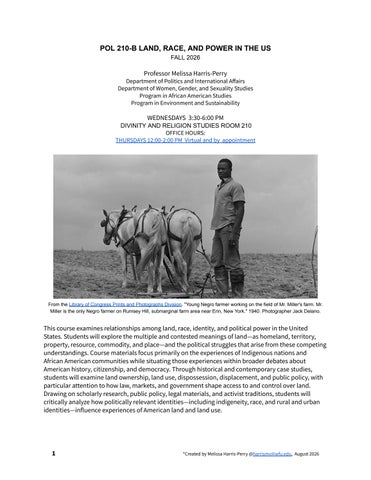
From the Library of Congress Prints and Photographs Division. "Young Negro farmer working on the field of Mr. Miller's farm. Mr. Miller is the only Negro farmer on Rumsey Hill, submarginal farm area near Erin, New York." 1940. Photographer Jack Delano.
This course examines relationships among land, race, identity, and political power in the United States. Students will explore the multiple and contested meanings of land—as homeland, territory, property, resource, commodity, and place—and the political struggles that arise from these competing understandings. Course materials focus primarily on the experiences of Indigenous nations and African American communities while situating those experiences within broader debates about American history, citizenship, and democracy. Through historical and contemporary case studies, students will examine land ownership, land use, dispossession, displacement, and public policy, with particular attention to how law, markets, and government shape access to and control over land. Drawing on scholarly research, public policy, legal materials, and activist traditions, students will critically analyze how politically relevant identities—including indigeneity, race, and rural and urban identities—influence experiences of American land and land use.
1
*Created by Melissa Harris-Perry @harrismv@wfu.edu, August 2026
Learning Objectives After completing this course students will be able to: ● Explain major historical and contemporary debates about land ownership, land use, dispossession, and property in the United States, with particular attention to the experiences of Indigenous nations and African American communities. ● Analyze how race, indigeneity, place, and political power shape competing understandings of land and influence access to, control over, and use of land. ● Critically evaluate scholarly research, legal materials, policy documents, journalism, media, and cultural texts, assessing their evidence, arguments, and perspectives. ● Apply interdisciplinary approaches drawn from political science, history, sociology, law, and related fields to contemporary questions involving land, identity, and public policy. ● Communicate evidence-based arguments through clear and persuasive written, oral, and collaborative work. ● Engage professionally with scholars, legal practitioners, journalists, policymakers, and community partners to examine contemporary challenges related to land and property, including participation in the Wake Forest University School of Law Heirs' Property Project.
Representative from the National Council of Negro Women visits the Pig Bank of the Mississippi-based Freedom Farms Cooperative, 1967 (Photo credit: unknown)
2
*Created by Melissa Harris-Perry @harrismv@wfu.edu, August 2026
Attendance Regular attendance and active participation are essential to the success of this course. Students are expected to arrive on time, remain for the full class period, and participate thoughtfully in class activities. Some class meetings will be conducted via Zoom. Advance notice will be provided whenever possible. Students are expected to attend Zoom sessions with their cameras on unless prior arrangements have been made with the instructor. Zoom class meetings will not exceed 90 minutes. Students are permitted up to two (2) unexcused absences during the semester without penalty. Beginning with the third unexcused absence, the final course grade will be reduced by one-third of a letter grade (e.g., A to A−, B+ to B). Each additional unexcused absence may result in an additional one-third letter grade reduction. Absences related to documented illness, university-sponsored activities, religious observances, or other significant circumstances will be considered on a case-by-case basis. Students are encouraged to communicate with the instructor as soon as reasonably possible when such situations arise.
Late Assignments Each student receives one (1) Late Pass for the semester. The Late Pass may be used on any assignment except the Final Exam and the Heirs' Property Project. When used, an assignment may be submitted up to 48 hours after the deadline with no explanation required and no grade penalty. To use your Late Pass, simply indicate "Using Late Pass" in Canvas or send a brief email before or when you submit the assignment. No explanation is necessary. The Late Pass is intended to cover the ordinary, unexpected disruptions that occur during a semester. Students do not need to explain or document their reason for using it. After the Late Pass has been used, late work will be assessed as follows: ● Submitted within 48 hours of the deadline: one-third letter grade deduction ● Each additional 24-hour period: an additional one-third letter grade deduction Documented illness, family emergencies, or other significant circumstances fall outside this policy and will be considered individually. When possible, students should communicate with the instructor as soon as reasonably possible regarding these situations.
3
*Created by Melissa Harris-Perry @harrismv@wfu.edu, August 2026
Accommodations Students who require academic accommodations should contact the Center for Learning, Access, and Student Success (CLASS) as early as possible, preferably before the start of the semester, to ensure that appropriate accommodations can be arranged. Center for Learning, Access, and Student Success (CLASS) Email: class@wfu.edu Phone: (336) 758-5929
Tutoring and Writing Support Wake Forest provides outstanding academic support through peer tutoring and The Writing Center. I encourage you to take advantage of these resources throughout the semester—not only when you're struggling, but also when you want to strengthen your writing, develop ideas, or receive feedback on assignments.
Health and Well-Being Your physical, mental, and emotional well-being matter. While this course has high expectations, I do not expect you to navigate significant health challenges alone. If illness, stress, or other circumstances begin to interfere with your ability to participate fully in the course, please reach out to me as soon as reasonably possible so we can discuss appropriate options. A few reminders for a successful semester: ● Stay hydrated (Drink more water than you think you need!) ● Get adequate sleep. When possible, take a nap. (Though taking one during class is less than ideal!) ● This is a long class period, so we will take a short break during each meeting. If you need to step out briefly, stretch, or use the restroom, please do so with minimal disruption to your classmates. ● If you find yourself falling behind—academically or personally—please come talk with me during office hours. Those conversations are often most helpful when they happen early. ● Learn a bit about emotional regulation here If you would benefit from additional support, I encourage you to connect with the University Counseling Center and other campus wellness resources.
4
*Created by Melissa Harris-Perry @harrismv@wfu.edu, August 2026
Use Of Generative AI Generative AI tools (e.g., ChatGPT, Claude, Gemini) can be valuable learning tools when used thoughtfully and transparently. In this course, AI should support your learning—not replace your intellectual work. Wake Forest University adopted guidelines for GAI use in 2026. The guidelines below comply with the general WFU guidelines but are specific to our class this semester. When using generative AI, students are expected to follow four principles: Purpose. Use AI to enhance your learning by brainstorming ideas, exploring questions, organizing information, or improving the clarity of your writing. AI should not replace your own reading, analysis, or argumentation. Accountability. You are responsible for the accuracy, quality, and integrity of all work you submit. AI systems can generate factual errors, fabricated citations, biased analyses, and misleading conclusions. Verify all information using reliable sources. Transparency. If you use generative AI in preparing an assignment, disclose that use in accordance with the instructions for the assignment. When requested, include the prompts you used and briefly describe how AI contributed to your work. Ethics. Do not submit confidential, personal, or sensitive information to AI systems. Assignment-specific instructions may further restrict or expand the use of AI for particular activities.This prohibition is especially important for students participating in the Heirs' Property Project, who must comply with all confidentiality and AI policies established by the Wake Forest University School of Law. APPROPRIATE USES OF GENERATIVE AI Unless otherwise specified, students may use generative AI to: ● ● ● ● ●
Brainstorm topics, research questions, and possible approaches to an assignment. Develop or refine an outline or organizational structure. Identify relevant concepts, theories, or areas for further research. Improve grammar, style, clarity, or organization of writing that you have already drafted. Generate practice questions, study guides, or explanations to support your learning.
In every case, the intellectual work—including reading assigned materials, evaluating evidence, constructing arguments, and reaching conclusions—must remain your own. INAPPROPRIATE USES OF GENERATIVE AI Unless an assignment explicitly permits otherwise, students may not use generative AI to:
5
*Created by Melissa Harris-Perry @harrismv@wfu.edu, August 2026
● Complete assigned readings in place of reading the assigned materials.You are expected to read all assigned materials yourself, even if you use AI to help you understand them. ● Generate reading responses, discussion posts, reflections, or other assignments intended to demonstrate your own thinking. ● Produce substantive portions of papers, essays, or other written assignments that you present as your own work. ● Invent, fabricate, or cite sources that you have not personally located and verified. ● Misrepresent AI-generated work as entirely your own. Using generative AI in ways that substitute for your own analysis, interpretation, or writing may constitute a violation of the Wake Forest University Honor Code. HEIRS' PROPERTY PROJECT Students participating in the Wake Forest University School of Law Heirs' Property Project must also comply with the Law School's policies and professional standards regarding the use of generative AI. Where the Law School's policies differ from or are more restrictive than this course policy, the Law School's requirements will govern work completed for the project. A Note from Professor Harris-Perry I use generative AI as one of several professional tools in my own teaching and scholarship. I use it to brainstorm ideas, improve organization, identify ambiguities, edit prose, and think through alternative approaches to assignments and course design. I remain responsible for all final decisions, factual accuracy, course content, and the work I produce. I encourage you to think about AI in the same way: as a tool that can strengthen your learning, but not substitute for your reading, analysis, judgment, or original thinking.
6
*Created by Melissa Harris-Perry @harrismv@wfu.edu, August 2026
AGREEMENT TO STANDARDS FOR SHARED LEARNING ENVIRONMENT
As a member of this class I agree to do my best to abide by the following standards of conduct for our shared learning environment. These standards apply to in-person and digital interactions. I will: 1. Abide by the Wake Forest University Honor Code. As a student at Wake Forest University, I pledge to support and uphold the Honor Code. I will endeavor to make it an integral part of my life and promote its values in the community. 2. Adhere to the Wake Forest University Statement of Principle Wake Forest is a community of persons who seek the enlightenment and freedom which come through diligent study and learning. An even higher goal, however, is to give life to the University motto, Pro Humanitate, as the passion for knowledge is translated into compassionate service. A tradition is shared that embraces freedom and integrity and that acknowledges the worth of the individual. This heritage, established by the founders and nurtured by succeeding generations, promotes a democratic spirit arising from open-mindedness and discourse. Wake Forest fosters compassion and caring for others. Its collective strength and character are derived from the values and distinctive experiences of each individual; therefore, the richness of human intellect and culture is affirmed in its contribution to knowledge, faith, reason, and dialogue. Furthermore, Wake Forest strives toward a society in which good will, respect, and equality prevail. To that end, hatred and bigotry in any form are rejected, and justice, honor, and mutual trust are promoted. 3. Agree to the Expectations for Conduct in this Class Our goal is to create a classroom in which every student can think carefully, speak honestly, and learn from disagreement. We strive to create a classroom where: ● every student has an opportunity to contribute; ● ideas may be questioned and debated without personal attacks; ● disagreement is expected and treated as part of learning; ● personal experiences are respected but never required; ● no one is expected to speak on behalf of an entire group. In this class we will: Assume Good Faith, Not Shared Values
7
*Created by Melissa Harris-Perry @harrismv@wfu.edu, August 2026
We will encounter arguments that challenge our own beliefs about gender, family, work, reproduction, and care. Disagreement does not imply ignorance, malice, or bad character. Critique Ideas, Not People We analyze arguments, frameworks, and evidence—not the moral worth or intentions of classmates, authors, or social groups. Speak From Our Own Position, Not For Others Use “I” statements when reflecting on experience. Separate Description from Endorsement Reading an argument—especially one you find troubling—is not the same as endorsing it. Our goal is to understand how ideas function politically and culturally. Distinguish between discomfort and disrespect. A challenging idea, difficult historical fact, or disagreement with your perspective may be uncomfortable. Disrespect involves personal attacks, ridicule, intimidation, or conduct that prevents others from participating. This course welcomes intellectual discomfort but does not tolerate personal disrespect. Respect Complexity We are studying issues with multifaceted causes and consequences. Individual stories are valid and valuable, but should be treated cautiously as evidence. Support claims with evidence. We will distinguish between evidence, inference, and opinion. Strong arguments are supported by reasons and evidence, not simply conviction. Confidentiality with Care Personal experiences shared in class should be treated with respect and discretion. No one is required to disclose personal information to participate fully. 4. Refrain from Recording No audio or video recording of class is allowed whether class is meeting in person or via Zoom unless: 1. You have documentation that audio/ video recording is necessary to meet approved academic accommodations., and 2. You have express, written permission of all those being recorded. PLEASE SIGN THIS AGREEMENT AND SUBMIT ON CANVAS
8
*Created by Melissa Harris-Perry @harrismv@wfu.edu, August 2026
COURSE OUTLINE MODULE 1
INTRODUCTION
TOPIC
1.1
August 26
INTRODUCTION
MODULE 2
POLITICS OF THE FRONTIER
2.1
September 2
THE FRONTIER AND MAKING AMERICA
2.2
September 9
FRONTIER MYTH AND SETTLER COLONIALISM
2.3
September 16
CHEROKEE LAND DISPOSESSION GUEST: REBECCA NAGLE
MODULE 3
POLITICS OF PROPERTY
3.1
September 23
PRIVATE PROPERTY AND MAKING AMERICA
3.2
September 30
FROM BEING PROPERTY TO OWNING PROPERTY
3.3
October 7
HEIRS’ PROPERTY GUEST: WFU HEIRS’ PROPERTY CLINIC
MODULE 4
LAND USE- AGRICULTURE
4.1
October 14
MYTH OF THE FAMILY FARM
4.2
October 21
BLACK FARMERS AND LAND DISPOSSESSION
4.3
October 28
AGRICULTURE, LABOR, AND ORGANIZING GUEST: JULIUS TILLERY, FARMER AND FOUNDER BLACK COTTON
MODULE 5
LAND AS VOTING DISTRICTS
5.1
November 4
MODULE 6
LAND USE-PLANNING
6.1
November 11
RACE, ZONING, URBAN PLANNING
6.2
November 18
DATA CENTERS, TRIBAL LAND, SOVEREIGNTY
BREAK
THANKSGIVING BREAK
ELECTION 2026-
November 25
NO CLASS - OPTIONAL READINGS
MODULE 7
FOOD- FIELD TRIP
7.1
December 2
FINAL
FINAL EXAM
FIELD TRIP
Wednesday, December 9, 12PM Thursday, December 11, 9AM Tuesday, December15, 2PM
9
Final Exam must be taken in-person There 3 available times/ dates
*Created by Melissa Harris-Perry @harrismv@wfu.edu, August 2026
COURSE ASSIGNMENTS CLASS PARTICIPATION - 10% Attendance and contributions to class discussion. ENTRANCE TICKETS- 40% PART I Most entrance tickets include a brief writing prompt or creative assignment which must be completed and turned in before the start of class. These assignments will serve as the basis for discussions. PART II At the start of most classes students will answer several multiple choice questions to assess knowledge of assigned materials. Prompts and creative assignments can be found on the syllabus and on the course CANVAS site. EXIT TICKETS- 5% Brief reflections at the end of each class meeting. Exit Tickets provide an opportunity to identify the most important ideas from each class, ask lingering questions, connect course concepts across units, and reflect on your own learning. FINAL EXAM -
20%
Students will complete an in-person final exam composed of multiple choice, short answer, and brief essay questions. HEIR’S PROPERTY PROJECT PARTICIPATION AND REFLECTION -25% The Heirs' Property Project serves as the applied learning component of this course. Working in collaboration with the Wake Forest University School of Law's Environmental Law & Policy Clinic, students will connect course concepts to contemporary questions of land ownership, law, and public policy through direct engagement with an ongoing community-based initiative. The Heirs’ Property Project is an effort of the Environmental Law & Policy Clinic at Wake Forest University School of Law started in January 2023, The Heirs’ Property Project is one of only a handful of law school clinics that provide direct legal services in these circumstances. Students in this class will contribute a minimum of ten (10) hours over the course of the semester working directly with the Heir’s Property Project. Details about the specific opportunities and tasks are forthcoming and will be detailed on the Canvas site and discussed in class. All students will submit a substantive reflection about their work on the project and its connection to course materials. Details and rubric for the reflection are forthcoming. EXTRA CREDIT Professor Harris-Perry will make a variety of extra credit opportunities available for students throughout the semester. Each assignment is worth .5 points on the final grade. Students may earn up to three (3) points on their final grade by completing extra credit assignments.
10
*Created by Melissa Harris-Perry @harrismv@wfu.edu, August 2026
MODULE 1: INTRODUCTION
Stan Kroenke America’s largest private landowner in 2026 Photo Credit: Kirby Lee-USA TODAY Sports, 2022
1.1 INTRODUCTION August 26 ASSIGNED MATERIALS BEFORE CLASS EXPLORE our course Canvas site to familiarize yourself with course content and expectations. READ: Land Report 2026 READ: Bartley, Tim. Introduction: Toward a Political Sociology of Land. The Politics of Land. Emerald Publishing Limited, 2019 p.1-12 ENTRANCE TICKET 1.1 Read, Sign, and Submit the Agreement to Standards for a Shared Learning Environment
11
*Created by Melissa Harris-Perry @harrismv@wfu.edu, August 2026
MODULE 2: POLITICS OF THE FRONTIER
A scene from Back to the Frontier, a 2026 reality TV show of Magnolia Network,
The American frontier is one of the nation’s most enduring stories about itself. This module examines how ideas of the frontier, Manifest Destiny, and American exceptionalism shaped understandings of land and national identity, and how Indigenous histories of sovereignty, dispossession, and resistance challenge those narratives. DATES
TOPICS
September 2
2.1 The Frontier Myth in the Making of America
September 9
2.2 The Frontier Myth and Settler Colonialism
September 16
2.3 Cherokee Land Dispossession
12
*Created by Melissa Harris-Perry @harrismv@wfu.edu, August 2026
2.1: FRONTIER MYTH IN THE MAKING OF AMERICA SEPTEMBER 2 How did the frontier become central to the American story about itself? 2.1 ASSIGNED MATERIALS BEFORE CLASS SECONDARY SOURCE READ Slotkin, Richard Gunfighter Nation : The Myth of the Frontier in Twentieth-Century America. Mythology of the American West. Open Road Media, 2024, INTRODUCTION: Significance of the Frontier Myth in American History PRIMARY SOURCES READ Frederick Jackson Turner. The Significance of the Frontier in American History 1893 Excerpts. (pp. 9 pages) READ Albert J. Beveridge. March of the Flag. Address to an Indiana Republican Meeting Indianapolis, Indiana, September 1898 Excerpts (5 pages) WATCH John F. Kennedy, Acceptance of Democratic Nomination for US Presidency, 1960. Begin minute 14:00 (Approx 22 minutes total, Approx 7 minutes focused on New Frontier) WATCH Ronald Reagan, Farewell Address to the Nation. 1989. Begin minute 18. (Approx 21 minutes total, approx 4 minutes focused on the Shining City) WATCH Barack Obama, Concession Speech, New Hampshire Primary 2008. Begin minute 9. (Approx 12 minutes total, approx 3 minutes focused on Yes We Can) 2.1 ENTRANCE TICKET - PART I Watch: Star Wars and the American Frontier (ABC News, 1999) (approximately 4 minutes) For the first part of your Entrance Ticket, do something similar to the analysis presented in this clip. Identify a contemporary example of popular culture (e.g., a film, novel, television series, Netflix show, social media trend, video game, advertisement, or other cultural product) that draws upon, reimagines, or reproduces themes of the American frontier, Manifest Destiny, exploration, or American exceptionalism. Submit to Discussion Board 2.1: A link (or citation) to your example. A brief explanation (50 words or fewer) describing why you selected it and how it reflects one or more of these themes. Be prepared to discuss and expand upon your analysis during class. Generative AI Note: You may use generative AI to brainstorm possible examples of popular culture. However, your explanation and analysis must be your own original work. During class, you should be prepared to explain, defend, and deepen your analysis without relying on AI. You are responsible for ensuring that the example is accurately described and genuinely illustrates the themes you identify.
13
*Created by Melissa Harris-Perry @harrismv@wfu.edu, August 2026
2.2: FRONTIER MYTH AND SETTLER COLONIALISM SEPTEMBER 9
What does the story of the American frontier obscure about how the United States acquired land? 2.2 ASSIGNED MATERIALS BEFORE CLASS SECONDARY SOURCES READ Dunbar-Ortiz, Roxanne. Settler Colonialism. Chapter 2 in Not a Nation of Immigrants : Settler Colonialism, White Supremacy, and a History of Erasure and Exclusion. New York: Beacon Press. 2021. pp 40-69; READ Chang, David A. “Enclosures of Land and Sovereignty: The Allotment of American Indian Lands.” Radical History Review 2011.109 (2011): 108–119 WATCH America's Wild West: Discovery of a Land (Full Episode) | What Really Happened. National Geographic. (Approximately 40 minutes) PRIMARY SOURCES READ President Andrew Jackson to Congress, “On Indian Removal,” December 6, 1830. EXPLORE: Conditions of the Indian Tribes, 1867 READ Letter from Uriah W. Oblinger to Mattie V. Thomas and Ella Oblinger, December 1, 1872 READ: The Surrender of Chief Joseph, 1877 2.2 ENTRANCE TICKET - PART I LISTEN to Woody Guthry, This Land is Our Land (Time approx 4 min) Take a moment to learn more about Woody Guthry here Write one new verse (or two short verses) to Woody Guthrie's This Land is Your Land. Your song should tell a story with a distinct point of view. Your revised lyrics should be based on the materials assigned for this week and should be written from a clearly identifiable point of view. For example Cherokee family, Choctaw elder, federal official, surveyor, settler/pioneer or enslaved laborer. You should be prepared to explain your lyrical choices and deepen your analysis in conversation with your peers. Post the new lyrics to Discussion Board 2.2. Generative AI Note: The lyrics must be entirely your own original work. You are not required to provide musical accompaniment. However, you are welcome to use AI to set the lyrics to music. If you choose to do so you must cite the AI program used and provide a screenshot of the AI interaction/ directions. If you have the skill and interest, you may also compose and record the new song yourself.
14
*Created by Melissa Harris-Perry @harrismv@wfu.edu, August 2026
2.3: CHEROKEE LAND DISPOSESSION SEPTEMBER 16
What does Cherokee land dispossession reveal about the relationship among land, law, and sovereignty? 2.3 ASSIGNED MATERIALS BEFORE CLASS SECONDARY SOURCES LISTEN THIS LAND podcast from Crooked Media. SEASON 1: EPISODE 4 - The Treaty (30 min) SEASON 1: EPISODE 5 - The Land Grab(30min) Love podcasts? If you have the time and interest feel free to listen to the entire season. And Season 2 is spectacularly interesting as well. READ Nagle, Rebecca. By the Fire We Carry The Generations-Long Fight for Justice on Native Land. Harper, 2024, Chapter 12, Slow Bleed Chapter 13, The Victory Chapter 15, The Backlash READ Melinda C. Miller; “The Righteous and Reasonable Ambition to Become a Landholder”: Land and Racial Inequality in the Postbellum South. The Review of Economics and Statistics 2020; 102 (2): 381–394. PRIMARY SOURCES EXPLORE The Treaty of New Echota, 1835 EXPLORE The Dawes Act 2.3 ENTRANCE TICKET- PART I We will be joined via Zoom by Rebecca Nagle, award winning journalist and citizen of Cherokee Nation. Nagle is the author of By The Fire We Carry: The Generation-Long Fight for Justice on Native Land and the writer and host of the podcast This Land. She is the recipient of the American Mosaic Journalism Prize, Women’s Media Center’s Exceptional Journalism Award, a Peabody Nominee, and numerous awards from the Native American Journalist Association. Ms. Nagle's work exemplifies the intersection of journalism, historical research, legal analysis, and public advocacy. Her visit offers an opportunity to discuss how scholars and journalists shape public understanding of land, sovereignty, and Indigenous rights. After listening to and reading the assigned materials for this week, develop at least three questions for Ms. Nagle. The questions should follow our course pedagogy: Describe:Identify one idea, event, or historical detail from Ms. Nagle's work that you would like her to explain or expand upon. Analyze:Ask a question that examines Ms. Nagle's interpretation or analysis of history, law, politics, or Indigenous sovereignty. Reflect: Ask a question about how Ms. Nagle's work changed, challenged, or deepened your understanding of land, race, or political power.
15
*Created by Melissa Harris-Perry @harrismv@wfu.edu, August 2026
MODULE 3: POLITICS OF PROPERTY The United States is often described as a nation built on private property. This module examines how land became property, why property rights became central to American political thought, and who was included—or excluded—from that vision of ownership.
DATES
TOPICS
September 23
3.1 Private Property and the Making of America
September 30
3.2 From Being Property to Owning Property
October 7
3.3 Heirs’ Property
16
*Created by Melissa Harris-Perry @harrismv@wfu.edu, August 2026
3.1: PRIVATE PROPERTY AND MAKING AMERICA SEPTEMBER 23 How did private property become foundational to the development of the United States? 3.1 ASSIGNED MATERIALS BEFORE CLASS PRIMARY SOURCES READ John Locke. Of Property from Second Treatise on Civil Government, 1690 READ James Madison, On Property, March 1792 SECONDARY SOURCES READ Polanyi, Karl. Habitation versus Improvement. Chapter 4 of Great Transformation : The Political and Economic Origins of Our Time. 1944. New Edition Boston: Beacon Press, 2001. Pp. 35-44 READ Paul Larkin. The Framers’ Understanding Of “Property. Legal Memorandum No. 263. July 6, 2020 Edwin Meese III Center For Legal & Judicial Studies. The Heritage Foundation. pp. 1-11 READ Debbie Becher. 2023. Land Inequalities in the United States. Annual Review of Sociology 49:421-441 3.1 PART 1 - ENTRANCE TICKET This module claims: “Land as private property is one of the defining institutions of the United States” Use our course pedagogy to write a brief post (no more than 150 words total) highlighting how this week’s assigned materials illuminate the statement above. Post to discussion Board 3.1 Describe: Identify one idea, historical detail, legal case, or other fact from this week’s materials that demonstrates the centrality of land as private property in the American context.Cite the relevant assigned material, including page number or direct quote. Analyze: Explain one important political, legal, economic, or social consequence of the fact you identified. Reflect: How has your understanding of private property been challenged, deepened, or transformed by this understanding? NOTE: This week our class is meeting via Zoom. https://wakeforest-university.zoom.us/j/97658227669?pwd=uSaKkpGs9a2xob8utqwrNXZOXYcIKZ.1 Meeting ID: 976 5822 7669 Passcode: 357175
17
*Created by Melissa Harris-Perry @harrismv@wfu.edu, August 2026
3.2: FROM BEING PROPERTY TO OWNING PROPERTY SEPTEMBER 30 How did Black Americans move from being property to pursuing freedom and wealth through property within unequal institutions? 3.2 ASSIGNED MATERIALS BEFORE CLASS PRIMARY SOURCE READ DEED of SALE- Guilford County, NC 1804 READ DEED OF SALE- Guilford County, NC 1820 SCHOLARLY SECONDARY SOURCES READ Cox, Anna-Lisa CHAPTER 5 of The Bone and Sinew of the Land : America’s Forgotten Black Pioneers & the Struggle for Equality. New York, NY: PublicAffairs, Hachette Book Group, 2018. (pp. 77-98) READ Muhammad, Andrew, Christopher Sichko, and Tore C Olsson. “African Americans and Federal Land Policy: Exploring the Homestead Acts of 1862 and 1866.” Applied economic perspectives and policy 46.1 (2024): 95–110 READ Taylor, Keeanga-Yamahtta. Race for Profit : How Banks and the Real Estate Industry Undermined Black Homeownership. The University of North Carolina Press, 2021. INTRODUCTION: PAGES 1-24 MEDIA/ THINK TANK SOURCES READ Andre Perry, Hannah Stephens, Manann Donoghoe. Black wealth is increasing, but so is the racial wealth gap. January 2024 PRIMARY SOURCES READ Fair Housing Act 3.2 PART I Entrance Ticket What happens when people once legally defined as property seek freedom, security, and citizenship through property ownership? Using the assigned materials, write a brief response of no more than 150 words total using our course framework: Describe: Identify one specific law, policy, historical event, or institutional practice that shaped Black Americans’ access to property ownership. Cite the relevant assigned material, including page number or direct quote. Analyze: Explain how that example helps us understand the relationship between property ownership, freedom, citizenship, or wealth in the United States. Reflect: What tension, contradiction, or unresolved question about race and private property does this history raise for you?
18
*Created by Melissa Harris-Perry @harrismv@wfu.edu, August 2026
3.3: HEIRS’ PROPERTY OCTOBER 7 How do race, law, inheritance, wealth, and land converge in the politics of heirs’ property? 3.3 HEIRS’ PROPERTY SCHOLARLY SECONDARY SOURCES READ Mitchell, Thomas W. “The Heirs’ Property Field: Moving from the Shadows to the Light to Enlightened, Evidence-Based Solutions.” Agricultural and Resource Economics Review, vol. 54, no. 3, December 2025, pp. 583–95, https://doi.org/10.1017/age.2025.10021. MEDIA/ THINK TANK SOURCES READ Their Family Bought Land One Generation After Slavery. The Reels Brothers Spent Eight Years in Jail for Refusing to Leave It. Propublica July 2019 READ John Walsh, Michael Neal, Amalie Zinn. Prospective Heirs’ Property among Older Homeowners. Four Facts on Heirs’ Property Conditions by Race and Ethnicity. October 30, 2024 PRIMARY SOURCE
Uniform Partition of Heirs Property Act RECOMMENDED/ OPTIONAL/ KEEP FOR LATER READ Breland, Will. "Acres of Distrust: Heirs Property, the Law's Role in Sowing Suspicion Among Americans and How Lawyers Can Help Curb Black Land Loss." Georgetown Journal on Poverty Law & Policy 28, no. 3 (2021) 3.3 PART I Entrance Ticket We will be joined by Professor Scott Schlang, and Attorney De'Erricka, Green Co-Directors of the Heirs’ Property Project at Wake Forest University School of Law. The Heirs’ Property Project partners with undergraduate students to provide clients with skilled support for family decision-making processes, as well as with environmental expertise to support heirs’ property owners in stewarding their land. Professor Schlang and Attorney Green will visit our class to discuss the work our class will do for the remainder of the semester to support the efforts of the project. After reading the assigned materials for this week please prepare at least ONE (1) question about that you believe will help you to be better prepared for assisting the work of the clinic. Also, please complete the attached skills assessment form.
19
*Created by Melissa Harris-Perry @harrismv@wfu.edu, August 2026
MODULE 4: AGRICULTURE
Farmers at Leah Penniman’s Soul Fire Farms in New York state. Photo Credit: Courtesy of Capers Rumph
American agriculture is often imagined through the ideal of the independent family farmer. This module examines how race, labor, public policy, and access to land have shaped who could become a farmer, who performed agricultural labor, and how communities have used land and agriculture as sites of belonging and organizing for fairness. DATES
TOPICS
October 14
4.1 The Myth of the Family Farm
October 21
4.2 Black Farmers and Land Dispossession
October 28
4.3 Agriculture, Labor, and Organizing
20
*Created by Melissa Harris-Perry @harrismv@wfu.edu, August 2026
4.1: THE MYTH OF THE FAMILY FARM OCTOBER 14 Who is imagined when Americans imagine “the farmer”? 4.1 ASSIGNED MATERIALS BEFORE CLASS PRIMARY SOURCES LISTEN “Paul Harvey, So God Made a Farmer “ READ MacDonald, J. M., Dong, X., & Fuglie, K. (2023). Concentration and competition in U.S. agribusiness (Report No. EIB-256). U.S. Department of Agriculture, Economic Research Service. READ pp 1-25 READ Hank Tremblay What are family farmers up against right now? Farm Aid. December 2025 SECONDARY SOURCES READ Garkovich, Lorraine, Janet L. Bokemeier, And Barbara Foote. Harvest of Hope: Family Farming/Farming Families. University Press of Kentucky, 1995. Chapter 5 The Economic Challenges of Farming as a Business. pp 103-127 READ Minkoff-Zern, Laura-Anne. From Farmworkers to Farm Owners: An Introduction. CHAPTER 1 in The New American Farmer : Immigration, Race, and the Struggle for Sustainability. Cambridge, Massachusetts: The MIT Press, 2019. 4.1 PART 1 ENTRANCE TICKET Write your own version of Paul Harvey’s Paul Harvey, “So God Made a Farmer “ Learn more about Paul Harvey here. Your version should tell a story with a distinct point of view, such as migrant worker, Black farmer, immigrant farm owner, woman farmer, tenant farmer, corporate agricultural employee. You can choose to write from the perspective of a crop like soybeans or corn; a farm animal, such as a pig or cow; or even from the perspective of the land, such as a field or farm. You must include at least THREE (3) references to one or more of the assigned materials from this week or prior weeks If you use additional sources beyond the assigned materials for this week you must provide full references and citations. Your references do not need to be direct quotations, but the connection to the assigned material should be recognizable and substantive. Use your footnotes to identify the source that informs each reference. Generative AI Note: This must be entirely your own original work.
21
*Created by Melissa Harris-Perry @harrismv@wfu.edu, August 2026
4.2: BLACK FARMERS AND LAND DISPOSESSION October 21 How did Black Americans acquire agricultural land, and why did so much of that land disappear? 4.2 ASSIGNED MATERIALS BEFORE CLASS
SECONDARY SOURCES READ Hinson, Waymon R., and Edward Robinson. “‘We Didn’t Get Nothing:’ The Plight of Black Farmers.” Journal of African American Studies (New Brunswick, N.J.) [Boston], vol. 12, no. 3, September 2008, pp. 283–302, READ Merem, Edmund The Loss of Agricultural Land Among Black Farmers. Western Journal of Black Studies; Pullman Vol. 30, Iss. 2, (Spring 2006): 89-102. READ White, Monica M.. 2019. Freedom Farmers : Agricultural Resistance and the Black Freedom Movement. Chapel Hill: University of North Carolina Press. PART 1: Land, Food, Freedom READ The Pigford Cases: USDA Settlement of Discrimination Suits by Black Farmers. May 2013. 4.2 PART 1 ENTRANCE TICKET This week examines a striking historical pattern: Black Americans acquired significant amounts of agricultural land after emancipation, yet much of that land was lost over subsequent generations. Using this week’s materials, respond in no more than 175 words: Describe: Identify one law, policy, institutional practice, or form of collective action that affected Black farmers’ ability to acquire, retain, or use agricultural land. Cite the assigned material including a page number and/or a brief direct quotation. Analyze: Explain how your example helps us understand the relationship among race, agriculture, land ownership, and political power. Reflect: What does this history lead you to understand about farming that challenges or reinforces your previous beliefs?
22
*Created by Melissa Harris-Perry @harrismv@wfu.edu, August 2026
4.3 AGRICULTURE, LABOR, AND ORGANIZING October 28 Who owns and works the land, under what conditions, and who has worked to change those constraints and conditions? 4.3 ASSIGNED MATERIALS BEFORE CLASS WATCH Harvest of Dignity, 50 years after Murrow Film. (about one hour) WATCH Delano Manongs: The story of the Forgotten Filipino Farmworkers (about 30min)
LISTEN: Black Freedom Farmers: Land as Sites of Resistance.The Takeaway. July 2022. (approx 20 min) READ These farmworkers created America’s strongest workplace heat rules. Washington Post 2024. READ Pointing the Farm Bill Towards Racial Justice Toolkit. 4.3 PART 1 ENTRANCE TICKET We will be joined by Julius Tillery of Black Cotton (not yet confirmed) Julius Tillery is a fifth-generation farmer on family-owned and operated land. Tillery Farms is located in Rich Square, North Carolina. Read about Tillery in this piece- Rewriting the Story of Cotton. Watch Mr Tillery in this brief video. (Approximately 5 minutes) After engaging the assigned materials for this module, develop at least three questions for Mr. Tillery. The questions should follow our course pedagogy: Describe:Identify one aspect of Mr Tillery’s work that you would like him to explain or expand upon. Analyze:Ask a question that examines Mr. Tillery’s work in the context of themes/ ideas/ efforts from the assigned materials for this module. Reflect: Ask a question about how Mr. TIllery’s work has changed, challenged, or deepened your understanding of land, race, or political power.
23
*Created by Melissa Harris-Perry @harrismv@wfu.edu, August 2026
MODULE 5: LAND, RACE AND VOTING
North Carolina’s former 12th Congressional District
DATES
TOPICS
November 4
5.1
24
Land, Race, Voting Districts in 2026 Midterms
*Created by Melissa Harris-Perry @harrismv@wfu.edu, August 2026
5.1: LAND, RACE, AND VOTING DISTRICTS November 4 Political power is organized geographically. This module examines how the drawing of political boundaries determines who constitutes a political community, how votes are translated into representation, and how race and place shape struggles over democratic power. This class meets the day after the 2026 midterm elections and provides an opportunity for us to discuss the results in the context of our class. 5.1 ASSIGNED MATERIALS BEFORE CLASS SCHOLARLY SOURCE READ Canon, David T. “Race and Redistricting.” Annual Review of Political Science 25.1 (2022): 509–528. PRIMARY SOURCES READ Louisiana v. Callais (2025) READ NC Congressional Districts Map for 2026 Midterm Elections
MEDIA/ THINK TANK SOURCES WATCH “Gerrymandering Tilts Political Power. Here’s How Redistricting Affects Democracy.” Films On Demand, Films Media Group, 2021 READ Redistricting in North Carolina ahead of the 2026 elections. Ballotpedia. READ Scott Bomboy. The Supreme Court’s Callais decision sets new framework for racial gerrymandering.” National Constitution Center April 2026. READ What Louisiana v. Callais Means for the Voting Rights Act. Interview with experts. Harvard Kennedy School.
5.1- PART I ENTRANCE TICKET OPTION 1: Propose a framework for drawing North Carolina's congressional districts. Identify the principles or criteria your system would prioritize and explain why. How does your approach differ from or resemble the process reflected in North Carolina's current congressional map? What consequences might your framework have for the political representation of racial groups? Generative AI Note:Your framework and analysis must be your own. You may use generative AI or other software to create maps, figures, or images illustrating your proposal. Any such use must be cited, and you must submit a screenshot of the prompts/instructions used. OR OPTION 2 In no more than 150 words, identify one way that a theme we have studied this semester helps explain an aspect of yesterday’s North Carolina's 2026 congressional elections. You might consider agricultural policy, racial voting patterns, political narratives about land and place, rural/urban identity, or the geography and composition of congressional districts.
25
*Created by Melissa Harris-Perry @harrismv@wfu.edu, August 2026
MODULE 6: RACE, SOVEREIGNTY, AND LAND USE
Land-use decisions shape where people live, work, build wealth, and experience environmental risk. This module examines how zoning, planning, infrastructure, and development policy distribute political and economic power across communities, and how race and sovereignty shape struggles over who controls those decisions. DATES
TOPICS
November 11
6.1
Race, Zoning, Urban Planning
November 18
6.2
Data Centers and Rural Indian Land
26
*Created by Melissa Harris-Perry @harrismv@wfu.edu, August 2026
6.1: RACE, ZONING, AND URBAN PLANNING November 11
How have zoning and urban planning shaped racial inequality in American cities? 6.1 ASSIGNED MATERIALS BEFORE CLASS SCHOLARLY SOURCES READ Stephen Sills, Enduring Impact of Racialized Planning in Southern Cities. University of North CarolinaGreensboro, Center for Housing and Community Studies. Pp. 1-41 READ Whittemore, Andrew H. “The Role of Racial Bias in Exclusionary Zoning: The Case of Durham, North Carolina, 1945–2014.” Environment and Planning. Vol. 50, no. 4, June 2018, pp. 826–47, READ Lens Michael. Zoning, 2002. Land Use, and the Reproduction of Urban Inequality. Annual Review Sociology Jul;48(1):421-439.
MEDIA/ THINK TANK SOURCES WATCH The Tragedy of Urban Renewal: The destruction and survival of a New York City neighborhood. 2011. About 7 minutes READ Mindy Fullilove Eminent Domain & African Americans: What is the Price of the Commons. Pp. 1-10
6.1 PART I ENTRANCE TICKET No Part I -Entrance Ticket this week. Focus on work for the Heirs’ Property Project There will be a standard reading assessment multiple choice quiz at the start of class.
27
*Created by Melissa Harris-Perry @harrismv@wfu.edu, August 2026
6.2: DATA CENTERS, TRIBAL LAND, AND SOVEREIGNTY November 18 How should Tribal nations balance economic development, sovereignty, environmental protection, and community control when considering AI data centers? 6.2 ASSIGNED MATERIALS READ Tana Fitzpatrick. AI Data Centers and Tribes: Emerging Federal and State Policy Trends and Tribal Governance Options. June 2026 Native Nations Center for Tribal Policy Research. University of Oklahoma READ Data Centers for Tribal Economic Development: Frequently Asked Questions Office of Indian Energy Policy and Programs US Department of Energy. EXPLORE Honor the Earth- Stop Data Colonialism READ Morgan Gray, Kennedy Satterfield, Traci Morris, and Nicol Turner Lee. Avoiding the next digital divide: Defining digital sovereignty for Tribal Nations in the AI age. Brookings Institution. February 17, 2026 6.2 PART I ENTRANCE TICKET
No Part I Entrance Ticket this week. Focus on work for the Heirs’ Property Project There will be a Part 2 reading comprehension multiple choice quiz at the start of class.
28
*Created by Melissa Harris-Perry @harrismv@wfu.edu, August 2026
THANKSGIVING BREAK November 25
Indigenous Thanksgiving Foods served at the Pequot Museum, photo credit, Rachael Cerotti
Like land, food and food rituals in the United States are connected to distinct histories, peoples, race and power. As our semester pauses for the Thanksgiving holiday, the following optional readings offer two ways to think about how food, memory, sovereignty, community survival, and political power connect to themes we have explored throughout the course. Potorti, Mary. “‘Feeding the Revolution’: The Black Panther Party, Hunger, and Community Survival.” Journal of African American Studies 21, no. 1 (2017): 85–110. Sherman, Sean. The Sioux Chef’s Indigenous Kitchen. Minneapolis, Minnesota: University of Minnesota Press, 2017. INTRODUCTION (pp 1-18)
29
*Created by Melissa Harris-Perry @harrismv@wfu.edu, August 2026
7.1 FIELD TRIP
DECEMBER 2 DETAILS TO BE ANNOUNCED
FINAL EXAM The Final Exam must be taken in person . There are three available dates. Wednesday, December 9, 12 Noon Thursday, December 11, 9AM Tuesday, December15, 2PM
30
*Created by Melissa Harris-Perry @harrismv@wfu.edu, August 2026