NOTES
NOTEWORTHY
CIM sets ambitious goals in new Blueprint:2030 strategic plan
Just as CIM students are reaching for goals, so is CIM itself moving ahead.
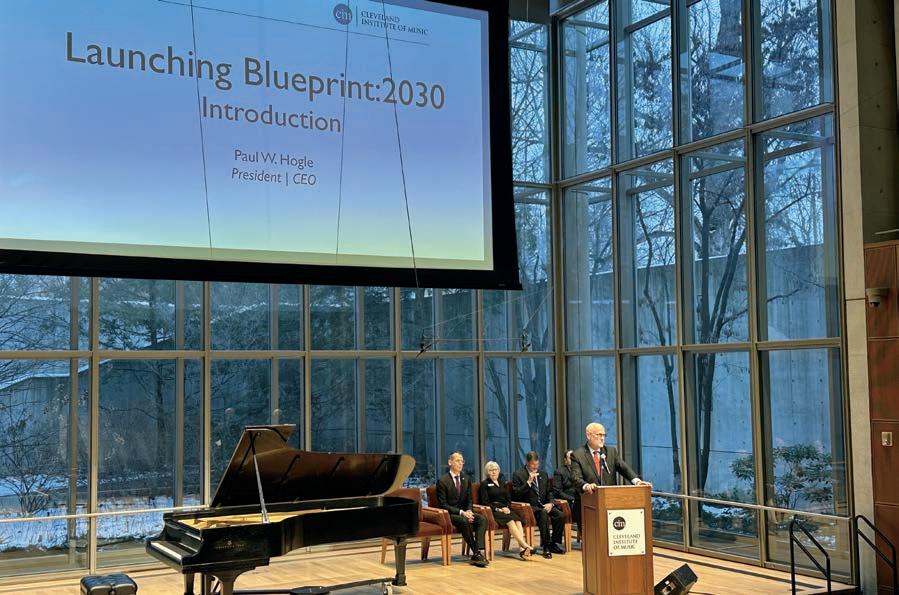
Today, the school is several months into Blueprint:2030, a five-year plan to cement CIM’s place as the destination for the world’s most talented classical music students. The plan, adopted in December, contains ambitious goals for outcomes, enrollment, budgeting, and philanthropy.
At the plan’s heart is a question: “Does CIM consistently prepare every student to envision and compete for a top-echelon music career?” Out of that arose three strategic imperatives: Student Achievement, People and Practices, and CIM’s Business Model.
Toward the first, Blueprint:2030 envisions new courses, secondary majors, and enhanced career planning to better prepare graduates for a changing professional landscape.
The second imperative contains plans for leadership succession, structured shared governance through a permanent Faculty
Council, an employee “culture of belonging,” and a global push for greater awareness of and pride in the CIM brand.
Some of the most ambitious benchmarks, meanwhile, belong to the third imperative. With Blueprint:2030, CIM resolved anew to pursue its “Moonshot” vision of a tuition-free future.
To that end, the school will strive not only to earn philanthropic gifts but also to realign areas of study with budgetary objectives; test and launch secondary majors; invest in “pipeline” youth, summer, and continuing education programs; and maximize income from facility rentals and ticket sales.
“Peer institutions are moving decisively toward tuition-free or no-loan models,” said Paul Hogle, CIM’s President & CEO. “If we are to compete for the world’s most gifted student artists, we must match that boldness.”


ON THE COVER
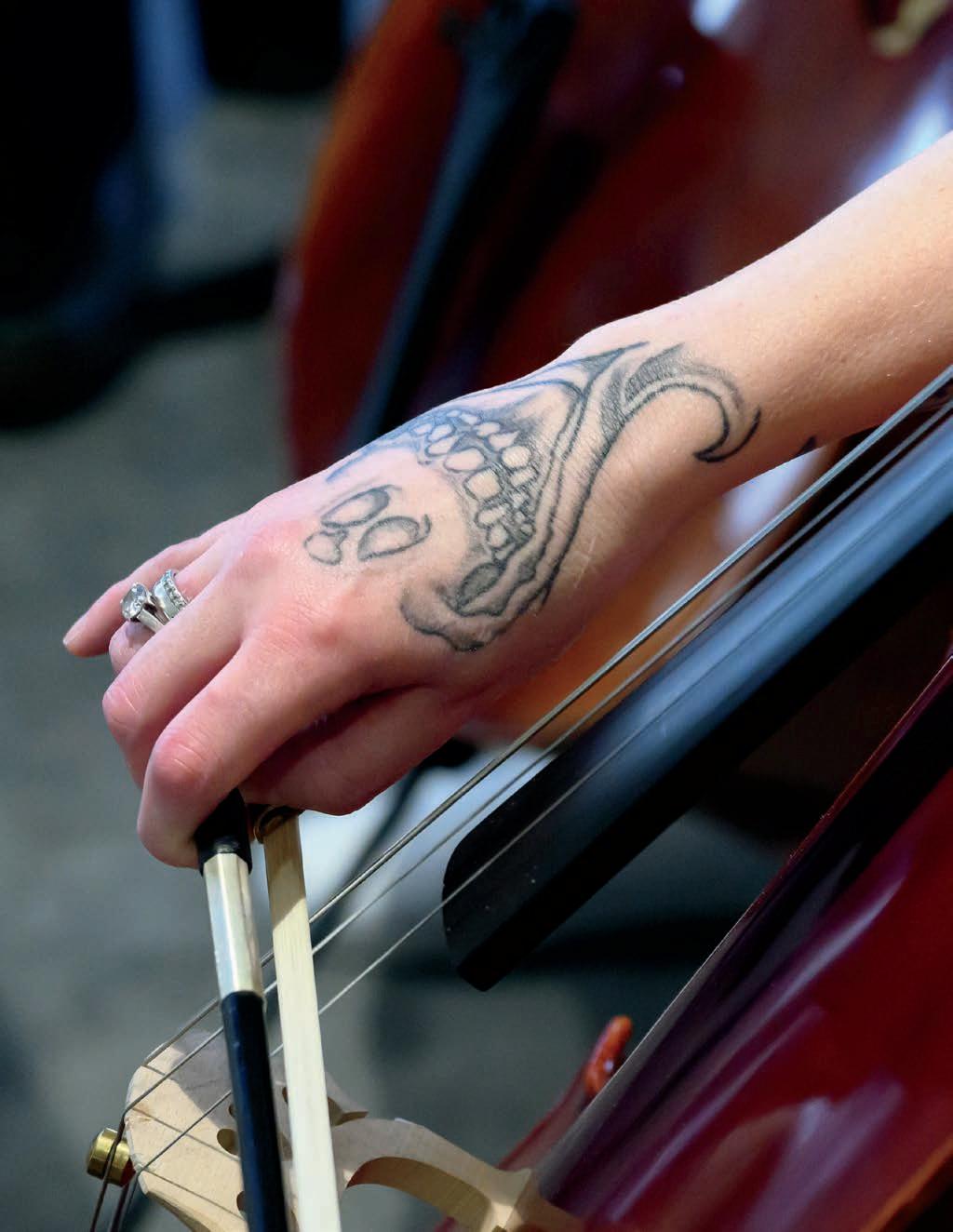
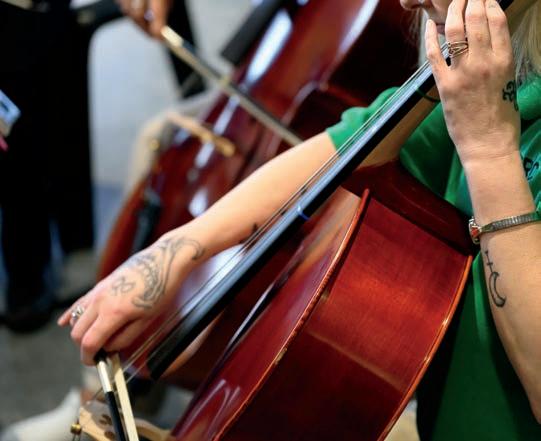
A resident at the Northeast Reintegration Center in Cleveland plays the cello with Renovare, a group founded by CIM alum Rebecca Shasberger (story, page 9).
All content written by Zachary Lewis Design by Tom Putters
PDFs of the current and past issues of Notes are available at cim.edu/news
CLEVELAND INSTITUTE OF MUSIC 11021 East Boulevard Cleveland, OH 44106
P: 216.791.5000
E: marketing@cim.edu | cim.edu

2 Noteworthy
CIM sets ambitious goals in new Blueprint:2030 strategic plan
CIM trombone student gets head start with appearance on NPR’s From the Top
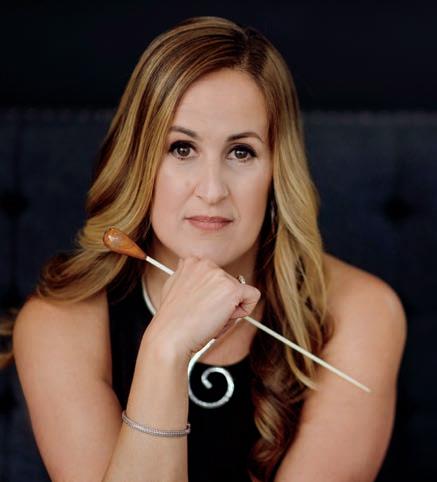
Distinguished Alumni Award recipient Kathryn Harsha parlays CIM education into rewarding, multifaceted career
Frequent CIM guest conductor Anthony Parnther earns two Grammy Awards
CIM’s new graduate-level saxophone studio comes into its own
Shark Tank investors take the bait from CIM alum Mike Block
Modern Snare Drum Competition boosts individuals and art form at CIM
New CIM Summer Institute gearing up for dynamic June, July, and August
9 Features
The gift of renewal: With Renovare, CIM alum Rebecca Shasberger offers music where it’s needed most
A commission like no other: CIM students write music for heartwarming Sing Me a Story project
Guitarist Damian Goggans forges groundbreaking path beyond CIM’s Musical Pathway Fellowship
16 Alumni Spotlight
CIM was where Chicago Symphony violist Paolo Dara found his focus
18 Lifetime Giving
Additional photos by Abigayle Flack, Yevhen Gulenko, Elizabeth Looby, Alexander Moiseev, Todd Rosenberg, Jaclyn Simpson, & Christopher Willard.
A scene from CIM Opera Theater’s production of Hansel and Gretel.
CIM is supported in part by the residents of Cuyahoga County through a public grant from Cuyahoga Arts & Culture.
Cover photo by Yevhen Gulenko.
NOTEWORTHY
CIM trombone student gets head start with appearance on NPR’s From the Top
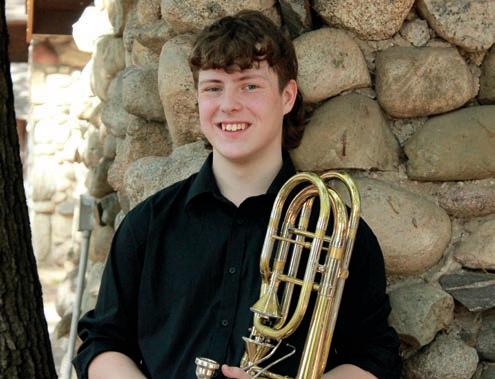
First-year trombone student Devin Spaulding got much more than he bargained for when he applied for NPR’s Jack Kent Cooke Young Artist Award.
Not only did he win the $10,000 grant. He landed an interview on the popular radio show From the Top.
“Things just went from good to better to the very best,” Spaulding said.
Which was more life-changing, the award or the interview, is hard to say. The award financed both a new trombone –Spaulding had been playing a loaner – and his 2025 summer at
Distinguished Alumni Award recipient Kathryn Harsha parlays CIM education into rewarding, multifaceted career
If there were a subtitle to the 2026 Distinguished Alumni Award going to Kathryn Harsha (MM ’99), it would be “The Paying it Forward Prize.”
She’s fused all elements of her CIM education into a rich and wide-ranging career helping others achieve their musical goals.
“It is a profound honor to receive this recognition,” Harsha said. “CIM produces some of the world’s most gifted musicians, and to be counted among them is something I don’t take lightly.”
Harsha’s career in greater Washington, DC is two-fold. She is artistic director of the Alexandria Choral Society and Pro Coro Alexandria and artistic director for programming at Encore Creativity for Older Adults, a choral arts organization for adults over 55.
With the former groups, she performs both large- and chamberscale choral and orchestral works. “It’s a joy to see the choral and orchestral worlds intersect, and to work with such spectacular musicians on new and classic music,” Harsha said.
In her role with Encore, meanwhile, Harsha supports some 60 ensembles, 30 conductors, and 2,500 singers nationwide as they pursue a mission of lifelong learning, wellness, and fun. “Every day, I get to witness the transformative power of music in building community,” she said.
Behind it all lies Harsha’s CIM education. Between many pivotal performance opportunities and hands-on work with faculty across the school, she was both inspired and fully trained for the rewarding career she enjoys now.
“My time at CIM was truly life-changing,” Harsha said. “It shaped who I am as an artist and a human being. It is a joy to return.”
Interlochen. The interview, however, and the work that led up to it, made him a better, more focused artist.
Over the course of six weeks before the interview, Spaulding studied audio production, storytelling, and career management in NPR’s remote Learning and Media Lab Fellowship.
“You learn to become more than a musician,” Spaulding said of the program. “You become a better human.”
Then came the actual interview, and a recorded performance of Brad Edwards’ Driving-Dreaming, both of which he completed at Interlochen.
“That was the most nervous I’ve ever been,” Spaulding said of his conversation with host Peter Dugan. But the experience proved rewarding in more ways than one.
Upon entering CIM, where he now studies with Brian Wendel and Randall Hawes, he found that his success on NPR came in handy in the studio and on stage.
“It gave me the confidence that people want to hear me, that people believe in me,” Spaulding said. “It’s another one of those things that keeps me going.”
Frequent CIM guest conductor Anthony Parnther earns two Grammy Awards
One of the leading figures in film music today is also a regular at CIM.
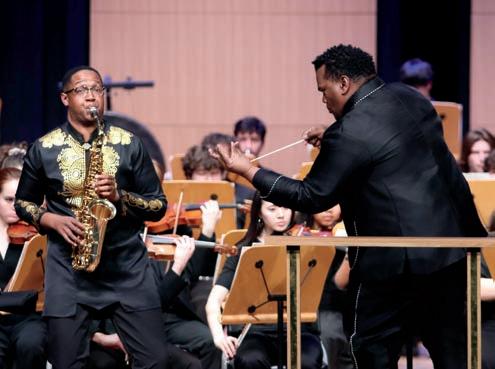
Even as his work earned two 2026 Grammy Awards, conductor Anthony Parnther has maintained a steady presence at CIM, leading both the CIM Orchestra and CIM Opera Theater several times in recent years.
A denizen of major Hollywood recording studios, with credits including numerous blockbuster films and television shows, notably including Black Panther, Parnther also conducted the original score to the hit 2025 film Sinners
On February 1 of this year, that recording won Grammy Awards in two categories: Best Score Soundtrack for Visual Media and Best Compilation Soundtrack for Visual Media. A few days later, the music director of the San Bernardino Symphony Orchestra was back at CIM, leading two CIM Opera Theater performances of Judith Weir’s Blond Eckbert.
The piece, Parnther told The Plain Dealer, marked “a wonderful opportunity to introduce our students and patrons to works they may not know but that will enrich and deepen their understanding of opera.”
Those were not the maestro’s first or last appearances at CIM or in Cleveland, where he is also a frequent guest of The Cleveland Orchestra. Parnther, who made his CIM debut in 2023, also led the CIM Orchestra last September, conducting works by Schumann, Still, and Williams (music from E.T. the ExtraTerrestrial ), and later this February, he returned to perform works by Tate, Childs, and Shostakovich in the new Kulas Hall.
CIM looks forward to many more visits by Parnther in the future.
NOTEWORTHY

Shark Tank investors take the bait from CIM alum Mike Block
Who knew music also has the power to tame sharks?
Earlier this year, star cellist Mike Block (BM ’04, Aaron) and colleagues appeared on Shark Tank, where they successfully convinced the show’s notoriously skeptical stars to invest in their company Forte3D, a manufacturer of high-quality, affordable 3D-printed string instruments. Specifically, they won a $250,000 investment, with a 16-percent stake in Forte3D.
“We were grateful it felt like such a positive portrayal and culminated in a successful deal,” Block said.
It almost never happened. Initially, Block – the company’s Chief Musical Advisor – balked at the notion. He was busy, as ever, and doubted the company’s chances.
But when his friend Alfred Goodrich, the company’s CEO, not only took on the effort but sailed through the selection process, all the way to a filming session in Los Angeles, Block came around.
As a CIM-trained performer accustomed to public speaking, he realized he was uniquely equipped to address the show’s investors and fans. “I just approached the filming like an educational workshop,” he said. “I knew I could play music and talk about cellos in front of anyone.”
Perhaps more importantly, he sensed a once-in-a-lifetime opportunity, one he’s now very glad to have taken. Appearing on Shark Tank was “a chance to place classical music into a national conversation about accessibility, and why music is important,” Block said.
“I felt a responsibility to talk about music and the lifestyle of our whole community to millions of people. Hopefully, they now feel a little more connected to what we do.”
CIM’s new graduate-level saxophone studio comes into its own
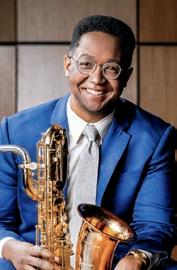
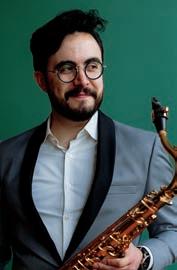
The saxophone department at CIM has reached critical mass following the appointment of two visiting artists to complement the teaching of faculty member Steven Banks
This year, students had access not only to Banks, an indemand performer and renowned composer, but also to lessons, masterclasses, and training in entrepreneurship with visiting artists Valentin Kovalev and Julian Velasco
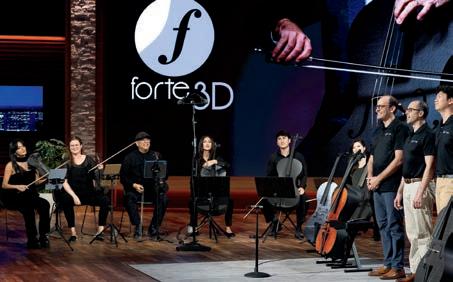
CIM cellist Mike Block, third from right, pitches Forte3D to a group of investors on the television show Shark Tank.
From left: Steven Banks, Valentin Kovalev, and Julian Velasco
“It’s been a dream of mine for many years to start a saxophone studio at CIM,” said Banks, at the time of his appointment.
Banks first joined CIM on the visiting faculty, in fall 2022. He then joined the faculty full-time in 2024, when he also opened the school’s first graduate-level saxophone studio.
Today, with Banks, a regular with major orchestras nationwide, a select group of top-tier students is pursuing either a Graduate Diploma or Master of Music degree. In addition to private lessons, all students enjoy abundant chamber and contemporary music opportunities as well as large ensemble experience.
But the visiting artists bring even more to the table. Kovalev is a multiple award-winning saxophonist with performance
and educational experience all over the world. Velasco, meanwhile, is the founder of the Nois Quartet and a soloist renowned for performing new music and improvising.
Scott Harrison, CIM’s Executive Vice President & Provost, praised the newly enhanced saxophone department, predicting the trio will have a significant impact on the saxophone world.
“They now get to build on an outstanding foundation and deepen their impact on our students and the musical landscape,” he said.
Modern Snare Drum Competition boosts individuals and art form at CIM
Summer at CIM starts not with a bang but a drumroll – many drumrolls.
Just before CIM’s Summer Institute gets underway, the season kicks off June 6 with the Modern Snare Drum Competition, a prestigious annual event led by percussion faculty and Cleveland Orchestra colleagues Marc Damoulakis and Thomas Sherwood.
“It’s kind of a unique thing,” said Damoulakis. “For us, it’s about furthering the art form and leaving a legacy.”
The opening round, which attracts up to 50 players under 26 from all over the country, takes place online. The second and third rounds unfold over one day at CIM, as the jury narrows a pool of roughly 15 to five or six and eventually three. Winners earn cash prizes and products from sponsors.
Success at Modern Snare Drum is “definitely a big feather in a student’s cap,” Damoulakis said. “If they do well, it gives them a boost and says they’re onto something.”
The contest does more than help individuals, however. It also boosts the field overall, producing talented, well-rounded winners and a vital stream of new music, through a tradition of commissioning new pieces for the contest. This year’s composer is Duncan Patton, former principal timpanist of the Metropolitan Opera Orchestra.
“We’re definitely expanding the repertoire,” Damoulakis said. “It’s been great involving people who don’t write only for snare drum.”
The greatest thing, though, per Damoulakis, is the intergenerational exchange, as winners return as judges and mentors. “What people will do in the name of helping students grow, it’s incredible,” he said.
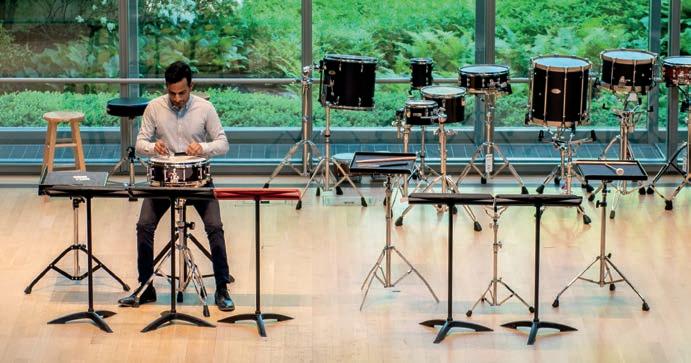
A student percussionist takes part in a recent edition of the Modern Snare Drum Competition in Mixon Hall at CIM.
NOTEWORTHY
New
CIM Summer Institute gearing up for dynamic June, July, and August
Summer 2026 is shaping up to be uncommonly busy at CIM.
Through its new CIM Summer Institute, the school is hosting more students than ever in a wider-than-ever range of fields.
“The new CIM Summer Institute is the clearest sign yet of how successful our summer programs are,” said Scott Harrison, CIM’s Executive Vice President & Provost.
June 13-21, faculty members Jennifer Arnold (viola) and Daniel Pereira (cello) will lead the Chamber Music Institute (CMI@CIM), a well-rounded intensive for string players ages 12 to 24. That same week, faculty members Todd Phillips (violin) and Si-Yan Darren Li (cello) will run the Advanced String Quartet Program, which includes coaching, masterclasses, and playing in a conductor-less orchestra.
Faculty pianist Gerardo Teissonnière will run a Young Artist Piano Seminar, July 5-11, an expansive week of lessons, eurhythmics, and a concerto competition. Young brass players will also be on campus that week, for the CIM Summer Brass Lab, led by faculty trombonist John Sebastian Vera
The youngest visitors will arrive August 3 for the Academy Day Camp, a unique, music-focused program for students entering grades two through six.
More information and registration materials are available at cim.edu/prep/summer.
The gift of renewal: With Renovare, CIM alum Rebecca Shasberger offers music where it’s needed most
Second chances are second nature to musicians. The art’s very existence hinges on the ability to try and try again.
Therein lies the profound beauty of Renovare Music, a Cleveland nonprofit founded by Rebecca Shasberger (MM ’17, Robinson), CIM’s 2026 Alumni Achievement Award recipient. With their words, music, and presence, Shasberger and her Renovare colleagues are giving a whole lot of people second chances, and a whole lot of hope.
“Our approach isn’t ‘You need us. We’re the saviors,’” Shasberger said. “It’s that we all need each other, that we’re all better and stronger and whole people when we know our neighbors and their stories.”
In itself, the work Renovare does isn’t unique. Shasberger and friends aren’t the first and won’t be the last musicians inspired by their Christian faith to teach in prisons, perform for the marginalized, or use songwriting to help process trauma.
What’s special about Renovare is that they do all three simultaneously, at a high level. They’re also unparalleled in that they’re consistent, committed to people and places. Much of the time, where they work, everybody knows their name.
“Everybody can see the value of it,” said violin faculty Stephen Tavani (AD ’18, Preucil), assistant concertmaster of The Cleveland Orchestra and an occasional volunteer with Renovare. “Then, once you experience it, you see ‘Wow, this is really special.’ The whole thing is just so lifegiving, for them and for us.”
A recent visit by Renovare to the Northeast Reintegration Center, a minimum-security prison for women in Cleveland, supported Tavani’s observation. In their regular two-hour session with a large group of incarcerated women, Renovare did more good than many people do in days. And that was just one location. The group also maintains a steady presence at a men’s correctional facility in Grafton, Ohio.
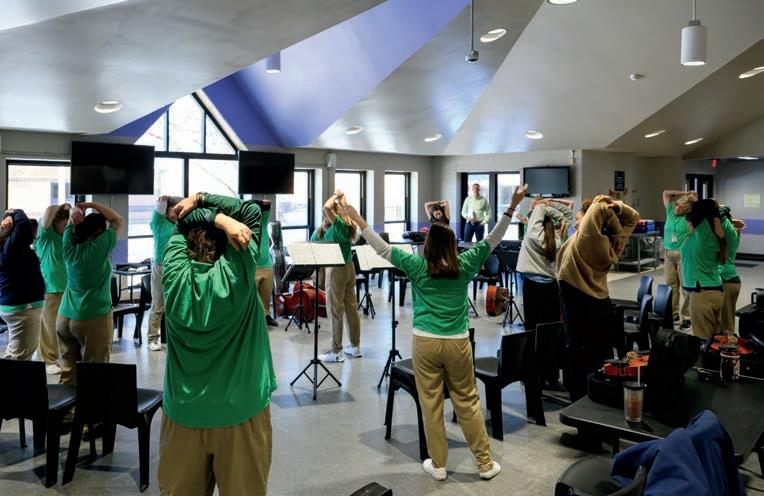
Sitting in a circle that included three from Renovare, some 16 women in matching green shirts kicked off the morning with stretches and an ice-breaking name game. The class then picked their instruments – on loan to the facility – and split into beginner and more advanced divisions.
Violinist Lalia Curtis (née Mangione) and violist Clara Prinston worked with the beginners. With unfailingly positive attitudes, they led the equivalent of a Suzuki group class, complete with “Mississippi Hot Dog” and rhythm,
fingering, and articulation exercises. When one player’s instrument broke, Curtis warmly took the student under her wing and pledged to see it fixed.
Shasberger, meanwhile, worked with a small group of violists and cellists. She polished their tone with scales and led a serious rehearsal of Beethoven’s Ode to Joy. At one point, to make a point about tempo, she asked her pupils to set down their instruments and sing the music instead. In effect, it was a chamber music coaching session, with fences and security guards.
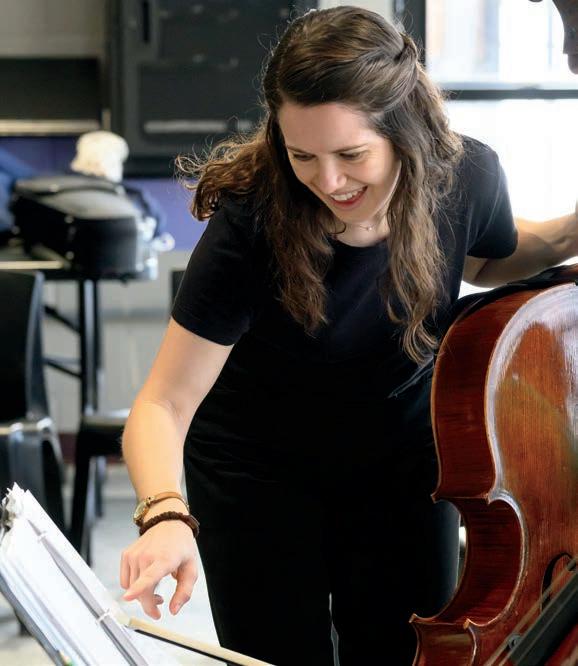
Cellist Rebecca Shasberger, CIM’s 2026 Alumni Achievement Award recipient, works with a resident at the Northeast Reintegration Center.
“This could easily be a dirge, but it’s supposed to be joyful,” Shasberger said. “By singing, we have a better sense of direction. If we’re singing too slowly, we can’t get through it without taking an extra breath.”
The impact of this work is probably hard to overstate. Not only does it bring the women obvious joy and culminate in a concert called “Music for the Soul.” It also may contribute to their timely release and ability to stay out. Shasberger couldn’t prove that music reduces recidivism, but the fact that students often come to her for lessons after their release speaks volumes, she said.
Teaching isn’t all Renovare does for the incarcerated, either. Frequently, Shasberger and friends also visit prisons as performers, to present formal concerts. Neither are the incarcerated the only people Renovare work with. In fact, they use music to lift up several vulnerable populations.
Concerts in homeless shelters, hospitals, and overlooked neighborhoods in and around Greater Cleveland “embody love in a really cool way,” Tavani said. “It shows how much this music we love is for everyone. It’s not just for rich people.”
One of Renovare’s most innovative and important efforts entails project-based
songwriting. Specifically, the group settles on a neighborhood or demographic in need and then coordinates with local leaders to identify and coach individuals through the process of writing, performing, and possibly even recording songs. Recent projects have centered on refugees and immigrants and Black infant and maternal health.
Participants get the ball rolling by writing, channeling their emotions and struggles into what will become the lyrics of their song. Then Renovare steps in, working with the budding artists to plumb their words for meter, rhythm, and melody. Typically, Shasberger said, it’s a process of trial and error, but also one that’s therapeutic, worthwhile irrespective of the final product.
“Sometimes a song just comes out, but sometimes it’s like pulling teeth,” she said. “We just try different things until they’re happy and it sounds like them. It’s not perfect, but it works surprisingly well. There’s something kind of disarming about it… You’re suddenly being drawn into this person’s story through their song.”
In a way, Shasberger was born to found Renovare. As a child – she took up cello at age 5 – there was no question she was going to at least play an instrument, if not make it her career. Meanwhile, she said, her discovery that her namesake
was a famous missionary set her on a path of “finding ways to live out my faith convictions… Those seeds were planted then.”
Two pivotal moments during her education clarified her vision. In high school, she was “blown away” by how eagerly listeners at a homeless shelter received the music of Bach. Later, as a student at Westmont College, she was stirred by the emotions her performances elicited in Eastern Europe, where music was tightly controlled.
“I realized how little I knew, that I just had a lot of preconceived ideas,” Shasberger said. “I’d lost sight of the power music has to move and impact people.”
CIM was where Shasberger truly began to envision what is now Renovare. Struck by the disparity between University Circle and some areas around it, and between places like Aspen and Ojai and her own neighborhood, she recalled a sense of dissonance, of feeling “torn…between music and people having no home or food.”
Research on Cleveland’s marginal communities and her CIM training in chamber music combined to generate interest in an ensemble with a shared vision and the realization that while she was a “reluctant entrepreneur,” she saw
Musician residents at the Northeast Reintegration Center warm up for a class with Renovare Music, founded by Rebecca Shasberger.
no alternative but to be “a different kind of musician, a bridge between spaces.”
The rest, while not quite history, was a series of practical matters: making connections, gaining experience, learning management skills, and raising funds. By 2018, Shasberger had a group of incarcerated men making music. One year later, she had a nonprofit, and shortly thereafter, Curtis came on board, along with several volunteers, including CIM alums.
The pandemic slowed their progress but never halted it, and by 2023, Shasberger was ready to hire her first non-musician, managing director Julie Davis. Next came Prinston, and then an administrative assistant. Now, “We’re figuring out what it looks like to be the most effective fiveperson team we can be,” Shasberger said.
Notice of Shasberger’s Alumni Achievement Award – which came “out of the blue,” she said – has only added fuel to
the flames. While Renovare enjoys robust support and its programs generate nothing but positive feedback, the organization itself has operated largely under the radar.
That may not hold true much longer. As an Alumni Achievement Award recipient, Shasberger – and thus Renovare – have
joined a long and high-profile list of what Shasberger called “remarkable people doing a lot of beautiful work.”
“I’m grateful that Renovare’s work is something that CIM finds meaningful,” she said. “I never take it for granted when people see the value in what we do.”
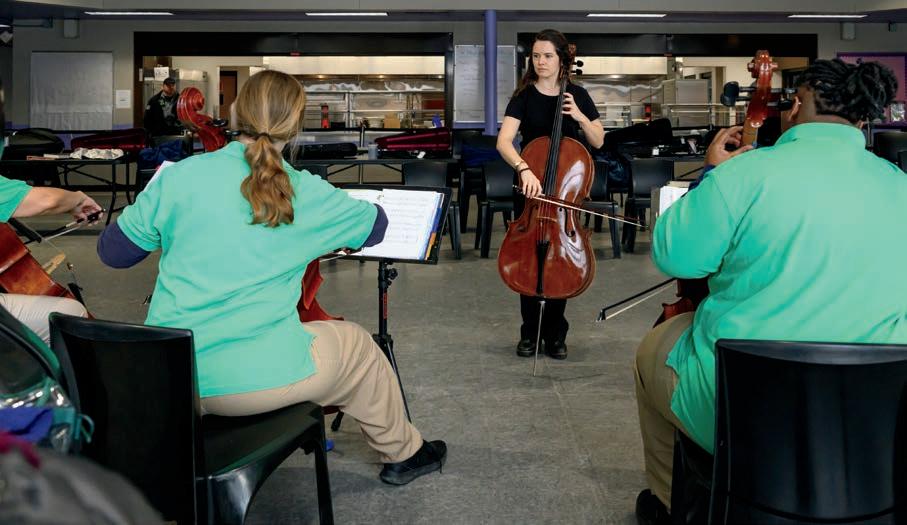
Shasberger, center, leads a class at the Northeast Reintegration Center.
A resident at the Northeast Reintegration Center in Cleveland plays the cello with Renovare.
FEATURE



A commission like no other: CIM students write music for heartwarming Sing Me a Story project
Only a little money changed hands, but for their recent work, CIM students Owen Axelberd and Andrew Schneider were nonetheless richly rewarded.
As volunteers with a nonprofit called Sing Me a Story, the young composers applied their talents in whole new ways, transforming colorful stories by chronically ill children into fanciful pieces of music. Both found the experience lifechanging, challenging in the best possible way.
“It was sort of a win-win,” said Axelberd, a second-year student of composition faculty Keith Fitch. “It was really amazing to have the opportunity to compose as a service to a family. To learn and magnify another voice I thought was really cool.”
For instrumentalists and vocalists, charitable work is fairly straightforward. All they have to do is play or sing.
For composers, though, it’s a bit more complicated. They can’t give back to their communities without lining up other musicians to perform what they write.
Enter Sing Me a Story, a Tennessee nonprofit that matches needy children, many of them terminally ill, with composers and performers. The composers turn stories penned by the children into short pieces of music. These, then, are performed live for the children and their families in either public or private settings. The organization’s website includes links to hundreds of performances of such pieces.
“It took me a while to get writing, but it was nice to be pushed this way,” said Schneider, whose match was a little boy named Sam with Ewing sarcoma, a rare and aggressive form of cancer. “I kept reminding myself that this piece wasn’t for me but for him.”
Schneider, a first-year CIM student, enjoyed his Sing Me a Story assignment on several accounts. Not only was he amused by Sam’s story, in which a family’s trip to London is disrupted by their escaped pets. He was also delighted to compose for a mixed choir like the one he’d joined in high school, and to get his feet wet working with a narrator.
“This pushed me in several different directions,” Schneider said. “It was the kind of thing I’d been looking to do for a while.”
Axelberd’s assignment, meanwhile, was a match made in heaven. Where many would have been daunted by the task of writing a four-minute piece for high school band about a playground train that springs to life and whisks a family off to Walt Disney World, he felt nothing but delight, as he himself is a longtime fan of Disney.
Being paired with Peter, a 10-year-old living with a neurodegenerative condition called Batten Disease – all to write a piece set in Disney World – was simply “a magical connection,” Axelberd said.
More than most composers, Axelberd said he knew how to evoke “that great music Disney has produced over the years.” He was inspired, not put off, when Peter, the tale’s author and central figure, rides a rollercoaster, tours Epcot, goes on safari, boards a ship captained by Mickey Mouse, and visits a Disney gift shop in search of a magnet to fix the train.
“I know what all those places sound like,” Axelberd said. “For me, there was something really charming and nostalgic about the whole thing. There was an overwhelming sense of childhood wonder.”
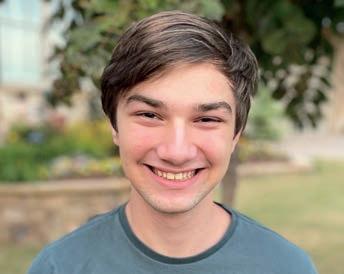
Owen Axelberd

Sam’s story was pretty fantastical, too. In his tale, a family’s pets escape from their cages and enjoy a wild day in London, before being recaptured. This inspires the family to launch what proves to be an extremely lucrative pet travel company.
Schneider, who’d only written one piece for choir before this, and never before worked with a narrator, said he took a lighthearted approach to Sam’s creation. He said he felt free to engage in “cartoonish” musical antics like having the choir proclaim “No pets allowed!” and whisper what would be the animal’s stage directions: “sneaking around the palace.” He also reached out to the choir’s director to gain a better understanding of the group’s abilities and who could handle a solo.
In contrast to his work for school or other commissions, “I didn’t feel like I had to be prepared to defend every single note,” Schneider said, adding that while he felt a responsibility to do a good job, “I didn’t have to take myself too seriously for this.”
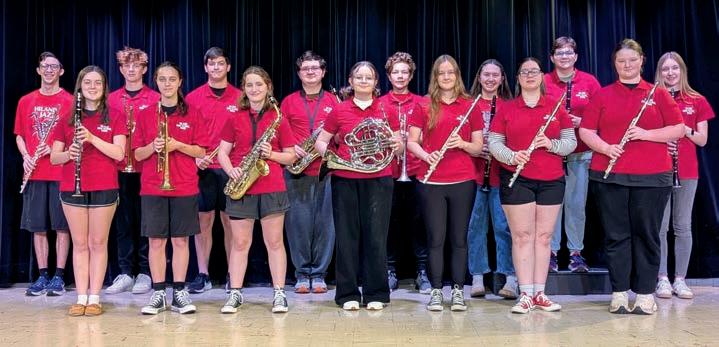
Axelberd, too, worked closely with his band’s director. He said he expanded the vision of the piece after he learned the Central Ohio group included a jazz drum set, full percussion section, and saxophone. He also found he could write virtuoso parts for certain players, at the director’s instruction.
“It wasn’t just a dedication,” Axelberd said. “It was a collaboration.”
For Sam, Peter, and their families, the significance of a custom piece of music based on their own writing will likely be greater than anyone can say. Schneider guessed that if he were in Sam’s place, the opportunity to “give a piece of myself” to a composer would be “earth-shattering.”
The impact on Schneider and Axelberd has been profound as well. For them, writing for Sing Me a Story was both eyeopening and transformational, a welcome opportunity to ply their craft in real-world conditions, in a way they never would have otherwise.
One of the most realistic aspects of Sing Me a Story was the deadline. Like most working professionals, Schneider and Axelberd had nowhere near as much time as they might have liked. All told, they had about two months between the day they got their stories and the day their music was due.
Both also cited the educational value of writing for specific groups, for specific purposes. These weren’t class assignments or competition pieces, penned in the abstract, in hopes of a performance someday. These were works conceived for and with real people.
The best part, though, was using their skills to help others, to make the world a better place. As composers, that’s not something they get to do every day.
“Seldom do we get to use music in this way,” Axelberd said. “Most of the time, composition ends up being self-focused. This was a project unlike anything I’d ever done before. This was a really great opportunity to grow as a composer.”
Andrew Schneider
The Hiland High School band will perform Owen Axelberd’s Sing Me a Story piece about a magical train trip to Disney World. SPRING
Guitarist Damian Goggans forges groundbreaking path beyond CIM’s Musical Pathway Fellowship
On a Halloween not long ago, Damian Goggans picked up a guitar for the first time, while in middle school.
Little could he have imagined the impact that moment would have, that 10 years later, after training at CIM as one of the first Musical Pathway Fellowship students, he’d be a multi-talented performer, composer, and scholar changing the face of music with one groundbreaking project after another.
“All the things I wanted to do, they all seem possible now,” said Goggans, a graduate student at Oklahoma City University. “A year ago, I was just going to school. Now it’s all happening at the same time. I’ll take it.”
Goggans isn’t just a success story, another example of a thriving former CIM student. He’s a success story many times over. At nearly every step in his musical life, Goggans has defied the odds and exceeded even the highest expectations.
At the moment, he’s truly hitting his stride. He’s got commissions from Karamu House in Cleveland, an arts magnet school in Alabama, and producer Ron Schmidt, who’s planning a film about the first integrated youth baseball league.

Meanwhile, his performance calendar is filling up and his mission to preserve the music of Black classical guitarists is ongoing. He’s also still promoting his video project from last year, a YouTube series featuring Goggans playing, singing, and explaining a set of etudes by Thomas Flippin, based on African American Spirituals.
“There’s absolutely nothing like it in the repertoire, not even close,” said Academy guitar faculty Erik Mann (MM ’02, Holmquist/Vieaux), one of Goggans’ former teachers and a longtime friend. “The guitar world has nothing like this. It’s mindblowing. He’s basically a quadruple threat.”

That Goggans is now a “threat” is something of poetic justice, a turning of the tables, as he himself has encountered innumerable actual threats, any one of which easily could have derailed him.
Financial stress, mental illness, death, homelessness: Over the years, Goggans and his family faced it all. As a child, he bounced between living with his mother and grandmother, both of whom struggled to pay the bills. Sometimes, he lived in a shelter. He also had an aunt with bipolar
disorder, and his newborn brother died in the early days of the pandemic.
Goggans, though, was not to be deterred. As if to remind the world that for every action, there’s an equal but opposite reaction, he kept pushing ahead as vigorously as he was pushed down, with his instrument as his source of strength.
“Guitar has been the main thing that’s kept me going,” Goggans said. “There’s been a lot, because of everything happening in my family. But guitar has given me something to do, instead of what I might have been
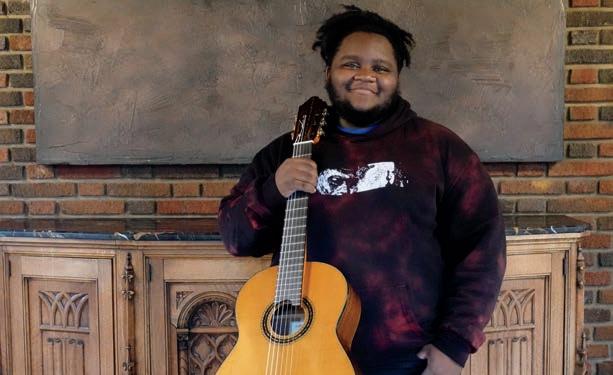
Guitarist and Musical Pathway Fellowship graduate Damian Goggans is making a name for himself as a performer, scholar, and composer.
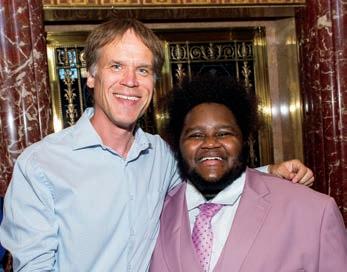
Goggans, right, poses with CIM faculty Erik Mann at Severance Music Center.
doing. The chance to take up something I was genuinely interested in was great.”
Brian Gaudino, the former director of education at the Cleveland Classical Guitar Society, which Mann leads, recalled how it all began. He said he’ll never forget the first day of the after-school program he taught at Goggans’ middle school, when a precocious young man stayed late to point out (correctly, it turned out) that the piece they’d just learned was based on the same rhythm as John Legend’s All of Me
From then on, Gaudino said, Goggans continued staying late after class, asking for help with music he was printing out at the library and learning independently. “We worked at an accelerated pace, and he kept up with no problem,” Gaudino said.
While it was Gaudino who discovered Goggans, in 2016, it was CIM that provided the catalyst to his transformation. One year after that first encounter with guitar, Goggans came to CIM as one of two students in the inaugural Musical Pathway Fellowship, a then-new scholarship program for young Black and Latinx students.
There, in Mann’s Academy studio, where he remained through high school, Goggans flourished, augmenting his training with devout independent study and participation in summer camps. Before long, the budding guitarist found himself on stage with the Guitar Society and receiving scholarship offers from prestigious universities. In the end, he enrolled at Oberlin Conservatory.
“Without CIM, I definitely wouldn’t have gotten this far,” Goggans said. “It was so important to where I am now. Because I got to go to CIM, I was able to see that this life was even possible.”
But it wasn’t just training and support that Goggans received at CIM. He also gained the sense of purpose that still informs most of his current work and research.
Early in his studies, Goggans asked Mann a simple but profound question, one that would change the course of his life: Are (or were) there other Black classical guitarists, and do (or did) any of them write music?
Goggans doesn’t recall the answer. Whatever it was, though, he wasn’t satisfied. Deep down, he was certain there were more than the handful of names Mann likely had at the ready.
How right he was wouldn’t become clear until later, when Goggans embarked on what may be a lifelong mission to catalog, perform, record, and promote the music of Black classical guitarists and arrangers throughout history. Flippin is just one in a collection that now consists of 61 names.
“And those are just the ones I could find so far,” Goggans said, noting the guitar’s deep African roots. “There are probably many more we’ll never know about. When most people think of classical guitar, they haven’t had any reason to wonder how Black people fit into the conversation.”
For Goggans, the mission is more than academic. It’s personal. Discovering, playing, and especially singing the music of his Black predecessors is a strangely powerful experience, Goggans said.
“It’s almost as if I’m speaking for my ancestors, like they’re speaking through me,” he explained. “I’m connecting to the history I’m trying to uncover.”
In the meantime, Goggans is also reconnecting to his Cleveland roots. Even as he completes his master’s degree in Oklahoma, he’s on staff at the Guitar Society, as a teaching assistant.
That means some day, he may be the one discovering the next up-and-comer, the one who puts a guitar in the hands of a naturally talented youngster who then proceeds to follow in his footsteps.
“I couldn’t be more proud of him,” Mann said. “It’s kind of unreal. It’s amazing to me that all this is happening.”
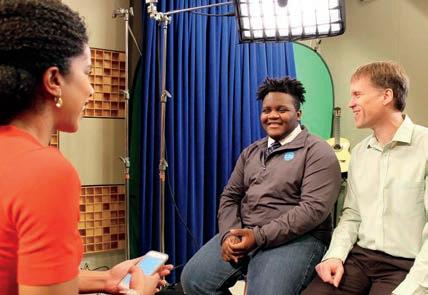
A young Goggans and Mann take part in a television interview when Goggans was a student at CIM.
Goggans poses with the instrument that changed his life, which he picked up for the first time in middle school.
ALUMNI SPOTLIGHT
CIM was where Chicago Symphony violist Paolo Dara found his focus
When Paolo Dara (BM ’19, GD ’24, Laredo/Rose/Sloman) enrolled at CIM, his vision of his future was hazy at best. Not only was he torn between orchestral and chamber music, he hadn’t yet settled on his primary instrument.
All he knew was that he loved both violin and viola, and that he wanted to settle somewhere in the Midwest, near his hometown of Grand Rapids, Michigan.
Luckily for Dara, he also felt at home at CIM. There, with devoted teachers, he was able to fully explore his options and ultimately to pursue a path that led earlier this year to an appointment in the viola section of the Chicago Symphony Orchestra.
“Sometimes, on stage, I have to ask myself, ‘Am I really in the CSO?,’” Dara said. “It’s unreal. But I’m grateful how it worked out.”
Chicago, as it turns out, was one of Dara’s two dream orchestras. The other was Cleveland. Once he’d settled on an orchestral career, he decided it had to be one or the other.
In part, that’s because, as a student at CIM, Dara attended Cleveland Orchestra concerts almost every week. For him, CIM’s student tickets were more than just a perk. They were life-changing, an experience that provided direction and inspiration.
Even before he’d set his sights on orchestral music, “In the back of my mind, I thought I’d love to be in a high-level orchestra someday,” Dara recalled. “The Cleveland Orchestra definitely influenced me to want to be in something like that down the line.”
There were other claims on Dara’s musical affections, of course, the strongest of which was chamber music. Throughout his long CIM career, Dara was a regular
participant in CIM’s Advanced String Quartet program. It was in that program, in fact, that Dara said he grew up, that he truly began to feel like an artist and to believe in himself.
Indeed, so firmly did Dara believe in himself that he often tested the program’s flexibility, as he was able to perform on both violin and viola. His Graduate Diploma recital included separate works by Brahms on different instruments. Even now, as a member of the Chicago Symphony, Dara and his friends continue to lead a chamber music collective in Grand Rapids called the Plymouth Chamber Players.
Dara was “very passionate about chamber music,” said cellist Si-Yan Darren Li, CIM’s director of chamber music programs and ensembles. “Paolo is not only gifted but also diligent, focused, committed, and persistent –important qualities that all students must possess to be successful.”
Many of these traits Dara said he likely picked up from his parents, who owned a restaurant in Grand Rapids. “They worked really hard, long hours,” he said. “Seeing their drive always inspired me.”
Dara’s drive – at least initially – was for the violin, and violin only. He played that instrument exclusively all the way through his teenage years and up to a summer at the Meadowmount School of Music.
There, everything changed. A shortage of viola players at the school prompted Dara to volunteer. That, in turn, led him to take up the instrument more seriously, even as the violin remained his first love. CIM then appeared on Dara’s horizon through his teacher, the late violinist and former CIM faculty member Jan Sloman, who encouraged him to apply.
The idea turned out to be incredibly prescient. At CIM, in addition to Sloman, Dara found a second mentor in former violin faculty member Jaime Laredo, whose offer to train him and even let him perform on his viola sealed his interest in that instrument. He also found an environment that suited his needs and personality.
“Compared to other schools, I felt very comfortable at CIM,” Dara said. “Everyone was so caring and approachable. I felt like I could breathe there.”
For all those reasons, Dara then returned to CIM after completing a master’s degree at the Shepherd School of Music at Rice University. This time, though, he wasn’t alone. He came to CIM in the company of
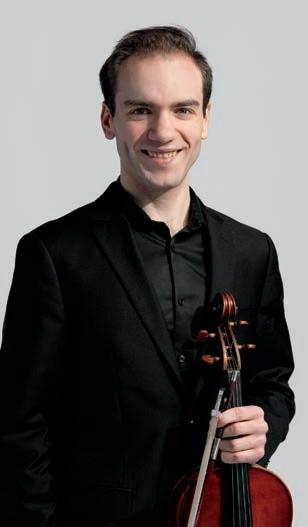
CIM alum Paolo Dara recently joined the viola section of the Chicago Symphony Orchestra.


violinist Karisa Chiu (MM ’24, Laredo/ Lowe), who is now his wife.
Like Dara, Chiu had just completed a graduate degree when they met at the Aspen Music Festival. She, too, was in search of post-secondary training. And so, they both enrolled (or re-enrolled) at CIM, making it their first musical home.
“It lined up perfectly for both of us to go to CIM together,” Dara said. “CIM was also the perfect place for Karisa at the time. It was a very special time for us.”
For Dara, part of what made that time special was also his studies with a third instructor, former faculty member Stephen Rose, principal second violin of The Cleveland Orchestra. By then, a future in orchestral music was beginning to come into focus, and Rose was the one to help make his dream come true.
At the same time, Dara was also beginning to conclude that his
orchestral future was probably in viola. He said he realized the instrument’s middle range was “where I feel at home…where my voice is. I think I find my very best self on viola.”
Performances with the CIM Orchestra at Severance Music Center sealed the deal. Playing in a hallowed space with illustrious conductors reawakened his desire to make a career out of doing just that.
“I wanted to play my best,” Dara recalled. “I still remember that feeling. Whenever we had a Severance concert, I tried very hard. It was always a really great experience.”
After that, Dara’s orchestral career took off – rapidly.
Dara’s first significant post was as principal second violin of the Akron Symphony Orchestra. Next came a job in his hometown, as principal viola of
the Grand Rapids Symphony. Then, in 2024, he jumped south to the Atlanta Symphony Orchestra, where he again took up the violin.
He’s now been in Chicago since January, when he joined the group’s viola section. The initial shock he felt playing in such an esteemed ensemble is slowly wearing off, he said, transforming into a deep gratitude for the way his dream has come true. Each week is feeling more comfortable, he said.
Meanwhile, on one point, he’s absolutely clear: Each of his degrees from CIM played a pivotal role in his current success.
“CIM was the perfect environment for me to get into the right place mentally,” Dara said. “There’s no way I would have gotten this job if I hadn’t studied at CIM.”
ALUMNI NEWS
Have some news? Visit cim.edu/alumni and click the Share Your News button. News is accepted on an ongoing basis and may be held for a later issue.
ALUMNI
Arianna Brusubardis Grace (202223, I. Kaler/O. Kaler) joined the second violin section of the Boston Symphony Orchestra.
Jacob Buhler (MM ’22, Lee/Setzer) was named associate principal second violin of the Auckland Philharmonia.
Brenton Caldwell (BM ’04, Irvine/ Ramsey) was appointed instructor of viola at West Texas A&M University and a member of the Harrington String Quartet.
Austin Cruz (MM ’22, Sachs) was appointed part-time lecturer at Eastern Michigan University.
Paolo Dara (BM ’19, GD ’24, Laredo/ Rose/Sloman) joined the viola section of the Chicago Symphony Orchestra.
LIFETIME GIVING
Thank you to the many supporters past and present who have made a CIM education possible for generations and continue to shape the future of classical music. Below is a list of some of the most generous donors, whose lifetime giving to CIM has exceeded $250,000 (as of March 20, 2026).
Keelin Davis (BM ’11, Updegraff) has been appointed associate dean and executive director of the Pre-College and Continuing Education departments at the San Francisco Conservatory of Music.
Joshua Elmore (YAP, DeMio/Stees) joined the faculty at the San Francisco Conservatory of Music.
Yu-Ming (Andrew) Ma (BM ’19, Cho/ Laredo/Sloman/Zenaty) joined the second violin section of the Detroit Symphony Orchestra.
Bill Kalinkos (MM ’05, Cohen) received a 2026 Grammy Award as a member of Alarm Will Sound, for the group’s album Land of Winter
Theodore Kuchar (MM ’82, Vernon) was named a 2025 Musical America Top Professional of the Year.
James Leonard (BM ’22, Damoulakis/ Yancich) was named principal percussion of the Greenville Symphony.
Connor Monday (BM ’18, Solis) was appointed acting fourth horn of the Columbus (OH) Symphony.
$10,000,000+
Cuyahoga Arts & Culture
The Fred A. Lennon Charitable Trust
$5,000,000–$9,999,999
Kulas Foundation
Barbara & Mal* (HDMA ’15) Mixon
Kevin & Kristen Stein and Family
$2,500,000–$4,999,999
Gay C. & Edward Addicott*
Mr. & Mrs. F. J. Callahan*
Ellen H. Hauck*
Elizabeth D. Hicks*
Barbara S. Robinson* (HDMA ’06)
State of Ohio
One who wishes to remain anonymous
Gabriel Napoli (MM ’19, Jackobs/ Vernon) joined the viola section of The Cleveland Orchestra.
Rachel O’Brien (BM ’16, MM ’17, Kondonassis) joined the faculty at Virginia Tech School of Performing Arts.
Scott Price (MM ’91, Hecht) was named the 2026 Teacher of the Year by the Music Teachers National Association. He is the Carolina Distinguished Professor of Music at the University of South Carolina.
Sam Rosenthal (YAP ’18, Irvine) was named a semi-finalist in the 2025 Young Concert Artists’ Susan Wadsworth International Auditions.
Catherine Schroth (BM ’06, MM ’07, Wells) founded Avon Early Strings Academy, an after-school music program in conjunction with Avon (OH) City Schools.
Muen Vanessa Wei (MM ’12, D. Shapiro) was nominated for an International Classical Music Award for her recording of works by Jean Louis Nicode on Toccata Classics.
$1,000,000–$2,499,999
Hope S. & Stanley I. Adelstein*
Mr. & Mrs. A. Chace Anderson
Vitya Vronsky Babin Foundation
Eleanor H. Biggs*
Robert R. and Gay C. Cull
Family Foundation
The Cleveland Foundation
Mr. & Mrs. John D. Gilliam
Clive & Mary Hamlin*
Linda Harper & Jim Martin*
Jean & Dick Hipple
Mort* & Emilie Kadish
The Kresge Foundation
Mr. & Mrs. Alexander McAfee*
John P. Murphy Foundation
Ohio Arts Council
Partners for CIM
The Payne Fund
Dick (HDMA ’06) & Pat* Pogue
Mrs. Alfred M. Rankin*
The Reinberger Foundation
Susan Rothmann, Philip Paul & Jeremy Paul
Edith H. Smith*
Dorothy Richard Starling Foundation
Mr. & Mrs. Joseph H. Thomas United States Department of Education
One who wishes to remain anonymous
$500,000–$999,999
Ms. Ruth Beckelman*
Mr. & Mrs.* Eugene J. Beer
Helen C. Brown*
Ann C. & Hugh Calkins*
M.E & F.J. Callahan Foundation
Irad (BM ’87, MM ’88) & Rebecca (BM ’87, MM ’89) Carmi
Mr. Arthur L. Charni*
Charlie & Grosvie Cooley
Rebecca & George* Dunn
Larry B. Faigin*
The GAR Foundation
Mr. & Mrs. Carl D. Glickman*
Margaret R. Griffiths Trust
The George Gund Foundation
Tom & Iris Harvie
Hunter Wirt (MM ’25, Damoulakis/ Yancich) was appointed second percussion in the Canton Symphony Orchestra.
Molly Wise (BM ’19, Irvine/Ramsey) was appointed visiting assistant professor of viola at The University of Iowa School of Music.
Yumiko Yumiba (AD ’24, I. Kaler) won first prize at the 2nd Annual Franco Gulli International Violin Competition.
STUDENTS
Owen Axelberd (composition, Fitch) won first prize in the Ohio Federation of Music Clubs Collegiate Composers Contest.
Carolyn Hoff (organ, Wilson) has been appointed full-time Organ Scholar at the Cathedral of St. Philip in Atlanta, beginning July 2026.
Soomin Kim (composition, Fitch) was awarded a 2026 Charles Ives Scholarship from the American Academy of Arts and Letters.
Elijah Leonard (trumpet, Miller) joined the Detroit Opera Orchestra as second trumpet and won first place in the brass division of Tuesday Musical’s 2026 Annual Scholarship Competition.
The Martha Holden Jennings Foundation
Mr.* & Mrs. Daryl A. Kearns
KeyBank
Dr. Vilma L. Kohn*
Mr. Richard A. Manuel*
National Endowment for the Arts
NewBrook Partners
C.K. “Pat” Patrick* & Nancy Patrick
Jane Kottler Post*
Audrey & Albert B. Ratner
Gail & Elliott Schlang
Mrs. Bert E. Siegel*
The Kelvin and Eleanor Smith Foundation
Mrs. Georgeanna Beaver
Whistler (BM ’49, MM ’51)
Three who wish to remain anonymous
$250,000–$499,999
Paul M. Angell Family Foundation
John and Elizabeth Aten
Mrs. Marguerite A. Barany*
Dylan Masariego (flute, Fink) won second place in the woodwinds division of Tuesday Musical’s 2026 Annual Scholarship Competition.
Jake McQuaid (flute, Sindell) won third place in the woodwinds division of Tuesday Musical’s 2026 Annual Scholarship Competition.
Devin Spaulding (trombone, Hawes/ Wendel) appeared on NPR’s From the Top.
Fiona Tsang (cello, Weiss) won first place in the strings division of Tuesday Musical’s 2026 Annual Scholarship Competition.
Alisdair Welty (organ, Wilson) won second place in the organ division of Tuesday Musical’s 2026 Annual Scholarship Competition.
Yi Ching Ariel Wong (voice, Schiller) won third place in the voice division of Tuesday Musical’s 2026 Annual Scholarship Competition.
ACADEMY
Nicholas Garrett (clarinet, Golovin) won the Euclid Symphony Orchestra’s 202526 Young Artist Competition.
Mr.* & Mrs. Alfred J. Buescher
Delores Comey*
Robert Conrad (HDMA ’98)
Virginia Deupree Crumb (BM ’77) and Carl & Jeanne Crumb
Dr. Mark H. Curley
Mr. & Mrs. John D. Drinko*
Rose Fabian Family Fund
Alice S. Feiman* (BM ’32, MM ’36)
William O. & Gertrude Lewis Frohring Foundation
The Ann and Gordon Getty Foundation
The Dorothea Wright Hamilton Fund
Mrs. Beverly S. Harris*
The Hershey Foundation
The Albert M. Higley Co.
The Higley Fund
George M. and Pamela S. Humphrey Fund
Hyster-Yale Materials Handling, Inc.
Carter Kissell*
FACULTY
Jason Vieaux (guitar, BM ’95, Holmquist) won the 2025 Mid-Career Artist Prize from the Cleveland Arts Prize.
Keith Fitch (composition) was a featured composer at the 46th annual New Music Festival at Bowling Green State University.
IN MEMORIAM
Erik Arnesen (BM ’78) died November 22, 2025 in New York City. He was a dedicated flutist and music teacher for 25 years.
Glenn Brown (MM ’71) died April 7, 2025 in Tempe, AZ. He played trumpet in the U.S. Army Band and founded Glenn Brown Piano Rebuilding.
Clive Hamlin died January 1, 2026. He was a longtime supporter of CIM and the generous spirit behind CIM’s first Presidential Scholarship.
Joy Miller Kiszely*
Emma Lincoln*
Mr. Robert Lubighil*
Mrs. Elliot L. Ludvigsen*
Charles & Sue Marston
Mr. Joseph B. McClelland*
Meldrum & Fewsmith
Communications
The Andrew W. Mellon Foundation
Laura Ingrid Messing*
Edith & Ted Miller*
David and Inez Myers Foundation
Ohio Department of Higher Education
Mr. & Mrs. Raymond P. Park
The Ranney Scholarship Fund
Peter J. Reichl*
Sam and Sarah Sato*
Astri Seidenfeld
Gail Staron*
Mr. & Mrs. Frank E. Taplin, Jr.*
Carole Hershey Walters
Ms. Annette E. Willis*
Every year, individuals, corporations, and foundations contribute generously to the Cleveland Institute of Music, directly supporting the transformative music education of CIM students. Through this incredible commitment and community of donors, CIM empowers the world’s most talented classical music students to achieve their dreams and potential.
Make your contribution to CIM with a meaningful gift of any size at cim.edu/donate or contact a member of CIM’s development team at 216.795.3140.
Address Service Requested
Be the Future of Classical Music
Every year, hundreds of classical music students walk through our doors to have access to some of the best training opportunities in the world. We are grateful to the hundreds who help ensure the next generation of classical musicians has access to these experiences by making donations to CIM’s Annual Fund every year.
Deepen your investment in the future of classical music by making a gift to CIM’s Annual Fund using the QR code or visit cim.edu/donatenow

cim.edu/donatenow