
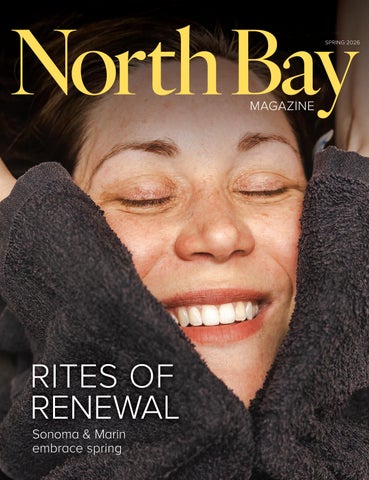
North Bay Magazine Spring 2026

Page 1


RITES OF RENEWAL

Sonoma & Marin embrace spring

PUBLISHER

Rosemary Olson

EDITOR

Daedalus Howell

COPY EDITOR

Suzanne Michel

CONTRIBUTORS

Kary Hess

Daedalus Howell

Ada Ionesco

Don R. Lewis

ADVERTISING

PRODUCTION

Deb Fisher

PRODUCTION

Zk Bradley

GRAPHIC

Jennifer Meyer

Jackie Mujica

Elena Razganov

Rowdy Tomkins

EDITORIAL

DESIGNER

Alan Sculley CREATIVE

Phaedra Heinen

Lisa Marie Santos

ADVERTISING

Danielle McCoy

Erin Hanson

Lynda Rael

Dianna Stone

CEO/EXECUTIVE

Dan Pulcrano

DIRECTOR OF

Cindy Couling

Thing Spring It’s a

The poetical season beckons

Pe.e. cummings, loved spring nearly as much as he despised using his typewriter’s shift key.

The man was notorious for pioneering new frontiers for lowercase letters—he rarely used capital letters, enough that academics covered for him by framing his aversion as a “radical experimentation with form.” Of the demonstrably few times the man used capital letters, one time, tellingly, was to spell “Spring” in his poem “Spring is like a perhaps hand.”

It should be noted that the Associated Press Stylebook does not capitalize the season, ditto Vanity Fair, which follows AP guidelines and where Cummings did

a stint a century ago. Which is to say he should know better, so we must assume Spring’s capital “S” was a deliberate, artistic choice. And in this rare instance, I support it because Spring, especially in the North Bay, is a proper noun in my book.

Here, Spring is a living, breathing being, brimming with life, verdant and vital, or as Cummings puts it in another vernal verse—it’s “mud-lucious” and “puddle-wonderful.” My own turn toward Spring has caught me off guard. I’m more of an autumnal type, by turns brooding or, glass in hand, possessed of an oily charm best accessorized with a light scarf.

But now that I’m a whisper wiser and barreling through the slaloms of my sixth decade, I finally see the utility of Spring. It is the antidote of entropy. Of cynicism

calcified into personality. Of the lowgrade constant cultural malaise that seeps when the rain won’t quit and neither will the news. Spring does not argue with despair—it outgrows it. It pushes green through cracked sidewalks and binds broken hearts in its vines.

Spring is playing the long game. For the first time last week, even the most world-weary columnist spied diamonds in dew drops. Spring reminds us that dormancy is not defeat, that what looked fallow was merely gathering strength for its moment. Which is coming, trust me.

Or as Cummings observed during one of his famous “nonlectures” at Harvard, “Then it was spring; and in spring anything may happen. Absolutely anything.”

Howell, Editor

PHOTO BY SERGEY SHMIDT
POPPY California’s state flower makes a big showing every springtime.

Beach Boys head to Rohnert Park

Wouldn’t It Be Nice

Once again, Mike Love is back on tour, leading The Beach Boys around the United States on a run that will see the band visit some two dozen cities, including the North Bay’s Rohnert Park when they perform at Graton Resort & Casino this April.

At 84, Love is the last member of the classic 1960s Beach Boys lineup still touring with the group. He owns The Beach Boys name and oversees the band’s business. The only other touring member with ties to the early edition of The Beach Boys is Bruce Johnston, who in 1964 joined the group to replace Brian Wilson. This was after Wilson decided to

retire from touring to focus on his role as the main songwriter and producer of The Beach Boys’ music and work exclusively in the studio.

Ostensibly, The Beach Boys have been touring over the past year plus to celebrate a pair of projects. One is the recent 50th anniversary of Endless Summer, the greatest hits album that

TOUR The Beach Boys have been touring over the past year to celebrate the 50th anniversary of their ’70s-era greatest hits album, ‘Endless Summer.’

revived the band’s career in the mid 1970s after The Beach Boys’ popularity had waned in the years following the groundbreaking 1966 album, Pet Sounds, and the innovative follow-up single, “Good Vibrations.”

“We probably do 18 of the 20 songs on that album in our concert,” Love said in a recent phone interview.

The group is also touring behind a 2024 documentary entitled simply, The Beach Boys, streaming on Disney+. Directed by Frank Marshall and Thom Zimny and written by Mark Monroe, the documentary traces The Beach Boys’ career from its inception in 1961 in the Los Angeles suburb of Hawthorne, where Love co-founded the

band with his cousins, Brian, Carl and Dennis Wilson, and friend, Al Jardine, mainly through the mid-1970s resurgence of the band.

The documentary has been dinged in some reviews for glossing over or omitting altogether some of the less positive elements of The Beach Boys’ history. These include tensions that

PHOTO BY JIM

TOCCHIO

existed in the group; the drug use of several members of the band; Brian Wilson’s struggles with drugs and mental health that initially culminated in a breakdown following the completion of the classic 1966 album, Pet Sounds; and the controversial role psychiatrist Eugene Landy took in managing Wilson’s life in the years that followed.

In addition, the deaths of Dennis Wilson from a drowning accident in 1983 and Carl Wilson from cancer in 1998 are only referenced with a note at the end of the documentary.

But Love likes how the film came out and feels it touches on aspects of the group’s history that some of the many other documentaries on The Beach Boys didn’t highlight.

“I think it showed a bit more of my involvement than has been in other projects, and there have been some fallacies said about me, like I didn’t like the Pet Sounds album, which was stupid because I named the Pet Sounds album, and I went with Brian to present it to Capitol Records,” Love said.

“And they really didn’t know what to do with it at the time because we had done things like ‘Surfing U.S.A.’ and ‘I Get Around’ and ‘California Girls,’ ‘Fun, Fun Fun.’ And, you know, they wanted something more along those lines, but Pet Sounds was an evolution,” continued Love. “Brian was using symphonic instruments on some of the tracks and stuff like that. But I sang on it and was lyricist on a couple of songs.

“I think this documentary really (depicts) how it was, how it really was, with the harmonies and the family connection, and it a bit more accurately told the story of the making of the music,” he added.

What is also memorable for Love is footage from a get-together in the summer of 2023 with all of the surviving band members, including Brian Wilson, who passed away this past June at age 82.

“The surviving members, and David Marks and Al Jardine and Bruce Johnston, we all got together at Paradise Cove, which is where we did our original album cover photo shoot,” Love said. He was referring to The Beach Boys’ Surfin’ Safari album, which depicted the five band members on a beach in a vintage truck, carrying a surfboard. “So over 60 years later, we got together at the same place, and we actually sang some songs together,

and it was really nice to have that as the final shot of the documentary.”

“That was more or less the reason for our get together at Paradise Cove in the documentary, just to get together and spend some time together and reminisce and see if we can sing together,” he said.

Prior to his death, Wilson had been placed in a medical conservatorship to manage his health and welfare. But Love said at the time of the get-together his long-term memory was still intact, and so were his abilities to sing and make music. In interviews following that get-together, Love and Johnston both mentioned the prospect of getting together with Wilson to try writing songs, but that, obviously, won’t happen now.

Meanwhile, Universal Music has also been busy continuing to compile deluxe box set reissues of The Beach Boys’ album catalog. The latest release is We Gotta Groove: The Brother Studio Years, which highlights the group’s albums, The Beach Boys Love You and 15 Big Ones, supplemented by a bevy of previously unreleased material.

Arriving in March, it covers music from 1976 and 1977, when Wilson, for the last time, was fully engaged in writing and recording for The Beach Boys. Among the unreleased material in the six-CD set is the legendary Adult/Child album that was shelved and has circulated in various forms in bootleg circles for years.

The Beach Boys’ live show, though, figures to lean toward the 1960s hits that had them vying with The Beatles to be pop music’s most popular band, while displaying the sun-kissed, harmony-laden sound (not to mention lyrics about surfing, cars and beautiful girls) that helped create America’s fascination with the idyllic California lifestyle.

But the band that performs the music, obviously, has changed a lot over the years, and the lineup, in fact, has evolved once again. Long-time musical director Scott Totten has moved on, and guitarist Brian Eichenberger, a touring member since 2015, has taken on that role. The band also has a new lead guitarist in John Wedemeyer and drummer in Jon Bolton. Love, Johnston, keyboardist Tim Bonhomme, sax/flute player Randy Leago, bassist Keith Hubacher and guitarist Christian Love (son of Mike Love) remain from previous lineups.

Love is pleased with this unit (“Actually, we sound better than we ever have,” he

‘We’re really doing more songs from more years of our band’s existence these days than we ever have.’
— MIKE LOVE

said). He noted that Eichenberger, in addition to leading the band, handles the high harmony parts initially sung by Brian Wilson, while Wedemeyer is a “diversified and brilliant” lead guitarist, and Bolton is “a show within a show” on drums. What’s more, Bolton’s vocals allow the band to perform a couple of songs Carl Wilson sang that couldn’t be performed with some previous lineups.

“We’re really doing more songs from more years of our band’s existence these days than we ever have,” Love said.

This unit is also focused on faithfully reproducing in concert the original versions of The Beach Boys’ material.

“We’re obsessed with recreating as close as humanly possible to the recordings, and that means singing the songs in their original keys, not lowering them because you’re not able to hit some of the notes anymore. We sing all these songs in their original keys. And maybe there’s a little bit of something extra we put in to end some songs, you know, just to be more dynamic because there is a live audience,” said Love.

“So instead of fading a (song) out like you would on a record or a single, we’ve come up with an actual ending to put a little more oomph into it, a little more pizzazz, you know, like the end of ‘Good Vibrations’ or ‘Wouldn’t It Be Nice,’” he continued. “It is a live concert, so you’ll do a little bit of something different in the end that makes it more dynamic.”

The Beach Boys perform at 8pm, Saturday, April 4, at The Event at Graton Resort & Casino, 288 Golf Course Dr. West, Rohnert Park. Reserved seating only. Must be 21+ to attend. Tickets start at $49.50.

Prenup, Actually

Not long ago, prenuptial agreements carried the whiff of mistrust—like the legal equivalent of hiding the fine print in a love letter. Fortunately, that narrative is quickly shifting.

Recent surveys indicate that prenuptial agreements are no longer a niche legal tool, but are increasingly part of how couples plan financially before marriage. According to a 2022 Harris Poll conducted on behalf of The New Yorker,

15% of Americans who were married or currently engaged reported having signed a prenup, up from just 3% in 2010—a dramatic increase over the past decade that suggests changing attitudes about financial planning and partnership.

The same survey found that roughly 42% of U.S. adults now support the use of prenups, and 35% of unmarried respondents said they’re likely to sign one in the future. More recent polling suggests even higher uptake among younger cohorts: A 2023 Harris Poll

Why prenuptial agreements are surging among younger couples

reported that 41% of Gen Z and 47% of millennials who were engaged or married said they entered into a prenup, reflecting a generational shift in how marriage and money intersect.

What’s driving the surge? And how are couples managing to bring it up without detonating the romance?

The professionals working closest to modern couples say the answer is less cynical than one might expect. If anything, they describe a generational move toward clarity.

PHOTO BY

ZIMMYTWS

Marriage as Both Romance and Financial Partnership

Melissa Murphy Pavone, CFP® and Certified Divorce Financial Analyst (CDFA®) at Mindful Divorce Partners (mindfuldivorcepartners.com), has watched the change unfold in real time.

“As both a CFP® professional and a Certified Divorce Financial Analyst (CDFA®), I can absolutely confirm that prenups are becoming more common among millennials, and for good reason,” Pavone says. “Many people are getting married later in life, with established careers, retirement savings, real estate, business interests or family wealth they want to thoughtfully protect and define before marriage.”

That timing matters. People are entering marriage with more behind them—and more ahead of them.

“Yes, significantly more than even five years ago,” Pavone responds when asked whether she’s seeing more requests. “I began noticing a meaningful shift around 2020–2021, and it has continued to grow. Millennials were the first group I saw proactively requesting prenups as part of responsible financial planning, and now Gen Z couples are approaching the topic even more openly and pragmatically. For many younger couples, a prenup feels less like a taboo legal document and more like a financial transparency conversation.”

That phrase, financial transparency, comes up repeatedly. The framing has

FUTURE PROOF Prenups are becoming increasingly popular among millennials and Gen Z.

evolved from protection against failure to clarity around partnership.

Jenny Bradley, divorce attorney and founder of Triangle Smart Divorce (trianglesmartdivorce.com), describes what some now call a “financial growth clause.”

“A good prenup always has what people are now calling a ‘financial growth clause,’” Bradley says. “It’s not just about dividing what you have today; it’s about looking ahead to how your finances, businesses and lives will grow together. Whatever term you use, we think this kind of forward-looking planning is smart. We have been doing this exact thing with our prenup clients for years.”

And at Bradley’s firm, she has observed a notable change.

“We’ve seen a big shift toward couples wanting to be more intentional with money before marriage,” she explains. “Prenups, or financial growth clauses, help couples have real conversations about the future: what happens with future income, new investments, business ventures, debts or even inheritances. Those are the kinds of things that can create tension

later if they’re never discussed.”

In other words, it’s less about predicting divorce and more about defining the architecture of shared life.

What’s Driving the Trend?

From Pavone’s vantage point, the forces are both economic and generational.

“From what I see in my financialplanning and divorce-planning work, several factors are contributing,” Pavone says. “People are marrying later and bringing established assets into marriage. Student loan debt and uneven financial starting points are common. Family wealth, inheritances and real estate values have increased significantly. More entrepreneurs and professionals want to protect business interests. Many millennials grew up watching their parents divorce and want to do things differently. Social media and financialliteracy content have normalized conversations about money.”

“The biggest driver, in my opinion, is a growing comfort with financial

PHOTO BY ELNUR

TREND ‘The biggest driver, in my opinion, is a growing comfort with financial transparency before marriage,’ says Melissa Murphy Pavone, a Certified Divorce Financial Analyst.

transparency before marriage,” she adds.

Libby Leffler, founder and CEO of First (thisfirst.com), a national prenup platform with considerable Bay Area volume, sees similar regional patterns.

“We specialize in making prenups accessible for modern couples, with significant volume from Bay Area customers,” Leffler says. “We’ve seen millennials and Gen Z fundamentally reimagining the prenup conversation. That mindset shift is driving the explosion we’re seeing, especially in the Bay Area.”

She identifies three significant influences locally.

“In this part of the country specifically, we see three major drivers of prenup adoption,” she says. “Student loan debt: couples looking to create an agreement that outlines who is responsible for existing or future student loan debt as they enter into marriage. Expected inheritance or family business ownership: This is particularly common in the Bay Area, where generational real estate can be significant. Equity compensation and startup ownership: also a trend in

the Bay Area, with our concentration of technology companies and startup founders. We’ve also seen founders referred to us by their VCs.”

In a region where a single IPO can reshape household balance sheets overnight, these conversations are less hypothetical than practical.

Not Just About Wealth

For Stephanie Fornaro, founder and CEO of Hello Nanny, the issue is personal as well as professional.

“As someone married, divorced and remarried, I am happy to contribute to this discussion, as I have been the product of no prenuptial agreement and went into my second marriage very intentionally with a defined agreement,” Fornaro notes. “As a society, we would never go into business with someone without a clearly defined business agreement. Yet, for some reason, when it comes to marriage, we just hope it works out and leave jurisdiction to a court. There is an agreement in place for every marriage.

But whether you decide what happens, or whether the state decides what happens is the only distinguishing difference.”

For Fornaro, caregiving economics are central.

“The driving trend from my vantage point is that in the event a couple decides to have children, who is stepping back from their career for domestic duties and for child caregiving duties,” she says. “It is disproportionately placed on women. They lose income; they lose retirement; they are displaced from the workforce, and these points are being recognized and causing more people to consider prenuptial agreements. Resentment builds quickly when these things aren’t distinguished and plans are thought out in advance.”

She also challenges common assumptions.

“The misunderstanding is that a prenup is to protect a person’s wealth, or existing wealth,” Fornaro explains. “But this is an outdated ideology. Today, prenups consider things like earning capacity, unpaid domestic labor, displacement from the workforce, retirement contributions,

etc. A prenup helps outline what happens in the event of divorce. You are pre-deciding.”

Julie Pham, owner of Paralegal-Ease & Notary, LLC (paralegaleasenotary.com), sees similar motivations across age groups.

“I’ve helped hundreds of couples of all ages and backgrounds create premarital agreements that fit their real lives,” Pham says. “You don’t need to be wealthy to have one; you just need to want to have a plan. Real couples are blending families, managing debt, buying homes or starting businesses. Every couple has something worth planning for… I’ve noticed that 75% of my couples are Gen Zs or millennials.”

She reframes the conversation in practical terms.

“When I’m working with a younger couple, I find the best way to explain a prenup is this: A premarital agreement is a marriage planning tool,” she notes. “The emotional relationship already exists. That’s why you’re getting married. What you’re creating when you get married is a legal relationship. And planning ahead will always set us up to win, in every area of life.”

So… How Does One Bring It Up?

If prenups are becoming normalized, the question remains: How do couples introduce the subject without making it weird?

“Timing and framing matter,” Pavone says. “The healthiest conversations happen months before the wedding, not weeks. I encourage couples to frame the discussion as part of broader financial planning—similar to talking about budgeting, retirement or where to live.”

She advises careful language.

“Language like ‘Let’s make sure we both feel financially secure going into marriage’ tends to land much better than ‘I need to protect myself,’” she explains. “The most common mistake I see is waiting too long to start the conversation, which can create unnecessary emotional pressure.”

Leffler sees similar pitfalls.

“The most common mistake we see? Springing the prenup on a partner lastminute, which feels more like a power play rather than a partnership decision based on trust and mutual respect,” she says.

“The couples who are the most effective at these conversations bring it up early

‘Many millennials grew up watching their parents divorce and want to do things differently. Social media and financialliteracy content have normalized conversations about money.’
— MELISSA MURPHY PAVONE

and want to get on the same page about money with transparency, respect and clarity,” she adds. “At First, we guide our couples through the conversation together in a collaborative, not competitive, way. Our process saves couples two to three months of time and more than $10K on average.”

Fornaro suggests starting even earlier.

“These conversations have historically been taboo in our society,” she says. “In an attempt to make it ‘not weird,’ these conversations should start at the early onset of dating. These are fundamental character and ideological beliefs that if one partner doesn’t agree on can be deal breaking.”

Pham reminds couples not to get lost in wedding logistics.

“Many couples get excited and lost in planning the wedding, the ceremony and celebrating their love, but what about everything that comes after ‘I do?’” she says. “The practical side of building a life together deserves the same attention.”

A Generational Reset

Bradley observes generational contrasts in how couples approach marriage and divorce.

“Stereotypically, with gray divorce, people are taught never to give up on their marriage,” she notes. “It’s like you go to this one place and you work forever, and you’re married to this person, and you’re going to be married to this person forever.”

“Gen Z has been taught that if you’re not happy, change it—almost to the point that I think sometimes they throw in the towel too soon on jobs, marriages,

relationships and such, and they don’t try to make it work,” she continues.

The differences are striking.

“It’s been very interesting to me to see the complete opposites,” Bradley says. “So we’ll meet with somebody who’s in their gray divorce years four or five or six times, and it might take a year or two or three before they finally decide, ‘Yeah, I think I just need to do it.’ Gen Z comes in guns blazing, and they’re like, ‘We’re done.’” Against that backdrop, clarity before marriage may offer stability rather than strain.

“We find that most couples think a prenup is about ‘what happens if we divorce,’” Leffler explains. “What they’re really doing is deciding how they’d like to build wealth together during the marriage.”

Perhaps that is the quiet shift underway. The prenup is no longer simply a hedge against disaster; it’s a blueprint for collaboration.

“Couples are already having the financial planning conversation anyway,” Pham says. “These are pretty normal conversations to have before getting married. Questions like: Do you want kids? What state do you want to end up living in? Do you like to travel? Should we invest in Airbnbs? Start a coffee shop business? A prenup is simply the marriage plan written down: an honest reflection of the conversations you are already having about money, expectations and shared goals for your marriage.”

Love may be blind, but that doesn’t mean one shouldn’t go into partnership with open eyes. w

Over the phone:

There are many challenges that friend or family caregivers face every day, and the COVID-19 pandemic has created an especially complex situation. There is support— caregivers do not have to go on this journey alone!

Redwood Caregiver Resource Center offers free and low-cost support throughout Del Norte, Humboldt, Lake, Mendocino, Solano, Napa and Sonoma Counties, serving unpaid friend or family caregivers regardless of income.

• Information

• Uniform Caregiver Assessment

• Family Consultation & Care Navigation

• Respite Care

• Short-Term Counseling

• Support Groups

• Caregiver Training

• Legal & Financial Consultation

• Education

Reverent Rebel

Restaurant Picco’s chef Michael Reyes raises the bar in Larkspur

On a Friday night in Marin, during ski week, no less, when half the county typically decamps for Tahoe, Restaurant Picco in Larkspur was buzzing.

The dining rooms glowed. Tasteful art hung against warm walls. And at the center of it all was a gustatory journey to the four corners of the Earth and back to the wilds of Marin. Twenty years in and the Magnolia Avenue brasserie is still the gravitational core of a town that knows how to eat.

Diners laughed and glasses clinked as the spirited dining room buzzed. It felt

like a ritual gathering place for people who love where they live.

We began with the mezze plate—a quietly audacious opener for a restaurant whose roots are Northern Italian. An excellent lamb kofta anchored the dish, deeply savory and spiced with confidence. It was flanked by falafel—crisp exterior, tender interior—and a piquillo pepper spread that carried both sweetness and heat. This was the first hint that Picco is not interested in culinary borders for their own sake.

The burrata that followed was a revelation—not because burrata is rare (it’s everywhere), but because of how it was treated. Kumquats, lightly fermented

Lightly fermented kumquats are rendered into a marmalade and splashed with an electric passion fruit vinaigrette to meet the premium burrata at its level before being placed on a croissant-loaf base.

and rendered into a marmalade with electric brightness with an electric passion fruit vinaigrette, underscored by a rarely seen croissant-loaf base. Adding dimension is a North African spice that completed the transformation into an exquisite demonstration of technique in service of taste.

BURRATA ELEVATED

Executive chef Michael Reyes, who has led the kitchen for the past six years, describes Picco as “an ingredient-driven restaurant.” It’s a phrase that gets tossed around casually in Northern California, but here it lands with credibility. Reyes cooks for all five senses. Aroma announces itself the moment plates land. But there’s also texture: Tableside, Reyes recalled how his mother would tuck potato chips into his sandwiches for a crunchy contrast; the life lesson stuck, and echoes of that memory show up in his food. Dishes crackle and yield, and consistently surprise.

Filet mignon carpaccio offers another example of reverence paired with reinvention. Traditional Venetian carpaccio is popular across the Bay Area, but Reyes’ travels in Venice led to a unique synthesis of his own version. Here, the thinly sliced filet is dressed with precision—capers, crispy garlic, arugula, horseradish aioli, parmesan—and the secret ingredient, housemade ramen noodles.

The Bay Area is a mosaic of international identities and culinary

CHOP The mesquite-grilled, sliced pork chop enjoys an Asian influence and is served with a flavorful kimchi pancake.

HELM Executive chef

Michael Reyes joined Restaurant Picco six years ago, raising its culinary game to new heights.

influences, and Reyes understands that pretending otherwise would be dishonest. Picco’s menu reflects that pluralism, with the results tastier than the sum of their parts.

This isn’t rule-breaking for sport. It’s rule-bending in pursuit of something more expressive. The smoked beef rib pappardelle makes the case vividly. Smoke and depth from the beef play against house-made noodles with supple elasticity.

A lightly dressed radicchio offers an acid note that balances the Beemster gouda fondue, which, in turn, is buttressed by the furikake, a Japanese condiment, that adds an additional whisper of umami to the dish.

Likewise, the mesquite-grilled, sliced pork chop enjoys an Asian influence—the sweet and savory flavor of saamjang, with radish and garlic chives. And instead of the usual green beans and potatoes, the pork chop arrives with a flavorful kimchi pancake.

The vegetarian offerings also carry their weight. There’s intention in the way vegetables are handled—wok-tossed broccoli di ciccio with preserved lemon

and toasted garlic, roasted cauliflower brightened by pomegranate and mint. Nothing feels like an afterthought.

Meanwhile, the service remains friendly and attentive without hovering (thanks, Marcus). There’s a seasoned ease in the dining room—managing partner Ryan Heis has been a welcoming face here for more than a decade, reinforcing Picco’s identity as a neighborhood institution.

Twenty years is no small feat in Marin, where restaurants rise, rebrand and recede with the seasons. Picco has endured by evolving without abandoning what made it matter in the first place.

On that bustling ski-week Friday, with Larkspur fully alive and Picco serving as its base camp, the longevity tracked. The restaurant feels rooted, but not rigid. And throughout, chef Reyes begins with reverence, adds a dash of experimentation and consistently arrives at excellence.

Restaurant Picco, 320 Magnolia Ave., Larkspur. 415.924.0300.

restaurantpicco.com.

Flow State

Petaluma’s La Dolce Vita Wine Lounge

Writers are a superstitious lot. We fret, we furrow—we have routines and rituals; we mutter incantations—and if we find that special place where the words flow easily, we stake a claim. Mine just happens to be where wine flows too—La Dolce Vita Wine Lounge in Petaluma.

At 18 and half years, La Dolce Vita remains the vanguard of the Petaluma wine experience, situated as it is at the “gateway to wine country,” a sobriquet the southernmost city of Sonoma County bestowed by canny marketers, but made true by proprietor Sahar Gharai. LDV, as some locals shorthand the establishment’s name, is the gateway to wine in the broader sense. Among an ever-evolving selection of local offerings, Gharai also

provides a panoply of international wines, representing the gamut of varietals and regions. This is, as she points out, a choice made with intention.

“In a winery tasting room, you’re limited to what that winery makes. But here, people get to explore—and that’s part of the draw,” she says. “This is a way for people to taste wines they otherwise might never get to try. They can sit down and explore something new from Italy, Lebanon »» 42

BY

PHOTOS
DAEDALUS HOWELL
TO GO La Dolce Vita boasts a bustling wine club with regular tasting events and carefully curated wines for local pick-up.

Finding Bliss

Bliss Organic Day Spa cultivates radical acceptance

The moment one walks into Bliss Organic Day Spa in Sebastopol, they feel it—a subtle but unmistakable exhale. The outside world, with its stress and to-do lists, fades into the background.

Clients are greeted by a kind, professional front desk team who understand that arrival is part of the treatment. Beyond them, a comfortable lounge invites one to sit and settle. There’s no rush. No flat, fluorescent glare. No clipboard thrust into their hands while they’re still catching their breath.

At Bliss, the shift begins before a single service starts.

“The service is only part of the experience—the deeper goal is helping someone finally rest,” explains owner Melena Moore. “Everything in the environment is intentional so the body understands it can soften: gentle scent, quiet sound, warm lighting. We don’t rush people into logistics because their nervous system is still in the outside world.”

SOOTH Regarding self-care as maintenance rather than reward is part of Bliss Organic Day Spa’s guiding philosophies.

That attention to nervous system awareness is part of what distinguishes Bliss from the standard “treat yourself” day spa model. This isn’t about momentary indulgence. It’s about sustainable well-being.

Belonging to Bliss

Bliss Organic Day Spa was founded as a place to heal, relax and feel beautiful, deep down and inside out. In June 2017, Moore purchased the spa from founder Annie Carouba after serving first as marketing director and then general manager. For Moore, ownership wasn’t just a business milestone; it was the natural evolution of a career devoted to wellness environments. The throughline has always been intentionality and how space, service and community intersect.

Unlike many spas that center their brand on a single signature treatment, Bliss is structured around rhythm and continuity. “We’re less focused on escape and more focused on creating sustainable well-being in everyday life,” says Moore.

PHOTOS BY KELSEY

“Instead of a single signature treatment, the essence of Bliss is ongoing care over time. People don’t just visit—they become part of the rhythm of the space.”

That rhythm is reinforced by Bliss’ membership model, which has become one of its defining features. In practical terms, it functions like a gym or yoga membership—an anchor in one’s calendar that prevents the creeping realization that it’s been more than a year since their last massage. While anyone can still book a one-time massage, facial, waxing service or an afternoon in Bliss’ bathhouse, members commit to returning regularly.

“A big part of what makes Bliss different is our membership model,” Moore explains. “Many guests commit to coming monthly, and that consistency turns self-care into a practice instead of a rare occasion. The membership offers treatments and bathhouse access at a

dedicated local rate priced significantly under the à la carte ticket price, creating reliable relationships that support both the guest and the business.”

In philosophical terms, it reframes selfcare as maintenance rather than reward. The consistency shifts self-care from a rare splurge to a steady practice.

“My understanding of self-care has shifted from indulgence to maintenance,” Moore says. “It’s not something you do after burnout—it’s how you prevent burnout. Regular visits, especially through membership, help people stay regulated and resourced so they can function better in their lives rather than escape from them.”

Bliss offers more than a dozen varieties of massage and more than 20 facial options, all performed using organic products that they deem proven and effective. The Hydrafacial, for example,

‘My understanding of self-care has shifted from indulgence to maintenance. It’s not something you do after burnout—it’s how you prevent burnout.’
—MELENA MOORE

delivers immediate glow and a visibly refreshed look. Waxing and other aesthetic services are approached with the same philosophy: slow, respectful and grounded.

“Whether it’s a massage, facial or even a waxing service, the approach is the same—slow, respectful and grounded in loving-kindness,” Moore says. “You can literally watch shoulders drop and breathing change once the body realizes it doesn’t have to brace anymore.”

Contributing to the heart of the spa is the Bliss Bath House, a self-care sanctuary formerly operated by the Dhyana Center and now fully integrated into the Bliss experience. Open seven days a week, the bathhouse includes saunas, hot tubs, and a cold plunge and spaces to rest between circuits of heat and water.

“The space allows people to create simple rituals—heat, water, quiet and

VISION Melena Moore is the owner of Bliss Organic Day Spa in Sebastopol.

BEST FACE FORWARD

The spa offers more than 20 facial options, all performed using organic products.

time,” Moore says. “Some guests sit together; some reflect alone; some just breathe for the first time all week. It’s basic but profoundly regulating.”

There’s something elemental about it: steam rising, muscles unwinding, the bracing shock of cold followed by warmth again. In a time saturated with optimization hacks and productivity metrics, the bathhouse offers something simpler—permission to pause.

But relaxation at Bliss extends beyond lighting and massage. It’s cultural.

In Good Hands

Moore is intentional about creating a workplace that feels safe and supportive for employees, believing that internal culture radiates outward. “I’ve worked in environments that didn’t feel respectful or supportive, and I wanted to build something different,” she says. “When employees feel safe, valued and respected, they naturally extend that same care to

every guest. That authenticity is what people feel when they walk in.”

That ethos of inclusion is explicit. “You can ask questions, be quiet, laugh or feel emotional—all of it is normal,” Moore says. “We meet people exactly where they are and treat everyone with the same respect and kindness. Many guests tell us it’s one of the few places they can fully relax, including members of our queer community who want to know they’re safe and affirmed.”

“Bliss is built on radical acceptance,” she adds. “There’s no right way to experience it and no expectation to perform relaxation. You just show up, and we’ll guide you through it.”

In other words, one doesn’t have to “do” serenity correctly. They don’t have to prove they deserve it. And they don’t have to arrive already calm.

Bliss Organic Day Spa has become, over time, more than a place for appointments. It’s a local ecosystem of care—one where regular guests recognize

each other in the lounge, where staff members build long-term relationships with clients and where wellness is woven into everyday life rather than reserved for anniversaries and gift cards.

For Moore, building this sanctuary is both professional calling and personal alignment. The natural beauty of Sonoma County—its fog, forests and fields—feels consonant with the organic, grounded approach she sustains at Bliss.

The promise of Bliss isn’t escape from reality. It’s steadiness in reality. It’s the cumulative power of regular touch, warm water, quiet rooms and being met with kindness.

One walks in carrying the stress of their week. They leave a little lighter. And when they return—again and again—that lightness becomes less of an exception and more of a baseline.

At Bliss, the “ahh” is real.

Bliss Organic Day Spa, 186 North Main St. #230, Sebastopol. 707.861.3434. blissorganicdayspa.com.

Villa Marin: The Face of the Vitalist

Some people see aging as a process of letting go. Others see it as a chance to choose more intentionally –to age with grace.

This second group is growing, building momentum. They call themselves Vitalists.

Vitalists aren’t trying to stay young. They’re focused on staying engaged — with their health, their interests, and their community. They value energy, clarity, and ease. They simplify not because life is ending, but because they want more room for what matters.

At Villa Marin, the Vitalist philosophy is at the heart of everything we do.

The Vitalist philosophy comes alive at Villa Marin — through self-governing principles, innovative services, integrated, 5-star health care, and a lifestyle that makes living well natural.

If you believe your life still has room to expand, you may already be a Vitalist.

And you may already be looking for a place like Villa Marin.

WATERFALL A self-guided

Prescribed byNature

Forest bathing and other ways to heal at Sugarloaf Ridge State Park

There are many indignities associated with modern life. Email. Deadlines. That vague hum of anxiety that presses down on one’s shoulders until Quasimodo’s posture becomes enviable. For some, the solution comes in a bottle. At Sugarloaf Ridge State Park, it comes naturally.

Welcome to Park Rx.

The idea is deceptively simple: Instead of advising patients to “exercise more,” medical providers literally prescribe time outdoors. Under the Park Rx for Health program, Sonoma County residents are encouraged to venture into local parks for structured, low-impact activities designed to improve physical and mental well-being.

PHOTO BY DAVID BERRY (CC BY 2.0)
nature trail along Sonoma Creek eventually leads to a 25-foot waterfall that occurs during the rainy season.

SANTA ROSA | 707.583.7667 424 Farmers Lane, Montgomery Village www.madelocalmarketplace.com

Best Ice Cream

Over the years, Fair fa x Scoop has found it s place in the rhy thm of our communit y life in Fair fa x . We’ve seen children grow, miles tones celebrated by favorite flavor combinations, and passing interac tions that turn into real connec tions.

Behind the counter, our hope is to be present with each cus tomer

themselves, which means cus tomers are met with real smiles, a spontaneous spirit that helps shape the experience at the Scoop.

Many of our flavors follow the seasons, inspired by what ’s grown nearby, including vegan flavors with gluten-free cones as an option We use organic ingredient s and work with local suppliers as much as we can Every thing we ser ve comes in compos table packaging which is par t of our mission to increase communit y joy while minimizing any potential negative impac t on our environment

One cus tomer once said of the Scoop, “This place feel s like a hug ” This meaning ful sentiment has s tuck with us, and our hope is that we

welcome and warm feeling to all of our cus tomers and g reater communit y

This reporter recently enjoyed an on-air interview with John Roney, park manager at Sugarloaf and an employee of the Sonoma Ecology Center, who has been stewarding this effort for nearly a decade. The Ecology Center took over park operations in 2012 after state budget cuts shuttered several parks.

“It was supposed to be for three months,” Roney says of his tenure. “But I’m still there.”

In 2016, Sugarloaf launched its Parks Rx program. “The idea is doctors write prescriptions to get people to go outside,” Roney explains. “We think getting outside is amazing for you.” The model began in Marin, but at Sugarloaf it evolved into one of the most active programs of its kind in the country.

Today, the park runs six “Hiking for Fitness” series annually, yoga hikes roughly 10 months a year and a Slow Journeys series designed for people with limited mobility. The goal, Roney says, is straightforward: “We try and make it easy

for everybody to get outside, and a way to get moving.”

The prescription itself has a certain psychological heft. Rather than a casual suggestion, it’s a plan. “If you say, here’s a prescription; here’s a program, it’s much more impactful,” Roney says. “It’s like, here’s a specific thing you can do. Not just generalities.”

From Participant to Leader

If Roney is the architect, Carrie Girvin is living proof of the blueprint.

Girvin is a local Kaiser Permanente oncology nurse who first signed up for Hiking for Fitness in 2017. She joined Roney for our interview and gamely observed, “I loved it, and I kept going back as a participant.” Eventually, someone suggested she volunteer. She has since participated in nearly every series and now helps lead them.

“I call them my hiking family now,”

‘The idea is doctors write prescriptions to get people to go outside. We think getting outside is amazing for you.’
— JOHN RONEY

Girvin says of the regulars.

The eight-week program comes in beginner and intermediate tracks. In the beginner series, many participants “haven’t hiked in years,” she says. “They’re really uncomfortable or unsure of their ability.” The hikes start short—sometimes under a mile—with minimal elevation gain. Over time, both distance and incline increase.

By the end of the intermediate series, hikers summit Bald Mountain.

“It’s one of the most beautiful hikes that I’ve done in Sonoma County,” Girvin says. “You’ve got 360-degree views. You can see the San Francisco Bay. And it feels like quite an accomplishment to many people.”

That accomplishment is earned. Bald Mountain’s elevation gain is substantial, and Girvin doesn’t sugarcoat it. “It’s a bun burner,” she says.

But no one is left behind. Each hike has a leader and a sweep. The group stops at trail intersections to regroup.

START HERE The Visitor Center at Sugarloaf Ridge State Park is a smart place to begin one’s journey.

VIEW A hiker takes in the view during 2025’s Headwaters to Headwaters Fundraising Hike for Sugarloaf Ridge State Park.

And the emphasis is on encouragement, not competition.

Beyond fitness, each week includes instruction: navigation with a compass, the 10 hiking essentials, first aid basics. “We’re teaching new hikers what equipment to use, survival skills—just so that they’re comfortable out on the trail,” Girvin says.

Volunteers like Girvin are the backbone of the program. “The volunteers are what make our program sustainable,” Roney says. “They do all the planning; they do the routes. It wouldn’t happen without them.”

Slow Medicine of Forest Bathing

If hiking is a cardiovascular workout, “forest bathing” is its more contemplative cousin.

The practice, popularized in Japan as shinrin-yoku, found fertile ground at Sugarloaf in 2012. Roney recalls that Amos Clifford introduced the concept there after learning about it abroad. It

has since grown into an international movement.

Forest bathing is a guided, slow-paced, semi-meditative walk. Participants pause to listen, smell and touch. “It’s a way to be present in nature,” Roney says.

Even for a park manager, that presence is not automatic. “When I’m walking around the park, I’m not present in nature. I’m texting the staff about things that need to be fixed,” he admits. “When I do this, it’s like, OK, stop and listen and smell.”

Two hours later, he says, the effect is unmistakable. “You’re like, I should do this every week,” he notes. This can nearly be achieved, as the organization offers forest bathing programs about 10 months a year.

Girvin experiences a similar reset through hiking. “At the end of my work week, I feel like my shoulders are up around my ears,” she says. “As I’m driving up there, I actually feel decompression of stress when I’m up there hiking.”

More strikingly, she reveals: “My mind is always racing every day all the

time at night, but when I’m hiking, my mind is quiet. So I tell people it’s like I’m recharging my battery for the next week.”

Accessibility, Community and the Long View

Not every prescription is for the summit.

The Slow Journeys program accommodates participants with limited mobility. These hikes are typically one to two miles, often along flatter trails and frequently include nature themes—birds, geology, wildflowers.

“We have people in wheelchairs, people with a walker, cane or (who) just want a slow hike,” Roney says. “People really love them.”

Sugarloaf’s offerings extend well beyond Park Rx. The park features 47 campsites and seasonal glamping tents outfitted with foam double beds. The Robert Ferguson Observatory—home to the largest telescopes open to the public on a regular basis in Northern »»

PHOTO

FIT The park runs six ‘Hiking for Fitness’ series annually, yoga hikes roughly 10 months a year and a Slow Journeys series designed for people with limited mobility.

«« California—draws stargazers. There are full moon hikes, mushroom hikes, Spanish-language programs and collaborations with local tribal leaders.

Beneath the programming is a deeper philosophy.

When state funding faltered, Roney and the Ecology Center stepped in not merely to keep trails open but to protect the land. Sugarloaf spans roughly 5,000 acres and contains the headwaters of both Sonoma Creek and Santa Rosa Creek. It hosts remarkable biodiversity—hundreds of plant species, bears, mountain lions, bobcats and, in recent years, Chinook salmon spawning in shallow pools.

The First Step

What makes Park Rx compelling is not novelty but specificity. The prescription is literal. The program is structured. The support is built in. For Girvin, the transformation was personal. “I never knew I loved hiking until I started this program,” she says.

That admission may be the most persuasive marketing copy imaginable for the program.

In an era of screens and static, of curated feeds and cortisol spikes, the notion that one can step into a forest and find that the mind becomes quiet borders on radical. Yet at Sugarloaf, it’s a weekly occurrence.

The barrier, Girvin notes, is often psychological. “To go to a place that you’re unfamiliar with, that maybe you don’t know the trails—that’s out of a lot of people’s comfort zone,” she says. “To show up and know that you’ve got a group, somebody’s going to lead you, you’re not going to be left behind, you’re going to make new friends—you’re going to be encouraged—I think it’s a lot easier for people.”

No co-pay required. Just a willingness to take the first step.

Sugarloaf Ridge State Park, 2605 Adobe Canyon Rd., Kenwood. 707.833.5712. sugarloafpark.org.

Sugarloaf Park Trail Guide

What follows are a few suggested hikes listed by approximate time to complete. Also, please note, dogs are not allowed on backcountry trails or service roads due to state park mandates.

IF ONE HAS 1 HOUR (FAMILY HIKES, 2 MILES OR LESS):

Creekside Nature Trail – 1 mile, easy, shaded, loop through campground.

Quest Hike – 1.4–1.9 miles, easy, rhyming clues and prize.

Meadow–Hillside Loop – 2 miles, easy/moderate, views and stream crossings.

Canyon–Pony Gate Loop – 2 miles, moderate, seasonal 25-foot waterfall.

ACCESSIBLE:

Creekside ADA Trail – 0.5 miles each way, flat, 70% shade.

IF ONE HAS 2 HOURS:

Vista Trail Loop – 4.1 miles, moderate, strong sun exposure, great views.

Neptune Picnic Table via Brushy Peaks – 5.2 miles round trip, moderate.

IF ONE HAS 3+ HOURS:

Bald Mountain Summit – 5.6 miles round trip, moderate-strenuous, 1,529-foot elevation gain.

Big Loop + Red Barn – 11.4 miles, strenuous.

PHOTO BY

Dawn Songs

‘Mindi

in the Morning’

The work day starts early for Mindi Levine, host of the Mindi in the Morning Show on Santa Rosa stalwart, KRSH, 95.9 FM.

From 6am, Monday through Friday, Levine comes in bright and early from her nearby home to start the day as well as get the radio station—a former group of train cars retrofitted into individual studios—up and running. For many, this would be a grind, but for her, it’s a bit of a dream gig.

“I wake up at 4:30am every day and for four straight hours provide unscripted entertainment to thousands of listeners. A radio high wire with no net. And, for

VOICE Every morning at 6, Sonoma County awakes to the voice of Mindi Levine on The Krush’s ‘Mindi in the Morning’ radio show.

me, it’s the most perfect four hours, every single day,” says Levine. “I’ve been trusted with a national institution, and I strive every single day to honor and live up to that standard.”

Levine took over coveted morning show duties in January of 2024, replacing Andres de Channes. While she’s not the first female morning radio host on the Krush, her slot had previously belonged to local radio royalty like Bill Bowker, Brian Griffith and the late Doug Smith. But if her 2025 Norbay Award for Best Radio DJ is any indication, her growing listenership could soon see her occupying the same lofty levels of popularity.

Born and raised in New Jersey, Levine headed to Los Angeles in the late ’80s before landing at Sonoma State University. There, she immediately got involved with the Associated Students Production Board,

helping produce shows with such acts as Green Day, Ice-T, David Lindley and Jellyfish, to name but a few.

After she graduated from SSU with her B.A. in English language and literature, she moved to Prague for two years to do marketing work for a division of Radio Free Europe. This is where she also caught the radio bug, doing on-air shows in English on Czech station Radio 1. Yet when she returned stateside, she leaned more into teaching with a four-year gig as an English teacher in East Los Angeles.

Through all of these moves, Levine stayed in touch with Sonoma County mentors and friends. Then one day, music promoter Sheila Groves of Notable Talent reached out to her.

“Sheila called me and asked me if I wanted to be her right-hand woman and to move up to Napa and launch the

ON-AIR In addition to her on-air duties, Levine is her station’s program director.

Uptown Theatre. When the call you’ve been waiting for your whole adult life comes, you follow something like that,” she says with a laugh.

As life’s journey is often prone to do, when her time at Notable Talent ended, another music related opportunity opened its door. Napa’s 93.3 The Vine needed a DJ, and Levine landed the job, where she held down the afternoon drive-time slot for six-plus years. During that time, she was voted Best Media Personality: Radio/Print/TV in 2016 by the North Bay Bohemian

It should be noted that at KRSH, she wears more than just the morning drivetime host hat. She also serves as the station’s program director as well as books the station’s Backyard Concert Series.

Regarding her job as program director, Levine says this is “where I strive

‘I wake up at 4:30am every day and for four straight hours provide unscripted entertainment to thousands of listeners. A radio high wire with no net. And, for me, it’s the most perfect four hours, every single day.’
—MINDI LEVINE

to make the best possible music and programming choices, choices that are scrutinized by thousands of ears daily. And I imagine listeners driving around to the soundtrack that I’ve created, and it has to be the best. It just has to be.” She continues, “Same goes with booking the Backyard Concerts. There are so many boxes that need to be ticked. It can be a lot of pressure, but I also thrive on that.”

For the uninitiated, the Backyard Concert Series refers to free, summer-long concerts in the literal backyard at the Krush studio, which also is the home for newly relaunched 95.5 The Drive, an afternoon drive-time talk radio show featuring local legacy media bon vivant Daedalus Howell, as well as Spanish language stations Exitos 98.7 and Latino 100.9 and Bob 96.7, which plays hits from the past four decades.

This year’s Backyard Concert Series is slowly coming together, so unfortunately, no sneak previews are to be had. But, it’s a point of pride for Levine to put together a fun and eclectic blend of local and touring acts.

Two years at the helm seems like a good reflection point. And so she talks about challenges that obviously orbit around the early start time for her show. Speaking to this, she says, “It’s always challenging to maintain the energy and quality of the morning show while also going out after work and seeing live shows, especially on school nights—yet it’s so incredibly important to me to do so.”

Indeed, local concert goers have likely seen Levine emceeing shows at HopMonk Tavern in Sebastopol as well as at the Wednesday Night Market main stage throughout last summer. As if all of this didn’t keep her busy enough, she also had the honor of hosting one of the stages at last fall’s Hardly Strictly Bluegrass in Golden Gate Park.

Of course, no article about a media personality would be complete without asking what is on their playlist. And with this question, Levine’s love for the local music scene comes shining through. The prompt gives her “too many to list” but notes local up and comers like Gas Money,

Ryan Woodard, Anna Jae, Ellie James, Audio Angel, Erica Ambrin, TERRIER, Sebastian St. James and Mitchell Thomas.

On a roll now, she says, “Of course, I adore our legends too, like David Luning, Chuck Prophet, Johnny Campbell and The Pulsators, Jesse DeNatale, Eric Lindell, Janiva Magness.” Forcing herself to stop, she realizes, “I hate this because I know I’m leaving too many people out. If I forgot to name you, know that I love you.”

As her show continues to keep its groove, Levine is excited to “grow the show with some exciting new segments.” She notes the newer “Get Lit” segment, which is a partnership with Redwood Writers and Copperfields that ties in her love of literature. “I’m always looking to find new ways to be involved with the community and grow our audience—I’m cooking up some fun ideas—stay tuned.”

The ‘Mindi in the Morning Show’ is on-air Monday-Friday locally at 95.9 FM and worldwide at KRSH.com.

1214 W Steele Lane

Santa Rosa

707.755.7222

karve.fit @karvesonoma

Karve your best self with us:

First single class: $25 ($10 savings)

Half off your first month unlimited membership (3 month minimum commitment)

$150/1st mo. for all classes ($150 savings)

$125/1st mo. for reformer pilates ($125 savings)

$90/1st mo. for mat pilates, TRX, and barre ($90 savings)

Luxury boutique group fitness in Santa Rosa featuring reformer and non-heated mat pilates, as well as TRX and barre fusion classes.

of different wines has really caught on. I see people who love discovering wines from all over, not just local bottles. There’s this real curiosity now to experience everything from nearby producers and global regions—it’s been fun to see that grow.”

Today, the lounge’s list features roughly 60 selections, skewing about 40% domestic and 60% international. Guests can sample wines by the three-ounce taste, a six-ounce glass or the full bottle, with an array of curated flights optimized for exploration.

That spirit of exploration is mirrored in the room itself—a low-lit, modern salon where the hum of conversation often swells into something like a house party but with better stemware.

packed,” Gharai points out. “I’m always trying to figure out ways to make it flow better because so many people show up. But it’s great for wine club members to meet each other.”

She adds, “What makes it special is that distributors come too—so we pour wines people may never have had before: interesting, lesser-known producers from around the world, and often small production wines. That exposure is really what I hoped for when I started those nights.”

Gharai’s curatorial approach, like the wines themselves, is a study in balance.

or Portugal—wherever—and savor it alongside something local. That’s the fun of it.”

Moreover, when it comes to some local wines, Gharai provides a venue for imbibers to explore those from providers who often don’t have tasting rooms of their own, similar to the enotecas—intimate spaces where wine is both ritual and retail—she encountered during a post-collegiate wine study abroad program in Florence, Italy. The inspiration to open her own venture was uncorked.

“Oh my God. It feels like a lifetime ago,” says Gharai, who opened La Dolce Vita Wine Lounge in September 2007—a swift 18 and half years ago.

When she started, the concept of a dedicated wine bar in Petaluma was hardly ubiquitous.

“People are much more open to exploring wine now than they were back then,” she notes. “In the early days, folks mostly thought of wine as something you did at a winery—drive out, taste a few things and leave. But now, going to a wine bar and sitting down to try a bunch

“I think we’ve been really fortunate,” Gharai says of the community that has formed around the lounge. “A big part of it is that La Dolce Vita is a comfortable place to be. It’s not intimidating or overly formal, but it’s not too casual either. You can come in for just a glass of wine—you don’t have to commit to a full dinner. And because of that relaxed vibe, people actually end up talking to one another. They sit on the couches, or at the bar … and before you know it, strangers are chatting like friends. That community aspect means a lot to me,” she says, then adds with a laugh, “It’s kind of like ‘Cheers.’”

Indeed, LDV is the kind of place where regulars bring newcomers the way one might introduce a friend to a favorite film (Fellini’s La Dolce Vita, perhaps?). Speaking of which, classic flicks are projected (silently) above the bar every night.

“I think part of it is that we never tried to make it pretentious or stuffy,” says Gharai. “We wanted a relaxed environment where people can learn about wine if they want, but they don’t have to. It’s about just having a place to be together.”

Every two months, that community coalesces in particularly buoyant fashion during the wine club’s Wednesday evening gatherings. The room fills quickly as members collect their allotments and guests queue up for tastes poured by the selected wines’ distributors.

“Oh, it’s always a big turnout—which is awesome and also funny because it gets

“I try to do a blend,” she says. “Local wines are important—we are in wine country, after all—so I make sure we highlight folks here in Sonoma and beyond. But I also look for producers you don’t always see. Maybe small production bottles that are fun to talk about, or things from regions people haven’t tried yet. I’ll bring in classic benchmarks and also quirky, fun stuff, all based on quality and value. If a wine doesn’t taste balanced or interesting? I won’t pour it. It’s that simple.”

The food program also carries equal intention.

“My family was huge in helping me launch this—especially my mom with the food,” Gharai recalls. “She came up with a lot of the recipes that pair so well with the wines. We have all kinds of things—paninis, crostini, homemade soups, hummus, salads—all things she would make for parties at home when we were kids. She makes her own dressings, everything from scratch, and it really shows in the quality. It’s like sitting down in someone’s home—but better, because the wine list is better,” she adds with a laugh.

And perhaps that’s the secret to La Dolce Vita’s longevity: It feels both worldly and intimate, like Florence by way of Petaluma Boulevard. For writers seeking flow, couples marking milestones, or friends discovering a new varietal from a country they’ve yet to visit, it remains what it has always been—a place to linger, to explore and to belong.

La Dolce Vita Wine Lounge, 151 Petaluma Blvd. S #117, Petaluma. 707.763.6363. ldvwine.com.

FOUNDER Sahar Gharai opened La Dolce Vita in September 2007, and it soon became a community hub.

Turn static files into dynamic content formats.
Create a flipbook