@losgatan
vol . 5 , no. 36 : may 6-12, 2026 : losgatan.com
fiat lux grand opening p8 : police blotter p9 : jazz on the plazz lineup p23 : jeffrey blum p28
INSIDE
REPLAY
Owner says people keep coming back for haircuts, connection Faizi Samadani, Contributor
Andrea Swan bought The Old Adobe Hair Shop just over 31 years ago after working as a hairdresser at the salon for eight years. March 1, 1995 was Swan’s official purchase date for the salon and barbershop. She says that despite being located in Silicon Valley where technology advancements have erased industries, and economic downturns (and the layoffs that come with alongside) can result in frugal habits, the salon’s business hasn’t been affected negatively. The original owner, Laurie Roberts, started the business in the early 1980s in the back of the Los Gatos Lodge before moving to the current location in 1984. After eight years of working as a hairdresser, Roberts asked Swan,“Could you take over the business?” The Old Adobe is unique because it’s located on a high-traffic street that’s recognizable to most town residents. And when sitting down with Swan, she made it clear that through the dot-com bust, the Great Recession of 2008 and most recently the global pandemic, their clientele has remained a constant. The Old Adobe salon is part of a sector—the human services world—that still requires human interaction and touch to stay alive. Swan made a down payment of $20,000 when taking over The Old Adobe. Back then, rent ➝ Adobe, 25
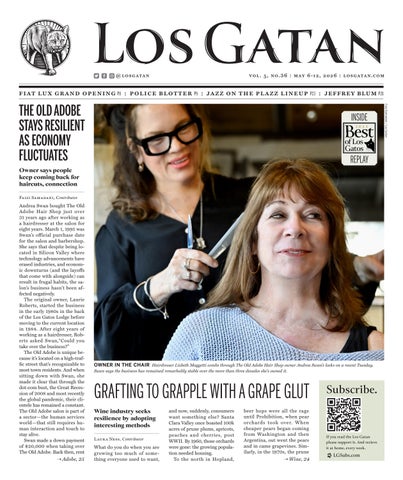
OWNER IN THE CHAIR Hairdresser Lizbeth Maggetti combs through The Old Adobe Hair Shop owner Andrea Swan’s locks on a recent Tuesday. Swan says the business has remained remarkably stable over the more than three decades she’s owned it.
GRAFTING TO GRAPPLE WITH A GRAPE GLUT Wine industry seeks resilience by adopting interesting methods Laur a Ness, Contributor
What do you do when you are growing too much of something everyone used to want,
and now, suddenly, consumers want something else? Santa Clara Valley once boasted 100k acres of prune plums, apricots, peaches and cherries, post WWII. By 1960, those orchards were gone: the growing population needed housing. To the north in Hopland,
beer hops were all the rage until Prohibition, when pear orchards took over. When cheaper pears began coming from Washington and then Argentina, out went the pears and in came grapevines. Similarly, in the 1970s, the prune ➝ Wine, 24
Subscribe.
If you read the Los Gatan please support it. And recieve it at home, every week.
LGSubs.com
Faizi Samadani / Los Gatan
THE OLD ADOBE STAYS RESILIENT AS ECONOMY FLUCTUATES