



FOR OVER 30 YEARS, TESTORFF CONSTRUCTION HAS BEEN HELPING SANTA CRUZ COUNTY FAMILIES BUILD THE HOMES THEY'VE ALWAYS IMAGINED
VOTED SANTA CRUZ COUNTY 'S PREMIER CONSTRUCTION COMPANY 2026





FOR OVER 30 YEARS, TESTORFF CONSTRUCTION HAS BEEN HELPING SANTA CRUZ COUNTY FAMILIES BUILD THE HOMES THEY'VE ALWAYS IMAGINED
VOTED SANTA CRUZ COUNTY 'S PREMIER CONSTRUCTION COMPANY 2026





Ihave to admit that when I first heard about straw bale homes, I thought of the three little pigs nursery tale and the Big Bad Wolf huffing and puffing and blowing the houses down.
I mean, straw, houses, are you kidding?
But then, reading these stories by Home and Garden expert Jillian Steinberger-Foster about the homes she’s landscaped that have lasted for decades–through our storms, heat and earthquakes–well, obviously, my image changed. Jillian and her husband Ken Foster own a company that landcapes these houses and her family members have lived in one for many years.
Reading her article shows that straw bale homes are on the cutting edge of the environmental movement, creating living spaces that are more affordable to maintain, and using nature’s elements to control the climate; they are comfortable year-round. No wolves at those doors.
Steinberger-Foster isn’t just a reporter (and years back she was my journalism student at Cabrillo…I’m so proud of her), but she followed her passion in landscaping and building amazing yards for people all over the county.
The other person in this story with a storied history is Michele Landegger, who now builds ecological homes and was once the guitarist in one of my favorite local bands, Pele Juju, an all-female world music outfit I always thought should be huge. I saw them many times at the Catalyst.
Check out that cover story for major inspiration for your next ambitious project.
Another intriguing article inside is about a proposal to have people do tours and tastings at cannabis producers, like we’ve done forever at wineries. Back in the days before legalization, who could have imagined this would be part of the future?
It’s something we can add to our tourist economy along with trends of wine tastings, hard alcohol tastings, and fancy beer tastings. I’m surprised that there aren’t local ice cream tastings, but who knows? They’d be great with the cannabis tours.
Happy reading and weeding.
BRAD KAVA | EDITOR
Tips for planting with color and water savings. P14
It sounds counterintuitive, but straw bale homes can be luxurious and environmentally friendly. P6
Affordable building materials can help in housing the unhoused. P12
CREATIVE
Deb Fisher
GRAPHIC DESIGNERS
PUBLISHER
Dan Pulcrano
EDITOR
Brad Kava
CONTRIBUTORS
Jillian Steinberger-Foster
Maria Grusauskas
PHOTOGRAPHER
Tarmo Hannula
DIRECTOR OF CREATIVE SERVICES
Cindy Couling
EDITORIAL PRODUCTION MANAGER
Zk Bradley
ASSISTANT EDITORIAL PRODUCTION MANAGER
Haley Tweedell
Jennifer Meyer
Jackie Mujica
Elena Razgonov
Rowdy Tompkins
EDITORIAL DESIGNERS
Haley Tweedell
Jax Vuckovic
ADVERTISING DIRECTOR
Debra Whizin
ADVERTISING REPS
Lisa Buckley
Kate Kauffman
Sue Lamothe
Danielle Ratliff
Like wineries,you can tour where your cannabis is grown. P 16
Fix, improve and grow it yourself. P24
Aurene Pokorny CIRCULATION





BY JILLIAN STEINBERGER-FOSTER
Some landscapers and gardeners are so focused on the outdoors that we give little attention to our indoor habitat. Why not build outdoor living quarters? A simple bathroom (compost toilet?), a kitchen (a table-top range, just like camping?) and certainly the whole backyard is “living space.” It’s possible that these “outdoor professionals” are overgrown kids who never wanted to be pulled away from their fort or treehouse, with fresh air, bird song, and the promise of adventure.
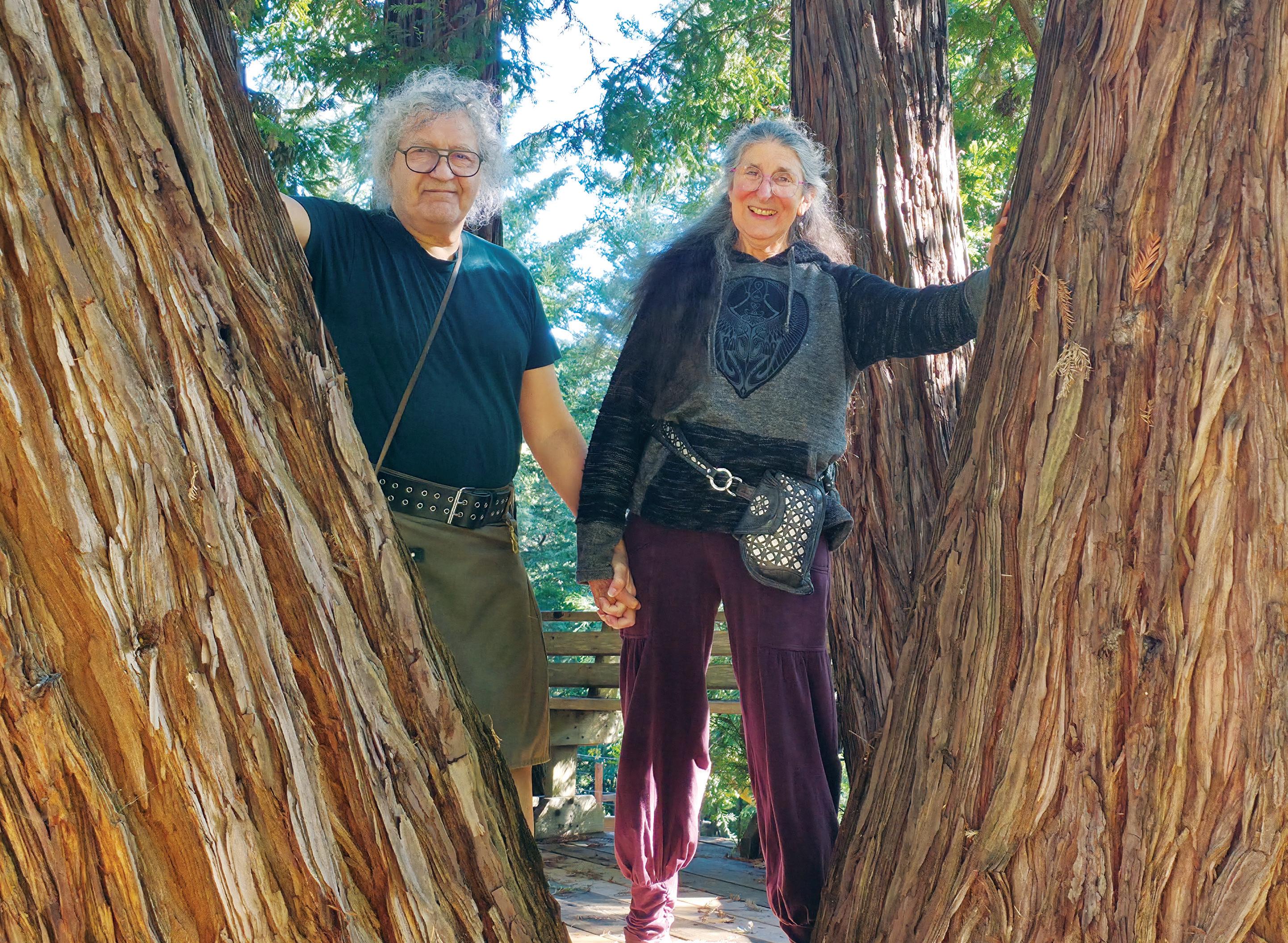
My husband and business partner, Ken Foster, and I have been focused on outdoor living areas for folks during many of our combined decades on Planet Earth. Ken started Terra Nova Ecological Landscaping, LLC back in 1988. I had a small company in Oakland, The Garden Artisan, where I provided regenerative gardening services, before joining Terra Nova in 2014. We landscape and garden together, and our
four rescue dogs–a Schipperke, a Border Collie, and a Catahoula and a Chow Chow mix from Arkansas–get the full run of the house, inside and out.
However, Ken’s parents, Herb and Ellie Foster, who started up the Quaker Meeting in Santa Cruz in 1951, spent their final years in the first permitted straw bale granny unit in Santa Cruz, behind their old family home off King Street on the Westside, which is now owned by Ken’s brother and sister-inlaw, David Foster and Margo McBane. This 640-square-foot ADU was designed and built by Michele Landegger of Studio Boa (buildingnaturally.com) in 2006. (Music fans might remember Michelle as the lead guitarist for the world music band Pele Juju.)
Twenty years later, this cozy unit is beautiful and comfortable as ever, with thick insulating walls, deep-set windows, and radiant heat floors. It feels spacious. Landegger and her partner Debrae Lopes used “earth
plaster” from their 20-acre property in Watsonville for the walls. It’s a pleasing and calming look. It’s also durable and low-maintenance. Now it’s home sweet home for the Fosters’ daughter Etta and her young son, Avery.
For those unfamiliar with the newest environmental technologies, straw bale construction is durable and ecofriendly. It is a sustainable, energyefficient style of building that uses upcycled straw bales, which are an agricultural waste product, as the main building material.
This reduces the lumber needed in a project. It insulates the home, leading to efficient heating and cooling. It also creates soundproofing and good indoor air quality. The 2-foot-thick walls are covered with stucco or plaster–often earthen clay–and have attractive deep window wells, and a homey look.
Importantly for the Santa Cruz Mountains, they are highly fireresistant. They are durable and eco-
friendly. Many of these buildings have a “truth window” so you can see a bit of the straw within.
However, before that, in 2001, Landegger and Lopes built a sprawling two-story straw-bale home on the top of Mount Roberta, in the Santa Cruz Mountains above Scotts Valley. The estate is called Skyote Mountain, and it’s a large wooded homestead, owned by husband René Vega, a retired Architect Partner at Microsoft, and his wife, Dr. Selene Kumin Vega, Professor of Mind-Body Medicine at Saybrook University. She is also a modern dancer, and it's something the couple enjoys together. They met at her mother’s dance studio, back in 1981, as young adults, and recognized in each other the shared passion to lead a sustainable lifestyle. And they’ve been doing it, living







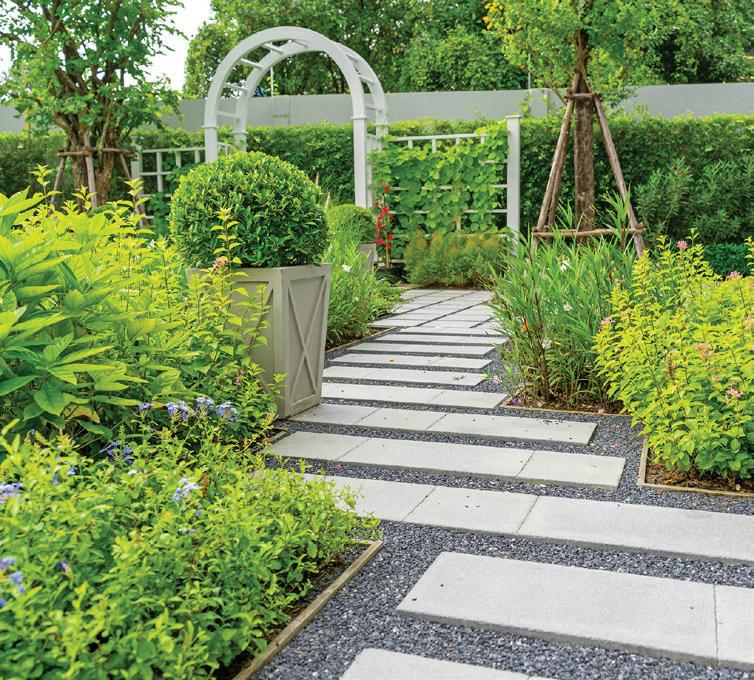
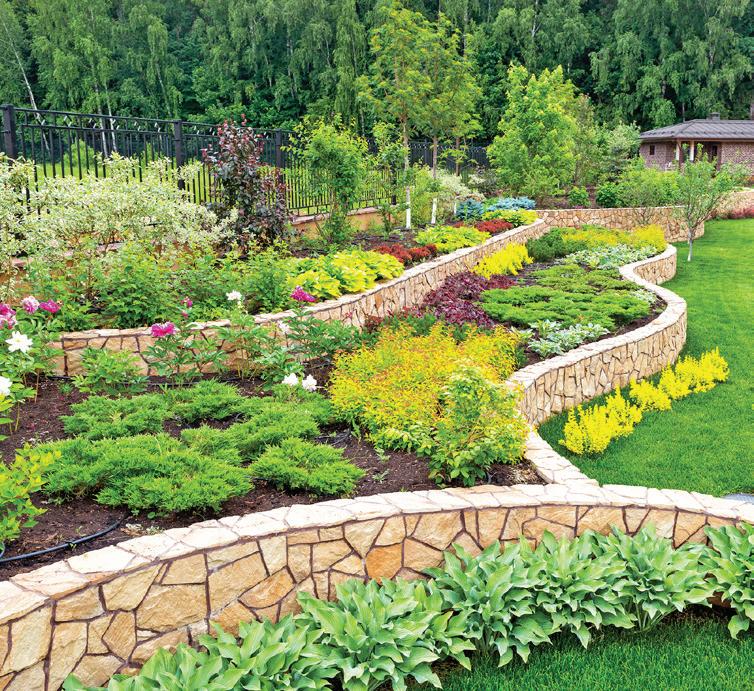
• Interlocking Pavers & Retaining Wall Systems
• Flagstone & Slate
• Real & Artificial Turf
• Decorative Gravel & Utility Sands
• High Quality Organic Soils & Compost Custom Mixes
• Drainage & Erosion Control
• Boulders
• Garden Tools & Masonry Supplies
• Pond Supplies & Pumps
• Soil Amendments
• Organic Fertilizers & Pest Control
• Decorative Mulch & Wood Chips
• Specialty growing products
delivery to your home or Jobsite


well for many years in the Santa Cruz Mountains. First, they were in Ben Lomond, and for the past 25 years-plus years, it's been at Skyote Mountain.
While the Vegas’ is a larger, rural property, it uses the same, or similar, building philosophy, style and materials as the Foster home in town. It was designed by green architect Daniel Silvernail, who remains a wellrespected, environmentally responsible architect in Santa Cruz today (silvernailarch.com). This home is a testament to the long-term solidity and comfort of a well-built straw bale home. It is pleasing and calming.
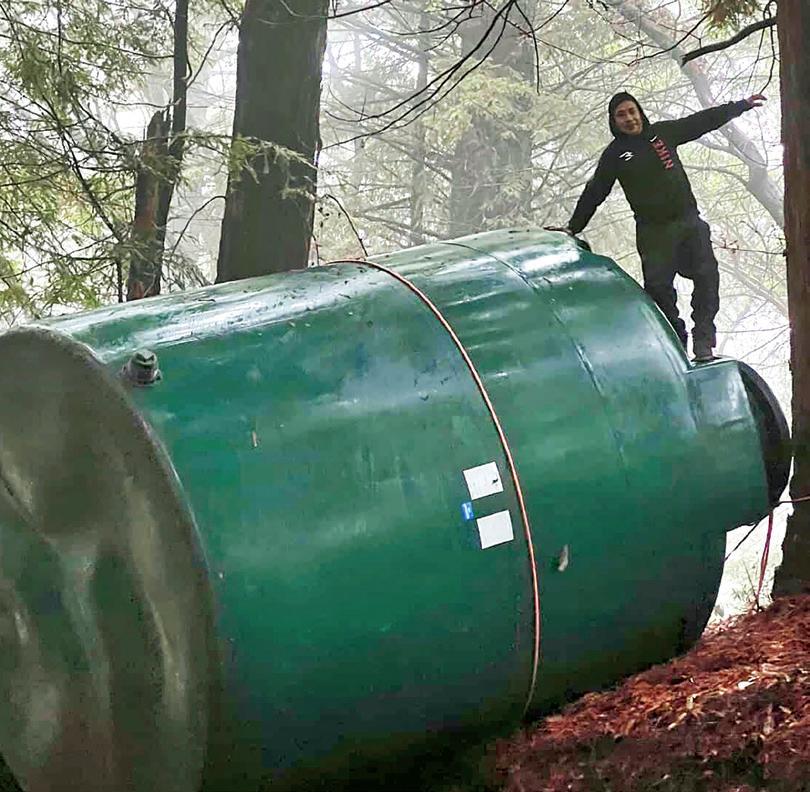
The building materials are nontoxic. The walls are thick and insulating. The flooring has radiant heat. With huge picture windows around the house, and southern exposure, it is passive solar. The temperature ranges from a comfortable 65-75 degrees, naturally. (However, Selene notes that with climate change, they are seeing higher indoor temperatures.) There is abundant natural light. They are fully off the grid in terms of electricity. The house is very low-maintenance. The only recent renovations are upgraded windows, modern solar panels, and high-quality gutters around the roofline. Those gutters are more important than they may sound–because they are helping the Vegas live more independently in terms of water. While they use city water inside the house for drinking, bathing and laundry, rainwater will now be piped around the sprawling garden areas, from two 5,000-gallon tanks. While Californians all over the state worry about watering their yards, the Vegas will have abundant water for theirs.
“I am deeply grateful to live in this beautiful place,” says Selene. “I see it as our responsibility to interact with the land in ways that are beneficial both for us and for the other beings that live here: trees, plants, animals, birds and bees.”
There were already many pollinators at Skyote Mountain, but Selene wanted new plantings to step up support for bees, butterflies, birds and other wildlife. (René wanted more blue pollinator plants!)
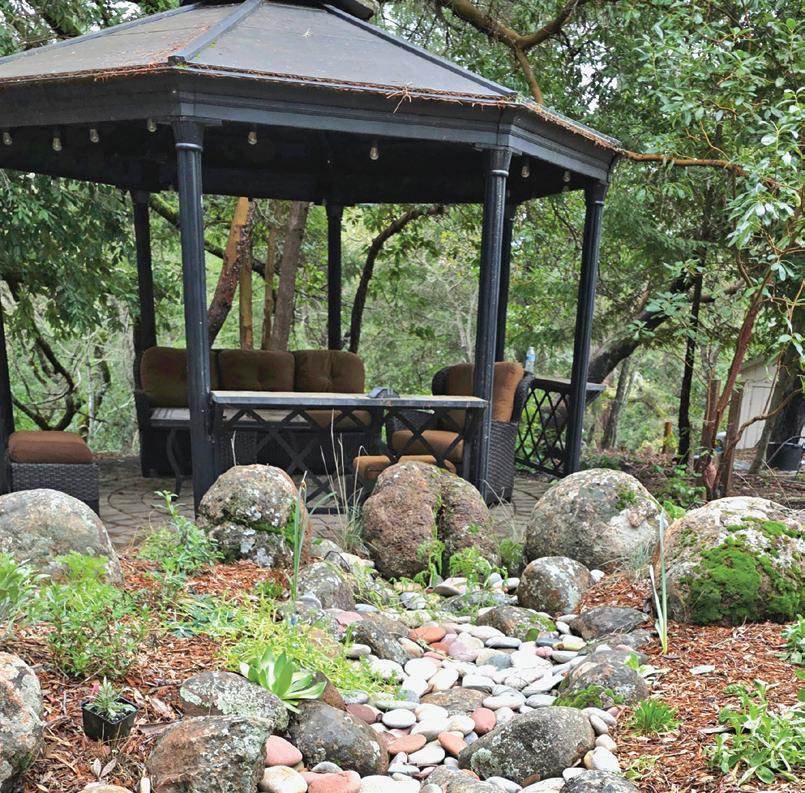
So, Terra Nova, taking a maximalist approach, planted in their front yard, a gazebo sitting area, and around the entrance and driveway. We also renovated and upgraded an old orchard, adding many new fruit trees and perennials to it, and built a vast, fencedin edible garden. Aside from the edibles, these are mostly drought-tolerant native plants.
In the three acres of the homestead’s clearing within the forest of redwoods, madrones, and oaks, we planted toyons (Heteromeles arbutifolia), coffeeberries (Frangula californica), western azaleas (Rhododendron occidentale), elderberries (Sambucas nigra),
10 »







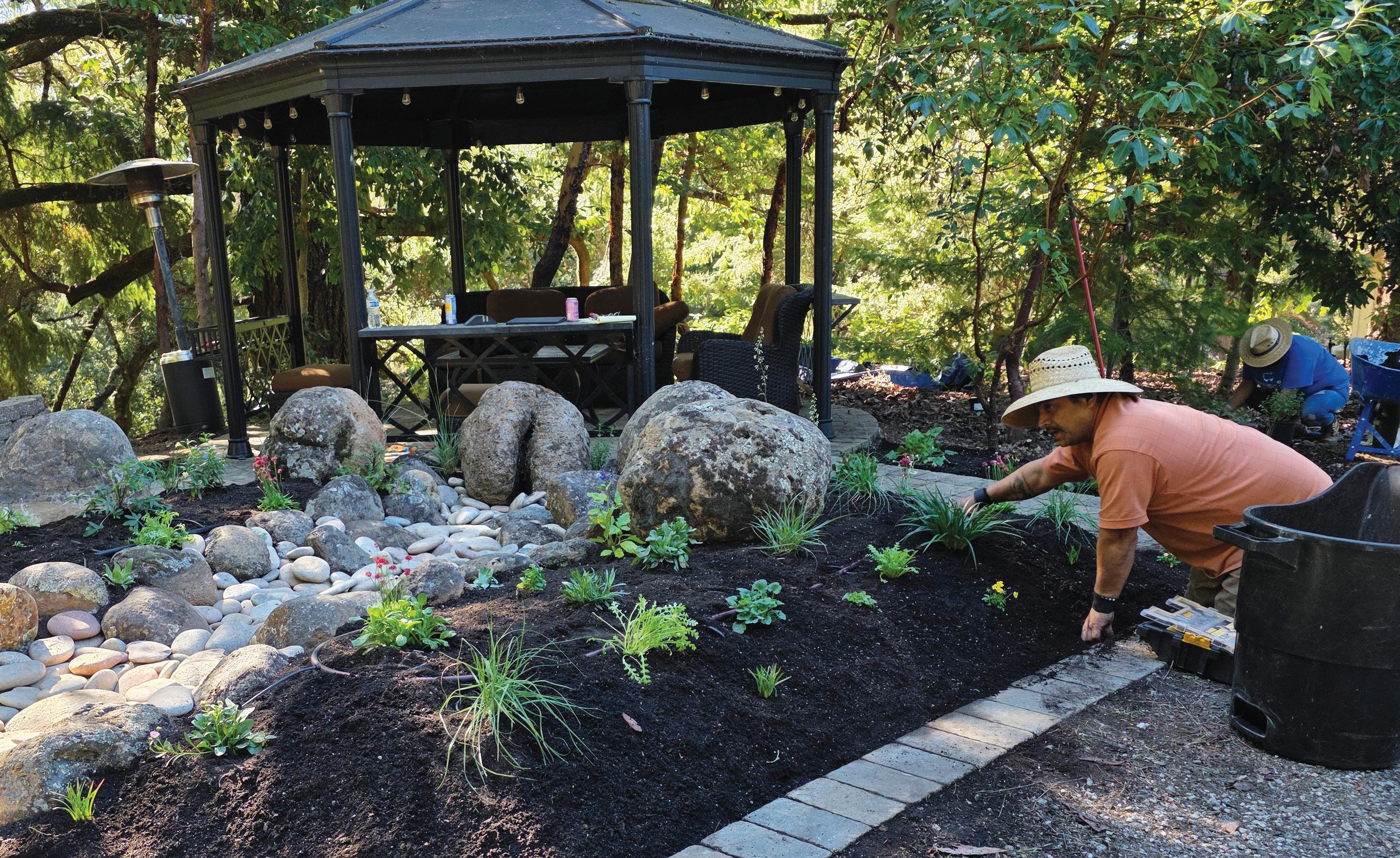
currants (Ribes species), a myriad of California sages from white sage (Salvia apiana) to Cleveland sage (Salvia clevelandii), and many more.
We didn’t forget the all-important buckwheat family (Eriogonum species.) Also our native rose (Rosa californica), color perennials like monkeyflowers (Diplacus species), and several native iris (Iris douglasii plus hybrids), grasses like deergrass (Muhlenbergia rigens), herbal ground covers that can be used in tea like Yerba Buena (Clinopodium douglasii) and Self-Heal (Prunella vulgaris).
Not to mention a flurry of wildflowers from various Clarkia species to Baby Blue Eyes (Nemophila menziesii), and more. There are also splendid, lowwater ornamentals like a collection of beautiful non-native Salvia species in the upper orchard, and hollyhocks! It's practically a botanical garden. But, even the drought-tolerant plants need agua to get established, not to mention the fruit trees and all the veggies.
Years ago, the Vegas grew enough produce in their former backyard in Ben Lomond that they didn’t need to shop for veggies at the store. And now, they will do it again. Their goal is to grow enough fruit and vegetables for themselves and to share with friends and neighbors. It’s something they
enjoy doing together.
Now, like electricity on the property, water for the landscape and gardens is also off the grid. Rainwater falls on the metal roof, flowing through the gutters through the downspouts, and through pipes to the tanks about 100 yards from the house.
Then, that water is pumped a few hundred yards to the other side of the homestead, to water all the new and existing landscape and edible plantings. Consider that it takes about 5.5” of rain to fill both tanks, which together can store up to 10,000 gallons. With their 3,000-square-foot roof, they can catch roughly 1,800 gallons in a one-inch rainstorm. Given that their annual rainfall is about 55”, there is plenty of water to fill the tanks a few times over. And they will.
Rainwater-to-drip-irrigation-systems are rare all over California, because the technology is not well-developed and special parts are not widely available.
This kind of project is still in the experimental stages. It is not included in landscaping curricula at local colleges or professional associations. It is off the beaten path.
Says René Vega, "We chose to reduce our impact on the Earth. That influenced the design of our house,
generating energy from the sun for electricity and for heating, and time shifting water from winter into the summer months with rainwater harvesting. It's our best effort to live lightly and comfortably in this world."
Terra Nova is one of the few licensed landscape contractors who want to take this innovation on, and get it dialed in. It’s all about systems, and how they work together. Like, getting the off-grid electrical to work with the offgrid irrigation. The Vegas’ solar home generates abundant electricity--and yet, you want a right-sized water pump that does not eat up too much power. Most water pumps we looked at were too powerful and could overload the system.
René, who is an engineer as well as an architect, helped design the system led the crew in the right direction.
According to Rupert Poole, the lead water management tech at Terra Nova, “To minimize power usage and draw on the solar power system, we chose a 1-horsepower water pump that requires less than one kilowatt of energy per hour of run time.
This is the smallest, most efficient pump we could find that still provides enough water pressure and flow rate for the Vegas’ outdoor water needs, including water for irrigation and
several hose bibs.”
This pump can move water up to 25 gallons per minute at 55 PSI. He adds, “Sizing the pump correctly is important for energy savings, as a larger 2-horsepower pump uses twice as much energy per hour of run time.” That pump, unfortunately, is not available locally. It took a lot of research to track down!
René took our suggestion to install two smart controllers, including one with 24 stations. These let “the weather control the water.” The smart controllers are programmed to change with real-time weather information. This means, regardless of weather changes, all the plantings will be wellwatered but not overwatered. Smart controllers have been proven to save as much as 75% of outdoor water use. And, when it starts raining, you don't have to go outside and get wet and turn off your controller, and then remember to turn it on again later.
This is especially helpful for people who travel.
So why are the Vegas continuing their ecological transformation on Skyote Mountain?
They remain committed to sustainable living, just as in their younger days. Says René, "We










chose to reduce our impact on the earth. That influenced the design of our house, generating energy from the sun for electricity and for heating, and time shifting water from winter into the summer months.
“It's our best effort to live lightly and comfortably in this world."
They also like the independence that comes with generating their own energy. This work is also considered “disaster preparedness.” With all that water flowing around the homestead, water access points are readily available in case of fire.
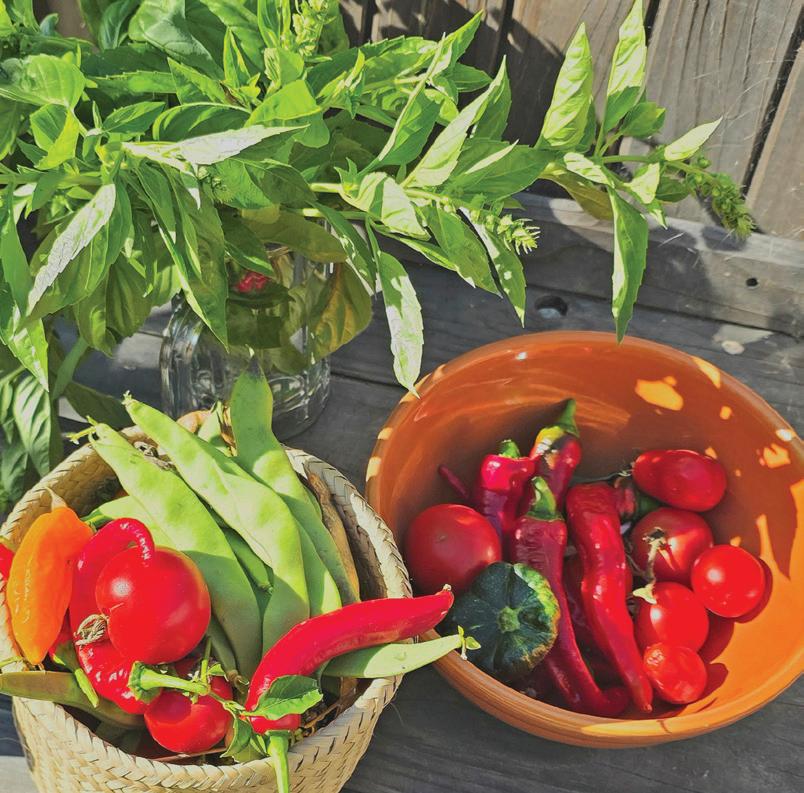
And, by growing their own food, there will always be something to eat-something fresh and organic, grown with their own hands, without pesticides. The orchards and edible garden are also an excuse to observe nature, as well as for lots of celebrations, in particular harvesting parties as there are now upwards of 50 fruiting trees and shrubs onsite, from plums to pomegranates, and from figs to avocados, not to mention all kinds of berries.
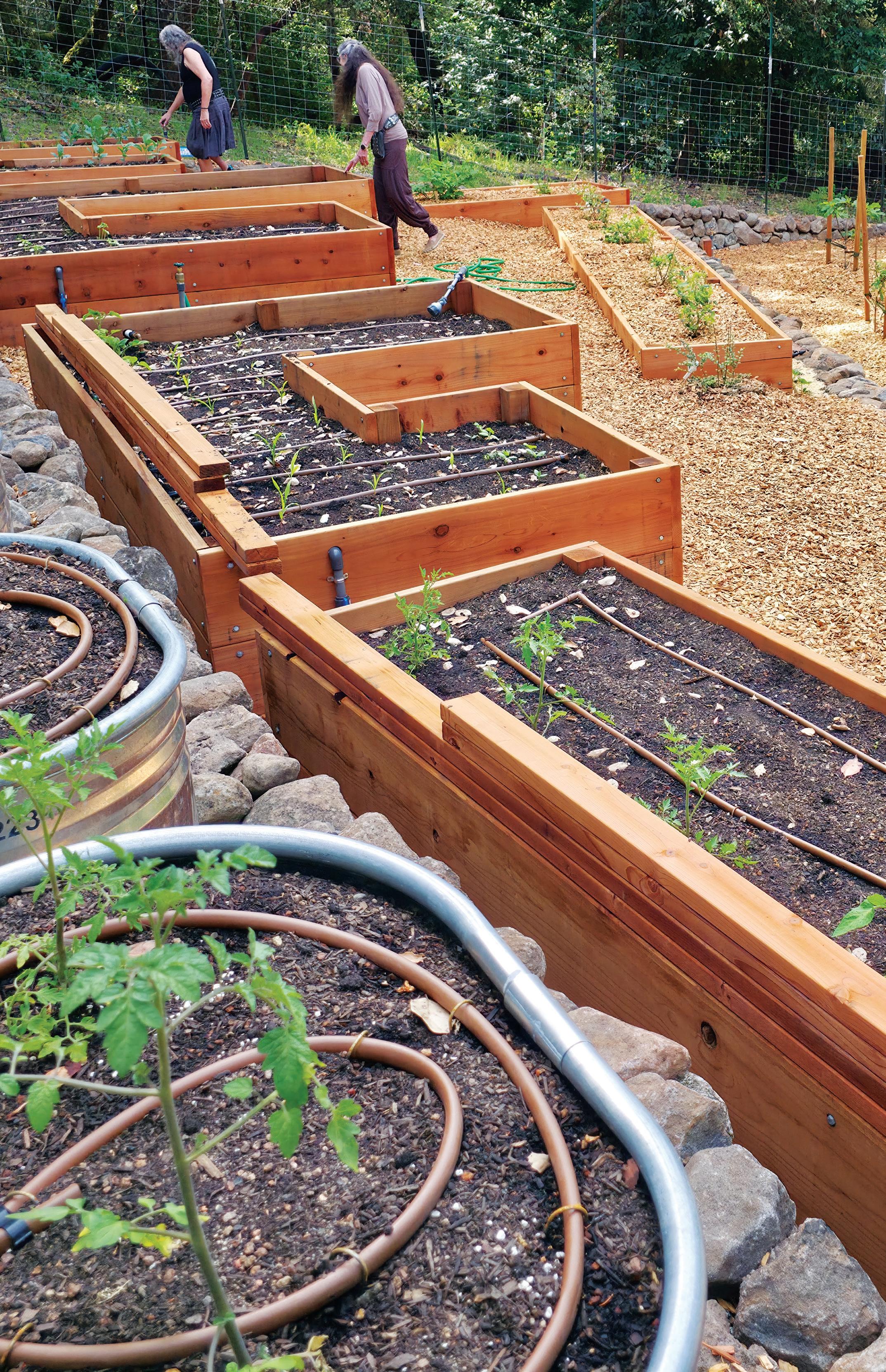
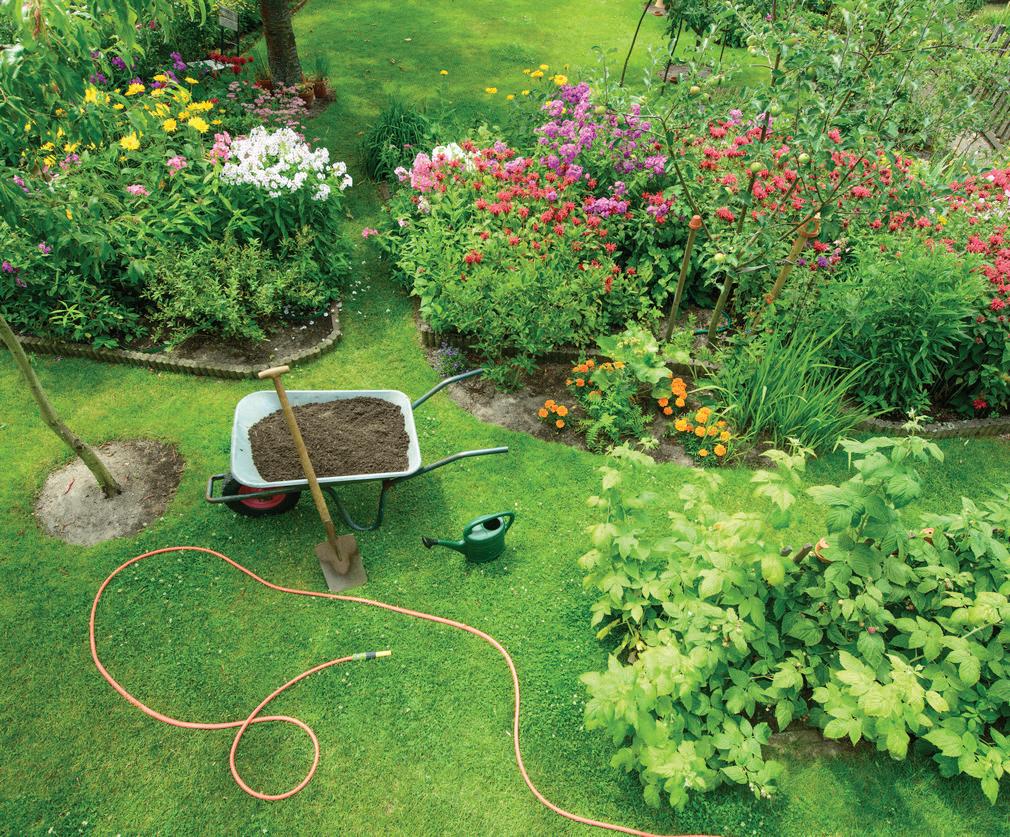
In addition to the water system, to transform the house into a sustainable estate, Terra Nova built about 700 linear feet of critter fences around the orchard and edible garden, which contains about 500 square feet of raised beds, most of them “keyhole beds”. The edible garden itself is about 10,000 square feet. We cut terraces out of the slope to make flat planting areas, as they do in the foothills of the Himalayas. We “sheet mulched” across vast swaths all over the homestead to get rid of weeds permanently or vastly reduce them. It's a harmonious place.
Michelle Landegger of Studio Boa says, “It is calculated that we have enough straw to build every new home needed to house California’s growing population and need for housing. And we can help, not hurt the environment, by using a local low embodied energy building material that captures, not releases, carbon!”
Like the Vegas, Ken and I are committed to sustainability. After all, my husband has five worm bins–and we send no dog poop to the landfill!
Because the worms love the poop. (We use this on plantings around our fence, and we don't use it on edibles, even though it makes beautiful, first-class compost that is free of pathogens. Plus, the dogs eat organic!) We are still highly focused on our backyard. But, we acknowledge, the beauty and comfort of the home is also of great importance–and we’ve built a cob tiny shed with a loft--in the backyard! Full circle.
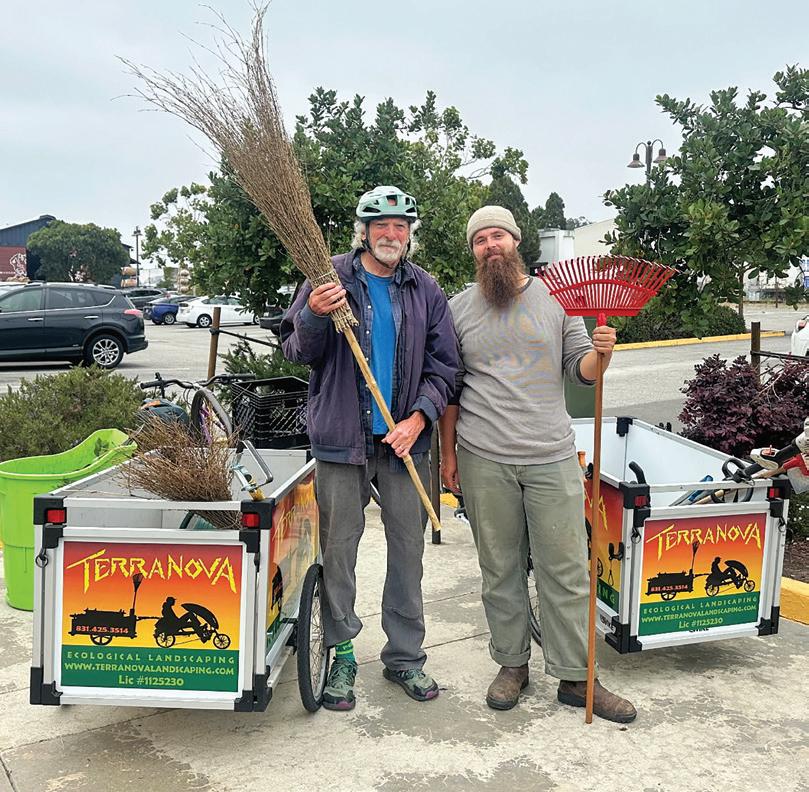
Reach Jillian and Ken at terranovalandscaping.com
NOTHING BUT THE TRUTH A truth window shows the straw bale and is a great conversation piece. PHOTO: JILLIAN STEINBERGER-FOSTER
BY JILLIAN STEINBERGER-FOSTER
As a part of its ministry’s mission, Mt. Calvary Lutheran Church in Soquel is collaborating with partners to build New Creation Village, which will be a straw bale community (tiny homes, small dwellings and apartments) for unhoused people, on its grounds. Their partners include Just Places (just-places.org), which is organizing the effort, as well as People First (peoplefirstscc.org) and Arkin Tilt Architects (arkintilt. com), a leader in natural building.
They have made significant strides toward designing several of the dwellings, working through the planning and permitting process and securing some of the necessary funds. Now they are looking to the larger community to help bring this project to fruition.











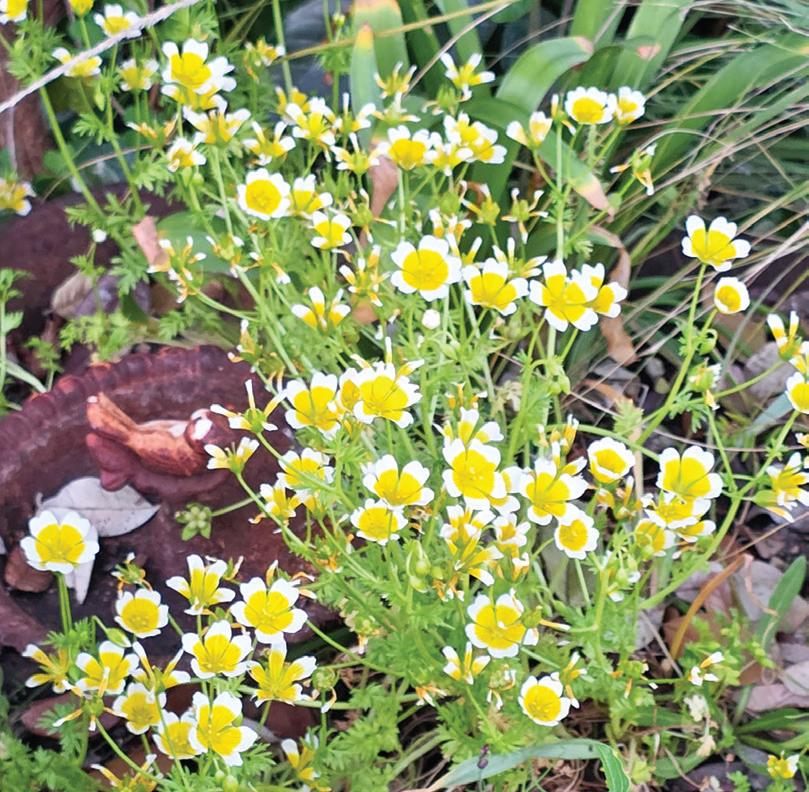
These were planted at the Vegas’ eco-house
BY JILLIAN STEINBERGER-FOSTER
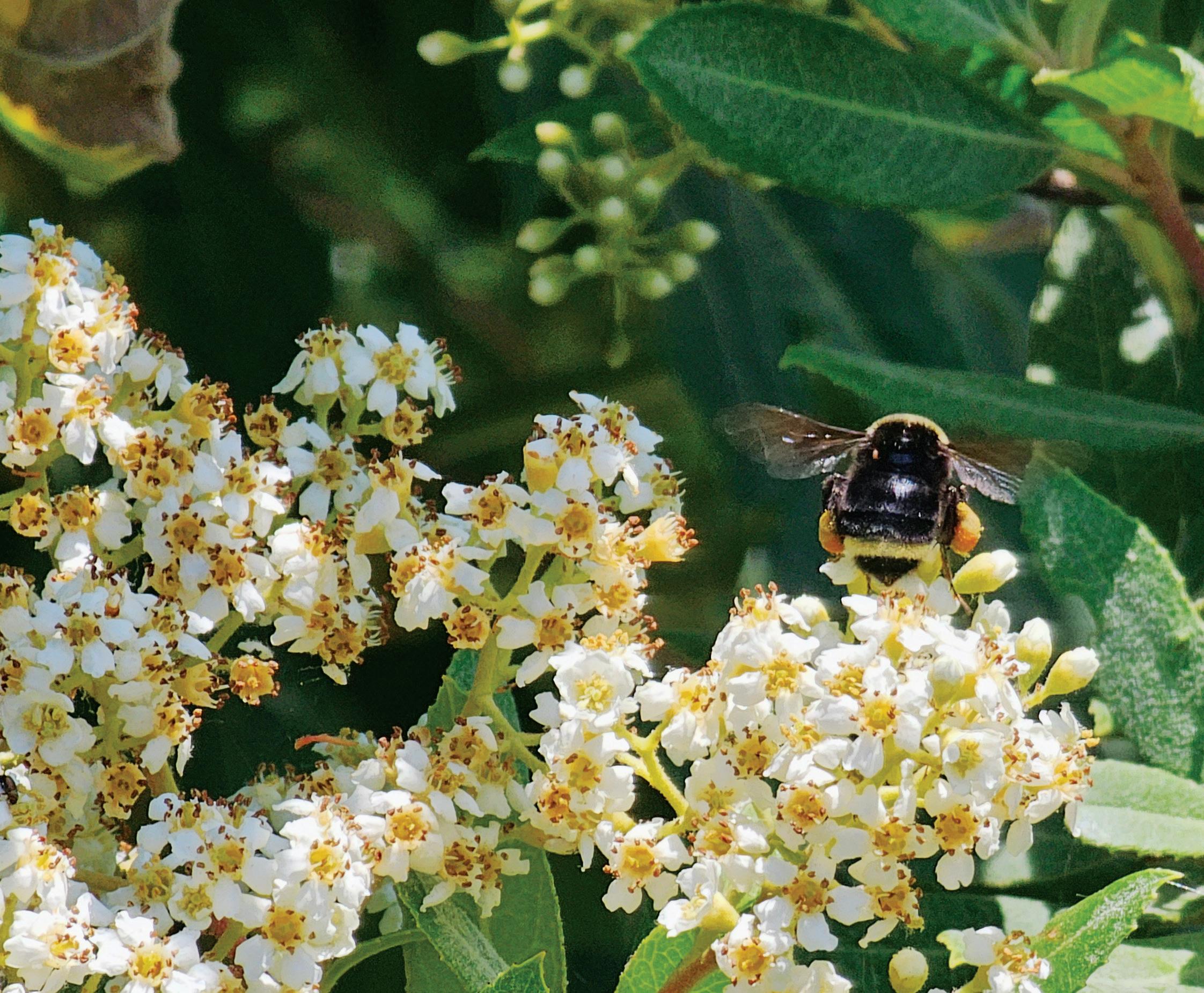
A carpenter bee is one of dozens enjoying pollen on a Toyon in bloom. In winter, red berries serve as “natural” holiday ornaments.
Here are a few selections that we planted at the Vegas' ecoestate. They are all useful, but in different ways. You can plant any or all of these now - they are in season.
Day of the Dead Marigold, Aztec Marigold, Cempaxochitl (Tagetes erecta) Native to Mexico and Central America, these giant marigolds are used for decorating and crafting, especially during festivals. Today, they’ve been adopted in India and Nepal, where they are a sign of celebration. No wonder they are such a great front door flower, either in a pot or a garden bed–they are cheerful and welcoming. They come in bright orange and yellow, like the 6-packs at the nursery, but they are larger–up to 3’ by 3’ when they are in the ground in rich soil, in sun, with consistent water. (Sustainability tip: Use dishwater!) The flowers themselves are 2-5” across. To keep the plant looking fresh, deadhead the spent blooms–and toss them around the garden, because they may reseed! They are deer-resistant and attract butterflies.
I cannot go through the summer and
fall without these beauties. If you plant them in spring, they will last until frost. I interplant them in edible beds, such as with tomatoes or cucumbers, because they are said to be beneficial–or “allelopathic”--driving away pests with their scent. The petals are edible, and they pretty everything up. Toss them on salads or desserts, or freeze them in ice cubes for iced tea, lemonade, or your favorite fruity cocktail or mocktail. String them as garlands around the house, and use them in wreaths–they will purify the air. They are also popular for making natural dyes. And of course, they are perfect for bouquets, nosegays, and boutonnieres
Fall in Love with California’s Native Monkeyflowers
Monkeyflowers come in many forms, sizes, and colors, filling unique niches and garden spaces in both sun and shade, from the Alpine Sierras to the wild beaches of Mendocino, to any garden near you. In the figwort family, they are classic California plants that draw pollinators.
White monkeyflowers (Diplacus bifidus) stay low to the ground, about 2’
Mexican Daisy (Tithonia diversifolia) This is a daisy with a purpose. It is a large, evergreen, free-flowering plant that can get to 12’ x 12’ (if you let it). In fact, if guests can’t find your house address, this may be the plant for you. Plant it in the front yard (at least 6’ away from a sidewalk, fence or exterior wall), and when it’s blooming from around late June through frost, just tell people, “Look for the garden with the huge yellow daisy plant, that’s us.”
It’s unlikely that the Joneses will also have this plant, but they might after they see yours because it’s visually spectacular–a showstopper–not to mention a favorite with the pollinators. It’s easy to grow–it’s a no fuss plant that can grow in poor soil and can go for long stretches without water. (Not that it doesn’t mind some compost and a splash of the hose.) It wants to be in the sun, in the ground, and will provide shade for other plants that need it.
high, and wind gently around the other plants in an ornamental garden bed, setting them all off. They look fresh and lacy most of the year. They can grow in sun or part-shade, where they lighten up dark spaces.
Our dominant, drought-tolerant sticky monkeyflower–which is usually but not always a very bright orange–looks as great in a home garden as on the side of any slope all over the Santa Cruz Mountains and much of the rest of California.
Sticky monkeyflower is as beautiful, bright and showy as any other flower at the nursery (Diplacus aurantiacus). Its native hybrid “Eleanor” is a softer yellow-orange. Red monkeyflower is similarly gorgeous (Diplacus puniceus).
Seep Monkeyflower (Erythranthe guttata), which is yellow, grows in riparian areas, so you can plant it at a wet spot in your yard, or by a pond, unlike most of the others, which like it drier. Some monkeyflowers even grow right at the shore along the California coast, getting washed by the tide a couple times a day–with seawater! You can observe these at Jug Handle State Natural Reserve in Mendocino County–it’s worth taking a trip. (parks.ca.gov)
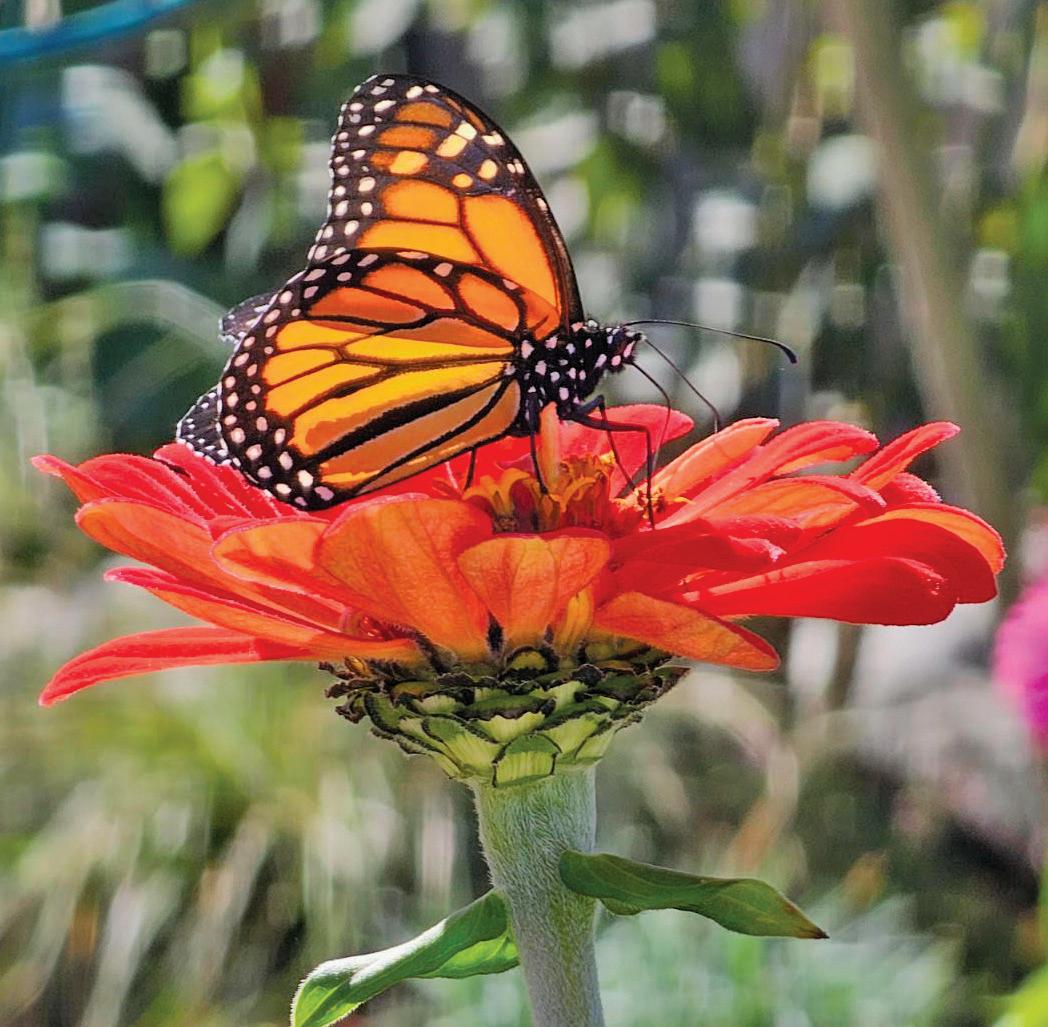
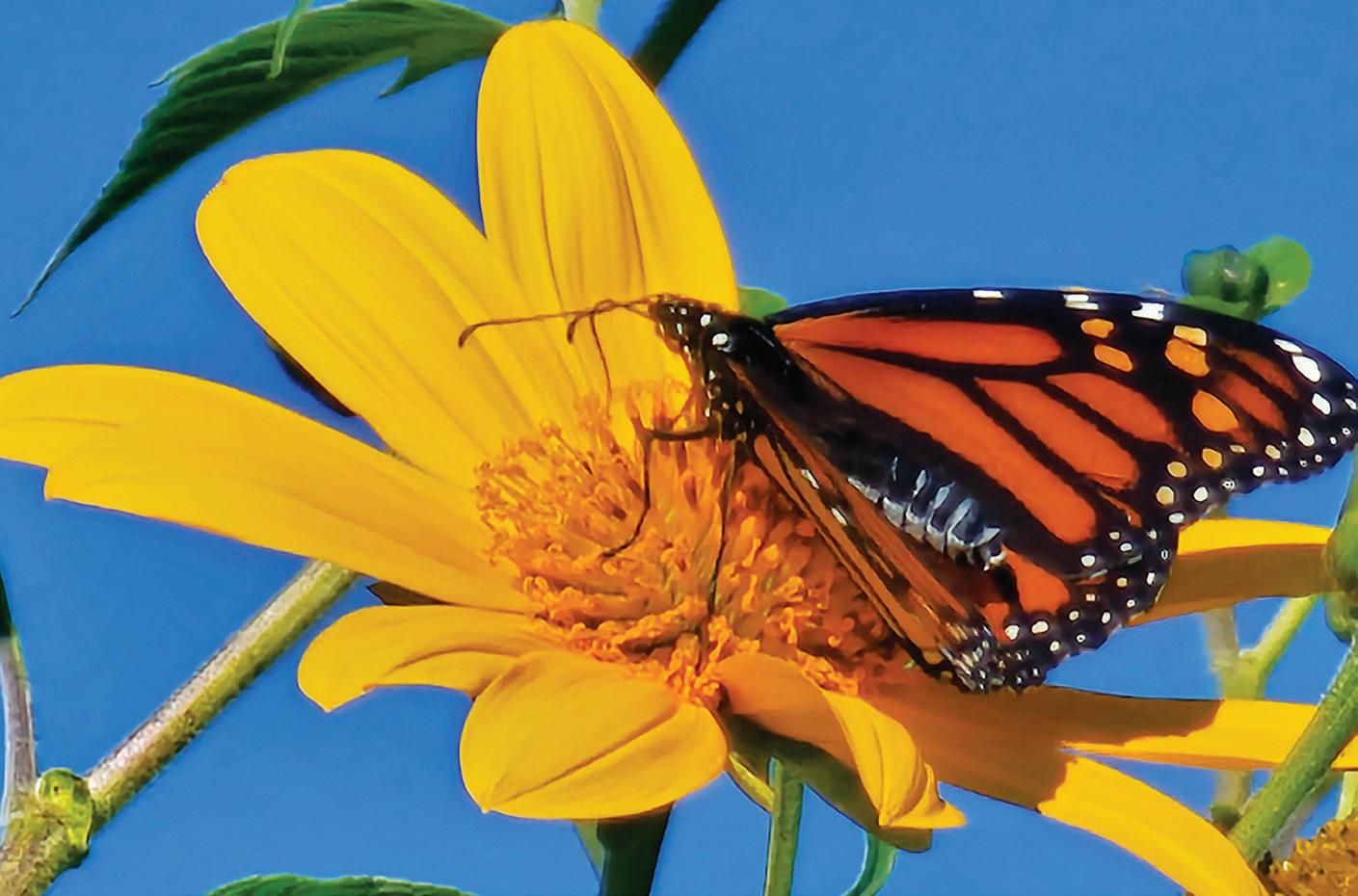
I have it in my small front yard garden, which is less than 1000 square feet, where it makes a perfect partial privacy screen. If you want it smaller, you simply cut some stems back where needed once a month or as needed. When it’s done flowering in December or January, you can hack it back. Besides colorful privacy hedges, Mexican daisies can demarcate a property line, either alone or in a mixed planting with other large plants such as pink or purple blooming species of Iochroma, Tiger Eye Abutilon (Abutilon pictum) and California flannelbush or Fremontodendron. We planted Mexican Daisies at the Labyrinth Garden at Calvary Episcopal Church in downtown Santa Cruz, in the Little Red Church at Center and Lincoln Streets. We hope they cheer people up when they walk by these monster yellow daisy bushes visited by monarchs.
This is for everyone, whether you have a pot on your apartment doorstep Do you have any pots around?
Go to the nursery and pick up a couple of organic bags of potting soil - G&B is a solid, organic Northern California brand. Fill the pot partway. Cut an organic potato of any type or types (organic markets often feature numerous colors, shapes and sizes of potatoes) from the store in a few pieces, and cover them with soil. They will grow green foliage and look nice. Eventually, they will start withering and it will be time to go digging for your little gifts. Potatoes grow. That’s just what they do. Easily!

We



‘We cracked the matrix,” an elated Jeff Nordahl tells me over the phone in early March. For more than a decade, the hempclad, punk-rock and Grateful Deadinspired cannabis farmer has abided by California’s regulatory “matrix,” while hoping to see it someday crack open— just enough to allow direct cannabis sales to customers.
“If we want to see craft cannabis farms survive, we’re going to have to figure out how those small family farms have opportunities to sell direct, just like small wineries. That’s the model,” says Nordahl, whose wish list includes farmers markets, in-state shipping and weed-tasting farm tours.
Now, thanks to Santa Cruz County’s Cannabis Farm Retail Licensing Pilot Program—which took effect on April 1—Santa Cruz craft cannabis farmers will be the first in the state to receive at least some of the privileges that keep small, craft wineries thriving: The three-year pilot program allows for direct on-site sales, and educational farm tours complete with on-the-farm weed sampling of purchased products.
“I have huge gratitude to the Santa
BY MARIA GRUSAUSKAS
Cruz community and to the people in government who have supported this concept, and see cannabis farming as a craft, and as an art, and as a lifestyle,” says Nordahl. “It’s cannabis as a verb, as opposed to cannabis as a noun.”
Nordahl began growing medicinally for himself decades ago, after realizing the plant helped his body recover from a long-undiagnosed case of Lyme disease. He founded the medical cannabis collective Jade Nectar in 2016, which produces a line of organic California olive oil and cannabinoid tinctures.
Today, Nordahl is the only remaining licensed cultivator in the Santa Cruz Mountains, and the first cultivator in the county approved for the pilot program. Roughly a half-dozen of the county’s 21 cultivators are expected to follow suit.
The impetus, says First District Santa Cruz County Supervisor Manu Koenig, was to try to at least begin to position the local cannabis industry to be sustainable, and maybe even have some advantages over other regions.
“We had been seeing declining tax revenue for as long as I’ve been on the Board,” says Koenig, who took office in 2020.
The county’s cannabis business tax revenue has dropped from $667,944 during the last quarter of 2020 to $142,081 as of this March.
“Part of that has been due to stiff black market competition and steep taxation, but also that we made it relatively difficult for cultivators,” Koenig says. “This was one of several recommendations that myself and [Fourth District County Supervisor Felipe] Hernandez brought forward to at least try to reward the folks that were still doing business in cannabis and had been playing by the rules.
“I think we need to become cultivators if we want to see the industry sustain itself. Just like these folks are tending to their plants, we need to tend and care for the industry in a way that I think will hopefully be beneficial to our collective health.”
As the first county in the state to dip its toe into cannabis tourism and direct-sales, Santa Cruz’s legacy of robust cannabis culture and activism, and production of high-quality cannabis—not to mention its cultural embrace of organic farming in general— may position it as a most promising candidate for spearheading reform in an
industry sliding precariously toward a monopoly of large industrial farms.
In addition to Santa Cruz’s well-known and historical cannabis culture, Koenig cites our proximity to the Bay Area as a major competitive advantage, providing an opportunity to tap into that area’s thriving tourist market.
“Santa Barbara has been growing enough cannabis to smoke out the whole country,” Koenig says. “We’re not going to compete on quantity, but we can compete on experience. Santa Cruz has always been about experiential tourism—certainly for the waves and mountain biking, and it should be for cannabis, as well.
“Part of the downside of legalization has been that we’ve seen sort of a trend toward higher and higher THC, and that being the measure of cannabis’s quality. The hope is that by enabling social experiences under the law, we’ll be able to compete more on the experiential side of things.”
Before voting the Pilot Program into being, the Board of Supervisors conducted public hearings in







toward indoor-grown, high-THC strains and their ultra-processed, petroleumextracted cannabis distillates, which he compares to the corn syrup model. It’s a trend that he says results in an isolated user experience, disconnected from where, how, or even why your product is grown.
“The industry wants to reduce cannabis to a consumer, packaged good. But cannabis is an experience. There’s a moving, living spirit that radiates from this plant,” says Nordahl. “And for people who are interested, being able to see the plants grow, understand where the cannabis is coming from and how it’s grown, really enriches and amplifies the experience. We want to reestablish the connection between farmer and patient and customer. That’s where the magic is.”
Cradled high in the mountains of Boulder Creek, a sun-drenched southfacing slope transforms, each growing season, into a mystical garden of landrace cannabis plants from all over the world.
This botanical garden of cannabis is a small slice of Jade Grove Farm and Wellness Center, located on a 250-acre park Nordahl acquired in 2017. The secluded mountain property hums with potential, encompassing miles of hiking trails through the redwoods, as well as a second cultivation site edged by a creek, dubbed “the Shire,” where certain heirloom and heritage strains are grown.
each district, and the Cannabis Licensing Office spoke with the cultivation community to understand the risks and benefits, as well as with the general public. While public concerns centered around stoned driving, local dispensaries were initially wary of competition.
“Dispensaries expressed concern during the public discussion phase, and during the ordinance adoption hearings, those issues that they raised led to modifications,” says Cannabis Licensing Manager Sam LoForti.
“So I believe the Board of Supervisors, the retailers and the farmers, as well as the community in general, shaped the program, and I do think the retailers were able to push for some changes in the program that hopefully mitigated their concerns.”
Those modifications include a restricted operating window of six contiguous months throughout the year, as well as a reservation-only model for the tours. Another condition of approval that every retail farm licensee must maintain is a verifiable designated driver program, so that no one will be allowed to consume cannabis and then drive away.
“People have different opinions about why the industry is declining,” says Nordahl. He points to the trend
On the hill above the gardens sit a few bunk houses, Jade Grove’s dispensary, freshly painted with a mountain lion mural by local artist Matt Jones, and a 3,000-square-foot dining hall containing a commercial kitchen— all relics of the site’s time as a Boy Scout camp during the ’40s and ’50s.
I was lucky enough to visit the garden during the peak of Jade Grove’s third season back in 2019, and will forever remember the delight of seeing so many different manifestations of the same plant in one place, and how, when the breeze sets in, thousands of leaves—in all sizes and shapes and colors— waved and shimmied and shook, as if experiencing the tickle of actual joy. Now, cannabis enthusiasts and home gardeners can experience and interact with the plants firsthand, and learn all they’d like to know about regenerative farming techniques and philosophy.
“Our farm is a window into the entire global world of cannabis,” says Nordahl. “It’s sort of like an art museum. And to tell you the truth, I’ve learned more about world geography through cannabis. I grow a cool plant, and then I go, ‘Where is Lesotho?’ And then I find out it’s a tiny country in Africa, with super high elevation and snow. They grow really great cannabis.”
Farm tourists will get to











walk among 50 or more of the unique varieties of landrace cannabis–pure strains– grown from Nordahl’s extensive seedbank. And, in a shady designated consumption area featuring picnic tables edged by redwood fairy rings, hang out and sample any tinctures or flower they purchase at the dispensary. Nordahl is working out details with a shuttle bus company to transport tourists to the site, and estimates tour pricing will be around $100.
Like heirloom varieties of vegetables, landrace varieties of cannabis have been selected for desirable traits and passed down through generations, but they are also specific to a region, whether that’s a village, a province, or a country. They are the oldest, purist cultivars; the foundational building blocks for all modern strains.
“Some of these landrace cannabis plants, it’s like the smell that they produce is some color your eyes have never seen. It’s a smell you have never smelled, and it throws your brain for a loop just because it’s this completely new olfactory experience,” Nordahl says. Highlights, just to name a few, include: the comically shaggy, dark purple-tinted Chitral Kush of Pakistan; the towering, spindly-leaved Ethiopian sativa that carries the rare, deeply energizing cannabinoid THCV; the pink-haired Mexican Sinaloa—known for the silly and giggly psychoactive effects characteristic of the classic old-school Mexican varieties of the ’70s-’90s—“from back when cannabis made you laugh,” says Nordahl; and some handsomely stocky Thai strains that Nordahl says have such an uplifting psychoactive effect they make you feel like you’re walking on pogo sticks. “You actually have to concentrate on not bouncing when you walk,” he says.
But landrace and heirloom genetics are facing their own extinction event, as commercial monocrop agricultural models dominate the industry, opting for those high-yield, high-THC strains that grow well in the controlled greenhouse environment of factory farms.
That’s why Nordahl is so excited to offer seeds from his landrace seedbank at Jade Grove’s on-site dispensary. The dispensary, he says, will be intentionally simple: a folding card table and a couple of chairs selling Jade Nectar tinctures, seeds, and un-trimmed flower— untrimmed to pass on the savings of this expensive process to the customer, and also, because “it’s a plant, and we’re going back to celebrating it as a plant. You can just flick off the leaves.”
Nordahl says he gets 10-20 emails a week from people asking for seeds, which he has to deny in order to not jeopardize his license. Now, any home gardener willing to travel to the Santa Cruz Mountains can buy the seeds legally through the track and trade system at his dispensary.
“We’re really hoping that by providing these seeds we’re going to be inspiring people to grow their own cannabis in their backyard or on their deck, or in their veggie gardens,” says Nordahl. “The best way to start preserving these genetics is through hobby seed banks. We’re trying to be one little central source for a diaspora. And I think that’s where landrace and heirloom genetics are going to survive—in the hobby garden of your backyard.”
On April 12, Jade Grove welcomed its first reservation-only customer, a local woman and backyard grower who was looking for landrace seeds to make her own tinctures and salves to share with her ill husband as well as friends and neighbors.
“This is our exact type of customer. A real backyard cannabis enthusiast and warrior,” Nordahl texts me, with his signature devil-horn hand emoji.
Local gardeners should have good luck growing landrace strains, because they are designed to be grown outdoors in the elements, and really just left alone. They don’t need staking, like most modern, giant-flowered strains, and, if you put some thought into providing good soil, they will thrive.
“Landrace cannabis can survive in the elements without imploding,” says Nordahl. “It still has disease resistance.”
When I visited Jade Grove in early March, the hundreds of hexagonal raised beds dotting the hillside were not yet planted, though 6-inchdiameter and larger trunks told last season’s vigorous tale. Nordahl raked his fingers into the soil to reveal the threadlike webbing of mycelium—the soil-enriching result of the hugelkultur growing method he employs, which relies on the breakdown of woody debris to bolster the soil’s biodiversity. The botanical garden also gets yearly applications of aged local horse manure from up the road.
First up for planting this year are some Middle Eastern landrace indicas.
“One of our absolute favorite plants of all time to grow is an Iranian variety that flowers any time of year. It’s just a beautiful plant,” says Nordahl. “The modern concept of indica is that it’s sleepy and lethargic. But real oldschool indicas are relaxing, without being incapacitating. They are dreamy and meditative, but really clear and thought-provoking.”
For Nordahl, the total magic of landrace cannabis is not just that they carry the influences of their origin climate and seasons, but also a whole culture’s idea of euphoria, mysticism, and whatever they found cannabis useful for. “They are a medium for expression,” says Nordahl. “There are beautiful cannabis enthusiasts in every part of the world. And we want to connect with them and to celebrate them.”
To book a farm visit, go to jadegrove.com.

As of print time, the second farm in Santa Cruz County to be preliminarily approved for the Pilot Program is Coastal Sun, an organic and regenerative cannabis and blueberry farm located off Green Valley Road in Watsonville.
Like Jade Nectar, Coastal Sun’s ethos of providing affordable organic cannabis as medicine has its roots in Santa Cruz’s trailblazing history of medicinal cannabis, and both farms have provided cannabis for Wo/ Men’s Alliance for Medical Marijuana (WAMM) patients on donation.
“That was my tie-in,” says Shy Ann Kenwood, procurement director and co-owner at Coastal Sun. Kenwood came down out of the Prop 215 Santa Cruz Mountains growing scene to work at Coastal Sun shortly after legalization, and is now a co-owner of the farm along with nine others.
“I knew that Valerie [Corral] was working with these guys and they were providing medicine to patients. She was a huge inspiration to me,” says Kenwood. “We had just under 40 acres, then another 80-acre parcel that got started as blueberries. Then we started growing cannabis for WAMM when Val lost her farm.”
Kenwood, who has rheumatoid arthritis, says cannabis helped her get off pain pills. “I was put on Lodine and
Vicodin by the age of 17, and by the time I got to college, I realized I couldn’t really function on pain pills,” says Kenwood. “I started really leaning into cannabis because I knew it helped, and it changed my world.”
Coastal Sun was one of the first cannabis farms in the state to be certified as organic. But the farm, which recirculates its water, also takes a regenerative approach to growing—and farm tours will focus on educating the public on what that actually means.
“I’m from the Central Valley, and out there you can really see, we’re headed toward a dust bowl situation again,” says Kenwood. “When they finish a crop, they rip it out and they leave the soil bare, and you lose your top soil and nutrition because the sun just beats down on it. You’re left with soil that is inert.”
In regenerative ag, the goal is a biodiverse, living soil—which is achieved through techniques like cover crops, hedgerows, insectaries, grazing animals and companion planting.
“You’re creating an ecosystem that’s sequestering carbon from the atmosphere,” says Kenwood. “When you come to our farm, you’ll never see a bare field.”
In the interim between growing seasons, cover crops—a mix of grasses and legumes that provide natural fertilization—help keep the soil









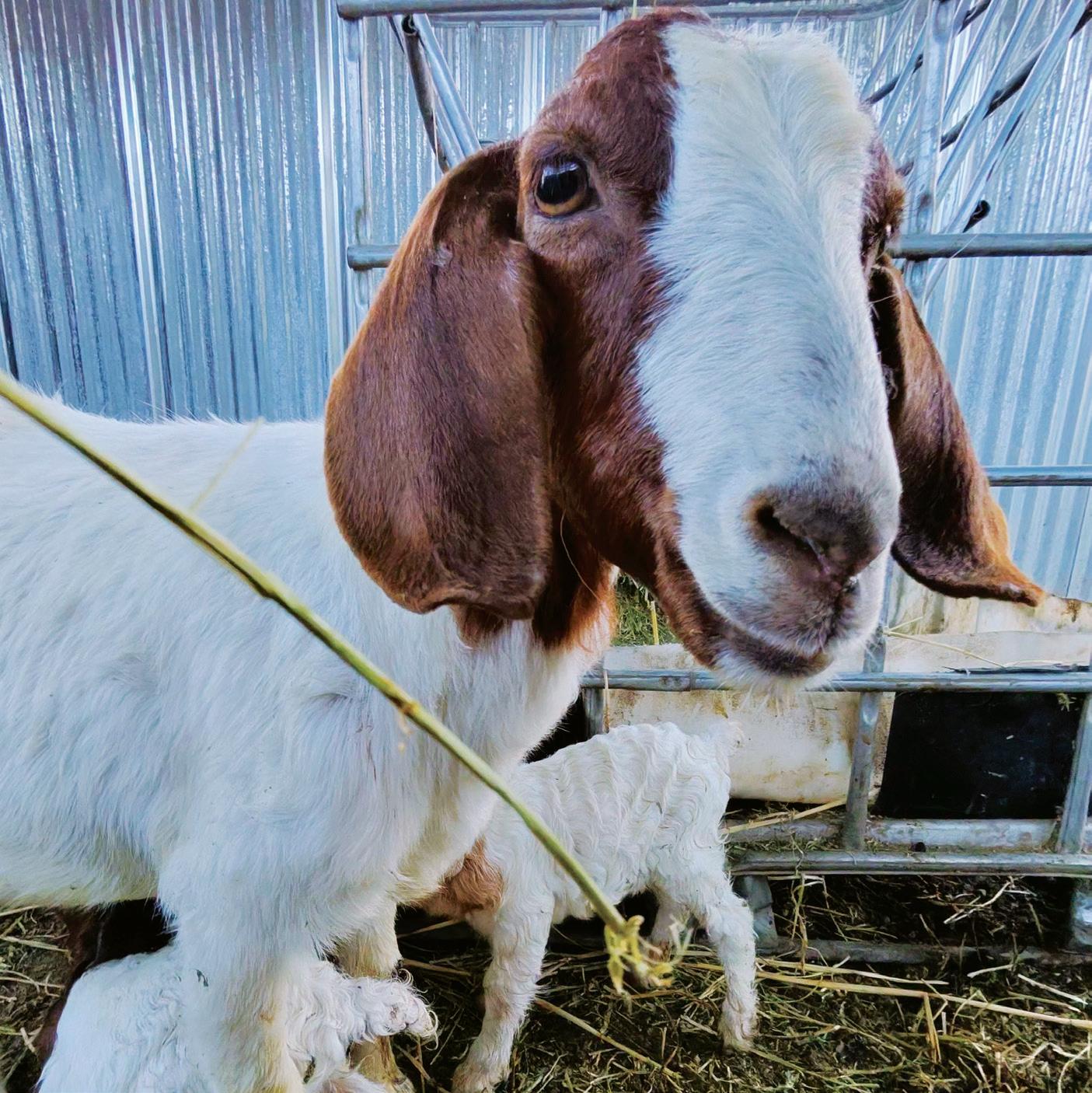
biologically active. “We have like 500-800 goats that eat the cover crops. It’s not the prettiest picture, but poop is a really big part of organics. The goats stamp their poop into the ground, which adds bioavailable nutrients back into the soil,” says Kenwood.
Wide swaths of tiny white flowers grow along the rows of cannabis—a companion planting of sweet alyssum that attracts beneficial insects to help keep the bad bug populations in check.
“Since we can’t use pesticides, a lot of what we use is bugs,” says Kenwood. That said, the outdoor varieties they grow tend to be healthier because of the elements they are subjected to.
“A lot of people like indoor cannabis because it gives you these beautiful crystalline buds, but when you smoke it, it doesn’t taste like much. Outdoor cannabis has much more of a flavor profile,” says Kenwood.
That flavor comes from terpenes, aromatic compounds created as a natural response to the environment, helping the plant respond to stress in the environment and ward off bugs.
Coastal Sun will offer on-site consumption, and its dispensary will sell blueberries, cannabis flower, and young cannabis clones to take home and plant in your garden.
“We’re really looking for an immersive, winery-style walking tour,” says Kenwood. “We want it to be a very involved, dynamic, hands-on experience for people who visit. Whether they use cannabis or not.”
Once tour reservations open, visit coastalsunfarm.com to book.
Once the three-year Pilot Program is up, the Santa Cruz County Board of Supervisors will decide how to move forward into the 2029 season and beyond. “At that point they could do a variety of things,” says LoForti.
“Potentially extend the term, potentially terminate, or codify it so it’s not a pilot program any more.”
Koenig says the Board of Supervisors will weigh all positive, neutral and potential negative indicators. Economically, they’ll look at any effect it has had on Cannabis Business Tax, as well as sales tax and anecdotal evidence from businesses of people coming into town for the tours.
While Kenwood is excited to share her passion for organic, regenerative cannabis with tourists, she’s not betting on a huge financial windfall. “We’re not right on the freeway like most of the dispensaries are,” she says. “So, it will be limited, but I think it will bring awareness about the brand.”
LoForti hopes for the same.
“I think it can assist farmers by providing them direct access to consumers, which in turn, provides them the ability to gain market share through consumer demand,” he says. “So, if consumers go to these farmers and purchase cannabis products, they can then go to their local retailers and say, ‘Hey, I’ve been here, I want this product.’”
Nordahl isn’t after a huge financial gain, either. “The goal is not to undercut our local dispensaries, but I do have a soft spot for our medical patients, so we would like to be able to
provide directly to medical patients, both local or elsewhere, and offer the best value to our Jade Nectar tinctures,” says Nordahl. “So yeah, there’s no Ferrari quest here.”
All of the money spent at Jade Grove’s dispensary will go back into building Jade Grove Farm and Wellness Center as a destination for healing retreats, à la Esalen. While taking a break to test out his on-site consumption area, Nordahl daydreams of things like a swimming pool, sensory herb and flower gardens, and herbal healing that goes beyond just cannabis, including, someday, “wellness pods” built in the forest where visitors can have a safe space for more formal guided psychedelic therapies.
The pipe dream of cracking the regulatory matrix on a more state-wide level, in order to see things like farmers markets and direct shipping become a reality, may be a harder-fought battle.
In October, Governor Gavin Newsom vetoed Assembly Bill 1332, which would have allowed microbusinesses to ship medical cannabis directly to patients in California under limited circumstances using a common courier. The bill passed unanimously in both the Senate, 39-0, and House, 78-0.
Newsom, who benefits personally from direct shipping to his PlumpJack Winery club members, deemed the proposed program “burdensome and overly complex to administer” in his veto statement. The Department of Cannabis Control (DCC) reported an annual cost of less than .05% of what the state collected in taxable cannabis sales in 2024, according to the California Department of Tax and Fee Administration.
Newsom has raised more money from corporate cannabis interests than any other California politician.
The largest contributors include Terra Tech Corp., which owns cannabis operations in California, Oregon and Nevada, and Pritzker Family/Tao Capital Partners, a major investor in the electronic vape company PAX Labs and MJ Freeway, a cloud-based software platform designed for the cannabis industry. It is safe to say that these corporate interests might not want to share their stakes in the market by allowing direct sales to small farms. As of print time, the Governor’s press office did not respond to a request to comment.
“I think the County has sort of had this extractive approach to cannabis taxes—and I think that’s certainly true for the state, it’s like, ‘OK, we’re going to legalize it, but we’re going to get as much as we can out of it,” says Koenig. As legal cannabis sales in the state have continued to decline over the last three years, the future of the small craft farmer, anyway, may depend on the type of grassroots reform Santa Cruz is modeling.
“We know there’s always going to be Budweiser. I am not in competition with Budweiser. We’d like farmers markets, we’d like direct-to-consumer opportunities, even shipping,” says Nordahl. “We’re just asking for them to please allow us a very small niche to be able to do our small craft, for people who appreciate small craft, artisan, boutique-style cannabis. We just created this [pilot program] in Santa Cruz, but we’re really the only county that’s offering it.”








ALLTERRA SOLAR
207-B McPherson St., Santa Cruz 831-425-2608, allterrasolar.com
AMERICAN LEISURE PATIO
1118 Ocean St., Santa Cruz
831-423-2425, americanleisurepatio.com
ANNIEGLASS
310 Harvest Drive, Watsonville 800-347-6133, annieglass.com
APPI POOL AND SPA
1527 Commercial Way B, Santa Cruz 831-476-6363, appipool.com
APTOS LANDSCAPE SUPPLY
5035 Freedom Blvd., Aptos 831-688-6211, aptoslandscapesupply.com
APTOS FEED AND PET SUPPLY
7765 Soquel Drive, Ste. C, Aptos 831-685-3333
A TOOL SHED
3700 Soquel Ave., Santa Cruz
831-477-7133, atoolshed.com
BAKER BROS. APPLIANCE
31 E Fifth St., Watsonville 831-722-1776, BakerBrosFurnitureAndAppliance.com
BATTERIES PLUS
101 Mt. Hermon Road, Scotts Valley 831-439-6720, batteriesplus.com
BAY FEDERAL CREDIT UNION
3333 Clares St., Capitola;
48 Rancho Del Mar, Aptos; 2028 Freedom Blvd., Freedom; 420 River St., Santa Cruz; 255 Mount Hermon Road, Scotts Valley; 1481 Main St., Watsonville; 831-479-6000, bayfed.com
BAY PLUMBING SUPPLY
2776 Soquel Ave., Santa Cruz 831-475-2900, bayplumbingsupply.com
BOTANIC AND LUXE
110 Cooper St., Ste. 100F, Santa Cruz 831-515-7710, botanicandluxe.com
BRASS KEY LOCKSMITH
220-A Mt. Hermon Road, Scotts Valley 831-438-4904, brasskeylocksmith.com
BREZSNY ASSOCIATES, CHRISTIE'S INTERNATIONAL REAL ESTATE SERENO
720 Front St., Santa Cruz brezsnyassociates.com
CAROLINE'S NON-PROFIT
THRIFT SHOP
8045 & 8047 Soquel Drive, Aptos 831-662-0327, carolinesnonprofit.org
CENTER STREET ANTIQUES
3010 Center St., Soquel 831-477-9211, centerstreetantiques.com
CENTRAL HOME SUPPLY
808 River St., Santa Cruz, 831-201-6167; 180 El Pueblo Road, Scotts Valley, 831-201-6178; centralhomesupply.com
CITY OF SANTA CRUZ PUBLIC WORKS
831-420-5160, cityofsantacruz.com/government/citydepartments/public-works
CLARK'S AUCTION CO.
56 Old El Pueblo Road, Scotts Valley 831-706-8776, clarksauctions.com
CLEAN HOME CLEAN MIND CLEANING SERVICE
831-254-0563
CLEMENTINE & CO.
126 San Jose Ave., Capitola 831-889-8290
CORRALITOS FEED & PET SUPPLIES, INC.
1486 Freedom Blvd., Watsonville 2895B Freedom Blvd., Corralitos 831-722-7884, CorralitosFeed.com
COUCH POTATO
3131 Soquel Drive, Soquel 831-462-4636, cpotato.com
CYPRESS COAST FENCE
836 Walker St., Watsonville 831-783-1500, cypresscoastfence.com
DAY ONE SOLAR
387 Coral St, Santa Cruz 831–687-8097, day1solar.com
DELTA GLASS
1811 Freedom Blvd., Freedom 831-724-6385, Delta-Glass.com
DIG GARDENS
7765 Soquel Drive, Aptos, 831-688-7011; 420 Water St., Santa Cruz, 831-466-3444; diggardens.com
DOMINICAN OAKS
3400 Paul Sweet Road, Santa Cruz 831-462-6257, dominicanoaks.com
DONNER LAND AND HOMES, INC. 1624 Dons Road, Boulder Creek donnerland.com
ECOLOGY ACTION
877 Cedar St., Ste. 240, Santa Cruz 831-426-5925, ecoact.org
EXPERT PLUMBING
2551 S. Rodeo Gulch Road, Ste. 7, Soquel 831-316-7338, expertplumbingca.com
EXTRAORDINARY CONSTRUCTION
435 La Fonda Ave., Santa Cruz 831-322-4422, extraordinaryconstruction.com
F. JOHN LABARBA CONSTRUCTION
741 Redwood Drive, Santa Cruz 831-423-1109, FJohnLaBarba.com
FAR WEST NURSERY
2669 Mattison Lane, Santa Cruz 831-476-8866, farwestnursery.com
FIRST ALARM SECURITY AND PATROL
1111 Estates Drive, Aptos 831-685-1110
FLOOR COVERINGS INTERNATIONAL - MONTEREY BAY
2320 Del Monte Ave. Ste. A4, Monterey 855-991-9767, FCIFloors.com
THE GARDEN COMPANY
2218 Mission St., Santa Cruz 831-429-8424, thegardenco.com
GENERAL FEED AND SEED
1900 Commercial Way, # B, Santa Cruz 831-476-5344
GO ASK ALICE
1125 Pacific Ave, Santa Cruz 831-469-372, goaskalicesantacruz.com
GOODWILL ccgoodwill.org
GOPHERS LIMITED
303 Potrero St. Ste. 39, Santa Cruz 831-335-2400, GophersLimited.com
GRANITEROCK
303 Coral St., Santa Cruz, 831-471-3400; 540 West Beach St., Watsonville, 831-768-2500; Graniterock.com





• Rebar
« 25
GRO REAL ESTATE
831-387-6237, gro-realestate.com
IBEW 10300 Merritt St., Castroville 831-633-2311, ibew234.org
ILLUMINÉE
402 Ingalls St., #23, Santa Cruz; 719 Swift St., #59, Santa Cruz, 831-423-1121, illuminee.com
INTERLITE SKYLIGHT
420 Kennedy Drive, Capitola 831-462-1700, interliteskylight.com
INTERIOR VISION FLOORING & DECORATING
2800 Daubenbiss Ave., Soquel 831-476-8780, interiorvision.biz
IRONHORSE HOME FURNISHINGS
3825 Clares St, Capitola
831-346-6170, ironhorsehomefurnishings.com
JASON GRAHAM CONSTRUCTION
131 Center St Ste 1, Santa Cruz 831-818-6792
JESSYKA SOTO, DAVID LYNG REAL ESTATE
301 Capitola Ave, Capitola 831-359-7189, jessykasellssantacruz.com
J.C. HEATING & AIR CONDITIONING
831-475-6538, jcheatingsc.com
JOSHUA ZELMON STONE DESIGN
180 Little Creek Road, Soquel 831-818-0111, joshuazelmonstonedesign.com
K&D LANDSCAPING
62C Hangar Way, Watsonville 831-728-4018, kndlandscaping.com
KIMBERLY PARRISH, ANDERSON CHRISTIE, INC.
831-421-1177, kimberlyparrishrealestate.com
KNOX ROOFING & KNOX GARDEN BOX
46-A El Pueblo Road, Scotts Valley 831-461-9430, knoxgardenbox.com
LOREN MORSE - EXP REALTY
1003 41st Ave, Santa Cruz 831-345-8912, LorenMorse.eXpRealty.com
LAUREEN YUNGMEYER, STATE FARM
230-F Mount Hermon Road, Scotts Valley 831-423-4700, statefarm.com
LAUREN SPENCER, REALTOR
824 B Mission St., Santa Cruz 831-662-6522, mysantacruzrealestate.com
LENZ ARTS
142 River St., Santa Cruz 831-423-1935, lenzarts.com
LEWIS TREE SERVICE
1500 Brommer St., Santa Cruz 831-476-1200, lewistreeserviceinc.com
1500 Brommer St, Santa Cruz, CA 95062
LUMEN GALLERY
112 Capitola Ave #100, Capitola 831-295-6647, lumengal.com
LYDIA HARVILLE, STATE FARM
1044 41st Ave., Santa Cruz 831-476-6665, lydiaharville.com
MAIN STREET REALTORS
2567 S. Main St., Soquel 831-462-4000, mainstrealtors.com
MADANI TEAM/ROOM REAL ESTATE
6990 Hwy 9, Felton 831-234-6683, roomsantacruz.com
MONUMENT LUMBER
2111 Freedom Blvd., Watsonville 831-724-7537, MonumentLumber.com
MOUNTAIN FEED AND FARM SUPPLY
9550 Hwy 9, Ben Lomond 831-336-8876, mountainfeed.com
MR. SANDLESS
831-747-7476, mrsandless.com
NATIVE REVIVAL NURSERY
831-684-1811, nativerevival.com
NATURAL SELECTION FURNITURE
607 Soquel Ave., Santa Cruz 831-423-4711, naturalselectionfurnituresc.com
OM GALLERY
1201 Pacific Ave., Santa Cruz 831-425-9107, omgallery.com
ORCHARD KEEPERS
116 McPherson St, Santa Cruz 831-854-7811, orchardkeepers.com
OUTDOOR SUPPLY HARDWARE
1601 41st Ave., Capitola 831-316-3823, osh.com
OUTSIDE-IN
7568 Soquel Drive, Aptos 831-684-0186, outside-in.myshopify.com
POTTERY PLANET
2600 Soquel Ave., Santa Cruz 831-465-9216, potteryplanet.com
RAINBOW CARPETS & FLOORS
416 Airport Blvd., Watsonville 831-728-3131, rainbowcarpetsandfloors.com
REDO CONSIGN AND REDESIGN
1523 Commercial Way, Santa Cruz 831-439-9210, redoconsign.com
SAMAYA'S ECO-FLOORING
3155 Porter St., Soquel 831-466-9719, ecowoodfloor.com
SANDBAR SOLAR AND ELECTRIC
2656 Mission St., Santa Cruz 831-469-8888, sandbarsc.com
SAN LORENZO GARDEN CENTER
235 River St., Santa Cruz 831-423-0223, sanlorenzolumber.com/garden-center
SAN LORENZO FLOORS
3113 Scotts Valley Drive, #4534, Scotts Valley 831-461-1300, scottsvalley.abbeycarpet.com
SAN LORENZO VALLEY WATER DISTRICT
13060 Hwy 9, Boulder Creek 831-338-2153, slvwd.com
SANTA CRUZ COUNTY BUILDERS
831-359-4300, santacruzbuilders.com
SANTA CRUZ CONSTRUCTION GUILD santacruzconstructionguild.us
SC 41 FURNITURE
2701 41st Ave., Soquel 831-464-2228, sc41.com
SELESA WEBSTER, US BANK
110 Morrissey Blvd., Santa Cruz 831-687-1224, selesa.webster@usbank.com
SHADY DAYS
825 Tower Place B, Santa Cruz shadydayssantacruz.com
SIERRA AZUL
2660 East Lake Ave., Watsonville 831-728-2532, sierraazul.com
SOLAR TECHNOLOGIES
705 N Branciforte Ave., Santa Cruz 831-200-8763, solartechnologies.com
SSA LANDSCAPE ARCHITECTS
303 Potrero St., Ste. 40-C, Santa Cruz 831-459-0455, ssala.com
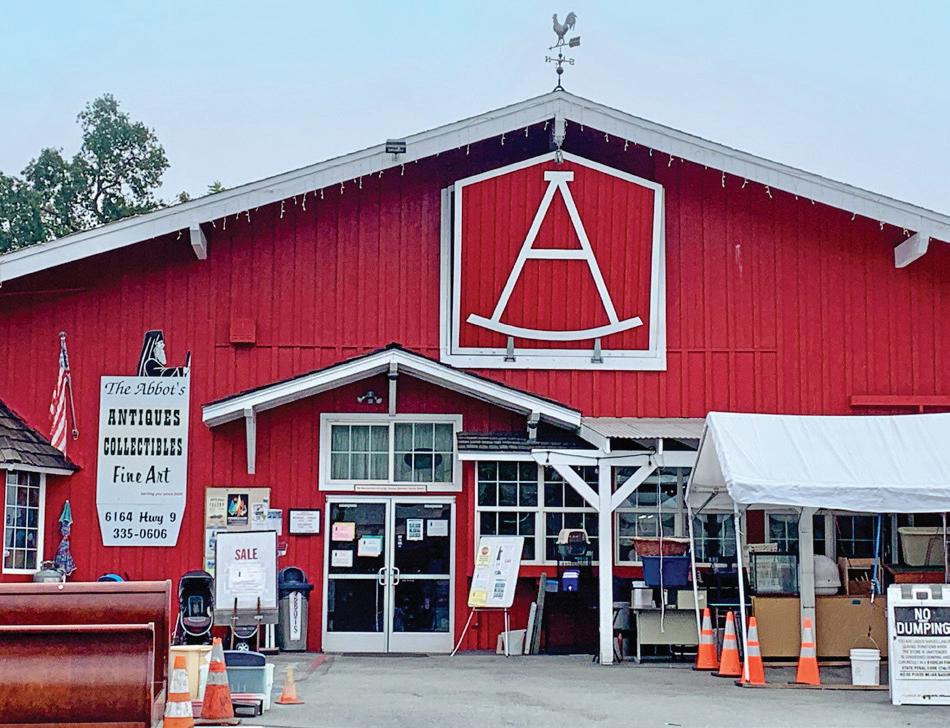
THE ABBOT’S THRIFT
6164 Hwy 9, Felton 831-335-0606, theabbotsthrift.org
TIDY EVOLUTION
Mia Keenan, Professional Organizer 831-331-5097, tidyevolution.com
TERRA NOVA ECOLOGICAL LANDSCAPING
831-425-3514, terranovalandscaping.com
TESTORFF CONSTRUCTION
9047 Soquel Drive, Aptos 831-684-2117, TestorffConstruction.com
THE SPA AND SAUNA CO.
707 River St., Santa Cruz 831-425-7727, hotspring.com
TOM RALSTON CONCRETE
241 Fern St., Santa Cruz 831-426-0342, tomralstonconcrete.com
TRANSFORMATIONAL COLOR
831- 435-9706, transformationalcolor.com
TRAVIS MARTIN PLUMBING
6185 Graham Hill Rd, Felton 831.461.4300, santacruzcaplumber.com
TURK THE ROOFER
3330 Gross Road, Santa Cruz 831-479-9653
WALLIS WOODWORKS
2608 Mission St., Santa Cruz 831-460-9183
WEST COAST COMMUNITY BANK
75 River St., Santa Cruz, 831-600-4020; 819 Bay Ave., Capitola, 831-464-5300; 7775 Soquel Drive, Aptos, 831-662-6000; 4604 Scotts Valley Dr., Scotts Valley, 831-461-5000; 595 Auto Center Dr., Watsonville; 831-761-7600 wccb.com
WESTSIDE FARM AND FEED
817 Swift St., Santa Cruz 831-331-4160, westsidefarmandfeed.com
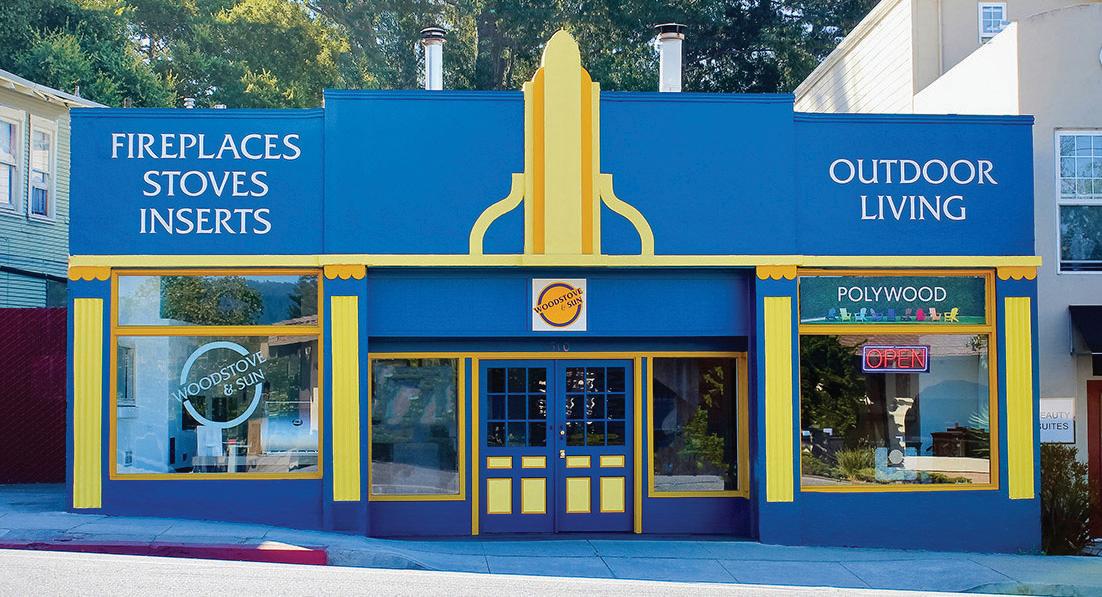
WOODSTOVE & SUN
510 Soquel Ave., Santa Cruz 831-425-5123, woodstoveandsunca.com
XTERMINATRIX HOLISTIC PEST CONTROL
Santa Cruz County 855-BUG-LADY, XTerminatriX.com