“There’s


“There’s
The 2024 primary campaign for Assembly District 2, the large North Coast region stretching from Santa Rosa to the Oregon border, is winding up this week, and local voters are—or should be—well aware of the six candidates, and the controversies that surround at least some of them.
Five of the candidates are Democrats, and one is
Republican. The party registration in the five-county region (Sonoma, Mendocino, Humboldt, Trinity and Del Norte) is 51% Democratic, 22% Republican and 19% no party preference.
That suggests that with the split vote on the Democratic ballot, sole Republican candidate Mike Greer is likely to coast into the top two slots for the general election race.
But among the Democrats, the race is a toss-up. Early favorite Rusty Hicks, the chair of the state California Democratic Party, would seem to have the inside track based on his considerable financial backing from
powerful unions and other interest groups. However several of the other candidates have called into question his status as a North Coast resident, since he moved from Southern California to Humboldt County less than two years ago. While a Political Action Committee (PAC) supportive of Ariel Kelley raised the “carpetbagger” accusation in a series of mailers in early February, other Democrats have also chafed at Hicks’ entry to the race. Ted Williams, for the past five years a Mendocino County Supervisor and also a candidate in the Assembly race, said that in late September he
A PIONEERING NEW CURRICULUM HOPES TO COMBAT TEEN MATH MALAISE
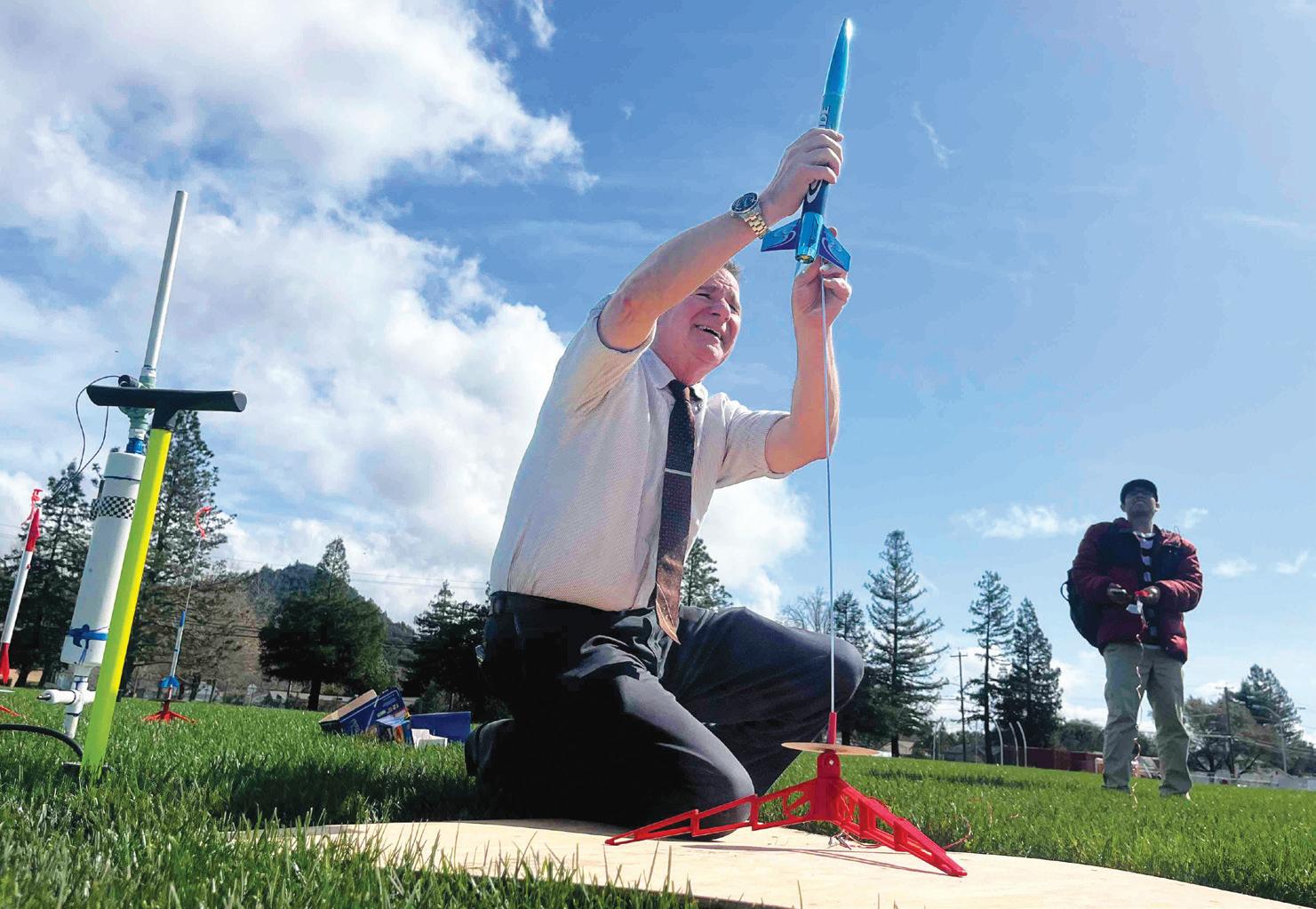
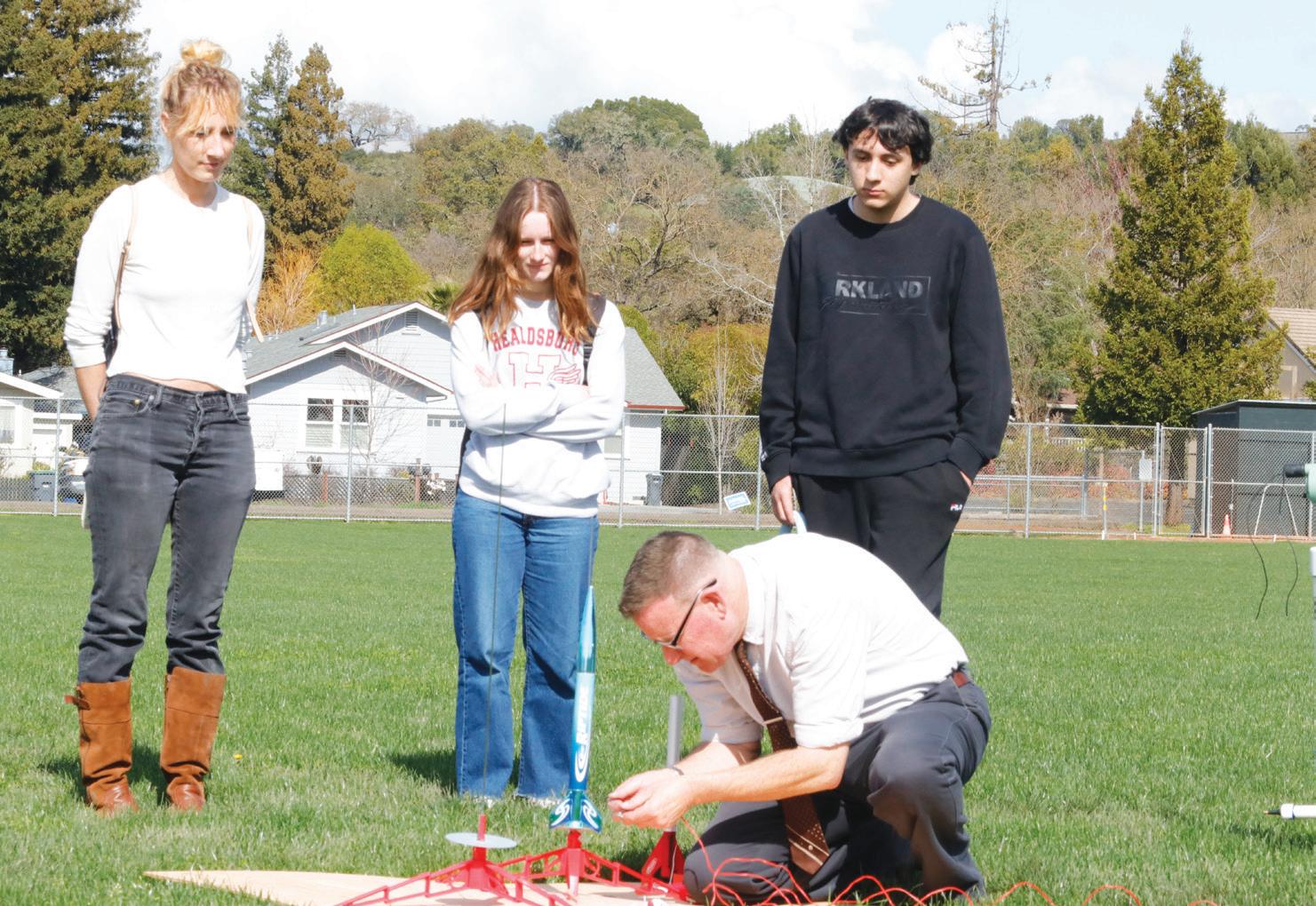
By Simone Wilson A six-year crusade to incorporate rocket science into the official schoolday curriculum at Healdsburg High School, led by art teacher Linus Lancaster, culminated last Thursday with a rocket launch at lunchtime.
“Somebody grab the air compressor!” said Lancaster, a U.S. Navy
was paid a visit by Hicks, who seemed to be “strategizing his run for Assembly and wanted referrals to influential people in Mendocino County.”
Only some time later did Jim Wood announce he would not seek re-election.
”My decision to not run was made in late October.
I followed what I thought was the best protocol. I informed the speaker of the Assembly and my chief of staff shortly after that,” Assemblyman Wood told the Tribune That suggests Hicks moved to Arcata for another reason, leaving behind an influential role as a labor leader and political organizer
veteran and aviation enthusiast who has been a fixture in the high school art department for a couple of decades now. His upside-down wall clock was steadily ticking its way into the half-hour lunch period. Students from the school’s Art and STEAM clubs, plus some curious tagalongs, trudged south to the baseball field on the first clear, sunny day in a week. “I know it’s wet and squishy out here, but the rain is part of why we got permission to do this,” Lancaster told the kids.
Countdown
For years, Lancaster has been trying to get the goahead from the Healdsburg Unified School District and the Healdsburg Fire Department to incorporate “formal lessons on basic rocketry” into art, math and science
for the college town in the redwoods, where he was prepared to run for office. “I don’t doubt Hicks has worked for the benefit of society, but it’s categorically inappropriate for an outsider from Los Angeles” to run for the seat, Williams said.
Door-to-Door
All of the candidates have been traveling the huge district since October to meet with voters and bolster their campaigns. Some have gone door-to-door in the Healdsburg area, or reached out to voters by phone campaigns either in person or through surrogates.
➝ Assembly Race, 4
classes at the high school— including “designing and building dry fuel model rockets” and launching them hundreds of feet into the air from the school’s baseball field.
In the meantime, the art teacher has run some after-school and weekend rocket workshops with support and funding from local organizations like the Healdsburg Center for the Arts and Corazón Healdsburg—but his dream has always been to work rocketry into the high school’s actual curriculum.
“When you ask to do something like this,” he said, “the first question is always: ‘Who else is doing it and what does it look like?’ Because institutions tend not to like to be trailblazers.”
So in late 2022, when Lancaster tracked down two public schools in
Photo by Christian Kallen Photo Courtesy Ted Williams for Assembly‘Past Lives’
Crafted Conversations return this month with an AVFilm discussing the what, why and when of the new Plaza Cinema Center, followed by a screening of Celine Song’s awardwinning Past Lives, introduced by curator Mike Traina. Thursday, Feb. 29, 5:30pm at the Fireplace Lounge, Craftwork, 445 Center St.
String Ensemble
The Fry Quartet performs Friday night, March 1, at The 222, following their Feb. 29 climate crisis film Rising Tide at 7pm. An eclectic program is promised, from Beethoven and Shostakovich to modern composer Gabriela Lena Frank. Pre-concert discussion 7pm, music at 7:30pm, tickets $35-$75. 222 Healdsburg Ave., the222.org.
Broadway Bootcamp
The Young at Heart Theater’s performance showcases what the students have learned during their three-month intensive program. Songs, scenes and dance numbers from Broadway musicals on Friday and Saturday, March 1-2, 7pm. Tickets at the door, $10 adults, $5 students, kids under 5 free.
Barrel Tasting
The 46th annual Barrel Tasting Weekend is Saturday-Sunday, March 2-3, at a number of wineries in the Alexander, Dry Creek and Russian River valleys.
A terrific way to learn more about the barrel-aging process and to sign up for “futures” on the wine when it’s bottled. $95 both days, $75 Sunday only, $10 designated driver, tickets at wineroad.com.
TEDx Sonoma
An afternoon of intelligent speeches, lectures and inspiration under the theme “Reimagine, Reconfigure, Reconnect,” a classic TEDx sentiment. Hear what more than 12 thought leaders have to say, Saturday, March 2, at Sonoma Country Day School’s Jackson Auditorium, 1:30-4:30pm. Tickets $25-$75, at www. tedxsonomacounty.com.
Caturday Movies
The New York Cat Film Festival wanders into Healdsburg on Saturday, March 2. Screenings at 2pm and 5pm at AVFilm, 375 Healdsburg Ave., Rm. 200, tickets $15.
Poyntless Sisters
The durable and popular female-fronted dance band returns to Coyote Sonoma this Saturday, March 2. Tickets $10, show at 7pm. Check out coyotesonoma.com/upcomingevents for more Coyote Den shows, 44-f Mill St. Spirit Bar
On Saturday, March 2, the Ruth Ahlers Quartet explores the great composers of Brazil. Saxophonist Ahlers is accompanied by Ken Cook (piano), Brade Maestas (Bass) and Kendrick Freeman (drums). Free, from 6-9pm at the Spirit Bar, Hotel Healdsburg, 25 Matheson St.
Farmworkers Fair
A resource fair to assist local farmworkers will be
Manager Jeff Kay said, “What a great dilemma we have—SMART is coming to Healdsburg!” That opened the doors for the sitting members of the council, although Vice Mayor Evelyn Mitchell was attending remotely from Hawaii, to offer their perspectives and preferences on the location question.
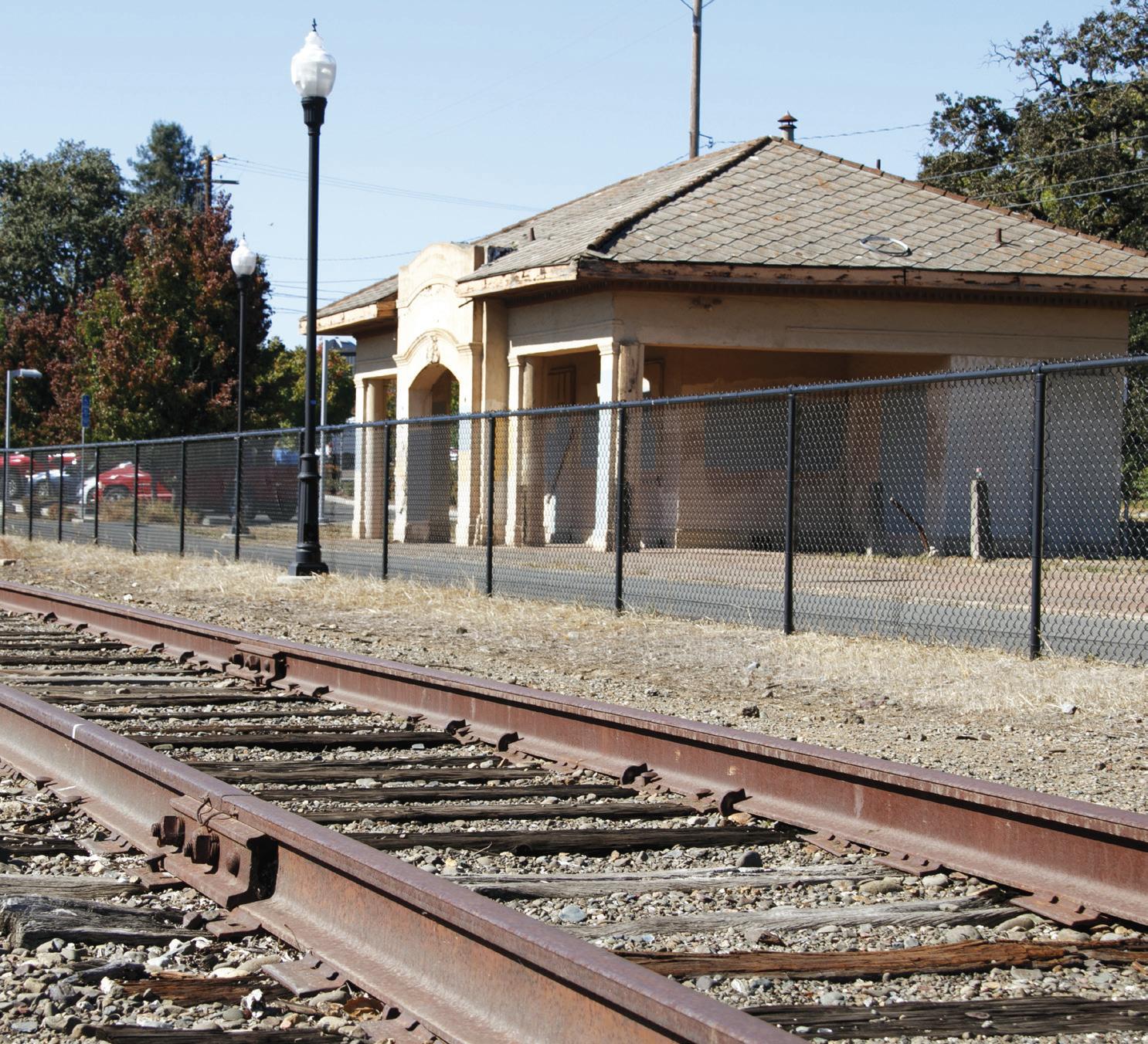
The council was presented with two “alternatives”: Alternative 1, to proceed with the pre-existing decision to construct the station near the current historic depot along Hudson Street; or Alternative 2, for the council to request additional information prior to deciding.

held Sunday, March 3, from 1:30-4pm at Our Lady of Guadalupe Church, 8400 Old Redwood Highway, Windsor.
Mosaic Dance
The Healdsburg Dance Collective presents its second annual “Mosaic” multi-disciplinary show, with live dance performances by UPside Dance Company, the SRJC Dance Company and a local Bachata duo. It’s Sunday, March 3, 4pm at The Raven, 115 North St. Tickets $15 children and students, $25 adults, $100 VIP at healdsburgdancecollective.org.
Sunday Funnies
Furthermore Wines has live music in the early
argument that a Hudson Street location would be beyond a supposed quarter-mile limit that commuters prefer to walk, and the repeated comparison with the one-third-mile gap between the Larkspur station and the ferry terminal, which commuters found too far.
“You’re at your destination when you get off the train,” he said. “Additional study won’t shift the scale.”
If the council leaned toward Hudson Street, the attending public embraced it. Nineteen people arose to speak for their allotted three minutes, of which four were open to further research for a downtown station, while 15 were clearly in favor of the historic Depot.
evening hours most weekends from Thursday to Sunday. On the first Sunday, March 3, they welcome comedians on tour for a barrel of laughs. It’s at 328-A Healdsburg Ave., starting at 7:30pm.
City Council
The first meeting of the month for the publicly elected council to oversee the management of the City of Healdsburg. It’s
Monday, March 4, starting at 6pm in City Hall Council Chamber, 401 Grove St.
Wild Men Upstairs
A quintet from New Orleans, the Deslondes present a disheveled set for Healdsburg audiences, following the opening act of Skyway Man in this
unusual evening at Second Story, Thursday, March 7. Free, doors open at 6pm, show 7pm. Upstairs at the Little Saint, 25 North St.
Songs Sung Blue
Neil Diamond Superstar is a nationally touring production celebrating the songs and styles of the songwriter, with Jack Wright and the Heartlight Band. It will take over the stage on Friday, March 8, at 7:30 pm. Tickets $35$50, online or at the Raven Performing Arts Theater 115 North St.
Oscar Evening
Sunday, March 10, the Oscars will be live via simulcast from Hollywood to Healdsburg, thanks to AVFilm. They used to do this
at the Clover Theater, now it’s at the Raven Performing Arts Theater, 115 North St., starting at 4pm, $15.
Upcoming at DCK
Pigs & Pinot, the annual celebration of pork and pinot noir, is always a hot ticket in the wine world. Chef Charlie Palmer oversees the high-palate fun at Dry Creek Kitchen on Friday and Saturday, March 15-16. DCK is at 317 Healdsburg Ave., tickets at pigsandpinot.com/tickets.
Post events on the Tribune’s online calendar at healdsburgtribune.com/ calendar and send special announcements to editor@ healdsburgtribune.com.
Cumings announced additional recent funding for the rail service, which puts the Healdsburg station—and, potentially, the Cloverdale station—closer to final funding. “I believe downtown is the better option,” he stated. “SMART is a parking solution, not a parking problem.”
Future-Proof?
While he threw cold water on the idea there could be a second station in Healdsburg, he called the downtown location “future-proof.” Like Zimmer, he discounted the impact of 38 train trips a day (19 in each direction) on the roundabout intersection, though it would need to be retrofitted with new signs and gates to assure the safe passage of the train through the intersection of Mill Street, Vine Street and Healdsburg Avenue.
Outlining the alternatives before the city council in the evening’s discussion, City
“Additional studies would require time and funding and should be evaluated as to their weight in the decision-making process,” the council was cautioned.
Public Reaction Even from the outset, though, the proposal for a downtown location was greeted skeptically. Mitchell, for instance, questioned the assumption that the city would lose the approximately 30 West Plaza Park parking spots that lie within SMART’s legal right of way if the rail did not need to expand with a second line and station.
Councilmember Ron Edwards pointed out that it would be less disruptive to move the SC Transit bus stop farther north on Healdsburg Avenue, which would place it closer to the Depot location, than to reroute the bus line altogether.
Councilmember Chris Herrod questioned SMART’s
These included Holly Hoods, executive director of the Healdsburg Museum, who said she was at the meeting not in that capacity, but “as a private citizen interested in history.” Her point was that the location of the Depot had been established in 1871, and it was intentionally put on the outskirts of the downtown core even though Healdsburg was, then as now, a walkable town.
Mark McMullen, head of a Healdsburg 2040 work group, stated their preference for the Depot location. He recounted that in 1997 a local committee appointed by the city had spent months researching a location for a commuter train (SMART was not yet in existence), and it had overwhelmingly “concluded that the Depot location was the best choice.” To discount or revisit that well-researched decision “should not be ignored,” he said.
Valerie White, another
member of that same work group, enumerated the disadvantages of building a new station downtown.
“It will be extremely disruptive and unsafe for the thousands of people who live and shop in Healdsburg,” she said, citing the impact on roundabout traffic, congestion at Vineyard Center (where Safeway is located), the reduction in public parking and the construction period itself, which could overlap the construction of the Foley Pavilion on North and Vine.
Former city council member Joe Naujokas, widely remembered as having suggested a downtown SMART station in the first place, announced his own position. “Hudson Street is the ideal location,” he said.
“Finally, this topic has been discussed for months,” White concluded.
“I encourage you to put it to rest tonight and vote to place the station at Hudson Street.”
End of the Line
And that’s pretty much what the council did. Without adequate reason or incentive to require further study of the downtown alternative, and the clear consensus of at least three if not four of the five members of council, the pre-existing decision to locate the SMART station at the historic depot was accepted.
However, there was no vote, and White was not the only one to wonder why not. Did it mean that SMART might continue to try to change the
council’s collective mind behind-the-scenes, since the downtown location was its stated favorite?
Kay reiterated that no vote was necessary, as no change to city policy was made or requested, because “the council direction last night just affirmed a number of previous decisions to locate the station at the Depot on Hudson St. That was the status quo option, so they essentially provided direction that it wasn’t necessary to explore the alternative option further.”
Even without a formal vote, the city apparently decided with its residents—and its history—that once a train depot, always a train depot. The SMART station will go on Hudson Street.
Campaign Noise
Last week’s Healdsburg Tribune (Feb. 22, “Campaign for Assembly Gets Down and Dirty”)
reported that Ariel Kelley’s sister, Shoshana Ungerleider, and “hedge fund manager Chris Hansen” have contributed $200,000 and $60,000, respectively, to a SuperPAC supporting Kelley’s State Assembly campaign. That SuperPAC is behind hit pieces portraying Kelley’s rival Rusty Hicks— sporting an L.A. Dodgers cap—as a “carpetbagger” from Los Angeles.
It is understandable that Kelley’s sister would invest a small fortune in her candidacy, but one has to wonder about the connection between Hansen and Kelley. The answer can be found in the tax returns for a nonprofit called “Operation Reboot dba Pillar,” which are available online. Hansen doesn’t just
run a $2.8 billion hedge fund. He is also president of Operation Reboot dba Pillar, whose most recent tax return lists Kelley as its Chief Executive Officer at an annual salary and benefits totaling $276,793. Hansen is Kelley’s boss. Hansen funded Operation Reboot dba Pillar for the purpose of making grants to assist Covid-distressed small businesses in reopening. But all of those grants have gone to businesses in Seattle, which is Hansen’s home town. Those businesses are located in neighborhoods surrounding Seattle’s “SODO” district, where Hansen has extensive property holdings across multiple acres. None of those grants have gone to businesses in California, much less in the Assembly district that Kelley seeks to represent. It seems fair to ask Kelley why she chose to leave her position as executive director of Corazón Healdsburg, where she served Healdsburg’s Latino residents at an annual
salary of $106,816, to increase that income nearly threefold running a nonprofit created to prop up businesses in Hansen’s stomping grounds 800 miles away. Perhaps she’s secretly a fan of the Seattle Mariners baseball team, which plays its home games in the SODO District.
As of last weekend, Kelley and her SuperPAC have together raised more than $1 million, with more than half that amount coming from Kelley personally, her sister and other family members, Hansen and Santa Rosa real estate mogul Bill Gallaher. Meanwhile, Hicks and his SuperPAC have together raised nearly $1.4 million. Look for a lot more ugliness from those two before Election Day.
Me? I’ve already voted for Chris Rogers. J on B. E is E n BE rg Healdsburg
Sure miss the days when candidates were motivated to run to serve their communities and take the high road during the campaign, focusing

MAILBOX
on their backgrounds, experience and skill sets rather than trying to skewer their opponents. Those kinds of tactics do make it easier to decide who NOT to vote for … It does make you wonder—why are they so willing to ignore ethics and morals in order to prevail? Is this Assembly seat that important to fulfill their ambitions? E ric Z i E drich Healdsburg
Resurrected Theater
As a resident of Healdsburg since 1985, I, like many of my friends who are also longtime residents, am both saddened and angry about the direction our community is headed. When I heard the Raven Theater was being resurrected, I was so happy, as I was a loyal patron for the many years that it operated. Now, where is that vision headed?
There has to be some kind of balance between growth and expansion, and yet maintaining the charm of our wonderful town. We all know money talks, and a lot of what is happening is that money is coming from people and developers who do not even live here. We all need to make our voices heard! s usan M ath E ny Healdsburg


















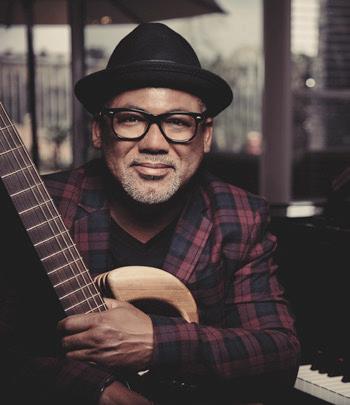










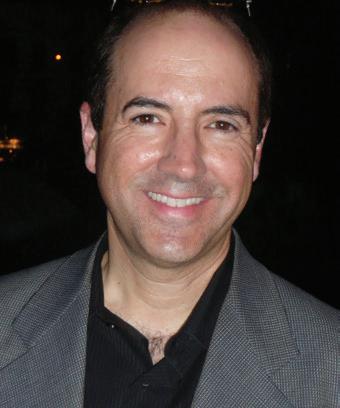







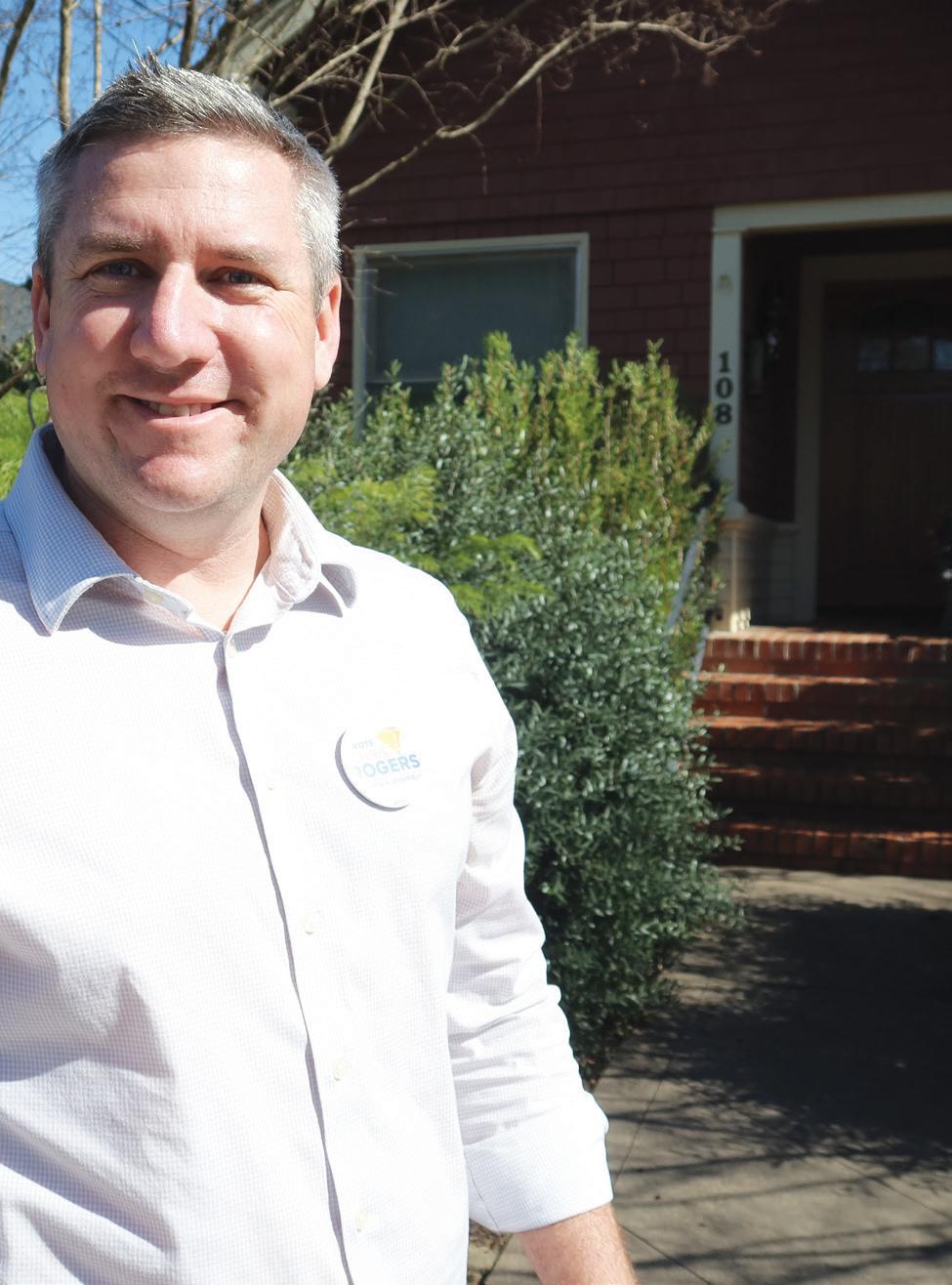
Chris Rogers, currently serving on the Santa Rosa City Council, has been in town several times, most recently on Feb. 24 following a campaign breakfast at Gallina d’Or (formerly El Farolito) with State Sen. Mike McGuire. Rogers worked as an aide in Sen. McGuire’s office, and has earned his endorsement.
Following that breakfast, Rogers hit the neighborhoods of Tucker, Haydon and University streets to knock on doors and make his pitch. Relying on a database updated daily of registered voters who have not yet voted, he spoke briefly to residents— connecting over the issue of dealing with four fire emergencies in the past few years and other local issues. If no one was home, he left a handout in the door.
“Particularly in a lowturnout election like this one, truly grassroots campaigns matter,” Rogers said. “When you’ve got so much money being spent on TV and on mail, what’s going to be most effective is to have one-on-one conversations with voters.”
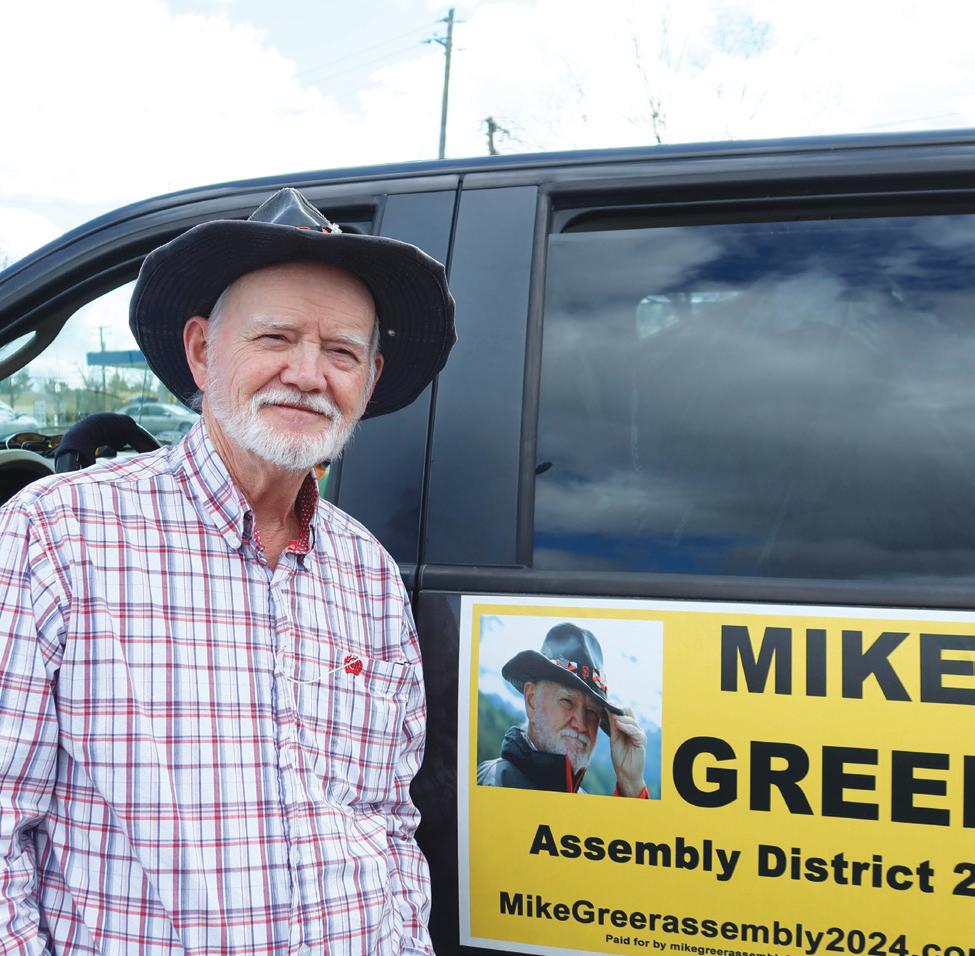
Similarly, Republican candidate Greer spent some time on Monday, Feb. 26, meeting potential supporters at Big John’s Market, then following a similar course through neighborhoods near the high school, armed with his own sheet of talking points. “Really, it’s a matter of getting out and meeting people,” said the former
special ed teacher and education trustee for Del Norte County. “It’s fun, it’s fascinating,”
Greer said. “You know, I enjoy meeting people, and I’ve yet to have one person that got upset at me because I was a Republican or anything else. They’ve just been very nice and polite. Which is a little bit different than what you see in the newspaper!”
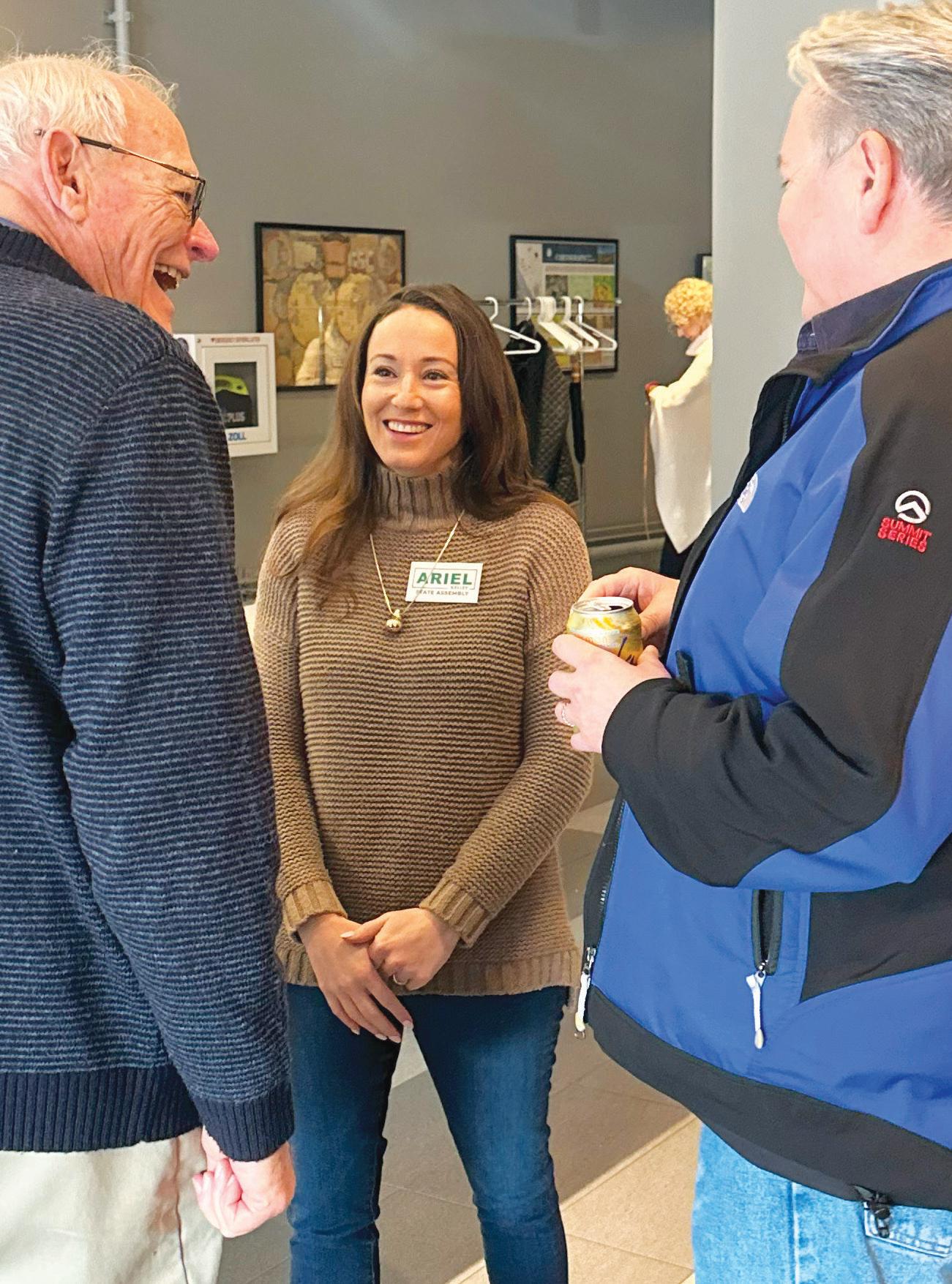
Kelley, of course, is a known entity in Healdsburg, in her fourth year on the city council after serving as mayor in 2023. She has held several meetand-greets with voters, the most recent at Cartograph Winery on Center Street, on Wednesday, Feb. 21.
Additionally, she has doubled-down on her status as the only woman in the race, with a “Standing Strong for California Women” message and holding a special campaign event in Santa Rosa on Feb. 24 with “reproductive access champions” to support her campaign.
Tribal Voice
The other Democratic candidate is Frankie Myers, the vice-chair of the Yurok tribe in the Humboldt River watershed. (A fifth candidate, Cynthia Click, left the race in December to endorse Myers.) He has been a key advocate for removing the decadesold dams in the Humboldt River watershed to return the natural wealth of the river to the area, specifically but not exclusively for the tribal communities.
It was only in the short window of time between Wood’s announcement (Nov. 10) and the closing of the application period to run for the Assembly seat that Myers decided to enter the race, and he admitted he hasn’t had time to personally campaign locally. “I have not in person,” he said. “I’ve reached out, I’ve talked to folks in Healdsburg via email and messaging, but haven’t been in person to Healdsburg as of yet.”
He has been to campaign events in northern Sonoma County, most recently the Feb. 25 Community Fashion Show at the California Indian Museum & Cultural Center in Santa Rosa. Yet he is confident and gratified that his campaign has moved beyond tribalism, so to speak, and is reaching a wider base.
“You know, the whole idea and premise of what I’ve been working on are these holistic visions for community and the environment, and our belief is that they’re based on these core truths of what it means to be here in this place,” he said in a telephone interview this week.
“These are things that aren’t singularly tribal, but these are initiatives and things that resonate with the entire community,” he continued. “Having now gone throughout the basin, throughout the district, throughout California, that is absolutely true. People care about the environment, they care about healthy communities, they care about sustainable economies.”
As for Hicks himself, much of his considerable campaign war chest has gone into TV ads and mailers, the most recent of which have tarred Ariel Kelley as financed by “big oil,” after Kelley’s PAC raised the carpetbagger issue.
Kelly pushed back on the characterization, stating she received from her late father (who died in March, 2023) trusts that included oil investments that she has since divested from.
As far as Hicks’ local on-the-ground campaigning, his aide Robin Swanson said, “Just as they have all across the 2nd Assembly District, Rusty and volunteers have been actively engaging with voters in Healdsburg, Cloverdale and Windsor over the phone and knocking on doors.”
Said Rogers, about the battle of negative campaign mailers and accusations, “I think in general, the public is looking for leadership that can unify people. And while these things work, otherwise [PACs] wouldn’t do them, I think that it has a tendency to make people less interested in participating in democracy.”
Election Day is Tuesday, March 5. Completed ballots are being accepted by mail-in or at the official drop box at Healdsburg City Hall, 201 Grove St. Healdsburg’s voting center at the Community Center, 1557 Healdsburg Ave., is open daily from March 2 to March 4, 9am to 5pm, and on March 5 till 8pm.









GIRLS
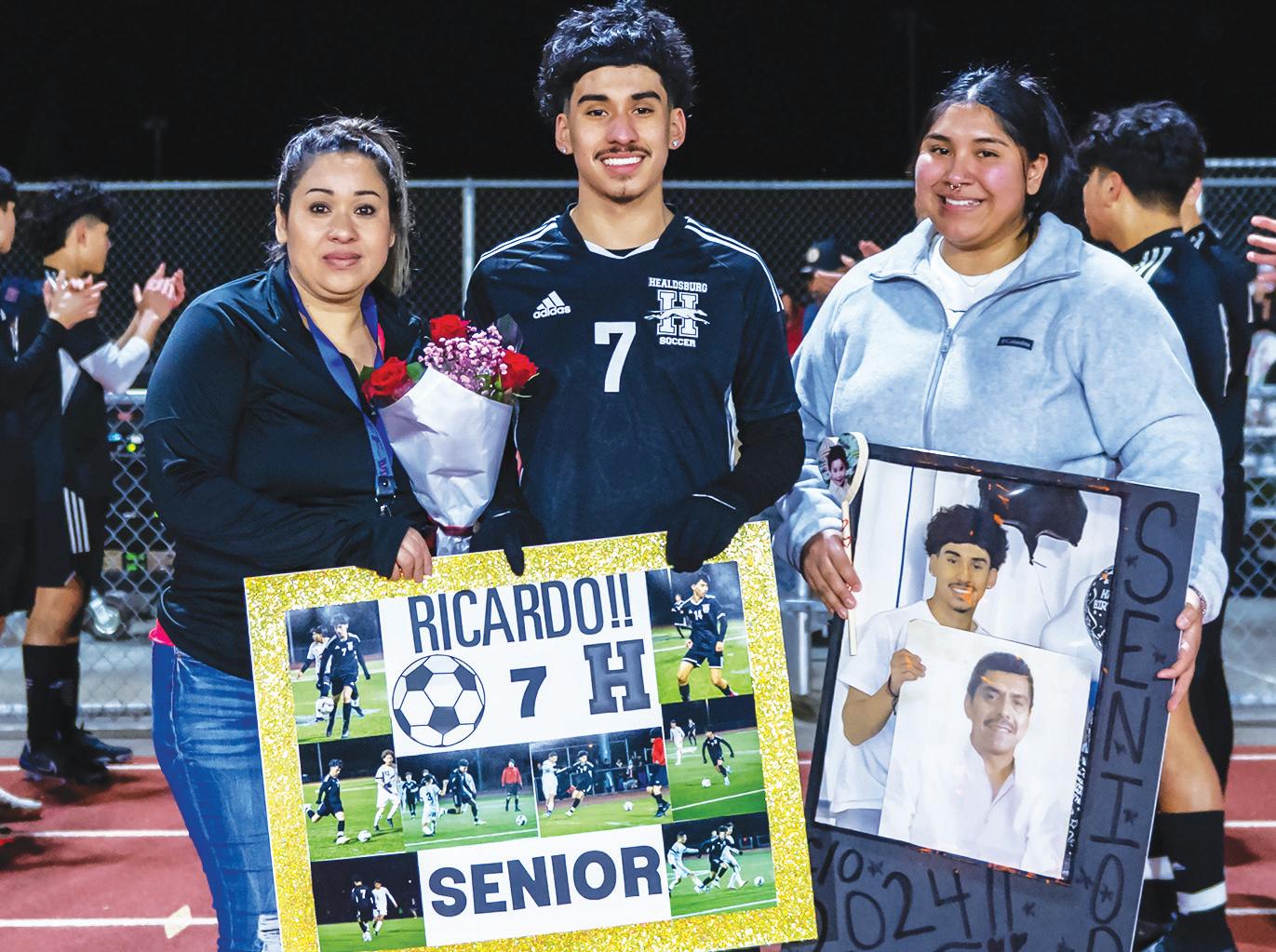
The Healdsburg High School varsity boys team made it into the first round of the North Coast Section divisional playoffs, overcoming an ending record of 2-4-2 in league play and an overall record of 5-10-2.
Coach Herbert Lemus said that the team made the playoffs based on their winning record against teams in Division 4 as well as the overall strength of schedule. “We play a lot of Division 2 schools,” he pointed out.
They came up short in the first game in the championship playoff, however, losing 5-1 to Lick-Wilmerding of San Francisco on Feb. 14.
Earlier in the month, the final two games in the season included a match with Analy, which finished first in the league with a 6-0-2 record. But one of those two ties came at the hands of Healdsburg on Feb. 7.
Analy had the lead 2-0 at the half, reported coach Lemus. “At the half we decided to press their defensive third to counter their style of play, and it paid off,” he said. “We managed to bring their team to their own half of the field, and we ended up tying the score.”
Goals were scored by senior Ricardo Gomez from the penalty spot, with senior Edwin Vasquez tying the game after getting a pass from senior Beto Avalos.
All-league selections for both girls and boys soccer players will be announced the week of Feb. 20.
Girls Season
The Healdsburg girls soccer team had a similarly difficult schedule this year, ending with a 5-9-2 record overall, 2-8 in the league.
But despite their winning 5-1-2 record against other Division 4 teams, their 2-8 league record put them low in the standing and they were not picked for the playoffs.
The last three games of the girls soccer season were all played in February, starting with a big Feb. 1 win over Elsie Allen, 7-0. Geraldine Nunez made two goals, with Maddie Munselle, Yanet Pacheco, Lucy Behrens, Julia Dolph and Jacqueline Threlfall all contributing as well. Kim Lopez and Liz Aleman split time tending goal for the shutout.
The girls team played the final two games of the season on their home field.
On Feb. 6 they faced Santa Rosa for the second time this year in an exciting game that came down to the wire.
Santa Rosa took a 1-0 lead into the half, then Threlfall scored to tie. But two quick goals by Santa Rosa opened up a lead, though Munselle scored for Healdsburg to get the Hounds within one. At the end of time Santa Rosa had won, 3-2.
The last time senior varsity members Virjinia Onate, Yanet Pacheco and Yuridia Hernandez played together was Feb. 8 in the Senior Night game against Piner. Despite Julia Dolph scoring in the second half, the Hounds suffered a 7-1 loss.
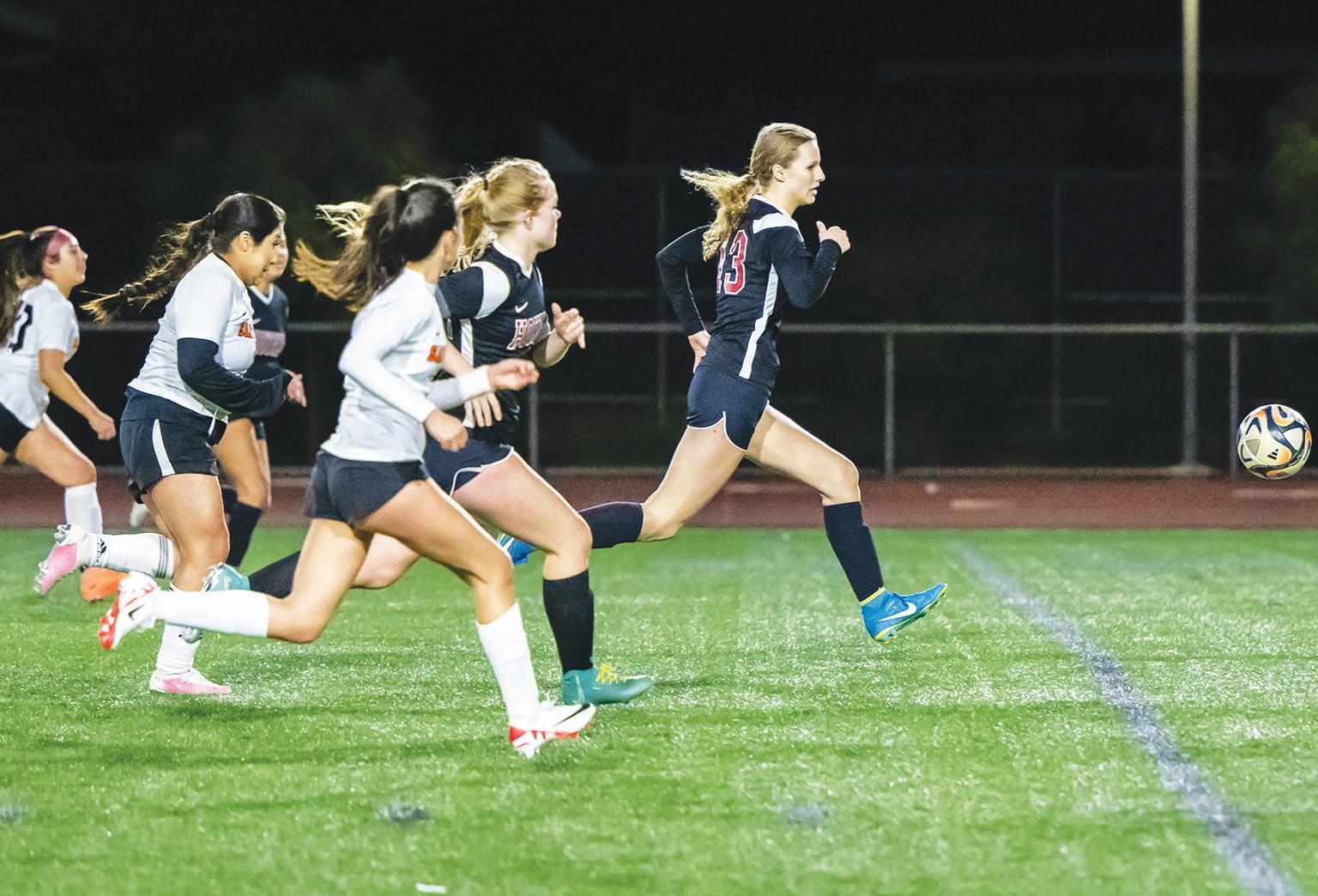
“The Hounds just missed the playoffs,” said Peter Mork for the team, citing the team’s success in NCS Division IV. “Their only loss was to Cloverdale who they subsequently beat. St. Helena, who the Hounds played to a 2-2 draw in their first game of the season, got selected [instead].” St. Helena lost their first playoff game on Feb. 14 to University High of San Francisco.
Said girls soccer coach Tomas Morales, “It was a phenomenal season, and we narrowly missed the playoffs. I’m proud of all these players. The seniors will be missed, but with such a young team we can expect great things from this team for years to come.”
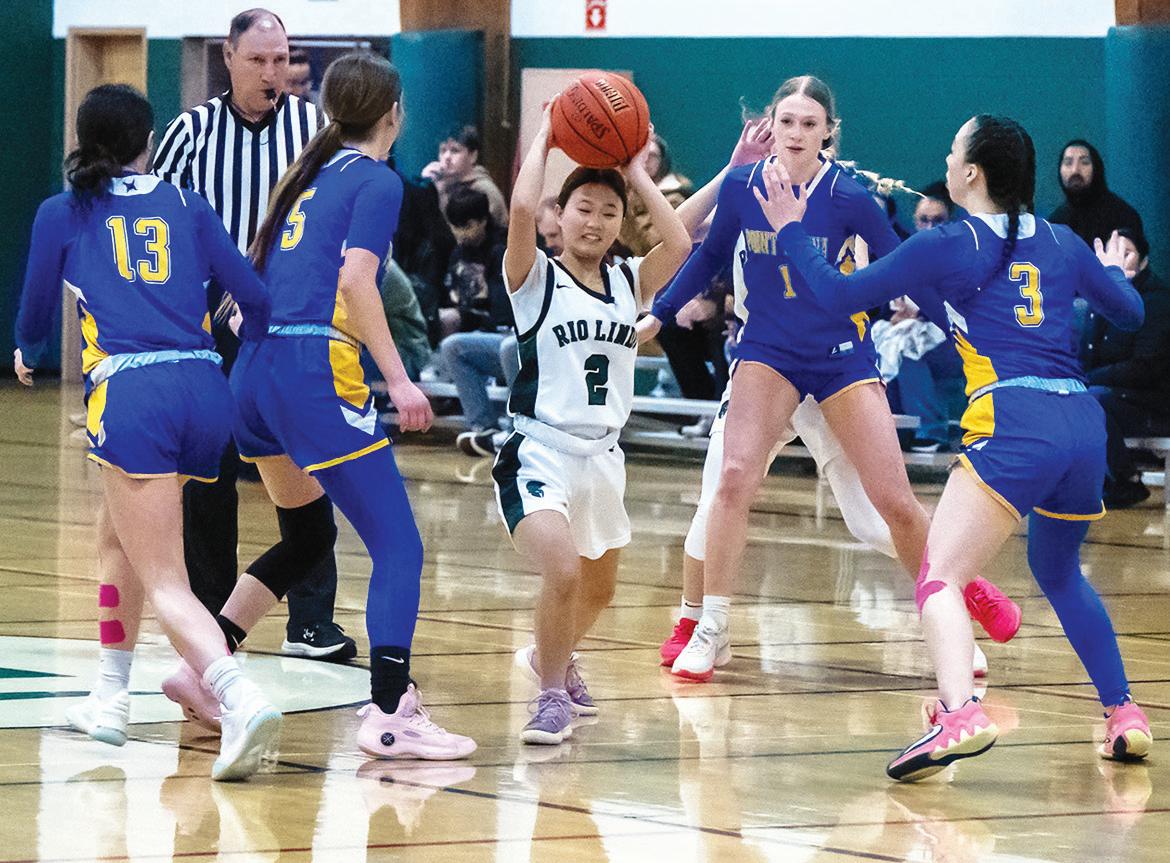
Lady Spartans Reach Semifinals, Fall to Point Arena
OFF-NIGHT OF SHOOTING DOOMS
OUTPOINTED
RIO LINDO
Staff Report
The Rio Lindo girls basketball team fell to the Point Arena Pirates last
Wednesday, Feb. 21, in the third round of NCS Division 6 playoffs. That bumps the Lady Spartans from the division playoffs, but there’s a chance they will get an invitation to the CIF. A slow start from the home team saw Point Arena end the first quarter
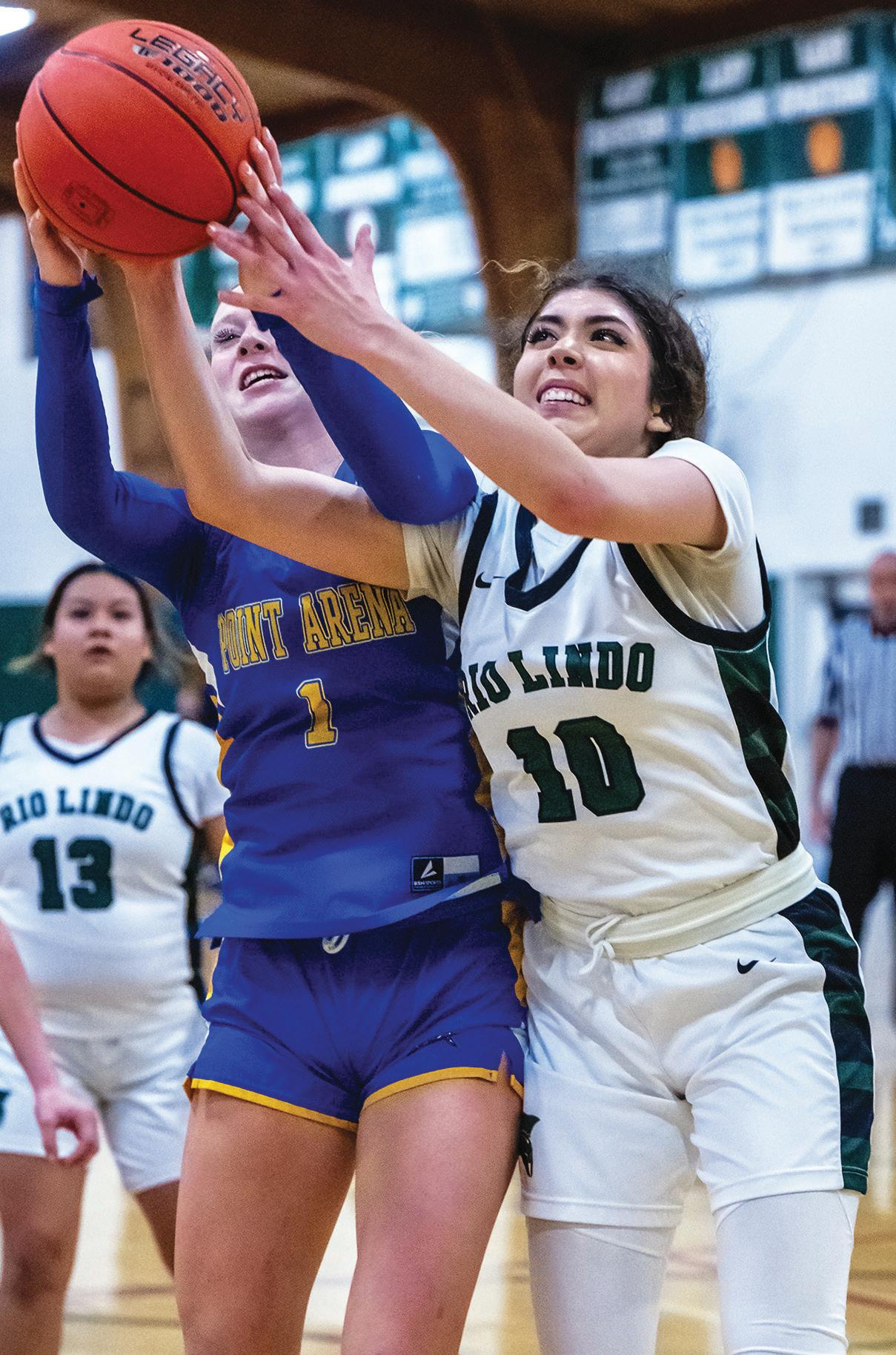
up 13-6, 22-9 at the half. At halftime, coach Laura Barcenas made some changes, and the second half started off stronger for Rio Lindo. They played back and forth, with the Spartans cutting the lead to 9 with four minutes left in the game.
But the big momentum-changing shot never
dropped for Rio Lindo. Each time Rio Lindo made a run, Point Arena would answer with a couple of baskets to keep them out of reach.
“It was an off night for our shooters,” Athletic Director Kevin Hardesty said. “The hustle and effort were there, but in the end
we didn’t shoot well enough to advance.”
In the end, the final score was 48-34 in favor of Point Arena. Pirates star Hattie Piper led all scorers with 27 pts, while Kaia Miller had 13 points and Belen Hernandez added 11 for Rio Lindo.
Saturday night in the NCS Division 6 championship game. Rio Lindo, which ended the season 19-5, will be seeded 8 in the CIF NorCal playoffs, Division 6, and played the No. 1 seed, Weed, on Wednesday, Feb. 28 (results too late for press time).
INTOXICATION AND MURDER BY NANOTECHNOLOGY
Monday, Feb. 12
12:24am
9:26pm
9:58pm
Street. A vehicle was driving erratically and slowly. The RP was told no officers were available to look into the situation because they were responding to the incident reported at 9:26pm above, which had priority.
Tuesday, Feb. 13
9:07am The RP called from inside the CVS Pharmacy on
Center Street and stated she was at risk of being murdered with nanotechnology. She indicated she was given poisoned drugs. Officers responded and arrested a 50-YO woman for possession of drug paraphernalia, possession of methamphetamine and public intoxication. She was brought to county jail.
11:38am An officer contacted a 28-YO man at Carl’s Jr. on Vine Street. The man was cited for driving with a license suspended for DUI and violating probation.
2:46pm Graffiti reported on Healdsburg Avenue at Matheson Street.
3:32pm A man who had been drinking was yelling at Taqueria El Sombrero on Center Street. Officers responded, but the man was gone on arrival and unable to be located.
3:44pm A hit-and-run accident occurred on Feb. 11 on North Street. The officer met with the RP and took a report.
8:43pm The RP indicated a man who had been drinking was yelling at passersby at The Wurst on Matheson Street. Officers responded, but the man was gone on arrival and unable to be located.
Wednesday, Feb. 14
10:56am Vandalism to a vehicle occurred on Fitch Street. The RP’s rear driver’s side tire was flattened and the gas line was cut. The RP estimated $500 in damages. A report was taken.
• 3:56pm Vandalism to a vehicle occurred on Fitch Street. The RP’s vehicle tires were slashed. A report was taken.
4:27pm Petty theft occurred at Healdsburg Senior Living Community on Grove Street. A resident was missing two jewelry boxes. The RP believed the resident’s memory was a little diminished regarding the whereabouts of the boxes. A report was taken.
➝ 1 Alabama and Philadelphia that had pulled the trigger on similar programs, he said it was a turning point in the conversation.
Superintendent Chris Vanden Heuvel said in an email to the Tribune: “We do have to look at all risks for these types of things, including student/staff safety and liabilities that may arise. After assessing these risks with our business office, we were able to approve this awesome opportunity for our students.”
Ready to Launch
Now, with written permission in hand from Healdsburg’s schools superintendent and fire marshal, Lancaster says around 200 students enrolled in art and math
classes at Healdsburg High will start in immediately on the rocket lesson plan he wrote—beginning with safety education—then design and build, then launch in late March or early April.
He hopes the new program will “inspire other public school districts to follow suit.”
At the first-ever schoolday rocket launch last week, students and teachers sent up some out-ofthe-box models from the Estes rocket company “to get some excitement going,” in Lancaster’s words.
HHS junior Andrew Ambrosi said he received a message about it in one of his group chats with friends, and “came running over” because he
Thursday, Feb. 15
10:13am The RP indicated that a woman was routinely seen kicking and pushing over Bird bikes at Barbieri Park on Bridle Path. Officers responded and located the 59-YO woman. She was cited on an outstanding warrant regarding vandalism.
2:39pm The RP indicated that a man walked up to another person on Healdsburg Avenue at Powell Avenue. The RP said the man reached towards his waistband and stated, “give me your wallet. I have a firearm.” The suspect left in a gray Ford Focus. The RP saw the suspect drive onto Highway 101 going southbound. The RP indicated that the suspect vehicle swerved, and the driver was possibly drunk. Officers responded to the area and spoke to nearby citizens. The officers were unable to locate the victim.
Friday, Feb. 16
4:25pm An officer stopped a vehicle at the Railroad Depot on Harmon Street for not having a front license plate. Following investigation, two people were arrested:
a 42-YO man was arrested and transported to county jail for possession of methamphetamine and violating probation, and on outstanding Sonoma County warrants regarding possession of methamphetamine, possession of a controlled substance without a prescription, possession of drug paraphernalia, criminal trespass and public intoxication. And a 38-YO man was arrested and transported to county jail for possession of methamphetamine, violating probation and on an out-ofcounty warrant regarding a violation of a court order.
Saturday, Feb. 17
11:03am Grand theft occurred at Enso Wealth Management on Healdsburg Avenue. A 500-gallon water tank was stolen the preceding night from
“wanted to see a real rocket go off.” (He had to run back, too, when he realized he was missing his own fifth-period presentation.)
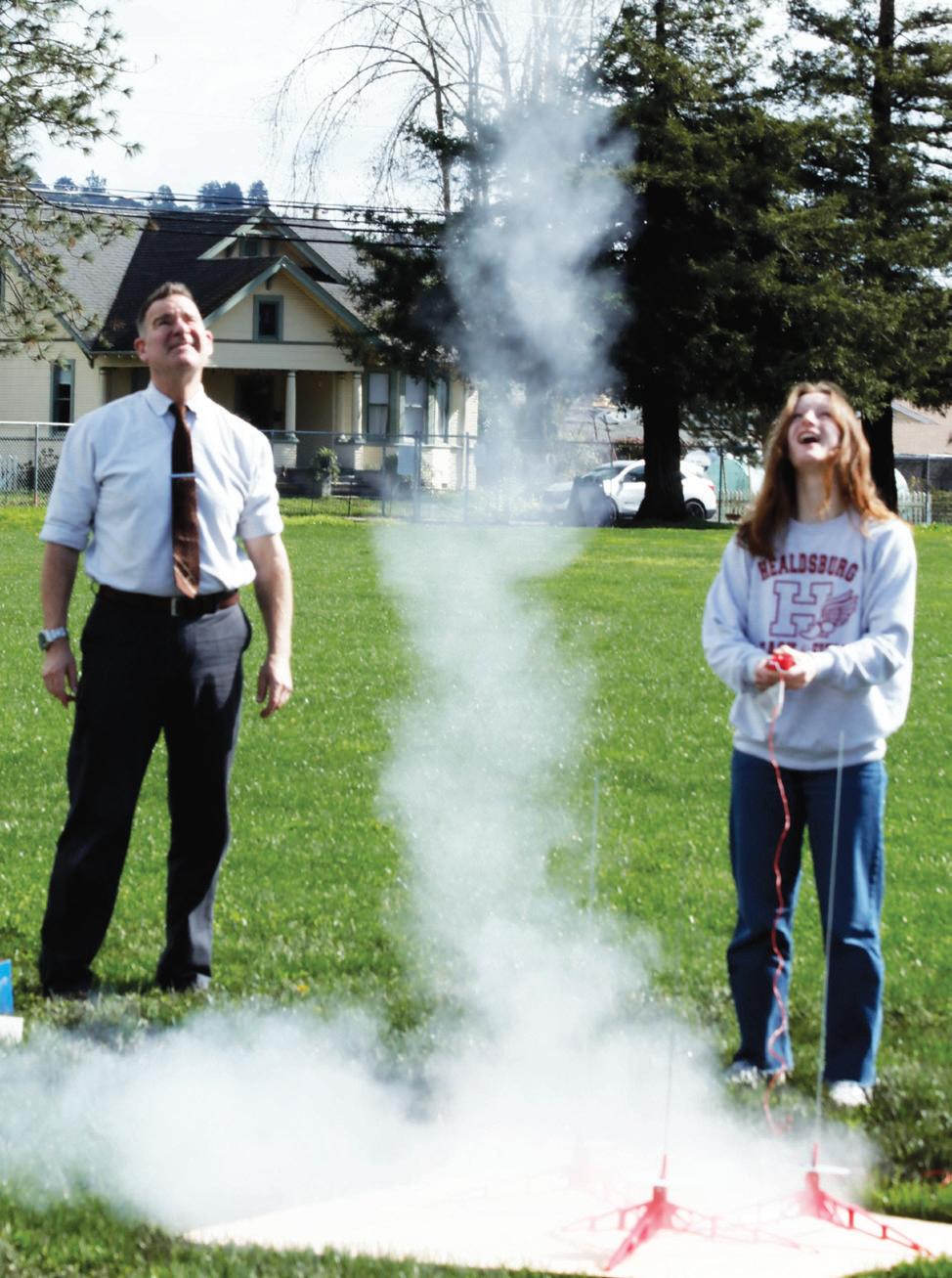
A few kids whipped out their phones to record a bright-blue, foot-and-ahalf-long Estes “Riptide” rocket shooting around 250 feet into the airspace above the baseball field at University and Monte Vista avenues. Other students squealed and scattered. At the end, as the rocket deployed its own mini parachute and fluttered back down to Earth, there was applause.
The high school’s newest and youngest math teacher, 24-year-old HHS alum Matthew Lopez, also attended. Soon, his students will write equations for where they want their own rockets to land.
“Our goal is to model the actual flight path,” Lopez
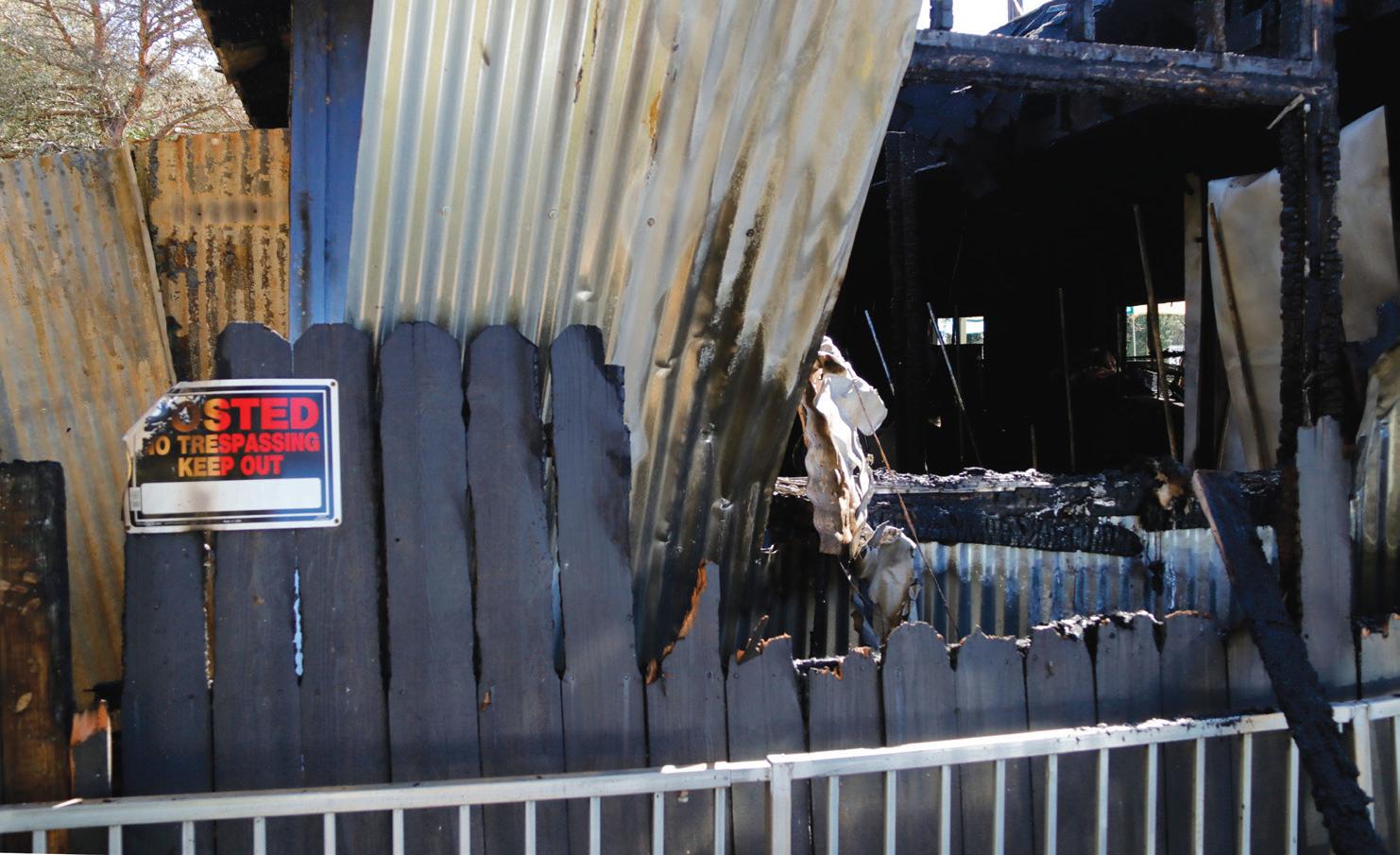
behind the business. An officer spoke with the RP and took a report.
• 11:21am Annoying and harassing phone calls occurred on Rose Lane. The RP spoke to a woman on the phone who the RP initially thought was from Xfinity, but when the woman asked the RP personal questions, the RP did not answer and disconnected. The RP believed it was a scam and advised the Healdsburg Police Department.
Sunday, Feb. 18
12:35am A vehicle was stopped for driving at an unsafe speed on Redwood Highway at Lytton Springs Road. A 38-YO man was cited and released on two out-of-county warrants regarding vandalism, DUI and driving with a license suspended for DUI.
1:50am A vehicle was stopped at Big John’s Market on Healdsburg Avenue for driving without headlights. A 28-YO man was arrested and transported to county jail for drunk driving.
11:24am Reckless driving occurred on Chiquita Road at Grove Street. The car was driving approximately
said. “I’m always trying to find a way to do something that isn’t paper, pencil, calculator.” To that end, his math students also collaborated recently with Lancaster’s ceramics students on a sundial project.
Lesson Plan
The goal of the new rocket curriculum is to “motivate students to engage in creative, real world problem solving activities in the fields of art practice, math, physics, and engineering,” the lesson plan says, “whose results will have a tangible thrill factor with ripple effects into other disciplines.”
Another HHS junior, 17-year-old Joie Kozubal, said she was walking home from school one day when Lancaster waved her over to play with some rockets—and she was hooked.
“I’ve been wanting this,”
10 miles per hour and was in the wrong lane at one point. Officers responded and located a similar vehicle that was unoccupied. The driver was gone on arrival and unable to be located.
• 11:43am Petty theft occurred at Tamarind Clothing on Healdsburg Avenue. The RP stated a woman stole a tank top valued at approximately $55. The RP was initially willing to press charges. An officer was dispatched, but then had to respond to a different priority matter instead. Later, the RP called back and stated the subject was walking towards Little Saint at 12:03pm. An officer responded, but by then the RP did not want to press charges.
11:44am The RP was in an argument with her sister at Fitch Mountain Terrace on South Fitch Mountain Road, and a candle was thrown. Officers responded. Medical assistance was not needed. A 54-YO woman was arrested and transported to county jail for violating a protective order, violating probation and assault with a deadly weapon.
1:08pm A vehicle was stopped on Healdsburg Avenue at Kennedy Lane for DUI and a defective
Kozubal said at last week’s launch. “I’ve been asking for an engineering class since ninth grade. And now, finally, in my junior year—I’m so happy it’s now and not later.”
Kozubel got to flip the switch for one of the inaugural flights. “POWER!” she yelled. “So cool.”
Next, “the students are going to be doing an entirely custom build,” Lancaster said. “So they’re going to have to be following exact directions; they’re going to be cutting their own fins out of balsa wood; and they’re going to be doing some problem-solving in terms of the parachute.”
There’s a touch of international history mixed into the lesson plan, too. The students’ 9-inch pencil rockets will be modeled after “the first rocket that was built by the Japanese
windshield or rear window.
A 28-YO man was arrested and transported to county jail for violating brassknuckles laws, child endangerment, illegal possession of a switchblade, DUI, possession of marijuana in a vehicle and violating the open-container law.
3:49pm The RP indicated that a man was banging on the window at Lucky Heron on Healdsburg Avenue. An officer responded and advised the man of the complaint and he moved along.
5:05pm The RP stated that a man was threatening him near Dry Creek Kitchen on Healdsburg Avenue. No weapons were seen. The suspect was last seen on an orange bicycle heading towards Little Saint. An officer responded, but the RP did not want to press charges so advice was given.
7:08pm At Jerry’s Valero on Dry Creek Road, a man was waving his hands erratically and fell on his back. Officers responded and arrested a 57-YO man for public intoxication and violating probation. He was taken to county jail.
Compiled by Carolyn Brennerspace agency in the 1950s,” Lancaster said. Students will even make their parachutes from silk, as the early rocketeers did.
The origins of Japan’s scrappy space agency, JAXA, are compelling, the art teacher said. “They started with nothing. NASA has all the money in the universe, and JAXA is just on this shoestring budget and they’re complaining that the roof of their building is leaking. To me, it’s just kind of charming that they’ve persevered through all of this. So they are our inspiration.”
On Thursday, March 7, weather willing, the scrappy rocket crew from HHS plans to send a few more ready-made Riptide rockets into the sky over town—launching a new transdisciplinary “art integration” movement at the local high school campus.