Sowing Seeds of Shoegaze by Granny Anarchy One of my favorite varieties of music is shoegaze. For some reason, a lot of people have trouble understanding and defining the genre. In fact, it seems that many shoegazers spend as much or more time defending their music as they do enjoying it! I also suspect that no two shoegaze fans will have the exact same explanation of just what shoegaze is - or isn't. (Caveat: Granny Anarchy is Gen X, and I loved this type of music before there was a word for - much less a modern interpretation of - shoegaze. In addition, I prefer not classifying art too closely, so understand that this guide may be biased towards my own experiences and aesthetic.)
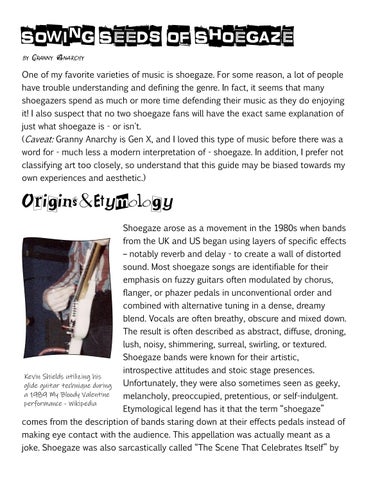
Origins & Etymology Shoegaze arose as a movement in the 1980s when bands from the UK and US began using layers of specific effects – notably reverb and delay - to create a wall of distorted sound. Most shoegaze songs are identifiable for their emphasis on fuzzy guitars often modulated by chorus, flanger, or phazer pedals in unconventional order and combined with alternative tuning in a dense, dreamy blend. Vocals are often breathy, obscure and mixed down. The result is often described as abstract, diffuse, droning, lush, noisy, shimmering, surreal, swirling, or textured. Shoegaze bands were known for their artistic, Kevin Shields utilizing his glide guitar technique during a 1989 My Bloody Valentine performance - Wikipedia
introspective attitudes and stoic stage presences. Unfortunately, they were also sometimes seen as geeky, melancholy, preoccupied, pretentious, or self-indulgent. Etymological legend has it that the term “shoegaze”
comes from the description of bands staring down at their effects pedals instead of making eye contact with the audience. This appellation was actually meant as a joke. Shoegaze was also sarcastically called “The Scene That Celebrates Itself” by