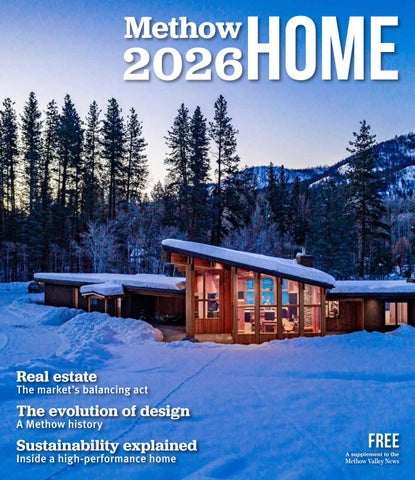
HOME Methow 2026

Real estate
The market’s balancing act
The evolution of design A Methow history
Sustainability explained Inside a high-performance home


![]()

Real estate
The market’s balancing act
The evolution of design A Methow history
Sustainability explained Inside a high-performance home


rospective Methow Valley homeowners have a lot of decisions to make when they decide to build: where, when, what — and increasingly these days, how.
Now-familiar terms like sustainability, Firewise and dark skies are likely to pop up in any conversation about a Methow building or remodeling project. Our experiences with fire, growth and environmental changes have reshaped how we talk about housing as not just a habitat, but also as a reflection of its setting.
In “Methow Home 2026,” we touch on some related topics that may help readers think about bringing their Methow dreams to life. You will find articles about how siting plays into design, what goes into a “high-performance home,” how to take dark skies and fire protection into account, and how to make site-friendly landscaping part of your plan.
Our home “profiles,” which illustrate the range of options available in the valley, each reflect the
planning elements that are “baked in” to every project. We also touch on changes in the local real estate market, the evolution of design trends, and the esthetics of Methow Valley life.
We appreciate the assistance of everyone who helped us put “Methow Home 2026” together — architects, designers, builders, owners, writers and photographers, and designer MyKenzie Bennett. Like building a home, a lot of parts go into the assembly of a magazine. Putting them together is complicated but rewarding.
We again extend thanks to our loyal advertisers, whose support allowed us to expand the size of this year’s magazine. They include locally owned businesses that provide jobs and support the local economy, and businesses that have developed a substantial presence in the valley by providing quality products or services. “Methow Home 2026” is a handy, year-round guide to the businesses that are here to assist you.
Don Nelson Publisher/Editor

On the cover
Photo courtesy of The Patterson Company
The Grizzly Mountain House: Story on page 6.

6 Mountain heir
The Grizzly Mountain House honors family tradition and its unique setting

11 The elements of a highperformance home
It’s about energy efficiency — and more

14 Between a rock and a green space
Inspiration meets challenge on a wooded slope

19 Shaped by the setting
The architecture of the Methow reflects our environment and traditionsy


23 Form and function
Owner-built home combines practicality and style

27 Nurturing our Methow Valley connections
History, humanity and nature form our community bonds

31 Living large in a small space
Edelweiss cabin is all about simplicity and comfort


We

Dragonfly

45 Resilience in the face of wildfire
Firewise tips for protecting your Methow Valley home
47 Methow Valley real estate market looks for balance
2026 could see a “reset” as playing field levels
MVN CONTRIBUTORS
Don Nelson Publisher/editor
Ralph Schwartz Reporter
Marcy Stamper
Reporter
Ann McCreary Freelance writer
Ashley Lodato MVN columnist
Shelley Smith Jones MVN columnist
Sandra Strieby MVN contributor
OTHER CONTRIBUTORS
Christine Estrada
Margo Peterson-Aspholm
Methow Conservancy
Ray & Mary Johnston
Building
55 Second Gear
Light-filled home envisioned years ago comes to life


Consider site, budget and maintenance before moving dirt
62 Living in the round
Yurt owners cite practical features and esthetic appeal 59 Landscaping for the long term


BY DON NELSON
The Grizzly Mountain House is all about angles, from the bold, fanshaped trusses that create a cathedral-like feeling in the central living space to the cantilevered wings that sweep back from either side of that room. But to the
owners who commissioned the house, the angle that mattered most was whatever orientation left them looking directly at Grizzly Mountain.
As design/build firm The Patterson Company notes in its description of the house, “the architecture follows suit.”
In fact, Grizzly Mountain dominates the setting with a revealing
view from the home’s site on the south side of Highway 20 east of Mazama — a perspective most people don’t see when they are just driving by.
“The central living space bends and cranks beneath the distinctive bat-shaped roof, turning deliberately to capture the mountain view,” Patterson Build says in its description of the house. “This movement defines the heart of the home, creating a room that feels both anchored and expansive.”
Orientation achieved. But beyond that, the home is thoughtfully configured to match the owners’ lifestyle and to enhance the meadow-like site. And it is deceptively simple for a 3,000-square foot house. The owners and Patterson Company put a lot of thought into creating that ease-of-movement ambiance.
The vaulted central room includes

the kitchen, dining and living areas in a decidedly open space that is “divided” for seamless usage by how the kitchen island and
furniture are configured. No matter where you are in the room, your eye is ultimately, inevitably drawn to the soaring
front windows, which frame Grizzly Mountain as if it were a still-life painting. The long central ceiling beam points like a magnetic

arrow to the mountain. Those who appreciate the integration of design and construction will be impressed with the inspiration that went into the ceiling’s structural array, which the owners describe as a “fishbone” design.
Where many recent Methow homes feature concrete floors, the Grizzly Mountain house has wood floors that, like the wood ceilings and walls in the center room, are intended to give the space a warm, welcoming feeling. The kitchen cabinets are stained black for subtle contrast that helps define the elegant but efficient space. After some negotiations, the refrigerator ended up on the end of the kitchen space that the owners preferred.
Over the dining area is a distinct light fixture, a transparent sphere of interlocking circles, that was special-ordered after the owners saw one in a lighting store and asked for a larger version. In the grand room and bedroom are stylish and practical Big Ass fans, familiar fixtures that are appropriate to their brand name. To the left of the grand room is a hallway that leads past an


office (mountain view) and into the master suite (great mountain view) and large bathroom (mountain view from the tub). The master suite has a fireplace and outdoor access; the bath has a spacious walk-in shower area with a remarkable array of shower head options.
Take the hallway to the right of the grand room and you encounter en suite guest bedrooms and a utility room. A detached garage is situated a walkable distance from the house.
The owners stressed their desire to connect with the outdoors. To that end, the Patterson Company website explains, “Indoor and outdoor living spaces are seamlessly integrated. The main living room opens directly onto a cocktail patio equipped with radiant heating, offering expansive views of the mountains and evening light. Adjacent to the dining room, an outdoor dining area provides a more sheltered environment for meals and conversation, thoughtfully extending

daily activities beyond the home’s interior walls.”
Pavers that surround the house are part of Firewise


considerations. The “wings” have stucco exteriors, and there is no substantial vegetation near the house.

541-410-5500
Artisanworks.inc@gmail.com methowvalleytimberframe.com
The property has been a family treasure for decades, a regular summer refuge to visit grandparents and enjoy the valley. The


WindermereMethow.com


family still calls it “the
and most family photos have the mountain in the background.
After corporate careers that took them around the country, the owners settled on the Grizzly Mountain site as their home — as they always assumed they would. They talked to several builders before deciding to work with the Pattersons, who came up with the concept and initial design. One early decision: no second story.
After some COVID-related delays, the home was completed in January 2024. Two years later, it still feels brand new.
“The Grizzly Mountain House is not a reinvention of its location, but rather a thoughtful addition to it,” the Patterson website concludes. “Anchored in tradition, informed by the landscape, and articulated through form, the residence demonstrates a longstanding connection with the land, river, and mountain — a relationship that predates construction and will endure well into the future.”


BY MARGO PETERSON-ASPHOLM
When I told my husband I was writing about sustainability for the Methow Home magazine, he said, “‘Sustainable’ is such a tired word. What does it mean, anyway?”
Annoyingly, he is right: The term has become jargon. In the simplest sense, sustainability describes ecological balance between depletion and conservation of resources. Basically, don’t run up a lot of credit card debt. But there are a bewildering number of considerations to design and build a truly sustainable home.
I am going to zero in on one of the most impactful, which is energy efficiency. I’ll cover the basics of high-performance design and explain its benefits, particularly
in the Methow Valley’s unique environment.
What is high-performance design?
When we talk about a house “performing” well, we mean that it does an optimal job of keeping its people protected, comfortable and healthy while consuming as little energy as possible.
To achieve this, we insulate and seal a building envelope to a high enough level that it significantly reduces energy loads. This reduces consumption of non-renewable resources as well as energy bills. Crucially, this very well-insulated and sealed home must provide balanced air exchange to assure health, comfort and durability.
You can think of a high-performing house as a series of controls that work in tandem. Thermal control isolates the interior from swings in exterior temperature and is achieved
through a thick, continuous blanket of insulation that wraps the walls, floors and roof. Also wrapping the house continuously is the air control layer, a continuous membrane that keeps air and moisture from leaking in or out of the walls.
Careful consideration of house orientation, as well as size, location, and insulative value of windows, is key to radiation control, which keeps the house from overheating in summer while allowing winter light and warmth to penetrate.
In addition to a tightly sealed building envelope, moisture control
is accomplished by a nifty bit of equipment called a heat recovery ventilator (HRV) that exhausts stale, moist air from kitchens and bathrooms while supplying filtered fresh air to living and sleeping spaces. Last but not least, a heat pump mini-split system provides energy-efficient heating and cooling.
Distinctive features
So, what are the results of this design and construction strategy? How do high-performing houses differ from typical code-built houses of the past?
“People often think that a high-performing house and a tight construction budget are incompatible. This is not necessarily true.”
For starters, smaller footprints and simple shapes are more efficient and easier to insulate and seal, so high-performing houses often avoid complex roof forms and sprawling floor plans.
Windows will be more thermally efficient, so you won’t feel much heat transfer when you are near them. The walls will be thicker, creating deeper sills at doors and windows. A well-insulated, air-tight house will be quieter, and there will not be noticeable temperature swings at the interior. The interior air will feel fresher, which will be most noticeable during periods of poor air quality. Finally, the house will use less energy, resulting in lower monthly bills.
People often think that a high-performing house and a tight construction budget are incompatible. This is not necessarily true, if project goals are reasonably set and the house is designed with care.
Pursuing Passive House certification or net zero metrics may not fit with a particular budget, but that doesn’t mean that there’s not low-hanging fruit to take advantage
of. For example, many homeowners dream of a wall of glass to capture the gorgeous Methow Valley views. However, fewer windows, thoughtfully placed, can still generously frame views, resulting in a reduced window budget, greater energy efficiency, and less need for external shading devices or window treatments.
High-performance construction demands a level of quality that sometimes comes at a premium. But consider that paying a bit more initially can result in lower operational and maintenance costs long-term. Less tangible savings include the health benefits of excellent air quality.
Love ’em or hate ’em, codes drive improvements in construction practices, with builders and suppliers adapting accordingly.
The Washington State Energy Code 2021 (WSEC) pushes designers and builders towards higher-performance construction (at a time when energy efficiency is actively discouraged at the federal level). We see the impact of WSEC on the ground in the Methow Valley. Builders I work with today routinely
install continuous external insulation and HRVs. Not long ago, these items were less common — almost considered to be frills. Contractor expertise and comfort, as well as the ready availability of required materials, can represent savings for owners.
If there is a place in Washington where investing in high-performance construction is most worthwhile, it could be the Methow Valley.
Consider that Winthrop records the greatest average temperature differential between winter and summer of any town in Washington: A good reason to build a house that modulates temperature.
The valley has periods of intense smoke in late summer: A good reason to build a house that provides an environment with cool, filtered fresh air.
Many of the houses I design tend to be smaller and more heavily inhabited in winter, creating lots of moisture and heat at the interiors: A good reason to build a house that prevents condensation and related damage at the building envelope. Finally, high-performing houses tend to be Firewise, since they have
fewer vent openings or overhangs to attract embers. No need to say why that is a good reason.
Ultimately, the Methow’s environment is fragile, and we make a forever mark on the landscape when we build anything. Assuming that we will, as a community, continue to build, using resources wisely feel like an imperative.
When I say resources, I mean all of it: Energy, land, materials, money, water, time. A high-performance home will be thoughtfully planned and designed, constructed with care, and properly operated and maintained. Architect, builder and owner each have important roles to play. Crucially, everyone on the team must elevate wise use of resources and high performance to the same level as interesting forms or lovely materials.
As an architect listening to clients’ hopes and dreams, I notice that it’s not uncommon to think of design and sustainability as separate concerns. No, no, no, my friends! Good design is sustainable and beautiful.
Margo Peterson-Aspholm is a senior principal with the Methow Valley office of Prentiss+Balance+Wickline Architects.


BY SANDRA STRIEBY
Todd and Catherine originally visited the Methow Valley to run the Cutthroat Classic trail race, and were “struck by how beautiful but low-key it was over here,” said Todd. Encouraged by friends, they started to consider finding a house in the valley.
A hike near Goat Creek provided the pivotal moment when, Catherine said, they sat on a bench overlooking the valley and realized “this is really special. Let’s not just think about it, let’s do this.”
Although they’d been planning to buy, rather than build, a house, the couple acted on a tip from a friend and visited a lot near Mazama. The lot was “definitely a challenging shape, very long and narrow,” said architect Margo Peterson-Aspholm of Prentiss Balance Wickline Architects (PBW), with “only one place where a house could reasonably be located.”
Those qualities had scared off potential buyers in the past, she said. Appealing features offset the challenges, though. At the toe of Flagg Mountain, the forested lot is close to Mazama and ski trails; it overlooks a meadow and offers lovely mountain views.
An initial exploration left Todd and Catherine intrigued. “There was a rock in particular that really
stuck out for us. We went and sat on it,” they said.
They remained uncertain, though. Leaving the lot, the couple walked farther up the hill, into the woods. It was there, looking down from Spokane Gulch, that they became sure they’d found their home in the Methow.
They called their real estate agent from the trail and started the process of creating a place for themselves.
Hillside House was built as a gathering place for an active couple, their three adult sons, and their sons’ future families. Todd and Catherine love hiking and backpacking, and wanted a house that would stand up to
their active lifestyle and those of their sons. They also wanted their house to accommodate slower times. It was important to them that there be “space in the home where people could feel they had personal space,” said Todd. Todd and Catherine had ideas about how they wanted the house to function; they also brought inspiration to the project — a photo from a burned forest that guided color choices; a love of Ponderosa Pine and the feel of living among the trees; and a vision, sketched on a napkin, of their house wrapped around the huge boulder from which they’d originally contemplated their building site.
Outdoor living spaces were important, too — the house has a patio large enough for dining and a deck
that puts viewers at eye level with native vegetation while offering a view to the meadow beyond.
Saving as many trees as possible was important to Todd and Catherine. At the same time, while they loved the sense of being immersed in the forest, the owners wanted sunlight.
Balancing those desires, and also creating an energy-efficient structure, became a factor in siting and designing Hillside House. Reducing solar gain in summer reduces cooling loads, said Peterson-Aspholm; allowing sunlight to penetrate in winter enhances both natural light and warmth.
The architect gave considerable thought to the effects of light and shade, she said, orienting the house to minimize glare and using overhangs to prevent excessive heat gain and existing trees to shade the house, all while maximizing sunlight and views. The house’s walls, roof, and high-quality windows and doors exceed energy code requirements, said Peterson-Aspholm; a “very efficient high-performing mechanical system,” with a heat recovery ventilator (HRV), ensures that indoor air stays fresh even when the house is sealed against heat, cold, or smoke.

Fitting the house to its site
Lovely as the lot is, it presented the designer and builder with an array of challenges. Ultimately, designing a house that would meet the owners’ needs meant crafting a structure on three levels, tucked into the hillside and embracing the boulder that initiated the design concept.

Todd and Catherine engaged Tom Bjornsen of Bjornsen Construction on a handshake — the kind of oldschool contract familiar to long-time valley residents. Touring houses he’d built let them see the quality of his work; they “could tell he’s a craftsman,” said Todd. On the job, Todd said, they found Bjornsen “a super hard worker.” He was also a problem solver.
House building started during COVID, and the project faced the difficulties of that time — supply chain disruptions and scheduling work-arounds meant to keep

various trades’ crews separated from one another. Bjornsen rose to the challenge, said the owners
“It was so easy to put complete trust in him to get the job done,” said Catherine, praising the builder for keeping them in the loop throughout the drawn-out process and ensuring there were “no surprises.”
Hillside House rises with the land, its three levels arranged to meet the family’s needs within a tightly constrained footprint. Fitting the house to its site was tricky, said Peterson-Aspholm, with the design requiring “lots of changes to get the foundation just right.” That process continued on the job site with thoughtful construction administration, said the architect.
“There are always questions; there’s no perfect set of drawings,”

Serving the Methow since 1995


she said.
Getting the house to climb the hill properly required working closely with the contractor and excavator. The end result, with garage below and living spaces above, is a dwelling that “flows nicely” through its several levels, said Peterson-Aspholm.
Creating that flow started with siting the patio and creating a close connection to the exposed boulder; that allowed Bjornsen to establish a benchmark from which to fit the rest of the house to the land. Speaking of the challenges posed by the sloped site and the tight fit required to place the house, Bjornsen said he’s “fortunate enough to have a good excavator” — Isaac Buzzard of B&B Excavating, with whom Bjornsen has worked for some 25 years.
In the process of excavating, Buzzard unearthed another huge boulder, which needed to be removed intact since fire danger precluded blasting, said Bjornsen. Rolled out of the way, the second stone found its own home on the site, becoming a landscape feature that bookends the house in balance with the original boulder.
Wildfire risk was another
influence on the design of Hillside House, which retains the feel of immersion among trees while recognizing the fire hazards inherent in living in the forest. A metal roof — standard, now, when PBW designs in fire country — and metal siding protect the structure itself, said Peterson-Aspholm.
The concrete patio and a bed of gravel around the house keep the perimeter fire- and ember-resistant; the ground under the eaves is free of flammable materials. Low-lying grasses and shrubs occupy the landscape close to the house; beyond that, Saul Labanauskas of Brothers Fire LLC thinned the forest within 30 feet of the building and removed dead trees to reduce fuels.
The jewel in its setting
Todd and Catherine appreciate modern architecture, said Peterson-Aspholm, but also wanted their house to feel appropriate to its setting. The finished design melds glass, steel, and concrete with warm-toned wood, appealing textures, and subtle color to create an atmosphere of refined comfort that accommodates the owners’ relaxed lifestyle. Throughout

the house, muted greens — in tile, light fixtures, furnishings — accentuate Hillside House’s connection with the surrounding forest. And in a surprise burst of more saturated color, a brilliant yellow front door evokes late-spring balsamroot and further tethers the house to its place in the North Cascades.
Hillside House’s entry is a pivotal space, connecting two wood-lined volumes occupied by the house’s living areas and garage. Peterson-Aspholm describes the entry as “a lantern piece,” a “glazed, welcoming element around the entry that draws you up the stairs” to the front door. Whether lit from within or illuminated by daylight, the entry seems to glow while it showcases wood walls indoors and the patio and boulder without. The space beyond the front door is “very inviting,” said Peterson-Aspholm, citing a “beautiful steel handrail” crafted by Tyler Johnsen of Johnsen Steel Works and tongue-and-groove fir paneling on walls and ceiling. Responding to the owners’ desire to respect individual privacy and respite as well as lively activity, wide cushioned window seats in

several spots invite solo relaxing or quiet conversation. There’s even a nap room — “a way to say napping is OK,” said Todd. In the bunk room, high windows facing the canopy of evergreens give upper berths the feel of a tree fort. Throughout the house, the forest is a living presence just beyond the window glass.
Todd and Catherine had high praise for Peterson-Aspholm and her ability to make their vision come true.
“She took us through a stressful process in a stressful time; it was so easy to turn decisions over to her,” said Catherine. Of the place they’re now occupying, Todd said “I think it’s a house
Custom residential new construction focused on design, materials, and long-term value. We limit ourselves to a small number of projects each year, working closely with designers and clients to build residential projects that are precise, durable, and thoughtfully executed.
PARKS CONSTRUCTION LLC
WA LIC. PARKSC*793RH
that’s going to live a long time.”
“We’re just enjoying it so much,” said Catherine,adding that, with the building process complete, they are “in the beginning stages of falling in love” and feel “incredibly blessed.” With rocks and trees for company, those blessings seem likely to endure.


BY RAY AND MARY JOHNSTON
The vernacular architecture of the Cascades evolved in response to a rich variety of environmental conditions, as well as to the succession of indigenous and immigrant inhabitants of the eastern slopes of the Cascades.
The main character in the drama of building in the mountains is the weather. An average winter in the Cascades finds from 3 to 10 feet of snow on the ground. Some winters, the snow is wet and heavy, while others bring light and fluffy powder.
There is a gradient of snow types from the wetter heavier snowfalls of the west slope to the dry and light snow of the eastern Cascades. The weight of the snow across this gradient ranges from 350 pounds per square foot at the Snoqualmie crest to under 100 pounds per square foot in some of the eastern valleys. Temperatures vary greatly as well.
To the west, the Pacific Ocean tempers the air, which rarely sees lows in the single digits. East of the crest, frigid air from the north
follows the river valleys and basins, lapping against the slopes of the mountains and into the mountain valleys on this “dry side” of the Cascades.
Temperatures on the east slope can sometimes drop into minus double digits. Summer temperatures in the 80s, 90s and 100s are common on the east side of the mountains, while to the west, even with increasing summer heat, 100-degree days are rare.
In our part of this system, snow, cold, heat (and the attendant dangers of fire and smoke) are all factors in design considerations. Along with these temperature differentials comes wind, sometimes severe and damaging.
The utilitarian buildings that grew out of these weather extremes reflect an attitude about snow, heat and wind. These structures — barns, sheds and houses — were robust, designed to hold the snow, resist the rain, turn an opaque wall to the prevailing winds and take advantage of the warmth of the strong low angle sun.
Buildings were clustered in farmsteads, capturing a small portion of the wild surroundings to husband
“Unlike some areas in the Mountain West, these buildings don’t dominate the landscape, are modest in size, and are generally tucked away, allowing the surrounding magnificence of the natural environment to be the main event.”
livestock and provide shelter from the elements for outdoor work and play. The structures were gritty, rough and practical, and adapted to hardship and hard work.
Over time, as scenic mountain locations became desirable places for recreation and relief from city life, more intentional and custom architecture with a capital “A” showed up. Architects practicing in the region looked at vernacular buildings and took some lessons. They deployed low-slope roofs which held snow, solid walls that turned protectively against the wind, and open walls that welcomed the sun.
These strategies were successful.
The snow added an insulating blanket on bitterly cold days. The site plans created gave protection to outdoor space provided shelter from the wind and were warmed by the sun.
In the Methow Valley, this evolution has continued. Open agricultural sheds were emulated by Doug Potter, who formed the Office of Shackitecture late in the 20th century. Doug’s buildings deployed reclaimed and site-milled woods in simple forms reminiscent of their utilitarian predecessors. He glazed open walls, decorated structure with carved shapes, reused old steel to make firm connections and created a unique new vernacular.
As time passed, architects working in the valley riffed on this home-spun yet sophisticated way of building. They brought other influences, but stayed in the orbit of the vernacular, incorporating modern interpretations of barn shapes and farmhouse gables into the vocabulary.
By now, a couple of generations of architects have designed buildings that owe their inception to the exquisite practicality of the rural vernacular. Unlike some areas in the Mountain West, these buildings don’t dominate the landscape, are modest in size, and are generally tucked away, allowing the surrounding magnificence of the natural environment to be the main event.
We all appreciate that the Methow is a singular ecosystem in terms of its rivers, wildlife, flora, weather, and both its historical and current culture. but it also has a unique built culture that has grown out of these conditions. There is a strong ethic of conservation, self-reliance and history that has saved us from ostentation.

The “fancy” structures, and there are some, tend to be integrated into the folds in the landscape and not apparent during a casual drive through. Other mountain valleys are not so fortunate. Most of us have been to those places where the architecture is less rooted in landscape and history, and more in the suburban and urban cultures where part-time residents reside, or mimic
national park lodges or English manor houses.
Change, that loaded word, has indeed happened here, and although some may see it and experience it more acutely, the built environment changes have been more graceful than in other places. We have no strip malls, or big box stores, or even a stop light. What we do have is a collection of extraordinarily


well-adapted domestic buildings (and a few fine public buildings) that respect the landscape and the spirit of the valley because people have looked closely at the weather, trees, water, wildlife, landscape, and history of this place.
Ray and Mary Johnston are principals in Johnston Architects, which has designed many Methow Valley Homes.
Books are open! Get your quote today for an artisan-made copper Weathervane that will last forevermore. An exquisite piece that will be the perfect finishing touch for your unique property. Now accepting proposals for 2027 placement.
coppermaiden.com
or visit etsy.com/shop/CopperMaidenArt to view a huge selection of signature Weathervanes


BY ASHLEY LODATO
Winthrop residents Anton McGready and Serena Shapiro have been reading the Methow Valley News’ “Methow Home” (formerly the “Building Guide”) magazine since 2003, when they first visited the Methow Valley. In 2006 they purchased a piece of property in the Rodeo Trails area of the Sun Mountain Ranch Club and in August of 2025 they finally moved into the home they built, incorporating many of the ideas and considerations they’d learned about from more than 20 years of reading the publication.
McGready and Shapiro were introduced to the Methow Valley in the early 2000s from another publication: a coffee table book called “Cabins,” that featured a small Methow Valley home.
“I was so intrigued by the cabin and the lifestyle of the owners,” McGready said. “I turned to Serena and said, ‘Where is the Meth-oh Valley?”
McGready and Shapiro visited, purchased a 3.1-acre lot, and spent as much vacation time as possible over the next 19 years exploring the Methow Valley and dreaming about the home they’d build once they eventually retired, he from teaching middle school and she from working in marketing and financial services. Over the years, they extended their visits, spending time in the valley in all seasons, and even making friends. “We met people out on the trails and started to get to know them,” McGready said. “When Steve Mitchell — who owned the Rocking Horse Bakery back then — recognized me from all my visits, I started to feel like this could really

be our community.”
In 2022 McGready and Shapiro packed up the Berkeley, California, home they’d lived in for 32 years, moved into a rental in the Cascade Condos, and broke ground on their lot. Almost exactly three years later — not coincidentally, the precise amount of time their building permit allowed for completion of their project — they finally occupied their new home.
McGready, who was raised in the port city of Southampton, on England’s southern coast, said he had always wanted to build his own home. Growing up, he helped his
father and uncle with remodeling projects and learned bits and pieces here and there. Once he and Shapiro purchased their Berkeley home, he did lots of work around the house, including building what he calls “a nonstandard pergola with reused materials.”
But it was a series of school field trips in his teaching career that really started the gears to an owner-built home churning. “We used to take my students to a biodynamic farm in Mendocino and we’d stop in Yukiah at this incredible place, built with straw bales and timber framing,” he said. “It was so inspiring. I knew I wanted to do something like that.”
It was the 2015 “Methow Home” — the first one post-Carlton Complex Fire — that solidified McGready’s thinking about building as fire-resistant a home as possible. “There was an article about Firewise building and landscaping,” he said. “We were living in California — we had wildfires that impacted communities too. I knew we needed to build a home that had the best chance of withstanding a wildfire.”
That priority led to McGready’s decision to use Faswall Insulated Concrete Form (ICF) blocks to construct his home. These non-toxic wood chip concrete building blocks are dry-stacked, without mortar, to create breathable and fire-resistant walls.
Once stacked, the blocks are filled with a pea gravel concrete aggregate mix, which makes the building’s thermal mass even higher, providing excellent insulation for keeping the house warm in winter and cool in summer.
An experiential learner, McGready traveled to Philomath, Oregon, to see the blocks made and talk to the manufacturer long before starting to work with them. He also completed a two-week building course with Shelter Institute in Woolwich, Maine. For a while he considered trucking two house frames built during Shelter Institute classes across the county and assembling them on his Rodeo Trails property.
Ultimately, though, McGready decided to site-build his house using the ICFs.
“We love the aesthetic of wood but really wanted to prioritize fire safety. So we decided to focus on our use of interior wood,” he said. “The interior trusses are mostly wood, but with a metal bottom cord, to create a lighter, more airy look.”
McGready and Shapiro selected their Rodeo Trails lot for its filtered view and obvious buildable site. Being in a planned neighborhood was appealing, with things like roads and snowplowing being taken care of through the HOA. Now, McGready is one of the HOA directors and

Shapiro co-chairs the Firewise committee.
The finished (except for one bathroom) home is one story, built on an 8-inch, air-heated slab. Clerestory windows shed natural light through the high shed roof ceiling of the great room, but the rest of the house features modest ceiling heights.
Above the kitchen and utility room, a mechanical space accessible by a ladder houses the HVAC system and ERV (Energy Recovery Ventilator), which control indoor temperature and air quality, including filtering smoke.
The home faces north — “an unusual orientation,” McGready acknowledged — but the land in front of them slopes away, allowing peekaboo glimpses toward the Pasayten Wilderness in the distance. Behind the house are towering pines, which offer shade from summer’s most intense heat, contributing to the home’s energy efficiency.
Other energy-saving features include low-voltage lighting and triple-pane windows, which include an argon gas layer tailored to the home’s altitude and climate.
Built on a low mound, the home’s
rooflines slope to the side in both directions, allowing water to run off the roof and into the swales on either side of the home site. The roof, facia, and soffit are all metal, with no vents for embers to enter, while the exterior finish is stucco — all critical components of McGready’s fire-resistant design.
At 1,650 square feet, the home is 50% bigger than the house McGready and Shapiro lived in for 23 years.
“It feels palatial,” Shapiro said, noting the features they’re enjoying for the first time: a foyer, a kitchen island, enough cabinet space to store all their dishes, and a walk-in closet. The three bedrooms are relatively small, allowing the bulk of

owner-built process, the to-do list still looms large. As soon as the outdoor building season resumes, McGready intends to pour concrete patios on the front side of the house and create steps leading up the gentle grade from the parking area to the home site. He also has plans for a small carport with storage.
But for now, the couple is enjoying experiencing the home through the seasons. The home has, so far, delivered on comfort and energy-efficiency throughout the fall and winter. Although it is McGready who, according to Shapiro, obsessively monitors the home’s interior temperature and energy use, it is Shapiro who is looking forward to seeing how the home performs in the heat of summer.
“Last summer we had the doors open so much because we were still building. I’m curious to see how it stays cool when we’re not letting in hot air all the time,” she said.
the home’s footprint to be dedicated to the spaces where people live: the kitchen, the living room, and the dining area, which currently serves as an ad hoc office for Shapiro. The interior walls are insulated and finished with earth-tone tinted clay plaster, which help create a serene and quiet atmosphere. “It’s the quietest place we’ve ever lived,” Shapiro said. “If Anton is in the kitchen and calls out, ‘What do you want for dinner?’ and I’m not in the same room, I can’t even hear him.”
While McGready and Shapiro are relieved to finally be occupying the home after what has been a long
McGready is quick to acknowledge that although he was involved in every aspect of constructing the home, he didn’t build it single-handedly.
“Alex Hall [Hall Construction] was super supportive — he even let a guy from his crew help me for various projects,” McGready said. “Alicia Heron [Heroncraft] provided incredible artisanship with the plaster. I wanted specialists like these to ensure that things were done right.” He added, with echoes of appreciation for the residents and business owners that made him feel so welcome during so many years of visiting, “There was just this amazing community available to us when we needed it.”


SUBMITTED BY THE METHOW CONSERVANCY
Few people have visited the Methow Valley and not fallen in love with it; it’s an easy place to form a profound connection with. But like any relationship, the bond with this place and the people who inhabit it must be thoughtfully tended.
As people who call this valley home, we can best nurture the place we live by understanding how the choices we make impact other living beings here — plants, animals, and other humans. The more we get to know this place, the more we come to love it — and the more we recognize that it’s up to each of us to find ways to care for, support, and protect the things we love about this valley.
The Methow Valley is the homeland of the Methow People and has been since time immemorial. We are grateful for the Methow People’s careful stewarding of this land, both past and present, and we hope to learn from their example.
Today’s Methow Descendants maintain a strong presence in their homeland. By learning more about their history and ongoing work you can help honor this valley as their home.
For thousands of years, the Methow Valley has been home to a rich diversity of species. It is one of the few remaining places in the lower 48 states with almost all of its original predators and prey present. From three species of endangered salmon that spawn in the Methow’s rivers, to elusive lynx and wolverines, to the cheery Arrowleaf Balsamroot that brighten hillsides

in the spring, this valley is evidence that humanity and wildness can continue to coexist.
The Methow Valley has not stayed wild and pastoral by accident. Most of those who are drawn to the Methow Valley cite its incredible beauty and wildness as a primary attribute. Whether we are recreating in the backcountry or landscaping our own backyards, it’s important to consider our impact on the places the wild critters call home. And in the age of social media, it’s critical to resist oversharing the secret, secluded spots that these animals depend on.
Learning to coexist with your wild neighbors is part of life in the Methow Valley. On any given day you might find a packrat nesting under the hood of your car, a rattlesnake napping in your woodpile,
a marmot excavating your foundation, or a flicker boring a hole in your soffit. It requires both equanimity and creativity, but you can find ways to live peacefully with both the popular and the pesky wildlife.
For many generations, farming and ranching have been critical components of the Methow Valley’s rural character and a thriving aspect of the rural economy.
Over the past 30 years, the Methow Conservancy has worked with the community and agricultural landowners to protect about 2,300 acres of irrigated farmland and another 3,000 acres of working rangeland through a combination of conservation easements and land
ownership, representing about 18% of the available agricultural land. As owners of two of the largest irrigated agricultural holdings in the Methow Valley, we lease several hundred acres of farmland to local farmers and ranchers for growing and grazing.
The Methow Valley’s unique rural character is shaped by the dedicated individuals who are up dawn to dusk, stewarding the land and raising good food. Those who live near working farms and ranches may notice the sounds of irrigation systems running at night; they might smell sheep or cattle; they might hear the jingling of the bells around the necks of grazing animals.
Being a good neighbor in the Methow Valley means acknowledging these experiences as aspects of living in a place with a strong
agricultural landscape and way of life.
Despite the vibrant agricultural community, between 2005-2020, private parcel acreage in agriculture decreased by 13%, while residential acres increased by 27%. The sustained existence of agricultural lands in the Methow Valley should not be taken for granted — it will take intentional effort to protect these lands and the working farms and ranches they support.
There are many ways community members and visitors can learn about and actively support Methow Valley agriculture. Attend a farm tour with the Methow Conservancy. Visit MethowGrown.org, or pick up the printed guide to farms in the valley. Shop at the Methow Valley Farmers’ Market and, when possible, choose local foods in Methow Valley grocery stores and farm stands.
Curiosity about and acceptance of the agricultural way of life pays big dividends: enjoying your place in a verdant, pastoral landscape and savoring the bounty of food grown and raised right here in the valley. By purchasing and eating local

products, you can help strengthen ties between community members, agriculturalists, and the landscape we all love.
Over the past 40 years, dozens of mountain towns around the American West were “discovered,” changing seemingly overnight from know-your-neighbor cozy communities to places where the local workforce could no longer afford to live. Housing prices skyrocketed as demand increased for homes in amenity-rich communities; workers began to bus in from neighboring communities.
The Methow Valley has seen unprecedented changes to affordability since 2018, with housing prices up more than 50%.
The Methow Valley economy and our health as a community depend on housing availability and affordability. When communities are not inhabited by the people who work in them, the essential character of those communities — the intimacy and neighborly atmosphere that make them so unique and special — begins to erode. Our community


is strongest when it is anchored by a strong local workforce, comprised of people who are invested and engaged in the economic, social, and environmental well-being of the Methow Valley.
The Methow Conservancy’s efforts to sustain a rural way of life have always supported clustering development close to towns. Promoting necessary growth in areas where development already exists — rather than dispersing it widely across a landscape — preserves desired open spaces and scenic views in the surrounding environments, such as riparian zones, shrub-steppe uplands, ridges, and agricultural fields.
The Methow Conservancy believes that the Methow Valley can forge an innovative path forward for rural mountain towns by embracing not only the valley’s wildlife habitat, agricultural legacy, and recreational values, but also its people and the importance of community members being able to live where they work.
It is still possible to chart a course for the future that includes local workers residing in the
Methow Valley, not commuting long miles to it from less expensive real estate markets.
Most mountain communities like ours don’t get the opportunity to prioritize housing that is affordable for people who live and work locally. The Methow Valley does.
The Methow Valley is a special place: beautiful, rugged, fragile, resilient and complex. The valley has a long history of coming together in innovative and sincere ways to overcome shared challenges and struggles. We, as a community, participate, learn, think deeply, and collaborate.
But we don’t always see eye-toeye; strong differences of opinion are frequent, presenting tension that must be navigated when seeking solutions to common problems. Yet one thing we tend to agree on is the importance of being good neighbors — to the land, to wildlife, and to each other. Here are some resources that can help us all be good neighbors.
• Learn about the First People
Large sizes available: Casement windows up to 3'6" X 8', Awnings up to 5'X6' Picture windows up to 6'X10' Fiberglass swing doors with multipoint locking now possible Most sizes available in triple pane North Cascades Builders Supply is now the dealer of all Marvin Products in the Methow Valley and beyond.
Please call 509-996-2251, email sales@ncbsupply.com or visit our Winthrop showroom to learn more about window and door solutions for your

who made the Methow Valley their home and the ongoing work of the Methow Descendants. (Confederated Tribes of the Colville Reservation, www.colvilletribes.com; or Methow Descendants, www. methowdescendants.org).
• Read more about the Methow Valley’s economy in the TwispWorks Economic Study (www.twispworks. org).
• Get familiar with the Methow Conservancy’s State of the Methow data collection project, which shares current information about land, economics, real estate, recreation, water, wildfire, and other data points. (methowconservancy. org/state-of-the-methow).
• Protect our dark skies by using only the lighting you need, aiming lights down, and using timers and/ or motion sensors (www.methowdarksky.org).
• When fencing is necessary, use wildlife-friendlier fencing. (methowconservancy.org/ do-fences-make-good-neighbors).
• Learn about the Methow Valley’s nonprofit organizations and find one (or more) that inspire you.
• Buy and eat food grown and
raised on local farms and ranches (www.methowgrown.org).
• Build your home and manage your property in harmony with Firewise principles. (www.fireadaptedmethow.org).
• Browse the Methow Conservancy’s new Good Neighbor Handbook (www.methowconservancy.org/ goodneighbor), which shares an ethic about living thoughtfully with wildlife, with neighbors, and with the community. Hard copies of the book are available at the Methow Conservancy office.


T R U E W E S T


Local Custom Home Builder Colin West


BY SHELLEY SMITH JONES
High up the mountain that is home to the Edelweiss neighborhood sits a compact cabin designed with efficiency and simplicity in mind. Situated adjacent to a grove of aspen trees, the owners — Jon Fewster and Victoria Carter — named it Quaking Aspen Cabin.
The 620-square-foot cabin was designed by Carter, who is owner of Seattle-based Victoria Carter Architecture. Her goal was to create a structure with only the essentials a family of three (Jon, Victoria, and son Daniel) would need to “live actively in connection to the beauty of the Methow Valley.”
Quaking Aspen Cabin rose out of the flat area at the top of the 2-acre property as a highly energy efficient shelter built to withstand the cold of winter and the heat of summer.
Like many other Methow Valley property owners, Fewster and Carter began coming to the valley many years ago. An avid outdoorsman, Fewster first came solo, primarily for cross-country skiing and ski racing. When he met Carter, he introduced her to the valley and, after marrying in 2006, they came every year to enjoy all the outdoor activities the area offers.
As son Daniel was getting older, Fewster and Carter realized that they would like to have something more permanent in the valley that they could enjoy before Daniel headed off to college, leaving their nest empty. At the time they began looking at properties, prices were going up but not to the crazy level the pandemic ushered in. Three properties were for sale in Edelweiss. The 2-acre site that they eventually chose had been in the same family for decades. It had been on the market for a while and was overgrown with brush and weeds. A dilapidated tent platform sat on the level spot at the top of the property. They bought it in 2015.
For the next few years, the family set up tents on the platform. They reveled in the view southward across the valley to Mount Gardner and heavenward to the dark sky sprinkled with twinkling stars. It was the connection to the outdoors that they had imagined. They even put an addition on the platform, adding an extra 25 square feet for camping.

Then they began to dream of building a shelter with walls and a roof over their heads.
Small, efficient, minimal
“Designing and building things is my business,” said Carter.
She was aware that it would be expensive to put a structure on their property. Keeping in mind that “budget was an issue,” they decided to pursue building a cabin that fit their minimal needs. Carter explained, “We were not interested in
having a big second home. Our Seattle home is compact.”
The goal of the build was to create a structure with as little consumption of resources — materials, water, power — as possible.
Carter came up with a plan and a design.
“Small, efficient, minimal was the name of the game,” she said. “I knew with more detail, bells and whistles, the cost goes up.”
The cabin was designed to provide the essentials in the small footprint of just over 600 square feet. The entry porch adds just under 400 square feet of
outdoor living space for three of the four seasons. Fewster built a picnic table that they had used on the tent platform. It now serves as an outdoor dining space just off the small linear kitchen.
For the sake of simplicity, the indoor space has only one interior door — to the bathroom. The cabin is designed for the family of three and one additional guest. The primary sleeping area is on the main footprint with a ladder to twin beds in the loft.
“It lives large for something very small,” Carter described.
Once the family felt good about Carter’s design, they sought a contractor who would work with them on their mission to create a minimalistic, sustainable building project.
Tall Timber fills the bill
Carter had worked with Chris “Flash” Clark and Katharine Bill of Tall Timber builders on another small project in the valley. She knew that Clark had years of experience building in the valley. She especially appreciated his attitude towards sustainability.
“It was a good pairing for us,”

Carter said.
Clark understood and worked with their desire for “minimalistic quality, durability of finishes, and non-toxic wherever possible.” The only plastic in the construction is the water lines. Charred Shou Sugi Ban wood siding, a metal roof, and wood-clad windows were chosen to express simplicity and durability.
The siding, wood decking, and exposed framing are left unfinished to weather organically. The only maintenance needed for the exterior is a refresh of the clear coat on the vertical grain fir door at the entry.
Carter reiterates that their desire was to “tread lightly” and they did “what was needed, nothing more.”
Todd Perbix did what structural
engineering was necessary to make certain that the view wall was reinforced. He checked the numbers for snow load with the efficient design of the 17-foot truss joist rafters spanning the width of the cabin. Perbix also designed structural clips to resist any possible wind uplift that could catch the underside of the roof and tear it off.


Because most of Carter’s architectural design is done on the West Side, working with Firewise guidelines is what she called “an interesting exercise.” On the rainy side of the state, trees are embraced where home builders do not want to cut anything down.
On a property in the pine forests of Mazama, trees are a fire hazard. A Department of Natural Resources forestry expert came to the property and identified the trees that were potential hazards. The trees with beetles were also marked to make sure that they were cut and chipped without affecting healthy trees. Several trees near the cabin were cut down and many more on the entire property were limbed — a project Carter said was a fouryear endeavor.
There is an interesting side note related to fire. North Valley Lumber had delivered all the lumber for the project in July 2021 not long before the Cedar Creek Fire threatened the upper valley. Contractor Clark had the lumber company come back and pick up the lumber as a precaution should the fire jump
the highway and river and threaten Edelweiss.
Indoor-outdoor connection Carter concluded that they could not have asked for a better indoor-outdoor connection with the sunny window wall facing Mount Gardner. The family fondly remembers the skyward view from the tent platform. It was important to them to carry that upward view to the inside, which was accomplished with the shed roof line that offers an expansive view on the high wall side.
“We can see the stars from the living room,” Carter described with satisfaction.
Quaking Aspen Cabin was included on a Small Practice and Residential Committee (SPARC) tour of projects in the Methow Valley in May 2025. The purpose of the tour for AEC (Architecture, Engineering, and Construction) professionals of six Methow Valley projects was to “celebrate the unique aspects of design and construction in this area … particularly regarding the climate, culture, and natural beauty of the area.”


BY CHRISTINE ESTRADA
When we think about what defines the rural character of the Methow, we often picture space. Quiet roads, working fields, migrating wildlife. We picture the way the valley settles into night and how the Milky Way arcs overhead across broad stretches of darkness.
That kind of darkness is becoming increasingly rare.
Darkness isn’t simply a void waiting to be filled. It’s a defining feature of this place, as much as the Methow River, the foothills, and the open benches of sagebrush. For generations, darkness has shaped how people move through the land, how wildlife navigate it, and how the valley feels once the sun goes down.
For the past five years, I’ve staffed the Goat Peak fire lookout at 7,001 feet near Mazama. From that perch high above the valley floor, the Methow looks different at night than it does from below. Light doesn’t stay contained the way we imagine it does. It travels. It reflects off hillsides and low clouds. Even the smallest addition — one light here, one there — can quietly reshape the night.
What’s striking isn’t any single light source. It’s the accumulation.


One unshielded porch light doesn’t feel like much on its own. Neither does a pathway fixture, a parking lot light, or a security light left on until morning. From the valley floor, each seems reasonable and isolated. But from a vantage point like Goat Peak, I can see where large islands of darkness still remain intact and where others are slowly eroding. A single new light where there has never been one before. Then another. And another. Over time, those dark islands grow smaller and more fragmented, like wildlife corridors cut apart by highways.
This is how darkness is lost. Not dramatically. Not maliciously. But slowly. Incrementally.
The stars don’t vanish in a single moment. The Milky Way softens first. Familiar constellations lose their edges. What remains eventually feels normal simply because it’s all that’s left. And slowly, darkness becomes something you have to drive away from town to experience instead of something that wraps the valley each night.
One more light. One less star.
Dark Sky International notes that once true darkness is compromised, it is extraordinarily difficult to restore. Globally, artificial light at night is increasing by an estimated two percent per year. That may sound small, but over time it fundamentally alters how night functions for ecosystems and for people.

susta inab le end uring d esign new struc tures
aiell oarchitecture com
aiell oarchit ect ure com
Today, more than 80% of the world’s population lives under light-polluted skies, and most Americans can no longer see a truly natural night sky from where they live.
Darkness is a valuable resource. It supports migrating birds, nocturnal wildlife, and even nocturnal pollinators that depend on the cover of night. It regulates human circadian rhythms. It reduces energy consumption. And perhaps most intangibly, it anchors a sense of place.
The Methow’s geography, buffered by distance and mountains, means the glow of distant cities often fades before it reaches us. That gives us something rare: agency. Our night

sky is shaped less by outside forces than by what we choose to do within the valley itself.
Living in the Methow isn’t passive. It’s participatory. Every decision we make about how we build, light, occupy, and use space becomes part of the valley’s long-term character. Whether we realize it or not, those
choices also impact our neighbors, both human and wild. Stewardship here isn’t limited to land or water. It also includes our darkness.
Ten years from now, the Methow’s night sky will reflect the choices we make today. Twenty years from now, it will reflect the ones we were willing to question and the ones we
weren’t. Our ability to step outside on a clear night and marvel at the stars, or delight in the dance of the northern lights, depends on how we steward our darkness.
Christine Estrada is a photographer, storyteller, and seasonal fire lookout who lives in the Methow Valley. Find her at www.trailchick.com.


Finding outdoor lighting fixtures that meet your needs and are friendly to neighbors and the environment can be a challenging process. Here are a few tips and resources.
• Use outdoor lighting only where and when it is needed. Turn off all lights that don’t have a clear purpose.
• Use shielded lights and careful aiming to target the direction of the light beam so that it points down and does not spill out where it is not needed.
• Use the lowest light level necessary. Brightness is generally indicated as lumens with higher numbers indicating more light.
• Use controllers such as timers or motion sensors so that light
is only provided when needed, dimmed when possible and turned off when not needed.
• Limit the amount of blue-violet light by using bulbs labeled amber or warm (also indicated by a color correlated temperature of 2,700K or lower).
• Keep landscape lighting shielded and low to the ground and away from reflective surfaces.
• Use reflectors instead of lights to mark driveways.
You can find dark sky light fixtures and lights at many physical and on-line retailers. Dark Sky International lists four dark sky approved retailers: Lowes, Home Depot, Volt, and Eagle Mountain. Dark Sky International also has an approved luminaires program that features hundreds
of products to meet your outdoor lighting needs — including streetlights, path lighting, residential, and commercial solutions (https://darksky.org/what-we-do/ darksky-approved/).
Need help with dark-sky and neighbor friendly lighting or have questions? The Methow Dark Sky Coalition (a program of Methow Valley Citizens Council) is happy to help. Visit methowdarksky.org for fixture and luminaire recommendations or contact us at info@ methowdarksky.org.
Attend a lighting workshop hosted by the Methow Dark Sky Coalition during dark week (April 11-19). The workshop will be at the Winthrop library on Thursday, April 16.


BY RALPH SCHWARTZ
Tucked into the back of a dead-end street off Lookout Mountain Road in Twisp, a home dubbed “Dragonfly” offers owners Jeff and Alicia Brown the best of both worlds.
Jeff, 71, and Alicia, 65, can walk from their new home into downtown Twisp to run errands. They also have the privacy of a rural retreat at the end of a quiet street.
Jeff and Alicia moved to the Methow Valley in the 1970s and operated two successful businesses:
Browns Farm near Mazama, which offered cabins for rent; and AJ Brown and Company, which built nearly 100 homes in the valley and dozens of commercial projects, including Little Star School in Winthrop.
The couple sold Brown’s Farm in 2023 with plans to buy or build a downsized home for their retirement years. They began shopping for locations during the valley’s real-estate boom in 2021. They could have landed anywhere, including any of the sought-after, picturesque spots in the Winthrop-Mazama corridor.
Why did they choose Twisp?
“I think Twisp chose us,” Alicia said. “The property is amazing.”
They built their 4,000-plussquare-foot home on one acre at the end of Lookout Place, just outside the town limits. They also purchased the narrow, 4-acre parcel of forest behind them, which stretches up to Twisp River Road. This practically ensures that they won’t have a neighbor to their west.
“Unless,” Jeff joked, “we get a really good friend.”
The Browns moved into their new home in January 2025 and have been loving it ever since.
Given all of Jeff’s building experience, his mind fills with ideas for home construction as soon as he
sets foot on a property. He decided to keep those ideas to himself, he said, as he made his first site visit with architects Kit and Sam Kollmeyer of Serious Fun Studio in Twisp.
“I just kept my mouth shut,” he said. “I didn’t want to influence them.”
Kit and Sam were free to draw up the early concepts that eventually materialized into the Browns’ new home. But Kit emphasized that the final product was a collaboration between the architects and the builder/owner.
They decided to tuck the house into the southwest corner of the lot, allowing for a spacious front yard and a cool back patio, shaded from

With your support, we can build a future based on the community-minded spirit that defines the Methow Valley, cultivating community, building belonging, dignifying every resident.

priced out."

the summer sun by the large hill that looms over their property.
“We live out here in the spring, summer and fall,” Jeff said of the patio.
Gracing the front yard is the home’s namesake: A metal dragonfly sculpture by Okanogan artist Dan Brown (no relation). The Browns won the piece at a Loup Loup Ski Bowl fundraising auction. Solar-powered bulbs light up the insect’s eyes at night.
Winter sunlight streams into large windows that surround the living room. The gable roof over the front of the house accommodates a 14-foot ceiling that makes the room feel more expansive.
More local art hangs in the living room: two paintings by Twisp artist Perri Howard. The riveting brown and gray landscapes fit in well with the decor.
Incidentally, Howard’s artwork is known to everyone in Twisp, whether they’re local or just passing through. The metal-mountain sculptures she crafted with artist husband Craig Howard serve as
gateways to both ends of the town, on Highway 20.
The front part of the house has an open floor plan that brings kitchen and living area together.
“Everybody ends up in the kitchen all the time anyway,” Alicia observed.
The large kitchen island is topped with quartz, which is easy to maintain. The cabinetwork is all hickory — “more of a contemporary style,” Jeff noted.
The kitchen feels so open and uncluttered because the pantry and a storage space for kitchenware is off in a nearby hallway.
Just down the hall, the en suite guest bedroom affords optimal privacy to visitors. The master bedroom, in the far southwest corner of the house, is so private the large windows don’t need blinds.
The garage is heated to the same temperature as the house, which makes for a comfortable start to a winter-morning outing. Even the garage doors are a design highlight — one large, one small, making for an eye-catching effect from the outside.
The house got the Firewise seal


humidifier gauges the ambient moisture levels in the house and adjusts as needed.
‘CODGER’
All of this came together under Jeff’s guiding hand. He came out of retirement to embrace the opportunity to build his own home. He wasn’t up on ladders pounding nails all day, but he cut the lumber and handed off to his longtime lead framer Corey Barnes, and Michael Prichard.
The finishing work was led by Craig Tissell, with whom Jeff had worked for almost 30 years.
“He’s a very, very talented, artistic finish carpenter,” Alicia said.
Just like any contractor would, Jeff posted a business sign outside his construction site. But it had no phone number or other contact information. And it didn’t say “AJ Brown and Company.”
The home’s interior is armored against the valley’s hot summers and frigid winters. An inch and a
of approval, Jeff said. He took out eight trees near the house, and lined the base of his home with a strip of gravel. The structure has corrugated metal siding but deftly avoids the storage-container look with some offsetting fiber-cement panels painted a subdued slate blue.
half of exterior insulation means the home is built like a “cooler box,” Kit said. An efficient heat pump brings in the heat from the outside even when the temperature is below zero. An automatic

This reunion of old work friends went under a new moniker: CODGER.
That’s “Crusty Old Dependable Geezers Erecting Residences.”
No word on what their next project might be.


Thank you to our clients, builders, colleagues, and friends. We are honored to work with all of you to build a sustainable, resilient, and beautiful community.


Find out what the Winthrop Office crew are up to on our instagram: @pbw_methowvalley
104 Riverside Ave. Ste A. Winthrop
509.996.8148
pbwarchitects.com
BY RALPH SCHWARTZ
The wildfire threat in Washington state is growing, and the need to ensure that your Methow Valley home is “Firewise” has never been more urgent.
Before the turn of this century, wildfire danger didn’t feel so pressing. In the 1990s, an average of 86,000 acres burned annually in the state. But that grew to 488,000 acres a year in the late 2010s.
Some of the most dramatic examples of the exploding wildfire danger in the state were seen right here in the Methow Valley. The 2014 Carlton Complex Fire destroyed 322 homes and left emotional scars that are still felt today. More recently, the Cedar Creek Fire in 2021 burned only three structures but left residents from Mazama to Twisp on edge for weeks.
Valley homeowners can’t always stop the next wildfire from starting, but they can do everything in their power to minimize the risk to their home.
Below is a step-by-step guide to protecting your home from fire, based on the Firewise program developed by the National Fire
Protection Association, with additional information from the Insurance Institute for Business & Home Safety, Washington state’s Emergency Management Division, and other emergency-preparedness agencies.
Even if a fire doesn’t seem close, the danger can be immediate.
The biggest risk to structures in a wildfire is flying embers, which can travel more than a mile in high winds.
• Roofs should have a Class A designation with no combustible materials: metal shingles or sheets; concrete deck; or clay or concrete tiles.
• Exterior walls and decks should be noncombustible: metal, masonry or fiber-cement.
• Windows should be double-paned and tempered.
• No wood fences running into house.
• Line the home with gravel, pavers or other noncombustibles; no plantings or mulch within 5 feet.
Maintaining your home
• Replace or repair broken shingles.
• Remove debris, pine needles and leaves from roofs and gutters.
• Enclose exterior vents with mesh.
• Enclose decks or don’t store combustible materials underneath.
• Don’t store firewood or other combustibles near the house.
your land
Within 30 feet of the house:
• Keep your lawn mowed.
• Trim off branches of large trees to 6-10 feet above the ground.
• Make sure the tree canopy is
more than 10 feet from your home.
• Remove “ladder fuels” — smaller trees and shrubs under larger trees.
30–200 feet from the house:
• Remove heavy ground litter and dead trees/plants.
• Remove vegetation along outbuildings.
• Keep space between trees. More information at nfpa.org
Situational awareness
• Don’t burn yard debris during county burn bans.
• Sign up for Okanogan County emergency alerts at okanogancounty.gov
Know and practice evacuation routes.
• Under Level 1 “be ready” evacuation? Pack a go-bag with clothes, food, water, toiletries, medications, pet supplies, important documents/ laptop.


BY ANN MCCREARY
Local real estate brokers describe the current Methow Valley real estate market as “balancing,” regaining equilibrium after the pandemic-driven instability of the early 2020s.
The Seattle-based real estate brokerage firm Redfin predicted 2026 would be the year of the “great housing reset” — the beginning a slow period of increasing affordability in home prices nationwide.
“I see a reset happening, but locally it looks more like normalization than a dramatic rebound,” said Adam Rynd, owner/designated broker of Coldwell Banker Cascade Real Estate in Winthrop.
“In 2025, inventory increased while sales softened, which is often the setup for a more balanced market. Buyers gain more choice and time, while sellers need to be more realistic on pricing and condition. In the Methow Valley, this reset is likely to be uneven, because small markets are driven by limited supply and a mix of primary and second-home demand,” Rynd said.
The “softening” of the Methow Valley real estate market is seen in a slight decline in sales last year compared to the previous year and a slower pace overall, said Ina Clark, owner/managing broker of Mountain to River Realty in Winthrop.
“Closed sales declined about 10%, prices eased modestly, and properties generally took longer to sell. Higher mortgage rates, affordability pressures and homeowners holding onto low-rate mortgages all contributed to slower activity,” Clark said.
“While demand remained steady for well-located, well-priced homes, the market was noticeably less competitive than in peak years,” she said.
Moving into 2026, “feels more like a reset than a rebound,” Clark said.
“The Methow Valley market has
transitioned from a fast-moving, seller-driven environment to a more measured and thoughtful one,” Clark said. “Buyers have more choice and leverage than they did a few years ago, but long-term supply constraints — especially for affordable housing — remain a defining issue for the valley.”
“There is no ‘reset’ that will bring our prices back to pre-pandemic pricing,” said Heather Marrone, owner/designated broker of Blue Sky Real Estate in Winthrop. “I don’t expect prices to appreciably increase or decrease” in 2026, she said. “[The year] 2025 was a relatively balanced market with neither the buyer or seller having a decided advantage. I expect 2026 to follow suit.”
A relative increase in the number of homes available for sale last year and at the beginning of 2026 is helping to stabilize the market, Marrone said.
“We had more home inventory than we have seen since 2019, so buyers had more options. This put pressure on sellers to be market-ready and priced right, in a way they have not had to be in some time … 2025 was a year where aspirational pricing was corrected by the market,” Marrone said.
“Our market is very slightly softer,” Marrone said. “Sellers usually translate that into ‘my home is worth less.’ The truer statement, that my brokers at Blue Sky are seeing, is that homes that are not 100% market-ready are lingering, and you get less money for them. Buyers are getting very picky about their discretionary spending when there are more options than they have had in over five years.”
Although inventory of homes and land for sale is the highest it’s been since 2019, “it is still historically low for the Methow Valley sales history,” Marrone said.
She provided data from Northwest Multiple Listing Service to illustrate her point, using the month of May,


which is when sales pick up for the seasonal Methow Valley real estate market.
The statistics show that in May of 2024 there were 27 new home and 19 new land listings, for a total of 46. In May of 2025, there were 39 new home and 17 new land listings, for a total of 56.
Going back to the pre-pandemic
year of 2019, there were 45 new home and 35 new land listings in May, for a total of 80. In 2016, there were 57 new home listings and 52 new land listings in May, totaling 109 properties. That’s almost twice the number available last May.
“Because there are less properties for sale than ... before, there is still demand. But most of our buyers


are extremely thoughtful, calculating, patient, and have no real need to buy. So increased inventory puts more pressure on sellers, to a point,” Marrone said.
Home sales declined by one from 2024 to 2025, with 94 listed and 12 unlisted homes sold by brokers in the valley last year, Marrone said.
Land sales showed a sharper drop, she noted. “Land continues to decline in terms of number of listings and sales, as it has every year since 2021, when land division became largely impossible outside of city limits,” Marrone said.


“In 2025 that took the form of 32 listed and 6 unlisted land parcels selling — the majority of those being in town, legal nightly rental, riverfront, or some combination therein. That is down 12 land sales from the previous year,” Marrone said.
“The largest volume of land still available for sale is located in the furthest southern portions of the valley between Methow and Pateros,” she said.
In a 2025 year-end report, Windermere Real Estate found that the average listing of land was on the market for 124 days, “indicating buyers are taking a more measured approach, while pricing remained stable.”
“Land sales slowed significantly in 2025, with fewer transactions and much longer marketing times,” said Clark. “This suggests pricing resistance, higher construction costs, and uncertainty around building are impacting land demand more than the home market.”
Marrone predicted that the tight inventory of vacant land will drive
“The Methow Valley market has transitioned from a fast-moving, seller-driven environment to a more measured and thoughtful one.” —Ina Clark, Mountain to River Realty
changes in the way people approach buying property in the future.
“Because we aren’t making more land in the Methow Valley, I expect in the next 10 years or less, it will be common practice for a buyer to purchase a home to tear it down and build a new one,” Marrone said.
“Vacant land being made undevelopable due to increased regulations, or buyers not finding a home on the market that does it for them — both will drive buyers to purchasing and extensively remodeling or tearing the home down completely to build from scratch.”
The median price of a home sold in the Methow Valley in 2025 was approximately $587,500, down from about $628,500, said Clark. “Late 2025 sales suggest prices entering 2026 remain slightly below the prior year, reflecting a modest market reset rather than a sharp decline,” she said.
The average price of a home went up last year, however, Marrone noted. The year-end average home
price in 2025 was about $718,000, up from about $700,000 in 2024. While the majority of homes sold in the $400,000-500,000 range last year, “we had more $1 million-plus home listings and sales than ever before. That is what brought the average up.”
“In 2025, 22 homes sold for over $1 million, up significantly from 13 sales in 2024 and 14 in 2023 — highlighting sustained confidence in higher-value properties and the Methow Valley market as a whole,” said Alexis Port, owner/designated broker of Windermere Real Estate, with offices in Twisp and Mazama.
“While luxury activity lifted the overall average price, pricing in the sub-$1 million segment remained relatively stable and accessible,” Port said.
Those higher end sales also meant that the overall sales dollar volume increased in 2025 over the previous year, even though total transactions declined, Port said.
“This dynamic points to a stableto-strong market, characterized by property values holding firm with a shift toward quality over quantity
— where well-priced, desirable properties continue to perform well. These conditions are often associated with limited inventory and periods of higher interest rates, both of which defined the Methow Valley market,” Port said.
Brokers said that as conditions have shifted from the seller’s market of a few years ago, homes need to be realistically priced and in good condition to attract interest and sell faster.
“From the outside it may seem like the market is resetting pricing,” Marrone said. “But from my perspective it means we have enough volume again that there are A-list homes and B-list homes. The A-list homes will command more money and sell faster.”
Homes that aren’t prepared for sale or that have “some funk that just can’t be fixed” will be B-list homes, and that category “will be more affordable,” Marrone said. “Inspections and contingencies are the norm again in contracts,” she added. “Very few sellers are pulling off the ‘as is’ sale.”
Although some homes are selling over listing price, “that’s no longer the norm across the board,” said Clark.
“There were 21 homes sales and two vacant land sales that sold over list price in 2025, compared to 2024 at 17 homes and five vacant land sales,” said Port.
“To give some perspective, this is down significantly from the height of the pandemic rush in 2022, where there were 52 homes sold over list price and 21 vacant land listings,” Port said. Cash sales are still common, representing 61% of sales in 2025, about the same as 2024, she said.
For buyers who need to finance a home purchase, “rates are hovering around 6.15%, which is one whole percentage point lower than this time last year,” Port said. Interest rates aren’t expected to move significantly in the coming year, she said. “Buyers without means (for a cash purchase) who could afford a $600,000 home at 3% are now looking at a $400,000 home at 6%,” Marrone said.
As interest rates remain comparatively high, some homeowners who financed their purchases a
few years ago at rates under 4% are “locked in,” meaning they are reluctant to sell when they are facing much higher interest rates today.
“That dynamic is still very real, but it is shifting as adjustable-rate mortgages ‘age out’ of lower rates,” Rynd said.
“Even though new listings increased in 2025, many homeowners with very low mortgage rates continued to wait to sell unless they had a strong life reason to move. Giving up a low-rate mortgage remains expensive, and that continues to limit how much inventory actually comes to market,” Rynd said.
But because the majority of buyers in the Methow Valley are still cash buyers, “the interest rate doesn’t totally control us like it does in other markets,” observed Marrone.
For many Methow Valley residents, housing affordability remains a significant challenge, local brokers said.
“Even with a modest price correction, the median home price remains well above what many local wage earners can afford, and the number of homes selling below $400,000 is very limited,” Clark said. “Affordability improves only gradually unless interest rates fall further or inventory increases meaningfully.”
With the median home price in the Methow Valley just under $600,000, affordable housing remains constrained for local residents, Port said.
“This shortage impacts workforce housing most strongly and limits meaningful opportunities for locals to buy homes in the community,” she said.
“If a local or their family didn’t own a home prior to the prices increases in 2020, they are unlikely to become homeowners now without the efforts that the Methow Housing Trust, Okanogan Housing Authority and other nonprofits are putting in,” said Marrone.
“There are certainly less options than in larger areas such as Spokane, for instance. But given the small size of the population, the amount of community-driven effort going into creating solutions in our very unique little valley is amazing,” she said.
“I feel the Methow Valley is going to be a model for other small, tourist-driven Western mountain towns.”


BY ANN MCCREARY
Planning to build your dream home in the Methow Valley? A thoughtful design will take advantage of the valley’s natural beauty, while mitigating the more challenging aspects of living in this sometimes-harsh landscape.
Architects Julia Atkins and Stone Faison describe how their design for a project called “Vista Residence” is driven by considering natural and human-related influences. Atkins and Faison, principals of Refine Design,
moved their business from Seattle to the Methow Valley last year.
“The design of the Vista Residence is a direct response to the Methow Valley’s natural forces — land, wind, sun, snow, fire — as well as the artificial ones — light and sound,” said Atkins.
The house will be built on a hilltop near Winthrop, “with 270-degree views but not a lot of trees or shading,” Atkins said. The site “offers lots of opportunities with views, but challenges with trying to maintain passive cooling in hot Methow summers.”
The owners, like many people who build homes in the valley, emphasized a desire for privacy. The
house will be located on one of the last remaining vacant lots in a small community of homes, Atkins said.
The architects walked the site with the owners and assessed the challenges and opportunities it presented. They conducted studies on wind and sun direction, and considered how to maximize privacy and views.
The result is an H-shaped home in the “Methow modern” style that is designed to take advantage of — and compensate for — its location.
‘Natural’ considerations and privacy
Atkins outlined design considerations driven by the Methow
Valley’s “natural forces.” Because the house will be built on a hilltop, the structure is designed to minimize its visual impact. “It’s pretty low slung, a pretty minimal profile, keeping it close to the ground and using natural materials to blend in with the landscape,” Atkins said.
The design balances privacy from neighboring properties with framed views toward Gardner Mountain and down the valley. It uses selective window glazing, screening, and building orientation to maximize views and privacy.
The H-shape house has a wing for bedrooms connected to a wing
with common living areas by a corridor/entryway. The front of the house facing the access road has limited windows to protect privacy, but the back of the house opens to floor-to-ceiling windows that capture the mountain and valley views. Windows on the front of the house in the bedroom wing are vertical and narrow, which provide light while creating a “louvered effect to protect privacy,” Atkins said.
The home’s configuration and orientation respond to strong winds funneling down the valley from the Cascades, using building form and placement to shelter outdoor living spaces. The outdoor living areas are tucked between the two long wings of the H-shaped house to create protected courtyards.
Passive cooling for summer shading
Long roof overhangs of 4 feet, building orientation, and shaded outdoor areas are designed to limit solar gain and reduce natural heating during hot summer months.

The sloping roof and long overhangs are designed to manage snow shedding and accumulation, keeping walkways around the house clear in winter. The entrance to the home is through a covered entryway with openings in the roof to let light in, but a walkway that is under cover and protected from snow.
Fire resistant design
Exterior materials will be fire resistant, such as metal and cement board siding, or wood with
58 Horizon Flats, Winthrop 509-996-2264


Our friendly and professional sta can help you with: -Building Products for Any Project -Windows and Doors -Decking, Siding, and Finish Lumber -Wood and Gas Stoves


fire-resistant treatments.
Artificial design considerations
The house design also addresses human-related impacts, including noise and light from nearby homes and roads, Atkins said.
The house site is about 300 yards from Highway 20, Atkins said. But the property has natural areas of higher elevation that allows the house to be “strategically placed so the landscape can block noise from cars” on the highway, she said. “We are using the natural contours of the land to act as a buffer.”
Strategic window placement and orientation of the house will reduce light impacts from headlights and neighboring houses. Limiting windows on the front of the house facing the road, and incorporating large windows on the side facing away from the road and neighboring
homes reduces light exposure from cars and houses, Atkins said.
The design will also incorporate dark sky lighting design, to reduce light pollution coming from the residence, she said. “We are thinking of the surrounding neighbors, being a good steward to make sure our skies stay dark.”


BY DON NELSON
Nearly nine years ago, Heidi Durham and Leslie Garrard bought a 5-acre lot in a spacious meadow near Mazama, with expansive views in every direction. From the start, they had a vision inspired by those vistas.
As avid, year-round outdoor recreationists, they already loved the Methow Valley and planned to someday retire here. The Seattle-based couple never lost sight of that goal.
The transition plan took initial form in 2019 with the completion of a “minimal” but highly functional space they called the Gear Studio. The 740-square foot cabin was
designed not only as storage for all their recreational equipment — kayaks, bicycles, paddle boards, skis and so much more — but also as a comfortable refuge from the city for the couple and their son, Finn. The studio space includes a small living/ dining area, work counter, full bath, sauna and outdoor shower. In the loft are a bedroom and kitchenette. They added a detached two-vehicle carport with a storage shed. While they settled into the Gear Studio, Heidi and Leslie were already pointing toward the next step: construction of an adjacent full-time house whose design would be consistent with the existing structures. (The Gear Studio was featured in the 2020 “Methow Home” magazine.)
As with the Gear Studio, the couple turned to Johnston Architects to translate their ideas into
realization. And they used the same builder, Chris Charters, who had done exemplary work on the first two buildings.
In August 2025, the small complex was complete.
It’s all intentional
First impressions of the 1,400-square-foot house are striking, from the gently sloped roof profile to the abundance of windows that flood just about every square foot of the inside space with ambient, ever-changing light.
“Windows are tools to expand the space you’re in,” said architect Ray Johnston. He and his wife, Mary, are principals in a firm that has designed many Methow Valley homes.
Indeed, from a distance the main room has a see-through effect that emphasizes the role of light in defining the home.
“The Methow Valley is the most beautiful place on the planet. We wanted to be able to observe it from every part of the house,” Heidi said. Mission accomplished.
The interior design is deceptively simple. From the rear entry, a corridor follows one side of the house, passing an office, second bath and ample pantry — all behind doors — and then opens up and traverses the kitchen/dining/living open space before concluding at the master bedroom suite, which can be made private with a pocket door. There is no part of the house that can’t be reached in a few steps.
The office was conceived as a quiet, airy work space in lieu of a guest bedroom, since the Gear Studio now serves as a guest house that is only a couple of yards away. The couples’ son Finn, now away at college, uses the studio when he


wall on the other. Between, furniture is deliberately placed to create separate “spaces” for dining and relaxing.
The en suite bedroom has east-facing windows for morning light, and the walk-in shower area (with a bathtub as well) looks west.
Floors throughout the house are concrete (but not radiant heat). “They didn’t want to have something so precious that you had to be careful with it,” Johnston said of the floors.
Plywood paneling is used to stylish effect inside and out the house, as it was in the Gear Studio. The great room and bedroom ceilings reveal laminated beams. Exposed steel post-and-beam frames provide structural support and visual variety.
“We use the beams as part of the decoration,” said Johnston, who described them as “expressed structure.” They also have a mellowing acoustical effect, he said.
visits. The couple also use the Gear Studio every day to access — well, gear — and to work out.
The “great room” includes a space-conserving linear kitchen on one end, and a plywood-paneled
Although the house is obviously lived in, there’s no clutter. Furnishings and décor are tasteful and minimal. Heidi and Leslie will tell you that all of it is intentional, right down to the items in each room.


“Each thing has a story,” Leslie said.
Also intentional: instant access to outside space — from the main entrance, the bedroom suite, the main room and the office. All have patio areas; the main room patio features a fire pit and grill.
Fire-resistant materials are part of the exterior design, including a curtain of gravel around the house. Landscaping was done by Windy Valley Landscaping. Johnston said there will likely be more landscaping in future “to enhance the site.”
As hoped for Johnston, Heidi and Leslie agree that the completed house is pretty much as originally planned, with tweaks.
“We master planned it with the house in mind,” Johnston said. “The idea was that the three roof forms would mimic the mountains beyond” with a “rise and fall” effect.”
The owners wanted “equally interesting views” in all directions,” Johnston said. “They liked the idea of one space.”
Back in 2020, when they were interviewed for the first “Methow

Home” article, Heidi and Leslie described the Methow as their “favorite place on the planet.”
“It’s our special spot for winter and summer play,” Leslie said at the time. “It’s absolutely captivating. As Seattle residents, we decided,

‘we’ve got to get land here. We’ve got to retire here.’”
The Methow Valley transition is nearly complete. Leslie is at the meadow house full-time; Heidi still spends time in Seattle but they regard their triad of buildings as
home. There is one new resident: a friendly greyhound named Vesper, who took the place of the late Eldo.
“It’s a crisp, impeccable building,” Heidi said of the newest space. “Everything feels very natural and ongoing.”


Johnsen Steel Works offers a fully mobile welding service to accommodate almost any field welding needs such as:
• Crane Lifting Service
• Oxy-acetylene cutting
• CNC plasma service
• Structural Welding Support and Fabrication for Residential and Commercial Building
• Custom Construction Brackets
• Custom Gutters and Downspouts
• Custom Exterior and Interior Stairs & Railings
• Custom Gates, Fences, and trellis
• Custom Shelving and Fireplaces
• Custom Gas and Propane Fire Pits
• Custom Privacy screens
• And Much More!!

BY SHELLEY SMITH JONES
Whether completing a new build or refreshing an old timer, landscaping is the finishing touch that brings a homeowner’s vision together.
The variety of landscapes and hardscapes offer endless opportunities to bring life, add a pop of color, and enhance curb appeal to what might be a “plain jane” yard.
If you are a do-it-yourselfer, research is essential and key. Even with a gardener’s “green thumb,” there are considerations that need to be followed to achieve the best chance of success. From simple to complicated designs, planning for long-term functionality and the degree of maintenance must be considered.
When possible, hiring a seasoned landscaper with years of experience working with the environment and plants in the Methow Valley can be a rewarding, blossoming experience.
The eastern slope of the Cascade Mountains has its own environmental considerations. Assessing where the sun hits your landscape is an important factor in selecting the appropriate plants for each location. Site preparation is vital to attain the best possible drainage. Snow melting off a roof or driveway with nowhere to drain can create unsightly and hazardous puddles, which translate to ice in frigid weather.
If your plot is nothing but rocks — and you plan to have more than rocks as landscaping — good topsoil is a necessity to provide the vegetation a bed to take root it.
With a plan in mind and an experienced “dirt guy” to contour and grade the general site, you are on your way.
Cathy Habermehl, partner of

Windy Valley Landscaping with her husband Jim and Eddy and Angie Layne, emphasizes the need of “purposefully shaping the dirt for its intended use.” If a homeowner plans to have berms for privacy, grading is done with that in mind. If cresting mounds topped with trees or foliage is the vision, then dirt needs to be so shaped.
“We landscaped a home on Wolf Creek where the property was nothing but rocks,” Habermehl said, “so much so that it was called ‘the rock house’ on my phone.”
To work with the rocks and still achieve the homeowner’s desire of privacy mounds with trees atop, Windy Valley landscapers piled the
rocks strategically, covered them with topsoil and made deep topsoil pockets for the trees’ root balls to nestle in and prosper.
Dirt work is also the prerequisite for an underground automated irrigation system. Many do-it-yourselfers have proclaimed that they wished they had it done professionally due to the post-installation problems they have encountered. No worries if you are skilled and confident. If not, it is always an option to contact a professional.
Grass, or no grass?
If your vision includes a small plot of green grass or an entire island of grass, there are choices to be made.
Habermehl emphasizes that, besides the owner’s vision of the final “look” of their outdoor space, the amount of time spent doing maintenance is a significant factor in choices.
“Many people want grass for dogs and kids,” she said. “Grass is cooling and feels good on bare feet, but water and maintenance are a factor.”
Some folks choose artificial turf for the green look, but Habermehl reminds them that the turf is plastic and in the heat of the summer, it can be sizzling. If it’s for a dog, his paws might not appreciate it.
Many people enjoy the mindless routine of mowing the lawn then looking over the scape when the mowing is done and enjoying the results of a manicured yard.
The choice between seeding and laying down sod is all about timing and finances, according to Habermehl.
“Many homeowners are at the end of their building project, and they just want it done,” she said. “They might have a wedding or other event coming up and don’t want to wait for seeded grass to sprout.”
Seeding grass is a process that takes time because along with the grass shoots come the weeds. It may take a year or two for the lawn to fully fill in along with some fertilizer and weed killer along the way. Sod has already established its grasses thus — besides being more expensive than seeding — it provides an “instant lawn.”
When opposed to any kind of chemical fertilizer, some folks choose to try to keep up with the weeds in an alternative fashion or perhaps choose hardscape rather than greenery.
Hardscapes: what are they?
Hardscapes include anything that is, well, hard — rock or concrete paver walkways, driveways, rock walls, concrete block retaining walls, outdoor fireplaces and pits and fences.
“The decision of where to use


hardscapes is dictated by the homeowner’s lifestyle,” Habermehl describes. “People who entertain outside like pavers for walkways and patios.”
Patty Pritchard and Jerome Bowler in Edelweiss had Windy Valley Landscaping design a walkway to a patio away from the dust of the road and the heat of the summer sun.
“We love sitting out there for neighborhood ‘happy hour,’” Pritchard said.
Water features with surrounding hardscapes are an option in the valley, but Habermehl warns that they are high-maintenance and can attract wasps.
Carefully chosen lighting can transform a landscape design by adding ambiance, creating visual appeal, and increasing safety.
One might want to highlight a special tree or shrub, a sculpture or other yard feature, or a unique architectural piece. Placing a light at the base of a tree or wall highlights them from below.
Path lights not only add ambiance but also help eliminate hazards for


visitors finding their way on dark or winding walkways.
Windy Valley Landscaping recommends low-voltage LED light systems for energy efficiency.
The fun part
Choosing plant materials that are hardy for the extreme weather experienced in the Methow Valley is of prime importance. As the project nears completion, picking out the plants is a pleasant task.
Dan and Erin at Wild Hearts Nursery on Twisp-Winthrop Eastside Road grow their own stock in three growing plots on their property. They will help a customer design a landscaping plan after a site visit and recommend the trees, shrubs, and perennials that are most likely to succeed in a specific site and environment.
Wild Hearts has demonstration gardens that showcase mature plants in real conditions where a do-it-yourselfer can pick from the environment that most closely fits their own. Included are a Woodland Shade Bed, Hell Bed (described as “most rewarding … thrives in full sun”), Prairie Bed, and Pine Bed.


Habermehl selects plants from all over the Pacific Northwest to find the best specimens for location, hardiness in extreme weather variations, and deer resistance. Her crew places the plants strategically so that the blooming plants are spaced out over the season. That means that from spring until fall, something is in colorful bloom.
Ornamental grasses are a favorite in the valley for their subtle color differences and graceful swaying in the wind. Such grasses include feather reed, blue oat, panicum and fescue.
Hardy shrubs that add color — and some blooms — include Oregon grape, barberry, spirea, Russian sage and burning bush.
Kinnikinnick is a hardy, trailing, evergreen groundcover that is frequently used for erosion control and in rocky, sunny, or partially shaded area.
Finally, throw in some perennial flowering plants such as coneflower and daisies.
All these flowering trees, shrubs, and plants will be a playground and feeding station for the pollinators.
Hanging baskets and pots are gorgeous accent pieces to patios and decks. However, be aware that they need copious watering and fertilizer or by mid-July, they will be haggard looking.
Whether your landscaping project is large or small, whether you choose to tackle it yourself or hire a professional landscaper, keep in mind the important building blocks to a successful result:
• Determine your vision, goal and budget based on your lifestyle.
• Assess your property for its site condition, sun exposure, soil (or rocks) and drainage.
• Be realistic about the amount of maintenance you are comfortable with.
Then, dive in.


BY MARCY STAMPER
Some people naturally think outside the box.
Christina Cline knew she wanted to live in a round space — having spent time in several round houses and Mongolian yurts, she was drawn to the open flow. “The energy keeps radiating back to the center in a feng shui way, instead of having separate spaces with far-flung rooms,” she said about her two-story round home outside Twisp.
Skyler Locatelli had also
experienced a few yurts in the valley before he decided to build one on his property near Mazama.
“They felt really nice, energy-wise,” he said.
Other people ended up in a round house for practical reasons. Keith Bengtsson hadn’t considered a yurt until one autumn when he needed a place to live that could be built quickly. He purchased a kit and plans for a 40-foot-diameter round house from Smiling Woods Yurts in Winthrop.
“But after experiencing it — and I’m not a really mystical person,” Bengtsson said, “something about
the circular shape turned out to be very soothing.”
Smiling Woods is one of the few companies in the country that designs and produces materials for round houses. In part because of that easy access, these pleasing round structures are popping up in more places around the valley.
For someone with the right experience, round houses can go up relatively quickly. Bengtsson worked with Pete Dixon, a local builder who’s erected several round houses, and the two of them got the roof on his 27-sided building in just
one day — and had the whole thing dried in for winter within three and a half months.
It helped that Bengtsson had more than five decades of experience working on unusual structures — for 15 years, he lived in a treehouse that he had designed and built himself. He’d also remodeled several houses and restored an old boat.
Although many people opt for a yurt because they want something quick to build, contractor Mike Parks with Parks Construction LLC
warns that round houses require specialized knowledge and tools — and have little tolerance for error. For someone without construction experience, “they’re not easy to put up — that’s a misconception,” said Parks, who has built four Smiling Woods yurts in the valley, including a two-story model.
With an experienced crew and the right equipment, erecting a round house can be pretty quick. Once the foundation is poured, a crew can finish the framing and attach the skylight and roof in just three weeks, particularly with a boom truck to set the walls and roof, Parks said. “They’re relatively fast to put together — but they’re not easy,” he said.
It’s crucial to have precise dimensions for the foundation so that the last panel meets the first exactly, Parks said. And the rafters need to meet perfectly — because it’s a circle, if anything is off, if you pull it together in one direction, it will bulge in another direction, Parks said. Parks acknowledges the appeal of round houses, but he makes sure his clients understand that, for the same square footage, they tend to be more expensive — and, because of the need for custom components, are more difficult to estimate — than conventional buildings.
Although it’s part of the company name, Smiling Woods avoids the term “yurt,” which is technically a nonpermanent fabric structure that won’t qualify for a building permit, Smiling Woods Yurts CEO Hanz Scholz said. Smiling Woods is careful to explain that they make round homes inspired by the designs of traditional yurts, but they are not intended to be portable.
Yurts go back at least 3,000 years. They were used by nomadic peoples of Mongolia and central Asia, who built round structures with a wooden frame covered with felt, canvas or animal skins. The yurts could be erected or taken down quite efficiently as people moved to new areas.
Smiling Woods Yurts got its start in 2007 when founder Michael Vilardi built a yurt in his garage for a friend after being inspired by one he’d seen in the valley. Still, it took a while for that inspiration to grow into a business.
A drum maker from Lopez Island, Vilardi had a sensibility that translated quite naturally to round structures. “The name comes from the idea that the trees around you are happy with the structure you put amongst them,” and that founding principle still guides the ethos of the company, Smiling Woods Sales and Customer Service Manager Jesse Davis said.
The essential design of Smiling Woods buildings also hasn’t changed much since then, although the company has upgraded the roof to meet industry standards and has streamlined production.
Smiling Woods offers five standard models, from 20 feet to 41 feet in diameter, but each one is customized for the purchaser. The basic interior has a half-loft with an open vaulted ceiling. The smaller the yurt, the more pronounced the interior curves are.
Many of their round houses include a bump-out for extra rooms. Some customers connect two yurts with a breezeway. People can customize wall heights, siding, and placement of windows and doors. Smiling Woods even created a kit for a 60,000-square-foot three-story building.
The basic construction involves two rafters per wall, which connect

to a large ring at the top of the roof with tension cables that hold up the entire structure. All Smiling Woods yurts have a vaulted ceiling with a skylight. Bengtsson used more than two thousand pieces of yellow pine for the ceiling of his yurt. “It’s like the Sistine Chapel — it’s absolutely stunning,” he said.
There are about 400 Smiling Woods round houses across the United States, with the majority in the Northwest and most in rural areas. About 14 of them are in the Methow, including two at the Bush School in Lost River.
Smiling Woods manufactures and
cuts all the components at their facility on Horizon Flat Road, a process streamlined by machinery they’ve built themselves. Everything has to be very precise, within 1/32 inch, Scholz said. The electrical, plumbing and HVAC systems aren’t part of the Smiling Woods package and need to be handled by specialists.
Depending on their workload, Smiling Woods can design a yurt in two weeks and deliver the components in six, Davis said. The company makes about 30 kits in a typical year.
A few companies in the United

97.5 fm
States and Canada also make round houses, and others make traditional yurts, with a fabric roof and walls and a collapsible wood lattice.
Because Locatelli loves to cook, he wanted the kitchen to be the centerpiece of his round home. A huge island separates the kitchen, outfitted with gleaming forest-green tiles and a professional-grade stove, from the living room. A dramatic spiral staircase leads to a sleeping loft; another bedroom and additional rooms are along the outer perimeter.
Locatelli didn’t pick a yurt to save money. “Affordability and building a home are not two words that go together,” he said, noting that all components — labor, materials and lumber — cost about $10,000 more than expected. Still, the fact that engineering and design came with the kit probably helped, since he didn’t need to hire an architect.
Although yurts may cost more to build, the thick insulation in the walls and roof makes Smiling Woods’ round houses relatively inexpensive to heat and cool, according to several owners.


Cline has a two-story yurt from Smiling Woods, where each story is fully contained, with its own bedroom, bath and kitchen.
Smiling Woods yurts work the same as a traditional home in terms

of permitting, design and engineering, although the company advises customers to describe them as “custom round homes,” since “yurt” conjures an image of a temporary fabric tent, Davis said.
Smiling Woods has two designers on staff who work with customers on specialized adaptations and produce architectural and engineering plans. Their round houses meet Okanogan County’s structural code, insulation requirements and snow loads. The yurts can be adapted for high winds, seismic risks or stricter fire codes. Anything you can do to increase fire resistance in a regular house, you can do with a yurt, Davis said.
Smiling Woods designs, builds and ships the yurts, but they don’t help with construction. They can recommend several builders in the valley who have experience erecting their homes.
Locatelli spent several years working on the interior of his round home and finds that walking around the space and not having the traditional rectangles feels really good. “It’s the first home I’ve built — I’m proud of it,” he said.
“Rectangles get kind of boring after a whole lifetime of building them,” said a carpenter in the valley who built his own yurt.
■ ARCHITECTS & DESIGNERS
Aiello Architecture 37
Artisanworks 9
CAST Architecture 2
Cherry Space Architecture 32
David Coleman Architecture 39
E . Cobb Architects . . . . . 58
GO’C Studio . . . . . . . 21
Intrinsic Design . . . . . . 17
Johnston Architects . . . . 67
Lawrence Architecture 67
Prentiss, Balance, Wickline Architects 44
Refine Design Architecture 36
Serious Fun Studio 35
Smiling Woods Yurts 26
The Patterson Company 28,46
Thomas Fragnoli Construction 53
■ ARTS & CULTURE
The Confluence Gallery . . . 53
Methow Valley
Interpretive Center . . . . . 34
■ BUILDING SUPPLIES
Cascade Concrete 3
Cascade Pipe & Feed Supply 8
DR Glassworks 50
Harmony House Interiors 48
North Cascades
Builders Supply 10,28
North Valley Lumber 52
■ BUILDERS & CONTRACTORS
Artisanworks 9
Blackcap Builders Collective 34
Eagle Handcrafted Homes 29
Half Moon Building Inc 16
Hired Guns Construction 64
Intrinsic Design 17
Leushen Construction 65
Marksmen Construction 12
McLean Hill Construction 54
Methow Construction 25
Noah Constructor 13
Parks Construction 18
Thomas Fragnoli Construction 53
True West Construction 30
Woras Construction 43
■ CABINETRY
Half Moon Building Inc 16
Somerset Homes Design 25
■ COUNTERTOPS
Precision Waterjet 50
Somerset Homes Design 25
■ CLEANING SERVICES
Valley Hospitality Services 35
■ COMMUNITY
SUPPORT SERVICES
Methow Housing Trust 42
Methow at Home 3
■ CONCRETE & GRAVEL
Cascade Concrete 3 Elliott Concrete & Masonry 56 Five Star Concrete 61
J . A Wright Construction . . . 24
■ ELECTRIC
Don Kruse Electric 45
Milstead Electric 29
■ EXCAVATING
Big Rock Excavation . . . . 54
J A Wright Construction 24
McHugh’s Excavating 24
Pennock Excavation 33
■ FINANCIAL SERVICES
J Bart Bradshaw, CPA 34
■ FLOORING
■ HOME & GARDEN