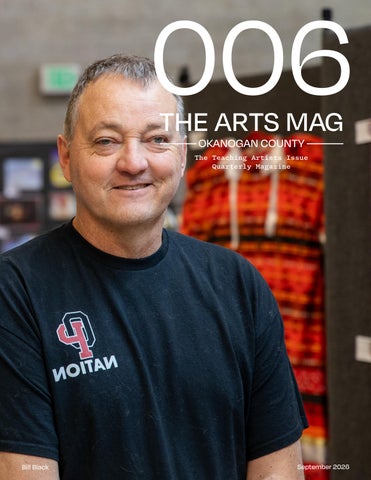
006 THE ARTS MAG OKANOGAN COUNTY
The Teaching Artists Issue Quarterly Magazine
Bill Black
September 2026
Board of Directors PRESIDENT
Staff EXECUTIVE DIRECTOR
Missi Smith
Sarah Jo Lightner
VICE PRESIDENT
EDUCATION PROGRAM MANAGER
Jill Sheley
SECRETARY Salyna Gracie
BOARD MEMBER Nicole Ringgold
TREASURER Dorothy Mitchel
BOARD MEMBER Ray Johnston
BOARD MEMBER Leslie Gerrard
Olga Surmacheva
LITERARY ARTS SPECIALIST Nick Littman
METHOW VALLEY ARTS INSTRUCTOR Ali Greb
CREATIVE ECONOMY PROGRAM LEAD Phoebe Webb
COMMUNICATIONS & MARKETING MANAGER Cailee Maestro
COMMUNICATIONS & MARKETING ASSISTANT Mackenzie Mayhem
ADVISORY MEMBER Don Ashford
INTERN Amelie Zerbe
Methow Arts Magazine CONTACT
SUPPORTERS
methowarts.org info@methowarts.org Instagram: @methowarts
Public School Funding Alliance Icicle Fund Community Foundation Arts WA Three Rivers Hospital WasteWise Methow Creative West Blue Star Coffee Roasters
STOCKISTS We would love to have our magazine in your business, cafe, or venue! If you would like to stock Methow Arts Magazine, please inquire at info@methowarts.org
DESIGNERS AND WRITERS Cailee Maestro Mackenzie Mayhem Nick Littman
ILLUSTRATOR Mackenzie Mayhem
COPY EDITOR Susan Peterson
PRINTER Wenatchee World
FEATURED ARTIST PHOTOGRAPHER
PARTNERS TwispWorks Confluence: Art In Twisp Methow Pride The Merc Playhouse Winthrop Rhythm & Blues Festival The Winthrop Co-op Gallery Methow at Home Cascadia Music
SPONSORS Blue Star Coffee Roasters Methow Valley News Johnston Architects KTRT The Root Riverside Printing Winthrop Folk N Roots Fest Harris Pottery Methow Valley Hospitality Resources Inc
Roxanne Best
SPECIAL THANKS COVER PHOTOS Roxanne Best
Paid in part by Okanogan County LTAC
04
around them. But we also want them to imagine. We want them to be curious. We want them to know how to take an idea that exists only in their minds and make something from it. We want them to collaborate, communicate, solve problems, take creative risks, and discover their own unique voices. This is why arts education matters.
from the director 7,500+ students received arts instruction or cultural enrichment through Methow Arts programing in Okanogan County during the 2025-2026 school year.
8 school districts are reached by Methow
Arts’ high-quality arts education and cultural enrichment programming.
10,726 students were enrolled across the
eight Okanogan County public school districts.
34 individual schools across 8 districts make up those Okanogan County public school systems.
Dear Community, Every fall, as students across Okanogan County return to their classrooms, I find myself thinking about what we want an education for our youth to look like.
WHEN SCHOOL BUDGETS SHRINK, OPPORTUNITY SHRINKS Washington State recognizes the arts as a part of basic education. ArtsWA notes that students are required to receive meaningful arts instruction during the regular school day, and the state’s K-12 Arts Learning Standards encompass dance, media arts, music, theatre, and visual arts. Although the law mandates art instruction, these requirements are not matched with funding to support the work within our schools. Recognizing the arts as essential and having the resources to provide them are two very different things. Public schools across Washington are facing increasingly difficult financial choices. Rural districts feel these pressures acutely: fluctuating enrollment, rising operating expenses, and the fixed costs of running schools across large geographic areas leave limited room for flexibility. When resources become scarce, schools must protect their most fundamental operations. Programs dependent on enrichment dollars, grants, partnerships, or limited discretionary funding become increasingly difficult to sustain. Arts opportunities become fewer, residencies shorter, materials get harder to purchase, and access becomes increasingly dependent on whether a community has outside resources available. For rural students, that loss can be especially significant.
Of course, we want them to learn to read, write, calculate, investigate, and understand the world
05
In an urban area, a child who doesn’t encounter the arts at school may still live near museums, theaters, music schools, galleries, or private arts programs. For many children in Okanogan County, school is their only point of access. That makes partnerships between public schools and community arts organizations not a luxury, but an essential piece of rural educational infrastructure.
tion, we invest in imagination, belonging, and the future of Okanogan County. With gratitude,
THE WORK AHEAD As public education funding becomes more constrained, organizations like Methow Arts are being asked to do more, not to replace our schools or educators, but to stand beside them. In some cases that means stepping in to sustain programs schools can no longer fund, with the hope of returning those programs to the schools when resources allow.
Sarah Jo Lightner Executive Director Methow Arts Alliance
It means raising private dollars to leverage public investment. It means building partnerships with school districts, foundations, local businesses, artists, and individual donors. It means purchasing materials, traveling hundreds of miles between communities, and continuing to reach students in places where arts programming might otherwise be unavailable.
P.S. This fall, we’re asking for your support to keep vital arts education programs in our schools. Our districts can no longer cost-share, leaving us a $35,000 shortfall for the 2026–27 school year—less than $5,000 per district. Every gift helps keep the arts accessible to local students. Please consider supporting our year-end campaign!
It also means advocating for public schools by reaching out to elected officials and voicing your support for fully funded public schools that champion our youth and educators. Funded public schools are not guaranteed, and we owe it to the future of the communities we love to ensure the next generation has the same opportunities that we all had. These opportunities should not depend on a ZIP code, a school district’s budget, or a family’s ability to pay. Art eduction belongs to every child. As we begin another school year, take a stand for our students. When we invest in arts educa-
06
METHOW ARTS
10-15
METHOW AT HOME
16-23
THE CONFLUENCE: ART IN TWISP
24-29
FEATURED ARTIST: BILL BLACK
HOW CAN I SOLVE THIS IN A DIFFERENT WAY? ART EDUCATION AT WORK
30-39
ARTIST UPDATE: JANET FAGAN
42-43
WINTHROP RHYTHM & BLUES FESTIVAL 46-49 METHOW PRIDE
50-55
CASCADIA MUSIC
56-61
INSIDE THE CURIOUS, OBSERVATIONAL WORLD OF ILLLUSTRATOR AND MURALIST JESS NEWLIN
62-67
THE MERC PLAYHOUSE
70-73
THE WINTHROP GALLERY
74-77
Methow Arts enriches the lives of people in Okanogan County by making the arts an integral part of public school education, economic vitality, and community. We envision a future where artists and art organizations collaborate and thrive, where the arts are part of the consciousness and experience of people of all ages.
MAKING ROOM FOR WHAT COMES NEXT By Cailee Maestro
For more than 35 years, Methow Arts Alliance has brought artists into schools, supported working artists, presented live performances, built public art, and connected people to creative experiences across Okanogan County. The organization began in the Methow Valley, but the work didn’t stay there.
Methow Arts Alliance is officially becoming Steppe Arts, Okanogan County—a new identity that better reflects the people and places we serve. At the same time, we are opening a new community arts space in downtown Okanogan and reimagining our longtime Twisp office as the Twisp Creative District Welcome Center.
Over the years, Methow Arts has traveled into the classrooms, communities, and gathering places that make up this county. Teaching artists drive miles to reach rural schools. Performers step onto stages and into gymnasiums from Pateros to Oroville. We’ve built partnerships with educators, artists, businesses, and organizations throughout the region. Somewhere along the way, the geography represented by the name Methow Arts became smaller than the community represented by our work.
Opening an office in Okanogan doesn’t mean we are suddenly expanding into Okanogan County—we’ve been here. Arts education has connected Methow Arts to communities throughout the county for decades. We’ve worked alongside schools, educators, and teaching artists to bring performances, residencies, and hands-on arts experiences to students in some of the smallest and most rural communities in our region. That work has grown to include artist services, public art projects, live performances, community partnerships, and support for the local creative economy.
This fall, we are taking a big step to change that.
12
METHOW ARTS
What we haven’t had is a physical place that reflects that countywide reach. Our new space at 111 S. 2nd Avenue in downtown Okanogan gives us one.
Methow Valley is where we began and where we remain deeply rooted, but after decades of serving all of Okanogan County, our name no longer tells the whole story.
It’s more than another office for staff. The building features gallery space, a rentable workshop, a community welcome area, and resources for artists and creative professionals. We imagine artists exhibiting new work, teaching artists and educators connecting, workshops filling the space, and community members coming through the door with questions, ideas, or simply curiosity about what’s happening.
“Our name has been an important part of our history, but it no longer fully represents all of the communities we serve,” explains Executive Director Sarah Jo Lightner. “We have been working throughout Okanogan County for decades, particularly through our arts education programs. Steppe Arts allows us to honor where we came from while creating a more inclusive identity for where we are going.”
There is something different about having a place where people can actually show up. A website can provide information and an email can start a conversation, but a physical space creates room for the conversations and connections we can’t necessarily plan for.
The word steppe comes from the landscape itself, the expansive terrain that stretches across much of Okanogan County and connects our communities. It gives us a name that holds more geography and more people while remaining rooted in this place.
The new space arrives alongside a new name. For an organization that has been Methow Arts since 1989, becoming Steppe Arts is significant. The
This isn’t about leaving our history behind; it’s about building on it.
Making Room for What Comes Next
13
That is why our Twisp space is an important part of what’s next. As we establish a home in Okanogan, our original downtown Twisp office will reopen as the Twisp Creative District Welcome Center, connecting residents and visitors with the Creative District, local arts resources, and locally created work and merchandise by artists and students. We are calling this phase of the transition Chapter One. The new name and these two spaces are just the beginning. Over the coming months, Chapter Two will bring the complete visual identity of Steppe Arts, and the next phase of an organization continuing to grow into its countywide role. Ultimately, a new identity isn’t about a new logo or what gets painted on the front of a building —it’s about who sees themselves in the organization behind it. “This isn’t about leaving our history behind,” Lightner says. “It is about building on more than 35 years of work and making sure our identity reflects everyone who is part of our future. We want people across Okanogan County to see themselves in Steppe Arts and know that this organization and these new spaces are resources for them.” On September 12, we’ll open the doors to our new Okanogan space. In October, we’ll reopen the doors in Twisp, with the exact date to be announced. What we are most excited about is what happens after that. An artist hangs new work on the wall. A workshop brings people around a table. Someone walks in looking for a resource and leaves having met the person they needed to meet. An idea starts in one of these spaces and finds its way into another community. We don’t know exactly what these spaces will look like five years from now, and that’s part of what makes this moment so exciting. We know why we are creating them. Now we are ready to see what our communities create inside them.
14
METHOW ARTS
Methow At Home supports older adults through the transitions of aging by offering educational programming, social connection, life planning, and volunteer support for household tasks. We foster a vibrant, multi-generational community rooted in joy, connection, and mutual appreciation, where everyone is valued. Our approach is about meeting people where they are, offering a variety of programs and services so that everyone can age at home in the community they love for as long as possible. Get to know the artists in our community through this member spotlight.
HANDS THAT TEACH: A WEAVER’S GENERATIONAL GIFT By Lindsay Morris
Susan Snover’s hands like to stay busy. “At the end of the day,” she confesses, “if I haven’t made something, the day doesn’t feel complete.” In a closet in her upstairs studio, her fabric room overflows with materials destined for transformation—sheets from the Senior Center Thrift Store, donated wool for a vest she’s helping an ILC student make, and scraps that will become reusable items and rugs. “My philosophy is if you can’t buy it at the Senior Center rummage room, you don’t need it,” she says. “If you go often enough, you’ll find it.” This resourcefulness is a worldview shaped by her Wisconsin farm upbringing and refined over 51 years as a professional weaver. “I’m a textile person,” Susan explains. “I like to educate people about textiles... opening people’s eyes to the fact that it’s not just a piece of cloth. It’s what it takes to make it, the history, and the people who do it.”
20
FROM BOBBY SOCKS TO PROFESSIONAL WEAVER Susan’s journey into fiber arts began at age ten when a Florida neighbor taught her to knit. She made angora cuffs to wear with her bobby socks—the height of 1950s fashion. Later on in her adult life, Susan discovered weaving almost by accident when a Seattle friend needed to store a loom during a house remodel. A six-week weaving class changed everything. “The message from the teacher was, ‘There’s no mistake that can’t be fixed,’” Susan recalls. “And so, I guess that’s how I became fearless about it. Well, if it doesn’t work, so what?” That fearlessness built a business. From her basement studio in Seattle, Susan wove 300 to 400 rag rugs a year, along with countless hand towels and custom pieces. But numbers don’t capture the real impact. Through her work, Susan
METHOW AT HOME
created something more valuable than a product —she created a lineage of makers. THE APPRENTICE TRADITION LIVES ON Over the decades, Susan has mentored five or six formal apprentices, each staying anywhere from a single summer to several years. “I didn’t pay anything, but I taught them everything I knew,” she explains. One student worked with her through college and beyond, eventually weaving hand towels from home while raising young children. Another apprentice became so skilled that Susan connected her with other professional weavers, leading to years of work creating fine clothing for Neiman Marcus. The weaving community, Susan notes, is inherently generous. “It’s very open and sharing. Since I like this stuff so much, if anybody shows even a slight interest, I want to help cultivate that.”
This instinct extends beyond formal apprenticeships. Susan has taught sessions for Methow Recycles’ Camp ReMake, where kids learned to craft reusable paper towels from donated sheets. She also led Yarn Club, an after-school program where elementary students made yarn-covered name tags, wove ornaments from CDs, created Japanese-style braided bracelets, and learned to identify different fabric types—taking home what they have learned to find examples of in their own houses. Currently, she hosts a knitting group and mentors a high school senior every Wednesday morning, teaching her to sew. When the student wanted to make a purple wool vest, Susan found material in her upstairs fabric room, then visited a quilter friend to gather lining options. She has been involved with the local Spinners and Weavers Guild since landing here full time in 2003. She’s quick to invite anyone and everyone to join, knowing that the collective wisdom of Guild members will help newcomers along the way. WHAT WEAVING TEACHES US When asked what values she hopes to instill in younger people, Susan’s answer is immediate: “The value of making something and finishing a job. Following through.” In an era of shortened attention spans and instant gratification, weaving offers something countercultural. You wind the warp, throw the shuttle again and again, watching fabric emerge with each pass of the shuttle. Susan’s non-paper towels begin as old flannel sheets. Her rugs are woven from various donated fabrics, sometimes even old rugs. “I’m keeping it out of the landfill. I bring it home, cut it up, turn it into a rug, and it moves on. It has a new life.” This focused resourcefulness counters our disposable culture.
Hands That Teach: A Weaver’s Generational Gift
21
that connect people. She participates actively in the organization’s decluttering services, visiting homes to help others let go of things—though she admits with a laugh that, “often, that means their clutter comes to my house, but I just turn it into something!” This is the reciprocal magic of aging in place: when we support elders to remain in their homes and communities, we preserve living repositories of skill, wisdom, and connection. Every child who learns to make reusable rags, every high school senior who finishes her first vest, and every person who discovers the satisfaction of weaving after being invited to the Weaver’s Guild benefits from Susan’s presence here. “Just because somebody’s old, they shouldn’t be thrown away,” Susan says quietly. “They’ve got a lot to give and to share.” Her advice for others aging in place is characteristically practical: “Get rid of your junk. Things aren’t that precious. Give things away now, so you can have the pleasure of seeing somebody else enjoy it.” This is the real product: not rugs or towels, but a community that values reuse over throwing away, making over buying, and learning over consuming. THE VALUE OF KEEPING ELDERS CLOSE Susan’s ability to serve as this kind of community resource—teaching, mentoring, and connecting people to skills and materials—depends on her continued presence in the Methow Valley. “The fact that I can live in this house by myself,” she notes, is made possible through practical support: “somebody comes and checks the smoke detectors, and in the winter, somebody comes to shovel the walkway.” As a founding member of Methow At Home, Susan helped create the very support system that allows her to age in place. She served on the social committee early on, arranging events
22
Even as she advocates letting go of possessions, Susan holds fast to what matters: the satisfaction of making something every day, the joy of an inquiring mind, and the deep pleasure of passing knowledge forward. Weaving, after all, is about interlocking threads— warp and weft crossing to create something stronger than either alone. In Susan Snover’s life, the pattern is clear: she weaves people together as skillfully as she weaves cloth, creating a tightknit community that holds us all.
Methow Valley Spinners & Weavers Guild 2026 Show and Sale, Friday November 20, 2 – 6pm and Saturday November 21, 9a – 3pm. 137 Old Twisp Highway between Twisp and Winthrop.
METHOW AT HOME
EVENTS TECH TUESDAY Every Tuesday 1-3 PM Winthrop Library Community Room
Tech Tuesdays are weekly events alternating between informative lectures and one-on-one Tech Cafe support sessions. They offer a great opportunity for people aged 60+ to polish their digital literacy skills. Our lectures cover everything from smartphone photography to avoiding email scams. Tech Cafes invite you to schedule an appointment, bring your device, and our savvy tech guides will help troubleshoot your issues. TECH TUESDAY Every Tuesday 1-3 PM Winthrop Library Community Room
Tech Tuesdays are weekly events alternating between informative lectures and one-on-one Tech Cafe support sessions. They offer a great opportunity for people aged 60+ to polish their digital literacy skills. Our lectures cover everything from smartphone photography to avoiding email scams. Tech Cafes invite you to schedule an appointment, bring your device, and our savvy tech guides will help troubleshoot your issues. GAME DAY AT THE GRANGE Every 1st and 3rd Sunday of the month, 1-4 PM, The Grange
Every first Sunday and third Sunday of the month come play games at the Twisp Valley Grange! Everyone is welcome! Bring a friend and your favorite board game to teach and enjoy with others, or simply come to join and try something new. Feel free to pack your favorite snack to share and a drink (alcohol-free, please!). Youth 10 and over who are interested in playing are welcome to come with a parent.
Hands That Teach: A Weaver’s Generational Gift
OPEN BOOK CLUB WITH FOWL September 18, 1 - 2:30 PM Winthrop Library Community Room
Join FOWL and Methow At Home for a relaxed and welcoming Open Book Club—a chance to share what you’re currently reading or a favorite book from the past. Each participant will have a few minutes to tell us about their book. You might inspire someone’s next great read—and discover a few new titles yourself! No assigned reading—just bring yourself and a book you’d like to share. METHOW HEALTH AND WELLNESS FAIR October 1, 1 - 3 PM Winthrop Library Community Room
Join us for the annual Methow Valley Health & Wellness Fair—a welcoming community event designed to help you stay healthy, informed, and connected. While this event is focused on the needs of older adults, everyone is welcome to attend and learn about the many health and wellness resources available in the Methow Valley. Visit with representatives from local hospitals, medical clinics, and community organizations offering information and support for healthy aging. Free services and resources include: • • • • • •
Blood pressure checks Hearing screenings Flu shots Advance Care Planning information Cognitive health resources Transportation services
Visit www.methowathome.org/events for more information.
23
The Confluence: Art in Twisp, a 501(c)(3) organization, was founded in 1988 by a small, forward-thinking group of artists who felt the Methow Valley needed a place to gather for the celebration of the visual arts. Since that time, The Confluence: Art in Twisp has become a cultural landmark in downtown Twisp.
Moon and Sun, Janet Fagan
FIND FOOD FOR THE SOUL AT THE CONFLUENCE: ART IN TWISP By Robin Dogget
Berries, Jim Haack
Artwork by Jill Pelto
Every season is unique in the Methow Valley, and for many, fall is a favorite. Cooler temperatures are welcomed by all as our landscape becomes invigorated with color. It’s a time to save ingredients for comforting meals and a time to gather together with family and community. This fall, The Confluence brings an exciting lineup of visual art exhibits that are sure to provide you with another kind of nourishment—good for your health just like a warm bowl of soup. In the main gallery, be sure to catch Food for Thought, an exhibit that pays homage to the simple pleasures and complex nature of food. Curated by watercolor artist Bethany Wray, this exhibit features work by more than a dozen artists, including two radiant paintings of vegetable subjects by artist Rod Weagant. Featured in the Community Gallery are paintings by local artists who gather regularly for a weekly drawing club. These quick studies are a treat for the eyes and
26
a great way to see how a composition comes together. Both shows are on view through October 3rd. Starting October 10th, The Confluence welcomes This Land is Our Land, showcasing artwork that sings a heart song for the wild places
Marcia Ives Pottery
THE CONFLUENCE: ART IN TWISP
that surround us and provides commentary on our connection to public lands. The Confluence’s Community Gallery will host the work of five artists in an exhibit that celebrates the work and 50th anniversary of the Methow Valley Citizens Council. The exhibit, 50 Years of Watching Like a Hawk, is dedicated to environmental advocacy and the vigilant spirit required to protect our natural world. This Land is Our Land and 50 Years are sure to be powerful exhibits that we hope inspire action on behalf of our treasured public lands. November brings shorter days, one or two frosts, and perhaps snow that transforms the landscape. As we spend more time snuggling indoors, it’s a good time to embrace the Danish practice of hygge. This year’s holiday exhibit, Hygge: The Gift of Comfort, will help us all get into the spirit. You’ll find one-of-a-kind, creative gifts to share with loved ones and a variety of goods to support comfort and well-being throughout the season. Be sure to join The Confluence for an evening event or two this fall. Whether for an opening reception, an art exhibit, artist talk or poetry reading, Confluence events invite our community to come together and share the experience of art. Renowned watercolor artist Andy Evansen will give an artist talk in mid-October. Later in the month, keep an eye out for the panel discussion with artists from 50 Years of Watching Like a Hawk. The next time you’re in Twisp, take a moment to enjoy the work and handicraft of our local artists who share their talents at The Confluence: Art in Twisp. Don’t miss out on all the new work coming through the gallery this fall—you might find a bit of art therapy for yourself along the way! The Confluence is located at 104 Glover Street in downtown Twisp. Hours are 10:00 a.m. to 5:00 p.m., Tuesday through Saturday.
Find Food for the Soul at The Confluence: Art in Twisp
Egg-xacting Revenge, Cheryl Quintana
OCTOBER EVENTS FOOD FOR THOUGHT Main Gallery: August 24 - October 3rd Curators: Bethany Wray
So much more than a daily necessity, food sustains us and brings us together. This exhibit features artwork of edibles as subject matter. DRAWING CLUB: OOPS, WE PAINTED! Community Gallery: August 24 - October 3
Painted still-life’s in the spirit of drawing club, quick studies and a practice for the artist. THIS LAND IS OUR LAND Main Gallery: October 6 - November 14 Opening Reception: October 10, 5 - 7 PM Curators: Jennifer Molesworth
A celebration of Public Lands which are cherished places for all to share. 50 YEARS OF WATCHING LIKE A HAWK Community Gallery: October 6 - November 14 Opening Reception: October 10, 5 - 7 PM
Honoring the 50th Anniversary of the Methow Valley Citizens Council. Featuring works by Sarah Gilman, Morgan Moomaw, Jessica Newlin, Fletcher Rickabaugh, and Shaila Tenorio. ARTIST TALK WITH WATERCOLOR ARTIST ANDY EVANSEN October 15, 4:30 - 6 PM
Andy’s career has brought him around the world, as he is a sought-after workshop instructor who paints and teaches internationally. 50 YEARS ARTIST PANEL DISCUSSION AND RECEPTION October 29, 5:30 - 7 PM
Participating artists in 50 Years of Watching Like a Hawk and curator Perri Howard will speak about art and the future of stewardship.
28
THE CONFLUENCE: ART IN TWISP
TWISP ART CRAWL October 10, 5 - 7 PM
NOVEMBER HYGGE: THE GIFT OF COMFORT Main Gallery: November 17 - January 9 Opening Reception: November 21, 5 - 7 PM Curators: Margaret Kingston
Featuring artworks that foster a feeling of contentment and well-being for the gift giving season. LOOKS LIKE HOME Community Gallery: November 17 - January 9 Opening Reception: November 21, 5 - 7 PM
Enliven your everyday with the colors and texture of hand-crafted pottery and textiles. Local artisans Marcia Ives and Susan Snover team up in the Community Gallery. TWISP ART CRAWL November 21, 5 - 7 PM
To contact the gallery, call 509-997-ARTS, email info@confluencegallery.org, or visit www.confluencegallery.org. The Confluence is located at 104 Glover Street in downtown Twisp. Open hours are 10:00 a.m. - 5:00 p.m., Tuesday through Saturday.
The Better Road, Gayle Seeklander
Find Food for the Soul at The Confluence: Art in Twisp
29
How can I solve this in a different way? ART EDUCATION AT WORK By Nick Littman Do you remember the first time you were proud of a piece of art you made at school? When you scrawled an oblong oval for a body, four sticks for legs, a pair of ears, and drooped tail, and called it a dog? Maybe you tried to scribble inside the lines with a brown washable marker, then proudly toted it home to present to your parents, saying, “Look what I drew!” We all begin with an ability to create—we can take an idea, pick up a crayon, and translate it to the page. Bill Black, the art teacher at Omak High School, says somewhere between the exuberance of that young child and the freshmen who walk into his classroom, most kids come to believe they’re no longer good at art. Many don’t feel like they’re good at much at all. Bill Black is there to show them otherwise.
30
What is the role of the teaching artist? Is it to teach students how to draw, paint, and sculpt? Or is it to unlock the magic of making something from nothing more than your hands, a few simple tools, and an emerging idea? Black’s aim isn’t only to pass on technical skills—he wants to give his students the ability to look at a problem, tilt their heads to the side, and ask, “How can I solve that in a different way?” When applying creativity to a challenge, there’s rarely one right answer. In a way, Black’s own career trajectory is a reflection of this philosophy of unfolding possibility. Born in Omak, he later moved to Nespelem. His dad was an enrolled member of the Okanogan Band of Indians, part of the Confederated Tribes of the Colville Reservation. After moving to Everett when he was eight, Black pursued music first. It wasn’t until he was in college for music that he found he had a knack for taking people’s
FEATURED ARTIST: BILL BLACK
ideas and turning them into artwork. He pivoted, enrolled in art school, and spent nearly 40 years as a commercial artist. A job as an in-house graphic designer for Colville Tribal Casinos brought him back to Omak. He never saw himself as a teacher, but when he was approached about an art teacher position, he thought, “Why not?” It’s been a great fit. In 2025, Black was one of 28 art educators nationwide selected for the ArtEffect Ambassadors program. Sitting down with Black on his back porch in downtown Omak on a very smoky morning was a breath of fresh air. In an education system that often devalues what cannot be measured, Black makes a strong case for arts education as a means of re-learning—or not forgetting—that we all have the ability to create. Nick Littman: You started out as a musician. What led you to pursuing art professionally? Bill Black: My high school music director insisted that I audition for Soundsation, the elite jazz ensemble at Edmonds Community College directed by the legendary Frank DeMiero. I really had no idea what I was walking into—I just showed up because my director told me to. Somehow, I got in. In hindsight, that was a bigger accomplishment than I realized at the time. Every year, Soundsation hosted a huge jazz festival with schools coming from all over the region. Students signed up for the jobs needed to put on the event. I procrastinated, so by the time I got to the sign-up sheet, there were only two jobs left: climbing around the rafters of the gym to hang stage lights, or creating all the advertising and promotional materials. My decision-making process was highly sophisticated: “There is no way I’m crawling around in that hot, dusty ceiling.” So... I became the designer guy.
I had no idea what I was getting into. It wasn’t just doing art and layout for a poster. It was concert posters, newspaper ads, programs, souvenir sweatshirts—and then someone told me I also needed to paint two 13-foot by 13-foot portraits of the guest artists to hang behind the stage! I hadn’t taken an art class since seventh grade. Somehow, I pulled it off. A few days after the festival, my advisor called me into his office. I figured I was in trouble. Instead, he looked at me and said, “You should think about going to art school. Take a look at the Art Institute of Seattle.” That had honestly never crossed my mind. When I thought of a professional artist, I pictured the stereotype—a painter in a beret, working in an attic somewhere, hoping to sell a painting. I never realized people actually made careers designing magazines, advertisements, logos, T-shirts, book covers, or all the other things we see every day. My dad arranged a meeting with a family friend who owned an advertising agency, and she explained what commercial art and graphic design really were. It turned out to be one of the best decisions I ever made. NL: What is your approach to teaching art? How has it been informed by your professional experience? BB: My teaching is built on two different ideas. The first comes from my background as a commercial artist and graphic designer. I spent decades creating art for clients. I call that “art with a purpose.” Every project started with a problem to solve: a business needed a logo, a school needed a poster, or a nonprofit needed a brochure. My job wasn’t to create something that I wanted—it was to create something that accomplished their goal. That’s very different from the way many people think about art. Fine artists often begin with an idea they want to express. Commercial artists begin with someone else’s objective and use
How Can I Solve This in a Different Way? Art Education at Work
31
“Art teaches students that there isn’t always just one right answer. It teaches them to explore possibilities, experiment, make mistakes, revise their thinking, and keep going until they find a solution that works.”
FEATURED ARTIST: NAME
Title
creativity to solve a problem. Neither approach is better; they’re just different. I genuinely enjoy the challenge of taking a client’s vision and bringing it to life. There’s nothing better than hearing someone say, “That’s exactly what I was hoping for.” That experience heavily influences how I teach. I want my students to understand that creativity isn’t just about making something beautiful—it’s about communicating ideas, solving problems, and thinking in new ways. Those skills apply whether they’re designing a logo, illustrating a children’s book, building a website, or tackling a challenge in a completely different career. The second part of my philosophy is confidence. Every project is really an exercise in problemsolving. Students don’t always get it right the first try—and neither did I as a professional. They learn to try an idea, evaluate it, revise it, and keep improving. By the end of the process, they’ve created more than just a piece of art: they’ve proven to themselves that they can overcome obstacles and create something that didn’t exist before. That’s the lesson I hope stays with them long after they’ve forgotten specific art techniques. NL: Can you tell me about a favorite art project that you like to teach students? BB: Almost every kid that comes through my door says, “Man, I can’t draw nothing. My art sucks. I can’t draw a straight line.” And I ask them, “Why is that?” Generally, they don’t have a response. To break the ice and take the pressure off, the first project that I have them do is simply this: “Take this class period and draw the face of your friend sitting across from you.” Invariably, they all make the same mistakes—they draw from their preconceived ideas of what a face looks like instead of actually observing it.
FEATURED ARTIST: BILL BLACK
At the end of class, we put all the drawings up on the board. Everybody draws a variation of Mr. Potato Head because everyone shares the same false assumptions about facial proportions. I say, “Look. Michelangelo isn’t here in disguise. Everybody is starting from the same line. Don’t worry about it!” It’s funny because they’re all afraid to display their artwork, and then they look at everybody else’s and they don’t feel so bad. Somewhere around the third or fourth grade, most kids drew something and someone said, “that doesn’t look real.” But before that, they’d come running home saying, “Look Mom! Look what I made! Put this on the fridge.” Next, we spend a week learning about what I call a “roadmap of the face”—the built-in measurements in your face, like how your head is five of your eyes wide. At the end of the week, they draw their friend’s face again using the tools and techniques we worked on. They compare the two drawings and see: “Oh man, when I really paid attention, this is what I made.”
If I can get them to remember the confidence and excitement of that third grader and get them to say, “look what I made.” Then I’ve done my job. NL: So you feel like that creativity gets lost along the way? BB: Oh, yes. Absolutely. For a lot of kids, somewhere between third grade and fifth grade, they suddenly think they suck at art. They think that art has to be a photorealistic representation. Some people can do that, and it’s a great skill. Is that art? I don’t know. I don’t think so. If every piece of art was supposed to be photorealistic, we’d just take a picture and call it good. I firmly believe that what develops an art style is the imperfections. The variations in the way you draw or paint something, and the way I draw or paint something, and the way someone else draws or paints something—those differences are where the ART is.
How Can I Solve This in a Different Way? Art Education at Work
35
NL: Arts education is consistently underfunded by school districts in Washington and around the country. Why should arts education remain an essential part of K-12 education?
NL: What creative skills do you want your students to leave your classroom with? How can the practice of art prepare them for going out into the world?
BB: Historically, I think the arts are undervalued because they don’t fit neatly into a standardized test. It’s easy to measure whether a student can solve a math problem or identify the main idea in a reading passage. It’s much harder to measure creativity, imagination, perseverance, or the ability to look at a problem from a completely different angle. Unfortunately, if something is difficult to measure, it’s often treated as less important.
BB: The world is changing faster than ever. Many of the jobs our students will have don’t even exist yet. I can’t teach them every technical skill they’ll ever need, but I can teach them how to think creatively, solve problems, communicate ideas, and keep learning. Those abilities will never become obsolete.
I couldn’t disagree more. Art teaches students that there isn’t always just one right answer. It encourages them to explore possibilities, experiment, make mistakes, revise their thinking, and keep going until they find a solution that works. Those are the same skills they’ll use whether they become artists, engineers, entrepreneurs, doctors, teachers, or parents. More importantly, art teaches students something about themselves. Every time they take an idea—that only existed in their imagination— and turn it into something real, they begin to understand that they are capable of creating, solving problems, and making a difference. That confidence carries over into every other part of their lives. My art program is funded through Career and Technical Education (CTE), which recognizes that creativity, design, communication, and creative problem-solving are valuable career skills. But the value of arts education goes far beyond preparing students for a career. It prepares them to think creatively, adapt to new challenges, and approach the world with curiosity and confidence. Those are skills every student needs, regardless of what path they choose.
36
There are more creative careers today than most people realize: graphic design, illustration, animation, game design, web design, user experience design, marketing, branding, photography, video production, product design, industrial design, architecture, and digital content creation are just a few. Every business, nonprofit, and organization needs creative people to communicate their story. I want students to understand that they have the power to create something that wasn’t there before. To be a creator rather than a consumer. Whether it’s a painting, a business, or a better community, every meaningful change starts as an idea in someone’s imagination. NL: You have Colville Tribal heritage and in the Omak School District you have many Indigenous students who are members of the Confederated Tribes of the Colville Reservation. How do you weave cultural perspectives into your classroom? BB: Teaching in Okanogan County is a privilege because this community has such a rich history and strong sense of identity. I was born here, and my dad graduated from Omak High School in 1966. The people, the landscape, and the community have all become an important part of who I am as a teacher. Having Colville Tribal heritage makes teaching in a district with many Indigenous students deeply
FEATURED ARTIST: BILL BLACK
personal for me—I’ve even had relatives in my classes! It carries a responsibility to represent Native cultures accurately and respectfully. One of the things I try to do in my classroom is move beyond stereotypes. Native art isn’t one single style, or symbol, or story—every tribe has its own traditions, history, and artistic voice. I want all of my students—not just Native students—to understand and appreciate that diversity. At the same time, art is a universal language. Every student brings their own experiences, culture, and perspective into the creative process, and those differences make everyone’s work stronger. NL: The 2025 statewide Healthy Youth Survey reports that many youth struggle with anxiety, trauma, or feeling hopeless about the future. How do you think the practice of art can build a sense of possibility in students’ lives? BB: It’s about baby steps, and it goes right back to that first face-drawing project. Just experiencing a small moment of success because they focused on a challenge builds something vital. The underlying goal of my teaching is helping kids develop confidence in themselves and their abilities, rather than feeling marginalized or shuffled into a corner. My art room is a safe space where they can express themselves without judgement. NL: Is it important for you to keep some creative projects going outside of teaching? BB: Yes! I make stuff—I can’t help it. It’s part of who I am. While I don’t chase freelance design clients so much anymore, I channel my creativity into my children’s book series, “Binky’s Big Backyard,” and my NDN All-Stars sports history effort. Staying in the design business helps keep me current on technology and all the changes. NL: In your own work and in your teaching, where does your inspiration come from? What have you learned being a part of the
ArtEffect Ambassador program? Have you brought some of what you’ve learned back to your students? BB: My inspiration almost always comes from stories. Whether I’m designing a logo, illustrating a children’s book, creating a lesson, or working with a client, I’m asking: “What’s the story we’re trying to tell?” The artwork is important, but it’s the story that gives it meaning. Being selected as an ArtEffect Ambassador reinforced what I’ve believed for a long time: art isn’t just about making beautiful things. It can educate, advocate, preserve culture, challenge stereotypes, and inspire people to make a difference. Art has the power to start conversations that might never happen any other way. I want my students to understand that their artwork can serve a purpose beyond earning a grade. A poster can inspire action. An illustration can preserve a story. A design can solve a problem. A photograph can change the way people see an issue. Art has the power to influence how
38
people think and feel, and that’s an incredible responsibility. One of the biggest lessons I hope my students learn is that every creative choice they make communicates something. Color, composition, typography, imagery—they all tell part of the story. When students begin to understand that, they stop asking, “What should I draw?” and start asking, “What do I want people to understand?” That’s a completely different way of thinking. If my students leave my classroom believing that their creativity can make a positive difference in the world—however they choose to express it—then I think I’ve been successful. Art has always been about more than making things. It’s about communicating ideas, telling stories, and when we’re at our best, helping to cause positive change.
FEATURED ARTIST: BILL BLACK
Sitting with Bill Black, I kept being reminded of Kobi Yamada’s children’s book, What Do You Do With an Idea? In the book, a boy has an idea that follows him around. At first, he tries to ignore it, worrying what others might think. It follows him. He decides to give it food, to nourish it, to play with it. Eventually he shows it to others. Not everyone likes it. But he sticks by it and the more he stays with it, the more he realizes he can do anything, he can think big, he can look at something in a completely new way. In the end, his small idea becomes more than just his, it goes out into the world and is everywhere. In his approach to teaching, Black is there to remind his students that they all have valuable ideas. In a world of rapid change, isn’t the ability to imagine new possibilities—and bring them to life—one of the greatest skills we can give to the next generation? Black makes a powerful case for the enduring relevance of art education in every classroom. With arts education funding in short supply, Methow Arts works to provide access to arts education for underserved students throughout Okanogan County. You can help inspire the next generation of creative thinkers by supporting Methow Arts today at www.methowarts.org
How Can I Solve This in a Different Way? Art Education at Work
39
ARTIST UPDATE JANET FAGAN
— despite loss and grief over shifting environmental and political landscapes.
Photo by Steve Mitchell
Since being featured in the Methow Arts magazine in 2023, I have continued to focus my practice on the wildlife and landscapes of Washington, both east and west of the Cascade Mountains. Most recently, I have been focusing on wildlife that is frequently misunderstood or maligned, and presenting them through a lens of compassion and appreciation. The 2023 article described me as an “optimist.” Three years later, I can say unequivocally that this perspective has helped me to continue to go into the studio each week, search and apply for opportunities, and keep the ball rolling
42
Paying attention to the inner landscape while being inspired by the outer one is a daily practice. Self-starting every day as a solo practitioner takes all the tools in my box some days, but community, gratitude, and movement are my go-tos when things get hard. If it’s hard for you, you are not alone. Reach out if you want to talk about your practice and how to keep it rolling — I would love to listen and share. Thanks to the Mary Kiesau Grant I received this year, I have been able to purchase all of the supplies I need to learn Mokulito — a Japanese process of wood lithography. I’ll be taking an online class in Mokulito as my jumping-off point, followed by a selfdirected week of learning as I step outside my typical studio practice to experiment with new methods that build on my printmaking and painting.
ARTIST UPDATE
Photo by Steve Mitchell
All of this will culminate in a three-week trip to Japan, where I will explore historic and contemporary printmaking alongside the landscape, architecture, and culture that has shaped the art. I look forward to incorporating these new techniques as I continue exploring both the outer world and my inner landscape through wildlife and figure work. On my wish list for the months ahead is getting a figure drawing group started in the valley again. If you are interested in this idea, please reach out to me — let’s make this happen!
Janet Fagan
In other news, I will have work in the upcoming Confluence Gallery exhibit, “This Land is Our Land” (curated by Jennifer Molesworth), as well as “Voices of Color,” a Women Painters of Washington juried exhibit at The Gallery at the Park in Richland, WA. I will also be opening my studio to new students in December for my ongoing adult private and small-group drawing, painting, and printmaking classes. Thank you for your interest and for all that you do to make art, support artists, and keep the creativity buzzing in our amazing community!
43
Rythm and Blues
The Winthrop Rhythm & Blues Festival is a three-day event — located at the Blues Ranch on the Methow River in the resort town of Winthrop, Washington — packed full of exciting national and regional entertainment for all ages. There’s on-site camping, food and craft vendors, portable showers, a beer garden, and easy access to the river for recreation and cooling, which all help make the Blues Ranch the perfect setting for Washington’s “best little festival.”
WINTHROP RHYTHM & BLUES FESTIVAL 2026 RECAP By Peter Dervin
Photo by Peter Dervin
The 2026 Winthrop Rhythm & Blues Festival celebrated its 39th edition in the beautiful community of Winthrop, Washington, along the banks of the Methow River. Known as the “#bestlittlefest” in the Pacific Northwest, this year’s weekend featured many new artists from Canada alongside many returning favorites. Vancouver Island’s young guitarist Garret T. Willie opened the festival with a rousing, rockin’ set of electric guitar blues. The Rumble, featuring Chief Joseph Boudreaux Jr., followed with a funky New Orleans vibe that kicked off the evening’s festivities. Seattle’s very own Dusty 45s lit up the night with their jubilant rockabilly set in the Beer Garden. Every evening to wrap up the day, The Methow Juke Joint Allstars (MJJA) took over the Beer Garden stage to rock the night away. Featuring the Real Lady A with Polly O’Keary & The Rhythm
48
Method (with David Miller on guitar and Tommy Cook on drums) alongside guitarist Peter Dammann, these musicians invited an array of special guests to perform with the MJJA band. Harmonica legend Stan Street from Clarksdale, Mississippi, was a welcome regular guest once again, while newcomer Sean McDonald—an amazing electric guitarist from Nashville on the Little Village Foundation (LVF) roster—thrilled the crowd. Another LVF musician, Harrell “Young Rell” Davenport, started Saturday off with his traditional blues on guitar and harmonica—truly an amazing talent! Jo Miller & Her Burly Roughnecks brought rootsy swing to the stage to the delight of the crowd. Miller has been a part of the Seattle music scene for over 30 years, most notably with her 1990s favorite band, Ranch Romance. Ariel Posen and his bandmates played a blues-infused set that had everyone dancing.
WINTHROP RHYTHM & BLUES FESTIVAL
Returning to the Winthrop Ranch Blues stage was the one and only Curley Taylor & Zydeco Trouble, bringing his accordion talents to Okanogan County. Always a fan favorite, Curley Taylor and his band got the festival into a funky groove. Sue Foley and her band took the blues to another level with her amazing guitar playing, while longtime favorites Southern Avenue, all the way from Memphis, brought their soulful electric blues for another rousing set. Tierinii Jackson-Naftaly proved once again why she is one of the most exciting performers in the blues music scene. The California Honeydrops brought their unique retro-soul to the stage with lots of horns, guitars and even a washboard. This was my second time watching them, and they are not to be missed. Kim Field & His Perfect Gentlemen opened the Beer Garden set with his harmonica and bluesy blues. Again, the MJJA hit the stage to celebrate Lady A’s birthday with another all-night jam session. This evening also featured a performance from Portland’s Lilla on vocals.
Sunday morning at the Winthrop Blues Ranch kicked off with the Gospel Summit, where Southern Avenue with Lady A and Sean McDonald lifted everyone’s spirits to start the day. Sean McDonald, after jammin’ all weekend, finally performed his set with the Perfect Gentlemen band, and he did not disappoint. Sean McDonald really impressed, as he played all weekend and won over many new fans. Long time favorite Too Slim & the Taildraggers made their annual appearance, having played almost every festival for over 30 years. What I always enjoy most about the Winthrop Rhythm & Blues Festival is discovering new bands and music. Bywater Call from Toronto was a wonderful surprise with their driving roots, rock, and soul music. Jeremie Albino was another great surprise, playing a rockin’ set that had the fans going crazy! Jeremie strutted across the stage playing harmonica and really played a great set. Shinyribs closed out the main stage with his brand of funky blues and soul, and had everyone dancing the night away. Local favorites, the Crunk Monks, kicked off the sets on the Beer Garden stage with a rousing funky set of fun music. The final performance of the Methow Juke Joint Allstars—again featuring Lady A with Polly O’Keary and the Rhythm Method—welcomed Too Slim (Tim Langford) to the stage, as they jammed into the night. Next year, the Winthrop Rhythm & Blues Festival will celebrate its 40th year, bringing a variety of excellent musicians, artists and bands to the “Best Little Fest” in the PNW. Congratulations to the entire staff and volunteers for making it all happen, and thanks to the Winthrop Music Association, (a 501(c) (3) non-profit) for supporting live music in the Methow Valley! For more information and to purchase tickets, visit www.winthropbluesfestival.com
Photo by Peter Dervin
Winthrop Rhythm & Blues Festival 2026 Recap
49
Methow Pride is working toward creating a rural haven where LGBTQIA+ individuals believe in their creative expression, share their voices, build thriving intergenerational relationships, and find rural belonging. We ultimately aim to keep LGBTQIA+ people present, safe, and alive in this rural and natural space.
42
METHOW PRIDE IN 2026: QUEER COMMUNITY BUILDING, VALLEY-WIDE EDUCATION, AND CELEBRATORY EVENTS By Gwen Touney, TwispWorks WWU Sustainability Pathways Intern
While officially founded in 2022, Methow Pride’s community-based roots began 10 years prior. The “Mazama Pride Ride” was a small gathering of community members walking, biking, and riding horses together to celebrate the LGBTQ+ community. In the years following, Pride events in the Methow Valley increased in size, featuring musical guests, performances, and interactive activities. After formally becoming an organization, and reviving Pride celebrations, Methow Pride started expanding their programming outside of the month of June, ensuring that LGBTQ-centered celebration occurs year-round. Many associate rural communities with increased homophobia or isolation for queer people. While this is a reality for many, rural areas can also be a source of strength and belonging for members of the queer community. As Methow Pride’s Celia Gottlieb explains, the rural nature of the Valley allows for more connection and collaboration.
52
“This community in particular thrives from relationality,” said Gottlieb when discussing the benefits and challenges of running a queer organization in a rural setting. This is reflected in the Methow Valley’s sustained support for Methow Pride events, demonstrating that LGBTQ+ community and allyship aren’t restricted to large cities—Pride can and does flourish in small towns. In 2025, the Pride Center and Sanctuary was established on the TwispWorks campus inside the Fireweed Print Shop—a well-known beacon for LGBTQ+ community and support in the valley. This space helped to expand the purpose of Methow Pride beyond celebration of queer identity, allowing Methow Pride to begin regularly offering community-building, education resources, and programming.
METHOW PRIDE
there are containers to hold you,’” Gottlieb says. While outward-facing, celebratory events like the Snowball (an all-ages “queer prom”) contribute significantly to LGBTQ+ visibility and acceptance, inward-facing, supportive spaces are equally essential. “The panoptic experience of a small community as a queer person is very real,” Gottlieb emphasizes, highlighting how regular Pride Center and Sanctuary hangout nights are vital to curating a sense of safety, belonging, and privacy for LGBTQ+ individuals in the Methow Valley. Gottlieb’s background is rooted in consciousness-raising and grassroots organizing, which is why valley-wide education is the third fundamental pillar of Methow Pride. The organization coordinates informational campaigns on topics like allyship and gender identity, and partners with organizations like No Hate in WA State to educate voters on ballot initiatives impacting the LGBTQ+ community.
Around this time, Gottlieb stepped into their role as the organization’s Programs Director. “To me, it’s all based around the question of ‘what does it take to unlock rural queer thriving?’” says Gottlieb. That question drives Methow Pride’s efforts to activate the Pride Center and Sanctuary and engage the local community. At 5:30 p.m. on the first Thursday of each month, the Pride Center and Sanctuary hosts Art to Heart, a relaxed hangout night for queer community members of all ages to be themselves and connect with one another. Dinner is provided, art supplies are set out, and attendees are welcome to craft, socialize, read, work on homework, or simply relax. “Part of attracting people to live here—specifically attracting queer people to live and stay here—is saying ‘there is community here, and
54
Gottlieb emphasizes teaching community members tangible steps towards LGBTQ+ acceptance —such as protest, letter writing, calling representatives, and talking with neighbors—helping people get out of their comfort zone and engage in effective advocacy and allyship. “If I can improve a few people’s muscle in doing that, that’s transformative,” affirms Gottlieb. Part of valley-wide education also includes providing non-queer community members with open, welcoming spaces to ask questions about identity and visibility, leaving room for learning and mistakes. “That’s how I see my role; you can ask me those messy questions.” “If I had to summarize what we’re hoping for the future, it would be: consistency of events, stronger bonds between queer community members, and more opportunities for folks to ask questions and engage in honest dialogue about rural LGBTQ identity,” Gottlieb says.
METHOW PRIDE
EVENTS FIRST THURSDAYS - ART TO HEART First Thursdays at Pride Santuary
Monthly queer community gathering for LGBTQIA+ connection and resilience! Bring an art project, book, or just yourself. Enjoy a homemade meal and conversation with fellow queer/questioning community members. ADVOCACY IN ACTION: NO HATE IN WA STATE September 17, 5:30 PM at Pride Santuary
Effective allyship is essential to supporting Methow Pride in achieving this future for the organization and community at large. Allies can get involved by attending events, volunteering, contributing ideas for events and programming, donating, or using the many free educational resources available on Methow Pride’s website and at NCW Libraries. The Pride Center and Sanctuary, which doubles as Methow Pride’s retail space, is open every Saturday from 10:00 a.m. to 2:00 p.m. Stay up to date by subscribing to Methow Pride’s newsletter, following on Instagram @methowpride, or visiting their upcoming events page at www.methowpride.org/upcoming-events
Write to your neighbors about upcoming ballot initiatives that threaten LGBTQ+ youth. We’ll share what’s on the ballot, write postcards together, then decorate them. Goal: 500 postcards to swing voters in Twisp and Winthrop. We need your help! YOUTH NIGHT: COOKIE DECORATING October 7, 4 - 5 PM at Winthrop Library
Cookie decorating, music, pizza, and a little bit of queer history in the Community Room facilitated by Methow Pride staff! This event is for queer, questioning, and allied youth under 18. Accessible using the LBMS/HS afterschool bus. SCHUBERT’S FINAL SONATAS: A BENEFIT RECITAL WITH MICHAEL BRADY October 10 & 17 at 7 - 9:15 PM
QUEER NORDIC SKI WAX CLINIC November 29, 4 - 6 PM. Location shared upon registration
Learn how to wax your classic and/or skate skis before the season begins with queer skier Maddie Morgan. Not a skier or already an expert in waxing? Come to meet other queer skiers, enjoy some solo stove time, and eat chili! This event is free but registration is required before November 26 to ensure supply quantity.
Methow Pride in 2026: Queer Commuity Building, Valley-Wide Education, and Celebratory Events
55
Cascadia Music creates connection in a divided world by sharing the joys of music. Through performances, programs, and community engagement, the organization brings people together to experience the power of music and its ability to inspire, connect, and enrich lives. Based in the Methow Valley, Cascadia Music is committed to fostering meaningful musical experiences that celebrate artistry, creativity, and community.
CASCADIA MUSIC BRINGS THE POWER AND JOY OF MUSIC TO THE METHOW VALLEY By Kataya Chorover
This spring and summer, with smoke and threats from nearby fires, many of us have been feeling mixed emotions. Fortunately, we have music, art, and community to help us get through these challenging times! In this issue, as we celebrate local artist-teachers, we want to recognize all the wonderful music instructors in our valley— especially those who partner with us to create broader access to lessons through our scholarship program. On July 25th, Cascadia Music celebrated its 40th Anniversary at the Methow Valley Community Center (MVCC) gym. Despite having to move indoors from our original venue at the Twisp Town Park due to poor air quality, the event was a great success and a true reflection of our mission to “build community by sharing the joys and power of music.”
The last minute venue change was both essential and appreciated, as the gym is now a “clean air” environment thanks to the recently completed MVCC Energy Retrofit project. With a mini-festival format, we hosted a full day of music by Cascadia Music teachers, students, family, and friends. The day began with a set of classical guitar pieces performed by 14-yearold Ace Rickabaugh. A longtime student of Terry Hunt, Ace shared a message of gratitude from the stage for his lessons with Terry and for Cascadia Music’s support through the Christine Cherrington Scholarship Fund noting how important they both have been to his journey as a music student here in the valley. He proceeded to wow the audience with his precision, dynamics, and grace. Next up was a set of bluegrass and old time tunes from The Apostles, who had the crowd
60
CASCADIA MUSIC
tapping toes, stomping feet, and sharing a few belly laughs. A beautiful classical strings set from Meadowlark (led by Pam Hunt), was followed by opera, vocal classics, and Latin romance from Rebecca and Roberto. A large group from the Cascadia Chorale, led by Dana Stromberger, sang a short set including a beautiful version of the classic “We Shall Overcome,” arranged by Wayne Mendro. With a finale of jazz from the Valley Tones Do Monk, featuring the amazing vocal stylings of Sarah Thomas, the participants were treated to a full day of joy, connection, a BBQ, beverages, and a raffle.
Golden Shoals, Shane Brown, Bordergrass Alliance, and Okanogan County’s own Omak Creek. Festival organizer Brian Alley sees the event as an opportunity to make live music and music education accessible to everyone, regardless of age, experience, or financial background. “Folk music is music that people make together,” Alley says. “It’s music that connects people. It’s music that carries stories, traditions, creativity, and a sense of belonging. Winthrop Folk N Roots celebrates that spirit by bringing people together for one magical weekend every October to hear, learn, and share music across cultures, generations, and musical traditions. Our goal is simple: to build a stronger, more connected community through the joy of making and experiencing music together.” For tickets and more information, visit: www.folknroots.com. ENSEMBLES & SCHOLARSHIPS Fall also brings our ensemble performances and annual holiday concert! If you play an instrument or sing, we hope you will consider joining the Cascadia Chorale or the Pipestone Orchestra. The ability to read music is required, but an audition is not! Details about our 2026 Holiday Concert will be announced soon. Stay tuned!
A huge thank you to all the performers, to the many volunteers who helped set up, serve food and drinks, sell raffle tickets, and clean up, and to the audience of over 150 people who came out to enjoy the music over the course of the day. Many thanks as well to EQPD, Methow Rafting, and Orchard House for their generous raffle donations! LOOKING AHEAD THIS FALL Cascadia Music is pleased to announce the upcoming Winthrop Folk N Roots Festival, taking place October 23rd and 24th. Featured artists include Max Gomez, Jenner Fox, Skillethead,
For information or if you’re interested in joing, visit Cascadia’s website, the Methow Valley Bulletin Board, The Methow Valley News, or contact director@cascadiamusic.org Applications are officially open for the Christine Cherrington Memorial Scholarship Fund. Administered by Cascadia Music, this scholarship covers up to 50 percent for music lesson costs for qualifying students based on financial need. Applications are accepted on a first-come, firstserved basis through September 30th. To apply via Google Form or to learn more, visit www.cascadiamusic.org/scholarships.
Cascadia Music Brings the Power and Joy of Music to the Methow Valley
61
INSIDE THE CURIOUS, OBSERVATIONAL WORLD OF ILLUSTRATOR AND MURALIST, JESS NEWLIN By Cailee Maestro
To spend time with Jess Newlin’s work is to realize how much there is to notice. A mushroom becomes something strange and architectural. A familiar stretch of mountains unfolds across an entire wall. Plants, birds, landscapes, and everyday objects become subjects worth studying. For the Carlton-based illustrator, muralist, and naturalist, drawing begins with attention: looking closely enough to understand something and staying curious long enough to discover what you missed the first time. That philosophy extends beyond Newlin’s own studio practice. At her weekly Drawing Club
62
JESS NEWLIN
at TwispWorks, artists of all experience levels gather for the simple practice of drawing together. There is no prerequisite for being there—only a willingness to show up, put pencil to paper, and keep looking. This summer, that practice of observation moved onto one of Newlin’s largest local canvases yet: the exterior of the Methow Arts building in Twisp. Her mural, an ode to the birds and botanicals of the Okanogan shrubsteppe, invited local youth into the painting process and transformed a public wall into an opportunity to look more closely at the ecosystem surrounding us. For our Teaching Artist Issue, we talked with Newlin about learning outside traditional classrooms, what drawing can teach us about attention, the vulnerability of making art alongside other people, and what happens when an artist gives a community permission to pick up a brush. Cailee Maestro: Illustrator, muralist, naturalist. Where do those three worlds meet for you? Jess Newlin: Three years ago, I fell in love with and decided to devote my life to mushrooms. I got certified as a Natural Science Illustrator so I could make mushrooms famous! Of course, the curriculum sparked obsession with birds, bugs, and botanicals as well. The art practice is in service to the natural world. CM: What has learning to be an artist looked like for you? Who or what have been your greatest teachers along the way? JN: I spent way more time than I care to admit getting ready to be an artist. But all it requires is the creative act. You do, so you are. Focus on writing rather than being a writer. Focus on painting rather than being a painter. I was raised by artists, and lucky to count many as friends. It may look like what they do is just magic (it is magic), but the more time you spend with them, the more you learn that breakthrough and mastery come from doing the work.
CM: Because attention is required to draw something accurately, most of us don’t practice every day. What happens when you spend that much time really looking at something? JN: My favorite part of being a scientific illustrator is getting to know the subject as I work. You have to look closely to get it right. You study it. You start to notice it around town, you watch it change with the seasons. You grow close, you treasure it. CM: Drawing Club feels less like a formal class and more like an invitation to practice together. What were you hoping to create when you started it, and what keeps you coming back every Tuesday? JM: Drawing Club is very informal, a place to practice and experiment. Donna Keyser and I started it to keep us accountable to a regular drawing practice, and it worked! Many weeks we were so busy that the only time I picked up a pencil was from 5-7 on Tuesdays, whether I was feeling inspired or not. But what has developed, and what I love about it, is that we have created a place where people can show up, make some bad art (or sometimes something epic), and try something new—a medium or a style—no consequences, no pressure, just play. CM: So many adults decided somewhere along the way that they “can’t draw.” Where do you think that comes from, and how do you help people move past it? JN: I don’t know, it’s hard being an adult. It helps to make bad art and lots of it. Don’t take it so seriously. CM: What have other people taught you through Drawing Club? Has creating a space for others to practice changed anything about the way you make art yourself? JN: It is inspiring to watch other artists work
64
JESS NEWLIN
Inside the Curious, Observational World of Illustrator and Muralist, Jess Newlin
65
through a prompt with their own approach. Our practices are timed, so there is no time to overthink. It has helped me loosen up and be less precious with my work. CM: Going from a detailed illustration to an enormous public mural is such a wild shift in scale. What does working that big ask of you as an artist that working small doesn’t? JN: There are a lot more logistics involved in muraling—equipment considerations, weather considerations—but all of the design decisions happen on the desk, in the sketchbook. Once it is time to paint the mural, we are just following a blueprint. CM: For the Methow Arts mural, you chose the birds and botanicals of the Okanogan shrubsteppe. What surprised you once you started looking closely at an ecosystem that surrounds us every day? JN: I’ve lived here for nine years, and historically, after the balsamroot came and went, I wrote off the dusty foothills above the valley floor. But then I took a closer look, and there is A LOT going on under that blanket of sage and bitterbrush! In fact, it’s one of Washington’s most diverse ecosystems! Less than 20 percent of the historical shrubsteppe habitat still remains, and it surrounds us here in the valley. We should do all that we can to protect it, honor it, and celebrate it. CM: What do you hope someone notices, wonders about, or carries with them after walking past the finished mural? JN: I want it to look cool, but I also hope that it starts a conversation. This mural is a celebration of our backyard, and I want people to feel some pride in that. You know, someone can point to the wall and say, “Oh look, a mural” OR they can point to the wall and say, “I painted that big sagebrush!” Now we’re having a conversation about the shrubsteppe!
66
JESS NEWLIN
CM: What are you looking closely at right now? JN: Well, we just pulled 500 onions out of the garden, and they are curing on racks on my back porch, so all I see is onions right now. “I’m not crying, I’m just an onion farmer!”
Newlin’s mural may be measured in feet rather than inches, but its invitation is remarkably simple: look closer. At the sagebrush. At the birds. At the plants we pass every day without knowing their names. At the wall you have driven past a hundred times. At what another person might be capable of making, and what you might be capable of making alongside them. For the artists and young people who helped paint it, that lesson is now part of the landscape itself. Their hands helped create something larger than any one of them—something their community will encounter again and again. And perhaps that is what Jess Newlin does so well as a teaching artist: she makes curiosity contagious. Whether she is putting pencil to paper, studying a mushroom, gathering around a table for Drawing Club, or handing someone a paintbrush, she creates an invitation to look, experiment, and participate. The goal isn’t perfection. It’s attention. It’s practice. It’s discovering that you have something to contribute. Sometimes, all it takes is looking closely. DRAWING CLUB UPDATE Drawing Club is currently on summer hiatus. Jess hopes to return to regular Tuesday gatherings this fall, from 5–7 p.m., at various locations throughout the TwispWorks campus. Stay tuned for upcoming dates and locations. Instagram: @jhnewlin Website: www.jessnewlin.com
Inside the Curious, Observational World of Illustrator and Muralist, Jess Newlin
67
everybody’s watching
RIVERSIDE PRINTING & DESIGN 117 West Second in Twisp
www.riversidecreates.com
Get good news delivered weekly!
Methow Valley News
Okanogan County - $45 yearly Washington State - $60 yearly Out of state - $70 yearly
Re-freshed
Guaranteed Fresh Fest returns with expanded lineup
Big move
Ready takes new role at Methow Housing Trust
ARTS Page A5
Methow Valley News
STORY Page A6
Methow rap
It’s all about
PUBLISHED WEEKLY SINCE 1903 duo merges Dope ah MeaN influences musical
T WISP, WASHINGTON
VOL . 120 NO.15
Hank’s Harvest Foods
power
ARTS Page B1
running for Four candidates seat Okanogan PUD
ws Methow Valley Ne Konrads sell to Spokane chain after 49 years
W W W.METHOW VALLEYNEWS.COM
AUGUST 7, 2024
$1.50
leaves legacy of caring
All told, Konrad spent $8,000 to help people flee the fire. “You take care of people, coupled with robust tourist you know?” said Hank’s trafwife, fic, summer and winter. Judy Konrad, during a recent “It’s a gem of a store,” Rigsinterview the Konrads gave BY RALPH SCHWARTZ bee said. to Methow Valley News. Regarding the workers, $1.50 Years 2024 he Hank’s24, JULY said, “We kept every single Harvest Foods in surging, later, as COVID-19 was one a visitor who Twisp has been more than of them.” a gro- two nursing homes operated W W W.METHOW 13 cery store for the past 49 years. on WhidVOL . 121 NO. A lifetime in groceries The place has been something bey Island came into the store T WISP, WASHINGTON and eyed Hank’s fully stocked 1903 like the Methow Valley’s A young Hank Konrad heart shelves of toilet WEEKLY SINCE was paper with and soul. PUBLISHED already busy working on the envy. Hank didn’t let the Community safety. family ranch, but he got man to members who pulled Mac Surface a job leave before giving him two experienced Within minutes, at Martin’s Foodland in palwhere the 2014 Road, let-loads Carlton GranCrossing Frazer Complex and of toilet paper free of geville, Idaho at the age of up to 10Fire already a pickup 13 so charge. started, withknow howthe fireowner store he could have some cash Hank Konrad horses. Meanin his “What the hell’s a couple evacuate two andtrailer his sontoJackson pocket. The grocery business still rushing manned werethe thousand engines dollars fire worth fuelwhile, of toilet pumps at their neighborwas a good fit for Konrad, up the who as flames marchedpaper?” Hank chuckled. “It’s not ing convenience moved up to manage a Barney’s to the scene store houses.going to hurt when of the a row us, one way or the behind power store in Orofino, Idaho. hillside was out and creditthat’s card predicted The other. ... We felt good about the wind machines “With job demanded a lot of Konrad’s it, weren’t boogie,” working. The to and going we never ran out.” this thing’s line oftoday, time, with travel between cars trying Rusty ChiefFor to6 escape the SCHWARTZ five Assistant the Konrads, giving has BY RALPH Districtwell past valleyFire only locations, and he and Judy stretched the pausing were been afirethe scene, way of life. Some people EaglesStamps expecting a child, so he took and club. said at ting winds an calltheit karma. helping to direct whilehave “People Fed by g us opportunity to take over a briefly didn’t a grass fire money failed “That all comes back to you,” for fuel,” grocery store on Glover Street fight. 100-degree temperatures, raced hustled Hank KonradDNR east of Twisp 21) Hank said. “I mean, I think in and said.crews “We gave District Twisp. on Highway 20 it them the6fuel or gave of homes Sunday (July does.” behind the row money totobuy form through pastureland Konrad got a $40,000 bank creeping thelines fuel.” homes near fire, which was “Webackhave big hearts,” he One woman to stop the loan to clean up the former and briefly threatened in tears residents’ who Road. added. “We came from big toward pulled updownslope fami- Hank and Judy Konrad at their Finley Frazer Crossing arrived with her two children Photo by Ralph Schwartz “Buckingham Palace” grocery planes Fire District lies and seen Canyon home. The Konrads Helicopters and water was headed the how things weren’t to a Spokane-based grocery chain Okanogan County yards. to Wenatchee, sold Hank’s Harvest Foods store, where The Confluence: of Natural totofind drop so goodonsometimes.” in July. a motel room. Serwithin an hour Art it Twisp gallery is 6, the state Department eastern edge. now. the U.S. Forest the “I said, ‘How fire’s advancing Hank’s opened there in 1975. Resources and the fire the same taxidermied animals are you going to Rosauers swiftly, keeping He takes over closed on July 11. Rosauers late Sunday afternoon be able to get By vice responded homes and halting a motel watching over the store. by that time room you but Hank’s confirmed they are discussing and Judy built the store’s current to 175if acres, Harvest But acquired the Hank’s don’t have money had grown location at flames away from Fire after it sped dozer line Foods contin- Hank’s forges on without Mini Mart a transfer of here?” Konrad ues to an effective serve Hank the store buildings ley Highway412 E. Methow Valthe same custom- and had dug recalled telling crews the the Frazer Crossing of the highway. accordand moved there in Judy, who sold to Rosauers on July 24, Rosauers CEO Cliff and the land, too. woman, ers,fire, south withPublic the same employees two-thirds aof the Rigsbee said. decade ago. around 1978. over rolling hills r ic t 6 st a t io n s her a cou- and Bennett “So I gave Rosauers was drawn to st andDNR all the familiar products on Supermarkets, a Spokane-based Terms of the sale of the A l l fo u r D i ing to dispatch reports Photo by MyKenzieple hundred The Konrads’ business phichain that now has 24 locations. of bucks.” two for a number of reasons, Hank’s Ryan Winthrop, Carlton theRodruck. shelves — Rigsbee losophy didn’t change prevent the spread Information Officer responded: Twisp, at 12:18 p.m.not to mention Sale of the grocery store businesses weren’t disclosed, but said: the location, the hillsides to over 49 the employees, the Konrads and Rigsbee 5 and water on The fire was reported and Mazama. (“be aware”) both and a loyal local customer Crossing Road, to drop retardant base A Level 1 evacuation Sunday was Sunday at 10 Frazer worked in tandem planes See answered HANKS, and effect A2 passers-by that went into Some Helicopters homes. Neighbors and and horses p.m. Tuesday. See FRAZER, A3 to nearby reported no injuries calls for help, moving cattle lifted at 12:59 Finley Canyon fire agement. Officials 70 addresses between Ridge to the afternoon, according and no damage to structures. Coyote Manacres as of Tuesday to the south and the evacuation order. to Okanogan County Emergency north were under contained at 220 The fire was fully
STORY Page
A8
VALLEYNEWS.C
OM
ing Fire’s halts Frazer Cross Quick response
advance
Homes are briefly threatened by blaze
Wint er 2024
/25
Valley As drought drags Methowon, some water TO THE METHO
A SUPPL EMENT
Fencin
keep bears g progra m may
at bay
W VALLEY
NEWS
S THE VALLE
Y
R&B FE ST ROCK
users are cut off
No restrictions for wells, town water users
Right at home
Valley natives compete World Cup in Minnesot at a Page
SPORTS
B1
Picture this
Methow Valle y News
Lots of photos from a Methow winter weekend Pages A5,
PUBLISHED
WEEKLY SINCE
1903
T WISP, WASHINGTO
Navy’s train ing
Proposal would increase flights in Okanogan County
N
VOL . 120
NO. 43
W W W.METHOW
A6, B3, B4,
VALLEYNEW
S.COM
FEBRUARY
21, 2024
$1.50
training area provides a variety rain, including of terflat plains to mountains, hills and Dean Kurath’s provide a realistic ing environment, hourlong trainsession was disrupted sevenmindfulness of the airspace, but the overall size Thursday by times last both vertically horizontally, training flightsU.S. Navy Growlers on is what’s critical and realistic training West Chewuch. above his home on the environment, for a ing said. WeldKurath, who’s The training been keeping the training area officially track of flights, has 11,500 to 25,000 goes 3,000 flights tallied about feet, with more from in 80% of flight than day, each from a year, with 10 to 30 per But aircraft time above 15,000 feet. told the Methowone to three minutes, he descend to tions as part lower of training maneuvers,elevaKurath was Valley News last week. planes authorized reviewing his with assembled comments log as he Photo courtesy feet, NAS Whidbeyto fly as low as 300 The Navy is to send Air Station representatives Whidbey Islandto Naval to Mazama proposing an expansionof NAS Whidbey/Easter at the meeting. said Whidbey), n Washington and of the Okanogan (NAS the east slopes which has the predominantThe EA-18G Growlers, proposed an of the Cascades. training area Airspace Extension Environmental expansion of the existing don’t fly below aircraft in the airspace, for fighter Most of the The Federal in Okanogan training area aircraft, extending Assessment 500 feet. Aviation Administration aircraft that Because the train in the would extend County. The expansion (FAA) reduced the military planes travel area are EA-18Gthe airspace flights current vertical so fast, low “would and horizontal Growlers. Area (MOA) the Military Operations 2020 to address increased airspace in dimensions airspace west to Mazama for a person be very brief encounters air-traffic safety commercial of east slopes on the ground and the evelt training the Okanogan and Roos- with additional training requirements, of or for wildareas don’t fully accordflights (alter- life,” the Navy said at native higher altitudes the Cascades and add ing to NAS Whidbey the meeting. meet the status 2), and no action (preserving Public Affairs Navy’s needs, NAS These which includes above the existing area, Officer Michael Welding. Whidbey quo). the machinesaircraft are extremely complex The expan- environmental assessment said in its that extends from Winthrop and Twisp and sion would make up The Navy proposal. The (EA) of the for that loss. conducts two near the Canadian operate, said take a lot of training to frequency of FAA has training: to Brewster. The space flights border for compatibility reviewed the air- hostile air-combat maneuverstypes of Eli Bennett, Methow Valley resident The expansion wouldn’t increase. a former to avoid officer aircraft and is needed to The EA includes and safety. training and enhance the in the U.S. Air weapons systems three alternatives: defeat electronic electronic warfare to operational readiness, Force with expeproposed expansion rience on systems, the at a virtual since the public meeting Navy said of regular fighter jets. Pilots need preferred alternative), (alternative 1, a lot training about the the expansion proposal last week. sets and proficiency,to maintain their skill The geography he said. of the Okanogan BY MARCY
STAMPER
2024
other basins in July 2023 and expanded the declaration in April 2024 to cover almost the entire state. A few areas in Seattle, Tacoma and Everett, which have reservoirs that help See TRAINING, utiliA3 ties manage the limited BY MARCY STAMPER water supply, aren’t included in the Although the Methow basin declaration. BY ANN MCCREARY has been in drought for Ecology doesn’t have more can be reimthe than a year, for most people, authority to curtail Local homeowners indoor of installing electric the official drought declaration domestic use by people bursed for the cost aimed who get a new program doesn’t impose any conservation their water from a well, fencing through Ecology away from attractants measures. Water Resources Communiat keeping bears chicken coops But 98 water users hav- cations Manager Jimmy like garbage, beehives, by Steve MitchellNoren’t been able to water Photo Towns and fruit trees. and cities waywith their ris said. to help hometheir fields since July 22 because 20, music fans found municipal A cost-share program water A6, A7. can of Highwaythe impose bear-resistant fencing photos,systems Methowclosure More River has restrictions owners pay for Festival. been temporary Methow on below the by outdoor and Blues month Despite Rhythmf lows. the minimum was launched thisCouncil (MVCC), These use, but no officials in Winthrop, to the annual Winthrop “junior” irrigators must Twisp or other municipalities Valley Citizens call with a newly formed hotline before watering, and a in Okanogan County in partnership recall any conThe goal of ditions are unlikely to change recent restrictions. Methow Bear Coalition. to reduce human-bear is until October, During program Wildlife said Nigel Kingsespecially dry periods the Fish and Valley. Department of bury, the state Department conflict in the Methow electric fence an electric of Washington of in Winthrop in the 1980s and be easier with Photo courtesy Ecology’s watermaster for “A simple three-wire and from homes may Okan- early 1990s, watering was occaPhoto courtesy criteria to be eligible to deter bears Washington’s ogan, Chelan and Douglas black bears away of Washington has been shown must meet certain gray wolves coun- sionally restricted to odd and Westbound traffic on the under a reclassificatio Department said Madelyn Hamil- Keepingsystem. Homeowners would North Cascades Highway ties. even days, Winthrop Clerk/Treareduce conflict,” Photo by Ralph Schwartz highway. Two days later, Friday lands and wildlife fencing n proposed lose their endangered of Fish & Wildlife the route was closed indefinitely afternoon (Aug. 2) passed the Easy Fire State law gives priority by the state. species status ton, MVCC’s public who is leading for reimbursements. as it crept toward the to surer Michelle Gaines said. But due to increased fire activity. grease containers. the river over irrigation habituated to program coordinator, beenmoved of an arising no restrictions on to interrights there havethen in Bears that becomehuman sources program. temporarily case figure out a established after 1976, when council after the pilot fencing upgrades will provide install the Thedecades,—since said that food from to resthey can but she instream rule was set. Bourn a new The cost-share program for materials conflict, until solution or build their seeking withviewervoirs, nuisance or a threat. pump,she andwas water may become a bear more permanent it some Ecology declared a droughtgiving meters, she thought, up to $500 to homeowners said. That left owner wants the state bear-resistant fence. own fence, Hamilton said. for for the Methow Basin and drawing from consideration. from If a property She to build their own of Transportation (WSDOT) program comes of removed, the only solutionthe bear. Summer 2024 11 funding, homeownthe only applicant. Funding for the kill Monteverde asSee DROUGHT, To be eligible for criteria, including to close the road to all traffic managers is to A3 Washington Department the council, temporarelectric fencand Vital wildlife was appointed by ers must meet certain valley where the grants from on Sunday morning (Aug. NORTH CASCADES HIGHWAY complethe “Properly installedas a simple and Wildlife (WDFW) group to its full 4). CLOSED BY DON NELSON ily bringing the living in areas of bear conflicts have Fish and The road is closed until further The North Cascades Highway been proven to sensitive Damien Spears of is closed from Granite BY MARCY STAMPER Ground Foundation. diversity grant” ing has way to deter smart and of five. reflects that greatest number notice. Creek, milepost 148, 10 miles Eligible areas took on ment minutes, because most accurately progress and taineer senior drove Rainier’s Matthew west WDFW’s “wildlife Town Council But only for a few Kirsten Vanderfor species effective Because historically occurred. black bears, which 157 on the east side, near Rainy of Rainy Pass, to milepost at the state Many campgrounds and trails the first election The Winthrop meet- results status of wolves describes the current Mazama, Edelweiss supports recovery actions member Mat Classic, Kenny to the mat for forcouncil last week’s Pass. There are no detours. Tuesday’s in opportunistic Hot, windy weather has near Stehekin, (Aug.6) primaryafter residences looking current include Lost River, areas election the second where Spears were notwas a different look the group since pushed Photo by Rick 59 in the Okanoconservation needs also recognizingin Washington, while released member although other often poke around sources,” Hamilton until of his two after has8been took third place. p.m.,onafter the two who new council Lewis half, and Wolf Creek, on a case-by-case with greatestand Vital Ground FounBY ANN MCCREARY that wolves Valleyand News ing, where aMethow 2017, announced to settled nearby fires closer gan-Wenatchee National Forest, than 3,000 was sent to a veteran established in potential food See page B1 victories over the Mounare not printer, appointed there in Washington, will be areas — the Pioneer and in North Cascades acres, fill a vacancy conserves for for story and shethewas may be assessed of the the meeting. results selected to coverage of no should remain western Washington and in this issue. unexpectNational the northern and mostly on actually dropped to 12% from a land trust that the end said. prothen said. at is photos. However, Fire is dation council results bears now Gray Hamilton resignation coexistence burning the a will protected,” posted northeastern of her be basis, wolves just 1/4 mile Park, including parts of on the newspaper’s to the counmust have member 15% because the fire has grown habitat for grizzly will Smith said. Facebook Under state law, “We hope this pilot the flanks, to reach 36,763 wasaselected leaving the town page as soon members listed as an in Washington, currently again possible, withoutfrom Stehekin, and the Easy Pacific Crest Trail. Vanderhalf Applicants for fundingproperty that and connects and— fully an “endangered” acres. overall. Still, fire reported endangered edly resigned in the Aug. 14 issue. will help community wildlife. The grants on their managers said spot to fill. There is 0% containment on species under cies is defined as “seriously Fire burned down to the North state law, would spein 2017, and re-elected the and other 30 projects at up to $500 gram unnecessary conflict, reduce bear attractant The Easy Fire has tripled the that homes, docks and with another council of the town’s five cil later in 2021. She said she no lonand must design avoid in Easy Fire. other valCascades Highway, forcing sitive species be reclassified as a sen- with extinction throughout threatened cover about BY MARCY and protect bears opposition they are fencing, levies were As a result, two to devote to the size in the past week, to 1,538 under a rule STAMPER that deter bears. all or a sigdamage to property, last will be neophytes ger had the time necessary Washington State Department acres All containment on the Pio- ues at risk along the lake are the Washington becoming proposed by nificant portion of its fence to specificationscoalition will pro- apiece. drew about 69% on the ballot. Each as of Tuesday (Aug. 6). next range within consequences of council members considered well protected. Department state.” the named is bear from A Two the position. neer Wildlife “sensitive” the Fire is along the shoreline of Fish and The $10.6-million replacement the the council MVCC and (WDFW). The Pioneer Fire added species The two leviesapproval in 2020. when another replacement levies proposed as “vulnerable and instructions Pilot program time to step off I more of Lake Chelan. EP&O levy funds habituated.” the Methow everything WDFW is seeking combined made black bears is the by about or declining is defined “I feel it is my Containment vide how-to videos Valley School that about 1,000 from small fencing, as month. said. “When become endangered 22% of and likely to Although deterring ADDRESS LABEL up being approved public input District See FIRES, A2 a member of both a recent class WDFW estimates Methow waterMay 6 on the and council,” Vanderhalftime. I feel like on building bear-resistant until by wide margins. are budget over the district’s operating advanced-placement classes sizes to or Brooke Bourn — in the the fencing program, Wildlife advice on design The educational the past four THURS. would reduce proposed rule, which significant portion of threatened in a school programs. I had more black bears live Planning Commission with a goal of to afterFRI. well as technical U.S. Fish and passionate its range.” SAT. well started, criminal penalties the Winthrop projects, Hamil- shed, sharing the landscape In SUN. It also supports operation (EP&O) programs and as programs expand and years. But career and decision by the bears to Committee, as MON. ing wolves, among else could be more Oct. 8 for kill- ingtonthe western two-thirds TUES. materials for specific of humans. As existing Oct. 9 reintroduce grizzly grizand Infrastructure Riverwalk project someone Oct. 10 of Wash70.5% to 29.5%, levy was passing go up, the levies are expected costs health care,college counseling, mental (including the Oct. 11 growing population residents know Service to The proposal other changes. of the effective.” Oct. 12 means that creton said. about Oct. 13 school Methow as an organizer Valley fencing expert to with 1,714 OPINION . . . . . . . . . where wolves by WDFW North Cascades had applied and votes and 719 downlist gray . . . . . . . A4 “yes” cation one-fourth of the cost cover facilities and buses. nursing services, of the landscape staff to endangered Vanderhalf’s announcement Last month an electricto the Methow many Methow that can lead to con- the are currently Valley) on the “no” votes as — and Marisa Monteverde by the of eduHARTS PASS . . . . . . . may also be part and related came (Feb. 16). immediate opening of Friday periodic statuswolves is the result of vacancy created The $6.6-million . . . . . . . A4 under the federallisted as said. bears are zlies programs in on from experience, from Montana next four years, a to fill a council of longtime council ated another could also apply for that the ARTS . . . . . . . . . . . . educational a demonstration of flict — especially when provided in the future, Hamilton owners take EndanThe levy for every five yearsreview that is required gered Species Act (ESA), . . . . . . . A5 techcouncil. Bourn Valley to lead of food Valley School according to Methow nology improvements educational to give up her recent resignation in the state for members for protected the change The steps that property ogy improvements SPORTS . . . . . . . . . . levy helps pay technolDistrict Superintendent for expanded Sunny, species listed but would have attracted to sources listing the same as for Nelson. to wildlife Mostly are . Ben vacancy, bear-resistant fencing . com. . . . Tom bears . would and B1 Partial as was member career and endangered, Venable. wolves’ federal passing 70% not Partly coalition, 30%, with 1,687 to deter black told the council CLASSIFIEDS . . . . . . the Planning Commission or sensitive. Clouds education programs, nice technical threatened said. “If grizto cloudy Mostly status. Wolves affect MVCC, the bear The demonstration by humans. fencing program seeks to . . . . . . . B2 sunshine After Monteverde and motivations position on The Washington eastern third sunny “no” votes. With “yes” votes and 723 grizzly bears, Hamilton in the The pilot and sun COMMUNIT Y . . . . . . motive technology, including autoThe agency we’re going to of the state, WEATHER DATA BASED sunny A3 State munity members. the coalition pre. . . . . . . B5 ON ACCUWEATHER.COM Seth about her background from common attractants, bears do come back, See WINTHROP, count countywide,just 70 ballots left to tution guarantees funding Consti- construction and welding, and FORECAST FOR T WISP on 14 years of said it based its decision way 97, are not protected west of Highcouncil member VALLEY LIFE . . . . . . . pro- deter bearschicken coops, garbage, bee- zly helped MVCC education, . . . . . . . B6 and passage of both of basic for for applying, only for her. fence building ies is assured. ington’s wolf data and trends on Wash- (see related story) and under the ESA including instruction design. It also pays lev- considered but certain programs livestock pare to offer the are managed population and Miles had a question WDFW based are care sciences, in graphic art, said. fruit trees, livestock, compost, enrichment The levies will population FENCING, A2 by on See health on a gram, Hamilton bear coalition also hives, new under their listing and are not model developed covered by replace two personal food, food-waste restaurant levies that are state law. status versity of Washington. at the UniMVCC and the net- and pet and expiring after existing pays based the allocation the state pitality and recreation, finance, hosthree emergency to carcass pits, boneyards, four The Methow on enrollment. and resources. The “Wolves in plan to purchase Some differences . . . A4 Valley resultsyears. result, many programs technology natural TUES. As a fences for people slightly more .......... significant Washington have made MON. levy goes are are funded ting type electric at the schools toward instruction favorable than OPINION . . . progress toward SUN. . . . A5 Downlisting four years ago, July 30 in SAT. by they were since their original .......... recovery to wolves from July 29 FRI. state allocationa combination of the use of technology and the ethical when the replacement HARTS PASS . . . . B1 endangered sensitive would July 28 state endangered THURS. ing in 1980, .......... July 27 maintain listVenable said. and the two levies, regarding the safe and coursework when July 26 ARTS . . . . . . . . . B3 July 25 breeding wolves there were no known on hunting and malicious prohibitions responsible ADDRESS LABEL .......... SPORTS . . . . . . . B2 Smith, WDFW’sin the state,” said Julia tional harassment of gray and inten.......... CLASSIFIEDS . . . B7 See LEVIES, recovery section endangered species ferences in management wolves. Dif.......... A3 and protection for wolves listed Mostly manager. COMMUNIT Y ADDRESS LABEL . . B8 Partly “This recommended as endangered .......... Mostly sunny or ALLEY LIFE . . ostly
Homeowners can up to be reimbursed $500 for installation
B6
area expansio n raises loca l concerns
A CL A SSIC
MOVE
Infor mati
Council: Winthrop Town ed, one one member appoint resigns withdraws, one
shifts Group dynamic in a single meeting
on f o r a n e nj o y Me t how Va a ble l le y v i s it
Dining
& lo d g i n g g
u id e s
Activ ities Fire activity grows in hot, windy f or e ve r y i n tere st & a l lweather a ges
Pioneer, Easy fires defy containment
WDFW propo ses downlisting state’s gray wolve s’ status
(509) 997-7011 | support@methowvalleynews.com PRIMARY COVERAGE
N VISITOR I
N F O R M AT I O
|
PS TRAIL MA
|
AC T I V I T I E
88° 58°
INSIDE ...
77° 46°
84° 54°
88° 57°
89° 54°
87° 56°
88° 54°
Both MVSD
S
89° 58°
88° 55°
INSIDE ...
88° 54°
87° 54°
88° 55°
FREE
levies approved
by wide margi
ns
Would be reclassifie d as ‘sensitive species’
The Merc Playhouse is a nonprofit community theater seated in the historic Twisp Mercantile Building in Twisp, WA. Originally built in the early twentieth century and transformed into a theater in 1999, the 100-seat venue has become a beloved cultural hub for the Methow Valley. With its exceptional acoustics and intimate setting, the Playhouse hosts a diverse yearly lineup of performances—from classic plays like Our Town and musical collaborations with local schools to reader’s theater readings, children’s productions, music concerts, lectures, and more – even offering its space for rentals and classes. The Merc Playhouse relies on ticket sales, donations, volunteers, and sponsorships to support its mission of connecting the community through live performing arts.
SETTING THE STAGE: A SUMMER AT THE MERC By Sarah Mack
For two weeks each summer, The Merc Playhouse becomes a place where young people throughout the valley come together to create a little magic.
Some campers are stepping onto the stage for the first time, while others return to theater camp year after year. No matter their experience level, they take on the challenge together.
This summer, young performers took over The Merc for two weeklong camp sessions of Shrek Kids. From 9:00 a.m. to 4:00 p.m. each day, kids ages 8–18 showed up ready to learn lines, sing, tackle choreography, and work together to put on a show. They walked into The Merc on Monday morning and by Friday afternoon, they were performing for a live audience.
While they’re certainly having fun, they’re also building skills that extend far beyond the stage. Campers learn from their directors and from one another. They practice listening, adapting when something doesn’t go quite right, supporting their castmates, and building the confidence to step into the spotlight. By the end of the week, friendships have formed, campers are rooting for one another, and a group of individual kids has become a cast ready to make an audience laugh.
BUILDING A SHOW AND A CAST If putting together an entire show in just five days sounds like a lot of work, that’s because it is. In a remarkably short amount of time, campers learn lines, music, choreography, blocking, and all the small pieces that have to come together before an audience ever takes a seat.
72
WELCOME TO THE SWAMP This year’s adventure took campers straight into the fairy-tale world of Shrek Kids. Across two camp sessions, performers brought Shrek, Fiona, Donkey, and a collection of familiar… and slightly
THE MERC PLAYHOUSE
unconventional… fairy-tale characters to life. The production offered plenty of room for big characters, humor, music, and movement, making it a fun introduction to theater for new performers while giving returning campers another opportunity to grow on stage. Directors Megan and Angie have been leading The Merc’s summer camps for several years, bringing experience, creativity, and plenty of fun to the process. In the span of a week, they guide campers from that first read-through all the way to a finished production—encouraging them to take creative risks, work through mistakes, and discover what they’re capable of. MORE THAN THE FINAL PERFORMANCE A full house and applause at the end of a performance are wonderful, but much of the magic of theater camp happens when there isn’t an audience watching. It’s the camper who finally remembers the line they’ve been struggling with. The quiet kid who starts speaking a little louder. The castmate who helps someone else remember where they’re supposed to be. It’s the friendships that form between kids who may not have known one another a week earlier. Those moments are harder to capture in a photograph, but they’re a big part of why The Merc continues to create opportunities for young people to experience live theater. The final performance is what the audience gets to see, but everything that happens along the way is what makes theater camp so special. NEXT ON STAGE: THE REVOLUTIONISTS The kids may have taken their final bows, but the stage won’t stay quiet for long. This fall, The Merc Playhouse presents Lauren Gunderson’s The Revolutionists, directed by Missi Smith.
of Terror. For audiences who love sharp comedy and stories about women refusing to stay silent, this play delivers. And unlike summer theater camp, this one’s for the grown-ups. Heads will roll. Language will fly. Revolutionaries will swear. You’ve been warned!
EVENTS AUDITIONS READERS THEATER: THE CRUCIBLE September 17 & 18, 6 - 7:30 PM
Set in 1692, The Crucible by Arthur Miller, is a hauntingly contemporary piece that explores the dramatized lives behind the very real trials of Salem, Massachusetts’ infamous witch hunt. Seeking: Actors 18+ Performance dates: October 30, October 31, and November 1 PERFORMANCES THE REVOLUTIONISTS September 25 - 26 & October 1 - 3, 7 PM with matinees on September 27 and October 4, 2 PM
READER’S THEATER: THE CRUCIBLE October 30 - 31 & November 1
The Revolutionists is a wildly theatrical comedy about four unforgettable women navigating the chaos of the French Revolution during the Reign
Seeing the Stage: A Summer at the Merc
73
Rythm and Blues
The Winthrop Gallery is an artist-run cooperative located on the boardwalk in downtown Winthrop, WA. Showcasing a wide variety of original artwork, from painting and photography to jewelry, textiles, and woodworking, the gallery connects visitors with the artists who live and work in the Methow Valley. By celebrating the seasons, the landscape, and the valley’s vibrant creative community, Winthrop Gallery inspires appreciation for both art and place.
EVERY MASTER STARTS AS A DISASTER: A NOTE FROM PAULA CHRISTEN By Paula Christen
The best advice I ever received came from an award-winning artist, wrapped in six blunt words: “Every master starts as a disaster.” I’ve never forgotten it, and I share it often—with beginners walking into their first lesson; with people returning to painting, an activity they loved as kids; and with adults who once had a brush in hand before the seriousness of grown-up life took over. It’s true for every one of us: no one is born an artist. We are born curious, and curiosity is what leads us to the skills. That’s the part I get to play. Someone walks into my studio with a spark—maybe just a flicker of “I’ve always wanted to try this”—and my job is to fan it. Sometimes that spark catches and grows into something lasting. Sometimes it burns bright for an afternoon, like a birthday candle—and that’s alright too. Either way, something real happened: a person made something with their hands and their attention.
76
What we are born with, as humans, is curiosity and the urge to communicate and share what we notice and feel. Creating is one way of doing that—but it’s a learned skill, not a birthright. No one is born knowing how to play tennis, either. You take lessons. You hit a thousand bad serves before a good one. Art works the same way: practice, and a willingness to be bad at it for a while. When a new student tells me, “I want to paint so badly,” I tell them: “Good—that’s exactly where we all start. By painting badly. You’ll get better.” That’s the whole secret, really. Not talent, not being “born with it”—just curiosity, practice, and permission to be a disaster on your way to creating something you didn’t know you could make. Paula Christen is a local artist and teacher. Learn more about her work and studio classes at www.paulachristen.com
WINTHROP GALLERY
Tamera Abate paints in encaustic, a technique with roots stretching back to ancient Greece, where hot wax was first used to seal and protect boat hulls against sun and salt water. Abate turns that utilitarian history into something luminous— bold color sealed beneath layers of wax, with loose, looping lines of white drifting across each panel like weather moving through. Laura Karcher brings wood into the room, and light along with it. Her new pieces move between traditional furniture, lamps and a series of whimsical lamps—wooden frames fitted with hand-worked panels of shoji paper, so that when the lamps are lit, the wood grain and paper texture glow from the inside out. Just in time for the dark winter nights ahead. Three materials. Three approaches. One shared instinct to find the beauty already sitting in front of them. Refreshments and light bites will be served.
EVENTS WOOD, WAX, & WITNESS: THREE ARTISTS, ONE VALLEY The Winthrop Gallery members invite you to the opening of our new Featured Artists show—three women, three materials, and three very different ways of paying attention to the world around them. Laurie Fry works in pastel, and her Methow landscapes read like memory more than record—softedged ridgelines, golden larches lit from within, and the particular blue that only shows up at altitude in October. Pastel is a quiet way to witness a place: built up in layers, dust and pigment settling the way light settles over a ridge at the end of the day. She takes you to the overlooks you already know by heart, and a few you’ve probably driven past without stopping.
FEATURED ARTISTS OPENING - LAURA KARCHER, TAMERA ABATE, AND LAURIE FRY NEW WORKS September 5, 5 - 7 PM at the Winthrop Gallery
HOLIDAY SHOW OPENING WITH CHRISTMAS AT THE END OF THE ROAD CELEBRATION November 28 at the Winthrop Gallery
Every Master Starts as a Disaster: A Note from Paula Christen
77
Want to promote your work or organi Love the magazine and want to suppo Contact: communications@methowa
ization? Partner with us. ort it? Become a Sponsor. arts.org
Our mission is to inspire artistic curiosity, empower creativity, and propel the creative economy in Okanogan County. Because art weaves the fabric of humanity, awakens the spirit, enables self-expression, and supports belonging, we believe: Art matters – for all of us.