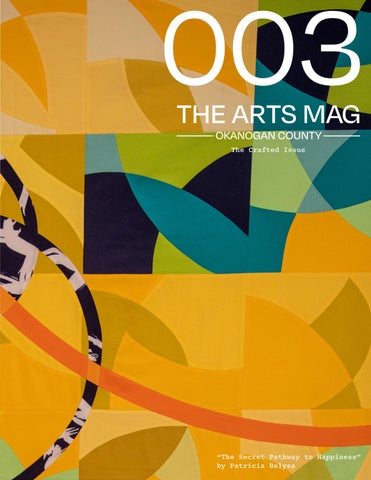
003 THE ARTS MAG OKANOGAN COUNTY The Crafted Issue
“The Secret Pathway to Happiness” by Patricia Belyea
Board of Directors PRESIDENT
Staff EXECUTIVE DIRECTOR
Missi Smith
Sarah Jo Lightner
VICE PRESIDENT
EDUCATION PROGRAM MANAGER
Jill Sheley
SECRETARY Salyna Gracie
Olga Surmacheva
OPERATIONS AND EVENTS COORDINATOR Patti Somerville
BOARD MEMBER Nicole Ringgold
VISUAL ARTS SPECIALIST Maddie Lee James
TREASURER Dorothy Mitchel
LITERARY ARTS SPECIALIST
BOARD MEMBER
METHOW VALLEY ARTS SPECIALIST
Ray Johnston
ADVISORY MEMBER Don Ashford
Nick Littman
Judith Robertson
COMMUNICATIONS & MARKETING MANAGER Cailee Maestro
MARKETING & COMMUNICATIONS ASSISTANT Mackenzie Mayhem
Methow Arts Magazine CONTACT
SUPPORTERS
methowarts.org info@methowarts.org Instagram: @methowarts
Public School Funding Alliance Icicle Fund Community Foundation Arts WA Three Rivers Hospital Waste Wise Creative West Blue Star Coffee Roasters
STOCKISTS We would love to have our magazine in your business, cafe, or venue! If you would like to stock Methow Arts Magazine, please inquire at info@methowarts.org
DESIGNERS AND WRITERS Cailee Maestro Mackenzie Mayhem
ILLUSTRATOR
PARTNERS TwispWorks Confluence: Art In Twisp Methow Pride The Merc Playhouse Winthrop Rhythm & Blues Festival The Winthrop Co-op Gallery
Mackenzie Mayhem
SPONSORS COPY EDITOR Aspen Kvicala
PRINTERS Wenatchee World
FEATURED ARTIST PHOTOGRAPHER
Blue Star Coffee Roasters Three Fingered Jacks Purple Sage / Methow Reservations Methow Valley News Johnston Architects Methow Trails KTRT The Root Tackman Survey LLC Riverside Printing
Roxanne Best
COVER PHOTOS Roxanne Best
COLORING PAGE Janet Fagan
SPECIAL THANKS Paid in part by Okanogan County LTAC.
from the director Dear friends and neighbors, I am thrilled to share news of a new chapter in our organization’s story, one that reflects both our roots and our expanding vision for the future. Over the next three years, Methow Arts will launch a transformational initiative that will extend our geographic reach, deepen our impact, and ensure that the arts continue to flourish across some of the most rural and culturally rich communities in Washington. This includes the opening of a satellite office and creative hub in downtown Omak/Okanogan and the addition of a halftime Creative Economy Program Manager dedicated to expanding programming and access. Our satellite office will act as a fulcrum connecting the amazing programs and organizations in the upper Okanogan to the Methow Valley. As a result of this initiative we will also be working on a rebrand for the organization and are excited for our community to give their input in that process.
04
This evolution is inspired by what we’ve learned from you: our partners, students, families, artists, and community members. You have shared your hopes for more accessible arts programs, impactful partner collaboration, stronger support for creatives, and expanded opportunities for young people to thrive through the arts. This project is our response: bold, collaborative, and rooted in the belief that creativity is a catalyst for connection, opportunity, and community well-being. Over the last year and a half, our board of directors has worked to define our strategy for the future; our staff has listened and shown up in community; and our partner, the Icicle Fund, stepped forward to join you in backing this work. Earlier this year, I wasn’t sure if our plan was possible, but thanks to you and our community of supporters we have this incredible opportunity. Methow Arts is humbled to be able to make this investment to strengthen arts and culture across the entire county, especially in this season of deep and unprecedented funding cuts in the arts at the state and national levels. Thank you. We will continue to anchor our work around our three core program areas: ARTS IN EDUCATION We remain deeply committed to ensuring that every student across the region has access to high-quality arts learning. With this investment, we create a stopgap measure for our Arts in Education program, filling the gap left by major federal and state funding cuts across sectors that have historically supported this work. In addition, this plan creates capacity for Methow Arts to work with our cross-sector partners to advocate for the necessary funding rural communities need to support healthy youth and, in turn, healthy communities.
PROMOTING THE CREATIVE ECONOMY & PUBLIC ARTWORKS Our home office in Twisp and our new satellite office will serve as central hubs for artists, makers, locals, and visitors. In Twisp, we will create a “front door” for the Twisp Creative District, a gift shop featuring student artwork and artist-created merchandise, an interpretive display highlighting public artworks, promoting the work of other local arts/culture organizations, and opportunities for visitors to support our creative economy. Our satellite office will offer a similar experience and include space to pilot community -centered programs. As part of our ongoing commitment to public artwork we will be adding a community mural to the front of our current office.
so that we can establish a path toward long-term sustainability for this initiative.
ENRICHING LIVES THROUGH LIVES THROUGH LIVE PERFORMANCE Live performances connect us across ages, backgrounds, and geography. This plan will allow us to collaborate more deeply with other organizations and bring high-impact performances that benefit all across Okanogan County. More details on these exciting plans are coming, so stay tuned!
Sarah Jo Lightner Executive Director, Methow Arts Alliance
This is a moment of celebration and a moment of possibility. It is also a moment made possible by you. Your support, partnership, and belief in the transformative power of the arts have brought us to this milestone. As we step into this next phase, we invite you to walk with us, dream with us, and help build a future where creativity is a resource shared by every community in our region. This work is just beginning. If you are inspired and believe that arts and culture are foundational to healthy and vibrant rural communities, consider amplifying your voice in this work. Join us as a volunteer, spread the word, or consider donating
If you want to guarantee that our youth have access to arts education not just for the near term but for a generation, consider donating to our endowment by contacting me at: director@methowarts.org. Thank you for being part of this journey. Together, we are expanding the reach of the arts, and strengthening the fabric of the community across Okanogan County. With gratitude and excitement,
Table of
contents 06
TWISPWORKS
8-13
METHOW ARTS
18-21
THE CONFLUENCE: ART IN TWISP
22-27
ARTIST UPDATE: SUBHAGA CRYSTAL BACON FEATURED ARTIST: PATRICIA BELYEA
CURVES, COLOR, AND THE CALL OF JAPANESE FABRIC
METHOW PRIDE
28-29
31-39
42-49
STUDIO STORIES: THE ART OF FIBER AND FELT
THE MERC PLAYHOUSE THE WINTHROP GALLERY
55-63
68-73 74-77
07
TwispWorks is a nonprofit community campus in the heart of Twisp, WA, on a historic 6.4-acre site. Home to artists, entrepreneurs, and nonprofits, it provides the space, tools, and connections people need to do their best work. From studios and small business support to community events and education, TwispWorks is a hub for creativity, collaboration, and a thriving Methow Valley economy.
THE ARTISTS AMONG US TwispWorks is a living canvas of makers, builders, and dreamers, each transforming raw materials into work that reflects the spirit of the Methow. From metal and paint to fiber and ink, these artists give shape to the imagination and help define the creative heartbeat of this campus. Here’s a glimpse into the hands and minds behind it all:
Bethany Wray
Watercolor becomes memory in Bethany’s paintings—each stroke capturing the light, movement, and essence of the valley’s ever-changing seasons. Through her workshops, she invites others to find their own rhythm in paint.
Culler Studio
he has honed a skill that produces usable items for every type of enthusiast.
eqpd
Championing durability and sustainability, eqpd designs and manufactures functional, ultradurable bags and accessories built for real life.
Textiles and handcrafted dyes by the legendary Sara Ashford, who specializes in creating unique colors using earth pigments—both ancient and exotic—as well as locally gathered botanicals.
Fireweed Printshop
Don Ashford Pots
KTRT The Root
The newly remodeled Bernie Hosey basement is now home to Don Ashford and his pottery creations, which showcase the ancient Japanese technique of Kurinuki. Don’s love of pottery has brought him joy for over 50 years, during which
10
A collaborative printmaking studio run by Laura Gunnip, where ink meets imagination and bold, tactile designs come to life on paper and fabric.
More than a radio station, KTRT is the Methow Valley’s independent voice, keeping the community connected througm usic, news, and local storytelling.
TWISP WORKS
Masha Falkov
A multimedia artist weaving steampunk narrative and scientific intrigue through glass sculpture, 3D printing, and illustration—inviting viewers into a world of intricate, organic beauty.
Methow Metalworks
Blending craftsmanship with creativity, Jerry Merz forges custom pieces that balance industrial strength with artistic expression.
Unruly Beings Tattoo and Tarot
Founded by Caitlin Cordell, the studio specializes in fine line, black and gray illustrative tattoos inspired by nature. With a background in social work, Caitlin takes a trauma-informed approach, using tattooing as a tool for healing and personal expression.
Velocity Made Good
Old Schoolhouse Brewery Taproom More than just a brewery, it’s a gathering place where craft beer meets community spirit in the heart of Twisp.
Multidisciplinary artist Perri Lynch Howard creates site-specific sculpture, sound installations, and integrated public art. Rooted in exploration and a deep sense of place, VMG investigates the intersection of sound, landscape, and human impact.
Orchard House Bakery
Kelleigh McMillan
A mighty confectionery crafting handcrafted, seasonal doughnuts that turn simple ingredients into edible art—plus offering the best homemade chai in the region.
Under the name Songbird Jewelry, Kelleigh crafts pieces meant for movement—light, organic, and effortless. She also shares her craft with young artists, ensuring that knowledge and creativity continue to flow through generations.
Peter Nawrot Woodworking
The Nightshade Bowery
Creating finely crafted furniture, cabinetry, and wood sculpture, Peter Nawrot blends traditional woodworking techniques with unique and stunning wood.
Red Umbrella Design
Founded by illustrator and graphic designer Baylie Peplow, this studio specializes in nature-inspired art and illustrations, offering prints and original works that bring beauty and meaning to everyday life.
Curated by Grace Ashford, The Nightshade Bowery blends hand-thrown pottery, vintage textiles, jewelry, books, and antiques into a moody, tactile environment. Rooted in local craftsmanship and Grace’s eye for objects with a story, the shop showcases more than 30 Methow Valley artists. Beyond retail, The Nightshade Bowery is a space for connection—hosting artist talks, workshops, and events that celebrate creativity and community in the Methow Valley.
The Wild In Us
A custom saddle and leather goods workshop founded by Trent Peterson, who blends traditional craftsmanship with a passion for the equestrian lifestyle. He donates a portion of each sale to the National Ataxia Foundation in his father’s honor.
The Artists Among Us
11
THE NIGHTSHADE BOWERY: WHERE CURIOSITY MEETS CRAFT By Grant Eadie
Stepping inside The Nightshade Bowery feels a bit like walking into a dream curated from decades of creative wandering. The space glows warmly beneath soft amber lights, its walls a deep blue that makes every texture and color sing. A vintage table draped with lace holds hand-thrown mugs, small paintings, and carved wooden spoons. Woven scarves hang beside fringed leather jackets, and shelves overflow with pottery, prints, and well-worn books. Overhead, a tangle of driftwood forms a sculptural canopy, casting patterns of light and shadow. It’s the kind of place that invites you to linger— where every corner holds another object worth admiring, another story waiting to be found.
Valley Goods space, marks a new chapter in the creative life of the campus—and in Grace’s own long connection to it.
That spirit of curiosity and care is exactly what artist and shopkeeper Grace Ashford hoped to create when she opened The Nightshade Bowery on the TwispWorks campus this fall. The shop, which takes over the former Methow
Grace’s approach to design is as much about emotion as it is about aesthetics. “I wanted people to come in and feel like there’s a lot to look at,” she says. “Maybe they’ll stay longer or come back when they have more time.” The shop
12
“The look is basically what you’d find inside my mind,” Grace says with a laugh. “I like things that are darker, a little moodier, full of history.” Her affection for old things—rusted metal, worn wood, antique fixtures—reflects a lifelong fascination with objects that have lived other lives. “It’s like finding something that was once a treasure to somebody and giving it a second story,” she says. That instinct for repurposing gives The Nightshade Bowery its distinctive charm: part art gallery, part curiosity cabinet, part cozy parlor.
TWISPWORKS
is arranged like a gentle labyrinth—each turn revealing a new maker or medium. “If I can merchandise art and represent the artists well,” she says, “then I’ve done my job.” And there are plenty of artists to represent. More than 30 local makers now have their work on display in the Bowery: jewelers, potters, painters, and textile artists from across the Methow Valley and beyond. “I took that responsibility seriously,” Grace says. “It’s my vision for my jewelry, but it also has to work for everyone else. I think it’s working. The feedback has been incredible.” Grace’s connection to TwispWorks runs deeper than most. Her mother was one of the very first tenants on campus, transforming a raw shed into a studio when TwispWorks was still a collection of dusty outbuildings and big dreams. “For her first opening, my sister and I came to town to help her get it ready,” Grace recalls. “We each showed our own work—my jewelry, my sister’s art, my mom’s creations. It was a family affair.” For years, Grace would return annually for mother-daughter trunk shows, watching the campus evolve into the creative hub it is today. “I got to see TwispWorks go from just a couple of people to a thriving community of makers,” she says. “It’s been amazing to watch.” Now, she’s part of that next evolution, helping define what the campus can be as it moves into its new master-planning phase. Her shop, she hopes, will become not only a destination for art lovers but also a gathering space for connection. “I want artists to feel comfortable here,” she says. “I imagine evenings where people can meet the maker, or a late-afternoon tea with an author reading from their book. I want it to be more than retail—something that brings people together.” As she continues to build her own jewelry workspace in the back corner of the shop, Grace looks forward to the quiet moments between visitors, when the hum of creativity fills the air. “This place works best when it’s alive,” she says. “When people are talking, learning, discovering something they didn’t expect.”
The Night Shade Bowery: Where Curiosity Meets Craft
The Nightshade Bowery stands as proof that art and commerce can coexist beautifully when rooted in community. Each object on its shelves carries a story—of craft, of place, of renewal. And much like TwispWorks itself, the shop invites everyone who steps inside to slow down, look closer, and stay awhile.
13
everybody’s watching
RIVERSIDE PRINTING & DESIGN 117 West Second in Twisp
www.riversidecreates.com
Get good news delivered weekly!
Methow Valley News
Okanogan County - $45 yearly Washington State - $60 yearly Out of state - $70 yearly
Re-freshed
Guaranteed Fresh Fest returns with expanded lineup
Big move
Ready takes new role at Methow Housing Trust
ARTS Page A5
Methow Valley News
STORY Page A6
Methow rap
It’s all about
PUBLISHED WEEKLY SINCE 1903 duo merges Dope ah MeaN influences musical
T WISP, WASHINGTON
VOL . 120 NO.15
Hank’s Harvest Foods
power
ARTS Page B1
running for Four candidates seat Okanogan PUD
ws Methow Valley Ne Konrads sell to Spokane chain after 49 years
W W W.METHOW VALLEYNEWS.COM
AUGUST 7, 2024
$1.50
leaves legacy of caring
All told, Konrad spent $8,000 to help people flee the fire. “You take care of people, coupled with robust tourist you know?” said Hank’s trafwife, fic, summer and winter. Judy Konrad, during a recent “It’s a gem of a store,” Rigsinterview the Konrads gave BY RALPH SCHWARTZ bee said. to Methow Valley News. Regarding the workers, $1.50 Years he 2024 Hank’s24, JULY said, “We kept every single Harvest Foods in surging, later, as COVID-19 was COM one a visitor who Twisp has been more than VALLEYNEWS. of them.” a gro- two nursing homes operated W W W.METHOW 13 cery store for the past 49 years. on WhidVOL . 121 NO. A lifetime in groceries The place has been something bey Island came into the store T WISP, WASHINGTON and eyed Hank’s fully stocked 1903 like the Methow Valley’s A young Hank Konrad heart shelves of toilet WEEKLY SINCE was paper with and soul. PUBLISHED already busy working on the envy. Hank didn’t let the Community safety. family ranch, but he got man to members who pulled Mac Surface a job leave before giving him two experienced Within minutes, at Martin’s Foodland in palwhere the 2014 Road, let-loads Carlton GranCrossing Frazer Complex and of toilet paper free of geville, Idaho at the age of up to 10Fire already a pickup 13 so charge. started, withknow howthe fireowner store he could Meanhave Hanktwo some horses. “What the cash in his evacuate Konrad hell’s a couple andtrailer his sontoJackson pocket. The grocery business still rushing manned werethe thousand fuelwhile, pumpsfire was a good fit for Konrad, up the dollars worth of toilet at engines theirflames marchedpaper?” who as neighborHank chuckled. “It’s not ing convenience moved up to manage a Barney’s to the scene store Homes are briefly houses.going to hurt when of the a row us, one way or the behind power store in Orofino, Idaho. hillside was out andwind creditthat’s blaze card predicted by The other. ... We the felt good about it, machines “With job demanded a lot of Konrad’s threatened weren’t working. boogie,” The to and going we never ran out.” this thing’s line oftoday, time, with travel between cars trying Rusty to6 escape the ChiefFor five Assistant the Konrads, giving has BY RALPH SCHWARTZ Districtwell valleyFire only locations, and he and Judy stretched the pausing scene, were been afirethepast way of life. Some people EaglesStamps expecting a child, so he took and club. said at ting winds an calltheit karma. helping to direct whilehave “People Fed by g us opportunity to take over a briefly didn’t a grass fire money failed “That all comes back to you,” for fuel,” grocery store on Glover Street fight. 100-degree temperatures, raced hustled Hank KonradDNR east of Twisp 21) Hank said. “I mean, I think in and said.crews “We gave District Twisp. on Highway 20 it them the6fuel or gave of homes Sunday (July does.” behind the row money totobuy form through pastureland Konrad got a $40,000 bank creeping thelines fuel.” homes near fire, which was “Webackhave big hearts,” he One woman to stop the loan to clean up the former and briefly threatened in tears residents’ who Road. added. “We came from big toward pulled updownslope fami- Hank and Judy Konrad at their Finley Frazer Crossing arrived with her two children Photo by Ralph Schwartz “Buckingham Palace” grocery planes Fire District lies and seen Canyon home. The Konrads Helicopters and water was headed the how things weren’t to a Spokane-based grocery chain Okanogan County yards. to Wenatchee, sold Hank’s Harvest Foods store, where The Confluence: of Natural totofind drop so goodonsometimes.” in July. a motel room. Serwithin an hour Art it Twisp gallery is 6, the state Department now. eastern edge. the U.S. Forest the “I said, ‘How fire’s advancing Hank’s opened there in 1975. Resources and the fire the same taxidermied animals are you going to Rosauers swiftly, keeping He takes over closed on July 11. Rosauers late Sunday afternoon be able to get By vice responded homes and halting a motel watching over the store. by that time room you but Hank’s confirmed they are discussing and Judy built the store’s current to 175if acres, But acquired the Hank’s Harvest don’t have money had grown location at flames away from Fire after it sped dozer line Foods contin- Hank’s forges on without Mini Mart a transfer of here?” Konrad ues to an effective serve Hank the store buildings ley Highway412 E. Methow Valthe same custom- and had dug recalled telling crews the the Frazer Crossing of the highway. accordand moved there in Judy, who sold to Rosauers on July 24, Rosauers CEO Cliff and the land, too. woman, ers,fire, south withPublic the same employees two-thirds aof the Rigsbee said. decade ago. around 1978. over rolling hills r ic t 6 st a t io n s her a cou- and Bennett “So I gave Rosauers was drawn to st andDNR all the familiar products on Supermarkets, a Spokane-based Terms of the sale of the A l l fo u r D i ing to dispatch reports Rodruck. Photo by MyKenzieple hundred The Konrads’ business phibucks.” two for a number of reasons, Hank’s Winthrop, Carlton the shelves — not to mention chain that now has 24 locations. businesses the spread of Information Officer Ryan Rigsbee prevent p.m. to weren’t losophy responded: Twisp, disclosed, but said: the location, didn’t change over 49 Sale of the grocery store at 12:18 water on the hillsides the employees, the Konrads and Rigsbee 5 The fire was reported and Mazama. retardant and (“be aware”) both and a loyal local customer Crossing Road, in tandem to drop base A Level 1 evacuation Sunday was Sunday at 10 Frazer See HANKS, A2 and planes worked effect passers-by answered that went into Some Helicopters homes. Neighbors and p.m. Tuesday. See FRAZER, A3 cattle and horses no injuries to nearby lifted at 12:59 Officials reported calls for help, moving Finley Canyon fire agement. between the 70 addresses afternoon, according and no damage to structures. Coyote Ridge to Manacres as of Tuesday to the south and the evacuation order. to Okanogan County Emergency north were under contained at 220 The fire was fully
STORY Page
A8
Quick response
nce ing Fire’s adva halts Frazer Cross
Wint er 2024
/25
Valley As drought drags Methowon, some water W VALLE TO THE METHO
A SUPPL EMENT
Fencing progra
m may keep bears
at bay
R&B FE ST ROCK
Y NEWS
S THE VALLE
Y
users are cut off
No restrictions for wells, town water users
Right at home
Valley natives compete World Cup in Minnesot at a Page
SPORTS
B1
Picture this
Methow Valle y News
Lots of photos from a Methow winter weekend Pages A5,
PUBLISHED
WEEKLY SINCE
1903
T WISP, WASHINGT
Navy’s train ing
Proposal would increase flights in Okanogan County
ON
VOL . 120
NO. 43
W W W.METHOW
A6, B3, B4,
VALLEYNEW
S.COM
FEBRUARY
21, 2024
$1.50
training area provides a variety BY MARCY rain, including STAMPER of terflat plains to mountains, hills and Dean Kurath’s provide a realistic ing environment, hourlong trainsession was disrupted sevenmindfulness of the airspace, but the overall size Thursday by times last both vertically horizontally, training flightsU.S. Navy Growlers on is what’s critical and realistic training West Chewuch. above his home on the environment, for a ing said. WeldKurath, who’s The training been keeping the training area officially track of flights, has 11,500 to 25,000 goes 3,000 flights tallied about feet, with more from in 80% of flight than day, each from a year, with 10 to 30 per But aircraft time above 15,000 feet. told the Methowone to three minutes, he descend to tions as part lower of training maneuvers,elevaKurath was Valley News last week. planes authorized reviewing his with assembled comments log as he Photo courtesy feet, NAS Whidbeyto fly as low as 300 The Navy is to send Air Station representatives Whidbey Islandto Naval to Mazama proposing an expansionof NAS Whidbey/Easte at the meeting. said Whidbey), rn Washington and the east (NAS which has the predominantThe EA-18G Growlers, Airspace slopes of the of the Okanogan training proposed an expansion of Cascades. area for fighterExtension Environmental the existing don’t fly below aircraft in the airspace, Most of the The Federal in Okanogan training area aircraft, extending Assessment 500 Aviation aircraft feet. that train in Administration Because the the airspace would extend County. The expansion (FAA) reduced the military the area are current vertical flights “would planes travel so fast, low EA-18G Growlers. and horizontal Area (MOA) the Military Operations 2020 to address increased airspace in dimensions airspace west to Mazama for a person be very brief encounters air-traffic safety commercial of east slopes on the ground and the evelt training the Okanogan and Roos- with additional training requirements, of or for wildareas don’t fully accordflights (alter- life,” the Navy said at native higher altitudes the Cascades and add ing to NAS Whidbey the meeting. meet the status 2), and no action (preserving Public Affairs Navy’s needs, NAS These which includes above the existing area, Officer Michael Welding. Whidbey quo). the machinesaircraft are extremely complex The expan- environmental assessment said in its that extends from Winthrop and Twisp and sion would make up The Navy proposal. The (EA) of the for that loss. conducts two near the Canadian operate, said take a lot of training to frequency of FAA has training: to Brewster. The space flights border for compatibility reviewed the air- hostile air-combat maneuverstypes of Eli Bennett, Methow Valley resident The expansion wouldn’t increase. a former to avoid officer aircraft and is needed to The EA includes and safety. training and enhance the in the U.S. Air weapons systems three alternatives: defeat electronic electronic warfare to operational readiness, proposed expansion Force with experience on systems, the at a virtual since the public meeting Navy said of regular fighter jets. Pilots need preferred alternative), (alternative 1, a lot training about the the expansion proposal last week. sets and proficiency,to maintain their skill The geography he said. of the Okanogan
2024
other basins in July 2023 and expanded the declaration in April 2024 to cover almost the entire state. A few areas in Seattle, Tacoma and Everett, which have reservoirs that help See TRAINING, utiliA3 ties manage the limited BY MARCY STAMPER water supply, aren’t included in the Although the Methow basin declaration. BY ANN MCCREARY has been in drought for Ecology doesn’t have more can be reimthe than a year, for most people, authority to curtail Local homeowners indoor of installing electric the official drought declaration domestic use by people bursed for the cost aimed who get a new program doesn’t impose any conservation their water from a well, fencing through Ecology away from attractants measures. Water Resources Communiat keeping bears chicken coops beehives, But 98 water users hav- cations Manager Jimmy like garbage, by Steve MitchellNoren’t been able to water Photo Towns and fruit trees. and cities waywith their ris said. to help hometheir fields since July 22 because 20, music fans found municipal A cost-share program water A6, A7. can of Highwaythe impose bear-resistant fencing photos,systems Methowclosure River has restrictions owners pay for Festival. More been on outdoor below Blues and month by Methow Despite the temporary Rhythmf lows. the minimum use, but no officials in Winthrop, Winthrop was launched thisCouncil (MVCC), These annual to the “junior” irrigators must Twisp or other municipalities Valley Citizens call with a newly formed hotline before watering, and a in Okanogan County in partnership recall any conThe goal of ditions are unlikely to change recent restrictions. Methow Bear Coalition. to reduce human-bear until October, said Nigel KingsDuring especially dry periods the program is of Fish and Wildlife Valley. Methow Department the bury, in in the state Department of Winthrop in the 1980s and conflict an electric of Washington electric fence be easier with Photo courtesy Ecology’s watermaster for “A simple three-wire and from homes may Okan- early 1990s, watering was occaPhoto courtesy criteria to be eligible to deter bears Washington’s ogan, Chelan and Douglas black bears away of Washington has been shown must meet certain gray wolves coun- sionally restricted to odd and Westbound traffic on the under a reclassificatio Department said Madelyn Hamil- Keepingsystem. Homeowners would North Cascades Highway ties. even days, Winthrop Clerk/Treareduce conflict,” Photo by Ralph Schwartz highway. Two days later, Friday lands and wildlife fencing n proposed lose their endangered of Fish & Wildlife the route was closed indefinitely afternoon (Aug. 2) passed the Easy Fire State law gives priority by the state. species status ton, MVCC’s public who is leading for reimbursements. as it crept toward the to surer Michelle Gaines said. But due to increased fire activity. grease containers. the river over irrigation habituated to program coordinator, beenmoved of an arising no restrictions on to interrights there havethen in Bears that becomehuman sources program. temporarily case figure out a established after 1976, when council after the pilot fencing upgrades will provide install the Thedecades,—since said that food from to resthey can but she instream rule was set. Bourn a new The cost-share program for materials conflict, until solution or build their seeking withviewervoirs, nuisance or a threat. pump,she andwas water may become a bear it some more permanent Ecology declared a droughtgiving meters, she thought, up to $500 to homeowners said. That left owner wants the state bear-resistant fence. own fence, Hamilton said. for for the Methow Basin and drawing from consideration. from If a property She to build their own of Transportation (WSDOT) Summer 2024 program comes of removed, the only solutionthe bear. 11 funding, homeownthe only applicant. Funding for the kill Monteverde asSee DROUGHT, To be eligible for criteria, including to close the road to all traffic managers is to A3 Washington Department the council, temporarelectric fencand Vital wildlife was appointed by ers must meet certain valley where the grants from on Sunday morning (Aug. NORTH CASCADES HIGHWAY comple“Properly installedas a simple and the Wildlife (WDFW) 4). group to its full Would be reclassifi CLOSED BY DON NELSON ily bringing the living in areas of bear conflicts have Fish and The road is closed until further The North Cascades Highway been proven to sensitive Damien Spears of is closed from Granite BY MARCY STAMPER Ground Foundation. diversity grant” ing has way to deter smart and of five. reflects that ed greatest number notice. Creek, milepost 148, 10 miles Eligible areas took on ment minutes, because most accurately progress and taineer senior drove Rainier’s Matthew west WDFW’s “wildlife as ‘sensitive Town Council But only for a few Kirsten Vanderfor species effective Because historically occurred. black bears, which 157 on the east side, near Rainy of Rainy Pass, to milepost at the state Many campgrounds and trails the first election The Winthrop meet- results status of wolves describes the current Mazama, Edelweiss supports recovery actions member species’ forcouncil Mat Classic, Kenny to the mat for last week’s Pass. There are no detours. Tuesday’s in opportunistic Hot, windy weather has near Stehekin, (Aug.6) primaryafter residences looking current include Lost River, areas election the second where Spears were notwas a different look the group since pushed Photo by Rick 59 in the Okanoconservation needs also recognizingin Washington, while released member although other until often poke around sources,” Hamilton of his two after has8been took third place. p.m.,onafter the two who new council Lewis half, and Wolf Creek, on a case-by-case with greatestand Vital Ground FounBY ANN MCCREARY that wolves Valleyand News ing, where aMethow 2017, announced to settled nearby fires closer gan-Wenatchee National Forest, than 3,000 was sent to a veteran established in See page B1 victories over the Mounfor potential food are not printer, appointed there in Washington, will be areas — the Pioneer and in North Cascades acres, fill a vacancy for story and shethewas may be assessed that conserves said. of the the meeting. results selected to coverage of no should remain western Washington and in this issue. unexpectNational the northern and mostly on actually dropped to 12% from the end prosaid. then is a land trust photos. However, at Fire is now burning just 1/4 dation council results bears Gray resignation coexistence the a will protected,” posted northeastern of her be counbasis, Hamilton wolves grizzly Park, pilot have on the the for including parts of the mile newspaper’s must member the town habitat Smith said. Facebook page as soon elected to Under state law, “We hope this leaving flanks, to reach 36,763 acres. 15% because the fire has grown members listed as an in Washington, currently again will Vanderhalf wasas possible, Applicants for fundingproperty that and connects and— fully withoutfrom Stehekin, and the Easy Pacific Crest Trail. an “endangered” reported endangered edly resigned overall. Still, fire managers in the Aug. 14 issue. will help community wildlife. The grants on their spot to fill. There is 0% containment on species under cies is defined as “seriously Fire burned down to the North state law, would spein 2017, and re-elected said the and other 30 projects at up to $500 gram unnecessary conflict, reduce bear attractant The Easy Fire has tripled the that homes, docks and with another council of the town’s five cil later in 2021. She said she no lonand must design avoid in Easy Fire. other valCascades Highway, forcing sitive species be reclassified as a sen- with extinction throughout threatened cover about BY MARCY and protect bears opposition they are fencing, levies were As a result, two to devote to the size in the past week, to 1,538 under a rule STAMPER that deter bears. all or a sigdamage to property, last will be neophytes ger had the time necessary Washington State Department acres All containment on the Pio- ues at risk along the lake are the Washington proposed by nificant portion of its of becoming fence to specificationscoalition will pro- apiece. drew about 69% on the ballot. Each as of Tuesday (Aug. 6). range council members Department is named next bear from the consequences Two replacement neer Fire is along the shoreline considered well protected. Wildlife (WDFW). of Fish and state.” A “sensitive” species within the The $10.6-million the council position.time to step off the MVCC and the The Pioneer Fire added The two leviesapproval in 2020. when another replacement levies proposed as “vulnerable and instructions Pilot program more of Lake Chelan. EP&O levy funds habituated.” the Methow everything WDFW is seeking combined made black bears is the by about or declining is defined “I feel it is my Containment vide how-to videos Valley School that about 1,000 from small fencing, as month. said. “When I become endangered 22% of and likely to Although deterring ADDRESS LABEL up being approved public input District See FIRES, A2 a member of both a recent class WDFW estimates Methow waterMay 6 on the and council,” Vanderhalftime. I feel like on building bear-resistant until by wide margins. are budget over the district’s operating advanced-placement classes sizes to or Brooke Bourn — in the the fencing program, Wildlife advice on design The educational the past four THURS. would reduce proposed rule, which significant portion of threatened in a school programs. I had more black bears live and Planning Commission with a goal of to afterFRI. well as technical passionate its range.” SAT. well started, criminal penalties the Winthrop by the U.S. Fish projects, Hamil- shed, sharing the landscape In the western SUN. to It also supports operation (EP&O) programs and as programs expand and years. But career and Committee, as MON. ing wolves, among else could be more Oct. 8 for TUES. humans. As decision to reintroduce grizzly bears someone materials for specific two-thirds killof existing Infrastructure go Oct. college 9 up, and project ington (including Oct. 10 the levies are costs health counseling, of 70.5% to 29.5%, levy was passing Oct. 11 growing population residents know Service The proposal other changes. of the Riverwalk effective.” Oct. 12 mental expected to means that grizcrecare, school ton said. the Methow Washabout Oct. 13 as an organizer Valley fencing expert with 1,714 OPINION . . . . . . . . . where wolves by WDFW North Cascades had applied and votes and 719 downlist gray . . . . . . . A4 “yes” cation one-fourth of the cost cover facilities and buses. nursing services, of the landscape staff to endangered Vanderhalf’s announcement Last month an electricto the Methow many Methow that can lead to con- the are currently Valley) on the “no” votes as — and Marisa Monteverde by the of eduHARTS PASS . . . . . . . may also be part and related came (Feb. 16). immediate opening of Friday periodic statuswolves is the result of vacancy created The $6.6-million . . . . . . . A4 under the federallisted as said. bears are zlies programs in on from experience, from Montana next four years, a to fill a council of longtime council ated another could also apply for that the ARTS . . . . . . . . . . . . educational a demonstration of flict — especially when provided in the future, Hamilton owners take EndanThe levy for every five yearsreview that is required gered Species Act (ESA), . . . . . . . A5 her techcouncil. Bourn Valley to lead Valley School according to Methow nology improvements educational recent resignation in the state for members for protected have to give up the change to sources of food The steps that property for ogy SPORTS as fencing levy would technolDistrict Sunny, species improvements for . but attracted same . . helps . . listing the . Nelson. expanded . . . . . . . . . . . B1 to Mostly are listed as endangered, wildlife wolves’ Superintendent vacancy, bear-resistant pay would not Partial member Ben career and Partly coalition, and com30%, with 1,687 was passing 70% to Tom Venable. to deter black bears told the council affect CLASSIFIEDS . . . . . . the Planning Commission federal status. or sensitive. Clouds education programs, nice technical threatened said. “If grizcloudy Mostly MVCC, the bear The demonstration by humans. fencing program seeks to . . . . . . . B2 sunshine After Monteverde and motivations position on The Washington Wolves in the eastern third sunny “no” votes. With “yes” votes and 723 grizzly bears, Hamilton The pilot and sun COMMUNIT Y . . . . . . motive technology, including autoThe agency we’re going to of the state, WEATHER DATA BASED sunny A3 State munity members. the coalition pre. . . . . . . B5 ON ACCUWEATHER.COM Seth about her background from common attractants, bears do come back, See WINTHROP, count countywide,just 70 ballots left to tution guarantees funding Consti- construction and welding, and FORECAST FOR T WISP on 14 years of said it based its decision way 97, are not protected west of Highcouncil member VALLEY LIFE . . . . . . . pro- deter bearschicken coops, garbage, bee- zly helped MVCC education, . . . . . . . B6 and passage of both of basic for for applying, only for her. fence building ies is assured. ington’s wolf data and trends on Wash- (see related story) and under the ESA including instruction design. It also pays lev- considered but certain programs livestock pare to offer the had a question livestock, are population Miles in WDFW managed trees, A2 graphic are said. fruit enrichment The levies will and on population model based by See FENCING, gram, Hamilton bear coalition also hives, food, food-waste compost, and are not care sciences, personal art, health covered by replace two developed at a new under state law. on their listing status levies that are versity of Washington. the UniMVCC and the net- and pet and restaurant expiring after existing pays based the allocation the state pitality and recreation, finance, hosthree emergency to carcass pits, boneyards, four The Methow on enrollment. and resources. The “Wolves in plan to purchase Some differences . . . A4 Valley resultsyears. result, many programs technology natural TUES. As a fences for people slightly more .......... significant Washington have made MON. levy goes are are funded ting type electric at the schools toward instruction favorable than OPINION . . . progress toward SUN. . . . A5 Downlisting four years ago, July 30 in SAT. by they were since their original .......... recovery to wolves from July 29 FRI. state allocationa combination of the use of technology and the ethical when the replacement HARTS PASS . . . . B1 endangered sensitive would July 28 state endangered THURS. ing in 1980, .......... July 27 maintain listVenable said. and the two levies, regarding the safe and coursework when July 26 ARTS . . . . . . . . . B3 July 25 breeding wolves there were no known on hunting and malicious prohibitions responsible ADDRESS LABEL .......... SPORTS . . . . . . . B2 Smith, WDFW’sin the state,” said Julia tional harassment of gray and inten.......... CLASSIFIEDS . . . B7 See LEVIES, recovery section endangered species ferences in management wolves. Dif.......... A3 and protection for wolves listed Mostly manager. COMMUNIT Y ADDRESS LABEL . . . B8 Partly “This recommended as endangered .......... Mostly sunny or sensiVALLEY LIFE . Mostly reclassification sunny Sunny sunny Cooler, sunny FOR T WISP THURS. FORECAST See WOLVES, sunny FRI. ACCUWEATHER.COM BASED ON A2 SAT. Feb. 22 WEATHER DATA
Homeowners can up to be reimbursed $500 for installation
B6
area expansio n raises loca l concerns
A CL A SSIC
MOVE
Information
Council: Winthrop Town ted, one one member appoin resigns withdraws, one
shifts Group dynamic in a single meeting
f o r a n e nj o y Me t how Va a ble l le y v i s it
Dining
& lo d g i n g g
u id e s
Activ ities Fire activity grows in hot, windy f or e ve r y i n tere st & a l lweather a ges
Pioneer, Easy fires defy containment
WDFW propo ses downlisting state’s gray wolve s’ status
(509) 997-7011 | support@methowvalleynews.com PRIMARY COVERAGE
N VISITOR I
N F O R M AT I O
|
PS TRAIL MA
|
AC T I V I T I E
88° 58°
Both MVSD
S
89° 58°
88° 55°
FREE
levies approved
by wide margi
ns
INSIDE ...
88° 54°
87° 54°
88° 55°
INSIDE ...
77° 46°
84° 54°
88° 57°
89° 54°
87° 56°
88° 54°
51° 29°
Feb.23
Rain, partly cloudy
51° 28°
Mostly cloudy
WEATHER
DATA BASED
Feb. 24
50° 29°
Mostly cloudy
SUN.
Feb. 25
45° 28°
Cloudy, pm showers
ON ACCUWEATHER.C
MON.
Feb. 26
42° 25°
Morning snow
OM FORECAST
FOR T WISP
TUES.
Feb. 27
42° 23°
Mostly cloudy
INSIDE ...
OPINION .... HARTS PASS . . . . . . . . . . . . A4 ........ . . . . . . A4 ARTS . . . ........ ........ SPORTS . A5 .... CLASSIFIEDS . . . . . . . . . . . . B1 ........ . . . . . B2 COMMUNIT Y . VALLEY LIFE . . . . . . . . . . . . B5 ........ . . . . . . B6
Methow Arts enriches the lives of people in Okanogan County by making the arts an integral part of public school education, economic vitality & community. We envision a future where artists & art organizations collaborate & thrive, where the arts are part of the consciousness & experience of people of all ages.
HOLDING SPACE FOR ART AND EMOTION By Olga Surmacheva
Teaching art is never simply about color theory or brushwork. At its best, art education opens a space where students can explore who they are, express what words cannot, and find confidence in their own voices. When social and emotional learning (SEL) and trauma-informed practices enter the classroom, creativity becomes something deeper. It becomes a pathway to growth, reflection, and connection. The art process begins with safety. Students take creative risks only when they feel secure, both emotionally and physically. A calm, consistent environment with predictable routines, clear expectations, and modeled kindness builds a deep sense of trust where even the smallest gesture matters. When students know they will be met with respect and understanding, they can relax into the process. That is where true creativity begins.
20
Choice is another key ingredient in the art room. Offering students meaningful decisions, such as selecting materials, choosing subjects, or interpreting a prompt, gives them agency. For many young people, especially those who have experienced adversity, choice is empowering. It helps restore a sense of control and builds confidence in their ability to make decisions and express themselves authentically. The message is clear: your ideas matter. Focusing on the process rather than the product shifts art-making from performance to exploration. The goal is not perfection. It is engagement, feeling, and discovery. When educators invite students to notice how colors, textures, or images connect to emotion, art becomes a powerful tool for reflection and emotional regulation. This awareness helps students build resilience, deepen self-understanding, and develop the skills to manage their emotions with confidence.
METHOW ARTS
Connection lies at the heart of the experience. Art naturally brings people together through shared projects, peer feedback, and group discussions. When a classroom culture celebrates kindness, curiosity, and respect, students learn to appreciate different perspectives and recognize the value of community. Collaboration becomes a way to practice empathy and reinforces the idea that creativity is not a competition but a shared human experience. For art educators, reflection is an ongoing practice too. Taking time after each session to notice what resonated, when students seemed most engaged, or which strategies supported calm and focus helps refine the approach. These observations guide future lessons and deepen understanding of how art supports emotional well-being.
PERFORMANCE SERIES THE ZANIAC The Winthrop Red Barn: February 27 Doors Open: 5 PM Show Starts: 6 PM
As winter deepens and spring edges closer, Methow Arts is excited to bring a burst of creativity to the Winthrop Red Barn with The Zaniac on Friday, February 27. This high-energy performance captures the playful, imaginative spirit Methow Arts loves sharing with our region, offering an evening that sparks joy and brings people together. Back by popular demand, The Zaniac brings laughter, movement, spectacle, and story, transforming the Red Barn into a space alive with possibility. Step inside, shake off the snow, and celebrate the magic of live performance. The Zaniac is a whirlwind of comedy, juggling, and high-energy stunts.. Part magician, part comedian, part stunt artist, he amazes audiences of all ages. After a long winter, his show is the perfect way for families to share laughter and wonder together.
When art is taught through a lens of compassion, flexibility, and awareness, it transforms the learning experience. Students begin to see art not just as a skill to master, but as a language for understanding themselves and connecting with others. Teaching this way reminds us that creativity and care are inseparable, and that every art room has the potential to be a space for both growth and healing.
Holding Space for Art and Emotion
At Methow Arts, we believe art is essential. It builds empathy, strengthens community, and expands what we imagine is possible. Opening the doors to a performance space creates opportunities for gathering, shared experiences, and cultural vitality. We invite families, students, visitors, and residents to join us. Whether you are craving laughter or longing for a performance that moves you, there is something unforgettable waiting onstage. To stay up-to-date on happenings at Methow Arts, check out our website at: methowarts.org
21
The Confluence: Art in Twisp, a 501c3 organization, was founded in 1988 by a small, forward-thinking group of artists who felt the Methow Valley needed a place to gather for the celebration of the visual arts. Since that time, The Confluence: Art in Twisp has become a cultural landmark in downtown Twisp.
Artwork by Phyllis Emmert
THE CONFLUENCE: ART IN TWISP By Teresa Mitchell
Artwork by Jill Pelto
As the only non-profit art gallery in Okanogan County, The Confluence proudly showcases the work of local and regional artists. The gallery hosts sixteen exhibits each year, eight in the main gallery and eight in the Community Gallery, and strives to share work from all segments of our rural community. The Confluence Gift Shop boasts a wide selection of handmade jewelry, ceramics, textiles, cards, and one of a kind works from artists across the region. By curating high-quality exhibits and a dynamic gift shop, The Confluence supports the local economy by putting money directly into the pockets of working artists. The Confluence is home to the Confluence Poets and hosts regular meetings, workshops, readings, and special events, like the William Stafford Birthday Celebration, which takes place on January 25, 2026. This year marks the 10th anniversary of the Confluence Poet’s celebration of William Stafford’s
24
birthday. Poets from across the region, including students from Liberty Bell Jr Sr High School and special guests will share their work. Each spring, The Confluence hosts the Trashion Show, a showcase event for designers who create high fashion using recycled materials. Through partnerships with other local businesses and organizations, Trashion Show has become one of the Methow Valley’s most popular events. Mark your calendars for next year’s event on May 16, 2026. Winter gallery exhibits reflect the breadth and depth of the lived experience, from living harmoniously with local wildlife in Backyard Wilderness to Intimacy, an exhibit that explores the uniqueness and universality of relationships. In February, the gallery will host our first split show, with Intimacy and a solo show by local artist, Perri Howard, sharing space in the main gallery.
THE CONFLUENCE: ART IN TWISP
Organized and managed by The Confluence, Art Crawl celebrates the Twisp arts community with an evening of opportunities to see incredible artwork, meet artists, enjoy refreshments, and gather with community members. Each Art Crawl is scheduled to coincide with The Confluence’s opening receptions for new exhibits. Participating organizations and businesses will be announced about three weeks before each Art Crawl through social media and The Confluence: Art in Twisp newsletters.
DECEMBER EVENTS BACKYARD WILDERNESS: COYOTE IN THE PARKING LOT Main Gallery: November 18 - January 10 Curators: Jennifer Molesworth & Janet Fagan
The title of this exhibit comes from experiences we all have had encountering wild animals in places commonly used by humans; a coyote in the parking lot, a mouse in the house, a hummingbird at the feeder, a bear on the trail. Artist’s work respond to questions like, “When we overlap so closely with our wild neighbors what is the outcome?” and “How can art give us new ideas and ways of seeing those connections?” The exhibit aims to shine a light on how we can share the land, sky, and water in ways that benefit all. This is The Confluence’s annual holiday show and work is sold off the wall in time for seasonal gift giving. UNTAMED BY CHERYL QUINTANA Community Gallery: November 18 - January 10 Curators: Jennifer Molesworth & Janet Fagan
A perfect pairing with The Confluence’s main gallery exhibit, artist Cheryl Quintana’s work in Untamed explores the animals of the Methow in stoneware form. Works include wall hangings and 3-dimensional pieces affixed to metal stands. As a part of the holiday exhibit, Cheryl’s work is sold off the wall in time for seasonal gift giving.
Fall 2025 Exhibition Season
Artwork by Grace Larkin
JANUARY EVENTS
FEBRUARY EVENTS
LOOK UP
INTIMACY
Main Gallery: January 13 - February 21 Opening Reception: January 17, 5-7 PM Curator: Janet Fagan
Main Gallery: February 24 - April 11 Opening Reception: February 28, 5-7 PM Curators: Marcy Stamper and Robin Doggett
Look Up aims to help us lift one another as we release gravity’s hold just a bit. Gravity holds us to the land, and metaphorically, can weigh down our spirits. Our eyes often search for what is lower than our hearts, turning our thoughts inward as we watch the ground pass by. Work in this show will help us shift our gaze to move beyond what is right in from of us to explore the potential of community.
Main Gallery exhibit, Intimacy, invited artists to create work that encapsulates the uniqueness and universality of intimacy—taking something inherently personal and internal and exploring how it can be shared with the greater world.
SHAPED BY ICE Community Gallery: January 13 - February 21 Opening Reception: January 17, 5-7 PM Curator: Margaret Kingston Featuring work by Jill Pelto, Cait Quirk, Claire Seaman, Emma Mary Murray, Danielle Schlunegger-Warner, Cal Waichler, and Margaret Kingston.
Shaped by Ice is a group exhibition featuring artists who have attended the North Cascade Glacier Climate Study. The two-week field season in August completed the project’s 42nd year conducting studies on the same glaciers, led by glaciologist Mauri Pelto. Art Director, Jill Pelto, has coordinated a variety of artists to backpack into the glaciers to experience the reality of the situation first hand. Exhibit artwork explores stories about how our glacial regions are changing and how these changes deeply impact human and natural communities at many levels, from the loss of freshwater resources to ecosystem shifts. Glacier loss is a visible sign of climate change. Our goal is to increase awareness, foster curiosity, and inspire personal connections between people and glaciers.
26
Intimacy is a term that encompasses a complex range of relationships and emotions. We have intimate relationships with our spouses, lovers, friends, and our children. Many of us feel a keen sense of intimate connection with ourselves, with an animal, or with a place that holds special significance. A sense of intimacy can be inspired by music, by a work of art, or by nature. Although intimacy is universal, it is also a highly individual experience that is—by nature—private and secret. Intimacy can describe a sense of personal space, or of nakedness and unmasking, with layers removed. And although it can feel intense or even tangible, the essence of intimacy—like with many emotions—can be hard to capture. OKANOGAN COUNTY HIGH SCHOOL STUDENT WORKS Community Gallery: February 24 - April 11 Opening Reception: February 28, 5-7 PM
The Confluence is proud to represent the work of emerging artists with our third annual exhibit of Okanogan County high school students.
THE CONFLUENCE: ART IN TWISP
ARTIST UPDATE By Subhaga Crystal Bacon
that received the Red Flag Poetry Chapbook Prize. A Pushcart Prize and Best of the Net nominee, Subhaga is also an AWP Writer to Writer mentor and a teaching artist working with youth and adults in schools, libraries, and private settings. Their work appears in a wide range of print and online journals, and they have been a residency fellow at the Sundress Academy for the Arts as well as Mineral Arts and Residencies. Poet Subhaga Crystal Bacon announces the release of a new poetry collection, A Brief History of My Sex Life, forthcoming from Lily Poetry Review Books on January 18. Subhaga is the author of five poetry collections, including Transitory (2023), a finalist for the Lambda Literary Award and winner of the Isabella Gardner Poetry Award, and Surrender of Water in Hidden Places (2023), a meditation on the Methow and Wenatchee watersheds
28
A Brief History of My Sex Life examines the sexual history of a lifetime—from a sexualized childhood to a confused sexual awakening to the complexities of mature sexual and gender expression. Through explorations of family, culture, and the latelife recollection of early childhood sexual abuse, these poems unravel an emergent nonbinary and transmasculine gender identity. The collection confronts difficult truths with clarity, humor, and vulnerability, finding companionship and solace in nature. In
ARTIST UPDATE
advance praise for the book, poet Jessica Cuello writes: “A Brief History of My Sex Life is a poetic memoir that traverses the self: it begins in the terrain of childhood and arrives at a profound peace. Beneath these deeply textured poems is an abiding search for self and an unrelenting honesty. Poetry has the power to investigate the innermost part of ourselves. Subhaga claims that power. ‘Now do you see?’ they ask, ‘You can love what you are / without flinching.’” Poet James Allen Hall adds:
and of itself. Subhaga Crystal Bacon’s A Brief History of My Sex Life is for all of us… who feel and live deeply.” Subhaga will read from their new collection at Brix Wine Bar on December 28 with visiting Seattle poet Margot Kahn, author of The Unreliable Tree, from 5:00–7:00 PM. They will also offer a reading and conversation with Methow Pride on January 24 from 3:00–5:00 PM. Additional readings, both online and in person, can be found at www.subhagacrystalbacon.com
“Bacon… casts a spell on both mind and body, taking us into the thrall of memory, childhood, fear, and wild bravery. Oppression ‘may as well burn all the dictionaries,’… ‘grow kids in silent rooms,’ because in those quiet spaces, ‘they’ll name themselves free.’ Put Subhaga Crystal Bacon in charge of words, and they will name us all free.” Poet Nicole Callihan writes: “For survivors. For healers. For teachers, alive and dead. For the salty-blooded and broken-hearted, the mothered and unmothered. For the shamed and the merciful. For the bodies within the body and the memories within the body and the body in
Poet Subhaga Crystal Bacon Announces New Poetry Collection
29
Curves, Color, and the Call of Japanese Fabric
CURVES, COLOR, AND THE CALL OF JAPANESE FABRIC By Cailee Maestro Tucked into the woods of Wauconda, Washington, that small high windswept corner of the Okanogan Highlands, is the home and studio where Patricia Belyea spends her days surrounded by fabric, color, and quiet. The place feels more like a retreat than a residence, a refuge that lets her creativity expand without interruption. From the outside, it reads like a simple cabin in the forest, but step inside and you find a working studio, a library of vintage Japanese textiles, a pared-back broadcast space, and the environment where an improvisational quilt maker has followed one small decision after another into a life that feels less like a career and more like a calling. From her first blue baby quilt sewn on a dining room table to the large-scale compositions drenched in curve and color that define her work today, Patricia has created a world where
fabric, teaching, travel, and community all come together. I sat with Patricia to dive into all of it; the quilting, the textiles, the evolution of her work and she talked openly about her creative growth, her teaching, and the beginnings of Okan Arts, the business she founded to import vintage Japanese textiles, lead creative retreats, and share her craft at a wider scale. And so our conversation unfolded, one question at a time, revealing the story Patricia has been piecing together for decades. Cailee: Can you share the story of how you first became interested in quilt making? Was there a particular moment or influence that sparked your passion? Patricia: I never planned to become a quilter. I simply wanted to make a baby quilt for an employee and chose soft blue fabrics as a quiet rebellion against the idea that pink is for girls. I didn’t know how to make a quilt, so I bought old clothes at Goodwill, cut them apart, and stitched the pieces together on my dining room table. Looking for guidance, I went to a meeting of my church’s quilting group and met Maurine Noble, a retired master teacher. She invited me to her home, taught me the basics, lent me a book, and handed me a spool of gray thread for piecing. It was exactly enough to get me started. Maurine wasn’t very mobile, so I would visit her, pull fabrics from her shelves one by one, and we would decide their fate together. The pieces she no longer needed often became the heart of my quilts. Quilting became our shared language and the root of a friendship that shaped everything that followed. Around the same time, my travels led me to vintage Japanese yukata cotton. I brought home a
32
FEATURED ARTIST: PATRICIA BELYEA
little, then a little more, and realized other quilters might love this fabric too. That spark eventually became Okan Arts. C: Wauconda is a remote, off the map kind of place. What drew you there, and how has living in such a unique setting shaped your creative life? P: I was born in Ottawa, Canada and most of my adult life happened in Seattle. My career, my marriage, raising our kids, all of that took place in the city. When I turned fifty, my husband and I asked each other a big question. If we could start fresh, what would we want our lives to look like? We both realized that we wanted more quiet and more countryside. We assumed we would end up in the Methow Valley, but one day my husband kept driving over Loup Loup Pass into the Okanogan Highlands. That is how we found this cabin tucked into the woods. It was bigger than what we pictured for ourselves, but peaceful and full of potential. For a long time it was our weekend escape. Then the pandemic hit while I happened to be here. The fear in the city was intense. I stayed. My husband never wanted to go back. Eventually it became clear that everything we needed was already here.
Curves, Color, and the Call of Japanese Fabric
Living here completely changed my creative life. My studio is downstairs. My vegetable garden is right outside. I spend my days working, tending the land and looking out at the hills. When Starlink came to the area, I suddenly had the internet speed to teach online classes from this very remote place. Now my life is quiet enough for deep focus and connected enough that I can share what I love with students all over the world. C: Your quilts often feature bold curves. What attracts you to this style, and how has your approach evolved over time? P: Yes, curves are a big feature in the quilts I have made in the last 15 years. Typically Japanese yu-
33
kata cottons have oversized motifs so it made no sense to chop the fabric up into little squares and triangles. As a self-taught quilt maker, I developed my curved piecing techniques through trial-and-error. For ten years, I created complex compositions filled with non-stop curves. Then I had a fiveyear hiatus while I made 25 quilts for my book, East-Meets-West Quilts, with an improv approach but no curves. After the manuscript was released to the publisher, I got back to my studio and quilt making. This time, I added curves to my quilts in a whole new way. I made complete quilt tops and then slashed into them to insert curved elements. I like to challenge myself with each quilt I make, leapfrogging from one idea to the next. The first quilt I made with inserted curves was so simple that it was barely worthy of note. But I got started in a new direction and that was the important step! Now my quilts with inserted curves are masterful and full of exciting layers and curves. The important key to all my work is precision, in the design of the curves and then the sewing. Over time, my curves have grown larger and more confident. My quilts are big, and the curves move through the surfaces with a lot of drama. I am not interested in little decorative wiggles. I am interested in sweeping motion and big shapes interacting with one another. Curves, for me, are a language. They carry gesture, rhythm, and emotion in a way straight lines do not. C: Many of your pieces explore the balance between tradition and innovation. How do you honor quilting’s rich heritage while also pushing creative boundaries? P: I grew up around quilts without thinking much about them. My family was from the Maritimes in Canada. My grandmother went to quilting bees at the church. My great aunt and uncle had blue and white quilts stacked on sleigh beds at their inn. My mother sewed dresses for my children
34
FEATURED ARTIST: PATRICIA BELYEA
and eventually became an avid quilter working with wild colors and patterns. So the traditional quilt world was always in my backdrop. I do not use patterns. I improvise. I cut, rearrange, and let the quilt grow on the wall. But I still see myself firmly in the lineage of quilt makers. Cloth, batting, stitching, binding. I respect the structure. I hand sew. I also stitch my quilts with a Sashiko 2 machine that mimics hand stitching. Where I push is in scale and composition. I love big, bold, sweeping curves. I use Japanese yukata cottons that have movement and breath, mixed with solids that make the color shine. And when I teach, I help people take those first steps into curves and improvisation because many quilters have never tried them. The tradition is the foundation. The innovation comes from asking, “What happens if I do it this way instead?” C: Some people see quilting as a traditional or domestic craft. How do you view it as a form of fine art or personal expression? P: I do not usually call myself an artist. In anything I write about my work, I describe myself as an improvisational quilt maker. The word artist carries a particular weight in the broader art world, and I feel it is a title others may give you rather than something you claim for yourself.
Curves, Color, and the Call of Japanese Fabric
That said, my quilts are absolutely a form of serious creative expression. They are large scale, physical works that occupy space and interact with the viewer. When someone stands in front of a bold quilt, their eyes move across the surface, their body shifts, their breath changes. That is the same kind of embodied experience you have with painting or sculpture. Quilting is also intimate and emotional. You are working with cloth that touches everyday life. Fabric holds memory, domestic history, and personal meaning. Even when I am not using found materials or family textiles, that lineage is embedded in the form. So while I am comfortable saying that I am a quilt maker, I take the work very seriously. I think deeply about composition, scale, color relationships, and the feeling a piece carries. And when the quilts go into exhibitions or galleries, they hold their own in that art context. The creative practice is what matters to me. C: When you start a quilt, do you usually know exactly how it will turn out, or is your process more intuitive and improvisational? P: I never know exactly how a quilt will turn out. Not once. Not ever. I do not sketch or follow patterns. I start with a spark of an idea and see where it leads.
35
For example, my quilt The Secret Pathway to Happiness (pictured as our cover photo) began with only a few intentions. I knew it would be yellow. I knew there would be blocks and that each block would include curves. I knew there would be a pathway moving through the design. That was all I had at the beginning. From there everything becomes improvisational. I pin fabric to the design wall, move pieces around, cut into sections that are already sewn, and sometimes turn entire compositions upside down. The quilt evolves because the process forces invention. With that same quilt, I completely ran out of yellow fabric. That opened the door for lime green, then turquoise, then blue and navy. Later I added the pathway and at first it looked ridiculous. So I cut into the finished top again and inserted thin orange lines. Suddenly the whole piece made sense. Improvisation is not chaos. It is focused attention and responsive problem solving. I let the fabric and the composition guide me.
36
FEATURED ARTIST: PATRICIA BELYEA
C: You have described quilting as a meditative process. What does it feel like, emotionally or mentally, to be in the midst of creating a quilt? P: It feels like being in the zone. Time disappears. I become completely engrossed. I will stay up far too late because I want to solve the next visual challenge. There are also moments when I hit a wall and think, this is not working. That is when I stop. I trust my subconscious. If I walk away and sleep on it, I often wake up knowing exactly what needs to change. Hand stitching is especially meditative. It is slow and deliberate. Some people sit on cushions to meditate. I meditate with a needle in my hand. After a day of hand quilting I sleep deeply. The process is absorbing and soothing and challenging all at once. It asks for my full attention and it gives something back in return. C: You have developed a deep appreciation for Japanese textiles and sewing techniques. How did that interest begin, and how does Japanese culture influence your work today? P: I always wanted to visit Japan and when I turned fifty I finally did. That same year we bought our home in Wauconda. Soon after, our daughters’ high school hosted Japanese homestay students for a short visit. We volunteered and our first student, Sayori, came to stay. When she left, everyone was crying. We told her she could come back anytime. She did, and eventually we hosted eight Japanese students over the years. We visited their families and became an American mom and dad for these kids. By the time I made my first quilt at fifty three, I was already fascinated with Japanese fabric. I discovered vintage yukata cotton, the hand dyed cotton used for casual summer kimonos. I source it online from small vendors and antique warehouses in Japan. It is deadstock fabric that lives
Curves, Colors, and the Call of Japanese Fabric
37
in back rooms, not in shops I can take my tour groups to. I bought one bolt, then another, and soon I had too much to justify as a hobby. After attending the Tokyo Quilt Festival one January I came home and registered Okan Arts as a business. That was the beginning. Japanese culture influences my work in many ways. The cloth has a lyrical, hand dyed quality that feels alive. C: When you travel to Japan to source vintage fabrics, what draws you to certain materials, and how do you know which ones will become part of your quilts? P: The tours I lead to Japan are not my fabric buying trips. The vintage yukata cotton I use is usually tucked away with small online vendors, antique warehouses, and dealers in Japan. I source it bolt by bolt from people who know where the good fabric is hiding. I am drawn to color, scale, and movement. Yukata cotton is hand dyed and often has this fluid surface that feels alive. The patterns can be bold or delicate, but there is usually a sense of motion that pulls me in. Because the cloth is only about fourteen inches wide, I pay close attention to the scale of the design so I can cut it and still honor the pattern. I do not buy fabric with a specific quilt in mind. The bolts arrive and become part of the conversation in my fabric room. When I start a new quilt, I go in there and see what calls to me. Some pieces speak up right away. Others wait quietly for their moment. And I am not precious about it. Fabric is meant to be used. Sometimes visitors say they could never cut into something so beautiful. My answer is always, why not. The greatest respect I can show the master dyers in Japan is to use their work well.
38
C: You also teach quilting workshops. What kind of experience do you hope to create for participants, and what do you enjoy most about sharing your craft with others? My workshops are technique focused, but they are not about everyone making the same quilt. I teach curves, composition, and improvisation in step by step exercises that build from simple to complex. Many quilters are afraid of curves, so I make the first steps approachable so confidence can grow. What I want for participants is discovery. I ask a lot of questions. Why do you think I did this. What happens if you remove that. I want people to understand intention rather than copy my choices. I encourage everyone to design their own pieces. You can tell that students are in the same class, but each quilt turns out completely different. That makes me very happy. At the end of a workshop, students leave confidently with new skills. They can now head home and make quilts with curved piecing, following their own ideas. There are lots of hugs as I send them on their way! C: What advice would you give to someone just starting out in quilting, especially if they feel intimidated or unsure where to begin? Start small and start simple. You do not need a perfect studio or fancy tools. Do not be afraid of making something you do not love right away. There are pieces that are working and pieces that are teaching you something. Let go of perfection and you will learn faster. Do not be precious with fabric. Use what you have. Cut into it. Sew with it. Fabric is meant to be used, not folded on a shelf forever. If your budget is tight, second hand clothing or castoffs can be wonderful. That is how I started and Maurine helped me build my first stash. And find even a small bit of community.
FEATURED ARTIST: PATRICIA BELYEA
One quilting friend, a guild, a class, or an online group can make such a difference. Having someone to share discoveries with keeps the experience joyful and helps you keep going. C: Are there upcoming projects or ideas you are excited to explore in your quilting practice? P: I have signed an agreement with the quilt museum in La Conner for a one-woman exhibit in the summer of 2028. There is lots of work ahead to prepare for that. My goal is to use Japanese textiles that have never been used before in the show quilts. Temple banners! Cloth signs from merchants! Shibori tablecloths! Antique Japanese calico! Okan Arts has been leading textile tours in Japan since before the pandemic. They are immersive journeys full of culture, artisans, and textiles. Next up will be textile tours in the UK. It is a whole new direction but at least all the communications will be in English! I am also continuing to teach. The materials I created for online workshops now help me teach in person as well. Every group of students interacts with curves, color, and composition a little differently. That ongoing exchange keeps my own practice alive and always moving forward. I walked away from my time with Patricia moved by how deeply her quilts carry memory, color, and intention. I feel so lucky she made the time to sit with me, share her story, and open the doors to the world she built with fabric and heart. To explore more, visit her at OkanArts.com. There you can shop rare yukata cottons, read her blog, learn about upcoming retreats and workshops, and be inspired by the evolving journey she continues to walk. There is much more to discover. Thank you, Patricia, for the colors, the curves, and the care you sew into everything you create.
Curves, Color, and the Call of Japanese Fabric
41
Methow Pride is working toward creating a rural haven where LGBTQIA+ individuals believe in their creative expression, share their voices, build thriving intergenerational relationships, and find rural belonging. We ultimately aim to keep LGBTQIA+ people present, safe, and alive in this rural and natural space.
42
SILVER AND SOUL: THE ART OF CLAUD CORCORAN By Methow Pride
When did you first find yourself falling in love with creating? What was that experience like? What inspired you?
What type of creation do you find yourself doing currently? Are there themes that show up in your work?
Claud: I first fell in love with creating when I was just a little girl. For my third birthday, my dad gave me a set of paints, and that gift sparked a lifelong passion for creating. He has always been a huge inspiration, introducing me to the beauty of experimental animation, street art, and art history. I feel deeply grateful to have grown up with a creative parent who guided me into the art world with such curiosity and openness. My mom nurtured that spark too. She supported me wholeheartedly, signing me up for art classes throughout my childhood. From sewing lessons to ceramics and, later, silversmithing classes and workshops, I was given space to explore, experiment, and fall in love with the process of making.
I am currently creating pieces that flow directly from my daily experiences and emotions. My dad and the natural world are huge inspirations, and I’ve always leaned on art as a way to express myself and make sense of what I’m feeling. The themes that show up in my life, whether that’s growth, connection, or challenge, tend to weave their way into my work, almost like my art mirrors what’s moving through me at the time.
44
What is one of your favorite pieces you have made? Claud: My sterling silver alligator remains my most meaningful work to date. Completely hand-fabricated, I devoted nearly 50 hours to constructing this intricate silver sculpture. The
METHOW PRIDE
Why is creating important to you? Claud: Creating is important to me because it shapes the way I see the world and how I share myself with others. Art has always been my preferred language. It allows me to communicate what words often cannot. Through it, I’ve been able to connect, express, and open doors to new experiences and communities. Living in the beautiful Methow Valley has been one of the greatest gifts art has given me. I moved there with the specific intention of studying in Nicole Ringgold’s silversmithing workshops, and that experience profoundly shaped both my craft and my perspective. It was more than just learning technique. It was an opportunity to immerse myself in a creative community and a landscape that continues to inspire me. What does it mean for you to be a young, queer, artist? For example: Do you find that your queer identity reflects in your work? If so, how does that manifest for you?
piece was born from loss. It was inspired by my dear friend Garrett, who tragically passed away due to struggles with mental health. He was one of my best friends, and we affectionately called him “Gator.” In the wake of his passing, I was overcome with grief and fell into a deep depression. Shortly after, I moved to the Methow Valley, where I continued studying under silversmith Nicole Ringgold. During my third workshop with her, I created Silver Gator. The process was both cathartic and incredibly challenging. His articulated tail, legs, and jaw pushed me to new technical limits, but also allowed me to pour my love, pain, and resilience into the work. This piece holds so much of my heart. I am deeply proud of what it represents: the bond of friendship, the weight of loss, and the healing power of creation.
Silver and Soul: The Art of Claud Corcoran
Claud: For me, being a young, queer artist is both an identity and a lens through which I create. It’s given me access to a community that is welcoming, supportive, and filled with love. That sense of belonging has opened doors to opportunities I might not have otherwise encountered, and it continually inspires me to create from a place of authenticity. I find that queerness manifests in my art through themes of transformation, play, and fluidity, qualities that mirror my own lived experience. One of my favorite pieces inspired by queerness is my praying mantis ring. The mantis feels like a queer symbol to me because of the way it defies expectations. Its body is strange, elegant, and otherworldly, moving with a fluidity that feels theatrical and expressive. In nature, the mantis also challenges traditional ideas of gender and power, with the female often taking dominance in ways that surprise or unsettle people. For me, that’s very queer: it’s about refusing rigid roles and instead embodying complexity, beauty, and
45
strength on your own terms. Making the ring kinetic, designed to move naturally with the finger, was my way of honoring that dynamism. Both the mantis and queerness remind me that identity is never static, but rather dynamic, evolving, and beautifully complex. What advice would you give to other, young queer artists? Claud: Advice I would give to other young queer artists is simple: do it afraid. Life is scary, and taking chances will always feel uncertain. Moving across the country was one of the hardest and scariest things I’ve ever done, starting over in a place where I didn’t know anyone came with real challenges. But it also showed me the importance of staying authentic and holding your head high, no matter where you land. People will try to discourage you or make assumptions about who you are. Let them. Gossip and misconceptions don’t define you. You know your truth. What matters is that you keep creating, keep making connections, and keep showing up for yourself and your art. Being
46
a young queer artist doesn’t make you fragile. It makes you unstoppable. What upcoming work are you excited about? Claud: I have been curating a collection that will be available in the Fireweed Print Shop. This release features my handcrafted silver pieces, including rings, earrings, necklaces, and bracelets. Each design reflects my personal style and the creative process I’ve developed through my experiences in nature and community. My holiday collection is inspired by the song “Rivers and Roads.” This song has always held deep meaning for me. It reflects my connection to nature and the transformative period I spent in the Methow Valley, where I learned many important lessons about change, belonging, and self-discovery. One line that resonates deeply with me is, “Been talkin’ about the way things change, my family lives in a different state.” This lyric mirrors my own experience. My whole family is back east, yet I have built a new sense of family here. The friends I have made in the Methow Valley have supported me in ways I had never experienced
METHOW PRIDE
before. I am profoundly grateful for the incredible and generous people who have become part of my journey. This collection draws inspiration from the natural world, with its organic forms, flowing lines, and raw beauty. Each piece is hand-fabricated and reflects the landscapes that have shaped me. Rivers and Roads has been the soundtrack to my travels, from driving through the Cascade Mountains to the Oregon coast, and returning home to the rocky shores of Maine. Alongside that, I’m currently working with an incredibly talented jeweler here in Hood River, Oregon. Madeline has taught me so much, I am honored to be able to work for her and alongside her! Together, with our amazing coworker Jenn, we will be debuting a collection of our personal works, showcased alongside one another. That group collection will have an opening I am thrilled for. In my free time, I continue to create custom pieces for those who reach out to me through Instagram (@art_byclaud)
Silver and Soul: The Art of Claud Corcoran
My hands (and heart) are full with work right now, and I’m loving every second of it. This season feels like the perfect mix of collaboration, growth, and creativity. I can’t wait to share more. Is there anything else you were hoping to share? Claud: I’m in an educational chapter of my career, continuing to explore new techniques and study under different teachers. This stage feels vital. I’m building both my skills and my perspective as an artist. While I hope to start my own business one day, right now I’m embracing the process of learning and growth. Alongside that journey, I also enjoy creating custom pieces in my free time, which allows me to connect personally with others through my work. To see more of what Claud Corcoran is up to, visit: @art_byclaud on Instagram To stay up-to-date on Methow Pride events, visit: www.methowpride.org
47
50
51
52
53
Artwork by Janet Fagan
By Cailee Maestro
In the Methow Valley, fiber and felt are more than materials, they are vessels of imagination, skill, and story. For Julianna Owens, felted hats are more than accessories; they rise from fibers, steam, and careful shaping, with each crown and brim forming a unique dialogue between material, intuition, and creativity. For Dede Fluette, every stitch and poke of a needle transforms wool, silk, and alpaca into animals and wearable art that carry whispers of the forest, the farm, and far-off travels. In their studios, making is both ritual and revelation, and every poke, stitch, and stretch becomes a story in itself. I sat with these two makers to discuss their craft, their inspirations, and the stories woven into every piece they create, revealing the passion, patience, and play behind their work.
Cailee: Can you walk us through the process of making a hat, from start to finish? Julianna: Yes, when making a hat, you start with a round piece of felt that sort of roughly looks like a hat, but not like anything you would ever want to wear out of the house. The first step in hat making is to steam this piece of felt until it’s hot to the touch. Steaming the felt makes it softer, more pliable, and easier to stretch. Step two is to take the steamed felt and stretch it over a block of wood that has been formed in the shape of a head. After the hat has been stretched over the block and secured in place it is allowed to cool and dry. As the felt cools its original stiffness returns so that when you take the hat off the block, it will hold its shape. Once the felt is cool and dry a smaller hand steamer is used to reheat and shape the top of the crown. This part of the process is kind of like sculpting and sets handmade hats apart from their factory made counterparts. There are a lot of traditional ways to style a crown but really anything goes! Then once you’ve trimmed and
56
shaped the brim, and sewn in a sweatband you get to add your embellishments. These could be ribbons, leather, feathers, a design stitched into the side of the hat. Again, you really get to have fun and express your creativity in this final part of the process. Then voila, a hat is born! C: Do hats have specific anatomy or parts that are important to understand when creating one? J: There are two basic parts of a hat’s anatomy: the crown and the brim. The crown is the part that fits around your head and the brim is the part that overhangs and protects you from the elements. This part of the hat requires its own attention and should be sized and shaped in a way that compliments the wearer and the crown of the hat. C: Are there particular materials you prefer to work with, and why? J: Rabbit fur felts are my favorite. They are more durable and hold their shape over time better
STUDIO SERIES:
than wool, and are a more affordable alternative to other furs like beaver or nutria. C: What tools or techniques are essential to your craft? J: I’d say the most valuable techniques I’ve learned come into play during the initial steaming and stretching part of the process. It can be really challenging to stretch the felt around your block and the potential to burn yourself is ever present. The first time I tried this on my own, my hands were thrashed! As far as tools go there is literally an infinite number of them that one could own. I once took a workshop in a warehouse that was absolutely full of blocks, hundreds, maybe a thousand of them in different shapes and sizes. It was impressive! Of course this is not where most hat makers start out. A collection like that is typically built slowly, over time. So, to start out I’d suggest getting a good steamer and one good open crown block (a block that is simply the shape of a head). A person can do a lot with just these two tools. C: What inspires your designs or influences your work? Are there recurring stories, themes, or motifs that appear in your hats? J: I’m mostly inspired by the natural tones of our beautiful backyard, here in the Methow Valley. My color palette tends to reflect the landscape, and the elements I use to adorn my hats are also reflective of the natural environment, some I’ve literally pulled from my back yard. C: Do you draw inspiration from history, fashion, nature, or personal experiences? How does that shape your creations? J: It’s funny, but in a way I think I am inspired by each individual hat as it begins to take shape during the making process. I never know what the final product will look like when I set out to make a hat. I just let that little hit of dopamine guide me as I try out options and decide on my direction. When it looks right it’s like a little spark
The Art of Fiber and Felt
is ignited in my brain and I know I’ve hit on something good. Perhaps that intuitive way of working is guided by something like nature or personal experience, but my inspiration is usually not readily apparent until I’ve finished the hat. Funny story though, I once made a hat that perfectly matched the dress I was wearing without realizing what I was doing until I was finished. On that day I suppose you could say I was inspired by fashion! C: Is there a particular hat you’ve made that holds special meaning for you? What’s the story behind it? J: Looking back on my time as a hat maker, the hats that stand out tend to be the firsts. The first hat I ever made, ugly as it is, will always have a place in the back of my closet. I remember the first custom hat I ever made and how I was so terrified that I was going to somehow mess it up. I remember the first time someone paid actual money for one of my hats and I started to think or hope that maybe this might become something. Those three are probably the most special to me.
58
C: How do you know when a hat is “finished” or truly embodies your vision? J: When I can’t fit anymore stuff on it! Just kidding. This is probably the hardest part of the process for me, and sometimes I never feel like a particular hat is “done.” Sometimes I will pull hats off the rack and reimagine them, change out the finishes or add something extra. It’s all about what inspires me in the moment, which can be very simple and restrained or full of embellishments. It seems to change day to day. C: What does a typical day in your studio look like? J: Well there is definitely coffee involved, and probably some chocolate, and some good music on the radio. Otherwise, the days can be very different. Right now, I’m in full production mode as I prepare for a large holiday show I was invited to attend. My goal is to bring 30 hats and I have a month to make more than half of that inventory. To speed the process I’ve been making four or five hats at a time, finishing one step on all of the hats before moving on to the next. Yesterday I sewed sweatbands into four of the five hats that
are currently in production. Tomorrow I will sew in the last sweat band, then move on to shaping the crowns and styling each individual hat. So, while yesterday was a little monotonous, tomorrow will be full of fun, creativity, and ribbons. C: Are there challenges in hat making that you’ve learned to overcome over time? J: There always seems to be some unobtained tool that would make what I’m trying to accomplish easier, or solve some problem I’ve been running into. Unfortunately, hat making tools are expensive and there is literally no end to the amount of stuff one could have in their hat shop. For these reasons I’ve had to get very creative at times, repurposing household items as hat tools, or getting my husband, who is a woodworker, to help me make one thing or another. C: Are there any new techniques, materials, or styles you’re excited to explore? J: I would love to explore some new styles like the adorably retro cloche, or introducing straw hats to my collection. I took a workshop last summer where I learned to do both, now I just need the equipment to bring these dreams to fruition. In both cases I would need to buy additional blocks and flanges and like I said earlier, these items are a little spendy.
C: What advice would you give someone interested in learning the art of hat making? J: I would definitely recommend starting with a workshop. I found it so helpful to get an understanding of the basics before diving into the process of hat making on my own. Additionally, these workshops are a trove of useful information about where and how to source materials and tools. I’ve definitely saved a lot of time and money by following the advice of my fellow hat makers. It’s also a great way to network and meet other fun and creative people! To see more of Julianna’s work, check out her Instagram: @fiddleheadsupplyco
Cailee: Can you walk us through your creative process, from idea to finished piece?
dle are all you need. It is fun to combine any or all methods and see what happens.
Dede: Wow! Tough question. If I’m making a wearable art piece, I usually start with a color palette in mind, look at what I have in materials, dye what I don’t have, and then go for it. For my animals, an idea starts to form, and I see if the materials are available or if I need to figure out a way to make them, such as a form or horns, things like that.
C: Do you have favorite materials you like to work with, and why?
C: Are there specific techniques or methods that are essential to your work? D: When I first started working with fiber, it was to try needle felting, which takes nothing more than a felting needle and some fiber. As I sit and poke with my needle, I watch YouTube videos, first on needle felting, then wet felting, nuno felting, felting with resists, and so on. The magic of felting is that it takes very little beyond the fiber. Some warm water, a little soap, and a nee-
60
D: I love superfine merino, silks, viscose, cotton cheesecloth, and alpaca for their next-to-skin softness when making wearables. I use Romney wool for structure and a variety of special wool breeds for animals. Fiber is just such a lovely and varied medium. C: How do you choose which medium to use for a particular piece? D: Almost everything I do uses some type of animal fiber. Anything that requires solid structure, I have to figure out. Depending on the size, I decide if I can needle felt it, use papier-mâché, or purchase a taxidermy form.
STUDIO SERIES:
C: What inspires your work? Are there recurring themes, stories, or motifs that appear across your pieces? D: I like the wild things. Forest colors, animals, and sea creatures all seem to become a thing for me. Sometimes it is a photo I have taken or seen, travel memories, or life on the farm. If I am in a creative frame of mind, I find just about everything inspiring. C: Do you draw inspiration from history, nature, personal experiences, or other artists? How does that shape your creations? D: If I am feeling really blocked, I will peruse the internet for inspiration. Sometimes I am inspired by other artists. I did a scarf inspired by Monet’s water lilies, things like that. C: Is there a particular piece you’ve made that holds special meaning for you? What’s the story behind it? D: My first commission was to fix a bison named Elvis that my clients had purchased, but it was destroyed by moths. I had never done anything like it and really had no idea where to even begin. First, my honey and I built an incredible studio so I would have somewhere to do such a big project. I literally poured my blood, sweat, and tears into it. Felting needles are sharp and barbed. I was very attached to Elvis by the time he left my studio. That work broadened my horizons on what I felt I could do, so Elvis was a really special piece for me. C: How do you know when a piece is “finished” or truly embodies your vision? D: Sometimes I poke, rub, and pick for a ridiculous amount of time, especially on a big piece like the bison. When working on a wearable, it is the layout that embodies the creativity. Beyond that, it is just the mechanics of doing the work.
The Art of Fiber and Felt
C: What does a typical day in your studio look like? D: I have three dogs. First they get a run so they are willing to settle down and lay by me while I work. Then I settle on my music, stare out the windows at my amazing view, tidy up, and then dig in or not. If I am not feeling it, I will go cook. C: Are there challenges in your creative process that you’ve learned to navigate over time? D: This past summer I spent all of May and most of August really sick and did not really get into the studio at all. I had all the materials to do the bison in the photos but had to keep putting it off. By the time I could start working on it, I was not feeling very inspired. It was a gift for a friend of mine, so I pushed myself to get moving on it because I really wanted to give it to her. That was finally enough to get me moving. Now that project is complete, I have about a dozen projects stacked up in my mind that I am excited about. Sometimes I just need to go out to my studio every morning like it is a job, and then my creativity returns. C: Are there any new techniques, materials, or mediums you’re excited to explore? D: Fiber is such a variable medium, and sometimes I feel like I have just barely touched the tip of the iceberg. Working with three-dimensional resists to make more structural work is something I am eager to explore. C: What advice would you give someone interested in trying your craft? D: Get a tetanus shot and just go for it. Needles are sharp, and raw sheep fleece has all sorts of cooties in it. Lol. To see more of Dede’s work, shop the website: www.etsy.com/shop/tinycabinfiberarts
This could be you!
The Merc Playhouse is a nonprofit community theater seated in the historic Twisp Mercantile Building in Twisp, WA. Originally built in the early twentieth century and transformed into a theater in 1999, the 100-seat venue has become a beloved cultural hub for the Methow Valley. With its exceptional acoustics and intimate setting, the Playhouse hosts a diverse yearly lineup of performances—from classic plays like Our Town and musical collaborations with local schools to reader’s theater readings, children’s productions, music concerts, lectures, and more– even offering its space for rentals and classes. The Merc Playhouse relies on ticket sales, donations, volunteers, and sponsorships to support its mission of connecting the community through live performing arts.
55
STITCHING STORIES: THE ART OF COSTUMING AT THE MERC By Darla Hussey
Backstage at The Merc Playhouse, the quiet rhythm of preparation hummed beneath the glow of work lights. A button was fastened, a collar adjusted, a skirt hemmed. For the October production of Our Town, that rhythm belonged to two veteran volunteers—Jane Hill and Anne Andersen—guided by director Jane Orme’s steady vision: one rooted in emotional truth rather than historical exactness. Despite Our Town’s 1901 setting, Orme chose to forgo traditional period clothing. Instead, actors were dressed largely from their own closets, supplemented with finds from The Merc’s costume room and a few secondhand discoveries. “We talked a lot about the Methow look,” Orme explained. Natural textures and muted tones replaced strict historical replicas, creating a world that felt lived-in, real, and quietly universal.
70
DOING MORE WITH LESS The hallmark of The Merc’s creative process is doing more with less. The production became an exercise in artistry through adaptation, finding just the right sweater or work shirt that conveyed character rather than declared it. At The Merc, costuming has always been as much about curating as creating anew. WHAT’S YOUR ‘WHY?’ When asked what led her to join Our Town, Jane Hill laughed. “Jane Orme asked, and I don’t say ‘no’ to Jane.” Hill moved to the Methow Valley in 2014 and quickly became part of The Merc family. “I hesitantly poked my hand up when a director needed a new light board operator, and I’ve been hanging around ever since.” Hill described the vision for Our Town as “ageless and placeless.” Costumes, she said, “should fade in importance. The words are the important
THE MERC PLAYHOUSE
things and remind us of the universality of human life.” “These are working-class people,” Hill added. “Overalls and jeans, plaid shirts—it feels like Twisp, no? Since we were aiming for ordinariness, many actors could pull a shirt or a skirt from their home wardrobes. That was helpful.” SAYING ‘YES’ TO THE DRESS Hill’s favorite discovery came midway through the process: a wedding gown from The Merc’s own collection. “It fit our bride, she liked it, and so did director Jane!” Hill said. “Many standard pieces, like wedding dresses, get reused through the years.” That spirit of reuse runs through The Merc’s history. “Every show, in some way, wears the history of those that came before,” Hill noted. The costume racks have become a living record of creativity and community—a reminder that great costumes don’t have to start in a costume shop; they can start in someone’s closet. COSTUMING ON A SHOESTRING (AND SOMETIMES A SAFETY PIN) Past productions offer proof. The Nutcracker (2022), co-directed by Missi Smith and Orme, carried the same mix of invention and thrift. The Nutcracker’s shako (hat) came from a defunct marching-band supplier; the Clock’s hat began as a $3 top hat decorated with 3D-printed gears and a Dollar Tree Christmas ornament. The mice’s baseball-cap masks were inspired by professional ballet costumes but hand-sewn by several members of the costumer’s family. That show had imagination stitched into every scene. In Beauty and the Beast (2023), Orme again teamed up with Smith (Orme directing, Smith choreographing), while costumer Darla Hussey paired surplus marching-band uniforms with upholstery foam and metallic leggings to create The Beast. The Beast’s and the Prince’s matching jackets—repurposed from The Nutcracker—
Stitching Stories: The Art of Costuming at The Merc
linked the two characters as reflections of the same soul. Belle’s gown—once gray and forgotten—emerged golden after a wash and was adorned with over 30 rose appliqués. One of the maids’ aprons resurfaced in Our Town—a small, perfect echo of continuity. Perhaps the most playful costuming turn came in Peter Pan (2017), directed by Smith for the children’s theater. Starfish tutus were crafted from shredded curtains; pirates and Lost Boys dueled with balloon swords; and the crocodile slinked across the stage in metallic leggings and a balloon-twisted mask-and-tail combo. The budget was small, but the creativity was boundless—a Merc trademark that continues today. The thread running through these productions is the same one woven into Our Town: imagination over extravagance, storytelling over spectacle. When that apron—a piece once worn in a fairy
71
UPCOMING PRODUCTIONS AND AUDITIONS AT THE MERC PLAYHOUSE The Merc Playhouse invites community members to take the stage in its upcoming season, with open auditions for several 2026 productions. Everyone is welcome, no prior experience required. Please visit the website sign up ahead of auditions dates. To receive updates about future auditions and announcements, sign up for the newsletter at mercplayhouse.org. AUDITIONS Once Upon Camelot—December 3 (3:45–5:30 p.m.) & December 5 (2:00–3:30 p.m.) Seeking: Actors aged 8–14 Performances: March 20–29, 2026 A whimsical comedy full of magic, mayhem, and medieval silliness—Merlin as a fly, knights turned into frogs, and a hero you’d never expect. PERFORMANCES The Little Prince—December 11-21 Screenplay by Rick Cummins and John Scoullar, adapted from the book by Antoine de SaintExupéry. Directed by Kira Wood-Cramer and produced by special arrangement with The Dramatic Publishing Company of Woodstock Illinois. The beloved story follows a young prince who visits various planets, including Earth, in a timeless exploration of loneliness, friendship, love, and loss. tale, now grounding a story about everyday life—reappeared on stage, it embodied The Merc’s quiet magic of making something simple feel deeply human. THE STITCH THAT BINDS As Our Town reminded audiences to savor the beauty of everyday life, its costumes quietly honored the same idea. “It’s easy to find a way to be and feel useful as we work together to keep our sweet community theater vibrant,” Hill said. Nothing flashy, nothing overdone—just the familiar made meaningful. When the lights rose and the story began, those clothes disappeared into character, and the audience simply believed. That’s the real magic: the art of making something ordinary feel extraordinary.
72
Readers’ Theater: Now and Then—January 1618 Screenplay by Sean Grennan and directed by Jim Ditto. A poignant and funny Reader’s Theater piece about love, ambition, and destiny—with a surprising twist. Readers’ Theater: The Playground—January 30-February 1 Screenplay by James Dalglish and directed by Don Nelson. When a mother wanders into a Manhattan playground, she finds herself face-to-face with the surreal world of privilege and pretense. To stay up-to-date on The Merc Playhouse events visit: www.mercplayhouse.org
THE MERC PLAYHOUSE
Rythm and Blues
Winthrop Gallery is an artist-run cooperative located on the boardwalk in downtown Winthrop, WA. Showcasing a wide variety of original artwork, from painting and photography to jewelry, textiles, and woodworking, the gallery connects visitors with the artists who live and work in the Methow Valley. By celebrating the seasons, the landscape, and the valley’s vibrant creative community, Winthrop Gallery inspires appreciation for both art and place.
DISCOVER THE HEART OF LOCAL ART AT THE WINTHROP CO-OP GALLERY By Paula Christen
Tucked into the scenic town of Winthrop, The Winthrop Co-op Gallery is more than just a gallery—it’s a collective voice of the Methow Valley. With 22 artist members, the gallery brings together an incredible range of creative expressions, from luminous encaustic wax paintings (a technique dating back to the 5th century B.C.) to modern sculpture made from recycled materials, where “tossed is not lost.” Visitors will also find vibrant oil, acrylic, and watercolor paintings, jewelry, glass works, fine wood creations, photography, and prints—all linked by one common thread: every piece is created by artists who call this valley home. Open 363 days a year (closed only on Thanksgiving and Christmas), the gallery welcomes visitors year-round. It’s not just a place to see art— it’s a place to connect with artists. Each day, a member artist hosts, giving you the opportunity to meet the creator behind the work. To plan
76
ahead, check the gallery website calendar to see when your favorite artist will be in attendance. The gallery is so beloved that there’s even a waiting list of artists eager to join. Every visit is a chance to discover fresh, authentic work that reflects the spirit of the Methow Valley. FEATURED ARTISTS OPENING: SAVE THE DATE Mark your calendar for Saturday, January 10, 2026, when the Winthrop Gallery will host the opening of its newest Featured Artists show. From 4:00 to 6:30 p.m., enjoy an evening with painter Patty Yates, painter Paula Christen, and jeweler Laurie Fischer, who will showcase their latest works. Next time you’re in Winthrop, be sure to add the Winthrop Co-op Gallery to your list of must-see
WINTHROP GALLERY
stops. It’s a welcoming doorway into the creative soul of the Methow Valley. Visit: www.winthropgallery.com for more to stay up-to-date.
Discover the Heart of Local Art at the Winthrop Co-op Gallery
Want to promote your work or organi Love the magazine and want to suppo Contact: communications@methowa
ization? Partner with us. ort it? Become a Sponsor. arts.org
Our mission is to inspire artistic curiosity, empower creativity, and propel the creative economy in Okanogan County. Because art weaves the fabric of humanity, awakens the spirit, enables self-expression, and supports belonging, we believe: Art matters – for all of us.