


By Matt Meduri
Last Thursday, January 22, Suffolk County District Attorney Ray Tierney (R) was sworn in to begin a second, four-year term.
Tierney made his maiden voyage in politics in 2021, unseating then-D.A. Tim Sini (D-Mt. Sinai) in the red wave that also allowed Republicans to take control of the Suffolk County Legislature for the first time in nearly fifteen years. Tierney unseated the one-term Sini by a whopping eleven points - 55.46%-44.54%.
Within the first two years of his term, Tierney accomplished the near-unthinkable: promulgating a suspect in the Gilgo Beach murders, a serial killing spree that rocked Long Island from 1993 to 2011. To date, suspect Rex Heuermann, of Massapequa Park, has been charged with seven murders in the spree, including the original “Gilgo Four.”
Continued on page 4


By Matt Meduri
The latest round of congressional appropriations has procured over $11 million in community projects for NY-01, with over $3 million earmarked for key projects across the Town of Smithtown.
Congressman Nick LaLota (R-Amityville) announced the successful negotiations that were signed into law by President Donald Trump (R-FL).
“Having worked in and around Suffolk County government for tenplus years before heading to Congress, I’ve been able to develop solid relationships with leaders like Supervisor Ed Wehrheim (R-Kings Park),” LaLota told The Messenger, adding that Town staff have been working collaboratively to identify needs to enhance quality of life and affordability.
“As a former village [Amityville] official, I have a keen appreciation for earning grant money. Doing so helps reduce budgetary and tax burdens, so I’m always eager to lean into getting money for municipalities,” said LaLota.
The Congressman also added an exclusive angle on the negotiating process when it comes to these appropriations.
Continued on page 10



DRUM TAO –
The Best at Staller Center for the Arts
January 31, 7:00 PM to 9:00 PM
Sachem East Drama Club Raffle Event at Sachem East High School Auditorium
January 31
2:00 PM to 6:00 PM
Sweet and Treats Expo at Great South Bay Brewery, Bay Shore
January 31 12:00 PM to 6:00 PM
Sunday Funday: Shadows & Surprises at Sweetbriar Nature Center, Smithtown February 1, 1:00 PM
Be My Valentine: Seashell Relief Sculpture with Anna Chan at Gallery North February 6, 6:30 PM to 8:00 PM
Valentine Craft Fair at Charles B Wang Center
February 7 10:00 AM to 7:00 PM

The Tragedy of Hamlet at Staller Center for the Arts
Stony Brook
February 13, 8:00 PM to 10:00 PM
Valentine’s Murder Mystery Dinner Show
“Till Death Do Us Part” at Fire Island Vines February 14, 6:30 PM to 9:30 PM
Falling In Love With Wildlife at Sweetbriar Nature Center
Smithtown February 15, 1:00 PM
Hot Cocoa Crush 5K Long Island at Eisenhower Park Field 2 February 21 9:30 AM to 12:00 PM
Psychic Fair and Gift & Craft Show at The Radisson Hotel February 22 10:00 AM to 6:00 PM
Long Island Pet Show 2026 at Suffolk Federal Credit Union Arena, Brentwood February 28- March 1 Times may vary

(631) 269-6421








Bagel Chalet
Bagel Toasterie (Mayfair Shopping Center)
Candlelight Diner
Hauppauge Palace • Shop Rite (Smithtown Bypass)
3 Sons Deli • Bagel City Company Kings Park Card Shop
Kings Park Manor • Linda’s Pizza
LIRR Kings Park Train Station Park Bakery • Raleigh Poultry Farm
Lake Grove Village Hall
718 Slice Pizzeria (719 Hawkins Ave)
American Legion
Hot Bagels • LIRR Smithtown Train Station
Maureen’s Kitchen • Millennium Diner
Smithtown Bagels
Smithtown Seniors Center
Smithtown Town Hall Stop & Shop • Sweetwaters
50% Cards Store (Lake Avenue)
7 Eleven (356 Lake Avenue) Lake Ave Deli
LIRR St. James Train Station
HAUPPAUGE:
Snow Sensory- February 8, 12:30 PM to 1:15 PM
Winter Festival- February 21, 12:00 PM
Teen Chocolate Olympics - February 9, 6:30 PM to 7:15 PM
Teen Donut Snowman - February 13, 6:30 PM
NESCONSET:
Be My Valentine- February 5, 10:00 AM to 10:45 AM
KINGS PARK:
Hello Love Wood Sign- February 4, 7:00 PM to 8:00 PM
Year of the Horse - Shell Craft- February 11, 7:00 PM to 8:30 PM
SACHEM:
Twinkling Stars- February 10, 10:00 AM to 10:30 AM
Saturday Morning Board Games- February 14, 10:00 AM to 12:00 PM





Continued from front cover
January 29, 2026
Tierney and Suffolk’s prosecutorial arm have also made history by utilizing avant-garde mitochondrial DNA to tie Heuermann to the murders, one of the first cases in the nation and the first in New York to be based on such cutting-edge technology.
Apart from this landmark case, Tierney has also reorganized the Suffolk D.A.’s office to prosecute a laundry list of other crimes, such as environmental and animal abuse offenses. Paramount to his tenure, however, is his campaigning for criminal justice reform and awareness for substance abuse disorders amidst the national opioid scourge.
Unopposed, Tierney was re-elected in November carrying the Republican and Conservative lines, earning 154,459 votes county-wide.
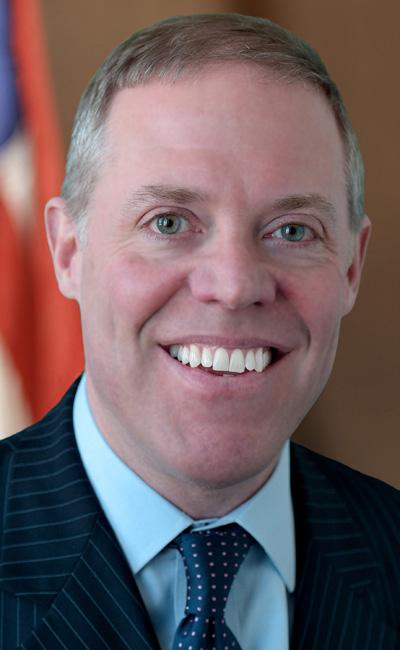
Tierney (pictured right) was joined by his wife, Erica, and children at the Suffolk Community College campus in Brentwood to be sworn into office a second time. Fittingly, a benediction was given by Brother Gary, a retired principal of St. Anthony’s High School, Tierney’s alma mater.
Former Assistant D.A. Doug von Oiste (pictured below), a long-time friend of Tierney, delivered opening remarks by acknowledging Tierney’s “hard work and great personal sacrifice” over the last four years. He said that Tierney’s proclivity to point out problems is accompanied by his ability to solve them, and “not with words,” but by serving as an “example.”
“Under Ray Tierney, the Suffolk D.A.’s office is the preeminent prosecutor’s office not only in the state, but in the nation,” said von Oiste. “The people of Suffolk County will be relying upon his hard work, his smarts, but most of all, they’ll be relying upon the thing that they saw in him originally, and that’s the character of the man.”
Von Oiste described Tierney as a “true gentleman, first and foremost.”
“He does not make a poor man conscious of his poverty, an obscure man of his obscurity, or any man of his inferiority or deformity,” said von Oiste. “He is humbled when necessity compels him to humble another. He does not flatter wealth. He does not cringe before power. He does not boast of his own possessions or achievements. He speaks with frankness, but always with sincerity. His deed follows his word. He thinks of the rights and feelings of others rather than his own.”
Tierney was then sworn into office by the Honorable Hector LaSalle (D), Presiding Judge of the New York State Supreme Court Appellate Division, Second Department.
Tierney opened his inaugural address by pointing out the theme of his first address, “optimism.” Upon reflecting on his last election, the holidays, and the end of his first term, he opted for the theme “thankfulness.”
“Some of the things that we were able to accomplish I could not get done without their help and certainly without the help of our County as well,” said Tierney of federal, state, and local law enforcement.
Tierney then laid out his accomplishments to date and laid the groundwork for what another four years entails.
“Gilgo Beach is not our signature case; it is one case among many,” said Tierney. “We’ve taken that comprehensive approach and spun that off into our Cold Case Unit.” Since its establishment, that unit has been able to name suspects in crimes that had gone cold for over a decade.
“To be able to give closure to those families, it means the world to me and my team,” said Tierney.
The D.A. discussed reforming property crime prosecutions, resulting in the nabbing of a

“comprehensive retail theft” ring that sent the perpetrators Upstate for “significant” periods of incarceration, and $3 million returned to the victims.
“When I first took office, I realized that there was this pernicious belief that law enforcement no longer cared about property crimes,” said Tierney. “Now, people in Suffolk County understand you can’t steal other people’s stuff. Retail theft is down significantly since I’ve taken office.”
Catalytic converter theft was one of the top headline-grabbing crimes plaguing Suffolk when Tierney was first elected, with over 1,200 in 2023, down to 550 in 2024, and just 158 in 2025.
With regards to dangerous street takeovers, Tierney thanked the County Legislature for their laws allowing for the forfeiture of these vehicles once suspects were apprehended. The cars were then destroyed so as to dissuade the organizers from monetizing the dangerous shows.
The Environmental Crimes Unit under Tierney has produced the Evergreen Initiative, resulting in better policing of the Pine Barrens - courtesy of the Suffolk County Sheriff’s Department - and the increase of penalties for illegal dumping.
“We’ve had a 773% increase in environmental crime cases under my administration. In the years prior, there were 93 environmental crimes cases,” said Tierney. “In the first three years of my administration,

there have been 812 cases. It’s not about the talking; it’s about the doing.”
Of gang takedowns, Tierney said that eight have been done so far, with the arrest of 141 “drivers of violence.”
“These individuals are responsible for 55 total shootings, at least four murders, 12 armed robberies, 70 instances of possession of criminal possession of weapons,” said Tierney. “They stole 30 vehicles and they financed their activities through sex trafficking and narcotics trafficking. And we took them off the street because we work together.”
Shootings, before Tierney took office, had risen 95% in a four-year period. The County Legislature granted D.A. Tierney and company ShotSpotter legislation, resulting in a reduction of cases by 34%, a decrease of 91% in black male shooting deaths, and just one gangrelated shooting fatality in the last two years.
“That is unheard of,” said Tierney. “We haven’t seen those numbers since the 1950s.”
With regard to overdose deaths and narcotics policy, Tierney said the objective has been to “go after the dealers who deal in death; those who sell deadly fentanyl and hold them responsible in court.” Tierney added, “it’s not only about prosecuting individuals; it’s also about counseling and advocacy.”
The push for Chelsea’s Law, named after Chelsea Murray, was effectively spearheaded by Tierney. He pledged that he will continue pushing for passage of that law.
“When I first got into office in 2022, we had 536 overdose deaths. That’s obscene,” said Tierney. “Last year, although the numbers are not completely in, it’s estimated that we’re going to have 211 overdose deaths this year. That’s still 211 deaths too many, but it also marks a 61% decrease in overdose deaths in Suffolk County.”
Of where these figures have left Suffolk, Tierney stated succinctly: “Suffolk County is the safest large county in New York State.” He mentioned the violent crime rate, which is counted per 100,000 of the population. For the Bronx, the rate is 1,265. For Queens, 554. Nassau County, which Tierney called a “very safe county” sits at 162.5 - a “phenomenal” figure, according to Tierney.
But for Suffolk, the rate sits at 91.8.
“It not only makes us the safest large county in New York State, but one of, if not the safest county in America,” said Tierney. “It’s because of the incredible team I’ve been given.”
Tierney reiterated his support for local and federal law enforcement partners, but also his assistant D.A.’s.
“Simply put, no one has better assistant district attorneys (ADAs) than Suffolk County,” said Tierney. “It trickles down to our bureau chiefs, supervisors, line assistants, clerical staff, discovery expediters, analysts, and victim witness advocates. They attack their jobs with enthusiasm and passion. And we have a lot of challenges in law enforcement, with discovery reform, with bail reform. Individually, we are weak. But together, we are strong, and we are getting the job done.”
Tierney added that while success was not unexpected, the “breadth” of his department’s success over the last four years has been.
“To my ADAs: get ready, because the first four years were good,” said Tierney in conclusion. “The next four years are going to be even better. We’ve got cases; we’ve got work to do. We’re going to continue working together. We’re going to continue to build our cases to make sure we’re acting fair and to do everything we can to protect the citizens of Suffolk County.”
By Matt Meduri
With no other state affected by the September 11 attacks quite like New York, it’s fitting that the New York congressional delegation led the charge in recently securing lifetime funding for the World Trade Center (WTC) Health Program.
The FY2026 appropriations minibus package includes full funding for 9/11 health care throughout the program’s lifetime. For Congressman Andrew Garbarino (R-Bayport), the fund has been a priority since he began his tenure in Congress in 2021. Along with Senator Kirsten Gillibrand (D-Albany), the two are the lead sponsors of the 9/11 Responder and Survivor Health Funding Correction Act, which served as the basis of the new funding formula.
Their efforts have led to delaying program cuts, expanding eligibility to 9/11 responders, and addressing funding shortfalls - all to have secured around $2.3 billion for responders and survivors.

The WTCHP was bipartisanly established in 2011 to cover the lifespans of all “exposed individuals, including first responders, survivors of the attacks on the World Trade Center, the Pentagon, and the Shanksville crash site, children who attended schools in downtown Manhattan on 9/11 and during the clean-up, and those who have since developed, or are expected to develop,
adverse health effects linked to the attacks.”
The program, reauthorized in 2015 and extended through 2090, provides medical treatment and monitoring for over 140,000 responders and survivors. That crowd spans all fifty states and nearly all 435 congressional districts.
“New Yorkers will never forget September 11th, 2001, and we have a responsibility to match our words with action. Responders and survivors must always

receive the care they were promised without delays or disruption,” said Garbarino in a statement. “This provision makes corrections to the funding formula to deliver full funding for the program through its lifetime. Funding certainty matters. It ensures the program can operate as intended and that those suffering from 9/11-related illnesses can focus on their health, not bureaucracy.”
Congressman Nick LaLota (R-Amityville) echoed these sentiments, saying in a statement, “I know countless New Yorkers who are still living with the health consequences of 9/11, and ensuring they receive the care they were promised is the least we can do…This funding provides certainty, dignity, and peace of mind to the heroes and survivors who have already sacrificed so much.”
“It’s been almost 25 years since the 9/11 attacks and New York’s heroic first responders and survivors still carry with them the burden of that day as they develop chronic conditions and diseases related to the air around Ground Zero,” said Congressman Jerry Nadler (D-Lincoln Square), the dean of the New York congressional delegation, in a statement. “We promised to Never Forget 9/11 and that means taking


We’ve spared no expense in describing how Suffolk County, the largest suburban county in the nation, is not only a national leader on many levels, but how the county is a microcosm of the nation overall.
Suffolk residents are attuned to a myriad of issues, and the familiarity isn’t surface level. Agriculture, heavy industry, maritime economics, internationally recognized tourism locales, precarious environmental situations, world-renowned research capabilities, and housing are just a few issues Suffolk can speak to with indepth experience, all while standing as an immediate bedroom-community of the nation’s largest city - and perhaps the most recognizable city in the world.
Criminal justice and the problems that accompany it are not to be excluded from that list, and Suffolk goes beyond its typical level of national leadership in that regard.
And it’s unmistakably because of District Attorney Ray Tierney (R).
The Suffolk D.A.’s office had been in Democratic hands for nearly the entirety of the Twenty-First Century. D.A. Tim Sini (D-Babylon) was elected in a landslide in 2017 in what was perhaps a harbinger of the seismic 2018 blue wave that would catapult progressive Democrats into Albany.
That, as it turned out, would be a recipe for disaster - especially in one of the largest prosecutorial offices in the nation.
Sini would not only get bad marks for being an ineffective prosecutor during his single, four-year term, but the figurative ghost of his predecessor Tom Spota (D-Mt. Sinai) would also haunt the office, as Spota and former SCPD Chief Jimmy Burke would glaringly push the FBI out of the Gilgo Beach investigation. Spota had served as D.A. from 2002 to 2017, while Sini would become SCPD Commissioner after Burke’s exit.
But Sini sat out on a mountain of evidence pertaining to Gilgo and could not get crimes from serious offenses to quality-of-life disruptions under control.
Sini was rightfully voted out in the 2021 red wave, delivering Suffolk now-D.A. Tierney, who promulgated suspect Rex Heuermann in the Gilgo case less than two years into his term.
Moreover, Tierney’s unopposed run for a second term in November is a testament to his ability to transcend partisan politics and truly make a difference, we find.
The Gilgo developments have been nothing short of earth-shattering, particularly as the avant-garde technology used to identify a suspect and rule out others makes Gilgo the first case in New York State history to be formed by this kind of evidence.
However, the bigger task at hand for any local prosecutor is to keep crime controlled in citizens’ everyday lives. While some prosecutors aim for the illusion of safety, Tierney has ensured comprehensive investigations into everything from
narcotics to human trafficking to theft rings.
The data speaks for itself. Catalytic converter theft, the talk of the town a few years ago, is now virtually nonexistent. What started as a 1,200-plus-strong problem in 2023 is now down to around 150 as of last year. Shootings had almost doubled in the four years prior to Tierney’s ascension to office. Now, the county has seen a 34% decrease overall and a 91% decrease in black male shooting deaths. The numbers not seen since the 1950s display a monumental win for quality of life and suburban revitalization across Suffolk.
True to form, Suffolk’s status as a premier American suburban county boasts an astonishingly low violent crime rate. While the Bronx sees a rate 1,265 - per 100,000 - Suffolk sees just 91.8. Suffolk is not only the safest large county in the state, but one of the safest large counties in the entire country.
Tierney’s overhaul of the D.A.’s office has led to more prosecutions of animal abuse cases and environmental offenses. While the County had poor ratings as far as the typical crimes go, Tierney and his team were able to transform the office, expand the bureaus, and slash the numbers across the books in just four years - all while prosecuting the laborious Gilgo Beach case.
But it’s not just about statistics and the archetypal forms of crime. Tierney has been a steadfast advocate for criminal justice reform, particularly as it pertains to the opioid epidemic and cashless bail reform. Tierney rightly asserts that Albany is too soft on criminals and essentially punishes the victims.
However, that doesn’t come from a place of purely partisan theatrics. Rather, it comes from a nuanced position that calls for the balance we as a country once understood implicitly and held as sacrosanct. The progressive experimentation with codes and statutes has put lives on the line, demoralized the innocent, and has given virtually every New Yorker just another reason to split for the South.
D.A. Tierney, while able to recognize a bad idea when he sees one, is also able to understand the premise. Bail reform, for instance, is a massive overcorrection, as Tierney has stated, but not one that didn’t come from a place of legitimacy. The pendulum simply swung too far.
That type of balanced, independent mantra is exactly what can get the job done in a much larger sense: staying tough on crime and following through on enforcement but parlaying intimate knowledge of the system from a psychosocial perspective to give everyone the reform they’ve been desperately craving.
Suffolk is privileged to have a district attorney in Ray Tierney, and thus, the county is evermore deserving of its high marks that make it a national leader in more ways than the obvious.
And that makes Tierney evermore deserving of the title, “America’s D.A.”
Since the regular, post-Census redistricting cycle in 2021, New York State has had three separate maps enacted.
The 2021 cycle, which was a complete disaster in and of itself, saw the fantasy-league Independent Redistricting Commission fail to reach a verdict, kicking the process to the Democrat-dominated State Senate. That map, appropriately dubbed the “Hochul-mander” was swiftly struck down by a Steuben County judge on appeal by Republicans. A special master was then appointed to draw a fairer map, one that, while healthily competitive, paved the way for the GOP to retake control of the U.S. House in 2022.
Democrats again decided to challenge that map on the basis of a constitutional technicality, allowing themselves to redraw the lines a third time not even halfway through the decade. While the lines didn’t move much, they are attributed to have aided two Democrats to win seats that might otherwise have been won by the GOP.
Now, Democrats are at it again, this time gunning for Staten Island parts of South Brooklyn, the former being a long-Republican enclave in an otherwise liberal bastion, and the latter being a red-trending area that has helped thin the margins in reliably Democratic territory.
Governor Kathy Hochul (D-Hamburg) vowed swift retribution for President Donald Trump’s (R-FL) redistricting arms race that he kicked off in August. That initiative has swept to Texas, Missouri, and North Carolina for the GOP, and California for the Democrats.
However, New York’s laws prevent a unilateral, one-party takeover middecade, thankfully, remanding the at-large map to remain in place at least until 2028. So, Hochul’s punch would have had to be pulled for quite a while.
Enter a creative decision by a State Supreme Court Justice appointed by Hochul herself. The judge also served as special counsel to the Governor
before his appointment to the state’s highest court. Justice Pearlman, prompted by a lawsuit from a flagrantly Democratic-aligned law firm whose stated mission is to help Democrats win elections, has ruled the Staten Island-based district racially biased against black and Latino voters.
Their solution? Axe the minority sections of south Brooklyn in exchange for affluent, white, liberal parts of Lower Manhattan.
This isn’t about racial politics; it’s simply about pure partisan lean. Pay no attention to the fact that Democrats were able to win this seat, albeit in an upset, in 2018 with no parts of Manhattan included.
The ruling is ironic as well, considering Congresswoman Nicole Malliotakis (R, NY-11) is herself of Cuban and Greek descent.
The decision also perpetuates the insulting tone with which many Democrats use against minorities. To Democrats, a minority voter is not “properly represented” unless it’s by someone of their own community –and if that “someone” is a Democrat. If minority voters choose a Republican, then they’re not choosing correctly, Democrats assert.
Malliotakis clearly isn’t the minority New York Democrats are looking for, despite those same voters ousting a Democrat to send her to Washington in 2020. Moreover, Trump’s 2024 margin in Staten Island - 63.9% of the vote - was the largest for any Republican presidential candidate since Warren G. Harding (R-OH) won in 1920. Trump’s 27% of the vote in Brooklyn was the best for a Republican presidential nominee since George H. W. Bush (R-TX) was elected in 1988.
Make no mistake: we don’t approve of Trump’s nationwide redistricting gamble. It’s a dumb move with terrible precedents, but New York Democrats are not entirely blameless here. The political retribution is understandable, but the reasoning is just downright demeaning to the very constituents whose interests they claim to uphold.
By Assembly Minority Leader Will Barclay
New York’s legislative process is objectively one of the most dysfunctional in the nation. A recent report from the Times Union (TU) effectively illustrated this point by noting New York is one of only twelve states that does not require public fiscal analysis on all legislation likely to impact revenue and expenditures. Making matters worse, lawmakers here introduce more bills each year than any other state legislature in the U.S. This perfect storm has bred an economically toxic environment in which hundreds of bills are being considered by lawmakers who have no idea how much the included policies will cost.
The impact of this negligence cannot be overstated. For example, the “fiscal implications” section of the state’s all-encompassing Climate Leadership and Community Protection Act (CLCPA), which unofficial estimates project will cost more than $600 billion to meet emissions and energy standards, simply reads: “To be determined.” If you want to know how much it’s going to cost for every school district in the state to purchase an entire fleet of electric school buses, a figure unofficially expected to be as much as $15 billion, you’d be disappointed to know that information isn’t available from the bill’s sponsors. Also noted in the TU report, the proposal to move New York into a singlepayer health care system—potentially impacting one-fifth of the entire state’s economy—“doesn’t have a real fiscal note.”
The inadequacies of the process extend well into the budget process, too. Often, lawmakers are expected to vote on fiscal policies included in the state’s spending plan without having a final figure to consider during roll call. Governor Kathy Hochul’s (D-Hamburg) executive budget proposal calls for $260 billion in spending. Every cent should be accounted for before anyone is expected to sign off on such an enormous bill. Yet, despite repeated calls from policy experts, lawmakers and reform advocates, changes to the broken process continue to be blocked.
Among the proposals we’ve faced pushback on include a bill sponsored by Assemblyman Ed Ra (R-Frankling Square), our Conference’s ranking member on the Ways and Means Committee, to create a nonpartisan “Office of Policy Research and Fiscal Analysis” (A.4532) to keep sitting members of the Legislature better informed about the fiscal impact of proposed legislation. Additionally, Assemblyman Ra sponsored a bill (A.3940, Ra) to require the governor to provide final budget estimates no later than one day prior to voting on the aid to localities, state operations or capital projects budget bills.
My appropriation reform bill (A.6337) would create an advisory committee to vet lump-sum expenditures. Assemblymembers Josh Jensen (R-Greece) (A.4301), Robert Smullen (R-Johnstown) (A.8877), and Joe DeStefano (R-Medford) (A.7795) have similar proposals to provide greater transparency protections for local governments and utility ratepayers. These are simple fixes that call for an honest, transparent assessment of how much of your money the state is going to spend.
There is no good reason to keep the true impact of these consequential policies a secret. To do so undermines democracy and erodes the public’s trust. No one in their right mind would run a household budget or business this way, yet our state government does it casually. Until this systemic problem is fixed, New Yorkers will continue to watch their tax dollars fund failed programs and wasteful policies.
Assemblyman Will Barclay (R-Pulaski) is the Assembly Minority Leader and has represented the 120th Assembly District since 2003. The 120th District contains most of Oswego County and parts of Cayuga and Jefferson counties.
By Hank Russell | Long Island Life & Politics
As with most of the budgets that emanate from Albany, the 2026 document contains both good and bad elements.
On a positive note, let’s start with the following:
At the moment, at least, the governor who is running for re-election this November has submitted a budget with no major tax increases.
She had earlier ruled out a request by New York City Mayor Zohran Mamdani (D-Astoria) and other progressives to raise income taxes once again. Earlier this year, she hinted she might be open to increasing the corporate tax, but no such increase was submitted in the budget. This doesn’t mean it won’t come about in a compromise with the state Legislature when the budget is finalized in April.
Billions will be needed to meet the wish list laid out by the newly elected mayor. His goal of creating free daycare alone will cost several billion dollars. A scaleddown version still required Hochul to come up with an additional $1.7 billion in her proposed budget.
The state’s finances have been on a roller coaster as of late. There was a massive infusion of federal funds during the COVID-19 era. Some of that was hoarded in reserve funds, but a good chunk of it was spent on new recurring projects.
State spending skyrocketed since 2019 an astounding 67%. New York State’s proposed budget of nearly $260 million is now two-and-a-half times the size of Florida’s, which has 3 million more people than New York.
But the $11 billion lost in federal funds seems to have been made up by a massive increase in additional revenues that came from additional revenues resulting from the white-hot stock market.
Since the finance industry is such a large component of the New York economy, major increases in the market translate into higher Wall Street salaries, and more taxable income flowing into the state government.
The Comptroller warns, however, that the spending levels coming from Albany are unsustainable. A downturn in the economy could cause huge deficits. It’s already been estimated by the state comptroller in August that the state is running a structural three-year deficit of $34 billion.
The governor has wisely proposed a modification of the State Environmental Quality Review Act (SEQRA) for affordable housing projects that are sought to be fast-tracked. This, according to the development community, will save a huge amount of time (which is money) and increase the stock of needed nextgeneration housing.
Hochul also seems to have picked up on the successes of Florida Governor Ron DeSantis (R), who, along with his Republican-led legislature, implemented car insurance overhauls that broke up the fraudulent accident rings and are bringing down premiums. These fraudulent doctor/patient/lawyer conglomerates are estimated to cost New York state countless dollars every year.
The biggest red flag evident in this budget is, once again, a massive increase in Medicaid spending.
New York already spends more on Medicaid and healthcare than the states of Florida and Texas combined, even though they have two-and-a-half times the population.
One out of every three New Yorkers is now on Medicaid and that figure is over 50% in New York City. This is simply unsustainable.
And despite President Trump‘s efforts to stop the flow of public funds for health insurance for those who are here illegally, the state continues to add people onto the rolls, regardless of their documented status.
Governor Hochul, like the governors preceding her, loves to boast about extra money going to our schools. But if there’s one thing that is evident to the common observer, it is that the state’s doubling and tripling of state aid to local education has had little to no impact on improving student performance.
That’s because the state continues to limit competition through charter schools, which are proven to provide better educational outcomes at a lower cost. The state has also allowed the Board of Regents to water down standards by lowering passing grades and even eliminating the need for Regents exams in some cases. New York spends more per student than any state in the nation yet continues to fall in the middle of the pack within the 50 states when it comes to student performance.
If there is one thing we’ve learned, it’s that throwing more money at the problem is not solving it. So why not give taxpayers a break and redirect that money for tax relief or other needed services?
Instead, the governor grants another $2 million to teachers’ unions to “train“ teachers. Why would this be given to the unions and not the administrations?
Seems like politics to us.
This op-ed originally appeared in Long Island Life & Politics. For more from LILP, visit them online at lilifepolitics.com.
Thursday, January 29, 2026
By Madison Warren
Two long-unsolved gang-related murder cases have finally led to indictments following investigations by the newly formed Cold Case Gang Homicide Unit, a joint effort involving the Suffolk County District Attorney’s Office, the Suffolk County Police Department (SCPD), the Suffolk County Sheriff’s Office, and federal law enforcement partners.
Gang violence remains a serious public safety concern across Suffolk County, and cases like this highlight how coordinated efforts by Suffolk County District Attorney Ray Tierney (R), SCPD Commissioner Kevin Catalina, and local law enforcement can bring long-awaited justice while working to keep communities safe.
Prosecutors announced last week that members and associates of the Huntington Station-based street gang known as the Lowndes Block Gang (LBG) have been indicted following a years-long investigation that spanned nearly a decade. Prosecutors allege the gang was made up of members from various Bloods-affiliated groups in surrounding areas and sought to establish dominance and control over the Lowndes Avenue section of Huntington Station.
The charges include the 2021 murder of Luis Cameron Rimmer-Hernandez, who was 21 years old, and the 2016 murder of Antoine Butts-Miller, who was just 18. The indictment involves nine members and associates of the Huntington Station–based Lowndes Block Gang.
D.A. Tierney expressed how, for years, so many people collaborated on this case to get to where they are, and that there was not one thing that broke the case open, but a number of things. This allowed them to charge not just the shooters in this case,

but anyone and everyone who was involved in the operations.
The indictment covers over a dozen crimes committed over the past decade, including the killings of Luis Cameron Rimmer-Hernandez and Antoine Butts-Miller. In addition to multiple shootings, defendants are charged with the possession of 11 firearms, six of which have been recovered by law enforcement. Prosecutors have also charged members with offenses related to sex trafficking and prostitution. Authorities allege the gang was led

by Marques Scott, also known by the street name “Pop,” a 31-year-old Huntington Station resident.
Prosecutors allege that Marques Scott, a highranking Bloods-affiliated member, exploited younger and lower-ranking individuals to carry out violent crimes in furtherance of the gang’s agenda. According to authorities, Scott provided firearms, money, and vehicles to younger members, using the promise of increased status within the gang as motivation.
Prosecutors allege that Marques Scott was charged in connection with the August 9, 2021, murder of Luis Cameron Rimmer-Hernandez, accusing him of ordering the killing. According to authorities, Scott and Rimmer-Hernandez were previously associated and considered friends and were arrested together in June 2021 in Nassau County on narcotics charges. Prosecutors say Scott later became angry with Rimmer-Hernandez, believing he failed to take responsibility for the drugs involved in their arrest.
Prosecutors allege that Marques Scott coordinated with multiple gang members to plan the killing of Luis Cameron Rimmer-Hernandez. According to authorities, Scott ordered a 14-year-old aspiring gang member, Ramon Lyons, to carry out the murder, while another member, Shakur May, allegedly supplied the firearm. Prosecutors say the killing occurred on Lowndes Avenue, where Lyons approached Rimmer-Hernandez and fatally shot him.
Prosecutors said Lyons was later promoted and rewarded by the gang for carrying out the murder, before being arrested approximately ten days later. D.A. Tierney stated that his office prosecuted Lyons and secured a conviction, and that Lyons is currently serving a sentence of twelve years to life in prison. Tierney also explained that under New York law, younger offenders are often subject to lesser penalties, a factor he said gangs exploit by using juveniles to commit violent crimes, knowing they may face less prison time than older members.
“This is something we are seeing in all gang cases. They know the laws of New York State are lenient when it comes to juveniles, and they are taking advantage of those laws,” said Tierney. “They continue to use the younger members to commit the most brutal violence that the gangs do…What we need to do is have our legislature understand the law. We need changes to this law so no other family has to deal with this.”
The indictment also includes the 2016 murder of Antoine Butts-Miller, for which Kevin Donaghy has been charged. Prosecutors allege that on August 27, 2016, Donaghy became involved in an argument with a rival gang member outside a house party and opened fire, missing his intended target and instead fatally striking Butts-Miller, who authorities say was an uninvolved bystander with no connection to the altercation.
Since that shooting, it has been a decade-long investigation into what is happening on Lowndes Avenue.
Prosecutors said the indictments represent a major step in holding violent offenders accountable and reinforcing public safety across Suffolk County. Tierney and Catalina emphasized that sustained, collaborative investigations between prosecutors, law enforcement, and partner agencies remain critical to dismantling gang activity and keeping neighborhoods safe.
Thursday, January 29, 2026
By Matt Meduri
National
Minneapolis, Minnesota, descends into chaos as another fatality is reported amid protests against federal law enforcement.
Alex Pretti, a 37-year-old intensive care nurse for the V.A., was shot and killed by Customs and Border Protection (CBP) agents. The shooting occurred amidst protests after the fatal shooting of Renee Good following an altercation with Immigration and Customs Enforcement (ICE) on January 7.
Video footage shows Pretti shouting at officers to not push fellow protestors into the street. Officers are then seen approaching Pretti, after which several other officers descend on him. One officer sprays Pretti in the face with a chemical irritant, after which Pretti kneels on the side of the road. An officer can be seen removing Pretti’s handgun from his waistband as Pretti is surrounded by officers, his back to the agent who removes his handgun.
Shots then ring out, videos show, with the final five shots delivered into a motionless Pretti.
Governor Tim Walz (DMN) activated the Minnesota National Guard, and Minneapolis Mayor Jacob Frey (D) requested the National Guard to support local law enforcement.
to a strong overperformance. In 2024, Democrats won this seat 83%-17%. On Tuesday night, they prevailed in the special election by a lopsided 95.6%-4.4% margin.
The Minnesota State House remains evenly divided and the power-sharing agreement between the DFL and the GOP remains intact.
In other electoral news, Delegate Eleanor Holmes Norton (D-DC) is retiring this term and will not seek re-election in November.
Norton has represented the District of Columbia’s at-large district as a delegate to the House. Delegates for D.C. and the five overseas territories are permitted to sit on committees and sponsor legislation but cannot participate in final floor votes.
Norton was first elected in 1990 and was re-elected in 2024 with about 80% of the vote in a four-way race that featured an Independent, a Republican, and a member of the D.C. Statehood party.

Department of Homeland Security (DHS) Secretary Kristi Noem (R-SD) (pictured above) has asserted that Pretti violated the law by failing to carry identification while carrying a firearm, which would have made him guilty of a petty misdemeanor. Other analysts have posited that a possible discharge of a weapon, possibly Pretti’s once it was apprehended by law enforcement, could have prompted the shooting.
President Trump said in a post on Truth Social that he had a productive phone call with Governor Walz on immigration policy going forward in the North Star State. Trump is also sending in “border czar” Tom Homan (R-AZ) in the wake of the shooting.
The shooting has also apparently delayed Senator Amy Klobuchar’s (D-MN) announcement that she will be running for governor of Minnesota this year. Walz, able to seek a third, four-year term, opted to not do so following the Somali fraud scandal. Klobuchar has filed paperwork and a formal announcement is expected on February 3.
Minnesota also saw a special election on Tuesday, which affirmed what was more or less expected: the State House will proceed in a deadlock with both parties each having 67 seats.
State House District 64A, located entirely within solidly-blue St. Paul, was retained by Democrats, but the recent uprisings might have lent themselves
trial following January 6. Cassidy has also been an unpredictable maverick on some key agenda items, including his opposition for the 2017 repeal of the Affordable Care Act.
“My mission is clear: to ensure the nation our children inherit is safer and stronger. This United States Senate seat belongs to the people of Louisiana, and we deserve conservative leadership that will not waver,” said Letlow in a statement on her campaign website.
Cassidy has been censured by the Louisiana Republican Party for his occasional votes against his party. He was first elected in the 2014 red wave, in which he ousted then-Senator Mary Landrieu (D-LA), a scion of the Landrieu political dynasty that had been a wellknown name in Louisiana politics for decades. Cassidy became the first Republican to hold that seat since 1883.
Norton’s 2024 margin, despite being a landslide in sapphire-blue D.C., was the smallest of her wins going back to 1990, behind only her initial election, in which she won a five-way race with 61% of the vote.
The Democratic nominee for this seat is all but certain to be the next delegate from the nation’s capital.
In other news on the Hill, Congressman Steny Hoyer (D, MD-05) has also announced his intention to retire ahead of this cycle.
First elected in a 1981 special election, Hoyer is the most senior House Democrat and the dean of the Maryland congressional delegation. He has served as House Minority Whip twice (2003 to 2007 and 2011 to 2019), alongside Congresswoman Nancy Pelosi (D, CA-11) as Minority Leader or Speaker of the House. Pelosi is also ending her historic congressional tenure this year as well.
MD-05 contains Southern Maryland, a safely-Democratic seat that has been in the Party of Jackson’s hands since 1975. The district backed Hoyer for re-election in 2024, giving him almost 68% of the vote.
In Senate news, Congresswoman Julia Letlow (R, LA-05) has announced a primary challenge against Senator Bill Cassidy (R-LA).
Letlow was first elected in a 2021 special election following the passing of her husband, Congressman-elect Luke Letlow (R), due to COVID-19 just five days before he was set to take office.
Julia Letlow is the first Republican woman to represent Louisiana in the House.
President Trump has endorsed Letlow in the Republican primary. Trump has encouraged Letlow to run due to his growing frustration with Senator Cassidy, one of the few Republicans who voted to convict Trump in his second impeachment
and if not, be removed or impeached. She also called for the firing of Border Patrol Commander Gregory Bovino.
“And make no mistake, when these people who have abused the power entrusted to them by their offices are finally out of power, states including New York, will hold them accountable,” said Hochul.
However, Hochul is under fire herself for refusing DHS help in response to the snowstorm that brought frigid temperatures and at least a foot of snow across the state.
“Secretary Noem offered assistance to New York ahead of the impending snowstorm,” said Hochul over the weekend. “I shared that the fastest way to help is for ICE to back off so people feel safe accessing warming centers, shelters, hospitals, and houses of worship.”

In other news, this weekend’s winter storm, unofficially named Winter Storm Fern by The Weather Channel, was one of historic proportions. Highest sustained winds were clocked at 60mph, with the highest gusts recorded at 71mph in Montgomery, Alabama. The lowest temperature recorded was -43F in Seagull, Minnesota. The maximum snowfall recorded was thirtyone inches that landed near Bonito Lake, New Mexico. Little Rock, Arkansas, saw 6.7 inches of sleet. The 6 inches of snowfall Little Rock received broke its daily snowfall record dating back to 1899.
At one point, the storm covered nearly 2,000 miles in length from the MexicoU.S. border to well past the Canadian border. 10,000 flights nationwide were cancelled or postponed.
As of Monday, 50 fatalities have been confirmed.
Governor Kathy Hochul (D-Hamburg) has called for DHS Secretary Kristi Noem (R-SD) to be removed from office following the second fatal shooting this month in Minneapolis as protestors clash with immigration law enforcement.
“Donald Trump’s leader of the Department of Homeland Security has proven to be unable and unwilling to follow the law to stop these killings,” said Hochul. “Kristi Noem has referred to these peaceful protestors as ‘domestic terrorists,’ and lied about the shooting victims being the aggressors. She has shown a profound disregard for human life.”
Hochul then called on Noem to resign
White House spokesman Kush Desai said in response to three confirmed fatalities in New York due to the temperatures, “What a surprise - while President Trump and his entire Administration have taken steps to ensure all Americans have the resources they need to recover from this historic winter storm, Democrats instead are, once again, prioritizing the wellbeing of criminal illegal aliens.”
Nassau County Executive Bruce Blakeman (R-Atlantic Beach), who is running for governor, said in a statement, “When lives are at risk, you don’t turn down help,” adding that Hochul “actually rejected federal assistance that was offered to help keep people safe.”
Other sources, however, have stated that Hochul never rejected such assistance.
In response to the winter storm, Suffolk County Executive Ed Romaine (R-Center Moriches) signed a declaration of emergency on Saturday afternoon, creating the flexibility in response measures and the ability to recuperate funds expended.
Snow totals across the Island rack up to on or near one foot, with Brightwaters taking first place with 14.5 inches. Setauket comes in second with 13.5 inches, followed by Islip with 13.0. Commack comes right behind with 12.8 inches. Unfortunately, the death toll continues to rise, with The New York Post reporting seven fatalities in New York City, as well as a man who died while shoveling snow outside a Floral Park church.
“There’s a lot of haggling that goes into securing these funds, and it doesn’t necessarily come down to who gets the most re-tweets or who has the most viral clip,” said LaLota. “The art behind securing these monies is special and my staff and I have developed relationships with my colleagues on the Appropriations Committee. We’ve gained their trust and confidence to vote to fund these projects.”
LaLota attributed credit to his staff, a “group of professionals who understand the levers of government and can properly advance Long Island’s interests.”
“It’s been a years-long, team effort to get these appropriations back to Long Island and it probably doesn’t get enough coverage that the far-left and far-right attacking each other does,” said LaLota. “The business of the Congress is power of the purse and my staff and I exercise that properly for that benefit.”
$1,086,400 has been appropriated for a critical clean drinking water project that will extend Smithtown Water District’s service area and distribution facilities to connect twentysix single-family homes that are currently on
private wells contaminated with PFAS, otherwise known as “forever chemicals.” Testing found that 1,4-dioxane levels have reached up to 2.59 parts per billion (ppb), well above New York’s drinking water standard of 1 ppb.
“These homeowners would have had to hook up their private wells to the public water system on their own dime, costing between $25,000 and $40,000,” a Town spokesperson told The Messenger. “No way. Not in this day and age can we expect anyone to be held responsible for that.”
The Town spokesperson said the decision would have come down to going broke for clean water or running the risk of developing cancer due to drinking, using, and bathing in the contaminated water.
The St. James Sewer Treatment Plant, a fifty-year-old facility, will receive $1 million for upgrades. The existing plant has no excess capacity to accommodate Lake Avenue, St. James’ de facto Main Street. A new, higher-capacity wastewater treatment plant is proposed and engineering designs are currently under review by the State Department of Environmental Conservation (DEC). State Environmental Quality Review Act (SEQRA) documents are also being prepared.
The Fairfield community off Moriches Road is currently seeing their sewer system upgraded to handle excess capacity from the Lake Avenue Business District. 674 units will be connected but will also allow for the full connection of the business district through a connection down Woodlawn Avenue.
“This is the final piece of the puzzle for Lake Avenue,” said the spokesperson of long-awaited downtown revitalization of St. James.
$1 million has been earmarked for the Kings Park outfall pipe replacement. The project will replace the 24-inch diameter outfall pipe that sits between two manholes. The current pipe is partially exposed, corroding, leaking, and passes through a beachfront area that is commonly accessed by residents. The new pipe will be designed and installed to match current specifications and new connections to the manholes. The new pipe will be accompanied by a protective bulkhead to protect the pipe from tidal action and further corrosion. The current exposed pipe is a safety hazard and an eyesore in a public recreational area. The replacement will also head off a pipe failure in the future.


By Jennifer S. Raguso, Esq.
Everything you should have in place and organized
No one expects a medical emergency. But every week in New York, someone is blindsided when a loved one who suddenly cannot speak for themselves, pay their bills, or make medical decisions.
Many people assume a spouse or adult child can automatically step in. Under New York law, that assumption is often wrong. Without the right planning in place, you may face treatment delays, frozen accounts, and even court proceedings during an already overwhelming time.
The good news? Most of these problems are entirely preventable.
If You Can’t Speak, Who Will?
Without a Health Care Proxy, New York law does not guarantee that your family can make medical decisions on your behalf. Disagreements among relatives can lead to delays or outcomes you never wanted. A simple, properly executed document can ensure that one trusted person has clear authority to act.
A Living Will and a Medical Orders for Life-Sustaining Treatment (MOLST) goes one step further by putting your wishes in writing, especially regarding life-sustaining treatment. Together, these documents give you a voice when you need it most.
The Paperwork You Will Be Searching for at 2:00 a.m.
During a medical crisis, loved ones often scramble to find basic information: insurance cards, medication lists, even the name of your doctor.
Every person should have a centralized record of essential information, including Social Security numbers, vital records, health insurance details, Medicare or supplemental policies, and long-term care coverage. Medical details matter just as much: diagnoses, allergies, medications, dosages, and preferred hospitals.
Equally important is access. Someone you trust should know exactly where this information is kept and how to retrieve it quickly.
The Hidden Problem No One Talks About: Digital Lockout
Today, many families are locked out of critical accounts during a crisis. Bills are paid online. Insurance is managed through portals. Important messages sit unread in email inboxes. Photos, documents, and calendars may or may not be stored in the cloud.
If no one has access to your usernames and passwords, or even knows what accounts exist, financial and personal chaos can follow. Maintaining a secure, updated list of digital accounts is no longer optional, it is a necessity.
“Can’t We Just Pay the Bills?” - Not Without This Document
One of the most common shocks families experience is discovering they cannot legally access bank accounts or manage finances.
In New York, without a Power of Attorney, loved ones may have no authority to act, even to manage routine bills. The alternative is often a guardianship proceeding, which can be expensive, time-consuming, and emotionally draining.
A properly drafted Power of Attorney allows a trusted person to manage financial and legal matters immediately, without court involvement.
The Financial Records No One Thinks to Gather
When illness strikes, financial obligations do not stop. Families need access to an inventory of assets, recent tax returns, property deeds, mortgage statements, life
and lists of outstanding
debts. Without organization, missed payments and financial penalties can quickly compound an already stressful situation.
Having these records organized and accessible allows someone to step in smoothly and protect your financial stability.
preparation. Having the right documents, organized information, and clear instructions helps you maintain control, dignity, and protects the people you love. An experienced New


Friday, February 6th 6:30pm- 10:30pm, doors open at 6:15pm



January 29, 2026
By Madison Warren
Residents in Hauppauge are voicing serious safety concerns over a proposed Battery Energy Storage System (BESS) facility planned for Rabro Drive, an area in close proximity to schools, homes, and community athletic fields.
In response, town residents have come together to form the Hauppauge Community Action Committee, a newly formed group that stays up to date on the project’s progress, organizes community outreach, and advocates for safety while ensuring residents have a voice in decisions that impact their town.

The project dates back to 2022, when an application was first submitted to the Town of Islip Planning Board. Some residents say many people in the community were unaware of the full scope of the project at the time. Public awareness increased after the Hauppauge Fire Department highlighted the proposal in a social media post. From there, the Hauppauge School District became more involved.
Many residents say their concerns stem from the potential dangers associated with large lithium battery facilities. These risks can include fires, toxic smoke, and thermal runaway events. Unlike traditional fires, lithium battery fires are virtually impossible to extinguish, which can put local fire departments in challenging, potentially dangerous situations.
The Town Council unanimously instituted a twelve-month moratorium on all BESS facility proposal within the Town of Islip at a September
board meeting.
However, the pressure remains. Residents also worry that if an incident were to occur, the location of the proposed facility could significantly impact nearby neighborhoods, schools, and the surrounding environment.
In response, the Hauppauge Community Action Committee was formed to ensure residents’ voices are heard regarding the project. Tara Vasquez, who has played a key role in bringing the group together, said she is committed to uniting the community to make their concerns known and to continue pushing back against the proposed facility.
On January 16, residents gathered at the Hyatt Regency Long Island during a Hauppauge Industrial Association meeting to protest the proposed 79-megawatt battery energy storage facility. Tara Vasquez said petitions requesting
extensions and further review of the project have garnered just over 600 signatures.
The group launched monthly meetings this month as it works to organize a unified strategy. The initial meeting focused on aligning members’ understanding of the project and identifying key priorities moving forward. Vasquez said that rather than having individuals fight the proposal on their own, she and other residents believed they would be stronger if they came together and pooled their resources. Even though this is the project at hand, Tara says they plan to continue this group long after this is over.
The meeting was attended by two board members, commissioners, the school district superintendent, representatives from the fire department, and numerous concerned residents.
As the project continues, members of the Hauppauge Community Action Committee say they remain committed to staying informed, engaged, and vocal throughout the process. The group encourages residents to get involved, attend meetings, and stay updated on developments surrounding the proposed facility. More information about the committee, including meeting updates and community resources, can be found on Facebook by searching Hauppauge Community Action Committee.
The Matinecock District’s annual event featuring a friendly competition where all the local Boy Scout troops get to test their scouts’ skills, communication, and teamwork to earn the “Scouting Spirit AwardOverall Best Troop.”
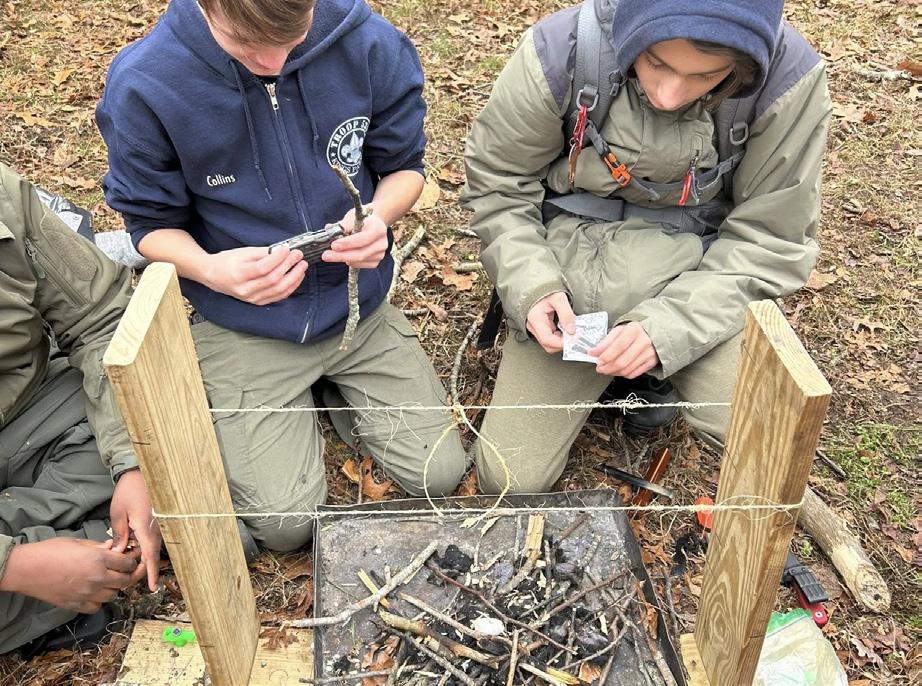
The Winter Camporee (also known as the Klondike or Polar Bear Camporees) is a winter event for Scouting America Troops, Posts, Ships, and Venturing Crews in the district. The competition covers scout skills, communication, teamwork, and scout spirit. This year’s theme was “Heroes vs. Villains” The scouts participated in testing their knowledge of map and compass usage, knots and lashing skills, fire building, and first aid skills Suffolk County Council, Scouting America’s staff, adult leaders from Troop 52 (East Northport) and Troop 125 (Commack), and Scouts from the Nissequogue Chapter of the Shinnecock Lodge Order of the Arrow (the National Scouting Honor Society) worked together to create a challenging program for the annual Matinecock District’s 2026 Winter Camporee at Baiting Hollow Scout Camp on the weekend of January 9-11.
Troop-personality vehicles that are outfitted with skis as well as wheels. This year, the skis (rather than wheels) were needed, and it was amazing! First place winner for the Sled Race was Troop 343 (Hauppauge) for the 2nd time in a row with a time of 30.17 seconds. In an imitation of the Iditarod race, the scouts had to sled down a gauntlet of cones and make a sharp left turn to finish where the race started– about 300 yards -- as the scouts pulled their Klondike Sled with a helmeted patrol member on board.
Each station carried a point system, and each additional challenge braved earned more points, and scout spirit also increased the troop and patrol’s points. The top patrol at each station were: Physical Fitness (Obstacle Course) - Troop 343 (Hauppauge); Shelter Building - Troop 474 (East Northport); Atomic Isotopes - Troop 8 (East Northport); Pioneering – Troop 474; Scouting Jeopardy -- Facts/History - Troop 539 G (Girl Troop) –(Kings Park); Fire building – Troop 343; communications and knots - Troop 343; First Aid -Troop 52 (East Northport); and Fireman Chit -Troop 343
Participating as patrols from 13 Scouting America units in the Matinecock District (from the Town of Huntington and the western section of Smithtown Township) this included Kings Park’s Boy Scout Troop 539G (“girl troop”). There were 10 event stations, and each station had highly competitive skill games to test the scout’s skills. In addition to the main activity, other challenges were incorporated within each station to add to the difficulty and challenges.
Prior to the closing ceremony, Troop 125 was the Color Guard as the American Flag was lowered on the flagpole in the late afternoon. The 13 Troops raced their “Klondike” sleds in the “TOGO – The Great Sled Race”. These “sleds” are colorful,
The Great Sled Race -- the annual great sled race where scouts built their own klondike sled and raced in a time match, a 300-yards challenge with a patrol member on the sled – Troop 343 (Hauppauge) completed the race in 30.17 seconds
Winners and achievements were announced at the campfire program of skits and songs that were presented by the various patrols and took place inside the Dining Hall of Baiting Hollow Scout Camp.
The most coveted award, --the Scouting Spirit Award Trophy as the Best Overall Troop & Scout Spirit Award – was presented to Troop 343 (Hauppauge)

The Smithtown Central School District is proud to recognize Mills Pond STEM Instructional Specialist Serena Spata and Tackan Elementary STEM Instructional Specialist David Junz, who have been accepted into the prestigious New York State Master Teacher Program.
The program honors outstanding K–12 public school STEM teachers and counselors who demonstrate excellence in instruction, a commitment to their own professional growth, and a passion for collaborating with colleagues to inspire the next generation of STEM leaders.
SCSD Director of Science Dr. Stephanie O’Brien praised the recognition. “We are so proud of Serena and Dave for being named Master Teachers,” she said. “In their roles as STEM Specialists, they have been driving forces behind our newest curriculum initiatives, making science and mathematics more accessible and engaging for every student. This honor is a true testament to their dedication to excellence in instructional design and teaching.”
For his work with Smithtown High School East leadership students, social studies teacher Joseph Toth has been named one of just 15 educators nationwide to receive the 2026 Lead4Change Fellowship.
“I was very surprised,” said Toth. “To be one of only 15 people selected nationwide is a great honor. I knew we had a strong chance, but this recognition means a lot.”
High School East Leadership students traditionally organize meaningful schoolwide initiatives, including the annual 9/11 remembrance ceremony, Pep Rally, Spooky Hallways, a blood drive and participation in the No Place for Hate antibullying pledge. This year, Mr. Toth expanded the
program’s impact even further by organizing eight service-learning projects throughout the spring. One standout initiative involved partnering with the Interact Club to grow hydroponic gardens, providing fresh, healthy food donations to the Smithtown Emergency Food Pantry.
“We wanted to do more service-learning projects for our East leadership students,” Toth explained. “Not only are we teaching leadership in the classroom, but we’re also showing students that their voices can be heard beyond it.”
As a Lead4Change Fellow, Mr. Toth will receive a $500 grant to enhance his classroom for the upcoming school year, along with invitations to professional conference calls and national events.


Dogwood fifth graders recently had the unique opportunity to experience the exciting world of broadcast journalism at the Newsday Offices in Melville. Students learned about news reporting, editing, social media and advertising. They experienced
using a green screen to report the weather and even participated in a mock press conference.
The fifth graders left with a new skill set to use during their school broadcasts, titled, Dogwood News 5 Broadcasts.

By Matt Meduri
We’re breaking from our look at the federal departments to discuss an ever-present debate in American politics, the filibuster. As a disclaimer, we might need another column at another point to fully delve into the history, provisions, and debate around the filibuster and its associated practices - although we think this is a good start.
A filibuster in general is defined by Oxford Languages as “an action such as a prolonged speech that obstructs progress in a legislative assembly while not technically contravening the required procedures.”
More specific to U.S. government and politics, particularly the U.S. Senate, the filibuster is a tactic used to delay or even block a vote on a measure by preventing the debate on the measure from ending.
Because the Senate has few rules on debate, unlike the rigid rules of the U.S. House, debate is essentially limitless. If no other Senator has the floor, a Senator who seeks recognition to speak is generally allowed to speak for as long as he/she wishes. Formal debate only ends naturally or by invoking cloture, which we’ll discuss briefly.
The Senate has fewer rules than the House mainly because it is a much smaller body and Senators represent entire states, rather than equallyproportioned districts. The Senate has 100 members, two from each state, whereas the House has 435 members, with state delegations sized proportional to population. In a much larger body, stricter rules are enforced to aid the flow of legislative progress.
In the Senate, however, the lengthier and more subjective process is employed so as to craft legislation in what’s often its final form before it heads to the president’s desk for his signature or veto. Moreover, Senators were originally elected by their states’ legislatures, acting as a lobbying arm for state governments in Washington, not directly for the millions they would otherwise represent. Upon the ratification of the Seventeenth Amendment, Senators began being elected directly by the people within their states. Despite the fundamental change, the Senate still serves as the de facto coliseum for states as a whole to have their say.
Rule XXII of the Standing Rules of the Senate permits the Senate to vote to limit debate by invoking cloture on the question. Cloture is just that - the vote on whether or not to end debate and proceed with the legislative process.
The filibuster remains a contentious aspect of American government due to the three-fifths majority required of the Senate in order to invoke cloture. This requires 60 Senators to enact. This empowers even a minority of Senators to block a measure and/or continue debate, even if cloture has the support of a simple majority.
In Senate majorities like the current one, this can be a crucial chokepoint. Republicans have a 53-seat majority, while Democrats have a 47-seat caucus to make up the majority. Even if a cloture vote rests on those party lines, it’s still south of the 60-vote threshold to end a debate, giving Democrats the ability to derail

legislation via filibuster.
A filibuster can, however, continue after cloture on a section of debate is invoked. There’s nothing preventing another Senator from gaining recognition and staging another filibuster, this time requiring yet another cloture vote.
If a debate ends on its own merits, a cloture vote is not necessary.
This is where much of the debate around the filibuster is found. Exactly how and when it’s employed often warrants scrutiny from the disadvantaged side, with calls to “abolish the filibuster” perhaps more present than ever in modern political discourse.
The realistic views of the filibuster are to delay legislation that could be considered harmful, oppressive, and/or consisting of change too fundamental for the nation to bear. Additionally, the virtually limitless debate allows for every single line of the action in question to be read aloud, challenged, and/or substantiated. It allows for a heuristic analysis of the legislation and offers the chances for minds to be changed, amendments to be presented, and disastrous courses of action to be avoided.
However, these positive aspects of debate aren’t always employed for what many would describe as “the right side of history.” We’ll dig into this momentarily.
The cynical take is that the filibuster can be used to simply delay, stall, or antagonize debate. The eventual support of the full Senate and president of an action or legislation might already be a foregone conclusion, but if the minority party - or even a disgruntled maverick from either caucus - has no other tools at his/her disposal, the filibuster is the last stand to make the rest of the session a nightmare for the rest of the chamber.
The delay tactic can be grueling, as filibusters are known to carry on for hours and even days, with the Senate’s dispersal disallowed until a vote has been reached. Debate can carry on throughout the night, putting the entire chamber at the mercy of just one Senator. To the cynics, the filibuster is only about pettiness and wasting time.
The filibuster is also often used as a lightning rod against the liberal rules of the Senate, often prompting calls for reform to make the Senate’s procedures stricter and more predictable.
The original rules of the Senate did not provide for a cloture vote to end debate. This prompted a filibuster during the very first session of the United States Senate. Senator William Maclay, of Pennsylvania, wrote of a September 22, 1789, hearing that the design was to “talk away the time, so that we could not get the bill passed.”
The pre-Civil War period saw less filibustering than expected, mainly because the Northern Republicans were intent on preserving the Union and keeping the Southern Democrats from seceding.
In 1917, President Woodrow Wilson (D-NJ) urged the Senate to allow for cloture to end debate. The rule was adopted in a 76-3 vote of the Senate. The first cloture vote was taken in 1919 to end debate on the Treaty of Versailles.
This column will seek to address the long-forgotten concept of civics and how it relates to American government in general, from the federal level to the local level. This column will explore Constitutional rights, the inner workings of government, the electoral process, and the obligations and privileges of citizens.
One of the first contentious filibusters was staged in 1946, in which five Democratic Senators opposed a bill that would have prevented workplace discrimination. That bill was proposed by Senator Dennis Chávez (DNM). The filibuster endured for weeks, prompting Chávez to pull the bill after a failed cloture vote, despite a majority of Senators having supported the bill.
The first record filibuster was set in 1953 by Senator Wayne Morse (I-OR), who spoke for 22 hours and 26 minutes in protest of the Tidelands bill, which outlined states’ ownership of their bordering tidelandsparticularly as it pertained to oil and gas leases. That filibuster record was quickly broken in 1957 by Senator Strom Thurmond (D-SC), who protested the Civil Rights Act for 24 hours and 18 minutes. Thurmond read laws of different states and even George Washington’s entire farewell address. The bill ultimately passed.
As of 2026, this is the longest single-person filibuster in U.S. history. It was also the longest single-person speech in Senate history until 2025, when Senator Cory Booker (D-NJ) spoke uninterrupted for 25 hours and 5 minutes.
The late 1950s and early 1960s saw the most famous and contentious filibusters, all pertaining to civil rights legislation. Southern Democrats, led by Senator Robert Byrd (D-WV) - for whom the previously discussed Byrd Rule was named - attempted to block the passage of the Civil Rights Act of 1964. The continuous 75-hour filibuster included a 14-hour-and-13-minute address from Byrd. Sixty days of debate ensued, ending in a 7129 cloture vote, only the second such successful vote since 1927.
Because of the lack of business conducted by the Senate during the Civil Rights Era, the two-track system was developed by Majority Leader Mike Mansfield (DMT) and Majority Whip Byrd. This allows the Senate, by unanimous consent, to set aside the measure being filibustered and consider other business. However, this caused filibusters to become more common and more bills to become deadlocked. An effective supermajority is now required to pass any legislation.
This term has been heard more commonly in the last twenty years or so. In 2005, Republican Senators led by Majority Leader Bill Frist (R-TN) proposed that filibusters against judicial nominees were unconstitutional. Senator Trent Lott (R-MS) first used the term “nuclear” to describe the option. The term is now widely used to describe a rule change by setting a precedent that conflicts with the plain language of the rules.
In 2013, Senate Democrats used the nuclear option to set the cloture thresholds to a simple majority for all judicial nominations, except those nominated to the Supreme Court. Democrats claimed that filibustering had been utilized against the Obama Administration.
In 2017, Senate Republicans eliminated that sole exception to extend to Supreme Court nominees, so as to appoint Justice Neil Gorsuch (R-CO) to the seat. A bipartisan letter of 61 Senators was sent to thenMajority Leader Mitch McConnell (R-KY) urging for the preservation of the filibuster.
The Town of Smithtown is praising the swift and heroic actions of local first responders following a life-threatening ice rescue that occurred Sunday afternoon at Gibbs Pond during the height of the winter storm.
Members of the Smithtown Department of Public Safety and the Nesconset Fire Department responded to a 911 report of two individuals who had fallen through the ice. Upon arrival, Park Ranger Leyland Crocilla was first on scene and was able to pull a 13-year-old boy to safety, assisted by a nearby Good Samaritan, and off duty FDNY Lt. John Fils-Aine who had witnessed the emergency.
“The courage and quick action demonstrated yesterday by Park Ranger Leyland Crocilla, our Department of Public Safety, the Nesconset Fire Department, and the Good Samaritans on scene, including off-duty FDNY Lt. John Fils-Aine, is nothing short of heroic,” said Supervisor Ed Wehrheim (R-Kings Park) in a statement. “In the middle of a dangerous winter storm, these individuals put their own lives at risk to save a father and his young son. Their training, teamwork, and instinct under pressure prevented what would have been an unthinkable tragedy. On behalf of the Town of Smithtown, I extend our deepest gratitude to every responder and resident who answered the call without hesitation.”
Shortly thereafter, crews from the Nesconset Fire Department arrived, deploying two Mustang suits and a diver, and were able to deploy a ladder over the fishing pier to extricate the victim. Once removed from the ice, both victims were treated for hypothermia. The father and son were transported to Stony Brook University Hospital for further evaluation.
Town officials, first responders, and public safety personnel are crediting quick action, extensive training, and seamless cooperation between agencies for preventing what could have been a tragic outcome.
A Strong Reminder: Ice Is Never 100%
Sunday’s rescue underscores a critical winter safety message: frozen ponds and lakes in our region are extremely unpredictable and often dangerously unstable. Despite appearing solid, ice can weaken rapidly due to fluctuating temperatures, snow cover, moving water

Do
Applications Open October 1 ,
Open to students in grades 7–12
Nominees
Nominations
Direct relatives of the



beneath the surface, or refreezing after partial melt. Ice that looks thick may not be strong. Thin, cracked, dark, slushy, or honeycombed ice is especially hazardous. Even along the shoreline, ice can be deceptively weak.
Residents are urged to stay off frozen bodies of water entirely. Children should never be allowed near ice unsupervised.
The Smithtown Department of Public Safety advise the community to keep the following in mind throughout the winter season:
• Never assume ice is safe. Avoid walking, skating, or playing on frozen ponds or lakes unless officially deemed safe by trained professionals.
• Supervise children closely and remind them to stay off ice at all times.
• Recognize warning signs—cracks, dark patches, open water, or snow-covered ice all indicate instability.
• Be prepared near any frozen body of water: travel with a buddy, keep a phone nearby, and know basic self-rescue steps such as remaining calm, spreading weight across the ice, and crawling back toward solid ground.
• Keep simple rescue tools available, such as a rope, throw bag, or flotation device, and call 911 immediately in an emergency.
Ice accidents happen quickly and without warning. Prevention remains the most effective way to keep families safe.
The Town of Smithtown extends its profound appreciation to Park Ranger Crocilla, the Good Samaritan whose assistance was instrumental, and the extraordinary men and women of the Nesconset Fire Department and Department of Public Safety. Their bravery, training, and teamwork saved two lives.
Residents are urged to remain vigilant near local ponds and waterways throughout the winter and to heed all posted warning signs.

By Ellyn Okvist, B.Sc.
Unfortunately, one is not always able to fully cover a subject in one column. Consider this a small introduction to the Newton Family.
The Newton Family-owned property from Ronkonkoma Lake, as indicated by the Landmark sign next to Moloney’s Island, to Hawkins Avenue and Portion Road, where our WWII Memorial Tree stood for over 75 years. Relatives also had holdings in the very area.
Progress came at the end of the 1800s, and automobiles were becoming a regular addition to the residents. Needed were many other items related to the automobiles, being gasoline, engine, battery, and mechanical services, and of course the auto repair industry, as accidents were happening.
Most of us are aware of the Newton’s Garage that was located at Ronkonkoma Avenue and Portion Road. The property was owned by the Newtons, and the two sons of Elbert Hollis Newton and Martha P. Newton, Sumner and Richard Bang, saw the opportunity to open a state-of-the-art gas and service station at that location. The State was about to extend Ronkonkoma Avenue to Stony Brook Road, and they saw the perfect location as they would be the only station on the route. Unfortunately, plans for the road extension were changed, yet their legacy of a station to serve the community never failed.
It was said that Sumner could listen to a Model T, Model A, or any engine, and identify the problem instantly. He had attended instruction classes in Detroit, Michigan, at the Henry Ford Plant for Mechanics. Later in 1910, he became a tester and instructor in Bridgeport, Connecticut, for the Locomobile Company of America, which was a pioneering American automobile manufacturer founded in 1899, known for its dedication to precision before the assembly line era. It was one of the earliest car manufacturers in the advent of the automobile age. Durant Motors took over the company after its demise in 1929.
Sumner was a remarkable man. His knowledge of the early steam engines, then followed by internal combustion power, was incredible. The Newton brothers kept a wellstocked repair shop, and they had license to sell, deliver, and repair a host of different makes and model automobiles.
Being an expert for Locomobile Company of America, the brothers purchased a tow truck, one that we can still recognize from a glance. The Model A Club of Long Island authenticated the tow truck years ago. It was purchased by a local family who used it to transport their race cars to Islip Speedway and other local speedways. Our current connection has the tow truck Upstate New York still being used.
The Lake Ronkonkoma Heritage Association was the recipient of one of the oak cabinets
Thursday, January 29, 2026

with parts for Model T, Model A, and other repairs still in the drawers. The original Mobil Pegasus sign was sold by the owners to a private collector when they retired. The bright red sign had visual impact and was instantly recognizable. It represented the golden age of American petroleum. Surviving examples are scarce. Who would think we saw this sign every day and never dreamed of its value?
According to military records, Sumner Newton (1887-1958) had served in the U.S. Navy from 1917 to 1919 during World War I and the U.S. Merchant Marines from 1942 to 1945 in World War II. He worked the Newton’s business along with his brother, Richard Bang Newton, until the latter’s death in 1945. He then dealt in local real estate. Sumner never married but courted two local women for many years. He was a member of the crew of the Esso Montpelier at age 55 sailing from Gibraltar to New York.

The darkest day for the family was losing their beloved Ensign David Lloyd Girardet, a WWII pilot of a Grumman Hellcat on April 10, 1945, in the South Pacific. His father was Sterling Cleiland Girardet, a Veteran of Spanish American War, WWI, and WWII. They had two other boys, Philip Newton Girardet and Alan Newton Girardet, and we are still in touch with this family today. The genealogy is as follows:
Caleb N. Newton (1763-1894) - Anna Blydenburgh Newton (1735-1832)
Samuel Newton (1802-1877) - Caroline Jayne Rhodes Newton (1803-1886)

Elbert Hollis Newton (1847-1928) - Martha P “Mattie” Williams Newton (1847-1935)
Lulu Estelle Newton Girardet (1884-1957)Sterling Cleiland Girardet (1881-1973)
Sumner Newton (1887-1958)
Richard Bang Newton (1889-1945) - Edna Helen Hart Anderson Newton [m.Weber 1948] (1917-2017)
You can view the Military Tribute Banners for Sumner and Richard Newton (pictured above) and Sterling, David, and Philip Girardet proudly displayed in the Village. The awards and battles they completed are abundant. Thank you to our friends, The Girardet family, who continue to add happiness to our lives and in keeping our history real.



The association between Richard Bang Newton and his brother Sumner was as the office manager at the garage. Richard was a memorable baseball player while attending Brooklyn Commercial High School which led him to play semi-professional baseball on the Sayville team. Richard Bang served as a yeoman aboard the USS George Washington during WWI and was a member of Connetquot Lodge #838, F.&A.M., the Smithtown Square Club, Ronkonkoma Fire Department, Central Brookhaven Republican Club, Brookhaven Town Trustees, Member and past Commander of the William Merritt Hallock Post American Legion, and the 40 and 8. He married Edna Helen Hart Anderson on November 26, 1933. She was the widow of Christian Anderson, and the father of her surviving son Sgt. Christian Anderson, whom he considered his son. Sumner and Richard shared a sister, Lulu Estelle Newton Girardet.
By Mollie Barnett
Two-and-a-half years into the modern AI era, Long Island businesses, from Nassau’s tech hubs to Suffolk’s small shops and professional firms, and even those operating across New York City, are no longer dazzled by promises alone.
Last year, AI was expected to deliver massive productivity gains. For many businesses, it didn’t. That wasn’t because AI failed, it was because the hype cycle ran ahead of understanding.
AI is evolving even faster now than it was a year ago, but the conversation on Long Island has shifted. Business owners are moving away from buzzwords and toward genuine value. Drawing from Reddit threads, Facebook groups, regional business networks, industry events like the New York AI Summit, and my own experience teaching AI adoption across Long Island, this article highlights the most common questions still being asked -- and what they reveal about what AI actually is and is not.
What is the best AI model or tool for my business?
This is the most frequent question I hear, probably because it is fundamentally flawed. AI is not a plug-and-play solution. It is a new form of infrastructure that businesses must learn to work with. There is no one tool, one program, one solution.
The starting point is the model platform.
Platform are OpenAI’s ChatGPT, Microsoft Copilot, and AWS’ s Claude. Each have different strengths, but similar capabilities, and as they evolve and compete, who is best at what may change. Today, this is the state of things:
• Copilot is a bit more controlled and restrictive, and is often well-suited for repetitive or structured work, predictive analysis and sharing across enterprise teams.
• ChatGPT functions as generative, assisted intelligence and is ideal for brainstorming, strategic thinking, and discovering new opportunities, obstacles and solutions.
• Claude currently rates highly for longform writing and coding, although it can get a bit Shakesperean on you if you don’t control it.
All of these platforms are useful, relatively safe, and constantly evolving. Others—such as Grok, Meta, and Gemini also function
like the aforementioned platforms but are tightly connected to larger ecosystems and social data, which changes how and where they add value.
• Grok is tied to X (formerly Twitter)
• Meta is tied to Instagram, Facebook, and the broader Meta ecosystem
• Gemini is tied to Google and its search, productivity, and advertising infrastructure
Because these platforms are connected to live social and data ecosystems, they are not just thinking partners, they are contextual platforms embedded in live ecosystems. That connection brings additional considerations around data flow, visibility, integration with existing platforms, and brand risk. Using ecosystem-based AI platforms requires greater awareness of how outputs may be retained, referenced, or connected to broader systems that influence reputation and decision-making.
Understanding whether you are working inside a closed platform or an open ecosystem matters, especially for businesses that trade on trust, reputation, and relationships.
How safe is AI for my business data and operations?
If you are hesitant to use AI because of security concerns, the greater risk may be not using it at all.
AI is already embedded in most businesses, inside Microsoft products, SaaS platforms, and everyday workflows and Shadow AI, AI used without company permission, is everywhere.
As former AI Influencer Allie Miller has said, “Every CISO knows employees are using ChatGPT with company data, they just don’t know how much is leaving the organization.”
There is no way for any IT provider to fully prevent AI exposure. What they can do is fortify systems, back up data, and help organizations establish education, policy, and governance.
The best defense is a good offense. When businesses intentionally adopt AI, they gain not only its benefits, but also clarity around how to use it safely.
How can AI add real value to my business?
Most businesses associate AI value with automation and efficiency. That is the

smallest return AI offers.
True value comes from alignment. AI helps businesses identify what is missing, what is leaking, and where friction is slowing growth. It can surface blind spots in operations, strategy, positioning, and execution.
Profit is never about one thing. AI helps refine many things at once, from processes, priorities, messaging, pricing, and planning, all while helping leaders stay on target.
Over-automation can actually harm a business. Excessive AI-generated content, for example, can dilute a brand that has no alignment or brand governance, or harm a brand in places that increasingly demand authenticity, places like LinkedIn.
Long Island’s LinkedIn strategy consultant Beth Granger notes, “LinkedIn’s algorithm rewards genuine engagement. Over-polished, automated AI content can quietly undermine visibility and trust.”
Is my data being leaked?
How can I make sure AI is safe?
Arianna Harrelson, VP of Client Relations at Apollo Networks, most AI-related data leaks come from inside organizations, not outside attacks.
IT teams can guard against external threats, but internal safety depends on awareness, training, and clear policy. When employees lack the tools or knowledge to compete effectively, they will find workarounds.
Education and governance are now core components of business security.
AI is changing every industry, from dentistry and law enforcement to medicine, finance, legal services, and even governance. To assume jobs will remain unchanged is unrealistic.
But the most common misunderstanding is that AI is only about replacement. What’s happening more often is job reshaping: tasks getting unbundled, responsibilities shifting, and roles becoming more fluid. Some work will be automated. Some work will be elevated. And many people will find that the “job” they were hired for is quietly changing underneath them.
“Adaptability is becoming a core business asset,” explains Dorian Caccamo of
Nielsen Associates.
“The organizations that will do best in an AI era won’t just hire for static qualifications, they’ll build teams that can learn, adjust, and evolve as the work evolves.”
Understanding where and when to use AI is essential.
“When businesses strip out the human element early in hiring and decision-making,” continues Dorian, “they risk becoming replaceable. The irreplaceable part of your business is the human read: the energy in the room, trust, nuance, and judgment. AI can assist—but the “vibe check” is still a leadership job.”
How do I know if my business is even ready for AI?
This is a quieter question, but one that sits underneath almost every AI conversation. Not every business is ready for AI adoption, in fact most aren’t, which is why many AI pilots turned into AI experiments last year. Readiness has less to do with company size or budget and more to do with clarity. Businesses that struggle most with AI often lack clearly defined processes, goals, or accountability. When those fundamentals are missing, AI simply magnifies the disorder.
Being “AI-ready” means understanding how work flows through your organization, where decisions stall, and where information breaks down. AI is most effective when it is introduced after these realities are understood, not before.
The better question is not “Where do I put AI?” or “How can AI improve my business?” Start by learning how the major platforms work. Explore how they fit into existing processes. Understand what they reveal about your business and start mapping what works before attempting to automate or install complex systems. AI is not a shortcut. It is a new environment, and the businesses that learn it thoughtfully will be best positioned for what comes next.
Mollie Barnett, AI Native Strategist, and Founder of State and Signal, LLC, Article was research and drafted with the assistance of various AI copilots.
By Madison Warren
A retired Suffolk County elementary school teacher and mother of two has made it her mission to continue making a difference in children’s lives through her own engaging children’s books.
Jess Gold has a growing collection of children’s titles, additional works of fiction, and time dedicated to developing her own screenplay; it’s clear she has turned her spare time into something remarkably productive.
What makes Gold stand out is that while her children’s books are fun and engaging, each one carries an underlying message. Through relatable situations and meaningful learning moments, her stories offer lessons that children can easily connect with and understand. Drawing on 25 years of teaching experience and lessons from her own children, she has found inspiration to continue educating and impacting young readers beyond the classroom.
Gold has always had a deep love for writing and books, recalling fond memories of frequent trips to the library as a child. She credits much of that passion to her mother, who encouraged her love for reading and writing and made education a priority in her children’s lives. After spending years freelancing as a writer, Gold eventually wanted to challenge herself creatively, prompting her to embark on a new journey to turn her writing into art.
She started with her first published work, a young adult novel titled Perception. After its release, her publisher approached her about the possibility of writing children’s books, since she was still teaching at the time. Gold said she would be thrilled to do so, despite having no experience with illustrating. Without hesitation, her publisher assured her that the illustration side would be handled, allowing Gold to focus solely on the writing. From there, she quickly began bringing her children’s stories to life.
Seven children’s books later, and Gold is still driving to make a difference in our youth. Gold told The Messenger, “I wrote them basically because as a teacher, I knew what I wanted to see in a classroom, I wanted to see an end to bullying, acceptance, family values, getting along, being the best you can be.”
One of Gold’s personal favorites is her book The Winner at Being Me, which explores the importance of self-confidence. The story follows a boy from an athletic family who, no matter what sport he tries, struggles to succeed. As the story unfolds, he discovers that his strengths lie elsewhere, and while those talents may not be athletic, they are just as valuable. The book highlights the idea that everyone has their own unique abilities and encourages children to take pride in who they are.
She has written many other books with meaningful messages aimed at making a lasting impact on children. I Can’t Think of Anything to Write!, Nobody Ever Picks Me!, and The Treehouse Story are just a few of her works that encourage creativity, confidence, and emotional growth. Her most recent work is a young adult book called Ice Storm, a story that explores how a sudden winter storm becomes a turning point for its characters, forcing them to face personal struggles and difficult truths. The story focuses on themes of identity, resilience, and growth, showing how moments of crisis can lead to self-discovery.
“Most of my concepts come from what I want to see in children and young adults. My whole purpose is to get people to enjoy reading, hearing a story, and escaping into it,” Gold noted.
Gold also remains actively involved in the community, frequently attending events, hosting book readings, and leading workshops. She participates in question-and-answer discussions with readers, offering hands-on learning experiences and meaningful opportunities for connection.
Through her books, community involvement, and lifelong passion for education, Jess Gold continues to make a meaningful impact on children both in and out of the classroom. While she may be retired from teaching, her lessons live on through the stories she shares. With a newly released book, ongoing screenplay projects, and several exciting endeavors currently in the works, Gold shows no signs of slowing down, even as many future projects remain under wraps.
You can find any of Jess Gold’s books on Amazon, at Barnes & Noble, and on her website www.jessicagoldbooks.com.

By Joe Cuminale

On Saturday morning, my friends from the organization Operation VEST held their fifth annual 22-Degree Run & Polar Plunge at Walker Park in the Village of Brightwaters.
This year’s weather conditions were more brutal than past years’, with air temperatures near -8F (with wind chill) for runners and 40F water temperatures (at least the water was not frozen over this year) for those taking the Plunge.
As the crews set up the finish line for the run, runners arrived to register and enjoy some coffee and other morning refreshments inside the extra-large, heated tent. I ran into some old friends that were helping with registration: Team EVA (Every Veteran Appreciated), Paws of War, and some of the folks from The Warrior Ranch. Brightwaters Mayor John Valdini was on site to also lend a helping hand.
Operation VEST (Veterans Ending Suicide Together) was founded by Stefan and Jenny Hespeler to help bring the awareness of suicide of our country’s Veterans, active military, and first responders. Please look this awesome organization at operationvest.org.
A beautiful rendition of our National Anthem was performed by Guy Yuhas. Everyone, including me, dropped to the ground to do the traditional 22 + 1 push-ups, representing the 22 Veterans + 1 active-duty soldier that take their lives every day, which is a very conservative number).
After all the runners had finished the 2.2-mile race, they went into the heated tent for some hot soup, cocoa, and coffee before wandering over to the beach for the Polar Plunge in the 40-degree waters of the Great South Bay, with members of the Bay Shore F.D. Dive/Rescue Team on shore. Operation VEST’s own Stefan Hespeler and Suffolk County Legislator and USMC Lieutenant Colonel Chad Lennon (C-Rocky Point) took the plunge with everyone else.

Thank you to all who participated in this year’s event and thank you to all that made this event a success. Thank you to Operation VEST for your hospitality and for all the help and services that you offer our Veterans, active-duty, and first responders every day.

Published by Messenger Papers, Inc.
Thursday, January 29, 2026
By Ben Solis | AMAC Contributor
China may not need missiles to cripple the United States. It may only need your car, your television, your refrigerator, and the growing web of “smart” devices quietly embedded into everyday American life.
The Internet of Things (IoT) – the vast network of internet-connected vehicles, appliances, cameras, and infrastructure systems – has created a glaring new cybersecurity vulnerability for American companies and individuals. Increasingly, the technology behind it is designed, built, or controlled by entities operating under the authority of the Chinese Communist Party (CCP).
The IoT connects billions of devices that constantly collect, transmit, and receive data. Cars track movement and surroundings. Home appliances log usage patterns. Buses, traffic systems, medical equipment, and energy infrastructure rely on continuous connectivity to function.
What makes this dangerous is not innovation itself, but who controls the technology that makes it possible. A large and growing share of the world’s connected hardware – and the software updates that govern it –originates in China, where companies are legally required to cooperate CCP state intelligence services.
British cybersecurity expert Charles Parton of the Royal United Services Institute warned that this reality gives Beijing extraordinary leverage. In a wry remark during testimony before Congress last year, he asked, “Why would China fake a fight with America? Why not just turn you off?” Parton has urged lawmakers to pass a sweeping ban on all modules (the specific components that enable devices to be connected to the internet) worldwide that Chinese technologies and algorithms.
That warning captures the central danger of the IoT era: control. Internet-connected systems can be monitored, manipulated, slowed, or shut down remotely. At a national scale, such access could disrupt transportation, logistics, communications, emergency services, and energy distribution – effectively freezing the economy without firing a shot.
The data these devices collect is just as valuable. Smart vehicles, appliances, and infrastructure sensors gather location data, audio, video, behavioral patterns, and environmental details around the clock. Aggregated and analyzed, this can reveal sensitive information about military installations, supply routes, vulnerabilities in critical infrastructure, and the daily routines of millions of Americans. In the wrong hands, such data becomes a weapon that is useful for espionage, blackmail, targeting, economic coercion, and cyberwarfare.
Chinese electric vehicles (EVs) illustrate how this threat is already materializing. John Moolenaar, the Chairman of the House Select Committee on China, recently described EVs as “digital eyes and ears on wheels,” emphasizing that Chinese EVs serve the CCP’s goals. Moolenaar further described the Chinese EV industry as a “political project.”
Although most Chinese EVs are still banned in the United States, for more than a year, security experts have issued urgent warnings that Chinese automotive software may be weaving invisible threads of spyware into electric vehicles, spinning a sprawling surveillance net. These EVs bristle with ever-watchful sensors, recording everything from a child chasing a ball to a soda can rattling down the street.
Each fragment of data is carefully collected, transmitted, and consumed by AI, opening the floodgates for outsiders to siphon vast seas of private information.
“EVs have become a vital tool for the CCP, providing them with fresh insights into Americans’ mindsets and daily habits,” Lt. Col. Quán Chāngpǔ, a defector from the early 1990s, told me.
“The party has been in war with the capitalist West, although they use the Leninist phrase ‘struggle’ which means the same,” another high-ranking official at the General Political Department of the Chinese military who defected to the West in the late 1990s said. “Until the CCP abandons Leninism, all Chinese technologies should be viewed weapons against the West.”
In building electric vehicles, the CCP uses its dominance to create dependency, sabotage platforms, and access secrets from embedded devices.
These dangers are not theoretical.
In November, a Norwegian public transport operator discovered a remote access point embedded in the software of its Chinese-made vehicles. The timeline of events initiated when the operator detected this digital
entry; subsequently, it was found that the manufacturer could use it to remotely reprogram the buses without authorization. Investigators confirmed that the manufacturer could not only retrieve data but also halt or slow down the bus.
Learning from Norway’s experience, the Danish Agency for Civil Protection admitted that internet-connected features like GPS, cameras, and microphones could expose Chinesemade buses to vulnerabilities.
Remote control is not unique to buses. Modern EVs – including American models – allow owners to summon vehicles or move them via smartphone apps. Four years ago, a German hacker used a third-party app connected to Tesla’s API to meddle with locks, windows, sound systems, and siphon sensitive data.
Overview - AMACThe Association of Mature American Citizens
The Association of Mature American Citizens represents Americans 50 plus. AMAC is centered on American values, freedom of the individual, free speech, and exercise of religion, equality of opportunity, sanctity of life, rule of law, and love of family, with benefits at all levels.
AMAC plays a vital role in helping build the services that will enrich the lives of America’s seniors. AMAC Action, a 501 (C)(4) advocates for issues important to AMAC’s membership on Capitol Hill and locally through grassroots activism. To Learn more, visit amac.us
The real danger was not the remote-control feature itself, which is typically public, but the fact that the Chinese EV manufacturer concealed it.
Security experts caution that hackers exploiting weaknesses in software and charging networks could freeze hundreds of thousands of cars left charging overnight, risking a paralysis that could sweep across the nation.
This mirrors Beijing’s earlier attempt to dominate global 5G and 6G networks – a strategy that met resistance only after years of complacency in the West.
Every “smart” device quietly entering American homes and cities coming out of a Chinese factory could be a threat. Without aggressive action, the conveniences of the IoT may become the infrastructure of foreign control – an invisible network capable of spying, manipulating, and disabling the country from within.









Etymology: late 16th century (also in the sense ‘smooth, unimpeded’): ultimately of Germanic origin; related to Dutch ‘slippery’ and German glibberig ‘slimy’.
Source: Oxford Languages
adjective
Pronounced: /glib/
Definition: (of words or the person speaking them) fluent and voluble but insincere and shallow.
Example: “The speaker’s eloquence satisfied many, but insiders thought his glib words left much to be desired.”
Synonyms: slick, disingenuous, superficial Antonyms: sincere, thoughtful, inarticulate



January 29, 1595: William Shakespeare’s play “Romeo and Juliet” is thought to have been first performed; officially published early 1597.




See how many words you can create. Must have center letter in word and can use letters more than once. 4 letter word minimum.


January 31, 1949: First U.S. daytime soap on TV “These Are My Children” (NBC in Chicago).
Source: Onthisday.com.

January 30, 1815: Burned U.S. Library of Congress re-established with Thomas Jefferson’s 6,500 volumes.

February 3, 1870: Iowa ratifies the 15th Amendment to the United States Constitution, allowing suffrage for all races and colors.

February 1, 1884: First volume of the Oxford English Dictionary, A-Ant, is published.


February 2, 1935: Leonarde Keeler first uses his polygraph machine on criminals, who are later convicted of assault based on its findings in Portage, Wisconsin.


February 4, 1789:
First U.S. Electoral College chooses George Washington as President and John Adams as Vice President.

By PJ Balzer
This past Sunday almost felt like a Sunday from days long past.
The snow began early, piled up rather quickly, and gently shut us inside our homes for the day. Time genuinely slows down when there is literally nowhere to go, no “to-do” list pending, and no chores to accomplish.
We live in a time and a place where everything is lightning speed. Our phones and headpieces keep us constantly plugged in. Our connectedness has made the world much smaller, which can have both pros and cons. We are multi-tasking at all times, eating a breakfast sandwich on the run while watching some live war footage happening on the other side of the world, oftentimes nearly choking on our food because in all of our multitasking, chewing our food is the last on the list of importance.

My dad tells me about a time when everything used to shut down on Sunday. The stores on “Main Street” were closed and all the owners, patrons, and their families attended an early morning church service or mass. The remainder of Sunday was spent with family, resting, reflecting, prayerful, and preparing for a brand-new week ahead. The schedule was tossed out the window for the entire day if it was seasonably nice out. The only work done that day was having a father-and-son baseball catch right before dinner.
This past Sunday, while almost everything was shut down, it reminded me that we have a weapon in our arsenal that we barely use. I’m guilty of this first and foremost.
It’s the mighty weapon of rest.
The weapon of taking a day off from everything and living one day a week that pierces through our busy schedules. Giving a whole day towards letting our minds and bodies slow down and heal. To break up our busy schedules and replace so much responsibility with simple rest. Not having to wait until we are sick and run down to give our busy lives a break.
Rest is certainly a Biblical principle as well. I personally believe that God knows best and even the boundaries He established for humans are ultimately for our benefit. He knows that we each need a break. The Sabbath day and its instruction was for humans to basically do nothing for one day a week with the intent being to come back rested and ready to go the following day and upcoming week.
Again, a principle I’m still working at following myself, but this past Sunday full of snow and shutdowns reminded me of how mighty the weapon of rest really is. Rest is not counterproductive, it’s ultimately ultra-productive.
“Give me six hours to chop down a tree and I will spend the first four sharpening the axe.” - Abraham Lincoln
By PJ Balzer
As wonderful things often do, this rolling train of generosity started out small, unseen, and not wanting to be seen or recognized.
It was seven years ago that a family with small children who at the time were living in a camper year-round reached out asking for help with a cooked Thanksgiving meal. They didn’t have the proper amenities to cook a full Thanksgiving meal to share together.
Shannon Horal-Behrhof, without hesitation or knowing the family personally, stepped up to help. That one act snowballed into also helping them with Christmas gifts for their children that year. Seven years and many families later, Christmas was delivered to families throughout Brookhaven Town once again this year.
Shannon Horal-Behrhof works as a tenth- and twelfth-grade English teacher at East Islip High School. She commutes about thirty minutes west each morning to work in the very town and high school she grew up in. She’s also not a stranger to some struggles and lean times which she feels strongly has moved her heart to help others.
It’s become a yearly tradition now that Shannon, her children, boyfriend, sister, and other helping hands from several communities help throw some Christmas joy around. These helping hands are made up of family, friends,
colleagues, and Facebook friendsall who have decided to spend time each Christmas being a channel of blessing and goodness. True service to a neighbor isn’t about you having it all together in order to help. It can be done out of an old car, small house, and possibly even having faced some of the same struggles as the receivers. It’s simply helping regardless because it’s Christmas.
“After we collect the gifts, I stage them in my classroom, and I have a community service club that I run called the STARS Club come in at night to help me wrap, organize, and bag the gifts,” says Horal-Behrhof.
“This usually takes several nights, and then my children, my boyfriend, and my sister help me bring them home and then deliver. My tiny house gets stuffed with thousands of gifts before we go house to house, day by day

until they are all done
She then joyfully gets into her 2006 car with a leaky roof and loud muffler to deliver bags of well-wrapped Christmas gifts to some of the most poverty-stricken families that live on Long Island. She feels that even her old car has its place in this beautiful work of giving.
“When the families we’re delivering to see and hear my car, their guard tends to drop a little. It tells them that we’re simply helping out a neighbor and we’re all in this struggle together.”
This year was particularly hard for children in certain pockets of Brookhaven Town. Many children on the Island have experienced personal fear and anxiety surrounding food, safety, and stability. New and very real fears have risen up since last Christmas for many of our neighbors. Several of the families she helped this year have a pending eviction. Others work full-time and make enough to pay rent and necessities, but not for presents under a tree. One little boy she helped is battling with sickle cell anemia parented by a single mother. Another local grandmother that reached out in a desperate plea is raising five of her grandchildren. Others have moved their large families in with their relatives’ large families. These families are sharing a house with the goal of just covering the bills to be able to live there together.

Amongst the generosity train that starts rolling in early November now is a friend’s business. Comtech happily helps every year to purchase for an entire family. They are very generous and organized by a very dear friend of hers from high school, Jennie Lanigan.
A nonprofit organization, the Attylu Foundation, also stepped in to help this year. This organization was started by a former student turned friend that lost her baby last year and has chosen to turn her memory and her name “Attylu” (Atlantic Lucille) into something beautiful and something that uses a tragedy to help another human.
“The hugs, the tears, or even the silent drop offs have kept me grounded, focused on the importance of Christmas, and so incredibly grateful,” says Horal-Behrhof.
While she clearly doesn’t engage in this charity for any personal benefit, she does say that it’s in return taught her and family about life, people, giving, receiving, and not to judge a person or their current circumstances until you get to know them a little.
By Ashley Pavlakis
The women’s lacrosse pipeline on Long Island runs deep as another homegrown talent has left her mark on the game. Islip native Kylie Ohlmiller Rees officially announced her retirement from lacrosse.
Ohlmiller is a household name in the women’s lacrosse sphere. Lucky for us, she’s a Long Island girl through and through. She’s been referred to as “the face of women’s lacrosse”, a “human highlight reel”, or simply just “KO17.” She was also known for her Batman-like eye black she wore during games. Whichever nickname you knew her by, her legacy as a female lacrosse player will forever be etched in history.
“The time has come for me to step down from professional lacrosse. While I wish my body could’ve given me more these last few years, l am immensely proud of the blood, sweat, & tears it took to overcome obstacles greater than I could’ve ever imagined for my career,” said Ohlmiller in a public statement on social media.
The start of what would become a storied career began at Islip High School. Ohlmiller played three seasons for Islip, if not for an injury her freshman year, she would’ve played all four. Regardless, that didn’t stop her from putting her name in the record books. The three-time captain accumulated over 250 points during her varsity lacrosse career. During her senior year, Ohlmiller scored 112 goals alone, contributing heavily to her stat line.
“Lacrosse has given me an outlet to release stress, a home to enforce creativity, a stage where I feel most confident. This game will forever live within me - and though you may not see me playing at a high level anymore, you can forever catch me on the field coaching, sharing stories, & passing on whatever I can to whoever wants to listen,” said Ohlmiller in a public statement on social media.
Ohlmiller didn’t have to go far when it came time for college as she stayed home, playing for the Seawolves at Stony Brook University. High school showcased a little bit of her skill, but college is where it really took off. The walls of Lavalle Stadium at Stony Brook University witnessed firsthand the extraordinary athlete that Ohlmiller was.
Take a look at these fun facts about Ohlmiller’s time as a Division I lacrosse player: 498 career points, 252 career goals, 246 career assists, 164 points in a single season, and 84 assists in a single season. INSANITY. Don’t worry though, it only took her 84 games to amass those numbers. Ohlmiller holds the NCAA record for career points in women’s collegiate lacrosse.
Aside from scoring goals and recording assists, Ohlmiller received some awards and honors for her efforts. The Seawolf is a two-time Tewaaraton trophy finalist (‘17, ‘18), IWLCA DI Attacker of the Year (‘17), two-time First-Team All-American, two-time America East Offensive Player of the Year (‘17, ‘18), and a four-time first-

team All-America East (‘15-‘18) winner.
Ohlmiller got to share the field with her younger sister, Taryn, for two seasons as a Seawolf. The younger Ohlmiller finished second behind Kylie in Stony Brook history in career goals with 219.
The Attacker went on to play professionally across four different [three are defunct] leagues from 2018-2025. She played in the United Women’s Lacrosse League, Women’s Professional Lacrosse League, Athletes Unlimited, and the Women’s Lacrosse League. Ohlmiller’s professional career saw her make stops in New York, Boston, and Maryland.
The Long Island native finished off her professional career playing for the New York Charging. Ohlmiller etched her name in the history books once again as she scored the firstever goal in league history during her team’s 1413 win over the Maryland Charm.
If you thought we were gonna go through Ohlmiller’s entire career without the National Team, you were mistaken. Kylie Ohlmiller did in fact play for the United States National Women’s Lacrosse Team. The left-handed shooter had stints with Team USA in 2017, 2021, and 2022.
Ohlmiller attributed her success to those who helped her along the way. When the time came to hang up the goggles and the stick, Ohlmiller thanked those closest to her.
“Thank you to every single one of my teammates - who have lifted me up in more ways than I can count. Thank you to my parents for the endless sacrifices they’ve made to allow me to pursue my dreams. Thank you to my sister, Taryn, for constantly providing me with a role model, a shoulder to lean on, and a best friend
in our favorite game to play together. Thank you to every coach & mentor I’ve had over the years - for pushing potential out of me that I never saw myself,” said Ohlmiller in a public statement on social media.
Unfortunately, parts of her career were plagued by injury, to combat that and still remain involved with the game, Ohlmiller turned to broadcasting. KO17 returned to her alma mater and served as a color analyst for the Coastal Athletic Association where she provided color commentary for Stony Brook’s games.
Ohlmiller is endorsed by Brine Lax, New Balance, and is the founder of her own company KO17 Lacrosse, a training organization that hosts camps, clinics, and provides online instruction. The retiree also hosts a podcast called “Dream On With Kylie Ohlmiller”.
Sports are a unique space for those who become deeply rooted in them. Some people grow up to play sports for a living, taking their skills to the next level and honing their craft. The one thing most retired athletes fall back on when they’re done playing is the kind of person they became because of the sport they played.
“The biggest thank you of all goes to this beautiful game for giving me the greatest memories, the best relationships, a career path I’m in love with, & lessons to live by for the rest of my life,” said Ohlmiller in a public statement on social media.
Thank you, Kylie Ohlmiller, for leaving the sport better than you found it. A girl from Long Island who made it big in the sport she loved. Your passion and dedication to the sport are next level. Here’s to happiness and success in whatever comes next!

By Raheem Soto
For Chad Pike, wearing a Long Island Ducks uniform means more than just another season— it means coming home. The Southampton native, once a young fan in the stands at Fairfield Properties Ballpark, is back for a second season with the Ducks. He’s joined by fellow returnee Jacob Asa, as both players re-signed with the club this week.
The Ducks announced the signings in a public press release on January 27, marking another chapter in the careers of two players who first earned their roster spots through the team’s open tryout system.
“We look forward to having Chad and Jacob back with us this season,” said Ducks Manager Lew Ford, via the release. “Both players earned their spot last year and contributed in important ways.”
Pike served as a rare two-way contributor in 2025, appearing in 21 games as a reliever and pitching to a 4.44 ERA with 17 strikeouts over 26.1 innings. He recorded his first professional save with three perfect innings on August 7 in York. Defensively, he played across the infield and in right field, while also contributing offensively with five home runs, 16 RBIs, and two four-RBI
games.
“Being able to now play for my hometown team after growing up on Long Island and coming to Ducks games as a kid is truly a full circle moment,” Pike said in the release. “It means a lot to represent the organization in front of family, friends and the community that supported me.”
Jacob Asa, a steady presence in the bullpen, made 44 appearances in 2025—third-most on the roster. The right-hander posted a 4.57 ERA with two saves and 45 strikeouts in 45.1 innings. He held right-handed hitters to a .183 batting average and didn’t allow an earned run over an eight-game stretch from late May through midJune.
“Getting an opportunity to come back to Long Island and build off of what I was doing last year is exciting,” Asa said, also via the team’s announcement. “The goal for any season is to win, and I’m looking forward to becoming a reliable asset this season.”
The Ducks, entering their 26th season in the Atlantic League of Professional Baseball, continue to lead the league in all-time wins and attendance. Known for offering second chances and building team culture around development
and community ties, Long Island’s ballclub remains a unique fixture in the professional baseball landscape.
For Pike and Asa, returning to Central Islip isn’t just another stop—it’s a continuation of a journey they’ve already made their own.

By PJ Balzer
The Sachem East boys’ varsity basketball team came into this season with extremely high hopes. They knew that they had a team with talent and height as well. They are currently sitting in fourth place in League One with a 9-6 record.
Up until this past week, Sachem East hasn’t felt like they’ve fully clicked in as a team. There’s been much talk about the team peaking later in the season just in time for a hopeful playoff bid and run. Their hopes just may have happened as they beat a really good Bay Shore team at home. Bay Shore is seeded at number two in the league with their only loss being a close game to William Floyd.
Bay Shore, who visited Sachem with a record of 12-1 and a five-game winning streak, ended up leaving with a record of 12-2 in an unexpected loss. Sachem East got it done from the opening tip-off until the final whistle, led by Josh Boothe who lit up the court with 27 points while hitting nine out of ten free throws. Derek Hansen added 10 points and 13 rebounds for the Flaming Arrows in Sachem’s 51-40 upset win over the Marauders. Trey Blair was the top scorer for Bay Shore with 13 points.
Sachem will have another big test as they take on top-seeded William Floyd this week.


The John W. Engeman Theater’s “Ring of Fire: The Music of Johnny Cash,” running now through March 1, 2026, features an exceptionally talented cast and creative team. Adapted from the Broadway production created by Richard Maltby, Jr. and conceived by William Meade, this show is packed with Johnny Cash’s iconic songbook and hits by many other well-known songwriters, including June Carter Cash, Merle Kilgore, Kris Kristofferson, Carl L. Perkins, Jack H. Clement, James Timothy Hardin, Shel Silverstein, and Terry Smith.
According to Paul Stancato, the show’s innovative choreographer and director, “This production is not a biography, nor is it a traditional musical narrative. It is a gathering of voices, memories, and songs that trace the spirit of Johnny Cash rather than the facts of his life… This is an actor-musician production, and the music is the heartbeat of storytelling.” So don’t come expecting a jukebox musical or a bio-musical. Do come expecting to be thoroughly entertained throughout the entire two-act performance.
Cash grew up surrounded by poverty but found strength and comfort in his family’s support and the uplifting sounds of gospel music. His rise to fame began in the mid-1950s as a key figure in Memphis, Tennessee’s vibrant rockabilly scene. Renowned for his musical range, Cash’s songs crossed genres—country, rock & roll, gospel, blues, and folk—earning him a rare place in the Country Music, Rock & Roll, and Gospel Music Halls of Fame.
“Ring of Fire” has no plot to speak of, just heartfelt, genuine glimpses into Cash’s onstage and offstage life. Rather than dramatizing the details of his life, the show centers on songs from Cash’s extensive catalog, letting the emotional arc of his music reveal his life’s trajectory. Ultimately, this well-received
with his hilarious rendition of Clement’s “Dirty Old Egg Sucking Dog.” He also closed the show on a high note, rocking “A Boy Named Sue,” a tongue-in-cheek song that garnered Cash a Grammy in 1969.


show (Saturday night’s production received a rousing standing ovation) is a musical love letter to the legendary Johnny Cash, revealing the heart, soul, mind, and body of this creative genius. The thematic scope of his music explores the human condition, fraught with unbearable loneliness, unrelenting addiction, heartbreak, and loss, and how the power of faith, family, love, and grace can pave the way to redemption. I left the theater feeling as if I had spent the evening in the company of talented performers who genuinely admire the Man in Black.
Speaking of talented performers, the Wojcik Casting Team assembled five superstar performers for this “Ironman” cast, which calls for the actors to play multiple characters. The ensemble includes Matt Cusack (who also serves as Musical Director), Armando Gutierrez, Allison Ann Kelly, Mark Mazzarella, and Cat Patterson. Each of these gifted artists possesses a trifecta of talent, including the ability to sing, act, and play a wide variety of musical instruments. The Swings are Mary Catherine Fehrenbacher, Trevor Lindley Craft, and Luke Surretsky.
The show opened with Cash’s songs influenced by his early years working alongside his Southern Baptist family in the cotton fields of Arkansas, and the Company’s moving rendition of “Five Feet High and Rising” was one of the show’s highlights.
Cusack aced the role of Older Johnny Cash, the show’s narrator. Cusack has powerhouse vocals, which he showcased in his riveting rendition of “Man in Black.” Mark Mazzarella, with his stellar vocals and swagger, commanded the stage as Young Johnny Cash. Furthermore, Mazzarella demonstrated his strong acting skills in scenes where Cash is drunk or stoned.
Kelly gave a memorable performance as Young June Carter, where she stole the show with her comedic rendition of Jack H. Clement’s “Flushed from the Bathroom of Your Heart.” The show also has many emotionally charged moments, including Kelly and Mazzarella’s passionate delivery of James Timothy Hardin’s searing ballad, “If I Were a Carpenter.”
Patterson, fiddler extraordinaire, delivered an awardworthy performance as Mama Cash and Older June Carter. Patterson mesmerized the audience with her breathtakingly beautiful rendition of “I Still Miss Someone.”
There are many humorous moments throughout the show. Gutierrez, a natural-born comedian, delighted the audience
Cash became empathetic toward the plight of prisoners after watching the 1951 film “Inside the Walls of Folsom Prison,” which inspired him to write songs from their unique perspective. Throughout his illustrious career, he performed in several prisons, including San Quentin, Huntsville State Prison, Leavenworth Federal Penitentiary, Cummins Prison, and Folsom Prison. The cast brought edgy realism to their high-energy performance of “Folsom Prison Blues.”
No show about Cash would be complete without his signature songs, “I Walk the Line” and “Ring of Fire,” and this dynamic cast delivered unforgettable performances of these hits!
The outstanding creative team includes Kyle Dixon (Scenic Design), Dustin Cross (Costume Design), John Burkland (Lighting Design), Laura Shubert (Sound Design), Megan Cohen (Props Design), and Jeff Knaggs (Wig/Makeup Design).
If you’re stumped about what to gift someone for Valentine’s Day, tickets to this must-see musical treat are sure to please everyone. To purchase tickets, call 631-261-2900, go online at engemantheater.com, or visit the Engeman Theater Box Office at 250 Main Street, Northport.

Cindi Sansone-Braff is an award-winning playwright. She holds a BFA in Theatre from the University of Connecticut and is a member of the Dramatists Guild. She is the author of “Grant Me a Higher Love,” “Why Good People Can’t Leave Bad Relationships,” and “Confessions of a Reluctant Long Island Psychic.” Her full-length Music Drama, “Beethoven, The Man, The Myth, The Music,” is published by Next Stage Press.