
Progress 2026: Look to the skies

Lifelong friends Lincoln Stover and Paul Murty launch MURST Ag LLC with focus on drone spraying
By ROBERT MAHARRY TIMES-REPUBLICAN
Class of 2023
BCLUW High School
classmates Lincoln Stover and Paul Murty have been friends for as long as they can remember, and they’ve also both grown up with a deep connection to agriculture — Stover’s father Kurt is a consultant, while the Murty family farms about 1,400 acres of land both northeast of Marshalltown and near Toledo along with father Brad’s day job as a banker with a focus on agricultural lending.
Not long after they graduated, Murty and Stover launched MURST Ag LLC, which is headquartered just outside of Marshalltown on Underwood Avenue and specializes in drone applications of chemicals and cover crop seeds. The venture has taken off over the last few years, and the duo spoke to the T-R about how they got into the business and their goals for the future during a recent interview.
“We both have been in ag our entire lives. In high school, we were in FFA, but growing up we both worked on farms all the time. I did some crop scouting for a couple companies, interned at New Century FS, worked at Corteva last summer as an intern on their crop protection side, marketing and sales,” said Stover, who is currently a student at Iowa State University and grew up near Liscomb.
Murty was in the process of becoming an agricultural pilot and flying crop dusters, but his interest in drone application arose out of challenges with some of the family’s hillier ground in Tama County.
“We always saw the planes flying, and there’s a lot of trees around. They couldn’t ever get close enough to the ground to do a very good job. I knew about these drones, and Lincoln and I actually went to a farm show and saw these drones back in February of our senior year, so we ended up buying three of those that year and getting pretty heavy into it,” he said. “And we’ve just expanded ever since.”
The industry is heavily regulated and required both of them to obtain chemical and remote pilot licenses and register their drones through the Federal Avia-

tion Administration (FAA) and the state of Iowa, along with a Part 137 license to dispense products from an aerial vehicle, a Part 44-807 heavyweight exemption to fly drones over 55 pounds. They also each had to pass a 125-question commercial pesticide application test focused on “higher level knowledge,” drift reduction, managing chemicals and being safe while flying.


tender and procure chemicals in addition to the two founders. The maximum takeoff weight for a T-100 drone full of chemical is about 400 pounds, and the pilots operate from a large elevated trailer they set up at the edge of a field.
When they started the LLC in 2023, Murty and Stover reached out to local farmers they knew and local cooperatives, spraying a few thousand acres including the Murtys’ own ground, and word of mouth quickly began to spread.
“We’ve just continued to grow and grow. We’ve sprayed all the way from Cedar Rapids to the west side of Ames. So we’ve sprayed quite a bit of area. Our name’s just gotten out there. We’ve gotten calls from all over Iowa, just people reaching out, word of mouth, and then we are on Facebook and we have a website,” Stover said. “We both have ties to a lot of different people in ag and ways to get our name out there.”
While they don’t foresee drone spraying completely replacing traditional ground rigs and piloted aerial crop dusters, Murty and Stover see them as especially useful on hillier plots and getting closer to trees than traditional planes can.
“Here in Marshall and Grundy counties, obviously, it’s pretty flat, but there are power lines at every intersection you go to, so (we’re) getting closer to those power lines than what a plane can do. And then there’s houses in a lot of these fields, so getting closer to those property lines, those trees, and then it’s just that consistent height above the crop,” Stover said. “These drones with all their radars and sensors, they do a pretty good job of keeping a consistent level.”
In 2026, MURST Ag plans to cover about 30,000 acres with three drones (and three backups) and run two crews as the company now employs five people between pilots, fill guys and guys who run
Looking forward, Murty foresees drones becoming more and more prevalent, citing their relatively low cost compared to ground rigs and crop dusters and their ability to cover about 1,500 acres a day — similar to a plane.
“I see these drones getting more and more popular, but I don’t see it potentially taking anything out of the industry. Ground rigs still always have their place, especially on bean fields or things like that, because ground rigs can just cover a lot of acres. And planes, out in Minnesota where they have really, really big, wide open fields, they’re just too efficient to switch to drones,” he said. “But I see agriculture technology just continuing to advance and continuing to go more autonomous as GPS technology advances and camera technology and all these sensors that can find objects and automatically avoid them. So I see it advancing very heavily.”
Stover said older farmers love to come out and watch the drones work while sharing stories about their younger days and how much things have changed.
“I don’t know how many times guys have told us that they were a flagger for a plane and they’d stand there and get drenched in chemical. Now it’s all GPS, and now we have these drones that’ll fly on their own and get the boundaries, and it’s just crazy how far it’s come,” he said. “Just in our short 21 years of life and short few years of farming, it’s crazy to see how far it’s already came too.”
The busiest time of year for MURST Ag is insecticide and fungicide season in July and August — some farmers will request a single application, while others prefer two about three or four weeks apart. They also spread cover crop seed after fungicide season once they switch

out the tanks on their drones as well as foliar feed, crop imaging, pasture spraying, yard spraying, spraying trees for insects and the potential for heavy lifting up to 225 pounds.
“With our drones and our trailers, we have the capacity for probably over 50,000 acres (of spraying), but for our first season with this new trailer and new drones that we just got, we want to take it a little slow (and) make sure everything’s good. We want to do all of our testing on our own,” Stover said. “This season, we want to take things slow, do a lot of testing… We’ve been in this for three years now. This’ll be our fourth, so we’ve done a lot of testing. We like to communicate with the farmers, check in on it, see how everything did for the season. We’ll have meetings with a lot of our farmers after the season to see how everything did. So we just want to make sure our drones are doing a good job (and) make sure our drones are doing a good job and make sure all our settings are good before we keep expanding and building.”
Murty and Stover also encouraged any farmer interested in hiring a drone chemical applicator to ask a lot of questions and know what they’re doing business with a trusted partner before entering into an agreement.
“Anybody can get into this. It takes a lot of paperwork and stuff, but anyone can do it. But I think it’s a matter of finding the guys who have done their research, been in ag for years and years like Paul and I have and know what farmers need, what they want, what they’re looking for and just know their way around ag rather than just someone who just hops into it and hasn’t really been from that ag background,” Stover said.
MURST Ag can be found online at https://MURSTag.com/ or on Facebook at https://www.facebook.com/profile. php?id=100089980613042. The phone number is (641) 751-7627, and the email address is MURSTllc@gmail.com.
T-R PHOTO BY ROBERT MAHARRY
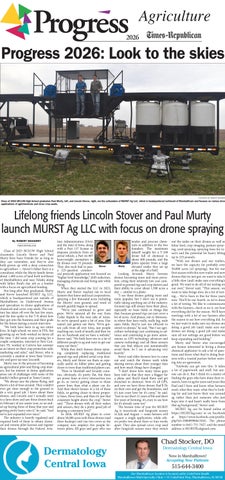
Class of 2023 BCLUW High School graduates Paul Murty, left, and Lincoln Stover, right, are the cofounders of MURST Ag LLC, which is headquartered northeast of Marshalltown and focuses on various drone applications of agrichemicals and cover crop seeds.
Stover Murty
Progress 2026: Family farm supplies successful Rhodes ‘hobby’ store

BY LANA BRADSTREAM
RHODES — A hobby, bolstered by a family farm, has blossomed into a small store in Rhodes — Clover Bloom Farms.
When Chris Buck moved back to Rhodes in 2023, he knew he wanted to plant a garden. With all of the extra produce, he started a roadside stand north of Rhodes where the family farm was.
“People liked it and were really supportive. I did that for another year and last June, we opened the store here and started selling meat, as well,” Buck said.
He partnered with his older brother Jeremy, and father Norman who operate the farm. Buck works with them on the beef side of Clover Bloom Farm and continues growing seven acres of vegetables to sell the produce from the brick and
mortar location.
Large coolers stand tall against a wall of the business, and is filled with beef cuts such as soup bone, various roasts, tenderloin filets, hamburger, tritip steaks, jerky and various beef sticks (Willie’s beef sticks and garlic parmesan are this reporter’s favorites).
The cattle raised in the cow-calf herd on the Clover Bloom Farm are grass fed and grain finished, giving the products a robust and natural beef flavor.
“We do rotational grazing, so they get fresh grass regularly which is fun to watch,” he said. “When you watch them go from one pasture to the next, they really get excited. We believe in a lowstress environment and try to raise them with as little chemicals as possible.”
Buck added that does not mean they do not treat the cattle if they get sick.


The way they raise the cattle creates the best-tasting beef, according to Buck.
“One of the things we hear from people is, ‘Oh my gosh. Your steaks have so much flavor,’” he said. “There’s a couple who moved from Des Moines. They recently bought some steaks from us and are trying each one. She told me it was the single best thing she ever had.”
Buck told her that is because they met the grower and producer, and the product is local and very fresh.
“One of the things we pride ourselves on is producing quality meat across the board,” he said.
If people are not fans of beef, Clover Bloom also raises and sells pork. Buck said they are very selective on the breeds they use and how they are fed and taken care of.
“Our pigs live on apples, and things they would forage for naturally,” he said. “I think the results speak for themselves. I’ve never had a pork chop taste like that before, and I’m not a pork chop person.”
For the vegetables Buck raises, he is focused on regenerative, no chemicals or tilling to ensure everything they grow has the least amount of harm for the environment while maximizing the flavor and quality. And everything that can be grown in Iowa is grown at Clover Bloom. Tomatoes are the biggest seller, but they also have peppers, celery, carrots, eggplant and more. He is even trying to grow peanuts, which will be interesting.
Stating the store is a family business, Buck said his mother has chickens and sells the eggs inside. His grandmother makes and sells her jams and jellies and his grandfather makes all of the woodwork which is also for sale.
“This is my attempt to infuse the economy of Rhodes,” Buck said. “I’m really passionate about helping Rhodes. I think it’s a community that has had highs and lows, and I want to be a part of helping people see it’s a great community to live in, where businesses can be successful. The store would not have been as successful as it has been so far without the support of the people here.”
Clover Bloom Farms
Address: 307 W. Walnut St. in Rhodes Hours: 4 p.m. to 6:30 p.m., Tuesdays and Thursdays; 9 a.m. to 1 p.m., Saturdays; 1 p.m. to 4 p.m., Sundays
The store has not even been open for a year yet even though it feels like it, he said, laughing.
Being able to work from home with his full-time job also gives Buck the flexibility to arrange deliveries and fulfill certain requests of customers.
“I will make deliveries during my lunch, or whenever I want to take a break from my real job,” he said.
Buck said the family farm is more than 100 years old, and like similar families, he wants to see it continue.
“I think right now, agriculture needs disruption to continue to exist,” he said. “We’ve built a system around soybeans and corn that’s not working. We have too much supply and not enough demand anymore. The markets are getting flooded. It’s less profitable and input costs are rising. We can be forced to change or embrace it and say this is a really good opportunity. Iowa has some of the best soil in the world, which means we turn out healthy plants and the best quality food you could possibly want. Why wouldn’t we take some of the best soil in the world and continue to make it healthier and better and grow high quality food? That’s a big thing for me - showing farmers there’s another way besides corn and soybeans.”
Contact


Chris Buck, the owner of Clover Bloom Farm in Rhodes, shows the coolers filled with beef and pork products in his store. Customers can get locally-produced homegrown beef, pork, jellies and more at Clover Bloom.
Progress 2026: Prop 12, tariffs and more challenge Iowa
An interview with new IPPA President Dean Frazer of rural Conrad


BY MIKE DONAHEY TIMES-REPUBLICAN
CONRAD — Dean Frazer was given a pig to raise when he was eight years old. At nine, he purchased a Hampshire sow for a 4-H project.
Fifty-two years later, he is still doing it albeit on a much larger scale. And he has help from his spouse Linda, son Grant and daughter-in-law Josie.
“They are full-time partners on the farm,” he said.
The family raises about 38,000 head a year along with corn and soybeans on their farm north of Conrad in Grundy County.
“We are raising pigs on the same farm I grew up on,” he said.
Frazer, 61, also said much has changed in the industry — especially in the last 3035 years — but the family has adjusted. He clearly remains passionate about the viability of the product in a competitive environment where consumers have their choice of beef, chicken and other protein-based products.
The “Taste What Pork Can Do” campaign initiated by the National Pork Producers (NPP) is an effort to alert consumers to pork’s convenience, nutrition, versatility and value. With beef prices at record highs, more consumers have been turning to chicken and pork, which is less expensive at supermarkets, according to Chad Hart, a professor of economics at Iowa State University.
He made those remarks during a presentation to agri-businesspeople, farmers and livestock producers in January at a program sponsored by GNB at the American Legion in Marshalltown. Campaigns by the NPP also emphasize that pork producers are raising their producing responsibility while being good stewards of the environment.
Frazer has significant resources to follow through on his passion in his role as president of the Iowa Pork Producers As-

sociation (IPPA), headquartered in Clive. He was elected to that position by fellow pork producers who are also members of the IPPA.
His term began in January of this year. His term will be up at the end of 2026, and then he will serve as past president in 2027.
“I never thought I would do this,” he said. “But there are a lot less pork producers in Iowa than before, and I have a passion for the business.”
As president, he represents his fellow pork producers in Iowa, a state which produces more hogs than any other, but also advocates for pork consumption and more.
Frazer cited two major challenges pork producers face. One is Proposition 12, an initiative voted on by a majority of Californians approximately eight years ago, which went into effect January 2025. Proposition 12 requires pork producers


not only in California but nationwide to document that pigs were raised “humanely” — that is, with adequate space before pork products can be sold in supermarkets and elsewhere.
Frazer said every producer wants to raise their pigs humanely.
“Pigs have been raised humanely on Iowa farms for centuries,” he said. “It is also a trade barrier between states. There are all kinds of products in the pork world … and it is a battle we continue to fight,” he said. “It has raised food prices 20-percent in California and is hurting the poorest consumers in the state. We are hoping to get resolution in the upcoming farm bill should that ever happen.”
Frazer also said that President Trump’s tariff initiative has had an impact.
“The tariff issue in the United States changes day-to-day,” he said. “As business

owners, we need a steady policy so that we can work with our trading partners.”
Frazer said he and family have been selling hogs to JBS-Marshalltown and its predecessors since the 1970s and said they have a cooperative business partner as well as Tyson’s in Waterloo.
In Iowa, the industry creates more than 120,000 full-time and part-time jobs including positions in hog production, slaughtering, processing and related activities, according to United States Department of Agriculture reports. An additional $8 million in wages are paid and $915 million in state and local taxes generated by the Iowa pork industry and related activities
For more information, contact the Iowa Pork Producers at or visit their website at 515-225-7675 or visit www.iowapork.org.


PHOTO VIA THE IOWA PORK PRODUCERS ASSOCIATION
Longtime hog farmer Dean Frazer of rural Conrad is currently serving a one-year term as the president of the Iowa Pork Producers Association
COURTESY OF CHATGPT/IOWA PORK
A caricature of Dean Frazer and his wife Linda, longtime pork producers in the Conrad area.
T-R FILE PHOTO
Pictured is the exterior of JBS hog processing facility in Marshalltown. It processes more than 5 million hogs annually and has nearly 2,300 employees.
AlliAnt EnErgy SolAr FArm

BY KRISTIN DANLEY GREINER
AMES — Cattle and horses can share a pasture, wheat and soybeans can grow side by side in the same field, and — according to Iowa State researchers — vegetables can thrive on the same plot as solar panels.
Agrivoltaics is the agricultural use of land that’s also used by solar panels.
The first year of a four-year study at the 10-acre Alliant Energy Solar Farm at Iowa State University, south of
Ames, showed promise, researchers say.
Matthew O’Neal, one of the project’s leaders and professor of plant pathology, entomology and microbiology at Iowa State University, said Alliant Energy and Iowa State queried researchers to see if anyone wanted to study agrivoltaics thanks to the partnership.
“Given the size and configuration of the solar farm, a group of us decided that fruit, vegetables,
beekeeping and pollinator conservation were the best options to explore at the solar farm,” O’Neal said.
“There are other things you can do at a solar farm, such as grazing livestock, even growing corn and soybeans, but given the size of the Alliant Energy solar farm, they felt the smaller plants would grow best, along with the bees.”
They studied whether the basics of farming — irrigation, fertilization, machinery and weed and


PHC
•
•
•
•
•
•
•
•
•

pest management — could be carried out around solar arrays and produce could be prolific. Iowa State University Horticulture Professor and Chair Ajay Nair, one of the project leaders, confirmed that it could.
“We used conventional farming practices between the rows of panels. One thing we did do differently for raspberries and grapes is that they were planted directly under the panels and we had to adjust the trellis height so it didn’t interfere with the panels,” O’Neal said. “There also are beehives at the site, and
in 2025, they produced an estimated 120 pounds of honey.
“One thing we’ve for sure found out is we can grow vegetables on a commercial scale on a solar farm. Period. There’s no doubt about it. We have demonstrated the practical aspects of an operation such as this will clearly work,” Nair said.
In the study’s first year, the planted vegetable crops included broccoli, summer squash and bell peppers. While broccoli planted between the panels grew a little smaller than in control
plots, summer squash and peppers within the solar panel area produced better, Nair said.
In its second year, research plots were located between fixed angle solar panels after 2024 used tilting panels. Tomatoes were added to the growing schedule, along with more pollinator habitat. One thing researchers did observe is that the ground under and between panels is cooler and wetter than the surrounding landscape, which could be a


FROM IOWA TO THE MOON
ISU team tests equipment that will help NASA harvest water from the moon
BY KRISTIN DANLEY GREINER
An Iowa State professor and former grad student have helped NASA discover how they could harvest water from the moon.
Mehari Tekeste, associate professor with the department of agricultural and biosystems engineering at ISU, also is director of the Soil Machine Dynamics Laboratory at Iowa State. At the ag lab, innovative science is applied to problems with an end goal of reaching a solution. Tekeste works with ISU students, industry leaders and government agencies to better understand interactions between machinery and soil resources.
Projects tackled with the technology available at the lab include wear-testing equipment design and researching levels of soil compaction from ag tires. It’s the only lab in North America that can perform accelerated wear tests. It also allows researchers to carry out tests in a replicated environment in Iowa’s winter when the fields are frozen.
One of Tekeste’s first grad students, Zamir Syed — who graduated with his doctorate degree from ISU in 2017 and owns Singularity Solutions in California — teamed up with Paul Schafbuch, professor of mechanical engineering at Iowa State, and Tekeste to determine which size of a chisel could be successfully used by the U.S. National Aeronautics and Space Administration to bust through the icy, rough terrain of the moon to reach the water.
Syed’s company landed the grant.
“In 2020, there was confirmation that molecular water existed on the moon through NASA's Stratospheric Observatory for Infrared Astronomy (SOFIA),” Syed said. “It detected the first confirmed physical water molecule in a summit region on the moon that wasn’t bound into a block of frozen mud. They’re estimating there’s millions and millions of gallons of water on the moon.”
The NASA-funded study predicted wear rates for a chisel to harvest the water trapped in icy regoliths, which are layers of unconsolidated rocky material covering bedrock.
“I looked at it from the eyes of what tools do you need firstly. If the ground is aggressive, you have to go with a vehicle that doesn’t fail. The plan for Artemis 3 is to use a vehicle with a payload of 1,760 pounds payload. If it ended up being chisels that they would take, you can’t take a lot of the tools to the moon, so we have to provide them with exactly what they need,” Tekeste said. “You also can’t go back and get more tools.”
Scientists have discovered that icy regolith in permanently shadowed lunar craters are ideal to be excavated to support what’s called “in-situ resource utilization” for the Artemis missions. In-situ resource utilization is the harnessing of local natural resources at mission destinations, instead of taking all needed supplies from Earth, according to NASA.
“To excavate on the moon,
we didn’t know how many chisels to take with us, what type of fueling to take, so we needed to perform these tests to determine that, to mine X kilograms of water, you need to take Y number of chisels to the moon with you,” Syed said.
Tekeste explained that the lunar regolith is abrasive and damages machine elements that interact with it. The team used a bin of special soil Tekeste’s team developed that simulated characteristics of the moon’s surface conditions. They had to replicate in the lab the extreme temperature fluctuations and rocky, icy terrain the chisel tool would experience when on the moon.
Data from the tests helped validate modeling to predict how the tool would wear, how long it could be expected to operate and how many of the tools would be needed. They studied specifically how a stainless steel pin held up against two compositions of icy granular soil.
Their results were highlighted in a recent issue of Earth and Space on Engineering for Extreme Environments.
But how are these results being used in real time?
“There are technologies NASA is developing that use heating elements to take the icy mud, dry it out, then collect the water vapor and turn that water vapor into liquid water,” Syed said. “They need to be able to start habitation on the moon, and there are grand plans to build these habitats, similar to a very small village, and need to provide sustenance for people, including drinking water.
They’re also looking at using the moon as a refueling station where researchers can load up on fuel and much more easily get to Mars, Jupiter or one of Saturn’s moons.”
Tekeste said that in a year or two, NASA plans to send a lunar vehicle to the moon to try and harvest water.
Iowa State continues to work with NASA on projects involving space exploration and the moon. Currently, Tekeste is part of a multi-institutional group reviewing specs of mobility studies on extreme deformable surfaces for a new autonomous vehicle that is part of NASA’s Artemis mission for Mars exploration.
“There’s no AAA on the moon, so if a tire fails, what do you do? The goal with this next project is for the vehicle to be on the moon for 10 years. It needs to be tires that can handle the terrain there,” Tekeste said. “The moon is very, very aggressive and you have the change in temperature, plus the terrain, so I doubt it’ll be rubber.”
Syed added that the material of the tire has to be invulnerable to the extreme environments of the moon, so it can’t be a rubber or regular polymer that would degrade in the radiation environment.
“You also can’t use regular steel, because it becomes affected by the radiation. So you have to look at a small group of materials you can use that would survive the environment,” he said.

“There’s
no AAA on the moon, so if a tire fails, what do you do? The goal with this next project is for the vehicle to be on the moon for 10 years. It needs to be tires that can handle the terrain there.”
—
Mehari Tekeste Associate professor, Department of agricultural and biosystems engineering
SEASON AFTER SEASON


Zamir Syed, who graduated from ISU with his doctorate in 2017, preps for an autonomy test. He has teamed up with Paul Schafbuch, professor of mechanical engineering at Iowa State, and Mehari Tekeste, associate professor with the department of agricultural and biosystems engineering at ISU, to determine which size of a chisel could be successfully used by the U.S. National Aeronautics and Space Administration to bust through the icy, rough terrain of the moon to reach the water.
for diseases to pop up in that environment. At the same time, researchers saw there were fewer Japanese beetles on the crops under the panels.

“What we’ve learned so far is the site is fantastic for honeybees. We have seen a 400% increase in honey production by the bees we’ve kept there for the past two years,” O’Neal said. “We deliberately planted perennial flowering plants that honeybees use to make honey and we’ve seen a remarkable increase in the number of flowers, too. We’ve also seen that some of the perennial fruit crops, like raspberries and grapes, survived the winters better under the panels than when out in the open air. They’re producing ample fruit and appear to be thriving.”
Additional years of growing data will be needed to confirm what researchers are seeing, but they think planting produce between panels could offer some relief from summer’s hottest days. Certain plants seemed to grow better under the panels, too, such as summer squash and bell peppers.
“We know that vegetables need full sun. That’s


true, but in July and August it can cause stress,” Nair said. “Partial shade may help some plants cope.” It was too early to tell if the strawberries, raspberries, grapes and honeyberries fared better with some shade, as they typically don’t produce a full crop in their first year. But the fruit plants under the panels appeared to establish well, Nair noted.
“At both our solar panel farm and other farms, we’re learning that plants that are shade tolerant do really well planted near the panels, such as leafy vegetables,” O’Neal said. “Ajay found that broccoli grows taller and puts out more leaves by the panels, but didn’t produce as much of the stalks. Lettuce and basil also really thrive in the solar setting.”
The project was funded by a $1.8 million grant from the U.S. Department of Energy. The interest in its results has garnered quite a bit of attention.
Forty different groups visited the farm in 2024, including students, growers, nonprofits, government officials, utility companies and other researchers interested in the study.
“I have been overwhelmed by the positive responses. Some visitors have been skeptical that it’s a good approach to using the land. But there generally was less skepticism as people walked through the site and saw what’s possible,” O’Neal said. “What’s


really cool about all of this is the opportunity to generate revenue from multiple streams on one piece of land. So the landowner gets a rental fee that is often two to three times what they’d get if it was rented for corn or soybean production. If they chose to farm the land, there’s an opportunity to generate even more revenue.”
Alliant Energy built, owns and operates the solar farm involved in the study, which has 3,300 panels capable of generating nearly 1.4 megawatts
of electricity — enough to power about 200 homes at maximum capacity. The panels are mounted two different ways, with the fixed tilt panels facing south at a 45-degree angle and then single access tracking panels that are in rows and go north and south, rotating throughout the day following the sun.
“The solar farm at Iowa State University was our company’s first solar project to incorporate agrivoltaics, and we’re thrilled the first-year research results are promising,” said Nick
Peterson, strategic partnerships manager for Alliant Energy. “This solar farm advances the concept that land can be used for energy production and agriculture, while also delivering the energy solutions our Alliant Energy customers and communities can count on in a unique way.”
O’Neal said anyone skeptical of taking land out of production can see that solar panels don’t prevent anyone from farming the land.
“Some may still be skeptical because this isn’t a
form of agriculture that is common in our landscape. That’s why we’re now interested in how we can combine livestock grazing at solar farms. But that takes up more space than fruits and vegetables, although horticulture production is a big part of Iowa agriculture in terms of cash receipts and not acres,” he said. “Our results are suggesting you can combine the two. We have livestock producers wanting to know if they can couple their grazing ground with solar farming.”


