
EDITOR JANE CURTIS PUBLISHER



EDITOR JANE CURTIS PUBLISHER
BY DEANNA MEYER
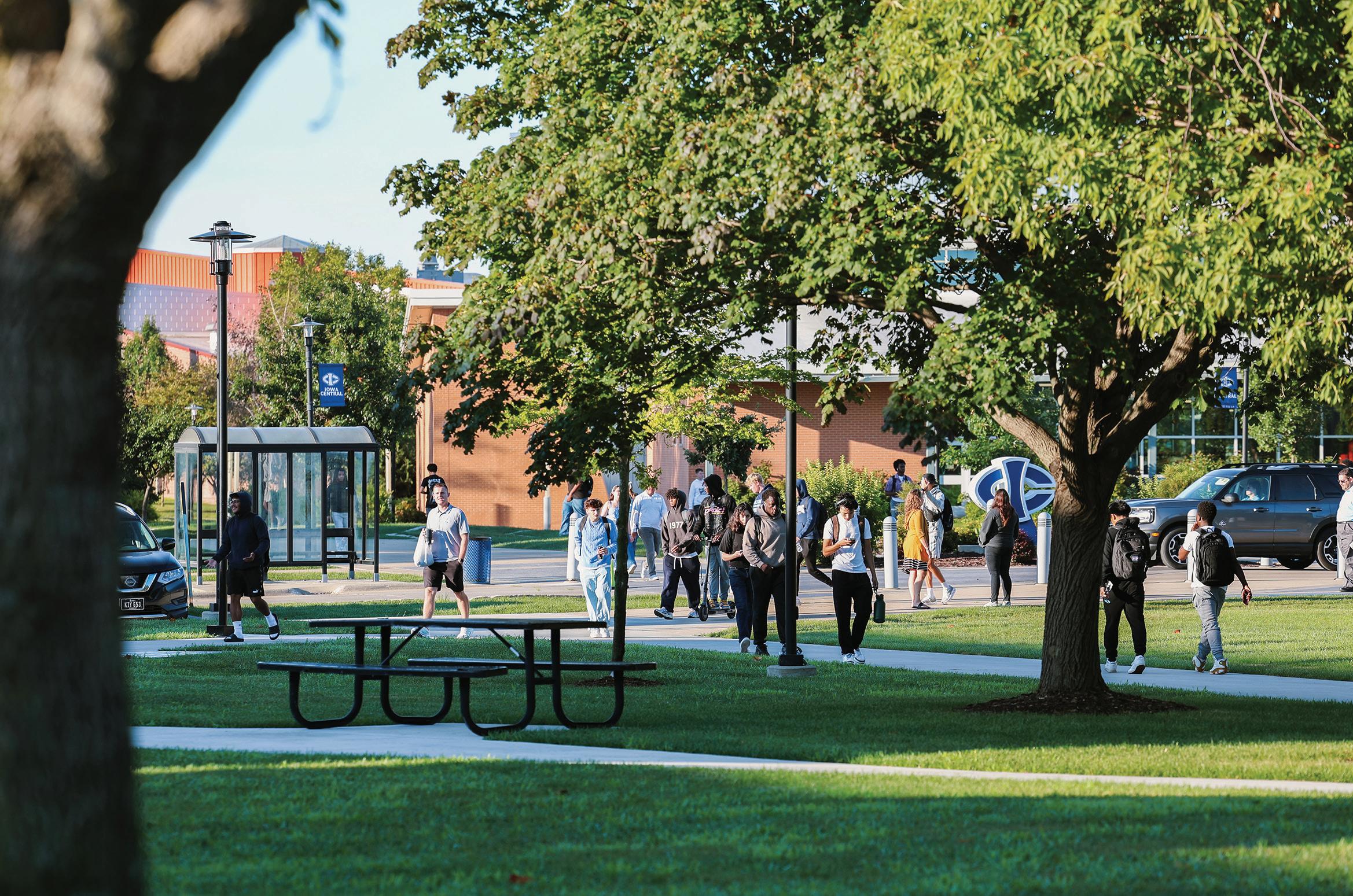
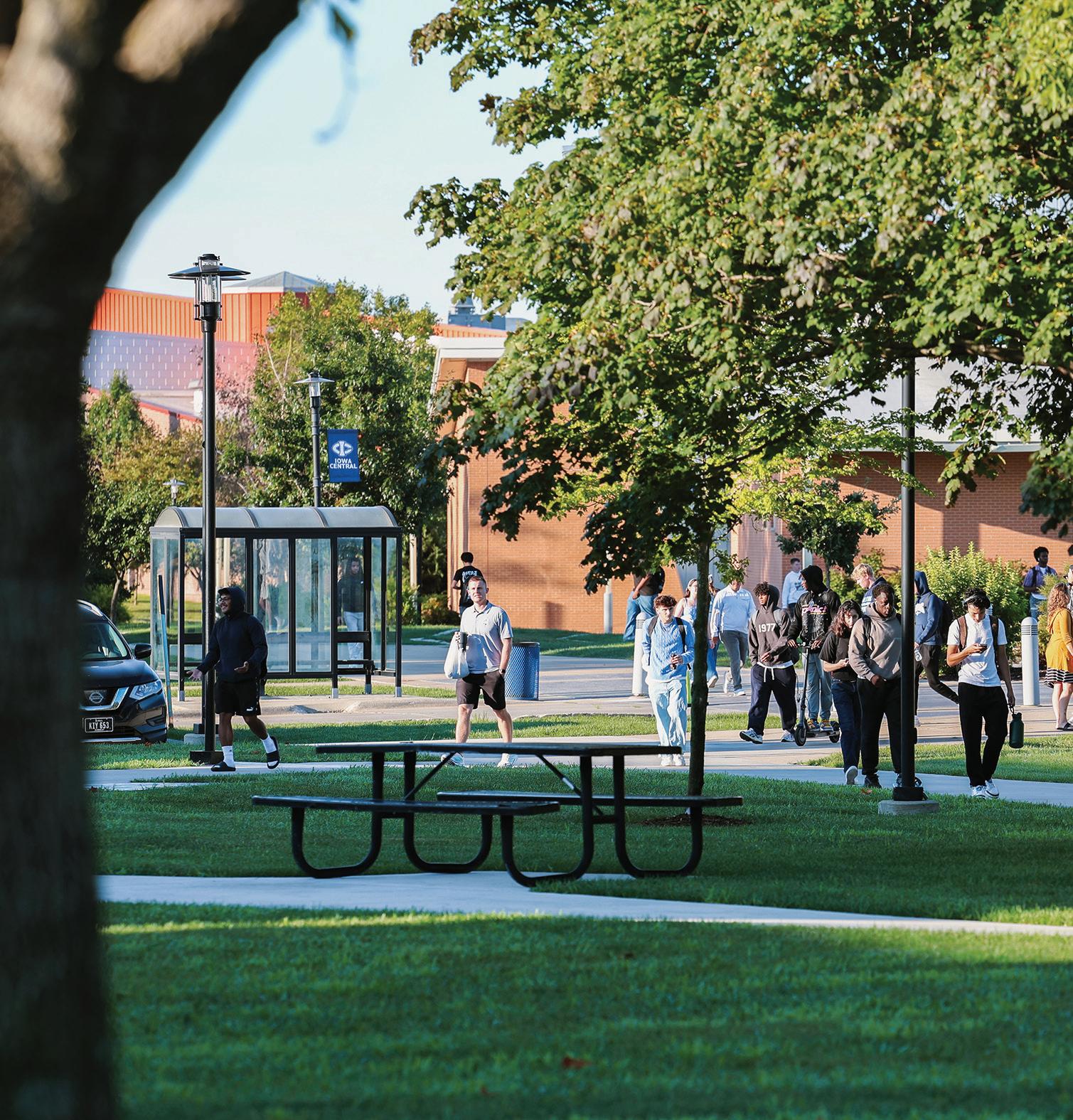
Students and faculty cross campus on their way to classes on the first day of the fall semester at Iowa Central Community College.
One’s senior year of high school is an exciting time, but it can also be one of daunting decisions — including whether to enroll in college or enter the workforce. Whatever path a student chooses, Sara Scharf — and those in similar positions — can help seniors navigate this crucial time.

“I feel like students put a lot of pressure on themselves to figure out what they want to do, where they want to go. But I always tell them, it’s OK right now to be undecided, and it’s actually OK to be undecided throughout the year.”
Sara Scharf, Iowa Central Director of regional high school partnerships
Scharf, the director of regional high school partnerships at Iowa Central Community College, visits four area schools each week, where she meets with students individually to help them with their next steps.
“I feel like students put a lot of pressure on themselves to figure out what they want to do, where they want to go,” she said. “But I always tell them, it’s OK right now to be undecided, and it’s actually OK to be undecided throughout the year.”
If a student isn’t sure of a career path or where they want to go to college, the first thing Scharf addresses is learning styles. Is the student more of a hands-on learner or more of a classroom learner and note-taker?
“Some just want to go into the workforce,” she said.
But for those considering college, she asks if they picture themselves doing one, two, four or more years?
For hands-on learners, she said a one- or twoyear degree might be a better fit. Others may know they want a bachelor’s degree.
Scharf encourages students to enroll in exploratory classes to help develop their
interests. She can even arrange for students to sit in on a college class.
“Even if they are not going to Iowa Central, they can still come and get the experience of, ‘This is what an auto class is like, this is what a welding class is like, this is what an anatomy class looks like.”
The next step might be to set up a job shadow.
“We just had a Manson girl who wanted to do something in the hospital, and she decided that surgical tech, after doing job shadows, was good,” said Scharf.
Attending career days can also be beneficial. For instance, when it comes to health care, she said most students know about nursing, but they might not know about being a medical assistant, med lab tech or dental assistant.
“I think that career days open up students’ eyes,” Scharf said, “especially younger students, sophomores and juniors.”
Once a student determines their course of study, then it’s time to look at colleges that offer those programs.
“I tell kids, that’s kind of the cool part,” she said, “you get to shop around.”
She encourages students to find the college environment that suits them best, whether that’s a big or small school setting, close to home or farther away. They should also consider the extracurricular activities offered, especially if they want to continue an interest from high school, such as marching band or theater.
Next, they can begin to compare tuition, fees, and other costs, and look at the acceptance process.
If a student knows they want a bachelor’s degree, she said it might be a good idea to check out the three types of colleges — community college, private and state universities — to get a feel for the differences in the types of campuses. If
a student knows for sure they want to attend a private school, she recommends visiting two or three to compare and contrast.
“The beginning of senior year is prime college visit time,” said Scharf, specifically October and November.
She added that going on college visits at the end of one’s junior year — whether in person or virtually — is also a good idea.
“But as a senior, we always recommend going on an individual visit,” she said, “because they’re going to tailor it a little bit more toward you if the college offers that one-on-one.”
Once a student decides on a college, the next step is to apply.
At some schools, applying is free, while others charge an application fee. All three state universities in Iowa charge an acceptance fee in addition to the initial application fee.
Colleges may also charge an application fee for housing. If possible, Scharf said students should apply for housing in the fall, as often it’s on a firstcome, first-serve basis.
Students also need to learn if their college or program of choice requires any special tests, such as the ACT, SAT or ALEX text.
“A lot of colleges have gone test-optional since COVID,” she said, “so not all students need it.”
Next on the senior fall to-do list is filling out the FAFSA (Free Application for Federal Student Aid), which opened on Oct. 1 this year. Filling out this form helps determine a student’s eligibility for various types of financial aid, which can include both grants and loans. The FAFSA can be sent to up to 20 schools.
“It’s easier now than it’s ever been,” said Scharf. “The FAFSA uses the IRS data retrieval tool, so a parent should have their taxes readily available, but it should just pull all of their information in.”
The first step is to create an FSA ID, which is how a student and parent sign in. In prior years, Scharf said students had to wait three days to be verified
through the Social Security Administration, but now they’ve removed that barrier.
“So once you create your FSA ID, you can go right in to filling out the FAFSA.”
The student starts the FAFSA online, then invites the parent. Scharf said the whole process can easily be done in 20 to 30 minutes.
“We help students with the FAFSA in our (ninecounty) region, even if they’re not going to Iowa Central,” said Scharf.
Any college’s financial aid office will also help students.
“People might assume that they make too much, so they don’t file it,” she said. “But some schools want you to have the FAFSA for scholarships, so we encourage them just to file it, because they might look at that as they’re awarding scholarships.”
In addition, she said any student loans obtained through the FAFSA have the best interest rates.
“Every student qualifies for those regardless of credit score, regardless of family circumstances,” said Scharf.
Fall is also a key time to begin applying for scholarships — a process which will likely continue throughout the school year.
Scharf recommends that college-bound students create a spreadsheet of all extracurricular activities they are involved in, from 4-H to music to athletics to volunteerism.
“That way, when you go your senior year to apply for these scholarships, and they ask what you’ve been involved in,” Scharf said, “you’ll already have that running list.”
She said some students will even create a resume with a running timeline of activities they’ve been involved in, then upload it with their scholarship applications.
Scharf recommends getting three letters of recommendation to submit with those applications,
advising seniors to fill out a “brag sheet” for those writing the letters.
“They can probably see what you do in the classroom, but they might not know that you volunteer at your church; they might not know that you’re involved in 4-H; they might not know that you received a specific award,” she said.
Scharf also encourages seniors to write a personal statement that includes their future goals.
“When you’re applying for a scholarship, you have no idea what the competition is, if there’s 10 candidates or if there’s hundreds of candidates, and you need to make yourself stand out,” said Scharf. “So if you only answer the questions that are provided, a lot of times, you’re maybe not standing out amongst the other candidates.”
Some students have unusual circumstances that may factor into receiving scholarships.
“We encourage them to share what they feel comfortable sharing,” Scharf said, “to show that they could really utilize some of that money to help them through school.”
When seeking scholarships, seniors should check with local service organizations or clubs as well as their parents’ employers. Also check with the college; some award scholarships based on grade-point average.
“Some schools will even use promotions,” she said. “If you come on a visit, you get a scholarship.”
For those attending community college, she said fouryear universities often offer transfer scholarships.
Students also need to be aware of scholarship deadlines. Some might be due in December, and others in February.
Several factors can impact the cost of college outside of tuition and fees. Among those are the decision to live on or off campus, meal plans, as well as personal expenses such as books and computers.
When visiting a school, Scharf recommends asking if meals are included in the cost of living on campus. Choosing a meal plan with fewer meals can save money.
Taking dual credit courses in high school is another way to lighten the financial burden. Scharf said the main thing is to be sure those credits transfer wherever the student plans to attend.
She said it’s also a good idea to reach out to the college to learn what resources are available, because a student might qualify for work study or college scholarships.
Finally, students can work with the school’s business office to set up a payment plan and avoid paying a lump sum up front.
Scharf said students will generally get their award letter and financial aid offers from colleges in the spring.
“Based on that,” she said, “some students reevaluate their choice (of college) after they get their financial aid offer.”
Next, if assigned a roommate, students can begin to figure out who’s bringing what and when move-in day is.
Orientations usually follow in the summer.
“I guess the big thing we tell kids is don’t stress. Kids just seem very stressed about picking a college. But it should be fun and exciting,” Scharf said.
“The more work we do their junior and senior year, going on visits, talking to that college. The more steps they put in, they just feel better. But I always tell them, it’s OK if you’re undecided. There’s things we can do to help alleviate that stress.”

FRESHMAN/SOPHOMORE
o Focus on grades — GPA matters from day one.
o Get involved in clubs, sports, volunteer work, or jobs to build experience.
o Start exploring interests and careers — Attend Career Days.
o Visit a college or two casually to get a feel.
o Create a four-year plan and review it with your counselor — Include college classes if you plan on taking dual credit classes in high school.
o Attend a local college fair.
o Take high school exploration classes to see if you can find a program you like.
o Start your activity/honors list that you will use when applying to colleges/scholarships.
Fall
o Start researching colleges/programs.
o Meet with your counselor and CCTC (college and career transition counselor) to review your plan, including both high school and college classes (dual enrollment).
o Attend a college fair.
Spring
o Take ACT/SAT (or prep for test-optional schools).
o Narrow college list to a realistic group of schools.
o Visit campuses.
o Complete a job shadow.
o Sit in on college classes to determine if you like a certain program/curriculum.
o Write a draft of your college essay/personal statement.
o Work on a resume/activity list
o Look for scholarships
Fall
o Finalize your college list.
o Go on a final college visit to solidify your decision.
o Ask teachers and other appropriate people for letters of recommendation.
o Apply for colleges.
o Request transcripts.
o FAFSA opens Oct. 1 (some schools have priority deadlines in Nov.–Dec).
o Apply for scholarships, some schools have early scholarship deadlines.
Winter
o Submit acceptance fees and housing, if needed.
o Continue applying for scholarships.
o Watch your email/college portals for updates.
Spring
o Compare financial aid offers.
o Make a final decision by May 1.
o Take placement tests if needed.
o Sign up for classes, orientation, housing.
Summer
o Finalize housing, class registration, and preparation for transition.
o Be sure you understand what your bill looks like when college starts: Do you need to take out additional loans, are your scholarships applied to your account, do you need to set up a payment plan?
o Attend orientation.
o Be sure to have your books and supplies.
o Practice self-care and independent skills.
o Reach out to roommates to prepare what you need to bring.

by Terri Schlichenmeyer
in case you don’t know it all
There’s so much to do, so much to remember, so many people to think about that your brain is packed. So why not slip into a book that’s browse-able and easy to slip out of? Try one of these great (and oh-so-fun!) books to enjoy ...
If you’re an animal lover, you’re also going to love reading “Trash Animals: The Animal Weirdos We Secretly Love” by Rachel Federman, illustrated by Clare Faulkner (Harper Collins, $12.99).
You’ve seen them on social media. You may have even seen them in person, so what do you know about the annoying, but admittedly cute, animals that live in our world? Creatures like bats, badgers, squirrels,
skunks, snakes, pigeons, and possums are profiled in this book and the articles about them are long and short. Take a quiz about them. Read about what they eat, so you know how to feed them, if you want to. Find out what movies have featured them, and join a fan club for your favorites. Dip in here, learn a little there, this is that kind of book.
For the word lover, “The Language-Lover’s Lexipedia: An A-Z of Linguistic Curiosities” by Joshua Blackburn (Avid Reader Press, $28.99) is just the thing to satisfy your word-nerd tendencies. Learn some comic book sound effects. Find out the exact classifications in the Dewey Decimal System. Learn pager code, and send a secret message. See how race horses are named. And — you’re gonna love this! — find a list of dictionaries that
you’re going to need on your shelf, ASAP.
This book practically screams to be browsed by linguists, crossword lovers, Wordle fans, and anyone who loves words and language.
Remember the Schott’s books, back in the day? Well, they’re back! If you loved them then, you’ll enjoy “Schott’s Significa: A Miscellany of Secret Languages” by Ben Schott (Workman, $35).
This linguisticallyfocused book is different from the Blackburn book, in that Schott takes a different tactic.

Subjects are broader and categorized differently, there are more illustrations (in color!) and because the book itself is larger, there’s more information; just know that larger means heavier. A lot heavier, if you tend to read in bed or on the fly.
want to be without something to do, no matter where you are, and this kind of book is perfect for your busy life. So head to your favorite library or bookstore and ask for the trivia books because there are lots of them and your librarian or bookseller can help you find the one that suits your interest, your kid’s interest, or whatever will tickle the fancy of the person on your gift list.
And then go ahead, Smartypants, and Season’s Readings!
by various authors, c.2025, various authors, various page counts, $12.99 — $35.
“Schott’s Significa” seems to have more about Great Britain than the above one. Alas, you can’t tuck Schott’s book in your pocket, like you can the Blackburn book, but they make excellent companions to one another and you know you can’t resist having both.
Okay, so you need more trivia. You don’t

Terri Schlichenmeyer lives in Wisconsin with her two dogs and a collection of almost 20,000 books. FLOWER CART
Complete Florist”

www.flocart.net
832-4630


Winter in Webster City brings the beauty of freshly fallen snow and the opportunity for fun but it also brings the responsibility of keeping our streets and sidewalks safe for everyone. As the snow falls this season, each of us plays a role in helping our community move safely and smoothly.
Our Public Works team works diligently to plow, sand, and treat city streets and alleys, often in challenging conditions. Crews make multiple passes to ensure roads are safe for travel, but heavy snow and icy patches can slow progress. Please drive cautiously, give plows the space they need, and allow extra time to reach your destination during snow events.
When a snow emergency is issued, it is very important to move vehicles off the street. This allows plows to clear roads efficiently and ensures everyone can travel safely. Vehicles left on the street during a snow emergency may be at risk of being towed or ticketed, so staying informed and cooperating helps keep our community safe and accessible.
Property owners are responsible for keeping sidewalks adjacent to their homes or businesses clear of snow and ice. Maintaining safe sidewalks helps everyone including neighbors, children walking to school, delivery drivers, and visitors move safely through our community. Clear sidewalks are not just a courtesy, they are an important part of public safety.
Winter is a perfect time to look out for one another. Helping a neighbor shovel their sidewalk or driveway, especially seniors or those with limited mobility, strengthens our community. Small acts of kindness can make a big difference in someone’s day and keep our neighborhoods accessible and welcoming.
Shovel early and often to prevent ice buildup
Spread sand or salt on slippery areas
Avoid piling snow where it blocks sidewalks or streets
Take breaks, stay hydrated, and dress warmly to avoid strain or injury
Encourage children to play safely in snow away from streets and sidewalks
By working together, Webster City can remain safe, accessible, and welcoming throughout the winter months. Whether you are clearing your own sidewalks, assisting a neighbor, moving your car during a snow emergency, or giving plows room to work, every effort counts. Let us all do our part to ensure our community moves safely, stays connected, and enjoys the beauty of winter.



Cold and flu season arrives each year. Though there might be little people can do to avoid catching a cold or coming down with the flu, certain approaches can make it easier to get through a bout with either illness. Flu vaccinations have been found to lessen the severity of infection with the influenza virus, while rest and plenty of fluids can help reduce the length of time a cold puts people out of commission.
Knowing what to eat when combatting a cold and the flu also can help people treat each virus. Chicken soup has long been a go-to when fighting a cold, and this recipe for “Homemade Chicken Noodle Soup” from Lines+Angles makes a worthy addition to anyone’s cold- and flu-flighting culinary repertoire.
Makes 8 servings
1 3 1⁄2-pound whole chicken
10 cups low-sodium chicken broth
8 carrots, peeled and sliced
6 stalks celery, trimmed and sliced
3 onions, peeled and sliced
2 cloves of garlic, peeled and minced
8 sprigs fresh parsley
2 sprigs fresh thyme
1 bay leaf
2 tablespoons butter
Salt, to taste
Freshly cracked black pepper, to taste
12 ounces wide egg noodles

1. Rinse the chicken inside and out under cold running water. Place the chicken in a large pot, set over medium heat and add the chicken broth. Add 1⁄4 of the carrots, 1⁄3 of the celery and 1⁄3 of the onions. Add the garlic, 2 sprigs parsley, thyme, bay leaf and enough water to just cover the chicken. Bring broth to a boil, reduce heat and simmer for about 11⁄4 hours, or until chicken is very tender, skimming any foam from the surface of the broth.
2. Remove chicken from broth and place in a colander to drain and cool. Strain the broth through a very fine mesh strainer into a large, clean soup pot. Discard the vegetables used to flavor the stock.
1. Skim any fat off the top of the strained broth.
2. Remove and discard the skin and bones from the chicken and cut the meat into bite-sized pieces; set aside.
3. Melt the butter in a large Dutch oven set over medium heat. Add the remaining carrots, celery and onions and cook for about 7 minutes or until the onions are translucent. Add the chicken pieces and chicken stock, season with salt and pepper. Bring soup to a simmer and cook for about 30 minutes or until the vegetables are tender.
4. Chop the remaining parsley; add the parsley and egg noodles, stirring frequently. Cook for 8 to 10 additional minutes or until the noodles are tender.
5. Ladle into soup bowls and serve hot.
Look at these photos and see if you can identify these local landmarks.










by Jim Miller
Dear Savvy Senior , I recently had an estate plan drafted, including a will, power of attorney and advance directive, but I’m not sure what to do about all my online accounts –email, banking, and social media. What can I do to make sure my family can access what they need and protect my digital information after I’m gone.
In addition to creating an estate plan, you should also make a “digital will” that lists all your online accounts and login information. This will help your loved ones access your electronic devices and online accounts more easily so they can manage your electronic affairs, according to your wishes, after you’re gone.
Montana State University offers a Digital Assets Inventory Worksheet (see Montana.edu/ estateplanning/digitalsssetsworksheet.pdf) to help you get started. Or consider purchasing a “password book” on Amazon for a few dollars. This will let you record and organize your online account information alphabetically. Here are a few other tips to help you prepare your digital life for your survivors.
Apple: If you’re an iPhone, iPad or Mac user, you should nominate a “legacy contact” who can access your Apple account’s data after you die. This is a secure way to give trusted people access to photos, files and messages. To set it up you’ll need an Apple device with a fairly recent operating system. iPhones and iPads need iOS or iPadOS 15.2 and MacBooks need macOS Monterey 12.1.
For iPhones, go to settings, tap Sign-in & Security and then Legacy Contact. You can name one or more people, and they don’t need an Apple ID or device. You’ll have to share an access key with your contact. It can be a digital version sent electronically, or you can print a copy or save it as a screenshot or PDF.
Take note that there are some types of files you won’t be able to pass on – including digital rights-protected music, movies and passwords stored in Apple’s password manager. Legacy contacts can only access a deceased user’s account for three years before Apple deletes the account.
Google: Google takes a different approach with its Inactive Account Manager (see Support.google.com/ accounts/answer/3036546), which allows you to share your data with someone if it notices that you’ve stopped using your account.
When setting it up, you need to decide how long Google should wait – from three to 18 months –before considering your account inactive. Once that time is up, Google can notify up to 10 people.
You can choose what types of data they can access – including emails, photos, calendar entries and YouTube videos.
There’s also an option to automatically delete your account after three months of inactivity, so your contacts will have to download any data before that deadline.
Facebook and Instagram: If you’re on Facebook or Instagram, both of which are owned by the parent company Meta, you can have your accounts either memorialized or deleted after you die if the companies get a valid request from a family member or friend. See Facebook.com/ help/1111566045566400 or Help.Instagram. com/264154560391256 for details.
Meta also strongly recommends Facebook users add a legacy contact to look after your memorial accounts – see Facebook.com/help/1070665206293088. Legacy contacts can do things like respond to new friend requests and update pinned posts, but they can’t read private messages or remove or alter previous posts. You can only choose one person, who also must have a Facebook account.
Passwords: If you use a password manager – a service that creates, saves and manages passwords for all your online accounts – see if it has an emergency access feature. Some services, like Keeper, Bitwarden and NordPass, allow users to nominate one or more trusted contacts who can access your keys in case of an emergency or death.