
Our Hometown 0326

Page 1


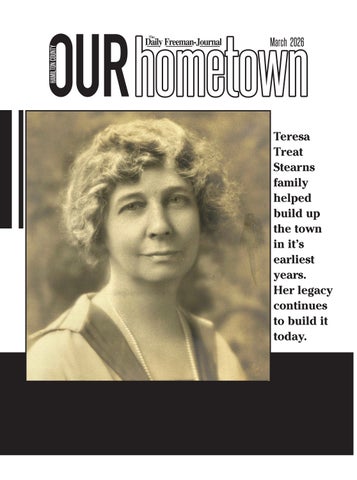
Teresa Treat Stearns family helped build up the town in it’s earliest years. Her legacy continues to build it today.
PUBLISHER GRANT GIBBONS

EDITOR KOLLEEN TAYLOR

ADVERTISING TREVOR CHRISTENSEN LEANNE DARR

GRAPHIC DESIGN MICHELLE COLSHAN STORY BY LORI BERGLUND KOLLEEN TAYLOR

Treat Legacy helped build and continues to build Webster City

The philanthropy that builds a community:

When Teresa Treat Stearns set up a trust to benefit Webster City, the world looked a lot different. She didn’t have children, she didn’t have nieces or nephews. But she has left a legacy to help the community that her family helped build. Time, talents and treasure. There isn’t a time limit for making a difference, Stearns died nearly 70 years ago. But her wishes are still being fulfilled through her trust.

Today, the physical donation of money gets a lot of attention. But the story of how that money was propelled into projects is often lost.

Projects today take a combination of money, leadership, time and talents.

It’s always been this way.

The early efforts to organize Webster City took neighbors working together to settle, build, and design a structured community.

But the time and talent they put into the city had a longer, lasting effect of developing a real town. It’s what went into putting up shacks, cultivating ground, building hotels and railroads, houses and barns.

A legacy is truly built with sweat and energy devoted to organizing volunteers, using skills that range from physical labor to planning and designing, rallying support, and leading to finish a project.

won’t mean much to the students; but there are still families, ancestors and friends who remember many of the people whose legacy is contributing to future graduates.

One of those scholarships that will be presented during the 2026 awards night has a history that stretches back as long as the Daily Freeman-Journal has been published, nearly 170 years.

This particular scholarship will be the Teresa Treat Stearns scholarship. In 1967, she passed away, leaving a sum of over $250,000 in trust to be used for the betterment of the community; part in scholarships for students, part to be distributed in grants to worthy projects. This scholarship has accumulated value over

Philanthropy, rooted in the Greek word for “love of humanity,” is the voluntary promotion of others’ welfare through the strategic giving of time, talent, or treasure. It involves private, often long-term initiatives aimed at solving social problems and improving human quality of life, ranging from individual donations to large-scale foundation grants.

We often recognize the individuals in Webster City who left money to the community and have facilities named after them, such as Kendall Young Library, Fuller Hall, Briggs Woods Park and Van Diest Medical Center. But lost between the pages of time are others who have been honored through their works; their talents.

Sometimes the stories are told; this spring the Webster City High School will be presenting scholarships again to high school students. Most of the names

the years, allowing for the trust department to give out significant grants and scholarships to those who apply.

Her life has been a mystery, a name not remembered well in the community.

But she was the daughter of a pioneering family. Teresa, also referred to as Tressa, was born on April 11, 1873. Her parents were L.L. Treat and Laura Ann (Cooper) Treat.

Her mother’s journey to Hamilton County is documented in “Recollections of Early Days” published in 1919.

Teresa’s mother, Laura Cooper moved to the area at the age of 12. Laura’s father purchased land in Webster City and moved to Iowa first from Pennsylvania. In November of 1857 , the Coopers: her grandmother and mother traveled from Pennsylvania on the Allegheny river on a raft, traveling as far as Pittsburgh where they boarded a train that took them to Chicago, then to Iowa City to meet Laura’s father, William Cooper and grandfather.

They traveled the rest of the way in a covered wagon, according to an article in the Daily Freeman Journal, detailed in the archives and re-published in 1922. Their first nights were sleeping in a slab lean-to. They eventually built a cabin with the help from families in the area. They had to work together to survive. Laura attended school where the former White Fox school House was located north of Webster City, and eventually became a teacher. The family moved into Webster City, where the young family helped create a new community. She was known for her strong character and involvement in the community.

Laura Cooper married L.L. Treat, who owned a general store in Webster City in the 1880’s. The Treat family was acknowledged to having an active part in the shaping of the city of Webster City during their lives. L.L. Treat passed away in 1915, Laura Treat passed away in 1922. They only had two children, Carl and Teresa. Their son, and Teresa’s only sibling, Carl died in 1908 of typhoid fever, leaving Teresa as the sole family survivor.

Nothing in the midwest was easy during those early years. Losing all her family, Teresa made a major move.

Teresa Treat married C. Parker Stearns of Hartford, Connecticut in 1924, moving to Minnesota, then California for a few years, before the couple returned to Webster City. Together with neighbors and friends they built a cabin retreat at property known as Treat Acres, south of Webster City. They lived in Webster City on Willson Avenue and as a couple became as resourceful and beloved as Teresa’s parents.

They were able to hire help at a time when there was little for work available in the area, and the family was noted for their willingness to share in responsibility and assist when needed.

The marriage lasted just over ten years, as Parker died suddenly in 1935 of a heart attack while cranking his car to start it.

Teresa continued to live in the Webster City area, maintaining her friendships and community involvement. She was a charter member of PEO Chapter JE, but was initiated into chapter E.L. in 1922.

Her contributions to the community were not always obvious, however according to The Daily FreemanJournal, in 1957 she committed money to finance a well at the Kendall Young park in 1957. Prior to the well, water for the Girl Scout camp had to be hauled into the cabin located in the park.

During her years in Webster City, she became the first woman to serve on the board of directors for the Farmer’s National Bank. She served on the board from 1933 until January of 1951.

In her obituary, she was cited for continuing much community work and being an integral part of church, clubs and civic life in Webster City.

She moved to Fort Dodge in the mid-1950’s, and was one of the earliest residents of Friendship Haven. She died at Friendship Haven at the age of 93 in 1967.

Her story could have ended there.

But her legacy to Webster City should be remembered as a testament to what a woman can accomplish, from her mothers’ travels across the country, establishing a home, efforts that helped amass funds that have been invested into the community well into the 21st century, help fund college and programs for families unrelated, with careers not even discussed in those early years of the 19th century.

Funds for both grants and scholarships have transferred over the years, as Farmer’s National Bank was sold to First American Bank, then by Availa Bank. With the change to Availa Bank, the trust department has now been spun off to GreenState Trust services in Fort Dodge. The funds are still only to be used for projects in Webster City, and for students graduating from the Webster City Community Schools.

Applications for scholarships and grant requests should be submitted to GreenState Trust Services by May 22. Indira Velazquez handles the trust, and can be contacted at 515-440-6958 or email at indiravelazquez@ greenstate.org.

A series of World War II radio talks C.S. Lewis Books We Love

MERE CHRISTIANITY

A visitor behind enemy lines C.S. Lewis explores Mere Christianity

This is the time of year when many of us delve more deeply into our faith. Perhaps we eat less often, or don’t eat certain things. Perhaps we have special worship services, devotions, or prayer groups. We look at our lives and take stock of our souls.

This prompted me to return to a classic by the British author, C.S. Lewis — yes, that Chronicles of Narnia guy. Mere Christianity is actually a compilation of radio broadcasts Lewis delivered over the British Broadcasting Corporation — BBC during the early years of World War II.

It’s good to note here that England has a state religion. The Church of England, or Anglican Church, was and is the state religion. Likewise, the BBC operates in service to the public. As the people of Great Britain suffered through the Blitz and so much more, folks at the BBC pondered what they might do to help. These were times when people needed consolation, empathy, faith.

Winston Churchill was honest enough to offer nothing more than, “blood, toil, tears and sweat.” Christianity knows all about blood, toil, tears and sweat, and so the BBC asked Lewis to prepare a series of radio broadcasts to remind and educate the suffering British people about the basic tenets of the Christian faith.

To Lewis’ great credit, he sought to feature only those beliefs shared in common by the many denominations of Christianity — from his own Anglican faith, to Lutherans, or any other protestant denomination, as well as my own Roman Catholic faith. He purposefully avoided any areas where we might differ, and offered up only those things we share in common. Most of the things he talks about we still share in common, but perhaps not all.

This is not a book about religion in the sense that many are accustomed to. You won’t have to memorize anything, but you might want to read a chapter and then ponder it a bit before moving on. The chapters are short, which lends itself to reading and pondering before reading on further.

Early on, Lewis tells us that Christianity is a “fighting religion.” Lewis, after all, is Irish, born in Belfast, Northern Ireland, in 1898. He often describes Earth as an enemy, or fallen territory. We cannot expect it to be easy here. But Lewis also loves to remind us that we are made to live forever in eternity.

Lewis will make the important Christian distinction that Jesus cannot be just a man. After building his argument based on reason, Lewis teaches us who the person of Jesus must be. “He left us no choice.”

As Lewis makes this reasoned argument, readers will find they are strong, sometimes harsh, but beautiful words of faith, if we just take time to digest them.

In his chapter, ‘The Perfect Penitent,’ we come to understand why we need this season of fasting and penance that most of us call Lent. He tells us that not only are we not very good at living a penitential life, but that we are incapable of it without God’s help. Tough words for those of us who think we can do it all on our own. He will have a lot to say about that idea. Lewis had no use for “soft soap” Christianity. He held that the world had already seen too much soft soap, and that this was the 1940s. Imagine what he would think of us today. For that reason, some may be offended by small segments of the book. Please respect the writer and don’t throw away the whole book for a few sentences. Courageous editors will let the words stand as the writer has placed them and let the reader sift them for himself. To do any less, we only cheat history — and ourselves.

I love some of the little nuances of this book. In one section Lewis responds to a radio listener who took him to task for using the phrase “damned nonsense” on the air. The listener maintained that there was no

room for such “cursing” on the public airwaves. But Lewis replied that he was not cursing, but rather using the real meaning behind the word and there really is nonsense worthy of being damned.

I enjoy the way Lewis described Christianity as a hallway and the various denominations as rooms. The hallway is a beginning, but you really want to get into a room, he strongly urged. The rooms are where you will find all the good stuff; places to rest, coffee, cookies. In my room, we serve a lot of fish. But it’s not about the coffee, cookies, or even the fish, it’s about the warmth of the room, the community therein.

I think Lewis well demonstrates that Christianity is not a faith meant for people to go it alone. He wants us all to find the room right for ourselves. Find the coffee, the cookies, maybe some fish, and definitely wonderful people to walk the journey with you.

Mere Christianity is available at Kendall Young Library. And since I am a big believer in shopping in actual stores whenever possible, I will mention you can often find copies of Mere Christianity and other books by Lewis at Hobby Lobby. I don’t want to live in a world without cookies, fish, or good stores to shop in.

Sitting Across the Table: Plant a tree for me —

After 60 years of providing comfort and care to tens of thousands of Webster City area families, the family of Bob Erickson said goodbye to their husband, father, grandfather and champion of Webster City to join the ranks of angels on March 7.

Bob Erickson, owner of Fosters Funeral Home in Webster City, left behind a loving wife, MaryAnn, and four children: LaJean, Jody, Scott and Amy, While struggling to say goodbye, Amy and Scott had to address the entire process of burying him, while grieving, sleep deprived and heart broken.

There were no flowers as per his wishes. Bob’s love of Webster City, for beauty in landscaping and gardening, is being perpetuated by asking family and friends to plant a bush or tree in remembrance.

The following poem was written by Scott in tribute to his father:

So God made a Funeral Director….

And on the eighth day, God looked down on his planned paradise and said, “I need a caretaker of the grieving.”

So, God made a funeral director.

God said “I need somebody to get up from their sleep, any hour of the night, miss meals, planned events and drive through the dangerous weather to help one of his own, make arrangements, clean, mow lawn, wash cars, embalm, cosmetize, contact newspapers, file insurance claims, maybe grab a sandwich for supper and stay past midnight, putting together an obituary and picture boards.

So, God made a funeral director.

God said, “I need somebody that can go days without sleeping or seeing their family, miss first Christmases and birthdays with their children, withstand the sighs and frustration of their wives and families as they are called out again to hello someone else, all the while knowing that they are still loved because what they’re doing is inherently good and right and moral. And….who during any given week of the year, will finish his forty hour week by Tuesday noon. Then, sore and exhausted, put in another seventy-two hours.

So, God made a funeral director.

God had to have somebody willing to saddle the brunt of the load of being an absent family member or friend when even his wife and children, let alone anyone else, has difficulty really understanding the life he leads.

So, God made a funeral director. It had to be somebody who’d love deeply and have true compassion…and not cut corners. Somebody to know his chemistry, anatomy, art and law and look a devastated parent, child, spouse, or sibling in the eye and relieve a tiny little speck of their pain by showing God’s love in his words and respect he shows to them and the deceased. Somebody to put the name on the board outside and then finish a hard days’ work with a five mile drive to church. Somebody who’d bind a family together with the soft strong bonds of sharing, who’d laugh and cry and sigh and reply with smiling eyes. When his son and daughter say they want to spend their life “doing what dad does”...

So, God made a funeral director.

staff on the job being done on the newspaper.

Bob Erickson died Saturday, March 7, and was buried on Wednesday, March 11. His wish was that people would plant trees

CITY SCENE CITY SCENE

EMPLOYEE RECOGNITION &

Today we celebrated and showed appreciation for our employees, but the truth is we are grateful for them every single day.

The success of the City of Webster City is a direct result of their hard work, dedication, and commitment to our community. We hope they know just how valued and appreciated they truly are!

Not present for photo:

Gabriel Ackerson, Matthew Meyer, Mateo Martinez, Luke Firs ching and Bronwyn McKee

CITY SCENE

Departments with no reportable injuries include:

• Finance Dept.

• Manager’s Office

• Parks & Recreation

• Police

• Waste Water Plant

• Water Plant

The City of Webster City thanks our employees for always going the extra mile and stepping up whenever needed. Their hard work has not gone unnoticed. Their dedication and commitment to the City of Webster City are truly inspiring, and we are grateful and fortunate to have them on our team.

Enjoy a taste of tradition easily

Tamales are a traditional Mesoamerican dish made of a masa dough and fillings, and then steamed in a corn husk or banana leaves. While tamales certainly are delicious, the time-consuming nature of making them may compel some to avoid preparing them at home.

This recipe for “Chicken Tamale Pie” offers the flavors of tamales in a single-pan dish. Try it, courtesy of “30-Minute Meal Prep” (Sourcebooks) by Robin Miller.

Chicken Tamale Pie

1 (8.5 -ounce) box corn muffin mix (such as Jiffy)

1⁄3 cup milk

2 tablespoons unsalted butter, melted

1 large egg

2 teaspoons taco seasoning

1⁄2 cup corn, canned, fresh or frozen (thawed if frozen)

2 cups shredded, cooked chicken

1 cup red enchilada sauce, divided

1 cup shredded Monterey Jack cheese, or a blend of cheddar and Jack, or Mexican cheese blend

Fresh cilantro leaves (whole or chopped) for serving

Serves

1. Preheat the oven to 400 F. Coat a 9-inch pie plate or oven-safe skillet (such as cast iron) with cooking spray.

2. In a large bowl, whisk together the corn muffin mix, milk, butter, egg, and taco seasoning. Fold in the corn. Transfer the mixture to the prepared pan, and smooth the surface. Bake for 12 to 15 minutes, until a wooden toothpick inserted near the center comes out clean or with moist bits clinging to it.

3. Meanwhile, in a large skillet or saucepan, combine the chicken and 3⁄4 cup of the enchilada sauce. Set the pan over medium heat and warm the mixture through.

4. Using the end of a wooden spoon or spatula, poke holes all over the cornbread in the pan. Pour the remaining enchilada sauce into the holes. Top the cornbread with the chicken mixture. Top with the cheese.

5. Bake for 5 minutes, until the cheese melts.

6. Top with fresh cilantro, and serve.

Landmarks

How well DO YOU know Hamilton County?

Look at these photos and see if you can identify these local landmarks.

Answers from last month:

Photo #1: fire pit/sculpture at city hall

Photo #2: 719 Seneca Street letter box on Legacy Learning building

Photo #1

Submit your entry

Please include the name of the building icon on which the Landmark is located, your name & phone number. Submit your entry ktaylor@freemanjournal.net or deliver to The Daily Freeman-Journal at 720 Second St., Webster City, IA

Photo #2

Is Your Aging Parent Safe at Home?

Dear Savvy Senior ,

After watching the coverage of the Nancy Guthrie kidnapping case, I’m worried about my own elderly mother who lives alone in another state. I want to make sure she’s safe without being intrusive. Are there simple, affordable ways to check in on her from afar?

- Concerned Son

Dear Concerned,

You’re not alone. High-profile cases like this often heighten fears, especially for adult children whose parents live alone and may be vulnerable. The good news is there are several free or low-cost ways to stay connected and gain peace of mind without infringing on your mother’s independence. Here are some nice options to consider.

Check-In App

If your mother uses a smartphone, a simple solution is Snug (snugsafe.com), a free app that checks in daily to confirm she’s OK. It’s used by tens of thousands of older adults who live alone and want their loved ones alerted quickly if something goes wrong.

Here’s how it works: After downloading the app, your mother selects a daily check-in time. Snug sends several reminders leading up to that time, prompting her to confirm she’s OK by tapping a large green button on her screen. If she doesn’t check in within 10 minutes after her scheduled time, the app automatically notifies her emergency contacts and shares her last known location so help can be sent promptly.

For added peace of mind, Snug also offers a Dispatch Plan ($20 per month or $200 per year) that includes multiple daily check-ins. If she misses one, Snug will call her directly to see if she’s OK. If there’s still no response, they can request an in-person wellness check by local authorities, who will visit her home to make sure she’s safe. The app works with both iPhone and Android devices.

Check-In Calls

If your mother doesn’t use a smartphone, a daily check-in call program can provide similar reassurance. Many police or sheriff’s departments nationwide offer telephone reassurance programs, often free of charge.

Typically, an automated system calls at a set time each day. If she answers, all is well. If she doesn’t pick up after repeated attempts, or the call goes to voicemail, her emergency contact is notified. If that

contact can’t be reached, backup contacts are called. As a last resort, local police or emergency services may be dispatched to her home.

To see if this service is available in your mother’s community, call her local police department’s nonemergency number or the Area Agency on Aging at 800-677-1116. If no local program exists, private companies like CareCall or ConfirmOK offer similar services for a monthly fee.

Technology Aids

You might also consider simple home technology to enhance her safety. Monitored medical alert systems are among the most common – wearable “help buttons,” some with fall detection, that allow her to call for help 24/7 while immediately notifying you. These typically cost around $1 per day.

Other options include motion or contact sensors placed around the home to track daily routines and alert you to unusual activity, or a small security camera with two-way audio, night vision and motion detection. Basic sensors and cameras can cost under $35, though they require Wi-Fi and do raise privacy considerations, so it’s important to discuss them with your mother beforehand.

While no solution can eliminate every risk, these tools can provide meaningful peace of mind, for both you and your mother, while preserving her independence.

ShotParting

Turn static files into dynamic content formats.

Create a flipbook
Our Hometown 0326 by Newspaper - Issuu