2026
January 23, 2026
Corn Edition Iowa Corn Growers Association
GROWING LEADERS
Young farmers urged to get involved in Iowa Corn Growers Association By LORI BERGLUND Farm News writer
G
rowing corn? Maier found that the only way That’s big he could make it was to find business in Iowa. an off-farm job — sometimes G r o w i n g working two or three jobs at leaders? That can be a lot the same time as farming. harder on this land between Slowly, he was able to build two rivers that produces more his own successful operation. corn than any other state in the It is perhaps because of these nation. struggles that he sees the value “I grow it, so I want to in becoming involved in an help move it and protect it,” organization such as the Iowa said Jerry Maier, a long- Corn Growers. time activist with the Iowa “My dad always thought Corn Growers Association that if you are going to be and member involved, of the then do Iowa Corn something; Promotion you need Board. to put A 1977 something graduate of back into Eagle Grove it,” he said. High School, “The Corn Maier grew Growers up helping on was a good his family’s organization W r i g h t to do that.” County farm. His dad After high also set school, he a strong headed off example of to Iowa State taking an University, active role earning a in one’s degree in community. agriculture in “Dad was 1981. on the fair “I started board for a d r i v i n g lot of years; — Jerry Maier a tractor he was on when I was Iowa Corn Promotion the co-op probably 8 Board member board, and or 9 years that’s just the old,” he way we were recalled. “I brought up,” just enjoyed Maier said. “You give back to working the ground and your community.” growing crops. Farming is Maier’s own involvement something new every year.” But the early 1980s was with the Iowa Corn Growers a tough time to return to the Association began in 1981, family farm. His parents but in those early years he would actually leave Iowa for chose to only do things at the Tennessee before the decade local level. “When I started, I stayed of the Farm Crisis was over. “The ’80s were really local for a long time because hard on my mom and dad’s of the amount of time it takes,” operation,” Maier said. “I he recalled. “It’s only three shared some equipment meetings a year, but if you with my folks when I was in really want to be involved, it’s college, but I never really did a lot more than that.” For young farmers, farm any of the ground that they did.” Like many small farmers, See MAIER, Page 7C
“My dad always thought that if you are going to be involved, then do something; you need to put something back into it. The Corn Growers was a good organization to do that.”
-Photo courtesy of Jerry Maier
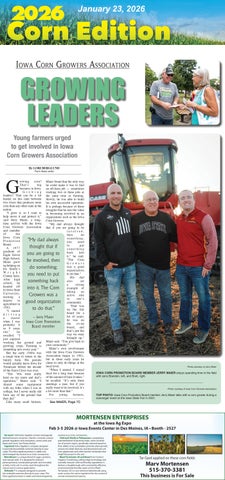
IOWA CORN PROMOTION BOARD MEMBER JERRY MAIER enjoys spending time in the field with sons Brandon, left, and Brett, right.
-Photo courtesy of Iowa Corn Growers Association
TOP PHOTO: Iowa Corn Promotion Board member Jerry Maier talks with a corn grower during a scavenger event at the Iowa State Fair in 2021.
2C
Friday, Jan. 23, 2026
Farm News/Fort Dodge, Iowa www.farm-news.com
Corn Collectibles Honor
‘KING CORN’
-Farm News photo by Lori Berglund
FROM CASSEROLE DISHES, salt and pepper shakers, to cookie jars, corn has been a popular subject of collectible pottery for decades.
Corn powers Iowa families
Lori Berglund Farm News columnist
I
t all started sometime after college. I was the editor of our sister publication, The Daily Freeman-Journal, and my mom and I spent a lot of summer vacation days antiquing together. I fell in love with the history of kitchen and household items from the early 20th Century. From stoneware crocks to green Depression glass, I loved it all. Young newspaper editors have skinny pocketbooks, but I was happy to add even just one nice piece to my small collection during each vacation. Mom told me the story of how Depression glass was plentiful and cheap — often even free — during the years of her childhood in the 1930s and early 1940s. Detergent companies, for example, might give away one piece of glassware with a purchase. Her mother never would have imagined the prices that this ubiquitous glassware would fetch so many decades down the road. Depression glass became a favorite collectible for me, but I also wanted to start my own collection of something meaningful to my own childhood. I noticed corn figurines were plentiful and I thought about what corn had done for me over the course of my lifetime. Corn put meat on the table for my family. Corn put clothes on my back, a roof over our heads, and gas in the tank. Corn even put me through Iowa State University. Soybeans did their part for
-Farm News photo by Lori Berglund
A SHAWNEE POTTERY PIECE placing a corn planter with a pig, right, celebrates the important connection between corn and pork producers.
sure, but I never had to walk a field of corn. In Iowa, “Corn is still King.” In the 1950s, the state of Iowa went as far to put “The Corn State” on our license plates. I wouldn’t mind a plate like that today. “Corn is King” was a fairly common slogan that people in the 1950s well understood. Consider what corn does for us yet today with numbers courtesy of the Iowa Corn Growers Association. n Each year, Iowa farmers grow about 2.4 billion bushels of corn, more than any other state in the union, and more than most countries. Just compare the size of Iowa to the size of Mexico, and Iowa alone still produces about three times more corn than the entire nation of Mexico. n Cattle, chickens, turkeys, and pigs — lots of pigs — love our Iowa corn. In Iowa, livestock eat about 357 million
bushels of corn each year. That’s a lot of steak, chops, chicken, turkey and eggs. n Even with feeding all that livestock, Iowa corn farmers still have the ability to fuel our vehicles. The state leads the nation in ethanol production, with some 1.6 billion bushels of Iowa corn generating nearly 30 percent of the nation’s ethanol. n That’s just a few of the nearly limitless uses for corn. The Iowa Corn Growers note that corn, in one form or another, is in nearly 4,000 grocery items, from toothpaste to crayons, and my own beloved Mountain Dew. Clearly, corn has done a lot for me over the years. I think I chose well when I started collecting corn pieces so many years ago. One of my favorites is a Shawnee Pottery pig with a planter that looks like an ear of corn. Corn and pigs, they just go together. As a young reporter
many years ago, I was assigned an interview with a beginning farmer, fresh out of Iowa State University. I was to ask him how many acres his family farmed. I apologized for even asking, as that is a very personal question. But the young man gave me the best answer that I will never forget: “We farm enough to feed the pigs.” Perfect answer, and absolutely true. It really explained the vital connection between corn and one of its best consumers for more than a century — hog producers. Many people today assume that corn is primarily used for ethanol — and a lot of it is — but the livestock industry, our most tasty source of great protein, also depends on corn producers. When I was growing up in the 1970s, the state’s cattle producers proudly advertised their product as “Iowa
Corn put meat on the table for my family. Corn put clothes on my back, a roof over our heads, and gas in the tank. Corn even put me through Iowa State University. Soybeans did their part for sure, but I never had to walk a field of corn.
Corn-Fed Beef.” These days, there is a movement toward grass-fed beef. Uhmmm, corn is a grass, a fruit, vegetable, and a grain. It’s like a miracle plant all-in-one. Really, corn to me seems like a gift from God for all that it can do for us. And it also produces some of the most tender, flavorful steaks and chops. Keep mine corn-fed, please. Corn really has done a lot for me over the years. Call me corny, I’ve been called worse, but I’m going to keep on collecting.
Contact us for all your hauling needs TRUCK REPAIR • HAULING ROAD STONE • CATWORK
JOHN’S AG SERVICE Hwy. 3 East • Humboldt • 515-332-1883
Buy, Sell, & Trade Farm Equipment New & Used Parts • National Locater Service Parting Late Model Tractors & Combines Colfax, IA, North Side of Interstate 80 at Colfax exit.
1-800-284-3001 • colfaxtractorparts.com
www.farm-news.com
Farm News/Fort Dodge, Iowa
Friday, Jan. 23, 2026
RECORD-BREAKING CROP
As corn floods the market, producers look to trim budgets By KRISTIN DANLEY GREINER Farm News writer
W
hile the fall harvest ended up setting a record as the biggest one yet, the surplus of corn has depressed markets, prompting producers to look at what they can do to trim their budgets. “There’s been a lot of discussion that the USDA’s yields were too high, so we could see this crop shrink a bit if the USDA adjusts its numbers next week, but it’s still the best yielding crop we’ve ever seen. It’s the biggest crop we’ve ever had and beat the previous record by at least a billion bushels. That’s insane,” said Chad Hart, Iowa State University Extension ag economist. While the huge harvest has pushed supplies upward and prices downward, the Chad industry has gotten Hart creative with just how it can use up that surplus, “Ethanol is running at a gangbuster pace, feed usage remains solid and steady despite shrinking numbers on cattle, but the big thing is that, despite the tariff turmoil and trade disruptions, the corn market has been on a heater when it comes to exports. “For 14 months, we saw things starting to pick up, basically from the end of 2024 throughout 2025 when we were exporting at an above usual pace,” Hart said. “In fact, we ended up at a record level for the end of the year. Here we sit at the beginning of 2026 and we’re still pushing exports at a record pace so far this year.” Export sales have been logged by regular customers as well as countries that are new to the market for the U.S.
-Farm News file photos
WHILE THE HUGE HARVEST has pushed supplies upward and prices downward, the corn industry has gotten creative with just how it can use up that surplus.
“It’s almost everybody — Latin America, southeast Asia, Europe, North Africa. Mexico is up 14 percent, Japan up 45 percent, South Korea up 246 percent, European Union up 170 percent, Taiwan up 240 percent,” Hart said. “When you put it all together, right now in terms of export sales, we’re up about 30 percent year over year and that’s an increase of roughly 450 million bushels. So we’re on a heck of a pace right now and hopefully will continue it.” Grain inspections numbers also continue to look promising, Hart said. Grain inspected to exit through export has been up about 65 percent compared to this time last year, which is helping “chew through the massive crop.” “We had our pricing lows real early in the harvest season, mid-August, so as you think about pricing in September, especially October — November, things got better but still weren’t good. Now
it’s better,” Hart said. “The futures markets are indicating that things likely will remain depressed here as we market this record crop. As we look out to the 2026 crop, that’s when we see the light at the end of the tunnel. If we look out toward July 2027, for example, we’re looking at $4.80-$4.90 corn. Those are prices producers can work with. Prices should get better. It’ll just take a little time.” Hart’s advice for growers: “If you don’t have to make a move, don’t.” “At the same time, now is a great time to do your homework, maybe figure out what would be some prices to move that crop and put in some offer sheets in the next few months,” he said. “That way you don’t have to think about selling the crop when you’re not paying attention to the market. We tend to see our best prices of the year in April-May-June, and producers are busy planting at that time. But if you’ve done your work and
put in your offer sheets, then wait and see if the market will work for you.” Adam Bierbaum, District 7 Director for the Iowa Corn Growers Association, farms in Griswold on his multigeneration farm with his dad and brother. Together they raise corn and soybeans. He confirmed that the yields weren’t as good personally as he thought it would be, and he wasn’t the only one. “When we talked with farmers, the soybeans were better than the corn. We thought the corn would be amazing and then southern rust took it out,” Bierbaum said. “That seems to be the consensus for most of the farmers I’ve talked to. Beans were good; corn was a disappointment. We had great expectations and didn’t meet them. It was an average corn crop for us.” Because of the lower prices paid for corn, Bierbaum said he’s looking at their budget to see where they can cut back, what expenses they can save on and what can be done differently. They held on to as much corn as they could, tapping into their on-farm storage. “We have probably 75 to 80 percent of the crop held here in our on-farm storage,” Bierbaum said. “We look at incremental sales of 10 percent at a time when we put our offers in. We think those are reasonable and we hope they hit so we can sell a bit at a time. If the offer hits, then we’ll put out another so we can get some sales on the books and start delivering grains. I watch the markets every day. “But you have to look at the big picture. It’s good to put offers out there, and if it spikes while you aren’t watching, it still gives you an option,” Bierbaum said. “Every one of us has a different approach, but most I know are following the same approach, as long as we can keep pushing exports, pushing ethanol and look at the long-term uses for corn.”
Agency
PO Box 129 • 402 Morningside Drive Sac City, Iowa 50583-0129
712-662-7500
800-253-4012 • Fax: 712-662-3247 SERVING YOUR CROP INSURANCE NEEDS SINCE 1958.
Farm Management • Real Estate • Appraisal • Consultation 1705 North Lake Ave • P.O. Box 67 Storm Lake, IA 50588 Office (712) 732-4811 • www.stalcupag.com
Visit Us At: 106 First St. • Calumet, IA 51009 (712) 446-2350 www.csagrow.com
3C
4C
Friday, Jan. 23, 2026
Farm News/Fort Dodge, Iowa www.farm-news.com
HIGH YIELD RESULTS
Stine Seed researchers dedicated to pushing the envelope By KRISTIN DANLEY GREINER Farm News writer
A
DEL — Stine Seed Company got its start in the 1960s in Dallas County when founder Harry Stine started yield checking soybean lines, which eventually inspired Stine’s Elite Trials program that’s become the largest soybean research and testing system in the world. But Stine is also known for its highyielding corn hybrids that go through an identically rigorous testing process, including four consecutive growing seasons in Guyana, South America, where favorable weather conditions there allow the Iowa-based company to move high performers faster onto the marketplace. Stine researchers are dedicated to pushing the envelope in their research on hybrids that flourish in high-population environments. Company leaders note that they not only have the most data on their hybrids, but the highest quality data of any testing being done. In 2023, Stine’s high population corn planted in 12-inch rows yielded 300-plus bushels per acre in areas with ideal growing conditions. In 2024, thousands of acres were planted in 12-inch rows at the Stine Farm, allowing researchers to push populations up to 51,000. The corn breeding program started in 1978, with hybrids undergoing testing in the Elite Yield Trials in the early 1980s. The company aims to expand its corn elite testing program until it becomes the largest corn research and breeding program in the industry. Hybrids are also developed with traits needed in different geographic locations. Stine and its affiliated entities own more than 800 patents. Myron Stine, the youngest of Harry Stine’s four children, has worked on the family farm since he was 9 years old. He attended his father’s alma mater, McPherson College in Kansas, earning a crop science degree. Myron Stine has worked his way up through the ranks of the business, starting as a sales representative, then becoming a regional manager, national sales manager, vice president and now president of Stine Seed Company, the family business’ retail arm. The next generation in his household, his two daughters, work in the company’s corn nursery. “We are very heavily focused on research. Every year, we have 1.2 million plots, and in those plots, we are evaluating brand new, never seen before genetics to determine if they are high yielding or not,” Myron Stine said. “It’s a very complicated program we do. At the farm in Guyana, once we develop a new inbred line, we can get four generations in one year, which is huge, because here in Iowa, you only get one generation. A lot of the speed in our research group is because of our presence in Guayana, South America.” Corn hybrids are tested in four different maturity ranges — early, earlymid, full season and late. Corn hybrids are tested in different populations
and research standability, yield and emergence. Researchers look at plant architecture and then compare them to the newest material to proven material in the marketplace. The first couple years of testing at Stine is done in the company’s Pre-Elite Trials. Only 5% of products evaluated in the Pre-Elite Trials move on to Elite Yield Trials. At each step, as researchers narrow the number of products being evaluated, they increase the number of repetitions and the number of locations tested for each. From there, less than 2% of those evaluated in Elite Yield Trials are ever commercialized. Only the best of the best in the Elite Yield Trials advance to market. The rest end up discarded. Every variable is matched perfectly to ensure solid results, including fertilizer and herbicide applications, the soil types the products are placed in and planting space and population. Company leaders also note that Stine is the only seed company to actively test in narrow rows for both corn and soybeans. “Our newer high-yielding genetics are typically 8 to 12 percent higher yielding than average genetics,” Myron Stine said. “We work with farmers and explain the yield potential of the hybrid, but then we have to show them how to reach that potential on their farm and the things they have to do to accomplish that, to tap into that highyield potential.” Another thing that sets Stine apart from competitors is that they’re focused on germ plasm. “Other companies do a really good job with trait platforms, but we don’t focus on trait platforms — we focus on genetics and then we partner with trait platform providers and move those platforms into our genetics. We are heavy on straight glyphosate materials. So that allows us
to have very, very high yielding, high performing straight glyphosate resistant material and conventional genetics,” Myron Stine said. “There aren’t a lot of companies that do that. They’re more focused on bringing herbicide and insect trait platforms to the market.” For the 2026 planting season, Stine has a plethora of products from the 105day to 108-day maturity range. There’s also a 100-day corn hybrid surfacing that Stine’s particularly proud of and will “bring our customers exceptional yield potential,” Myron Stine said. Stine’s hybrids are grown all over the U.S. and around the world, including in Argentina, Brazil, Uruguay, Paraguay and Europe. “We actually sell more corn in South America than we do in the states, and we have separate breeding programs down there,” Myron Stine said. There are research hubs in Iowa, Minnesota, Indiana and Arkansas, and each hub has 40 research locations to monitor. There are 1.2 million plots planted each to soybeans and corn in the U.S., excluding research and testing in South America. “We make hundreds of thousands of new genetic combinations each year that we plant in different growing environments, side by side, to see which ones are the winners. To harvest those plots, they’ll send out about 50 to 60 combines,” Myron Stine said. “Stine Seed Company is really good at developing high-yielding genetics. Other companies can say that, but the proof is in the pudding. Nothing makes us happier than when we can help a customer be more profitable on their acreages. We’re farmers ourselves and are the only privately held family company that’s involved in research and retail. There’s no family seed company like us.”
-Photos courtesy of Stine Seed Company
STINE SEED COMPANY researchers are dedicated to pushing the envelope in their research on hybrids that flourish in high-population environments. TOP PHOTO: Myron Stine, the youngest of Harry Stine’s four children, has worked on the family farm since he was 9 years old. Since then, he has worked his way up to president of Stine Seed Company, which was founded by his father, Harry Stine, in the 1960s.
“We are very heavily focused on research. Every year, we have 1.2 million plots, and in those plots, we are evaluating brand new, never seen before genetics to determine if they are high yielding or not.” Myron Stine President, Stine Seed Company
www.farm-news.com
Farm News/Fort Dodge, Iowa
Friday, Jan. 23, 2026
5C
Energy Efficient Stainless Steel Tanks Automatic Waterers Keeps Ice Out Now UL Listed Cattle • Hogs • Horses • Sheep
Hoskins Livestock Waterers PO Box 101 • Hoskins, NE 68740
402-565-4420 • 800-658-4020 www.hoskins-mfg.com
We’re For You
INSURANCE
Complete Insurance Services
Matt Goodwin
LIFE - HOME - AUTO - ACCIDENT - CROP HAIL - HEALTH
Creating Sustainable food, feed and fuel ingredients for a growing population
Farnhamville, Iowa Phone: 515-544-3266 PROCESSORS OF SCRAP IRON, METALS & BATTERIES. WE ACCEPT FENCE WIRE & ANIMAL FEEDERS. MUST BE FREE OF WOOD, FEED & DIRT.
QUANDT AUTO SALVAGE USED PARTS CAN COST HALF AS MUCH AS NEW!
Monday-Friday 7:30am-5pm
Parts have 30-day warranty
18829 Kittyhawk Ave • Carroll, IA 51401 (712) 792-9204 • 1-800-522-1903 www.quandtautosalvage.com Computerized Parts Locating & Service We sell the best and recycle the rest!
Des Moines, IA Blue Earth, MN 1-800-722-1715 1-800-722-9323 Alton, IA 1-800-383-1192
www.darlingii.com
Scrap Metal Receiving Hours: Mon. - Fri. 7:30-4:30; Closed over Noon Hour
Want the best Results. Start with the best water Providing the Highest Quality Water Treatment Products and Services to North Central Iowa Since 1949.
Sales•SERVICE•Rentals www.fdwater.com • 515-576-6481 • 612 S 32nd St, Fort Dodge
Rick Titus in His 51st Year of Selling and Installing More Efficient Fireplace Inserts & Vent Free Gas Logs. If you have a fireplace that burns wood, you know that it loses all of its heat up the chimney. Rick Titus has a wood burning insert that will burn with the efficiency of a wood stove and fit inside your fireplace so it keeps your fireplace look. The insert could heat up to 2,000 SQ. Ft and burn a third of the wood!
If you have one of the newer gas fireplaces that vents out the side of the home or up a chimney, Rick can convert it over to a Vent Free log and keep all the heat in the home.
If you have a gas log in your fireplace it also sends all of its heat up the chimney. Rick has Vent Free gas logs that can burn as efficient as a gas cook stove and burn with the damper closed, thus keeping all the heat in the house. The vent free gas logs could heat 1,000 SQ. Ft of your home
So no matter what kind of fireplace you may have, Rick has an efficient solution for it. Call Rick or email him at yahtitus@gmail.com or go to his web site below. Rick even has new fireplaces and wood stoves that can heat your home even during a power outage.
- photo by Les Houser, Wright County Monitor
Call Rick at 515-532-3881 or 515-293-2455 or visit www.fireplacesatthecountrystore.com
6C
Friday, Jan. 23, 2026
Farm News/Fort Dodge, Iowa www.farm-news.com
NUTRITION MATTERS Corn can provide key nutrients for sheep, goat health
By ELIZABETH ADAMS Farm News writer
F
or many producers in Iowa, lambing and kidding season is well underway. For others, lambing and kidding will happen during mid-to-late spring. Producers have some options as they prepare their flock for the main event. Experienced producers know that one of the most important factors in a good lambing or kidding season is the maternal health of the ewe or doe. Good nutrition and a balanced diet is important throughout the year, but increased nutritional needs become critical during the last 60 days of pregnancy, or late gestation, according to Jaelyn Whaley, SDSU Extension sheep field specialist. A ewe or doe who is expecting twins or triplets will require additional nutrients compared to those expecting singles. Inadequate nutrition in late gestation can result in pregnancy toxemia (ketosis), milk fever, lower and/or poor milk production, low weaning weight, poor lamb wool quality, and overall a low lamb/kid survival rate, Whaley noted. Keeping your flock or herd well supplied with their forage needs is vital for rumen health, but feeding grain is a good consideration when it comes to meeting the energy needs of mothers during late gestation. Whole grains, such as corn or barley, are considered highenergy feed. Corn, from an energy standpoint, is worth 1.9 times as much as the average quality hay, according to Susan Schoenian, sheep and goat specialist at the University of
-Farm News photos by Elizabeth Adams
ABOVE: A ewe cares for its lamb. A ewe or doe expecting twins or triplets will require additional nutrients compared to those expecting singles. TOP PHOTO: Toggenburg kid goats rest in the sun. Lambing and kidding season is well underway for many Iowa producers. BELOW: Woolly sheep get their fill at the feeding trough recently. Good nutrition and a balanced diet is important throughout the year for sheep and goats, but increased nutritional needs become critical during the last 60 days of pregnancy, or late gestation, according to Jaelyn Whaley, SDSU Extension sheep field specialist.
Maryland's Western Maryland Research & Education Center. Additionally, corn and other grains can be a more economical source of nutrients and are readily available. Having feeding and supplement plans secured before winter begins can help keep farmers on track with sheep and goats’ nutritional needs throughout the season. Establishing a relationship with a local cooperative and their feed specialists can benefit the producer’s efforts, but always begin a feeding/nutritional plan with one's veterinarian. Guidelines that producers should adhere to before and while feeding grain to ruminants, according to the Maryland Small Ruminant Page, are as follows: n Do not feed large quantities of grain to ruminant livestock at one time. This can lead to acidosis by promoting the growth of lactic acidic bacteria in the rumen. n Feed hay to ruminants before grain so that grain is not digested too quickly. n Feed a minimum amount of forage to encourage healthy rumen. n Never change rations too abruptly; it can disrupt the rumen. n Feed grains whole. Cracked grain increases the rate of digestion, leading to acidosis. Set a goal for meeting or slightly exceeding ewe/doe energy requirements during the last 60 days of gestation. This will result in lambs and kids having a greater chance of survival, according to Whaley. More energy and stamina after birth, better health, higher weaning weights, and higher wool quality in lambs all mean better performance and profitability for producers.
www.farm-news.com
Farm News/Fort Dodge, Iowa
Friday, Jan. 23, 2026
7C
Maier Continued from Page 1C especially those with a family, Maier encouraged that getting involved at the local level is a great way to start. The time commitment is what you make it, and it can be a way to start learning more about the organization and how it works on behalf of corn producers. “My big thing is that I would like to see the young guys get involved, even just getting our newsletter,” he said. “Start receiving the information and learn what we do, even just in the legislative area.” Representing District 2 in north central Iowa on the Iowa Corn Promotion Board, Maier is part of a 12-member board that oversees the use of checkoff dollars. As noted by the Iowa Corn Growers Association, the checkoff dollars are focused on “market development, education and research.” Board members are elected annually from each of the nine crop districts in Iowa. The board also includes four exofficio members. While even some farmers often struggle with the checkoff program, Maier is a ready defender of its purpose and value to grow the market for corn producers. “If you’re not willing to step up and promote your product, who do you expect to do it?” he asked. “The endusers, or someone like that, they have their own interests involved. The Corn Growers, we step up and represent you and your products, legislative-wise, and much more.” Maier noted checkoff dollars have been used to improve research and genetics for such things as finding ways to develop varieties that will better tolerate drought. “I always try to explain to people that the checkoff is a very good thing, doing a lot of things to help make farming more sustainable, more profitable,” he said. During tough economic times, Maier said the value of the checkoff dollars only grows. “Right now, we’re in a tough time, but even when you do everything right, you can still be in a tough time.” In his part of Iowa, yields have suffered in recent years due to a variety of weather concerns, according to Maier. “We’ve had too much rain, too much hail, and our yields have not been real
“If you’re not willing to step up and promote your product, who do you expect to do it? The endusers, or someone like that, they have their own interests involved. The Corn Growers, we step up and represent you and your products, legislative-wise, and much more.” — Jerry Maier Iowa Corn Promotion Board member
-Photo courtesy of Iowa Corn Growers Association
JERRY MAIER, right, participates in Iowa Corn Day at the Iowa State Fair in 2021. Maier is an Iowa Corn Promotion Board member.
To learn more To learn more about the Iowa Corn Growers, Iowa Corn Promotion Board, or becoming a member, visit iowacorn.org. good for the last four years, but I’m an optimist,” he said. “Every farmer is an optimist.” High input costs are yet another factor making it tough on farmers in the current economy, Maier noted. “It makes it tough because we do rely on fertilizer to grow these crops, and if we can’t feed the livestock for the cattle industry, that impacts the price people have to pay for meat in town,” he added. From corn to calves, it’s all connected, and the Iowa Corn Growers Association helps connect those dots into the fabric of American agriculture. Maier sees great value in getting involved, and working to protect and grow the corn market for the long-term future. During his own years with the Iowa Corn Growers Association, Maier has served on numerous committees and focus groups. He has served as vice chair of the Iowa Corn Research and Business Development Committee, chair of the Iowa Corn Usage and Production Committee and a member of the Animal Ag and Environmental Committee. He has served on the National Corn, Food, Feed and Industrial Committee, U.S. Grains Council Innovation and Sustainability, and Asia Advisory Teams, as well as many more gropus at the local, state and national level. But don’t be daunted by his long resume. For Maier, it all started at the local level in Wright County. And, for most farmers, that local involvement can make all the difference. Getting involved beyond that is always a personal choice. “I would just like to see more young farmers get involved,” he emphasized. “Start learning about what we do.”
UNI-HYDRO IRONWORKERS • Ellis Band Saws
Model Pro 80-24
• Drill Presses
Let Us Help You With All Your Farm Real Estate Needs
Leroy Hoffman
Jay Bargman
Leland L. Metzger
Cell: 515-341-0874
Cell: 515-341-5418
Cell: 515-341-5402
Listings • Auction • Appraisals • Tax-Free Exchanges • Farm Management 3000 Saw
220 East State Street, P.O. Box 519, Algona, IA 50511 • 866-295-2401 www.farmhomeservices.com • 515-295-2401
• Belt Grinders Model Pro 56
Model 45-14
Sales • Service
John Pitzer Sales Since 1962 1-800-726-3550 johnpitzersales.com
9400 Drill Press
39th Annual
www.HawkeyeFarmShow.com
Cedar Falls WIN $1,000 IN SHOWBUCKS! DRAWING DAILY AT 1PM
March 3, 4 & 5, 2026 SHOW HOURS 9 A.M.-4 P.M. DAILY FREE PARKING FREE ADMISSION • 200+ exhibitors with over 800 product lines on display • Daily seminars
8C
Friday, Jan. 23, 2026
ASSOCIATED MILK PRODUCERS INC.
Farm News/Fort Dodge, Iowa www.farm-news.com
Dinner Bell Creamery is about as close as you can get to buying directly from the dairy farm — without having to take a gravel road.
SANBORN DIVISION | 712-729-3255 | www.ampi.com | www.dinnerbellcreamery.coop
manufactures roll tarps and tarp kits!
High quality roll tarps and roll tarp kits for grain carts, wagons and grain trailers!
Give us a call today to discuss your needs! (515) 332-3265 Humboldt, IA Web: www.syntexindustries.com Email: info@syntexindustries.com
TAKING THE WORK OUT OF LOADING SEED SINCE 1989 MERIDIAN SEED TENDERS
Vinyl • lettering • Business signs Digital signs • trophies • plaques truck accessories / Detailing 3065 210TH Street, Goldfield, IA 515-570-0041 | 515-332-5270 terryandbobssigns@gmail.com
EIKLENBORG COMBINE SALVAGE Large Selection Of Tractor and Combine Salvage Many New Parts Available
APLINGTON, IOWA
319-347-5510
YOUR STEEL HEADQUARTERS Eagle Building Supply Area’s Best Prices • Free Estimates • Quality Products
ALLEN ANDERSON WILLIAMS, IA • 515-689-0022
Authorized Dealer
CELEBRATING 36 YEARS IN BUSINESS
Call us for the recent Farmland trends. Fred Greder
204 Broadway, Eagle Grove 515-448-3843 1209 Central Ave . E., Clarion 515-532-2887
EPLEY BROTHERS HYBRIDS
Family-owned business for all your Seed Corn and Soybean needs!
Certified Real Estate Appraiser Licensed Real Estate Broker In Iowa
23 3rd St NW • Mason City, IA
(641) 424-6983
www.benchmarkagribusiness.com
1515 18th SW
• OIL Mason City, IA • FILTERS 641-423-0734 • GREASE
800-383-5823
800-728-6293 Shell Rock, IA