Farm News Spring Farm 2026

Page 1


Planting precheck

With warmer degree days looming, farmers know they need to prep their planting equipment before heading to the fields, which includes calibrating the planter, updating any tech tools and checking tire pressure.

But it’s important to remember safety when tackling these preplanting chores.

Dan Neenan, director of the National Education Center for Agriculture Safety, noted that producers should determine which equipment they’ll need for the spring season and check to make sure all safety machinery guards are in place. Lighting and markings should be checked to ensure they’re visible and working properly, too.

“Remember, we are gaining sunlight as we progress into the spring, but will be out before daylight and after sunset. Try to be as visible as possible to the motoring public,” Neenan said. “This is where the lighting and marking come into play, so they can recognize you and get their foot off the gas as they approach you from behind.”

Growers should check and make sure there’s a fire extinguisher and a first aid kit readily available aboard their tractor. “A lot of farmers have purchased or rented extra land. Make sure you write down the address or 911 sign number for each property, make copies to put into each vehicle that will travel to each property so if an incident occurs you have the number ready to give the 911 dispatcher,” Neenan said.

Producers also need to read and follow label directions when working with herbicides and pesticides, Neenan said.

Doug Houser, digital agriculture Extension specialist with Iowa State University, said that a few of the key maintenance items that should be tackled include checking the seed openers.

“These blades cut the path in the soil. Inspect them for wear; for example, a standard John Deere or Kinze 15-inch blade should be replaced once it wears down to 14.5 inches. When blades are shimmed correctly, the seed sits at the bottom of the furrow. If they are too far apart, a ‘W’ formation occurs, leaving the seed improperly seated and exposed to air pockets. The gauge wheel arms carry the weight of the row unit and must be inspected for any play or wear that could affect depth consistency. Depth gauge wheels on a device to calibrate the planting depth of a planter row unit.”

A calibration tip Houser suggested calls for performing a pre-season depth calibration to the expected planting depth on a level surface using either a set of blocks the width of your planting depth or by investing in the Set-N-Seed Planter Depth Calibration Tool sold by Shoup.

“Doing this process will make sure each planter row unit and T-handle settings match the actual planting depth in the field,” Houser said. Additional tasks that should be done before planting, according to Houser, include the following:

n Replace hand-drawn field boundaries with driven, if possible, or even ones generated from previous applications is a great place to start.

n Consolidate and remove old items.

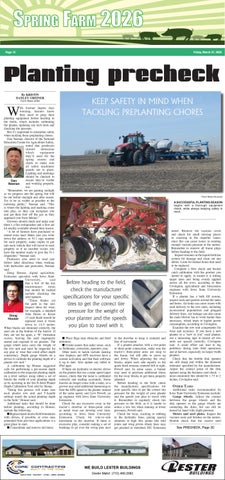
KEEP SAFETY IN MIND WHEN TACKLING PREPLANTING CHORES

Before heading to the field, check the manufacturer specifications for your specific tires to get the correct tire pressure for the weight of your planter and the speeds you plan to travel with it.

n Place flags near obstacles and field entrances.

n Create names that make sense, such as fieldname_correction_operator_year.

Other tasks to tackle include making sure displays and GPS receivers have a current activation and that their software is up to date. Also update any tablet or iPad apps.

If there are hydraulic or electric drives on the planter that use a radar speed input source, check that the radar is calibrated correctly and reading accurately. Some tractors no longer come with a radar, so a grower may need additional harnessing to feed the GPS speed to the planter instead of the radar speed, said Levi Powell, an ag engineer with Iowa State University Extension.

Check for any excessive sway in the tractor’s drawbar or three-point arms as metal wear can develop over time, according to Iowa State University Extension. Check for side-to-side movement in the drawbar. If there is excessive play, consider making a set of bushings to go over the swing pins next

to the drawbar to keep it centered and free of movement.

If a planter attaches with a two-point or three-point connection, make sure the tractor’s three-point arms are snug to the frame, but still able to move up and down. When adjusting the sway blocks, adjust each side equally so the quick hitch remains centered left to right, Powell said. In some cases, a farmer may need to purchase additional shims for the sway blocks to get them properly adjusted.

Before heading to the field, check the manufacturer specifications for your specific tires to get the correct tire pressure for the weight of your planter and the speeds you plan to travel with it. Remember to regularly check tire pressure in the field, as it is harder to notice a low tire when running at lower pressures, Powell said.

Check for wear, cracking or rubbing in the hydraulic lines, paying special attention to high flex points like fold joints and wing pivots where lines may get pinched or stretched, ISU Extension

noted. Remove the vacuum cover and check for small missing pieces or cracking in the impeller vanes, since this can cause issues in creating enough vacuum pressure at the meters. Remember to remove all frame plugs before heading to the field.

Inspect strainers in the liquid fertilizer system for damage and clean out any debris. Look for kinked hoses that need to be replaced. Complete a flow check and bucket catch calibration with the product you intend to apply, to ensure it is hitting target rates and being evenly applied across all the rows, according to Ben Covington, agricultural and biosystems engineer with Iowa State University Extension.

If a planter has a bulk fill system, inspect seals and gaskets around the tanks and hoses. Air leaks can cause issues with seed delivery to the row units, including inconsistent populations and plugged delivery lines. Air leakage can also cause the main blower fan to work harder than necessary, which leads to higher power consumption, according to Covington. Examine the row unit components for wear and accuracy. If you have a new planter or a “new to you” used planter, use a measuring tape to ensure all row units are spaced correctly, Covington said. A small offset can lead to big problems during later field operations and at harvest, especially on larger width planters.

Check that the double disk openers are still sharp and within the diameter tolerance specified by the manufacturer. Adjust the contact point of the disk openers using the business card check — most commonly this should be 1.75 to 2 inches, Covington said.

Other tasks

Additional tasks recommended by Iowa State University Extension include: Gauge wheels. Adjust the contact between the gauge wheels and the disk openers so the gauge wheels are contacting the disks, but can still be turned by hand with slight pressure. Meters and seed plates. Inspect the vacuum seals and brushes on the meters. Double check that the correct seed

Dan Neenan
Doug Houser

Gearing up to plant

With an eye on the Mideast, farmers grateful to have booked inputs early

Winter may still have some fury left, but Todd Christeson, agronomy manager at United Co-op in Webster City, is looking forward to serving customers when the soil warms and the tractors and planters hit the fields again.

After years when central Iowa has seen frequent drought conditions, the U.S. Drought Monitor has the area looking well refreshed for spring planting. As of mid-March, Hamilton, Webster and surrounding counties all appear in the “normal” rating for soil moisture. Several counties in northwest and southeast Iowa remain in a moderate drought, while counties buffering the swath through central Iowa are in moderate conditions.

Of course, as any farmer knows, all of that can change quickly. For Christeson, despite uncertainty in the world, he remains optimistic and eager to see the planters rolling soon.

“Our soil moisture seems pretty good right now; we don’t need any more,” he said. “If we can get the crop in the ground, and then let it start raining again, we’ll be in pretty good shape.”

But don’t get in too big of a hurry, with cold weather in the forecast for mid-March, soil temperatures in central Iowa were still hovering in the low 40s and upper 30s, according to the Iowa State University statewide soil temperature map.

The elephant in the room as farmers gather and talk about the upcoming planting season continues to be the conflict in the Mideast. Even the national media has taken notice of the impact the closure of the Strait of Hormuz may have on fertilizer and input prices for farmers nationwide.

The American Farm Bureau Federation has been voicing its own concerns and penned a letter to President Donald Trump on March 9. (Read the letter in full at fb.org.)

“Your leadership in advancing the One Big Beautiful Act and in providing $12 billion in emergency economic assistance has helped farmers enter 2026 on better economic footing. Yet we are still experiencing a generational decline in farm income driven by outof-control inflation and dramatically declining crop prices. This is especially concerning when, just as American farmers begin to put seeds in the ground for spring planting, the prices for key inputs such as fertilizers and fuel increased rapidly following the closure of the Strait of Hormuz,” the letter began.

If there is good news to be had, it is that the vast majority of farmers traditionally book their input needs far ahead of planting season. Price increases coming from overseas will not have an immediate impact because farmers acted last fall to plan for the spring season.

Christeson estimated that at least 80

Precheck

percent of farmers, and perhaps even more, took advantage of early booking, long before the current crisis erupted.

“Most of our stuff isn’t going up because of buying early,” Christeson said. “But if we had to buy it now, it’s really expensive.”

Like most Americans, he is hoping for a safe and swift resolution to the conflict overseas. If, as the Administration has said, the situation is resolved quickly, the long-term impacts may be minimal.

“Most everybody has their inputs and everything bought for this year,” Christeson explained. “So it’s more a question of what’s going to happen next fertilizer season. I think the question is how long it drags out over there. If they calm down, it can be back to business as normal. Right now, it’s very volatile.”

The conflict has served to focus attention on the global markets that fuel American agriculture.

“I didn’t realize until a week ago that Iran is the third-largest exporter of urea in the world,” Christeson.

A great deal of phosphorus put down on American fields also comes from overseas, while the vast majority of potassium and potash is imported from Canada, he said.

Some in the national media have speculated that the impact on inputs might prompt farmers to change up their planting plans, but Christeson doesn’t foresee that happening.

Changing from corn to soybeans has

Continued from Page 1C

disks, knockouts and double eliminators are installed for the crop you will be planting. Finger pickups. On finger pickup planters, inspect the meters to ensure that the fingers spin freely and that all fingers open and close properly.

Seed placement system. Clean seed tube sensors and check the condition of the seed drop tube. If you are using a high-speed planter, check the condition of seed belts or brushes and any wear parts within the cartridge. Row cleaners. Check bearings and linkages for signs of wear. On pneumatic row cleaner systems, check for leaks in the airbags and airlines. Down force. Check for leaks in air lines or hydraulic hoses, as well as airbags and

cylinders. Be sure all gauge wheel load sensors are working and reading properly. Check these in the diagnostics on the display. Closing system. Inspect the bearings in the wheels. Check the alignment of the closing wheels by setting the planter down on concrete and pulling it forward 4 or 5 feet. Make sure the closing system wheels are centered over the line that is created on the concrete by the double disk openers. Once the planter’s been pulled into the field, set the planter in the ground and pull it forward for a short distance to be sure the row units are fully engaged in the ground. Measure the distance from the bottom of the 7-by-7 frame tube to the ground. This should

been one possibility cited in order to save on input costs, but with seed and inputs booked last fall, that is unlikely to happen.

“I think most people will keep with their regular crop rotations,” Christeson said. “I don’t think too many people would switch to beans because of the nitrogen.”

While corn-on-corn has become more popular in recent years, the agronomy manager did note that farmers may have already planned to change things up for their own reasons.

“Usually, if you have been corn on corn for several years, and you switch to beans, your bean crop is huge,” he said. “Usually, it can be between 80 to 90 bushels per acre, just because you change the crop.”

In addition to soil benefits, crop rotation also allows for different chemistry that will assist in combating resistance from weeds.

“Rotation gives you different chemistry for weeds,” he explained.

Even changing products or brands can allow for some resistance to build up on the part of weeds, he said. Rotating crops helps stay one step ahead of the weeds.

“With going corn to beans and beans to corn, you’re using different chemistry every year,” Christeson said, “so that kind of helps.”

Spring is on the way, and come what may with the weather or on the international scene, farmers will be hitting the fields soon.

“Most everybody has their inputs and everything bought for this year. So it’s more a question of what’s going to happen next fertilizer season. I think the question is how long it drags out over there (in the Mideast). If they calm down, it can be back to business as normal. Right now, it’s very volatile.”

— Todd Christeson Agronomy manager, United Co-op in Webster City

needed to

the frame lift wheel linkages, recommended Ryan Bergman, manager of research with agriculture and biosystems engineering at Iowa State University Extension. Next, adjust the levelness

of the planter. If the planter is pitched too far forward or backward, it can limit the range of motion on the parallel arms or cause problems with the row cleaners and closing systems. With the planter still in the ground, measure the distance from the bottom of the tongue to the ground. Do this at both the rear and front of the tongue, Bergman said. These measurements should be close to the same. If needed, an adjustment at the tractor connection point can be made. On two-point mount planters this simply requires raising or lowering the three-point; on drawbar type planters, unbolt the hitch tang and move it up or down using the extra holes provided, according to Bergman.

-Farm News photo by Lori Berglund
TODD CHRISTESON, agronomy manager at United Co-Op in Webster City, is looking forward to the start of the planting season and assisting farmers with their input needs.

DAIRY GOATS a year-round commitment

Saathoffs’ show goats have earned their ‘legs’

CLARE — It is a busy day on John and Susan Saathoff’s farm.

Susan Saathoff is watching three does carefully, because they are in labor. The barn is cozy and dry in comparison to the mud and wind outdoors, which is good for the Toggenburg in the back stall who is really close to kidding.

The other goats in pens are in different stages of labor and pawing around anxiously waiting for their moment.

The Saathoffs began to raise goats in 2013.

“We had some Nigerian dwarf goats to begin with,” said Saathoff.

A few years later, they purchased their first standard dairy breed goats — Toggenburgs. Saathoff chose the Toggenburg breed because she had been milking her Nigerian goats and she needed more milk for making soap. Toggenburg goats are a Swiss breed of standard dairy goats that originated in Switzerland. It is a well-established breed and was imported to the U.S. during the early 1900s. They are prized for their gentle nature, cold hardiness and their high volume of milk production.

In addition to the Toggenburg breed, the Saathoffs also raise Oberhasli Brienzer goats. Oberhasli goats are another type of standard dairy breed that originated in Switzerland. They are also prized for their gentle nature and high butter fat content in their milk.

“Oberhasli's are a little calmer than the Toggenburgs,” Saathoff said.

She said that the Toggenburgs are definitely more entertaining with their antics.

The Saathoffs have put a lot of work into their herd. They work hard to maintain breed standards, health and the general happiness of their goats. The Saathoffs show their goats at American Dairy Goat Association (ADGA) sanctioned shows around the state.

That's how their prized Oberhasli has received all its “legs.” Receiving “legs” refers to obtaining a permanent, lifetime championship and sets the standard in the show ring.

Working with local youth has been important to the Saathoffs. Every May, the couple host a showing/fitting workshop for 4-H youth at their farm. Youth get hands-on experience, learning how to set a goat, leading, and fitting for their own showing purposes.

Additionally, the Saathoffs donate a goat-kid to the AGDA’s Share-A-Kid program. Through an application process, the program offers a kid for 4-H’ers to show during the summer show season.

Aside from showing, raising and milking goats has its purposes. Saathoff uses the milk to make a moisturizing, goatmilk soap that she sells. She also uses goat milk for cooking and baking; making cheeses, butter, bread, cinnamon rolls and even ice cream. While milking is part of the gig (twice a day), Saathoff

them until next season,” said Saathoff. Working dairy goats is demanding, and it requires year-round commitment.

beginning of the new year brings quiet maintenance and allows time for cleaning and getting supplies ready for kidding. Kidding begins in February and that can last through April. Milking begins right after kidding and continues through the fall. June through September are the showing months for the

Saathoffs. Fall is breeding time; then things settle down until the new year. And the cycle begins again.
-Farm News photo by Elizabeth Adams
A TOGGENBURG DOE stands in the kidding pen. Toggenburg goats are a Swiss breed of standard dairy goats that originated in Switzerland. It is a well-established breed and was imported to the U.S. during the early 1900s. They are prized for their gentle nature, cold hardiness and their high volume of milk production.
-Photo courtesy of Susan Saathoff
SUSAN SAATHOFF has won many awards while showing her goats at American Dairy Goat Association sanctioned shows around the state.
-Photo by Susan Saathoff
RIGHT: Oberhasli kids (left) and Toggenburg kids (right) share a cozy space.

Iowa’s #1 Ag Bank

On the upswing corn, soybean markets

Hart: Grains have moved steadily higher the past five months

Although the soybean and corn markets are enjoying better prices at the moment due to several factors, planting intentions could cause a swing in the other direction.

versus corn, which currently holds the front spot for planting intentions.

“It’s called a late shift of land,” Hart said, “when we see a swing toward soybeans to try and avoid higher fertilizer costs.”

This year likely will bring another big harvest, economists foresee, but there’s still a fair amount of crop sitting in the bin.

Chad Hart, agriculture economist at Iowa State University Extension, said March 13 that for the past five months, corn and soybeans have been steadily moving higher, driven by exports and China fulfilling its obligation to buy more soybeans.

“Corn continues to set record levels in terms of export sales. Beans are not at record levels yet, but we are seeing China purchase more soybeans than they have. With the start of the war with Iran, we saw that add a little more oomf to crop prices, too,” Hart said.

“Put that all together and we’re finally looking at price levels for soybeans that are up in the 11s now. There’s an old joke that you hate to see soybeans in the 11s, so hopefully we’re on our way up through the 11s to the 12s.”

Another factor that could affect the markets is fertilizer prices. They’ve been on the rise, which could push more producers toward planting additional soybean acres

“Right now, this price rally is rewarding producers for keeping crops in the bin. The question is, ‘How long will it last.’

Hopefully we will see more of a seasonal pricing pattern and look for that high to establish itself between Mother’s Day and Father’s Day. The prospective plantings report at the end of the month will reveal what producers plan to plant this spring,” Hart said.

Chris Pudenz, economics and research manager for the Iowa Farm Bureau, said that row crop farmers both in Iowa and across the country are seeing the cost of production higher than what the return is being returned by the market.

“I’m hearing very anecdotal talk from a couple of folks that lead me to believe we could see similar corn acreage planted in Iowa as last year.

Corn has been a clear favorite — until what happened in Iran and with fertilizer prices — to be a more profitable crop

than soybeans for 2026, but soybeans have made quite a run these past couple of days,” Pudenz said March 13. “Oil prices have really taken off, which has impacted soybean oil prices and the energy market broadly.”

“However, fertilizer prices — especially urea — might cause some folks who have prebooked their fertilizer to switch and consider planting more soybeans instead of corn and the corn market is factoring that into prices.”

Pudenz said he recently spoke with one farmer who had prepaid 60% of his fertilizer while a colleague

spoke with another farmer who had prepaid 50% of his fertilizer. Recently, Pudenz was in a meeting in Boone County with farmers and when asked if they’d prepaid for fertilizer already, only one farmer hadn’t done that.

“A study from the University of Illinois two years ago showed that 82% of corn farmers said they had prepaid fertilizer as a risk management tool. But the Farm Bureau president in South Carolina recently reported that folks in his area do very little to no prepaying for fertilizer,” Pudenz said. “I also think the international conflict is

-Farm News file photos

SOYBEAN AND CORN PRICES have been steadily moving higher the past five months, according to Chad Hart, agriculture economist at Iowa State University Extension.

providing Iowa farmers with the opportunity to premarket some of their fall crop at more favorable prices than folks were expecting this time of year, and this opportunity was certainly unexpected.”

Chad Hart Chris Pudenz

In a good spot livestock markets

Pudenz: 2025 was a ‘very strong year’

The livestock markets are sitting in a good spot, economists believe, and as grilling season approaches, prices should see a “little pop.”

Chad Hart, agriculture economist at Iowa State University Extension, said that the cattle market appears to be doing just fine right now, but “everyone’s worried about the other shoe dropping.”

“The war exacerbated the queasiness in the market, but they’re still showing very strong prices and we’re still seeing a very strong consumer demand,” Hart said March 13. “It’s great if you’re selling animals, but it stinks if you have to buy them.”

That outlook holds true for pork, as well, Hart said.

“When you look at the cattle side of the equation, things are still in pretty good shape and it’s been this way the past couple of years — not much has really changed,” he said. “They’re in the same spot and hoping consumer demand

holds up despite all the geopolitical price uncertainty.

The pork market isn’t doing quite what beef is, but it’s not in a bad spot either.”

Pork prices are hovering around where production costs are at, but as the grilling season approaches, Hart predicts a “little pop in price.”

Chris Pudenz, economics and research manager for the Iowa Farm Bureau, said Iowans have been in a similar market situation the past couple of years where there’s a “tale of two economies.”

“You have a livestock ag economy that’s doing pretty well and then the row crops that are struggling pretty badly. The hog markets were quietly healing in 2025 and we’re looking to continue that healing into 2026,” Pudenz said. “There’s plenty of healing to be done following a very disastrous 2023, with continued bleeding into 2024. But 2025 ended up being better than a lot of folks expected from a margins perspective, and in 2026, so far indications are that it should be pretty similar from a producer profit perspective.”

Pudenz agreed that 2025

was a “very strong year” for cattle producers — one for the record books from a profitability perspective.

“For cattle feedlots, there’s some questions as to how strong returns will be for feeder steers and calves, which have gotten very expensive. That’s good for cow-calf producers in the state and region, but it’s starting to squeeze margins for cattle feedlots in the state.

I’m already hearing stories of smaller or less efficient feedlots deciding to leave pens empty because they don’t want

to take the risk of placing their expensive feeder cattle and betting on a bull run,” Pudenz said.

“Last year, that paid off, but this year, sitting where we are, a lot of folks are unwilling to make that same bet,” he continued. “I talked to one cattle producer in western Iowa whose pens were empty and another with pens full, so it’s all up to the individual producer’s operation, financial situation and their preference for risk.”

“There’s plenty of healing to be done following a very disastrous 2023, with continued bleeding into 2024. But 2025 ended up being better than a lot of folks expected from a margins perspective, and in 2026, so far indications are that it should be pretty similar from a producer profit perspective.”

Master Gardener learning from a

Rinehart sprints into spring gardening season

BOONE — Every spring brings great expectations for those who dig in the dirt. Fresh tomatoes, homegrown sweet corn, and long days spent in the sun. Such is the stuff that dreams of Master Gardeners are made of.

Iowa State University’s Master Gardener program has raised up new gardeners throughout the state, teaching them the basics of gardening so that they may share their knowledge and the work of their hands in their own communities.

“I’m a retired teacher, and before I retired I always saw the information about Master Gardener classes. I thought, ‘I’m going to take that class when I retire,’” said Gayle Rinehart, now a veteran Master Gardener in Boone County.

In fact, Rinehart wasted no time in signing up for the classes when she retired some nine years ago. The Denison native had spent her career teaching preschool special needs and was ready to give back to her community in another way — this time through gardening.

“I did that right away and signed up for the Master Gardener class the fall after I retired,” she recalled.

So, while her fellow teachers were heading back to the head of the class, she was heading back as a student in an entirely new field of endeavor.

“I just like working outside,” Rinehart said of her choice of an encore career as a Master Gardener.

One of the unique features of the Master Gardener program is that it’s not just about gardening, but education with community service. Graduates continue on by volunteering in their communities.

“I was naive enough that my first project was at a church that had a 70-by100-foot plot of land that they were looking for someone to take over,” Rinehart recalled. “I wrote a grant, and the work was managed by Master Gardeners, and we donated all of the produce we raised.” They selected plants that area food pantries said would be popular choices for the families served.

“We had about 100 tomato plants, we had 100 pepper plants, and we didn’t do a lot of odd things, just food that people would want,” she said.

Pumpkins, squash, turnips and a few small watermelons were also popular.

Organizing enough volunteers for such a large garden proved to be a challenge bigger than any evasive weed, but the community garden was appreciated as a way to

help provide fresh foods and alleviate some food insecurity for area residents. With the arrival of spring, Rinehart shared a few recommendations for those who want to grow their own produce this year. First of all, she said to take a look at the space that you have and determine what plants would do the best, based on such things as how much sun it receives. At her own home, because the yard is mostly shaded, she has turned to raised beds placed where they can capture the most sunlight. The raised beds can be very convenient and may require less weeding, but regardless of how large or small one’s garden is, it’s best to stay ahead of the weeds, rather than wait for one big day of pulling and

hoeing.

“I think it’s easier if you look at your garden often, no matter what size it is, instead of waiting, and then you don’t get overwhelmed,” she said. With the raised beds, she uses mulch or straw between the plants to discourage weed growth. This practice can also be used in larger garden spaces, as available.

Just as it’s important to rotate crops in a conventional garden, it’s good to refresh the soil and rotate crops as possible in raised beds. She doesn’t change out all the soil, but will replenish it annually with new soil and such things as bagged manure.

As a Master Gardener, Rinehart commits to 20 hours of community service annually, plus an additional

10 hours of education.

Most of her volunteer hours are now at the Boone County Hospital where she maintains a number of outdoor plantings.

“I mostly volunteer at the hospital,” she said “They have some memorial gardens and rose bushes.”

With nearly a decade of service as a Master Gardener behind her, Rinehart still finds joy in sharing her work and volunteer efforts with the community. She encourages more people to get involved. To learn more about becoming a Master Gardener, contact the Extension office in your county. Some counties offer classes both spring and fall, and staff will be able to advise when the next class session is starting.

MASTER GARDENER

GAYLE RINEHART spends her retirement years volunteering to care for outdoor landscapes at the Boone County Hospital.

To learn more about becoming a Master Gardener, contact the Extension office in your county. Some counties offer classes both spring and fall, and staff will be able to advise when the next class session is starting.

-Submitted photo

MORTENSEN ENTERPRISES

Tar Gard 1-0-5 Foliar Applied contains biologically derived extracts, enzymes, vitamins, minerals, natural growth regulators and stimulators, amino acids and bases and more. See Photos Below

Ingrained Foliar Applied is uniquely designed to provide bioavailable nutrients directly to your crops. This foliar applied product is stable and electronegativity neutral so as to be nonreactive.

MicroBoost is a unique blend of sugars, proteins, and natural acids. It is designed to enhance photosynthesis, overall plant growth, and microbial activity in the soil. It can be used throughout the season and in various applications

Defender T is uniquely designed to provide bio-available nutrients directly to your crops. This foliar applied product is stable and electronegativity neutral so as to be nonreactive . Yield and Shield or Paleopower a proprietary, patented blend of bacterial strain, some of which are of ancient orgins, speci cally selected based on their ability to be sustainable, promote plant growth, restore microbial diversity, and decontaminate soil from glyphosate and other harmful herbicides that might be present in the soil. Weed Terminator 20 and Boost from Contact Organics Combining cuttingedge technology and scienti c research with soil friendly ingredients. It delivers a breakthrough with consistently e ective, environmentally friendly weed control. Weed Terminator 20 is a non-selective bioherbicide using acetic acid as the active ingredient for the control of annual and

Contact: Marv Mortensen 515-370-3381

Turn static files into dynamic content formats.

Create a flipbook