
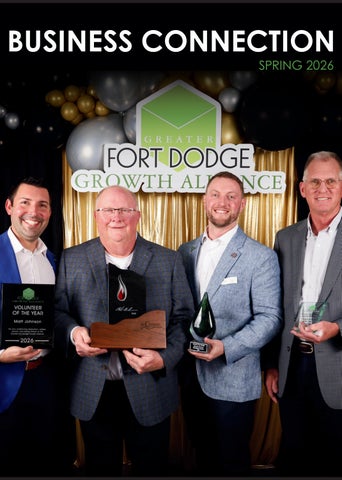
Business Connection Spring 2026

Page 1


Our mission is to unify and coordinate accountable economic and community development to enhance the quality of life in Fort Dodge, Iowa, and the region.

NEWEST TEAM MEMBER LINDSAY LAUFERSWEILER

GREATER FORT DODGE GROWTH ALLIANCE STAFF

Astra Ferris - CEO astra@greaterfortdodge.com

Lindsay Laufersweiler - Community Engagement Director lindsay@greaterfortdodge.com

Jefferson Fosbender - Economic Development Director jefferson@greaterfortdodge.com

Katy Grobe - Marketing Specialist katy@greaterfortdodge.com

Emily Mikos - Operations Coordinator emily@greaterfortdodge.com

Kamisha Mosley - Administrative Assistant kamisha@greaterfortdodge.com

The Greater Fort Dodge Growth Alliance is pleased to welcome Lindsay Laufersweiler as our new Community Engagement Director. A Fort Dodge native and former Webster County Recorder, Lindsay brings more than a decade of public service and leadership experience to the role. She will lead the Growth Alliance’s membership and community engagement efforts while supporting programming and advocacy across the region.

UPCOMING EVENTS

MARCH LEADING LADIES

12:00

BOARD MEMBER SPOTLIGHT

DALE DECKER

CHIEF EXECUTIVE OFFICER, DECKER TRUCK LINE

“I’m tremendously proud that Decker Truck Line, Inc., has continued to provide reliable freight transportation services to our customers safely, on time, and claim-free with the best tools in the industry to do it successfully for more than 90 years. At the heart of it all is our professional truck drivers, and it is my duty to support all aspects of their important role in our company and industry. It is my vision to continue pushing the envelope to offer industry-leading supply chain solutions driven by innovation and cutting-edge technology.”

A Local, Single–Source Transportation

and Logistics Provider

Decker Truck Line, Inc., is a family-owned and operated trucking company that has been committed to exceeding expectations for 95 years. Built on strong Midwestern values with headquarters in Fort Dodge, IA, the Decker team takes pride in the caliber and dedication of its team members and their commitment to providing safe and on-time service to

customers across the nation. Whether hauling temperature-controlled produce or frozen goods, pharmaceuticals, or building materials, Decker has the expertise and experience to handle them safely.

The Industry’s Best Professional Drivers

Driver friendly and driver first, Decker equips its late-model tractors with refrigerators, microwaves, wi-fi, power outlets, televisions, DirectTV, and more. These amenities, plus extensive safety training, top-notch technology, a strong driver support team, proactive truck maintenance, and industry leading compensation and benefits, contributed to Decker earning the Best Overall Fleet distinction in the 2025 Best Fleets To Drive For contest led by CarriersEdge. This prestigious award is a direct reflection of Decker’s culture, innovative mindset, and commitment to safety and driver programs.

To be considered for the Best Fleets program, for-hire carriers operating 10 or more tractortrailers must be nominated by a company driver or independent contractor working with them. Nominated fleets are evaluated in areas like driver compensation, pension and benefits, professional development, driver and community support, safety records, and more.

After the initial nomination, carriers complete an extensive questionnaire, and then the leadership team is interviewed. Finally, all drivers are sent a survey to complete. The highest-scoring fleets are identified as the Top 20 Best Fleets To Drive For and grouped according to size. The highestscoring fleet in each size category is named an overall winner. In 2025, Decker was honored in the large carriers division. This was the first Best Overall Fleet distinction for Decker, but the company has landed in the top 20 six times— including for the 2026 recognition.

In early 2026, Decker was also named a Truckload Carriers Association (TCA) Elite Fleet certified carrier, a program that spotlights companies that demonstrate excellence in creating supportive, rewarding, and driverfocused work environments. Selected carriers prioritize competitive compensation and benefits, a strong safety culture, driver

engagement, and innovative practices that enhance quality of life behind the wheel.

Powered by State-of-the-Art Equipment

Decker’s fleet features late-model tractors and refrigerated, van, and flatbed equipment, ensuring safe, efficient transport for all types of freight. Decker’s well-maintained trucks and trailers are equipped with the latest technology, enhancing performance, reliability, safety, and on-time delivery. Whether customers need temperature-sensitive reefer solutions, versatile van trailers, or durable flatbeds, Decker’s equipment is designed to meet unique shipping needs with precision and care. The company maintains long-term partnerships with truck and trailer manufacturers to ensure consistent capacity and regular equipment upgrades.

Smart Freight Management with Advanced Technology

Decker offers industry-leading supply chain solutions through innovation and cutting-edge technology. Efficient freight solutions are powered through the McLeod transportation management system, which is integrated with technology that enables customers to have 24/7 visibility to their loads. Moreover, the company tracks and closely monitors the state of its refrigerated units to confirm each unique commodity and customer requirement is always maintained. Electronic logging devices ensure driver hours-of-service compliance and tracks behavior. Coupled with Decker’s inward- and outward-facing event recorders, the company actively coaches driving performance to enhance safety and overall performance.

DECKER BY THE NUMBERS

95 Years of Service

Family-owned & Operated Since 1931

Operating 750 Tractors & 1,500 Trailers

60% Reefer, 30% Flatbed, 10% Dry Van

630 Professional Truck Drivers

200+ Support Staff

Operations Team Available 24/7

5 Strategic Nationwide Locations

& PLACES FACES

shiningstar

CORA ANDERSON

Age: 16 • Hometown: Fort Dodge

Grade/School: Saint Edmond (Sophomore)

Artistic Interests – both musically and artistically:

Yes, I love both music and art. I love to use my creativity in art through classes, workshops, and personal projects. My family enjoys visiting art museums whenever we travel to a new town or place. I love listening to music and performing music in band and choir.

How long have you been interested in making art?

I have been making art since I was little. I remember taking art classes at the Blanden with my dad starting when I was 6 years old. I became interested in music when I had the opportunity to join the musical Willy Wonka in middle school at St. Edmond.

ALISYN JOHNSON

What do you most enjoy about performing? What I enjoy the most about performing is meeting new people. I love to make people laugh, have fun, and learn about other people and their interests.

Do you come from an artistic family?

Yes, my dad is a very talented artist. He is the director of the Blanden Art Museum. He loves to work in his studio at home and make artwork and enter them into shows. My mom is a teacher, though she is not very artistic, she is creative, always writing and trying new ‘crafty’ things.

Age:11 • Grade/School: 6th grade/Fort Dodge Middle School

What do you enjoy most about music class at school?

I like to learn about music and gaining knowledge about different genres. It makes me feel joy and helps me to connect with others.

Would you like to learn how to play an instrument? What instrument would you choose? If you already play one, tell us about it and how long you’ve been playing.

I started playing the piano when I was in 3rd grade. I have the most amazing piano teacher Anna Miller and she inspires me to challenge myself by learning how to read new songs and she encourages me to be more engaged in music. Playing the piano makes me feel relaxed and is a great way to entertain myself when I get bored. My parents bought me a new guitar for Christmas, and I look forward to starting lessons soon.

LIZZY TIERNAN

How often do you sing outside of school?

I like to sing along to music when I hear songs that I like playing on the radio. I also sing at church and I had a duet with my younger sister in this year’s Christmas program. I also really enjoy singing in musicals that I have been involved in. I was also in the Children’s Choir last year through McSweeny’s School of the Performing Arts.

What do you enjoy about performing in concerts?

I like singing with a group of people and learning how to combine our voices. I enjoy performing in front of others and seeing them enjoying the music.

Age: 16 • Grade/School: Junior / St Edmond Catholic School

Hometown: Fort Dodge Iowa

What are your Interests – both musically and artistically?

I love doing black and white pencil drawings and working with any new or odd materials I can play around with. Musically I love participating in musical productions. During my freshman and sophomore year when the opportunity was formerly available the highlight of my day was show choir rehearsal before school.

How long have you been interested in making art?

In elementary I enjoyed art class, but when I got to high school I loved it even more. I have had an art class in my schedule 5 out of the 6 semesters I have been in high school.

What do you most enjoy about performing?

Coming together with the whole crew in costume and making jokes and having fun backstage.

Do you come from an artistic family?

Nope

What is the most difficult, or challenging, part for you when creating a new piece of artwork, or preparing a new production?

Whether working on a production or making a new art work there is always that one mistake that you just can’t seem to get quite right, but it’s fun to laugh about it with people because in reality only the artist, or the cast of the show will ever truly notice that the mistake is there.

artiststar

RICHARD HANSON

Age: 77

Hometown: Fort Dodge, Iowa

How would you describe your artistic style, and what draws you to the images you choose to paint?

I would describe my style of painting as realistic. However, over the past fifty years I have worked in a few different styles. Since the mid-eighties I have concentrated my efforts on highly detailed textured images. For me, creating the illusion of surface texture within an original, well-designed composition is very satisfying. I enjoy making detailed paintings that communicate in some way with the viewer.

When did you begin painting?

The first painting I completed was in my senior year of high school. It was a portrait completed in oil. I enjoyed the process and I seemed to have an aptitude for it.

DAVE HEARN

Age: 75

What is your educational background?

I am a graduate of St Edmond High School. I have an AA degree from Iowa Central Community College, a BA Degree in Art Education from the University of Northern Iowa and an MA in Studio Art (painting) from Minnesota State University, Mankato.

What do you most enjoy about painting?

The thing I really enjoy about painting is the attempt to produce an original and compelling image. I like the challenge of making a self-satisfying work that meets my initial vision.

Growing up, was your family interested in the arts?

Growing up my parents didn’t have any formal education in the arts. My two sisters participated in dance and choir in high school. My grandmother on my mother’s side was a self-taught artist and painted some very nice watercolors.

Hometown: Fort Dodge • Instrument: Keyboards, Piano

How did you first become interested in making music?

When I was very young, living in Texas, my grandparents had a record player and a lot of classical recordings. I listened to the Leonard Bernstein Young People’s Concerts on TV and played lots of music records. More importantly, they had a piano and I was fascinated with it. I was only 4 years old, but I loved experimenting with the keys on that piano. I composed my first little piano piece on that piano at 4 years old. I was hooked.

How long have you been performing and making music?

As a child of 4, I was an unapologetic ham, banging on the keys for anyone who would listen. That unfortunately for some has continued to this day.

MEGAN CASSADY

Age: 34 • Hometown: Fort Dodge, IA

Tell us about some of the bands you have been in. The first band I formally played in was for a talent show at old North Junior High in Fort Dodge - piano, trumpet and clarinet. I played the trumpet. We were pretty good as I remember. The first pro band I was a member of was HAWKS, which signed to Columbia Records in 1980 and released two albums in ’81 and ’82. We had a chart single, “Right Away” and an album radio charted song “It’s All Right, It’s OK” (which I wrote) both from the self-titled first album. All the members were from the Fort Dodge area, except for our guitarist from Des Moines via Minneapolis. We were inducted into the Iowa Rock’N’Roll Music Association Hall of Fame in 2007.

The Frontier Fiddle Band was an old-time and original outfit led by Shadric Smith in which I played the accordion.

Profession: High School Band Director - Southeast Valley

What role did the arts play in your childhood?

The arts played a huge part of my childhood. From my dad drawing caricatures during church, to listening to oldies in the car while my mom hauled my brother and me to our events, to going to my dads concerts, to watching and learning how to cook by my mom and grandma, I was completely immersed my entire childhood. Being a band directors kid, I didn’t necessarily have a choice to be in band. However I am the person I am today because of my experiences with the arts.

What is one of your first memories of music?

Either listening or performing.

I remember being in 4th grade and my dad, a trombone player, asked me what instrument I wanted to play. I was the youngest child and my two older brothers played the trumpet. I looked at my dad and said “I want to play the clarinet!” He looked at me, perhaps a bit disapprovingly, and said “I thought you wanted to

play the trombone?” - I have now been playing the trombone for over 20 years.

What made you decide to become a music educator?

There were a lot of factors that played a part in me becoming a music educator. I actually fought it for a while. I saw the long hours my dad put in. The nights and weekend commitments. I was working in the church and doing music lessons part time. I wasn’t convinced that was what I wanted to do for my career. I knew I loved music and I loved working with kids. With some significant reflection, I realized that although it would be a ton of work, I had a passion for teaching music and that was what I wanted to pursue. After about eight years in the workforce, I went back and got my teaching certificate. I am in my fifth year as a band director at the age of 34.

DON’T

“The small spark of hope within the spirit of a child can make all the difference in the world.”‘

It is hard to imagine a child growing up in our community with little or no hope for a bright future. Unfortunately, we know that living in poverty can destroy hope in the hearts of children.

United Way of Greater Fort Dodge believes that one of the worst things about childhood poverty is the slow acceptance that there is no way out and there is nothing they can do to change or break from the hopelessness of being poor. Those who live in poverty often experience high rates of chronic and acute health problems, depression and mental illness, hunger, homelessness, low self- esteem and abuse. These “toxic stressors” for children and adolescents often lead to lasting impacts on their learning, positive social development and personal well-being.

Meeting Basic Needs - In Fort Dodge, 25% of our youth live in households that are at the poverty level or very close to it. Children living in poverty struggle just to meet their most basic living needs for decent housing, food, clothing, safety, access to healthcare and transportation. United Way’s main goal is to help lift

these children up and give them hope for a brighter future.

Building Confidence and Self Esteem - When children are offered a “helping hand” they get the message that someone cares and thinks they are “worth it.” This internal feeling helps them gain confidence in themselves and the motivation to succeed and get excited about proving what they can do and how far they can go.

Breaking Out of the Legacy of Childhood PovertyWe know that when we help a child break out of the legacy of poverty, we tackle one of the worst things about childhood poverty – hopelessness. The small spark of hope and happiness within the spirit of a child can make all the difference in the world.

Working Together to Help Children - United Way believes that a community of friends working together can make a real difference in impacting young lives and helping them overcome the horrific social ills of poverty. Donations to United Way from caring citizens are used effectively to touch the lives of hundreds of youths in life-changing ways.

Donations to United Way can be made payable to United Way of Greater Fort Dodge, 24 North 9th Street, Fort Dodge, IA 50501. For more information on United Way, call us (515-573-3179), or email us (rk@fd-foundation.org). You can check out our website (www.unitedwayfd.org) or stop in our office in downtown Fort Dodge. You never know how your support might help a child feel a sense of hope for a bright future.

Over the past few years, we’ve been reminded of just how exposed we are to natural disasters. It’s devastating to see the impact on people’s lives and property. If you’ve been affected by one of these events — whether it’s a hurricane, tornado, flood or fire — what steps should you take to begin the recovery process?

Once you and your loved ones are in a safe place, consider these suggestions:

Determine if your insurance company can help. If your property was damaged or destroyed, your homeowners/renters and vehicle insurance may help cover part of the losses. Depending on the type of disaster, you might need to rely on flood or earthquake coverage. Go over your policies, and understand what damages will be covered. If you need assistance, your insurance agent or broker can help.

Review your financial options. Look into whether you have excess cash to cover any costs. If you have established an emergency fund, you may need to tap into it now.

Seek help from disaster relief organizations. If your home was destroyed or severely damaged, contact the American Red Cross or another relief group for help with temporary housing, food, clothing and other necessities.

Contact your employer. Dealing with the aftermath of a disaster may affect your ability to work. Contact your employer to explain the situation, though they will likely be familiar with what happened. Depending on where you

work, you might even have access to some type of employee assistance program.

Photograph and document the damage. If it’s possible, and when it’s safe to do so, take pictures and videos of the damage to your home and belongings, and create an inventory of lost or damaged items. You might also have existing photos that can be of use to your insurance company.

Go through your documents. Your paper documents — bank statements, insurance policies, investment account information — may have been destroyed in a fire or other disaster, but you may still have electronic copies on your computer, and they are likely also available online. Go through these documents to determine what you have and what you need to replace.

Look for temporary relief measures. In the wake of a destructive fire or other disaster, you may be able to apply for temporary relief measures such as mortgage forbearance,

loan deferments or government assistance programs. If you live in a presidentially declared disaster area, you might be eligible for disaster relief from the Federal Emergency Management Agency (FEMA).

Evaluate your longer-term financial strategies. Once you have gotten past the short-term emergency period, you may need to review your entire financial picture and long-term strategies. This may involve reallocating your investment dollars, revising your budget or setting new financial goals. If you work with a financial professional, they can help you in this area.

Turn static files into dynamic content formats.
Create a flipbook