Progress
Agriculture THE
essenger Daily Freeman-Journal The
2026
Alliant Energy Solar Farm
n Alliant Energy, ISU undertake four-year study n Officials: Vegetables can thrive on solar farm By KRISTIN DANLEY GREINER MES — Cattle and horses can share a pasture, wheat and soybeans can grow side by side in the same field, and — according to Iowa State researchers — vegetables can thrive on the same plot as solar panels. Agrivoltaics is the agricultural use of land that’s also used by solar panels. The first year of a four-year study at the 10-acre Alliant Energy Solar Farm at Iowa State University, south of Ames, showed promise, researchers say. Matthew O’Neal, one of the project’s leaders and professor of plant pathology, entomology and microbiology at Iowa State University, said Alliant Energy and Iowa State queried researchers to see if anyone wanted to study agrivoltaics thanks to the partnership. “Given the size and configuration of the solar farm, a group of us decided that fruit, vegetables, beekeeping and pollinator conservation were the best options to explore at the solar farm,” O’Neal said. “There are other things you can do at a solar farm, such as grazing livestock, even growing corn and soybeans, but given the size of the Alliant Energy solar farm, they felt the smaller plants would grow best, along with the bees.” They studied whether the basics of farming — irrigation, fertilization, machinery and weed and pest management — could be carried out around solar arrays and produce could be prolific. Iowa State University Horticulture Professor and Chair
A
-Photos courtesy of Iowa State University
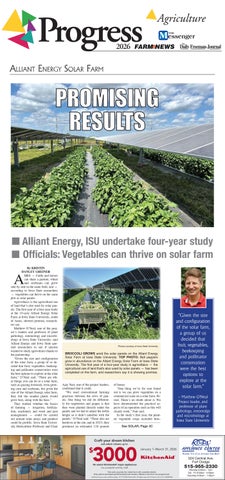
BROCCOLI GROWS amid the solar panels on the Alliant Energy Solar Farm at Iowa State University. TOP PHOTO: Bell peppers grow in abundance on the Alliant Energy Solar Farm at Iowa State University. The first year of a four-year study in agrivoltaics — the agricultural use of land that's also used by solar panels — has been completed on the farm, and researchers say it is showing promise.
Ajay Nair, one of the project leaders, confirmed that it could. “We used conventional farming practices between the rows of panels. One thing we did do differently for raspberries and grapes is that they were planted directly under the panels and we had to adjust the trellis height so it didn’t interfere with the panels,” O’Neal said. “There also are beehives at the site, and in 2025, they produced an estimated 120 pounds
of honey. “One thing we’ve for sure found out is we can grow vegetables on a commercial scale on a solar farm. Period. There’s no doubt about it. We have demonstrated the practical aspects of an operation such as this will clearly work,” Nair said. In the study’s first year, the planted vegetable crops included broc-
“Given the size and configuration of the solar farm, a group of us decided that fruit, vegetables, beekeeping and pollinator conservation were the best options to explore at the solar farm.” — Matthew O'Neal Project leader, and professor of plant pathology, entomolgy and microbiology at Iowa State University
See SOLAR, Page 3C
January 1–March 31, 2026
On select KitchenAid® major appliances
524 Central Ave. Fort Dodge
515-955-2330 Monday 8:30am - 7pm
*See sales associate for rebate form with complete details. Only valid at participating KitchenAid brand retailers. Rebate in the form of a prep Tue - Fri 8:30am - 5:30pm terms and conditions apply. ®/™ © 2026 KitchenAid. rightsofreserved. Printed in the U.S.A. 250838KM. *See sales associate for rebate*See formsales with associate complete for details. Only valid atcomplete participating KitchenAid brand retailers. Rebate in the form ofretailers. a prepaid card. rebate form with details. Only valid atAdditional participating KitchenAid brand Rebate in theAllform a prepaid card. Additional terms and conditions apply. ®/™ © terms 2026 KitchenAid. All rights Printed in the U.S.A. 250838KM. Additional and conditions apply.reserved. ®/™ © 2026 KitchenAid. All rights reserved. Printed in the U.S.A. 250838KM.
Saturday 9:00am - 1:00pm