Companies partner to make sustainable ammonia fertilizer in Iowa
By DARCY DOUGHERTY MAULSBY Farm News writer
BOONE — Access to more reliable, sustainable, affordable nitrogen fertilizer is starting to become a reality in Iowa, thanks to innovative, new technology that makes ammonia from water, sunlight and energy.
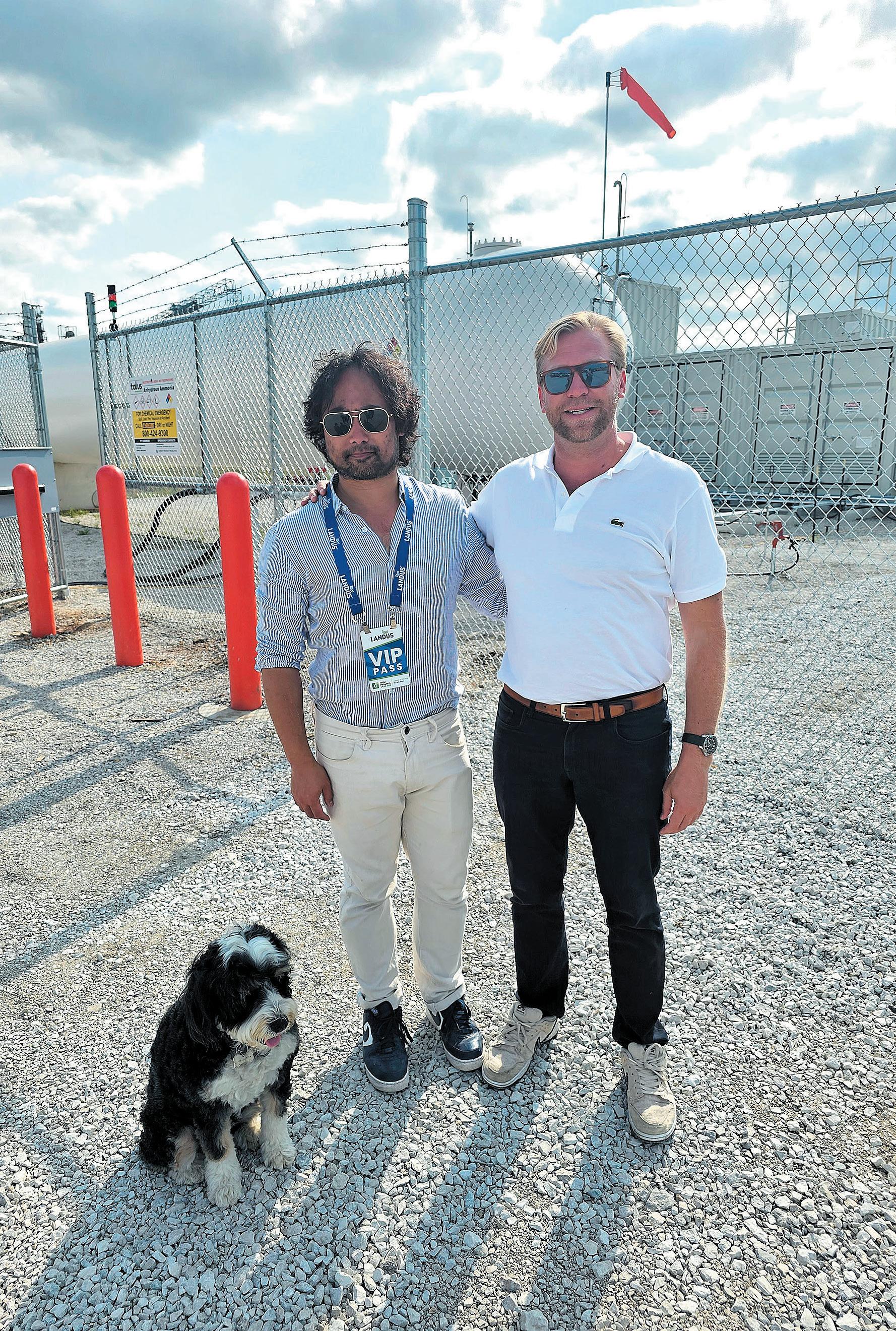
Talus Renewables, an energy technology company, has teamed up with Landus to produce eco-friendly “green” ammonia by the Landus facility near Boone, northeast of the Farm Progress Show site.
“Talus’ containerized, green ammonia solutions decrease the cost and increase the sustainability and reliability of ammonia,” said Hiro Iwanaga, co-founder and CEO of Talus, who was on-site during the 2024 Farm Progress Show.
This modern technology is changing the economics and environmental impact of anhydrous ammonia. Demand remains strong for ammonia, which is composed of nitrogen and hydrogen (NH3).
Ammonia is the secondmost produced chemical in the world by mass, according to a 2022 publication from the International Renewable Energy Agency (IRENA).
Most ammonia is used to produce fertilizer. Today, a significant source of the global nitrogen supply is produced offshore in places such as China, Russia and the Middle East. Ammonia that’s shipped to the Midwest results in high carbon-intensity (CI) scores that can impact American farms that use this fertilizer. That is especially problematic for farmers trying to lower their CI metrics to become eligible for carbon credits and other incentive programs.
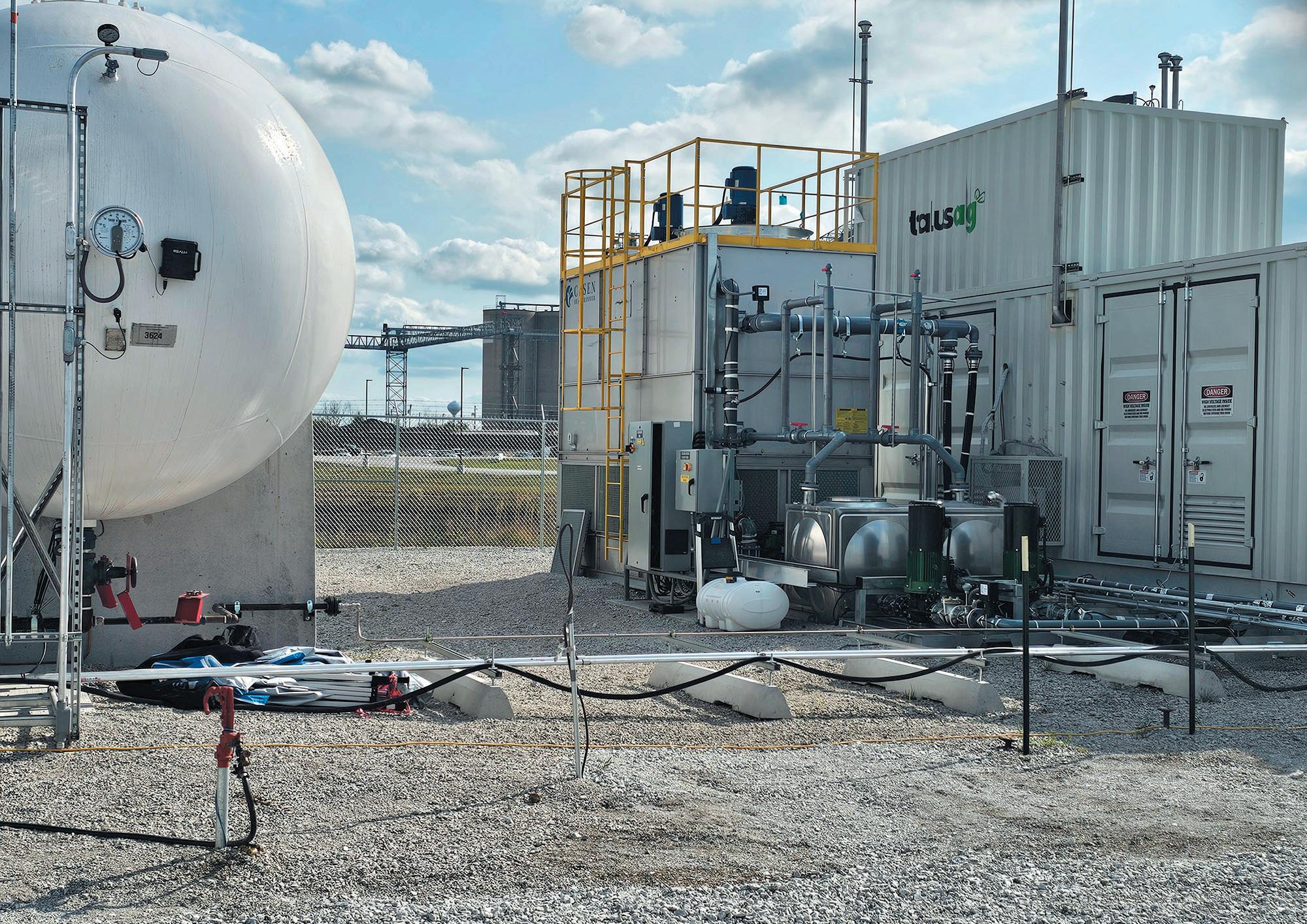
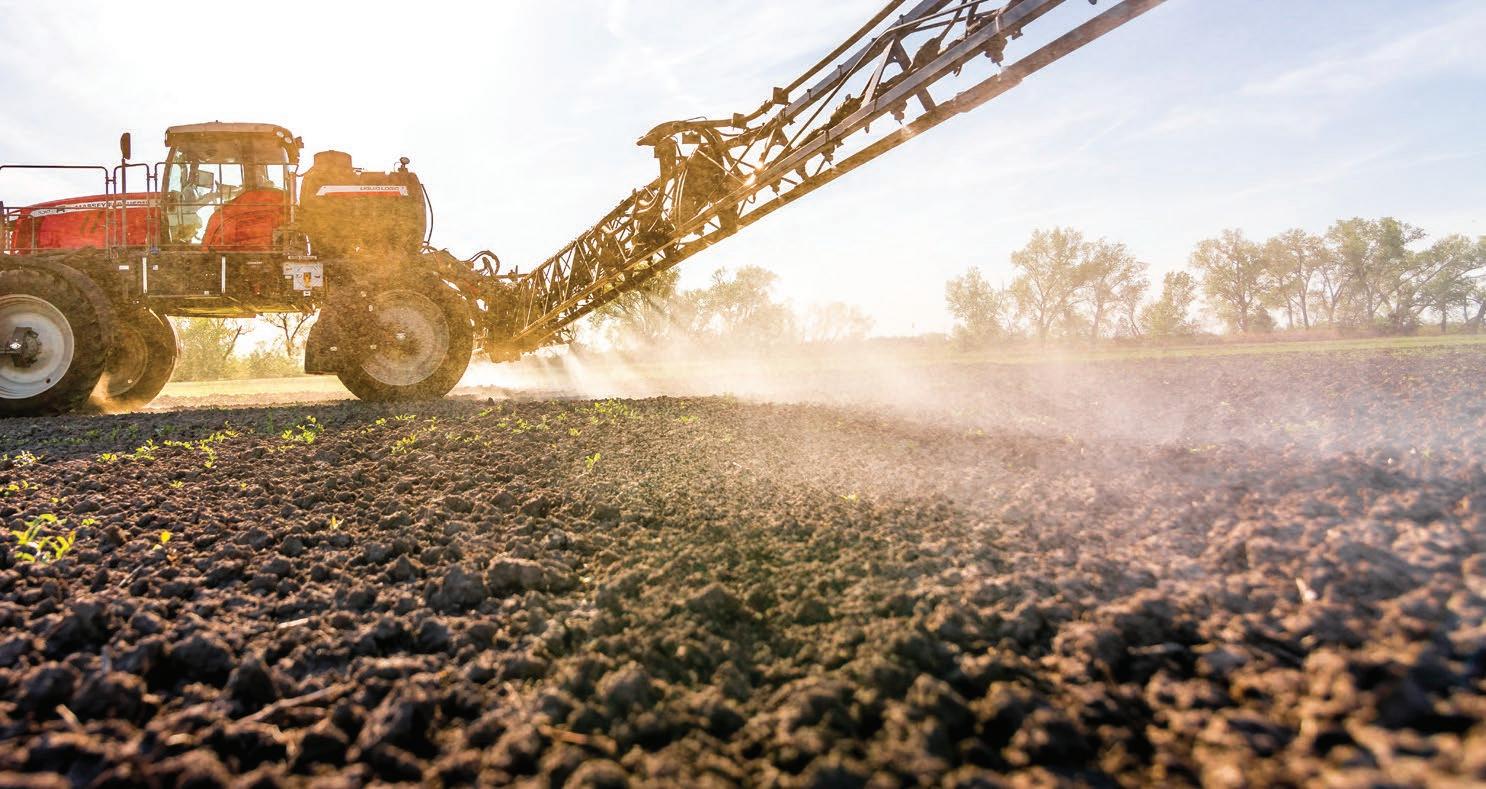
Through Talus’ innovative technology, ammonia can be produced locally, near the point of use, at a lower cost. This technology eliminates the traditional process of ammonia production that relies on extracting hydrogen from natural gas, an energyintensive process laden with carbon emissions.
The Talus system essentially uses the Haber-Bosch process,
which was developed at the turn of the 20th century to produce ammonia. (In 1908, chemist Fritz Haber combined nitrogen from the air with hydrogen from natural gas, over a metal catalyst at high pressure and temperature, to produce ammonia.)
The Talus process incorporates a key difference. It uses water instead of natural gas to make green ammonia, which is chemically equivalent to traditional anhydrous ammonia.
“We run electricity through water to split the molecule,” said Tristan Peitz, head of business development with Talus, who noted that oxygen is released during this process. “Oxygen is the only emission.”
The Talus facility’s Boone location has a capacity of 300 to 500 tons of ammonia a year.
Bringing fertilizer production closer to home will help eliminate costly links from the supply chain, said Matt Carstens, Landus president and CEO. He spoke during a ribbon-cutting event in mid-June 2024 near Boone at the Landus site, which includes a new $15 million, 75,000-square-foot fertilizer manufacturing and repackaging facility.
“We’re looking forward to bringing U.S.-made, sustainable and fully customizable fertilizers to our farmers across the Midwest,” Carstens said.
Some farmers will have the opportunity to start utilizing green anhydrous ammonia as early as the spring of 2025, according to information from Landus.
Making ammonia supplies cheaper, greener and more reliable
Talus Renewables pioneered the first commercial, modular, zero-carbon green ammonia system and brings years of experience to its latest projects. The company began operating a prototype, smallscale green ammonia system in 2012.
It all started with one key question: How do we produce
See GREEN, Page 3C

“Our
roots are in philanthropy, and our ethos is to serve smaller farmers. Talus’ initial push was to improve food security in the developing world.”
— Tristan Peitz Head of business development for Talus
and
an energy technology company that has teamed up with
to produce eco-friendly
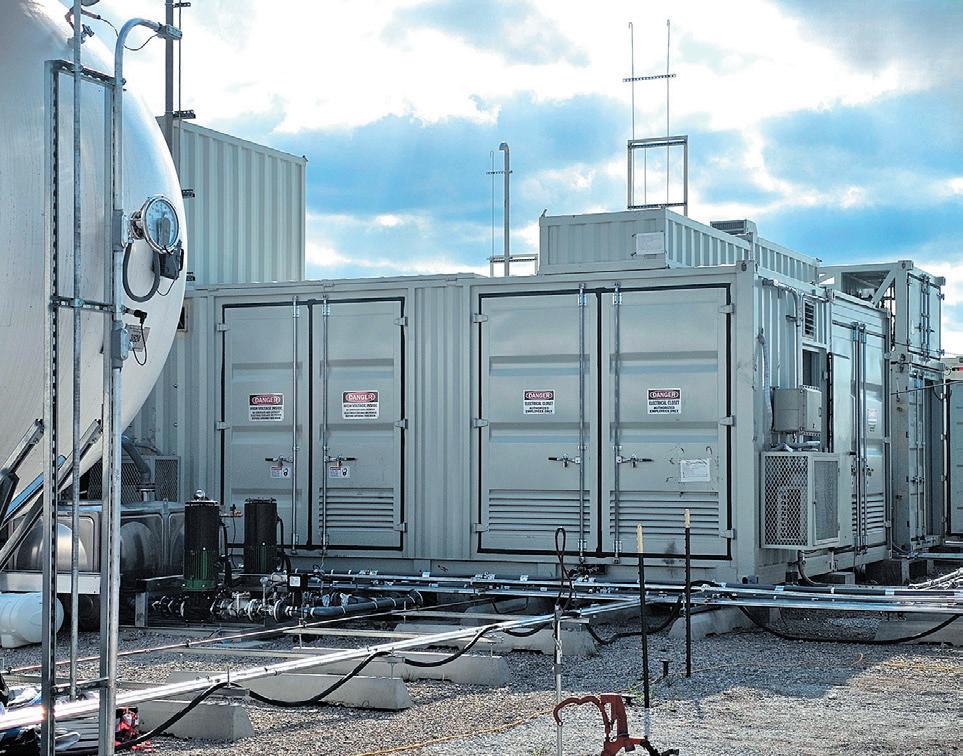
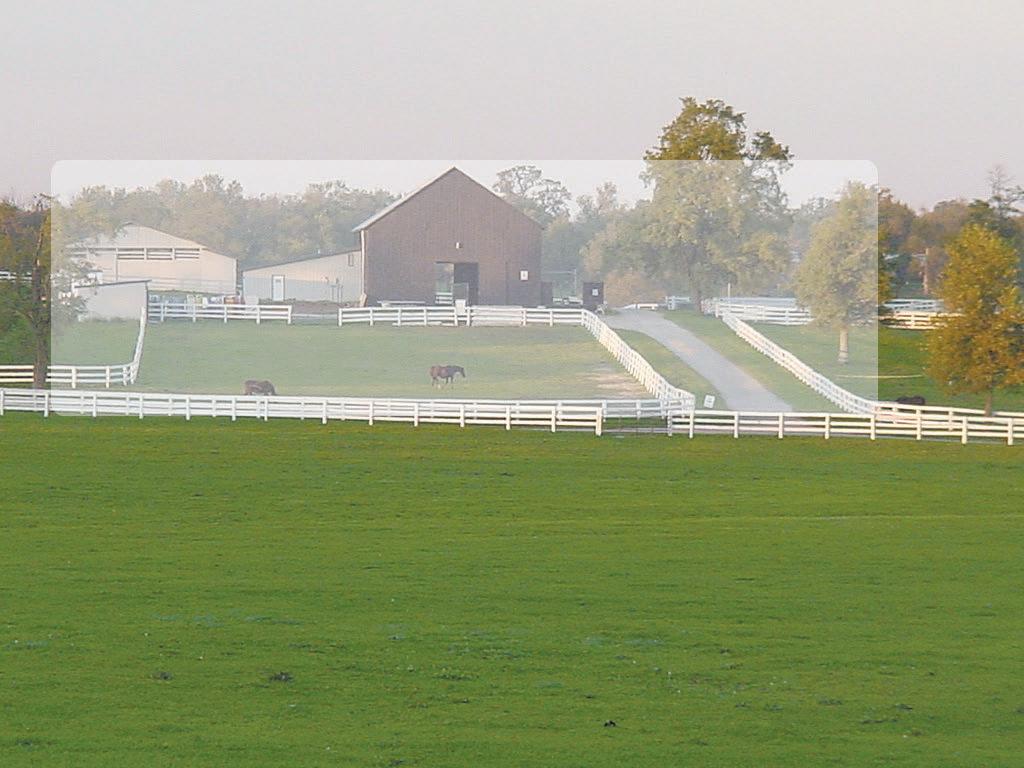
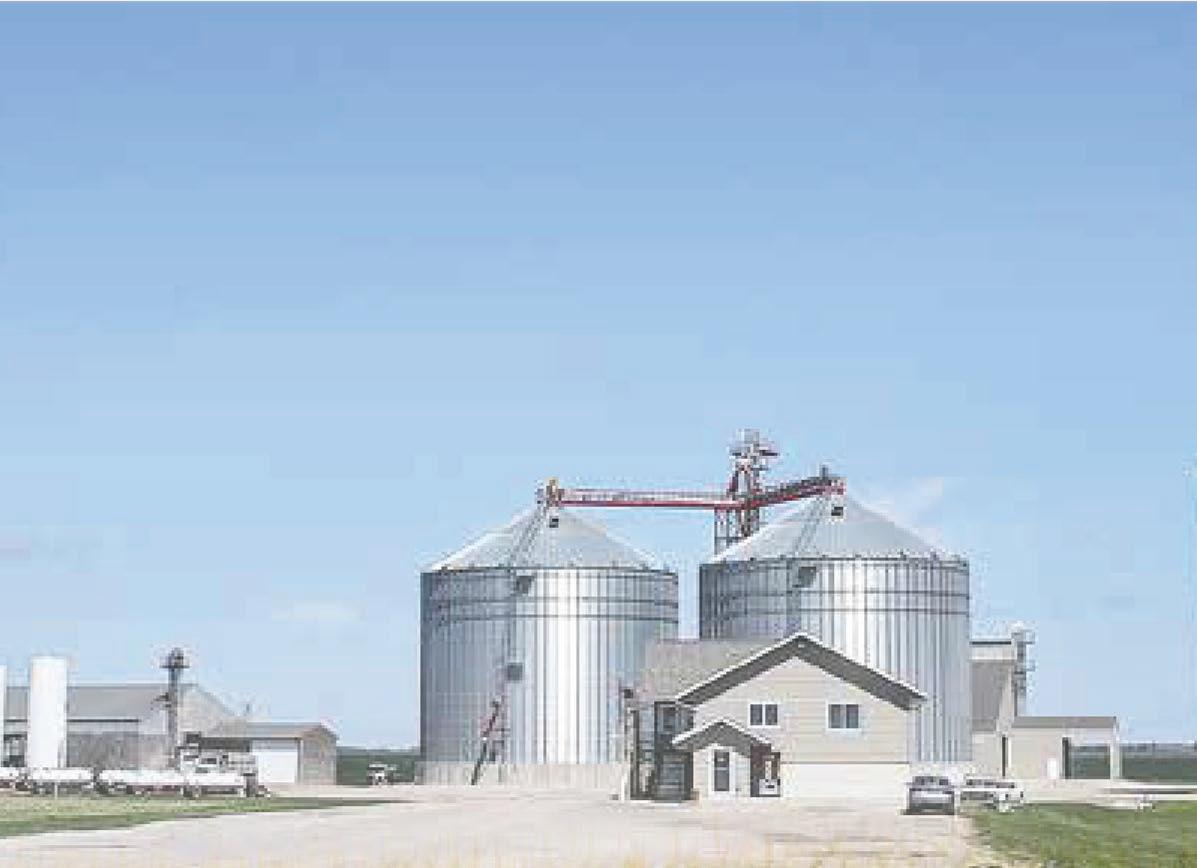
TOP PHOTO: Through Talus’ innovative technology (which operates in this facility near Boone), ammonia can be produced locally, near the point of use, at a lower cost. This technology eliminates the traditional process of ammonia production that relies on extracting hydrogen from natural gas, an energy-intensive process laden with carbon emissions.







• Represent the collective voice on the hill in Washington D.C. and Des Moines.
• Advocate for Iowa farmers related to corn markets, production and profitability.
• Connect with other industry leaders and farmers as a resource to give you an edge on making decisions for your farm.

To our members, thank you for making your voice heard. If you would like to become a member please visit iowacorn.org/join today! JoIn here:







By KRISTIN DANLEY GREINER Farm News writer
Japan looks to the United States as a supplier of corn and dried distillers grains.
Paul Gieselman, an Iowa Corn Promotion Board member from Louisa County, spent Jan. 14-17 in Japan talking about the corn harvest’s quality in the hopes of continuing that positive trade relationship between the two countries.
“The U.S. Grains Council puts together a report every year and a farmer from Missouri and myself went to Tokyo to present the report’s findings of the corn harvest quality and to talk about farming from our perspective,” Gieselman said.
The trip also helps the trade delegation reassure its international customers that the U.S. is a “steady, reliable, consistent supplier” like
it’s been for many years. As competitors with other countries, the delegation also discussed the differences between the grains coming from Brazil and Argentina compared to U.S. grain.
“There are subtle differences between the two,” he said.
“The main difference is we can provide quality, consistent, economically viable products to potential international customers.”
Recently, Japan has approved an ethanol mandate that says it must have E10 in place by 2030 and E20 by 2040.
“The potential for U.S. corn to meet that demand is immense,” Gieselman said. “They have goals for carbon neutrality by 2040.”
Gieselman said the trip included a visit to a wet mill and a full day of discussions with potential end users of ethanol blends.
“As you get on the
Continued from Page 1C
nitrogen fertilizer in remote, rural areas to help increase food security?
“Our roots are in philanthropy, and our ethos is to serve smaller farmers,” said Peitz, who noted that Talus is registered as a public benefit corporation.
“Talus’ initial push was to improve food security in the developing world.”
Much of the company’s initial work focused on serving farmers in sub-Saharan Africa, where nitrogen fertilizer for growing crops is extremely expensive and difficult to obtain. In some of its projects in Africa, Talus’ technology has harnessed electricity from in-house solar farms to convert hydrogen into fertilizer.
The war in Ukraine has made Talus’ technology even more timely and important.
“With the Ukraine war, there’s been a significant disruption in global supply chains for fertilizers, among other commodities, particularly for African countries, which receive their major fertilizer supplies from Russia and Ukraine,”
Iwanaga said in a statement.
Making the production of ammonia cheaper, cleaner and more reliable, with minimal water usage, can help farmers around the world increase their productivity and boost their profit potential. This carbon-free technology can lower the cost of nitrogen fertilizers by 50%, according to Talus.
“As you get on the international stage, it becomes even more important to establish these relationships and show them we’re active and interested. These relationships are incredibly important to continuing to do business with our customers.”
— Paul Gieselman, on Japan trip
international stage, it becomes even more important to establish these relationships and show them we’re active and interested. These relationships are incredibly important to continuing to do business with our customers,” he said.
“This trip focused on Japan and Mexico since they’re large

importers of corn in all forms — DDGs, ethanol, raw.”
Gieselman also has gone on international trade trips to China, Guatemala and Canada, as well as several domestic trips.
“About every 10 years, I go on a mission trip,” Gieselman said. “They’re very intense, with all hours consumed with work. No down time.”
As a fifth generation family farmer who has farmed for more than 25 years, it’s even more important to Gieselman personally to help create export outlets. He and his wife have three boys who are interested in helping on the family farm in the future.
The global importance of ammonia inspired Talus’ company name, Peitz said. In human anatomy, the talus bone is located in the ankle joint, between the heel bone and the two bones of the lower leg. Even though the talus is small, it plays a big role in a person’s ability to
stand and move.
“The talus bone is critical for stabilizing your entire body, but it’s often overlooked,” Peitz said. “Likewise, ammonia is a critical raw material that stabilizes global food production, but its important role is often overlooked.”
Farmers aren’t the only ones who can benefit from Talus’ ammonia production systems, Peitz added. There are additional applications for this technology in mining, maritime shipping and more.
“The promise of rapidly deployable, modular, autonomous,




green ammonia systems will extend far beyond agriculture to industrial and renewable energy applications,” said Iwanaga, a Stanford University graduate and entrepreneur.
Powering rural economic development
Talus is planning to build more green ammonia facilities around the globe, from Spain to Eagle Grove. In America, these systems have been designed to work under the strictest interpretations of the 45V clean hydrogen production tax credit from the federal government, according to Talus. Green ammonia production also creates opportunities for rural economic development, Peitz said. The company has been working with various rural electric cooperatives, including ones in Iowa, to figure out how to manage their power load.
“Electricity is the biggest part of our cost-of-goods sold,” Peitz said. “It has been fantastic working with rural electric cooperatives. Their service is great, and they are key parts of their rural communities.”
Depending on how green ammonia technology evolves, farmers may someday have the option to have their own onfarm ammonia production plant.
“Producing green ammonia in rural Iowa is a natural fit,” Peitz said. “We want to enable more economic development in rural areas.”



































































































By DARCY DOUGHERTY MAULSBY Farm News writer
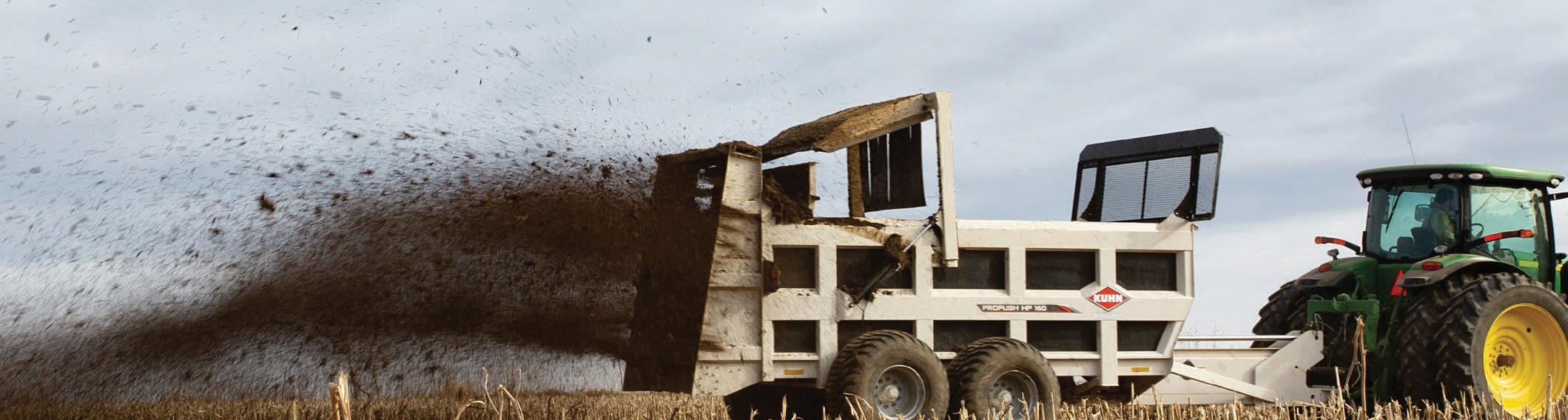
KLEMME — What if you could apply manure during the growing season to help feed the crop when it needs the nutrients?
It’s a reality on Brent Renner’s farm near Klemme, where he’s been using an autonomous application unit called 360 RAIN.
“I wanted to find a way to sidedress swine manure,” said Renner, a corn and soybean grower. “My goals are to spread less manure over more acres and get the same or higher yields.”
Renner has been using his 360 RAIN machine for the past two years. He has participated in a 30-acre trial with Iowa State University, plus he is using the technology on an additional 150 acres this year.
In early August 2024, Renner partnered with ISU Extension and Outreach to host the “In-Season Manure Application with Irrigation Field Day” on his farm. Attendees got an in-depth look at 360 RAIN, which applies irrigation water or diluted manure to the base of a growing crop throughout the growing season.
Not only does the technology help reduce nutrient losses, but odors are minimal as the manure is applied, said Renner, who drilled a separate well to feed his 360 RAIN machine.
Creating nutrient-rich “million-dollar rains”
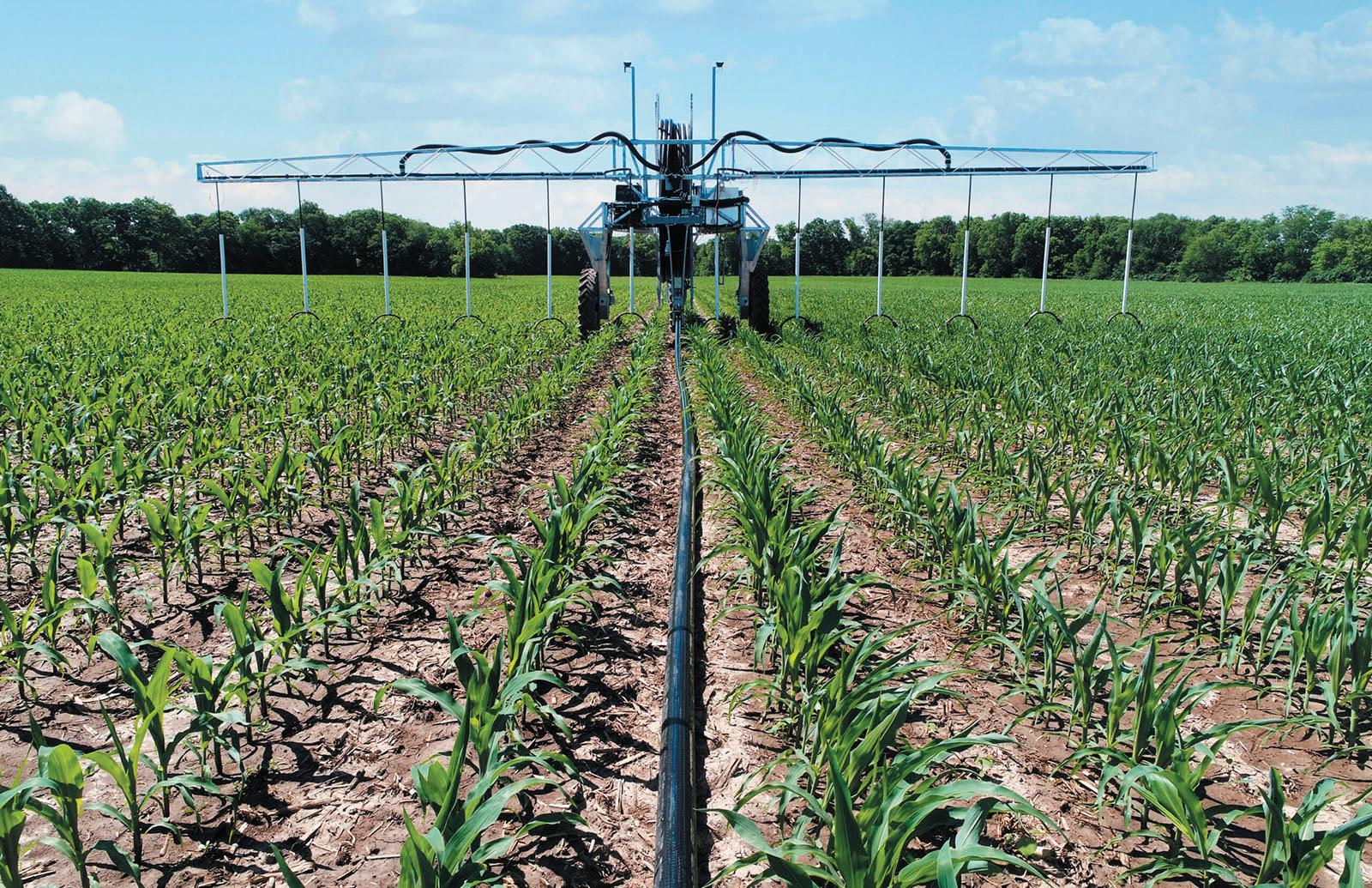
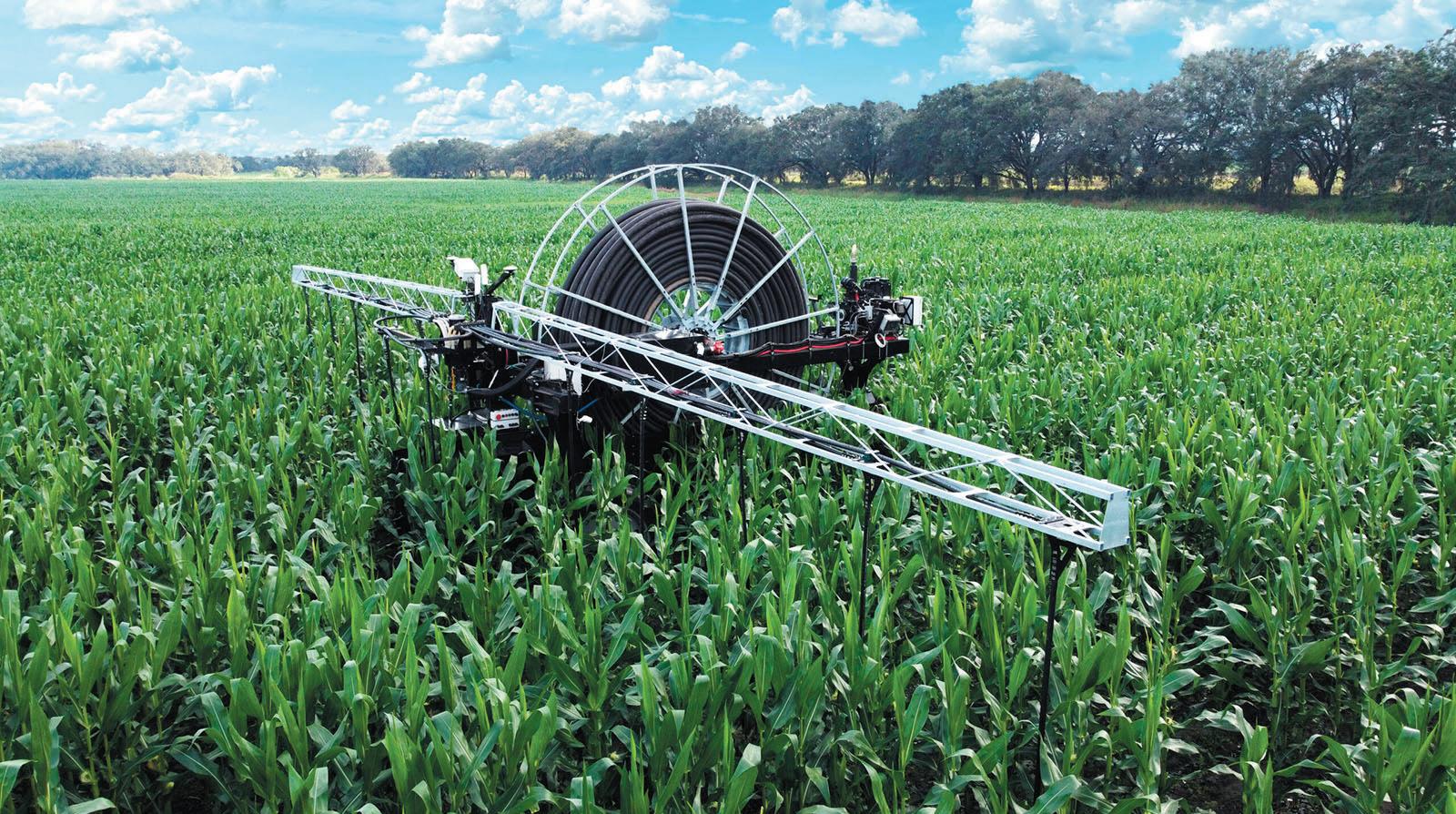
Developed by the 360 Yield Center in Morton, Illinois, 360 RAIN is a three-wheeled electric vehicle powered by a 24-horsepower diesel engine. The machine’s booms apply water and nutrients through Y-DROPstyle hoses. Machine guidance is provided through RTK (Real-Time Kinematic) and communication through a cellular network that provides the control, coverage and rate instructions.
“It can drive to all four corners of my field, and it puts water and nutrients exactly where I want by the plant roots,” said Renner, whose machine has a 60-foot boom.
A 360 RAIN machine can apply hog manure, nutrients from dairy lagoons, or nutrients like UAN. A computer-controlled reel dispenses 3,000 feet of 3-inch diameter, flexible hose. As the machine moves, the reel dispenses and retrieves the hose, so the hose never drags on the ground.
At 0.45 miles per hour, 360
“I wanted to find a way to side-dress swine manure. My goals are to spread less manure over more acres and get the same or higher yields.”

— Brent Renner, Klemme-area farmer
RAIN can apply more than 2 million gallons of water per week. That’s the equivalent of a half inch of rain over a 160-acre field from a well producing 215 gallons per minute.
There are roughly 100 of these machines in use across the country, said Larry Geerts, an Iowa-based regional manager with the 360 Yield Center.
“This machine can work 24/7 from germination to pre-harvest,” he noted. “It lets you create a million-dollar rain with tremendous yield response.”
Better nutrient use, higher yields Research shows that the 360 RAIN technology can help farms manage manure better.
“The in-season nutrient application offers the potential for improved nitrogen utilization,” said Dr. Daniel Andersen, an associate professor of manure management and water quality in the Department of Agricultural & Biosystems Engineering at ISU. “I’m also excited to see how this automated machine may save labor associated with manure management.”
In recent years, Andersen and his
colleagues have conducted tests at the Northeast Iowa Research Farm near Nashua to study how manure application timing impacted crop performance and nitrate leaching to tile lines.
“Our work showed opportunities for improved manure use, if we could find ways to move manure application timing closer to crop demand,” he said.
When 360 RAIN was announced publicly in 2021, ISU researchers took note.
“We want to find better ways to improve nutrient-use efficiency, while reducing the risk of nutrient loss to sub-surface drainage,” said Kapil Arora, a field agricultural engineer with ISU Extension and Outreach. “Key aspects of 360 RAIN include yield improvement from consistent and timely watering, the ability to introduce manure or critical nutrients throughout the growing season past the V4 corn growth stage, and lowering off-season manure application costs.”
The 360 RAIN machine does a great job of navigating through
growing corn, and the manure injection pump works well, Andersen noted.
In 2023, researchers collected soil data from their 360 RAIN trials.
“The plots that received spring manure applications had twice as much residual nitrogen, compared to those that received manure inseason using the 360 RAIN unit,” Andersen said. “Given the growth season in 2023, it was exciting to see that adding manure with some water enabled corn to take up and use the nitrogen. We also saw a nice yield improvement on the plots receiving irrigation water last year.”
Boosting resilience to dry weather patterns
Some pre-planning is required when using the 360 RAIN machine.
“When you’re planting, you need to map field passes so that 360 RAIN can follow your path and avoid running over corn,” Andersen said.
Also, it can be a good idea to dilute the manure to ensure you hit your target nitrogen application rates, Andersen said.
“Plan ahead to cultivate a water source, like a well or a pond, to acquire that water when fertigating with manure.”
The 360 RAIN technology offers exciting opportunities for mitigating methane emissions from manure storage by limiting the amount of manure being stored, Andersen said.
Also consider carbon credits.
“While the carbon credit market is still new and developing, we see great potential for taking advantage of this to help fund technology like 360 RAIN.”
With 360 RAIN bringing innovation to irrigation, this machine offers some interesting possibilities, especially with drainage water recycling (the irrigation of tile drainage water back onto cropland).
“The 360 RAIN machine offers potential resilience to different weather patterns,” Andersen said.
“With the dry growing seasons in 2021, 2022 and 2023, we’ve seen more interest in irrigation and its potential value.”
Some poor-performing soils with low corn suitability ratings (CSR) may benefit the most from this technology, Arora noted, although more research is needed.
Renner is optimistic. “This is a big investment, but long-term I think it makes sense. This is amazing technology.”
































Excellent yields but not enough sales outlets presented problems for producers this year. Ralph Lents, president of the Iowa Corn Promotion Board, has farmed for more than 45 years near Greenfield in Adair County, raising corn, soybeans and hay, along with caring for a cow herd. He described 2024 as a rough year profitability wise.
“The big issue is our trade is down a little bit,” Lents said. “We need some more trading partners, plus ethanol needs to pick up. We need year-round E15 sales. Trade and ethanol is where we can make the quickest gains immediately.”
The new administration might end up costing producers, too, Lents said.
“The proposed tariffs, well that’s a very big concern for us. We’re up against the wall right now. Two of our biggest trade partners are Canada and Mexico. We need them badly,” Lents said. “Mexico is our No. 1 corn exporter and tariffs imposed there will hurt us. Canada is a big ethanol user and tariffs will be problematic there, too. A lot of our P&K (phosphorous and potassium) is imported. If tariffs are imposed on those, it’s a double whammy.”
Looking ahead to 2025, Lents doesn’t see a lot of opportunities to reach a profitable margin.
“There might be a couple of possibilities come spring, depending on the weather, but there’s just not much more profitability potential in corn and soybeans,” Lents said. “I’m expecting more profitability in corn than soybeans, so I’m looking for a lot of people to not grow as many soybeans. There’s no way we can make money off those bigger switches in acres than expected.”
If he hits 225-bushel yields, Lents said he’ll make a bit of profit and 200-bushel corn will only allow him to break even.
“Beans aren’t even close,” he said. “I’m extremely concerned what can happen to this corn
market if we get extra acres.
Then Mother Nature always has the last say and bankers might not loan enough money to plant acres to corn. They might be more selective.”
Luckily, Lents doesn’t need to purchase any equipment, but has been focusing on repairing what he already owns. His cash flow wouldn’t allow him to buy anything new anyway, he said.
“In eight or nine years, we’ll be growing another billion bushels of corn on the same amount of acres we plant now. We raise more corn because we’re getting better at it. Genetics are improving. But we need somewhere for it to go. We have to create demand,”


Lents said. “That’s what we’re trying to do at the association. More demand and more uses for corn. The road that gets us there the fastest is trade and ethanol.”
Chad Hart, economist with Iowa State University Extension, said corn’s the “best house in a bad neighborhood.”
“While it looks sad, it looks better than other crops and that’s the challenge. When looking at corn, we ended up on an up note, but it hasn’t been a strong up note,” Hart said.
“In 2024, we watched those prices, especially in the middle of the year, drop like a rock. Corn did have some upward momentum after harvest, but
it wasn’t enough to lift prices to where farmers need them to be.”
On Jan. 2, Hart said he saw improvement in prices, but not enough to cover costs.
“Costs seem to be coming down, but not as much as prices went up. I’m expecting a little bit of a decrease in cost structures in 2025. Fertilizer prices have been down the past couple of years, but seed costs and labor costs have gone up,” Hart said. “When you think about overall costs, they’re moving in the right direction, but not moving fast enough and prices haven’t been able to rebound. That’s why farmers are feeling more squeezed.”






















































By DARCY DOUGHERTY MAULSBY Farm News writer
JEFFERSON —There’s a mystery in the Greene County Courthouse — and it’s hiding in plain sight on the rotunda floor in this grand, 100-plus-year-old building.
Who created the “Greene County, Iowa: The Land of Plenty,” ceramic tile mosaic featuring a large cornucopia of corn?
“We did our research, and the closest we ever found was a mention that the mosaic was installed by a local craftsman,” said Don Van Gilder, a retired assistant Greene County engineer and unofficial courthouse historian.
Measuring 14 feet in diameter, the artwork features roughly 50,000 pieces of tile.
“The tiles vary in size from threefourths inch square to very tiny, irregular shaped pieces,” Van Gilder said. “This artwork displays a great deal of skill and ingenuity.”
The question about who created the mosaic emerged around 2010, when famed Iowa columnist Chuck Offenburger was standing in the courthouse rotunda, gazing at the mosaic. When Van Gilder walked out of his office, the pair admired the size, color, intricacy and artistry of the corn mosaic.
To find more answers, Van Gilder and other county officials reviewed the original blueprints for the courthouse, the architects’ notes, board of supervisors’ meeting minutes, and stacks of 100-year-old articles from the Jefferson Bee and the Jefferson Herald.
They came across many names of people involved in the design, construction and finishing work on the courthouse. They learned that the current building was built at a cost of nearly $180,000. They noted that groundbreaking for this remarkable courthouse started in 1915, and the building was dedicated on Oct. 27, 1917 — an event that attracted 10,000 people.
They discovered the names of the artists who completed the murals on the sidewalls at the top of the rotunda. But they struck out on finding the identity of the mosaic’s artist (or artists).
“It’s still a mystery,” said Van Gilder, a member of the “Courthouse 100” committee, who planned the courthouse’s centennial celebration in 2017.
That’s where the tall corn grows
This historic courthouse is the third center of government dedicated to serving the people of Greene County. The first (a one-story wooden structure that doubled as a schoolhouse) was built in 1856 on the town square in Jefferson. (Prior to this, a local judge held court in a log cabin southeast of Jefferson, after Greene County was organized in 1854.)
A new courthouse (a two-story building
General information: BioEmpruv is a biological fermentation extract containing a host of di erent substances that accomplish numerous actions within a corn plant. BioEmpruv contains biologically derived extracts, enzymes, vitamins, minerals, natural growth regulators and simulators, antioxidants, amino acids and bases and more. It also contains natural phytoalexins to boost the corn plants’ immune system and to increase the resistance to disease and pathogens as well as to environmental stresses. BioEmpruv contains natural and biodegradable ingredients. No chemicals or residues. BioEmpruv will be your best line of defense against Goss’s Wilt and other bacterial leaf diseases. Curative & very systemic. Much wider application window. Developed by PhD biochemist Dr Awada, Logan, UT.


MEASURING 14 FEET IN DIAMETER, this ceramic tile mosaic features roughly 50,000 pieces of tile, forming the centerpiece of the rotunda floor in the Greene County Courthouse in Jefferson.
ABOVE: On the Panama-Pacific International Exposition grounds, the Iowa Commission had a massive cornucopia display built — about 30 feet tall and 40 feet wide. Huge signs with “Iowa” on them flanked both sides of the horn of plenty, which was emblazoned with the words, “The Land of Plenty.” Spilling out from this cornucopia were 400 bushels of Zeller seed corn.
referred to as the Red Brick courthouse) was built in the town square in 1870 to replace the original courthouse. By the late 19th century and early 20th century, however, it was clear the Red Brick courthouse was inadequate.
“Greene County was growing fast back then, especially with the railroad coming to the area,” Van Gilder said. “The second courthouse was condemned because of fire hazards, and the new one was built to be as fireproof as possible.”
This third courthouse was a work of art. Designed in the Beaux Arts style, the elegant building incorporated prominent features that were much more common in state capitols and federal buildings than rural county courthouses.
“It’s a real gem on the prairie,” Van Gilder said.
Greene County’s agricultural heritage — combined with a major national event in 1915— inspired the corn theme that accents the rotunda.
Back then, the Panama-Pacific International Exposition (similar to a world’s fair) was held in San Francisco, California, between February and December 1915. Among the many exhibitions and contests held at this extravaganza, which attracted more than 18 million people, was a competition for best seed corn.
In west-central Iowa, plenty of people already knew that Willard Zeller
of Franklin Township in southern Greene County was developing the best seed corn around. He had refined and improved the trusty Reid’s Yellow Dent Corn, which he’d originally purchased in Illinois.
“All this started a few years before 1915, when Willard entered what he thought was really good corn in a contest in Omaha,” said Van Gilder, referring to the 10 ears of corn that Zeller exhibited in the National Corn Show. “When he got 13th place, he vowed he’d never be 13th in anything again.”
Zeller got serious about breeding top-quality corn after the “unlucky 13 fiasco.” He took two of his highestyielding ears of corn from the group he exhibited in Omaha, including one that produced 118 bushels per acre, and another that produced 105 bushels. His corn breeding efforts paid off, as he won top honors at corn shows around the Midwest and beyond.
By 1915, he formed Zeller Seed Company. He and his son Earle Zeller took their best 80 ears of 1914 corn to San Francisco, where their entry won the world championship. Back home, the state’s “Iowa Commission for the San Francisco Exposition” saw an opportunity to launch a new promotion, featuring Iowa as “The Corn State.”
They sent representatives to Zeller’s farm and bought all the ears of corn
The Broad Spectrum Disease Prevention
Bio-Empruv * Commercially applied to spuds, sweet and eld corn since 2014. It has increased corn yields from 10-90 Bu/A, depending on application timing and infection rate. Keeps plants green and lling until natural maturity (BL) is reached. Drydown with normal senescent plants let the healthy ears dry faster and earlier than corn and grain from a die down plant.

Foliar Application
• Produces a systemic e ect in the plant. For best result apply 8 oz at V6 to VS and 24 oz at V12 to V14 before the plants get too tall. Apply along with a high quality surfactant like Argosy at 1 qt/100 gals

available — 400 bushels of it. Each ear was carefully wrapped individually in newspapers, placed in barrels and shipped in a boxcar destined for San Francisco.
On the Panama-Pacific International Exposition grounds, the Iowa Commission had a massive cornucopia display built — about 30 feet tall and 40 feet wide. Huge signs with “Iowa” on them flanked both sides of the horn of plenty, which was emblazoned with the words, “The Land of Plenty.” Spilling out from this cornucopia were 400 bushels of those splendid ears of Zeller seed corn.
“This gave Iowa national recognition as a major corn-growing state and put us on the map,” said Van Gilder, who grew up on a farm in Greene County.
Inspiring awe Around this time, county officials back in Jefferson were studying the proposed designs for the new courthouse. Greene County Auditor B.S. McCully suggested to the board of supervisors that the cornucopia display in San Francisco be designed right into the floor of the rotunda — and it was.
“(That design) especially ‘belongs’ to Greene County, for the reason that Mr. Willard Zeller furnished all the corn, which made up the big pile flowing from the mouth of the horn,” reported the March 14, 1917, edition of the Jefferson Bee.
Following this massive achievement, the Zeller family’s seed business thrived in Jefferson for the next few years. The company went bankrupt by 1922, however, devastated by a farm recession that swept the heartland before the big stock-market crash of 1929.
While Willard Zeller and his family left Jefferson around 1927 and moved to California, the legacy of their awardwinning corn endures in the Greene County courthouse mosaic, which also features sheaves of golden grain in the outer circle of the design. There’s a debate about what those bundles of grain represent. Some say they’re oats, which would have been a major crop in 1917, while others suspect they’re wheat, which dominated Iowa crop production into the 1880s.
In any case, the striking, corn-themed cornucopia mosaic never fails to capture people’s imagination when they visit the courthouse, which is listed on the National Register of Historic Places.
“I worked in this building for nearly 45 years, and I’d often see people stop and gaze at the cornucopia,” Van Gilder said.
Natural light filtering through the stunning, stained-glass dome 60 feet above the main-floor rotunda illuminates the impressive mountain of corn depicted in “The Land of Plenty.” “It gives you a feeling of awe,” Van Gilder said.

Contact: Marv Mortensen 515-370-3381 • Bob Strelt 515-709-0143
























By KRISTIN
GREINER Farm News writer
In 2024, land values in Iowa dropped an average of 3.1%, bringing the statewide average for land prices to $11,467 per acre as of November 2024. So what’s the outlook for land values in 2025?
Rabail Chandio, Iowa State University Extension economist, wrote that the drop in farmland values wasn’t unexpected.
In November 2023, nearly half of respondents to the 2023 Iowa State University survey anticipated a decline in land values for 2024, with 30% predicting decreases of less than 5%. The observed 3.1% decline aligns with these expectations. Additionally, nearly 70% of respondents believe land values remain higher than they should be and 58% expect further declines in the coming year due to downward pressures from falling commodity prices, consistently high interest rates and elevated input costs.
However, despite the declines, most values remain above 2021 levels when land values first surged during the pandemic. Factors that contributed to the shifts in Iowa farmland values include limited land availability, stronger-thanexpected crop yields, ample cash and credit availability, along with persistent demand
from both local buyers and investors that altogether have prevented sharper declines.
Despite challenging weather conditions, Iowa's corn and soybean yields reached 213 and 61 bushels per acre, respectively, demonstrating resilience and boosting the market. Additionally, investor interest, encouraged by inflation concerns and a lack of alternative investment options, provided further stability.
“However, these positive influences were outweighed by negative factors, including declining commodity prices, higher input costs and elevated interest rates. Farm income trends depict the challenges facing the farmland market. Land values declined in eight of Iowa’s nine crop reporting districts, marking a reversal from last year’s trends,” Chandio wrote in a report.
The largest decreases were recorded in the west-central and north-central districts, which reported declines of 7.4% and 4.9%, respectively. These districts, which experienced some of the largest surges during the pandemic, are now seeing the sharpest declines.
The southern districts, which had more moderate value increases last year, are seeing smaller declines, with southwest and southeast districts each reporting a 1.7% decrease.
South-central Iowa was the only district to report an increase this year, “likely
driven by investor influence, especially for recreational land, and lower land availability,” Chandio noted.
In the 2024 survey, investors accounted for 23% of farmland sales, slightly down from 24% in 2023 and 27% in 2022, reflecting declining inflation rates. Survey respondents identified falling commodity prices as the most significant negative factor impacting 2024 farmland markets, with less than 10% citing high input costs as a concern.
However, farm income, while lower than last year, remains above the 20-year average.
“In the short term, farmland markets face pressures from declining commodity prices, high costs and high interest rates. However, the longterm outlook remains positive,

with the market expected to adapt and stabilize rather than experience a rapid collapse,” Chandio pointed out.
According to a land values report released by Farmers National Company, there are more motivated buyers than interested sellers.
“There are many factors for buyer motivation, but much of it can be explained by mindset translating to demand,” said Paul Schadegg, senior vice president of real estate operations at Farmers National Company. “Farm operators continue to be the primary buyers of ag land. Their mindset or motivation revolves around reinvesting in their farm enterprise, expanding operations, and utilizing today’s farm equipment fully. Location of land offered for sale also plays a large role in
their decision making, as often this land has not changed hands for generations and once sold, may not be sold again.”
Across the industry, land listings are down, on average, 25% from the active and accelerating value market experienced between 20202023. Throughout 2024, average land values gradually declined from the record highs reached in 2021 and 2022, dropping 5% to 10% in the past year in Iowa and southern Minnesota.
Buyer demand has weakened for poorly drained and lowerquality farms, while highquality, highly tillable farms have maintained steady interest, according to Thomas Schutter, area sales manager for Iowa and southern Minnesota.
“This sustained demand has sometimes driven auction prices for premium farmland to levels comparable to those seen two years ago. With the decline in buyer demand, alternative sale methods have become more common, particularly for lower-quality farms,” Schutter said. “While higher-quality farms are still predominantly sold through auctions, there has been a noticeable increase in the use of traditional listings and sealed bids for marketing farmland in some areas. Looking ahead, it’s important for sellers to research and understand their local market to help set realistic expectations for their farmland’s value.”








One Dow City farmer seeks to keep raising the bar when it comes to corn yields
By DARCY DOUGHERTY MAULSBY Farm News writer
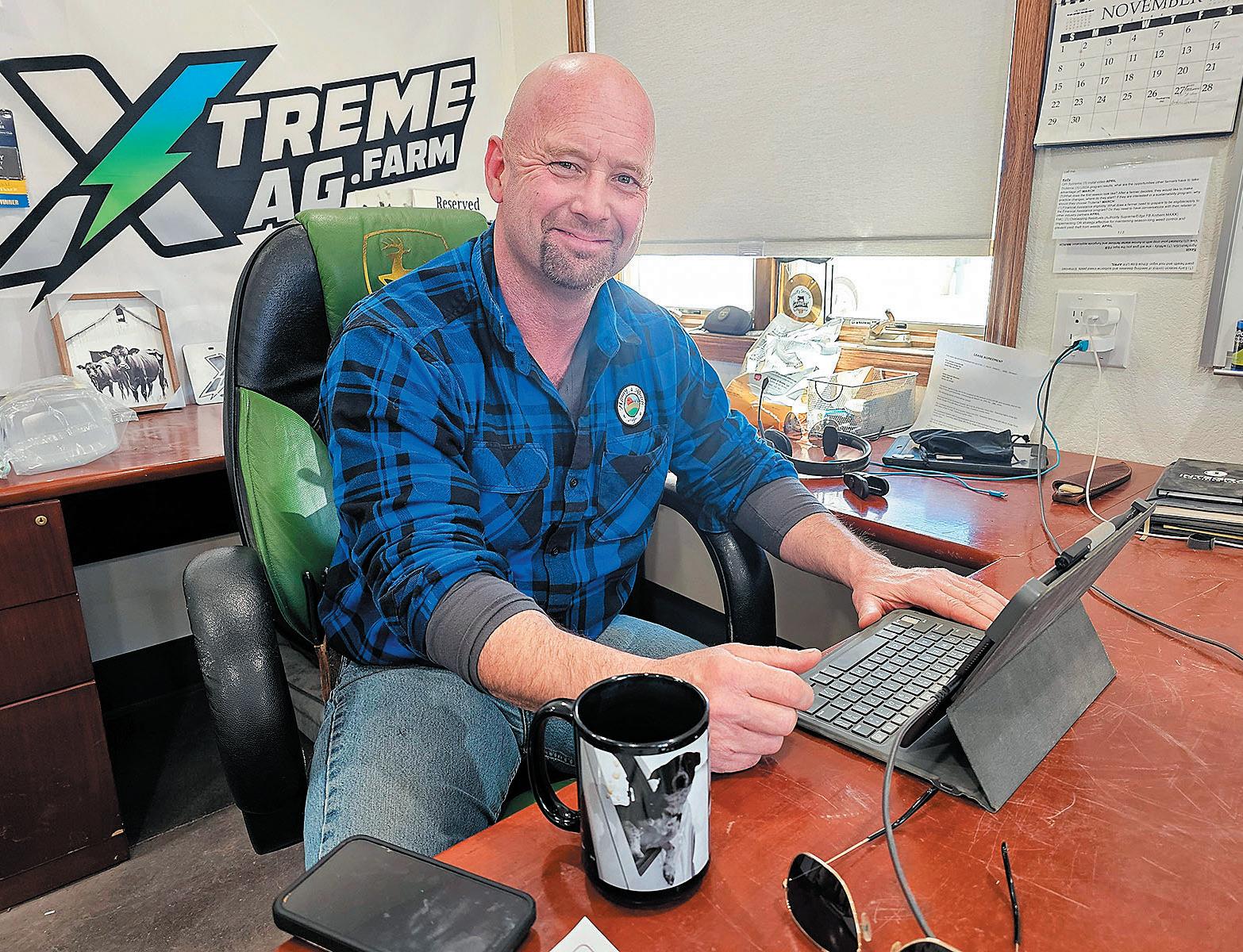
DOW CITY — Western Iowa notiller Kelly Garrett’s focus on soil conservation, sustainability and innovation has led to multiple firstplace finishes in the National Corn Growers Association’s (NCGA) Yield Contest, including strong results in the 2024 contest.
He won first place in Iowa with 335.1 bushels per acre in the no-till irrigated class in 2024. He also won first in the nation with 323.9 bushels per acre in the nitrogen management class. (Compare this to the top producers in the first NCGA Yield Contest in 1965, when the winning corn yield was 218.9 bushels per acre.)
The 2024 contest included six winning entries exceeding 400 bushels per acre. For growers like Garrett, the challenge is to keep raising the bar — and raising bigger yields.
“I want to break the highest yield that Francis Childs from Iowa got in 2002, which was 442 bushels per acre,” Garrett said.
But that’s only part of the story for Garrett, who farms in the Arion/Dow City area. He focuses on the moneymaking principles behind his 100% no-till system. When he was a featured speaker at the National No-Tillage Conference in Louisville, Kentucky, in early January 2025, he explained why balancing the soil is the top priority on his 7,000-acre farm, and how it pays to pursue opportunities in the carbon market.
Back in December 2020, news started spreading about Garrett finding a $341,000 “treasure” hidden in his Crawford County soil. More specifically, that fortune was worth $341,175 — in terms of carbon. This generated a feature story on Christmas Eve 2020 in the Wall Street Journal, when Garrett became the first farmer in America to sell carbon credits to a corporate buyer.
“Carbon credits aren’t a shell game,” said Garrett, 49, a sixth-generation farmer who runs a 7,000-acre, no-till corn and soybean farm near the Arion/ Dow City area. “They’re an incentive to farm in a more regenerative way to effect positive change, plus they can offer another revenue stream for farmers.”
Since 2012, Garrett Land & Cattle has been 100% no-till and has implemented additional eco-friendly practices, such as utilizing manure, cover crops, livestock grazing, crop rotations and more.
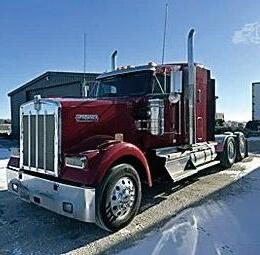
Garrett also works with the Feed Energy Company in Des Moines. His trucking company not only hauls products for Feed Energy, but Garrett gets a nutrient-rich, liquid plant food product made from a liquid byproduct of Feed Energy’s production process. He applies it to his own acres, plus he custom applies the product on 50,000 acres.
All this attracted the attention of Locus Agricultural Solutions, whose team approached Garrett in 2020 about

participating in CarbonNOW, a carbon credit program.
“I didn’t think it would amount to anything, because carbon programs in years past didn’t pan out,” Garrett said. “I was willing to try it, though, because I thought, ‘What do we have to risk?’”
Carbon markets pay off
The Locus team connected with Garrett after checking out XtremeAg (www.xtremeag.farm), which Garrett and a small group of like-minded farmers created in 2019 following an Ag PhD field day in Baltic, South Dakota. Their online platform offers a wealth of free videos, along with the opportunity for members to get farming expertise from top growers focused on enhancing crop yields and improving return on investment (ROI) and boosting farm profits.
Garrett worked with the CarbonNOW team to sell the carbon credits at $15 per credit in a carbon marketplace called Nori. E-commerce giant Shopify became the first customer when the company purchased 5,000 tons of carbon credits for $75,000 on Dec. 1, 2020.
“They wanted to offset their carbon emissions from Black Friday,” Garrett said.
Within nine months, all of Garrett’s carbon credits were sold. To put a price tag on those credits, CarbonNOW had asked Garrett to send data about his crop yields, crop rotation and fertility plan for 3,000 acres from 2015-2019. The company took this data and also used algorithms to run some numbers.
After going through the documentation and verification process, it was determined that Garrett had
removed 22,745 tons of carbon from the atmosphere during that five-year time period — equivalent to offsetting the average annual emissions of almost 5,000 passenger vehicles.
“With one ton of carbon equaling one carbon credit, and one carbon credit valued at $15, that’s how we got $341,175 of carbon credits,” Garrett said.
From sustainable ag to regenerative ag
When Garrett started farming more than 25 years ago, he never envisioned anything like the carbon credit market evolving into a revenue stream the way it is today. He just tried to follow in the footsteps of his grandfather and father and look for opportunities to make the most of their hilly Crawford County farmland in Paradise Township and beyond.
“This area is part of the Dane Ridge Watershed, and my grandfather John Weiss was installing terraces and dams in the 1960s,” Garrett said. “My dad started no-tilling corn into beans. When I started farming full-time in 1998, we began no-tilling our beans into corn. By 2012, we put row cleaners on the planter and went 100% no-till.”
It’s important to be open to new ideas, stressed Garrett, who farms with his sons, Connor and Cael, along with a number of employees. “The most expensive sentence in farming? ‘I’ve always done it that way.’”
In 2016, Garrett began using drip irrigation on his acres. The system is installed 16 inches below the soil surface. Compared to a traditional pivot irrigation system, drip irrigation uses
“I want to break the highest yield that Francis Childs from Iowa got in 2002, which was 442 bushels per acre.”
— Kelly Garrett Dow City-area farmer
about 25% less water, Garrett noted. There’s no mud, since the water isn’t sprayed onto the soil surface. This also means less risk of fungal diseases that can take hold when plant leaves are wet. Drip irrigation also allows for zone treatments, from watering to fertigation.
“An acre of irrigation costs $2,500,” Garrett said. “Let’s say an acre of land costs $12,000. That means the cost of drip irrigation is 21% of the value of the land. With drip irrigation, we can add a 30% to 35% yield boost with corn, and 35% to 50% with beans. Irrigation is not expensive, relative to the value of farmland today, especially when you can achieve these yield gains.”
Taking advantage of the 45Z tax credit
This is just one of Garrett’s many goals. He also wants to make the most of the federal government’s Section 45Z credit. The Section 45Z tax credit will provide significant financial incentive for ethanol producers to make necessary capital expenditures to capture and process carbon dioxide and for farmers to increase production of low carbon intensive corn for ethanol production.
That’s where carbon intensity (CI) scores come in — along with the potential for farmers to profit from carbon credits. The lower your CI score, the better. Garrett’s score currently is a negative 6, thanks to the regenerative ag practices he uses on his acres.
“That translates to $1.925 per bushel, with the Z45 tax credit,” he said. Through XtremeAg (which now includes the XtremeAg TV show on YouTube and AcresTV), Garrett shares how he incorporates a variety of regenerative ag practices, from notill and cover crops to variable-rate technology, to boost his farm’s yield and profit potential, including carbon credit programs.
“It’s not enough to be sustainable, which means you’re just holding steady,” he emphasized. “Regenerative means you build back. It’s very much attention to detail. There isn’t one silver bullet. On our farm, we’re on two paths of regenerative ag and high yields, and these paths are converging.”


























By KRISTIN DANLEY GREINER
News writer
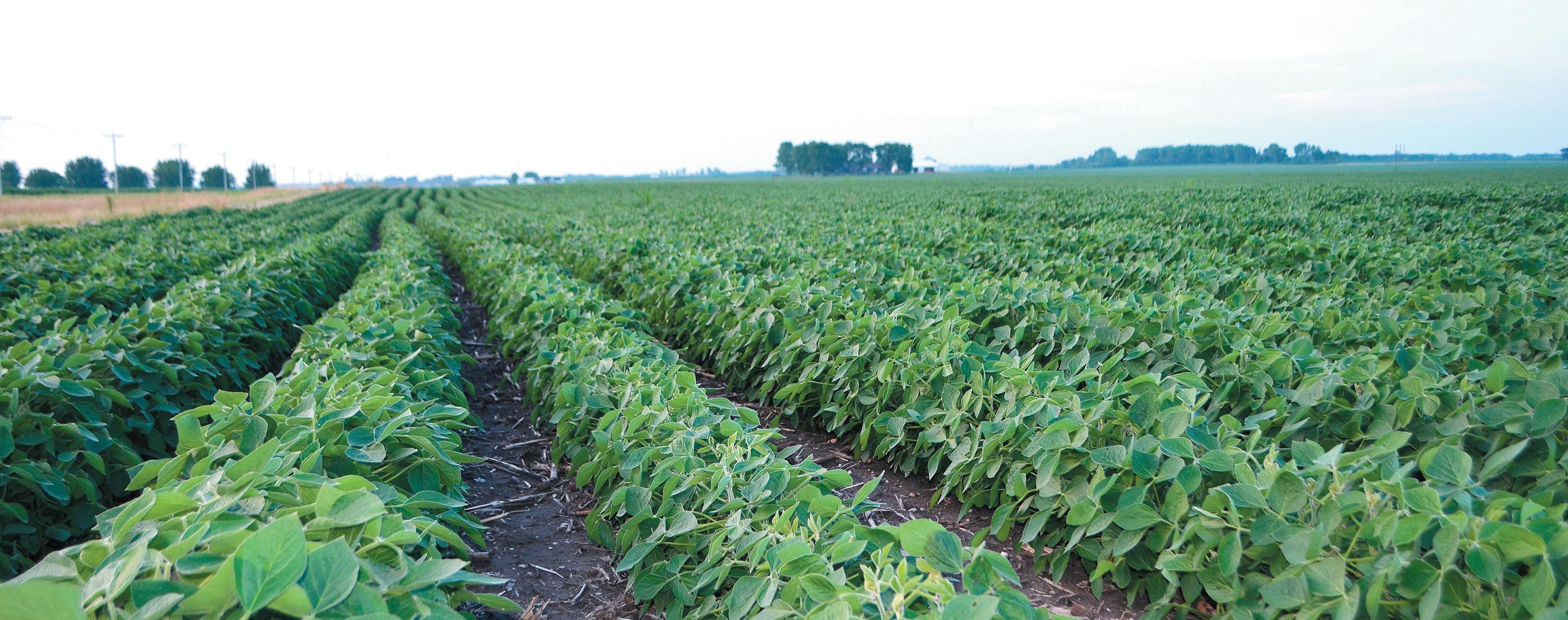
Rotating crops every planting season is a common practice for corn and soybean farmers. In fact, three out of every four acres in Iowa are rotated annually between corn and soybeans.
Planting beans on beans is a practice discouraged by many, but with the way the market has been behaving, farmers might want to consider it.
“Alternating between a cereal such as corn and a legume such as soybeans produces more bountiful yields and helps keep soil healthy,” according to Sotirios Archontoulis, an agronomy professor
“Alternating
at Iowa State University. “Repeatedly planting the same crop in the same land is like going to a restaurant and ordering steak with a side of steak.” If a crop is going to be planted back to back, it’s typically planted continuous corn. Beanon-bean rotations are more common in other countries, including Argentina, Archontoulis said.
“Demand for soybean oil is expected to surge in the coming years to ramp up production of renewable diesel, and the lower input costs for soybeans are appealing when fertilizer prices spike, as they did in 2021. But there’s almost no U.S. research into continuous soybeans,”
a legume
soil healthy.”
— Sotirios Archontoulis,
Agronomy
professor at Iowa State University
he noted.
A three-year-long project spearheaded by Archontoulis at Iowa State focuses on field trials and model simulations to determine if soybeanon-soybean rotations or continuous soybeans with a winter cover crop of cereal rye would be economically feasible and easy on the soil’s health.
“It’s not like these systems are going to take over the Corn Belt. But it’s good for farmers to have more optionst,” he said. “Our goal is to determine if this can be profitable and what the consequences are for the environment.”
The project launched in 2023 and is funded by the Iowa Soybean Research Center in partnership with

Iowa State and the Iowa Soybean Association.
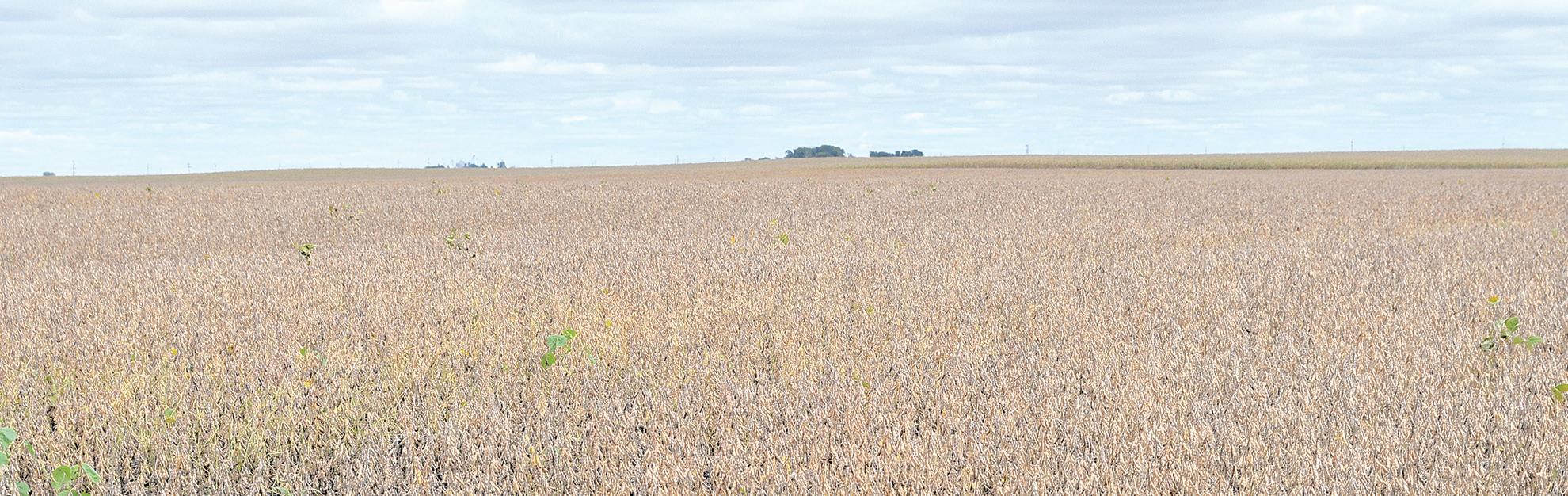
At two ISU research farms — a site near Sutherland in northwest Iowa and another between Ames and Boone — teams are experimenting with methods for planting and managing continuous soybeans. Variations include soybean-onsoybean planted at different row widths, continuous soybeans with rye cover crop and soybean-rye-soybean treated with manure, along with control plots of corn-soybean and corncorn. During the growing season, weekly drone flights checked for crop stress, and ground probes pushed eight feet deep measured water tables.
Seniors monitored soil health, and researchers tracked any incidents of soybean cyst nematodes.
In the first year, the continuous soybean plots were as productive as rotated control plots. But prior research indicates a yield penalty possibly will emerge over time, Archontoulis said. How big of a penalty is the question, he added.
“Most farmers want to start the discussion by asking about yield. If it’s a 1% reduction, that’s a discussion that can continue. If it’s 25%, that’s the end of it,” he said.
Chad Hart, Iowa State University Extension ag economist, said he doesn’t foresee farmers planting beans on beans
this year based on market behavior. In fact, he anticipates more acres planted to corn this year because they’re losing less in the markets with corn.
“Market prices are favoring corn. Even though research has shown that bean-on-bean can be useful, it depends on where prices are and, right now, that’s with corn,” Hart said. “Bean on beans traditionally isn’t done in Iowa because of concerns with diseases and pest pressure, but most farmers will tell you they plant the beans to get to the corn. They love to farm corn. Beans — they tolerate. But if it were more profitable, they would consider it.”