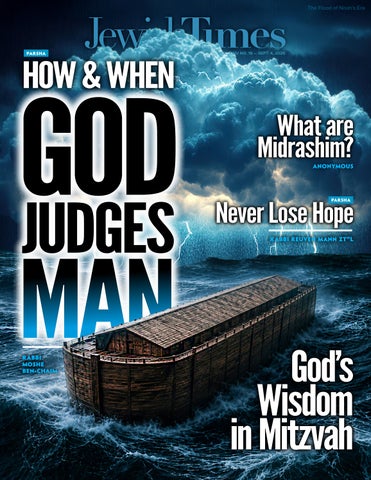
The Flood of Noah’s Era
PARSHA
HOW & WHEN
VOL. XXIV NO. 18 — SEPT. 4, 2026
What are Midrashim? ANONYMOUS
Never Lose Hope PARSHA
RABBI REUVEN MANN ZT”L
RABBI MOSHE BEN-CHAIM
God’s Wisdom in Mitzvah
the FREE
Just click any
2
|
WWW.MESORA.ORG
SEPT. 4, 2026
icon in this issue
MESORA THE JOURNAL ON TORAH THOUGHT | Please send letters and questions to: Comment@Mesora.org |
3 Repent THOUGHTS
Now is the time
3 Midrashim
RABBI MOSHE BEN-CHAIM
Examples of midrash vs. literal truths
5 God’s Judgment
RABBI MOSHE BEN-CHAIM
Maimonides’ insight into justice and human nature
6 Wisdom in Mitzvah
8 Midrashim ANONYMOUS
Major Rabbis and writings say they are metaphors
RABBI MOSHE BEN-CHAIM
The simplest area in Talmud contains primary ideas in thought
13 Never Lose Hope
7 God’s Judgment II
RABBI REUVEN MANN ZT”L
The title says it all
RABBI MOSHE BEN-CHAIM
Heeding God’s system helps ourselves crucially
| REPENT, FOLLOW TORAH |
If you are not Torah observant, now is a vital time to make that change. From Rosh Hashanna through Yom Kippur we rise early and recite selichos (forgiveness prayers). With God’s looming judgment, we return to our senses and realize that we are His creations, with conditional existence. This realization is lost throughout the year as our focus on earning, family and health obscures our mortality, and our debt to God for our very lives. God desirsd that all people benefit from a Torah life that earns us the most satisfying earthly existence, and an eternal afterlife. For there is no greater loss than losing our soul’s eternal existence once we physically pass away. Many Jews sadly reject God’s will, and some are yet ignorant. But we are fortunate for our Torah knowledge and must now apply it. Help yourself, educate others. ■
LETTERS RABBI MOSHE BEN-CHAIM
Subscribe FREE to the Jewishtimes: mesora.org/jewishtimes –––––––––––––––––––––––––––––––––––––
Articles may be reprinted without consent of the Jewishtimes or the authors, provided the content is not altered and credits are given.
Midrashim
An example of midrash is Satan accusing Abraham of losing his mind when Abraham traveled to slaughter his son Isaac. Satan is a metaphor, referring to man’s instincts, not a literal being. In other words Abraham had tremendous conflict about the command to slaughter his son, as if someone was accusing him of irrational behavior. The invention of a character called Satan is necessary, as a literal depiction of internal psychological forces are not believed by the masses since they cannot be witnessed. Sigmund Freud opened up a lecture with the same sentiment, as he told his students that he has a more difficult challenge: “You will raise doubts against me, as I do not teach about seen physical body organs, but about psychological components that are not seen.” But other times, what sounds like midrash, is not. (CONT. ON NEXT PAGE)
WWW.MESORA.ORG SEPT. 4, 2026
| 3
LETTERS SHARE
4
|
conveyed through a human "created" hand that smote them.
DANA: Did Rashi take the Midrashim literally? Exodus 7:4 says, “I will lay My hand upon Egypt and deliver My ranks, My people the Israelites.” Rashi says “A literal hand to smite them.”
Perhaps Rashi is telling us more than we already suggested...
RABBI: Rabbi Israel Chait stated that Rashi meant God used a literal hand to smite the Egyptians. But this does not mean God has a hand....it was a "created" hand, like the created plaques. God is not physical and cannot have body parts. That would be the worst heresy. Thus, the question arises as to why a hand was necessary as an additional punishment. A hand is representative of a "personality.” Meaning, this "hand" was to display disapproval, unlike the inanimate boils, hail, blood, etc. Even the insects and beasts do not convey a "will" of an authority that disapproves. So we can suggest that God deemed it crucial that Egypt senses disapproval, only
Why must God create a hand to hit the Egyptians? This we said was to indicate something all the other plagues cold not: there is a WILL that disapproves of their idolatrous ways. But God's lessons are not simple; they drive at deep and central truths. What was true about Egypt's culture? Their gods were inanimate, as King David says, "They have eyes but see not; ears but hear not, noses but breathe not..." What is God's message? God is waking Egypt up to the realization that their gods never once answered them! They took no notice, nor did they ever respond. Now, the Israelite God is responding! This was a great shock. Until that point, their entire concept of a god was of a silent carving
WWW.MESORA.ORG SEPT. 4, 2026
of stone or wood. The fact that there is a God who responds was the most startling concept, something the primitive mind would never expect. But now, not only did they face this reality, but they understood that this Power disapproved of the Egyptian belief system. Meaning, the very revelation of the true God is simultaneous with the rejection of all others, exactly as the first of the Ten Commands has it: God is one, and there is no other. Alainu says this as well. It appears we uncovered a fundamental by pondering this Rashi. Think about it again, the very revelation of the true God is simultaneous with the rejection of all others. God teaches this by demonstrating His living will through the creation of a smiting, disapproving hand: polytheism is false, idols are inanimate and powerless. Although in many other cases Rashi quoted midrash (metaphor)…here he did not. Thank you Dana for bringing this up. ■
FUNDAMENTALS SHARE
HOW & WHEN
“P
erhaps there is among you some man or woman, or some clan or tribe, whose heart is even now turning away from God our God to go and worship the gods of those nations. Perhaps there is among you a stock sprouting poison weed and wormwood (a corrupt person), who, when hearing the words of these curses, imagines immunity, thinking, “I shall be safe (from punishment) because I follow my own willful heart”—so that his moist is added to his dry. God will never forgive him. Rather, God’s anger and passion will rage against him, until every punishment recorded in this book comes down upon him, and God blots out his name from under heaven.
(Deut. 29:17-19) RABBI MOSHE BEN-CHAIM
”
“His moist is added to his dry” means God will view his prior inadvertent (moist/drunken) sins as intentional (Rashi). Rashi says further, that God says:
When a person feels safe and denies these punishments, he causes Me to combine his prior inadvertent sins with those committed with premeditation and I will exact punishment from him for everything as if all his sins were fully intentional. How do we understand God converting inadvertent sins to intentional sins? That sounds like God is changing the intent of previous sins, when you can’t change history! Furthermore, why is it discussed in a metaphor, God adds the “wet to the dry?” Just say clearly, “God is converting accidental sins into intentional sins.” Why use metaphor? Metaphor is employed because God is not literally converting the prior inadvertent sins, as we said, history cannot be altered. Ezekiel 18:24 says similarly: (CONT. ON NEXT PAGE)
WWW.MESORA.ORG SEPT. 4, 2026
| 5
FUNDAMENTALS
God’s Wisdom in Mitzvas
SHARE
So, too, if someone righteous turns away from righteousness and does wrong, practicing the very abominations that the wicked person practiced, shall they live? None of the righteous deeds that they did shall be remembered; because of the treachery they have practiced and the sins they have committed—because of these, they shall die.
This is the meaning of “I will exact punishment from him for everything as if all his sins were fully intentional.”
History remains unchanged, but his prior goodness no longer plays any role now. “God will never forgive him” precisely because this person will never repent. But a person who does repent, Torah [1] tells us that nothing stands before We derive that God judges a person in his repentance, meaning it is effective and he can be forgiven. current state: But the final question arises: If God does not recall the good of a person who becomes wicked, judging a person in his current state alone, how can Maimonides say in that very same law (Repentance 3:3) that each year God weighs a person's sins against his merits? This cannot be if God forgets all the merits! So which way Rashi: “Where he is”: According to the is it: does God retain the merits from the actions he is now doing shall he be year, or does God forget them? judged. But the answer is found in that very same law because Maimonides qualifies that God judges a person based on his the person only loses merits when he current values. “None of the righteous regrets doing them. This means that he deeds that they did shall be rememdoes not value the good whatsoever. But bered.” Maimonides writes: if he does not regret the mitzvos he Anyone who changes his mind about the performed, then he is a person who had moments during the year where he was mitzvos that he has performed and righteous and moments during the year regrets their merits, saying in his heart, “What value was there in doing them? I where he slipped and committed sins. In wish I had not performed them,” such a that case God retains both: all his good and all his evil and then weighs them at person loses all merits. As Ezekiel 33:12 states, “The righteousness of the upright Rosh Hashanna. But if one regrets all the good he did, or if he hears the curses and will not save him on the day of his transgression” (Laws of Repentance 3:3). is confident that what he did was righteous (meaning he justifies his evil), in The idolater, confident in his choice to sin, that case there is no merit to the person's can’t be corrected as he heard the curses life. and ignores them; He's following his There are two individuals that are being heart, which he feels determines reality. addressed: He feels justified in all his heart tells him 1) An individual, like all individuals, who and that the curses won't apply to him. has sins and merits throughout the year. He won’t change. His previous good This type of person, each Rosh Hashadeeds and lesser sins do not register anymore, as he has corrupted himself to a nah, God will weigh his merits against his level of evil that is irreparable. He denies sins and whichever weighs out Torah’s warnings. He is beyond help. His determines his fate. current values render him “as if” his lesser 2) One who has done good during the sins are now converted to intentional sins, year but then he becomes corrupt and does not value the good activities and and as if all his previous good deeds mitzvos. That person has no merit never took place. All previous merits whatsoever. ■ plays no role in his current state (he no longer values them), it is as if he never [1] Pirkei Avos 4:11, Maimonides Hil. performed those good actions, for his Teshuva 6:2 previous goodness does not affect him.
Rabbi Moshe Ben-Chaim
Where must one’s head tefillin straps fall? Rabba would let the straps fall entirely behind him over his shoulders. Mar bar Ravna draped the straps over the shoulders to the front of the body. Rav Acha bar Yaakov would braid the straps. (Menachos 35b).
God heard the cry of the boy, and an angel of God called to Hagar from heaven and said to her, “What troubles you, Hagar? Fear not, for God has heeded the cry of the boy where he is” (Gen. 21:17).
6
|
WWW.MESORA.ORG SEPT. 4, 2026
H
aving the straps fall behind oneself indicates a disregard, no attention or importance is given to the straps as they are inconsequential to the mitzva. Mar bar Ravna’s need to observe the straps in front of oneself indicates they cannot be degraded by being out of sight. And lastly, to braid the straps is a means of beautification. Meaning, certain mitzvas require higher respect. So the dispute is are the straps 1) of no consequence, 2) not to be degraded, or 3) they must be beautified. The category we discuss here is an object of mitzva. And relegated to this category is the question of degrading the object. Rabba held there is no status of mitzva in the straps and one need not show any respect to them, so degradation of mitzvah is inapplicable. Mar bar Ravna draped the straps in front of him, as he felt that these are objects of mitzva and one cannot degrade them by being behind him. Rav Acha bar Yaakov held that, unlike other mitzvot, the straps of the Tefillin are related to actual Torah portions in the boxes—a higher-level mitzva—and require honor, explaining why he braided them to beautify them. These three opinions cover all possible cases: 1) An object of mitzva has parts (straps in this case) that are unrelated to the mitzva and require no respect. 2) Straps are considered part of the object of mitzva and therefore cannot be disregarded. 3) Not only are there objects of mitzva, but certain mitzvos are of a higher nature and require honor. And the higher nature here is based on the Torah portions enclosed in the tefillin. Either something is: 1) not an object of mitzva, 2) it is an object of mitzva, or 3) not only is it an object of mitzva, but it has a higher status demanding higher respect—kavod—through beautification. ■
FUNDAMENTALS SHARE
RABBI MOSHE BEN-CHAIM
When God Judges
Mankind J
ust as a person's merits and sins are weighed at the time of his death, so too the sins of every inhabitant of the world together with his merits are weighed on the festival of Rosh Hashannah. If one is found righteous, his [verdict] is sealed for life. If one is found wicked, his [verdict] is sealed for death. One of in-between status, his verdict remains tentative until Yom Kippur. If he repents, his [verdict] is sealed for life. If not, his [verdict] is sealed for death. (Maimonides, Laws of Repentance 3:3)
Sodom’s Destruction
Rosh Hashanna—the Jewish New Year—is not a Jewish matter: God judges all mankind each year, not only Jews. And this is perfectly sensible as God wants the good for all peoples, since He created all peoples. With Rosh Hashanna, God gives mankind an advance warning to repent so we can live and correct our ways. No one lives eternally, so we must take to heart that our earthly stay is brief. Our eternal life must be our greatest concern. And that eternal life is earned by our ideas, values and actions here and now. We correct those through God’s Torah (Bible) guidance. It’s the only book verified as divine in origin. All other religions are mere belief, and to risk your afterlife on unproven beliefs is the worst decision, as its impact is fatal and eternal. Torah is replete with histories of God’s reward and punishments for both individuals and nations. God spared Noah but the world was destroyed. God saved Lot and destroyed Sodom. God saved the Jews and destroyed Egypt. God saved Abraham, Isaac, Jacob, the 12 Tribes, Joseph, Moses, Joshua and so many others. This validates that our actions meet with either good or evil, as Moses teaches, “I place before you life and death…and choose life” (Deut. 30:19). To earn the afterlife, our ideas about God must be true, not fantasy. Maimonides formulated the 13 Principles to this end. We must also practice proper morality. If we have wronged another, we must obtain his forgiveness. If we cheated, we must return what we stole. If we don’t follow any command, we must ask God’s forgiveness and abandon our poor ways and commence immediately to adhere to all commands. And if we have not studied God’s Torah, the greatest mitzvah, we must engage in it at once and permanently, reducing our working hours and maximizing our hours of study. We must teach our family and others all the above. Following this path, God will be kind and generous to us, just as He was to the patriarchs and matriarchs. He will bless us here, and in the next world. May you all find the clarity to follow God’s Torah for your own benefit, abandon your false religions, repent, and may God bless us all. ■
WWW.MESORA.ORG SEPT. 4, 2026
| 7
RABBIS SHARE
V
ANONYMOUS
8
|
WWW.MESORA.ORG
SEPT. 4, 2026
irtually every tractate of Talmud contains sections known as Aggadoth or Midrashim. Some include various statements of our Sages and stories regarding different people and events. Others contain moral principles, and biblical exegesis. Not all Midrashim were recorded in the Talmud. Some were compiled in separate books by various Sages, such as Midrash Rabba and Pirkei d'Rabbi Eliezer. Upon close examination of the various Midrashim a common problem often arises: they do not make sense. Some Midrashim contain passages that make sense at first glance, yet careful analysis will expose many problems. Many, on the other hand, do not make sense even at first glance. They appear to be outright absurd and irrational. Others actually contradict verses in the Torah. How are we to understand these statements? Did our Sages want us to understand Midrashim literally and thereby accept nonsensical
statements as true? No intelligent person will accept nonsense as truth. Perhaps, then, they had a different purpose in mind when compiling these statements. We must understand what these great minds were trying to accomplish with Midrashim and what our method should be when approaching them. The Rambam writes in the Introduction to the Guide for the Perplexed that there are pasSages in the Midrash "which, if taken literally, appear to be inconsistent with truth and common sense, and must therefore be taken figuratively." Many people are drawn after the literal meaning of Midrashim. They feel that since our Sages wrote them in this form, we must accept them in that form. They do not understand that there is great wisdom behind their words. The cause of this mistake is ignorance as the Rambam states, "We have further noticed that when an ill-informed Theologian reads these (CONT. ON NEXT PAGE)
RABBIS SHARE
Midrashim, he will find no difficulty; for possessing no knowledge of the property of things, he will not reject statements which involve impossibilities." A person that accepts impossibilities as possible cannot have true knowledge and a sound intellect. The Rambam continues to discuss the method which an intelligent person should use when confronted with a difficult Midrash, "When, however, a person who is both religious and well educated reads them, he cannot escape the following dilemma: either he takes them literally, and questions the abilities of the author and soundness of mind, or he will acquiesce in assuming that the pasSages in question have some secret meaning, and he will continue to hold the author in high estimation whether he understood the allegory or not." A person has the right to accept either possibility. However, it would be irrational to accept the passages literally and at the same time hold the author in high estimation. For a person cannot be respected for making statements which are inconsistent with truth. If a noted scientist would publicly proclaim the earth to be flat, he would be ridiculed and called a fool. He would lose all honor he might have had. The Rambam's approach to Midrashim is not unique. It is the approach of our Mesora. Rishonim such as the Meiri, Ritva Ramban and Rashba offered non-literal interpretations to numerous Midrashim. In fact, Rashba wrote a special commentary on certain Midrashim called Perushai HaAggadoth. In it, he shows that Midrashim were not meant to be taken literally. They contain deep concepts, which were written by way of allegory, and only great Torah scholars will understand their true meaning. Rabbeinu Yitzchak Abohab writes in his Menoras HaMeor (Fourth 'Ner', Part 3, Chapter 2), "But a person that does not have the ability to comprehend them (Midrashim) by way of their deeper meaning and he thinks that they are literal - there isn't anything that is more separated from intelligence and
further from knowledge." Acharonim, as well, held that Midrashim have a deeper meaning and are not meant to be taken literally. The Vilna Gaon analyzed various Midrashim in a non-literal manner in a small book entitled 'A Commentary on Many Aggadoth'. Rabbi Moshe Chaim Luzzatto (Ramchal) discusses the nature of Midrashim in his Essay on the Aggadoth. He writes, "they would commit them to writing so that they would not be lost to succeeding generations, but [they would do so] in an obscure form or in various riddles." The Maharsha discusses in the introduction to his Commentary on Aggadoth that statements of our Sages that contain wild stories and statements that do not make sense are to be explained as parables and metaphors. Why, then, did our Sages write Midrashim in this manner? The Rambam writes in his Introduction to the Commentary on the Mishna, "The Sages purposely arranged them in such a disguised form due to extremely weighty considerations. First of all, the purpose in this was to sharpen their disciples' wits and to broaden their minds. Another purpose was to beguile the fools so that their minds would not be able to discern their actual substance; for if you would plainly show them these brilliant truths, they would turn their faces away in scorn, because of their destitute nature." Foolish people cannot appreciate a true profound concept. Rather they prefer to understand Midrashim literally and project a mystical, supernatural quality on them. They are amazed at the literal appearance, yet if shown the underlying concept they run away from it and despise it. Even brilliant scholars may fall into the category of fools. The Ramchal writes in his essay, "As for their (Midrashim) value, it would be disrespectful towards the Creator, blessed be He, to give over His secrets to men of bad character, even if they be brilliant scholars." He continues, "only persons of clear mind, who have been well trained in correct logical analysis, will succeed in
[understanding] them. Dense individuals and those untrained in correct logic, if they should come across them, would interpret these true and precious concepts as to make them erroneous and harmful." A person may be an expert in Talmud and Halacha, be in charge of a synagogue or a Yeshiva, yet be dense in areas of philosophic thinking. He will think he understands the Midrashic passage properly and proceed to teach them to others. By this he will do great harm to himself and to others. The author of the Siddur Avodas Halev states, "the aggadoth according to their outward appearance without understanding their deep intentions are prone to cause the blind to go astray on the way and lead them to darkness and not light (Otzar HaTeffilos, pg. 20)." A person must be trained to think properly to begin to comprehend the hidden ideas contained in the Midrashim, otherwise he "will become snared in error and confusion" (Ramchal), and will never see the light of truth. Amazingly, many people today will only accept Midrashim in their literal sense. They are brought up to believe that our great and wise Sages were magic men capable of performing supernatural feats. They feel that these brilliant and sharp minded men accepted ridiculous stories as actual occurrences and passed them on to future generations. These people have either disregarded the above opinions or are ignorant of them. They are arrogant in assuming they understand the words of our Sages without even using the method of our Mesora. We must not jump to conclusions when faced with a difficult statement. We must use intelligence in all attempts to comprehend a Midrash. If we cannot understand it, we must have the courage to admit we lack the knowledge needed. Conversely, we should only tackle problems which are within our capabilities. The more true knowledge we acquire, the more we will comprehend the profound ideas of our great Sages. ■
WWW.MESORA.ORG SEPT. 4, 2026
| 9
CODES FOUND IN THE BIBLE
SHARE
CLUES IN THE TEXT REVEAL MYSTERIES
All books depict history, facts, theories, fiction or poetry. No book is coded with hidden messages beyond the words or patterns revealing marvels. But the Bible (Torah) was written by God, and is “coded.” The order of verses, use of certain phrases, apparent contradictions and other Biblical patterns are purposeful clues to God’s wisdom. This book unveils those patterns and shares the hidden messages.
10
|
WWW.MESORA.ORG
SEPT. 4, 2026
Genesis Book II (Published July 2026)
WWW.MESORA.ORG SEPT. 4, 2026
| 11
Is Judaism mystical, or is it rational, based on reason and proofs?
12
|
WWW.MESORA.ORG
SEPT. 4, 2026
Never Lose Hope
SHARE
PARSHA
T
his week’s Torah portions, Nitzavim-VaYeilech, are very relevant to the High Holiday season that’s just around the corner. Rosh HaShana initiates the Ten Days of Repentance. Because this is a time of judgment, when all humanity comes before Hashem, it is most propitious to examine our ways and engage in Teshuva. (Rambam, Hilchot Teshuva 2:6)
The Hope of Teshuva
Yet many people have a low opinion of themselves and despair of their ability to improve. Parshat Nitzavim, however, is optimistic and assures us in no uncertain terms that Bnei Yisrael (The Children of Israel) will be successful in their quest to return to Hashem:
RABBI REUVEN MANN ZT”L
“It will be when all these things come upon you, the blessing and the curse that I have presented before you; then you will take it to your heart among the nations where Hashem, your G-d, has dispersed you. And you will return unto Hashem, your G-d, and listen to His voice, according to everything that I command you today; you and your children, with all your heart and all your soul.” (Devarim 30:1-2) It is therefore essential that we always retain an outlook of hope and self-confidence. The Rabbis reinforce the principle that we must never give up, in physical or spiritual matters. (CONT. ON NEXT PAGE)
WWW.MESORA.ORG SEPT. 4, 2026
| 13
PARSHA SHARE
The Sharp Sword
The Gemara in Berachot 10a relates the story of the dialogue between the prophet Yishayahu and King Chizkiyahu, who had fallen ill. Hashem told Yishayahu to visit the sick King Chizkiyahu:
Yishayahu said to Chizkiyahu, “Thus says the Lord of Hosts: Set your house in order, for you will die…” (Yishayahu 38:1) Yishayahu said to Chizkiyahu, “The decree against you has been issued [, and this judgment cannot be changed.]” Chizkiyahu said, “I have received a tradition from the house of my father that even if a sharp sword rests upon a person’s neck, he should not [give up hope, and] refrain from praying for divine mercy.” Most of us have heard many accounts of Holocaust survivors and their experiences under the Nazis. The other night on the History Channel, I heard a unique story that illustrates many profound teachings of Judaism. I was not able to get all the details, especially the name of the storyteller, whom I will refer to as the Survivor. This person, while still in his teens, was carted off to Auschwitz. The harsh conditions took their toll, and he soon became ill. During that time, word went out among the camp inmates that there was to be a “selection.” This always caused great fear, as all the prisoners had to line up before the Nazi “doctor,” who would determine who would live and who would die. In this instance, the “physician” making the call would be none other than the infamous Joseph Mengele, the ultimate doctor of doom. The Survivor stood in line until he faced the “angel of death,” who took one look at him and waved him to the left, which everyone knew meant the gas chamber. As he started to walk in that direction, he could not reconcile himself to his fate and determined that he must do something, anything, to alter the outcome somehow, though the chance was the tiniest imaginable. Bear in mind that the chances of anyone surviving a Nazi decree of death were essentially nonexistent. Such survival required an immensely unlikely miracle. But that is precisely what can happen when the “sharp sword” is pressing against your neck, and you retain the courage and determination to take action, no matter how desperate. The Survivor stood once again before Mengele. He pleaded with him, saying that he was young and could still do much work for the Germans. Then, without having any idea why, he blurted out that his father was a great scholar and
14
|
WWW.MESORA.ORG
SEPT. 4, 2026
journalist who had written significant books. (He would later say that he could not explain what motivated him to tell Mengele about his father. Why would that Nazi be impressed by or care about his father’s stature, and how would that nugget of information help keep him alive?) Suddenly, however, Mengele leaned back and concentrated. Sitting next to him was a Jewish doctor who served as his assistant. He turned to the Jewish doctor and asked him, “Do you know this man’s father?” In point of fact he did not know that prisoner or his father, but he understood what was happening. He turned to Mengele and told him that of course he knew about his father, who was a very significant scholar. Mengele then sat back and gave the matter more thought. He asked the Jewish doctor whether he would want the Jewish prisoner if he decided to give him to him as a gift. The assistant responded enthusiastically in the affirmative. The generous Angel of Death then graciously turned the inmate over to his Jewish assistant as a “gift.” The sharp sword was removed from the condemned Jew’s neck through an amazing miracle. The Jewish doctor took care of the Survivor, and both managed to survive the Holocaust. Many years later, the Survivor attended a medical conference in France where his savior from Auschwitz was present. The
doctor recognized the Survivor immediately, although his appearance had changed completely since the Auschwitz days. The two had a tearful and joyous reunion. The Rabbis say that if one saves a single life, it is as though he saved an entire world (Sanhedrin 4:5). The same is true when one saves his own life. This story illustrates that we must never give up and always make efforts, no matter how remote and hopeless they appear.
Never Give Up
This also applies to the spiritual realm. “Even if a person has been a sinner all his life and does Teshuva at the end, it is effective” (Rambam, Hilchot Teshuva 2:1). We should be concerned about ourselves and others at this time. If we are trying to bring someone back to Judaism, we should never give up or say that we have done everything possible, and now it’s hopeless. We must make that extra effort even when we feel the sharpness of the sword upon our necks. For the mercy of Hashem is always there for those who seek it. May we merit to achieve it. Shabbat Shalom. ■
WWW.MESORA.ORG SEPT. 4, 2026
| 13
SHARE SHARE SHARE SHARE
WWW.MESORA.ORG SEPT. SEPT. 4, 4, 2026 2026 14 | | WWW.MESORA.ORG 16
NYDesign.com Designers of the Jewishtimes & Mesora.org Building loyalty and sales through design strategies 516.569.8888 WEBSITE
Branding
Dataviz/Charts
Websites
Social Media
UI/App Design
Infographics
Landing Pages
Advtg/Promo
Wires/Prototypes
Iconography
Editorial Design
Animation
App Store Design
Illustration
Presentations
Packaging
7 | | 115 13
WWW.MESORA.ORG SEPT. 4, 2026 WWW.MESORA.ORG SEPT. 4, 2026
SERVING ROCKLAND COUNTY
SHARE
(347)489-2048 www.BBGHandymanServices.com
HOME REPAIR DONE RIGHT! SUMMER SPECIAL!
BEFORE
AFTER
Power Washing $295.00 Starting at
BEFORE 18 16
AFTER
•All Home Improvements •Over 25 Years Experience •Free Estimates | WWW.MESORA.ORG
SEPT. 4, 2026
WWW.MESORA.ORG SEPT. 4, 2026
| 19
Subscribe FREE at Mesora.org/Jewishtimes
Thought-provoking articles on Torah, Israel, science, politics and readers’ letters.
30 Years / 703 Issues