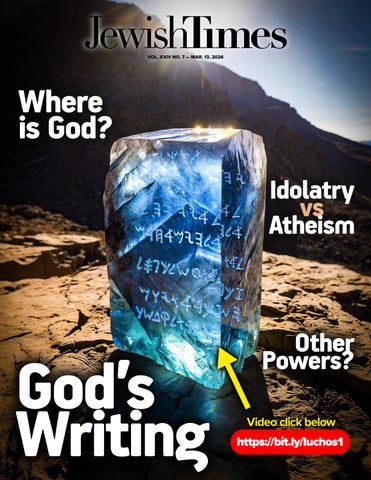
VOL. XXIV NO. 7 — MAR. 13, 2026
Where is God? Idolatry vs Atheism
God’s Writing
Other Powers? Video click below https://bit.ly/luchos1
the FREE
Just click any
2
|
WWW.MESORA.ORG
MAR. 13, 2026
icon in this issue
MESORA THE JOURNAL ON TORAH THOUGHT | Please send letters and questions to: Comment@Mesora.org |
3 Mysticism
RABBI MOSHE BEN-CHAIM
Rejecting astrology
3 Evil
RABBI ISRAEL CHAIT
Atheism vs. idolatry, which is worse?
4 Ego & Jealousy RABBI MOSHE BEN-CHAIM & HOWARD SALAMON
King Solomon’s psychological insights
6 Temple
RABBI MOSHE BEN-CHAIM
Astonishing lessons derived from the Tabernacle
11 Science MT. EVEREST
Sea fossils at its peak unveil tremendous forces that elevetaed this once upon a time seafloor
13 God is Nowhere RABBI MOSHE BEN-CHAIM
Another fundamental from Sinai
| OTHER POWERS? | Jews are attracted to astrology and mysticism. Their Torah study has failed to train them in intelligent thought. Perhaps the blame is their educators and rabbis. They believe such nonsense, that astrological “powers” exist that affect one’s personality and will. They maintain this belief without evidence and without any Torah authority. Proper Torah education and study makes a person wise in all areas because Torah is not teaching just facts, but a unique method of thinking. Rabbis and teachers must reject what God rejects: “Do not fear heavenly phenomena, for other nations fear them” (Jer. 10:2). Other nations are superstitious, but Jews are to be rational. ANSWERS RABBI ISRAEL CHAIT
Idolatry vs. Atheism
Subscribe FREE to the Jewishtimes: mesora.org/jewishtimes –––––––––––––––––––––––––––––––––––––
Articles may be reprinted without consent of the Jewishtimes or the authors, provided the content is not altered and credits are given.
SERA: Who errs less: an idolater or an atheist, and what is the reason? RABBI CHAIT: IT depends on the type of atheist. If he believes that there is
absolutely no God, i.e., there cannot be a God, then he is the furthest away [from truth]. But if he just doesn’t know the proof of God, but accepts the possibility of God, then the idolater is further away. This because the idolater at least has some concept of a "cause" for the universe, as opposed to the absolute atheist. SERA: The 10 commands are listed in a hierarchy of importance, most crucial to less crucial. This proves that recognizing God (atheism) is more crucial than idolatry, as the 1st command is to know God, and the second is to reject idolatry. Thus, denying God (atheism) is worse than idolatry. ■ WWW.MESORA.ORG MAR. 13, 2026
| 3
PSYCHOLOGY SHARE
KING SOLOMON
“ Dead flies spoil the perfumer's oil; greater than wisdom and honor is a little foolishness. The heart of the wise man is to the right and the heart of the fool is to the left. Also on the path that the fool travels, his heart is lacking and he tells everybody that he's a fool.” (Koheles 10:1-3)
W
Rabbi Moshe Ben-Chaim & Howard Salamon
Ego& Jealousy 4
|
WWW.MESORA.ORG MAR. 13, 2026
hat relationship exists between spoiled perfumer’s oil and wisdom obscured by minor foolishness? Why should a minute amount of foolishness completely obscure the honor and wisdom of a person? After all, one could live his whole life intelligently and with a good reputation, but if he does one small error, that’s all that people focus on. How do we explain this sociological phenomenon? Lastly, what does it mean that the fool “tells everybody that he's a fool?” King Solomon is drawing a parallel: just as a tiny dead insect spoils a vat of perfumed oil, so too man's one small act of foolishness obscures all his wisdom and honor. But why shouldn't we say that the man still led a life where he was 95% intelligent and only 5% foolish? Why does the minute foolishness completely overshadow his fine reputation? Mathematically speaking he should retain a 95% good reputation. What King Solomon is referring to is a sociological phenomenon: ego and the jealousy of those who feel inadequate. People recognize a wise man who has great honor, but they are jealous that they fail to attain greatness like him. However, without doing anything deserving critique, the masses can't justify attacking the wise man, as much as they want to. But once the wise man commits even one small error, that is all the excuse the public needs to vent (CONT. ON NEXT PAGE)
PSYCHOLOGY SHARE
their resentment. The wise man’s history is forgotten in seconds, as the public seeks only to defend their egos, not to seek the truth. Once they have any small excuse to attack the perfectly wise man in order to defend their egos, saying “He’s really not much better than us,” they will forget all his good. King Solomon uses the analogy of perfumer's oil because just as perfume creates a good image for a person regarding the senses, good actions also refine one’s reputation. And in both cases a very minute negative element suffices to obscure all the good. Due to the power of the ego, people are very resentful. Any chance to ruin your competition’s reputation will be welcomed, and pounced upon. People will attack their competition for the smallest foolishness he performs.
“The heart of the wise man is to the right and the heart of the fool is to the left”
The rabbis explained the second verse to mean that the wise man, being accustomed to wisdom, is always prepared to devise a wise plan to deal with life's problems. This is what is meant by “his heart is to the right.” Whereas the fool who does not engage wisdom, when he has problems in life, since his heart is “to the left,” meaning he's not involved in intelligence, he has no acumen to escape his problems.
“Also on the path that the fool travels, his heart is lacking and he tells everybody that he's a fool”
Finally in verse three we wish to understand what it means that “the fool tells everybody that he's a fool.” Of course this does not mean literally walking around telling people, "I am stupid!" So what does it mean? It refers to inevitability: ultimately at every turn his words and his actions will be seen by all others as conflicting with how the world operates. He consistently creates problems for himself. For example, he does not restrain his mouth when his boss tells him to do something, so he gets fired. Other people have the common sense to know when not to speak. But the fool is guided solely by whatever emotion arises at that moment and he acts on it without thought. The world follows laws, man cannot deviate from God’s decreed natural laws governing every object and event, whether they're natural laws or laws of psychology. And since the fool is not aware of these laws, inevitably the fool bring problems upon himself by conflicting with natural law. That is what is meant when he tells everybody he is a fool. Since literally everything has a design and a manner of operation developed by God, whomever conflicts with how all matters operate, like this fool, will always have problems, and these constant problems is the fool “telling everyone” he’s a fool. As his errors occur at all times, all people know he is a fool as if he told them so. ■
WWW.MESORA.ORG MAR. 13, 2026
| 5
TEMPLE PARSHA
SHARE
Rabbi Moshe Ben-Chaim
T
he question was asked, why in the Tabernacle’s service are we commanded to smoke the Incense Altar both times: when cleaning the Menorah in the morning, and when lighting the Menorah at sunset? What is the indispensability of “smoke” when servicing the Menorah?
Menorah
To answer this we must first understand what Menorah is. The Menorah has seven branches, correlating to the 6 days of creation and 7th day of rest. The Menorah bears 3 designs: amorphic spheres, flowers and cups. And of course we must explain the purpose of lights on the Menorah. We must also explain why the Incense Altar is not used when the twelve loaves of the showbread are replaced every Friday on the Table. There's a tie between the Incense Altar and Menorah, which does not exist in relationship to the Table of showbread.
Tabernacle Counters the Gold Calf
The rabbis teach that the Tabernacle came as a response to the Gold Calf. What was the sin of the Gold Calf? The Jews miscounted the 40th day of Moshe’s descent from Mount Sinai and panicked, thinking that Moshe was dead. They approached Aaron and demanded that he create a replacement for “the man” Moses. This intentionally stresses their attachment to a physical leader. Seeing that Hur was already killed when refusing to accommodate the people's request for a god, Aaron decided to participate in making the calf by tarrying, as an act of delay until Moshe would descend. The sin of the Gold Calf was an uncontrolled, (CONT. ON NEXT PAGE)
6
|
WWW.MESORA.ORG MAR. 13, 2026
PARSHA SHARE
imagined method of relating to God, which was idolatrous. The Tabernacle thereby comes as a corrective measure to the Jews' sin. The Tabernacle is a highly structured system with precise measurements and vessels and specified acts of service, which restrict any imagination in relating to God. Everything in the Tabernacle teaches a sublime lesson.
A Veil
The actual name Tabernacle (mishkan) refers to the first layer of the Tabernacle’s coverings. This is because this is the Tabernacle’s primary message: a “veil” between man and God exists. This directly addresses the error of the Jews who imagined they knew how to relate to God (by making the Gold Calf). This message of a veil is again reiterated by the Tabernacle’s structure of having one room that is accessible called the Holies. This room is in front of a veil separating the Holy of Holies, which man cannot enter except one day a year. The Tabernacle represents two distinct areas: one area which man can approach, the Holies, and one area that man cannot approach, the Holy of Holies. The Holy of Holies contained the Gold Ark with the angels on its lid covering, which housed the Torah and the Tablets of the Ten Commandments. This off-limits room teaches man that there is knowledge—certain metaphysics and knowledge of God—which is unavailable to man while on Earth, the same lesson which God told Moshe, “man cannot know Me while alive” (Exod. 33:20). The Holies, which the priests were commanded to enter daily, contained the Menorah, the Table of the shewbread and the Incense Altar. Thus, the Holies is an area of knowledge that man may attain. This explains why the Menorah was positioned in the Holies because the Menorah related to knowledge of creation attainable by man. Now what type of knowledge can man have of creation? This is understood by the three designs we mentioned above: an amorphous shape, a flower and a cup. These three objects refer to the three categories of creation that man may observe and derive insight. The amorphous sphere refers to substance (man can study water, soil, fire, etc.). The flower refers to design: man can appreciate the purpose of animal’s wings, fins, claws, trees, etc. Finally the cup—a functional object—refers to nature’s functionality: meteorology, gravity, biology, vegetation, zoology and all nature’s systems. When man studies the creations of the six days—the lesson of Menorah’s six branches—man now realizes that his knowledge of the natural world is knowledge of substance, nature’s design, and its governing laws. However, man must also realize that even when studying that which he may observe—nature—he is still greatly limited in terms of his knowledge of God. Man cannot exhaust all natural knowledge, God’s wisdom is endless. Einstein said we only scratch the surface of the God’s knowledge. (CONT. ON NEXT PAGE)
WWW.MESORA.ORG MAR. 13, 2026
| 7
PARSHA SHARE
The Answer
This ignorance is indicated by the smoking incense when the priests cleaned the Menorah in the morning and when they lit it at dusk. During any service of the Menorah, smoke had to accompany its service to show that there is a veil between us and understanding the universe. However the lesson of the Table with the 12 loaves of showbread indicates God's supply of food to the 12tribes. This is not referring to natural law but to God's providence, which acts behind the scenes and is not observable. Therefore there is no light on the table with the showbread as there are lights on the Menorah, because the Menorah is referring to observable natural law, and what is observable requires light. But the Jews at Sinai ignored what is observable, and followed imagination in creating their gold idol. The distinction between the two rooms is that the Holy of Holies is purely metaphysical knowledge, unrelated to physical world. Thus, man cannot enter that room to show he admits his ignorance of this realm: man cannot know what God is, what angels are, and the depth of Torah wisdom. While the Table deals with God's metaphysical providence, it relates to the physical world. That's why it contains 12 loaves of bread, i.e., God sustains the 12 Tribes. But Providence is not observable knowledge, explaining why the Table has no lights.
Why Beaten Gold?
The only vessels made of pure beaten gold (Exod. 25:17,31) relate to knowledge: the metaphysical knowledge shared by cherubs on the ark’s cover and the Torah contained inside it, and natural knowledge embodied in the Menorah. The aspect of knowledge these two vessels embody is further stressed by the commands that they both be created by hammering a solid gold chunk into their final forms of angels and the Menorah. Such a method of formation requires great skill and wisdom. One viewing the cherubs and the Menorah, knowing they were created through a hammering process and not molds, will appreciate the skill in their creation, and will associate to the knowledge both vessels convey in their design. As knowledge is most valued, God commanded these 2 objects be made of the finest material to convey the value of knowledge. (CONT. ON NEXT PAGE)
8
|
WWW.MESORA.ORG
MAR. 13, 2026
PARSHA SHARE
Tablets
Finally, what was at the center of the Tabernacle? It was the Ark that housed the Tablets of the Covenant. But as the content of the Tablets—the Ten Commandments—are also in the Torah scroll, we must understand the need for a second record of these Ten Commands appearing in the sapphire stone Tablets. Torah provides a strange detail: the Tablets’ writing was visible “from both sides” (Exod. 32:15). What exactly does this mean; that there were letters etched into two opposite surfaces of the sapphire stones? If that's the case, what does that prove? As we learn, (Exod. 34:4) Moshe hewed the second set of stones, certainly he could have carved letters into their surfaces! Therefore the statement that the Tablets were written “from both sides” cannot mean that letters were carved into the surfaces or hollowed through, as this would not prove anything. These Tablets contained something astonishing: naturally formed letters and commandments “inside” the translucent tablets. Imagine cutting down a tree and finding in the trunk not rings, but words…or lightning bolts forming letters and sentences in the sky. The Tablets were equally miraculous. “From both sides” means one could see into the sapphire’s internal grain and view commandments that man cold not penetrate. The words literally grew within the stone’s internal grain as it formed during the 6 days of creation (Avos. 5:6). God did not “write” by carving into the Tablets; the writing evolved as part of their natural grain formation. This proved Torah is from God. Naturally formed commandments declare that God (the creator of sapphire) is the same as Torah’s author. That is, Earth exists for Torah. Maimonides explains that “the Tablets were the work of God” means they formed naturally and not through craftsmanship (Exod. 32:16, “Guide” book I, chap. lxvi). The Jews at Sinai heard intelligence emanating from fire, proving the source of this intelligence and Torah is not biological, not of this physical world. For anything physical perishes in fire. The Tablets’ miraculous writing carries forth this lesson that Torah is from God, to all future generations who could not attend revelation at Sinai.
Summary
In summary the Tabernacle corrected the sin of the Gold Calf, which was man's unbridled imagination in his failed relationship to God. The Tabernacle has numerous specific laws concerning its dimensions, its vessels, its layout, and all of its services. This highly controlled system inhibits man from expressing any idolatrous imagination. Rather, man learns tremendous truths by creating the various vessels with their specific designs. The coverings as well as the dividing curtain between the Holies and the Holy of Holies teach man that his knowledge is limited; there is a veil that exists between him and God. The smoking of the Incense Altar when servicing the Menorah reiterates this lesson regarding creation. Man learns that the metaphysical world is not within his capacity to grasp. But the room called the Holies, which the priests were commanded to enter, teach what man can know about God and creation as well as His providence. But the smoking of the Incense Altar when servicing the Menorah teaches that even regarding observable creation, man has much ignorance. And the Holy of Holies contains the Tablets bearing miraculous proof that Torah is from God. ■
WWW.MESORA.ORG MAR. 13, 2026
| 9
PARSHA
CODES FOUND IN THE BIBLE CLUES IN THE TEXT REVEAL MYSTERIES
All books depict history, facts, theories, fiction or poetry. No book is coded with hidden messages beyond the words or patterns revealing marvels. But the Bible (Torah) was written by God, and is “coded.” The order of verses, use of certain phrases, apparent contradictions and other Biblical patterns are purposeful clues to God’s wisdom. This book unveils those patterns and shares the hidden messages.
10
|
WWW.MESORA.ORG
MAR. 13, 2026
SHARE
SCIENCE SHARE
Mount Everest contains marine rocks, proving that the highest point on Earth was once at the bottom of the ocean.
WWW.MESORA.ORG MAR. 13, 2026
| 1111
12
|
WWW.MESORA.ORG
MAR. 13, 2026
NOWHERE God’s Place REALITY
SHARE
RABBI MOSHE BEN-CHAIM
A
fter the end of God communicating the 10 Commands, the Jews were frightened by the miracles, sounds sights: All the people witnessed the thunder and lightning, the blare of the horn and the mountain smoking; and when the people saw it, they fell back and stood at a distance. “You speak to us,” they said to Moses, “and we will obey; but let not God speak to us, lest we die.” Moses answered the people, “Be not afraid; for God has come only in order to test you, and in order that the fear of God may be ever with you, so that you do not go astray.” So the people remained at a distance, while Moses approached the thick cloud where God was. God said to Moses: “Thus shall you say to the Israelites: ‘You yourselves saw that I spoke to you from the very heavens: With Me, therefore, you shall not make any gods of silver, nor shall you make for yourselves any gods of gold. Make for Me an altar of earth and sacrifice on it your burnt offerings and your sacrifices of well-being, your sheep and your oxen; in every place where I cause My name to be mentioned I will come to you and bless you.’”
Ibn Ezra says this group of Jews were priests and officers. Earlier (Exod. 19:12) God warns Moses that he should rope off the mountain prior to revelation so nobody ascends the mountains during the event, which would be worthy of death. The sin would be viewing God as having “location” and viewable, thereby making Him physical. This addresses the entire nation. And it's significant that in that first story God says the
following after He concludes His communication: “after the final shofar blast then the people can ascend the mountain” (Exod. 19:13). His intent is that the people should see no physical evidence of God, but only after the event concluded. So we have two groups of Jews who were responding to God's revelation in two ways. The first group—the nation as a whole—desired to approach the mountain, while this second group of priests and officers retreated from the mountain. It says twice that they stood from a far. Repetition is always God’s way of emphasizing a core idea. In contrast to that it says that Moses drew close, while they were standing from afar. Moses intended to reiterate God’s message that there is nothing “on” the mountain. God reinforces this by saying, “I spoke to you from the very heavens.” Meaning, God is not on Earth, but in some dimension, in heaven, He is metaphysical. Again, the higher level Jews thought they would die if they heard God speaking any further, so they retreated. Moses did the opposite and walked closer. And then God steps in and says “I spoke to you from the heavens,” not from the Earth. But the lower Jews intended to “look for God” so God commanded the mountain be roped off. God finally says “Do not make any gods of silver, nor shall you make for yourselves any gods of gold.” God repeated the message that rendering God as a physical object is a grave sin. Jews “standing from afar,” “Moshe drawing close” and then God saying He’s speaking “from the heavens” all share one thing in common: they’re all referring to “location.” This final story in parshas Yisro focuses on the message that God does not exist physically anywhere. ■
WWW.MESORA.ORG MAR. 13, 2026
| 13
Is Judaism mystical, or is it rational, based on reason and proofs?
14
|
WWW.MESORA.ORG MAR. 13, 2026
ALL HOME IMPROVEMENTS SERVING ROCKLAND & ORANGE
(347)489-2048 www.BBGHandymanServices.com
HOME REPAIR DONE RIGHT! SPRING SPECIAL!
BEFORE
AFTER
BEFORE
AFTER
Power Washing $325.00 Starting at
•Reasonable Rates •Over 20 Years Experience •Free Estimates WWW.MESORA.ORG MAR. MAR. 13, 13, 2026 2026 WWW.MESORA.ORG
15 | 19
SHARE SHARE
16
|
WWW.MESORA.ORG
MAR. 13, 2026
SHARE
NYDesign.com Designers of the Jewishtimes & Mesora.org Building loyalty and sales through design strategies 516.569.8888 WEBSITE
Branding
Dataviz/Charts
Websites
Social Media
UI/App Design
Infographics
Landing Pages
Advtg/Promo
Wires/Prototypes
Iconography
Editorial Design
Animation
App Store Design
Illustration
Presentations
Packaging
WWW.MESORA.ORG MAR. MAR.13, 13,2026 2026 WWW.MESORA.ORG
17 || 13
Subscribe FREE at Mesora.org/Jewishtimes
Thought-provoking articles on Torah, Israel, science, politics and readers’ letters.
28 Years / 692 Issues
18
|
WWW.MESORA.ORG
MAR. 13, 2026