VOL. XXIV NO. 17 — AUG. 28, 2026
Rejecting Jesus Exposing False Religions MAIMONIDES
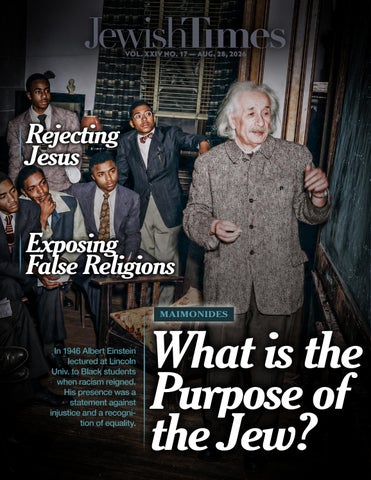
In 1946 Albert Einstein lectured at Lincoln Univ. to Black students when racism reigned. His presence was a statement against injustice and a recognition of equality.
What is the Purpose of the Jew?
the FREE
Just click any
2
|
WWW.MESORA.ORG
AUG. 28, 2026
icon in this issue
MESORA THE JOURNAL ON TORAH THOUGHT | Please send letters and questions to: Comment@Mesora.org |
3 Tzedaka
5 The Purpose 8 Telling God of the Jew what to Do
THOUGHTS
The perfection of charity
RABBI MOSHE BEN-CHAIM
RABBI REUVEN MANN ZT”L
God made us the safe-guarders of reality, of truth, to share with mankind
3 Jesus
RABBI MOSHE BEN-CHAIM
How belief in him violates God’s words
How can God tell man to “tell God what to do?”
13 Torah Inscribed on Stones: Why?
7 How God Exposes False 4 Superstition RABBI MOSHE BEN-CHAIM Religions Defining its error and what is
RABBI MOSHE BEN-CHAIM
How they verify God kept His word. The first printing press.
RABBI MOSHE BEN-CHAIM
not a violation
Isaiah’s prophecy: the formula of verifying the true God
| TZEDAKA | Rabbi Israel Chait spoke about how charity is vital to perfection. An average person finds difficulty parting with his wealth. But the perfected person, who understands there is a system behind the physical world and lives by it, does not feel loss when he gives charity because he knows God's promise of replenishing his charity overrides mathematics. That metaphysical reality is what guides the physical world and also is responsible for providentially helping the righteous. The righteous person is more in line with ultimate reality than the person who fears loss. His reality is God, not nature.
LETTERS RABBI MOSHE BEN-CHAIM
Rejecting Jesus DAVID: I need assistance with a rebuttal to some people insisting that God is punishing His people for
Subscribe FREE to the Jewishtimes: mesora.org/jewishtimes –––––––––––––––––––––––––––––––––––––
Articles may be reprinted without consent of the Jewishtimes or the authors, provided the content is not altered and credits are given.
rejecting Jesus. I usually counter sarcastically, “Yeah, the Almighty is punishing the Jewish people for following Deuteronomy 13:2-12 and 18:20; and for not believing in human sacrifice.” I regularly read Rabbi Skobac (Jews for Judaism) and Rabbi Singer's (Outreach Judaism) literature, however I cannot seem to phrase what I'm trying to say correctly. Thank you for your time and assistance.
RABBI: The following quotes are helpful: You shall not make for yourself a sculptured image, or any likeness of what is in the heavens above, or on the earth below, or in the waters under the earth (Exod. 20:4) Do not to act wickedly and make for yourselves a sculptured image in any likeness whatever: the form of a man or a woman (Deut. 4:16). (CONT. ON NEXT PAGE) WWW.MESORA.ORG AUG. 28, 2026
| 3
LETTERS SHARE
Your approach is correct: we validate God’s view based on what He said, referring to not creating other gods such as figurines of anything in the heavens or the Earth, including humans. God hid Moses’ grave, precisely to prevent human deification (Deut. 34:6). This fully rejects deification of Jesus: as worshipping a mere “form” of man is prohibited, certainly worshiping man himself is prohibited. God does not punish, but rewards people who follow His words, like rejecting Jesus. This is also why we reject Jews flocking to the Rebbe’s grave to give him notes, which shares crime of praying to Jesus. We do not defend our own and this equal condemnation shares Torah’s honesty and fairness. And on this note of following only what God says, God never stated that He's punishing Jews for rejecting Jesus. A person is not capable of knowing God's thoughts in order to make such a statement. That's what Isaiah 55:8,9 says, “My thoughts are not your thoughts, and your ways are not Mine.” God clearly discounts a person making any assumptions about how God operates. And there's a very good reason why.
Rejecting Superstition
YEHUDA: I have sent some of your writings to a few people and I was surprised that they liked it more than I expected. You can't change the superstitious people much, they are following nothing but emotions and bias. But you can give a BIG wake up to all the mostly normal people who sit by idly and allow it all to happen and are swayed by “what we see everyone else do.” Regarding the section “False Notions” in your book, have you ever thought about ?כוזו במוכסז כוזוThis is written on mezuzas and is a code for the words י-ו אדנ-י אלהנ- אדנwhere each of these letters is replaced with the next letter in the Hebrew alphabet, viz., (Aleph becomes Bet format). Basically, people write these 3 names of God on the mezuza, so is this a violation to “adding a mitzvah to the Torah?” The Rambam in the famous Mezuzah 5:4 allows writing
4
|
WWW.MESORA.ORG AUG. 28, 2026
דש- יon the outside of course, otherwise one forfeits his World to Come. What are we lacking without י-?שד In Yoreh Deah 179 there are some strange things allowed. Did the Rabbis go along with these superstitions?
RABBI: 1. One who says, "My bread has fallen from my mouth!" or "My staff from my hand!" or if a deer stopped before them on the road, or a snake passed on their right, or a fox on their left; someone to whom these things have happened, and they derive divination from it not to go on a trip, or not to begin a project or similarly, these are prohibited. 2. Someone who has been bitten by a scorpion: it is permitted to whisper spells for them, even on Shabbat, and even though this thing is completely ineffective, because the person is in danger, they permitted it in order that their mind should not be torn apart (made insane). 3. A child who has been wounded: we may not recite verses over them, or place a Sefer Torah upon them. A healthy person: it is permitted to recite verses over them, in order to protect them from the damaging forces. All these laws are consistent with how reality operates. The first source teaches that there is no correlation between those events and our success or failure: things falling from our mouth or hands, or passing animals are unrelated to our fate. To attribute any connection is superstitious, imagination and fallacy. Judaism was created by the world’s Creator; both operate with perfect reason and scientifically. That is why God gave us senses, to determine what is real. And nothing observable validates any correlation between these events and our success. Although many Jews—including flawed rabbis—are mystical, and believe things without proof, God demands we use our senses and our minds. Those flawed rabbis’ views are nowhere to be found in God's Torah. But God equally recognizes human limitation. Therefore a person who was bitten by a lethal animal is not
restricted from saying some words that would prevent him from going insane from his fear of death. Similarly, God did not prevent a soldier from taking a gentile wife that he captured in war. The soldiers' victorious state of mind would not tolerate being restricted from her (Rashi). And the 3rd case that you cited above is prohibited, namely using a Torah, tefillin or mezuza for physical protection. Maimonides refers to this as heresy, for he says that Torah is to perfect our souls, not to heal our bodies (Law of Star Worship 11:12). The heresy is in rejecting the true purpose of Torah, which is for our souls. But a healthy person can recite Torah verses or do mitzvos with the proper thought that the merit of fulfilling God's commands will earn him God’s reward. This complies with Torah.
The Prohibition of Adding to Torah
God created man’s personality traits with many qualitative and quantitative variations. Therefore, Torah allows degrees of observance, as in hiddur mitzvah, where one fulfills tefillin, but can buy more beautiful tefillin to express one’s love of that mitzvah and make it more beautiful, although not necessary. One does not add to the mitzvah in this respect. Rashi gives examples of the sin of adding mitzvos to the Torah, like wearing 5 tzitzis, making tefillin with 5 Torah sections, or carrying 5 species on Succos, or adding a 614th command like wearing red on Fridays. Again, tzedaka has a minimum, an average of 10%, but one may give up to 20% if he is so motivated to fulfill the mitzvah best, unless he is extraordinarily wealthy, in which case he may give over 20%. The structure of a mitzvah’s core components must not be changed, but variations in each mitzvah may be tolerated. To alter Torah, one must alter the object of mitzvah or the performance, or change the amount of 613 mitzvos. Writing י- שדon the unwritten side of the mezuzah parchment does not alter Torah’s text, and is not obligatory, so it’s not adding to the Torah. Similarly, painting one’s succah does not suggest this to be a command, so there is no addition to Torah’s laws, and is permissible. ■
In 1946 Albert Einstein lectured at Lincoln Univ. to Black students when racism reigned. His presence was a statement against injustice and a recognition of equality.
MAIMONIDES
FUNDAMENTALS
What is the Purpose of the Jew? Rabbi Moshe Ben-Chaim
SHARE
All the matters of diviners, horoscopists, fortune tellers, witches, etc. are falsehood and lies with which the original idolaters deceived the gentile nations in order to lead them after them. It is not fitting for the Jews who are the wisest of the wise to be drawn into such emptiness, nor to consider that they have any value as stated, [Num. 23:23] “No black magic can be found among Jacob, or occult arts within Israel.” And it is also stated, [Deut. 18:14] “These nations which you are driving out, listen to astrologers and diviners. This is not [what God has granted] you.” Whoever believes in [occult arts] of this nature and, in his heart, thinks that they are true and words of wisdom, but are forbidden by Torah, is foolish and feeble-minded. He is considered an underdeveloped intellect. The masters of wisdom and those of perfect knowledge know with clear proof that all these crafts which the Torah forbade are not reflections of wisdom, but rather, emptiness and vanity which attracted the feeble-minded and caused them to abandon all the paths of truth. For these reasons, when the Torah warned against all these empty matters, it advised [Deut. 18:13] “Be perfect with God, your Lord.” (Maimonides, Laws of Star Worship, 11:16)
“It is not fitting for the Jews who are the wisest of the wise to be drawn into such emptiness” “Not fitting” is not the language of a command. Typically, Maimonides states that something is either “commanded, obligated, prohibited or punished.” This phrase of “not fitting” means that outside the 613 commands, the Jewish nation has other primary Torah directives, like representing God’s wisdom to the world: “Observe them faithfully, for that will be (CONT. ON NEXT PAGE)
WWW.MESORA.ORG AUG. 28, 2026
| 5
FUNDAMENTALS SHARE
proof of your wisdom and discernment to other peoples, who on hearing of all these laws will say, ‘Surely, that great nation is a wise and discerning people’” (Deut. 4:6). Following reason and proof, and rejecting superstition and idolatry is a matter of our national distinction. As our role is to represent truth—not imagination—“It is not fitting for the Jews to be drawn into such emptiness.” Maimonides formulates this as a national matter, indicating it’s not a mitzvah on an individual. Embracing this role as intellectual leaders is a pre-Torah perfection displayed by Abraham. God created Earth for man, where all other creations serve the one purpose that all mankind achieves perfection. But over time, mankind corrupted themselves with idolatry, except Abraham who discovered and taught monotheism. God then made Abraham’s seed into the nation of Israel to correct all other peoples. Besides 613 commands, Torah shares God’s will by depicting the lives of the patriarchs and matriarchs and God’s favor of them with His guidance: God gave the Jews His Torah. Thereby, He designated the Jews as the “wisest of the wise” as no others received God’s wisdom. Our divine gift and reputation demands we are knowledgeable of God’s will, and teach others who wish to follow God. It is then no surprise that anti-Semitism has always existed among the ignorant who act with sibling rivalry and who jealously demonize the Jew, knowing that God favored the Jew; not because we are of any better human design than others, but because our patriarchs chose monotheism. Regardless of such anti-Semitism, we teach all who wish to learn. But we do not proselytize or threaten like radical Islam. Our leaders and teachers must ensure that the Jewish nation lives by Torah.
“No black magic can be found among Jacob, or occult arts within Israel” This was a prophetic statement God told Bilam to tell Balak when trying to oppress the Jews. Why refer to Jacob’s 2 stages in life: his earlier stage as Jacob, and later once given the additional name Israel? And what does superstition have to do with one’s transitional stages in life? This teaches that it is during one’s advances in his perfection, that can create insecurities, where one can succumb to seeking superstitions for security. But Jacob did not do so. From his transition from Jacob to Israel, no superstitions were found in him. But Maimonides doesn’t end there. He cites another verse: [Deut. 18:14] “These nations which you are driving out, listen to astrologers and diviners. This is not what God has granted you.” Here, Maimonides shares the source of idolatry: the need to be guided by man, the infantile state. “Listening to astrologers”
6
|
WWW.MESORA.ORG AUG. 28, 2026
describes man’s need for another that he can “listen” to. Perfected man follows truth, idolatrous man follows man. He seeks human approval like and child. So Maimonides adds, “Perfect with God” refers to engaging the mind, seeking reason and proof. But believers in the fallacy of alien powers and the ability to forecast of one’s future, abandons rational thinking; they are not perfect with God. They seek to satisfy the emotion of dependency on man. Such a person “abandons all the paths of truth,” since truth refers to testing whether a notion exists, and rejecting what does not. But idolatrous people accept as real anything that satisfies their fears. They don’t cross check reality or reason for verification of their beliefs. Thus, their lives are spent believing what does not exist, and what does not exist cannot answer prayers or provide help. They must fail. Twice does Torah refer to man being perfect, “tamim.” God first tells Abraham “Walk before Me and be perfect” (Gen. 17:1). This command to Abraham was regarding circumcision. On this verse Ibn Ezra says that Abraham's perfection would be not inquiring “why to perform this command.” Now of course we are supposed to use our minds in every area. But what Ibn Ezra means is that Abraham shouldn't let his understanding be what determines whether to perform the command. Evidently Abraham had the understanding that the human body is a perfect creation and damaging it with circumcision is questionable. So he should not abstain from performing circumcision until he understands it fully; he must act even without full understanding. The second case Torah tells man to be perfect, is regarding idolatry and superstitions: “Be perfect with God, your Lord” (Deut. 18:13). One should follow God perfectly without belief and any other powers, which are false. Therefore, imperfection would be not following God alone but accepting other powers, or accepting one's own meager understanding. “Perfect with God” refers to one who follows God exclusively.
“This is not what God has granted you” Maimonides uses a Torah verse to reiterate his main point that the Jew has a role to fulfill, and that role is to engage wisdom, reason and reality in selecting beliefs and principles, and teaching mankind. God created “all” mankind, not just the Jew. God desires all peoples benefit from the life of wisdom and reality which is the most enjoyable life. The Jew who fails to study and practice Torah hurts others by not offering them a chance to say “Surely, that great nation is a wise and discerning people.” The purpose of the Jew is to live by Torah, enabling others to identify us and inquire of God’s will for mankind. This is embodied in the morning blessing of sanctifying God’s name publicly. ■
FUNDAMENTALS SHARE
How God Exposes False Religions
God imposed their expiration. What type of God dies or is destroyed? Thus, God being first and last rejects all other gods and religions as lies, explaining why this verse concludes, “there is no god but Me.” First and last results in the inescapable conclusion that there are no there gods. The structure of this verse is perfect, like all verses. “And who is like Me?! Let him call out and tell, and set forth before Me, from Creation, let him tell us miracles and future events”
The next verse says God says that He alone possesses ultimate power and ultimate knowledge, which are the two primary praises we offer God on the High Holidays: He alone is the king (creator) and He alone is all-knowing, Malchiyos and Zichronos. Here too Isaiah refers to these incomparable Rabbi Moshe Ben-Chaim & Howard Salamon greatnesses: “Let him tell us miracles and future events [he performed].” And since no other God can make such a claim, it is exposed as a lie. The first rejection of false gods is their inability to manipulate natural law, such as God displayed with all His miracles. Never has there been any control of nature—miracles—demonstrated by any being except the Jewish God. And the claims we hear from Christianity about Jesus’ miracles have no witnesses and therefore they are mere claims. But Judaism has over two million witnesses at Revelation at Mount Sinai. God is above time, so the future is inapplicable to Him. Therefore, He God being “first” rejects all claims of knows our future, while imagined gods other gods. “First” means God alone or those claiming divine inspiration, created everything. Thus, other gods cannot tell the future. This is because all need God to create them, even in theory. Being first, God exposes all false earthly knowledge is “knowledge of the observer.” And without an event having gods as dependent beings, as a true transpired, one cannot know what will God is not dependent for its existence. be. God's second rejection of false gods But other religions may yet say, “God will not endure, and my god will endure is that never has anyone forecasted the passed God’s life” and also, “You cannot future with any accuracy. God created time, so He is not limited by time to prove God will be last, as the end has not arrived yet.” To this God responds, “I know the earth’s future. He created everything, and has full knowledge of am the last.” God rejects the theory of all. For this reason the true prophets His expiration, as He is not subject to who rise after Moses must be validated deterioration, which is a created, by forecasts with 100% accuracy. Only physical property. The destruction of then is the prophet validated as having Egypt’s and other peoples’ gods contact with God (Deut. 18:22). ■ invalidates their statuses as gods, as
I am the first, and I am the last and there is no god but Me. And who is like Me?! Let him call out and tell, and set forth before Me, from Creation, let him tell us miracles and future events [he performed]. (Isaiah 44:6,7)
WWW.MESORA.ORG AUG. 28, 2026
| 7
PARSHA SHARE
Telling G-d What to Do Rabbi Reuven Mann, ZT”L Edited by B. Silberstein
T
his week’s Parsha, Ki Tavo (“When you enter the Land...”), discusses, as the title indicates, the many laws that become obligatory once the people are settled in their divine inheritance. Many Torah laws pertain to the agricultural produce that the land yields.
The Purpose of the Gifts
The farmer must distribute much of his produce before he can sit back and enjoy his own share. The bulk of the “gifts” are distributed to the Kohanim, the Levites, and the poor. The tribe of Levi was excluded from inheriting a share of the land, as they were to be exclusively involved with maintaining the Temple and performing its services. As important as this assignment was, it was not their primary function. Above and beyond this was their mission to “teach Your ordinances to Yaakov and Your Torah to Yisrael” (Devarim 33:10). Because the Tribe of Levi was preoccupied with the Torah education of the nation, they were freed from the ordinary tasks of securing Parnassa (sustenance). The two main gifts that a landowner was required to distribute were Terumah, which was given to the Kohen, and Maaser Rishon (the first tithe), which was given to a Levite. There was, in addition, an obligation of Maaser Sheni (the second tithe). This is most unusual, simply because that portion is not given to anyone. The owner keeps it for himself. In what sense, then, is it a tithe?
8
|
WWW.MESORA.ORG
AUG. 28, 2026
The answer is that these mandated gifts possess a certain holy status. They may not be eaten by everyone, nor may they be eaten in a state of ritual impurity. Thus, the special designation of Maaser Sheni is that it can only be eaten in Yerushalayim. This requirement expresses so much about the special character of that holy city. In the opening verses of the Book of Kohelet (Ecclesiastes), King Solomon introduced himself as “king in Jerusalem” (Kohelet 1:1). On this, Metzudat Tzion comments, “the city of wisdom.” The Torah wanted each individual to spend as much time in Yerushalayim as possible, to interact with the great sages who resided there, and to partake of the unique culture of knowledge and learning that pervades its environment. Thus, he was commanded to go up to the capital for each of the three major festivals. In addition, the farmer would have to go there to consume his portion of Maaser Sheni. There are profound dimensions to all the laws of the Torah. The obligations to donate to the Kohen, the Levite, and the poor are rooted in the Jewish concept of ownership. The obligation to share our bounty with others is a manifestation of the fact that the land does not belong to us. The true owner is Hashem, Who leases it to us on certain conditions, the most significant being the obligation to share its fruits with others. When we actually give to the designated recipients, we should not indulge in any feeling that we are being generous. We are not the givers, but are merely transferring what Hashem has allotted to them. Happy is the one who has the merit to serve as Hashem’s delivery person.
Telling Hashem What to Do
Our Parsha also details a unique Mitzvah called Vidduy Maaser (confession of tithes), which is performed on the last day of Passover in the fourth and seventh years of the seven-year cycle. Essentially, one must recite in detail how scrupulously he has fulfilled all of his tithing responsibilities. The major theme of this declaration is his meticulous care in not violating the sanctity of the tithed objects or misusing them in any way. The individual making the confession proudly concludes his accounting with the words: (CONT. ON NEXT PAGE)
PARSHA SHARE
“I have listened to the voice of Hashem my G-d, and I have done according to everything that He commanded me” (Devarim 26:14). He then concludes his oration by proclaiming:
“Look down from Your holy abode, from Heaven, and bless Your nation Yisrael, and the ground that You have given us; as You have sworn to our Fathers, a land which flows with milk and honey” (Devarim 26:15). Rashi explains that the meaning of our exhortation to Hashem to “Look down from Your holy abode” is that “we have done what You decreed upon us; now You do what is incumbent on You, as You said, ‘If you walk in My statutes… then I will give the rain in its seasons…’”
The Righteous Do Not Demand Reward
Rashi’s interpretation is challenging. Firstly, the notion that we tell Hashem what He must do smacks a bit of Chutzpah. Secondly, what Rashi says here seems to contradict a principle he enunciates elsewhere. For, Rashi commented on Moshe’s words (Devarim 3:23), “And I petitioned Hashem at that time...” that even though the righteous could base their requests of G-d on the good deeds they have done, they do not do so, but rather base their appeal exclusively on undeserved mercy. Yet here we see what appears to be the exact opposite. The crop owner proclaims that he has faithfully discharged all his responsibilities, and as a result, he insists that Hashem fulfill His promise of rewards. I should like to suggest a resolution of this dilemma. When an individual comes before Hashem to request mercy, he must display absolute humility and not imagine that he is worthy or deserving of the favor he is requesting. For who is he to accurately assess the true value of his deeds and determine how G-d ought to reward them? But he does recognize and acknowledge Hashem’s infinite mercy and that He bestows good even on the unworthy. The case of Vidduy Maaser is different. The demand for reward is being recited because that is how Hashem structured the Mitzvah.
As it says:
“Bring the whole tithe into the storehouse, that there may be food in My house, and test Me now in this,” says Hashem of Hosts, “if I will not open for you the windows of heaven, and pour out a blessing for you, until there is no room for it” (Malachi 3:10).
We only talk this way because G-d instructed us to do so. If we have acted properly in fulfilling the tithing requirements, He wants us to emphasize for ourselves that He should keep His side of the bargain. Thus, this does not contradict the rule that when praying for personal matters, one avoids any haughtiness, but relies purely on Hashem’s mercy.
The Cure for Arrogance
But why did Hashem tell us to insist that He keep His side of the deal? In my opinion, this warning is intended to prevent us from becoming arrogant. Our relationship with Hashem and our adherence to the Torah are fundamental to our existence and destiny as a people, whether we live in the Land or outside it. The Torah teaches, however, that our success or failure in the Land is fundamentally determined by that relationship, although the precise workings of Hashgacha (Providence) are beyond our ability to discern. Moshe frequently mentions a great danger: that when Am Yisrael (Nation of Israel) experience success, it will go to their heads, and they will say:
“My power and the strength of my hand have made for me this wealth” (Devarim 8:17). The Mitzvah of Vidduy Maaser is intended to divest Am Yisrael of this false notion. They therefore recount their meticulous attention to every detail of the tithing responsibilities and proclaim that they have acted according to all that Hashem has commanded them. They then “remind” G-d that He should now do what He has sworn to do, not because there is any necessity for that, but only to ingrain in their consciousness that all the good that ensues comes solely from our beneficent Creator, Who rewards all those who uphold His commandments. May we always merit to do so. Shabbat Shalom. ■
WWW.MESORA.ORG AUG. 28, 2026
| 9
CODES FOUND IN THE BIBLE CLUES IN THE TEXT REVEAL MYSTERIES
All books depict history, facts, theories, fiction or poetry. No book is coded with hidden messages beyond the words or patterns revealing marvels. But the Bible (Torah) was written by God, and is “coded.” The order of verses, use of certain phrases, apparent contradictions and other Biblical patterns are purposeful clues to God’s wisdom. This book unveils those patterns and shares the hidden messages.
10
|
WWW.MESORA.ORG
AUG. 28, 2026
SHARE
Genesis Book II (Published July 2026)
WWW.MESORA.ORG AUG. 28, 2026
| 11
Is Judaism mystical, or is it rational, based on reason and proofs?
12
|
WWW.MESORA.ORG
AUG. 28, 2026
PARSHA SHARE
Torah Written Upon Stones Rabbi Moshe Ben-Chaim
W
hat purpose was achieved by writing the Torah in 70 languages on 3 sets of 12 stones (36 stones total)? According to Talmud Sota, 35b, which opposes Rashi on the Chumash, one set was erected in Moav, one in Gilgal, and the third set in the Jordan itself. What is to be learned from these 3 sets of stones and their locations? I believe a significant idea is borne out of this. God promised Abraham He would give Israel to his descendants. To demonstrate that, 1) God fulfilled his promise, and that, 2) these were in fact Abraham’s worthy descendants, i.e., those who follow Abraham’s teachings (not merely biological descendants), it was necessary that the recipients of God’s promise to Abraham demonstrate that they do in fact follow Abraham’s philosophy. Being a biological descendant was no guarantee of receiving Israel; sharing genes is insufficient. Abraham’s children and grandchildren are defined as those who hold fast to Abraham’s teachings. Their writing of the Torah on these stones
prior to their entrance to Israel displayed their entitlement. But why have such testimonial stones erected at three separate locations: 1 set in Moav (Trans-Jordan), 1 set in Israel in Gilgal, and 1 set in the Jordan river? These three sets prove that God was solely responsible for bringing the Jews into Israel. By erecting “road signs” on both sides of the Jordan River, shows from where the Jews journeyed, and to where they arrived. Placing one more set in the Jordan River itself, we discover how the Jews entered the land: through a miraculous event of the Jordan River drying up. It would be impossible for anyone to erect and plaster such huge stones while immersed in the river. The stones therefore delineate the starting point, the end point, and the path. Such a path of entrance is only possible via a miracle, and therefore enacted by only God Himself. God thereby eliminates all possible explanations of the Jews entering the land naturally, bereft of His divine intervention. Thus: God fulfilled His promise to Abraham that He would enter the Jews into Israel. I believe this to be the reasoning behind the miraculous conquest of Jericho as well: an indisputable proof of God’s essential involvement and fulfillment of His age-old oath to Abraham. Deuteronomy
27:3 reads, “And write on them (the stones) all the words of this Torah when you cross over, in order that you come to the land which Hashem your God gives you, a land flowing with milk and honey, as God—the God of your fathers—spoke to you.” The verse testifies that the writing on these stones is connected with God’s promise. The fact that the Torah is written in 70 languages upon these stones is to teach that the Torah is ultimately for all mankind. As we say in Alenu each day, “...and all children of flesh will call Your name.” These three sets of stones teach future generations of the miracles of the entrance into Israel: God entered the Jews into the land in accordance with His oath. For that ancient generation, it was a demonstration that they truly followed Abraham’s teachings, and his monotheistic ideology learned from God. As God stated in Genesis, “Will I keep hidden from Abraham what I shall do (to Sodom)?” “…in order that he will command his son and his household after him, and they will keep God’s path.” Another feature of these stones is that they contained carved Torah texts in 70 languages. This carved writing was to facilitate the plastering of these stones, literally forming a printing mechanism. When the plaster would dry and be peeled off the face of these stones, the plaster contained the Torah in raised text. When applied with ink and placed onto flat surfaces like paper or parchment, duplicate copies of the Torah were thereby created, in the 70 languages. The Talmud states this was to offer all nations the ability to study the Torah. ■
WWW.MESORA.ORG AUG. 28, 2026
| 13
SHARE SHARE SHARE SHARE
14 | | 16
WWW.MESORA.ORG AUG. AUG.28, 28,2026 2026 WWW.MESORA.ORG
WWW.MESORA.ORG AUG. 28, 2026
| 13
NYDesign.com Designers of the Jewishtimes & Mesora.org Building loyalty and sales through design strategies 516.569.8888 WEBSITE
14
|
Branding
Dataviz/Charts
Websites
Social Media
UI/App Design
Infographics
Landing Pages
Advtg/Promo
Wires/Prototypes
Iconography
Editorial Design
Animation
App Store Design
Illustration
Presentations
Packaging
WWW.MESORA.ORG AUG. 28, 2026
WWW.MESORA.ORG AUG. 28, 2026
| 13
SERVING ROCKLAND COUNTY
SHARE
(347)489-2048 www.BBGHandymanServices.com
HOME REPAIR DONE RIGHT! SUMMER SPECIAL!
BEFORE
AFTER
Power Washing $295.00 Starting at
BEFORE 16
AFTER
•All Home Improvements •Over 25 Years Experience •Free Estimates | 115197 | WWW.MESORA.ORG
AUG. 28, 2026
WWW.MESORA.ORG WWW.MESORA.ORG AUG. AUG.28, 28,2026 2026
|
Subscribe FREE at Mesora.org/Jewishtimes
Thought-provoking articles on Torah, Israel, science, politics and readers’ letters.
30 Years / 702 Issues
18 16
|
WWW.MESORA.ORG
AUG. 28, 2026