


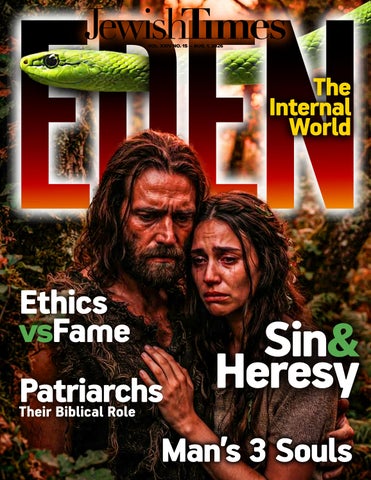
Biblical Role





Just click any icon in this






3
RABBI MOSHE
RABBI
RABBI MOSHE BEN-CHAIM Ibn Ezra on perfection
RABBI MOSHE BEN-CHAIM & HOWARD SALAMON
King Solomon’s wisdom on desiring the good for itself
RABBI ISRAEL CHAIT
God’s words are not to be taken lightly. They all behold infinite wisdom.
RABBI ISRAEL CHAIT R. MORTON MOSKOWITZ ZT”L
RABBI REUVEN MANN ZT”L
My 3 Rabbis discuss the role of the 3 Patriarchs
13 How Judaism Di ers
RABBI MOSHE BEN-CHAIM
Knowing the unparalleled distinction is crucial

But the wicked are turbulent like the sea, who cannot rest, whose waters toss up mire and mud. (Isaiah 57:20).
What is this turbulence? What generates it in the wicked man only? What prevents his rest? What is the mire and mud?
How does the wicked man di er from the righteous man? “Who is wise? One who knows the
RABBI MOSHE BEN-CHAIM (CONT.

“I am first and I am last and besides Me there is not other god” (Isaiah 44:6).
God being first means that everything else owes its existence to God. This strips the claim of power from all other gods, as everything is dependent on God for its very existence. God being last means that all else has a limited duration, all else deteriorates and dies. Again this refutes claims of other gods, for how can any god be forced to cease existing?
Being first and last, God exposes all gods as false. For a true god should not requiring God to be created, and the limited duration of all other gods reveals they are powerless against God. ■
outcome” (Tamid 32a). The intelligent man studies the world and studies himself. He understands when complying with the operation of the world, his life is calm and his needs are easily attained. He uses sturdy wood to build his shelter and soft materials to weave his clothing. He plants from good seeds and does not oversaturate his fields, and awaits the proper season for harvest. In this manner he successfully provides for himself and his family. But one who does not follow the natural law will not have a sturdy shelter. His clothing made from coarse materials will scratch his skin and his crops will drown. Man naturally is endowed with numerous instinctual drives. A wicked person is one who caters to all of them as soon as he senses an urge. He runs from one fantasy to another, causing himself frustration after frustration, as every enjoyment is short-lived. He does not think that talking back to his employer will cause him to be fired, which ultimately happens and eventually he is without food and a home. Since he does not have intelligence he does not have the ability to reflect upon himself and determine where he is making mistakes. This turbulent man has no rest and the result is that he has a distasteful life, similar to mire and mud being thrown in his face at every turn. But as the previous verse states, the righteous man has peace. He knows when to speak and when not to speak. All of his actions are reviewed and strategized, just like the wise Jacob had planned the bribe when his brother was approaching him to kill him.
The rule is that God gave us a mind to perceive natural law, which includes interpersonal relationships. If we respond rashly to every negative statement thrown our way, we lose the company of others and have di culty in gaining friendships needed for working in society. But if we anticipate the fallout from our negative speech and actions, and we control and strategize our interactions with others, we will find peace and success. ■



And the snake was the shrewdest of all the wild beasts that the God had made. It said to the woman, “Did God really say, ‘You shall not eat of all trees of the garden?’” The woman replied to the snake, “We may eat of the fruit of the other trees of the garden. It is only about fruit of the tree in the middle of the garden that God said, ‘You shall not eat of it or touch it, lest you die.’” And the snake said to the woman, “You are not going to die, but God knows that as soon as you eat of it your eyes will be opened and you will be like divine beings who know good and bad.” When the woman saw that the tree was good for eating, and lustful to the eyes, and that the tree was desirable as a source of wisdom, she took its fruit and ate. She also gave some to her husband, and he ate. Then the eyes of both of them were opened and they perceived that they were naked; and they sewed together fig leaves and made themselves loincloths (Gen. 3:1-7).
Maimonides says the snake spoke only to Eve (Guide, book III chap. xxx). Her receipt of the prohibition of even one fruit, weighed heavy on her. This explains her conflict. That one prohibition weighed far greater than it truly was, explaining why the snake said, “Did God prohibit all fruits?” What prompted this extreme sentiment? It was another psychological desire to be fully unbridled, as the instincts repel any and all restriction. To Eve, although literally all else was permitted to eat, that single restriction was intolerable. “Did God really prohibit all fruits? No, only one fruit is prohibited.” She intended to minimize the restriction, but she failed. Eve and Adam were created as adults, with full knowledge. So they knew angels existed, and they knew angels aren’t physical and cannot enjoy food. This made them both feel greater than angels in one respect. But with that elation over angels,
they experienced frustration that there was one restricted tree. But that was not what caused their sin. They sinned as Rashi says because “God created the angels” (Avos 4:21). Meaning, the restriction on one food was not su cient to drive them to sin. They had to justify eating that fruit: they imagined being like divine beings (angels): “God knows that as soon as you eat of it your eyes will be opened and you will be like divine beings who know good and bad” (Gen. 3:5). Again, this was Eve talking to herself. Eve and Adam sinned as “God created the angels” (Rashi, Avos 4:21) means God’s creation of these higher beings presented Adam and Eve with the desire to be higher beings too. Although the restriction on the one fruit generated a desire for it, they were not compelled to sin until they imagined the honor that they would attain by attaining knowledge of good and evil. Man must justify his wrongdoings, as man cannot knowingly harm himself (Rabbi Israel Chait).
But why did God give this restriction? This much we can say: Man cannot exist without a divine command. For man must know his relationship to God: we are subservient. God created man to benefit by observing God’s will. A divine command teaches this relation ship. Without a command, man can study the universe and arrive at God’s great wisdom. But nothing in nature conveys the idea that man should obey and serve God. Without a command, man would see other animal life, and by comparison, he would recognize he has intelligence so that he engages it. But the relationship as a servant of God would not be observed from nature. Therefore, as soon as man was created he was given a command. Now man is enabled to employ his free will and choose to follow God’s will over his own and enjoy the best life, that of wisdom and obedience for his own good, and inherit the afterlife. Thus, a command teaches man he is to obey God. It also entitles man to reward.

But it is interesting and noteworthy that the first description of man’s creation, “Let us make man in our image” (Gen. 1:27) refers to God giving man intelligence, an “image of God,” but there is no command given in connection with this intelligence alone. The second reference of God creating man refers to creating him from the dust of the earth and giving him animal life (Gen. 2:7). Also noteworthy is that here God states that man can eat of all fruit trees (Gen. 1:29), but still no mention of the prohibition to eat of the Tree of Knowledge. The prohibition is only
(Koheles 1:7)
Rabbi Chait: Koheles 1:5 teaches the cycle that man takes with his emotions. Verse 1:6 tells us that this cycle cannot operate without a bit of reality: that man feels he is getting somewhere, i.e., north, south. However, this is a delusion. There are two causes for man following this foolish cycle. One cause is what King Solomon stated in verse 1:6: man thinks he’s getting somewhere. But this is only a secondary cause. The primary cause is based on a need. That need is man’s great reservoir of psychological energy, depicted as a river; a relentless force. “The sea is not full” means that man’s desires are never quenched.
workings of the psyche. The rivers flowing to the sea are the emotions flowing to the desired object. “Yet the sea is not full,” i.e., man is not satisfied. This is because the desire is only as enjoyable as it is a novelty. Once novelty fades, so does the desire for the object. This is what is meant by “there they return again to flow.” Since novelty fades away, the waters (man’s energies) gather to flow towards yet another desired object. Furthermore, when one fantasizes about a desired object, he must incorporate into his fantasy the illusion that his satisfaction will be endless. As stated, fantasy requires the desired object, and the feeling that the enjoyment is eternal. (CONT.
Speaking of eternal, God created the Tree of Life in the center of Eden (Gen. 2:9). Man requires the central immortality fantasy to chase desires. For if man accepted his mortality, thereby understanding that all desires and satisfactions are short-lived, he would not chase what is temporal. But for every desire man chases, based on his feeling of immortality, he imagines that enjoyment will be endless. Immortality essentially drives man’s fantasies. It is the needed driving force behind every desire. Maimonides said, “The tree of life extends over an area of five hundred years' journey, and it is from beneath it that all the waters of the creation sprang forth” (Guide, book II, chap xxxi).
Tree—aytz—means counsel. Maimonides notes that Job lived in Utz, advising the reader to take “counsel” of Job’s story: “The name Uz therefore expresses the exhortation to consider well this lesson, study it, grasp its ideas” (Guide, book III chap. xxii). Again, “God planted the world in man’s heart” (Koheles 3:11). God also made other trees “desirous in appearance and good to eat” (Gen. 29), for man operates by fantasizing or imagining before he acts.
Why is the Tree of Knowledge of Good and Evil not also located “in the center” of the garden (man's psyche)? Because this knowledge was not initially planned to be part of man's psyche. Man would have been better o as God first created him: involved solely in matters
of truth and falsehood, not good and evil, the latter is a distraction from the former higher area of truths and fallacy (Maimonides).
understanding the mind, the emotions and man’s primary desires is the necessary backdrop for understanding the dynamics and justice of a divine command. Only once God refers to the rivers and the trees, does He command Adam and Eve in the forbidden fruit.
(Although God refers to di erent aspects of man’s creation (intellect, physicality, pcyhe), there was only one creation of man which contained all aspects.)
God recounts Eve’s steps before sinning so we appreciate her psychological dynamics:
And the snake said to the woman, “You are not going to die, but God knows that as soon as you eat of it your eyes will be opened and you will be like divine beings who know good and bad.” When the woman saw that the tree was good for eating, and lustful to the eyes, and that the tree was desirable as a source of wisdom, she took its fruit and ate.

Eve denied mortality, strengthening her desire, and justified eating the fruit.
With this understanding, we can appreciate God’ subsequent creation of the conscience to help Adam and Eve to not sin again so quickly. This newly created capacity of the mind that made them aware of their nudity, also provides a sense of guilt, which acts as a secondary brake system to prevent man from sin. Guilt can assist man in refraining from sin, far better than without it. But we would not understand the need for guilt and a conscience to be created, had God not first recorded man’s ease in sinning so quickly. Man now knew he was mortal. This generated a desire to deny his disturbing mortality by eating of the Tree of Life, meaning over-involvement in his earthly attachments to deny death (Targum, Koheles 7:29). This is why God drove man out of Eden where the Tree of Life was located. In other words, God altered man’s psyche once more, creating a balance between mortality and immortality. As involvement in either extreme is unhealthy. This balance is expressed by God’s creation of a spinning, fiery sword, and childlike cherubs.
And God said, “Now that man has become like us, knowing good and bad, perhaps he will stretch out a hand and take also from the tree of life and eat, and live forever!” So God banished them from the garden of Eden to work the land from which they were taken. Man was driven out; and in east of the garden of Eden were stationed the cherubim and the fiery turning sword to guard the way to the tree of life. (Gen. 3:22-24).
The mortality of a sword and the immortality of cherubs suggests a balance, allowing man to live happily, feeling death is far o based on a feeling of youth. ■

“Better is anger than laughter...”
(Koheles 7:3)
In order to answer why this is so, Ibn Ezra first explains human nature at length. He states that its is known by wise individuals who follow proofs, that man is composed of three souls, or faculties. The first is the faculty that desires sex, food and love. He calls this faculty “nefesh,” the instincts. The second faculty perceives via the senses and is the cause of man’s movements and actions. This faculty also desires honor, and he calls this “ruach,” ego. The third faculty is what enables man’s speech, discerns truth from false and possesses wisdom. This faculty he calls “neshama,” the soul or intellect. He states that Saadia Gaon had the same understanding of these three faculties. Ibn Ezra adds that the second faculty is “between” the other two.
This is a direct parallel to Sigmund Freud’s division of human nature into the “id”, the “ego” and the “superego”, matching the same order as above.
The idea that the ego is “between” the other two, is that man’s ego is pulled by his instincts and by his sense of “right” (soul) as if man were made of metal, and stood in between two powerful magnets. He would feel an attraction to both. We sense this ourselves, how our emotions pull us one way, but our sense of truth and morality oppose our desires.
Ibn Ezra explains: “the instinctual drive is powerful, and since it has a body and the support of other instinctual drives it is impossible for the intellect to overcome it.
He means to say that when man is pulled by an emotion, man being physical (body) strengthens the instincts, and other emotional forces are activated, adding to the tug and making it more di cult to refuse an urge. When the Jews sinned with the Golden Calf, the Torah says they also ate, drank and indulged in illicit sexual activities (Exod. 32:6, and see Rashi). This shows that one instinctual arousal awakens other instincts to seek gratification. As the Jews satisfied their idolatrous instinct, other instincts sought gratification too. On this truth, Ibn Ezra warns: “one that indulges in eating and drinking, will never become wise.”
So how does man escape the grips of his instincts? Ibn Ezra says he must make a few calculated steps. First, man must team his ego with his instincts to seek honor or greatness. Man seeks honor more than baser gratification, so man can conquer his instincts by feeding his ego. In doing so, a small portion of man’s soul is awakened, as he requires some intelligence to direct a strategy for his social advancement. But in this phase, man still cannot realize abstract wisdom, due to the power of his ego seeking honor, which also gives birth to anger.
Here, Ibn Ezra answers our verse above, that “anger is better than laughter.” For he says, anger can exist only when ego is involved. Without ego, one cannot feel angry that something did not go as he wished. This angry “intolerance” is an expression of ego. But as he said earlier, ego awakens some portion of intelligence. So anger is better than laughter, since anger carries some intelligence, while laughter does not.
At this point, when man has strengthened his intellect through the assistance of the ego for he has engaged the intellect to help his ego goals, Ibn Ezra says man must now immerse himself fully in intelligence, causing the intellect to grow stronger, to the point that it can subdue the ego. This plan, Ibn Ezra advises, is how man can arrive at a life where his intellect rules his instincts and his ego. The rest of his commentary removes all assumed contradictions in Koheles, by applying this understanding of the workings of “man’s 3 souls.” ■
Haftorah of Deuteronomy (Isaiah 1:1-4):
The prophecies of Isaiah son of Amoz, who prophesied concerning Judah and Jerusalem in the reigns of Uzziah, Jotham, Ahaz, and Hezekiah, kings of Judah: “Hear, O heavens, and give ear, O earth, for God has spoken: ‘Children I made great, and set them on high, and they have rebelled against Me. An ox knows its owner, a donkey its master’s trough, Israel does not know, My people do not ponder [their God]. Woe, a sinful nation. People laden with iniquity. An evil seed (lineage). Destructive children. They have forsaken God, provoked the Holy One of Israel. They have turned backwards.’”

Rabbi Moshe Ben-Chaim & Howard Salamon
“Give ear, O heavens, let me speak; let the earth hear the words I utter!” (Deut. 32:1). Here, when admonishing the nation, Moses too called upon heaven and Earth. Rashi and Radak explain this to mean that Moses warns the Jews that their rejection of Torah will meet with God withholding heaven’s rains and Earth’s produce, also mentioned in Shima. Ibn Ezra says, “I believe that the correct interpretation is that Moses called heaven and Earth to witness because they last forever” (Ibid.). Both explanations mean that the prophets’ words reflect God’s absolute truths. When admonishing the nation, Moses and Isaiah conveyed the absolute, inescapable tragedy of violating God’s Torah, equating God’s reward and punishment as permanent as heaven and Earth. When the Jews are confronted with an inescapable system of reward and punishment, this is a great motivation not to violate God’s words.
“Children I made great, and set them on high, and they have rebelled against Me”
God bestowed Torah (greatness) and providence (highness) to the Jews. The sin was one of relationships: God raised the Jews like “children,” but the Jews sinned against “Me.” How does this di er from other sins? They failed to see the Torah’s value, despite its “great” integral value and its social benefit of elevating them “high” over all other peoples. They also failed to recognize the value of the source of Torah—“the Jews sinned against Me”—the all-knowing and all-powerful God. Had the Jews possessed knowledge of Torah's benefits and the reality of who God is,
they would not have traded those for false gods. This explanation as a sin of ignorance is proven from the very next verse: “An ox knows its owner, a donkey its master’s trough, Israel does not know, My people do not ponder [their God].” Their sin was one of ignorance.
“Woe, a sinful nation. People laden with iniquity. An evil seed (lineage). Destructive children.”
In the final verse above, 1:4, notice the 4 terms: “Nation. People. Seed. Children.” These terms indicate 4 unique sources of the Jews’ sins. What is the dynamic of the corruption in each one?
One source of sin is “nationhood.” This refers to some shared, binding quality which separates one nation from another. Common ground fosters justification for a sinning, viz., “If my peers act this way, it must be okay.”
“People” refers to unifying behaviors in which group members take pride. It’s not that others justify some matter, but there’s an additional element of pride in “belonging.” We see this in groups marching for causes. And causes are not short-lived, but are movements over time, sustained values and actions. This explains “laden” with sin. Laden means a repeated, piled-up and sustained corruption based on identifying with others.
“Evil seed” is a deeper identification…a group with shared history, a common lineage or seed. People lend credence to their history. God told Abraham to leave his “land, his birthplace and his father’s house.” Why leave? It was for this very reason that one identifies with his history, and when that history is corrupt, it prevents one’s improvement through breaking from it. Thus, God told Abraham to break with his identification with his family’s history of idolatry. Identifying with a history is a greater corruption than the previous level of belonging to a group. How so? “Seed” and family are viewed as “integral” to oneself, as compared to joining an “external” movement. Seed is a stronger identification.
“Destructive children” means copying one’s parents, and feeling justified even at their destructive behavior. One trusts that his parents live and teach what is proper. So even destructive behavior is unquestioned.
Jeremiah refers to the surprise realized by others:
“Our fathers bequeathed to us futilities” (Jer. 16:19). They felt fathers should have been trusted, but they discovered otherwise.
“They have forsaken God, provoked the Holy One of Israel. They have turned backwards”
“Forsaking God” refers to denying the universe has a Creator, a rejection of reality.
“Provoking the Holy One of Israel” refers to causing their punishment. This is God not in the capacity as Creator, but as God of Israel—Torah recipients—which contains punishment.
“Turning backwards” is a critique of the Jews, independent of punishment or denying the Creator. It means they forfeited common sense. A rational person doesn’t turn backwards, but follows reality and moves forward using all his knowledge. ■
A good name is better than fine oil, and the day of death [is better] than the day of birth (Koheles 7:1).
Ibn Ezra says the day of death is better than the day of birth because at birth, it is not yet known whether the person will turn out good or evil. But when a person dies, we see he has lived a good life. So the day of death is better as one has earned goodness by following God. Now let's focus on the first half of the verse.
A good name being “better” means one has a barometer of good vs. evil, where “better” refers to what partakes more of that good, as compared to fine oil. So what is Torah’s definition of “good”?
You have been told mortal, what is “good” and what God requires of you: do justice and to love goodness, and to walk modestly with your God” (Micha 6:8)
The “good” refers to God’s ethics and is tied to walking “modestly” which means the poor man cares nothing for public acclaim. Ibn Ezra comments: “The poor man who knows his proper actions, has greater honor than the pleasure of physical pleasures (fine oil).” But the poor righteous man cares nothing for honor or public acclaim. Therefore “a good name” really refers to his good acts, which parenthetically result in a good reputation. Meaning, he values proper ethics for the ethics alone: “He performs the good because it is good, and not for any other purpose” (Maimonides, Laws of Repentance 10:2). Ibn Ezra’s statement “He knows his proper actions” refers to “his” internal knowledge, not to public acclaim. Choosing a good name means he chose what results in a good name—proper ethics—but not hat he wanted at the good name per se. Therefore we explain “A good name is better than fine oil” as referring to a poor man who acts properly as his mind agrees with truth and Torah morality. His good name refers to his internal knowledge of the self, “He knows his proper actions”—knowledge of himself. He is attached to truth and morality, unconcerned with fame, and this far outweighs physical pleasures like fine oil. “Better” means his good actions are in line with truth, whereas physical pleasures—fine oil—are merely preparatory for man to be in the state of mind to acquire greater wisdom. Pleasures are a means while knowledge and morality our true objectives, as they perfect our true essence, our soul. And this is because the “good” refers to God’s truths. ■

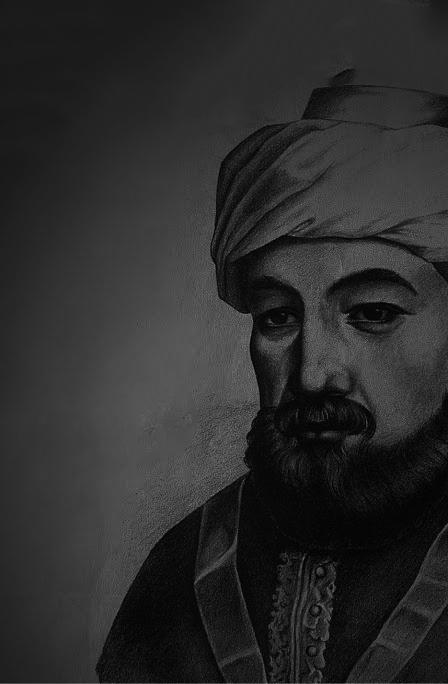
aimonides maintains that if a person says Moses wrote anything in Torah (Bible) on his own, he is a heretic. Rather, we must believe that every word, every letter was dictated by God.
It would seem that Maimonides should have stopped there, saying very simply: “If a person believes Moses wrote a word—without God’s authority—then he’s a heretic.” But let's say one believes that every word was in fact dictated by God. Then he's fine. But Maimonides doesn't say that, that's not enough. He says even if a person would believe that, it still would not be enough because Maimonides goes on to say that this is considered a violation of “despising God’s word” (Num. 15:31). Maimonides says “every single Torah word has wisdom, knowledge and astounding things for one who understands them.” What does that have to do with it? Why didn’t Maimonides say simply, “If a person believes Moses added to Torah, that’s heresy.” But let's say he believes that the whole Torah is from God, but he believes that there
but nevertheless he would say that God told Moses to write them, and of course every word was formulated why God, and Moses wrote all the di erent events, what's the problem about that? But according to Maimonides he's still a heretic. Why?
Because Maimonides is saying is that the heresy is “despising God’s word.” It means to say that he he's reducing the word, the meaning, even if the person would believe that God dictated these events, but these events are just historical facts, but they have no real relevance, there's no concepts, no ideas to be derived from them…this is “despising God’s word.” And this is heresy, which means saying anything created by God is a mere historical fact, and doesn’t contain endless wisdom. If one believes God does things in such a way, that’s despising God’s words and he is a heretic. That was the heresy of Mennashe. Maimonides extended the concept. It's not simply that you have to believe that every letter is from God, that's not enough. He means to


Paraphrasing Rabbi Israel Chait, unlike other philosophers and philosophies, God’s Torah does not instruct man with ideas alone: God included stories of uniquely intelligent personalities—the patriarchs and matriarchs—how they intelligently managed all aspects of their lives: determining truth and morality, education, religion, the mundane, family, justice, politics and all areas from troubles to success. Torah provides these models of intelligent and healthy personalities, as theoretical advice alone doesn’t allow one to identify with a human model. Identification provides the much needed emotional support to help man better appreciate how certain decisions helped others succeed practically, saved them from evil and earned them God’s help. Appreciating examples of Torah’s models enjoying better lives and God’s providence, provides the Torah reader with more formidable and convincing support and motivation to choose and live realistically and successfully.
Rabbi Moskowitz said as follows:
“Now, if the purpose of the commands is just to keep Torah, what difference is it if we are Israelites or another
nation? Why must Torah observers be descendants of the 12 tribes? Why can’t Torah observers be any people who keep Torah? We also must ask what or who are the patriarchs? The patriarchs and matriarchs did not have Revelation at Sinai and therefore they did not keep the commandments (mitzvos). They perfected their souls by coming in line with God’s will without commandments. They had that ability to relate to God directly through their minds. Most people cannot do this and require a system (Torah) to attain perfection. Torah’s purpose is not merely commandments, but to help mankind attain the level of the patriarchs. Thus, Israel’s mission must always be attached to the patriarchs to show that the life of the patriarchs embodies the essence of the commands. If we lose the attachment to the patriarchs, that would separate the patriarchs from the commandments, and people will just keep the commandments as an end themselves, without using them as a means of attaining the perfection of the patriarchs.
The Torah system includes the patriarchs to impress this idea that perfection is not only the commandments, as the patriarchs had no commandments or halacha. Now, if halacha [and commandments] were the essence, the patriarchs didn’t have the essence! Our nation must always connect to the patriarchs to represent that idea. The patriarchs surpassed our perfection, probably greater than you could ever reach, and they did so
without halacha. Why are gentiles prohibited to observe laws outside of civil laws? It is due to our mission. If gentiles kept the Torah, it would confuse the world to believe that all that is required is keeping the commandments. But this would forfeit the Jews’ mission, that the essence is perfection of the soul, embodied in the patriarchs. As gentiles are not connected to the patriarchs, only the descendants of the patriarchs can teach this lesson. [Therefore those who represent Torah’s objective—the perfection of the patriarchs—they alone most observe the commandments to teach that the commandments isolated from the patriarchs is not God’s will, and is not human perfection].”
Rabbi Reuven Mann's essays frame the patriarchs as living proof that the human mind, unaided by divine command, can independently discover God and ethical perfection. Living roughly 400 years before Sinai, Abraham, Isaac, and Jacob each arrived at monotheism through their own intellectual inquiry rather than inherited tradition, which is why the liturgy names each one separately and why each successive patriarch added new understanding (reflected in their increasing frequency of prayer). Rabbi Mann emphasized that Judaism, unlike most religions, has no single founder or concept of sainthood — the patriarchs' preserved fallibility keeps ultimate devotion focused on God rather than on human figures — and that Abraham's central mission, aligned with Maimonides' view, was uprooting idolatry and establishing rational monotheism in its place. Functioning as prophets, teachers, and parents at once, the patriarchs and matriarchs each contributed a distinct trait to the nation's moral character (Abraham and Sarah kindness, Isaac and Rivka disciplined strength, Jacob's family their integration), forming a cumulative moral architecture rather than repeated lessons — which is ultimately why Genesis opens with their biographies before any law is given, establishing them as models of the Torah's core claim that reason alone can lead man to truth. ■
Is Judaism mystical, or is it rational, based on reason and proofs?
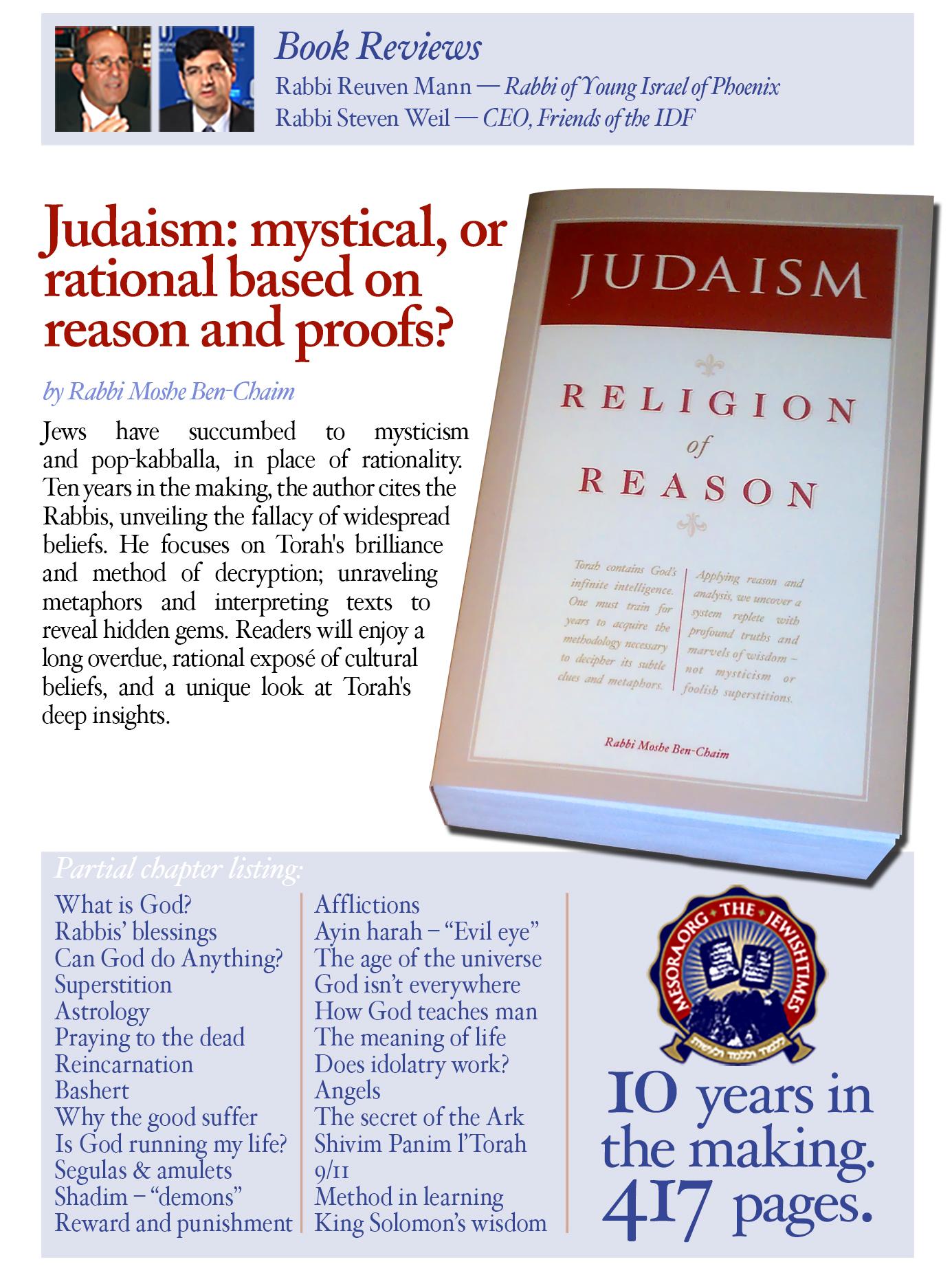

Rabbi Moshe Ben-Chaim
“
Religion” refers to a lifestyle of submission to a benevolent authority, designed and transmitted by the author. All religions except Judaism claim to be God’s only true religion, but they all lack validation. Judaism is the only religion with proof of Divine origin. This proof is demonstrated through God’s revelation of His existence and His communication to 2.5 million Jews on Mount Sinai 3338 years ago. The Jews witnessed an intelligent voice speaking from within the fiery mountain. Biological or earthbound life cannot exist in fire, precisely why God used fire in this event. No other religion claims to possess proof because Divine revelation never happened to others, and as Torah (Bible) says, “It will never happen again” (Deut. 4:32-34).
Judaism is the only religion whose claim is supported by world acceptance of Torah. This acceptance is 100% proof of God’s revelation to the Jewish people. Had Revelation at Sinai not occurred, it would not have been believed by that generation, and certainly not by the rest of the world and all future generations through the present day. The only way Revelation at Sinai became accepted is because it was witnessed, and then all witnesses passed the story down to the following generations through today. God wished that this event remain a 100% proof throughout all generations. Had a false prophet attempted to convince any group that they witnessed what they had not, they would never accept him, nor would they replace their known history with the false prophet’s lies. A unanimous identical transmission of a witnessed event occurs only when that event occurred. Unani mous transmission—a single Biblical account—is proof of the truth of Revelation at Sinai. God revealed Himself to masses only once: to the Jews on Mt. Sinai, where He gave the Jews His Bible.
All other religions are founded on a single person’s claim (or a fabricated story of few witnesses, without actual witnesses) that God communicated with man. Something of this nature cannot be proven, and is precisely why they formulated their religions with the demand for “blind faith.” Those religions did spread, but not due to witnessed events. Those religions spread as they appealed to human emotions. People will accept what is pleasing. Someone dying for my sins is very appealing. Praying to a tangible human figure is more pleasing than praying to an invisible and abstract God. But not one other religion can provide evidence of Divine communication. Therefore, there is no basis to
accept any other religion. Furthermore, as God designed only one human being, multiple religions is nonsensical. Just as all people are treated identically for cancer, all people will find the happiest life with the same religious system.
Judaism is also unique in its intellectual and brilliant design, in its basis in reason and proof, and in its full compliance with human nature, o ering real happiness and no conflict with human nature. Judaism is founded on principles which are rational and comply with man’s nature as a philosophical and psychological being. Not one law in all of Judaism goes against man’s nature. Unlike Catholicism which frowns upon divorce and praises celibacy, Judaism embraces the need at times for couples to divorce if they will be happier that way, and Judaism also embraces man’s need for sexual happiness and children. These are just two examples of how Judaism approaches life honestly. Catholicism makes man into a mystical and infallible saint or an angel, one who is above actual human drives and emotions. This opposes Judaism, and true human nature. Judaism accepts that man’s happiness must stem from his being in line with his nature. And Judaism doesn’t hide our leaders’ sins. We have no saints, all men sin: “For man is not wholly righteous on Earth who does what is good and doesn’t err” (Koheles 7:20).
Judaism realizes that besides man satisfying his psychological needs, he has a much higher part which must be addressed: his soul. By man ignoring this essential part of his nature, he will never reach his ultimate, Divine mission of approaching God. Man achieves this mission and ultimate happiness by his immersion in study of creation and Torah, actualizing his true goal and purpose in an appreciation of the Creator. Torah, Prophets and Writings, along with the Talmud, were written in a highly stylized format which takes years to master. Their style is such, that as one delves deeper and deeper, he or she finds more profound ideas. This analysis and search satisfies man in its very process, as well as through enlightenment of new insights. As God possesses infinite wisdom, man will always see new insights, provided he has toiled under the tutelage of those before him trained in the method of Talmudic and Biblical exegesis, teamed with the essential modes of interpretations only found in the Oral Law, which God also communicated to
The system of Jewish law—halacha—is also a major component of Judaism. It guides man’s every action from waking and prayers, to blessings over food, ethical and moral conduct, business practices, social relationships, and Holidays. All areas of life are always placed in check as man judges each of his actions for Torah compliance prior to commencement. This process engages man’s mind throughout his days when he is not involved in study, which must comprise the majority of his
In truth, there is no comparison between the Divinely designed system of Judaism and man made religions for the precise reason that there is no comparison between God and man: man made all other religions. God made Judaism, the Bible. ■


All books depict history, facts, theories, fiction or poetry. No book is coded with hidden messages beyond the words or patterns revealing marvels. But the Bible (Torah) was written by God, and is “coded.” The order of verses, use of certain phrases, apparent contradictions and other Biblical patterns are pur poseful clues to God’s wisdom.
This book unveils those patterns and shares the hidden messages.