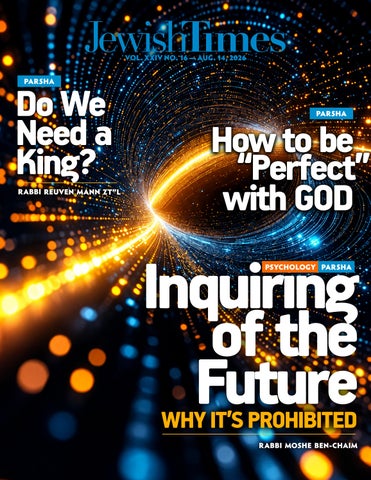
VOL. XXIV NO. 16 — AUG. 14, 2026 PARSHA
Do We Need a King? RABBI REUVEN MANN ZT”L
PARSHA
How to be “Perfect” with GOD
Inquiring of the Future PSYCHOLOGY PARSHA
WHY IT’S PROHIBITED RABBI MOSHE BEN-CHAIM
the FREE
Just click any
2
|
WWW.MESORA.ORG
AUG. 14, 2026
icon in this issue
MESORA THE JOURNAL ON TORAH THOUGHT | Please send letters and questions to: Comment@Mesora.org |
3 Shofar
4 Tomorrow
THOUGHTS
The perfections the shofar calls to mind
3 Teshuva THOUGHTS
Using this seasonal awareness to introspect and repent
RABBI MOSHE BEN-CHAIM
Moses’ 2 warnings in recent parshas alert us to an improper concern and relationship to God
7 Need a King? RABBI REUVEN MANN ZT”L
Rabbi Mann compares 2 great rabbis’ dispute
8 Following God Perfectly RABBI MOSHE BEN-CHAIM
2 Torah clues concerning this interesting mitzvah and what it means
| SHOFAR | The shofar sounded at Mt. Sinai to accept God’s sole kingship. It was present when Abraham sacrificed Isaac to show his great love of God. It is bent to show our needed humility. It sounds like a cry to show our remorse for our sins. And it sounds like an announcement to declare God is “in the field” awaiting our return to Him. ■
THOUGHTS RABBI MOSHE BEN-CHAIM
Subscribe FREE to the Jewishtimes: mesora.org/jewishtimes –––––––––––––––––––––––––––––––––––––
Articles may be reprinted without consent of the Jewishtimes or the authors, provided the content is not altered and credits are given.
Reflecting & Repenting Another year has passed. We eventually must answer to God for our actions. Sounding the shofar awakens us to God’s ultimate judgment of ourselves. It’s time again to review our actions and values to confirm we live in line with what earns us eternal life. Review the ethics of your business dealings, your interactions with friends and family. Make amends. ■
WWW.MESORA.ORG AUG. 14, 2026
| 3
SHARE
When God your God has cut down before you the nations that you are about to enter and dispossess, and you have dispossessed them and settled in their land, beware of being lured into their ways after they have been wiped out before you! Do not inquire about their gods, saying, “How did those nations worship their gods? I too will follow those practices.” You shall not act thus toward God your God, for they perform for their gods every abhorrent act that God detests; they even offer up their sons and daughters in fire to their gods. (Deut. 12:29-31).
Inquiring of the Future PSYCHOLOGY PARSHA
WHY IT’S PROHIBITED RABBI MOSHE BEN-CHAIM
4
|
WWW.MESORA.ORG AUG. 14, 2026
When you enter the land that the God your God is giving you, you shall not learn to imitate the abhorrent practices of those nations. Let no one be found among you who consigns a son or daughter to the fire, or who is a fortune teller, a soothsayer, an omen teller, a witch, one who casts spells, or one who consults ghosts or familiar spirits, or one who inquires of the dead. For anyone who does such things is abhorrent to God, and it is because of these abhorrent things that God your God is dispossessing them before you. You must be wholehearted with God your God (Deut. 18:9-13). (CONT. ON NEXT PAGE)
PSYCHOLOGY PARSHA SHARE
What is “abhorrent” about seeking to secure one’s future and future knowledge? It’s not the knowledge per se, as true prophets rightfully share the future. But it is the search that is evil, the insecurity, the assumption that without God’s involvement, foolish practices like passing children through fire pillars can secure the future, or people can tell you the future. It’s a denial of reality, a fear and an inadequacy to welcome the unknown of tomorrow and feel capable of addressing it as one should. But a wise man knows that reality has governing laws and patterns, that people have a limited emotional range, and that intelligence can navigate life with success, with God’s help. That knowledge provides man the confidence to tackle tomorrow. But one ignorant of these fundamental areas lacks the realization of what’s possible and manageable, and instead he imagines an uncontrollable and terrible future. He is incapacitated by his fears and resorts to any glimpse into the future. The Egyptian Jews suffered 210 years of harsh slavery because they followed Egypt’s idolatry. They caved to the need for Egypt’s approval and followed their practices. This is why they were enslaved. Above, Moses repeatedly warns the Jews not to follow that same insecurity upon entering Israel. Man is not to be raised higher than God. But evidently, that is so common among people. Their need for ego satisfaction—societal approval—outweighs their knowledge of truth: God alone hears and responds to man, not lifeless idols, “They have eyes but don't see, ears but don't hear” (Psalms 115,135). God alone created all, and He alone provides for man based on his perfection. God alone knows and causes our future. Moses warns the Jews they will soon encounter idolatrous cultures in Israel, whom, due to their distortion of reality and their rejection of the true God, God is dispossessing and giving their land to the Jews. But what exactly is the insecurity which drives man to false gods depicted in the above 2 quotes?
Rashi: Walk before God whole-heartedly, put your hope in Him and do not attempt to investigate the future. But whatever it may be that comes upon you, accept it whole-heartedly, and then you shall be with Him and become His portion. Moses identifies a major human insecurity: “What will happen to me in the future? Will I have health and success? What can I do to guarantee success? Perhaps other cultures have the answers?”
Why Seeking the Future is Wrong
The future has not yet happened; it does not yet exist. Just as a person cannot see a non-object as nothing is in front of him, a person also cannot know the future, for it is as non-existing as the non-object. Secondly, human knowledge is based on observation. And with nothing to observe, man has no ability to perceive. The future can’t be observed. Instead, man should trust God's system of Reward and Punishment and feel confident that what will unfold in his life will be based on his merits, trusting in God’s justice. Moses emphasizes that the other nations fall prey to social insecurity, “Those nations that you are about to dispossess listen to soothsayers” (Ibid. 18:14). What does it mean that they “listen” to soothsayers? It means they depend on “people,” they “listen to others.” Man plays a significant role in a person’s life. Many have never abandoned the infantile need for the parental figure. Society becomes the parent (Rabbi Israel Chait). In contrast, God says,
prophet is validated by sharing the future where all unfolds precisely: “If the prophet speaks in God’s name and the oracle does not come true, that oracle was not spoken by God” (Ibid. 18:22). If God does not wish us seeking forecasts, but to accept life as it happens, why is the future that which validates a prophet? This shows that only God knows the future, thereby rejecting all other practices of forecasting as false. This categorically dismisses all fortune tellers as liars. So, in practice, God does not wish man to seek the future; man should trust that God’s governance is fully just with nothing to worry about, provided we follow Torah. But when God must intercede in human affairs to help man with divine direction, we must have a method of validating a true prophet. That method is 100% accurate predictions, something that is impossible without God's intervention, thereby dismissing all idolatrous fortune-telling as lies. ■
I will raise up for them from among their own people a prophet like yourself, in whose mouth I will put My words and who will speak to them all that I command. And anybody who fails to heed the words spoken in My name, I Myself will call him to account (Ibid. 18:18,19). God demands a person follows reality, that he follows God’s words which are validated only when spoken by a prophet. And a WWW.MESORA.ORG AUG. 14, 2026
| 5
PARSHA SHARE
This week’s Parsha, Shoftim, takes up the matter of Jewish government. Although the Torah seems to favor the appointment of a king to rule over G-d’s people, it is actually somewhat ambiguous on the desirability of establishing a monarch.
Is a King Necessary?
There is a Talmudic dispute in Sanhedrin 20b on this subject. Rabbi Nehorai holds that appointing a king is not mandatory, but a concession to the will of the people. If they join together and request a king to judge them and fight their wars for them, then they will be granted their wish. However, Rabbi Nehorai believes that this arrangement is not ideal, and if the people are not interested, a king would not be appointed. It is important to understand Rabbi Nehorai’s conviction. The vast majority of the Mitzvot are not suggestions or optional guidelines, but obligatory. There must be a very good reason why, in this case, the Torah is merely granting permission. We can understand Rabbi Nehorai’s viewpoint by considering the many restrictions the Torah placed upon the king. He is enjoined from excessively accumulating silver and gold, horses for warfare, and wives, so that he should not develop a lust for domination and remain humble.
The Dangers of Human Power
Do We Need a King? RABBI REUVEN MANN ZT”L
6
|
WWW.MESORA.ORG AUG. 14, 2026
The Torah is wary of placing too much power in the hands of a mortal. That is why Moshe was Hashem’s ideal choice to be the first leader of Bnei Yisrael (Children of Israel). His most outstanding qualification was his humility and utter distaste for the limelight. Moshe realized that Bnei Yisrael are G-d’s people, and He alone is their Ruler. A human monarch tends to glorify himself and solicit reverence that ought to be directed toward the Creator. Moshe was the perfect choice for the position because he did not attract attention to himself. He communicated G-d’s commands and taught the people how to observe them. However, was Moshe’s leadership style the rule or the exception? Jewish history has been marked by some remarkable leaders. Aside from Moshe, there was Yehoshua, who oversaw the conquest and settlement of the land; King David, whose military accomplishments paved the way for the construction of the Beit HaMikdash (Holy Temple); and King Solomon, who built it. Would the Beit HaMikdash have been built without the inspired leadership of these great men? Unfortunately, the righteous kings of Israel were far outnumbered by the wicked ones. The practice of idolatry that plagued the people and led to the destruction of the First Temple was foisted on the nation by evil kings. And the internal strife that marked the breakdown of the Second Temple was triggered by endless lethal competition among rivals for power. The wise adage that “power corrupts” can be clearly borne out in the history of the Jewish monarchy, which, on the whole, proved to be a disaster. This enables us to better understand and appreciate the opinion of Rabbi Nehorai. (CONT. ON NEXT PAGE)
PARSHA SHARE
Rabbi Yehudah disagreed with Rabbi Nehorai and held that appointing a king was mandatory. The Rambam rules in accordance with this position and further maintains that the Mashiach (Messiah) will be a king who is a scion of Beit David (House of David). This difference of rabbinic opinion reflects the ambivalent nature of human power. When Moshe sensed that he was nearing his end, he beseeched Hashem to appoint a successor so that the Children of Israel should not be “like sheep that have no shepherd” (Bamidbar 27:17).
Government and the Will of the People
Every nation needs a governmental structure. There can’t be a situation where everyone is permitted to do that “which is right in his own eyes” (Shoftim 21:25). America is a truly great country, but the extreme indulgence of every individual whim has led to a sundering of social cohesion and has triggered a cultural war that can lead to grave consequences. As Jews, our national mission requires that certain individual preferences be sacrificed for the sake of societal good. Moreover, matters of ethics and morality are not to be determined by the “will of the people” nor to be influenced by the fashion of the times but by the eternal Mitzvot of the Torah. The contemporary State of Israel is a liberal democracy that guarantees individual rights and freedom of choice. Its government consists of legislative, executive and judicial branches. But ultimately, as in every democracy, it is the will of the people that rules. From a practical standpoint, this is fortunate, as someone once quipped, “Democracy is the worst form of government except for all the others.” At present, it is impossible to implement a societal order based on adherence to the Torah. I don’t believe it would be a good thing to legislate Shabbat observance, adherence to Kashrut, the holidays and so forth. Bnei Yisrael, at this point, will not stand for being told what to do.
Awaiting the King Mashiach
However, in the Messianic era, the entire nation will return to a wholehearted embrace and observance of the Mitzvot. This will be accomplished by the King Mashiach, who will be “exceedingly wise, even wiser than King Solomon, and a great prophet, close to Moshe Rabbeinu (our teacher)” (Rambam, Hilchot Teshuva 9:2). It is only through the heroic deeds of an exalted leader endowed with all the power and authority of the Jewish king that Bnei Yisrael will be redeemed and fulfill their mission of being a “light unto the nations” (Yeshayahu 42:6, 49:6). Until he arrives, we must accept the situation we are in and the strictures that govern our religious behavior. We cannot impose Judaism on anyone, no matter how pure our intentions. We must respect all our fellow Jews and their “right” to live as they see fit, even in a manner contrary to Torah. We need to relate to them with great understanding and be able to demonstrate the beauty and relevance of Torah wisdom. By treating all our brethren with great friendship and love, and engaging them with reason, we will help to prepare the path for the Mashiach, who will complete the mission initiated by his great forebear, King David. May we merit to witness this soon. Shabbat Shalom. ■
WWW.MESORA.ORG AUG. 14, 2026
| 7
FOLLOWING GOD PERFECTLY “ PARSHA
SHARE
When you come into the land which Hashem your God gives you, do not learn to do like the errors of those nations (Deut. 18:9).
RABBI MOSHE BEN-CHAIM
or to secure oneself. A few examples will help to illustrate this point. Molech was a practice through which a parent would pass his child through two flames: not burning the infant, at least according to Maimonides. What was this objective? Let us consider. Fire is the one element which opposes all biological existence. In all elements an organism may survive, except in fire. Passing the child through fire unharmed, the father imagines that just as the child is shielded from flames, he will be shielded from all other mishaps during his life. It makes sense that the parent/child relationship forms the prohibition, as the parental instinct is strong for the survival of their children. However, this parent has a distorted notion that this action is fortuitous and actually protects his child. Kosame and Nichush were two practices which “foretold” the future. So too was the practice of consulting the dead. The goal is to obtain knowledge.
”
The Torah lists many idolatrous prohibitions: setting signs or accepting omens (Nichush), passing children through fire (Molech), forecasting using objects (Kosame), fortune telling and horoscopes (Mi’onane), witchcraft (Kishuf), consulting the dead and others. These practices are not based on truth or knowledge and therefore they are false. But this Torah section concludes with a statement not found at the end of other sections: “Perfect (tamim) shall you be with Hashem your God (ibid 18:13).” Why isn’t this statement found at the conclusion of dietary laws, sexual prohibitions, or monetary laws? Why is the statement of “Perfect shall you be…” mentioned here alone? What does “perfect” mean? We must say that only regarding idolatrous violations is one “imperfect” with Hashem. If one were to eat non kosher foods, he would not violate this command to be perfect. What specific value does “perfect” with God target? Each of the aforementioned idolatrous practices is an attempt in some way to procure information
What common thread runs through all these practices? The answer is “knowledge.” In each of these violations the inquirer seeks security through some imagined source of knowledge, via a warlock, an enchanter, or the dead. He assumes there is a source of knowledge out there, besides God. This is precisely where one removes his self from following God perfectly, or rather, “exclusively.” To assume sources of knowledge other than God, is to not follow God “perfectly.” It is a dilution of God’s unique and exclusive position. Therefore, the command to “be perfect with God” demands that we deny all imagined sources of knowledge or forces. Rashi explains this topic in (CONT. ON NEXT PAGE)
8
|
WWW.MESORA.ORG
AUG. 14, 2026
PARSHA
this same manner: “Follow Him perfectly and look to Him, and do not chase after the future. Rather, all that comes upon you accept it wholly, and then you will be with God and in His portion (Deut. 18:13).” The followers of these practices assume that aside from God, there are other means through which the universe operates. They assume that outside of natural law, other powers exist. This is of course baseless. But their insecurities propel them to seek forecasts for their actions, so they need not think for themselves and they are no longer insecure about the future, which scares them. Relying on another person’s advice or assuming to know the future removes their need to make decisions and provides a false sense of safety. This is the opposite of God’s plan that man engage the gift of the intellect and approach each new day intelligently. Similar to these idolatrous practitioners are present day Jews who check a Mezuzah when household members fall sick, or those who don red bendels to ward off evil, place keys in challas for luck, use prayer books as protection, and those who ascribe powers to Rebbes and Kabbalists. I recently heard of a Meir bal Hanase practice where individuals believe that by giving charity one can locate a lost object. How damaging are such notions. What is “created” cannot function outside of the “Creator’s” plan for that thing. It is clear. Just as God set boundaries for the sea, “You set a boundary, they cannot overstep (Psalms 104:9)” so too, all of creation follows the laws governing its matter and behavior. Man’s act of giving charity has no natural relationship to finding objects. Thus, Meir bal Hanase practices are ineffective. Just as a parchment and ink Mezuzah burns when ignited and cannot protect itself, it cannot protect man. And wearing red threads cannot withstand God’s punishments. This practice is a direct violation of God’s system of Reward and Punishment: sins yield punishment and creations are ineffective against God’s will. (Tosefta Sabbath chapter seven prohibits this act.) All practices assuming forces aside from God are idolatrous. It makes no difference if we see “religious” Jews practicing such foolishness, if we read about them in a book, even if authored by a Rabbi. The truth is only that which we perceive, or that which we reason to be true, or what God wrote in His Torah. He created and controls the universe; therefore, He alone determines reality. Not people, and not objects. “Perfect shall you be with God” means we must not deviate from following God alone. God is the sole Cause of all that exists. This excludes anything else from
affecting reality outside its range of laws. Having shown that the term “perfect” (tamim) refers to man’s requirement not to assume knowledge or powers outside of God, we have a question. In Genesis 17:1 regarding circumcision, God instructed Abraham to “Walk before Me and be perfect.” God again uses the term “perfect.” How does this fit in with our theory? Ibn Ezra says the following commentary on this command to Abraham to “be perfect”: “You should not ask why (to) perform circumcision (ibid).” On the surface, Ibn Ezra appears to defy all he stands for, i.e. a life of understanding. How can he make such a statement? Ibn Ezra is not saying we should abandon our minds. Rather, he is teaching us that Abraham should not make his performance of Divine decrees depend on his own intelligence as a prerequisite for his fulfillment. Ibn Ezra teaches that man can fall prey to this erroneous notion: “Only when I understand the reasons will I perform Torah laws, but not before.” To this Ibn Ezra teaches, “Do not inquire why to perform circumcision” i.e., “Do not let your inquiry determine your acts.” Meaning, perform the commands despite your lack of comprehension. Of course, continue to strive for the reasons behind this and all commands. This is Ibn Ezra’s teaching, and why the term “perfect” is also used here. In this case too, man can go so far as to think of himself as a source of knowledge outside of God, considering himself on the level to vie with God and His commands. God says to Abraham “be perfect” – follow Me even when your mind does not yet grasp with complete understanding. Thus, man is not “perfect with God” in two ways: when he makes imaginary forces, or himself, vie with God. We see Abraham does follow this concept, as he did not second-guess God when he was commanded to kill his son Isaac. A wise Rabbi once asked why Abraham inquired of God’s decision to destroy Sodom but not regarding Isaac’s slaughter. The Rabbi suggested that Abraham realized he could learn about God’s justice. But regarding perfection via commands, Abraham felt he could not necessarily understand how a command would perfect him, although it did. He therefore did not ask about the killing Isaac – a Divine command – but he did inquire about God’s justice for Sodom. Finally, what about circumcision poses a greater problem than other commands? Perhaps, as God’s works must be perfect, asking man to surgically alter the body poses a question. No other command tampers with God’s design. ■
“
SHARE
Just as a parchment and ink Mezuzah burns when ignited and cannot protect itself, it cannot protect man. And wearing red threads cannot withstand God’s punishments. This practice is a direct violation of God’s system of Reward and Punishment: sins yield punishment and creations are ineffective against God’s will.
”
WWW.MESORA.ORG AUG. 14, 2026
| 9
CODES FOUND IN THE BIBLE CLUES IN THE TEXT REVEAL MYSTERIES
All books depict history, facts, theories, fiction or poetry. No book is coded with hidden messages beyond the words or patterns revealing marvels. But the Bible (Torah) was written by God, and is “coded.” The order of verses, use of certain phrases, apparent contradictions and other Biblical patterns are purposeful clues to God’s wisdom. This book unveils those patterns and shares the hidden messages.
10
|
WWW.MESORA.ORG
AUG. 14, 2026
SHARE
WWW.MESORA.ORG AUG. 14, 2026
| 11
Is Judaism mystical, or is it rational, based on reason and proofs?
12
|
WWW.MESORA.ORG
AUG. 14, 2026
SHARE SHARE SHARE
16
|
WWW.MESORA.ORG
AUG. 14, 2026
WWW.MESORA.ORG AUG. 14, 2026
| 13
SHARE
NYDesign.com Designers of the Jewishtimes & Mesora.org Building loyalty and sales through design strategies 516.569.8888 WEBSITE
14
|
Branding
Dataviz/Charts
Websites
Social Media
UI/App Design
Infographics
Landing Pages
Advtg/Promo
Wires/Prototypes
Iconography
Editorial Design
Animation
App Store Design
Illustration
Presentations
Packaging
WWW.MESORA.ORG AUG. 14, 2026
WWW.MESORA.ORG AUG. 14, 2026
| 13
SERVING ROCKLAND COUNTY
SHARE
(347)489-2048 www.BBGHandymanServices.com
HOME REPAIR DONE RIGHT! SUMMER SPECIAL!
BEFORE
AFTER
Power Washing $295.00 Starting at
BEFORE 16
AFTER
•All Home Improvements •Over 25 Years Experience •Free Estimates | 1519 | WWW.MESORA.ORG
AUG. 14, 2026
WWW.MESORA.ORG WWW.MESORA.ORG AUG. AUG.14, 14,2026 2026
|
Subscribe FREE at Mesora.org/Jewishtimes
Thought-provoking articles on Torah, Israel, science, politics and readers’ letters.
30 Years / 701 Issues
16
|
WWW.MESORA.ORG
AUG. 14, 2026