The Journal of Film & Visual Narration
Vol.10 No.02 | Winter 2025
OVERVIEW
Table of Contents Vol.10 No.02 | Winter 2025
The spiralling eye in Hitchcock's Vertigo. Paramount Pictures, 1958.
OVERVIEW II
About MSJ
IV
Notes from the Editors Kelly Doyle and Michael Howarth
VI
Our Contributors
28 An Interview with Jay Glennie: The Making of The Making of Quentin Tarantino’s Once Upon a Time… in Hollywood Andy Hageman
ARTICLES
REVIEWS
01 Mathematical Mayhem: Symbolism, Symmetry, and Spirals in Vertigo Heather Miller
35 Carving Time: Watching Joynt and Singh’s The Nest Amidst the Labours of Women’s Love and Survival Rebecca Yoshizawa
10 The Culmination of Shakespearean Villainy in Transformers: The Movie (1986) Scott Manning FEATURETTES 19 Metacinema and Artifice: Fourth Wall Transgression and Narrative Reflexivity in The Wonder Travis Cooper INTERVIEWS 24 Falling Down a Strange Rabbit-hole: An Interview with Director and Animator May Kindred-Boothby Paul Risker
UNDERGRADUATE SCHOLARSHIP 38 Losing the Moral High Ground: An Analysis of Star Wars—Episode III: Revenge of the Sith’s Disruption of the Heroic Male Archetype Cole Smuland 44 There Is No Sanctuary: Subverting the Lighting Conventions of Horror in Alfred Hitchcock’s Psycho (1960) and Bong Joon-Ho’s Parasite (2019) Brook Lowery ANNOUNCEMENTS 49 Open Call for Papers
MISE-EN-SCÈNE
I
OVERVIEW
About MSJ EDITORS Kelly Ann Doyle, Kwantlen Polytechnic University (KPU), Canada Michael Howarth, Missouri Southern State University, USA FOUNDING EDITOR Greg Chan, KPU, Canada ADVISORY BOARD Greg Chan, KPU, Canada Richard L. Edwards, Ball State University, USA Allyson Nadia Field, University of Chicago, USA David A. Gerstner, City University of New York, USA Andrew Klevan, University of Oxford, United Kingdom Gary McCarron, Simon Fraser University, Canada Janice Morris, KPU, Canada Miguel Mota, UBC, Canada Paul Risker, University of Wolverhampton, United Kingdom Asma Sayed, KPU, Canada Poonam Trivedi, University of Delhi, India Paul Tyndall, KPU, Canada REVIEWERS Andrea Hoff, UBC, Canada Michael Howarth, Missouri Southern State University, USA Robert Pasquini, KPU, Canada Paul Tyndall, KPU, Canada COPYEDITORS Kelly Doyle, KPU, Canada Michael Howarth, Missouri Southern State University, USA Joakim Nilsson, KPU, Canada Robert Pasquini, KPU, Canada LAYOUT EDITOR Patrick Tambogon, Wilson School of Design at KPU, Canada OJS CONSULTANT Karen Meijer, KPU, Canada
II
Vol.10 No.02 | Winter 2025
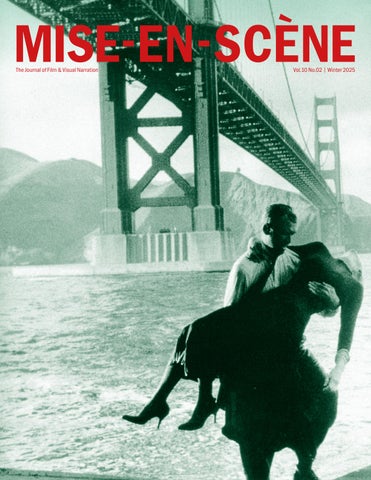
The views and opinions of all signed texts, including editorials and regular columns, are those of the authors and do not necessarily represent or reflect those of the editors, the editorial board, or the advisory board. Mise-en-scène: The Journal of Film & Visual Narration is published by Kwantlen Polytechnic University, Canada WEBSITE journals.kpu.ca/index.php/msq/index FRONT COVER IMAGE Stock Photo, 2025/Vertigo, Paramount, 1958 BACK COVER IMAGE Jake Hills on Unsplash SPONSORS KPU Faculty of Arts KDocsFF KPU Library KPU English Department CONTACT kelly.doyle@kpu.ca SOCIAL MEDIA facebook.com/MESjournal UCPIPK-f8hyWg8QsfgRZ9cKQ issuu.com/mesjournal ISSN: 2369-5056 (online) ISSN: 2560-7065 (print)
Situating itself in film’s visual narrative, Mise-en-scène: The Journal of Film & Visual Narration (ISSN 2369-5056) is the first of its kind: an international, peer-reviewed journal focused exclusively on the artistry of frame composition as a storytelling technique. With its open-access, open-review publishing model, MSJ strives to be a synergitic, community-oriented hub for discourse that begins at the level of the frame. Scholarly analysis of lighting, set design, costuming, camera angles, camera proximities, depth of field, and character placement are just some of the topics that the journal covers. While primarily concerned with discourse in and around the film frame, MSJ also includes narratological analysis at the scene and sequence level of related media (television and online) within its scope. Particularly welcome
are articles that dovetail current debates, research, and theories as they deepen the understanding of filmic storytelling. The journal’s contributing writers are an eclectic, interdisciplinary mixture of graduate students, academics, filmmakers, film scholars, and cineastes, a demographic that also reflects the journal’s readership. Published annually in the spring and winter, MSJ is the official film studies journal of Kwantlen Polytechnic University, where it is sponsored by the Faculty of Arts, the KDocsFF Documentary Film Festival, the KPU Library, and KPU's English Department. In print, it can be found in KPU's and Cinemateca Portuguesa-Museu do Cinema's libraries. MSJ appears in EBSCO's Film and Television Literature Index. P MISE-EN-SCÈNE
III
OVERVIEW
Notes from Our Editors
Since its inaugural issue in 2016, MSJ has carved out a unique space as an open-access, peer-reviewed, international journal under founding editor Greg Chan’s dedication, expertise, and passion for filmic narration and storytelling. I am honoured to have been part of MSJ’s own story as a reviewer, advisory board member, copyeditor, and sometimes contributor since the beginning. Now, I am honoured to take up the mantle of co-editor alongside Michael Howarth as we carry forward this incredible legacy we’ve been entrusted with. We are privileged to be at this juncture, and to have Professor Chan’s guidance as we step fully behind the curtain, so to speak. Films are a unique form of storytelling in that they encompass not a singular artistic, narratological, or even technical approach, but rather, they are synergistic creations that rely on the passion and expertise of many hands and minds working in tandem. They sit at the nexus point of history, politics, and the cultural imaginary of people and nations. They offer critique, innovation, and connection and have been noted in early film scholarship to do something not done before in literature or theatre: to connect people across the world through stories visually put before the frame despite language and cultural barriers. Mise-en-scène composition offers its own language, one in which its ‘words’ are carefully selected via blocking, costuming, set design, key and fill lights. This is a language that like any must be learned and practiced; one that demands cultivation and careful, critical attention to both create and critique, but also one that resonates. Without being taught to really ‘see’ the visual grammar and syntax of visual culture, to speak the language and engage meaningfully as part of a rich discourse with a medium that has a complex history and exciting future, we risk being content with skating on the surface all that film has to teach us and tell us about ourselves and our world. Our vision at MSJ is a synergistic, community-building hub for discourse that reminds us that the image is neither innocent nor accidental. Rather, it creates meaning, bears meaning, and invites engagement. You’ll find that engagement and the involvement of many hands and minds in the pieces that follow, as well as the opportunity to embrace the careful, poetic, affective language of the frame. In the attasecond pace of our age, marked increasingly by the Tik-Tokification of the visual, it has never been more important to cultivate a critical understanding of the intentionality and beauty of the moving image, and indeed, to be moved…to action, to thought, to reflection. We are, after all, the stories we tell.
Kelly Doyle Editor
IV
Vol.10 No.02 | Winter 2025
Kelly Doyle & Michael Howarth
Having served on the advisory board for MSJ since its inception, I am honored to serve as one of its new editors alongside Kelly Doyle. I would also like to thank Greg Chan for his support and guidance over the years, especially during these last few months as we worked to assemble this current issue, which affirms what MSJ stands for: the belief that cinema remains our most complete art form, and that mise-en-scène is where meaning crystallizes into experience. It seems fitting, then, that we open this issue with Hitchcock’s Vertigo, a film that understands how composition shapes consciousness. Every element Hitchcock places before us—the spiraling forms, the vertiginous angles, Kim Novak’s gray suit against San Francisco’s cool palette—works in concert to manifest Scottie’s psychological unraveling. We don’t just observe his obsession; we inhabit it through spatial relationships, color temperatures, and the precise choreography of bodies moving through architectural space. This is what mise-en-scène accomplishes when wielded with intention: it transforms the frame into a philosophical argument. In our current moment, so much visual content prioritizes information delivery over formal consideration, and we need to be reminded that cinema’s power has always resided in its ability to communicate through the language of space, light, and movement, to say what cannot be spoken. The pieces in this issue show us that great filmmaking isn’t about capturing reality but constructing it. Every frame is a choice, every composition an interpretation. MSJ exists to defend that tradition, to argue that how we see matters as much as what we see. As we navigate an era of algorithmic recommendations, returning to films like Vertigo isn’t nostalgia but necessity. Because cinema, at its highest expression, doesn’t just show us stories. It teaches us to see. And in our accelerating visual culture, that type of education has never been more essential. Cinema, at its best, creates worlds where every visual element participates in meaning-making, and in these pages, we’ll continue exploring how filmmakers use the total resources of the frame to think through images. Because in an age of increasing visual noise, the disciplined grammar of mise-en-scène offers something increasingly rare: precision, intentionality, and the recognition that cinema is not just something we watch, but something we inhabit. Welcome to the conversation.
Michael Howarth Editor
MISE-EN-SCÈNE
V
OVERVIEW
Our Contributors
TRAVIS COOPER
Travis Warren Cooper (PhD) is a lecturer in the Department of Philosophy & Religion at the University of Indianapolis. Trained in anthropology and religious studies, his work explores the intersections of media, film, and everyday life. He is the author of a 2022 book on digital culture and is currently developing a second project, The Metaforest: Cinema, Metaphor, and Memory in the Age of Hypermediation (under contract with Indiana University Press). His writings on film have appeared in Film Criticism, East European Film Bulletin, Flow Journal, Sapiens, and forthcoming with The New Review of Film and Television Studies.
ANDY HAGEMAN
Andy Hageman is professor of English and director of The Center for Ethics and Public Engagement at Luther College in Decorah, Iowa, USA. He researches, teaches, and publishes academic works on David Lynch’s cinema, weird and horror film and literature, reimagining race through speculative fiction, and most recently the ecological fabric of Stephen King’s fiction. He also writes culture journalism for online film and Twin Peaks journals. Andy lives in smalltown Iowa with his partner and their two daughters.
VI
Vol.10 No.02 | Winter 2025
Our Contributors BROOK LOWERY
Brook Lowery is a graduate of Kwantlen Polytechnic University with her BA in English and Creative Writing. She resides in the Lower Mainland on the unceded territories of the Katzie, Kwantlen, Semiahmoo, Stó:lō, Tsawwassen, and W̱SÁNEĆ nations. Her research interests include the intersection of pop culture, sexuality, gender theory, and feminist theory, and her work has been published in KPU’s Alight and Nottingham Trent University’s Literary Cultures. She was a recipient of the 2023 KPU Intersectional Social Justice Essay Award and currently works as a student research assistant on the Virago Nation digital archive. She is a connoisseur of whimsy.
SCOTT MANNING
Scott Manning is an independent scholar a ndco-chair of the Medieval & Renaissance Area for the Mid-Atlantic Popular & American Culture Association. He has published essays in Film & History, Studies in Medievalism, and The Year’s Work in Medievalism. Scott is also the author of Joan of Arc: A Reference Guide to Her Life and Works (2023). With Kevin J. Harty, he is co-editor of Cinema Medievalia: New Essays on the Reel Middle Ages (2024), as well as the forthcoming The European Middle Ages on Film (2027). He holds a BA in military history and an MA in history.
HEATHER MILLER
Heather A. Miller is the interim Department Chair of Mathematics at Missouri Southern State University in Joplin, Missouri where she currently teaches various mathematics courses and works closely with the Honors Program. She earned her Master of Science of Mathematics in 2013 from Pittsburg State University. Her research interests include how mathematics intersects with Gothicism and popular culture. She is currently at work on a book about the presence of mathematics in the films of Alfred Hitchcock.
MISE-EN-SCÈNE
VII
Our Contributors PAUL RISKER
Paul Risker is an independent scholar, freelance film and literary critic, and interviewer. Outside of editing MSJ’s interview and film festival sections, he mainly contributes to PopMatters, although his criticism and interviews have been published by both academic and non-academic publications that include Cineaste, Film International, The Quarterly Review of Film and Video, and Little White Lies. He remains steadfast in his belief of the need to counter contemporary cultures emphasis on the momentary, by writing for posterity, adding to an ongoing discussion that is essentially us belonging to something that is bigger than ourselves.
COLE SMULAND
Cole Smuland is an English major student at Kwantlen Polytechnic University who does his best to work Star Wars into every school assignment he possibly can. He is an unapologetic fan of the fantasy and science fiction genres, and wants to someday turn that passion into a career in the arts. At the moment, he works as a bartender at a taphouse in Langley. He is always happy to have a conversation about movies, comic books, or your favourite fictional universe.
REBECCA YOSHIZAWA
Rebecca Yoshizawa is a sociologist and educator in the Sociology Department at Kwantlen Polytechnic University in British Columbia, Canada. Specializing in the sociology of science, she has published on diverse topics such as reproductive politics, fat studies, and more recently, paleontology and fossils.
VIII
Vol.10 No.02 | Winter 2025
ARTICLES
Mathematical Mayhem Symbolism, Symmetry, and Spirals in Vertigo BY HEATHER MILLER Missouri Southern State University
ABSTRACT
While mathematics and film studies are often seen as disparate areas, they can intersect and enhance each other. In Vertigo (1958), Alfred Hitchcock uses the golden ratio and golden spiral to juxtapose the desire for order within the chaotic moments of Scottie’s (James Stewart) investigation into Madeleine’s (Kim Novak) life. The spiral motif directs viewers to look closer at various aspects of both the mise-en-scène and the characters while inversely understanding less about each of them as the film progresses. The golden ratio connects to key moments of the film and highlights Hitchcock’s desire to invite the viewer into Scottie’s world while sending them down a spiralling path of chaos, confusion, and deception. Hitchcock further utilizes mathematics through his use of symmetry and reflection, accentuating the similarities and differences amongst characters, themes, and locations. This article will thus explore how understanding the mathematical symbolism in Vertigo can allow for a deeper affinity and appreciation of Hitchcock’s masterpiece.
Alfred Hitchcock, known as the Master of Suspense, applied any and every technique at his disposal to deepen and intensify his films, even unconventional techniques associated with mathematics, a discipline which is not commonly associated with film production but which, in reality, is the unifying thread that runs through all of life. Mario Livio, head of the Science Division at the Space Telescope Science Institute, notes how “numbers and mathematics have the curious propensity of contributing even to the understanding of things that are, or at least appear to be, extremely remote from science” (1). For example, mathematics dictates the arrangement of leaves climbing up the stem of a plant and how their arrangement maximizes the surface area for the absorption of sunlight; mathematics explains beauty from
a quantitative standpoint, highlighting why the audience’s eyes are immediately drawn to specific characters, items, or settings; and mathematics clarifies and intensifies the growing tension and suspense in Hitchcock’s Vertigo. Hitchcock once stated, “I find that the easiest way to worry people is to turn the tables on them” (Gottlieb 123). One of the ways he achieved this was to use mathematics as a tool to help keep people in a constant state of suspense. The opening credits of Vertigo introduce the audience to Hitchcock’s chaotic world. By fracturing the woman’s face within the shots, Hitchcock hints at how the coming story will unfold; the full story will not be visible or easily understood. Only parts and pieces of the tale will be unveiled at various moments along the way, so the audience MISE-EN-SCÈNE
01
Mathematical Mayhem: Symbolism, Symmetry, and Spirals in Vertigo
Fig. 1 | Title in Hitchcock’s Vertigo, 00:01:19. Alfred J. Hitchcock Productions, 1958.
Fig. 2 | Spiral emerging from eye in Hitchcock’s Vertigo, 00:01:25. Alfred J. Hitchcock Productions, 1958.
is continually anticipating the unknown and building suspense around what little they think they do know. The closeness of these opening shots adds intimacy and discomfort to the film. The audience is immediately thrust into a situation where they are up close and personal with someone on the screen. The social decorum of personal space has been violated. Thus, the audience is prepped to look closely at the characters as their stories unfold. Tension and unease continue to build as the title Vertigo grows out of a woman’s eye (Fig. 1). Seeing one eye centred and isolated within the frame is unsettling. Film critic Michael Howarth comments on how “a shot of an eye symbolizes a new angle or perspective; it alerts the viewer that he or she (or even one of the characters) will soon change his or her perspective and begin to see the world in a new light” (198). Perspectives will constantly be changing and evolving throughout Vertigo as new evidence is brought to light. Even the title Vertigo suggests Hitchcock’s desire to cause unsettling, destabilizing sensations in his audience as they view the film. Then, as the colour shifts from a muted palate to unnatural red in the opening title sequence, Hitchcock alludes to the impending danger the woman presents. In this film, Hitchcock frames women as untrustworthy. By scrutinizing the female characters, the audience will experience their own vertiginous sensations. The assumed facts they are holding tightly will disintegrate within their hands as the ground falls away with each new revelation. Next, the spiral appears in the woman’s eye behind the title (Fig. 2). Hitchcock uses the spiral to draw the audience into a 02
Vol.10 No.02 | Winter 2025
reality that is full of duplicity and chaos, a reality that leaves them wondering what is real and what is not. Patrick McGillian points to the math behind the opening sequence and how “Saul Bass… put his unique stamp on the title sequence…with a distinctive prologue that juxtaposed images of eyes with dizzying Lissajous spirals” (561). Spirals are mathematical representations of different types of equations. An important characteristic about a spiral is its movement around a centrally fixed point, known as the centre. Spirals come in many differing forms: logarithmic, hyperbolic, Archimedean, and golden, just to name a few. Hitchcock uses women, specifically Madeleine (Kim Novak), as the centre around which Scottie (James Stewart), and consequentially the audience, spirals. Madeleine, as the centre of both Hitchcock’s story and Scottie’s obsession, becomes the focus for the audience and the origin of chaos and confusion. The placement of the spiral within the woman’s eye following the title primes the audience to question the validity and trustworthiness of the women and to expect a spiralling chaotic world in the film to follow. Therefore, the spiral is a perfect symbol for Vertigo because the more closely one follows Hitchcock’s spiralling story in search of the truth, the further away from the truth one actually becomes. Hitchcock hides the golden spiral (a logarithmic spiral with a growth factor of the golden ratio, approximately 1.618…) throughout the film. Stephen Ornes, an award-winning writer and scholar on science and mathematics, observes how “the golden ratio…often invokes ideas of harmony and elegance” (34). Hitchcock thrived on turning the audience’s expectations on their heads, and he commented that “suspense involves contrast” (Gottlieb 115). The golden ratio is used throughout Vertigo to highlight moments of discovery but also moments where fractured stories are exposed. Hitchcock, instead of using the golden spiral to harmonize, uses the golden spiral to add layers of confusion and deception. Vertigo opens with a rooftop chase scene. Scottie stumbles during the chase and hangs from the side of the building while a fellow officer attempts to help him. This scene highlights the disorienting change of perspective experienced by people suffering from vertigo. As Scottie dangles from the rain gutter, the ground rapidly falls away. He is frozen in fear, and his fellow partner (Fred Graham) falls tragically to his death. The medical condition of vertigo is only mentioned here in detail at the beginning of the film. By giving his protagonist a limitation, Hitchcock makes Scottie more human and more relatable to the audience. Due to this vertigo, Scottie quits the police force. Vertigo forces Scottie to shift his perspective and identity. It is Scottie’s vertigo that sets off the chain of events and leads him straight to Gavin Elster (Tom Helmore) and his wife, Madeleine. As Scottie enters his final days of recovery following the tragic accident on the rooftop, he discusses the upcoming reunion with his old college chum, Gavin, with his longtime friend and previous lover, Midge (Barbara Bel Geddes). Hitchcock utilizes a monochromatic colour palate in Midge’s apartment to hint at Midge’s personality and her relationship to Scottie. She is shown in a yellow blouse while Scottie lounges in her yellow apartment. The colour yellow is chosen to highlight both Midge’s creativity (she is an artist and undergarment
Heather Miller
Fig. 3 | Hidden golden spiral in Midge’s apartment in Hitchcock’s Vertigo, 00:09:30. Alfred J. Hitchcock Productions, 1958.
Hitchcock uses the spiral to draw the audience into a reality that is full of duplicity and chaos, a reality that leaves them wondering what is real and what is not. designer) and her cowardice. Midge and Scottie were once engaged, but she broke off the relationship. Midge is afraid of her feelings for Scottie and harbors regret for having broken off their relationship in the past. Her regret is further evidenced later in the film when she paints herself into a replica of Carlotta’s portrait, trying to win over Scottie’s attention and affections. Hitchcock also uses yellow in association with Midge because she is Scottie’s processor, the one he turns to in order to work through his thoughts and questions surrounding the mysterious Madeleine. Leatrice Eiseman, executive director of the Pantone Colour Institute, notes how yellow “is believed to stimulate the left side of the brain to prepare for more logical thinking, clearing the mind in order to provide the clarity for reasonable decision making” (38). Midge’s attire and apartment being yellow provide the clarity and stimulation Scottie needs to try and address his vertigo, confront his confusion about Madeleine, and help prepare him for the twisted tale unraveling before him. The first emergence of the golden spiral, outside of the title sequence, can be seen as Scottie discusses his acrophobia with Midge in her apartment (Fig. 3). Midge is the centre around which the spiral originates as she discloses to Scottie how unlikely it is that he will ever overcome his fear of heights
without another shockingly traumatic situation. Midge is the giver of knowledge in this moment, but the spiral also showcases Midge’s focus on her work and not Scottie. Scottie stands to the side of the frame, away from Midge and her work, signifying his removal from her attention and life over the years. Additionally, Scottie’s distance from the centre of the spiral calls attention to his lack of control over his fear. Hitchcock employs another mathematical concept in the next scene: symmetry. Symmetry is the “intrinsic property of a mathematical object which causes it to remain invariant under certain classes of transformations” (Weisstein). As Scottie visits Gavin Elster, he learns of Elster’s desire to have his wife followed. Elster believes his wife may be possessed by her late great-grandmother, Carlotta. Scottie does not believe in the supernatural and does not want to be a private investigator for Elster. As writer and critic Paul Duncan observes, “when Scottie meets Elster, the framing is symmetrical, their body language is the same then changes as they talk, Scottie starting high (in power position) and Elster low, and ending up reversed as Scottie is persuaded by Elster’s argument” (131-132). While subtle, the arrangement of Scottie and Elster throughout this interaction shows the shifting of power between the two men and the shifting from equality and symmetry to an imbalanced dissimilarity; this change highlights how “Geometry is a journey—that roughness inhabits the curves of reality, that beauty and symmetry can take complicated forms” (Ornes 69). The symmetry between the men shifts during this scene as Scottie surrenders control to Elster, who will then use that power to manipulate Scottie into believing the tumultuous tale to come. Although he still doubts the validity of Elster’s concerns, Scottie agrees to visit Ernie’s that night in order to catch a glimpse of Madeleine. Her reveal comes with many layers, masterfully assembled by Hitchcock. Madeleine, as she walks to the bar preparing to leave Ernie’s, pauses just behind Scottie. This close-up shot of Madeleine’s profile implies a duality to Madeleine’s character. Scottie is not privy to a full shot of Madeleine’s face at this time, suggesting hidden aspects of her character. The bright red wallpaper within the restaurant adds a layer of symbolism to the shot as well. Red typically signifies danger and, contrastingly, love, both of which will be experienced by Scottie during his pursuit of Madeleine and the truth. Colour theory has been utilized by artists for millennia, but only since the invention of colour television and movies has it begun to play a role in cinema. While colour theory is typically associated with art and design, it intersects with mathematics as well. Engineer Ethan Gardner explains how math supports the understanding of complementary colours and analogous colours in his article “A Math-Based Approach to Colour Theory”: A complementary colour scheme is a two-colour combination consisting of a base colour (H0) and another colour (H1) that is 180 degrees apart from H0 on the colour wheel…Analogous colour schemes use a combination consisting of a base colour (H0) and one or more adjacent colours (30 degrees apart) on the colour wheel. MISE-EN-SCÈNE
03
Mathematical Mayhem: Symbolism, Symmetry, and Spirals in Vertigo
Mathematics helps underline the relationship between the colours and how they interact with each other, allowing for richer symbolic meanings. When Madeleine is first viewed, she is wearing a stunning green shawl that stands out against the vibrant red interior of Ernie’s. The choice to put Madeleine in green produces many implications. Firstly, the green in Madeleine’s shawl complements the red of the restaurant’s walls; red and green are located 180 degrees apart on the colour wheel. It is important to note that complementary colours “enhance or emphasize the qualities of their opposites” and when they are “placed immediately next to each other, they appear more intense…each complement intensifies the brilliance of the other and seems to visually vibrate” (Eiseman 20). Madeleine stands out amongst the crowd because her outfit dramatically contrasts with her surroundings. Secondly, the green in Madeleine’s dress is symbolic. Green symbolizes renewal and regrowth. Madeleine will continue to live on and be reborn through Carlotta and Judy as the story unfolds. Thirdly, green acts as a physical representation of temptation, a point echoed by cultural historian Kassia St. Clair when she remarks how in The Wizard of Oz the Emerald City “is a metaphor for the magical fulfillment of dreams: it lures the characters in because they all want something from it” (220). Madeleine is the personification of the Emerald City for Scottie, bringing him into her convoluted story through intrigue. Scottie desires to know her story, why she is acting strangely, and along the way, she becomes the fulfillment of his dreams. Scottie cannot restrain his own emotions, and he forms emotional connections with Madeleine that blind him to her deception and dangerousness. After initially viewing Madeleine at Ernie’s, Scottie decides to follow her around for a day to see if he can discover any clues to her seemingly odd behaviour. He observes Madeleine buying flowers at a flower shop, visiting Carlotta Valdez’s grave, staring transfixed at a portrait of Carlotta in a museum, and visiting the McKittrick Hotel, Carlotta’s old home. Carlotta is the common denominator that seems to be guiding Madeleine and her actions. Through Scottie’s surveillance, the audience is introduced to another mathematical concept: reflection. In mathematics, reflections can be examined with respect to functions. Typically, these functions are studied in the most rudimentary sense by discussing reflections across the x and y axis in the Cartesian coordinate system. The whole concept of reflection looks at how the original can be transformed to mirror itself across a dividing line. Madeleine is a reflection of Carlotta across the line of time. Her daily activities, as witnessed by Scottie and subsequently the audience, are all closely tied to Carlotta and her life. Reflections will continue to play an integral role throughout the film as Madeleine reflects Carlotta and then Judy is forced, by Scottie, to reflect Madeleine. Hitchcock uses the mathematical concept of reflection to insinuate commonalities between Carlotta and Madeleine, allowing for conclusions to be drawn about Madeleine’s impending fate. Hitchcock also uses the golden spiral in Scottie’s observations of Madeleine to highlight various connections between the characters. While viewing Madeleine’s behaviour at the art 04
Vol.10 No.02 | Winter 2025
Fig. 4 | Spiral connection between Madeleine and Carlotta in Hitchcock’s Vertigo, 00:26:35. Alfred J. Hitchcock Productions, 1958.
Fig. 5 | Spiral connection between Madeleine and Carlotta in Hitchcock’s Vertigo, 00:26:42. Alfred J. Hitchcock Productions, 1958.
The golden ratio is used throughout Vertigo to highlight moments of discovery but also moments where fractured stories are exposed. museum, the camera zooms in on the flowers she has brought before slowly panning up to reveal that they are the same flowers Carlotta is holding in her portrait, yet another example of reflection. The next close-up shot is on the spiral updo of Madeleine’s hair (Fig. 4). Again, the camera carries the viewer’s eye to the portrait of Carlotta, while deliberately closing in on the same spiral that is present in Carlotta’s hair (Fig. 5). Hitchcock uses the physical spiral within the women’s hair to act as a unifier between the two women, signaling connectedness and reflection, but it also hints at Madeleine’s spiralling mental instability. It is feared that she is wandering down the same dark, spiralling path as Carlotta. If the reflections between the two women do not cease, then Madeleine’s life will end in tragedy. The golden spiral will continue to unite the many transformations of Carlotta through Madeleine and eventually Judy (Kim Novak). In mathematics, as in nature, the spiral suggests consistency, predictability, and beauty. Mathematics is the one constant throughout all of time, but Hitchcock likes to take one’s expectations and corrupt them. If the audience is expecting predictability when they view the spiral, then Hitchcock is
Heather Miller
going to connect the spiral to chaos and disorder. Each time the spiral reappears, Madeleine and Scottie have traveled further down the rabbit hole into a world that seems normal but is anything but. Following Scottie’s surveillance of Madeleine, Hitchcock hides the golden spiral within the bookshop scene. Scottie has once again turned to Midge for help in processing what he has witnessed and is led to Argosy’s Bookshop. Hitchcock arranges the characters within this scene by the golden spiral, showcasing their connectedness to each other and the story being told (Fig. 6). Within this scene, Midge is closer to the bookshop owner as the story is told; she connects Scottie to this new information, so Hitchcock places Scottie further away from the source of information physically. Hitchcock, here, directs the audience to pay attention, to draw close to these new facts, but he also suggests that by focusing on Carlotta’s story, one will be sent spiralling into the unknown. Pop Leibel (Konstantin Shayne), the proprietor of Argosy’s Bookshop, reveals many dualities present within Carlotta’s sad tale. In mathematics, duality fundamentally “gives two different points of view of looking at the same object” (Atiyah 69). Pop Leibel explains various dualities within Carlotta herself, which then get projected onto Madeleine. He refers to Carlotta as “Beautiful Carlotta. Sad Carlotta” (00:34:15). Her story in and of itself has duality. Her beauty made her desirable, but when she became obsolete to the rich man she loved and he disposed of her, she transformed into the “Sad Carlotta” Pop mentions. This story mirrors Elster and Madeleine’s story. The entire latent plot of the film spirals around Elster’s desire to rid himself of his wife and the convoluted way he goes about achieving that. It is important to note that because of the reflection and symmetry between Carlotta and Madeleine, Hitchcock is providing the audience with foreknowledge of what to expect when it comes to Madeleine and her fate. Madeleine unveils the duality that exists between herself and Carlotta when she takes Scottie to the Sequoia National Park. During this scene, Madeleine’s hair is once again coiffed up in a spiral, reflecting Carlotta’s presence and drawing attention to their duality. Scottie asks Madeleine if she has ever visited the forest before, which she denies. Hitchcock presents mounting evidence of Madeleine’s possible possession by Carlotta such as the spiral as the symbol for Carlotta’s presence within Madeleine. Hitchcock uses Scottie’s knowledge about the trees to bring to light duality and reflection amongst Madeleine and Carlotta and, subsequently, Judy. Scottie tells Madeleine about the trees, that “their true name is sequoia sempervirens-always green, ever living” (00:58:45). This quotation connects directly to Hitchcock’s use of the colour green in reference to Madeleine, and this visual imagery also emphasizes the duality present between Carlotta and Madeleine. Paul Duncan describes how the name of the trees “explains why, when we first see Madeleine, and then later Judy Barton, she is wearing green” and how “the green light (from the neon sign) bathes Judy when she is transformed back into Madeleine. Carlotta becomes Madeleine becomes Judy—they are objects of love reincarnated, remade, over and over. They are everlasting…It’s a romantic,
Fig. 6 | Hidden golden spiral in Argosy’s Bookshop in Hitchcock’s Vertigo, 00:34:15. Alfred J. Hitchcock Productions, 1958.
Fig. 7 | Vertigo staircase in Hitchcock’s Vertigo, 01:16:34. Alfred J. Hitchcock Productions, 1958.
gothic idea played out in bright sunshine” (132). The trees act as a symbolic reflection of Carlotta’s story upon Madeleine. Hitchcock again utilizes the spiral motif within the forest through the cross-section of a tree. Madeleine points at a ring within the tree and says, “Here I was born, and here I died” (00:59:41). Following this declaration, Madeleine walks away into the forest like a spectral being fading from existence and does not respond to Scottie calling out her name. The spirals within her hair and in the tree stump where she located her declared birth and death dates point to Carlotta’s apparent full possession of Madeleine, at least for fleeting moments. Hitchcock has succeeded in using the spiral symbolism to heighten the tension and suspense within Vertigo. All of these spiralling connections, reflections, and dualities point directly to the suspenseful crescendo that will crash down upon the characters. MISE-EN-SCÈNE
05
Mathematical Mayhem: Symbolism, Symmetry, and Spirals in Vertigo
Fig. 8 | Hidden golden spiral in Scottie’s dream in Hitchcock’s Vertigo, 01:24:27. Alfred J. Hitchcock Productions, 1958.
Hitchcock likes to use parallelism— consequently, another mathematical concept—to reiterate important themes and ideas throughout Vertigo. The battle for Madeleine and her life culminates at the Spanish Mission south of San Francisco. Scottie takes Madeleine there in hopes of reconnecting her to reality, of helping her overcome her unknown fears, and to break the connection that seems to have formed between her and Carlotta. Madeleine, hair upswept into spirals for one last time, seems dazed. She flits between the present as herself and the past as Carlotta, highlighting the existing duality and reflection between the women. Finally, it appears Carlotta has overtaken Madeleine entirely, and she rushes for the church bell tower. Scottie, determined to save Madeleine, and redeem himself for failing to save his fellow officer at the beginning of the film, follows and stumbles into one of Hitchcock’s most iconic scenes: the vertigo staircase. As Madeleine, presumably under Carlotta’s possession, races up the stairs with Scottie in pursuit, his vertigo is triggered, and the audience actually gets to experience the golden spiral and its dizzying sensation (Fig. 7). Spiralling up and around, trying to catch Madeleine, Scottie glances over the banister and is caught in a cold sweat as the floor quickly falls away from him, inducing the spiralling, chaotic feelings of uneasiness, imbalance, and uncertainty. Hitchcock admitted to Francois Truffaut that he had “thought about the problem [of the spiralling camera 06
Vol.10 No.02 | Winter 2025
movement] for fifteen years. By the time we got to Vertigo, we solved it by using the dolly and zoom simultaneously” (246). Mastering this complex camera motion allowed Hitchcock to impose vertigo on the audience while witnessing Scottie’s paralysis in his pursuit of Madeleine. These stairs, which personify the golden spiral, symbolize Scottie’s loss of control of the investigation, of his own body, and of Madeleine. Everything has spiraled out of order. Madeleine’s death is the suspenseful crescendo Alfred Hitchcock set out to produce, but without the symbolic and literal spiralling staircase, much would have been lost. Madeleine’s death also signals another duality within the film: two people have now perished due to Scottie’s inability to overcome his vertigo. Reflection accentuates the falling death of Madeleine by reminding the audience of the officer’s fall from the rooftop. Hitchcock likes to use parallelism—consequently, another mathematical concept—to reiterate important themes and ideas throughout Vertigo. Following Madeleine’s death, Scottie’s life spirals into darkness. He sits through a trial to determine if he is liable for her death. Elster and Scottie chat by the window following the reading of the verdict. Elster is leaving San Franscico and Scottie is lost in his grief. This scene will shortly be reflected within Scottie’s dream, highlighting some unknown truth integral to the overall plot of the film. Hitchcock employs a twisted, confusing dream sequence with absurd colours and amination to showcase Scottie’s griefstricken subconscious and to offer up clues to the mystery of Madeleine. Scottie’s head is isolated in the centre of the frame in the opening scene of the dream sequence, indicating his isolation and loneliness following Madeline’s death. The strobing effect of the colour transitions illustrates the tumultuous shift happening within Scottie and his mental state. The grief and loss are overwhelming him, colouring his world and all that he sees and experiences. An artistic rendering of Madeleine’s flowers—which incidentally are the same flowers Carlotta holds in her portrait, yet another example of duality—fills the next shot. The flowers morph into ambiguous coloured shapes, exploding outward towards the screen. This imagery represents both the duality in Madeleine and Carlotta, as both women possessed the same flowers, but it also signifies how their stories implode from within. Both women are pushed to the brink emotionally and mentally and resort to suicide. The exploding flowers represent how their lives became overwhelming and ended in their self-destruction. The dream continues to offer up more vital information regarding Madeleine’s story. Mirroring the scene only moments before, Scottie is shown standing at the window with Elster, only this time Carlotta (Joanne Genthon) stands between them. Another golden spiral is hidden within this shot in the arrangement of the characters, with the focus of the spiral being Carlotta (Fig. 8). Elster’s hands on Carlotta notify viewers of his control over her story and how it was portrayed to Scottie. Elster manipulated Carlotta’s story to fit the twisted tale he sold as Madeleine’s. This scene is integral to understanding the deception being perpetrated by Elster. Carlotta is gazing
Heather Miller
intently up at Scottie, begging him with her eyes to realize the scheme that’s been playing out. Hitchcock gives just enough for the audience to begin working out the duplicitous nature of Elster and Madeleine. Scottie, sadly, ends up in a mental hospital while he tries to come to grips with failing, yet again, to protect someone on his watch and begins to process his loss and grief. Midge is shown in blue while she attempts to awaken Scottie from the depths of his grief. Her apparel is blue in the hospital, symbolizing the calming demeanor she strives to portray to Scottie during his loss. The blue of her outfit also alludes to her sadness at watching the man she loves fall apart emotionally before her. Midge’s outfit colours—yellow at the beginning of the film and blue following Madeleine’s death—point to her role in Scottie’s life. As previously mentioned, complementary colours sit 180 degrees apart on the colour wheel. Yellow and blue, the two colours most associated with Midge throughout Vertigo, are complementary colours on both the RGB (Red Green Blue) and CMY (Cyan Magenta Yellow) colour wheels. This is significant because “as the name suggests (complementary and not complimentary), these colours help each other stand out. They bring out the best in each other by making their complement more vibrant or noticeable” (IxDF). Midge’s role has been as a friend, a processor, and a caregiver. She helps bring out the best in Scottie throughout the film, and Hitchcock’s use of colours communicate and magnify different layers to their relationship. In the next sequence, the slow panning shot of San Francisco marks the passage of time, informing the audience that Scottie has spent much time recovering from Madeleine’s untimely demise. Hitchcock expertly uses mise-en-scène to alert viewers to his multilayered masterpiece. As Scottie stands mournfully outside of Madeleine’s old residence, her green car— note the symbolism of renewal and rebirth again—appears on the left-hand side of the frame. Near the centre of the shot is a “One Way” sign facing Madeleine’s old car. Here Hitchcock is inviting viewers in on an ironic little secret: there’s always more than one way to interpret a story. While coming to terms with Madeleine’s death, Scottie revisits all her old haunts: Ernie’s, Carlotta’s portrait at the museum, and the flower shop. While visiting the flower shop, Scottie encounters a reflection of Madeleine. This scene introduces Scottie and the audience to a new transformation of Madeleine, and subsequently Carlotta: Judy Barton. Scottie’s first view of Judy mirrors that of his first observation of Madeleine—both women are clothed in green. Hitchcock is reiterating the eternal aspect of these women through the use of this colour. While Madeleine’s dress is shrouded in a green shawl, Judy is clad entirely in green. Additionally, the shot of Judy talking to her girlfriends on the street is flanked by green cars, stressing the rebirth motif. Carlotta was reborn into Madeleine who is reborn as Judy, creating reflection after reflection after reflection. Unbeknownst to Scottie, Judy is not just a reflection of Madeleine; Judy is Madeleine. After forcibly inviting Judy to dinner, the audience is privy to Judy’s inner thoughts through a sequence of flashbacks uncovering the truth of what happened
Fig. 9 | Madeleine’s profile in Hitchcock’s Vertigo, 00:18:05. Alfred J. Hitchcock Productions, 1958.
Fig. 10 | Judy’s profile in Hitchcock’s Vertigo, 01:44:40. Alfred J. Hitchcock Productions, 1958.
at the Spanish Mission. As Judy pens a letter to Scottie confessing the whole tragic tangled tale, the camera slowly spirals around her, mimicking the golden spiral. Instead of adding layers of deception and increasing the chaotic loss of control, the truth is finally being revealed and unraveled before the audience. Elster, having discovered Scottie’s limitations from the newspaper, used Judy to play Madeleine, arranging a staged scene so he could kill his wife. Scottie has spent the entirety of the film following spiralling stories of betrayal and disinformation. While Scottie is still in the dark on who Judy really is, Hitchcock has ratcheted up the suspense as the viewer anxiously awaits how this new truth will affect the characters onscreen. After their date, Scottie escorts Judy back to her apartment. The neon sign outside her apartment window casts a green glow around her room. Hitchcock hides Judy within the shadows while Scottie asks to see more of Judy, an ironic juxtaposition of dialogue and imagery. Judy, suspecting that Scottie’s affections are only for Madeleine, asks, “Why? Because I remind you of her?” (01:44:22). Judy is completely in silhouette, but, again, acts as a reflection of Madeleine. When first viewing Madeleine at Ernie’s, Scottie and the audience receive a close-up, side profile shot of Madeleine’s right side (Fig. 9). Here in her apartment, Judy wants to be seen for who she truly is but, instead, is concealed in the shadows with her left side profile facing Scottie and the audience (Fig. 10). These two profile shots symbolize the two sides to Judy/Madeleine. Hitchcock utilizes the darkness to shadow Judy in her apartment, signifying MISE-EN-SCÈNE
07
Mathematical Mayhem: Symbolism, Symmetry, and Spirals in Vertigo
Scottie’s inability to see Judy because he is so deeply enamored by Madeleine’s memory. Sadly, Scottie’s inability to let go of Madeleine produces a manic desire within him to transform Judy into Madeleine. In mathematics, transformations can be discussed in relation to functions. Specific additions or subtractions to a function can produce dramatic physical effects within its graph. The same transformation is forced upon Judy. Scottie demands clothing for Judy that Madeleine wore, and he demands her hair be not only dyed but also styled in the same spiralling updo. He does not love Judy and does not desire to do so; instead, Scottie insists Judy transform into Madeleine, becoming the perfect reflection of the love he lost. Having fallen in love with Scottie when she played Madeleine, Judy allows herself to be molded and manipulated back into Madeleine. Judy defeatedly asks Scottie, “If I let you change me, will that do it? If I do what you tell me, will you love me?” (01:51:05). Scottie longs for Madeleine to love; Judy longs for Scottie’s love. The interdependence between the two characters mimics relations between dependent functions in mathematics; by changing one, the other will also be affected.
for that intimacy with Scottie. The second scene follows when Scottie purchases her new clothing. She is upset at being rejected for being herself and asks to be released from the relationship. Scottie tries to reassure her that he has feelings for her by grasping her face in his hands and saying, “No, Judy. It’s you too. There’s something in you…” (01:50:01). Scottie recognizes the falsity in his statement as he’s talking and purposely removes his hands from her face. His hesitancy in making physical contact with Judy prior to her transformation makes the embrace following her transformation brutally heart wrenching. The golden spiral reappears during Scottie’s first full embrace of Judy post-transformation. He has embraced no one since Madeleine’s death, and by hugging and kissing Judy, he is reminded of her prior reflection, that is to say Madeleine. Hitchcock uses the spiralling camera movement to signify a returning to what once was. Scottie’s sins—his failure to act and protect Madeleine—are figuratively being erased. The clock is rewinding and the spiralling motion of the camera acts as a physical representation of that. Additionally, the background shifts from Judy’s apartment to the stables at the Spanish Mission,
The green halo of light around Judy reminds the viewer of her seemingly apparent eternality as she continues to transform, reflect, and return repeatedly. Judy’s full transformation into Madeleine signals her final rebirth. Hitchcock again uses fractured close-up shots, mirroring the title sequence, of Judy’s hair, lips, and nails during this transformation to communicate her fractured self. Judy cannot be her own full person but must, instead, take on the parts and roles of another, namely Madeleine, to be loved and accepted by Scottie. After returning from the beautician, Scottie is dissatisfied as Judy kept her original hairstyle and only changed the colour. This act of keeping the hairstyle indicates Judy’s last stand. She desires so much to be loved as herself and wishes to retain some remnant of who she truly is. Scottie, desiring only Madeleine, commands Judy to style her hair in the same way Madeleine did. As Judy reenters the room after fixing her hair, her outline is blurred by the eerie neon green light from the hotel sign outside her window (01:55:30). She appears like a ghost, returning from the grave. After over a year of mourning, Scottie’s love has finally resurfaced. The green halo of light around Judy reminds the viewer of her seemingly apparent eternality as she continues to transform, reflect, and return repeatedly. Scottie embraces Judy fully for the first time following her complete transformation. Before accepting her inevitable role as Madeleine and donning Madeleine’s clothing and hairstyle again, Scottie did not engage in physical contact with Judy outside of dancing. Subconsciously, he could not be intimate or have physical affections with another woman; his heart belonged too completely to Madeleine and her memory. The distance between Judy and Scottie is accentuated in two small scenes. The first is while they are walking along the water, and Judy glances down at a kissing couple. She longs 08
Vol.10 No.02 | Winter 2025
the last location Scottie embraced Madeleine. The continual spiralling motion of the camera also allows for the spiral of Judy’s hair to be viewed. Carlotta’s existence is still present and noted through this spiral symbol. Judy cannot escape the choices she made and now must remain a reflection of the woman she helped murder in order to receive the love she so desperately longs for. Hitchcock continues utilizing symmetry and duality to highlight Carlotta’s presence through Judy’s duplicated spiralling updo, and also through her necklace. Previously in the film, while Madeleine is viewing Carlotta’s portrait, the camera deliberately zooms in on Carlotta’s necklace. Madeleine is not wearing any such necklace in any shots. Hitchcock is leaving a clue for the audience, something he wants them to pay attention to as the story evolves. As Judy prepares for a date with Scottie following her full transformation, she requests his assistance with a necklace. Importantly, Scottie first sees the necklace in Judy’s mirror, through a reflection. Reflections in mathematics accentuate the duality between two objects across some line of symmetry. Here, Hitchcock’s use of the mirror doubles down on the mirroring aspect between Carlotta, Madeleine, and Judy. A close-up shot of the necklace on Judy cuts to the painted image within Carlotta’s portrait before fading back to Scottie’s face. Scottie has finally realized the lies he has fallen for. Ironically, following his revelation, Judy kisses Scottie declaring, “Oh, Scottie. I do have you now, don’t I?” (01:58:58). Little does Judy know that the veil of deception has been ripped asunder through her shortsighted selection of jewelry. Hitchcock uses the Spanish Mission as a poignant symbol
Heather Miller
of mastery for Scottie and as a unifier for Carlotta, Madeleine, and Judy. After realizing the truth about Judy, Scottie drives them out to the mission. The tension in the car is high while the suspense reaches peak levels for the audience when Scottie tells Judy, “One final thing I have to do and then I’ll be free of the past” (02:00:05). The juxtaposition between the two visits to the mission is startling. With Madeleine, bright sunshine bathes the two lovers while Scottie strives to release her from her inner demons and Carlotta’s control. With Judy, dark ominous clouds hang over the shadowed mission, symbolizing the turbulent scene to come. The weather and atmosphere around the mission also suggest how knowing the truth doesn’t always produce peace. Scottie’s heart is troubled with the truth he has discovered, and he wishes to free himself from his past through revisiting the mission. Duality is at the forefront of the final sequence of Vertigo. Scottie has been to the mission before with Madeleine and is now there with Judy. He has raced up the hauntingly spiral staircase before, but where he once was frozen in fear, he is now motivated by anger. Scottie’s vertigo is ever-present as experienced by Hitchcock’s spiralling staircase technique, but Scottie redirects his attention away from his fear and toward understanding his manipulation. Love for Madeleine has morphed into anger at Elster and Judy. Scottie has been repetitively tricked, and the sense of injustice and anger fuels him to overcome his vertigo
and ascend the mission bell tower. Sadly, the duality continues. After being spooked by an investigative nun, Judy plummets to her death from the same window through which Madeleine’s body was tossed. In a sense, Scottie has lost two of his loves in the same manner. Hitchcock continues his motif of rebirth and renewal through this final scene. Scottie’s final shot in the film shows him peering over the edge of the bell tower at Judy’s body. His outline is a reflection of his falling silhouette from his previous dream. Hitchcock uses the dream to foreshadow the scheme Scottie would fall into, but it is only by following Judy’s accidental demise that he fully understands the spiralling chaotic plan he was duped into believing. Vertigo is a tragic story of duplicity, deception, disintegration, and demise. Mathematical concepts, such as reflection, the golden spiral, transformations, and colour theory riddle the captivating plot, offering deeper layers of manipulation and understanding. Carlotta is transformed into Madeleine who is transformed into Judy. Scottie, due to the tragic losses he experiences, also transforms from a fearful yet trusting man into a depressed manic shell of a man who is trapped by his own past. Alfred Hitchcock has utilized mathematics to heighten suspense, symbolism, and tension within Vertigo while ensnaring Scottie in his own repeating and spiralling chaotic life. P
WORKS CITED
Atiyah, Sir Michael F. “Duality in Mathematics and Physics.” International Journal of Physics, 2021, chrome-extension:// efaidnbmnnnibpcajpcglclefindmkaj/https://fme.upc.edu/ ca/arxius/butlleti-digital/riemann/071218_conferencia_ atiyah-d_article.pdf. Duncan, Paul. The Pocket Essential: Alfred Hitchcock. Pocket Essentials, 1999. Eiseman, Leatrice. The Complete Color Harmony. Quarto Publishing Group, 2017. Gardner, Ethan. “A Math-Based Approach to Color Theory.” EthanGardner, 15 Mar. 2009, ethangardner.com/posts/ color-theory-math/. Gottlieb, Sidney. Hitchcock on Hitchcock: Selected Writings and Interviews. California UP, 1997. Howarth, Michael. “Surreal Estate: Building Self-Identity in Monster House.” Kidding Around: The Child in Film and Media, edited by Alexander N. Howe & Wynn Yarbrough, Bloomsbury Publishing, 2015, pp. 193-210.
Interaction Design Foundation (IxDF). “What are Complementary Colors?” Interaction Design Foundation - IxDF. 23 May. 2025 www.interaction-design.org/literature/topics/ complementary-colors. Livio, Mario. The Golden Ratio. Broadway Books, 2002. McGilligan, Patrick. Alfred Hitchcock: A Life in Darkness and Light. HarperCollins, 2010. Ornes, Stephen. Math Art: Truth, Beauty, and Equations. Sterling Publishing, 2019. St. Clair, Kassia. The Secret Lives of Color. Penguin Books, 2017. Truffaut, Francois. Hitchcock. Simon & Schuster Paperbacks, 1984. Vertigo. Directed by Alfred Hitchcock, performances by James Stewart and Kim Novak, Alfred J. Hitchcock Productions, 1958. Weisstein, Eric W. “Symmetry.” From MathWorld—A Wolfram Web Resource. mathworld.wolfram.com/Symmetry.html.
MISE-EN-SCÈNE
09
ARTICLES
The Culmination of Shakespearean Villainy in The Transformers: The Movie (1986) BY SCOTT MANNING Independent Scholar
ABSTRACT
This essay examines the Shakespearean inspired rise and fall of Starscream (Christopher Collins), one of the many robots killed off in the 1986 animated film Transformers: The Movie. Originally released with the intent to market toys to children, Hasbro saw death in the film as a practical approach to write off characters of discontinued toys. This essay examines scriptwriter Ron Friedman’s approach of crafting Starscream as a “metallic Iago” who never quite got it right when trying to usurp his leader. In addition, when Starscream finally seizes control, he commemorates the moment with an over-the-top coronation ceremony straight from a film set in the Shakespearean Middle Ages. The scene is meant to lampoon his lust for power, and his quick, violent death is meant to put the character to rest. However, Starscream's death only seems to make him more popular, a popularity that has persisted for 40 years.
INTRODUCTION
Although not a commercial success and criticized for killing off characters to coincide with Hasbro’s toy line production, the 1986 animated film The Transformers: The Movie (Dir. Nelson Shin) connected with fans and “has had a lasting legacy within the franchise, and to this day is one of the cornerstones of the entire Transformers phenomenon” (Frost 685).1 Before the live-action films that began in 2007, the 1986 animated film was the only foray into the box office for the transforming alien robots, and it featured star-studded voice work by Leonard
Nimoy, Judd Nelson, Eric Idle, Robert Stack, and Orson Welles. Today, the film celebrates a “cult following…particularly among the now adult fans of the franchise” (Bainbridge “Transformers” 28), and numerous works have explored the continued popularity of the 1980’s incarnation of Transformers among adults (Bainbridge “Fully”; Fast and Örnebring; Geraghty; Johnson; Wolski). Ron Friedman, the author of the first two drafts of the film’s script, witnessed the cult following firsthand, and he found that fans “know and love all of ” the Transformers characters,
1 The film has seen release on every major format beginning with VHS, Betamax, and LaserDisc. The past five major releases include the first DVD edition (Kid Rhino, 2000), the 20th Anniversary (Sony BMG, 2006), the first Blu-Ray edition (Sony BMG, 2007), the 30th Anniversary (Shout! Factory, 2016), and the 35th Anniversary on 4K Ultra HD Blu-ray (Shout! Factory, 2021). 10
Vol.10 No.02 | Winter 2025
Scott Manning
including the focus of this essay, Starscream (Christopher Collins), who Friedman describes as “the treacherous and cowardly Shakespearean villain” (I Killed Optimus Prime 28). Starscream, whom Friedman had spent several years developing through the first two seasons (1984-1985) of the Transformers cartoon series, was crafted as “a metallic Iago unable to sway his lord, Megatron, who is channeling an ignoble Othello” (103). In the 1986 animated film, Starscream finally saw his moment to usurp Megatron (Frank Welker), the leader of his faction. In his zeal, Starscream commemorated the event with a coronation scene (00:32:26-00:33:53) complete with trumpet fanfare, a faux bishop with a crown, and a cape, all elements borrowed from earlier medieval cinematic coronations such as Laurence Olivier's Richard III (1955). Such a scene is out of place with futuristic alien robots in outer space, as well as with everything viewers had learned about Transformers up to this point in the franchise. However, the filmmakers used this hodgepodge scene to play up the delusions of grandeur of the short-lived king, giving Starscream a dramatically tragic, Shakespearean ending. Viewed within no other context, The Transformers: The Movie may fit into Shakespearean scholar Eric S. Mallin’s definition of a “non-adaptation,” as it “takes up Shakespearean thematic elements” while paying “no overt homage to Shakespeare” (1). However, outside the film, Friedman, an unapologetic bardolator, has made numerous statements in writing and on panels that reveal “William Shakespeare has always been my primary inspiration and muse” (I Killed Optimus Prime 194). For the film, he declared a strong desire for “audiences to really care, and feel something about the story they’ll be paying to see,” and “Shakespeare was particularly helpful to me” in the writing process (161, 195). This essay will provide a brief history and overview of the Transformers continuum leading up to The Transformers: The Movie, as well as the marketing interests of Hasbro during the film’s production that aimed to eliminate discontinued toys such as Starscream. These marketing interests enabled Friedman to explore the concept of death in the film, allowing him to craft a tragic ending for his “treacherous and cowardly Shakespearean villain.” Finally, this essay will explore the out-of-place medievalism of the coronation scene and how its elements were used to lampoon Starscream’s lust for a crown. What will become apparent is that although The Transformers: The Movie is a futuristic animated Sci-Fi film made with the explicit purpose of marketing toy robots to children, the filmmakers were inspired by Shakespeare and Shakespearean films in their storytelling and mise-en-scéne. The result was the creation of a death scene that had the opposite effect initially desired by Hasbro, as Starscream is still a popular character and toy 40 years after his initial discontinuation. TRANSFORMERS (1984-1986)
Transformers, as an intellectual property of toys, debuted in the U.S. in 1984 as a result of a longstanding collaborative partnership between U.S.-based Hasbro and Japan-based Takara that dates back to 1971 (Johnson 153-196). These robot toy figures have been compared to a Rubik’s Cube (Dixon 139; Fleming 125), as they could be twisted and shifted into a robot form and into
some vehicle or device, inspiring their franchise name. With the express purpose of promoting the toy line, Hasbro commissioned an animated television series, as well as two comic book series that ran concurrently in the U.S. and U.K. (Hidalgo 69). Hasbro and Takara, now Takara Tomy, have continued their partnership, drawing “upon each other’s innovations,” repackaging new stories and toy lines in a “transnational” process that reuses characters and plot devices for each iteration within their respective markets. The process has successfully kept Transformers “in a constant state of evolution” (Johnson 181), and, in 2024, Transformers returned to the box office with its first animated film since 1986 with Josh Cooley's Transformers One. The basic outline of Transformers has remained the same since it originally launched in the U.S., and it focuses on a species of alien robots fighting a civil war that eventually spreads to Earth. At the beginning of the franchise, Hasbro tells us the civil war is between the “heroic Autobots and the evil Decepticons” (Budiansky 33). Groups from each of these factions left their home planet of Cybertron and while fighting in space, they crash-landed on Earth four million years before the present day. These shipwrecked Transformers survived but were offline and dormant. A volcanic eruption in 1984 reawakened the ship’s computer which then promptly reconfigured the robots to transform into earth-based vehicles, devices, or weapons, and, from there, the war picked back up for 65 episodes across the next two years (Frost 589-689). That brings us to The Transformers: The Movie. Released in the summer of 1986, this film jumps 20 years into the future of 2005. Viewers quickly learn that the civil war is still raging, and the “treacherous Decepticons” have conquered Cybertron while the “valiant Autobots” persist on the planet’s moons (00:04:09-00:04:30). THE TRANSFORMERS: THE MOVIE AND THE MARKETING INTERESTS OF HASBRO
From the beginning of the franchise, the writers of Transformers toiled to ensure that each robot had their own backstory and personality, and Friedman tells us that “the enormous cast of characters” was one of “the biggest inescapable problems I had to solve elegantly and fast” when writing the film (I Killed Optimus Prime 191). To meet this challenge, Friedman tells us he relied on Shakespeare, as “no other writer was able to handle such large casts, and dramatize the trigger points of human conflict better” (195). Friedman made personalities, speech patterns, and motivations unique for each character. Where robots existed in both the first two seasons of the television show and in the movie, filmmakers took care to continue the characters’ personalities with the same voice actors. When Hasbro assigned Friedman the extra task of writing off discontinued toys in The Transformers: The Movie, he proposed the idea of killing off characters, something that had not occurred in the first two seasons leading up to the film. Hasbro jumped at the idea and even provided a list (Frost 681). Friedman later explained that presenting death in the film was not because he was a “bloodthirsty savage,” but because he wanted “to raise the stakes, giving the surviving characters opportunities to grieve, suck it up, and add a more profound dimension to their reactions, actions and speeches, to give the MISE-EN-SCÈNE
11
The Culmination of Shakespearean Villainy in The Transformers: The Movie (1986)
story more gravitas, that is the weight which life and conflict lay on each of us” (I Killed Optimus Prime 161, 166-167). Furthermore, by raising the stakes, “It is no longer let’s pretend mayhem because those friendly and familiar Autobots are now dead. The dark prospect of Death changes the value of everything” (99). The result is a violent film, even though the principal victims are all robots. They are shot, driven over, torn apart, exploded, eaten, digested, and even melted in hot, liquid metal. According to the List of Deaths Wiki, there were at least 73 characters visibly dead or killed, or wounded so extensively that they were reincarnated (repurposed) into new characters (“Starscream”). A complete body count is not possible for The Transformers: The Movie, as one planet and two moons are destroyed entirely, and another planet is nearly destroyed, killing millions. Hasbro received plenty of blowback for this approach, especially because Optimus Prime (Peter Cullen), the most popular character in the franchise, was one of the victims, “in accordance with the tactic of killing off toys when they reach a sales peak” before introducing the next replacement (Dixon 265). Even Friedman has lamented, “Unfortunately, I think my presenting the ‘somebody needs to die notion’ started the corporate thinking that led to Hasbro handing Optimus Prime a death sentence” (167). Friedman attempted to soften the death of Optimus by playing up one of the new characters as a young King Arthur of sorts, but it fell flat with viewers (Manning 199-201, 209-211). However, not all the film’s deaths are lamented, and fandom arguably remembers one of them, Starscream, fondly. SHAKESPEAREAN VILLAINY IN THE TRANSFORMERS: THE MOVIE
Two characters who enjoyed continuity from the first two seasons to the 1986 animated film were Starscream, a Decepticon known for his screechy voice, and his leader Megatron, known for his brute ruthlessness. Although both Starscream and Megatron share a goal of defeating the Autobots in the civil war, Starscream maintains an underlying higher purpose of replacing Megatron as leader of the Decepticons. In Friedman’s crafting of the two characters as a metallic Iago and an ignoble Othello, he kept them at odds with each other. Reflecting on the dialogue between the two, he tells us: I was thinking Shakespeare. I was thinking Shakespearean villainy in which the villains are well spoken, in which they express their contempt for each other in ways that are memorable, in which you can see their evil machinations that are each based on the same phenomenon, which is “I’m the one that’s important. I’m the only one that matters. I am the bringer of all goodness and knowledge.” When those people confront each other, it should be a festival of fireworks and Shakespeare did that brilliantly. So my attempt was to do that. (“Q&A with Transformers The Movie Writer Ron Friedman from TFcon Toronto 2019,” 00:20:19-00:21:02) The first two seasons of Transformers played through this dynamic often, as Starscream would seemingly turn on Megatron, but then cower away when the opportunity for easy usurping had passed. When he was caught in his 12
Vol.10 No.02 | Winter 2025
Starscream’s lust for a crown and the coronation scene are both reminiscent of Laurence Olivier’s film adaptation of Richard III (1955).” treachery, Starscream suffered verbal and physical abuse and even exile, but he more often escaped unscathed, living to betray another day. At the start of The Transformers: The Movie, Starscream remains at Megatron’s side, still “pouring honeyed poison, or outright contempt into Megatron’s titanium ear holes to which an unimpressed Megatron always responds with withering disdain, and belittlement” (Friedman 103). Starscream challenges his leader, but always in a way that appears to be helpful with a tinge of sarcasm and plausible deniability. This conversation follows after they work together to successfully hijack a shuttle and massacre the Autobots onboard: Megatron: This was almost too easy, Starscream. Starscream: Much easier, almighty Megatron, than attacking the real threat—the Autobot’s moon base! Megatron: You’re an idiot, Starscream. When we slip by their early warning systems in their own shuttle, and destroy Autobot City, the Autobots will be vanquished forever. (00:08:00-00:08:24) Here, Starscream goes along with Megatron’s current plan and blandishes his leader as “almighty,” but insinuates that if he were in charge, he would take a different, better approach, all within earshot of the other Decepticons. The scene demonstrates that Megatron continues to tolerate Starscream’s subtle insubordination, just as Othello tolerated Iago’s initial lies until Othello began to doubt himself. The framing of the scene in The Transformers: The Movie is similar to that of Oliver Parker's Othello (1995). Megatron/Othello (Laurence Fishburne) stare forward in contemplation, waiting for Starscream/Iago (Kenneth Branagh) to finish “pouring their poisoned honey” (Fig. 1). The viewer can sense the waning patience in the leaders while the usurpers ramble on. Megatron/ Othello seemingly grit their teeth in silence. But Megatron, as the “ignoble Othello,” would never reach the same stage of self-sabotage as his Shakespearean counterpart, and Starscream would need to act more boldly. Audiences had watched Starscream try and fail to usurp his leader, and the metallic Iago would finally take one step too far in the film. After a lengthy battle on Earth ended with the severe wounding of Megatron and the Decepticons retreating to Cybertron, their ship is unable to maintain the weight it is carrying. Starscream steps in and asks the Decepticons for a solution to “lighten our burden” if they are ever to make it back home. Another Decepticon declares, “In that case, I say it is survival of the fittest.” Starscream gleefully asks, “Do I hear a second on that?” All the uninjured Decepticons declare they are in favour while all the wounded Decepticons vote against. Starscream says,
Scott Manning
Fig. 1 | Starscream suggests an alternative to his leader’s current plans in Shin’s The Transformers: The Movie, 00:08:11. Sunbow Productions, 1986. Iago (Kenneth Branagh) works on the downfall of Othello (Laurence Fishburne) by disguising lies as concern in Parker’s Othello, 00:52:53. Columbia Pictures, 1995.
“The ayes have it!” and Decepticons start tossing each other out into space (00:26:48-00:27:21). Starscream personally seizes the weakened Megatron and stands at the door to space and declares with a smile and wink, “Oh, how it pains me to do this.” Megatron struggles to respond, “Wait, I still function.” Starscream releases his former leader, “Wanna bet?” Megatron fades away into space screaming Starscream’s name (00:27:23-00:27:38). The preceding sequence reinforces Starscream’s conniving approach of plausible deniability, mimicked from Iago. Starscream never suggested anyone should be thrown out into space; he was only following what the majority wanted. This sequence keeps with the Iago persona that Friedman crafted for Starscream. In the first act of Othello, Iago convinces the gullible Roderigo to join him in informing Brabintio of his daughter’s rendezvous with the title character. However, before Roderigo comes down to meet the accusers, Iago flees after convincing Roderigo to stay, keeping Iago’s name and face out of the controversy. Iago rushes to ensure that he is by Othello’s side as an ally when Brabintio later confronts Othello (1.1.158-173). With Megatron seemingly gone, Starscream immediately declares himself the new leader of the Decepticons. However, this is a culture where the strongest rule, and even though Starscream finally got one up on Megatron, the fallen leader was not at his strongest. The Decepticons reject Starscream’s declaration. Others promote themselves as “the most powerful” or “superior,” and thus, more worthy of rule. A fight ensues, and in the end, Starscream somehow wins the dispute (00:27:39-00:28:35). What follows is the coronation scene of Starscream assuming leadership of the Decepticons, which is a scene straight from a medieval film, but with robots in outer space. TRUMPET FANFARE, AND THE CORONATION AND FALL OF STARSCREAM
Fig. 2 | The coronation of Starscream at the Decepticon Hall of Heroes, in Shin’s The Transformers: The Movie, 00:32:30. Sunbow Productions, 1986. The crown looms large (literally) in Olivier’s Richard III, 00:12:39. Sony Pictures, 1955.
Cinematic medievalism, the creation of the Middle Ages on film, began in 1895 with a kinetoscope by Thomas Edison, featuring a short of Joan of Arc (Harty and Manning 8). Today, medieval films proliferate the box office and streaming services, and over the past three decades, there has been a boom in medievalism studies focused on film (Harty; Finke and Shichtman; Elliott; Amy de la Bretèque; Harty and Manning). Yet, this scholarship does not focus solely on films set in the Middle Ages, but also how unlikely productions borrow from the period. Starscream’s coronation in The Transformers: The Movie makes it one such unlikely production, and the scene was modified from the initial script drafts to further lampoon the appropriated medievalism of it. The result features the “Decepticon Hall of Heroes” on Cybertron (Friedman, The Transformers: The Movie script 45). This open-air pavilion features two rows of large statues of unknown robots, leading up to a round platform with 23 steps (Fig. 2). Although there is no visible throne, the final script described it as “the closest thing the Decepticons have to a throne room” (Friedman and Dille 44). The first thing the viewer hears is trumpet fanfare. On top of the platform is Starscream in a large purple cape on his shoulders, which “looks slightly ridiculous,” according to the script (44). Astrotrain (Jack Angel), another Decepticon, acts as a bishop holding up a large golden crown adorned with red MISE-EN-SCÈNE
13
The Culmination of Shakespearean Villainy in The Transformers: The Movie (1986)
The purpose of the coronation ceremony is the culmination of the metallic Iago’s delusions of grandeur to one day lead and have followers.” jewels (Fig. 3). As Astrotrain begins to crown Starscream, the fanfare starts again. An annoyed Starscream screeches, “Get on with the ceremony!” The camera cuts to five Decepticons blowing trumpets. The trumpeters exchange looks and continue with the fanfare until Starscream fires a perfect shot to clip the ends of the trumpets, leaving the trumpeters disappointed. While his supporters keep onlookers in-line at gunpoint, Starscream is crowned, he looks around with satisfaction, extends an arm to his new subjects, and announces, “Fellow Decepticons, as your new leader, I…” (Fig. 4). Let us first examine the medievalism of this moment. The scene features trumpet fanfare, a faux bishop with a crown, a would-be king with a cape, and a podium. Each of these can be what medievalist Andrew B.R. Elliott identifies as a “historicon,” a term he coined to define a film’s “visual conventions which each aim to evoke to the spectator an element of ‘medievality’” (182). Elliott provides numerous examples of historicons including castles, princesses, banquets, and knights, and these “symbolic tropes, images or sequences of events” act as “signs of medieval-ness” to audiences (193). The coronation ceremony in The Transformers: The Movie provides audiences with a familiar sequence: trumpets blare, a bishop crowns the king, and the king addresses his subjects. Starscream’s lust for a crown and the coronation scene are both reminiscent of Laurence Olivier’s film adaptation of Richard III (1955). Early in the film, the title character (Laurence Olivier) delivers a monologue, originally delivered in Shakespeare’s Henry VI, Part 3 (3.2.167-173), where he tells the audience:
Fig. 3 | The faux bishop crowns the king in Shin’s The Transformers: The Movie, 00:32:32. Sunbow Productions, 1986. The coronation of the title character in Olivier’s Richard III, 01:51:34. Sony Pictures, 1955.
Then, since this Earth affords no joy to me But to command, to check, to o’erbear such As are of better person than myself, I’ll make my heaven to dream upon the crown, And, whiles I live, t’ account this world but hell Until my misshaped trunk that bears this head Be round impalèd with a glorious crown. (00:11:36-00:12-10) Under an oversized crown that dangles from the ceiling (Fig. 2), Richard declares that he will lie, cheat, and murder his way to the throne with a smile, just as Starscream had successfully done over the course of two seasons of Transformers to finally achieve his grand moment in the animated film. Richard’s eventual coronation scene in the 1955 film could be seen as a model for Starscream’s coronation, as there is a bishop, crown, cape, podium, and trumpet fanfare. A giant gold crown is suspended above the podium in Richard III while a giant golden Decepticon emblem looms over the podium in The Transformers: The Movie (Fig. 2). The placement of these symbols indicates to audiences that the elevated platform is where the ruler resides 14
Vol.10 No.02 | Winter 2025
Fig. 4 | The new king addresses his subjects in Shin’s Tthe Transformers: The Movie, 00:32:51. Sunbow Productions, 1986. Richard III basks in his glory in Olivier’s Richard III, 01:53:07. Sony Pictures, 1955.
Scott Manning
over his subjects. Upon the crowning of Starscream/Richard, there is a moment where the ruler revels in silence (Fig. 4). The onlookers and the audience are subjected to the new kings’ indulgence of their moments, as if posing for a painting. Both scenes are framed below the kings, so the viewer is looking up. The new ruler stands above all. This follows the preceding scene where the king has bowed or kneeled momentarily to receive the crown (Fig. 3). Medievalism studies scholarship has thoroughly demonstrated that historical fidelity is typically not the intention or even to the benefit of filmmakers when it comes to medieval films, because “to be authentic a film need not conform to the historical reality (whatever this might have been), but only to what the audiences think the period looked like” (Elliott 215). For example, although trumpet fanfare is a common aspect of medieval films, it is entirely a post-medieval creation, as “surviving evidence on the medieval horn and trumpet…offers precious little help in re-creating their music” (Haines 46-47). As such, the trumpet fanfare we know today has its origins in modern medievalist movements such as the Romantic orchestral tradition (47-48). Turning back to the coronation scene in The Transformers: The Movie, the film differs from earlier versions of the script. The second draft only describes a faux bishop with a crown and the platform. Instead of trumpeting fanfare, one Decepticon “intones ritual from an ancient book,” and Starscream wants him to “get on with the ceremony! Your future monarch is waiting!” In this draft, these ceremonial words are recited: “In accordance with ancient ritual, we, the Decepticons of Cybertron, herewith anoint and extol thee, noble Starscream and proclaim thee King until time ceases to flow and…” The ceremony is interrupted, and Starscream exclaims, “Get on with it! Complete my investiture!” (Friedman, The Transformers: The Movie script 45). While there are no trumpets to annoy Starscream in this draft, there are key words that are fit for a cinematic medieval coronation—investiture, king, monarchy, herewith, anoint, noble, and extol. There is even use of “thee,” to provide a Shakespearean feel among the alien robots who have all somehow spoken English for millions of years. The use of such archaic, “mock-medieval” (Elliott 193), or “pseudo-medieval” language (Osberg and Crow 40) is another sign Elliott has identified to convey “medieval-ness” to the viewer (193). The trumpets were a post-script addition entirely. While Friedman’s second draft calls for an ancient book to delay the coronation, Flint Dille’s modified script uses no such props to annoy Starscream who just wants to “Get on with the ceremony” (Friedman and Dille 44). The trumpets were added during the storyboarding process (Chung 2A), and it is clear the filmmakers were influenced by medieval film to further lampoon Starscream’s moment. The ceremony is out of place for everything we know about the Transformers based on the first two seasons in 1984 and 1985, and thus far in the film. Quite simply, the Decepticons are not a crown culture.2 Megatron led
Fig. 5 | Trumpet fanfare from alien robots ends after their trumpets are destroyed in Shin’s The Transformers: The Movie, 00:32:34-43. Sunbow Productions, 1986.
the Decepticons through brute force, and he kept his troops in line because he was the strongest. There were no ceremonies or crowns; there was just Megatron barking orders. When Megatron was gone, the Decepticons still believed that the strongest should lead and they were willing to fight over this belief, as they did on the shuttle. The purpose of the coronation ceremony is the culmination of the metallic Iago’s delusions of grandeur to one day lead and have followers. His desire to evoke some ancient custom that, if it did exist was not being followed, further emphasizes how out of touch Starscream was with his fellow Decepticons. Starscream’s coronation ceremony had its origins among humans on Earth, not among his fellow alien robots. The ancient book in Friedman’s second draft leant some credibility to the moment, even if the other Decepticons were not enthusiastic about participating. Megatron might have forsaken the old ways, but there was at least an artifact that suggested Starscream was not inventing anything. Without the ancient book in the film, the ceremony instead appears merely to be Starscream’s interpretation of how rulers were crowned on Earth instead of how rulers were determined on Cybertron, especially among the Decepticons. Said another way, the ceremony is appropriated and anachronistic. As such, when a challenger arrives, the Decepticons stand by and watch instead of defending their new leader.
2 Thanks to Dawn Manning for making this laconic statement during a screening of the film. MISE-EN-SCÈNE
15
The Culmination of Shakespearean Villainy in The Transformers: The Movie (1986)
Starscream attempted to redefine the customs of the Decepticons by introducing a cinematic medieval ceremony.” THE END OF STARSCREAM’S REIGN AND TRUMPET FANFARE
The film corrects the deviation from Decepticon practices quickly and Starscream has little time to revel in his moment. When a challenger arrives, Starscream demands to know “Who disrupts my coronation?” and Galvatron (Leonard Nimoy), unknown to any of the ceremony participants at this point in the film, swoops in from space to answer, “Coronation, Starscream? This is bad comedy” (00:33:04-08). A bewildered Starscream asks, “Megatron, is that you?” (00:33:09-10). An earlier scene revealed Megatron floating through space before encountering Unicron (Orson Welles), a planet-sized robot with reincarnation powers (00:28:36-00:32:19). This new Galvatron appears to retain Megatron’s memories, but he has a new body, personality, and voice actor. Galvatron responds, “Here’s a hint,” transforms into a large cannon, and fires a single shot at Starscream (00:33:11-15). The Decepticons on the podium, who just crowned Starscream, jump off to safety. Starscream is engulfed in electrical currents, and his color fades to grey, reminiscent of other Transformers who had died earlier in the film. Then Starscream crumbles into ash. His crown drops and tumbles down the steps to Galvatron’s feet (00:33:25-34). The crown, which loomed high on the podium, has tumbled to the lowest point on the ground. The crown, which meant everything to previous kings such as Richard III and Starscream, means nothing in this world. Instead of picking up the crown, Galvatron slowly steps on it and drags it under his foot, with the animation showing every crinkle of the metal and the shards of gems splintering (Fig. 6). With a smoldering pile of ash on the podium, Galvatron turns to the Decepticons who have simply stood in shock, and he asks, “Will anyone else attempt to fill his shoes?” (Fig. 7). Galvatron is framed below the podium, which is clear of the faux-bishop and other participants. However, the angle is low, and the perspective makes Galvatron appear larger than the podium, as he takes up the screen top to bottom. The only thing on the podium are the ashes of the metallic Iago. The Decepticon emblem still looms above the podium, but even that is lower than Galvatron. He makes no attempt to climb the steps and instead stands eye-toeye with the onlookers. He needs no cape, crown, or podium to assert his rule. There is a moment of silence until an onlooker asks, “What’d he say his name was?” Galvatron identifies himself, and the Decepticons immediately chant “Hail, Galvatron” over and over while the same trumpet fanfare, this time without trumpets, plays in the background (00:33:44-53). The brevity of Starscream’s rule coupled with Galvatron’s quick ability to assume leadership of the Decepticons demonstrates just how out of place the medieval coronation was for Cybertron. The slow, methodical destruction of the crown emphasizes that the lapse in medieval revelry is over. Make no mistake, this brief scene in The Transformers: The Movie is a medieval ceremony, in the sense that it imitates 16
Vol.10 No.02 | Winter 2025
Fig. 6 | The crown falls before the challenger’s feet, ready for the taking, but he instead crushes it in Shin’s The Transformers: The Movie, 00:33:34-36. Sunbow Productions, 1986.
Fig. 7 | The victorious awaits any would-be challengers while the previous king is a smoldering pile of ash on the platform in Shin’s The Transformers: The Movie, 00:33:39. Sunbow Productions, 1986.
similar scenes from films set in the Middle Ages, but this is most evident with the presence of trumpet fanfare (Fig. 5), visually and audibly. As music historian John Haines points out, “Almost as soon as medieval cinema began, the trumpet fanfare” was “placed on screen in stereotypical way[s],” meaning, “players swiftly raising their instruments to their mouths and blowing” (45). Haines further emphasizes that the trumpet fanfare is “the ultimate diegetic musical expression of the Chivalric Middle Ages in cinema” (66), and, I would add, on Cybertron. This is another historicon in Elliott’s model (182), but it is an audible cue, not just a visual one. As mentioned, we hear the trumpet fanfare again as the Decepticons chant “Hail Galvatron,” well after the trumpets were destroyed earlier by an impatient Starscream. The fanfare from absent trumpets is
Scott Manning
fitting, as Haines also points out that, within cinema, “it is the sound more than the sight of the trumpet…that says ‘Middle Ages’” (66, emphasis added). Shakespearean recreations have used the sound, not always the sight, of trumpets in a similar fashion. For example, during the crowning of Edward IV (Cedric Hardwicke) in Richard III (1955), the king proclaims, “Sound drums and trumpets,” and trumpets are heard but not seen (00:11:03). Later, trumpet fanfare is also heard after Richard III’s coronation, again absent of visible trumpets (01:52:28-31). With Starscream in ashes and the crown crushed, the sound of trumpet fanfare afterward provides one final parting shot to mock the slain king. Starscream attempted to redefine the customs of the Decepticons by introducing a cinematic medieval ceremony. They were prepared to accept these customs, even if it was through malicious compliance like blowing their trumpets just a little too long. However, once a stronger challenger arrived and disposed of the king, the Decepticons immediately rejected the medievalism and reverted back to following the strongest leader. STARSCREAM’S DEATH AND THE EFFECT OF HIS POPULARITY
In the case of Starscream, Hasbro’s phasing out of the character did not hamper fandom’s appreciation of him. As one critic of the death of Optimus Prime still admits, “the many deaths...lend the film some extra gravitas” and “it works in the film’s favour,” even if “the reasoning behind it was pretty cynical” (Frost 682-683). The scene of his coronation and ultimate demise instead cemented his legacy. In the Unofficial Guide to Transformers (2001), avid collector J.E. Alvarez declared Starscream “everyone’s favorite Decepticon” (13). Even Flint Dille, one of the writers for the film, could not hide his glee on audio commentary for The Transformers: The Movie when Starscream appears: “He’s probably my favorite Transformer…I just always liked him. He’s just such a treacherous swine” (“Audio Commentaries” 00:07:50-00:07:57). Yet, the 1986 animated film struck a chord
with fans, and they have clamored for the doomed king since. Through Hasbro and Takara’s transnational strategy of starting up new incarnations of shows, movies, and toys, Starscream is always part of the story. For example, the two companies have released more than 45 traditional toys of the original Starscream incarnation alone through 2025 (“Starscream_(G1)/toys”). Friedman has explained that in his attempt to give each character their “all important ‘face time’ so an audience could… give a shit,” he had meant that he had to craft “memorable individuals with distinct personalities, idiosyncratic attitudes, catchy speech patterns, and humor wherever appropriate”(I Killed Optimus Prime 212). In order to craft memorable scenes, such as “gilded royal processions,” Friedman freely admits he relied on Shakespeare for inspiration (2019, 195). Among Shakespearean tragedies, Starscream’s reign was shorter than Richard III’s, but it was no less memorable for Transformers fans. By crafting characters and interactions inspired by the Bard and incorporating a medieval coronation ceremony that was purposefully ill-suited for these alien robots, fans appreciated that the metallic Iago took one step too far at the wrong time and met with such a graphic demise. They appreciate the Shakespearean-inspired drama and the misguided medievalism Starscream pushed on his fellow Decepticons to cement his new, albeit brief, rule. Along with toys, the scene has played out in other incarnations of Transformers, as Starscream remains the eager usurper who never quite gets it right, over and over again, for 40 years now. While Hasbro approved using death in its film’s narrative to phase out toys, the coronation and death of Starscream cemented the metallic Iago’s legacy among fans. P “For Ron Friedman (1932-2025), whose imagination and candor continue to inspire.”
MISE-EN-SCÈNE
17
The Culmination of Shakespearean Villainy in The Transformers: The Movie (1986) WORKS CITED
Alvarez, J. E. The Unofficial Guide to Transformers: 1980s through 1990s, 2nd ed. Shiffer, 2001. Amy de la Brèteque, François. L’Imaginaire médiéval dans le cinéma occidental. Honoré Champion, 2004. “Audio Commentaries.” The Transformers: The Movie. 1986. Dir. Nelson Shin. 20th Anniversary Special Edition, DVD. Sony BMG, 2006. Bainbridge, Jason. “Fully Articulated: The Rise of the Action Figure and the Changing Face of ‘Children’s’ Entertainment” Journal of Media & Cultural Studies vol. 24, no. 6, 2010, pp. 829–42. https://doi.org/10.1080/1030 4312.2010.510592. ---. “Transformers: The Movie: Making Modern Mythology the Marvel Way,” Marvel Comics into Film Essays on Adaptations Since the 1940s, edited by Matthew J. McEniry, Robert Moses Peaslee, & Robert G. Weiner, pp. 27-38. McFarland, 2016. Budiansky, Bob, writer. Transformers Universe, no. 2. Marvel Comics Group, 1987. Chung, Peter. “Sequence # 13: Transformers: The Movie.” Storyboard, revised, 1985. sunbowmarvelarchive.blogspot.com/p/mp-4034-transformers-movie-sunbow.html. Dixon, Bob. Playing Them False: A Study of Children’s Toys, Games and Puzzles. Trantham Books, 1990. Elliott, Andrew B.R. Remaking the Middle Ages: The Methods of Cinema and History in Portraying the Middle Ages. McFarland, 2011. Fast, Karin and Henric Ӧrnebring. “Transmedia world-building: The Shadow (1931-present) and Transformers (1984-present),” International Journal of Cultural Studies vol. 20, no 6, 2015, pp.1-17. doi.org/10.1177/1367877915605887. Fleming, Dan. Powerplay: Toys as Popular Culture. Manchester UP, 1996. Friedman, Ron. I Killed Optimus Prime (So Sue Me): Confessions of a Hollywood Screenwriter. I.L.I. Productions, 2019. ---. The Transformers – The Movie. Script, 2nd draft (2 May 1985). sunbowmarvelarchive.blogspot.com/p/mp-4034-transformers-movie-sunbow.html. Friedman, Ron and Flint Dille. The Transformers – The Movie. Revised script (6 August 1985). sunbowmarvelarchive. blogspot.com/p/mp-4034-transformers-movie-sunbow. html. Frost, Ryan. Transform and Roll Out: The Unofficial and Unauthorized Guide to the Transformers Franchise, 19841992. Telos Publishing, 2018. Geraghty, Lincoln. “Repackaging Generation One: Genre, Fandom, and The Transformers as Adult/Children’s Television.” In The Shifting Definitions of Genre: Essays on Labeling Films, Television Shows and Media, edited by Lincoln Geraghty and Mark Jancovich, pp. 181-200. McFarland, 2008.
18
Vol.10 No.02 | Winter 2025
Haines, John. Music in Films on the Middle Ages: Authenticity vs. Fantasy. Routledge, 2014. Hidalgo, Pablo. Transformers Vault: The Complete Transformers Universe Showcasing Rare Collectibles and Memorabilia. Abrams, 2011. Harty, Kevin J. The Reel Middle Ages: American, Western and Eastern European, Middle Eastern and Asian Films About Medieval Europe. McFarland, 1999. Harty, Kevin J. and Scott Manning, eds. Cinema Medievalia: New Essays on the Reel Middle Ages. McFarland, 2024. Johnson, Derek. Media Franchising: Creative License and Collaboration in the Culture Industries. New York UP, 2013. Manning, Scott. “Arthurian Legend and the Death of Optimus Prime in The Transformers: The Movie (1986).” Studies in Medievalism, vol.34, 2025, pp.192-212. doi. org/10.1515/9781805435600-013. Osberg, Richard H., and Michael E. Crow. “Language Then and Language Now in Arthurian Film,” King Arthur on Film: New Essays on Arthurian Cinema, edited by Kevin J. Harty, pp. 39-66. McFarland, 1999. Othello. Dir. Oliver Parker. Sony Pictures, 1995. “Q&A with Transformers The Movie Writer Ron Friedman from TFcon Toronto 2019.” YouTube (2020). youtube.com/ watch?v=NwVlFdvlGRc. Richard III. 1955. Dir. Laurence Olivier. London Films. Shakespeare, William. Shakespeare’s Plays, Sonnets and Poems from The Folger Shakespeare. Ed. Barbara Mowat, Paul Werstine, Michael Poston, and Rebecca Niles. Folger Shakespeare Library. folger.edu/explore/ shakespeares-works/all-works/. “Starscream_(G1)/toys.” TFWiki. N.d. tfwiki.net/wiki/ Starscream_(G1)/toys. “The Transformers: The Movie.” List of Deaths Wiki. N.d. listofdeaths.fandom.com/wiki/Transformers: The_Movie. The Transformers: The Movie. 1986. Dir. Nelson Shin. Sunbow Productions/Marvel Productions/Toei Animation. Anniversary Special Edition, DVD. Sony BMG, 2006. Transformers One. Dir. Josh Cooley. Paramount, 2024. Wolski, Michal. “‘Everything transforms and nothing changes’: Strategies of adapting The Transformers toys into a TV series.” Journal of Adaptation in Film & Performance, vol.15, no.1-2, 2022, pp. 131-147. https://doi.org/10.1386/ jafp_00073_1.
FEATURETTES
Metacinema and Artifice Fourth-wall Transgression and Narrative Reflexivity in The Wonder BY TRAVIS COOPER University of Indianapolis
ABSTRACT
This essay examines Sebastián Lelio’s The Wonder (2022) through the lens of metacinema, focusing on how the film employs miseen-scène and fourth-wall transgressions to foreground its own artifice. Beginning with its startling opening on a soundstage, the film repeatedly disrupts narrative immersion, calling attention to the constructed nature of cinematic storytelling. This essay places these scenes in dialogue with Federico Fellini’s And the Ship Sails On (1984), a masterclass in reflexive cinema that similarly reveals its backstage machinery. By situating The Wonder within broader traditions of cinematic self-consciousness, the essay highlights how metacinema transforms spectatorship from passive consumption into an active, interpretive ritual. By destabilizing realism and exposing the scaffolding of film, The Wonder crafts a story while interrogating the very conditions of storytelling itself.
Although cinema is arguably one of the most immersive visual and narrative media, some films are more aware of their artifice than others. Sebastián Lelio’s period piece, The Wonder (2022), opens without warning to what appears to be a Hollywood movie set (Fig. 1). A disembodied narrating voice greets us, the confused viewers: “Hello. This is the beginning. The beginning of a film called The Wonder.” Cognitive dissonance immediately ensues. The narrator continues: “The people you are about to meet, the characters, believe in their stories with complete devotion.” As viewers, we did not ask for this peek behind the curtain. What’s going on? Anticipating the audience’s bewilderment, the voice proceeds: “We are nothing without stories. And so we invite you to believe in this one” (00:01:07-00:01:31). The
Fig. 1 | Opening on the film set in The Wonder, 00:01:00. Element Pictures et al., 2022.
MISE-EN-SCÈNE
19
Metacinema and Artifice: Fourth-wall Transgression and Narrative Reflexivity in The Wonder
Fig. 2 | Transition from the non-diegetic to the diegetic in The Wonder, 00:01:41. Element Pictures et al., 2022.
camera pans steadily through the soundstage, left to right, before zooming into one faux building—the interior of a ship, bearing nineteenth-century passengers, including the protagonist—thus delving into the primary narrative (Fig. 2). The semiotically confused mise-en-scène of the opening frames throws into relief the many carefully constructed elements that go into the effective crafting of a compelling visual narrative. Are we watching a documentary about the making of the film? Have we selected the behind-the-scenes special features, rather than the feature itself? What is going on, exactly? The exposure of the soundstage, dollies, and filmmaking equipment signals to the viewer that the narrative (proper) has not yet begun. The harsh lighting and messy backstage environment are in heightened contrast against viewer expectations regarding what we thought would be a moody period piece set in a remote Irish village in the 1800s. What we are seeing, instead, is a reflexive prelude, an appeal to the audience to reflect on the nature of belief and disbelief, spectatorship, and story. The opening of The Wonder is too much for some viewers. Some find it distracting or pointless. Others—this author included—find it hauntingly effective. But as uncanny as this movie’s introduction may appear, such a cinematic gesture is far from new. Too many similarities exist between Lelio’s The Wonder and Federico Fellini’s hyper-reflexive And the Ship Sails On (1984) to be mere coincidence. An unforgettable scene in Fellini’s notoriously experimental film challenges what audiences expect of the cinematic experience. First, there is the gradual addition of sound in the opening minutes of And the Ship Sails On (00:03:49) followed by the jarring aesthetic switch from black and white to technicolor (00:07:15). But Fellini is in prime trickster form when in a later scene the camera breaks its gaze away from the film’s primary fictional content—the cruise ship and the sea, the wealthy people on the cruise, the ship’s crew, and the various comedic shenanigans that unfold between these different classes—and turns to pan slowly through the backstage operations of directing and recording the film. We see the people on the deck being tossed back and forth with the ship’s pitching (Figs. 3 and 4). But then, ostensibly unrestrained from its traditional narrative, the camera pans 20
Vol.10 No.02 | Winter 2025
slowly left. In the turn, one glimpses something strange and alien to the narrative. A single microphone boom pole comes into view (Fig. 5). Next, various camera equipment and soundstage scaffolding enter the frame (Fig. 6). Then stagehands, lighting stands, and the massive infrastructure of the hydraulic system powering the rocking of the artificial sea enter the frame (Fig. 7). Lastly, we glimpse the primary camera operators, including the director, Fellini himself, although his face remains obscured behind the camera, which is now square in the centre of our gaze (Fig. 8). At this most solipsistic moment of cinematic exposure and indulgence, the metacinematic aside ends. Seemingly satisfied, the camera completes its sojourn. Then the frame sinks back into the immediate, fictional storyline. Fellini is a master of reflexive arthouse cinema. The opening fourth-wall transgression of The Wonder is a tip of the hat to the playfulness of the Italian auteur. As scholars turn their attention to metacinema, several theories of what exactly constitutes metacinema are emerging. Metacinema indulges in doubleness, layers, and complexity, often involving films about films. Its gaze looks both inward and outward; it is self-referential. Metacinema embeds stories within stories. As with the backstage exposure parallels in The Wonder and The Ship Sails On, metacinema revels in intertextuality, allusions, and gesture. Metacinema stretches the boundaries of realism and cares not for oversimplistic binary distinctions like documentary or fiction. And as embodied so well by Lelio’s controversial opening, metacinema encourages a heightened awareness of the socially constructed nature of film artifacts. Metacinematic expression shatters audience expectations by transgressing the so-called “fourth-wall” of the diegetic narrative. Fourth-wall transgressions occur exactly three times in The Wonder: first, in what we might call the prelude (00:01:07); second, around a third of the way through the narrative (00:25:39); and third, during the epilogue (01:42:23). We have discussed the exposed soundstage and the narrator’s entreating of the viewer to suspend disbelief. But later, after we are absorbed in the narrative, a character (Niamh Algar) unexpectedly breaks from her performance as a household servant, peering eerily into the camera and making intense eye contact with
Travis Cooper
Fig. 3 | The view of the crew and passengers in The Ship Sails On, 02:02:55. Criterion Collection, 1999.
Fig. 6 | The soundstage revealed in The Ship Sails On, 02:03:04. Criterion Collection, 1999.
Fig. 4 | Seconds before the fictional narrative frame breaks in The Ship Sails On, 02:03:00. Criterion Collection, 1999.
Fig. 7 | More backstage operations in The Ship Sails On, 02:03:27. Criterion Collection, 1999.
Fig. 5 | The boom appears, signaling the camera’s departure from the fictional narrative in The Ship Sails On, 02:03:02. Criterion Collection, 1999.
Fig. 8 | The director in the frame, face obscured behind the camera in The Ship Sails On, 02:03:38. Criterion Collection, 1999.
viewers (Fig. 9). When she speaks, we recognize her voice as the narrator from the film’s unsettling documentary-style opening. This meta-interlude is short lived. As soon as we connect what is happening, in only one or two breaths, the narrator breaks eye contact. Her expression and demeanor shifts. She is a servant again. Back in character, the story moves on. The fourth-wall is again intact and the narrative resumes. Films working in the meta vein may pay homage to reflexive directors of the past, but they also challenge and reconfigure the role of the audience as consumers of visual narratives. The Wonder demands engaged and attentive (rather than passive) viewers and therefore turns moviegoing into an intellectual, even playful sort of popcultural ritual of reception. Viewers must be on the alert for allusions and parallels. Viewers must be vigilant hunters of reflexive winks and other gestures. Metacinema requires viewers to engage in both eisegesis and exegesis, both reading meaning into and teasing meaning out of a film.
Another way to put this is that metacinema does not lend itself easily to what Kyle Chayka describes as ambient television, that is, the viewing of low-stakes entertainment media hosted on mainstream streaming sites like Netflix that play in the background while one works on their laptop, scrolls social media feeds, or does other things as they only half-attentively watch. Metacinema, to the contrary, turns watching into an artistic and intellectual game of reference and connection. It demands audience participation and urges viewers to be present—to pay even more attention to the mise-en-scène. Staging, props, sounds, colour, composition, costumes: in the metacinematic paradigm, these axiomatic filmic ingredients take on heightened relevance via contrast. Metacinema, in short, is cinematic “self-consciousness” (Yacavone 86). The Wonder is a film that knows its own name, introduces itself to the viewer at the beginning, and bids farewell at the end. The film says, Look, I am indeed a fictional film. I MISE-EN-SCÈNE
21
Metacinema and Artifice: Fourth-wall Transgression and Narrative Reflexivity in The Wonder
am a Netflix-distributed period piece. But who cares? Want to hear a compelling story? I dare you to resist the narrative’s power. In the film’s final moments, the camera pans right, exiting the primary narrative and coming full circle to end at the beginning. We are on the modern film set. Again, the harsh overhead lighting, the exposed gear, the technology. At the far right of the frame, we see that the narrator is there, again with her piercing gaze and spine-tingling eye contact. Is she still in character? Is she still the servant? No. Gone is the long period dress and
visual aesthetic. Gone is the rural Irish Midlands setting. She is in modern clothes. But is this a costume? Or is this Niamh Algar herself, the real-world actor who play-acts as the servant, all for the sake of story craft? As Algar unflinchingly stares, the camera zooms in on her face for a final close-up. Algar whispers a soft but chilling refrain, encouraging nothing short of a poetics of audience attentiveness, calmly leading the viewer out of the labyrinthine narrative: “In, out. In, out.” Then the screen cuts to black. P
Fig. 9 | Breaking the fourth-wall with direct audience address and eye contact in The Wonder, 00:25:39. Element Pictures et al., 2022.
Fig. 10 | The final seconds of the film. The narrator is back at the soundstage in The Wonder, 01:42:28. Element Pictures et al., 2022.
22
Vol.10 No.02 | Winter 2025
Travis Cooper WORKS CITED
And the Ship Sails On. Directed by Federico Fellini, 1984. The Criterion Collection, 1999. Chayka, Kyle. “‘Emily in Paris’ and the Rise of Ambient TV.” The New Yorker, 16 Nov. 2020. https://www.newyorker.com/culture/cultural-comment/emily-in-parisand-the-rise-of-ambient-tv.
The Wonder. Directed by Sebastián Lelio, Element Pictures/ House Productions/Screen Ireland, 2022. Yacavone, Daniel. “Recursive Reflections: Types, Modes, and Forms of Cinematic Reflexivity.” Metacinema: The Form and Content of Filmic Reference and Reflexivity, edited by David LaRocca, Oxford UP, 2021, 85-113.
MISE-EN-SCÈNE
23
INTERVIEWS
Falling Down a Strange Rabbit-hole An Interview with Director and Animator May Kindred-Boothby BY PAUL RISKER Independent Film Scholar
Director May Kindred-Boothby’s animated silent short film, The Eating of an Orange (2025), unfolds outward from a simple premise involving a stranger giving a young woman an orange. But Kindred-Boothby’s graduation film is anything but simple. It’s a film layered with metaphors, its imagery communicating to the audience through a dreamlike filter. In The Eating of an Orange’s abstract and metaphorical seven-and-a-half-minutes, a large manor house is filled with identical people, who all eat the same, move the same, and look the same. However, the stranger gifting an orange to one of the women disrupts this carefully maintained balance of conformity. The young woman begins to explore this strange orange object—she has never seen an orange before. With what some audiences may see as a science-fiction twist, the young woman is transported into another realm, surrounded by symbols of the natural world. The exploration of the orange is also a journey of self-discovery—the orange is an extension of her sexuality. She is, however, forced to make a choice. She must either discard the orange and return to the only world she has known or take a brave step forward into a future filled with new possibilities. Bristol-based animator and director Kindred-Boothby previously animated director Matan Rochlitz’s 2018 animated short documentary, I Have a Message For You, which remembers a story his grandmother told him of a woman who survived being captured by the Nazis. She has directed and animated the music videos for Cosmo Sheldrake’s “The Feet are the Link” (2024) and “Egg and Soldiers” (2017), as well as “Swarm Swamp Swim” 24
Vol.10 No.02 | Winter 2025
Fig. 1 | The woman takes a bite from the forbidden orange that has been gifted to her by a mysterious person in The Eating of an Orange, 00:02:30, 2025.
(2019) by Tom Rosenthal and Cosmo Sheldrake, and the official music video for LYR, “Adam’s Apple” (2020). These have encompassed a range of styles, from individual mono prints for “The Feet are the Link,” a combination of styles for “Swarm Swamp Swim” and a charcoal style of animation for “Adam’s Apple.” Speaking with MSJ, Kindred-Boothby discussed the gradual slide down the metaphorical rabbit-hole, as she imbues the real world in her films with a deepening strangeness. She also reflected on the influence of dreams on her work, allowing the audience to respond individually to the film’s specific themes of shame, social norms, and power, and ceasing to be a person during the making of The Eating of an Orange.
Paul Risker
Fig. 2 | The woman encounters her sexuality in abstract form in The Eating of an Orange, 00:03:09, 2025.
PAUL RISKER: Of all the modes of storytelling, why animation? MAY KINDRED-BOOTHBY: My mum taught me to draw when I was
quite young, so I started off doing illustration and then my BA was in illustration, but I wasn’t very good at it. Trying to compact everything that I wanted to say into one image never really worked. Then, when I found out that I could make the illustrations move, I was like, “Oh, my God, this is so exciting,” and that’s what I’ve done ever since. Although it’s obviously so much work, it is incredible because it’s like you are able to show people your imagination, and to create all these other worlds. PR: And what’s the appeal of the short form? MKB: Obviously, I’m biased because I make shorts [laughs] but I
just think they’re great. You have so much freedom within them because you do not have to maintain interest for an hour and a half. So, you don’t have to do all the other stuff to make that possible. Instead, you can just focus on a bizarre little idea, and of course, you have a lot more freedom in the abstract. PR: The Eating of an Orange is an abstract work that relies on
metaphor, but did you know from the beginning that you’d be pursuing this concept, or did it emerge slowly as the idea and the themes shaped the film?
I made the film while I was doing my master’s degree at the Royal College of Art, which was heavily research-based. So, I did a lot of reading—mainly queer theory actually, and also queer theory about nature. I had a lot of academic theory rattling around in my head, which I quite like to have when I approach a subject or topic, because it’s nice to make something that you feel you’re really invested in. Then, the initial question was, how do I condense any of this into a story that will actually make sense? But then, once it began, it ended up flowing in quite a nice way. It started with the idea of the orange and the giving of the orange to someone who’d never seen one before, who lived in this incredibly clean, very controlled environment where the orange was banned. That represented the natural world and also the character, neither of which were allowed to flourish in this controlled environment. So, that was the core of it and everything else grew around it. PR: There’s a nice moment in The Eating of an Orange where the
protagonist sneaks off one night with the orange, and you sense the delight and ecstasy of discovery, because the orange is an extension of her own sexuality. And yet, the moment doesn’t sacrifice but emphasizes her innocence. The scene has a particular energy, and it juxtaposes with the guilt, shame and embarrassment that society has burdened sex and sexuality with. MKB: That was definitely the intention. There’s so much shame
MKB: Well, what normally happens when I have an idea is that
it starts off in the real world and then the more I work on it, the stranger it becomes.
around sex and sexualities, especially around queerness, female sexuality and other forms as well. There’s a lot of shame in all of it or an imposed shame and that idea of innocence is definitely MISE-EN-SCÈNE
25
Falling Down a Strange Rabbit-hole: An Interview with Director and Animator May Kindred-Boothby
Fig. 3 | The men come marching in in The Eating of an Orange, 00:04:11, 2025.
what also drew me to the orange, because what’s more innocent than enjoying eating an orange? How could anyone object to that? And it’s sort of like the same thing where we parcel off pleasure in different ways, and some of it’s demonized and some of it is allowed by this abstract social construct. So, I wanted to make it very playful and innocent.
characterization in how people walk and move, which is something that we pick up on all the time. These social cues of people’s mannerisms and how they present themselves through movement are something that we all make judgments on, and it feeds into our perceptions of people, but on a very subconscious level.
PR: The audience should pay close attention to the physical
PR: Thinking about layers of consciousness, I’ve always appreci-
movements of the characters, which are an integral aspect of the film. At times, it’s as if the characters are levitating, and there is also this otherworldly and spiritual feel to the film. What was your thought process behind these different aspects?
ated the period when you’re neither awake nor asleep. It conjures up an array of fascinating imagery that doesn’t necessarily form a narrative. Instead, they’re a series of free-flowing images that are in a constant state of metamorphosis. I felt The Eating of an Orange captured this experience or sensation.
MKB: […] I wanted the characters other than the protagonist
to have quite long necks because they were all spying on each other all the time. So, it was this idea of them peering around corners and always being able to see. In my mind, their necks had evolved because the culture of their world was to always spy on and shame each other—that’s one of the things about shame, right? There isn’t a force that inflicts this onto someone. It’s a social engagement that we do to each other, which is a big part of the story’s point. Then, I wanted the movement of the space itself and her own movement throughout the film, to become more fluid and looser as she begins to think that there’s maybe a more fluid way of doing things, as opposed to this binary, black-and-white world that she’s been living in. I’m also just a massive movement geek—I really love it. If I’m ever in a train station waiting for a train, then I’ll be looking at how everyone is moving. I think there’s so much 26
Vol.10 No.02 | Winter 2025
MKB: I have very vivid dreams, and they inspire me quite a lot.
I’ll sometimes just dream something, and I’ll be like, “What the hell was that about?” But these dreams are like amazing visual worlds. There’s something called hypnopompic hallucinations, where you wake up, but one part of your brain is slower waking up, so the dream carries on around you, like it’s implanted into the world. I’ll wake up and can see the bed, but then past the bed, the dream is still happening. It depends on how sleepy I am, but it takes me a minute, and then I’ll think, “Ah, yeah, okay. Now I’m awake. That was a weird dream.” And that was the inspiration for the transitions between the two different worlds in the film, which fold together. I was trying to capture that sensation of this liminal, world bending, and dreamy place. I don’t know if you’ve ever got into dream interpretation, but it can be quite interesting what represents what, but on a
Paul Risker
personal level. So, you dreamt of a wolf last night. Well, what do wolves mean to you? From there you can figure out a narrative of what the dream might mean based on your initial responses to it, and I guess that’s something that I was trying to do with this film. I was trying to find that balance of saying without saying too much. So, a lot of the symbolism will mean different things to different people, but hopefully, it will get the message across in a lighter way, without being too prescriptive, which I think is how dreams work.
the orange and then disappeared beyond the wall would represent the possibility of that connection that’s outside of what she has known. And also, the little slug creatures, the plants and the tree itself, would be another form of an ecosystem. We don’t have to reside in a way of living that doesn’t work for us—there are other possibilities. Having made it on my masters, there was a very limited time period. I had so many ideas, like what would happen next after she climbed over the wall and what would she find? In the end, I had to curb my enthusiasm.
PR: Filmmakers have told me there are three versions of the
film—the film that’s written, the film that’s shot, and the film that’s edited. Is there a fourth version that’s created by the audience?
PR: How do you look back on the experience of making The Eating
of an Orange? MKB: It was very intense because it’s a seven-and-a-half-minute
MKB: This was very much what I wanted for it, because even
though I’m coming at it from my own place, we are all affected by the themes of shame, social norms and power in our own ways. So, I wanted to make something that was about the specifics of what I wanted to make it about, but was also relatable to anyone. I wanted it to be more about critiquing that social construct as a whole, rather than necessarily the specificity of anything that was to do with my experience.
animation and I made it in about five or six months. So, I worked for very long days, drawing for fourteen hours a day most days for a large chunk of that time. Looking back, it feels like a strange dream because I was like an animation machine—I ceased to be a person. And I was living on a canal boat in London, in quite a small space, which is beautiful, but also intense in itself. I’d go for walks and think, “There’s a world out here.” So, it was a very surreal experience and the next thing I do, I’m going to aim for more of a sustainable practice.
PR: Human beings seek out connection, but these relation-
ships can either be healthy or toxic. The Eating of an Orange is an exploration of coercion and control versus freedom for self-discovery and self-growth. The tree is also a powerful symbol of growth that communicates the character’s emotional and intellectual experience. MKB: It was something that I thought about quite a lot because
I definitely didn’t want to make something that felt like it was anti-community or anti-connection or anti-collectivity, because there are a million different ways of doing that and loads of them are really beautiful. So, I was hoping the woman who gave her
PR: What drives you then, as a filmmaker and animator, through
all the challenges a film will throw at you? MKB: People want to make films for lots of different reasons,
but one of the reasons why I really love filmmaking is because, like storytelling, it is so powerful, and it can make us reflect on the world. If you can leave people questioning things about the story, then they will also hopefully be asking questions about the world and how we function within it. That, to me, is what makes it really exciting. P
WORKS CITED
“Adam’s Apple” (music video). Directed by May KindredBoothby, performances by LYR, 2020. The Eating of an Orange. Directed by May Kindred-Boothby, performances by May Kindred-Boothby, and Rose KindredBoothby, 2025. “Egg and Soldiers” (music video). Directed by May KindredBoothby, performances by Cosmo Sheldrake, 2017.
“The Feet Are the Link” (music video). Directed by May KindredBoothby, performances by Cosmo Sheldrake, 2024. I Have a Message for You. Directed by Matan Rochlitz, performances by Klara Prowisor, and Philippe Szyper, 2017. “Swarm Swamp Swim” (music video). Directed by May KindredBoothby, performances by Tom Rosenthal, and Cosmo Sheldrake, 2019.
MISE-EN-SCÈNE
27
INTERVIEWS
An Interview with Jay Glennie
The Making of The Making of Quentin Tarantino’s Once Upon a Time… in Hollywood BY ANDY HAGEMAN Luther College
What follows is my conversation on September 10, 2025 with JG, the author of the new, massive, and gorgeous book, The Making of Quentin Tarantino’s Once Upon a Time… in Hollywood. Jay’s new book has a large number 9 printed on its spine because he is currently writing the definite making-of volume for all 10 Tarantino films. If he had only written the book we discuss, Jay would have secured a major role in writing film history. To be contracted to produce books of the same scope (170,000+ words) and commitment to aesthetics for the oeuvre of one of the most important directors ever is unprecedented. The book Jay created is itself a master class in soliciting interviews from a director, cast, and crew that are more detailed and thoughtful than the superficial soundbites that come out of typical film junkets and press tours. Not only does Jay get amazing interviews, but he selects excerpts from them with an expert eye on how to construct a compelling and accurate narrative of the film, from its beginnings to the legacy it is just starting to build. This was Jay’s first official interview about the book, and his exuberance over completing it and having a physical copy fresh off the press comes through clearly. Jay is also a natural raconteur, so conversation with him roams fast and free because he excels in connecting with people. Plus, Jay brings as much modesty as thrill to describing how he got the opportunity to create this book and the choices he made to produce the book that scholars, fans of Tarantino, and cineastes more broadly will want to read and have on their bookshelves. In addition to his Tarantino series that’s just getting started, Jay has published impressive making-of volumes on Trainspotting, Raging Bull, Performance, The Man Who Fell to Earth, and The Deer Hunter. These warrant exploring, and they paved the way for Tarantino to request “The JG Treatment” when anticipating the idea of a making-of book for Once Upon a Time… in Hollywood. 28
Vol.10 No.02 | Winter 2025
ANDY HAGEMAN: Jay, I’m going to start recording now if that’s okay
with you. JAY GLENNIE: Yes, yes. I remember way back I was so naive. Bob
[De Niro] and I were chatting, and he asked, “Are you recording this?” And I say, “Yeah, yeah, Bob, yeah, we’re calling, and I’m recording.” He said, “Jay, you’ve got to ask when you’re recording something.” But I was just forgetting, you know, because I was talking to Robert De Niro. I was caught up in how amazing it was, and I hadn’t even asked. AH: I could imagine being starstruck or so focused on making
the most of the precious opportunity. Why don’t you talk a little about how you got into writing these film books? JG: Sure, well, I didn’t have a formal film background. I used
to write for TV format way, way back, and I started thinking about a project on British Oscar winners. So I started writing this list in the really early hours of one morning. We’d just had our first daughter, and I was up late. I thought, “Oh, that’s a great idea!” And I went and woke up my wife to tell her what a great idea this project was, and, lesson number one, when you have a very young child, you never wake up Mum when she’s finally got to sleep. I think the Jack Daniels had kicked in when I was thinking of waking her, but I caught myself in time and slept on it. It still felt like a good idea the following morning. To tell a long story very short, I ended up interviewing loads of different people. Olivia de Havilland, Jeremy Irons, and Ben Kingsley. All manner of people, including some of the producers of The Deer Hunter who were English. And their stories were so full of, sort of, rancor, regret, bitterness, falling out. I thought, oh, there’s a story here. So I started writing away and talking with different people involved with The Deer Hunter. I didn’t really
Andy Hageman
Fig. 1 | Jay Glennie’s The Making of The Making of Quentin Tarantino’s Once Upon a Time…in Hollywood [Insight Editions, 2025]
know what I was gonna do with it, truth be told. I knew that I needed to go to the next level to really discover things, and the next level was going to be Robert De Niro. AH: So, without any real connections or inroads you decided you
email, and they come back to me, “Yeah, Bob would be up for this, but you can’t call him Robert, that’s his dad’s name, you have to call him Bob.” And the next thing, I’m on a chat with Bob, and we’re doing The Deer Hunter book, which wasn’t even a book when I had that call.
were going to find a way to get in touch with Robert De Niro and ask him to revisit that film with you?
AH: Wow. I like your reflection that you made it happen because
JG: That sense of naivety sometimes really helps, isn’t it? When I
didn’t know what the rules were, I didn’t know what the etiquette was. I didn’t have a book deal, I didn’t have an agent. But I sent Bob DeNiro… or Robert De Niro an email. I sent his people an
you weren’t aware that you were breaking etiquette. You believed that something was there to be made and told, but you didn’t have it all mapped out yet. That seems like an important lesson in a world where most action needs to be algorithm-approved before you begin. MISE-EN-SCÈNE
29
An Interview with Jay Glennie: The Making of The Making of Quentin Tarantino’s Once Upon a Time… in Hollywood JG: Well, then a friend, a guy that I knew, had put online some
pictures from The Man Who Fell to Earth and said that he was going to do a book on that film. They had beautiful pictures of Bowie and the film. I thought about how the producers of The Deer Hunter also produced that film. So I said, “Well, I’m doing this book on The Deer Hunter, why don’t I write the story of The Man that Fell to Earth?” And I thought, it’s much better to have a story in a making-of book. When they’re just pictureled, you don’t necessarily go back to them. If you’ve got a narrative to draw you in, you’ll go back. So that got me started on combining powerful images with the narrative of how the film came together. So I ended up writing this book on The Man Who Fell to Earth with a buddy of mine, and I met Nick Roeg. That led to me writing the book on Performance. Meanwhile, The Deer Hunter is still bubbling under the surface for me to write. The producer of Performance said, “Why don’t you write a book, replicate the book you did on The Man Who Fell to Earth on Performance?” I said, “Yeah, I’d like to follow the same format and get Mick Jagger and James Fox.” Lo and behold, they both said yes. So now I thought, well, what the hell. Am I going to do this? So I ended up setting up my own little shingle. That gave birth to the Performance book. Then I thought, that’s how I’m gonna do The Deer Hunter. I’ll do it on my own little shingle. AH: So, you took your passion and naivete into connecting with
top-tier film people and into book publishing. This is a pretty atypical story of one person making things happen outside of industry machines. I think that’s why your books have such striking vision, in terms of the writing and as physical objects.
brilliant plan, yet it was a series of taking leaps of faith in yourself and in what you found meaningful. I was going to ask you to share about your journey to this book, and you’ve already shared a lot of that. Still, I wonder about your background in writing and film. Was this something you studied? JG: Yeah, well, I always loved films, Andy. I suppose, like, you and
I, we were chatting prior to this conversation, and we’ve both always loved films. I had no background in writing. No background in film either. These are things that I love but not things that I set out to train to do. Just a huge love of film, and like I said before, a big dose of naivety. Talking to you, you’ve got a background with your degrees. For me, that was the biggest thing, the naivety of just asking. And not being frightened of the word “No,” and, touch wood, I haven’t really had a lot of “No.” There’s a few little stops and starts that perhaps they didn’t get off the ground. But that wasn’t really a “No.” They were just more of a thing’s fizzled out, and maybe I didn’t have the enthusiasm for the project. The biggest thing for me was just asking. AH: Regardless of your training background, Jay, you’re a formi-
dable film writer. You make this recent book entirely about the film instead of about yourself. And you took the time to recreate the whole story of the film instead of just assembling interview excerpts around themes or steps in the production. So, let’s shift into talking more specifically about The Making of Quentin Tarantino’s Once Upon a Time… in Hollywood. JG: When I said to Q about coming on board to do the Taxi Driver
JG: Could be. So then, Bob [De Niro] and I met, and I showed
him the Performance book, showed him what we’d done, and he said, “Brilliant.” So we went for The Deer Hunter book, and then the Raging Bull book, and then we’re off. One of the people I interviewed about the legacy of Performance was Irvine Welsh. In that interview I suggested we do a similar book on Trainspotting. He said, “Yes, I’ll introduce you to Danny Boyle,” so we ended up doing a book on Trainspotting. Right, and when we finished Raging Bull, Bob [De Niro] said, “What’s next?” I said, “Taxi Driver.” AH: I expect we’re at the point where your path crosses with
Quentin Tarantino’s. Is that right? JG: The biggest fan I knew of Taxi Driver was Quentin. So I
got in touch with Paul Schrader, who I’d worked with, obviously, on Raging Ball and Taxi Driver, and Paul put me in touch with Quentin. Quentin said, “Yeah, I love the idea.” We had a chat over a three-hour Zoom call. A few bottles of wine involved. Then I find myself on a flight to his house, and we talked about doing the 10 books of deep dives into his films. That’s basically what happened. It literally is just as bizarre as that. AH: It’s amazing how sometimes small decisions just ripple
out like that. In retrospect, your publication record looks like a 30
Vol.10 No.02 | Winter 2025
book and then sent him my books, he was just bowled over by The Deer Hunter book in particular. And that’s basically what happened. He said, “Would you give my films the JG treatment? Yeah, when that call comes, you don’t say no. AH: Absolutely. So, take us into your process. Without getting
too meta, take us into The Making of The Making of Quentin Tarantino’s Once Upon a Time… in Hollywood if you would. JG: It was a case of following a similar simple format and keep-
ing myself out of the story. Making sure that as many voices, as many of his colleagues, and obviously Q, told their story. So, you know, that’s the laborious part, is making sure that on this occasion, Leo, Brad, Margot—and all the wonderful younger actors that Quentin put together—and Al, and all these people came on board. So what happens is I go and visit Quentin. We spend a week together. We go really deep, laugh and talk about films, we watch films together. But then I go away, and we meet up the following day, and I try and transcribe as much as I can, and I know what questions I want to ask when I come back with as much detail as I can about Once. I think you already know that we’re doing the whole 10, so— and it’s the same for Basterds and Django. Then I start interviewing all the cast and crew, and then, with what they’ve told me, I go back to Quentin. I say, “Oh, so-and-so said this,” and that
Andy Hageman
kicks his memory into gear, and then he gives me some more detail on what they’ve told me. Then I do my best to turn it into something that makes you want to turn the page. I didn’t want it to be too sterile. I want my books to be able to feel like you’re watching the film as well. AH: Absolutely, and I appreciate your description, because I feel
like that integrated, reciprocal approach to conversations really comes through in the book. You’re not explicitly in the book as its author, yet you are the one who triangulates all of the input, choosing what to fit together. And it’s funny you mention the book feeling like watching the film because after only a few pages, I ended up having my laptop open with the film cued up so that I could drop into scenes and sequences to rewatch them in light of your new contexts and information. There are some making-of books on the market that feel like a quick patch together of brief interviews, and your writing is in a whole different class. I think readers will be shocked, in a positive way, that your book, which has a huge format to show off the incredible visuals, has so much high caliber writing. I don’t know how you wrote this in the timeframe that you did. JG: Oh, thank you, and it means a lot. Honestly, I don’t mean this
as egotistical as perhaps it could come out, but the books really are written for me. And Quentin. But that’s exactly what I told Q at the onset. Look, if I like them and you like them, I think we’re gonna be pretty much off to the races. If either of us doesn’t like them, then we are up against it. I was hoping to make these books in particular as authoritative and as entertaining as Quentin is in his interviews. Whenever you hear an interview with Quentin, you know you’re gonna get the full three-course meal. To make a book that’s anything less would be a disservice to him and to his films. I used to do the press junkets, Andy, for various different outlets. I know how it is, being in the holding pen with some of the people, waiting to go in, and then you get your five minutes of actual interview time. And you’ve got to get a beginning, middle, and end in this piece that you’re doing. Consequently, in five minutes, you’re going to have three questions. Invariably, the same three questions that these people have heard all day long. Right. You can see they’re dead behind the eyes by the time you get to ask.
to make sure these books aren’t anything salacious, like looking for drama behind the scenes. AH: Yes, it’s such a great time to capture the making-of while it’s
still relatively fresh in everyone’s experience but there’s been enough time for the film to have a reception, a place in culture. And your book is definitely invested in NOT being flip about anyone or any difficulties that did occur during production. There’s a section where you provide multiple voices and points of view on a set decorating challenge that illustrates this perfectly. Where some writers might have sensed a titillating gossipy story, you present a case of professionals being professional but within the constraints of money and time and communication that happen within a major film production. As a reader, I felt like I caught a glimpse of a stressful situation in which the people involved shared understandings of what happened and respect for each other. Not salacious at all, Jay. As a bit of a shift, to get at the origins of your love for Tarantino films, what’s the first one that you remember seeing, whether in the cinema or somewhere else? JG: I just met my wife. We hadn’t been dating that long and we
went away for a weekend. Pulp Fiction had just been released in a town just where we’d gone away. And we hadn’t taken into account that the clocks had changed, so we checked out of the hotel an hour earlier than we should have. We got to the cinema an hour early. But boy, yeah, when we saw Pulp Fiction, I had already seen Reservoir Dogs, and everybody had the soundtrack, but Pulp just solidified everything for me. I used to walk around with a Miles Davis album under my arm, thinking I was cool. It’s the same thing with Quentin’s soundtracks. His films meant everything to me. I’d never seen anything like Pulp Fiction. And then I went back and watched Reservoir Dogs at the screenings in London when it was re-released. Because we had a real problem over here with Reservoir Dogs, it wasn’t released at the same time as you guys because of the ear-cutting scene. And then you’re straight into Jackie Brown, aren’t you? I’m a huge Elmore Leonard fan, and Rum Punch, you know. I loved reading that on a flight home from Australia—I’d lived in Australia for a while, and I was at the airport and picked Rum Punch up, and read it, and next thing I know, a few years later, I’m watching it as Jackie Brown. There’s nothing like watching a film with Quentin, I’m telling you, man. If you ever get the opportunity.
AH: So, once you’re in with Tarantino, how did the expanse of
interview and research unfold?
AH: I bet. What did you two watch together?
JG: His lawyer, Carlos—these guys have just taken me in, and
JG: Oh, we’ve watched loads of different films, put on a Western, The Last of the Mohicans, the original. I went to a screening for Bob’s birthday at Tribeca last year. So a group of us all went to celebrate Bob’s birthday, and they put on a screening of Jackie Brown. And Quentin came along, and he interviewed Bob. And I was with my wife, and I said to Kelly, look, just watch Quentin watch this film. I mean, I don’t know how many times he’s seen Jackie Brown, but he was literally bopping away, laughing at all the jokes. Pretty amazing to get to watch him watch films!
have literally been my godfathers. They open up the door. The door’s generally open when Mike Simpson said, look, Quentin wants X to talk to Jay. When I follow up with somebody else and say, look, I’m doing this book, sometimes I don’t hear back at first, eventually I get a reply to say they were just checking me out to make sure I was the real deal. And, they found out that I am, and then they just open up. I know that these books are never going to be the last word. There’s always going to be something else to uncover. I also want
MISE-EN-SCÈNE
31
An Interview with Jay Glennie: The Making of The Making of Quentin Tarantino’s Once Upon a Time… in Hollywood AH: Dream job.
AH: Wow, I can imagine it would be surreal.
JG: Yeah, yeah, yeah, yeah, yeah, yeah.
JG: And it’s my job to make sure that these guys feel comfort-
AH: It’s interesting, too, because I think you and I are proba-
able chatting to me and opening up. These guys are giving me hours at a time.
bly similar in age and generation. In our 50s, maybe. My entry point was Pulp Fiction, too. I was a university student, saw it in the movie theaters, and that was the hook. Now I’m in my 14th year of teaching college students in the US, and I always have Tarantino in my film studies courses. It’s fascinating to see over the years what are the new fans’ entry points and how that shapes their ideas of Tarantino. I mean, so many come through Kill Bill. This is informal; I don’t have the data to back it up, but my impression is that Kill Bill is the widespread entry point for people in their 20s now.
AH: Yeah, you’re clearly really great at warming people up
and having conversations. I’m still thinking about how you mentioned the young, rising actors. Reading those sections of your book about casting for the Manson family is especially cool. You don’t say it outright, but for readers who are really into cinema, we’re going to be thinking about how this is Margaret Qualley on the road to The Substance, Mikey Madison en route to Anora, Austin Butler on the road to Dune and Elvis. You focus on the narrative of Tarantino’s film, yet there are implications for these actors’ career trajectories in the wake of this film.
JG: Yeah, I wasn’t there, sadly, but at his cinema, he just played
Kill Bill: The Whole Bloody Affair. Yeah, I’m looking forward to when we attack the Kill Bill part of this project, to sit down and watch The Whole Bloody Affair. I keep sounding like a broken record, but once again, I’m looking forward to hearing all the different stories on how that one was brought together. He told me some things to be sure and ask Uma [Thurman] when I get to her Kill Bill interview. AH: Well, I’m curious, what were some interview moments that surprised you in working on Once Upon a Time… in Hollywood? JG: Oh, gosh. I suppose the young guys and girls in the cast. It’s
when you’re seeing them at X amount of feet tall in the cinema, they look pretty iconic and impressive. And then when you’re chatting to them on Zoom, you do realize just how young they are, and how young they were five years hence, six years hence, when they were auditioning. But just what an impact Quentin has had on them. That wasn’t surprising, but it was really powerful. I mean, Mikey Madison, huge fan of Quentin. Austin Butler, huge fan of Quentin. You know, these weren’t just gigs for these guys. They were huge fans before they even got to the set. Austin, he was telling me that he used to collect Quentin’s screenplays and read them constantly as a young actor. There’s so many lovely, surprising stories as well. You get somebody like Al Pacino, and you think, hell, how could Al Pacino be impressed by anything with what he’s seen in his career? But, you know, he loved working with Quentin. And Brad and Leo, I mean this is not going to be an answer to the question you’ve given me, but Brad has told me so many great stories about reading for the role in Basterds. That was his first time out with Quentin, and then he talked about how amazing it was to read the screenplay for Once Upon a Time right there in Quentin’s house. It’s thrilling as a writer to keep getting yeses. I don’t know why I was surprised about that, because it is Quentin, and Quentin has given me the credence and authority to go and talk to all of these amazing people. But, I mean, I was talking to Sam Jackson last week. Hell! I mean, just hearing his voice over Zoom. 32
Vol.10 No.02 | Winter 2025
JG: Yeah, exactly, Andy, I wanted to make it about the present
without getting out of the story into what was coming in the future. AH: It seems to me that readers will be able to make those asso-
ciations, and so it’s really nice to get the actors’ enthusiasm and get their voices about that specific project, and not talk about it as a stepping stone. JG: And the sliding doors moments, I mean, we must make a
mention of Victoria Thomas. She is literally Quentin’s right hand on the cast, and she knows everybody, young and old. She’s got a finger on the pulse, and one of the nicest, loveliest ladies you’ll ever meet. Just to think how many of those young Turks have gone on, you know, Mikey, Sydney, Austin, Margaret, Maya Hawke. And Dakota Fanning. Almost unrecognizable as Squeaky. But she comes in, and she wasn’t not gonna let that role go. She was adamant she wasn’t, and she told me so. And then, you know, when I told her about what Kurt [Russell] had told Quentin—that Quentin was going to meet the best actress in Hollywood—to see her delight at hearing that, but embarrassment, and it just makes the whole conversation something that I can add to the book. You know, the book hasn’t been released yet, and you’re my first interview for it, and I appreciate this chance to talk about it. AH: It’s my pleasure. Before we started recording, we were talking
about archives, and one of the really sweet moments in the book is when you include the little note that Julia Butters wrote to Leonardo DiCaprio after the table reading. It’s just this cute little archival bit, and I wonder, obviously you were pretty limited in terms of what you could include, are there archival things that got left on the cutting room floor? JG: Yeah, well I’m doing books on all 10 films, and I wanted to
make sure that the archival sections of the older books are more Quentin-led. He has an extraordinary archive. He collects everything! But, yeah, Julia, her and her mum, oh, what a duo they
Andy Hageman
are! We went up to London, my family. Julia invited my wife and my two daughters along to see Freakier Friday, and she’s blossomed into just the loveliest person, and everybody loved her in the film. In writing my book, it was amazing finding out things like the magic trick that she did. Her mum kept that. She knew that this opportunity was going to be something. She kept that magic trick, just to keep Julia quiet in the room. I love the whole story of how Julia got into the film. Quentin told me, he was just watching some daytime TV when all of a sudden he was like “whoa, whoa, whoa, whoa, whoa, whoa, who’s this girl?” He got Victoria [Thomas] onto it. He said, “Look, I think I might have found who we need.” He had actually been quite worried that this role was going to be a Hans Landa situation, where he had written a character that he loved but then wondered if he could ever find the person to pull off the performance. And, you know, he found his girl, and, didn’t he just? She was absolutely marvellous in the film, wasn’t she?
JG: Yeah, I hear what you’re asking. I think what I’m hoping to
achieve is to take away all the conjuncture that’s out there on the internet that’s taken as gospel. I mean, I’m not even gonna parrot what your leader calls the news, but that fake news, you know, I’ll have to say it, that kind of thing. So I’m hoping for this book and the remaining 9 books that there’s a story to each of them. Sadly, they’re so bloody big and heavy and cumbersome that you are going to have to put them down. But I’m hoping that you wouldn’t really want to put it down because each page, you’re going to be learning something new, but more than just informative, I want readers to enjoy their time inside the book. Also, that you’re going to come away with learning something perhaps you don’t know, like the collaboration it takes to make a film. But what you’re not gonna get is any salacious gossip. I’m not interested. Just not interested at all in that. What I am interested in, is making sure that the reader comes away with the enjoyment. AH: I’ll attest to enjoyment and to the learning you mentioned.
AH: Agree on all fronts, and I loved reading the parts around
Julia’s involvement, from casting to the table read and filming. Her scenes with Rick Dalton are absolutely crucial to the audience feeling deeply for the characters, and she absolutely shines on screen with a performance for the ages. I’m thinking about how Once Upon a Time… in Hollywood was one of the most important things that got me through the worst phase of the pandemic, Jay. It was the last really amazing picture that I saw in the cinema before lockdowns, and then I would rewatch it at home during the days of isolation. The film is about upheavals in film culture, and we were living through an upheaval that made us wonder if we’d ever return to cinemas. JG: Yeah, actually Julia told me that was the first time she
watched the film, was during lockdown. Because she was obviously not old enough to watch it the first time around, but she watched it during the lockdown because her parents said, “Okay, right, you can watch it now.” AH: What else sticks in your mind at this point, now that you’ve fully written the book and you’ve got a little time and distance from that writing process? JG: Q told me, that was the first time he’s ever written a screen-
play when he knew what the end and last shot was gonna be. He’d never written the ending first, but he knew what the ending was gonna be. AH: Speaking of endings, it looks like we just have time for
another couple of questions. You talked about writing your book and thinking about yourself and Quentin Tarantino as the audience to make happy, but I wonder how do you imagine your book might fit into a world where film fans have endless access to interviews and blogs and think pieces? What do you hope your book offers to film fans, film posterity, film culture?
Your story of how this movie came to exist is like a film-school level description of all the professionals who create together. You also capture so many moments that add up the film. Moments when people made decisions, worked as a team, struggled to tap into another person’s vision, conducted research, coaxed public officials and private homeowners to open spaces for filming, and it goes on. Now, in addition to the contents you deftly capture in writing, I want to say something about the book as physical media. Frankly, Jay, this is far and away the most beautiful book I now own. And it’s funny because for me to prep for our interview and a book review I’ve already published, the publisher could only share a low-resolution pdf with me. It totally worked for reading your prose, and maybe it even helped direct my focus to the writing even more. But that low-res version didn’t do any justice to the images, and it gave no sense of what it would be like to hold this book or set it on a table with a cup of coffee to flip around its pages. Then the physical copy arrived by post, and it nearly broke my front porch when the delivery person dropped it. It’s massive! It’s a book that will keep readers coming back because the huge volume of writing invites us back and the pictures do, too. The pictures include some film stills, but really you’ve assembled behind-the-scenes shots on sets, costume and prop sketches and designs, and so much more. JG: It’s beautiful, isn’t it, Andy? Simon Granger and I, he’s
designed all my book covers. So yeah, we worked hard on this one. It had to have that LA glow, and what you’re going to get from all of the book covers, you’re going to get different tone, different color, but there’s going to be a coherence to them. I mean, I can’t wait for the world to see, but, you know, especially for Quentin’s fans to see this. And I think I can probably go on record, but that forward wasn’t enough. Q’s doing the forward to each book as well. I was almost reluctant to ask him to do the forwards, because I didn’t want people to think that that’s all he did. Sometimes you do that, don’t you? You pick up MISE-EN-SCÈNE
33
An Interview with Jay Glennie: The Making of The Making of Quentin Tarantino’s Once Upon a Time… in Hollywood
a making-of book, and all they’ve done is a forward, and they haven’t contributed to the book.
JG: Gee whiz, Andy, jeez, that’s the hardest question in the world.
into film nerd ecstasy pretty much!
What I do love about Quentin, it won’t answer your question just yet, but what I do love about Quentin is that he only literally casts for the role. I mean, there’s some actors that are not mentioned in the book. I shouldn’t really say that, because it feels like I’m holding stuff back, but some of the actors that wanted to be in his film, some of the musicians that offered up records for his soundtracks. It’s a no. I don’t know many filmmakers that wouldn’t say yes to some of these people that I know about. If they’re not right for the role, it almost doesn’t matter whether you’re Brad Pitt or Leo. You know, Leo expressed an interest in “what can I do” in Basterds? You know, looking over the fence a little bit, is there anything in Basterds for me? His mum’s German, so he was asking, oh, maybe I can do this Hans Landa character. Quentin went and cast Christoph Waltz, and it’s impossible to imagine anyone else as Landa. Q’s brilliant for unearthing actors that have fallen off the radar. Robert Forster. What a great story told to me by the wonderful Spencer Garrett, who plays Alan Kincaid in Once, about Robert Forster. That’s gonna be a beautiful piece in the Jackie Brown book. I’m not really answering your question yet. Yeah, I really do hope that Q, in 10, that he finds an actor that maybe I don’t know too much about, or has fallen off the radar, and we all sit up and think, gee whiz! God, of course! Why didn’t we think of that? Yeah, that’s my answer. All right.
JG: Insane, oh my gosh. Oh, bloody hell.
AH: Diplomatic and thoughtful. You manage both.
AH: Let’s land with a final question: who are one or two actors
JG: Cheers, buddy. P
AH: Readers definitely will know that Tarantino was highly
involved, well beyond the forward, Jay. And something I admire is that you also didn’t make this book totally Tarantino centered either. That’s the other end of director involvement, when a making-of book enacts a sort of fanboy, and it is usually fanboy, worship that lacks critical distance or the perspective to appreciate all of the amazing creative efforts that go into a film. JG: Thanks, Andy.
I’ll finish by sharing that I sent Q a copy. And he’s busy doing his things, which I can’t go into, but he’s busy doing some work. So there was a delay, and Mike Simpson, his lawyer, his agent had got his, Carlos had got his, and they were just, “Oh my god, Jay!” I’m like, fuck yeah, they like it, I love it. But you’re waiting on Q to get back to you, and Q doesn’t really do phones, anything like that, but, you know, we email and whatnot. And then I got the email come through, and I’d take two words out of the email, and they were “FUCKING AMAZING!!” in capital letters and two exclamation marks. My job’s done, man. AH: Wow, that had to be both a huge relief and way beyond relief,
who haven’t worked with Tarantino yet and you’d love to see them work with him in the next project? You can change your mind immediately after the interview. I’m just asking for an off-the-cuff reaction.
34
Vol.10 No.02 | Winter 2025
REVIEWS
Carving Time
Watching Joynt and Singh’s The Nest Amidst the Labours of Women’s Love and Survival BY REBECCA YOSHIZAWA Kwantlan Polytechnic University
Quite honestly, I am sure I missed something important. I watched The Nest (2025, dir. Chase Joynt and Julietta Singh) in bits of moments I had between—and sometimes at the same time as I was undertaking—the innumerable tasks of labour and love that comprise women’s work. My kids’ school had requested that all the children bring in a carved pumpkin for Halloween, so as I carved the spooky face my son had sketched upon the orange gourd in sharpie marker, I pondered the first 11 minutes of the documentary I had at that point been able to watch. I found a little peace and feeling of forgiveness in reflecting on the scene where Singh’s daughter Isadora interviews Singh—the film’s co-director, co-writer, narrator, and central figure—about her fears and feelings toward Singh’s aging mother, Christine. This loving, intergenerational “sharing of authority” (see for instance Frisch) between mother and child, whom Singh describes elsewhere as “magical” (Unthinking Mastery xi) is emblematic of connections between kin depicted throughout the documentary. I have to believe that my shortcomings in being able to dedicate all my energies to the film would be forgiven by its creators, knowing that one of its many theses is that women’s contributions are underacknowledged and undervalued historically and contemporarily, not only due to sexism but also to its intersections with racism, classism, colonialism, and ablism. Patriarchy relies upon it: it is easy to add more work to work that is made invisible. As a woman, I am very, very busy. My fragmented viewing was magnitudes smaller than, but still an example of, women’s strategies for surviving, providing, and thriving amidst the oppressive social structures that we learn about in the documentary. And my piecemeal viewing practice paired nicely with the film’s praxis of weaving stories from collected fragments and producing, as it were, a
Fig. 1 | Promotional Poster for NFB’s The Nest, 2025 MISE-EN-SCÈNE
35
Carving Time: Watching Joynt and Singh’s The Nest Amidst the Labours of Women’s Love and Survival
nest: a complex home made from bits and bobs and from which we grow, depart, and return. The press kit describes that “at the end of her mother’s life, decolonial writer Julietta Singh returns to say goodbye to her childhood home,” a Victorian mansion in Winnipeg affectionately nicknamed “the nest.” In the film, Christine invites us to explore the home’s structure as a metaphor for its history: “in stripping off each room, a piece at a time, I was able to dig out a little bit more Canadian history and trace it back.” Learning about her childhood home through the reflections of her mother, Singh “began to wonder who else had been here, a question that drove [her] toward… unexpected connections” of the home’s former inhabitants and their ties to local, Canadian, and transnational histories. Where men’s stories emerged with little effort, women’s stories required ghost hunting of their absent-presences. Singh found “140 years of forgotten matriarchs and political histories she never knew.” We learn from the film that Metis, Deaf, Japanese, South Asian, and Indigenous women’s political histories are tied to the house. For instance, “there in the margins of the archive was Annie Bannatyne… [who had] built my mother’s home” in the 19th century. Annie Bannatyne was a prominent Red River Metis woman whose philanthropic works included establishing the Winnipeg General Hospital, but she is also known for publicly “horsewhipping” a politician who’d had a racist and derogatory letter published nationally in newspapers. We meet her living kin who described how knowledge of her was hidden from them, and the emotions and realizations they experienced in discovering her more fully in archives, photographs, and even paintings. Consistent with the themes of haunting and nest-building, the documentary takes a nonlinear approach to historical recounting, weaving the ephemeral stories of the past that often persist in mere traces with reflections of current experiences by Singh, her family members, and members of diverse communities whose stories can be tied to the weft of the house. Historical media, such as old films or radio broadcasts, are incorporated with imagery of historical documents alongside re-enactments combining historically accurate clothes and culturally diverse imagery and symbols, such as taiko drumming and disco dancing. The documentary thereby produces a number of conjurings: subaltern stories and unexpected connections, or what Singh describes as the “transtemporal, trans-maternal, and transcultural political bonds that arise through shared space” (On anticolonial homemaking, abstract). That’s as far as I got into the second stretch of watching I managed to carve time for. Between a day of grievance meetings, member chats, and research for my work in the Kwantlen Faculty Association (the labour union representing faculty at Kwantlen Polytechnic University where I am an instructor of Sociology), I watched yet more bits of the documentary. Although forgiving of such
watching habits, the film pushed me still to examine my own intersecting privileges as a viewer. For instance, I was confronted with my able-bodied privilege when Deidre Hase, a teacher at the Manitoba School for the Deaf, was signing in ASL a story about deaf education which was not audibly dubbed. My attention to the visuals of the film was therefore forced, and it gave me many gifts; I loved seeing the choreography of hand and face. I loved hearing the whoosh of breath from the mouth of another ASL speaker, Joanna Hawkins, when she reflected on learning about Mary Ettie McDermid, the first deaf teacher in western Canada (Schools in Western Canada 140) who is tied to the home because in the early 20th century, a fire at the Manitoba School for the Deaf resulted in the house becoming a makeshift boarding school for the pupils. The whooshes of breath added beautifully—and ironically—to the soundscapes of the documentary and they speak: deaf people are not silent. Hase reflected on children who grow up in hearing families and never interact with the deaf community only to come to the school and learn ASL for the first time—a language which had been banned in 1880 at the Milan Conference (1880: The Milan Conference), and a ban which Mary would have defied. “As soon as they find that language, they change,” said Hase. A black and white film watched by Isadora, projected upon the inside of the home’s garage door, silently echoed: “As long as we have deaf people on earth, we will have signs.” Indeed, we learn that the school pupils made a printing press in the house to publish their school newspaper, The Silent Echo. The documentary addresses connections of kin contra traditional patrilineal and racist norms. Naturally, and in spite of my divided attentions, my curiosity drew to Singh in the days I spent consuming the film in crumbs. As I drove one of my sons in the pouring rain to get his soccer team pictures taken, and the other to his climbing lesson, paying attention to the road more than my thoughts of Singh, I wondered (with a bit of shame and guilt as to the norms of whiteness that prompted my question)… With her elderly mother Christine seemingly a white woman, why does Singh have a South Asian last name? In the documentary, we hear Singh’s mother, a self-described activist, speak of a post-Vietnam War political impulse that influenced her choice to marry an Indian man. “Was it romantic or was it political?... Politics emerges in everything we do if we are going to be honest with ourselves,” she said. I found my own connections and emotions in this notion and was thus invited into the nest Singh and Joynt build with the film. As explored in images of kimonos and tea ceremony, the house served as the Japanese consulate after the internment of Japanese Canadians during the Second World War. My family by marriage, from whom I get my own “unexpected” (Japanese) last name as a white woman, experienced this internment. They were dispossessed of their farms and forcibly relocated to unheated, single room cabins in the interior of British Columbia, where eggs froze overnight inside the kitchen cabinets during winter. The voice of my husband’s late greataunt Irene Tsuyuki1 telling how she survived reverberates in my
1 See a film (2008) featuring her: “Ohanashi: The Story of Our Elders, Irene Tsuyuki,” available at https://movingimages.ca/products/ ohanashi-story-our-elders-irene-tsuyuki?srsltid=AfmBOoqF4pD1Zse9OyDw7apRdoO9jW4CGQKJUAyyYJrhVWNYkrq-gw2U 36
Vol.10 No.02 | Winter 2025
Rebecca Yoshizawa
mind when I try to imagine what it could have been like, safe in my family’s history that is devoid of that particular violence. In the film, a survivor of internment relates how the subsequent generations of Japanese-Canadians worked hard to acquire the languages and knowledges necessary to describe what happened as unjust and to push for acknowledgement, apology, and redress from the Canadian government, thus caring for their elderly kin and their departed ancestors. At the beginning, the documentary directs us: “the task at hand is to fully embody the erasures of colonial history.” Reviews (Heeney; Woodend) rightly praise the decolonial themes; less central to commentaries are the successes borne from the film’s feminist praxis. Singh narrates, “home is as much a place as it is an ongoing challenge.” The film intervenes in the aligned dualisms of men/women and public/private which figure “the home” a place where important and political things do not happen and where women happily reside to blissfully, naturally, quietly serve as mothers and caregivers. “We find,” as Singh narrates, “lost ancestors… in our private spheres.” Singh and Joynt shake the metaphorical brooms of the house of all kinds of dust, wrestling profound historical ghosts out of hiding to tell their stories. Near the end of the film, Singh describes the “heroics of everyday life” associated with home, which I find are particularly maternal and feminine acts of love and survival. The Nest, just in the same ways that it invited Singh into the lives of many other women, historical and contemporary, it also invited me into the works of Singh. Near the beginning of the documentary, Christine described the home in a manner that locates its present life: “The house was structurally solid, it had beautiful interior spaces, and in fact the way I like to describe it in a nutshell, it was dying in a sarcophagus of modern
applications which were all fossil fuel-based.” Immediately, nasty visions of plastics and tars came to my mind—and thus grief for present ecological, environmental, and climate disasters—as well as my own research, which addresses paleontology as a means of knowing, sometimes begrudgingly, about the contemporary planetary dangers we face. As I sifted around Google Scholar to read works by Singh in preparing to write this review, I realized she has authored a book, Unthinking Mastery: Dehumanism and Decolonial Entanglements, which I had bought as part of my research into paleontology and climate crisis. Making the connection in my own house to my own books felt like the film’s methodology was coming to life in my hands! Yet, I quickly turned to feel shame because I realized I hadn’t yet had time to read Unthinking Mastery—I mean, digging through the disorganized mess that is my bookshelf, I found the book still wrapped in cellophane. How embarrassing—but also felt the sting of my own flawed assumptions that a writer of works relevant to my Big Paleontology Research Project wouldn’t also be the same person making a feminist, decolonial, and artful documentary about Indigenous, racialized, and disabled women in Canadian history. However, I found Singh’s work again forgiving yet nurturing; in Unthinking Mastery, she writes, “in failing to master, in confronting our own desires for mastery where we least expect or recognize these desires, we become vulnerable to other possibilities for living, for being together in common, for feeling injustice and refusing it without the need to engage it through forms of conquest” (21). Singh and Joynt’s film succeeds in gently pushing us as viewers out of the nest and into new connections, feelings, and insights about race, colonialism, disability, aging, gender, motherhood, kinship, and home. Women haunt. Women linger. And women persist, we learn. Even if only in fragments. P
WORKS CITED
1880: The Milan Conference. Deaf History Europe, <https://deafhistory.eu/index.php/component/zoo/item/1880> Frisch, Michael. “Commentary: Sharing Authority: Oral History and the Collaborative Process.” The Oral History Review 30.1 (2003): 111-113. Heeney, Alex. “HotDocs Review: Chase Joynt and Julietta Singh’s The Nest.” Seventh Row, June 2025. <https:// seventh-row.com/2025/06/05/hotdocs-review-chase -joynt-julietta-singh-the-nest/> Schools in Western Canada. Deaf Culture Centre, < https://deafculturecentre.ca/wp-content/uploads/2020/deafheritagecanada/1_Chapter_6.pdf>
Singh, Julietta. “On Anticolonial Homemaking.” Studies in Gender and Sexuality 25.3 (2024): 199-208. Singh, Julietta. Unthinking Mastery: Dehumanism and Decolonial Entanglements. Duke University Press, 2017. The Nest. Directed by Chase Joynt and Julietta Singh, National Film Board, 2025. <https://collection.nfb.ca/film/the-nest> Woodend, Dorothy. “Can you go Home Again? At the Queer Film Fest, ‘The Nest’ Uncovers Layers of History in a Family Home.” The Tyee, September 2025. <https://thetyee. ca/Culture/2025/09/12/Can-You-Go-Home-Again/>
MISE-EN-SCÈNE
37
UNDERGRADUATE SCHOLARSHIP
Losing the Moral High Ground An Analysis of Star Wars—Episode III: Revenge of the Sith’s Disruption of the Heroic Male Archetype BY COLE SMULAND Kwantlan Polytechnic University
ABSTRACT
Revenge of the Sith (2005), the third installment in George Lucas’s Star Wars prequel trilogy, follows Anakin Skywalker (Hayden Christensen), a Jedi Knight destined to bring balance to the Force. Driven by fear and attachment, Anakin seeks the power to prevent the death of his wife, Padmé Amidala (Natalie Portman). This obsession isolates Anakin from his mentor, Obi-Wan Kenobi (Ewan McGregor), and leaves him vulnerable to the manipulations of the evil Chancellor Palpatine (Ian McDiarmid). As Anakin descends into darkness, the film exposes the weaknesses in the traditional image of the male hero. Through Anakin’s pride, jealousy, and need for control, the story reveals how patriarchal values lead to destruction rather than strength. By showing Anakin’s fall through visual contrasts of light and darkness, Revenge of the Sith challenges the idea of heroism and redefines what it means to be powerful.
Director George Lucas’s Star Wars: Episode III – Revenge of the Sith (2005) walks its hero down a darkly unconventional path, ultimately calling the nature of heroism itself into question. The film tells the story of Jedi Knight Anakin Skywalker’s (Hayden Christensen) fall to the Dark Side of the Force. As Anakin grows increasingly distrustful of the Jedi Order, he is manipulated by the evil Chancellor Palpatine (Ian McDiarmid), who lures Anakin to his side by promising him the power to prevent the death of his wife, Padmé Amidala (Natalie Portman). As Palpatine enacts his plan to destroy the Jedi Order and gain dominion over the galaxy, Anakin joins him, betraying those he loves and ultimately transforming into the Sith Lord Darth Vader. In this way, Revenge of the Sith disrupts the spectator’s ability to identify with its protagonist. As the film’s central figure, Anakin Skywalker embodies the traits of a traditional male hero as defined by critic Laura Mulvey 38
Vol.10 No.02 | Winter 2025
in her essay “Visual Pleasure and Narrative Cinema.” However, over the course of the film, Anakin’s actions subvert the spectator’s expectations of him as a hero. The film portrays Anakin’s ideological corruption, contrasting it with the steadfastness of characters such as Obi-Wan Kenobi (Ewan McGregor) and Yoda (Frank Oz). Through Anakin’s moral decline, Revenge of the Sith exposes the flaws inherent in Hollywood’s heroic male archetype: Anakin’s pride, his desire for power, and his disregard for female autonomy are all partially responsible for his descent into darkness. The film also subverts conventional representations of heroism through mise-en-scène. For example, sublime settings and strategic camera angles are used to highlight Anakin’s inner darkness. Visual contrast between the themes of good and evil further underscores Anakin’s inner turmoil: in particular, light and dark are placed in opposition in order to illustrate Anakin’s
Cole Smuland
Fig. 1 | Padmé stands in Anakin’s shadow as they discuss their opinions on the Clone War in Lucas’s Revenge of the Sith, 00:42:24. Lucasfilm Ltd., 2005.
gradual fall to the Dark Side of the Force. Through mise-enscène, Anakin is depicted as a morally complex character who embodies the roles of hero, victim, and tragic villain. Anakin’s nebulous heroism compels the spectator to reconsider the line between tragedy and true evil, ultimately disrupting preconceived notions about the male hero’s role in cinema. Mulvey contends that traditional Hollywood cinema reinforces patriarchal ideology. She argues that “the determining male gaze projects its phantasy on to the female figure which is styled accordingly” (11). “Phantasy” is defined by The International Journal of Psycho-Analysis as “an imaginative fulfillment of frustrated wishes” (Hayman 105). Therefore, women in traditional Hollywood films are portrayed through the lens of the male gaze, or rather as men wish them to be. Moreover, in Hollywood films, “man controls the film phantasy and also emerges as the representative of power” (Mulvey 12). Mulvey’s theory suggests that within film narratives, men control the fulfillment of their desires from positions of power. This representation of male control reinforces the patriarchal ideal of male dominance within society. Conversely, women in traditional film are “bound by a symbolic order in which man can live out his phantasies and obsessions” (7). While men have agency within traditional cinematic narratives, women are relegated to passive roles, often existing solely to satisfy male desires. Here I apply Mulvey’s theory to Revenge of the Sith, in which the desires of the male protagonist, Anakin, revolve around and overshadow the character of Padmé Amidala. Throughout the film, Anakin becomes obsessed with keeping Padmé alive at any cost. This obsession controls Padmé’s fate, thereby diminishing her autonomy and restricting her role to that of “[a] bearer of meaning [rather than a] maker of meaning” (7). Padmé’s actions have little to no impact on the outcome of the narrative; instead, her character serves primarily as a means of showcasing Anakin’s growing possessiveness. During a conversation with Anakin, Padmé can be seen standing in Anakin’s shadow (Fig. 1). The lighting
and positioning of the characters in this shot symbolizes how Anakin’s role in the film eclipses that of Padmé’s. By confining Padmé to her traditional cinematic gender role, Revenge of the Sith encourages the spectator to view Anakin in the light of his own traditional role as a stereotypical male hero. Moreover, Anakin’s obsession with controlling Padmé’s fate compels him to take action, thus fulfilling Mulvey’s criteria that the male hero be “the active [character] forwarding the story” and “the representative of power [in the film]” (12). In his role as a male hero, Anakin has authority over both his own fate and Padmé’s. Through this authority, Anakin exemplifies the patriarchal control which Mulvey condemns. However, while Mulvey is largely correct in arguing that traditional Hollywood films reinforce patriarchal values, Revenge of the Sith endeavours to do the opposite. Through Anakin’s slow moral corruption, Revenge of the Sith exposes the weaknesses of the heroic male archetype. In doing so, the film also criticizes the patriarchal values embedded in the paradigm. For instance, Anakin’s actions—which are motivated by jealousy—reveal the oppressive nature of his attachment to Padmé. Anakin’s “attachment” is not to be confused with “compassion,” which Anakin himself defines in Star Wars: Episode II – Attack of the Clones (Dir. George Lucas, 2002) as “unconditional love [that] is central to a Jedi’s life” (00:35:20-00:35:40). Rather, Anakin’s attachment to Padmé is marked by his selfish inability to relinquish her, even in the face of death. In Revenge of the Sith, Yoda asserts that “[this kind of] attachment leads to jealousy, [which is] the shadow of greed” (00:34:20-00:34:28). Anakin’s jealous attachment to Padmé frames her as an object within his possession; this perspective illuminates the oppressiveness of patriarchal values, which fail to recognize women as individuals with autonomy. Anakin’s misguided point of view is further reflected in his declaration that “[Obi-Wan] will not take [Padmé] from [Anakin]” (01:46:48-01:46:50), which illustrates Anakin’s sense of ownership over Padmé. The film criticizes Anakin’s patriarchal MISE-EN-SCÈNE
39
Losing the Moral High Ground: An Analysis of Star Wars – Episode III: Revenge of the Sith’s Disruption of the Heroic Male Archetype
Fig. 2 | Obi-Wan and Anakin fly into battle in Lucas’s Revenge of the Sith, 00:02:20. Lucasfilm Ltd., 2005.
Fig. 3 | Palpatine orders Anakin to execute Count Dooku in Lucas’s Revenge of the Sith, 00:14:11. Lucasfilm Ltd., 2005.
Fig. 4 | Dooku awaits Anakin’s decision in Lucas’s Revenge of the Sith, 00:14:20. Lucasfilm Ltd., 2005.
viewpoint by showcasing the consequences of his possessiveness. In his attempt to control Padmé’s fate, Anakin falls to the Dark Side, ultimately losing his own autonomy in the process. This shift shapes the film’s tragic resolution, highlighting the pitfalls of viewing women through the lens of reductive gender stereotypes. By emphasizing the flaws inherent in Anakin’s role, Revenge of the Sith effectively criticizes the patriarchal values embedded in the heroic male archetype. The film also criticizes patriarchal values when viewed within the larger context of the Star Wars saga. Padmé’s lack of agency in Revenge of the Sith stands in contrast to her active role in the two preceding Star Wars films, which both portray her character as an agent of change. Likewise, Padmé’s role in the film is juxtaposed with the roles of other female characters in the Star Wars universe—roles which typically subvert traditional Hollywood gender norms. For example, Princess Leia (Carrie Fisher) acts as a preeminent leader and valiant warrior throughout the original Star Wars trilogy. The article “Space Bitches, Witches, and Kick-Ass Princesses’’ by media scholar Megen de Bruin-Molé argues that Leia’s strength of character makes her “a powerful role model for gender equality” (229). De Bruin-Molé 40
Vol.10 No.02 | Winter 2025
highlights how actress Carrie Fisher’s “name and likeness as Leia became a rallying cry among women” following the contentious United States election in 2016 (238). The article also examines the impact that other female Star Wars characters, such as Ahsoka Tano (from The Clone Wars, 2008-2020, voiced by Ashley Eckstein) and Sabine Wren (from Rebels, 2014-2018, voiced by Tiya Sircar), have had on mainstream society. De Bruin-Molé asserts that these characters are “part of a growing commitment [in mainstream entertainment] to female characters and to feminism” (225). The nuanced portrayal of Princess Leia and characters like her in the Star Wars saga represent a consistent theme of female empowerment. Padmé’s role in Revenge of the Sith intentionally contradicts this theme, reflecting a deliberate storytelling choice on Lucas’s part. By placing both Padmé and Anakin in recognizably traditional gender roles, Lucas is able to throw the dangers of those roles into sharp relief. The characters’ tragic fates serve as a stark warning against the perils of adhering to restrictive stereotypes. Ultimately, both Padmé and Anakin suffer in service of Revenge of the Sith’s cautionary message to the spectator about the perils of tradition and attachment. Throughout Revenge of the Sith, Anakin’s descent into darkness is meticulously portrayed through mise-en-scène. For example, during the film’s opening sequence, Anakin and Obi-Wan fly into battle in perfect tandem (Fig. 2). The characters’ synchronicity reflects their shared history, as well as Anakin’s moral alignment with Obi-Wan and the Jedi Order. The harmony in sound and motion between their starfighters conveys the idea that “together, [Anakin and Obi-Wan] are unstoppable” (Stover 21). However, as the film progresses, Anakin and Obi-Wan become increasingly divided, representing Anakin’s disconnection from the Jedi and his shift toward the Dark Side. This division begins when Obi-Wan is knocked unconscious during the pair’s duel with Count Dooku (Christopher Lee). From his position as an onlooker to the duel, Chancellor Palpatine—who is shackled to a throne-like chair—commands Anakin to kill Dooku (Fig. 3). The chair’s imposing design lends Palpatine an imperious air, suggesting his control over Anakin. Moreover, with Obi-Wan incapacitated, Palpatine’s guidance remains uncontested, compounding his influence over Anakin’s actions. This ominous mise-en-scène sets the stage for Anakin’s inner darkness to emerge. At the conclusion of the duel, Anakin holds his own blue lightsaber and Dooku’s red blade to Dooku’s neck (Fig. 4). The intense contrast in colour between the blades provides a visual representation of the choice Anakin faces: he can follow the path of the Jedi and let Dooku live, or succumb to anger and kill Dooku in cold blood. In the moment before Anakin’s decision, the camera shifts to inhabit his point of view. By placing the spectator in Anakin’s position, the film creates an opportunity for the spectator to experience emotional gratification: if Anakin chooses to spare Dooku, the spectator will share in Anakin’s heroism. Instead, Anakin chooses to execute Dooku, thereby denying the spectator emotional gratification and violating their trust in him as a hero. This breach of trust disrupts the spectator’s alignment with Anakin in his role as the film’s protagonist. The mise-en-scène in this sequence also mirrors the climax of
Cole Smuland
Fig. 5 | Obi-Wan and Anakin clash on Mustafar in Lucas’s Revenge of the Sith, 01:55:01. Lucasfilm Ltd., 2005.
Fig. 8 | Anakin’s eyes turn Sith-yellow after his defeat at the hands of ObiWan in Lucas’s Revenge of the Sith, 02:00:05. Lucasfilm Ltd., 2005.
Fig. 6 | Anakin duels with Obi-Wan in Lucas’s Revenge of the Sith, 01:52:08. Lucasfilm Ltd., 2005.
Fig. 9 | Yoda offers his wisdom to Anakin in Lucas’s Revenge of the Sith, 00:34:03. Lucasfilm Ltd., 2005.
Fig. 7 | Alexandre Cabanel’s The Fallen Angel, 1847. Musée Fabre, Montpellier.
Fig. 10 | Anakin grapples with premonitions of death in Lucas’s Revenge of the Sith, 00:33:41. Lucasfilm Ltd., 2005.
Star Wars: Episode VI – Return of the Jedi (Dir. Richard Marquand, 1983), during which Anakin’s son, Luke, faces a similar choice. In Return of the Jedi, Luke Skywalker (Mark Hamill) makes the heroic choice to spare Darth Vader’s life. Anakin’s decision to kill Dooku stands in contrast to Luke’s act of mercy, thus highlighting Anakin’s inner darkness. At the climax of Revenge of the Sith, the growing divide between Anakin and Obi-Wan culminates in a duel. The duel takes place on Mustafar, a volcanic planet providing a hellish landscape. Mustafar’s dramatic reds and oranges reflect the intensity of the conflict (Fig. 5). The volatility of the environment heightens the spectator’s sense of danger, and the operatic score stresses the duel’s emotional weight. Additionally, Obi-Wan’s defensive, measured approach to the fight is juxtaposed with Anakin’s reckless aggression. This contrast in choreography encapsulates the ethical divide between the two adversaries; Obi-Wan’s defensiveness reflects his commitment to the Jedi ideal of peace, whereas Anakin’s aggression exposes his own malicious intent. The duel also features a shot (Fig. 6) that mirrors Alexandre Cabanel’s painting The Fallen Angel, which depicts Lucifer after
his fall from grace (Fig. 7). This shot further emphasizes Anakin’s ethical corruption. The duel concludes with Anakin’s defeat and dismemberment. After his loss, Anakin’s eyes turn yellow (Fig. 8). The harsh colour of Anakin’s eyes represents his submersion in the pain and anguish of the Dark Side, and the desolate volcanic background accentuates his suffering. However, Revenge of the Sith’s mise-en-scène best captures Anakin’s inner turmoil during his conversation with Yoda. The two characters sit in a dark room, lit only by sunlight filtering between half-closed blinds. While both of Yoda’s eyes are illuminated (Fig. 9), half of Anakin’s face remains in shadow (Fig. 10). The conflict between light and dark across Anakin’s face symbolizes his internal struggle between the Light and Dark sides of the Force. Meanwhile, the shadows encroaching within the room illustrate the Dark Side’s growing influence over both Anakin and the galaxy at large. This imagery echoes Yoda’s warning that “the Dark Side clouds everything” (Attack of the Clones 00:04:58-00:05:04), including Anakin’s ability to discern good from evil. At the end of the scene, Yoda’s MISE-EN-SCÈNE
41
Losing the Moral High Ground: An Analysis of Star Wars – Episode III: Revenge of the Sith’s Disruption of the Heroic Male Archetype
Fig. 11 | Anakin leads the attack on the Jedi Temple during Order 66 in Lucas’s Revenge of the Sith, 01:19:41. Lucasfilm Ltd., 2005.
Fig. 12 | Darth Vader is born in Lucas’s Revenge of the Sith, 02:07:57. Lucasfilm Ltd., 2005.
eyes remain in the light, signifying his commitment to the Jedi path. Conversely, Anakin’s eyes descend into darkness, foreshadowing his fall to evil. Light is also used to isolate Anakin from the Jedi after his turn to the Dark Side. For instance, during his assault on the Jedi Temple, Anakin marches into a single beam of light (Fig 11). The light from the Temple emphasizes Anakin’s lone figure, illustrating his separation from the Jedi who dwell within. The impression of separation is heightened by Anakin’s cowl, which shields him from the light and evokes the same Gothic undertones as Darth Vader’s armour. By isolating Anakin from the Jedi, Revenge of the Sith forces the spectator to split their sympathies. This division of loyalty challenges Anakin’s status as the film’s hero, further problematizing his connection with the spectator. The disconnect between Anakin and the spectator reaches its peak during the final phase of Anakin’s transformation to 42
Vol.10 No.02 | Winter 2025
evil. In this scene, the camera looks directly down upon Anakin’s mangled form, showcasing his vulnerability. Around Anakin, lights embedded in the floor outline the iconic Imperial insignia. By positioning Anakin against the backdrop of the Imperial symbol of oppression, the film implies that Anakin is at the Empire’s mercy. This notion evokes a feeling of helplessness from the spectator. This feeling is magnified by the audience inhabiting Anakin’s powerless point of view as a cybernetic mask descends to cover his face. The subsequent shot depicts the mask closing over Anakin’s face from above, separating him from the spectator entirely. Throughout the scene, the spectator can hear the sound of Anakin’s heart beating steadily. As Anakin is fully encased in armour, his heartbeat stops, suggesting the death of his character. A sinister rendition of composer John Williams’ “The Imperial March” echoes in the background, and a single rasping breath issues from the mask as a new heartbeat begins (Williams). The rasping breath and renewed heartbeat hint at
Cole Smuland
the creation of a new life. Altogether, the mise-en-scène in this sequence conveys the symbolic death of the film’s protagonist, Anakin Skywalker, and the birth of a notorious antagonist—Darth Vader. Instead of a heroic transformation, Anakin undergoes a horrific metamorphosis. By transforming its hero into a villain, Revenge of the Sith reveals the darkness lurking beneath the polished surface of the heroic male archetype. This revelation challenges conventional ideas about male heroism, consequently redefining the spectator’s notion of traditional heroism in film. As the revelatory scene nears its conclusion, Darth Vader rises into a solitary beam of light (Fig. 12). Vader’s bound form, the oppressive surrounding darkness, and the sinister figure of Palpatine all create a sense of entrapment. At the same time, mechanical arms reach out like grasping claws, and the red and orange lights of medical droids glow ominously in the background. This foreboding mise-enscène solidifies Vader’s status as a villain bound to evil against his will. While the spectator retains a sense of sympathy for Vader’s plight, their connection to him as the film’s hero is
ultimately severed. By disrupting the spectator’s straightforward connection with its hero, Revenge of the Sith invites the spectator to reflect on the nature of heroism itself. This reflection revolves around Anakin’s uncertain moral standing. Anakin is no mere anti-hero: his transformation into Darth Vader requires him to commit acts of true evil. However, despite Anakin’s unforgivable crimes, the spectator still relates to his motivations. Moreover, the film’s mise-en-scène reminds the audience that Anakin remains a victim of both Palpatine’s manipulations and his own vulnerabilities. Anakin’s moral complexity makes him relevant to real life in ways that conventional heroes are not. His journey serves as a warning against the dangers of power and jealousy, thus highlighting the pitfalls inherent in patriarchal roles. By disrupting the spectator’s alignment with its hero, Revenge of the Sith transcends its own role as an entertainment piece. The film offers viewers a critical lens on the dynamics of personal identification with heroes, ultimately illuminating the darker aspects of Hollywood’s heroic male archetype. P
WORKS CITED
Cabanel, Alexandre. The Fallen Angel. 1847, Musée Fabre, Montpellier. De Bruin-Mole, Megen. “Space Bitches, Witches, and Kick-Ass Princesses: Star Wars and Popular Feminism.” Star Wars and the History of Transmedia Storytelling, edited by Sean Guynes and Dan Hassler-Forest, Amsterdam UP, 2018, pp. 225–40. Hayman, A. “What Do We Mean by ‘Phantasy’?” The International Journal of Psycho-Analysis, vol. 70, no. 1, 1989, pp. 105-114. Abstract. PubMed, pubmed.ncbi.nlm. nih.gov/2737819/. Mulvey, Laura. “Visual Pleasure and Narrative Cinema.” 1975. Screen, vol. 16, no. 3, 1975, pp. 6-18. Oxford Academic, doi. org/10.1093/screen/16.3.6. Star Wars: Episode II – Attack of the Clones. Directed by George Lucas, performances by Hayden Christensen, Ewan McGregor, Natalie Portman, and Frank Oz, Lucasfilm Ltd., 2002.
Star Wars: Episode III – Revenge of the Sith. Directed by George Lucas, performances by Hayden Christensen, Ewan McGregor, Natalie Portman, Ian McDiarmid, Christopher Lee, and Frank Oz, Lucasfilm Ltd., 2005. Star Wars: Episode VI – Return of the Jedi. Directed by Richard Marquand, performances by Mark Hamill, Harrison Ford, and Carrie Fisher, Lucasfilm Ltd., 1983. Stover, Matthew. Star Wars: Revenge of the Sith. Del Rey Books, 2005. Williams, John. “The Imperial March.” Star Wars: Episode V: The Empire Strikes Back (Original Motion Picture Soundtrack), RSO Records, 1980.
MISE-EN-SCÈNE
43
UNDERGRADUATE SCHOLARSHIP
There Is No Sanctuary
Subverting the Lighting Conventions of Horror in Alfred Hitchcock’s Psycho (1960) and Bong Joon-Ho’s Parasite (2019) BY BROOK LOWERY Independent Scholar
ABSTRACT
The horror film genre is known for its iconic conventions, with one of the most distinct being its use of lighting. Horror films traditionally utilize dim and shadowy lighting to build tension and fear within the audience, while bright lighting is used sparingly to break said tension and signify a reprieve from the terror. However, in both Alfred Hitchcock's Psycho (1960) and Bong Joon-Ho's Parasite (2019), this convention is flipped on its head. This essay argues that by presenting their most gruesome moments of horror in bright light, Hitchcock’s Psycho and Joon-Ho’s Parasite break this genre convention by using light to signal their greatest terrors and subvert their audience’s genre expectations. In illuminating the darkness of minds brought to madness in bright light, both films force their audiences to reconsider what truly makes a monster while confronting the horrors of human monstrosity head-on.
The are many classic conventions of the horror genre, with one of the most iconic being its distinct style and use of lighting. Horror narratives are haunted by darkness and, as noted by Dave Monaham and Richard Barsam, create atmospheric tension by using low-key lighting which enhances shadows and lends horror its conventional dark and eerie look (159). This convention of dim, shadowy lighting fills the audience with a sense of unease, which heightens the psychological terror that often accompanies a horror film. The figurative darkness at the heart of the horror genre comes from this psychological terror; it is the assumption that there is something lurking in the shadows, in the dark, or under the bed ready to cause harm. This knowledge of an unseen force, human or inhuman, that might bring about harm, is the most frightening thing in a horror film. The thing which the audience cannot see but knows is there, the monster waiting to jump out from the shadows and attack, 44
Vol.10 No.02 | Winter 2025
builds tension in the audience each time they see a dark shadow flit across the background of a shot or hear a bump echo from a dark corner of the screen. Thus, the simple presence of light acts as a safe haven within horror films, signifying a release of tension as this anticipated danger passes and the terror remains firmly in the dark. Or at least, it should. Two horror films, Alfred Hitchcock’s Psycho (1960) and Bong Joon-Ho’s Parasite (2019), break and subvert this convention by having their most terrifying scenes occur in brightly lit areas rather than shrouded in darkness. In these films, it is not a monster that poses the greatest threat but rather the possibilities of a human mind brought to madness. By presenting the grim possibilities of human brutality in bright light, Hitchcock’s Psycho and Joon-ho’s Parasite break and subvert the horror convention of light signaling safety. In both films, light no longer signifies a moment of peace for the audience. Rather, it becomes the catalyst for tension and fear.
Brook Lowery
In defying this convention, Psycho and Parasite force audiences to confront the reality that evil does not just hides in shadows; it can truly be found anywhere. As noted by Alison Landsberg in “Horror Vérité: Politics and History in Jordan Peele’s Get Out (2017),” there are many iconic conventions of horror, such as the “psycho killer and … [the] haunted house,” with its style of lighting also acting as a key genre convention (632). Both Hitchcock and Bong subvert this convention in their respective films by having the horrors illuminated front and center, with the most famous and most gruesome scene of Hitchcock’s Psycho taking place in a blindingly bright bathroom at the Bates Motel. Much of Hitchcock’s filmography, as noted by Katarzyna Szmigiero in “‘We All Go a Little Mad Sometimes’: Representations of Insanity in the Films of Alfred Hitchcock,” focuses on “character[s] whose behaviour departs from the generally accepted social norms” (159). These topics are considered taboo—figuratively and literally dark in society—and are often concealed behind a desire to hide humanity’s darkness. Hitchcock, however, places these topics in the spotlight in Psycho, with the titular psycho, Norman Bates (Anthony Perkins) murdering Marion Crane (Janet Leigh) in a brightly lit bathroom. The scene was shot in a studio, enabling Hitchcock to have full control over the lighting of the scene (“Psycho Filming”), including the on-screen lights above the bathroom mirror and off-screen key lighting and backlighting. Monaham and Barsam assert that lighting aids an audiences’ understanding of a film as it influences how they perceive each element of a scene, including characters, mood, and narrative arcs (158). The combination of key lighting and backlighting in this shot creates a “high contrast effect” (159) which subtly enhances shadows and emphasizes the dark undertone of the scene to the audience, while maintaining an overall visual brightness (Fig. 1). This effect is heightened by the hard light provided by the bathroom lights which bathes the scene in a blinding stark contrast. This, in turn, washes the violence in light and makes it impossible for the audience to ignore the gruesome murder being presented on screen, denying the audience the opportunity to find solace in the light. Notably, one element in the scene is kept shrouded in darkness—Norman’s face. This is accomplished using backlighting, which outlines Norman in a “rim of light” while keeping the rest of him shrouded in darkness to enhance the mystery around his actions and his identity (159); viewers are encouraged to believe that the assailant in the scene is in fact Norman’s mother (see Fig. 1). The bright light also enhances the helplessness of Marion’s situation: she is naked, soaking wet, and at her most vulnerable, being blinded by lights which—based on the traditional conventions of horror— are meant to keep her safe. Norman rains blows upon her, undeterred by the supposed safety the light is meant to provide her. Hitchcock utilizes this tactic of highlighting the human brutality at the heart of the film’s horror rather than hiding it in shadow once again in the scene where Detective Milton Arbogast (Martin Balsam) is murdered by Norman in the Bates house. As Arbogast slowly makes his way up the grand staircase, his face is bathed in bright hard light in the Bates’ foyer. Just as he reaches the second floor, the camera shifts to a birds-eye angle, where
Fig. 1 | Norman Bates’ face obscured in the bright bathroom. Alfred Hitchcock’s Psycho, 00:48:13. Paramount Pictures, 1960.
Fig. 2 | Norman Bates stabs Detective Arbogast in the Bates house. Alfred Hitchcock’s Psycho, 01:17:42. Paramount Pictures, 1960.
the second floor landing is lit in a wash of bright light, with minimal shadows cast throughout the shot (Fig. 2). The only real shadows that are evident are those which cling to the walls and the outskirts of the shot, enveloping Arbogast in a halo-effect of light. He is standing in the brightest lit area, which subconsciously invites the viewer to relax, as they presume that nothing dangerous or horrifying should happen to him yet, as he has not entered the shadowy outskirts of the shot where danger typically lurks. There is one noticeable shadow that moves into the bright light of this halo, though, after it first appears on the right wall: that of Norman as he emerges from his hiding place, rounding the corner and attacking Arbogast with a knife (Fig. 2). Otherwise, the entire brutal murder is washed in light: as Norman swings his knife down upon Arbogast, it glints ever so slightly in the bright light, and the terror on Arbogast’s face is uncomfortably clear as he stumbles backwards and tumbles down the stairs. As Monaham and Barsam explain, traditional horror lighting creates atmospheric tension through its use of shadows which often slightly obscure the terror on screen and force the audience to mentally fill in these twisted gaps themselves (159). However, Hitchcock flips this convention on its head in both the two most iconic murder scenes within Psycho. In doing so, Hitchcock implies that light alone cannot not protect characters or film viewers from the very human evils that lurk in the dark—it simply amplifies the dangers that come from the shadows. Bong’s Parasite expands upon this concept of centering the realities of human brutality in bright, unavoidable light MISE-EN-SCÈNE
45
There Is No Sanctuary: Subverting the Lighting Conventions of Horror in Alfred Hitchcock’s Psycho (1960) and Bong Joon-Ho’s Parasite (2019)
rather than hiding them in shadows in its climactic birthday party rampage scene. In the lead up to this scene, Geun Se (Park Myeong-hoon), the husband of the park family’s former housekeeper, seeks revenge against the Kim family for the loss of both his wife’s job and her life. He escapes the dark second basement of the Park home, where he had been hiding out for years, after attacking Ki Woo (Choi Woo-sik), the son of the Kim family. Geun-se drops the large scholar stone, a recurring prop in the film, on top of Ki Woo’s head multiple times as he lay on the floor. Geun-se stands motionless in the first basement of the Park house, watching a large pool of blood form beneath Ki-woo’s head, seemingly admiring his work (Fig. 3). The shot is lit with a combination of high-key lighting and hard light, which creates a clear definition between the brightly lit foreground and the slightly dimmer background, where the majority of the shadows in the shot reside. The large pool of blood that spills from beneath Ki-woo’s head is rendered a deep maroon—almost to the point of being black—in this bright light (Fig. 3), stressing the dark reality of the horrors the audience has borne witness to and haunting them with a startling visual reminder that they cannot ignore. This lighting combination also makes the gruesome wounds and dried blood on Geun-se’s face more easily visible (Fig. 3), forcing the audience to confront the reality that while Geun-se is certainly monstrous for beating this young man over the head with a stone, he has also experienced brutal violence and loss at the hands of the Kim family. As he stands before the body of Ki-woo, free from the dark confines of the secondary basement of the Park home, Geun-se refuses to hide himself or his brutality from the world any longer and is ready to stand in the light of day once more. As Geun-se makes his way out into the yard where the party is in full swing, he runs at and stabs Ki Jung (Park So-dam), the daughter of the Kim family, in her heart. He stands above her bloody body, wearing a disturbingly calm look as he eyes the young boy she was shielding. The bright blue sky fills up the frame behind him, the natural light from the sun casting a shadow across his bloodied face and making him appear even more threatening (Fig. 4). As the rampage continues, the backyard is covered with blood, food, and a few dead bodies, all baking beneath the unrelenting sun. This scene is the most gruesome of the film, and just like the bathroom scene in Psycho, it is lit so that the audience cannot ignore its brutality. Throughout this scene and the entirety of Parasite, there is nowhere for the audience to hide from the violence that is depicted on screen, or the harsh realities of how said violence came to be, just as the Kim family cannot hide from their low socioeconomic status which forced them to begin their (ultimately deadly) scam upon the Parks. The lighting in these two shots emphasizes the disparity which lies at the heart of the film, which Alireza Farahbakhsh and Ramtin Ebrahimi elucidate in “The Social Implications of Metaphor in Bong Joon-ho’s Parasite”: “the lives of the lower class and the upper middle class in a capitalist society are intertwined in a world where the former always stands in the shadow of the latter” (88). The Kim’s, who thought they had finally risen up from the darkness of their underground apartment and lower status, are in fact no better off now that they stand in the 46
Vol.10 No.02 | Winter 2025
Fig. 3 | Geun-se stands over Ki-woo’s bloody body. Bong Joon-Ho’s Parasite, 01:52:12. CJ Entertainment, 2019.
Fig. 4 | Geun Se stands in the sunlight after stabbing Ki Jung. Bong JoonHo’s Parasite, 01:53:43. CJ Entertainment, 2019.
shadow of the upper-class Parks. The light of their victory failed to protect them from the dark repercussions of the actions they took to achieve it. Throughout Psycho and Parasite, Hitchcock and Bong break and subvert the horror convention of light as a signal of safety for the audience in their respective films. These directors twist the convention on its head and use light to amplify the gruesomeness of their most violent scenes, placing them in the spotlight. In doing so, the films refuse their audiences the opportunity to turn away or hide from the depictions of human monstrosity as shown through murder, just like the victims of violence in both films who were left gawking at the horror of their deaths as light cascaded down upon them, providing them no sanctuary. By presenting horror in such a blinding way, Hitchcock and Bong also force their audiences to reconsider what exactly a monster is, as it is not always a boogeyman lurking in the shadows. Sometimes, a monster is just a person basking in the sunlight, unafraid of hiding their darkness from the world any longer. P
Brook Lowery WORKS CITED
Farahbakhsh, Alireza, and Ramtin Ebrahimi. “The Social Implications of Metaphor in Bong Joon-ho’s Parasite.” CINEJ Cinema Journal, vol. 9, no. 1, 2021, pp. 87-116. ProQuest, www.proquest.com/scholarly-journals/socialimplications-metaphor-bong-joon-ho-s/docview/ 2563847610/se-2?accountid=35875, DOI: 10.5195/cinej. 2021.291. Hitchcock, Alfred, director. Psycho, Paramount Pictures, 1960. Joon-Ho, Bong, director. Parasite, CJ Entertainment, 2019. Landsberg, Alison. “Horror Vérité: Politics and History in Jordan Peele’s Get Out (2017).” Continuum: Journal of Media and Cultural Studies, vol. 32, no. 5, 2018, pp. 629-642. Taylor and Francis, DOI: 10.1080/10304312.2018.1500522.
Monahan, Dave, and Richard Barsam. “Mise-en-Scène.” Looking at Movies: An Introduction to Film. 7th ed., E-book, Norton, 2022, pp. 158-162. “Psycho Filming & Production: Filming Locations.” IMDb, www.imdb.com/title/tt0054215/ locations/?ref_=tt_dt_loc. Szmigiero, Katarzyna. “‘We All Go a Little Mad Sometimes:’ Representations of Insanity in the Films of Alfred Hitchcock.” Culture, Medicine and Psychiatry, vol. 47, no. 1, 2023, pp. 152-175. ProQuest, www.proquest.com/ scholarly-journals/we-all-go-little-mad-sometimes-representations/docview/2791434355/se-2, DOI: 10.1007/ s11013-022-09789-y.
MISE-EN-SCÈNE
47
ANNOUNCEMENTS
Open Call for Papers Vol.11 No.02 | Winter 2026 Photo credit: Aaron Burden on Unsplash
For its upcoming issue, Mise-en-scène: The Journal of Film & Visual Narration (MSJ) currently seeks submissions that encompass the latest research in film and media studies. Submission categories include feature articles (6,000–7,000 words); mise-en-scène featurettes (1,000–1,500 words); reviews of films, DVDs, Blu-rays, or conferences (1,500–2,500 words); M.A. or PhD abstracts (250–300 words); interviews (4,000–5,000 words); undergraduate scholarship (2,000– 2,500 words) or video essays (8–10 minute range). All submissions must include a selection of supporting images from the film(s) under analysis and be formatted according to MLA guidelines, 9th edition. Topic areas may include, but are not limited to, the following:
◦ Mise-en-scène across the disciplines ◦ Cinematic aestheticism ◦ Transmedia ◦ Film spectatorship ◦ Auteur theory ◦ Adaptation studies ◦ Pedagogical approaches to film & media studies
◦ Frame narratology ◦ Genre studies ◦ Documentary studies ◦ Fandom studies ◦ Seriality ◦ Television studies ◦ Film/Video as a branch of digital humanities research
THE DEADLINE FOR SUBMISSIONS IS: JUNE 5, 2026 Please sign up as an author through the registration portal to begin the 5-step submission process: https://journals.kpu.ca/index.php/msq/about/submissions
MISE-EN-SCÈNE
49