Mise-en-scène: The Journal of Film & Visual Narration (Issue 11.1, Summer 2026)
The Journal of Film & Visual Narration
Vol.11 No.01 | Summer 2026
OVERVIEW
II About MSJ
IV Notes from the Editors
Kelly Doyle and Michael Howarth
VI Our Contributors
ARTICLES
01 Recursive Hellscapes and Abusive Authority: The Horror of Police Corruption in Can Evrenol’s Baskin (2016) Kelly Doyle
FEATURETTES
12 Immersion, Intimacy, and Isolation: Subversion of Space in Sorry to Bother You (2018)
Justin Gonatas
INTERVIEWS
16 Inside the Frame: Ali Asgari on Divine Comedy and Filmmaking in Iran
Ali Akarcesme
20 Journeying into Metaphorical Dark Corners: An Interview with Director Alireza Khatami
Paul Risker
UNDERGRADUATE SCHOLARSHIP
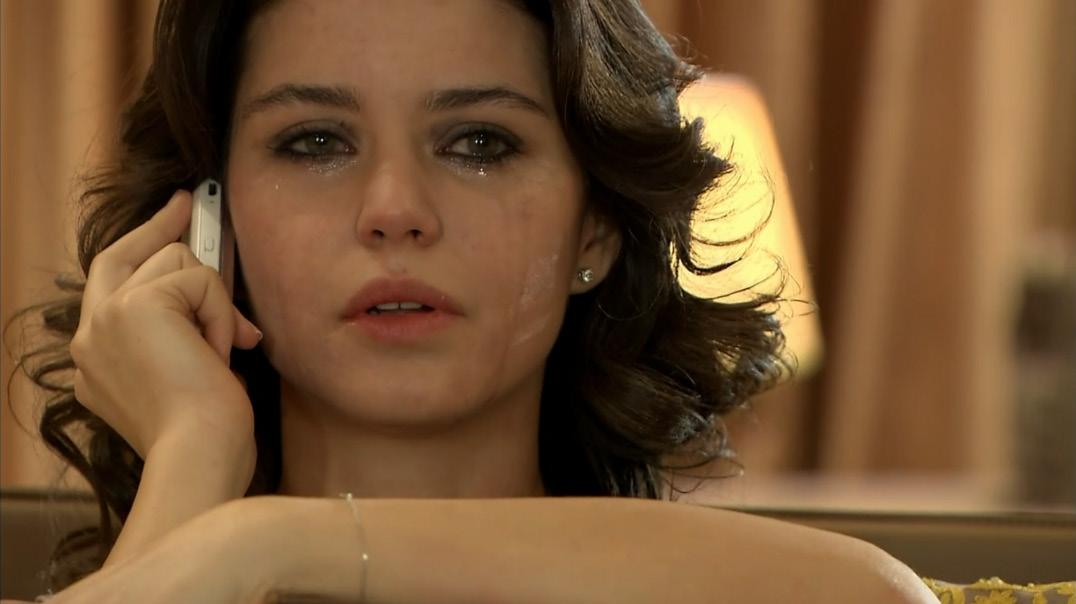
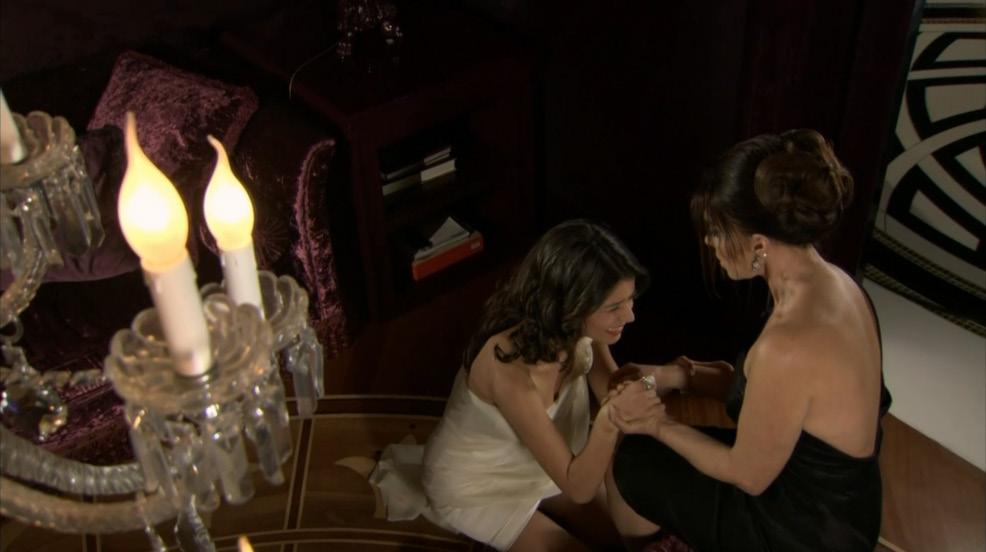
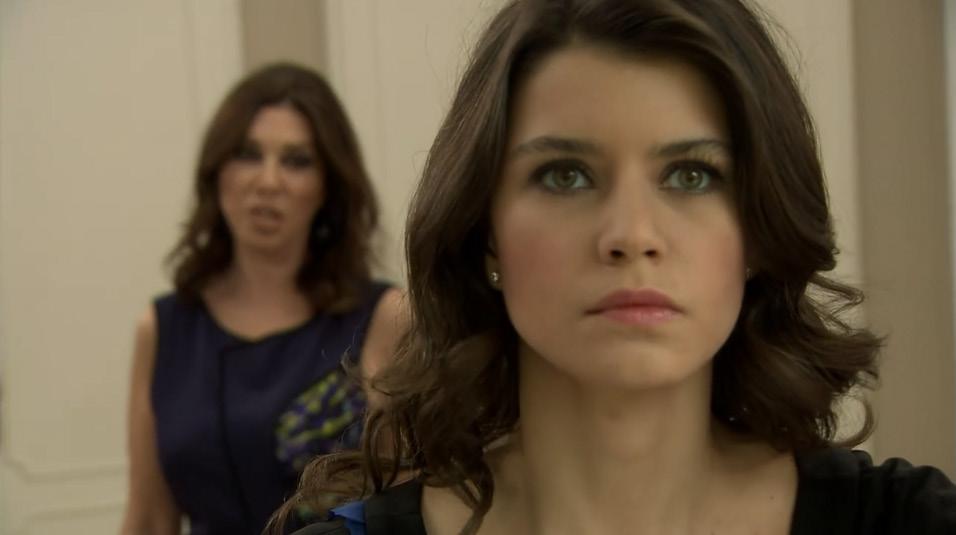
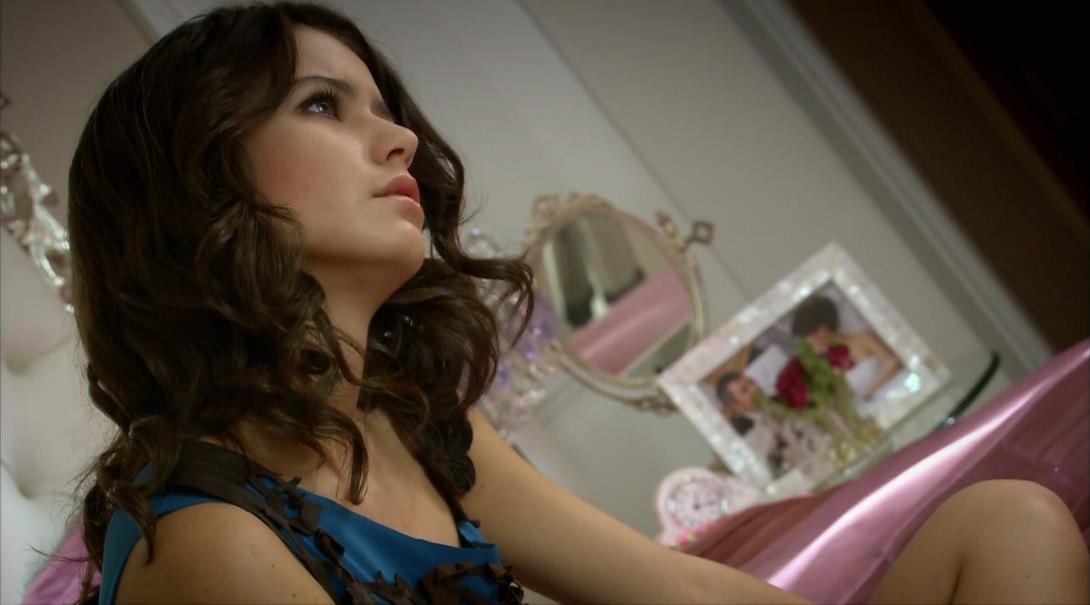
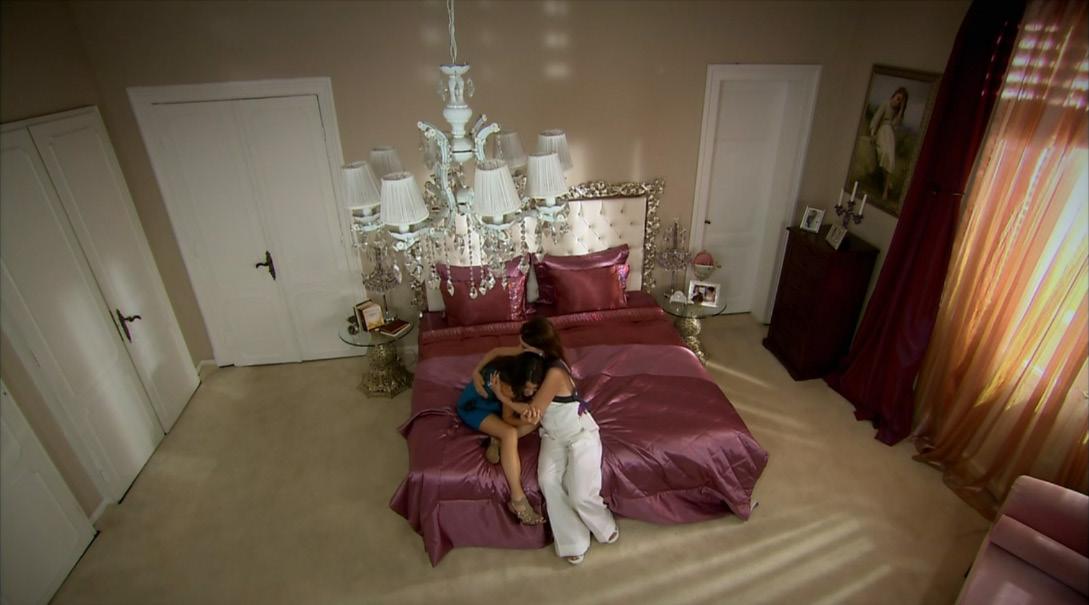
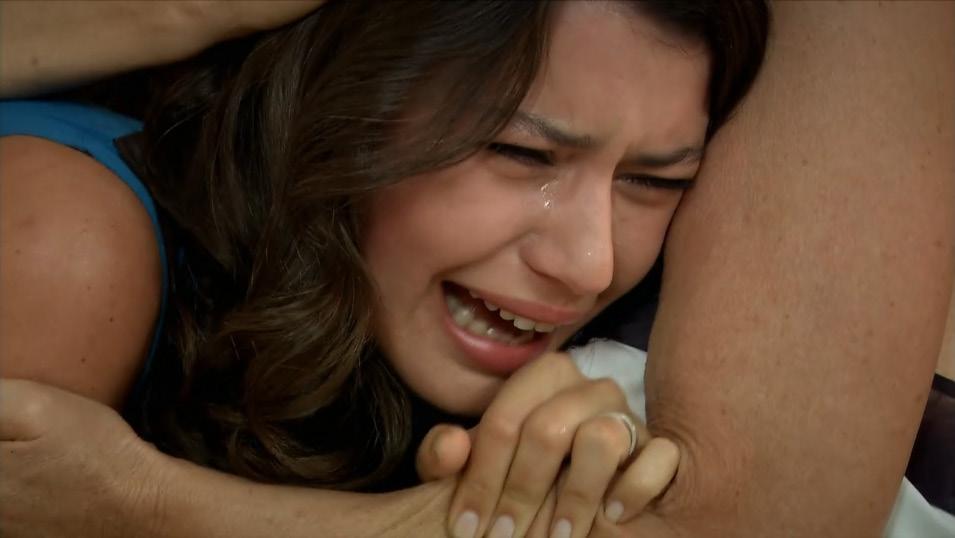
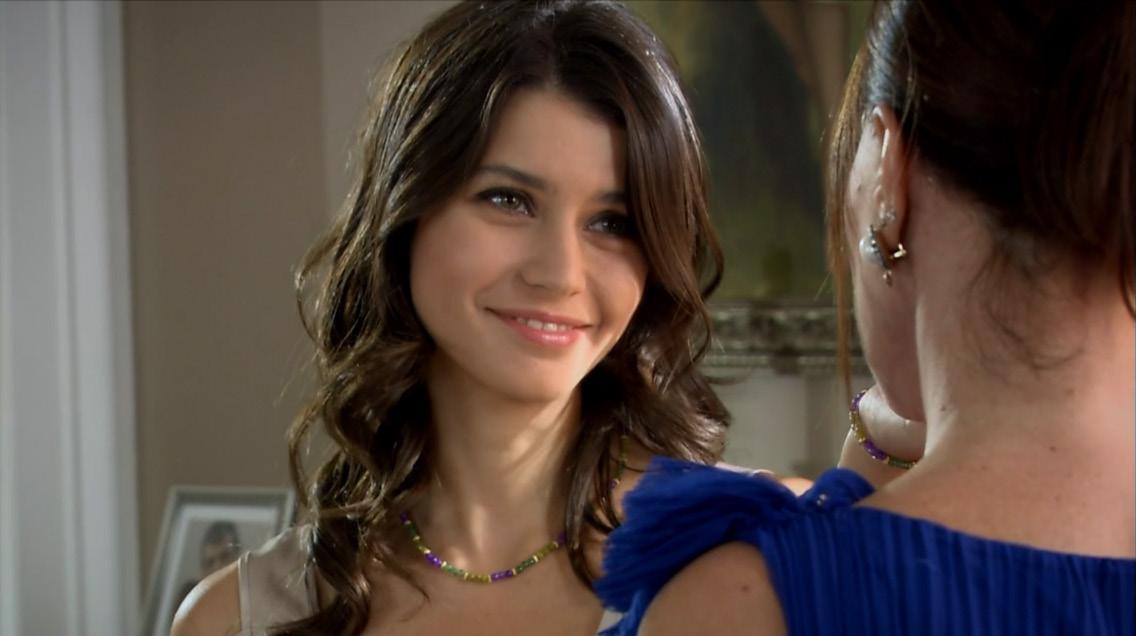
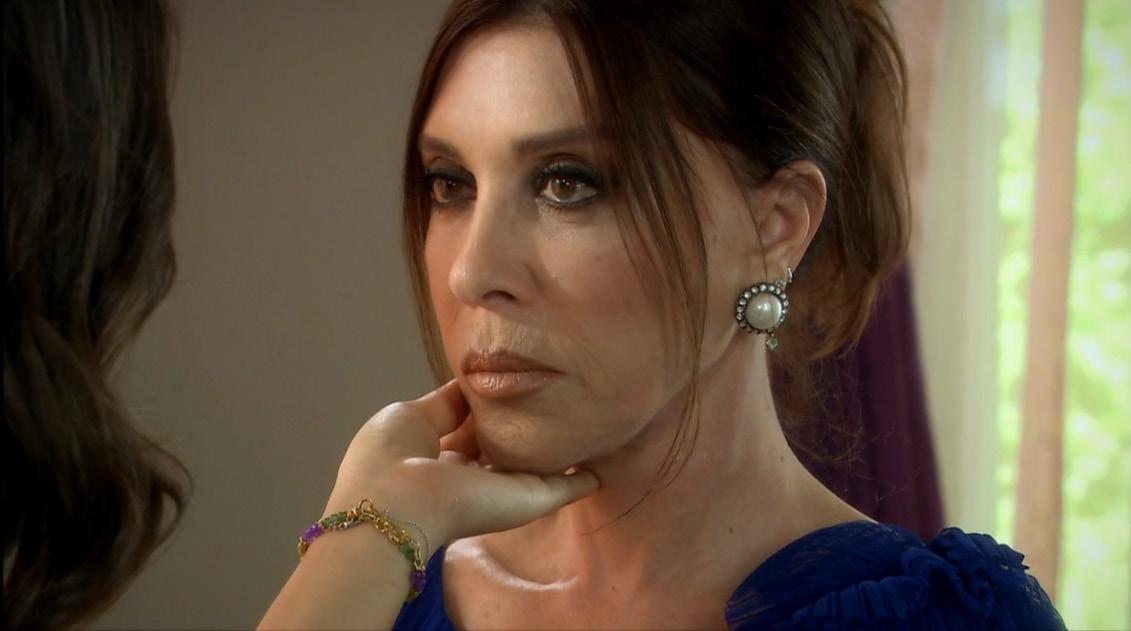
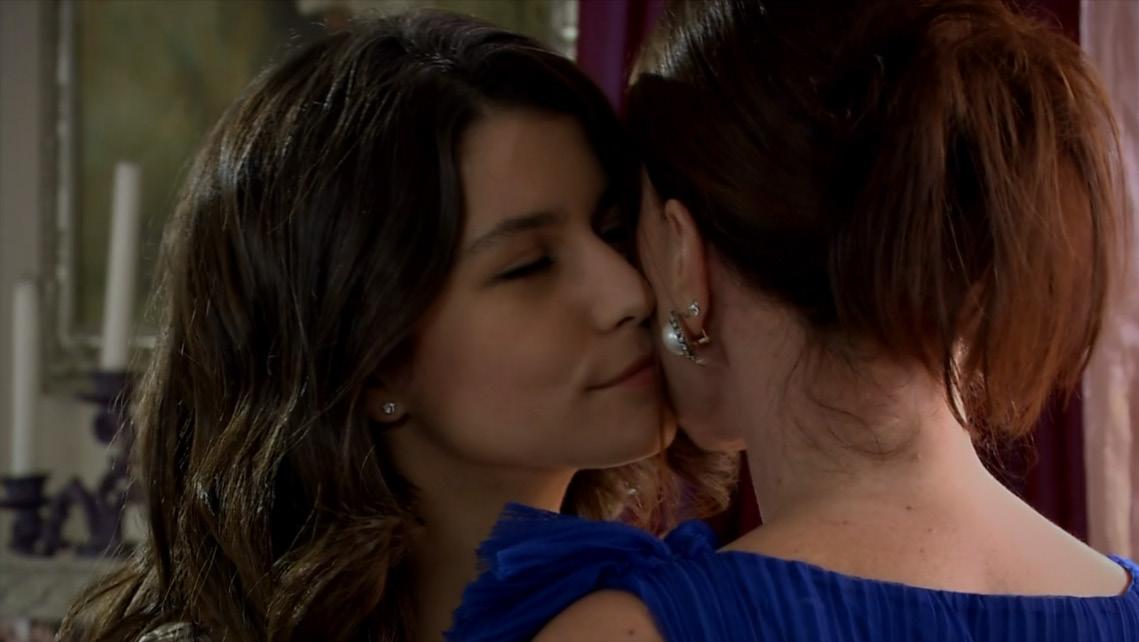
24 Marriage or Death: Salvation within Patriarchy An Analysis of Female Autonomy in Aşk-ı Memnu Elif Zülal Köse
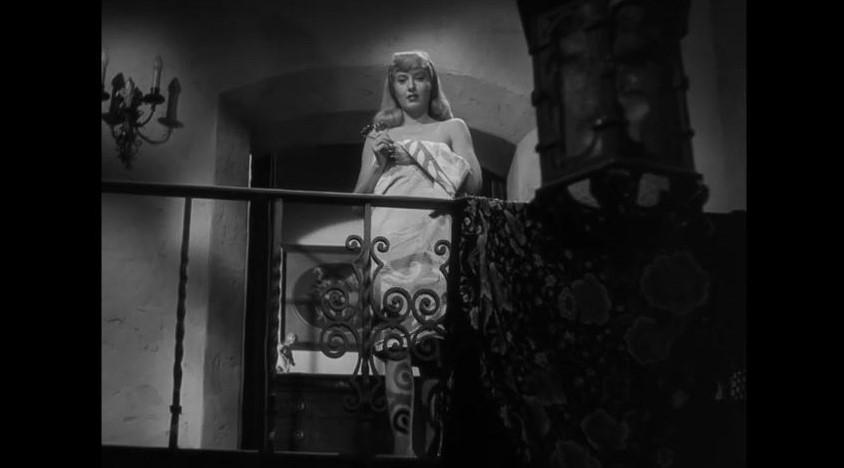
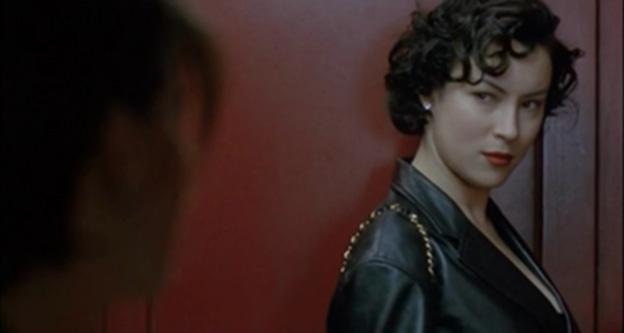
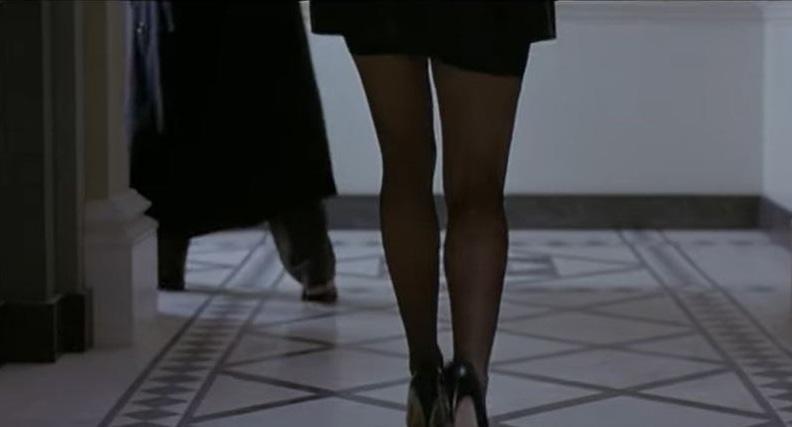
30 Film Noir and the Evolution of the Femme Fatale Archetype: Double Indemnity (1944) and Bound (1996) Julie Alexander
ANNOUNCEMENTS
37 Special Call for Papers
Can Evrenol’s Baskin, Raven Banner Entertainment, 2016.
EDITORS
Kelly Ann Doyle, Kwantlen Polytechnic University (KPU), Canada
Michael Howarth, Missouri Southern State University, USA
FOUNDING EDITOR
Greg Chan, KPU, Canada
ADVISORY BOARD
Greg Chan, KPU, Canada
Richard L. Edwards, Ball State University, USA
Allyson Nadia Field, University of Chicago, USA
David A. Gerstner, City University of New York, USA
Andrew Klevan, University of Oxford, United Kingdom
Gary McCarron, Simon Fraser University, Canada
Janice Morris, KPU, Canada
Miguel Mota, UBC, Canada
Paul Risker, University of Wolverhampton, United Kingdom
Asma Sayed, KPU, Canada
Poonam Trivedi, University of Delhi, India
Paul Tyndall, KPU, Canada
REVIEWERS
Ali Akarcesme, Kutztown University, USA
Andrea Hoff, UBC, Canada
Michael Howarth, Missouri Southern State University, USA
Robert Pasquini, KPU, Canada
Samantha Lay, Meridian Community College
Mazyar Mahan, University of Texas at Dallas, USA
Paul Tyndall, KPU, Canada
COPYEDITORS
Kelly Doyle, KPU, Canada
Michael Howarth, Missouri Southern State University, USA
Joakim Nilsson, KPU, Canada
Robert Pasquini, KPU, Canada
LAYOUT EDITOR
Patrick Tambogon, Wilson School of Design at KPU, Canada
OJS CONSULTANT
Karen Meijer, KPU, Canada
The views and opinions of all signed texts, including editorials and regular columns, are those of the authors and do not necessarily represent or reflect those of the editors, the editorial board, or the advisory board.
Mise-en-scène: The Journal of Film & Visual Narration is published by Kwantlen Polytechnic University, Canada
WEBSITE journals.kpu.ca/index.php/msq/index
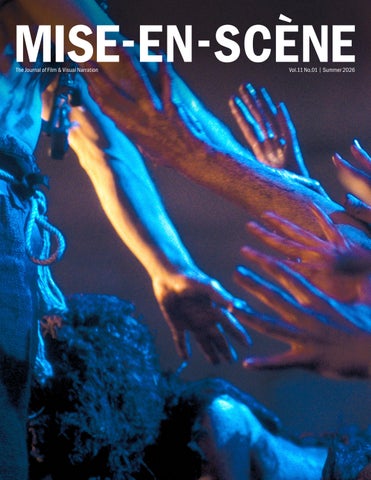
FRONT COVER IMAGE
Baskin. Directed by Can Evrenol, 2016. Image courtesy of Can Evrenol.
BACK COVER IMAGE
Jake Hills on Unsplash
SPONSORS
KPU Faculty of Arts
KDocsFF
KPU Library
KPU English Department
CONTACT kelly.doyle@kpu.ca
SOCIAL MEDIA facebook.com/MESjournal UCPIPK-f8hyWg8QsfgRZ9cKQ issuu.com/mesjournal
ISSN: 2369-5056 (online)
ISSN: 2560-7065 (print)
Situating itself in film's visual narrative, Mise-en-scène: The Journal of Film & Visual Narration (ISSN 23695056) is the first of its kind: an international, peer-reviewed journal focused exclusively on the artistry of frame composition as a storytelling technique. With its open-access, open-review publishing model, MSJ strives to be a synergistic, community- oriented hub for discourse that begins at the level of the frame. Scholarly analysis of lighting, set design, costuming, camera angles, camera proximities, depth of field, and character placement are just some of the topics that the journal covers. While primarily concerned with discourse in and around the film frame, MSJ also includes narratological analysis at the scene and sequence level of related media (television and online) within its scope. Particularly welcome are articles that dovetail current debates, research, and theories as they deepen the understanding of filmic storytelling. The journal's contributing writers are an eclectic, interdisciplinary mixture of graduate students, academics, filmmakers, film scholars, and cineastes, a demographic that also reflects the journal's readership. Published twice a year since 2016, MSJ is the official film studies journal of Kwantlen Polytechnic University in Vancouver, Canada. It is included in EBSCO’s Film and Television Literature Index P
Notes from Our Editors
In my Film Theory course, I always remind students that Hollywood and Englishlanguage cinema represent only a small piece of the global puzzle. The world of international film history and artistic innovation is vast. Standard modern techniques like wipes, fades, and substitution splices—the trick Instagram users now use to instantly change outfits—were pioneered by French magician-turned-filmmaker George Méliès. We see this enduring global influence everywhere: from the Russian formalists’ mastery of montage to the German Expressionism of Fritz Lang and Robert Wiene that directly shaped directors like Tim Burton. Today, India stands as the world’s largest film producer. Despite systemic challenges like limited capital, technical barriers, and distribution hurdles, independent national cinemas thrive worldwide. Stories that challenge and move us do not belong to a single tradition; they belong to all of us. Something vital is lost when we view cinema through a narrow, single-culture lens.
While national cinemas speak directly to their own social contexts, they also invite broader conversations about the human experience. Universal notes of hope, resistance, love, and fear permeate the frame across borders.
This issue features a special focus on Turkish film and television, inspired by a research visit I took to Bilkent University in Ankara, Türkiye, in the fall of 2025 to study Turkish horror. While Türkiye has a rich cinematic history, its horror genre is a relatively new, exciting frontier. This national cinema, like others, is refining technique and narrative in ways that are culturally and politically distinct yet deeply resonant. I hope the following pages inspire readers to look beyond familiar horizons and savor the exciting synergy of global screen culture that allows us to recognize our own experiences, but also those we could only imagine.
Recently, while teaching a class called World Cinema, I was reminded of how important foreign films are, particularly for younger viewers raised on sequels and franchises. There is a paradox at the heart of film culture in the English-speaking world: we celebrate cinema as a universal art form while watching it, overwhelmingly, in a single language. Streaming services have made more films available, but availability is not the same as discovery. Algorithms confirm our tastes rather than expand them. And movie theaters, by and large, continue to showcase familiar Hollywood fare.
Somewhere in the margins (subtitled, underseen, distributed poorly) are extraordinary films that make the case that the history of cinema cannot be understood by looking at any one national cinema. Consider what we would lose if the argument against subtitles always won. No Kurosawa. No Fellini. No Bergman. These directors are not footnotes in film history. They are part of its spine. What international cinema offers is the full range of human experience across vastly different conditions of life. Each national cinema brings its own vocabulary and enlarges the viewer’s capacity for understanding worlds unlike their own.
As the pieces in this issue illustrate, the films that endure are often the ones that arrive from unexpected places and speak to something essential in the human condition, regardless of language. The sorrow is the same sorrow. The joy is the same joy. What expands our taste is advocacy: the friend who insists you watch something amazing, the critic whose review makes a film feel important, or the journal that says, “Here is a world you haven’t entered yet, and it will change how you see your own.” The movie screen is not a window into only one world. It is a window into many. And the more of them we look through, the more clearly we can see.
Michael Howarth Editor
Our Contributors
Ali Akarcesme is a filmmaker and educator whose work bridges creative practice and critical inquiry in cinema and television. Since 2016, he has taught film production, history, and media theory, emphasizing industry practice and analytical rigor. Before academia, he worked as a television producer creating non-fiction programming for RCN Cable. His directing work includes the award-winning short narrative Departures and the current documentary Who Needs Preacher Moss? Between Faith and Funny. His films explore identity, immigration, and underrepresented communities. He remains active in the industry, bringing knowledge and contemporary production methods into the classroom to prepare students for a rapidly evolving media landscape.
Julie Alexander graduated from Kwantlen Polytechnic University with a Bachelor of Arts degree in February 2026. She enjoyed learning about the different ways societal norms are represented in literature. Her research interests include women’s rights, female autonomy, and empowerment. The Topics in Film studies course enabled Julie to analyze how female sexuality is often presented as a threat to male authority and patriarchal order. In her spare time, she enjoys being outdoors, playing soccer, and reading.
ALI AKARCESME
JULIE ALEXANDER
Kelly Doyle is a member of The Society for Cinema and Media Studies and current editor and former advisory board member, reviewer, author, and copyeditor for Mise-en-scène: The Journal of Film & Visual Narration. Her specializations include Critical/Film Theory and horror and she teaches Theory, and special topics courses on zombie films and contemporary horror. Kelly has presented papers on horror film at numerous national and international conferences and published two recent book chapters that theorize notions of human and American exceptionalism, racism, speciesism, and sexism in zombie film and television. She has worked with the Vancouver Horror Show film festival as a panelist and a judge for their horror screenwriting competition. In 2026 she visited Bilkent University in Ankara, Türkiye, to conduct exploratory research on Turkish horror film.
Justin Gonatas is a recent graduate of the Master of Arts in English program at Youngstown State University, researching dreams and their use in American culture, cinema, and politics. In addition to his graduate studies, he works as a videographer for a news affiliate in Youngstown, Ohio, which aligns with his interest in how American media adapts and frames reality.
KELLY DOYLE
JUSTIN GONATAS
ELIF ZÜLAL KÖSE
Elif Zülal Köse is a recent graduate of American Culture and Literature from Bilkent University in Turkiye. She aspires to become a Media Studies scholar. Her area of interests include fandom studies, transmedia storytelling, critical theory, and popular culture. She enjoys well-written fan fiction. She is particularly interested in exploring and participating in fandom spaces, especially if it is about Turkish Dramas. Ultimately, Elif intends to pursue a dissertation on historical drama Magnificent Century.
Paul Risker is an independent scholar, freelance film and literary critic, and interviewer. Outside of editing MSJ’s interview and film festival sections, he mainly contributes to PopMatters, although his criticism and interviews have been published by both academic and non-academic publications that include Cineaste, Film International, The Quarterly Review of Film and Video, and Little White Lies. He remains steadfast in his belief of the need to counter contemporary cultures emphasis on the momentary, by writing for posterity, adding to an ongoing discussion that is essentially us belonging to something that is bigger than ourselves.
PAUL RISKER
Recursive Hellscapes and Abusive Authority
The Horror of Police Corruption in Can Evrenol’s Baskin (2016)
BY KELLY DOYLE Kwantlen Polytechnic University
ABSTRACT
Turkish horror films typically centre Islamic horror and Djinn narratives, but Director Can Evrenol's Baskin (2016) is one of the few post 2000s horror films to offer a sociopolitical rather than a religion-based commentary that is inextricable from notions of masculinity and policing. With a premiere at the Midnight Madness Film Festival in Toronto, Canada, this self-financed horror film from a television commercial director turned film director effectively put Türkiye (formerly referred to as Turkey) on the map for Western audiences as the 8th Turkish film to earn a theatrical release in the United States as of 2015. Horror is still a relatively new genre for Turkish film, with only four horror films produced during the Yeşilçam, or golden, era (1950s to 1980s) followed by a mini-boom occurring in the early 2000s. The opportunity to repress anxiety is disrupted if not prevented outright in Baskin. Enmeshed in polarizing tension between conservative and secular values, post-millenial horror in Türkiye mediates, represents, and responds to distinctly Turkish anxieties about justice, rights, and religion. In Turkish, ‘baskin’ means a raid, foray, incursion, or a descent and signals moral and institutional decay in Baskin as five police officers descend into hell after responding to a distress call from one of their units. This article explores how Baskin creates a scathing indictment against the misuse of force and power by Turkish police and of authoritative power in general through an analysis of symbolism, color, and allegory. These elements in turn mediate and inform a sociopolitical commentary on real-world antecedents in Türkiye, and most notably, the Gezi Park protests in 2013.
Director Can Evrenol’s Baskin (2016) is notably one of the few Turkish horror films that deliberately includes English subtitles and which decenters Islamic horror and Djinn narratives, the subgenre that by far dominates the Turkish horror film landscape post 2000. With a premiere at the Midnight Madness Film Festival in Toronto, Canada, this self-financed horror film from a television commercial director turned film director effectively put Türkiye (formerly referred to as Turkey) on the map for Western audiences as the 8th Turkish film to earn a theatrical release in the United States as of 2015. As highlighted by a number of scholars, horror is still a relatively new genre for Turkish film, with only four horror films produced during the Yeşilçam, or golden, era (1950s to 1980s) followed by a miniboom occurring in the early 2000s (Koçer 150; Özkaracalar 249; Ozgur 175). This resurgence un-coincidentally follows the re-election of the conservative AKP (Justice and Development Party), which has been in power since 2002. As astutely observed by Robin Wood, “one might say that the true subject of the horror genre is the struggle for recognition of all that our civilization represses or oppresses, its reemergence dramatized, as in our
nightmares, as an object of horror, a matter for terror, and the happy ending (when it exists) typically signifying the restoration of repression”(24), where in this case the civilization in question is Turkish rather than American. As I will argue, the inclination to repress anxiety is disrupted if not prevented outright in Baskin. Enmeshed in polarizing tension between conservative and secular values, post-millenial horror in Türkiye mediates, represents, and responds to Turkish anxieties about justice, rights, and religion. Many of the horror films being made up to
Coupled with a wariness of paternalism and authority in modern day Türkiye, Baskin goes on to critique what Evrenol frames, quite literally, as a nightmare of toxic masculinity perpet uated in patriarchal systems of law and rule from which
waking may or may not be possible.
this point were remakes, adaptations, or outright plagiarism of Western horror films, like The Exorcist (1973)/(Şeytan 1974) as Turkish filmmakers emulated Western techniques. Now, many Turkish filmmakers, armed with technical know-how and experience their predecessors lacked, are forging new and innovative paths in horror Recognizing a market inside and outside Türkiye, with Baskin Evrenol presents one of the first original Turkish horror films to offer a sociopolitical rather than a religion-based commentary, one that is inextricable from notions of masculinity and policing. In Turkish, ‘baskin’ means a raid, foray, incursion, or a descent (Google Translate trans.) and signals moral and institutional decay as well as institutional force in Baskin as five police officers descend into hell after responding to a distress call from one of their units. Evrenol creates a scathing indictment against the misuse of force and power by Turkish police and of authoritative power in general. These elements in turn mediate and inform a sociopolitical commentary on realworld antecedents in Türkiye, and most notably, the Gezi Park protests in 2013.
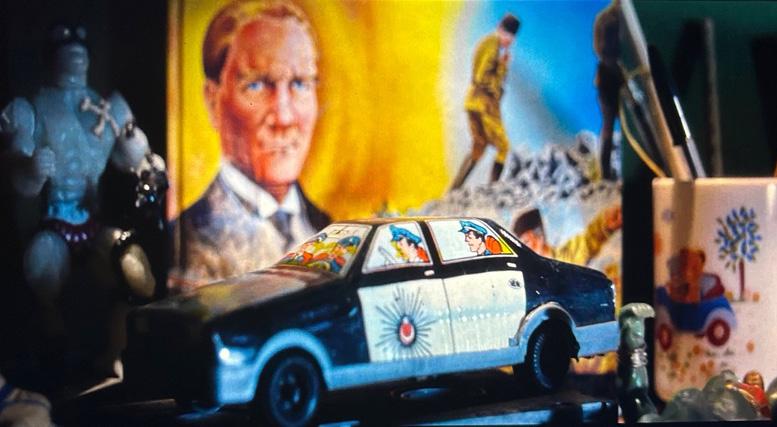
Baskin’s opening shot is pivotal as it introduces the film’s protagonist, Arda (Berat Efe Parlar), and underscores his childhood ideal of heroism. In turn, this informs his choice to become a police officer as an adult. Ultimately, it serves to emphasize the discrepancy between this ‘dream’ and the consequences of that choice in a situation that is found wanting when held up to these ideals. Using a jib shot, the camera floats dreamily up, then laterally from right to left to reveal a variety of figures, books, and toys on a shelf before finally descending to a sleeping Arda (Fig. 1).
The subtle movement from right to left is destabilizing in that it inverts the way that viewers and readers in much of the world read text and visuals, from left to right. As such, Evrenol creates a subtle and unsettling sensation of feeling adrift and untethered to reality. Visually and metaphorically, the items on Arda’s shelf emphasize his ‘dreams’ of justice, heroism, and leadership. For instance, Arda’s encyclopedia depicts two images of Mustafa Kemal Ataturk, the founding father and former president of Türkiye (Fig. 1), and alludes to Turkish national pride and the secular values that characterized the republic “upon the dissolution of the Islam-oriented Ottoman Empire” (Sahinturk 95). By abolishing the Sultanate and Caliphate, Ataturk ushered in a new era that among other things gave women equal civil and political rights, emphasized free and compulsory primary education, and “replace[d] the Ottoman script with the Latin alphabet” (Smith 36). Doubtless, Ataturk represents leadership for the young boy, a man worth emulating. Notably, some of Arda’s figures, like the teenage Mutant Ninja Turtles and an English language comic called Red Kit: Chasing the Daltons, provide anchor points to the values of morality, heroism, and justice that Western audiences will also understand. The protagonist of this comic is a cowboy who pursues the villainous Daltons in an effort to bring them to justice.
Germane to an understanding of Arda’s psyche, the police car in the foreground (Fig. 2) connects and extends values of justice, service, and security for the people, all of which are later undermined by the tight-knit and hypermasculine group of police officers with whom adult Arda (Görkem Kasal) serves.
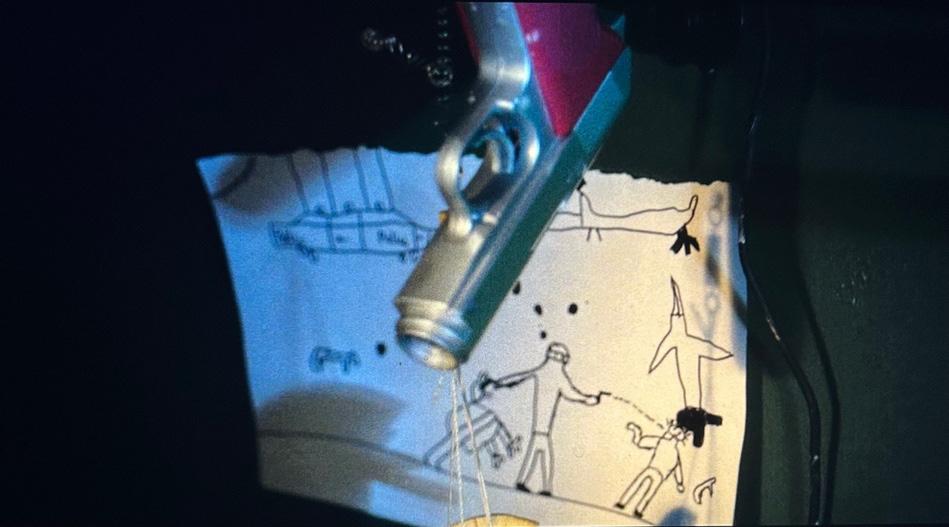
This is also foreshadowed by the foregrounding of the toy gun against Arda’s drawing of a police car in the background while one man, ostensibly a ‘bad guy,’ shoots another man. Implicit here is the message that justice is problematically tied to violence, a theme that Evrenol makes readily apparent in his portrayal of police in the film. In essence, the scene establishes an uneasy tension between the ideals of law and authority and the ways they can be deployed to questionable, often nightmarish ends. In addition, the scene’s use of 1980s synth loosely situates Arda’s childhood during a period which was marked by an “oppressive political and social atmosphere created by the military regime” after the 1980 military coup in Türkiye (Suner 306). Coupled with a wariness of paternalism and authority in modern day Türkiye, Baskin goes on to critique what Evrenol frames, quite literally, as a nightmare of toxic masculinity perpetuated in patriarchal systems of law and rule from which waking may or may not be possible.
In 2013, Turks staged a peaceful protest at Gezi Park in Istanbul after, as Yeşim writes, the government planned to build a new shopping mall and residential complex within a replica of an Ottoman military barrack (808) in the park. This would have effectively erased one of the city’s few green public spaces. Yeşim notes that public outrage from half the population was first in response to party corruption that allowed cronies to profit from political decisions about public space that ignored city planners, architects, and indeed, public consultation itself (808). Further, Amnesty International details the excessive use
Fig. 1 | A toy figurine, miniature Turkish police car, and an encyclopedia featuring Mustafa Kemal Ataturk, the founder of Türkiye as a modern secular republic (00:00:28. Raven Banner Entertainment, 2016).
Fig. 2 | A toy gun hangs in the foreground against Arda’s drawing of an altercation between police and ‘bad guys’ (00:00:30. Raven Banner Entertainment, 2016).
of police brutality against peaceful protestors: “the use of live ammunition, tear gas, water cannon, plastic bullets and beatings” that led to more than 8000 injured people, at least three deaths, and many sexual assaults (“Turkey Accused” par. 2). In the short 11-minute version of Baskin (2013) that precedes the feature-length film, adult Arda (Gorkem Kasal) mentions to his police unit that he can’t get the image of the kid who lost his eye out of his head (00:01:00-00:01:04), and while the situational context for his comment isn’t made clear in the film, this moment cannot help but inform Baskin’s characterization of the police as dangerously hypermasculine and morally bankrupt. While the short was filmed before the Gezi Park protests, the overall political climate of government overreach is a significant precursor. Çakırlar points out that “the post-2011 period can be considered a turning point in the AKP’s rule as the party started to set forth an avert authoritarianism, anti-feminism, and conservatism in the aftermath of its electoral hegemony” (180). The values set forth in this ‘New Türkiye’ seem strikingly at odds with those of the republic’s founder, and in turn, Baskin’s young protagonist.
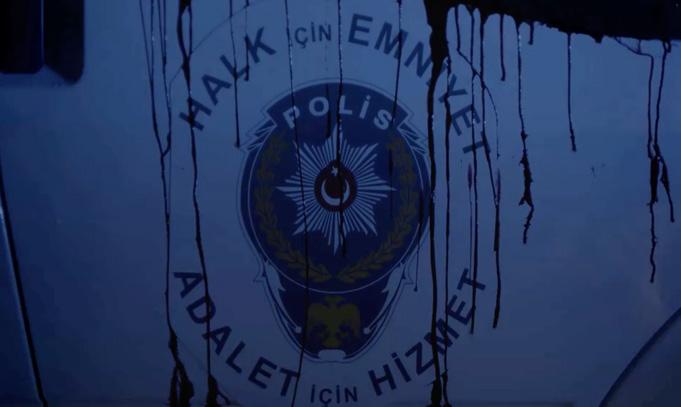
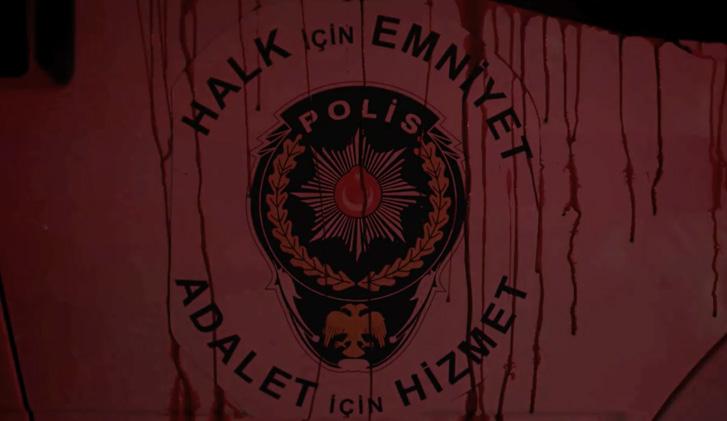
Significantly, Evrenol shot Baskin (2013) in a conservative part of Istanbul (“Baskin Interview” 00:36:18) shortly before the Gezi Park protests and the reported police brutality that took place there. One of its central images is the police logo literally tainted by spilled blood as the police flashers alternate between blue and red, colors that remain a consistent and symbolic part of the film’s composition (Figs. 3 and 4). Reading “Halk için emniyet adalet için hizmet,” or “security for the people, service for justice,” this guiding philosophy is visually marred by the spilling of innocent blood and made ambulatory as the motto is alternately washed in the oversaturated flashing of red and blue police flashers. In effect, the arrival of the police signals an urgency that is not cleanly codifed in terms of offering aid. Instead, it indicates a nightmarish slippage from realism to surrealism in the film. While this first violent act is committed by a cult, the investigating officers are implied to be complicit in the violence even as they are positioned as future victims of it. Because the sacrifice of the sheep directly precedes the officers’ ‘raid’ on the building and their descent into hell, it is highly suggestive of their own moral descent. The film’s temporal proximity to the Gezi Park protests situates it as an indictment of how the protest was mishandled, especially as it is developed into a feature film several years after the protests. Evrenol’s consistent use of blue and red remains a hallmark of the feature-length production that becomes increasingly significant.
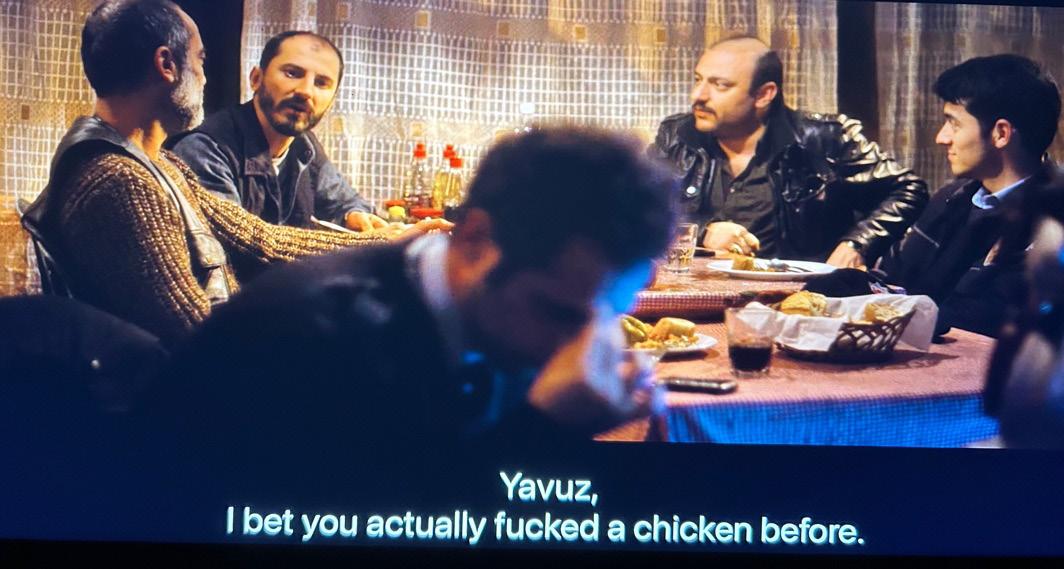
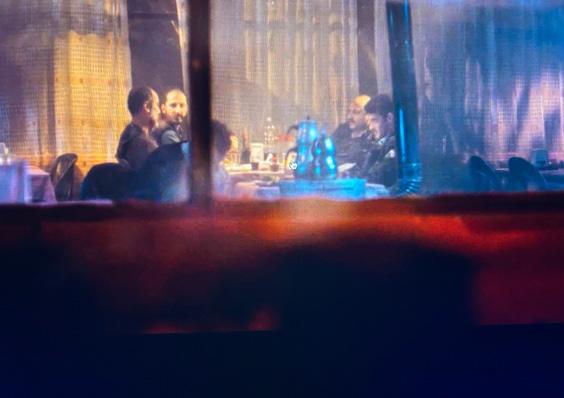
In the feature, viewers are introduced to Baskin’s (2016) five police officers as they have dinner at Yeşilvadi Restaurant (Fig. 5) before their night shift begins. The scene emphasizes their sexism, machoism, and abuse of power while foreshadowing their descent into hell. Yavuz (Muharrem Bayrak) is established early as an obnoxious, foul-mouthed, and bullying individual. He asserts that 70 percent of Turkish men lose their virginity to animals while in the army (00:08:54), threatens to copulate with his colleague as though he was a chicken (00:08:15), and perhaps most significantly, sees his own perceived sexual prowess as a mark of his own masculinity and superiority. He calls Arda, the Rookie of the group, an inexperienced city ‘boy’ and a
‘newbie’ while he himself is apparently “seasoned with brothels, whores, and what not” (00:09:17). Yavuz symbolizes a masculinity marked not by leadership or the protection of the public but rather by sexual dominance, power, and transactional relationships; at brothels, women must be compensated for intimacy. Yavuz wears a wedding ring, but his references to women suggests a devaluing of women at worst or at best, a need to perform masculinity to his colleagues.
Tellingly, Yavuz shares a sordid story about mistaking a trans woman for a cisgendered woman during a sexual encounter and decides to see the encounter through until the woman, who has not undergone reconstructive surgery, begins to self-pleasure. For Yavuz, the act then becomes ‘dirty.’ The significance here is twofold: on the one hand, the story is comical to the other men; Yavuz can laugh because as the person in control of
Fig. 3 and 4 | After a dead sheep is thrown from above to land on the police van, its blood runs down the car door and the logo upon it (00:03:10. Vimeo, 2013).
Fig. 5 | Apo (Fatih Dokgöz) teases Yavuz about copulating with animals (00:08:15. Raven Banner Entertainment, 2016)
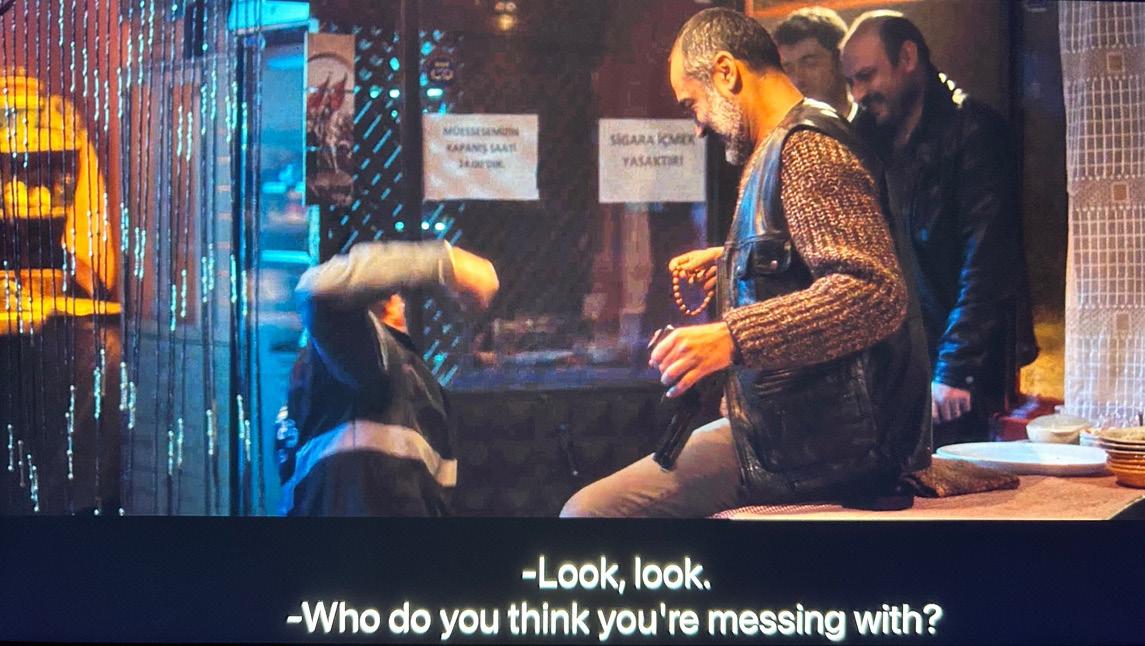
the sexual act he understands his masculinity and his ‘straightness’ to be intact. On the other hand, when the young man who waits their table overhears and laughs while serving their coffee, Yavuz mistakes it for laughter at him. For Yavuz, being mistaken as homosexual is an insult to his identity and his masculinity. His aggressive reaction is to physically and verbally intimidate the young man, a situation the restaurant owner tries to de-escalate by deferentially apologizing on his behalf while the young man himself is afraid to speak. The scene highlights Yavuz’s fragile masculinity and the certainty that those outside of his unit are truly outsiders and held to a different standard. They are civilians, subject to the rules the five policemen are not. The anxiety felt by the waiter and the restaurant owner reflect the potential severity of this reality. It is when Yavuz overhears the waiter mumble, “if only you weren’t cops” (00:13:16), that the situation escalates. While the other officers initially try to deter him; squad leader Remzi (Ergun Kuyucu) invites Yavuz to do whatever he likes and assures Yavuz that it will stay between them. While the other officers look on and laugh, Yavuz proceeds to headbutt and beat the young man (Fig. 6).
Jarringly, Remzi laughs while holding a tespih or prayer bracelet, used to count repetitions of prayers in daily remembrance of Allah, in one hand, and a gun in the other. While he thumbs the tespih at various points in the film, its appearance here marks the dissonance between an ostensibly Muslim man who observes prayer and leads the others as they ‘serve’ justice, and the deeply flawed police chief he reveals himself to be. One is again reminded in this moment of the Gezi Park protests as an antecedent. Gardner observes that:
The levels of violence used by police in the course of Gezi Park protests clearly show what happens when poorly trained, poorly supervised police officers are instructed to use force – and encouraged to use it unsparingly – safe in the knowledge that they are unlikely ever to be identified or prosecuted for their abuses (qtd. in “Turkey Accused”).
In Baskin, Evrenol resists an unproblematic identification with these bullying and vulgar men—Yavuz in particular—and invites the viewer to note the stark contrast between young Arda’s dreams of heroism and the men from whom he is currently learning. Perhaps what is most significant here is not
that these men are evil, but that they are not. Where Yavuz is overly antagonistic, the others are complicit or at least passive. Arda and Seyfi (Sabahattin Yakut) in particular are the only two men who wear the full uniform, including a tie and a buttondown dress shirt, suggesting a greater internalization of the responsibility that comes with the job they do. Seyfi feels literally ill at ease from the film’s outset, suggesting that something about what they are doing and how they are behaving does not feel right. Even so, they see themselves as the ‘good guys’: Remzi, viewers learn later, has cared for Arda since his parents died in a car accident when he was a child. Further, a later, lighter scene in which the men sing along to a song on the radio features a sequence in which Apo improvises a rap about being called and quickly showing up where he’s needed (00:20:26): pride in his position as an upholder of law is clear in this moment, although there is cognitive dissonance between how Apo sees himself, his role as a policeman, and his failure to intervene at the restaurant. My point here is that there is nuance to the behaviour of these men, which is especially important since viewers are later charged with assessing whether or not they deserve the fate that awaits them. Ultimately, they are victims within a system, operating under a framework in which they have far less agency than they imagine but in which they are still accountable for their actions.
In all of the stills above and still more to follow, the viewer cannot help but notice that the entire film’s colour palette is dominated by amber, blue, red, or some combination of all three. These colors permeate the entire film from start to finish, with increased saturation of blue and red as the situation becomes increasingly horrific. Drawing on the red and blue flashers of the original short film, the feature length heavily leans on these colors and their association with police presence that is increasingly associated with coldness, authority, and heated violence. The most neutral of the colors, a warm amber, is not neutral at all: rather, it suggests an element of caution akin to what one might see on traffic signage. In the context of Yavuz’s raised and amber-saturated fist, the color’s resonance shifts: on the one hand, it wars with the cool authoritarianism of the police suggested by the blue saturation at his back. On the other, it extends to wash Remzi, Arda, and Apo in a warm glow that suggests comradery and warmth despite the shameful abuse of power that is taking place (Fig. 6).
Baskin suggests tension between younger generations of Turkish men (Arda) and the toxic elements of patriarchy that underwrite the attitudes of the older ones. In the context of Turkish cinema, Evrenol undermines the ideological project of 1970s Turkish horror films, which he describes as patriarchal, macho, pro-religion, and pro-nation (“Baskin Interview” 00:20:30-20:30:35). Aslan points out that men in the films made in this period tend to be the head of blue-collar labourers, police or “public saviours,” who are strong, brave, and problem-solving (qtd. in Serarslan et al. 178). Serarslan et al. elaborate that in the wake of a growing feminist movement in Türkiye in the 1990s, films in the 1990s and early 2000s centered men in ways that emphasized violence and sought to soothe men’s egos and a sense of weakening authority in a changing social landscape in which women were rejecting traditional roles (178-179). Further,
Fig. 6 | Yavuz beats the helpless boy while the other officers laugh and encourage him (00:14:39. Raven Banner Entertainment, 2016)
was my intention, at least. I tried to make those cops as macho and sexist and Turkish as possible… Baskin is also about sexuality and a kind of anti-macho idea” (“Exclusive Interview”). Evrenol stresses that until the 1980s and 1990s, law stipulated that it was unacceptable to create a negative image of the police in film, or to insult them (“Baskin Interview” 00:41:13). The original law Evrenol is likely referring to was, according to Smith, established in 1934 and stipulated 10 criteria filmmakers should avoid, including propagating religion, attacking the state, propagating social and political ideology which contradicts the national regime, and contradicting moral and national values (64-65). “‘Censorship in Turkey has been a matter of policing from the very beginning and it has been one of the major ways in which the state has intervened in the distribution and exhibition of films’” (Erdoğan and Kaya qtd. in Smith 64). As a case in point, Evrenol confirms that onscreen depictions of alcohol and smoking were routinely pixelated, sexual dialogue un-translated, wounds blurred (“Baskin Interview” 25:41-26:02). In this context, Baskin is a film that boldly transgresses lines of propriety around body horror, policing, sex, smoking, and language in a way that would have been shocking or perplexing to Turkish audiences unfamiliar with such extreme depictions. Baskin unapologetically explores the dark underbelly of these taboo subjects, a task to which horror is well-suited. Historically, this is a genre which is often dismissed out of hand as low-brow or crass, but which has the potential to be evocative and subversive. Horror is a genre of the nerve endings, capable at its best to shock viewers out of complacency.
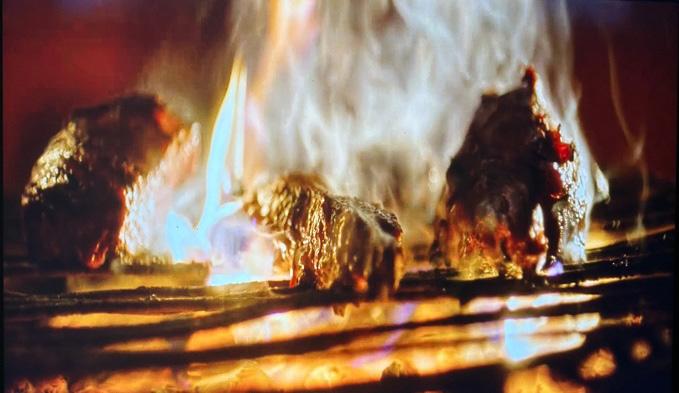
Significantly, the scene in which Yavuz beats the server marks the moment where the men’s action and inaction alike lead them irrevocably on a journey to hell, suggesting punishment for their abuse of power and their machismo. The waiter’s beating is juxtaposed with cuts to Seyfi vomiting in the bathroom outside and seeing a frog in the soap dish, then to close-up shots of meat cooking on a grill inside the restaurant. Together, this trifecta of images creates an ominous warning of things to come (Figs. 7, 8, and 9).
while Bikiç notes that Turkish horror after 2000 has a negative or hostile attitude towards women (482) and that it fuels a “male-dominated sexist discourse” that is “excessively conservative and even bigoted” (Dogan qtd. in Serarslan et al 483), I would stress here that Baskin, which has an almost entirely male cast, relentlessly undermines this vision of masculinity and emphasizes the harm that it does at an institutional, personal, and even spiritual level. Evrenol asserts that “although it’s very male-oriented, Baskin is about the anti-male in Turkish society; that
Evrenol explains that frogs, which appear inexplicably and in large quantities in the film, “are doom bringers in mythology. In Baskin, they lead the cops to their doom in their nightmarish journey. They symbolize the film getting off its tracks” (“Making a Feature”). That the first appears in a soap dish suggests that these police officers are corrupt, with metaphorical ‘dirty hands’ that cannot be washed clean. The cut to cooking meat emphasizes not only the growing intensity and amplification of Yavuz’s heated assault, but also a disruption of positive connotations of cooking and eating juxtaposed with the cold, dirty blue space of the bathroom. What the viewer sees cumulatively is unpalatable. Further, the earlier shot at dinner (Fig. 9) contextualizes what follows: while the men eat in the background, meat is thrown on the grill in the foreground. As such, it appears that the five men are themselves on the grill as the flames lick up around them. Bars from the window in this separate room give the impression that it is the policemen who are jailed or trapped. To my mind, this is not only foreshadowing of the trap that awaits but also an indication that the men are themselves beholden to an institution and ideology they cannot escape.
Fig. 7 | After vomiting and washing his face, Seyfi recoils in disgust when he observes a frog in the soap dish (00:13:38. Raven Banner Entertainment, 2016).
Fig. 8 | Meat sizzles on a grill while the confrontation between Yavuz and the waiter escalates (00:14:45. Raven Banner Entertainment, 2016).
Fig. 9 | Slightly earlier during dinner, the police eat their meal while in the foreground, the grill seems to sizzle beneath them (00:9:02. Raven Banner Entertainment, 2016)
Instead of Sufi mystics who spin gracefully in long, white skirts to loosen the ego, open the heart, and become centered in Allah’s presence, Baba’s followers cling to earth, darkness, and pain.
Their journey to the village of Inceagac in response to a distress call becomes a journey to hell, along which the officers continue to anchor their masculinity to performative shows of strength and sexual dominance that soon give way to helplessness. For instance, despite the fact that Seyfi has been sick all evening, he insists on driving and is insulted by his colleagues’ suggestion that he rests in the back of the van. To do so would be considered weak and perhaps effeminate. Later, they are forced to stop the van as they are harassed by persons unknown who hit the van, and Yavuz threatens them in terms that are gendered and are charged with sexual violence: “You bust our balls, we’ll rip your balls off!” He shouts, following up with a vulgar promise of sexual penetration (00:24:30-00:24:33). In other words, harassing the police will result in violent retaliation that attacks virility and is assaultive as well as feminizing. Yavuz has already established that being penetrated is coded as weak and submissive, which becomes symbolically significant later as notions of masculine authority and sexual virility are inverted to undermine both.
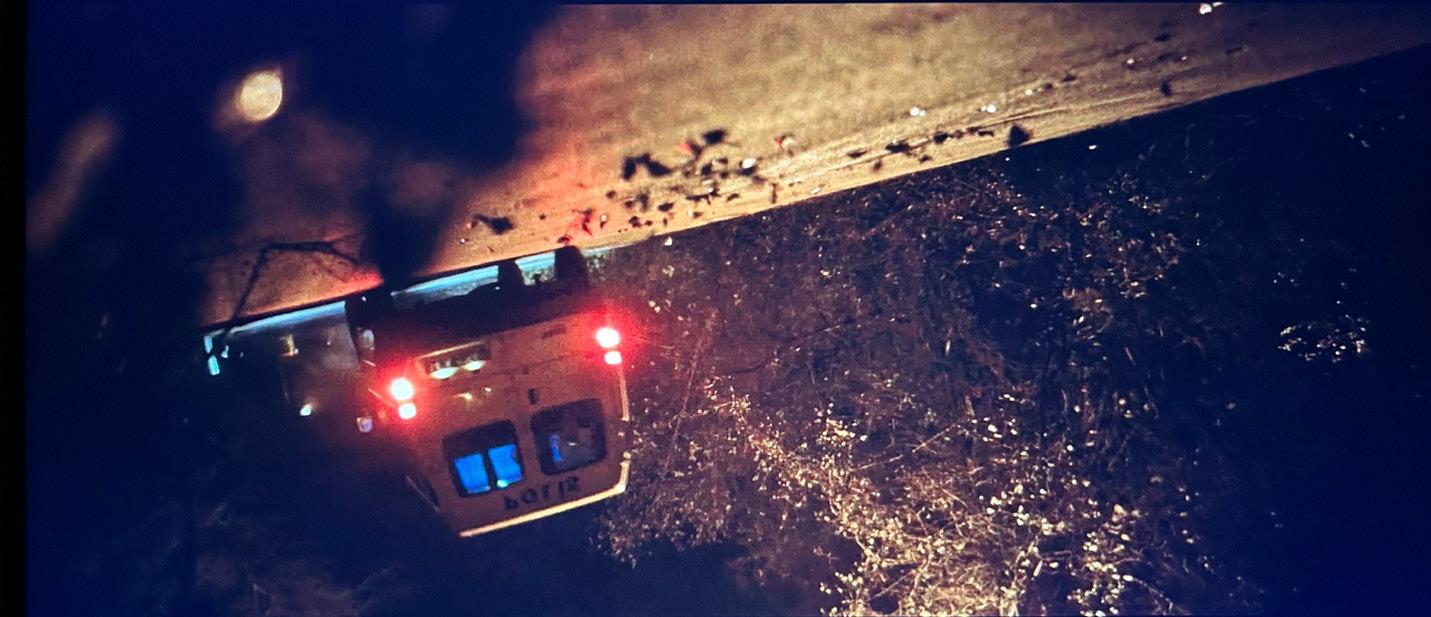
The camera does a 180-degree camera roll as the van travels past it on the way to the village, literally and figuratively
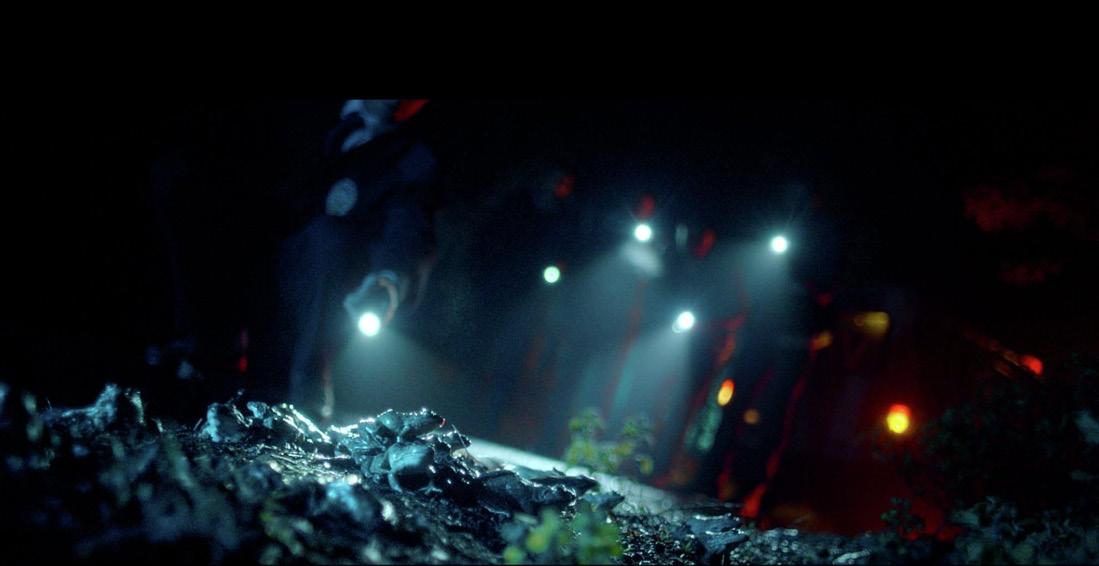
anticipating the world turned upside down (Fig. 10). Solidifying the fact that reality has given way to a surreal hellscape, Seyfi observes that the road is unfamiliar although he knows the town they are travelling to, and that they have been driving for what feels like 10 years (00:23:45). Time and space appear to have subtly shifted. Evrenol’s use of amber, red, and blue in this shot are natural rather than oversaturated, but this indication of a reality that is grounded quickly gives way. One of the most prominent visual signifiers that the men are entering a different, hellish reality is the increasingly use of saturated reds and blues. As a case in point, the men see a swarm of frogs—Evrenol’s symbol of doom—bathed in blue light on the side of the road (Fig. 11), and later, in the buckets of villagers they encounter on the way. The warning signalled by the single frog in a soap dish is amplified here, especially since the van’s amber light flashes ominously in the background.
Shortly after, as they drive on, Seyfi fails to see a bloody man standing in the center of the road, which causes them to run him down and to veer into a lake before they can cross the upcoming bridge. While Evrenol does not overly situate the film in a distinct religious framework, this failed bridge crossing evocatively calls to mind the Sirat bridge. In Islamic eschatology, this is the bridge over hell that every soul must cross to reach paradise on the other side; one’s ability to do so depends in part on good deeds, faith, prayer, and moral conduct, with the crossing being swift for some, harder for others, while still others slip into hell. After a time, with transformation and personal growth, some may eventually pass, suggesting the recursive, rather than linear, testing of a person’s worth. This notion is applicable to the five police officers, who find themselves symbolically resurrected from the lake and in hell rather than paradise. Based on their deeds, they all have varying levels of work to do.
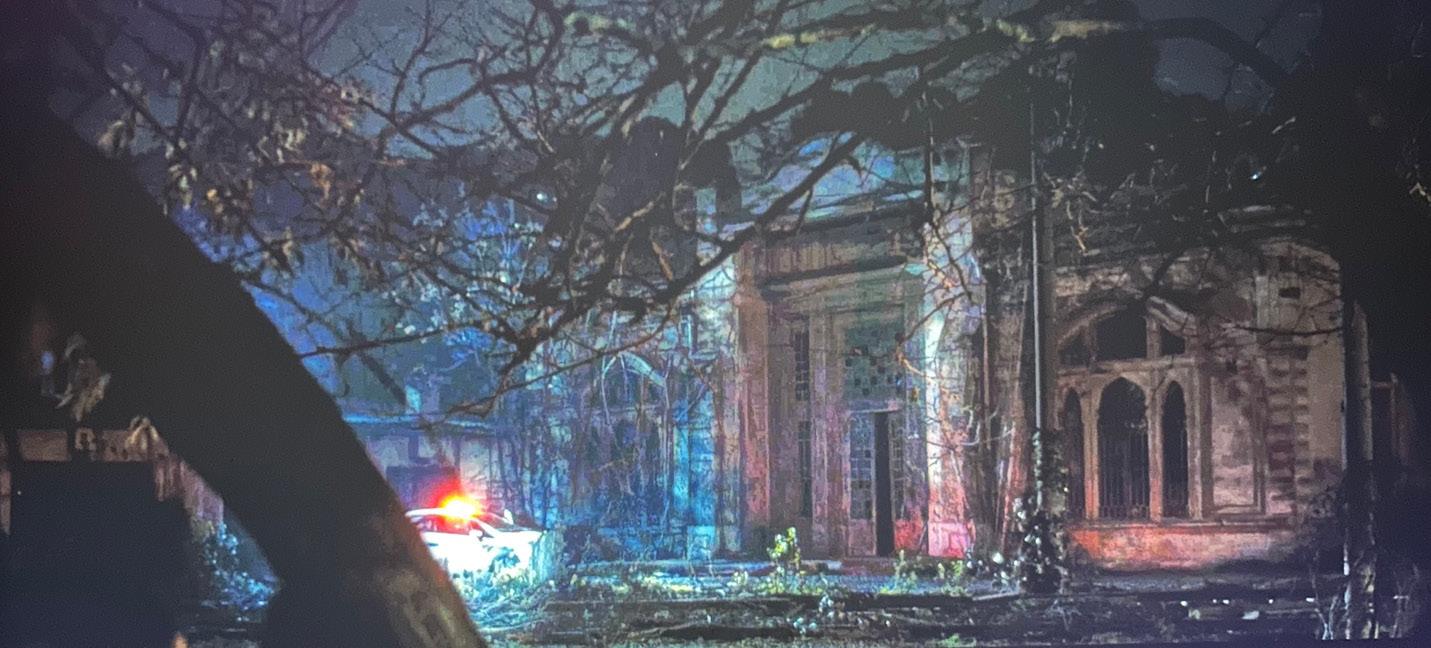
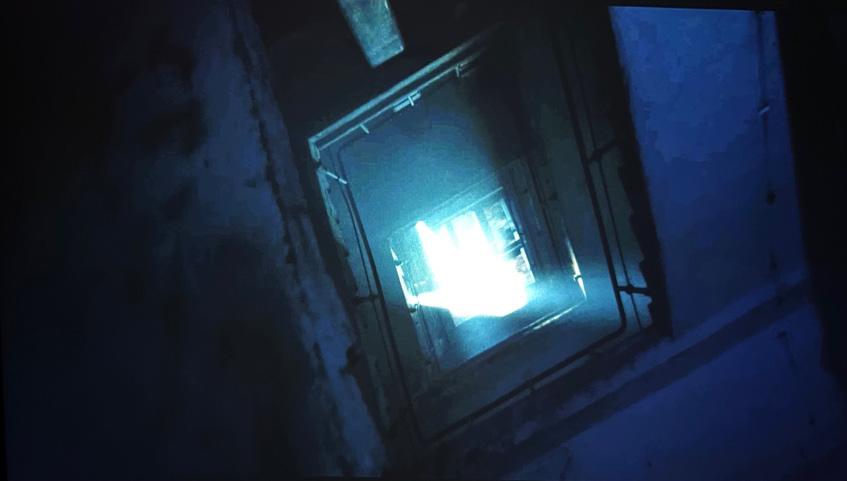
Considering the import of the job the men do symbolically and perhaps politically, it is significant that the distress call the unit receives leads them to an abandoned and decrepit Ottomanera police station (Fig. 12) that represents institutional rot and a sense of justice and morality that has long since departed or been corrupted. They are led by an unwilling local who later runs off, saying “Fuck the police” (00:43:00) to emphasize the lack of trust in and respect for them. A wide shot reveals the station washed in the impotent flashing blue and red of an empty police car belonging to another unit. The viewer later learns that they, and many other people, are being tortured and butchered by a cult in the dark recesses of the building. As such, the source of the ‘distress’ call is a decaying symbol of law and order that is tainted by the hidden obscenities occurring within it: the butchering, exploitation, and implied consumption of said bodies serves as an allegory for the ways in which bodies are consumed and manipulated to serve ideologies and authority figures. When the squad finds a single surviving officer, incoherent and repeatedly smashing his head on the wall, he has no identification and is ineffectual: instead of taking action, he attempts to erase what he has seen as he smashes his head. Rendered inarticulate, he is stripped of both his vocational authority and his identity. As a bastion of law and order itself in ruin, the blood covered and filthy station is marked by a literal descent into darkness (Fig. 13). After its time as a police station, it briefly became a stable,
Fig. 10 | As the police travel to Inceagac, a 180-degree camera roll turns the scene upside down, suggesting a transition to hell (00:21:14. Raven Banner Entertainment, 2016)
Fig. 11 | After their van is rocked by an unseen individual on the way to Inceagac, the officers see a mass of frogs writhing on the side of the road (00:25:10. Raven Banner Entertainment, 2016).
and the animalization of those inside becomes a key motif: the police and prisoners are robbed of their humanity and shepherded like sheep for worship, or for sacrifice. Allegorically, the ostensible choice between mindlessly following authority or becoming fodder from flesh becomes clear. For all their state authority, these men are symbolically bodies subject to the will of the state, as they and others become bodies to be used at the will of Baba (Mehmet Cerrahoglu), the leader of the cult who resides in the station.
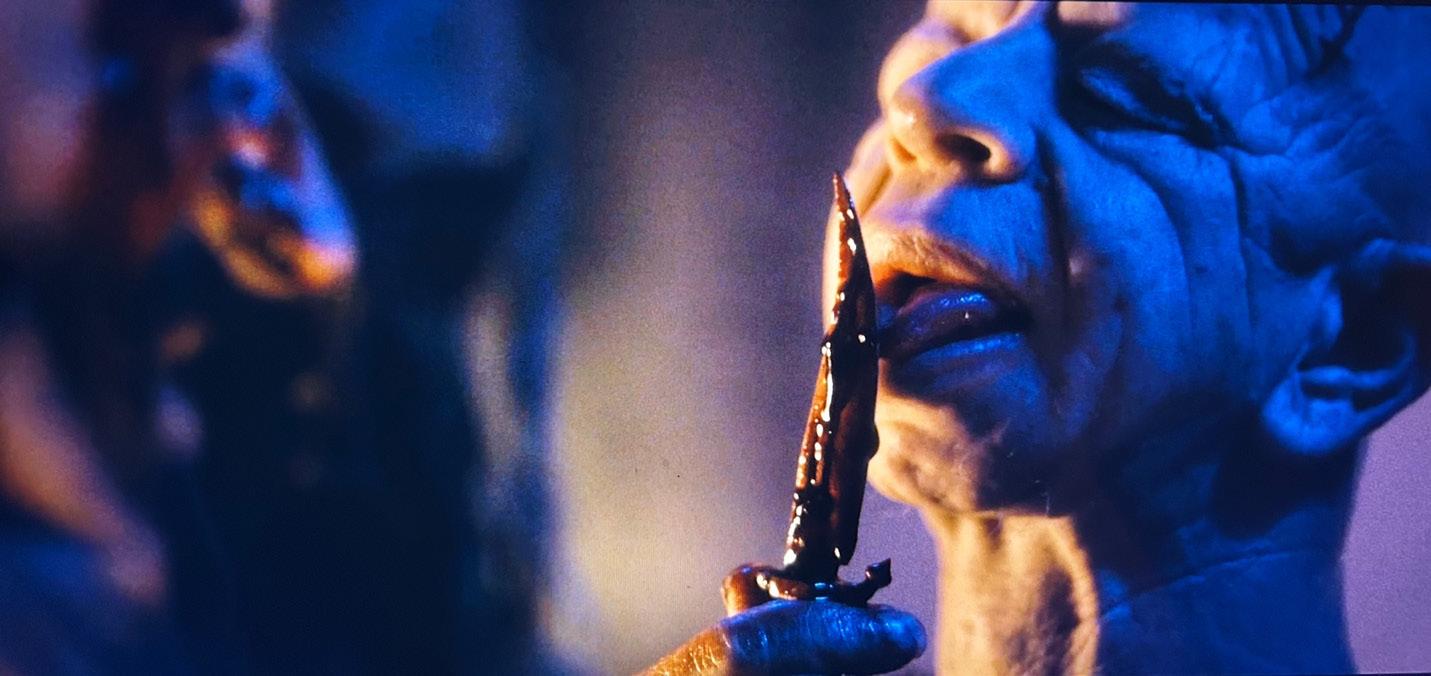
When the men ultimately find themselves chained at the mercy of cult leader Baba, the film escalates in dread and body horror in ways that destabilize identity, power dynamics, and masculinity. Baba (meaning father in Turkish) positions himself as a spiritual leader, as a shepherd offering insight to the world beyond the worship of power while instead focusing on what is beyond. He asks Yavuz for his name and Yavuz responds, “we are the goddamned law!” Yavuz’s use of the word ‘we’ indicates an attempt to situate himself as part of a select police collective with authority and state protection rather than as an individual, an attempt which Baba strikes down: “do you think your law is here?” (01:09:45-01:09: 58). As the most outspoken, vulgar, and arguably violent member of the group, it is significant that Baba singles him out. Baba claims that “the human soul is corrupt. It only worships power. It keeps searching for new things to worship” and then asks Yavuz: “Are you ready to stop worshipping power and unite with us? Give up your worldly eyes and open your eyes to what’s beyond? Open your heart to me, son” (01:10:19-01:11:16). Baba means this literally: he cuts out Yavuz’s eye with a knife and licks the blade (Fig. 14). Baba makes clear that humanity, and these police in particular, are already tainted by an illicit lust for a power that he robs from them, but despite his suggestion that not seeing physically will open Yavuz’s ‘eyes’ to the divine, it is a violent act done against his will under a new, inverted patriarchal authority that has little to do with organized religion. In one fell-swoop, Baba demonstrates how fleeting and transitory power is. The cult’s religious beliefs are in many ways ambiguous and unanchorable in a real-world context. That said, the deliberate maiming runs contrary to Islam’s central tenet to neither inflict or reciprocate bodily harm on oneself or others. It also inverts Sufism’s (a spiritual path within Islam) focus on purifying the heart. This is not to suggest that Evrenol’s film is a critique of Islam or spirituality. Indeed, its use of religious or spiritual allegory is more fluid, inviting comparisons to a spiritual journey of self-transformation, accountability, and resistance against those who would position themselves as authority figures in a spiritual context and a literal one. In this sense, Baba’s actions as well as the police’s resonate as morally untenable for secular and religious audiences. Türkiye is a secular country, but Islam is the predominant faith.
I would point out that Baba’s own overall goal, if any, is unclear, and his preaching extends to those that follow him and not to himself: All of Baba’s followers are inarticulate and thus voiceless. Most who are visible are also missing eyes or teeth; they recoil and seem to feel Yavuz’s pain as his eye is carved out. Baba himself is whole, and thus clearly not subject to his own ideology of seeing the divine by giving up worldly organs. As the police are tortured and killed, the scene centers around Baba’s
Fig. 12 | An abandoned squad car sits outside the abandoned Ottoman-era police station of Inceagac. (00:40:30. Raven Banner Entertainment, 2016).
Fig. 14 | Baba licks Yavuz’s blood from his knife after digging out Yavuz’s eye (01:12:32. Raven Banner Entertainment, 2016)
Fig. 13 | The officers descend into the bowels of the station, an allegory for their descent into hell (00:49:15. Raven Banner Entertainment, 2016)
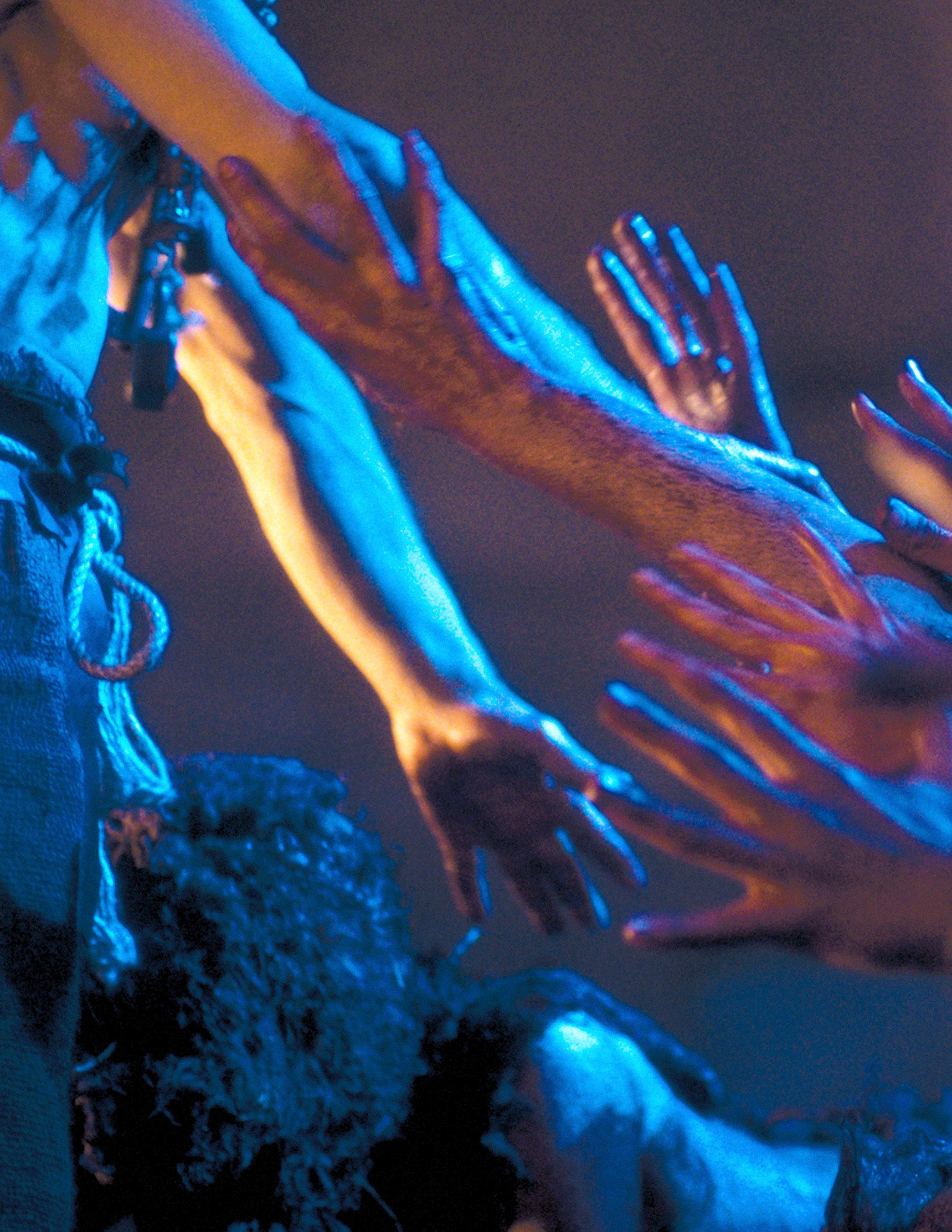
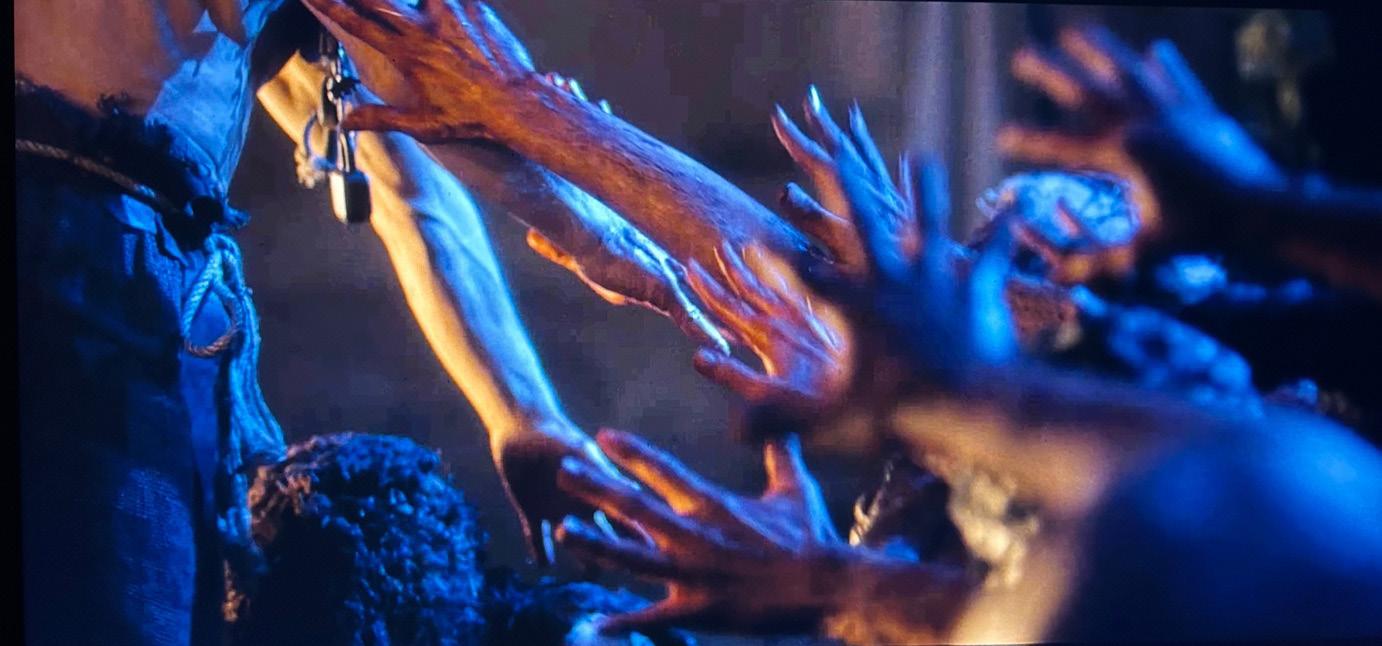
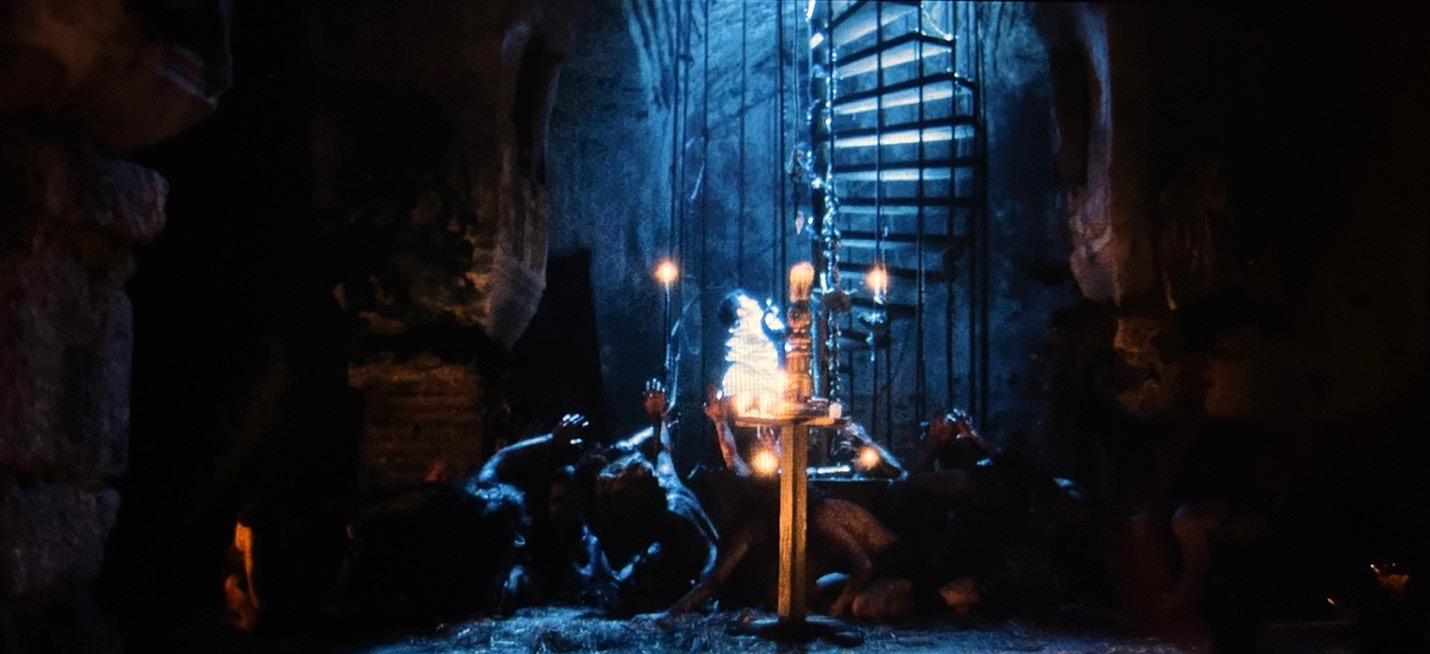
Fig. 15 | Baba’s congregation reach for him with shaking, desperate hands (01:18: 34. Raven Banner Entertainment, 2016)
The notion of inescapable fate is reiterated by the many moments that are marked by a hand—Baba’s hand—reaching for Arda in his nightmares as a child and in his dreamscapes as an adult.
monologue about fate, faith, and the right way forward, which is uninterrupted by any dissenting voice. Evrenol opines that “when there’s a monologue and some guy preaching, it’s frightening” (“Exclusive Interview”), indicative as it is of authoritarianism. This fear resonates in a cultural and political context given that to this day in Türkiye, opinion is polarized around the rule of President (former Prime Minister) Recep Tayyip Erdoğan’s AKP Party, its pivot away from secularization, and its hostility to those who critique or oppose it. Baskin condemns corrupt policing while also indirectly calling into question leaders and systems that facilitate corruption and encourage the silencing of opposing voices. Baba’s goal is supposedly a connection to the divine, but the reality is a soiled group of wretched humans who follow Baba blindly in a literal and figurative sense, who crawl and writhe over one another like the damp applause of skin on skin (Fig. 15). They are washed most frequently in blue light, an indicator of cool authority that echoes the uniform of Turkish police: navy blue with lighter blue undershirts. Here, they are subject to Baba’s authority. Their behaviour and appearance mirror that of a mass of frogs the men encounter on their way to the station, which also clamour over one another and symbolize doom. Baba’s followers are, notably, binary opposites in terms of behaviour and movement to the Turkish whirling
dervish. Instead of Sufi mystics who spin gracefully in long, white skirts to loosen the ego, open the heart, and become centered in Allah’s presence, Baba’s followers cling to earth, darkness, and pain.
This particular scene strikingly undermines Yavuz’s toxic masculinity and perceived superiority, but in ways viewers are encouraged to sit with in discomfort. The punishment is disproportionate to his deeds or his words: he is literally and forcibly damaged and penetrated by Baba’s knife. Penetrative threats, as I’ve outlined above, are Yavuz’ default in the film to assert his authority and masculinity. Here, his greatest fear is realized as he becomes the penetrated rather than the person penetrating, yet it doesn’t read as vindication for the viewer. Worse still, Baba forces him to copulate with a female follower clad only in a grass skirt and wearing an animal skull, which inexplicitly results in an almost immediate impregnation and the birth of some unspeakable offspring. There is a sense of legacy here, a perpetuated cycle of birth and death that centers around death, force, and violence, and the act of forced copulation recalls Yavuz’s earlier story of sexual prowess in the restaurant. However, here Yavuz is coded as little more than a breeding bull copulating with a woman who is similarly coded as animal. For both characters, humanity is erased, but for Yavuz, sexual agency, institutional authority, and bravado are also stripped bare. He exists now in the service of Baba’s pleasure, so to speak. As Evrenol elucidates, the more he approached the police as sexist and macho, “the more the evil they confronted became kind of sexually ambiguous and sexually deviant” (“Exclusive Interview”). Earlier in the film the men joke about the sexual deviance of using animals for sexual release, a deviance that is significant here because Yavuz and the female worshipper/prisoner are simply tools to be used to some esoteric purpose. Notably, insofar as Baskin critiques a toxic masculinity that shelters behind institutional authority, it is significant that the most overtly sexist and aggressive character is forced to cede control, identity, and self-respect. As a genre, horror has often leaned on misogynistic representations of women and a graphic assault and rendering of their bodies, and while Baskin is not free of such associations, it pointedly forces identification with male characters who are subjected to sexual or mutilating violence. Indeed, one of the first disturbing tableaus in the station features a naked, blood and dirt-streaked woman who appears to be penetrating an equally filthy man from behind while his face is forced into excrement. Insofar as the ‘evil’ here is sexually ambiguous, I would posit that it serves to emphasize many male characters as passive, rather than active agents, and that all individuals are potential victims of abusive power. As craven as Yavuz is, his suffering and death are unjustified, as is the torture and murder of the rest of his unit.
Arda is the only survivor of the encounter with Baba’s cult, but his victory is fraught as his trauma, anger, and horror loom large while shattering his sense of self and to some extent, his ideals. After disarming Baba, Arda frees himself and beats Baba to death with a stool (Fig. 16).
The moment before Arda commits this first and only violent act for survival is juxtaposed with the moment after, illustrating his triumph but also the loss of his identity. In the first medium shot, the visual weight falls on Arda’s shirt and his affiliation with
Fig. 16 | Arda straddles an incapacitated Baba (01:26:22. Raven Banner Entertainment, 2016).
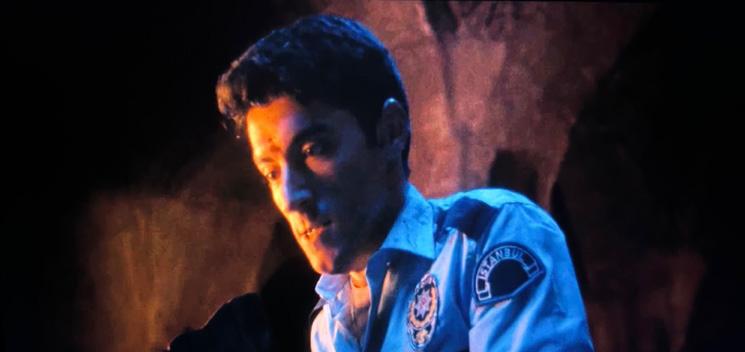
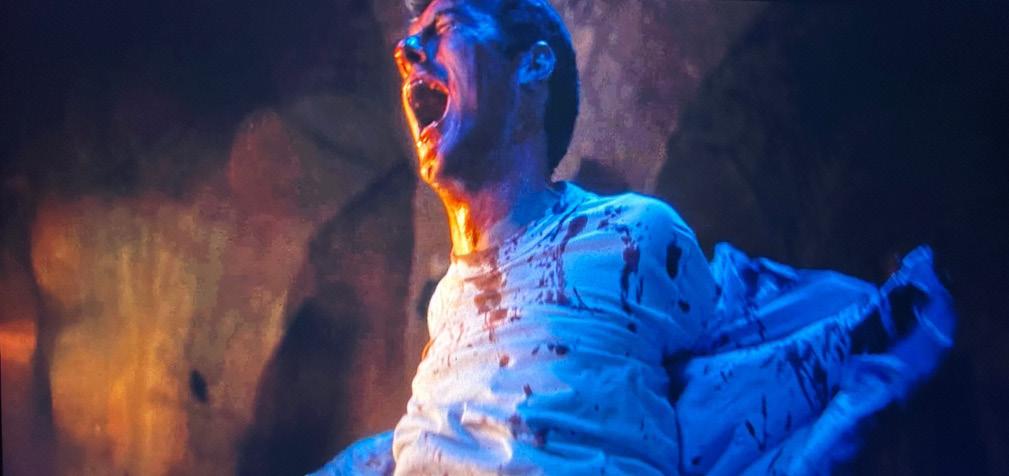
Fig. 17 | After beating Baba to death with a stool, Arda rips off his soiled and bloody police shirt (01:28:06. Raven Banner Entertainment, 2016).
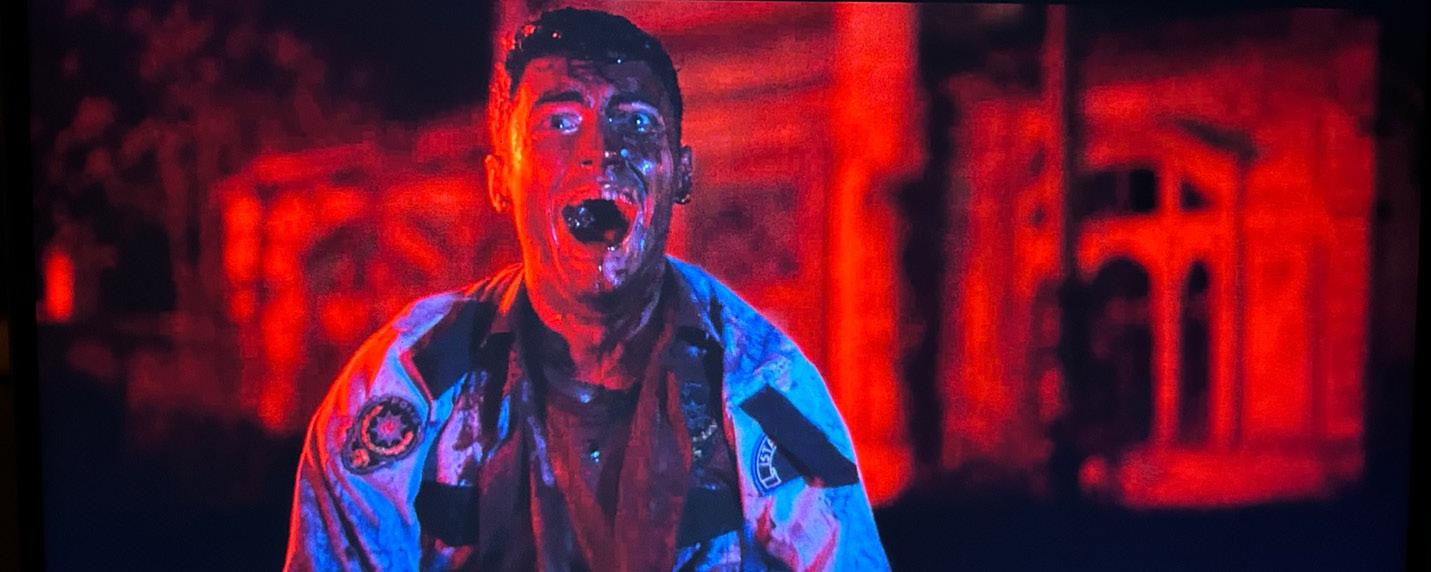
the Istanbul police force as he sits atop a stunned Baba. As Arda repeatedly smashes a stool into Baba’s head offscreen, the shot remains tight on Arda’s reaction as he is increasingly soiled with Baba’s blood. The kill is visceral, personal, and is a triumph in that it allows Arda to both get vengeance and escape. However, his freedom comes at the cost of his youthful idealism and its connections to his identity as an officer of the law. In the extremity of his loss and horror, Arda rips open his soiled shirt (Fig. 17) a tacit rejection of his vocation and the pejorative associations with it that Evrenol weaves throughout the film.
Visually, as Arda is lit from the right with blue light, this moment recalls the obvious symbolic resonance of the authority, and perhaps responsibility, of wearing police blues. Although in dream/nightmare sequences Remzi is positioned as a father figure to Arda who literally gives him the key to Baba’s undoing, it is clear that the patriarchal system that offers him guidance from Remzi, his unit, and finally Baba all end in disaster, trauma, and violence. From here, the film’s end is fraught with a central question: is escape from the systems in which we are so deeply entrenched possible?
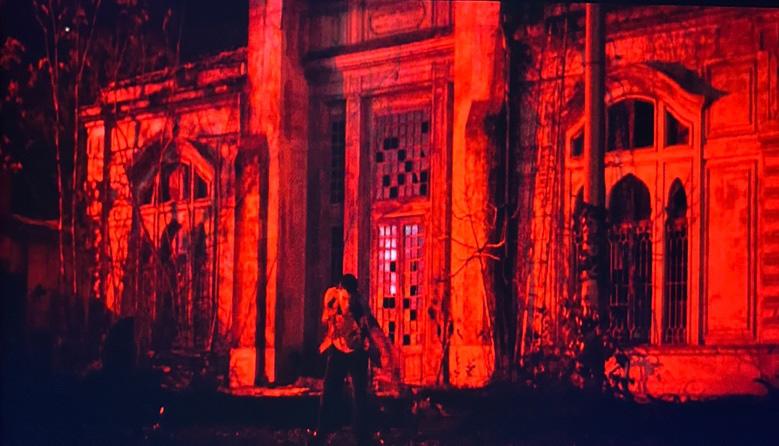
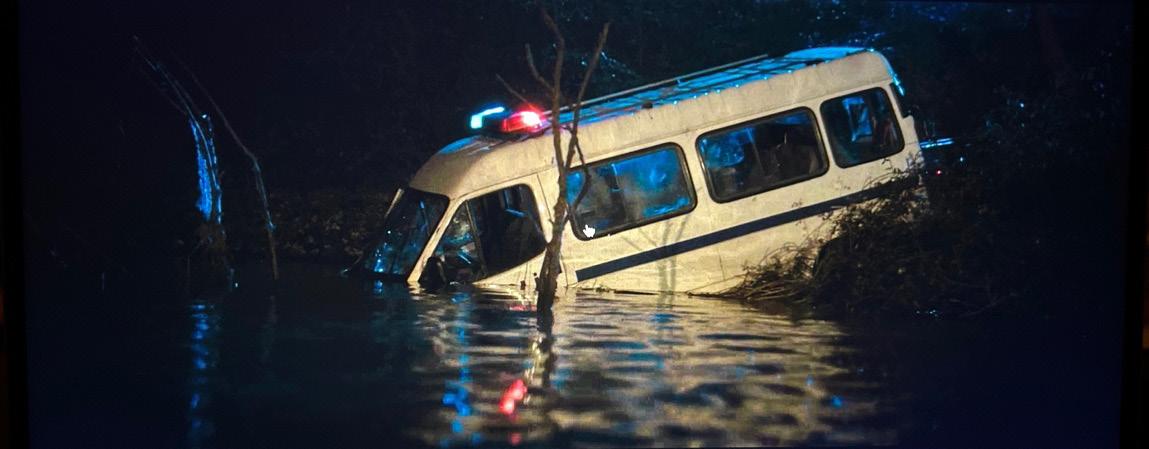
Arda’s escape from the abandoned building is coded as hopeful, yet this reading is anything but definitive. As he ascends to the surface, a wash of light shines on him from above, and although Baba’s cult members tentatively reach out to him as a new potential leader, Arda rejects the call of authority and power and thus contradicts Baba’s earlier assertion that the human soul only worships power (Fig. 18). A key light shines from above, illuminating Arda in a wash of white light that suggests his purity and goodness. Unfortunately, this impression is short lived. After all, Baba is first introduced as he descends into the cavern using the same staircase, suggesting that evil and corruption are literally and figuratively ‘top down.’ Further, rather than emerging into the light, Arda is greeted by a hellscape that is saturated in red and which amplifies the film’s nightmarish atmosphere and bloody violence (Fig. 19). A medium, shallow-focus shot of Arda laughing in shocked disbelief at his survival with the decrepit police station in the background literally foregrounds the horrific legacy of corrupted institutions that leave a mark on the people who are a part of them or who become victim to them, even if the institution itself is literally behind them: it continues to loom (Fig. 20). Arda is visibly soiled by blood; the evidence of his descent into trauma and violence is clear, marked early in his life by the death of a childhood friend, then his parents, and finally his adult colleagues, and it contradicts the wholesome connotations of policing presented in the film’s opening sequence. Shortly after this juncture, as Arda stumbles down the road and out of Inceagac, the film reveals that he is the man their police van runs down earlier in the film as it happens again and viewers witness it from Arda’s perspective. This final sequence in Baskin, in which the police van again veers off the road and into a lake before it can cross the bridge ahead, is perhaps the most contentious and ambiguous as it invites the viewer to consider if fatalistic, cyclical violence can be remedied in the film’s narrative (Fig. 21). In the final shot, the light returns to more realistic shades, suggesting an anchoring in reality. As such, it is possible to read this as a confirmation that the five men have been freed by Arda’s actions after an unknown number of hell loops; after
Fig. 18 | Arda focuses on the light above as he ascends while Baba’s body lies broken in the foreground and his followers reach to Arda to guide them (01:28:52. Raven Banner Entertainment, 2016).
Fig. 20 | Arda falls to his knees, laughing hysterically in shocked disbelief that he has escaped (1:29:53. Raven Banner Entertainment, 2016).
Fig. 21 | As the van veers into the water for the second time, it is notably empty; the men are not inside as they are in the first iteration of the hell loop (01:31:29. Raven Banner Entertainment, 2016).
Fig. 19 | The exterior of the abandoned Ottoman-era police station is drenched in red light (01:29:41. Raven Banner Entertainment, 2016).
What is striking at the end of the film is thus not the ambiguous recursiveness—or possible cessation—of the hell loop, but the relentless will to resist fear, oppression, and corruption that especially Arda embodies.
all, the men are no longer in the van as they are in the first iteration the viewer witnesses. My reading is more cynical: perhaps, and more likely, the shot is temporally positioned in the timeloop after the men have already reached the abandoned Ottoman police station to start the hell-loop anew. Shot with a handheld camera, the effect is a destabilization of the reality suggested by subdued ambers, blues, and reds. Further, it mirrors the earlier 180-degree camera roll shot in terms of a color palette misleadingly reminiscent of reality.
While it is tempting to read the final shot of the empty van as evidence of escape, the overarching impression is more cynical and is afforded considerable weight via esoteric (at least to a non-Muslim audience) Islamic symbolism: the van still fails to cross the bridge (perhaps the Sirat Bridge), and a smiling photo of the 5 officers previously seen secured above the rearview mirror floats desolately on the surface of the grimy water in the front of the van; the happy moment is a moment lost, frozen, perhaps dead. Together, these elements are suggestive of a renewed descent into hell. Further, earlier Baba tells four of the five police officers, who are literally in chains and thus captives of fate, that hell is not a place you go; it is a state that is carried inside. The innate corruption suggests that until they individually do the transformative work, they are doomed to veer off course and into hell again and again. When he asserts that “the human soul is corrupt. It only worships power” (01:10:19), in essence, Baba warns that a hunger for power is recursive and
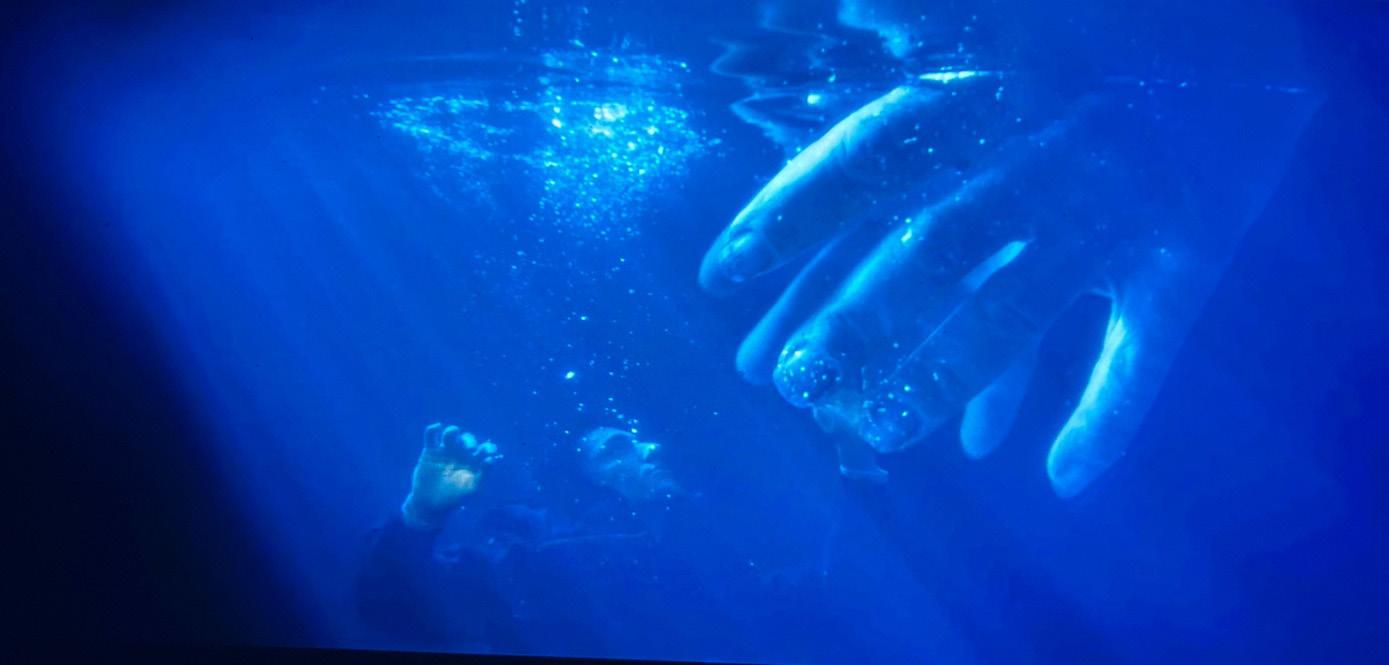
inescapable. Nevertheless, as stated above, the film resists a clean ending in this regard that leaves space for viewer interpretation. The idea of inescapable fate is deployed to ambiguous ends in Baskin. At the restaurant, a hooded figure that viewers later come to understand is Baba delivers a bucket of meat and spectrally looms behind Seyfi in the restaurant bathroom mirror: his presence haunts the edges of reality and dreaming. Given the context of human butchering that takes place at the Ottoman station, the cooking of this meat on the grill takes on incrementally ominous connotations as it suggests the consumption, literally and figuratively, of bodies and perhaps souls. The notion of inescapable fate is reiterated by the many moments that are marked by a hand—Baba’s hand—reaching for Arda in his nightmares as a child and in his dreamscapes as an adult. Even after Arda escapes the lair of the cult, his ascension is interrupted by a close-up shot of Baba’s bloody hand, shakily reaching for him despite the fact that Arda killed Baba. Baskin suggests that corruption, intimidation, and fear must be confronted again and again, as part of the human spirit and in general. While most of the reaching-hand imagery throughout this film is bloody and threatening, the sequence following the van’s first plunge into the lake is a dream sequence in which Arda finds himself drowning in deep water until a giant, surreal hand reaches to save him (Fig. 22).
The blue hues here seem to suggest divine intervention, especially with a diffuse key-light illuminating the scene from above, but the hand in question still belongs to Baba and is both ambiguous and ominous. The authoritative power that offers ‘a hand up’ may not be benign. Arda is named after his father dreams his name, suggesting predetermination. Interestingly, Arda means light, warmth, or a divine figure (“Variations and Nicknames”). When the viewer meets Arda, he is understood in the context of his childhood books, toys, and heroes, putting him in the best possible position to save himself and possibly
Fig. 22 | After the police van veers into a lake, Arda’s dream sequence ends after he is rescued from the water by a huge, god-like hand (00:35:12. Raven Banner Entertainment, 2016).
the others, or to break the cycle. It is worth pointing out that the dream/nightmare sequences are complex and nuanced in this film, but a thorough examination of them is beyond the scope of this article. I suggest that the power of this film is not in determining whether the ending solidifies a case for escape or endless entrapment, but rather in the indominable spirit of resistance in the face of control, intimidation, and oppression.
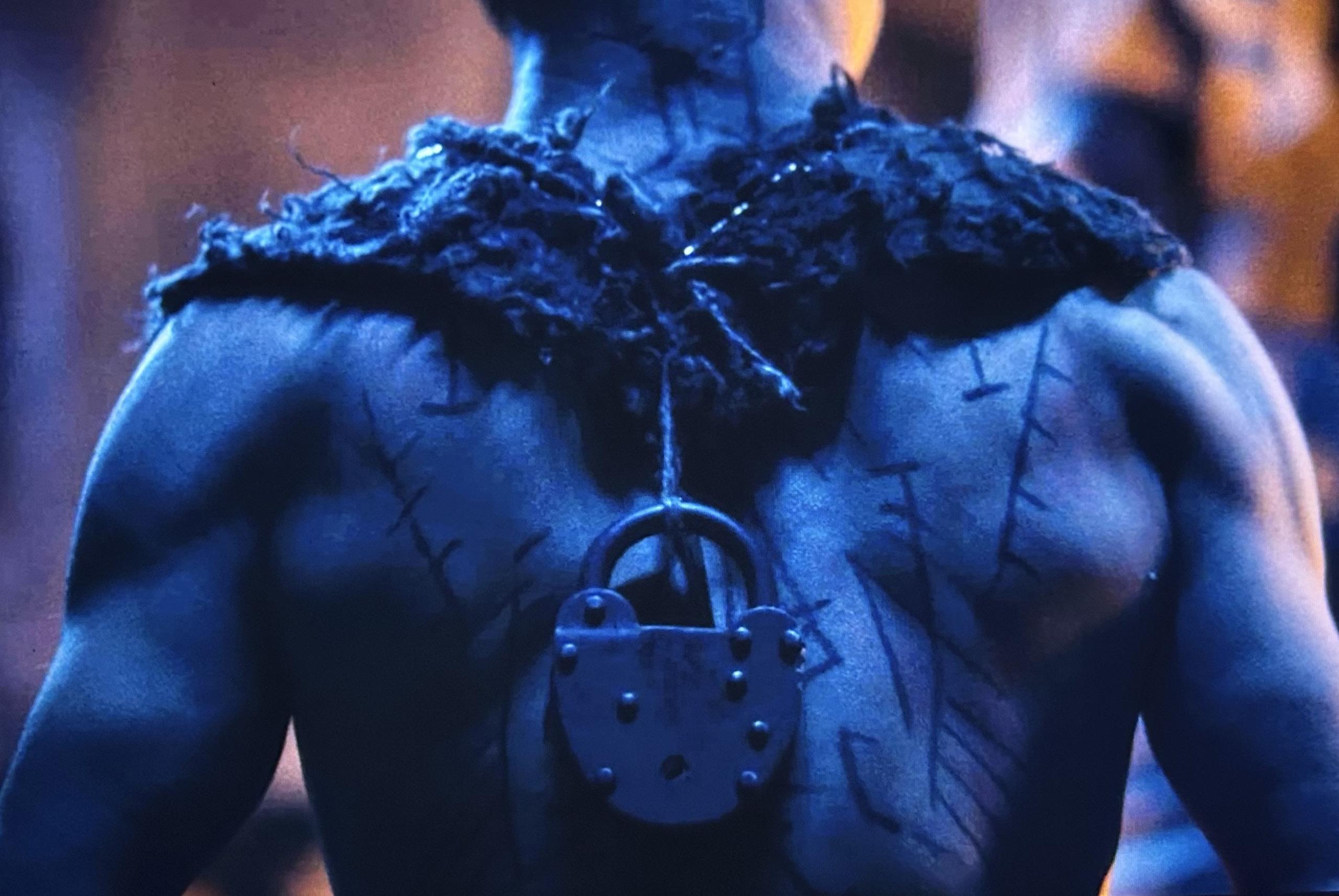
Yavuz notably resists Baba’s imperative to ‘open his heart’ and while his body may be used to some evil purpose against his will, his will resists until the end. Similarly, although Baba slits Remzi’s throat, an act that robs him not just of life but symbolically of voice as well, Remzi is able to speak to Arda in a final dream sequence, during which a literal ‘key’ to defeating Baba is now accessible inside Remzi’s torn throat. It is significant that Baba is covered in chains and locks, and when Arda somehow transposes the dream key into his current reality to attack Baba with it, Baba is disarmed. What is striking at the end of the film is thus not the ambiguous recursiveness—or possible cessation—of the hell loop, but the relentless will to resist fear, oppression, and corruption that especially Arda embodies.
The ‘key’ to this resistance is associated with having, and using, one’s voice in times of political, social, and personal upheaval. Again, it is taken directly from Remzi’s ‘voice box.’ An open denouement forces viewers to sit with discomfort and uncertainty; it prevents the comforting closure provided by clear endings in which struggle is resolved. The beauty and horror here rests in a liminal space of discomfort that invites viewers to reflect on notions of agency and resistance in the face of corrupt cycles, but it is, for all its horror, a position of hope. As Bikiç observes, cinema has “the potential to reshape social life” and to confront and process the real pain, memories, and experience that delineate social memory (480). The film’s ambiguous ending also suggests to viewers that they have a choice in terms of what they see, what it means, and perhaps, what can be done differently. P
Many thanks to Bilkent University and to the Department of American Culture and Literature for hosting me and facilitating my research on Turkish horror film.
Arat, Yeşim. “Violence, Resistance, and Gezi Park.” International Journal of Middle East Studies, vol. 45, no. 4, 2013, pp. 807-809, https://www.jstor.org/stable/43304018
Baskin Short Film (2013). Directed by Can Evrenol and Ogulcan Eren Akay, performances by Muharrem Bayrak, Görkem Kasal, and Remzi Pamukcu, Vimeo, 2013, https://vimeo. com/75031229#
Baskin. Directed by Can Evrenol, performances by Muharrem Bayrak, Görkem Kasal, and Ergun Kuyucu, Raven Banner Entertainment, 2016.
“Baskin Interview with Director Can Evrenol and ‘The Father’ Mehmet Cerrahoglu.” YouTube, uploaded by Without Your Head Horror Interviews, 10 Jul. 2016, https://www.youtube. com/watch?v=HJkDwu4XJ-4
Bikiç, Nagihan Çakar. “The Effects of the Use of Time and Space in the Context of Memory Studies on the Narrative Structure of Turkish Horror Cinema.” Selçuk İletişim Dergesi, vol. 13, no.2, 2020, pp. 471-500.
Çakırlar, Cüneyt. “Djinns as Transformative Otherness: Forms of Toxic Kinship in Postmillenial Turkish Horror Film.” Transnational Horror: Folklore, Genre, and Cultural Politics, Liverpool UP, 2025, pp. 171-196.
“Crossing the Bridge of Siraat”. Islamic Insights, https://www. islamicinsights.com/religion/crossing-the-bridge-of-siraat. html?utm_source=copilot.com
Gingold, Michael. “Exclusive Interview: Director Can Evrenol Talks Housewife, Bad Religion, and Almost Casting a Porn Star.” Rue Morgue, 5 Oct. 2018, https://rue-morgue.com/ exclusive-interview-director-can-evrenol-talks-housewifebad-religion-and-almost-casting-a-porn-star/
Özkaracalar, Kaya. “Horror Films in Turkish Cinema: To Use or Not to Use Local Cultural Motifs, That is Not the Question.” European Nightmares: Horror Cinema in Europe Ince 1945, edited by Patricia Allmer et al., Columbia UP, pp. 249-260.
Sahinturk, Zeynep. “Djinn in the Machine: Technology and Islam in Turkish Horror Film.” Digital Nightmares: Haunted Technologies, Network Panic and the Found Footage Phenomenon, edited by Blake, Linnie, and Xavier Aldana Reyes, I.B. Tauris, 2015, pp. 95-106.
Serarslan, Meral et al. “Sin, Punishment, and Woman in Turkish Horror Films.” International Journal of Arts and Sciences, vol. 4, no. 4, 2011, pp.175-186.
Smith, Iain Robert. “Hollywood and the Popular Cinema of Turkey.” The Hollywood Meme: Transnational Adaptations in World Cinema, Edinburgh UP, 2017, pp. 34-74.
Suner, Asuman. “Horror of a Different Kind: Dissonant Voices of the New Turkish Cinema.” Screen, vol. 45, no. 4, 2004, pp. 305-323, https://doi.org/10.1093/screen/45.4.305
“Turkey Accused of Gross Human Rights Violations in Gezi Park Protests.” Amnesty International, 2 Oct. 2013, https:// www.amnesty.org/en/latest/press-release/2013/10/turkeyaccused-gross-human-rights-violations-gezi-park-protests/ “Variations and Nicknames of Arda.” Momcozy, https://momcozy. com/en-ca/blogs/baby-names/arda
Wood, Robin. “Chapter Five. The American Nightmare: Horror in the 70s”. Horror: The Film Reader, edited by Mark Jancovitch, Routledge, 2002, EBSCOhost, research. ebsco.com/linkprocessor/plink?id=ae5b411c-2a813d4d-beda-201d1d7f1520. WORKS CITED
Immersion, Intimacy, and Isolation
Subversion of Space in Sorry to Bother You (2018)
BY JUSTIN GONATAS Youngstown State University
ABSTRACT
Sorry to Bother You (2018) emerged among a rising trend of Afrosurrealism in American film and television. Through frames within frames and character proxemics, director Boots Riley transports the viewer into the surreal reality of Cassius Green (Lakeith Stanfield) to critique the Afrosurreal capitalism found in the film. Sorry to Bother You follows Cassius’ rise through the ranks of RegalView, a telemarketing agency that essentially sells slave labor. To become a power caller, Cassius adopts a white voice so that his white customers will feel more comfortable with him. In turn, the more confident Cassius becomes in his white voice, the more intimate he allows himself to become with the call recipient, as illustrated by the characters' on-screen proximity. Coincidentally, the immersion into the call and intimacy with the white customer create trouble for Cassius at home, as he increasingly isolates himself from his class-conscious girlfriend, Detroit (Tessa Thompson).
Sorry to Bother You (2018) emerged among a rising trend of Afrosurrealist film and television in the mid-to-late 2010s. Compared to surrealism, which distorts reality through absurdity, Afrosurrealism presents a “realism so real” that it “forces a total reorientation to self and society,” shifting our “understanding of the republic” (Francis 101). Afrosurrealism features “magical” or “hallucinatory” details, but maintains a heightened sense of reality in political, cultural, and racial contexts (Francis 104). In essence, Afrosurrealism signifies the creation of a reality that is evocative of our own. It works as a looking glass, pinpointing details to illustrate the horrors of the American experience.
The film follows the rise of a young Black telemarketer, Cassius Green (Lakeith Stanfield), who adopts a “white voice” to succeed at his job. Cassius elevates from telemarketer to
“Power Caller” as his former coworkers attempt to unionize. He rises among the best of RegalView’s power callers after landing a sale for WorryFree, a company that sells modern-day slave labor and houses employees in lavishly decorated prisons. Later, the company’s CEO, Steven Lift (Armie Hammer), explains his development of Equisapians—a human-horse hybrid and the future of labor—hoping Cassius will join the project as the “Martin Luther King” of the new people. Amidst it all, director Boots Riley subverts the space on screen to make viewers active participants, transporting them into Cassius’ point of view.
Mise-en-scène is directly used to create cinematic reality. Gibbs notes that mise-en-scène “encompasses both what the audience can see, and the way in which we are invited to see it” (5). Similarly, Tarkovsky finds, “The image is an impression of
the truth, a glimpse of the truth permitted to us in our blindness” (106). The filmmaker uses mise-en-scène to make Cassius’ subjective experience the film’s objective reality. Through frames within frames and character proxemics, Sorry to Bother You depicts capitalism as a system that breaks down private space, turns intimacy into exploitation, and ultimately treats bodies as tools for profit, namely through WorryFree and the Equisapian project. Riley transports viewers into Cassius’ rise and fall, showing how comfort, status, and proximity to power alienate him from his community and make him increasingly complicit in the system that exploits him and others. In the film, viewers become active participants, highlighting their own complicity in capitalist societies.
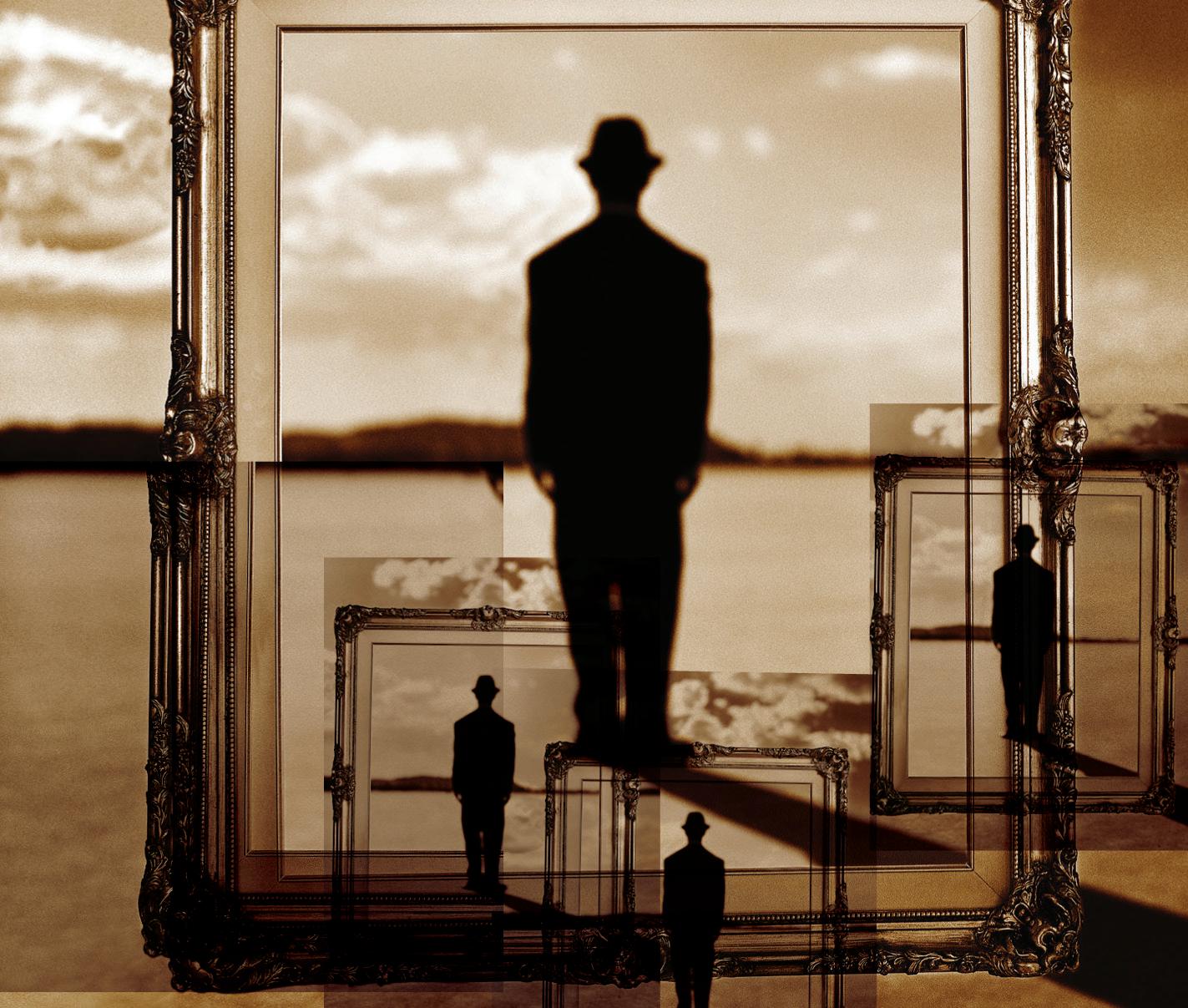
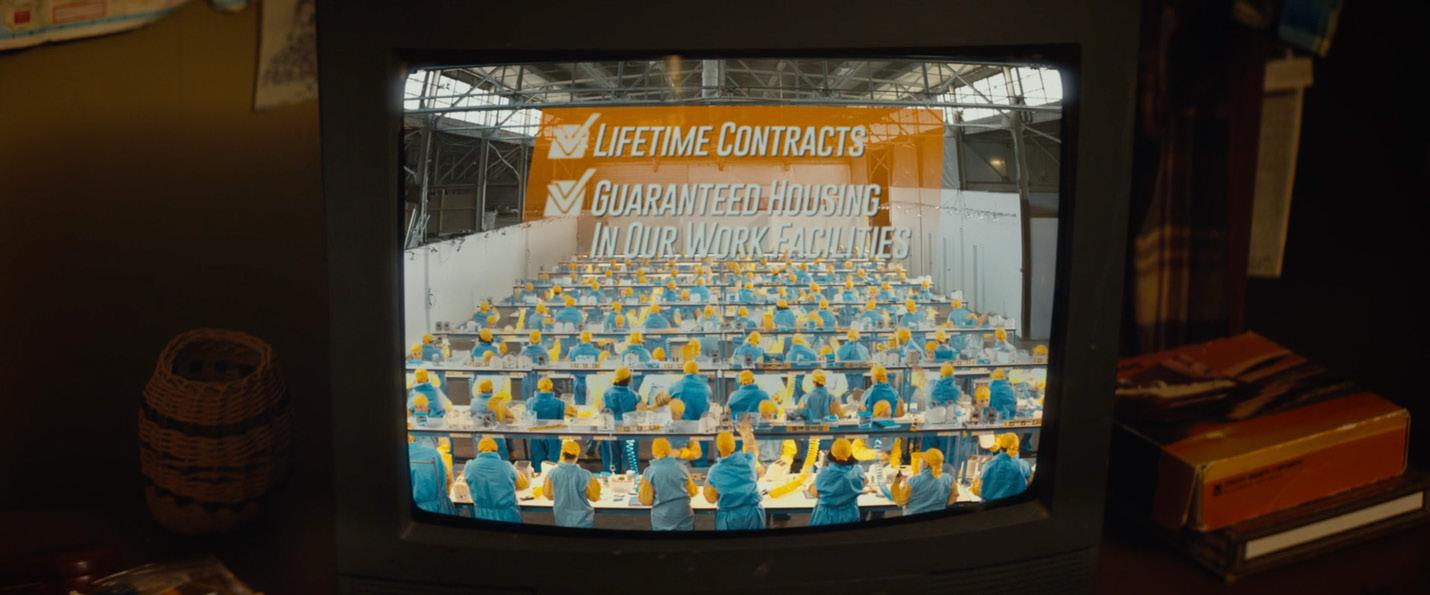
On a first viewing of Sorry to Bother You, viewers might be most stricken by the hauntingly white-sounding David Cross and the comedic dubbing evocative of Spaghetti Westerns. However, the deeper the viewer dives into the film, the more they come to understand immersion as the tool shaping Riley’s cinematic reality. From televisions to billboards to cell phones, Riley explicitly places the primary focus within the secondary. Rather than letting news coverage or billboards fill the entire screen, Riley utilizes frames within frames to transport viewers directly into Cassius’ point of view (Fig. 1).
To illustrate the transactional nature of Cassius’ existence, Riley physically places Cassius within the world of the phone call. The more Cassius masters his white voice, the shorter the distance between him and the call recipient, illustrating his rise to power caller. The callee becomes more comfortable with Cassius because he sounds whiter than they do; as Langston (Danny Glover) notes, “It’s not really even a white voice;” it is what white callees “Wish they sounded like…. What they think they’re supposed to sound like” (00:14:42-00:14:52). Cassius sounds whiter and more worry-free than the person on the other end of the line, enabling both the recipient and himself to be more comfortable with the closeness.
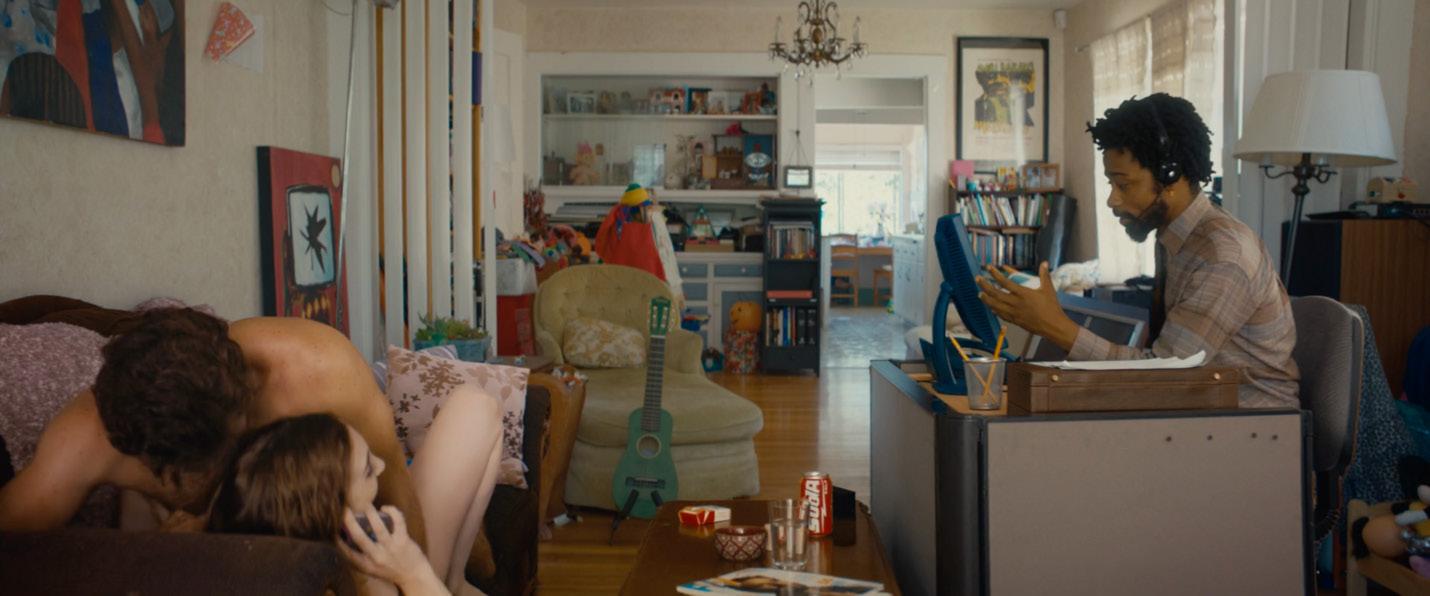
In his first call, before mastering his voice, Cassius is uncomfortable with the intimacy (Fig. 2). On the couch, the callee is
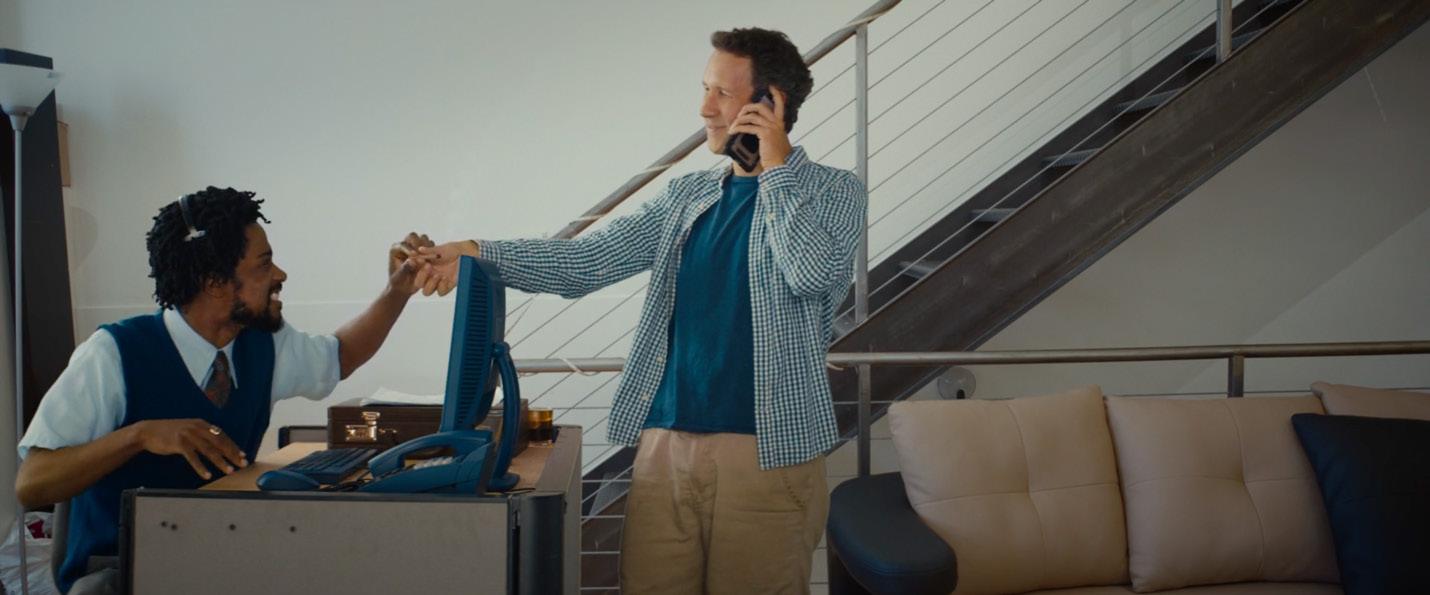
having sex. Cassius is positioned on the right side of the screen, immersed in the world of the call recipient, yet isolated, uncomfortably looking away from the sexual deed. Several scenes later, Cassius has mastered his voice. He shares a blunt with a white recipient, highlighting that he is now confident with the recipient and the transaction, though not fully connected (Fig. 3). Accordingly, as he becomes a power caller, Cassius becomes linked to the callee. In the transaction of his final call, Cassius sits touching the recipient (Fig. 4). Their legs are intertwined, and their faces touch as the recipient sits on a toilet. A master of his white voice and of the capitalist society that prioritizes it, Cassius breaks down private space in the world of the call, exploiting the call recipient as the capitalist system exploits him.
Fig. 2 | Cassius is isolated from the intimacy of the phone call before finding his white voice in Sorry to Bother You, 00:10:33. Annapurna Pictures, 2018.
Fig. 3 | Cassius and a recipient share a blunt as he finds his white voice in Sorry to Bother You, 00:25:00. Annapurna Pictures, 2018.
Fig. 1 | Commercials show the benefits of being a WorryFree employee in Sorry to Bother You, 00:06:02, Annapurna Pictures, 2018.
To rise to the top, Cassius sticks to the script. He climbs the corporate ladder and becomes increasingly intimate with his recipients. In doing so, he becomes increasingly isolated from his friends and his class-conscious girlfriend, Detroit (Tessa Thompson). In the montage, Cassius’ room transforms from lacking to splendor, juxtaposed against the growing distance between Cassius and Detroit. The white voice that makes Cassius valuable to his employer creates a rift with his loved ones; his proximity to power excludes him from his community.
Through a series of transitions from beat-up to brand-new, Cassius’ former life is replaced. He becomes engrossed in new, more costly goods. While the transformation of goods is visually striking, the most meaningful elements in this sequence are the couple’s proximity and the direction they face. Initially, the couple is placed closely, facing each other in profile and kissing (Fig. 5). A dissolve signals a change in time. Among Cassius’
new wealth, they no longer face one another, nor are they touching (Fig. 6). Still in profile, they face opposite directions, a rift between them. Detroit no longer wants to be with Cassius because she no longer thinks he is with the cause. Like commodification, Detroit and Cassius continue to use each other for sexual transactions, but his money disgusts her too much to be in a relationship. Eventually, they reunite, but only after Cassius acknowledges his role in the trap of material success and exposes Lift’s plan for the Equisapian project across national television. Cassius gives up his high-rise apartment and intends to return as a regular telemarketer, but he turns into an Equisapian before that happens.
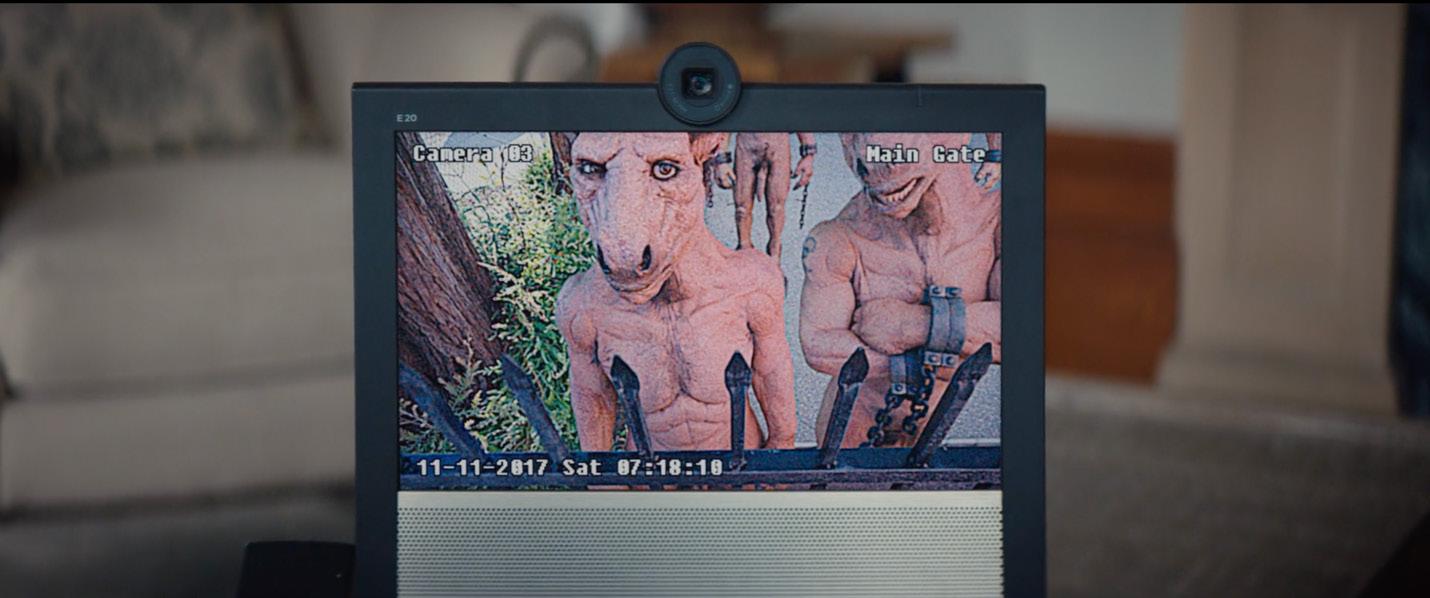
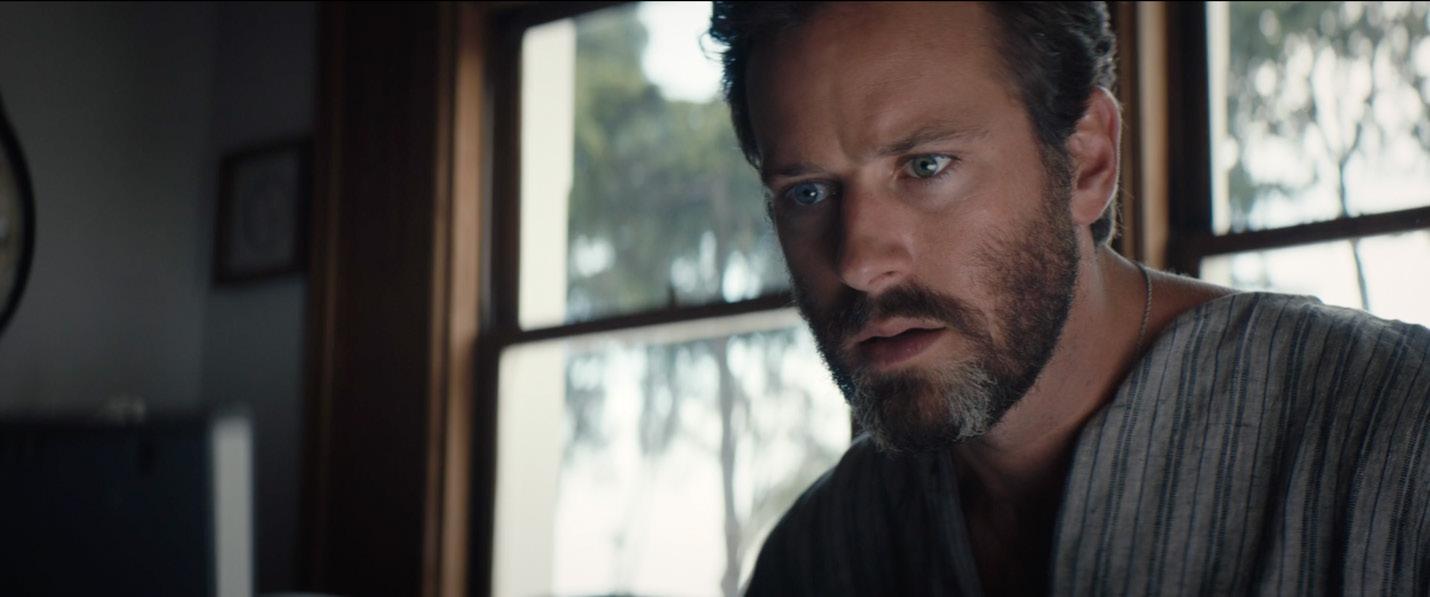
In an end-credits scene, Riley breaks from identifying frames within frames with Cassius’ point of view. From Lift’s point of view, Riley stages images of Cassius as Equisapian and of Lift’s reaction in succession, as if to say, “Now it’s your turn” (Figs. 7 and 8). With nothing else to lose, Cassius confronts the
Fig. 5 | Cassius and Detroit kiss before waking up in the new apartment in Sorry to Bother You, 00:52:07. Annapurna Pictures, 2018.
Fig. 6 | Cassius and Detroit sleeping in the new apartment in Sorry to Bother You, 00:52:11. Annapurna Pictures, 2018.
surreal truth that, for the capitalist system to survive, he will be taken advantage of by any means necessary. Cassius has lost everything. Now he will make sure that Lift loses everything, too. The end-credits scene immerses viewers in Lift’s perspective, illustrating that everyone in capitalist societies is complicit, from the top down. Sorry to Bother You satirizes American society, and, like all good satire, it is incredibly perceptive. Steven Lift is likened to a handful of trisyllabic-named billionaires with their teeth sunk into American culture, capital, and politics. The film was released two years into the presidency of one of them. It is unlikely that Riley’s film is an overt critique of President Donald Trump; however, it is clearly critical of the trap and exploitation of an economic system that led to his rise to fame. Sorry to Bother You argues that we are all complicit in capitalist societies, but, in an attempt to shift our understanding of the republic, it asserts that those at the top are far more complicit than those at the bottom. P
WORKS CITED
Francis, Terri. “Introduction: The No-Theory Chant of Afrosurrealism.” Black Camera , vol. 5, no. 1, 2013, pp. 95–111. JSTOR, https://doi.org/10.2979/blackcamera.5.1.95. Accessed 3 Mar. 2025.
Gibbs, John. Mise-en-Scène: Film Style and Interpretation . Wallflower P, 2002.
Sorry to Bother You. Directed by Boots Riley, Annapurna Pictures, 2018.
Tarkovsky, Andrey. Sculpting in Time. Translated by Kitty HunterBlair, U of Texas P, 1986.
Fig. 7 | Security footage shows Cassius and his group of Equisapians in an end-credits scene in Sorry to Bother You, 01:45:33. Annapurna Pictures, 2018.
Fig. 8 | Lift’s reaction to Cassius in the security footage in Sorry to Bother You, 01:45:35. Annapurna Pictures, 2018.
Inside the Frame
Ali Asgari on Divine Comedy and Filmmaking in Iran
BY ALI AKARCESME Kutztown University
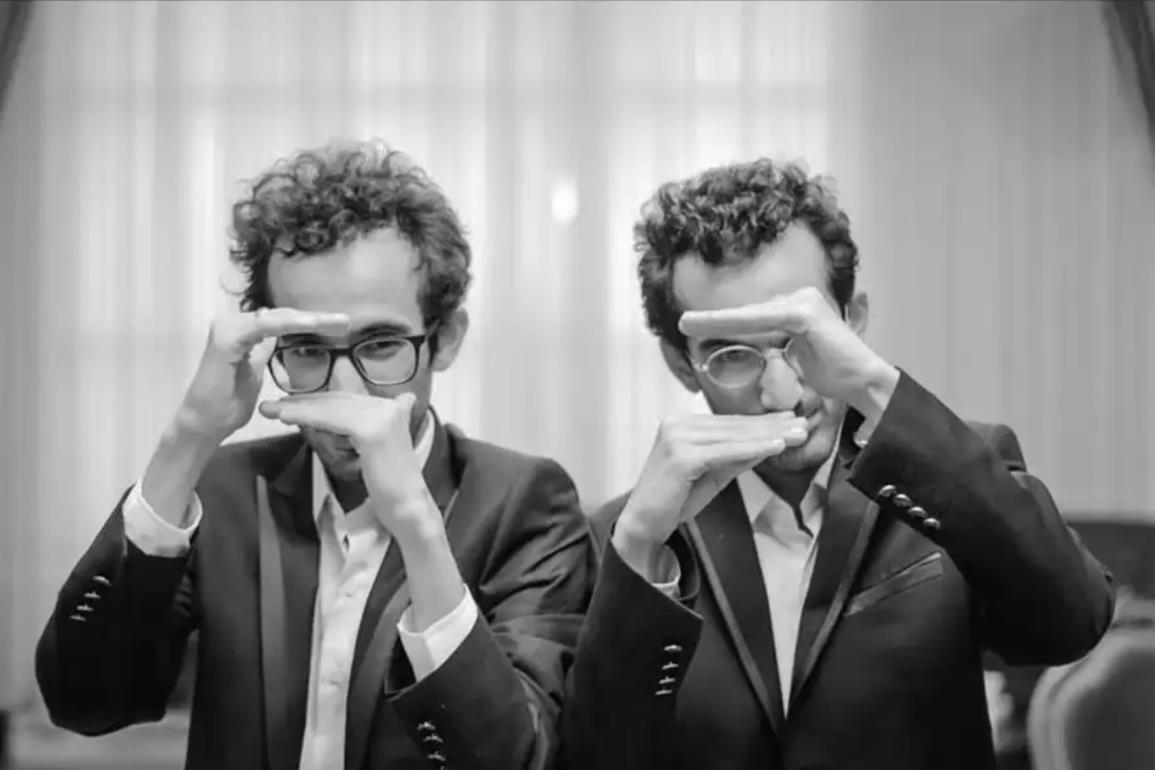
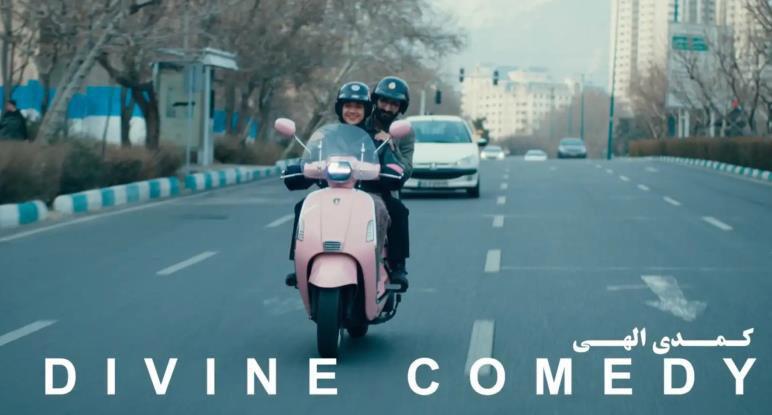
Director Ali Asgari lives and works in Tehran, where he has built a reputation for sharp, understated films that expose the quiet absurdities of life under Iran’s cultural bureaucracy. His 2023 feature Terrestrial Verses, co-directed with Alireza Khatami, premiered in Un Certain Regard at Cannes and later found an audience through informal community screenings inside Iran. His new film, Divine Comedy (2025), follows a fictional director named Bahram who smuggles his banned movie into private homes. The film, so far, debuted at Venice, took the Special Jury Prize and Critics’ Prize at Antalya, and has since traveled to Hamburg, Tallinn, Marrakesh, Doha, Frijorn, and AFI Los Angeles.
Iranian cinema has long turned restriction into resource. In October 2025, Martin Scorsese told Iranian filmmaker Jafar Panahi at the New York Film Festival that post-war Italian neorealism and contemporary Iranian films share a common mission: To restore humanity after ideological collapse. Scorsese urged streamers to make these works “available everywhere—especially in the U.S. and Canada” (Scorsese and Panahi).
I spoke with Asgari over a crackling video line from New York to Tehran. What follows is a condensed, technical Q&A drawn from that hour-long conversation.
AKARCESME: How did the concept for Divine Comedy first emerge, and what led you to revisit Dante’s vision at this moment?
ASGARI: The title isn’t decoration. Dante gave me a way to think about thresholds—doors, counters, corridors—and a person moving through them toward a fragile kind of light. I’m not recreating the poem; I’m letting its structure sit under a very ordinary story. You watch a man pass from one circle to another, judged at each stop, and you start to feel the weight on his shoulders.
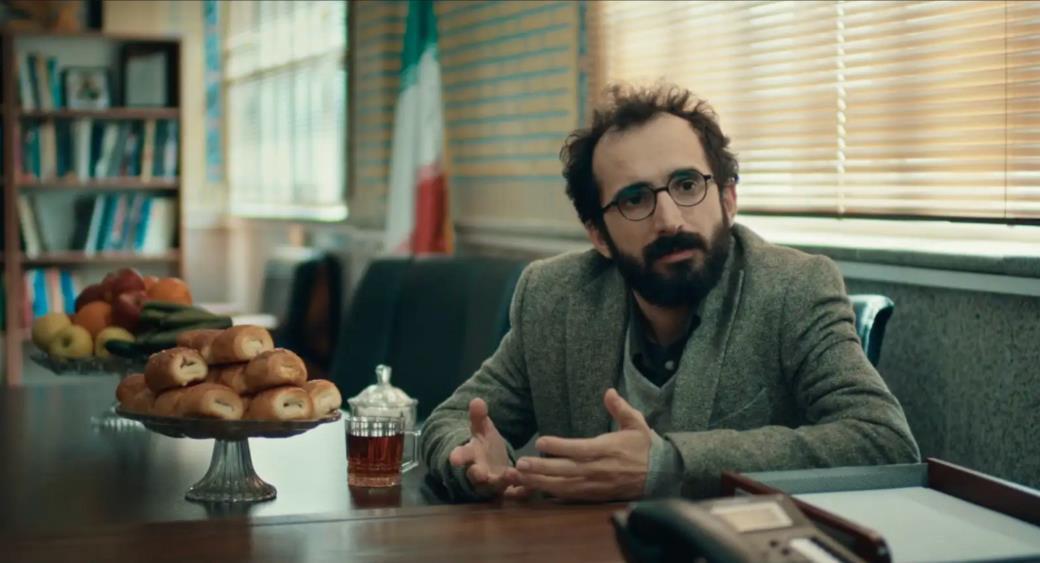
AKARCESME: Let’s talk about two specific shots. First, the table scene: Bahman sits opposite a government representative, but the official never appears on screen. Why keep the voice off-camera?
ASGARI: I never show the official’s face. The system is the monster, not one man. The sweets and flag are polite theater; the voice from nowhere is the real power. I wanted the audience to feel the same claustrophobia Bahram feels—trapped by invisible rules.
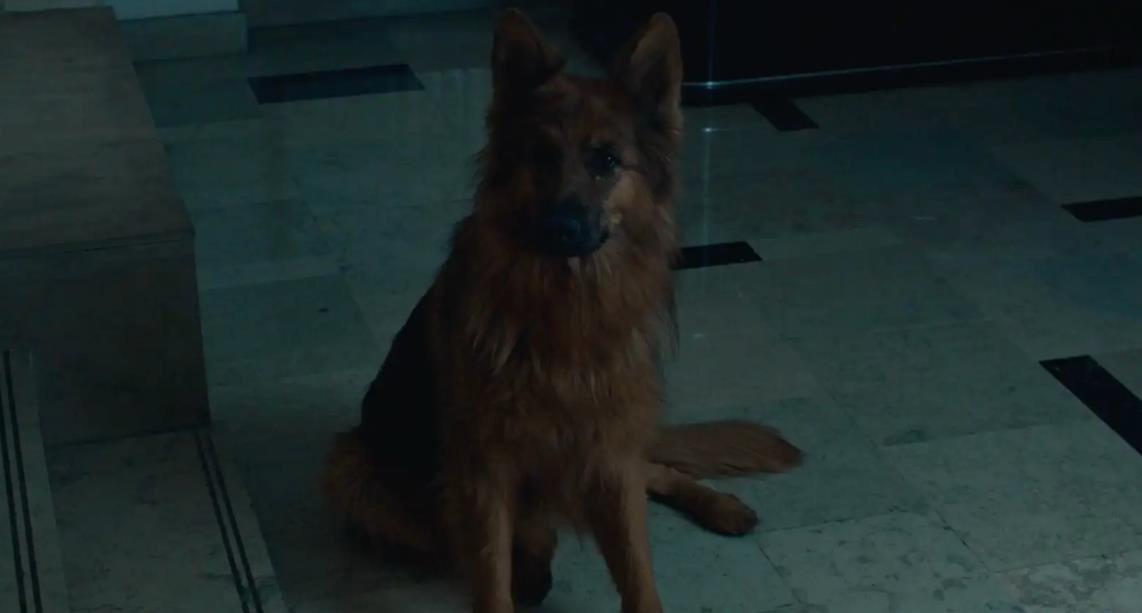
AKARCESME: Second, the dog: Shila. The image is striking, and the symbolism is rich. The film ends with Sheila staring into the lens. How did Shila enter the film?
ASGARI: Dogs are “impure” in official ideology. If a script mentions a dog inside a home, the Ministry demands cuts. Sheila opens the film by barking at the projection and closes it by staring at us, judging the human stupidity. She’s my Cerberus, my she-wolf from Dante’s hell, guarding the gate of absurdity.
AKARCESME: How does working inside Iran shape authenticity, cultural responsibility, and audience connection?
ASGARI: Authenticity comes from proximity—to the streets, the accents, the way people touch a cup or lower their voice. That proximity creates responsibility. You can’t exoticize the people you live among. Practically, shooting inside Iran keeps me honest: Fewer tricks, more attention to faces and rooms. And in recent years many of us decided to change how we work. Oddly,
Fig. 1 | In conversation with filmmaker Ali Asgari via Zoom.
the films became more connected to daily life when we stopped designing them to satisfy forms.
AKARCESME: Do you use allegory, symbolism, or metaphor to address sensitive issues? How effective are these techniques?
ASGARI: They are trying to… to cancel this animal. And it’s a little bit like a metaphor, and it isn’t camouflage for me; it’s precision
at another frequency. A closed door, a voice from outside the frame, a dog waiting at the edge of a room—these are concrete things that carry ethical weight. If you respect the reality, the symbolism comes naturally and audiences feel trusted rather than lectured.
AKARCESME: Your film often carries a realist—at times almost documentary—quality, especially in the still-image sequence
Fig. 3 | Shila in the entryway from Divine Comedy (00:42:10). Salt For Sugar Films, 2025.
Fig. 2 | Bahman vs. the off‑screen official at the table from Divine Comedy (00:55:20). Salt For Sugar Films, 2025.
featuring the twins, Bahram and Bahman. That section really captivated me. What creates that distinctive sense of realism?
ASGARI: We earn it in blocking and sound. I like longish takes that allow behavior to build. The camera respects the geometry of a real room; the mics pick up edges fiction usually polishes away. Rehearsals give the actors freedom to surprise me without breaking the scene. With the twins, I leaned into mirroring gestures—two bodies calibrating the same space, as if the frame itself was testing reality.
AKARCESME: There’s a wonderful looseness to these scenes, especially in how the twins keep returning to The Matrix (Dirs. Lana and Lilly Wachowski 1999). It made me wonder—was improvisation a major part of your process?
ASGARI: We rehearsed for weeks in their apartment. I recorded their real conversations, then built dialogue from those tapes. On set we shot fast—ten days—but the rhythm came from months of listening.
AKARCESME: Speaking of The Matrix, I’m curious what films or filmmakers have inspired or influenced you?
ASGARI: I started with the American classics—Huston, Hitchcock, Ford. Then Scorsese, Woody Allen. Later the Dardennes, Haneke, Angelopoulos. Now slow cinema: Weerasethakul, Tsai Ming-liang. But if I name one film that changed me, it’s Fellini’s 8½ (1963)—it shows a filmmaker lost in his own imagination, trying to finish a movie that may never exist.
Also, I learn from American rigor with point of view and rhythm, from Italian Neorealism’s attention to ordinary bodies, and from Iranian poetry. The Matrix came up because twins and mirrors invite viewers to test reality’s seams. My films probably live in those seams, frames within frames.
AKARCESME: How have political, social, or institutional constraints influenced your process—muting or cutting parts of the film, for instance?
ASGARI: I try to keep the courage at the writing table as I don’t think about “authenticity” when I write. And that’s why I don’t want to censor myself, because if I wanted to censor myself, I would go to the Ministry of Culture and ask for the permission of the shooting, or permission for anything. So, in this case, now that I decided to not, but limits exist, and not only local ones. Certain topics ripple beyond our borders. Sometimes you trim for survival; sometimes you keep a line and accept the consequence. I design the scenes so that the political is inseparable from the domestic. That tends to pass through filters because it looks small even when it says something large.
AKARCESME: Who is your intended audience?
ASGARI: First, the people at home. If a family in Tehran recognizes its daily negotiations with power and love, I’ve done my job. But I also believe the films should travel. That’s why I appreciate anyone who argues for real access abroad. If viewers in Canada or the U. S. can actually find the work, the conversation widens.
Fig. 4 | The twins mirror gestures from Divine Comedy (01:07:33). Salt For Sugar Films, 2025.
AKARCESME: You often talk about a matrix of performance—fixed camera grammar with room for discovery. How do you calibrate that?
ASGARI: I fix the shot’s grammar—height, axis, where the scene must begin and end. Inside that, I let timing breathe: overlaps, where the eyes land, when someone sits or stands. It isn’t improvisation in the comedy sense; it’s controlled discovery. The twins’ scenes depend on it. Their mirroring only feels alive if the room teaches them how to move.
AKARCESME: Your films rely heavily on dialogue, family dynamics, and deep characterization. What drives this choice: Budget limitations, industry pressures, or cultural influences?
ASGARI: All three, but mostly culture. Dialogue is a living art here; people listen closely. Family is where rules become intimate—
Iannone, Pasquale. “The Roots of Neorealism.” Sight & Sound, BFI, *Sight & Sound*, 25 Apr. 2024, www.bfi.org.uk/sight-and-sound/ features/roots-neorealism.
who can marry, who can keep a dog, who controls movement. If you center the family, you can stage politics without slogans. Budget and pressure then push you toward what matters most: eyes, hands, thresholds.
AKARCESME: How would you define Creative Freedom as a filmmaker living in Iran?
ASGARI: I keep crews small, avoid flashy set-ups, and write lines that carry more than one reading. That way I can keep filming at home and keep faith with the audience. Sometimes the bravest move is to hold a shot and let silence do the work. I decide what interests me and accept the consequences. I avoid self-censorship on hijab, dogs, or politics. My next script touches religion— not to attack, but to explore. That’s the line I walk. P
The Matrix. Directed by Lana Wachowski and Lilly Wachowski, Warner Bros., 1999.
Panahi, Jafar, and Martin Scorsese. “Jafar Panahi and Martin Scorsese Discuss It Was Just an Accident and Rebellious Filmmaking.” Film at Lincoln Center Daily, 12 Oct. 2025, filmlinc.org/nyff2025/daily/jafar-panahi-and-martin-scorsesediscuss-it-was-just-an-accident-and-rebellious-filmmaking/. Accessed 4 Nov. 2025.
Terrestrial Verses. Directed by Ali Asgari and Alireza Khatami, Taat Films Iran, 2023.
Fig. 5 | Two‑up on a scooter seeking light from Divine Comedy (01:28:51). Salt For Sugar Films, 2025.
Journeying into Metaphorical Dark Corners
An Interview with Director Alireza Khatami
BY PAUL RISKER Independent Film Scholar
Iranian director Alireza Khatami’s Turkish language mysterythriller, The Things You Kill (Öldürdüğün Şeyler 2025), an international co-production between Canada, Türkiye, Poland and France in addition to being Canada’s submission for the 98th Academy Awards, is a deceptively playful film. It sits in the tradition of film that surprises its audience by taking unexpected narrative detours, even fracturing the rules that ground its world.
The story revolves around Ali (Ekin Koç), a university professor whose strained relationship with his father reaches a breaking point after the suspicious death of his mother. Soliciting his gardener, Reza (Erkan Kolçak Köstendil), to enact his revenge against his father, sets up a straight-forward though emotionally complex story, narratively at least. However, Khatami takes the film in an unexpected direction that will be compared to narrative detours in films like David Lynch’s Lost Highway (1997), but Khatami’s twist explores the psychoanalyst Carl Jung’s ideas about the confrontation with our shadow side, the antisocial side of our persona. Jung suggests being morally authentic and
whole requires the individual to confront their shadow.
Khatami builds on the themes of his previous films, including his first feature, Oblivion Verses (los versos del olvido 2017), about an aging man who works as a caretaker at the morgue. When he comes across the body of a woman who died during a protest, he sets out to offer her a fitting burial. Khatami’s sophomore feature Terrestrial Verses (2023) was a collaboration with Iranian filmmaker Ali Asgari. The series of vignettes conveyed the shared experiences of individuals summoning the resilience to confront and survive adversity. The Things You Kill is the director’s third feature.
Speaking with MSJ, Khatami discussed the unpredictability of life, the reason that filmmaking continues to excite him, and his frustrations with how the cinematic form is not pushing its boundaries. Khatami also reflected on the need to risk losing or alienating one’s audience, how The Things You Kill has been critiqued through more of a Western lens and yet, rejects Western thought, as well as the Jungian aspects of his mystery-thriller.
PAUL RISKER: Why filmmaking as a means of creative expression? Was there an inspirational or defining moment for you personally?
ALIREZA KHATAMI: It was accidental. I was an 18-year-old writing poetry and winning some competitions. I’m from a very small town, and I’d loan any poetry book the library had. One day, there was this old woman there who was quite grumpy with me because I had been there so many times. She said, “Okay, there are a pile of books over there that are not registered. Go quickly and pick some books; I have to close.” I didn’t even look at the books. I just picked two and took them home. One book was a collection of scripts by filmmaker Mohsen Makhmalbaf, and the other one was a book on the films of director and writer Miklos Jancśo. So, it was quite random.
I had only been to the cinema four times in my life, and I became bored reading the one book, but when I read the scripts, I realized how close to poetry it was. Then, I started reading the works of Jancśo. I had no idea what a dolly shot was, but there I was reading about this guy who made the longest dolly shots of his time. I realized there’s a poetic way of expressing a feeling through the camera. That became my accidental entry into cinema, and I just fell in love with how films told stories. Then, quite randomly, I ended up pursuing it.
PR: To talk specifically about a film’s cinematography, which piqued your interest early on, I’m thinking about Terrestrial Verses as well as The Things You Kill, where you exercise a cinematographic restraint. It’s important to realize that stillness can communicate and provoke as much as technical flourish. Ultimately, we need to keep asking questions about what cinema is and what cinema can be, and cinematography plays an important role in this.
AK: For me, it’s not just about moving the camera. It’s about how the camera can be used in a way that can both provoke the audience and speak for itself. In Terrestrial Verses, we didn’t show the interrogator—the camera is from his point of view. It’s locked, and the fact that the camera cannot move was part of the storytelling. Then, in The Things You Kill, whenever we are with Ali, the camera is static or its movements more controlled, whereas with Reza, it is always handheld. But once Ali overcomes Reza, the camera can then move fluidly and adopt the handheld style. I would try to think, ‘Why am I using the camera in this way? Why am I moving it?’ Or ‘Why is it out of focus? Did I pull the focus? Did the actor(s) move out of focus?’ I’d also think about the ethics of doing this, and this is why cinema is still exciting for me.
Cinema is less than 200 years old, and lots of people act like it is long dead. Filmmakers aren’t pushing the medium anywhere. Instead, everyone acts like there are these written rules and this is how it has to be. I understand there’s money and studio involvement, but there’s still a lot we can do as filmmakers. I like to push the audience towards the moment they are ready to stand up and leave. So, I push it all the way to that edge, but because I want them to sit until the end, I don’t push it as far as an experimental piece could go. I do love to experiment, but it is a fine balance.
PR: So, the film’s twist, where it suddenly transforms into a different kind of film, is motivated by this?
AK: There are two reasons for it. When I was younger, I noticed that Korean filmmakers were good at shifting tones, moving from tragedy to comedy to drama. Then, as I got a bit older, I realized that’s life, which doesn’t play like one genre. Life is so fluid. It moves from one moment to another and even moves between
Fig. 1 | Photo of Alireza Khatami at The Things You Kill Premiere during the 2025 Diversity and Inclusion Film Festival, Indiewire, 2025.
these things. So, that was one reason. The second reason is that there’s an expectation from me, as an “Iranian” filmmaker, to be like directors Jafar Panahi or Asghar Farhadi, where I’m only good to talk about “human rights.”
Form is not an opportunity I’m afforded. So, I thought, ‘Okay, I need to make sure they [the audience] settle in, and then, halfway through, pull the rug out [from under them]. By then, it’ll be too late for them to walk out.’
Everybody comes in thinking they know this movie, and you don’t expect what happens. I have seen some folks pissed off about it, because, hey, I’m not Norwegian with blue eyes. I get it, but those people that don’t have that prejudice find it a pleasant surprise, because this is a place they haven’t been to before. And I love taking audiences to places they have not been to.
At the end of this film, there are people that have no idea whether they like or dislike it, and I think that’s brilliant. What still excites me about this art is you can go places that are unknown. Of course, there is risk, and you could completely lose the audience, but there is no fun in it if we don’t take risks.
PR: Picking up on your point about the Korean influence, western critics are likely to draw comparisons between The Things You Kill and the films of David Lynch, specifically Lost Highway, for example. Are there any films or filmmakers, beyond Korean cinema that have influenced your creative voice?
AK: Lynch has been a huge inspiration for me because he taught me to embrace my demons and shadows and play with them. My first two films were compared to the work of Abbas Kiarostami, which I found humbling. But this movie, The Things You Kill, is the first time the critics finally allowed themselves to mention Western figures, too. It’s the first time they mentioned Lynch or Brian De Palma. Some people even mentioned John Woo and Luis Buñuel. But that’s mostly because of the [narrative] shift, which Lynch did in Lost Highway. But I’m in collaboration with all of these filmmakers. I stand on their shoulders; I borrow from them, and I’ll hopefully pass the torch to someone else. If you’re doing your work properly, then it’s never just one person you’re in constant conversation with.
PR: In an interview with Karan Khandari, the director of Sister Midnight (2024), he suggested cinema lacks mystery. Have we reached a place where we’re more comfortable when everything is explained or are we too accepting of being told we’re content with a lack of mystery and uncertainty? Can we get back to a place where mystery is restored?
AK: I would love to get to that place. Those are the movies that excite me, and that’s why in the film one of the characters says, “kill the light,” because not everything has to be seen in the light. This belief is very much a Western issue, because the culture is all about enlightenment and bringing forth the light. In the East, they’re very comfortable being in the dark, and that’s why the monster in western horror movies is in the shadows. In The Things You Kill, it’s okay to be in the dark, because not everything can come to the fore. To know yourself, you sometimes have to sit in the dark, right? This is very important, and it’s a cornerstone of my philosophy as a thinker and as a filmmaker.
Life is a mystery, and you’re not going to know everything from the glimpse of your time living on this planet. And what a privilege it is to hold this mystery. And movies with [a sense of] mystery continue to live on in you. For example, what does the ending of Lee Chang-dong’s Secret Sunshine (2007) mean when [Mr. Kim] holds up the mirror? And what’s the metaphor of Burning (2018)? So, yes, we should go towards mystery.
PR: In The Things You Kill, the space and places are meticulously used to open up the layers of the story. To be able to understand the film, we must understand the context of how the spatial is being used to help express the film’s themes and ideas, as well as the identity of the characters.
AK: One of the most important stages of filmmaking for me is location scouting. I absolutely enjoy it and I almost drive my team mad until we find the right places. I believe once I have a great location, then half of my job is done. I then give the location to the actors and magic happens.
Now, one of the main philosophies for this movie was self-negotiation. When we talk about this, especially in the language of western cinema, it is usually a confined space, like a dark corner you go into to reflect. I wanted to break away from this, so I thought, where can I put him? I wanted this landscape under the sun where there’s no place to hide. You’re on your
Fig. 3 | After visiting Ali’s family, where family truths are revealed, Reza momentarily pauses his journey and stares out at the vast and empty landscape in The Things You Kill, 01:30:26, Fulgrance, Remora Films, Lava Films, Tell Tall Tale Band With Pictures, and Sineaktif, 2025.
Fig. 2 | Director David Lynch and actress Patricia Arquette on the set of Lost Highway (1997), Deadline, 2025.
own, with only yourself, right? And then I contrasted that with the spaces of the home, which is always framed within frames— through the mirror, doors, and windows. There’s always some confinement in these spaces and the character is under constant pressure. So, when he goes out, there is a chance to meet and negotiate with himself and then come back to these personal spaces and find a new way of functioning. The homes play a critical role in the film’s storytelling.
Reza is a character secure in his own sense of self, and as the film unfolds, his identity becomes murkier. The Things You Kill is about identity and the importance of being self-aware to navigate the difficulties of the human experience. It also strikes me that the film is in part Jungian.
Let me talk about just one aspect of it. In today’s world, we are constantly pushed to identify with certain things and also to constantly simplify things, or to know everything. We are uncomfortable with not knowing, so we simplify things. To put it simply, we have become naïve and judgmental. But life is filled with complexities, right? And the quick and easy answer
WORKS CITED
Burning. Directed by Lee Chang-dong, performances by Yoo Ah-in, Steven Yeung, Jeon Jong-seo, Kim Soo-Kyung, and Choi Seung-ho, Pinehouse Film, Now Film, NHK, Finecut, 2018.
Lost Highway . Directed by David Lynch, performances by Bill Pullman, Patricia Arquette, Robert Blake, Balthazar Getty, and Robert Loggia, Cibby 2000 and Asymmetrical Productions, 1997.
Oblivion Verses ( los versos del olvido ). Directed by Alireza Khatami, performances by Juan Margallo, Manuel Moron, Itziar Aizpuru, Tomás del Estal, Julio Jung, and Gonzalo Robles, House on Fire, Endorphine Production, Lemming Film, and Quijote Rampante, 2017.
Photo of Alireza Khatami. ‘The Things You Kill’ Director Alireza Khatami Dares Audiences to ‘Almost Leave’ His Exhilarating Canadian Oscar Entry. IndieWire, uploaded by Ryan Latanzzio, 14 Nov. 2025, https://www.indiewire.com/ features/interviews/the- things-you-kill-alireza-khatami-canada-oscar-1235160573/
is always violent. So, it’s difficult to live a complex life and one’s identity is going to come apart. But as Reza’s sister says, it’s very easy to preach from afar.
For me, the film is a self-negotiation. That’s why we first see Reza in front of the mirror, and then we descend into the mirror where the entire film unfolds. And only when he is finally willing to acknowledge these [different and competing] identities are not working for him, and he has been unwilling to accept the mysteries of life, do we come out of the mirror. He went inward, he negotiated, and now he can face the world. We can definitely describe it as a Jungian philosophy because he wrote about the shadow. In Persian literature, the question of self is an important one, and it is always talked about with the metaphor of the mirror. One great anecdote is that the mirror is filled with dust, and you have to go inside to clean or to polish it, so that it becomes a mirror. […] In the Jungian language this is facing the shadow, right? And in the film, I use both the mirror and the shadow. P
Photo of director David Lynch and actress Patricia Arquette. Patricia Arquette Reacts To ‘Lost Highway’ Director David Lynch’s Death: “Nobody Like Him.” Deadline, uploaded by Glenn Garner, 16 Jan. 2025, https://deadline.com/2025/01/ patricia-arquette-reacts-lost-highway-director-davidlynch-death-1236259289/
Risker, Paul. “Anarchist Filmmaking and Restoring Cinema’s Mystery: An Interview with Karan Kandhari.” Cineaste Magazine , Cineaste Publishers, 2025.
Secret Sunshine. Directed by Lee Chang-dong, performances by Jeon Do-yeon, Song Kang-ho, Jo Young-jin, Kim Youngjae, Seon Jeong-yeop, and Song Mi-rim, Cinema Service and Pinehouse Films, 2007.
This essay examines the complex relationship between Bihter Ziyagil and her mother Firdevs Yöreoğlu in Turkish Drama Aşkı Memnu (2008-2010), an adaptation of Halit Ziya Uşaklıgil’s 1899 novel. Bihter’s desire to separate from her mother’s scandalous reputation puts her in a position where she struggles to keep up with the demands of the society as well as her own needs and desires as a woman. Firdevs’s presence in Bihter’s marriage frustrates Bihter, and she finds herself in a secret affair with her husband’s nephew Behlül. Despite all her attempts, Bihter can find happiness neither in her marriage nor in her affair with Behül. Unable to cope with the heartbreak, Bihter finds the solution in embracing her similarity to Firdevs, which would not last long. At last, Bihter’s initial wish to form a separate identity leads to her self-destruction. Her final act of suicide is not merely a punishment for her immoral actions but her salvation from the judgment of patriarchal society.
On the evening of 24 June 2010, the Grand National Assembly of Türkiye was in the middle of a legislative session which struggled to reach quorum. Instead of attending the session, the congressmen were in the lobby, glued to the screen to the finale of the record-breaking show Aşk-ı Memnu (Hilal Saral 2010) (Habertürk) The television event became a cultural phenomenon so great that it convened 75% of the total audience, including the congressmen, to watch the tragic ending of Bihter Ziyagil (Beren Saat) (Ecevit 23). Aşk-ı Memnu won many prestigious awards; as of 2026, it continues to remain one of the most watched TV shows in Turkish television, with yearly reruns still dominating ratings.
Firdevs acts as a catalyst throughout the show, influencing and manipulating Bihter in various ways. Firdevs is introduced as a high-maintenance, self-centred person who infuriates Bihter and her sister Peyker (Nur Fettahoğlu). Bihter holds her mother to patriarchal standards, expecting Firdevs to be self-sacrificing and devoid of sexuality. Firdevs’s refusal to fit in these standards increases the conflict between mother and daughter. Firdevs resents her children for stealing her youth and beauty and habitually sabotages their happiness; Bihter resents Firdevs for being greedy, which ultimately caused her father’s downfall. According to poet Adrienne Rich, this hatred incites a feeling, ‘matrophobia’, which also arises in Bihter and induces fear of becoming her mother (235). Thus, Bihter separates herself from her mother through marriage, though it also helps her humiliate Firdevs as revenge.
Firdevs initially objects to the marriage between Bihter and Adnan (Selçuk Yöntem), recognizing Bihter’s true intentions to humiliate her. Bihter says, “You would have ran to him if he
Adapted from Halit Ziya Uşaklıgil’s 1899 novel, Aşk-ı Memnu follows the story of Bihter, whose eagerness to escape the humiliating “Melih Bey Takımı” pushes her to marry an older man. Struggling to navigate the demands of society, Bihter eventually commits suicide. While Aşk-ı Memnu is often perceived as a tragic love story, it is rather a narration of Bihter’s tragedy by showing how her relationship with her mother Firdevs (Nebahat Çehre) changes and shapes her decisions in a patriarchal society. This article will examine the visual dimensions of Bihter’s psyche, and her relationship with her mother Firdevs, as influenced by patriarchy.
chose you, but [Adnan] chose me instead” (Episode 3, 00:06:06). According to critic Catherine Hakim, Adnan’s choice is an affirmation of Firdevs’s loss of erotic capital, which represents beauty, youth, and presentation (17). In a transactional society where marriage is the only way of gaining autonomy, preserving erotic capital is essential for Firdevs to ensure survival (27). Losing a potential husband to her younger daughter proves her diminishing value in the marriage market. This loss is essential to Firdevs’s character as it justifies her ongoing bitterness towards her daughters; she fears being defeated by them.
Besides defeating Firdevs, Bihter has another reason for marrying Adnan: distancing herself from Firdevs. Bihter chooses an older man because association with Firdevs ruins her chances of being taken seriously by younger men; “[she] will be liberated from being Firdevs Hanım’s daughter once [she] become[s] Adnan’s wife” (“Episode 3” 00:05:47). Even though Bihter claims to love Adnan, her remarks confirm that her motivation in this marriage is to solely exasperate her mother and reclaim her reputation as a Ziyagil. When another argument arouses, Bihter reminds Firdevs of Adnan’s choice, and aggressively states, “You will never get a dime out of Adnan. Everything he owns belongs to me now” (00:53:12). Bihter’s outrage reaches a peak as she slams on the dining table to assert her dominance. Firdevs’s reaction to Bihter’s outburst is a cheeky laugh (Fig. 1). “I know this woman,” Firdevs says. She holds Bihter from her shoulders and turns her to face the mirror on the wall. “Same greed, same rage, same passion. No matter how much you claim yourself as your father’s daughter, you are mine” (Fig. 2). Firdevs lets go of Bihter as she smiles and says, “I’m proud of you” (00:53:27). Firdevs’s tight hold on Bihter is a demonstration of the power dynamic in their parent-child relationship. In the mirror, Firdevs
appears confident as Bihter seems startled, and she shrinks under Firdevs’s touch. As the mother, Firdevs is in charge, dominating Bihter through their physical and inner resemblance. Bihter’s efforts to define her self-image based on being her father’s daughter is dismantled through her similarity to Firdevs in terms of character, which is Bihter’s biggest nightmare.
In a Lacanian context, the mirror constructs a “Narcissistic fantasy,” whereas in this scene it dismantles Bihter’s idea of self (Smith 106). Confrontation with her similarity to Firdevs leaves Bihter defenseless. Regardless of her efforts to dissociate herself from Firdevs, she fails. Even though the mirror does not show a visual ugliness, it reflects what Otto Rank describes as the visceral ugliness that she represses (76). Bihter shares her mother’s temperament despite her insistent claims that she takes after her father; and there is no force which can prevent her true self from surfacing. Firdevs weaponizes their
Fig. 1 | Firdevs laughs at Bihter’s outburst. "Episode 3" 00:53:20. Ay Yapım, 2008.
Fig. 2 | Firdevs shows Bihter their reflection in the mirror. “Episode 3” 00:53:30. Ay Yapım, 2008.
inherent similarity to provoke her since Bihter stole the man Firdevs planned to marry. Bihter’s inertness in front of the mirror symbolizes her defeat; she gulps, likely to swallow her humiliation (Elsaesser 87). Firdevs has won.
Consequently, Bihter battles an internal war to gain independence while subconsciously being merged with Firdevs through their shared temperament, according to Stone (8). It is mandatory for her to establish borders between herself and Firdevs to distinguish her own personality. However, separating herself from her mother is not possible for Bihter as Firdevs moves into the Ziyagil Mansion. It is not only Firdevs’s physical presence that disturbs Bihter, but also her psychological impact. During Firdevs’s extended stay at the Ziyagil Mansion, we get to witness their parent-child dynamic firsthand. Firdevs overturns Bihter’s life as she insists on the possibility of an affair between Bihter and Adnan’s nephew, Behlül (Kıvanç Tatlıtuğ). Despite her criticism
of Firdevs’s greedy and passionate nature, Bihter gives in to her desires and ends up cheating on her husband just like her mother, proving herself as ‘Firdevs Hanim’s daughter’. However, when Behlül tells her that “[she] really [is] Firdevs Hanim’s daughter.” (“Episode 64” 00:02:36), Bihter loses her composure. Just like Firdevs, Behlül uses Bihter’s weakness to provoke her for conspiring to regain his advances. Hearing such a statement from her lover is even more detrimental than being reminded of her similarity to her mother. He is right nevertheless, because Bihter is indeed emulating Firdevs’s demeanor. When Firdevs calls her afterwards, Bihter declares her hatred for her mother as Bihter blames Firdevs for her misery (Fig. 3).
Bihter is once again reminded that she has become exactly like her mother and she cannot run from it any longer. In a voicemail to Behlül she introduces herself as ‘Firdevs Hanım’s Daughter’, conveying that his words did not affect her, as consciously imitating her mother is less humiliating than involuntarily becoming her double (00:23:41). It is Firdevs’s pride and confidence she holds onto not lose herself.
Firdevs’s psychological control over Bihter extends to the Ziyagil Mansion, where Firdevs provokes Bihter to assert her authority as the lady of the house. Fueled by Firdevs, Bihter takes her anger out of the household. Despite what Bihter thinks, Firdevs’s provocation aims to strengthen Bihter’s position as the lady of the house rather than create unnecessary conflict. The Ziyagil Mansion is the only place in which Bihter can claim any authority and Firdevs, as a mother, aspires to guide Bihter through the realities of managing a household in a patriarchal society where women cannot exert ‘practical’ power.
While Firdevs appears to genuinely care about her daughter, her self-indulgence surpasses her compassion for Bihter’s
Fig. 3 | Bihter cries after Behlül calls her ‘Firdevs Hanim’s daughter’. "Episode 64" 00:16:55. Ay Yapım, 2010.
Fig. 4 | Bihter begs Firdevs to stop the wedding. "Episode 69" 01:23:34. Ay Yapım, 2010.
situation. Firdevs blackmails Bihter to secure her position in the mansion (“Episode 23”). Later, Bihter uses the same strategy against Firdevs to prevent Behlül from marrying Nihal (Hazal Kaya), a marriage Firdevs imposed on both parties to eliminate Behlül from Bihter’s life (“Episode 69”). Firdevs aims to eliminate Behlül not out of concern for Bihter’s happiness with Adnan, but because the termination of their marriage would deprive both from the prosperity it provides. What Firdevs fails to account for is Bihter’s devotion to the affair, which takes her by surprise when Bihter swallows her pride to eventually ask for Firdevs’s help to stop Behlül and Nihal’s wedding (Fig. 4).
Bihter and Firdevs are at visually opposite sides, which is demonstrated through their fashion choices. While Bihter’s white attire shows her hopes of holding onto her innocence, Firdevs’s satin black dress expresses her unapologetically desirous nature. Bihter accepts the mother’s identity by holding Firdevs’s hand; the high angle emphasizes Bihter’s vulnerability as she falls on her knees, yielding to matriarchal authority.
Firdevs becomes Bihter’s anchor in navigating her split with Behlül. As Bihter tries to find ways to stop the wedding, Firdevs reminds her of the realities of the patriarchal society, that the revelation of the affair would not only ruin Firdevs’s reputation along with Bihter, but it would also account for social suicide (“Episode 77”) (Fig. 5) While Bihter is lucky enough to survive the aftermath of an extramarital affair, a revelation would ruin the already tarnished reputation of the “Melih Bey Takımı”. By declaring her unfaithfulness to the society, Bihter would be destroying her chances of finding another husband, reducing her name to one of a mistress. Even though Firdevs sounds tone-deaf, she wants to help her daughter before she causes irreversible damage
to her honor in a society where it is her most valuable dowry. Though Bihter tries to shut Firdevs down, the likelihood of a shameful life Firdevs warns her about is essentially what sets the ground for Bihter’s imminent suicide.
Bihter’s emotional turmoil becomes more apparent through the visual composition as the wedding date approaches (“Veda”). As Bihter sits on the bed covered with satin pink sheets, the disharmony between her blue dress externalizes the alienation she feels in her own home. As stated by Blain Brown, the Dutch angles demonstrate her deranged state of mind as she thinks about the imminent wedding of her lover and her stepdaughter (66). Her wedding picture with Adnan indicates her doubts and regrets regarding her own marriage (Fig. 6). Worried by Bihter’s silence, Firdevs gets the door unlocked by a maid. Bihter smiles at Firdevs, rather tragically, when she is confronted about locking herself into her room. Alarmed by Bihter’s unstable mood, Firdevs
Fig. 5 | Firdevs scolds Bihter for acting irrational. "Episode 77" 00:46:21. Ay Yapım, 2010.
Fig. 6 | Bihter stares blankly after Behlül leaves her for good. "Veda" 00:17:08. Ay Yapım, 2010.
questions Bihter’s intentions; it is not the revelation she is afraid of but rather the mental wellbeing of Bihter ahead of the wedding. Bihter’s confident gestures contrast her fluctuating expression as she talks: “I’m Bihter Ziyagil, Firdevs Yöreoğlu’s daughter. No one can humiliate me. No one can hurt me” (00:31:34). For the first time, Bihter does not use Firdevs’s name as an insult but a praise. She associates Firdevs with strength and pride, two traits she needs desperately to move on with her life after the affair. By Lucy Irigaray’s words, Bihter tries to “rewrap herself in the flesh of the other,” meaning that she embraces her mother’s identity to protect herself (110).
Despite Bihter’s efforts to hide her pain, she fails and transforms into a little child seeking comfort in her mother’s arms. Her cries disprove her claims, her hand on her chest insinuates the pain she feels in her heart. Firdevs hugs Bihter to her chest as she caresses her head; and the high angle allows us to grasp the Bihter’s devastation (Fig. 7).
The heartless mother image Bihter attributed to Firdevs is broken as Bihter squeezes Firdevs’s arm for support (Fig. 8).
Compared to their previous interactions, this bond feels like a mother-daughter relationship, without rivalry and hostility. Bihter asks, “Mother, how will I bear it?” (00:33:09). This question hides the answer to the ultimate difference between Firdevs and Bihter. They share the same characteristics, but their coping mechanisms are entirely different. Firdevs prioritizes herself by adopting pride as means of survival, while Bihter’s immense desire to be loved and emotional fragility keeps her from recovering from such a loss. Bihter is aware of the difference between herself and Firdevs, and it is why she attempts to declare herself as Firdevs’s daughter as a last resort. However, according to Alison Stone, reclaiming this identity does more harm than good for Bihter, and she starts to dissolve in her mother (8). After realizing that being her authentic self caused her distress, Bihter adopts Firdevs’s demeanor. Thus, the failure of Bihter’s attempts to separate herself form Firdevs is the cause of this dissolution. Already in a deranged state, Bihter appears so cheerful that it alarms Firdevs. Their last conversation on the day of the wedding serves as Bihter’s farewell to her mother, and a warning of future events.
Foreshadowing her impending suicide, Bihter declares her intentions to leave the mansion (Fig. 9). Following Bihter’s claim that hell is about to break loose, Firdevs threatens Bihter by saying “If you do something foolish, I will never forgive you. Not in a lifetime.” (“Veda” 01:07:39). Bihter caresses Firdevs’s cheek, an unexpected display of affection, and says “Not in a lifetime.” (“Veda” 01:07:50) (Fig.10). Bihter’s decision to commit suicide is apparent in her last conversation with Firdevs, and the affection shown towards her mother; she seals the conversation with a kiss on Firdevs’s cheek (Fig.11). In their last scene together, Bihter asserts dominance through the kiss, finalizing their symbolic war that has been going on since the mirror scene in Episode 3.
Throughout the show, Bihter and Firdevs’s scenes are compositionally isolated. Bihter’s desire to separate is reflected in composition choices by separating Firdevs and Bihter on the screen. However, they do appear together in a two-shot in scenes that are detrimental to Bihter’s sense of identity. Such scenes are
Fig. 10 | Firdevs looks puzzled as Bihter shows affection. "Veda" 01:07:52. Ay Yapım, 2010.
Fig. 7 | Firdevs pulls Bihter to her chest as she cries. “Veda" 00:33:12. Ay Yapım, 2010.
Fig. 8 | Bihter cries in Firdevs’s arms. "Veda" 00:33:11. Ay Yapım, 2010.
also shot from high angles as to emphasize Bihter’s vulnerability as well as shame.
Bihter’s actions throughout the show are controlled by ‘matrophobia’ that aims to set Bihter free from the reputation of ‘Melih Bey Takımı’. From her fashion choices to her marriage, Bihter attempts to detach herself from Firdevs in various ways. While Firdevs strove to elevate her position with a marriage after her husband’s death, Bihter took patriarchy’s side against her mother, eventually failing herself. The marriage which she thought would yield autonomy to her ended up confining her. Though Bihter seems successful in separating herself from Firdevs in the end by committing suicide and refusing the life of shame, she falls victim to the realities of patriarchal society. Some may argue that the suicide is a punishment for Bihter’s immoral actions; but after a life of carrying the shame of Firdevs’s obscene actions, for Bihter it is actually a salvation from the real punishment that would be the judgement of the world. P
WORKS CITED
Brown, Blain. Cinematography: Theory and Practice: Image Making for Cinematographers, Directors, and Videographers, 2nd ed., Focal Press, 2012.
Ecevit, Aygen. What Do Audiences Think About Literary Adaptations: A Reception Study on Turkish TV Series And Fidelity , İhsan Doğramacı Bilkent University, MA Thesis, Ulusal Tez Merkezi, 2017 www tez.yok.gov.tr/ UlusalTezMerkezi/tezDetay.jsp?id=qf7D8jg0baDI9KBWvnj0XQ&no=8u7EgDfi1O4Y_n7P9YTs5Q.
Elsaesser, Thomas. “Tales of Sound and Fury: Observations on the Family Melodrama.” Imitations of Life: A Reader on Film and Television Melodrama, edited by Marcia Landy, Wayne State UP, 1991, pp. 68–91.
“Episode 3”. Aşk-ı Memnu , directed by Hilal Saral, season 1, episode 3, Ay Yapım, 2008. Amazon Prime, www. primevideo.com/detail/Ask-i-Memnu/0KP7GXKZXE 34ZX9OOD2KF4K51K
“Episode 23”. Aşk-ı Memnu, directed by Hilal Saral, season 1, episode 23, Ay Yapım, 2008. Amazon Prime, www. primevideo.com/detail/Ask-i-Memnu/0KP7GXKZXE 34ZX9OOD2KF4K51K
“Episode 64”. Aşk-ı Memnu , directed by Hilal Saral, season 2, episode 26, Ay Yapım, 2010. Amazon Prime, www. primevideo.com/detail/Ask-i-Memnu/0KP7GXKZXE 34ZX9OOD2KF4K51K
“Episode 69”. Aşk-ı Memnu, directed by Hilal Saral, season 2, episode 31, Ay Yapım, 2010. Amazon Prime, www. primevideo.com/detail/Ask-i-Memnu/0KP7GXKZXE 34ZX9OOD2KF4K51K
“Episode 73”. Aşk-ı Memnu, directed by Hilal Saral, season 2, episode 35, Ay Yapım, 2010. Amazon Prime, www. primevideo.com/detail/Ask-i-Memnu/0KP7GXKZXE 34ZX9OOD2KF4K51K
“Episode 77”. Aşk-ı Memnu, directed by Hilal Saral, season 2, episode 39, Ay Yapım, 2010. Amazon Prime, www. primevideo.com/detail/Ask-i-Memnu/0KP7GXKZXE 34ZX9OOD2KF4K51K
Hakim, Catherine. Erotic Capital: The Power of Attraction in the Boardroom and the Bedroom, Basic Books, 2011.
Heilman, Robert Bechtold. Tragedy and Melodrama: Versions of Experience, Washington UP, 1968.
Luce Irigaray, et al. The Irigaray Reader, Blackwell Publishers, 2004.
Rank, Otto. The Double: A Psychoanalytic Study, translated by Harry Tucker Jr., The North Carolina UP, 1971.
Rich, Adrienne. Of Woman Born: Motherhood as Experience and Institution, Virago, 1976.
Smith, Kenneth M. “Lacan, Zemlinsky, and ‘Der Zwerg’: Mirror, Metaphor, and Fantasy.” Perspectives of New Music, vol. 48, no. 2, 2010, pp. 78–113, doi.org/10.1353/pnm.2010.0007
Stone, Alison. Feminism, Psychoanalysis, and Maternal Subjectivity. Routledge, 2014.
Uşaklıgil, Halit Ziya. Aşk-ı Memnu, edited by Ali Faruk Ersöz, Türkiye İş Bankası Kültür Yayınları, 2022.
“Veda”. Aşk-ı Memnu, directed by Hilal Saral, season 2, episode 41, Ay Yapım, 2010. Amazon Prime, www. primevideo.com/detail/Ask-i-Memnu/0KP7GXKZXE 34ZX9OOD2KF4K51K
Film Noir and the Evolution of the Femme Fatale Archetype
Double Indemnity (1944) and Bound (1996)
BY JULIE ALEXANDER Kwantlen Polytechnic University
ABSTRACT
This essay examines the evolution of the femme fatale archetype within the film noir genre, focusing on how female sexuality, desire, and manipulation are represented. Traditionally, the femme fatale is characterized by beauty, charm, and sexual allure, using deception and coercion to manipulate male protagonists for personal gain. Although the archetype has changed over time, recurring patterns continue to frame female sexuality as a deceptive force that produces moral and emotional ambiguity. Through a comparative analysis of Double Indemnity (1944), directed by Billy Wilder, and the neo-noir film Bound (1996), directed by Lily and Lana Wachowski, this essay explores how contrasting portrayals of the femme fatale reflect shifting attitudes toward gender, sexuality, and female agency. Ultimately, the modernized femme fatale challenges traditional assumptions about female sexuality by rewarding female agency and transforming women from symbols of male desire into figures of autonomy, empowerment, and resistance.
In the world of film noir, female characters are often confined to a specific archetype: the femme fatale. To achieve her goals, this character typically employs beauty, charm, and sexual allure— alongside deception, embellishment, and coercion—to seduce and manipulate the male character. The portrayal of femme fatale characteristics has evolved over time within the noir genre, although a recurring pattern of behaviour persists that frames female sexuality as a tool used to ensnare men in a web of deceit and betrayal, with the false promise of intimacy and sex. The temptress is mesmerizing and complicated and her interactions with the protagonist generate moral and emotional turbulence and ambiguity. Thus, the themes of love, lust, and desire are central to understanding the motivations and manipulation behind the femme fatale character.
By examining the femme fatales in Double Indemnity (1944) and Bound (1996), viewers can appraise the evolution of this archetype. In Billy Wilder’s Double Indemnity, the femme fatale, Phyllis Dietrichson (Barbara Stanwyck), manipulates the protagonist, Walter Neff (Fred MacMurray), and convinces him to assist her in killing her husband for financial gain and her freedom from the confines of marriage. Notably, this film’s point of
view comes directly from the protagonist, influencing and limiting our perception and understanding of the femme fatale’s motives and actions. Similarly, the 1996 neo-noir thriller Bound, directed by Lily and Lana Wachowski, presents the story through the eyes of Corky (Gina Gershon), the lesbian female protagonist who is seduced and befriended by the femme fatale, Violet (Jennifer Tilly). Less arrogant and thus more cautious than Walter, Corky initially questions Violet’s motives and trustworthiness, but eventually agrees to support Violet in her quest to leave her mob boyfriend, Caesar (Joe Pantoliano). Phyllis and Violet are femme fatales who exhibit sexual allure, manipulative tendencies, and moral ambiguity; comparing them provides an opportunity to dissect the typical femme fatale character and appreciate the intricacy of female characters in film noir and how they have evolved over time.
In classic film noir, the femme fatale often uses her sexual provocation to deceive and exploit the male protagonist, and Phyllis does this masterfully (Grossmann 20). Right from the start, Phyllis’s appearance emphasizes her sexual appeal; her revealing outfit and suggestive dialogue draw Walter—and the audience—into her web. When they first meet, Phyllis is standing
at the top of the stairs, hastily covered in a towel (Fig. 1), and her whole being exudes a magnetic and dangerous sexuality that Neff cannot resist. This scene positions Phyllis as both an object of desire and a figure of control, and her sexual appeal initiates the power dynamic that ultimately leads to Walter Neff’s demise. When the camera pans in on Phyllis at the top of the stairs, she is bathed in light, which emphasizes the power her sexual allure has over Neff. The audience and Walter, in retrospect, question if Phyllis made a calculated decision to hastily cover herself in a towel or if this was an innocent act of convenience, which adds to the ambiguity of her femme fatale characterization.
During their initial conversation, Phyllis seduces Neff by presenting herself as a vulnerable woman who is often left alone, as her husband is perpetually away: “I guess he has been too busy down at Long Beach in the oil fields” (00:10:20-00:10:22). Phyllis’ combination of vulnerability and sexual allure cause Neff to feel protective and powerful, which blinds him to her true intentions. Phyllis uses her beauty and charm to distract Neff from the purpose of his visit and persuade him into believing that she needs saving. In their second conversation on Thursday afternoon, after some back-and-forth flirting, Phyllis asks Walter, “Could I get an accident policy for [my husband] without bothering him at all?” and he proposes that she could “pay for it [herself] and he wouldn’t need to know anything about it” (00:20:26-00:20:38). In this scene, Phyllis seats herself extremely close to Walter, deliberately placing her arm across the back of the couch while facing him directly. She is using her beauty and sexual desirability as a weapon to manipulate him, and she appeals to his ego and male longing, convincing him that he is in control of the situation, when it is evident that she holds the strings.
Phyllis uses emotional manipulation to play on Neff’s desires, making him a pawn in her scheme to kill her husband. Common to classic film noir, Phyllis is presented as “an evil woman whose raison d’etre is to murder and deceive …” (Grossman 19). Thus, her sexual allure, intelligence, and ruthlessness enable her to convince Neff to disregard his moral code, in exchange for the false pretence of love and intimacy. During a meeting in Jerry’s Market, Phyllis challenges Walter’s commitment to the scheme when she states “It’s not our heads. It’s our nerve we are losing” (00:41:55). She demonstrates a firm understanding of his weakness for love and intimacy by saying, “It’s so tough without you. It’s like there is a wall between us” (00:42:13). As Walter leaves, the camera pans in on Phyllis’s face (Fig. 2),
Fig. 1 | Phyllis begins her seduction in Double Indemnity, 00:08:20. Paramount Pictures, 1944.
Fig. 2 | Phyllis in Jerry’s Market. Behind that calm face, what is she really thinking?, 00:42:25. Paramount Pictures, 1944.
and she appears to calmly consider the situation. However, the shadow across the left side of her face suggests that she is calculating her next move.
It is difficult to determine Phyllis’ morality and thoughts, as the film is narrated from Walter’s perspective. This point of view forces her into a zone of subjectivity, which reinforces the patriarchal ideal of male heroism. While the characterization of Neff is firmly positioned within the realm of sympathy, Phyllis is portrayed as an enticing, sexually empowered woman who is dangerous and conniving in nature. Phyllis’ utilization of poise and sexual allure are made apparent by the male voiceover narration from Walter Neff, and thus “his point of view defines the particular tone of his desire and disillusionment” (Boozer 21). Walter’s narration shapes the viewer’s perception of Phyllis, which essentially objectifies her as a symbol of male desire, further accentuating the ambivalence of her character.
Alston argues that “the femme fatale is a shifting character who wields a certain amount of her own power” (26). Seen through his eyes, Phyllis manipulates Walter by weaponizing his desire, and then ruthlessly turns on him, the final defining trait of the femme fatale archetype.
Over time, the classic femme fatale has evolved, which is most evident in the 1996 film Bound, as the character Violet is presented as a more complicated interpretation of this archetype. This film encapsulates the traditional film noir essence combined with a unique crime thriller plot that emphasizes lesbian sexuality, challenging the conventional noir genre. Katherine Farrimond states that over the past two decades of Western cinema, there has been “a large proportion of recent films featuring bisexually active women” whose characters are represented as “sexy, deadly, femme fatale types” (138). As a femme fatale, Violet manipulates and schemes to achieve her goal, but her motivations and relationships are clearly presented to the audience as more complex than Phyllis Dietrichson’s. Violet’s sexuality highlights a modern femme fatale, who “uses her charms on men and women alike, making everyone a potential victim” (142). The characterization of Violet as a bisexual femme fatale challenges the heteronormative bias of this archetype. By using a less ridged gender stereotype for the two main characters, Violet and Corky, the audience is introduced to a contemporary understanding of female empowerment where the confines of patriarchal ideals are dismantled.
When Violet is introduced at the beginning of the film, in the elevator scene, she is evidently beautiful, and like Phyllis in her towel at the top of the stairs, Violet utilizes her sexuality as a form of power. This is visible in the way that she drops her sunglasses to make eye contact with the female protagonist, Corky, and following this, the camera pans in on Violet’s coy facial expression (Fig. 3). Her sexual allure is highlighted by the camera’s focus on her body as she exits the elevator and walks down the hall with an enticing female strut (00:02:55-00:03:01; Fig. 4). The low camera angle and close-up on Violet’s legs focuses attention on her fishnet stockings, short skirt and high heels, providing the audience with Corky’s viewpoint and a sense that she is intrigued, but not destabilized by desire. Although Violet’s legs are highlighted, the film promptly returns to her face, showing there is a shared erotic awareness, and Violet is conscious of Corky’s gaze upon her body.
As demonstrated by camera angles, tone of voice, and her physical proximity to others, Violet uses her sexy nature to manipulate the characters she interacts with. Violet cleverly orchestrates two meetings with Corky, wherein she exudes sexual desirability shown by her body positioning and topic of conversation. In a more obvious way than Phyllis, Violet’s physical and sexual enchantment is a central aspect of her character. During the second meeting, when Corky asks, “What are you doing?” Violet candidly shares her intentions: “Isn’t it obvious? I’m trying to seduce you […]. I’ve wanted to ever since I saw you that day in the elevator” (00:13:45-00:14:00; Fig. 5). In this scene, the tempter has begun to set her trap, and the further Corky falls into the web of desire, the more power Violet has over future situations. Like Double Indemnity, the storyline of Bound centers
on a woman—here involved with a gangster—who has ambitions of escaping her relationship, which becomes accessible through an alliance with Corky. The main difference between Phyllis and Violet is that Violet is perpetually in danger, and she openly uses her sexuality as a tool to evade detection, while she works to gain power, control, and autonomy. Violet’s sexual allure serves as both a weapon and a means of survival, which makes it harder to define the morality of her actions.
Unlike Walter, Corky is suspicious of Violet, as after their first flirtatious meeting, she hears Violet having sex with Caesar through the thin apartment wall (00:03:32-00:03:58). Following this, Violet shows up with an offer of coffee, and the two women have a conversation filled with sexual innuendo, which ultimately leads them on a path of secret intimacy (00:04:17-00:6:33). As Violet and Corky begin their sexual relationship, the ambiguity of Violet’s sexuality becomes a prominent question that impacts the level of trust Corky has towards Violet. Corky does not exude Walter Neff’s level of arrogance, and due to her sexual identification as a lesbian, she is more hesitant to respond to Violet’s sexual appeal. Unlike Walter, Corky immediately sees these femme fatale attributes as a warning sign of potential danger. Corky’s distrust is amplified when she sees a different man enter Violet’s apartment and hears them in the throes of passion, which increases her suspicions of Violet (00:23:30). After Corky hears Violet having sex with different men, she questions whether Violet is a lesbian, or if her provocative behaviour is just a tactic to seduce and manipulate her. Corky challenges Violet’s sexual orientation when she states, “So what are you saying? You don’t have sex with men” (00:25:09-00:25:15). True to femme fatale personae, Violet replies “What you heard wasn’t sex … [it was] work,”
highlighting her character’s ambiguity (00:25:19-00:25:23).
Farrimond suggests that “Corky’s doubt over these [work] claims is intrinsically connected to the validity of Violet’s other claims,” such as promising that “she won’t double-cross Corky” when they rob Caesar (146). Thus, Violet’s variable sexuality becomes an obstacle in the budding relationship between these two women, as Corky—and the audience—remain unsure of Violet’s trustworthiness.
Given that this film is presented from Corky’s perspective, trust must be established before the plot can progress. Like the male protagonist in classic noir, Corky functions as the central consciousness of the story, though in contrast to Double Indemnity’s male point of view—which obscures the female experience—the storyline of Bound gives significant access to Violet’s perspective. In this way, the film showcases a dual female viewpoint, which challenges the predominant male narration of the traditional film noir genre by shifting the focus away from heterosexual masculinity towards queer female experience. Like Phyllis, Violet utilizes beauty and charm to achieve her goals, although she deviates from the classic femme fatale archetype by employing an honest approach to communication with the protagonist, which has a positive impact on her connection with Corky. A turning point in their relationship happens when Violet confides in Corky, telling her that previously she “used to be able to block it all out, but [she] can’t do it anymore” (00:32:4400:33:37). In this scene, Violet relies on her sexual allure and the intimacy they have shared to promote a partnership, as she reaches for Corky’s hand across the table (Fig. 6). In contrast to Phyllis and her manipulation of Walter, Violet confides in Corky and shares pertinent information about her involvement with the Mob, which could be used against her. In this manner, Violet
is redefining the femme fatale archetype as she expresses vulnerability and requests a female’s help, rather than relying on the traditional male saviour.
Departing from the classic film noir representation of the femme fatale archetype, exemplified by Phyllis Dietrichson’s selfish and calculating nature, Violet’s actions are primarily motivated by her desire for freedom from what Corky and the audience see as a toxic and dangerous life. Lipiner and Maurer state that “the classic femme fatale character” has been revolutionized and “the new femme fatale ‘gets away with murder,’ thus posing a monstrous threat to the capitalist and patriarchal economy in which she operates” (424). Support for this theory can be seen in the way that Violet constructs a plan to steal the Mob’s money and frame her boyfriend, Caesar, which enables her to escape the tumultuous relationship she has as a mobster’s girlfriend and build a new life with Corky. Furthermore, Violet’s portrayal of the femme fatale character flips the classic archetype as she enlists a female’s help, rather than relying on the traditional “knight in shining armour” to save her. Even though Violet uses her beauty, charm, and sexual appeal to seduce Corky, she attempts to protect her saviour from becoming a victim within her scheme for a better life. Ultimately, Violet places herself in harm’s way to protect Corky as she actively fights off Caesar and kills him. This act of violence
WORKS CITED
Alston, Louise Francis. “Femme Noir: A Subcategory of Neo Noir Film.” University of Technology Sydney (Australia) , 2019, pp. 1-169, ProQuest , DOI: ezproxy.kpu.ca:2443/ login?url=https://www.proquest.com/dissertations-theses/femme-noir-subcategory-neo-film/docview/3039 732474/se-2
Boozer, Jack. “The Lethal Femme Fatale in the Noir Tradition.” Journal of Film and Video , vol. 51, no. 3/4, 1999, pp. 20-35, JSTOR, http://www.jstor.org/stable/20688218.
Bound, directed by The Wachowskis, performances by Jennifer Tilly and Gina Gershon. Gramercy Pictures, 1996. Daily Motion, uploaded by Classic Movie, 2024, https://www. dailymotion.com/search/Bound%201996/videos
Corkin, Stanley. “Sex and the City in Decline: Midnight Cowboy (1969) and Klute (1971).” Journal of Urban History, vol. 36, no. 5, 2010, pp. 617-633, DOI: 10.1177/0096144210365458
Double Indemnity, directed by Billy Wilder, performances by Barbara Stanwyck and Fred MacMurray. NBC Universal, 1944. YouTube Movies & TV, 2024, https://www.youtube. com/watch?v=l7AjKUDyrCE
showcases her immense loyalty towards Corky and her commitment to steal from the Mob and build a life together. In contrast to Phyllis, Violet does not fit neatly into the role of a heartless manipulator who uses the pretence of love and desire as tools for personal gain. Violet challenges the traditional femme fatale archetype by jeopardizing her own well being to ensure her lover, Corky, survives.
In this manner, Bound displays a modernized femme fatale character who overtly uses sexual allure and manipulation to gain autonomy, while still maintaining a sense of morality. As opposed to Phyllis, who ends up being killed by her co-conspirer, Walter, after she shoots him, Violet escapes from her situation without harm to herself or Corky. Comparing how each femme fatale executes her plan, Phyllis displays a blatant disregard for anyone but herself, using her mix of vulnerability and sexual appeal to seduce Walter and manipulate him, wherein he becomes a pawn in her game of deceit and betrayal. Throughout their relationship, Phyllis dangles the chance of intimacy under his nose, which provides her an opportunity to control him to reach her goal of personal and financial freedom. Even though both Phyllis and Violet utilize their sexual allure as a tool to seduce and entice others, in the end, Violet proves to Corky that her feelings were sincere, and both women are rewarded with a relationship based on desire, love, and trust. P
Farrimond, Katherine. “‘Stay Still So We Can See Who You Are’: Anxiety and Bisexual Activity in the Contemporary Femme Fatale Film.” Journal of Bisexuality, vol 12, no.1, 2012, pp. 138-154, DOI: 10.1080/15299716.2012.645725
Grossman, Julie. “Film Noir’s ‘Femme Fatales’ Hard-Boiled Women: Moving Beyond Gender Fantasies.” Quarterly Review of Film and Video, vol 24, no.1, 2007, pp. 19-30, DOI: 10.1080/10509200400485983
Lipiner, Michael, and Yael Maurer. “Looks that Kill: Double Indemnity (1944) Reimagined in Postmodern Neo-Noir and Television.” New Review of Film and Television Studies, vol. 20, no. 3, 2022, pp. 424-445, DOI: 10.1080/17400309.2022.2060009
Vol.12 No.01 | Summer 2027
For its forthcoming issue, Mise-en-scène: The Journal of Film & Visual Narration (MSJ) invites submissions on a special horror-themed issue that encompass the latest research in film and media studies. Submission categories include feature articles (6,000-7,000 words); mise-en-scène featurettes (1,000-1,500 words); reviews of films, DVDs, Blu-rays or conferences (1,500-2,500 words); undergraduate scholarship (2,0002,500 words) or video essays (8-10 minute range). All submissions must include a selection of supporting images from the film(s) under analysis and be formatted according to MLA guidelines, 9th edition. For this horror-themed issue, topic areas might include, but are not limited to, the following:
◦ Postmodern Horror
◦ Abjection
◦ The philosophy and ideology of horror
◦ Phantasmal presences
◦ Gender and body image
◦ Pedagogical approaches to teaching horror
◦ The environment and eco-horror
◦ Folk horror
◦ Adaptations
◦ Horror and politics
◦ Body horror and/or parasitic horror
◦ Slasher films
◦ The Other and/or the doppelganger
THE DEADLINE FOR SUBMISSIONS IS: JANUARY 8, 2027
Please sign up as an author through our registration portal to begin the 5-step submission process and visit journals.kpu.ca/index.php/msq/about/submissions to learn more about the journal's scope, section policies, and submission guidelines.