








































JOSH DAWSON Castanet
The union representing 1,200 workers at Highland Valley Copper says years of warnings about health, safety and compliance issues haven’t led to real change — even after a scathing government report.
In the investigation report, workers detailed unfair punishments, insufficient resources and leadership, gaps in learning and safety personnel, worries that safety concerns were being ignored and the majority of employees said they had experienced or seen bu llying and harassment on site.
In response, Teck said it was working with the workers’ union to strengthen health, safety and workplace culture since

t he investigation was conducted, including tackling opportunities and recommendations made in the report.
Two labour mediators have been appointed to work with the parties.
Speaking with Castanet Kamloops, United Steelworkers Local 7619 president Kyle Wolff said both parties agreed to collaborate on determining next steps, but “that just hasn’t happened, there’s no collaboration.”
“As far as I’m concerned, the approach from HVC management — not corporate, corporate’s concerned — but from HVC management, is to do e xactly the same thing they’re doing right now and expect a different result,” Wolff said.
“It’s the definition of insanity.”
I n a statement

Sunday, Teck said work between USW and HVC began in July last year, around the time of the investigation, and has involved several joint meetings.
Wolff said those meetings were related to contracting out and safety issues. He said HVC management hasn’t met with the union to collaborate on any actions since the report was released, noting it’s been weeks. The two sides are scheduled to meet on Thursday.
“Both parties are working on responses to the report within the report timelines,”
Teck’s statement reads.
Wolff said there’s been no improvements made at the m ine since the

investigation was conducted, to which Teck disagreed.
“HVC is committed to highest standards of safety performance and has made i mprovements to safety standards in the past 12 months,” Teck said.
According to Wolff, HVC’s plan to tackle the problems is to increase disciplinary actions, e nforce more procedures and
policies and ask workers to report harassment. But he doesn’t think that strategy will solve anything.
He pointed to a finding of the investigation report where conflicts between workers and supervisors were “widely reported” when workers pushed back on jobs, citing safety concerns. Workers reported feeling
LACK OF RESULTS: continued on page 9
JAKE COURTEPATTE newsroom@merrittherald.com
A prominent court case at the Merritt courthouse is moving to a new date.
Christopher Jarvis, 49, was scheduled to appear in court via video conferencing on Feb. 3 to set a trial for a charge of second-degree murder in the death of his wife, Pamela Jarvis on Dec. 16.
Jarvis and his legal counsel were to make their
decision known to be tried by judge alone or have a jury present, however the date has been adjourned to Feb. 17, once again in Merritt. If the accused does not choose, they are often deemed to have elected for a judge and jury trial, especially for more serious c harges.
The Merritt Herald will continue to update the public on the proceedings.


3:39a.m. on Jan. 28.
We celebrate the positive impact of women in the Nicola Valley. MARCH 8

This marks the 21st celebration honouring women in the Nicola Valley on International Women’s Day. We want to celebrate the women in our community who are working hard to create and support positive changes, and a healthy community.
If you have an amazing woman in your life you’d like to recognize, we invite you to nominate those who have made a positive impact on your life, the lives of others, or our community.
Please join us for snacks and cake following the ceremony at Canadian Country Music Hall of Fame - Sunday, March 8 at 2 pm
Please email your nominations to nvwomeninaction@gmail.com by Feb. 13 @ noon Include the reason for your nominations and their contact information with your submission. ONLY ONE NOMINATION PER PERSON PLEASE
JAKE COURTEPATTE newsroom@merrittherald.com
Merritt police are asking the public for help in identifying two suspects who broke into a downtown Merritt business on Jan. 28.
At around 3:30a.m., surveillance cameras within The Lemonade Stand on Quilchena Avenue captured two individuals, both wearing hoods and masks, e ntering the store with tote bins. The suspects stole the store’s entire line of Fog vapes and Yocan Herb units, according to Shannon McMichael, executive assistant to store owner Wesley Lesosky, adding that they were
still able to open the same morning “so we can serve our loyal customers.”
McMichael said no damage was done to the property other than the front door lock, which was fixed by a local company the same day.
A police report has been filed with the local detachment.
“We are actively investigating the break-in at the Lemonade Stand and are following up on some leads,” said Staff Sergeant Josh Roda. “We would ask that if any member of the public has any information on the break-in that they call the Merritt RCMP at 250-378-4262 or Crime Stoppers.”
• Food Service and Meal Program
• Peer Support Worker
• Indigenous Cultural Support
• Outreach Service
• Activities Coordination
• Event Coordination
• Donation Sorting

• Building purpose and hope in your



JAKE COURTEPATTE newsroom@merrittherald.com
Merritt RCMP are asking for the public’s help in identifying a man they say may have stolen hundreds of dollars of merchandise from a local business.
On at least three separate occasions during the month of January, the male described as Indigenous, between 5’6” and 5’10” tall, short shaved dark hair and a small
moustache and goatee shoplifted different merchandise from the same s tore.
Each time the suspect entered the shop wearing different clothing (pictured).
Merritt RCMP Cst. Blake Chursinoff called this type of behaviour “unacceptable”.
“If anyone knows who this individual is, please come forward and speak with the police. We all pay the price, literally, for
individuals who take advantage of and steal from business operators within our community. The Merritt RCMP will do everything within our ability to complete this investigation, and we need the public’s assistance on this one.”
Anyone that may recognize the man or have more information is asked to call the Merritt RCMP at 250-378-4262 and reference file number 2026-215.


This week’s submission is by Envy Rauch, grade 9.
Submit your artwork to newsroom@merrittherald.com for a chance to be featured in print each week! Submissions are printed on a first come, first serve basis.



When we think about heart health, diet and exercise usually come to mind first. Yet one of the most powerful—and often overlooked—factors affecting our heart is stress. Chronic stress raises blood pressure and increases cortisol, the body’s primary stress hormone. Over time, elevated cortisol can strain the heart, disrupt sleep, and contribute to inflammation.
The good news is that stress can be regulated with simple, gentle practices that are easily accessible. Prayer and meditation calm the nervous system, helping to shift the body out of “fight or flight” mode and into a state of rest and repair. Even five minutes a day of quiet breathing or reflection can lower heart rate and blood pressure. Try doing this upon awaking in the morning and the night before bedtime.
Walking meditation is another effective tool. Unlike brisk exercise, this practice focuses on slow, mindful movement and awareness of breath and surroundings. Gentle stretching, yoga, or tai chi further supports circulation while releasing

muscle tension that often holds stress in the body. Meditating with others, whether in a class, faith group, or informal gathering, adds an extra layer of benefit. Group practices foster connection and accountability, both of which are heart-protective.
Music also plays a powerful role in heart health. Soothing sounds from instruments such as the handpan, flute, or piano can quickly calm the nervous system and support emotional balance. What you eat plays an important role as well. Naturally colorful foods are rich in antioxidants, which help protect the heart by reducing inflammation and oxidative stress. Beets, carrots, and red, yellow, and orange peppers are especially beneficial. Beets are a precursor to n itric oxide, a compound that helps relax and widen blood vessels, supporting healthy blood pressure and circulation. Brightly colored vegetables provide vitamins, minerals, and phytonutrients that nourish the cardiovascular

Editor,
Canada’s observance of International Development Week from February 1 to 7 is more than a moment for reflection; it is a call to action. This uniquely Canadian tradition unites civil society, government, and communities to tackle urgent global challenges and the partnerships needed to address them. This year’s theme, Prosperity through Partnership, could not be more relevant. As inequalities grow and advancements in women’s and children’s health face increasing pressure, partnership is no longer optional; it is essential. Canada’s long-standing commitment to international cooperation must now be met with renewed urgency, especially through ongoing and strengthened support for initiatives like the Global Financing Facility during the 2026 to 2030 period.
As a woman and a young person, I find it hard to reconcile my own safety and privilege with the reality faced by millions who worry about whether they will live to see tomorrow, all due to weak health systems and deep inequality. This worsening crisis serves as a wake-up call. Prosperity cannot thrive without partnership, and partnership must include efforts that ensure women and children everywhere have the opportunity to survive and succeed. I cannot accept an injustice rooted solely in where one is born. I urge Canada to continue and increase its support for the Global Financing Facility for 2026 to 2030. Honourable François-Philippe Champagne, our global family needs Canada to step up. Please show women and children, both here and abroad, that Canada is doing all it can to lead with compassion and responsibility.
system.
The Merritt Herald welcomes your letters, on any subject, addressed to the editor. Letters may be edited for length, taste and clarity. Please keep letters to 300 words or less. Email letters to: newsroom@merrittherald.com.
From the Herald archives
FEBRUARY 8, 1995

Drivers with front tinted windows will have to get rid of them. RCMP from the Merritt highway patrol are watching for drivers with vehicles that have tinted windows in the front or on either side of the driver.
Cst. Geoff Gaucher said in the past, there was little enforcement of this traffic violation which may be why he sees many vehicles now with the tinted windows.
“Lately, I’ve been stopping eight to 10 vehicles a week with the plastic tint on their windows,” he said.
Caffeine-free herbal teas, such as chamomile or rooibos, support relaxation. Green tea is a helpful exception—it contains flavonoids that support heart health and L-theanine, which promotes calm without drowsiness.
Finally, friendships are medicine for the heart. Volunteering, staying socially connected, and asking for help when needed all
reduce stress and support emotional well-being. A supported heart is a healthier heartemotionally and physically. Love your heart, and it will love you back!
Officers are trying to be fair which is why they are issuing notices that state get the plastic tint off the windows. Gaucher explained drivers have seven to 14 days to remedy the situation.
“Then if I see them after that date with the tinting still on, I will give them a $75 ticket.”
The dark plastic is known to cut out 20 to 25 per cent of outside light. During the day it is not that much of a problem, Gaucher said.




The City’s tax increase is influenced by factors beyond the inflation rate. While inflation is an important consideration, it does not reflect all of the cost pressures faced by the City. Some contracted costs increase at rates higher than inflation, such as RCMP costs, which rose by 6.6 percent year over year. Another significant factor is the increase in property insurance costs following the 2021 flood. The City also needed to address wage discrepancies created by the rapid rise in the cost of living leading up to the 2025–2028 Collective Bargaining Agreement. Together, these factors continue to impact the City’s operating costs.
According to BC Assessment, “A common misconception is that a significant change in your assessed value will result in a proportionately significant change in your property taxes. The most important factor is not how much your assessed value has changed, but how it has changed relative to the average change for your property class in your municipality or taxing jurisdiction.”
BC Assessment also notes that average change is calculated at the property class level, which includes a mix of property types that may increase or decrease at different rates. More information and explanatory videos are available at INFO.BCASSESSMENT.CA/PROPERTYTAX

TAX BURDEN?
The loss of industrial taxpayers, such as forestry, has shifted more of the tax burden onto residents. The City is working to attract new business and industry to broaden the tax base and reduce pressure on residential taxpayers.
HOW
Without new industrial investment, the City can only reduce the residential tax burden by updating user fees, securing grant funding, and limiting service levels.
Here are some of the ways the City is working to reduce the residential tax burden: (1) The City is actively involved in economic development to attract new industrial and commercial taxpayers. (2) In 2024, the City reviewed the Fees and Charges Bylaw, which hadn’t been updated since 2015. Still some user fees are far below full cost recovery. Nevertheless, this new annually-reviewed model pro vides predictable cost projections for the next three years. (3) The City has been very successful in obtaining grant funding, such as FireSmart or the recent Active Transportation Path and Voght Street improvements. However, most of the current provincial funding is earmarked for flood mitigation and cannot typically be used for operations. (4) The City also carefully examined service level reductions, presenting multiple options during the 2025 budget cycle. Strong public feedback against service reductions led Council to limit reductions at that time.
SHARE YOUR VOICE
Residents shared feedback at the January 29th Open House. Additional opportunities to provide input on ways to limit the tax burden are available on the City’s website, including an online survey. Residents are also encouraged to attend council meetings, sign up to speak when the budget is on the agenda, or contact the mayor or council members directly.
MEETING: TUESDAY, JANUARY 27, 2026



“disempowered to speak up and described retaliation for doing so,” which reportedly resulted in some staying silent even in unsafe conditions.
Wolff said that hasn’t changed, with workers still afraid to speak up and a lack of results from reporting instances of harassment or bullying.
According to Wolff, there is minimal legislative protection for workers from bullying or harassment because there is no such language in the Mines Act — meaning it’s up to HVC to uphold standards.
“My fear is that without improvement, without immediate changes, we’re gonna end up killing somebody, because we’ve gotten damn close way too many times,” he said.
He said the problems have led a high attrition rate of workers and the mine’s reputation “is mud.”
Wolff said he’s worked at HVC for 20 years, but in the last decade he said he’s seen a “slow degradation of good behaviour.” He said dozens of harassment and bullying reports are made

“My fear is that without improvement, without immediate changes, we’re gonna end up killing somebody.”
Local 7619 President Kyle Wolff
annually and there were over 40 dangerous occurrences at the mine last year.
“Like fires, significant injury, machines over berms, lost control of vehicles — like serious, serious issues,” he said.
Wolff said he expects health and safety to be a major bargaining issue when the union’s contract expires next September, if changes don’t occur at HVC.
“The inability for the employer to sit down and say, ‘How are we going to do this together?’ is causing most of the friction,” he said.
“We are so utterly frustrated by the lack of actual give a sh** that I think it’s going to change, less collaborative and more of we’re just demanding this now
— your employees are demanding these changes.”
Wolff said he hopes the mine’s leadership will change course.
“They’re the ones that created the majority of the issues, they’re the ones in charge of trying to figure it out, and they are the ones that have been told to collaborate with the union to empower the employees to make it a better workplace,” he said.
“If the employer can’t realize that the people that work for HVC are the most important product they have, then they’ve lost this opportunity.”


JAKE COURTEPATTE
newsroom@merrittherald.com
A ‘backyard marathon’ may not be as literal as it sounds, but it is the next best thing.
The Merritt Backyard Ultra is coming on May 23, brought to town by David Coulombe, one of the newest constables of the Merritt RCMP.
Coulombe said he chose this project and running gives him “resilience, balance and so much more in (his) own life.”
“My hope is to share those positive benefits by bringing our community together for a meaningful challenge in support of an important cause.”
All proceeds from the race will go to support Cops for Kids, a charitable foundation that is committed to helping children that have suffered a medical, physical or traumatic crisis in their young lives. It is Cst. Coulombe’s Community Policing Problem Solving Model, or CAPRA, project, a community-driven initiative that each new RCMP me mber completes as part of their training process.
With course details yet to be determined, runners will complete a 6 .7-kilometre loop every hour starting on the hour, until just one runner remains. Those that finish early can use the

stage at Merritt Civic Centre on May 8.
extra time to rest, eat, and prepare for the next hour.
The last to complete a full solo loop is declared the winner.
“The Backyard Ultra is all about challenging yourself at your own level,” said Coulombe. “Whether your goal is two loops or 24, every lap is a win.”
The event is a team racing format, though only one team member runs each loop at a time. The runner must finish the loop within the hour for the team to continue. Teams may complete a maximum of 24 loops.
“With the start and finish in the same place, supporters can cheer, help between loops, and keep the energy high,” said Coulombe. “Add music, great vibes, and race-day fundraising fun and it becomes a full-day community celebration!”
Entry fee is $100 per person, with a start time scheduled for 7a.m.
For more information, contact David at davidcoulombe@rcmp-grc.gc.ca.
“We truly believe this will be a rewarding and empowering event, and we’d love our community to feel that sense of accomplishment alongside us,” said Coulombe. “Come for the challenge, stay for the connection, and be part of something special.”
There’s a good moon on the rise in Merritt.
North America’s Premier CCR tribute band, Creedence Clearwater Relived, a.k.a. the Bad Moon Riders, will be bringing all of the greatest hits of Creedence Clearwater Revival to the
Led by vocalist Mike Kelly, the show promises to transport you to the golden era of rock, reliving classic CCR hits like Fotunate Son, Proud Mary, Born on the Bayou and Bad Moon Rising.
Tickets for the show are $49.95, and are available at www.thebadmoonriders. com.










TIM PETRUK Castanet
A Merritt man is accused of using ChatGPT to draft a phoney letter from his girlfriend to police recanting an alleged domestic assault in December.
The 39-year-old man was charged with assault causing bodily harm following a Dec. 17 incident in Merritt, in which his partner suffered a fractured vertebrae when she was slammed to the ground - allegedly by him.
Merritt Mounties received a recantation letter from the complainant on Dec. 3 0, which led to the charge being stayed.
In court on Tuesday, Crown prosecutor Garry Hansen said the woman recently told police the man used AI to write the letter.
“She said the letter that was submitted
recanting the assault causing bodily harm was constructed by him using ChatGPT,” he said.
Charges have been laid in connection with the ChatGPT allegation and a new assault, alleged to have taken place on Jan. 22 involving the same complainant.
Jayson Joseph Dunlop is charged with one count each of intimidation of a justice system participant and assault.
He was granted bail following a hearing on Tuesday in Kamloops provincial court.
While on bail, Dunlop will be prohibited from being within five kilometres of Merritt and from having any contact with the complainant. He will also be prohibited from possessing weapons, among other conditions.
He is due back in court on Feb. 17 in Merritt.
A Merritt-area First Nation has issued a travel advisory for members heading to the U.S., warning that ongoing political unrest and recent actions by American federal agents may pose risks to First Nations travellers.
In a notice posted to social media, the Upper Nicola Band said it fears the political unrest unfolding south of the border could be unsafe for First Nations peoples.
“As we strongly condemn all forms of violence which have occurred as a result of actions by U.S. Immigration and Customs Enforcement agents, we have issued a travel advisory regarding travel to the U.S. and urge all members who must cross the border to take precautions and be aware of their rights,” the s tatement reads.
The band is urging its members to exercise extreme caution, carry proper identification, including their status card and passport, and check all relevant government travel advisories which may change from time to time.

The advisory notes the Jay Treaty reaffirms Indigenous peoples’ right to travel freely to and from the U.S., but the band expects that not all federal law enforcement official will be familiar with that right.
The travel advisory comes days after the Assembly of First Nations issuing its own travel advisory to Indigenous people to be cautious when travelling to the U.S.
The AFN stated in a social media post it has heard reports of some First Nations members are experiencing increased scrutiny by U.S. Immigration and Customs Enforcement (ICE).
The organization advised travellers to ask to speak to an ICE agent’s supervisor if they do not accept your tribal ID. In emergency cases, the AFN recommends contacting the Canadian consulate for assistance at 1-613-996-8885.
The Tk’emlups te Secwepwmc band shard the AFN advisory on its Facebook page, but does not appear to have issued a warning of its own. Castanet has inquired with the band as to whether it has any travel advisory in place for its members and is awaiting reply.




Castanet
The City of Merritt’s STUWI(x) Naturalization Project is earning national recognition, featured in a report by the Institute for Catastrophic Loss Reduction.
The report, Cities Adapt with NatureBased Solutions, highlights innovative, community-led approaches to climate adaptation across Canada, and has a dedicated chapter on Merritt authored by Leila Darwish.
The STUWI(x) project is a nature-based initiative demonstrating how working with natural systems can reduce flood risk, restore riparian habitats and returning rivers to a more natural state.
The first phase of the project involves a voluntary buyout program of private properties in the project site along the banks of the Coldwater River. That will be followed by Phase 2, in which permanent structures and infrastructure will b e removed from the floodplain, along with invasive species.
The third phase involves a steering committee of representatives from the municipality and area bands meeting to develop naturalized floodplain design for the project site.
Over a period of 18 months, the steering committee will develop a community-driven design that integrates traditional knowledge, ecological restoration and floodplain mitigation.
The design process centres on Indigenous elders’ knowledge with support from stream and riparian

Literacy Merritt would like to thank the community participants that supported Family Literacy Week, without your involvement programs like this could not exist.





specialists, engineers and other subject matter experts, according to the report.
Phase 4 will involve constructing and implement the designs and recommendations that arise from the steering committee.
The project seeks to restore and naturalize a repeatedly flooded area in the city that was hard hit by the 2021 atmospheric river flooding. It would restore the area to a natural floodplain and support the permanent establishment of the natural river channel at the confluence of the Coldwater and Nicola Rivers, the report stated.
The City of Merritt, the report stated, has so far developed the voluntary buyout program, and private properties were purchased using grant funds.
Steering committee members meanwhile have started meeting to share t raditional knowledge and Indigenous perspective on the river and restoration, exploring community needs and potential design ideas for the naturalization pl an.
The completion date for STUWI(x) is 2027.
“By reconnecting rivers to their floodplains, restoring native vegetation, and revitalizing natural corridors, the project supports water filtration, wildlife habitat, and long-term ecosystem health,” the report stated.
“These nature-based solutions help slow and absorb floodwaters, stabilize soils, and enhance biodiversity, creating a more resilient landscape for both people and wildlife.”











HVAC
• Heat Pump, Wall Mounted Mini Splits
• Air Conditioning
• Dual Fuel System/Hybrid System
• Air Ducts & Sheet Metal
• Commercial Refrigeration
• Walk-in Cooler & Freezer
• Commercial Ventilation
• Exhaust Fan
Gas Fitting-Gas Permit & Inspection
• Furnace
• Fireplace
• Roof Top Unit
• Make-up Air Unit

• Kitchen, Dishwasher, Garburator
• Shower, Bathtub, Faucet
• Drainage
• Water Pump
• Tankless
• Gas Fired/Electric Hot Water Tank
• Combi, Boiler, Floor Heating
• Leaking Detection
• Washing Machine Installation/ Replacement


MICHAEL POTESTIO Castanet
The Thompson-Nicola Regional District board of directors handed out a new, five-year contract for invasive plant management throughout the TNRD.
At its regular meeting last Thursday, the board voted unanimously in favour of handing the contract to Spectrum Resource Group Inc. at an estimated contract value of $1,750,000 over the term.
The previous five-year pact expired at the end of 2025 and a request for quote was issued last fall, yielding a number of proposals for the five invasive plants management regions the TNRD is responsible for — Cache Creek, Clearwater, Clinton, Kamloops and Merritt — and Spectrum was chosen as it scored the highest on on the regional district’s evaluation criteria — 74.2 out of 100.
“Spectrum has direct experience administering the required services as they have been contracted by the TNRD to carry out invasive plant control service since 2019,” a TNRD staff report stated.
Spectrum and the TNRD entered negotiations resulting in price reductions from the original proposal, and the intent is to amalgamate all five opportunities into a single contract, the report stated.
The TNRD has been coordinating and
administering operational management of invasive plants for various organizations and agencies since 2018.
The regional district’s invasive plant program has been receiving annual grants and funding from the Ministry of Forests, Ministry of Transportation and Transit, Ministry of Environment and BC Parks, FortisBC, and BC Hydro to carry out management of invasive plants on their respective jurisdictions.
In addition, the invasive plant program has also been coordinating and administering invasive plant management on TNRD owned and controlled land, such as solid waste facilities.
Management activities have been divided into five separate invasive plant management areas as each area has unique bio-geoclimatic characteristics resulting in varying invasive plant species and priorities for management.
The scope of the work for the new contract is largely the same as past agreements for similar services.
Although Spectrum scored the highest overall, they were not the lowest cost proposal. As part of the negotiation process, TNRD staff worked with Spectrum to find opportunities for cost saving without impacting service levels. The negotiated contract resulted in a cost
reduction from their original proposal, the report stated.
Most of the funding for this agreement will be received through annual grant or service agreements from provincial agencies and other organizations for which the TNRD administers invasive plant management. These amounts fluctuate annually resulting in an estimated contract value of $1,750,000 over the term. The contract amounts are already included in the TNRD’s current budget, the report stated.
A Nomination Meeting will be held for eligible electors of the Upper Nicola Band to nominate candidates for the Offices of one (1) Chief and nine (9) Councillors for the next term.
FEBRUARY 12, 2026
6:00 - 7:00 PM
Our Lady of Lourdes Church 6961 Douglas Lake Road, Quilchena BC
Eligible electors are members of the Upper Nicola Band who are at least eighteen (18) years old on the day of the Nomination Meeting , who have not otherwise been disqualified per the Election Regulations
Each valid nomination form shall have a mover and a seconder along with three (3) other eligible electors, who must sign the candidate’s Nomination Form.
All Candidates must meet the eligibility requirements, including:
a) Has been a registered member of the Upper Nicola Band for at least two (2) years prior to the Nomination Meeting;
b) Is not an undischarged bankrupt;
c) Must submit their Criminal Record Search results and signed Code of Ethics to the Electoral Officer by 12:00 PM on February 26, 2026 ;
d) Is not in financial arrears with the UNB, has been in good financial standing with UNB for at least one (1) year prior to the Nomination Meeting, and must pay all debts in full or they will not be on the ballot .
Please read the Upper Nicola Band Custom Election Regulations for full details.
ADVANCE POLL - MARCH 14, 2026
8:00 AM - 8:00 PM
Our Lady of Lourdes Church 6961 Douglas Lake Road, Quilchena BC
REGULAR POLLS - MARCH 21, 2026
8:00 AM - 8:00 PM
QUILCHENA, BC
Our Lady of Lourdes Church
DOUGLAS LAKE, BC
UNB Administration Office
COUNTING OF VOTES
MARCH 22, 2026, at 9:00 AM Gathering Place 9390 Manuel Road Douglas Lake, BC
The Voters List and the Upper Nicola Band Custom Election Regulations (2025) can be found at the UNB Service Buildings; at the webpage listed below; and can be requested from the Electoral Officer.
Email: nominations @onefeather.ca | Toll Free: 1-855-923-3006 www.onefeather.ca/nations/ uppernicola
Bullying through electronic means.
There are many forms, including harassment, impersonation, outing, cyberstalking, and denigration, but all exist – at least in part – in the digital world. Cyberbullying can often feel even more overwhelming than traditional bullying, because access to a target is 24/7. If you think you’re being targeted online, or know of a friend who may be involved, take a look at the following steps to help you stay safe online. And most importantly, THINK before you post.
Use an online nickname that doesn’t provide clues to your real identity.
Use an online nickname that doesn’t provide clues to your real identity.
open emails from strangers.
Use an online nickname that doesn’t provide clues to your real identity. Don’t invites from strangers. Don’t
Use an online nickname that doesn’t provide clues to your real identity. Don’t accept friend invites from strangers. Don’t open emails from strangers.
Don’t
Don’t accept friend invites from strangers. Don’t open emails from strangers.
Don’t accept friend invites from strangers.
4 Change your passwords regularly, especially if you think someone else might have them. Don’t share your passwords, even with friends.
Don’t share your personal information (name, family members’ names, school, friends’ names, age, address, phone number, etc.) with anyone you don’t know.
Change your passwords regularly, especially if you think someone else might have them. Don’t share your passwords, even with friends.
4 Change passwords regularly, if you think someone else might have them. Don’t share your passwords, even with friends. 5
your passwords regularly, especially if you think someone else might have them. Don’t share your passwords, even with friends.

Remember to log out of social networking sites like Facebook when you leave a computer.
computer.
post or forward naked photos of yourself or anyone else.
Never post or forward naked photos of yourself or anyone else.
YOU KNOW SOMEONE WHO IS BEING BULLIED ONLINE:

Don’t share cell phone numbers or email addresses with people know. Never

Don’t share cell phone numbers or email addresses with people
ARE BEING BULLIED
IF YOU ARE BEING BULLIED IF YOU KNOW SOMEONE WHO IS BEING BULLIED ONLINE:
•
When you see someone being bullied online, stand
• When you see someone being bullied online, stand up for them.
• When you see someone being bullied online, stand up for them.

• When you see someone being bullied online, stand up for them.
• Write down or save what you see and when you see it.
• or and see it.
• Write down or save what you see and when you see it.
• Write down or save what you see and when you see it.

• Help the person being bullied understand that they don’t deserve to be bullied. You could do this by phoning them, sending them a private message, email or text, or by speaking with them at school.
Help the person being bullied understand that they don’t deserve to be bullied. You could do this by phoning them, private message, or or by speaking with them at school.
• Help the person being bullied understand that they don’t deserve to be bullied. You could do this by phoning them, sending them a private message, email or text, or by speaking with them at school.
• Help the person being bullied understand that they don’t deserve to be bullied. You could do this by phoning them, sending them a private message, email or text, or by speaking with them at school.

• Don’t encourage bullying behaviour by participating in a bullying conversation thread or, “liking” or forwarding a hurtful comment.

• Don’t try to reason or communicate with the person who is bullying you.
• Don’t try to reason or communicate with the person who is bullying you.
• Use the “block” feature to prevent the person from contacting you again.
• Use the “block” feature to prevent the person from contacting you again.
• Use the “block” feature to prevent the person from contacting you again.

• Tell a trusted adult or contact the Kids Help Phone web site.
• Don’t encourage bullying behaviour by participating in a bullying conversation thread or, “liking” or forwarding a hurtful comment. • Don’t try to reason or communicate with the person who is bullying you. Use the “block” feature to prevent the person from contacting you again.
• Don’t encourage bullying behaviour by participating in a bullying conversation thread or, “liking” or forwarding a hurtful comment.
• Don’t encourage bullying behaviour by participating in a bullying conversation thread or, “liking” or forwarding a hurtful comment.
• Tell a trusted adult or contact the Kids Help Phone web site.
• Tell a trusted adult or contact the Kids Help Phone web site.
• Save any messages you receive as evidence.
• Save any messages you receive as evidence.
• Save any messages you receive as evidence.




STOP: Don’t try to reason with or talk to someone who is cyberbullying you.
People rely on the internet every day. In recent months, reliance on digital technology was pushed even further as social distancing measures had the world going online for school and work and to maintain relationships with friends and family.
may have the right to monitor student activity without students’ knowledge and you can easily get yourself in trouble.
BLOCK: Use the block sender technology to prevent the person from contacting you again.
A 2018 report from Pew Research Center indicated that nearly 25 percent of young adults in America reported being online almost constantly. Common Sense Media says teens spend an average of nine hours a day online, compared to roughly six hours for those between the ages eight and 12 and 50 minutes for kids younger than eight.
• It is easy to hide or fake one’s identity on the internet, so never take someone you meet or speak with online at face value. Never meet up with someone you do not know or only met online.
TALK: Tell a trusted adult, inform your school, use a help line and/or report it to police.
SAVE: Save any instant messages or emails you receive from the person bullying you, or capture any comments or images that have been posted online.
Students must exercise caution when spending time online. Connectivity can be empowering, but it also puts students at risk from others and even their own, sometimes irresponsible behaviors. Staying safe online should remain a priority for students who must spend more time on the internet and using digital education tools. These are some tips for maintaining cyber safety.
• Exercise caution when sharing information like your name, address, phone number, and other personal data online. Check with a trusted parent or teacher before sharing private data.
• Talk to your parents or educators about extortion and ransomware that tries to trick you into providing payment in some shape or form to prevent a perpetrator from releasing private information about you, advises the Readiness and Emergency for Schools Technical Assistance Center. Various steps can be taken to promote cyber safety among students, parents and administrators.


2/3 of youth have faced bullying over their cell phones or online.
• Report any online activity that makes you feel uncomfortable, scared or confused, whether it is directed at you or a classmate.
Talk about it with someone you trust and try to find a healthy way to change what is happening or how you react to it.
• Think carefully before you post comments online. Data remains online indefinitely, and your words and actions today can greatly affect your future.
• Respect others online by refraining from demeaning or bullying comments.
Three out of ten bullied students reported missing school at least once during the year because of cyberbullying.
• Do not try to get around firewalls and blocked websites set up by school administrators. These limitations are there for your protection.
• Stick to school-sanctioned assignments and internet browsing when using school-issued devices. Administrators

Call a help line – reaching out to a counsellor in an anonymous way can help make talking about it easier.
kidshelpphone.ca





28, 2026 - MARCH 1,
















GRETCHEN WILLMS
Grasslands 4H Club Reporter
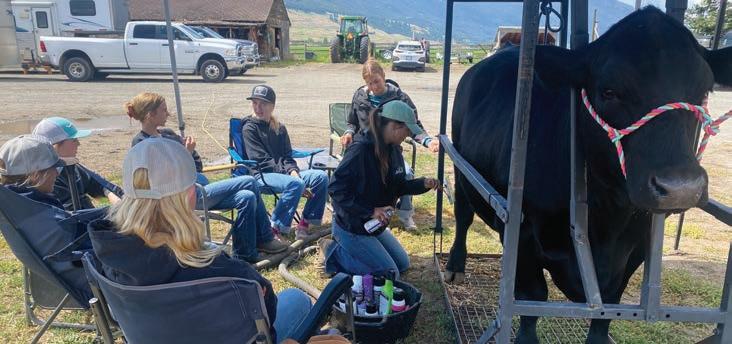
January marks the start of a new 4H year and we are excited for the opportunities coming up in 2026!
A ll members are currently preparing for a busy year of public speaking, raising animals, showing at fairs and so much more. The Merritt 4H chapter currently has beef, goat, and sheep projects for ages 9-21, and cloverbuds for ages 6-8.
An animal project consists of choosing an animal by January, and learning about its basic health, feeding, grooming, and housing requirements. Beef and sheep projects are raised to sell in September, however, some projects, such as pack goats, are raised to perform at shows and can be used year after year.
On achievement days, members wash and groom their animals and show them
in a ring to be judged on the animal’s presentation as well their own skills in leading and showing. Members are currently working towards their achievement day on Labour Day weekend with m any going on to show animals at the BC Ag Expo in Barriere in late September.
Our club is small but mighty and has been in the Nicola Valley for around 80 years. It teaches our children and youth lifelong skills of public speaking, running meetings, managing budgets, record keeping, ethically raising animals, and caring for our land.
The four Hs represent our core values: Head: managing, thinking Heart: relating, caring Hands: giving, working Health: being, living
These are taught and practiced for the next generation to come up contributing positively to our community, country,


and world. With the slogan of “learn to do by doing” adults take a step back and allow members to try things themselves, learn from mistakes, and work together as a team. Some of the best memories

are made in the small moments, working together towards a shared goal. We are always looking to expand our group and welcome anyone interested!



MORGAN HAMPTON
Contributed
The Lower Nicola Garlic Fest began, as most great things do, as a dream.
Pete and Becky Ratzlaff were some of the earliest garlic growers and aficionados in the Nicola Valley. One year at h arvest time they decided to share their love of the spicy, pungent vegetable with others, and so launched what would later become one of the Nicola Valley’s most popular events: Garlic Fest.
“It was at their home and they would sell their garlic… they would make some garlic products, it was a neighbourhood event,” explained Karen Knapp, an organizer for the annual festival.
Unfortunately, after Pete passed away Becky felt it was too much to run as a one woman show and handed the reins over to the Lower Nicola Community Association (LNCA), hoping to see the event grow and improve.
“That’s when we realized there were other Garlic events out there and that
there were vendors who wanted to sell,” explained Knapp.
Being held the last full weekend of September makes the event a big draw for vendors who have been on the Garlic Fest “circuit” throughout the growing season as it gives them an opportunity for a “last hurrah” to move their products before winter, when markets move i ndoors and shift to a Christmas theme.
Held at Smith Pioneer Park in Lower Nicola, 2025 saw the event reach a maximum vendor capacity with 100 vendors on site. Many are local, but the event now draws vendors from Ashcroft, Cache Creek, Vernon, Kelowna, and as far away as Oliver. After the success of 2025 there is now a wait list for potential vendors looking to take part.
However, it is more than just a weekend of fun.
“Garlic Fest is what keeps the Community Hall open,” explained Knapp.
“It’s very difficult to fundraise out here, with a small group of people to try to
hold an event at the hall, what would we put on?”
Indeed, just four dedicated volunteers manage the day to day operations of the Community Hall and planning the Garlic Fest, with more pitching in to assist with set up, running the concession, and selling raffle tickets.
Insurance alone for the hall is $6,000 a year. On top of this are utilities, maintenance, and repairs. Garlic Fest covers t hese costs for the Association.
“That’s why the Garlic Fest is so very important,” said Knapp.
That is also the reason why, despite requests each year, there are no food trucks at the festival. The concession is staffed by volunteers and monies are put directly back into the Association.
“We need that money for the hall.”
This also enables to Association to provide low rates for community use of the hall. Without the influx of operating capital they would be required to charge much more than they do for things such
as the Tuesday card games where anyone interested can drop in to play Canasta and Crib, or the POUND classes on Mondays and Wednesdays.
“Trying to give people that live out here something to do,” is the main goal of the LNCA, Knapp said.
“Seeing all the people out there, in Lower Nicola. Putting on a community event that people enjoy… I sell tickets and I face the field, it’s so nice to see all these people out here and they are getting something that they want – which is a product – and enjoying the park.”
As the event grows year over year, Knapp thanks those who help to make it possible.
“The TNRD are very supportive,” said Knapp.
“We really appreciate all of the people who come out and help, and we hope to see everyone again.”
Garlic Fest 2026 will take place Sept. 26-27, and vendor applications open on Mar. 1, 2026.

Celebrate agriCultural Day
Douglas Lake Cattle Company
Join us in honouring Canada’s rich agricultural heritage and the hardworking farmers and ranchers who feed our nation! Douglas Lake Cattle Company, one of Canada’s largest and most historic cattle ranches, is proud to celebrate this special day with our community.
What We Celebrate:
•The dedication of farmers and ranchers who sustain our food supply
•The legacy of agriculture in Canada
•Sustainable and responsible ranching practices
As we recognize the vital role of agriculture, we invite you to support local farmers, learn more about sustainable ranching, and celebrate the incredible contributions of Canada’s agricultural industry.
Douglas Lake Cattle Company – Ranching with Tradition, Sustainability, and Passion!
MORGAN HAMPTON
Contributed
Most of us can remember when there was just one kind of garlic, it was known simply as “garlic”, no variations, and was a cook’s staple.
Today, garlic has exploded into a kitchen phenomenon – spawning festivals, cookbooks, Pinterest boards into the thousands, and dedicated Facebook groups.
In 2023 farm gate and domestic sales of Canadian garlic totaled an estimated $22.9 million, with growers producing roughly 1,918 tonnes of fresh garlic. Ontario holds the largest share of garlic production land in the country, over 40% of Canada’s garlic producing acreage is within that province, but BC and Quebec are also significant producers.
Locally, the Nicola Valley boasts its own specialty garlic producer, 3Bar Farms, helmed by the Handley family, who have now been growing garlic for 14 years.


“The garlic process to get your new crop in the ground starts around early September,” explained Lucas Handley, who goes by the affectionate Farmers’ Market nickname ‘The Godfather of Garlic’.
“At that time we will pick the biggest and best cloves out of our stock, and put them aside for planting.”
Fields are prepped in late September for an early October start and bulbs are split apart to be readied for planting. Unlike many crops garlic is planted in the fall instead of the spring because it requires a cold period (called vernalization) to initiate growth.
“ In the spring the garlic will come up and we will use mechanical cultivators and manual labour to pull weeds as garlic does not care for the competition,” explained Handley.
“By early June the scapes will begin to form and at that time we remove them.






This allows the energy to go into bulb production.”
The bulbs dramatically increase in size in the last three to four weeks of their life cycle, creating a harvest window that begins in late June or early July.
“Harvest usually takes a few weeks, starting with our early season varieties and making our way through to the late season varieties,” said Handley.
“Once harvested, the garlic goes into the curing or drying rooms, where it is left on racks to dry down. Once it is dry, the stocks and roots are removed and the bulbs are polished and made ready for sale.”
The bulbs then go into a cool storage facility for the remainder of the season, allowing sales into the fall and winter months.
Since 2017 3Bar Farms has been on the Garlic Festival circuit, where garlic growers and lovers alike can gather to celebrate the humble but mighty garlic bulb.
“Demand has steadily grown,” noted Handley.
“We have found that garlic connoisseurs are a lot like wine connoisseurs, and they really enjoy variety and choice, so we have made it our mission to provide the best possible selection. We have sourced different varieties from far and wide.”
There are ten recognized types of garlic, each with
distinct characteristics. Hardneck varieties are Porcelain, Purple Stripe, Marbled Purple Stripe, Glazed Purple Stripe, Rocambole, Asiatic, Turban, and Creole. Softneck varieties are Artichoke and Silverskin.
Hardneck garlic produces a stiff stem and fewer but larger cloves with a bold flavour. Softneck has a more flexible neck and produces more cloves of a smaller size and more mild flavour.
Each type has several varieties and 3Bar Farms currently boasts a whopping 125 kinds of garlic planted, with 65,000 bulbs just waiting for spring weather to kick off the growing season.
“Distinctions range from garlic that are full flavor, earthy tones to hot and spicy,” explained Handley. “Some pair well with Caesar salad, others pair better with your lasagna. On our website there is a dedicated guide to all of our varieties and what they are good for: www.3barfarms.com.”
If you’re really adventurous, let’s not forget that the Lower Nicola Garlic Fest even serves garlic ice cream. Handley also cautions people about confusing local garlic with grocery store garlic, which is typically imported from China.
“When you shop for garlic in the stores you will notice that the root, or basal plate, has been completely removed, this happens on imported garlic,” said










Handley.
“Other garlic is imported from the US as well as Mexico. You know that you are getting local garlic if there is still an inch or so of root attached to the bulbs. Local garlic generally has a lot more flavor, and in the case of ours, we have a full line of flavour palates to choose from. Local garlic also does better for folks wanting to replant in their own gardens, as the garlic is already adjusted climatically to the growing region.”
While he describes himself as “just a farmer”, and not qualified to be handing out medical advice, Handley nonetheless swears by garlic for his own robust health.
“Garlic is a very good sort of natural antibiotic, and it’s is also supposed to be very good for blood flow. I personally try to make sure I ingest at least a couple of cloves of garlic every day as it keeps my immune system strong.”
Now an old pro on the garlic scene, Handley looks forward to yet another busy market and festival season in 2026, offering fresh garlic and scapes as early as June and main crop garlic available mid to late July. Watch for them at one of BC’s garlic festivals August to end of September.
“Garlic has become one of my favourite crops to grow,” Handley concluded.










Pure and unpasteurized, Nicola Valley Honey is produced entirely in the valley surrounding Merritt. Its fine quality, flavour and texture are the result of a combination of climate, soils and flowers, typical to this southern interior dry belt region.
Nicola Valley Honey is available in a variety of sizes from 50g to 15kg. Creamed honey, comb honey and beeswax candles are also produced by Nicola Valley Apiaries
For more than a century, albeit with a brief hiatus here and there, the Nicola Valley Fall Fair has been drawing urban and rural folk alike together for the Labour Day weekend.
In celebration of Agriculture Day, below are a selection of memories of the Fall Fair through the years.
“When I was around five years old, I entered the Fall Fair with my chocolate chip cookies, including the ‘secret ingredient’ that won me the first prize in my category. The ingredient? Rainbow chocolate chips!”
— Sara, lifelong Merrittonian
“The Merritt Fall Fair is one of the highlights of the year for me and our community – celebrating local agriculture, youth, and the volunteer spirit that makes Merritt such a great place to call home. It’s always a pleasure to attend and show our support to those participating in the events of the weekend.”
—
Fraser-Nicola MLA Tony Luck
“When I first moved here in 1977 the rodeo and the Fall Fair was the biggest event of the year. Everybody got together, it was a very happening time. It was always really neat to see the people of the valley and their hobbies, and you might be surprised. You’d recognize a name and think, ‘I didn’t know that person did that’, and you could go and talk to them about it.”
—
Merritt Mayor Mike Goetz

“I love the anticipation of the Fall Fair, before the weekend starts and the fundraising garage sales kick off. It’s always been so much fun to go treasure hunting and help raise money for the big event. — Taylor hometown Merrittonian
We work with small business clients, rural folk, farmers and ranchers, and participants in the resource sector of the Interior.
We help clients with their businesses, wills, estates, estate and succession planning, plus issues unique to the ranching and resource sectors of B.C.’s Interior.
250.828.0282 • mmlc.ca
975 Victoria Street, Kamloops, BC V2C 2C1
MORGAN HAMPTON
Contributed
The Canadian Federal Government has recently announced the closure of three Agriculture Agri-Food Canada (AAFC) Research and Development Centres in Guelph, Ont., Quebec City, Que., and Lacombe, Alta., along with four satellite research farms at Nappan, NS., Scott, Sask., Indian Head, Sask., and Portage la Prairie, Man.
The news comes on the heels of an announcement that AAFC planned to cut 655 positions in a cost saving measure.
According to the Government of Canada, 5,690 people were employed by AAFC as of March 2025, representing 1.6% of the federal public service workforce. However, Canada’s Agriculture Union notes that while the federal public service has grown an estimated 30%-40% over the past decade, AAFC staffing levels have already decreased by 14%.
“These cuts will sabotage important gains we’ve made in agricultural research and set research on Canadian food products back by decades,” said Milton Dyck, National President of the Agriculture Union in a press release.
“We have been warning the federal government for months about cutting an already-decimated department. There is simply no more room to cut.”

The facility at Lacombe, Aberta has been in operation for 119 years, and the community, along with the more than 100 employees, have been blindsided by the closure notice, with the Agriculture Union saying that they were notified of the closure alongside employees and without advanced notice.
AAFC issued a statement regarding the seven closures, which will likely take place over the course of a year.
“AAFC will remain Canada’s largest agricultural research organization, with 17 research centres nationwide and research farmland in every province,” said an AAFC spokesperson.
“There are no imminent site closures, and any winddown of scientific operations would follow a careful decision process that could take up to twelve months. Many employees may be retained, reassigned, or relocated. It is too early to determine final workforce impacts.”
However, critics have raised concerns about the federal government’s choice of departments and industries to reduce, particularly as Canadian agriculture faces increased difficulties with both tariffs from major trading partners and increased active and proposed regulations on farmers and producers on the national and provincial levels, while other countries move towards increasing their agricultural independence and sustainability.
Australia, for example, estimated an investment of $1.4 billion in agricultural research and development in 2024/25.
U.S. public agricultural research and development is approximately $5.16 billion annually.
In New Zealand The 2025/26 budget includes nearly $1.12 billion for agriculture, biosecurity, fisheries, and food safety.
A perusal of Global Affairs Canada also shows a continued to commitment to agriculture outside of the country, such as $5 million “to enhance the gender-responsive resilience of farming households, especially women-headed, and their agri-food livelihoods to the impacts of climate change in the Dry Zone of Sri Lanka.”
And a more recent announcement of $8.2 million on “gender-just, low-carbon rice value chains” in Vietnam, which was called out as “a waste” at the time by Members of Parliament in the House of Commons.
However, Keith Currie, President of the Canadian Federation of Agriculture (CFA) remains optimistic. He called the cutbacks a “necessary evil” and said “there’s nothing wrong with efficiencies”, noting that farmers and ranchers hail from an industry that understands cuts and belt tightening better than most, pairing agricultural know-how with business sense.
“That’s what you do on our farms,” Currie said.






MORGAN HAMPTON
Contributed
The Canadian Food Inspection Agency (CFIA) recently proposed sweeping new regulations regarding livestock traceability. The proposed regulations created a storm of dissent and widespread push back amongst producers nationwide, leading to a pause on their implementation, a pause many producers are saying is not enough.
According to the CFIA “The proposed amendments to the Health of Animals Regulations would expand the scope and improve the accessibility, timeliness and accuracy of animal identification and movement information, apply new requirements to both currently regulated species (bison, cattle and sheep) as well as proposed species (goats and cervids) that would now be regulated. Updates to the requirements for animal identification and records will also increase agility and efficiency throughout the traceability system. By addressing the gaps in the livestock traceability system, the regulatory proposal will strengthen the ability to protect Canada’s food supply and animal resource base and reduce the impact of various events on Canada’s national herd and the Canadian agriculture economy.”
While producers are mostly supportive of the above intentions they argue that the new regulations would go a step too far, becoming far too “burdensome” and “financially prohibitive.” Concerns were also raised that small producers would be disproportionately affected, in an industry already beleaguered by owner/ operator unpaid labour, administrative burden, and an abundance of regulation at regional, provincial, and national levels – sometimes overlapping or in contradiction of each other.
Currently, federal requirements include the mandatory identification of cattle, bison, sheep, and pigs, with movement reporting also required for pigs. New regulations would not only require movement reporting for cattle, bison, and sheep, it would also bring goats and cervids (deer and elk) under the same regulatory umbrella.
This would, in effect, apply to all domestic and commercial livestock
across Canada, meaning large-scale producers, hobby farmers, and those who keep livestock as pets, would all be impacted.
Owners of livestock and operators of commingling sites such as farms, community pastures, abattoirs and veterinary clinics, would be required to register their location with the province and obtain a unique Premises ID (PID).
Animals would also be required to bear an approved indicator, such as a chip, tag, or leg band depending on species, before leaving their farm of origin.
All movements of regulated species between premises would then have to be recorded with the proper administrator.
During a move-in event, the proposed required information would include:
a) the PID of the departure site
b) the PID of the arrival site
c) date the livestock left the departure site
d) date the livestock were received at the arrival site
e) individual tag numbers of animals arriving at your site
f) license plate number, including the province, territory, or state, of the truck that delivered the livestock
Within seven days of the event. The death and disposal of any animal bearing an approved indicator, even on farm, would also have to be reported to the proper administrator within seven days.
This would drastically increase the paperwork and administrative burden on producers and those within the industry, a fact pointed out by the Canadian Cattle Association (CCA).
“CCA recognizes the system cannot be onerous for producers; traceability requires adoption and participation to be effective. Our goal is to ensure all regulations and proposed changes are feasible and offer clear industry value,” read a statement from the organization.
During the consultation process, the Canadian Association of Fairs and Exhibitions (CAFE) also questioned whether the workload would be feasible at such events.
“While the Canadian Association of Fairs and Exhibitions (CAFE) is supportive of the proposed Regulations, they have expressed concerns regarding

movement reporting, indicating that the requirement to report the move-in of animals was too burdensome to their sector, which is driven by volunteers,” read one of their comments.
With volunteer rates declining, fairs, exhibitions, and youth clubs such as 4H could suffer or simply fold under increased regulatory pressure.
The CFIA declined to alter the regulations under these circumstances, instead offering “guidance documents” and “training”, as well as suggesting that fair and exhibition operators communicate guidelines to participants and hope that the burden falls more to owners than volunteers.
After the announcement of the proposed new regulations the Alberta Beef Producers, Manitoba Beef Producers, and the Saskatchewan Cattle Association all called for a halt to their implementation, and the BC Cattlemen’s Association also voiced concerns from their members. Even Alberta Premier Danielle Smith weighed in on behalf of Alberta cattle ranchers.
However, while the CFIA agreed to a pause, they maintain that advancing traceability is a must for a country that exports over 40% of its beef cattle production, more than $1.8 million worth of lamb and mutton, and more than $100 million worth of combined live bison and bison meat.
According to the CFIA, “The proposed Regulations would play a role in tracing
diseased animals and in reducing the extent and duration of a disease outbreak… This benefit measures the reduced cost due to fewer zones contained, shorter time of containment, and fewer animals culled.”
Specifically, the CFIA modelled a foreign animal disease outbreak occurring every 20 years, with a focus on foot-and-mouth disease (FMD), although Canada has been free of FMD since 1952 and it is not classified as a public health risk.
Ultimately, there has been widespread conflict over the proposed regulations, with negative feedback across livestock sectors and threats of non-compliance.
Greg Douglas, a veterinarian and partner with Prairie Animal Health Centre, who previously served as Saskatchewan’s Chief Veterinary Officer and later Ontario’s Chief Veterinarian told WestCentralOnline that the rollout has eroded trust between producers and CFIA.
Similarly, Chad Ross, chair of the Saskatchewan Cattle Association, said: “We strongly disagree with fines for non-compliance under these proposed rules. That kind of approach treats producers like criminals rather than partners in animal health.”
The finalized regulations are expected to be published after further consultation, and until that time the industry waits with bated breath to see what will be expected of them moving forward.
The Merritt Curling Club’s doubles tournament saw 16 teams competing on Jan. 31, including some newcomers and a junior squad.

‘A’ Champions
Ken Conway-Brown and Vern Latremouille

‘B’ Champions
Debbie Barker and Dianne Mentzer (100 Mile)


Fri. Feb 13 vs Beaver Valley-7 pm Sat. Feb 21 vs Osoyoos-7 pm Fri. Feb 27 vs Kelowna-7 pm Sat. Feb 28 vs Quesnel-6 pm

‘A’ Runner-ups
Sean Cornies and Paul Montgomery

‘B’ Runner-ups
Tom Dall and Jean Dall (100 Mile)
Congratulations
Sam Saskiw KIJHL Week 18 Goalie of the Week
Alex Cordero and Jobie Siemens on surpassing 100 games in Junior Hockey
Thank You!
Josh Halverson-Nicola Valley Sports, Vicki Klassen of Klassic Knitting, Jim Cooley-Game on Sports Bar and Grill, also Kyle and Kelly Hall-Empty Keg
JAKE COURTEPATTE newsroom@merrittherald.com
The hot hand was retained this week by the Merritt Centennials, who once again took the top spot in the weekly KIJHL power rankings thanks to three of a possible four points.
January 30, 2026 - Merritt Centennials 8, Sicamous Eagles 1
The Cents were the favourites heading into their first game of the weekend on Friday, bringing a seven-game winning streak into their matchup with the Sicamous Eagles.
Merritt, the victors of three meetings in a row between the division rivals dating back to the start of January, came out swinging with five goals in the first period from five different players, namely Marcus Hughes, Kaden Wilkins, Callum MacLean, Ryker Swanson and Noah Lawless.
Troy Horn added to the scoresheet in the middle frame and Marshall Wagner in the third, before Wilkins added one more late goal to chase the Sicamous starting goaltender from the net.
At the other end of the rink, Tyler Picha stood tall for the Cents for his fourth win in five games, stopping 19 of the 20 pucks he faced.
January 31, 2026 - Merritt Centennials 3, Revelstoke Grizzlies 4 (SO)
The Cents took to the road the following night to visit the powerhouse Revelstoke Grizzlies, who have flirted with the pinnacle of the league standings throughout the season.
The back-and-forth affair saw the teams blank the first twenty minutes before exchanging powerplay goals in the second, with Merritt’s off the stick of Wagner for his sixth of the year.
Each team found the back of the net twice in the third period, including goals from Cents MacLean and Alex Cordero, before overtime solved nothing and a shootout was needed.
From there it was a carousel of both rosters getting their chances, with Merritt goalie Sam Saskiw and his Revelstoke counterpart Austin Seibel standing on their heads to stop eight of the first nine shots they faced.
The Grizzlies eventually were able to solve Saskiw for a second time to earn the extra point.
In total, Saskiw saw a whopping 52 shots thrown his way, stopping 49 to earn visiting star of the game honours.
The four-game roadtrip continued on Tuesday following press time in Princeton to face the high-flying Posse, with a rematch between the nearby rivals scheduled for Feb. 6 at Princeton & District Arena at 7p.m.
The next home game for the Cents is scheduled for Feb. 13 against another top five team in the league, in their only
JAKE COURTEPATTE
newsroom@merrittherald.com
Now in its 57th year, the Moccasin Hockey Tournament is returning to Merritt and Lower Nicola Feb. 6-8.
Around 30 teams will be taking to the ice at Nicola Valley Memorial Arena and Shulus Arena for the three-day bonanza. “Bring the Nations together, bring the energy, and let’s get those moccasins rolling and the blades moving,” said Organizer Cebo Tom. Four levels of competition will be

meeting of the season with the Beaver Valley Nitehawks. Puck drop is set for 7p.m. at Nicola Valley Memorial Arena.

featured in this year’s tournament, from ‘Neff’, to “Cuzzin’, to ‘Uncles’ to ‘Aunties’. An alumni game is also on the docket, featuring a number of players from tournaments past.
General admission is set at $20 per day or $45 for a full weekend pass, with kids ten and under as well as elders 65+ getting in for free.
For more information, email moccasinhockey@outlook.com. Volunteers are still ne eded as well.


Despite the rainy weather and higher temperatures, the Winter Whirlwind race series still went off without a hitch at the Merritt Speedway on Jan. 31. Find below the winners.

8-Cylinder Trophy Dash Winner



4-Cylinder Trophy Dash Winner
Armstrong









CHURCHES OF MERRITT WELCOME YOU
Crossroads Community Church 2990 Voght St. • 250-378-2911
Service Time: Sundays 10:00 a.m.
Merritt Baptist Church 2499 Coutlee Avenue (at Orme) Sunday service 10 am, Phone (250)378-2464
Merritt Lutheran Fellowship in St. Michael's Anglican Hall • 250-378-9899
Service Time: 3rd Sunday each month 1:30 p.m.
Sacred Heart Catholic Church Corner of Jackson & Blair • 250-378-2919
Mass Time: Sundays 9:00 a.m.
St. Michael’s Anglican Church 1990 Chapman St. • 250-319-8823
Service Times: 2nd and 4th Sundays only - 10:00 a.m.
Trinity United Church Corner of Quilchena & Chapman • 250-378-5735
Service Time every Sunday - 10 am
Somang Mission Community Church (SMC) 1755 Coldwater Ave. (The Cadet Hall) Sunday Service Time: 2:30 pm • 250-280-1268 Sunday School Time: 12:15 pm
Nicola Valley Evangelical Free Church 1950 Maxwell St. • 250-378-9502
Service Times: Sunday 10 am
Motion Church Merritt Sundays 10 am Coquihalla Middle School (2975 Clapperton Ave) www.wearemotionchurch.ca/merritt ■ Approved

Children grieve too. Remember, like adults, each child reacts differently to loss. Sharing your grief with your child is one way to help them learn about
DEADLINE: MONDAY at noon. for that week’s paper.
www.merritthospice.org
Email: merritthospice@shaw.ca
Monday to Friday, 9 a.m. to 5 p.m.
April 22, 1943 - January 26th, 2026
David Montague Gilchrist, ( significantly known as Monty) was born in New Westminster, BC ,April 22, 1943, sadly passed away peacefully January 26th, 2026 surrounded by family.

He grew up in Victoria, BC, graduated from the University of Victoria with his Bachelor of Education and then later received his Masters of Education at Gonzaga University in Spokane, WA.
In loving memory of Derek Clare
February 4, 1933 - January 24, 2026
Derek Clare passed away peacefully at home, surrounded by his family. He was 92 years old.

Derek was a devoted husband, father, grandfather, and great-grandfather. He is survived by his beloved wife, Elizabeth, with whom he shared a lifetime of love and partnership. He was a proud and caring father to Jeff (and his wife Cheryl) and Deborah (and her husband Rob).
He was a much-loved grandfather to Raichelle, Jade, Chris, and Shane, and took great joy in his role as a great-grandfather to Kalanestra, Wyatt, and Ryan, who brought him immense happiness in his later years.


Monty moved to Merritt, BC in 1968 and started his career as a High School Teacher at the Merritt Secondary School. Monty was involved in different educational and training programs through out his teaching career including setting up the Merritt Outreach Program. He was well respected in the community including the First Nations in Merritt area. Monty was involved in the Canada Cadet Program for many years and achieved the Rank of first Lieutenant. After retiring from teaching he worked for the BC Ministry of Forestry as a Fire Warden for the Nicola Valley until 2022.
He will sadly missed by his Family that he loved. Including his two sisters, his children and Grandchildren and his dear friends.
As requested by Monty, there will be no memorial service. In lieu of any gifts or flowers, the family asks that you donate your money or time to any charity of your choice.

September 27, 1935 to January 30, 2026
It is with sadness that we advise of the passing of Anne Philp, wife of almost 61 years to John and mother to son Darren and daughter Jodi. Darren and wife Mandy live in Southport, Queensland, Australia. Jodi and husband Dwane live in Blackfalds, Alberta, with their younger children Ronald, Allanah and Finnley. Their oldest daughter Allyssa is in Red Deer, second daughter Kelsey and husband Adam and their three children live in Lacombe, Alberta, while oldest son Dahlin and wife Erika live in Edmonton. Her sister Jessie also survives. Anne was a committed Christian so the family has the secure knowledge that when she left this earth Friday afternoon, she was welcomed into her eternal heavenly home by angels rejoicing in her arrival, as unexpected as it was by us left behind. Anne was the youngest of a family of nine children born to Dyrk and Katerina Driediger. She was born in Bassano, Alberta. There will be an informal celebration of life held at Crossroads Community Church (across the street from the RCMP) at 2:00 pm Thursday, February 5th. If you have memories of Anne, please come prepared to share them.

Known for his steady nature, quiet strength, and deep love for his family, Derek lived a full life rooted in commitment, resilience, and care for those around him. His home was a place of comfort, and his presence will be deeply missed by all who knew him.
The family takes comfort in knowing that Derek passed peacefully, at home, and surrounded by love.
A private family gathering will be held to honour his life.
Anita Orton
March 11, 1940 - January 13, 2026
It is with great sadness and the fondest of memories that we announce the sudden and unexpected passing of Anita Orton (née King) of Lower Nicola, B.C. at the age of 85 due to heart failure.

Left to mourn Anita’s departure and celebrate a life welllived are her loving husband of 56 years, Harry, Anita’s half-brother Dave and his wife Lynda of Langley, nieces Diane of Roberts Creek and Teresa of Abbotsford and their respective families, as well as a host of relatives back in England.
Anita was born in Bristol, England, but lived most of her childhood in the vicinity of Bexhill-on-Sea and Hastings on the southeast coast. From an early age, she exhibited a love for animals, including horses, dogs, cats and birds. Anita developed a special affection for horses and a passion for caring for them. She had a gift of helping both children and adults become comfortable handling, grooming and riding these magnificent creatures.
Anita and her mom, Paula, immigrated to Canada in the late1950s and first settled in Langley. Anita was initially introduced to the Nicola Valley by longtime resident and family friend Jean Anderson. It was Jean who also introduced Anita to a dashing young Brit named Harry who had also made his way to the Merritt area via Australia and was working at the Nicola Ranch. Their mutual love of horses quickly sparked a romance, and they were married on June 25, 1971 in Aldergrove, B.C.
Anita and Harry spent several years living in the Langley area, and were instrumental in developing and growing the Fraser Valley Hunt Club. Their affection for the Nicola Valley never diminished however, and they eventually returned to the place where they first met, settling at the north end of Nicola Lake on land owned by the Guichon Ranch. They would later move to Lower Nicola.
The pair of British ex-pats soon became well-known locally. A quiet, private person by nature, Anita always had a playful gleam in her eye and a gift for repartee. You always had to be on your toes around her, and most certainly on your best behavior.
Anita was especially loved by the generation of young children that she coached as head instructor of the Nicola Valley Pony Club. The organization and its membership enjoyed considerable success competing in horse shows and three-day events around the B.C. Interior. One of Anita’s early students, Dana Cooke, went on to compete internationally for Canada.
Anita and Harry were also integral in the growth and success of the local Merritt Tennis Club. They loved to play the game, and share the sport with others. They followed the Grand Slam tournaments on TV with a passion.
In recent years, Anita was content to live a quiet life with Harry on Aberdeen Road in Lower Nicola, take music lessons with Cecilia Dyck, watch the deer, feed the birds, tend to her cats Sally and Susie, go into town occasionally for a coffee or lunch with friends, and drop in at the library.
All who had the good fortune to meet and spend time with Anita will be saddened to learn of her passing, but be blessed with great memories of her wonderful personality and infectious smile.
There will be no formal funeral service by request. A small, private gathering of family will take place in the Spring. In lieu of flowers, a donation can be made to the Kamloops branch of the B.C. Society for Prevention of Cruelty to Animals.

December 24, 1946 – January 16, 2026
Nadene (Dean) passed away peacefully after a brief illness at Nicola Valley Hospital. She was predeceased in 2023 by her devoted husband, Ed, to whom she was married for more than 50 years. She was also predeceased by her two sisters, Rita Hansford and Pauline Smith.

Dean leaves to mourn her sisterin- law, brothers-in-law, many cousins, nieces, nephews and friends. Dean was born to parents Nanne and Martha Terpstra, and was raised in the heart of the large Terpstra family on a hobby farm along Latimer Road in Cloverdale. After graduating from the University of British Columbia, she set out on an adventure, moving to Fraser Lake in northern British Columbia, where she worked as a school librarian. It was there that she met the love of her life, Ed Morris.
They were married in Cloverdale in 1970, and several years later Dean and Ed made Merritt their home. It was there that they built their life together — building their home, planting roots, forming lifelong friendships, and creating a home that was always open and welcoming.
Dean was a natural host and took great joy in entertaining. Her home was filled with laughter, music, conversation, and good food. She loved hosting family and friends, as well as gatherings of her bridge group. Dean and Ed shared many interests, including curling and bonspiels, cruising with family, their beloved cats, the backyard swimming pool and working together in their vegetable garden.
Dean will be remembered for her warmth, humour, kindness, and generous spirit. She leaves behind many who were fortunate to have been welcomed into her life and her home.
No services will be held, by request.

VALUE ADDED LUMBER REMANUFACTURING PLANT PRODUCTION WORKERS (FT/PT)
• Wages: starting $20 to $28
(depends on experience & attendance)
• Steady day shift work
• Students welcome to apply
• No experience necessary
• Will train
CERTIFIED MILLWRIGHTS REQUIRED
CARPENTERS REQUIRED WITH EXPERIENCE
LICENCED SECURITY GUARDS
Excellent medical & dental plan
PLEASE SUBMIT RESUME IN PERSON TO 1195 Houston Street, Merritt BC • 250-378-6161

START DATE: IMMEDIATELY - BENCH AREA - 4 routes available
Route 1: Bremmer, Grimmett, Nicholson, Reid Ave , Crt, Pl, & Walters
Route 2: Gillis, Parker, Boyd, Greaves & Parker
Route 3: Juniper, Pineridge, Ponderosa, Sunflower, Wildrose & Panorama
Route 4: Boyd, Greaves, Juniper, Panorama & Parker



































































Merritt, British Columbia, is a hidden gem in the province’s real estate landscape, offering a mix of affordability, variety, and small-town charm that is increasingly attractive to buyers, investors, and families alike.
The housing market in Merritt includes detached single-family homes, townhouses, and condominiums, providing options for a wide range of budgets and lifestyles.
Detached homes can range from starter properties priced around $200,000 to larger, newer homes exceeding $600,000, while townhouses and condos are typically listed between $250,000 and $400,000.
Current median asking prices hover around $499,000 for houses, $327,000 for townhouses, and $276,000 for condos, though these numbers
fluctuate depending on location, size, and features. Recent market trends have shown slight decreases in assessed values, reflecting a modest softening compared to previous years, while inventory levels remain variable, creating a dynamic environment where buyers and sellers must act strategically. Affordability is one of
Merritt’s strongest appeals, particularly for first-time homebuyers seeking entry into the BC housing market or investors looking for positive rental returns.
Rental demand in the area is steady, with one-bedroom units renting for roughly $1,000–$1,200 per month and larger suites commanding higher rates, making investment properties a potentially lucrative option.
Beyond numbers, Merritt offers lifestyle benefits: a close-knit
community, proximity to outdoor recreation, and the charm of small-town living without sacrificing access to essential services.
While the market’s smaller size means fewer listings than in urban centers, it also provides opportunities to find unique properties at more attainable prices. Buyers and investors benefit from working closely with local real estate agents, staying informed on market fluctuations, and visiting properties in person to evaluate neighborhoods and amenities. In summary, Merritt’s real estate market combines affordability, diversity, and investment potential, making it a compelling choice for those looking to establish a home, grow a rental portfolio, or simply enjoy the balance of community living and natural beauty.


Working with a real estate agent can give both buyers and sellers an edge in what continues to be a challenging real estate market. Agents, brokers and Realtors® are professionals who have distinct expertise and knowledge of the process of buying and selling homes. That expertise is evidenced by how many people rely on real estate professionals each year. A 2022 Zillow Group Consumer Housing Trends report found 88 percent of homeowners choose to list their homes with a real estate agent when it comes time to sell.
Individuals understand that it can be in their best interests to work with real estate professionals, but they may not know where to look as they seek to work with one. Here are some tips for finding the right match in a real estate professional.
• Know the difference in real estate professionals. Real estate agents are required by the state in which they operate to pass a real estate license exam. Real estate brokers take it a step further and undergo additional training, which could bring additional experience to the table. Realtors® are members of the National Association of Realtors® and beholden to its strict code of ethics. These individuals also may have undergone additional training that qualifies them to work with certain types of clients, such as seniors.
• Seek referrals. Friends or family members, or even others in the community, can put people in touch with real estate professionals. When asking for referrals, individuals can inquire about certain professionals and how
they handled buying and/or selling a home.
• Work with the right type of agent. Generally speaking, real estate agents either work with buyers or sellers in the transaction. Many will do both, but some specialize in buying or selling. Find a professional who either does both or specializes in your position.
• Research an agent’s online presence. Use the internet to see if the agent has a website, a particular philosophy or a specialty. This also may be a place to check online reviews. Don’t be dissuaded by one or two poor reviews. However, if there are many, it may be best to look elsewhere.
• Meet and interview potential agents. Individuals should speak with a couple of real estate professionals to see what they offer. This is a good way to determine if there is a connection there, and whether the agent will get the results needed. A well-prepared agent will come with data, including “comps” of properties in the area. Professionals typically have information about the current market trends and a portfolio of the homes they have brokered recently.
• Go with gut instincts. If it’s between two people of equal qualification, select the person with whom you have a stronger rapport. This person will be guiding you through a sizable financial transaction, so comfort level is important.
Finding the right real estate professional can take some time. But the right professional will guide clients through the often complex and occasionally frustrating process of buying or selling property.
First-time home buyers in British Columbia can access reliable information from several key sources to guide them through the homebuying process. The BC government offers official resources on programs like the First-Time Home Buyers’ Program, which explains eligibility for Property Transfer Tax exemptions, as well as general guidance on buying and selling a home. Federally, the Government of Canada provides details on the Home Buyers’ Plan, the First Home Savings Account, and the First-Time Home


Buyers’ Tax Credit. Additional helpful resources include financial websites such as Ratehub.ca and WOWA.ca, which provide calculators and clear explanations of incentives and costs. Buyers can also seek professional advice from licensed real estate agents, mortgage brokers, and lawyers or notaries, who can assist with market insights, financing, legal contracts, and closing procedures, ensuring a smoother and more informed home buying experience.