
OVERVIEW
OVERVIEW
FROM THE DIRECTOR: AN INTERVIEW WITH KAREN OSTER
THE LIFE OF JOHNNY CASH
AFTER THE SHOW: DISCUSSION QUESTIONS
Theatre Arts – Responding, Connecting
T.R.07, T.R.08, T.R.10, T.R.11, T.Co.10
English Language Arts –Speaking and Listening, Reading, Language, Writing SL.1, SL.2, SL.4, SL.6, R.1, R.2, R.3, R.4, L.4, W.1
Music – Responding, Connecting
M.R.07, M.R.08, M.Co.01, M.Co.02
THE MUSICAL GENRES OF JOHNNY CASH ACTIVITY: GENRE SCRAMBLE
Music – Responding, Creating, Performing
M.R.07, M.R.08, M.Cr.01, M.Cr.03, M.P.04, M.P.06
THE TRAIN BEAT OF “FOLSOM PRISON BLUES” ACTIVITY: TAPPING OUT THE TRAIN BEAT
Music – Performing, Connecting M.P.04, M.P.05, M.P.06, M.Co.02
MAN IN BLACK MONOLOGUES
ACTIVITY: SONG LYRIC MONOLOGUES
ACTIVITY: CASH-INSPIRED ORIGINAL MONOLOGUES CHALLENGE
Theatre Arts – Performing, Creating T.P.04, T.P.05, T.Cr.01, T.Cr.03
English Language Arts – Writing W.3, W.4
SUGGESTED READING: “MAN IN BLACK AT 50: JOHNNY CASH’S EMPATHY IS NEEDED MORE THAN EVER”
English Language Arts – Reading, Speaking and Listening, Language
R.1, R.2, R.3, R.4, R.10, SL.1, SL.2, L.4
ACTIVITY: THE PROTEST SONGS OF JOHNNY CASH
Music – Responding, Connecting M.R.08, M.Co.11
English Language Arts – Reading, Writing, Speaking and Listening R.1, R.2, W.1. W.7, W.8, W.9, SL.1, SL.2, SL.4, SL.5
JOHNNY CASH AND PRISON REFORM THE PRISONERS’ RIGHTS MOVEMENT
English Language Arts – Reading, Writing, Speaking and Listening, Language, R.2, R.5, R.6, R.9, R.10, W.1, SL.1, SL.2, L.5
History and Social Sciences – U.S. History II, Elective: U.S. Government and Politics, Grade 8: U.S. and Massachusetts Government and Civic Life
USII.T4.09, GOV.T1.09, GOV.T3.02, GOV. T4.08, 8.T4.10
SUGGESTED READING: PRISON WRITING IN 20TH CENTURY AMERICA
English Language Arts – Reading Literature, Writing, Language RL.1, RL.2, RL.10, W.1, L.5
In Ring of Fire: The Music of Johnny Cash, Trenna, Jason, Eddie, David, and Mark perform songs from Johnny Cash’s musical repertoire, offering anecdotes that illuminate various aspects of Cash’s life and embody the characters and narratives found in his songs. These characters navigate Depression-era farm life, family tragedy, musical inspiration, fame, great love, spirituality, addiction, and arrest.
Listen to the Original Broadway Cast Recording of Ring of Fire HERE.
Featured songs:
“Country Boy”
“Straight A’s in Love”
“While I’ve Got It On My Mind”
“Five Feet High and Rising”
“Sweet Bye and Bye”
“Daddy Sang Bass”
“Flesh and Blood"
“The Old Rugged Cross”
“Cry, Cry, Cry”
“Big River”
“I Still Miss Someone”
“Get Rhythm”
“Egg Suckin’ Dog”
“Oh Come, Angel Band”
“Flushed from the Bathroom of Your Heart”
“If I Were a Carpenter”
“Ring of Fire”
“Jackson”
“I’ve Been Everywhere”
“Sunday Morning, Coming Down”
“All Over Again”
“Going to Memphis”
“Delia’s Gone”
“Folsom Prison Blues”
“Man in Black”
“I Walk the Line”
“The Far Side Banks of Jordan”
“Why Me, Lord”
“Hey Porter”
“A Boy Named Sue”

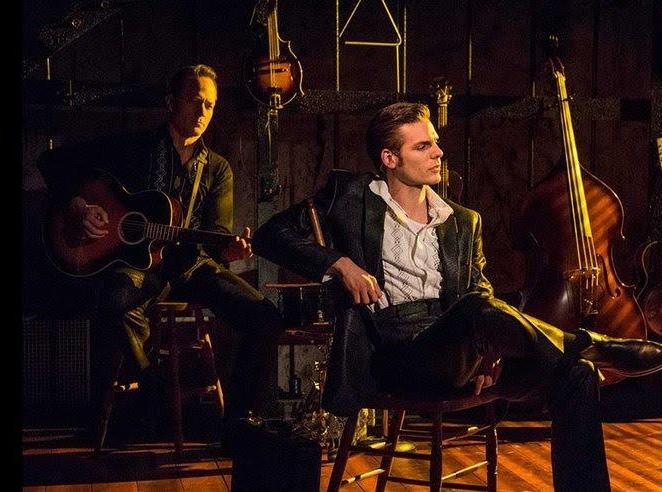

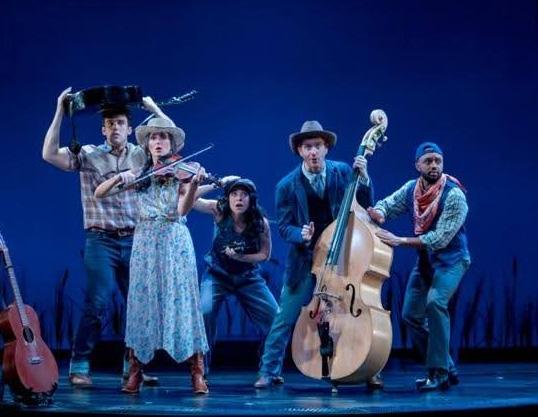

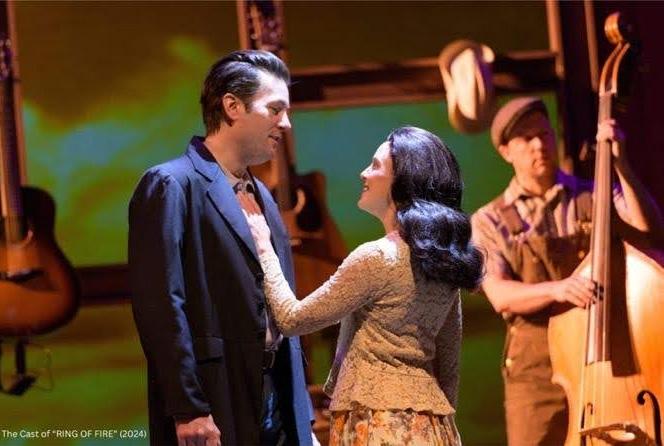

Topics to Consider in Ring of Fire: The Music of Johnny Cash: Redemption, Resiliency, Love, Injustice, Poverty, Addiction, Hardship, Crime, Morality, Rebellion, Freedom, Contradiction, and Alienation.
Karen Oster is one of the co-directors of Ring of Fire: The Music of Johnny Cash. She is a director, educator, actor, and musician. She has coordinated and directed young actors in numerous productions, including Joseph and the Amazing Technicolor Dreamcoat (Broadway and National Tour) and Paul Simon’s The Capeman (Broadway). Her performance credits include Nunsense, Swingtime Canteen, and Pump Boys and Dinettes. She recently directed Red Riding Hood (2023) and Elephant and Piggie: We’re in a Play! (2025) at MRT. She is the Performing Arts Chair at Middlesex Community College, where she teaches acting, directing, musical theatre, and improvisation.1
What is your process like? What’s the first thing you do when you start on a new show?
It’s always important to me to have a strong image in mind for whatever production I’m working on. After reading the play over and over, I’ll start to come up with descriptive image words, then find images that represent those words—something that will evoke the overall feeling of the piece. This helps with the collaborative process. I can share these images and words with my design team and cast, and it’s a great starting point for discussions, helping everyone work toward a unified concept.
In addition to being a director, you’ve also worked as an actor and a musician. How does this interdisciplinarity affect your practice as a director, especially for shows where music plays a crucial role, such as Ring of Fire?
1 “Performing Arts Department Faculty Directory: Karen Oster,” Middlesex Community College, accessed October 3, 2024, https://www.middlesex. mass.edu/performingarts/osterbio. aspx.
Music has a way of unifying people, and that’s one of the things I love most about working on musicals like Ring of Fire. When you’re in a room full of artists who are not only acting but also making music together, there’s a real sense of home—of shared creativity. My background as an actor and musician allows me to approach directing from a more holistic perspective. It’s not just about blocking or shaping scenes—it’s about listening deeply, fostering collaboration, and letting the music guide the emotional core of the piece. That connection creates something incredibly intimate and communal.
Ring of Fire is a jukebox musical, and it also features many biographical elements. How do you navigate the challenges of directing a show like this?
One of the biggest challenges—and joys—of this show is finding focus in the midst of so much musical energy. Unlike traditional book musicals with clear scene breaks, Ring of Fire flows more like a concert, so I need to be attuned to everything happening at once. It’s a delicate balance between honoring the iconic music and creating something fresh that still resonates emotionally. I often think of myself as a “glorified audience member”—I’m constantly asking myself, How does this moment feel? If it moves me, it’s likely to move others. That instinct is key when working with beloved songs and real-life inspiration.
Do you remember what your introduction was to Johnny Cash’s music? Do you have any memories or associations you'd like to share?
I played a lot of instruments growing up, and I taught myself guitar and banjo simply because I loved the way they sounded—there’s something so earthy and expressive about them. I’ve always been drawn to country music, especially bluegrass, so Johnny Cash’s music felt like it was always part of my world. What’s always stood out to me is the raw honesty in his voice. It grabs you right away—like he’s telling you the truth, even when it’s painful. That emotional connection is what pulled me in from the start. His songs don’t feel polished or manufactured—they feel lived-in, like someone is handing you their heart. That kind of authenticity is rare, and it’s what makes his music timeless.
Are there any other jukebox musicals you'd love to direct? Is there another musician's music or life story that you'd love to see adapted for the stage?
I’m always drawn to shows where the actors are also the musicians—there’s something electrifying about that kind of storytelling. While I don’t have a specific artist in mind, I’m intrigued by any project that lets music live organically within the narrative. When you see performers truly inhabit both the character and the music, it creates a depth that’s so exciting to explore as a director.
What do you think it is about Johnny Cash’s music and story that people continue to find so compelling, even today?
I think it’s the rawness—his willingness to sing about pain, justice, redemption, and resilience. Cash was never afraid to stand up for the underdog or share his struggles openly. That kind of honesty doesn’t go out of style. His story and his music speak to the human condition in a way that feels timeless.

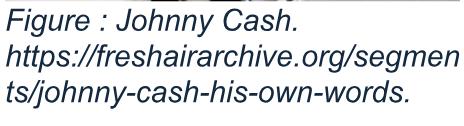
Born John R. Cash, Johnny Cash was born in Arkansas in 1932, four years into the Great Depression. Cash was the fourth of seven children, and he worked alongside his brothers and sisters in the cotton fields starting at the age of five. As a child, Cash had an affinity for music of all kinds, from the gospel songs and hymns he heard in church to the traditional Irish folk music his family listened to on the radio. Cash began playing music and writing his own songs at the age of twelve, shortly after the death of his closest older brother, Jack.
After graduating from high school in 1950, Cash joined the Air Force, where he served in West Germany as a Morse code operator and Soviet transmission interceptor.2 After being honorably discharged in 1954, Cash married Vivian Liberto, whom he had met during his military training in San Antonio, Texas. After the new couple settled in Memphis, Tennessee, Cash got his first record contract with producer Sam Phillips. Cash’s first singles, “Hey Porter” and “Cry! Cry! Cry,” were popular and well-received, as were “Folsom Prison Blues” and the hit, “I Walk the Line,” which were released the following year. His tendency to wear all black, paired with his affinity for songs about outlaws, outsiders, and the working class led to the development of his persona, “The Man in Black”: a rebel and a champion of the downtrodden.
Despite his early-career success, Cash struggled with addictions to alcohol and amphetamines, a dependency that worsened in the early 1960s while he was touring with the Carter Family. He was arrested in 1967 for possession and suffered a nearly fatal overdose the same year, and his public image suffered. At the urging of June Carter and her family, Cash sought treatment for addiction in 1967. When Vivian filed for divorce, Cash and June Carter married in 1968.
With his career on the upswing, Cash recorded his first live album, Johnny Cash at Folsom Prison, at the eponymous prison where he performed for over 2,000 incarcerated men. The album peaked at number one on the Country Chart, and Cash won the Grammy Award for Best Country Vocal Performance. The following year, Cash released his second acclaimed live album, Johnny Cash at San Quentin.
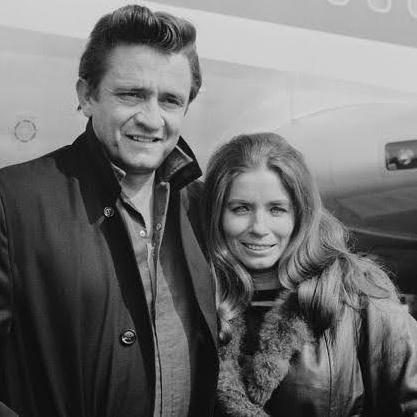
From 1969-1971, Cash hosted The Johnny Cash Show, which featured an array of established and up-and-coming musicians, including Joni Mitchell, Bob Dylan, Roy Orbison, Louis Armstrong, Linda Ronstadt, The Monkees, Ray Charles, The Carpenters, and Mahalia Jackson. In the 1970s, Cash became friendly with a string of US presidents, including Richard Nixon, Gerald Ford, and Jimmy Carter. He was openly critical of the Vietnam War and regularly advocated for prison reform and Indigenous Peoples’ rights.
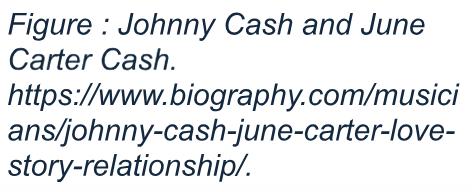
After seven years of sobriety, Cash began using amphetamines again in the late 1970s. He struggled to stay sober throughout the 1980s, and his career again suffered as a result. He attended rehab throughout the decade between performing and recording with Willy Nelson, Waylon Jennings, and Kris Kristofferson in the country supergroup, The Highwayman. Cash’s career was revitalized when he again achieved lasting sobriety in the 1990s. Under contract at American Recordings with producer Rick Rubin, Cash’s music reached a new generation of listeners. Cash expanded his musical repertoire to cover various contemporary artists across a number of musical genres. In 2002, amidst long-standing health issues, Cash filmed a music video for his harrowing, emotive, and acclaimed cover of “Hurt” by Nine Inch Nails. The now iconic, Grammy-winning footage of Cash playing and singing at his home in Tennessee and the Cash Museum is interspersed with archival footage from his expansive life and career. Cash died a year later in September 2003, three months after the death of June Carter Cash.
Today, more than twenty years after his death, Johnny Cash is still beloved as an icon of American music and culture. His career had a profound impact on many musicians, including Bob Dylan, Bruce Springsteen, Dolly Parton, Neil Young, John Prine, Leonard Cohen, Kris Kristofferson, Willie Nelson, Tom Petty, Nick Cave, Arlo Guthrie, The White Stripes, Metallica, and Roseanne Cash. The power and promise of Cash’s artistic and humane legacy is well-articulated in Bob Dylan’s eulogy for his late friend:
If we want to know what it means to be mortal, we need look no further than the Man in Black. Blessed with a profound imagination, he used the gift to express all the various lost causes of the human soul. This is a miraculous and humbling thing. Listen to him, and he always brings you to your senses. He rises high above all, and he’ll never die or be forgotten, even by persons not yet born—especially those persons—and that is forever.3
Suggested Viewing: Watch Johnny Cash’s iconic music video for the song “Hurt,” directed by Mark Romanek.
1. What did you know about Johnny Cash prior to seeing Ring of Fire at MRT?
a) What opinions/associations did you have regarding his life and music?
b) Have your opinions/associations changed?
2. At the opening of the show, Jason poses this question: “I always thought life was like a train ride. It may take you to places you’ve seen all your life. Or it might take you to places you never dreamed you’d visit. But one thing is certain. No matter where the train takes you, sooner or later, the trip will end. So the question is: That man who gets off at the last stop—is he a good man?”
a) Why do you think the play begins with this anecdote and subsequent question?
b) Does the play answer this question? If so, what is the answer? If not, why not?
3. While aspects of Johnny Cash’s life are explored in Ring of Fire, this musical is not a traditional biopic.
a) What are the effects of having five different performers embody aspects of Cash’s life and songs?
b) What might be the reasoning behind this creative decision?
3 Bob Dylan, “Remembering Johnny,” Rolling Stone, October 16, 2003.
4. Consider the effects of having the actors in Ring of Fire double as musicians.
a) How did this casting/creative decision affect the play?
b) What might be the reasoning behind this creative decision?
5. Director Karen Oster feels that the “rawness” and “honesty” of Johnny Cash’s story, voice, and lyrics “speak to the human condition in a way that feels timeless.”
a) What other musicians or artists “speak to the human condition” in this way? How so?
b) What do you think Johnny Cash’s story and music can offer audiences and listeners today?
6. Consider the ever-popular form of the “jukebox musical.”
a) How does this theatrical genre differ from other kinds of theatre?
b) How is Ring of Fire different or similar to other jukebox musicals that you know?
c) What do you think the creative impulse is behind jukebox musicals?
d) What makes this genre effective? What makes it popular among audiences?
Extension Activity: Read and Respond! As an icon of American music and culture, Johnny Cash has been written and spoken about by fellow musicians, as well as scholars and historians. Quotes about Johnny Cash’s music, artistry, and legacy can be found HERE, along with follow-up questions. These quotes and questions (for music and English curricula) can be used for class discussions and close reading exercises.
“I’ve gone through periods in my career when I’ve collected all kinds of old American songs— cowboy songs, blues, gospel. Collecting these various songs of various ilks, I find they all have a common thread. That there’s love, there’s hate, there’s death, there’s a lot of things in common in all of them. Sometimes you have to look for it, but it’s there.”4 – Johnny Cash
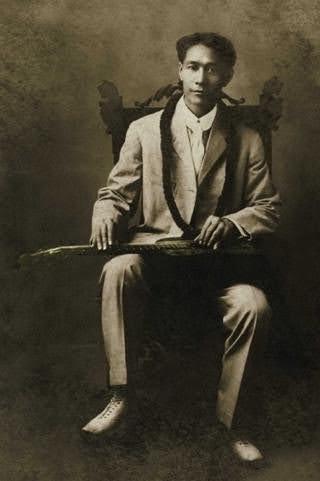
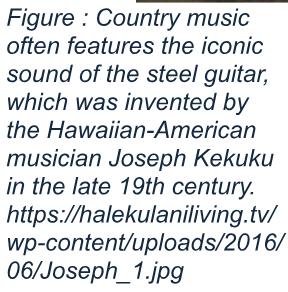
Country Music – American country music emerged from the British folk music traditions of the settlers who immigrated to the Appalachian region. As settler communities expanded to the south and west, Appalachian folk music was influenced by the music of French and German immigrants, as well as by the music of enslaved individuals and Mexican and Cajun communities. Characteristics of country music include the use of string instruments, vocal twangs, narrative lyrics, simple chord progressions, and themes of love, family, community, pride, and loss. Country music, then known as “hillbilly music,” gained widespread popularity in the 1920s and 1930s following the invention of the radio, which featured prominent country recording artists like Gene Autry, Jimmie Rodgers, Jenny Lou Carson, Hank Williams, and the Carter Family.
Rock and Roll Music – Rock and roll music is often characterized by upbeat rhythms, raw and energetic vocalists, amplified instruments, 4/4 and 12/8 time signatures, and themes of rebellion, romantic love, and societal strife. Rock and roll has its

roots in a variety of Black music genres, including the blues, electric blues, jazz, swing, gospel, and boogie woogie. Sister Rosetta Tharpe, Fats Domino, Chuck Berry, Little Richard, Bo Diddley, Elvis Presley, and Buddy Holly are all considered to be foundational figures in the rock and roll genre.
Rockabilly Music – As one of the first genres of rock and roll, rockabilly music emerged in the 1950s. While rockabilly is primarily considered a conglomeration of country (“hillbilly”) music and rock music, it often features aspects of swing, R&B, bluegrass, boogie-woogie, gospel music, and the blues. Common characteristics of the genre include a prominent rhythm, 12-bar blues chord progression, expressive vocalists, vocal twangs, and a band featuring acoustic guitar, electric guitar, and bass. Famous rockabilly musicians include Johnny Cash, Carl Perkins, Elvis Presley, Buddy Holly, Wanda Jackson, Jerry Lee Lewis, and Janis Martin.
Folk Music – Traditional European and American folk music was preserved, spread, and altered through the practice of oral tradition. Folk songs are passed down from generation to generation, often within rural communities. As a result of this oral tradition, the same folk song often lyrically differs from community to community. Folk songs most often follow an AABB structure, and they frequently explore themes of family, work, regional culture, celebration, and struggle. In the mid-20th century, the United States experienced a “folk revival,” during which the popularity of traditional folk music skyrocketed among mainstream audiences. This folk revival also resulted in new folk music, which was performed and recorded by singer-songwriters. While the “new” folk music of the folk revival was not the result of communal oral tradition, it adopted the other characteristics of the genre, including form, instrumentation, theme, and lyrical simplicity. The new folk songs of the 1960s and 1970s frequently explored themes of social justice.
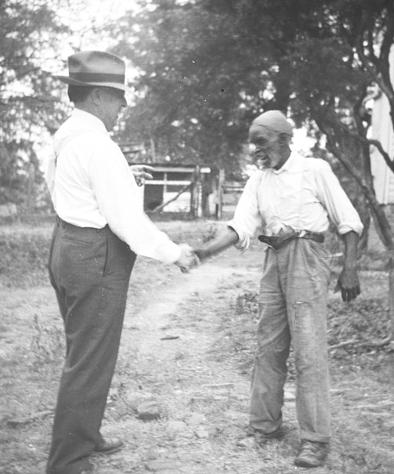
Blues Music – The blues music genre originated in Black communities throughout the American Deep South following the Civil War. Black American musical traditions, including spirituals, field hollers, and work songs, heavily influenced the blues genre. Traditionally, blues songs feature a single vocalist accompanied by a string instrument. Blues songs often follow a simple chord progression, known as “12-bar blues,” and many blues songs feature what’s known as “blue notes”—notes played or sung at a slightly different (often lower) pitch for the sake of emotional expression. Common themes in blues songs include love, betrayal, religion, poverty, pain, discrimination, and struggle.
Gospel Music – Gospel is a genre of protestant worship music that has been a part of religious life in both Black and white churches since the 18th century. Gospel music features religious themes of redemption, hope, joy, and praise, and often features upbeat rhythms, compelling harmonies, and powerful, emotive vocalists accompanied by piano, organ, and guitar. Secular music genres, including R&B, soul music, and jazz, have influenced Gospel music.
In this activity, student groups utilize their genre knowledge and musical critical thinking skills to analyze a Johnny Cash song, featured in Ring of Fire, identify its correct musical genre, and imagine how the song might be different if it belonged to a different genre.
Instructions: Divide the class into groups of 2-4 students. Assign (or have groups choose) one of the songs featured in Ring of Fire. Have each group research, analyze, and listen to their song to decide which genre it belongs to.
Students should consider the song’s rhythm, time signature, form, harmony, tone, and lyrics, along with the instrumentation, arrangement, and the singer’s interpretation and vocal expression. While Johnny Cash’s rendition of their song should be the primary focus, student groups may listen to additional recordings of the song to supplement their understanding.
Once student groups have sufficiently analyzed their songs, they can outline a reimagined version of their songs. This new version must adhere to a different musical genre than Johnny Cash’s original version. How do their songs change when shifted from one genre to another? What stays the same?
1. Have each student group create a presentation showcasing their analysis of their assigned Johnny Cash song, along with an outline of the changes they would make to their proposed genre-scrambled version (and the reasoning behind these changes).
2. For advanced classes, have students perform a snippet from the original version and their proposed genre-scrambled version.
The “train beat” is a percussion rhythm that is commonly found in country music. This beat, which mimics the rhythmic sound of a train chugging down a railroad, is often achieved with a 4/4 time signature, and a snare drum playing uneven eighth or sixteenth notes on the 2nd and 4th beats. This beat is featured in many of Johnny Cash’s most famous songs, including “Folsom Prison Blues.” In the 1968 live recording of this song, the train beat was played by drummer W.S. Holland. However, in the original 1955 recording, Cash’s band did not feature a drummer. Cash achieved a snare-drum-like sound by placing a dollar bill beneath the strings on the neck of his guitar.
In Cash’s song, the symbol of the train is invoked not only through this iconic country groove but also through the song’s lyrics. As musician and ethnomusicologist Aaron Fox articulates,
“Folsom’’ is about this mythic train that runs through twentieth-century American experience, a train the narrator hears off in the distance while he sits locked up for shooting a man in Reno, ‘‘just to watch him die.’’ This unseen train ‘‘tortures’’ the narrator as he imagines it full of ‘‘rich folks drinkin’ coffee’’ and ‘‘smokin’ big cigars,’’…‘‘Folsom’’ exaggerates and symbolizes all the fantastic American movement and luxury and historical ‘‘progress’’ that has always happened just beyond the horizon of rural working-class existence, but always within earshot: ‘‘But those people keep a-moving,’’ Cash sings, ‘‘and that’s what tortures me.’’5
Whether achieved by a single dollar bill or a snare drum, the train beat in “Folsom Prison Blues” brilliantly pulls listeners into the psyche of Cash’s mournful narrator, merging narrative and rhythm to create what Fox calls the most “canonical example of a trope that has been ubiquitous in country since Jimmie Rodgers…first sang of ‘waiting for a train’ with the
unemployed and the hobos around the station water tower in 1929.”6
Discuss:
1. What differences do you hear between Cash’s original 1955 recording of “Folsom Prison Blues” and his 1968 live recording of the song?
2. How does the train beat affect the tone and mood of “Folsom Prison Blues”?
3. Why might songs that don’t reference trains utilize the train beat? What effect does the train beat have on songs that don’t explicitly reference trains?
4. What other Cash songs played in Ring of Fire: The Music of Johnny Cash feature the train beat?
5. Aside from country, what other musical genres regularly use the train beat?
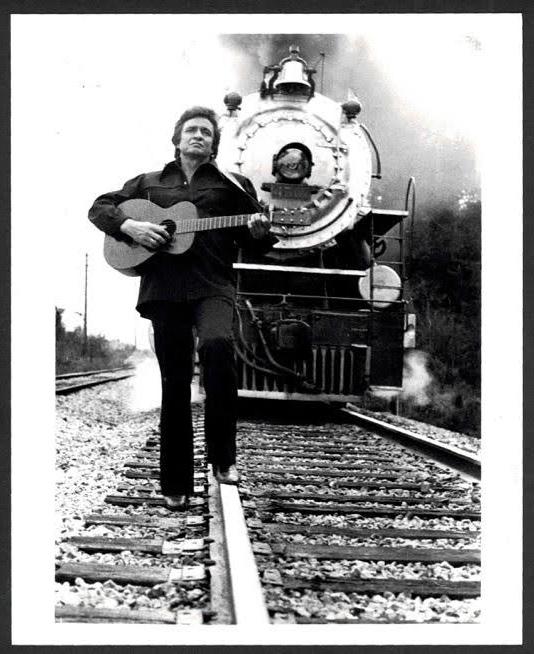


When Johnny Cash first recorded “Folsom Prison Blues,” he resourcefully created a snare-drum-like sound by placing a dollar bill under the strings on the neck of his guitar. In this activity, students take a leaf out of Cash’s book of musical resourcefulness in a fun activity that helps hone the skills of coordination, rhythm, and musical collaboration. Students use household items to create makeshift drums, and using these drums, they then learn and practice a train beat that can be used in Johnny Cash’s “Folsom Prison Blues.”
Required Materials: Tin foil, paper bowls, and small or medium-sized cardboard boxes.
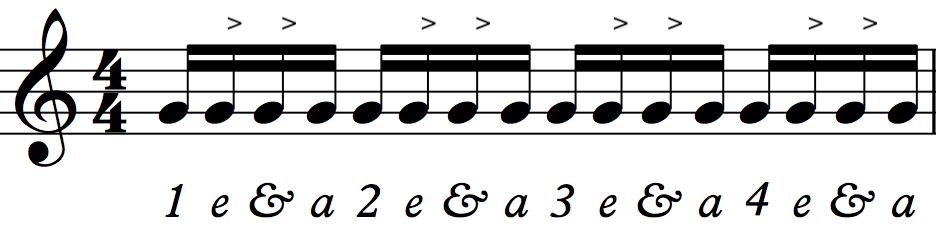
Level 1: Have students familiarize themselves with the basics of the train beat using their hands on the floor or a desk: the train beat is played with sixteenth notes in a time signature of 4/4. Students should alternate hands, playing beats 1 and 3 with one hand, and beats 2 and 4 with the other. (For beginners who might benefit from a slower pace, you can begin with fourth notes or eighth notes, and then progress to sixteenth notes once students have the rhythm down.)
Level 2: Next, have students make the beat uneven by adding an accent on beats 2 and 4. Practice this rhythm as a class.
Level 3: Have students make their “snare drums” by tucking a small sheet of tin foil over the top of a paper bowl (the foil should be taut across). Students can then use these to tap out the train beat they have just learned using their hands or pointer fingers.
Level 4: Add bass! Divide the class in half. Group A can use their snare drums to continue playing the learned beat. Group B can provide a bass drum sound by tapping their hands
against upside-down cardboard boxes on beats 1 and 3. Once this beat has been mastered by the respective groups, have the groups switch!
Level 5: Play along to “Folsom Prison Blues” as a class or in small groups!
Note: For visual learners, Nick Adams’ short video, “One Minute Drum Lesson: how to play the train beat,” is an excellent resource.
1. Have students play around and come up with other variations of the train beat using their “snare” and “bass” drums, or using other makeshift drums from other accessible household materials.
2. For advanced classes, have small student groups write an original song verse featuring the train beat.
Johnny Cash’s expansive musical repertoire features many songs that are narrative-heavy, a trait common in the folk and country musical genres. For this reason, a great number of song lyrics written and/or performed by Cash have excellent dramatic potential. In the following exercises, students use song lyrics as a jumping-off point for theatrical inquiry and compelling solo performance.
Note: Some Johnny Cash songs are better suited to these exercises than others. A list of narrative-heavy Cash songs well-suited to these activities can be found HERE.
In this activity, students select (or are assigned) a narrative-driven Johnny Cash song to analyze and perform as a music-less monologue. This challenging exercise allows students to practice their skills of creative interpretation, character building, textual analysis, and dramatic pacing.
To begin, students should familiarize themselves with their selected song and its lyrics. Individually or in pairs, students can then use the guiding questions below to outline their characters and monologues.
1. What is this song about?
a) Who is this song about?
b) What happens over the course of the narrative?
2. Who is the narrator of the song (your character)?
a) Are they talking about themselves or someone else?
b) If they are talking about someone else, what is your character’s relationship to this person?
3. How would you describe this character? Consider: age, gender identity, personality traits, appearance, pace of speech, occupation, relationships, etc.
4. As a dramatic text, what is the tone of this piece? Is it comedic, tragic, romantic, etc.?
5. What is the setting of your monologue? When and where do you think it takes place?

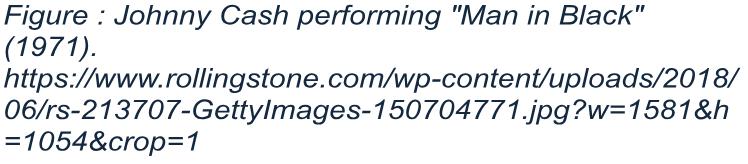
Next, have students individually annotate their lyrics as they would a dramatic text. These textual annotations can include beats, actioning, pacing, pausing, emphasis, and business/ mannerisms. Students should also consider the dramatic rationale for repetition and rhyme in their songs if they are featured. (Repetition provides students with the opportunity to deliver the same phrase in different ways.)
Before performing their monologues, have students rehearse individually or in small groups. Rehearsal time is crucial for this exercise because it allows students to practice delivering their monologues without slipping into song (this is harder than it seems!)
Extension Activity: For a more collaborative exercise, divide students into pairs and have them direct and block each other's monologue performances.
For this activity, students use a narrative-heavy Johnny Cash song as the inspiration for a short, original monologue.
Rules:
1. Monologues must be between 150 and 300 words.
2. Monologues may feature only one sentence or phrase from the original song.
3. Monologues must reflect some kind of emotional arc.
4. Monologues should feature a short, one-sentence description before the main text.
Considerations:
1. Because of their short length, monologues do not need to recount the entire narrative of the selected song. Writers are free to explore only one aspect, character, or event
2. mentioned in a given song.
3. The writer can decide who their character is. Their character could be the narrator of the song, the subject of a song, or a minor character.
4. The timeline is also up to the writer. A monologue may take place before or after the events of a given song, so long as the events and characters featured in the song inform
the writer’s creative choices.
5. Monologues should not feature stage direction unless they are necessary to the plot.
Extension Activity: Give students the opportunity to see their original monologues come to life: Scramble the monologues among the class and have everyone perform a different one!
As an iconic American figure, Johnny Cash’s music and legacy have long been analyzed through the partisan lens of American politics. While he never publicly endorsed a political party, he was known to hold both liberal and conservative views throughout his lifetime. Those on the right of the political spectrum often champion Cash as a patriot and defender of traditional values. Those on the left of the political spectrum hail him as a rebellious defender of the oppressed.
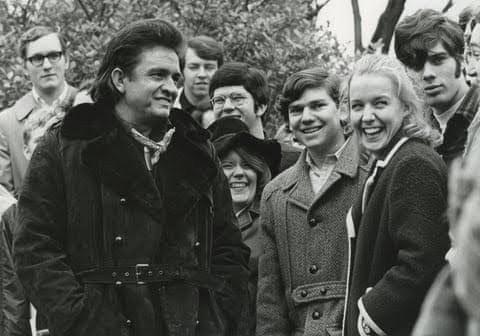
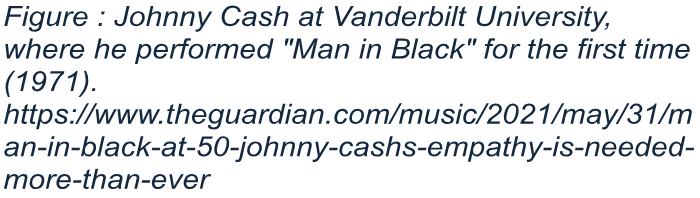
Michael Stewart Foley is an American political culture historian. In his book, Citizen Cash: The Political Life and Times of Johnny Cash, Foley explores what he calls Cash’s “politics of empathy.” In 2021, Foley wrote an article for The Guardian, reflecting on the legacy and the 50-year anniversary of Cash’s album Man in Black. Foley provides an overview of the iconic songs on Cash’s 38th album and reflects on their status as protest songs.7
Have students read, consider, and discuss Foley’s article, “Man in Black at 50: Johnny Cash’s Empathy is Needed More Than Ever.”
1. What was Cash’s position on the Vietnam War in January of 1970?
a) When and why did this position change?
b) How was this change of position expressed in the liner notes for his 1971 album, Man in Black?
2. Who and what inspired Cash to write the song, “Man in Black”? 7
a) Where was this song first performed?
b) Why is this significant?
3. What does Cash express in the song “Singin’ in Viet Nam Talkin’ Blues”?
4. How does Foley view the song “The Preacher Said Jesus Said” in the context of the other songs on the album?
5. Who wrote the song “Look For Me”?
6. To Foley’s mind, how is the song “Dear Mrs.” a “damning critique”?
7. According to Foley, what does Man in Black have to teach listeners about citizenship?
Discussion Questions:
1. Look up the words “empathy” and “sympathy” in the dictionary.
a) How are these two words different?
b) Why do you think Foley describes Cash’s politics as a “politics of empathy” rather than a “politics of sympathy”?
2. Foley argues that Cash was far from an apolitical figure. Today, some musicians and celebrities face criticism for expressing their political views, while others face backlash for refusing to publicly express their political views.
a) How do you feel about this? Is there an acceptable limit to how outwardly political artists and celebrities should be?
b) Do artists and celebrities have an obligation to use their platforms to speak on political issues?
3. Do you believe that all art is inherently political? Why or why not?
Extension Activity: Looking to read more about Cash’s “politics of empathy?” Check out this excerpt from Foley’s book, Citizen Cash: The Political Life and Times of Johnny Cash.
From Billie Holiday’s “Strange Fruit” to Marvin Gaye’s “What’s Goin’ On,” protest songs are a large part of American musical tradition. Musicians across a wide array of genres have used the power of song to voice dissent and rally their listeners toward social change. In this activity, students utilize their close reading and research skills to consider and analyze protest songs recorded by Johnny Cash.
To begin, discuss the nature of protest songs as a class. What is a protest song? How do protest songs inspire social change? What is the difference between an explicit protest song and an implicit protest song?
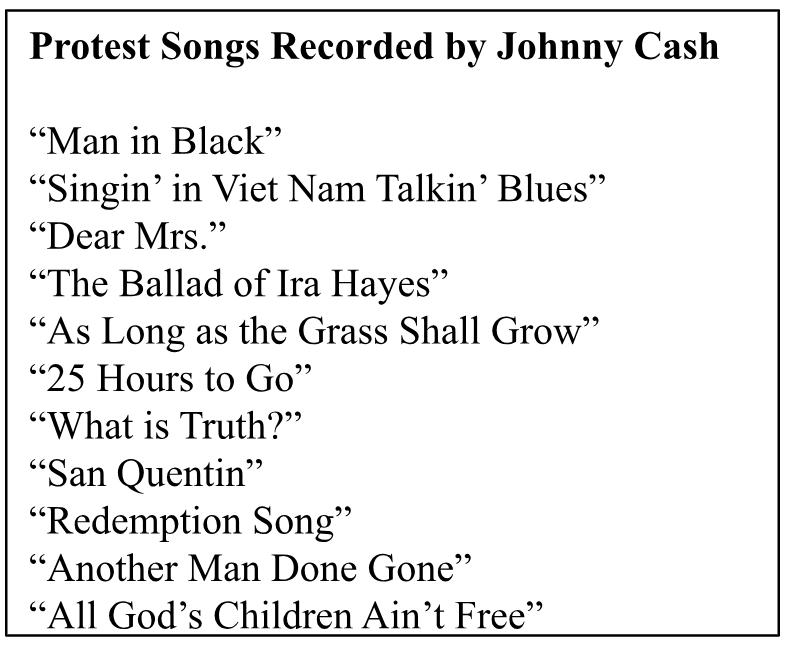
Next, divide the class into groups of 2-4 and assign each group a protest song recorded by Johnny Cash. Students should listen to, analyze, and research their songs using the guiding questions below. (This exercise is also an opportunity for students to practice being discerning in their research!)
If time allows, have each group create a PowerPoint or Google Slides presentation of their analysis and findings to share with the class. Students should have a bibliography slide at the end of their presentations to practice citing their sources.
1. Who wrote this song? When was it written?
2. When did Johnny Cash record this song? What is this song protesting? Is it an explicit or implicit protest song?
3. Explore the context of this song: What relevant events and political movements were happening when this song was written and recorded?
4. How does this song function as a protest song? Does it utilize the rhetorical modes of ethos, pathos, and/or logos? Consider the song’s lyrics, form, tone, mood, style, language, narrator, instrumentation, and Cash’s vocal expression and delivery.
Extension Activity: With the skills utilized in this exercise, have students write short essays about a protest song of their choice.
In 1953, while he was stationed in West Germany, Johnny Cash saw Crane Wilbur’s film, Inside the Walls of Folsom Prison. The fictional film followed Folsom prisoners mistreated by a tyrannical warden, and the attempted reforms carried out by an empathetic captain of the guards. Despite its generally poor reception, Inside the Walls of Folsom Prison had a profound impact on the young Cash. The film inspired him to write the song “Folsom Prison Blues,” which was released two years later to great success.
This song, about the longings of a Folsom prisoner who once “shot a man in Reno just to watch him die,” perpetuated Cash’s captivating outlaw image. Many listeners believed Cash’s lyrics, delivered with startling authenticity, were true and not musical fiction. Despite numerous arrests for drug-related offences, Cash was never incarcerated. Yet the subjects of prison and crime were ones that Cash returned to again and again, with songs like “San Quentin,” “I Got Stripes,” “Delia’s Gone,” “25 Minutes to Go,” and “Greystone Chapel.” Throughout his lengthy career, Cash expressed not only a music-informed interest in those behind bars, but a humanitarian one as well.
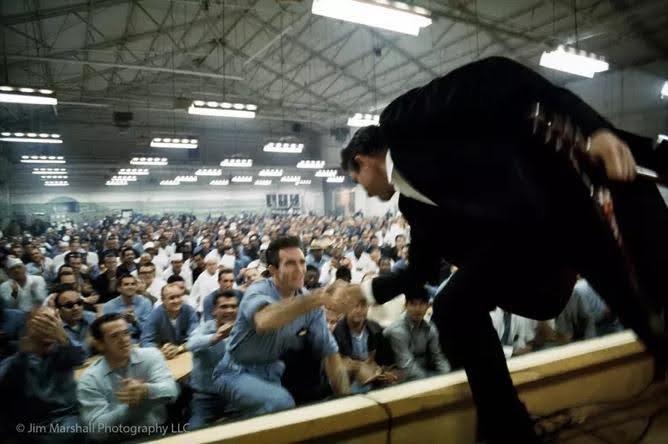
Cash gave his first prison performance in 1957 at Huntsville State Prison in Texas. Following this performance’s wildly positive reception, Cash continued to perform at state prisons across the country. By 1967, Cash’s public reputation had waned due to his struggles with addiction. An arrest for possession and a nearly fatal overdose drove him to attend rehab after marrying June Carter in 1968. Sober for the first time in years, Cash knew how and where he wanted to make a career comeback: he wanted to make his first live album, and he wanted to record it at Folsom Prison.
Widely regarded as one of the greatest live albums of all time, Live at Folsom Prison became a sensation that relaunched Cash’s career. On the opening track of “Folsom Prison Blues,” the applause, whistles, hollers, and cheers can be heard from Cash’s inmate audience. As cultural historian and biographer Michael Striessguth observes,
When he said that time kept dragging on, those who felt the clumsy passage of the hours whistled their understanding. The song was Cash’s pledge of allegiance to the men, and when it ended like toppling metal cans, the hall erupted. They identified with “Folsom,” and Cash’s performance of it carried him and them both through the show in rowdy partnership.8
Beyond prison walls, Cash advocated for prison reform through talks with six U.S. Presidents, and in 1972, he testified at a Senate Judiciary subcommittee hearing. Before Congress, Cash shared the stories of inmates he had met, depicting chilling details about life in American prisons. He openly condemned “public apathy” regarding the conditions and treatment of incarcerated individuals, and advocated for expansive prison reform.9
The ethos of Cash’s perspective regarding incarceration is reflected elsewhere in his life and work. Much of Cash’s musical repertoire champions the underdogs of society: not just inmates but outcasts, rebels, the working classes, the poor, the addicted, the oppressed, the lost, and the desperate. As expressed by media studies scholar Leigh H. Edwards, Cash’s songs about crime and imprisonment are not merely about irredeemable inmates who have done unspeakable things. In some songs, men are jailed simply for being poor or homeless. In other songs, individuals who are not criminals “nevertheless consider crime under conditions of extreme poverty when they need to provide for their families; they pray to God to give them alternatives.”10

Cash’s lyrical dedication to underdogs of all kinds encourages listeners to abandon thinking in absolute terms. His songs incite us to consider the capacity for good and evil in every individual, regardless of circumstance. Despite the sorrow, regret, anger, and longing expressed in much of his music, Cash’s songs and their narratives push us to empathize with the downtrodden and, by extension, to strive for a better world. This notion, Cash felt, was not singular to the songs he performed and wrote, but part of a larger musical tradition. “Our heroes in song were, for the most part, antiestablishment,” Cash once said. “We want to feel his pain, his loneliness, we want to be a part of that rebellion.”11
Discuss:
1. How are the topics of crime and incarceration explored in Ring of Fire: The Music of Johnny Cash? What does the play have to say about thesetopics?
2. How is the topic of morality explored in Ring of Fire? What does the play have to say about this topic?

3. Consider Cash’s statement that prison reform should not start in prisons but “out on the street” with opportunities.
a) What opportunities might he be referring to?
b) Do you agree with this sentiment? Why or why not?
4. Consider what you know about Cash’s prison performances.
a) How might these performances have been beneficial to inmates?
b) How might these performances have been beneficial to the general public?
c) Are there potential ethical issues that might arise from musicians performing in prisons?
Extension Activity: As a class, listen to “Folsom Prison Blues” and “San Quentin.” Have students compare, contrast, and discuss: Are there differences in how these two songs address the topics of crime and incarceration? Have students consider lyrics, tempo, form, tone, instrumentation, and vocal expression.
Suggested Viewing:
• An excerpt from the 2008 documentary, Johnny Cash at Folsom Prison
• Johnny Cash being interviewed on his decision to perform at Folsom Prison in 1968
• Johnny Cash performing “San Quentin” at San Quentin Prison in 1969
• Merle Haggard on watching Cash perform while he was an inmate at San Quentin Prison
Suggested Listening:
• Cash’s live recording of “Folsom Prison Blues” at Folsom Prison
• Cash’s live recording of “Greystone Chapel,” written by Folsom Prison inmate Glen Sherley
• Terry Gross’s interview with Cash, where he talks about his prison concerts (20:17 mark)
• “Johnny Cash plays Folsom Prison” on BBC’s Witness History Podcast
Throughout the 1950s, the United States saw a dramatic surge in prison uprisings. Across the country, prisoners protested inadequate food, overt racial and religious discrimination, and brutal working conditions. Poor treatment of incarcerated individuals was, unfortunately, not a new phenomenon. While the 8th Amendment, ratified in 1791, forbade the use of “cruel and unusual punishments” on prisoners, the lack of clarification regarding what may be deemed “cruel” or “unusual” leaves this phrase largely open to interpretation. Additionally, while the 13th Amendment abolished slavery and “involuntary servitude” for non-imprisoned Americans, this right is not extended to those who had been found guilty of committing crimes.
Furthermore, until the 1960s, the United States judicial system practiced what is known as the “hands-off” doctrine, whereby courts did not rule in cases pertaining to the treatment and management of incarcerated men and women. This principle insinuated that those imprisoned had relinquished their constitutional rights, leaving inmates isolated and with little to no hope of bettering their conditions.

Throughout the 1960s and 1970s, a new movement dedicated to the rights of prisoners emerged, and the hands-off doctrine faced increasing scrutiny, which led to it waning in legal practice. Legal scholar James B. Jacobs described this movement as a “broadscale effort to redefine the status (moral, political, economic, as well as legal) of
prisoners in a democratic society.”12 Like the other influential socio-political movements of the period—the civil rights movement, the anti-war movement, the students’ rights movement, the gay liberation movement, the Chicano movement, and second-wave feminism—the prisoners’ rights movement was part of a post-World War II trend, which sought to “extend citizenship rights to a greater proportion of the population by recognizing the existence and legitimacy of group grievances.”13

Through legal action, protests, uprisings, hunger strikes, and the written word, incarcerated individuals, free citizens, and legal advocates achieved effective reforms and lasting legal protections, notably in numerous Supreme Court rulings. Among these cases were Cooper v. Pate (1964), which established that inmates had the right to sue in federal court; Lee v. Washington (1968), which ruled that racial segregation in prisons was unconstitutional; Johnson v. Avery (1969), which ruled that inmates had the right to advise and aid others with legal paperwork; and Younger v. Gilmore (1971), which upheld the decision that inmates had the right to access legal resources and law libraries.
While these legal achievements of the 1960s and 1970s ensured some basic rights to incarcerated individuals, the momentum of prison reform soon stalled. In the late 1970s and early 1980s, mass incarceration began due to changes in administration, rhetoric, and political policy. Today, the United States has the highest incarceration rate in the world. Despite the strides made by the prisoners’ rights movement sixty years ago, many Americans feel that the criminal justice system is still in need of drastic reform. In the last ten years, American prison conditions have been scrutinized and condemned by Amnesty International, the United Nations, and Human Rights Watch for issues such as overcrowding, police brutality, racial prejudice, health concerns, and the practice of solitary confinement.
Research Questions:
1. What was the Supreme Court case Pervear v. Massachusetts (1866)? How did this case lead to the widespread practice of the “hands off” doctrine?
2. What was the Supreme Court’s ruling in Jones v. Cunningham (1963)? How did this case influence the ruling of Cooper v. Pate (1964)?
3. How did the court rule in the case Cruz v. Beto (1972)?
4. How did the Court rule in Wolff v. McDonnell (1974)?
5. What was established with the ruling of Estelle v. Gamble (1976)?
Suggested Viewing: Looking to learn more about American prison history and the rise of mass incarceration? Check out Ava Duvernay’s award-winning 2016 documentary, 13th, which is available on Netflix.
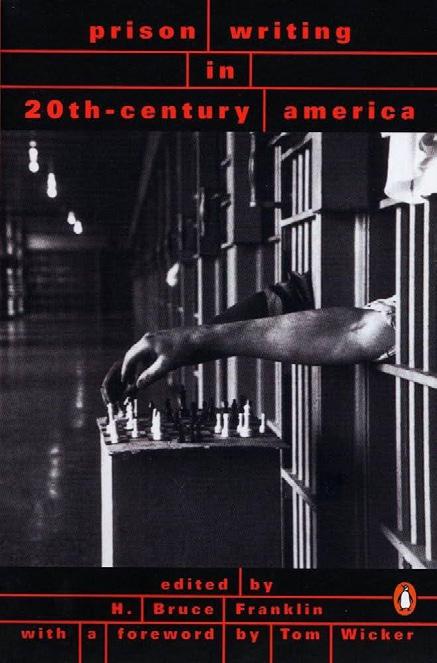
For as long as prisons have existed, imprisoned men and women have put their thoughts down on paper. Through letters, short stories, novels, poems, song lyrics, and memoirs, incarcerated and formerly incarcerated individuals have documented their experiences, observations, dreams, feelings, and imaginings for centuries.
H. Bruce Franklin was a leading scholar in American prison literature. He edited the 1998 anthology, Prison Writing in 20th Century America, which features written work by some authors who are “prominent figures in American letters,” and others who are “virtually unknown.” Selected for what they reveal about “the modern American prison,” and what they reveal about “human beings in the most difficult circumstances,” the texts featured in this anthology offer compelling and varied insight into the complex and often brutal world of American incarceration.14
Four short texts featured in Franklin’s anthology can be found HERE. For each of these texts, Franklin provides a brief overview of the writer’s life and work.
These texts include:
• Jimmy Santiago Baca’s poem “The New Warden”
• William Wantling’s poem “Sestina to San Quentin”
• An excerpt from Jim Tully’s story “A California Holiday”
• An excerpt from Nathan C. Heard’s novel House of Slammers
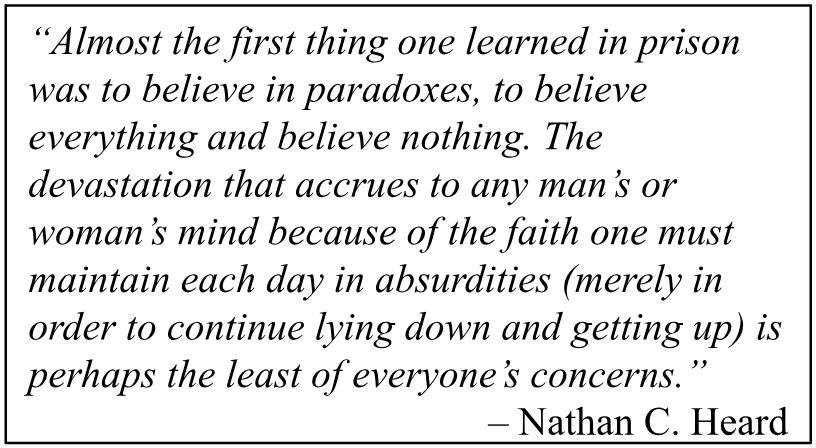
These texts can be used for close reading exercises, class discussions, and writing assignments. Various thematic and narrative connections can be readily made between these texts and Ring of Fire and the music of Johnny Cash. Questions and connections for students to consider can be found HERE
Suggested Further Reading: JSTOR hosts an expansive open-access archive of American prison newspapers and periodicals from the 20th and 21st centuries. Read and explore the American Prison Newspaper Collection.