Overview
Overview
An Interview with Playwright Vichet Chum
After the Show: Discussion Questions
English Language Arts – Reading Literature, Speaking and Listening
RL.1, RL.2, RL.3, SL.1, SL.2, SL.4
Theatre Arts – Responding, Connecting
T.R.07, T.Co.11
Considering the Coming-of-Age Genre
About Spoken Word Poetry
Suggested Reading: “The Resurgence of Spoken Word” by Yasmin Khan
English Language Arts – Reading Literature, Reading Informational Text, Language Speaking and Listening, Writing
RL.2, RL.3, RI.1, RI.10, L.4, SL.1, W.9
Theatre Arts – Responding, Connecting
T.R.09, T.Co.11
Suggested Reading: Soma’s Poetry
Making Connections: The Poetry of Kosal Khiev
English Language Arts – Reading Literature, Speaking and Listening, Language
RL.1, RL.2, RL.3, RL.4, RL.6, RL.10, SL.1, SL.2, L.4, L.5
Spoken Word Brainstorming and Practice Exercises
Spoken Word-Related Improv Exercises
Spoken Word Poetry Prompts
English Language Arts – Writing, Speaking and Listening, Language W.4, W.5, W.10, SL.1, SL.6, L.5
Theatre Arts – Performing, Creating T.P.04, T.P.06, T.Cr.01
The United States’ Bombing of Cambodia
The Cambodian Genocide
Lowell and Cambodian Immigration
The Deportation of Cambodian Refugees
History and Social Sciences –World History II, U.S. History II, U.S. Government and Politics (elective) WHII.T7.01, USII.T3.10, USII.T3.12, HSS.GOV.T1.09, HSS.GOV.T4.07
English and Language Arts –Reading in History and Social Sciences
RCA-H.1, RCA-H.2, RCA-H.1
Kween follows 16-year-old Soma, a queer Cambodian-American Lowell native, navigating a number of newfound challenges: her father’s deportation to Cambodia, the absence of her mother, who is away caring for her father amid his mental health struggles, and the upcoming wedding of her older sister Dahvy, who has become Soma’s guardian. Soma takes to TikTok to express her feelings about her father’s deportation, performing a spoken word poem that captures her frustration, sadness, worry, and hope. When her video goes viral, and as the local spoken word contest approaches, Soma grapples with questions about history, legacy, the power of words, and love of all kinds.
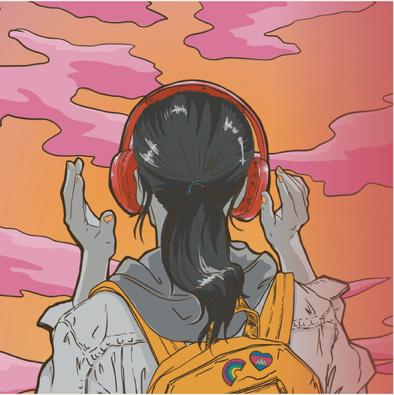

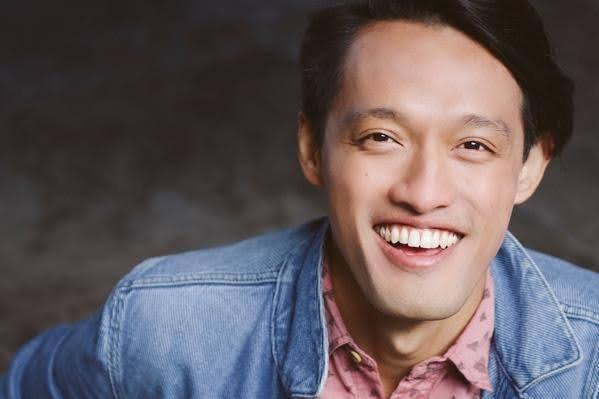

Vichet Chum is a New York-based writer and artist. His plays have been produced at theatres across the U.S., including Steppenwolf Theatre, Roundabout Theatre Company, the Alley Theatre, Seattle Children’s Theatre, Page 73 Productions, Chautauqua Theater Company, Ars Nova, and Merrimack Repertory Theatre. He is the recipient of the Lucille Bulger Service Award (2023), the Laurents/Hatcher Award (2021), an Edgerton Foundation New Play Award (2021), and the Princess Grace Award in Playwrighting (2018). His plays include Bald Sisters, KNYUM, and High School Play: A Nostalgia Fest. He is currently an Underground Resident at Roundabout Theatre Company, a board member at the New Harmony Project, and a steering committee member for the Asian American Performers Action Coalition (AAPAC). His debut young adult novel, Kween, which is based on the play commissioned by MRT, was published in 2021.1
Kween was commissioned by MRT. What was the process for developing this play like? Were Kween the play and Kween the book written concurrently, or did one precede the other?
The play was commissioned by MRT in the early stages of the pandemic. As things were unfolding and theatres were moving offstage to online spaces, you can imagine how grateful I was to receive the support. In some ways, the time period was really supportive of developing the piece, and in other ways, not so much. I no longer had a day job, so I had a little more real estate to really dream the story. On the other hand, developing a play on Zoom was tough. I had to listen in rehearsals in a different way and rely on my own intuition about what was happening in the story.
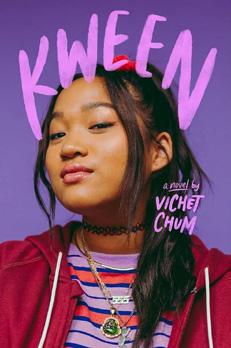

A friend of mine, who happens to also be an editor of young adult novels, saw an early Zoom presentation of the play and suggested to me that it could also be a book. We worked on a proposal together, and the publishers bought it. I could never have imagined that I would be so fortunate to work on the same story in two different kinds of mediums concurrently. At times, it was complex, trying my best to understand what each vessel was asking of me. Plays ask for immediacy. You have an audience’s attention for a short period of time. What do you want them to experience in a room together? Books ask for a very personal relationship with the reader. How can you communicate a world and its characters so the reader can fully imagine the intricacies and truth of the world? The book came out in the fall of 2023, and now, I’m thrilled to finally premiere the play with you now. I hope the two versions continue to speak to one another.
Soma is experiencing an enormous change in a very concentrated amount of time while also carrying a legacy of war as a child of refugee immigrants. She also happens to be a normal teenager, going through normal teenager things. I wanted to offer her a language that was her own, something that would give her a means to process everything that she is navigating. In many ways, I think spoken word poetry is one of the most honest art forms, because while it can use classic structures, it dares to defy them. Its only intention is to get to the raw, messy truth. It also demands to be performed. Soma is seeking to be witnessed, and that takes a tremendous amount of courage. I wanted to draw the link between spoken word poetry and live theatre. We share the eternal impulse to get into a room, connect with each other, and make ourselves vulnerable enough to be changed or transformed. Honestly, I think the world could use a little more of that exchange.
Cambodian identity and culture are explored in this play through the characters of Soma, Dahvy, and Sophat. These characters are recognizably American, but they engage with their Cambodian roots in different ways. How did these characters' complex, individual Cambodian American identities emerge? Are there particular considerations you feel are essential when writing Cambodian American characters?
Being Cambodian American is not a monolith, and yet, in the greater cultural space, we rarely witness the multiplicity of our community’s stories. As a writer, that is the responsibility I’ve taken on: to honestly and passionately write about as many Cambodians as possible.
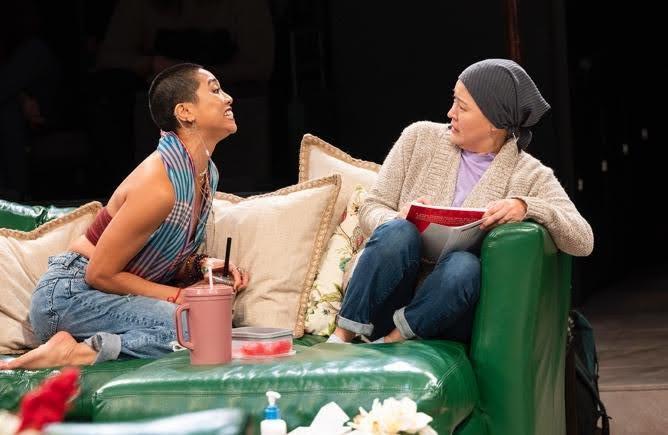

Dahvy follows a pretty classic trope in the community: the older daughter who is always the surrogate parent. I wanted to include that role because I think many people will recognize her as them. So much is expected of her for the house to stand, but she must find truth, dignity, and peace for herself as she navigates that pressure.
With Sophat and Soma, I think you rarely get to see two queer Cambodian kids live as freely and fully as they do. Not that that doesn’t come with complexity, but I really desired to capture a friendship that, maybe in some eyes, is a little aspirational. They are living at the axis of multiple identities, and I think that represents the truth of many kids like them. While the setting of Lowell is obviously very affirming of Cambodian heritage, I still think that with Sophat and Soma’s generation, there is a learning of culture and history that has to be more intentional than is immediately felt, more academic than intuitively lived. That’s the nature of how cultural heritage moves through generations. It requires a
consciousness and desire to keep it alive. In this story, I wanted to witness the many ways in which people navigate their identities, while also creating a universal story that many people who are not Cambodian can also feel themselves situated in.
Additionally, while references to the Cambodian genocide and the Cambodian Civil War aid audiences and readers in their understanding of some of the characters, this part of Cambodian history is not at the forefront of the story. The topics of American legislation and immigration, for example, play a larger role. What was behind this creative decision?
In all my work, I try to show the complexity of history. For instance, while many people may know that the Khmer Rouge committed a horrible genocide against its people, many don’t know that the U.S. government enacted Operation Menu in Cambodia, a carpet-bombing campaign that destabilized the country further and made it possible for the Khmer Rouge to come into power.
More bombs were dropped on Cambodia than the Allies dropped during World War II. So, you can’t speak about Cambodian history without understanding the consequences of American interventionism and the military-industrial complex.
That being said, in the greater cultural context, most stories about Cambodians have been only about the Cambodian genocide. We have so many other stories! So many other dreams! So many other concerns! When I began to write this play, one of those concerns of mine was the wrongful deportations of Southeast Asians, which spiked up to over 200% in the last Trump administration. Obviously, that has evolved to even more monstrous proportions in the second term, in which migrants are being disappeared off the streets, from their homes, and from their families without due process. When I started this play, I could never have imagined the level of inhumanity we’ve now reached. I want to shed a little light on the issue. Ultimately, the story isn’t just about Cambodians but many other migrants who are just trying to live with safety and dignity.
The Lowell setting feels crucial to this story and these characters, and parts of the city's history are referenced in the play. Can you share a bit about why you chose to set this story in Lowell? Did you do any research?
I love Lowell. I don’t mean to romanticize it. As a guest, I’m sure there are so many nuances that I don’t know about or don’t have to contend with. But that being said, to me, Lowell is one of the most honest, hardworking places I know. I’ve done three shows at Merrimack Repertory Theatre since 2018, including my own solo show, and so I’ve had the privilege to cultivate some experiential research as I’ve moved through the city. From spending time with Angkor Dance Troupe to learning at the Boott Cotton Mills Museum to exploring Western Avenue Studios, the city is such a patchwork of history and culture. The people are incredibly generous and open. And yes, being in a place with such a high concentration of Cambodians, my people who are doing so much to keep the city thriving for all… that work thrills me. All in all, it was such an obvious thing to set the play in this city. In fact, I want this production to be a love letter to Lowell, for everything they’ve given me as an artist and a person.
Throughout the play, Soma expresses admiration for Jack Kerouac, and Britney expresses admiration for Octavia Butler. What writers did you admire when you were Soma and Britney's age? Have your literary tastes changed
I loved books like Things Fall Apart, The Giver, and The House on Mango Street, among so many others. Because I was a theatre kid, I was also obsessed with the works of John Patrick Shanley, David Henry Hwang, Suzan-Lori Parks, Tennessee Williams, and Martin McDonagh. I also remember the sensation of reading The Joy Luck Club by Amy Tan and feeling for the
first time that I was witnessing some adjacent approximation of my own experiences as an Asian person in the world. My tastes haven’t changed too much. I’m still drawn to deeply passionate stories of real people going through real things. I love it when an author is able to use language to express an evergreen idea in a completely new way. Some of my favorite books of the last ten years have been On Earth We’re Briefly Gorgeous by Ocean Vuong, Martyr! by Kaveh Akbar, and Afterparties by Anthony Veasna So.
What advice do you have for young aspiring writers?
As you begin, try not to self-edit. Be a channel for whatever is coming out. Write. Write. Write some more. When you’re ready (and when you’re not), invite the voice of a trusted person to witness what you’re trying to do. See if they have notes. Take the ones that are useful. Keep the ones you’re not sure about in a drawer somewhere. Don’t worry about the rest. Return always to your instincts that you have cultivated to arrive at this moment of writing. Trust yourself. Write. Write. Write some more. Maybe edit somewhere in there. Write. Write. Write some more. Enjoy it when you can. Only you can write you. Write. Write. Write some more.
What do you hope audiences take away from Kween at Merrimack Repertory Theatre?
I want people to get to know a family that is just trying to do their best. I want people to laugh and learn and feel moved by spending time in this world. I want people to see themselves in these characters. I want people to feel the urge to share their truths with others. I want people to feel like they want to see another play… at Merrimack Repertory Theatre.
1. Throughout the play, Soma expressed admiration for the writer Jack Kerouac. When pressed by Britney, she says that her fondness for Kerouac stems from the fact that he was an immigrant who grew up in Lowell. Are you drawn to writers and artists whose life experiences are similar to yours? Why or why not?
2. How does the play explore the topic of social media?
3. Soma performs a poem on TikTok without difficulty, but when she’s tasked with performing one of her poems for a live audience, she struggles. What differences are there between performing live and performing on social media? What challenges are unique to each of these formats?

4. Theatre scholar Trevor Boffone writes that, “From its onset, TikTok has been an inherently theatrical space, one that encourages us to reexamine the very ethics and craft of performance.” Do you think that all of TikTok is theatrical? Why or why not? How might TikTok encourage us to reflect on the “ethics and craft of performance”?2
5. On the topic of cultural roots and identity, Vichet Chum says that for people of Soma and Sophat’s generation, “there is a learning of culture and history that has to be more intentional than is immediately felt, more academic than intuitively lived.” This, Chum says, is “the nature of how cultural heritage moves through generations.” What does Chum mean by this? How are his sentiments explored in his characterizations of Soma 2 Trevor Boffone, “TikTok
and Sophat?
6. In her essay on immigration, Soma writes that she is fed up with writing essays about “awful things” that become laws, and “tired” of writing essays that “make it seem like everything is long ago history, as if people aren’t their history.” Why is writing about and reflecting on the “awful” parts of history necessary? How can we engage with and learn from history in a way that prioritizes the people of the present?
7. At the end of the play, Soma shares a poem with Dahvy. In the poem’s concluding lines, Soma says that to be a “Kween” is to “find a way to be honestly seen / And hold up your people when the going gets tough / And to remind yourself, that this can be enough.” What leads Soma to this new understanding?
8. Vichet Chum writes that both theatre and spoken word poetry “share the eternal impulse to get into a room, connect with each other, and make ourselves vulnerable enough to be changed or transformed.” How and why does the gathering and witnessing of performance encourage us to connect with one another? How can this lead to change?
Coming-of-age stories follow a protagonist as they move from childhood into adulthood. Protagonists in these stories mature emotionally, morally, or psychologically, and typically conclude the narrative with a different or more nuanced understanding of themselves and their world. This new understanding often arises from how the character responds to and navigates the challenges and obstacles that constitute the story’s plot.
Coming-of-age stories have been enormously popular for centuries, and while plots, characters, and settings vary widely from story to story, all of these narratives work to portray and explore the familiar experience of growing up.
Reflect & Discuss:
1. How does Vichet Chum’s Kween adhere to the coming-of-age genre? How does Soma grow and mature throughout the play?
2. Why do you think coming-of-age stories are so popular? What makes a coming-of-age story effective?
3. What books, films, plays, or video games do you know of that function as coming-of-age stories?
4. In real life, what does “coming of age” look like? Are there certain aspects of coming of age that are universal?
5. Is coming of age in 2026 different from what it was like to come of age ten years ago? What about twenty-five or fifty years ago? How so?
6. How would you describe what it’s like to come of age today? What are the pros and cons of coming of age in the 21st century?
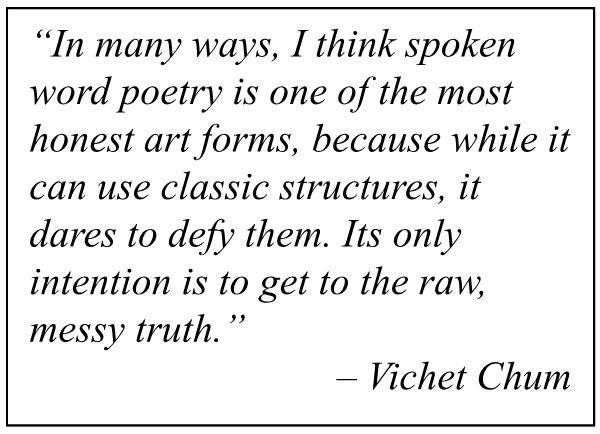
The history of sharing poetry orally through performative means is an ancient one that spans a wide array of cultural traditions. Spoken word poetry is a broad category of poetry encompassing all poetry written for performance. Contemporary spoken word poetry often explores themes of social justice, oppression, community, and identity, and typically features wordplay, repetition, and rhyme. The Black Arts Movement, Beat poetry, the Nuyorican (New York Puerto Rican) Arts Movement, and musical genres like jazz and hip hop have strongly influenced this politically charged form of spoken word poetry. Since the 1990s, slam poetry has been among the most common subgenres of spoken word poetry. Slam poetry is performed at slams, competitions in which a number of poets present, perform, and compete. Each poet’s poem and performance is scored by a selection of randomly chosen audience members, who serve as the competition’s judges.

Button Poetry is a Minneapolis-based company that publishes and promotes spoken word poetry. By “encouraging and broadcasting the best and brightest performance poets of today,” Button Poetry is dedicated to expanding spoken word poetry’s audience by showcasing “the power and diversity of voices in our community.”3
Button Poetry regularly releases videos of poets performing their work on YouTube and TikTok. Exploring and watching some of these videos can serve as an excellent introduction to this poetic genre. A playlist of poems appropriate for classroom use can be found HERE
Extension Activity: After familiarizing themselves with the world of Button Poetry, have students discuss and brainstorm a list of things that make an effective spoken word poem and performance. Have students create a list of criteria for evaluating their own spoken word poems and performances based on what they’ve observed.
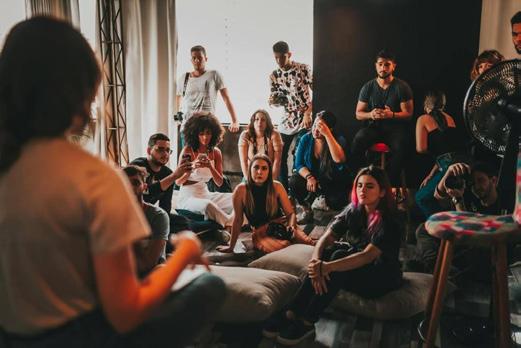
Yasmin Khan is a British-Pakistani writer, journalist, and activist. In her article, “The Resurgence of Spoken Word: From Slam Poetry to Digital Performance,” Khan explores the unique capacity of spoken word poetry to embody identity, activism, and intersectionality while fostering social change, both at live events and in digital spaces.4
Read an excerpt from Khan’s article HERE. Then, reflect on the article and discuss it as a class.
Comprehension Questions:
1. How does spoken word defy the “limitations of print”?
2. How does the embodied form of spoken word “disrupt traditional hierarchies?”
3. What makes spoken word audiences essential in performance spaces and on digital platforms?
4. How has the spoken word poetry of TikTok adapted to the platform? How does it differ from spoken word poetry on YouTube?
5. What makes digital spoken word poetry accessible to both poets and audiences? Why is this important? In Khan’s view, what is the downside to this accessibility?
6. What sets digital spoken word apart from other kinds of digital content?
7. How does spoken word celebrate diversity?
8. Define the following words: “ephemerality,” “commodification,” “pedagogy,” “brevity,” and “multilingualism.”
Discussion Questions:
1. To Khan’s mind, the inherent vulnerability of spoken word poetry is not a “weakness” but a “connection.” What does she mean by this? How does Chum explore the inherent vulnerability of spoken word in Kween?
2. Reflecting on the unique nature of spoken word, Khan writes that “speaking itself is a refusal to be silenced.” Do you think speech and performance are better suited to challenging oppression and inspiring social and political change than the written word? Why or why not?
3. Khan writes that the current resurgence of spoken word poetry “suggests a cultural hunger for presence in an era of
detachment.” What is this “era of detachment” the result of? Do you think Soma would agree with Khan’s sentiment? Why or why not?
4. In the article’s conclusion, Khan writes that the popularity of digital spoken word “does not erase the importance of live performance. Rather, it creates a continuum where physical and digital stages coexist.” Is this unique to spoken word? Do you think a similar “continuum” could exist between live theatre and potential forms of digital theatre? Why or why not?
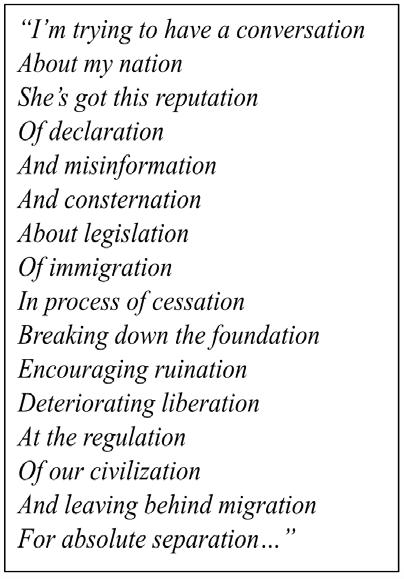
Throughout the play, Soma turns to spoken word poetry to express and explore her thoughts and feelings. Kween begins with Soma taping herself performing a spoken word poem, titled “A Khmer Scene.” Soma then posts this video on TikTok, only to see it go viral. Later in the play, after Soma struggles to perform another one of her poems before a live audience, she recites a new poem, titled “Self-View,” alone in her room.

Read "A Khmer Scene" "Self-View" before analyzing and discussing them as a class or in small groups.
Comprehension Questions:
1. What are each of these poems about? Summarize them.
2. What literary devices do you recognize in these poems?
3. How do the narration styles of these poems differ?
4. What rhyme schemes do you recognize in these poems?
5. In “A Khmer Scene,” Soma says that her father was “rewarded” for years for “behaving like the imported.” What does she mean by this?
6. What does the word “consternation” mean? What does the word “comported” mean?
7. What might the “red light” Soma refers to in “Self-View” be?
8. In “Self-View,” Soma says, “She’s not looking for a tear / From ye avatars out here / Chick doesn’t even know / Who’s hooked into this flow.” What does she mean by this?
Discussion Questions:
1. "A Khmer Scene" is written in first person, while “Self-View ” is written in third person. What effect do these different narration styles have on the reader/listener?
2. Consider the broader context of these poems. What do each of them reveal about Soma’s character and her mindset? How so? How do each of these poems function within the dramatic arc of the play?
3. Vichet Chum says that spoken word poetry’s primary intention is to “get to the raw, messy truth.” What “raw” and “messy” truths does Soma explore in these poems?
Kosal Khiev is a Cambodian spoken word poet and tattoo artist. Khiev was born in a refugee camp in 1980, after his parents escaped the Khmer Rouge’s rule in Cambodia. Khiev and his mother immigrated to the United States in 1981, and Khiev grew up in California. When he was 16, Khiev was involved in a gang shoot-out. He was tried as an adult and served 14 years in prison. Khiev began writing while incarcerated and attended poetry classes offered by the Arts in Corrections program. Upon his release from prison, Khiev was deported back to Cambodia, a country he had no memory of. Khiev was invited to London in 2012, where he represented Cambodia in the Poetry Parnassus, a poetry festival associated with the London Olympics. In his poem, “Why I Write,” Khiev reflects on his reasons for writing poetry. In the following activity, students familiarize themselves with the poem, reflect on its form and themes, and connect Khiev’s work to Soma’s poetry in Kween.
Watch and Listen:
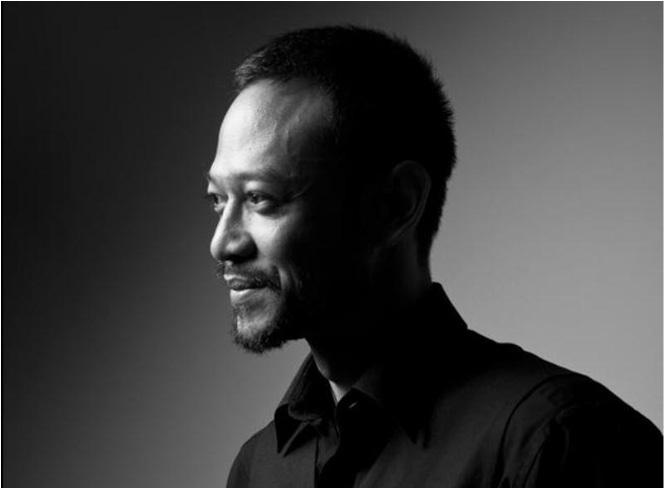

To begin, have students watch the video of Khiev performing his poem, “Why I Write” at the Southbank Center in London.
QuickWrite:
After listening to the poem once, have students quick write individually for 5 minutes. Have them write and reflect on the following questions: What stands out to you about this poem? What makes this poem effective?
Read:
Next, divide the class into small groups. Have students read the poem silently to themselves, and then have them read the poem aloud as a group by “popcorning” it to each other. The full text of the poem is available HERE.
Analyze:
Individually or in groups, have students analyze the poem using a close reading worksheet.
Discuss:
1. If you had to summarize why Khiev writes in one word, what would it be?
2. Having watched, read, and spoken the poem aloud, what stood out to you? Were different things brought to your attention by familiarizing yourself with the poem in these three different ways?
3. Unlike some other poems, the text of this poem has no stanza breaks. Why do you think this is?
4. Khiev also uses slang and abbreviations in the text of this poem, sometimes writing “4” instead of “for,” “u” instead of “you,” and “cuz” instead of “because.” The poem’s written text also contains a few typos. Why might this be? Is this intentional? What effect does this have on the reader?
5. What similarities do you notice between Khiev’s poem and Soma’s poetry?
6. If Soma were to write a poem called “Why I Write,” what might her poem include?
More Spoken Word Poems by Kosal Khiev
• Moments In Between The Nights
• Love U I
• Earthy
Sticky-Note Brainstorming
Write a single word on a number of large sheets of paper and hang them around the classroom. Give each student a number of sticky notes, and have everyone walk around the classroom. For each word they encounter, students should write another word or short phrase they associate with it on a sticky note and paste it onto the large sheet of paper. After everyone has pasted their sticky notes, have students walk around, consider the results of the communal brainstorm, and then share observations.
Words that work well for this exercise include: Humans, history, heritage, culture, poetry, politics, social media, performance, family, rhythm, borders, love, United States, identity, and hometown.
Word Association Chain
Provide the class with a single word and instruct each student to write it on a blank page. Then, next to this word, have them write the first thing they associate with it. For 5 minutes, have students continue on silently, writing the first word that comes to mind when they think of the last word they wrote (and only that word). An example is as follows:

Assonance Applies
Assonance, the repetition of vowel sounds, is one of the most common literary devices utilized in spoken word poetry. Have students practice using assonance by creating lists of singlesyllable, two-syllable, and three-syllable words that share the vowel sound of the provided word. A practice worksheet for this exercise is available HERE
Bad Poetry
Have students use their knowledge of what makes an effective spoken word poem to compose the worst spoken word poem they can come up with. This exercise is a useful way for students to reflect on the skills and techniques required to craft an excellent spoken word poem, while relieving them of the pressure to produce something “good” immediately.
Extension Activity: Bad spoken word poetry deserves to be performed as poorly as possible! Have students perform their poems for the class.
Electric Company
Divide the class into pairs. Student A says a noun, for example, “shoe.” Student B then offers a second word that creates a compound word or phrase, for example, “laces.” Together, both students say the whole phrase (“shoelaces”), followed by the rhythm, “duh-do-do.” Student B then offers a word, which Student A expands upon. After a few minutes, scramble up the pairs and begin again.
In this improv exercise created by Baltimore Musical Improv, students hone their quick thinking, metaphor-making, rhythm, and rhyme skills. In a circle, have the first person share two rhyming lines that follow the format, “It’s like the _______ without the _______”. For example, “It’s like the pilot without the plane, it’s like the head without a brain.” The next person in the circle repeats the last line and then adds a second rhyming line of their own. For example, “It’s like the head without the brain, it’s like the sink without the drain.” Continue around the circle.
Have one student begin the scene by delivering and finishing the line “Love is like…” (e.g., “love is like a tidal wave”). Then, have a student in the audience jump up and join the scene by delivering a second line that rhymes with the first (e.g., “It’ll send me to an early grave”). Have these two students continue the scene, taking turns delivering rhyming lines on the topic of love and acting them out accordingly. If a student fails to deliver a rhyming line in a timely manner, another student from the audience takes their place and continues the scene. Coming up with exact rhymes and slant rhymes is the goal of this game; however, because finding new rhymes becomes more difficult as the game continues, students may make up their own words, so long as the made-up word’s meaning can be easily inferred by the audience.
1. Write about your name. What is the meaning of your name? Why were you given your name?
Write a poem about what it means to come of age in 2026.
Write about where you come from: your hometown, your ancestors, your heritage, etc.
Write a poem that serves as a complaint.
Write a poem that serves as a letter.
Write a poem that serves as a warning.
Write a poem that serves as a promise.
Write about something you think more people should talk about.
Write about something that others don’t know about you.
Write about something you would take with you if you had to leave home for a long period of time. 11. Write about a social or political issue that you care deeply about. 12. Write about an event or interaction in your life that changed you or changed how you saw the world.
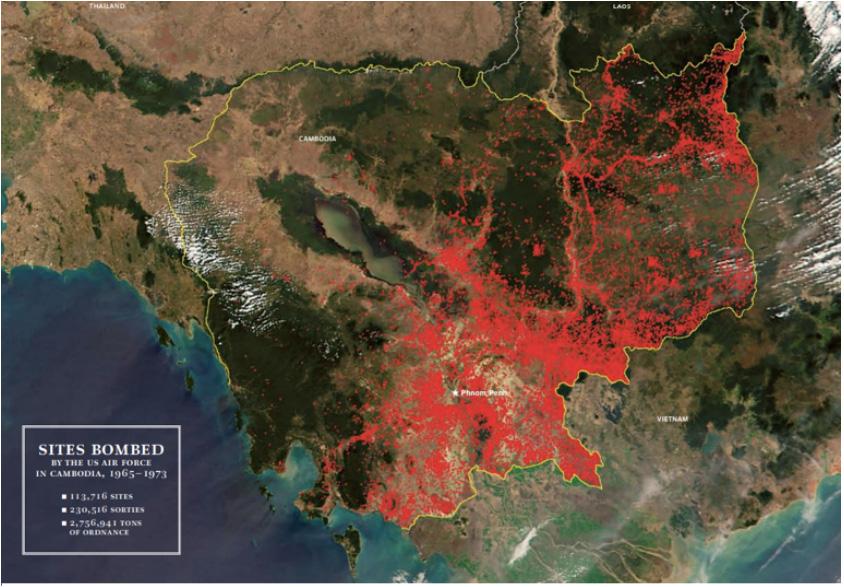

By 1965, the United States was years into a losing conflict in Vietnam, supporting the Southern Vietnamese troops against the Communist Viet Cong to the north. Cambodian Prince Sihanouk cut ties with the United States, claiming he sought to remain neutral in the Vietnam War. Sihanouk nevertheless allowed communist North Vietnamese troops to utilize Cambodian ports and take refuge in Cambodian towns and jungles. In retaliation, the United States, under President Johnson, launched several covert, targeted airstrikes along the Cambodian-Vietnamese border. Bombing increased drastically in 1969, and the United States began carpet bombing the mobile headquarters of the Viet Cong as they tracked them through the Cambodian jungles. In 1970, a military coup deposed Prince Sihanouk. Lon Nol, a Cambodian nationalist, took power as prime minister with support from both the United States and South Vietnam. To buy the increasingly unpopular Lon Nol government time against the encroaching Pol Pot-led Khmer Rouge, and to provide the retreating U.S. troops with cover, President Nixon ordered Operation Menu to be carried out. Operation Menu involved extensive carpet bombing deeper inside Cambodian territory, across both jungles and densely populated villages and towns. The extent of this operation was mainly kept secret, for it blatantly disregarded Nixon’s
promise to Congress that the bombing in Cambodia would only occur thirty kilometers from the Vietnam border and always avoid civilian towns by a minimum of one kilometer. Between 1965 and 1973, the United States dropped 2,756,942 tons of bombs on Cambodia, a net weight larger than the total weight of bombs dropped by all the Allied countries in World War II. The result was the loss of hundreds of thousands of Cambodian civilian lives. One Nixon administration official stated years later: “We had been told, as had everybody… that those carpet-bombing attacks by B-52s were totally devastating, that nothing could survive.” The death and destruction brought forth by the United States’ attacks perpetuated anti-Western, anti-American sentiment among the Cambodian people. The Khmer Rouge capitulated on this growing hatred and unease, shaping their propaganda tactics around the American-induced devastation. Former Khmer Rouge officer Chhit Do explained that it was common practice for the Khmer Rouge to lead civilians to the bombing sites:
Every time after there had been bombing, they would take the people to see the craters, to see how big and deep the craters were, to see how the earth had been gouged out and scorched…Terrified and half crazy, the people were ready to believe what they were told. It was because of their dissatisfaction with the bombing that they kept on co-operating with the Khmer Rouge, joining up with the Khmer Rouge, sending their children off to go with them....5
By 1973, the United States Congress became aware that it was being deceived about the extent of U.S. military destruction in Cambodia. Congress ordered a halt to the operation, but by then, the damage was irreparable; civilian lives had been lost, and villages destroyed, and the Khmer Rouge had amassed an additional 200,000 troops. Two years later, the Khmer Rouge took the capital of Phnom Penh, and Pol Pot’s reign of terror began.
When Pol Pot and the Khmer Rouge took power in April 1975, they began their rule by murdering the officials of the former government and military personnel. In a matter of days, urban areas, including the capital city of Phnom Penh, were emptied. Schools, banks, businesses, and even hospitals were closed and destroyed. Seen as enemies of the rural agrarian utopia Pol Pot sought to create, city dwellers, labeled as “New People,” were forcibly removed from their homes and relocated to the countryside. Those who refused were killed, as were those who lagged behind. On the long treks from city to country, many individuals were told that the cities were being emptied to protect the citizens and that Americans were bombing cities.
Many of these victims, particularly the sick, disabled, and elderly, died on the way to the countryside. Those who survived were immediately put to work in labor camps and farming communes, where they were overworked, underfed, and beaten. Families were separated, and communes were divided by age and gender. Unauthorized meetings with family were forbidden and resulted in execution. Living conditions were poor, and rations were small; many forced laborers starved to death, and others perished or suffered from diseases like malaria, typhoid, cholera, dysentery, intestinal worms, and

infection.
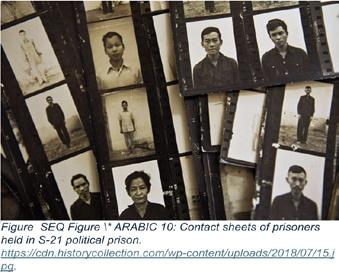
While many toiled to death in the countryside, other individuals were deemed too large a threat to live. Intellectuals and professionals were targeted and branded as “capitalist imperialists.” They were tortured and executed along with their families. Religious individuals of various denominations were targeted and killed, Buddhists and Christians among them. However, it was the Cham Muslims who were particularly singled out; nearly 80% of the Cham population in Cambodia was eradicated during the Khmer Rouge’s reign. In political prisons like the infamous S-21 (Tuol Sleng), prisoners were interrogated and tortured with waterboarding, hosing, sleep deprivation, suffocation, and various forms of maiming.6 Bodies piled up by the thousands, and unable to bury bodies quickly enough, individuals were marched to mass graves, today known as “Killing Fields,” where they were beaten to death. Western medicine was considered a product of capitalist imperialism and was no longer practiced. With nearly all doctors imprisoned or executed, the regime relied on child medics who were encouraged to perform medical experimentation without anesthesia on political prisoners. The rate of killings spiraled as the Khmer Rouge became more paranoid. Frustrated that the forced labor wasn’t meeting food production goals, the Khmer Rouge looked for scapegoats at every turn: the intellectuals, the monks, the petty bourgeoisie, the individualists, the New People, and the secret capitalist imperialists all sought to undermine their rule and return Cambodia to the days before the “glorious revolution.” By the end of the reign, the increasingly paranoid Khmer Rouge had begun executing members of the party. Officials were killed for failing to meet impossibly high harvest demands or for failing to find and punish any number of imagined traitors. By the time the Khmer Rouge was removed from power, between 2 million and 3 million Cambodian citizens had died by execution, starvation, overwork, and disease. Nearly 25% of the Cambodian population had been wiped out in less than four years.

Since the 19th century, immigrant communities have been foundational to the city of Lowell’s community, culture, and industry. By the mid-20th century, Irish, French Canadian, Greek, Portuguese, and Latin American immigrants had ventured to Lowell in search of better lives for themselves and their families. In the late 1970s, Lowell became a relocation and secondary immigration center for Southeast Asian refugees, and by 1980, the city had welcomed fewer than 100 immigrants from Cambodia and its neighboring countries of Vietnam and Laos. These newcomers were attracted to Lowell’s affordable housing, and, once settled, they established community centers, small businesses, and a temple. That same year, President Jimmy Carter signed the Refugee Act of 1980, which authorized an annual increase in the number of accepted refugees from 17,400 to 50,000. This new legislation led to a great influx of Lowell’s Cambodian and Southeast Asian population.
Throughout the 1980s, this influx reached new heights as Massachusetts experienced expansive economic growth. Known as the “Massachusetts Miracle,” this economic boom resulted in part from the arrival of high-tech, healthcare, and financial service companies. During this period, unemployment declined from 12% to 3% statewide, taxes were lowered, and residents saw an increase in income. Mayor Michael Dukakis perpetuated this boom by funding loans and grants to several cities and towns, including Lowell. His administration also established several refugee support agencies.
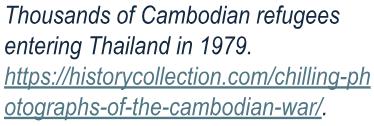
As an industrious, affordable, immigrant-friendly city with a newly established Cambodian community, Lowell appealed to arriving Cambodian refugees more than ever. During this time, an estimated 30,000 Cambodian immigrants and refugees settled in Lowell. Most of these refugees were survivors of the Cambodian genocide who had witnessed the mass atrocities of the Khmer Rouge’s regime. Today, Cambodian Americans make up a fifth of Lowell’s population. As home to the secondlargest diasporic Cambodian population in the United States, Lowell is a hub of Cambodian community and cultural institutions.
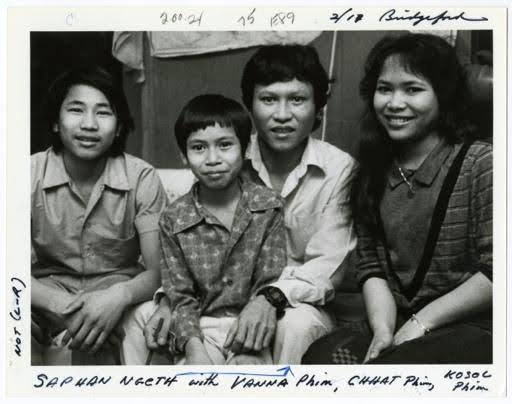
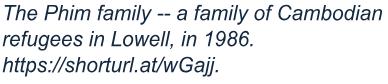
Suggested Further Viewing and Reading: Southeast Asians: A New Beginning in Lowell is a photobook by James Higgins and Joan Ross, with a foreword by Dith Pran and an introduction by Hai B. Pho. This photobook documents the lives of Cambodian, Vietnamese, and Laotian immigrants and refugees in Lowell during the 1980s. The book is available for reading and digital downloading through UMass Lowell’s SEA Digital Archive
In May of 1975, President Gerald Ford passed the Indochina Migration and Refugee Assistance Act, which allowed around 13,000 South Asian refugees to enter the United States legally. This act was passed to aid and resettle the many Vietnamese, Cambodian, and Laotian people who had been displaced during the Vietnam War.
In 1996, President Bill Clinton signed the Illegal Immigration Reform and Immigrant Responsibility Act into law. Designed to deter illegal immigration, the law cracked down on punitive measures for noncitizens who had committed a crime or overstayed their visas. In 2002, the United States and Cambodian governments signed a repatriation agreement negotiating deportation processes for Cambodian Americans with criminal records who were not U.S. citizens.
Since then, more than 1,000 Cambodian Americans have been deported back to Cambodia. The majority of these deportees are men in their twenties and thirties who were born in refugee camps. Many have no memory of the home country they are forced to return to. Reporting on the issue, journalist Vivian Ho notes that the formerly convicted deportees have “already repaid their full debt to society when they [are] sent back… They are, for all
intents and purposes, handed a second sentence – this time for life.”7 Many of those deported leave behind families, communities, and careers, and many face language barriers, economic difficulty, isolation, addiction, and other mental health struggles after leaving the United States. The Khmer Vulnerability Aid Organization (KVAO), a non-profit seeking to aid, settle, and integrate newly arrived deportees, reported that 8% of its members have died since returning to Cambodia, some by suicide.
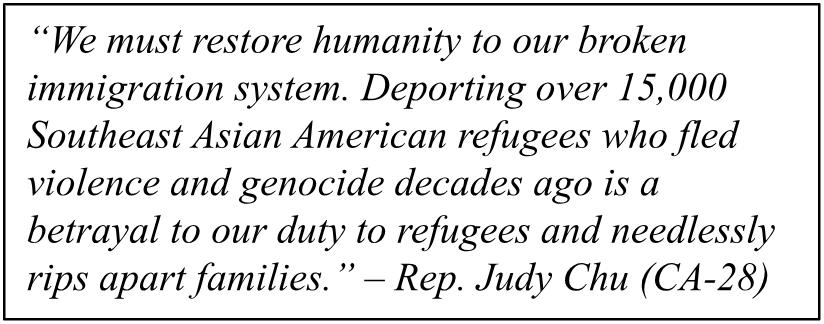
In 2022, the Prime Minister of Cambodia, Hun Sen, met with President Joe Biden. He urged the United States to reevaluate and “amend” the 2002 repatriation agreement due to the “humanitarian aspects of the issue.”8 Nine months later, U.S. representatives Judy Chu, Pramila Jayapal, Zoe Lofgren, and Ayanna Pressley introduced the Southeast Asian Deportation Relief Act of 2023 (SEADRA), a bill that would “limit the Department of Homeland Security’s ability to remove” members from Southeast Asian refugee communities, and “strengthen the process of reopening deportation cases, ensuring that Southeast Asian refugees who have already been deported can return home to the U.S.”9
Have students read and consider the proposed Southeast Asian Deportation Relief Act of 2023 10
Discuss:
1. Consider Sec. 2 of this proposed bill.
a) What are some of the findings presented?
b) What is the purpose of sharing these findings? How do they shape your understanding of the proposed bill?
2. What would this proposed bill achieve? Summarize Sec. 3, 4, and 5.
3. What arguments could be made to support this proposed bill?
4. What arguments could be made in opposition to this bill?
Suggested Further Reading and Resources:
• “‘Like becoming a refugee again’” by Vivan Ho, The Guardian
• “US Deports Dozens More Cambodian Immigrants, Some for Decades-Old Crimes” by Denise Couture and Ashley Westerman, NPR
• The Indochina Migration and Refugee Assistance Act of 1975, H.R.6755
• “The U.S. Immigration Debate” by Diana Roy, Claire Klobucista, and Amelia Cheatham, Council on Foreign Relations
• Resources for South Asian Refugees Facing Deportation (SEARAC)
• Resources for People Detained in the United States (Freedom for Immigrants)
• Know Your Rights and More Resources (MA Immigrant and Refugee Activist Coalition –MIRA)
7 Vivian Ho, “‘Like becoming a refugee again’: They paid for their crimes. The US deported them anyway,” The Guardian, August 17, 2023, https://www.theguardian.com/ world/2023/aug/17/cambodia-prison-sentence-deportation
8 Ry Sochan, “PM asks US for ‘humanitarian’ shift in deportation policy,” The Phnom Penh Post, November 22, 2022, https://www.phnompenhpost.com/national/pm-asks-ushumanitarian-shift-deportation-policy
9 Judy Chu quoted in “Reps. Chu, Jayapal, Lofgren, & Pressley Introduce Southeast Asian Deportation Relief Act to Keep Refugee Families Together,” press release, August 22, 2023, https://chu.house.gov/media-center/press-releases/reps-chu-jayapal-lofgren-pressley-introduce-southeast-asian-deportation
10 Judy Chu, et al., US Congress, House, Southeast Asian Deportation Relief Act of 2023, 118th Congress, 1st sess., H. Rep. 5248, https://chu.house.gov/sites/evo-subsites/chu.house. gov/files/evo-media-document/seadra-final-text-updated-8-18-2023.pdf