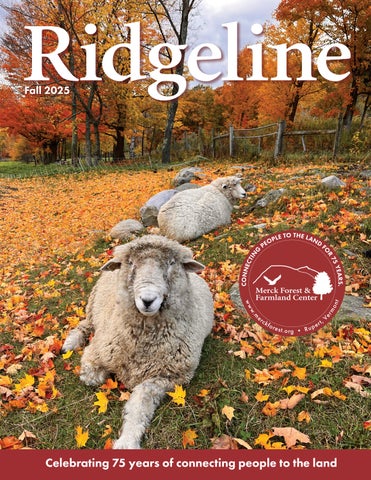
Fall 2025
Celebrating 75 years of connecting people to the land
MFFC BOARD OF TRUSTEES
Celebrating 75 Years of Merck Forest & Farmland Center This fall, as the seasons change, we reflect on the many transitions that have shaped Merck Forest & Farmland Center. For 75 years, this landscape has been a place of learning and renewal. Where curiosity becomes stewardship, and visitors become lifelong friends of the forest and farm. Together, we honor this legacy of conservation, education, and community. And together, we look to the future—protecting this landscape, deepening connections to the natural world, and inspiring the next generation of caretakers.
Jill Perry Balzano Dinah Buechner-Vischer Renee Flesch Barrett Geoffrey Flynn Greg Hopper, Treasurer John Stasny, President Keely Levins Culligan Kate Kavanaugh Erik Sandvick
ADVISORS
Chip Ams Donald Campbell Jean Ceglowski Austin Chinn Sue Van Hook Vlad Ivanov George Hatch Jon Matthewson Dee Myrvang Sam Schneski Katelyn Stevens Paul Wheeler
STAFF
Your support makes this work possible. As we celebrate 75 years, we invite you to continue beside us. Together, we ensure that the transitions ahead are filled with growth, discovery, and a love of this remarkable place. Thank you for being part of Merck Forest & Farmland Center’s story Past, Present, and Possible. Content & Images: MFFC Staff • PG 15 lower left, image courtesy of Andrew McKeever PG 21 & 31 Twilight image courtesy of @chasinghippos Magazine layout: Renée Noel-Cutler 2
Renata Aylward, Communications Manager Darla Belevich, Visitor Center Staff Stephanie Breed, Visitor Center Staff AJ Brundige, Field Educator Dylan Durkee, Fleet & Facilities Manager Marv Gates, Visitor Center Staff Chris Hubbard, Education Specialist Carson Robinson, Land Management Assistant Eric Jenks, Field Educator Marybeth Leu, Operations Director Keenan McMorrow, Land Management Assistant Tom O’Handley, Senior Director of Development Cara Davenport, Sr. Education Manager Amy Pim, Development Coordinator Elena Santos, Education Manager John Schneble, Director of Program Hadley Stock, Farm Manager Mike Stock, Land Resource Manager Rob Terry, Executive Director Ryan Warner, Timber Shop Assistant
Voices from the Ridge: Letters from Leadership By Rob Terry, Executive Director
By John Stasny, President
As the colors begin to shift across the ridges and valleys, I’m reminded once again of the many unique gifts this land offers—including the chance to witness seasonal change on a grand, unhurried scale. With the arrival of fall at Merck Forest & Farmland Center comes a kind of clarity: cooler air, sharper light, and a renewed invitation to take stock of where we’ve been and where we’re headed.
The mornings in particular have been glorious lately in Southwestern Vermont. When I breathe the cool, crisp morning air and see a pink sky over green mountains decorated with wisps of cloud and patches of early fall color, I feel a refreshing peace, and a voice somewhere in my soul whispers reassuringly, Ahhh, all is well. But then I remember: all is not well. I have learned from others at Merck Forest—people who know more about the subject than I do—about the many alarming ways that the picturesque forests and fields in my morning scenes are dying before our eyes. Rapidly changing climate, opportunistic pests, diseases, invasive flora, and a host of related maladies are taking a lethal toll. It forces me to ask: How can we honestly face these frightening realities and hold the weight of the unanswered challenges they pose to our future, without it stealing the moments of peace and refreshment that so many of us want to find in the outdoors?
This year, that sense of reflection carries special significance for me. On September 1, I began a two-month sabbatical. This time away is not a departure from our work, but rather an opportunity to step back from the daily rhythm and devote focused, intentional thought to the big questions before us: How will Merck Forest grow, adapt, and lead over the next 75 years? Amidst unprecedented global change, what should we hold fast to—and where must we embrace transformation? Our 75th anniversary is more than a celebration of the legacy built by those who came before us; it is also a call to chart a bold course for the decades ahead. During this sabbatical, I’ll be engaging deeply with paleoclimatic data and climate modeling to understand how we can work alongside the species with whom we share this land, ensuring that its rich biodiversity endures as we enter what is forecast to be the most rapid period of warming in our planet’s history.
I have no answer, but I encourage you to try two things this fall that I find helpful. First, get into the woods and slow down. Visit Merck Forest if you can, or find a nearby park or preserve. Take a quiet walk, or just be still. The feel, smells, sights, and sounds of a bird call, sunlight, and breeze through changing leaves, damp earth, and subtle signs of life can soothe us somewhere deep down, and in the same moment call us forward to fearlessly ask questions, confront the problems we discover, and take bolder action toward solutions.
While I’m away, our dedicated staff and board will continue the work that makes this place thrive: tending the forests and farm, welcoming visitors, engaging students, and safeguarding the wild and working landscapes that define Merck Forest. I am deeply grateful to be part of such a capable, committed team.
Second, connect with people who are on the same journey. Attend an event at Merck Forest or step into our Visitor Center, and introduce yourself. We’d love to meet you! We have a passionate team of staff and volunteers with a wealth of knowledge about the challenges and the hope for our wild and working lands, within Merck Forest and beyond. We do not have all the answers, but we are not afraid to ask questions with you, and we can still enjoy a good, slow walk in the woods.
When I return, I look forward to sharing the ideas and inspirations gathered during this time, and to working alongside all of you—friends, partners, and supporters—to ensure that Merck Forest continues to flourish as a place of learning, discovery, and connection for generations to come.
3
Stay in the Colors at Merck Forest By Renata Aylward Communications Manager There’s a cabin with your name on it. Actually, there are nine, each one is tucked into Merck Forest & Farmland Center’s 3,500 acres of hills, woods, and winding trails. In autumn, those hills shift into one of New England’s most spectacular transitions with a riot of red, gold, and orange that makes you forget the world beyond the treeline. Fall at MFFC is unique, and staying in a cabin is a front-row seat to Vermont’s most spectacular show. Cool nights call for flannel and firewood, and maybe a mug of hot cider under the stars. Whether this is your first visit or a return to a beloved tradition, MFFC’s backcountry cabins offer a rare kind of Vermont experience: no crowds, just trails, sky, and the occasional sound of a porcupine gnawing on a tree nearby. It’s a front row seat to the seasons changing. All of the cabins are rustic, unplugged, and hike-in, each equipped with a woodstove, fire pit, and outhouse. Beyond that, what you bring is up to you. You’ll need the essentials like a sleeping bag, chocolate, a headlamp, chocolate, card games, more chocolate. Visitors who stay in a cabin often tell us the same thing: they came for the foliage, but what stayed with them was the feeling of being in the middle of something bigger. The landscape shifting its colors around them. Their own sense of pace shifting, too. This fall, if you need a reset, there’s a cabin waiting. Stay in the colors and let Vermont’s brightest season stay with you. 4
5
The Inconvenient Road Ahead: Why an Eight Hour EV Trip Matters By Rob Terry, Executive Director I recently found myself outside of Binghamton, New York, parked behind a closed community health center, watching electrons trickle into MFFC’s trusty Chevy Bolt early on a Sunday morning. I was on my way from Merck Forest & Farmland Center to Washington, DC, to connect in person with some of the partners who help make our work possible. Upon plugging into the deceptively labeled “fast” charger, I was informed that I would be ready to hit the road, with a nearly full battery, in a scant hour-and-forty-five minutes. With nothing in walking distance except a few closed car dealerships and some office buildings, I settled in. Going electric tacked an extra three hours onto the typical seven-and-a-half-hour trip from my home in the Taconic Mountains to the nation’s capital. The inconvenience of waiting for a battery to charge is the price of not running on gasoline. It’s the price of trying to do something differently in a world that has long favored convenience over consequence. As I sat there, staring at a sky streaked pink by the rising sun, I couldn’t help but think about how small my annoyance was compared to what’s coming if we don’t make far bigger changes than this.
The Long View: Lessons from Deep Time Today’s climate story is not new, but it is unprecedented in speed and scale. I often ground my thinking in paleoclimatic records, those time machines written in ice cores, sediment layers, and fossilized pollen grains. Fifty-six million years ago, during the Paleocene–Eocene Thermal Maximum (PETM), carbon dioxide surged into the atmosphere, likely from massive volcanic activity and methane hydrate release. Global temperatures rose by 9-15°F in less than 20,000 years—a geological instant, but a leisurely pace compared to what we are forcing today. Forests migrated poleward, tropical species surged into previously temperate zones, and oceans turned acidic. It took over 100,000 years for the Earth to stabilize. Go back further: ninety-seven million years ago, in the Cretaceous Hot Greenhouse, atmospheric CO₂ levels exceeded 1000 ppm, and crocodiles basked in the Arctic. Or forward again to our own Holocene epoch, the 11,700-year warm interlude that has allowed agriculture, cities, and everything we call “civilization” to flourish. We have built our entire way of life on the stable climatic plateau of the Holocene—and we are now kicking the legs out from under it. 6
The Intergovernmental Panel on Climate Change warns that on our current trajectory (SSP5-8.5), we could see PETM-level warming by 2100—ten to one hundred times faster than any comparable shift in the geologic record. For the northern temperate forests we steward at Merck Forest in Vermont, this means species like sugar maple may retreat upslope and northward, while oaks—perhaps grown from the very acorns elementary school groups will scatter in coming years—become keystone species in a transformed forest. It means invasive pests will continue to expand in milder winters, storms will topple stands of trees not evolved for saturated soils, and the ecological baseline for “restoration” will evaporate before we can even define it. This is not abstract. It is the ground under our boots, the canopy over our heads, the livelihoods of our farmers and loggers, the childhood winters we remember, and the future the students we teach will inherit.
Facing the Scale of Change When I talk about this with young people, high schoolers helping manage invasive species in forested stands slated for harvest to improve resilience, or undergraduates at the University of Vermont designing wetland restoration plans—the question always comes in some form: “Is there any hope?”
“The inconvenience of waiting for a battery to charge is the price of not running on gasoline. It’s the price of trying to do something differently in a world that has long favored convenience over consequence”
My answer is complicated. There is hope, but only if we redefine what hope looks like. Hope is not the passive comfort that someone, somewhere, will invent a silver bullet. Hope is active, messy, and often inconvenient. It looks like that eight-hour EV road trip: a series of imperfect, incremental choices that add up to a different trajectory. It looks like adaptive management—setting a course, monitoring what happens, adjusting when reality veers from expectation. It looks like a society willing to embrace disruption before disruption is forced upon us.
We need to be honest: the changes required are not small. We cannot tinker at the edges of a system built on fossil carbon and expect a different outcome. The scale of transformation needed—decarbonizing energy, rethinking agriculture, redesigning cities, reforesting landscapes—is daunting. It will strain institutions, unsettle economies, and challenge identities. But we have done hard things before. We built international systems to reduce ozone-depleting chemicals when we discovered a hole in the sky. We phased out lead in gasoline and paint, protecting millions of children. We created the national park systems that safeguarded landscapes for future generations. None of those victories was perfect, but they were real.
The Personal as Political Merck Forest & Farmland Center manages 3,500 acres of working forest and farmland on the southern edge of the Northern Appalachian–Acadian ecoregion, in a critical corridor for species migrating northward in response to the warming climate. As ecological shifts driven by the changing climate accelerate, our mission to inspire curiosity, love, and responsibility for working and natural lands increasingly centers on preparing people, not just landscapes, for the challenges ahead. Long-term forest monitoring plots are being established to track climate impacts, offering participants not only data but a tangible role in documenting change. Assisted migration trials with oaks will build future canopy resilience while demonstrating that human intervention can support adaptation rather than simply record decline. When students disperse acorns in a sugar maple stand, they learn more than ecological theory; they experience what it means to contribute to resilience in the face of uncertainty. Each observation, each seedling, reinforces the idea that individual actions can influence collective outcomes. That sense of agency, rooted in doing, not just learning, may prove as vital to the future of these forests as the trees themselves.
A Necessary Inconvenience So yes, that eight-hour EV trip was inconvenient. It tested my patience and forced me to think ahead in a way I hadn’t when I could just fill a tank in three minutes and be on my way. But maybe that’s exactly what we need: a little inconvenience to remind us that comfort has always come at a cost, and that real change rarely feels easy at the start. In the coming years, we will all be asked to take trips that are longer than we’d like, to invest in futures whose payoff we may not see, to change habits forged over generations. The question is not whether it will be hard; the question is whether we will choose to do it on our terms, or have it forced upon us by a planet we’ve pushed too far. When I finally pulled into my driveway at the end of the trip, the battery nearly empty, I realized the road ahead will not always be smooth, but at least I was still moving forward. That, I think, is the work of our time. 7
The Joy Green Visitor Center Turns 35 By Stephanie Breed, Visitor Center Staff
“For many years, Merck Forest & Farmland Center (MFFC) meant a great deal to Joy Green—and Joy meant a great deal to Merck Forest. She loved every acre, every trick of the weather, every twist of the road. She delighted in bird song and human voices, the rustle of air among the leaves, the music of pebbles tumbling in a stream. Merck Forest was her haven, her escape, her delight, her enchantment—her shalom.” Throughout MFFC’s history, a remarkable group of individuals has shaped its path with vision, dedication, and care. Joy was among these influential leaders. Beginning in the late 1960s, she was a frequent visitor, volunteer, and board member, and throughout the 1980s, she served as Board President. During her tenure, Joy championed the expansion of environmental programs and strengthened the organization’s community outreach. Forty years ago, visiting “The Merck” was a different experience. The property had no electricity, access to the backcountry was limited, and the small education center—housed in a corner of the Harwood Barn—was run by weekend volunteers and closed in winter. School groups, summer campers, interns and Student Conservation Association participants immersed themselves in farm, field and forest work. The Winter Wildlife Study, later renamed the Wintering Program, offered college students a month-long immersion in survival skills and winter ecology. Public programs and guided hikes began drawing more visitors. As interest grew, so did the idea for a dedicated visitor facility. At the groundbreaking ceremony on August 26, 1989, Joy said:
“This building…will teach about our belief in reverence for life and good stewardship of our earth. We hope that everyone who comes here will learn something about the natural world and appropriate attitudes toward it. So, when next you visit Merck, we hope you will learn something you didn’t know before. Maybe you’ll even tell us about that.” The Winter 1989 Ridgeline described the new headquarters: “The construction of the new headquarters building is well underway and expected to reach completion in February. Designed by architect Thomas Keefe of Bennington, the headquarters will exemplify environmental values of the organization. Occupying a woodland site, the 1,500-square-foot building will be solar powered, with electricity generated by a state-of-the-art photovoltaic system. Heat will be produced by a highly efficient Finnish masonry wood stove. Special glazing and insulation will minimize heat loss. The building’s appearance will fit unobtrusively into its setting. Located at the front entrance gate of Merck Forest, the headquarters will be a convenient and inviting place for visitors to drop in, ask questions, and pick up information.” Sadly, Joy passed away before the building was completed. On June 9, 1990, the new center was dedicated in her honor as the Joy Green Visitor Center. In his remarks, Carl Reidel—family friend, trustee, and UVM Director of Environmental Studies—said: “Let us make a… commitment as we dedicate this new center that our land management and education programs will speak clearly and forcefully to all who visit here: that conservation is a matter of the heart and spirit as much as mind and matter; and that conservation is an ethical idea… an ethic rooted in understanding and respect for nature and spiritual values.” In its early years, the Visitor Center was staffed by volunteers who greeted guests, provided maps, offered trail recommendations and sold maple syrup. Shared offices gave the growing paid staff much-needed workspace. Today, the building hums with activity. The shop sells MFFC grown meat, maple syrup and a wide range of educational materials. Field Educators prepare for camps, workshops, and festivals. Technology upgrades keep operations smooth, and weekly all-staff meetings bring together teams from land management, farming, education, administration and facilities. On a personal note, the Greens were our neighbors and Joy was my godmother. Her son Jon often brought his younger brother 8
Ricky and my brother Chad camping here in the late 1960s. Jon recently reflected: “Inevitably, our memories of Joy fade, and yet, in my mind’s eye, I can see her hiking into Merck with her husband, Bob, and a dog or two in tow, a piece of Timothy grass between her teeth—or maybe sitting on a blanket enjoying a picnic. I can almost hear her warm, melodic voice when she sees you coming. Joy loved and cared for Merck Forest in much the same way she cared for her family of five sons. As with her family, MFFC represented all the wonderful possibilities for life. She loved how it made her feel safe, inspired, and positive about nature and all that it offered. At Merck, anything seemed possible—and she wanted to share this magical place with family, friends, and anyone willing to engage with it. That love of the land—and of how Merck makes us feel about ourselves, each other, and the natural world—is her enduring legacy. One that is needed now more than ever, and may endure forever.” Jon and his family still return to Merck Forest to pick blueberries, camp at the shelters, climb Mount Antone, and bask in the land’s rejuvenating power. The Joy Green Visitor Center stands as a testament to her life, her vision and her belief in the transformative magic of this place. 9
Above: Jon and grandsons in front of the Visitor Center
From Students to Stewards: A Merck Forest Journey By Cynthia and Jeff Boettner, MFFC supporters In 1979, Cynthia and I were students studying Environmental Studies at the University of Michigan, both eager to spend the summer with the Student Conservation Association at Merck Forest. Growing up in the flat suburbs of Detroit, neither of us had experienced a landscape like Vermont’s. When I arrived in April to start planning the garden, and Cynthia joined in late May to work on the Nature programs, the moment I first walked down the road from the parking area to the barn was life-changing. The valley opened before me, and I knew I had found a magical place. I lied a little when writing to Cynthia, telling her it “should be a decent summer”. I wanted her to be surprised. When her parents dropped her off, they, too, were struck by the sweeping beauty of the land. Cynthia’s reaction mirrored mine: we had entered a magical world. We both stayed on at MFFC until November, working on projects for Duncan Campbell, Merck Forest’s Executive Director at the time, and living in the lean-tos below the barn, with an outdoor kitchen, and the occasional wandering cow. Our neighbors, Judy and Fred Buechner, hosted an unforgettable midsummer turkey feast, and the colors of the fall, the rhythm of farm life, and the quiet moments in the forest left a deep imprint. Those memories draw us back time and again, a way to relive the magic of that first summer. Vermont itself left a lasting impression, from taking produce to Rutland for the Farmer’s Market and meeting locals, to witnessing town-meeting style governance where every voice counted. Yet it was the landscape that truly called to us. Clark’s Clearing, with its tiny cabin, became a personal sanctuary. We returned years later, skiing to the cabin and camping, and have visited several times since. Even though we now live in western Massachusetts, the experience at Merck Forest shaped our sense of home and ultimately drew us to New England. This is where we belong. Returning for a reunion, it was inspiring to see how much Merck Forest has grown. Watching the new barn rise, designed for more space for animals with beautifully crafted post-andbeam construction, reminded us of the care and vision that continues to shape the place. For newcomers, our advice is simple: live in the moment, soak up the views. Up close, the diversity of life is present and thriving alongside the working farm and forestry practices. Merck Forest is a living classroom, a sanctuary, and a community that leaves an enduring mark on everyone lucky enough to experience it. 10
What Your Gifts Do LAND STEWARDSHIP Keep trails open, forests healthy, and wildlife corridors intact so this landscape can support both people and species for decades to come. EDUCATION & PROGRAMS Give students (from PreK to grey) and campers handson experiences in farming, forestry, and conservation— often at low or no cost— creating the next generation of earth stewards. FACILITIES & CABINS Maintain backcountry cabins and community spaces that provide spaces for visitors to learn and explore in the heart of our forest. COMMUNITY & OUTREACH Bring people together through festivals, workshops, and field trips, creating connections that strengthen both our community and our shared landscape. Every gift fuels the work, the wonder, and the people who care for Merck Forest.
Seven Miles, 1,600 Feet, and a Bear Along the Way By Renata Aylward, Communications Manager Under clear September skies, 61 runners set off on the inaugural Cabin Trail Run, winding through Merck Forest’s trails and scenic ridges. Organized by Merck Forest & Farmland Center friends Emma and Elliott Couch of The Mountain Goat, a local outfitter in Manchester, Vermont, the rugged 7-miler featured 1,600 feet of “up”. Our very own Keenan McMorrow edged out Trustee Geoff Flynn to claim Merck Forest honors. Top overall runners included Jessica Bashaw, Shannon Zeilman, and Heidi Bourhill for the women, and Tim Van Orden, Raleigh Thiele, and Dillon Thiele for the men. Our great volunteers helped the morning run smoothly, including intern Ben Linvill and board members Chip Ams and Greg Hopper. The race, a reincarnation of a previous Trail Run with The Mountain Goat, featured two of our famed cabins–Ned’s Place and The Glen–as aid stations and check-in points, where striped maple coins were stamped and participants were able to refuel with a shot of Merck syrup. The morning was capped off with the Kids’ Fun Run, a 0.6-mile loop around the farm, past the sheep, goats, pigs, and chickens. Chip Ams spotted a Merck Forest resident (a black bear) on the course just before the race, although it did not make it to the finish line. The inaugural Cabin Trail Run offered something for every runner and a reminder that Merck Forest is a place where adventure, community, and nature converge. With trails conquered, cabins visited, and memories made, participants left with a well-earned sense of accomplishment and with stories to carry until next year.
Clockwise top left: Top female finishers Jessica Bashaw (right), Shannon Zeilman (left), and Heidi Bourhill (center); group photo of all staff and runners; Top male finishers Tim Van Orden, Raleigh Thiele, and Dillon Thiele
11
When the Leaves Turn: The Science Behind Vermont’s Colors By Mike Stock, Land Resource Manager Nature’s paintbrush is sweeping across the mountains here at Merck Forest, and the hillsides are coming alive with fall colors. Standing among the sugar maples, oaks, and birches, it’s impossible not to marvel at the transformation - from deep greens to yellows, oranges, and reds. Here’s how this magic happens. Most of the color is already there in the leaves, hidden beneath the green of chlorophyll, which dominates throughout the growing season. As days grow shorter and nights get cooler, trees begin preparing for winter. At the base of each leaf, an abscission layer forms, a special zone of cells that slowly shuts down the flow of water and nutrients. With the chlorophyll fading away, the other pigments are revealed: the yellows and oranges of carotenoids, and the rich reds and purples of anthocyanins, formed from sugars trapped in the leaves. The most spectacular colors come from healthy, well-hydrated trees. Leaves that are deep green in summer often produce the brightest autumn spectacle. Stressed or sick trees may change color earlier, and drought can cause leaves to brown and shrivel, especially on trees growing in shallow soils. Wilt diseases can also curl leaf edges into brown tips, reminding us that fall colors are as much a story of resilience as they are of beauty. Even some conifers join the party. The larch, or tamarack, is unique among needled trees; it turns a brilliant yellow before dropping its needles like a broadleaf tree. And here at Merck Forest, as you walk along almost any trail or peer out over the rolling ridges of the Taconic foothills, you’ll see these shifts happening across the landscape, from the sun-drenched slopes to the cool, shaded valleys. Plenty of warm sunlight, adequate water, and cool—but not freezing—nights combine to create the richest display. It’s a delicate dance of light, temperature, and moisture, and when the conditions are right, Vermont’s forests put on a show like no other. If you’re looking for a colorful hillside to enjoy, we hope you’ll explore Merck Forest. Our trails, ridges, and open fields are always ready to welcome you. Witnessing these changes in person is a reminder of the cycles of life and the resilience of the forests we steward every day. 12
13
The Spaces Between: Learning Through Transition By John Schneble, Education Director Transitions are rarely simple or straightforward. They carry feelings of uncertainty and discomfort, pushing us into unfamiliar territory. Yet these challenging moments hold the same potential for growth that has sustained Merck Forest & Farmland Center through its remarkable history—and the same promise that will guide it through the next 75 years of evolution. One of my most significant transitions happened during my junior year of college. Soccer was not just an activity for me—it was my identity. I vividly remember where I was standing when I decided to step away from the game. I had dreams of playing professionally and thought the sport would always be central to my life. Walking away felt like stepping into a void; I knew nothing else, and reimagining my future seemed overwhelming. What I did not realize was that endings often open doors to beginnings we could not have imagined. Shortly after leaving soccer, I accepted a job as an after-school program director. At the time, it felt like a way to stay busy while sorting out my next steps. But that decision, born from uncertainty, became the foundation for a three-decade career in education. The work of guiding and creating opportunities for young people has shaped my life in ways soccer never could have. My transition from athletics to education was not about losing something, but about making space for something new to flourish. This fall at Merck Forest, I witnessed transitions of a different kind, but the theme remained the same: growth through change. We hosted students from Harvard, Tufts, and Williams who spent several days living in our cabins and working on essential farm tasks. Their responsibilities included checking sugar bush lines, splitting firewood, mulching the blueberry patch, gardening, and clearing trails. On the surface, these tasks centered on land stewardship and supporting MFFC’s operations. But watching these students work together, I realized their week represented something more significant—a transitional experience shaping their understanding of themselves. Many had mastered the world of books and classrooms. At MFFC, they adapted to the rhythm of physical labor, the demands of teamwork, and the patience required for hands-on tasks. Just as I experienced leaving soccer, these students discovered new capacities within themselves. Over 70 individuals contributed more than 700 hours of labor, valued at $24,422.58. These statistics represent young people’s willingness to embrace transitional experiences and lean into growth. Transitions challenge us, pulling us from the familiar into the unknown. But if we step forward with openness, they become turning points that shape our lives. As Merck Forest & Farmland Center continues onward for its next 75 years, it too will embrace change’s discomfort and continue growing, creating opportunities for countless individuals who will find transformation within its boundaries.
70+ + 700+ = $24,422.58* INDIVIDUALS CONTRIBUTED HOURS VALUE OF VOLUNTEER HOURS *Independentsector.org - a national membership organization that connects, strengthens, and advocates for nonprofits and philanthropies. 14
Clockwise top left: Harvard students taking a wagon ride in to the backcountry; Harvard students enjoy team building activities; Harvard students split and stack wood out at Dunc’s Cabin 15
Stories Left Behind: From heartfelt notes to whimsical drawings, cabin notebooks and the VC note box are filled with the memories and gratitude of those who want to share the joy of their visit.
16
Harvest Festival 2025: Apples, Axes, and Awe If you wandered up the hill on September 20th, you would have been greeted by clear blue skies against the Merck Forest ridgeline, Vermont’s fall colors emerging, and about 250 smiling faces at this year’s Harvest Festival. Harvest Festival is a community favorite, and among this year’s most popular attractions were apple cider pressing and timber sports, which both drew a steady crowd. Kids leaned in as apples tumbled into the press and then sampled the results with sticky fingers. Equal parts amusement and amazement filled the crowd as they watched MFFC staff and volunteers carry a 10-foot timber around the timber games course, split logs with razor-sharp axes, and then expertly wield chainsaws to make one-inch coasters from a vertical beam, each balancing perfectly atop the last like a wooden game of Jenga. Wagon rides rolled out from the sap house, offering a chance to take in the landscape from the “comfort” of stiff wooden benches on the MFFC farm wagon. Kids’ crafts this year included paper making, which sent paper pulp flying on occasion. Young makers at the wood craft table turned twigs and wood scraps into works of art, jewelry, and games. We were also honored to have many great partners on the sap house deck this year - the Vermont Center for Ecostudies drew crowds with tick bite wisdom best described as “knowledge you are glad to have.” Manchester Community Library had a free book giveaway made possible by a grant from the National Endowment for the Arts, and Watson Wheeler Cidery showed the fine art of making cider, and brought bottles of their finest hard cider, “The Merck” made in part with apples harvested on campus. Not to be outdone were Farmer Hadley’s roasted chicken and squash wraps, which added an aroma that tempted even the most dedicated cider loyalists away from the press. Apples crunched, axes thwacked, and kids clambered over tractors and front-end loaders, all over a soundtrack of families and friends laughing together. It was a picture book Vermont fall day. Harvest Festival is one of Merck Forest’s signature events for all these reasons and more. The Merck Forest & Farmland Center landscape connects us to these moments that make memories. If you missed it this year, mark your calendar for next fall. We can’t wait to welcome you!
17
18
The Power of Pausing By Cara Davenport, Sr. Education Manager With 3,500 acres and over 30 miles of established paths and trails at Merck Forest & Farmland Center, most people leave here having gone for a hike, whether they came for it or not! And while walking and hiking are favorite Merck Forest pastimes for many, they aren’t for everyone. On one memorable occasion, while I was leading a group of elementary-aged summer campers along the Discovery Trail, one said, “I didn’t think this was supposed to be a HIKING camp!” Touché, kiddo. Being on your feet in this landscape is a special way to experience it, whether you’re walking, jogging, trekking up Old Town Road toward the 1850’s Harwood barn, standing on the deck of the sap house, perusing the maple syrup selection on the shelves at the Visitor Center, or stepping into one of the barn spaces at the farm to greet some of the animals. There’s another great way to spend time connecting with this space and landscape: sitting in it. One way we incorporate the practice of sitting into programs at Merck Forest is through an activity called “sit spot”. Sit spots are core to the routine of summer camp and other programs at Merck Forest; as the name suggests, campers pick a special spot of their own and then spend anywhere from 5 to 15 minutes at that spot. Sitting. There are many things that you can learn about a place by moving through it, but stopping and staying still can be just as important (if not more so) to experience and learn about a place. And it doesn’t have to be on a bench, or even on a trail, although those are great choices for stopping and sitting. It could also be on a rock in the middle of the woods, or under a tree ablaze with fall color, or next to a blueberry bush in the middle of a u-pick session. The art of sitting is a habit that can be developed with practice and is productive. That might sound counterintuitive, but sitting still can accomplish a lot: sharpen attention and observation to the world around you, help you connect to the present and tune into your immediate environment, reset your concentration and perception of time, and give the gift of your presence to the place where you are. My favorite sit spot at Merck Forest is a smooth, oval-shaped rock about the size of a dinner plate that pokes up off the side of the Farm Trail. (If you have never walked the farm trail, it is the first trail on your left as you pass the Visitor Center.) Once, I sat down on my rock and stared at the ground without really seeing it for a full five minutes, my mind full of not-here thoughts. Then, my eyes and brain suddenly focused on the tiniest, most perfect grey feather I had ever seen, lying on the same patch of soil I had been staring at. It was about ¾ of an inch long, smaller than the first knuckle of my finger. I never would have seen it if I had been walking or standing, and I almost didn’t even see it after sitting and staring at it for a good while. Sometimes the only way to see what’s around you is to stop and give yourself time to notice it.
Sometimes the most powerful way to connect with the land is by staying still. In this reflective essay, our Senior Education Manager shares a beloved practice from our programs at Merck Forest: the “sit spot.” Whether you’re 8 or 80, this simple habit of observation can deepen your sense of place, sharpen your awareness, and bring surprise and wonder into the smallest moments. 19
Year At a Glance 2025 Events Explore all that Merck Forest & Farmland Center has to offer! From guided hikes and educational workshops to seasonal farm activities, there’s something for everyone. Visit merckforest.org/programs-and-events to see full program details and register for events—some programs require advance registration, so secure your spot today!
Kits and Cubs Wednesdays & Fridays 10-11:30am A nature program with preschoolers and their caregivers. Enjoy outdoor adventures, storytime, and nature crafts.
Fall Foliage Wagon Tours Saturdays through November 1 Every Saturday, hourly, from 10 am to 2 pm. Weather permitting. Climb aboard for a tractor-pulled wagon ride through a one-of-a-kind view of our stunning forest and farmland during fall foliage. A perfect outing for families and friends.
Adventure Dinner October 12 An incredibly tasty collaboration between Merck Forest and Adventure Dinner. Register for the Leaf Peep & Aperitif at adventuredinner.com. Lace up your hiking boots and enjoy fall foliage with four fire-cooked courses scattered along a two-mile trek through the forest and pasture. Tickets are $165 per person (plus tax) and include: $10 donation to MFFC. Register at AdventureDinner.com
merckforest.org•802-394-7836 20
Twilight on the Mountain October 18; 4pm-7pm Join us on October 18th, from 4 - 7 pm, for a magical evening at Merck Forest. Our annual member & donor appreciation event this year is a hoedown and the perfect way to celebrate your support of this cherished place. Enjoy local food and drink, stunning views from the sap house, wagon rides, and a contra dance with Sally Newton and the Newton Family Band. ✨ Not a supporter yet? There’s still time! Make a gift of $75 or more by October 10th to reserve your spot for this unforgettable night.
Halloween on the Farm
Pig Processing Workshop
October 25; 4pm-6pm
November 1; 11am-3pm
A spooktacular all-ages evening where the woods come alive with Halloween fun! Trick-or-treat among our friendly farm animals, take a wagon ride and explore our haunted barn filled with spine-chilling surprises, or take a less spooky walk in our grass maze, sit for a spell, and listen to a Halloween story at the old homestead stump circle.
You’ll learn how to slaughter and process a pig safely. In collaboration with Rural Vermont. This workshop is for anyone interested in self-reliance, homesteading, adding pigs to your farm, or who is generally food and farm curious.
Full Moon Hike November 15 A leisurely evening hike under the stars. Bundle up, bring sturdy shoes, and enjoy the perfect way to embrace the outdoors and the moonlit Merck Forest landscape. Full moon hikes happen monthly on the full moon.
Wreath and Ornament Making Workshops Wreath Making Workshops: Saturdays - December 6, 13, 20: 10am–12pm & 1–3pm, Sundays - December 7, 14: 10-12am & 1–3 pm Ornament Making Workshops: Thursdays - December 4, 11, 18: 4-5pm Kick off the holiday season and create a festive wreath, and / or your own custom ornaments with greens, pine cones, and other natural elements sourced from Merck Forest! Welcome winter and get creative with nature.
merckforest.org•802-394-7836 21
Hands in the Dirt, Eyes on the Future By Jackson Kitts, MFFC Farm and Communications Intern, and Duke University First Year This summer at Merck Forest & Farmland Center (MFFC), I volunteered as a farm/communications intern, and it was a worthwhile experience. I chose to help out at MFFC since I felt that I hadn’t spent enough time with nature in my state of Vermont. I had all of this natural landscape around me, yet I felt I hadn’t immersed myself in it as much as I would have liked. When I had my first day at MFFC, I felt instantly welcomed by the community around me. I didn’t have much experience with farm work, but Hadley Stock, the farm manager, and the farm crew team were very enthusiastic and collaborative. During my time, I was able to operate an excavator, herd sheep, and go on a cabin exploration, among the many other amazing new things I was able to try. However, I don’t think the most valuable thing I learned was a farm skill, but rather the amount of effort and teamwork it takes to finish a task, even if it’s really small. I think that helping out with manual labor isn’t the easiest of tasks and it is hugely rewarding when you are finished and can look back, even if it isn’t something big. On the other part of my time, I helped out with the communications at MMFC. Before starting, I felt that I would have more of a grasp on communications than working on the farm due to my journalism experience beforehand. While I was working, I developed and strengthened many skills. I worked closely with Renata Aylward, the communications manager, to create social media posts, interview various people, and get beautiful photos of the area. I learned how to be flexible, as not everything I created was perfect from the start. The hours I spent editing tested my patience, but seeing the finished product is well worth the effort. Additionally, I have found walking in the wilderness looking for the perfect shot quite relaxing, and it gave me a chance to connect with myself, being alone with nothing but the sound of nature. As I now head off to a college (Duke University) that has a different environment, I will certainly miss the acres of forest that surrounded me here at MMFC. I am thankful for the opportunity that I had to meet everyone and collaborate with such a welcoming community. 22
Book Review: When You Find the Right Rock by Mary Lyn Ray Review by Elena Santos, Education Manager When You Find the Right Rock by Mary Lyn Ray, illustrated by Felicita Sala. Chronicle Books, 2022. This August, during Kits and Cubs “rocks week,” I chose When You Find the Right Rock by Mary Lyn Ray, illustrated by Felicita Sala, as our storytime book. It quickly became one of my favorite books to read at the close of each program. When You Find the Right Rock illustrates the many ways rocks can be appreciated - for their various sizes, shapes, colors, and uses, and can remind us that, like rocks, each child is unique. The color palette and illustrations are as comforting as they are captivating. The mixed-media illustrations are warm and textured, offering a visual comfort that pairs beautifully with the book’s gentle themes of love and belonging. One of my favorite pages to spend time looking at during Kits and Cubs storytime was the “rocks might surprise you” page. The obvious choice is the bright blue rock. But when I asked kids what rock surprised them, they said the white one, the red one, and the speckled one. Rocks are one of the most widely available natural materials (aka: toys!) for children to incorporate into their imaginary play outdoors. A small rock can be an ingredient in mud pie, a valuable treasure, or something to put in a pocket. A big rock can be the perfect spot to rest and observe the world around you. This book is a lovely reminder to appreciate rocks and the innate beauty of nature. 23
Caretakers Jamboree: Honoring 75 Years of Land Stewardship Renata Aylward Communications Manager This July, Merck Forest & Farmland Center hosted its first-ever Caretakers Jamboree, and it was nothing short of memorable. Over 70 MFFC staff, interns, SCA crews, board members, and friends traveled from across the country to reconnect, sing songs, swap stories, and share memories of their time at Merck Forest. The weather was picture-perfect for a summer day, and the food, prepared by Farm Manager Hadley Stock, was delicious. Matt Profft brought his homemade, hand-churned ice cream, Don Campbell plucked his banjo, Jock Irons strummed his guitar, and Jonathan Blake captured the day through his lens. Karen Noyce and Art Norton got the chance to see how well the cabin they built in the 1970s has stood the test of time. Liz Putnam, founder of the Student Conservation Association, recounted stories of the original SCA crews at Merck, linking past generations of caretakers to the present. Caroline Herter jumped on a plane in Boise to join us. Everyone contributed their good spirits, making for an afternoon full of joy and connection. Each had a hand in shaping the Merck Forest landscape into the thriving place it is today. It was a kind and joyful gathering and celebration of Merck Forest’s 75th anniversary. Across conversations, the theme was clear: people cherished their time here, the lifelong friendships (and marriages!) they made, and their pride in contributing to this working landscape was palpable.
24
Farming with Forests in Mind By Hadley Stock, Farm Manager Agroforestry is a term I’ve been getting acquainted with lately. According to the Oxford Dictionary, it’s: “agriculture incorporating the cultivation and conservation of trees.” The USDA defines it as “the intentional integration of trees and shrubs into crop and animal farming systems to create environmental, economic, and social benefits.” And my definition? Short answer: trees in pastures. Long answer… do you have a minute? Agroforestry is so much more than just trees in pastures. It’s a carefully designed, interwoven, and complex system that considers soil structure, pH, nutrient availability, water, topography, historical and current land use, and plans for the future. These systems aim to feed communities at every level: microbial, ecological, and economic. They create diverse landscapes and ecosystems, store carbon, filter and retain water, and provide habitats for humans, domestic animals, wildlife, and microbial communities alike. It’s a paradise for overthinkers like me. I love a good rabbit hole, and agroforestry has been a total winner for this farm nerd! Earlier this year, Mike (Merck Forest’s Land Resource Manager) and I joined an agroforestry cohort led by NOFA-VT (Northeast Organic Farming Association). This two-year program brings together 15–20 farmers and tree enthusiasts from across Vermont who are interested in ancient agricultural traditions and how to implement them today. We meet monthly at farms already practicing agroforestry, learning from specialists in a variety of disciplines. Each meeting leaves me with new insights—and even more questions—and I love every minute of it.
Agroforestry is about creating legacy systems, ones that may not reach full maturity in my lifetime, but will serve future generations. That’s a responsibility I take seriously.
As fall arrives at MFFC, my attention shifts from the day-to-day of farming to planning for the next field season. This year, that includes planting trees in our pastures. But this is different from my usual planning—where I think one or two years ahead about lambs, hay bales, or crops. Agroforestry is about creating legacy systems, ones that may not reach full maturity in my lifetime, but will serve future generations. That’s a responsibility I take seriously. Planting trees in agricultural fields is still controversial. It challenges what people expect a farm to look like. Close your eyes and think of a farm. Did you picture open, rolling pastures? Now imagine those pastures dotted with trees. It might be harder to imagine. And for people who have farmed for years, it’s even harder to understand why anyone would plant trees in those pastures.
Here’s what I’m envisioning at MFFC: in the rows where we mow to place portable fencing within the pastures, we’ll plant a variety of trees and shrubs. The species will vary depending on the conditions of each pasture and which trees are best adapted to those conditions. Some of the species we’re considering: • Hickory (shagbark & yellowbud): Nuts for humans and livestock; yellowbud nuts make a delicious cooking oil; provides shade and windbreaks. • Hybrid chestnut: Nuts for humans and livestock; leaves can be fodder; shade and windbreak. • Honey locust: Pollinator-friendly, nitrogen-fixing, nutritious fodder, shade and windbreak. • Mulberry: Food for humans, livestock, and wildlife; leaves and branches. Excellent for fodder, shade, and windbreak. • Willow: Excellent for livestock fodder and craft uses. This is just the start, and designing these systems will take time to get right. I’m excited to keep learning, refining, and building a project that will continue long after my time at MFFC. Agroforestry practices will help create resilient, diverse, and beautiful landscapes that feed and shelter communities for generations to come.
25
Treading New Ground: Mettawee’s Wetland Boardwalk By Chris Hubbard, Education Specialist With power saws and drills strategically placed, a cart trundles along the boardwalk, delivering curbing that builders secure along the crisp, clean edges. Scraps of wood, stacked like Jenga pieces, wait to be gathered up. A repositioned boulder is transformed into seating under a white pine, and a stack of black locust waits to be transformed into railings around the deck at the pond. After 2½ years of planning with consultants, ecologists, and grant managers, the Wetland Boardwalk at Mettawee Community School is nearing completion. Soon, students will be scampering along the boardwalk, exploring the diverse ecosystem of the wetland, making their way to the woods, or settling in to read a book in the cool shade of the willows. They’ll be eye-to-eye with pollinators buzzing around the goldenrod and Joe-Pye weed and peering into abandoned birds’ nests or well-trodden deer paths. Construction started in late June, as flagged stakes began marking the sinuous paths in the wetland, weaving through the speckled alders, indicating where supporting stainless steel piles would be installed. Following the placement of the piles, supporting joists were installed, followed by black locust decking, and now, the curbing. The main trail section starts at the school and then crosses the wetland, emerging in an adjacent field. A junction will send students along a second section of boardwalk and onto an overlook, as well as heading toward a spur trail leading to a pond. The trail to the overlook transitions to a crushed stone path leading to an upper field where an observation platform has been constructed. Drainage features, culverts, and swales ensure the boardwalk stays sturdy through heavy rains. This section will provide students’ views of Haystack Mountain, a local landmark in the Taconic range, and a birds’-eye view over the wetland complex adjacent to the school. The spur leading to the pond will give students a different vantage point, as the boardwalk rises in elevation over the wetland in areas where water tends to collect and deepen as spring rains and run-off flood the area. While the wetland and resulting water often created a barrier to access, that same wetland is no longer seen as the obstacle it once was. The boardwalk creates a new opportunity for exploration and education and will provide ease of movement through the landscape. The trail system, designed for universal access, will soon allow all students to visit the wetland and overlook. Once completed, the boardwalk will also be open to the public outside school hours, giving the broader community a chance to explore and enjoy this new window into the wetland.
26
27
From Forest to Frame: A Year of Transitions By Ryan Warner, Timber Frame Shop Assistant Every timber in our new small-animal barn has a story, and it starts with the first trees we felled last fall. We knew this project was going to be a major undertaking, and it will continue to be up until we host the barn raising. In the Fall of 2024, Dylan Durkee, MFFC’s Fleet & Facilities Manager, and I first went into the woods to scout trees specifically for this new barn. Felling trees is hard work, and using the cool fall mornings to harvest spruce trees seemed like the ideal time of year to get started. As the log pile grew and late Fall transitioned into the winter months, our work transitioned into milling the spruce trees that we harvested. Moving from logging to milling felt like real progress. As we moved on into deep winter, we needed more logs. Dylan and I scoured the landscape for trees that could be used for this project and that adhered to proper forest management. Merck Forest provided different species that will add beauty and integrity to the barn, including Red Oak, Eastern White Pine, Black Cherry, Ash, European Larch, and Spruce. The winter months are the ideal time to harvest due to the low water content of the trees and the ease of pulling the log out of a snowy wood (although it still isn’t what I would call easy). The log pile grew once more, and it was time again to mill logs into timbers. Winter months transitioned to the early Spring, and we had some timbers ready to start cutting joinery. This was an exciting moment, and it sure was nice to work in the heated Timber Frame Shop. We started with the seventy-five floor joists needed, because the joinery is minimal. As the weeks passed and spruce timbers became finished stacks of floor joists, the weather warmed and the sap flowed. Spring brought new life to the farm, including lambs, goats, rabbits, and chicks, and new life to our efforts. Dylan and I transitioned to bigger, more complicated timber frame joinery. We cut mortises, tenons, scarf joints, and knee braces. We assembled posts and beams inside the shop to lay out scribed, live-edge knee braces. Each joint is meticulously shaped and fitted together. The stacks of timbers slowly but surely started to dwindle, while the stacks of finished timbers, ready for final assembly, grew steadily. As the barn raising draws nearer (stay tuned to our website and our social media channels for updates), and the beauty of fall colors arrives, so does our excitement around seeing a year of hard work turn into a functional, beautiful building on campus made from trees in this landscape.
28
Mortises, tenons, scarf joints, and knee braces are all key components and techniques used in traditional timber framing to create strong, stable, and enduring structures. A mortise is a hole or slot, while a tenon is a protruding piece that fits into a mortise, forming a classic mortise and tenon joint. A scarf joint joins timbers lengthwise, and a knee brace is a diagonal member that adds triangular stability to a timber frame, connecting major beams to posts.
MORTISE AND TENON JOINTS
KNEE BRACES
SCARF JOINTS
Mortise: A cavity, hole, or slot cut into a timber.
Function: A diagonal piece used to connect a major horizontal beam to a vertical post.
Function: Used to join timbers end-to-end, extending their length without creating a weak, simple butt joint.
Tenon: A piece projecting from another timber that is precisely shaped to fit into a mortise. Function: The primary purpose is to connect timbers, often a post to a beam. The precise fit allows for the joint to transmit forces and can be secured with a peg.
Purpose: To add rigidity and stability to the timber frame through the geometric principle of triangulation, effectively creating a self-supporting structure. Joinery: Knee braces are joined to the main timbers using mortise and tenon joints, which are particularly strong when authentically crafted
29
Method: The timbers are cut at an angle to create a large, strong, and visually smooth overlapping surface. Benefits: Distributes stress evenly along the joint’s length, making it durable for long beams and structural elements.
Community, Celebration, and a Bold New Course By Tom O’Handley, Senior Director of Development This has been an extraordinary year of celebration, reflection, and planning. Highlights include: our Caretakers Jamboree in July (see recap on page 24), when 70 former staff joined Liz Titus Putnam, founder of the Student Conservation Association, at the Caretaker’s Cabin for our 75th Anniversary Alumni Reunion; a series of 75th Anniversary events across the Northshire and Washington County, hosted by our dedicated Trustees and Advisors; and on September 13, the revival of our partnership with The Mountain Goat for the first annual Cabin Trail Run - a rugged 7 mile course through the MFFC forest. This month, on October 18, we’ll have a moment to reflect on the past and present one more time at Twilight on the Mountain, our annual celebration of community. (See the next page for more information and mark your calendars!) We’ll honor Darla Belevich, Jean Ceglowski, and Sue Van Hook, who have made extraordinary, long-lasting contributions to Merck Forest and our community. Darla first came to MFFC 50 years ago as a visitor and now warmly welcomes you all at the Visitors Center. Jean has served on our Board of Trustees and been a friend and neighbor, just down the hill in Rupert, for years, going back to George Merck’s time. And Sue, who first came to Merck Forest 36 years ago, recently stepped down as our Board President. Under her leadership, we’ve increased our engagement through managed programs from 300 to 3,000. We’ll also welcome new friends Bianca Stone, Vermont Poet Laureate, and Brian Donahue, Professor Emeritus of American Environmental Studies at Brandeis University. I stumbled upon Bianca’s poetry at Battenkill Books in Cambridge, New York. Standing in the aisle, I read and was wowed by the poem “Autobiography” in her recent collection, What is Otherwise Infinite. At Twilight on the Mountain, Bianca will read a poem or two, and she’ll be joined by her husband Ben Pease, with whom she’s cultivating a thriving literary community at Ruth Stone House in Goshen, Vermont. (ruthstonehouse.org.) Brian will bring signed copies of “Slow Wood,” for our guests to purchase. Published by Yale University Press, this remarkable book offers “a radical proposal for healing the relationship between humans and forests through responsible, sustainable use of local and regional wood.” You’ll get a glimpse of this vision in action: during wagon rides at Twilight, Executive Director Rob Terry will lead us to the Timber Frame Shop, where our new animal barn–crafted entirely from “slow wood”is beginning to take shape. Most of all, Twilight this year will be a chance to refuel before we embark on a bold new course for the next 75 years. We’ll cap things off with a spirited contra dance, led by Sally Newton and the Newton Family Band. Sally’s father, Fred, many of you may recall, led many a contra dance here at Merck Forest & Farmland Center in years past. We’re excited to have Sally and her family join us again this year for a harvest supper, prepared by our very own Farm Manager Hadley Stock. If you can join us, wonderful, but if not, we are so grateful for your support and look forward to having you alongside us as Merck Forest grows, adapts, and leads over the next 75 years. Thank you for your partnership!
30
) n H w o d e o TWILIGHT (
IN CELEBRATION OF OUR 75TH ANNIVERSARY YOU’RE CORDIALLY INVITED TO ATTEND
ON THE MOUNTAIN
PHOTO BY @CHASINGHIPPOS
SATURDAY OCTOBER 18, 2025 | 4-7 PM
a gathering in appreciation of our community Honoring
Darla Belevich • Jean Ceglowski • Sue Van Hook
Special Guests
Bianca Stone, Vermont Poet Laureate Brian Donahue, Author, “Slow Wood”
HARVEST SUPPER • WAGON RIDES • CONTRA DANCE
RSVP by October 10 amy@merckforest.org
31
PRESORTED STD US POSTAGE PAID MANCHESTER, VT 05254 PERMIT No. 3
3270 Route 315 PO Box 86 Rupert, VT 05768
Support Merck Forest & Farmland Center by supporting our Annual Fund or by becoming a member today at merckforest.org
32