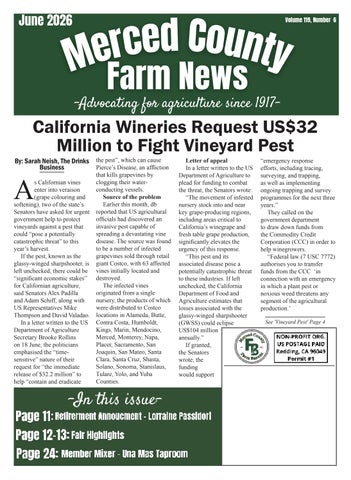
California Wineries Request US$32 Million to Fight Vineyard Pest
By: Sarah Neish, The Drinks the pest”, which can cause Pierce’s Disease, an affliction Business
A
s Californian vines enter into veraison (grape colouring and softening), two of the state’s Senators have asked for urgent government help to protect vineyards against a pest that could “pose a potentially catastrophic threat” to this year’s harvest. If the pest, known as the glassy-winged sharpshooter, is left unchecked, there could be “significant economic stakes” for Californian agriculture, said Senators Alex Padilla and Adam Schiff, along with US Representatives Mike Thompson and David Valadao. In a letter written to the US Department of Agriculture Secretary Brooke Rollins on 18 June, the politicians emphasised the “timesensitive” nature of their request for “the immediate release of $32.2 million” to help “contain and eradicate
that kills grapevines by clogging their waterconducting vessels. Source of the problem Earlier this month, db reported that US agricultural officials had discovered an invasive pest capable of spreading a devastating vine disease. The source was found to be a number of infected grapevines sold through retail giant Costco, with 63 affected vines initially located and destroyed. The infected vines originated from a single nursery, the products of which were distributed to Costco locations in Alameda, Butte, Contra Costa, Humboldt, Kings, Marin, Mendocino, Merced, Monterey, Napa, Placer, Sacramento, San Joaquin, San Mateo, Santa Clara, Santa Cruz, Shasta, Solano, Sonoma, Stanislaus, Tulare, Yolo, and Yuba Counties.
Letter of appeal In a letter written to the US Department of Agriculture to plead for funding to combat the threat, the Senators wrote: “The movement of infested nursery stock into and near key grape-producing regions, including areas critical to California’s winegrape and fresh table grape production, significantly elevates the urgency of this response. “This pest and its associated disease pose a potentially catastrophic threat to these industries. If left unchecked, the California Department of Food and Agriculture estimates that losses associated with the glassy-winged sharpshooter (GWSS) could eclipse US$104 million annually.” If granted, the Senators wrote, the funding would support
“emergency response efforts, including tracing, surveying, and trapping, as well as implementing ongoing trapping and survey programmes for the next three years.” They called on the government department to draw down funds from the Commodity Credit Corporation (CCC) in order to help winegrowers. “Federal law (7 USC 7772) authorises you to transfer funds from the CCC ‘in connection with an emergency in which a plant pest or noxious weed threatens any segment of the agricultural production.’ See 'Vineyard Pest' Page 4
Page 2
I
open this column with another bittersweet moment as Lorraine Passadori has gracefully called the end to her Farm Bureau career. Lorraine started with the organization over 40 years ago. At the time she was working for a local law firm, deciding to make the switch and join a rambunctious group of farmers. Thankfully those same farmers found light in the fact that her second interview was completed in full clown makeup and costume. Unfortunately for Lorraine, the interview she was called in for was the same day as the law firm’s Halloween celebration. The story goes that she tried to make an excuse as to not come in that day, but the president at the time, Joe Alvernaz, wouldn’t take no for an answer. Through these years she has watched the organization through tremendous milestones and challenges – from opposing leapfrog development to agricultural mitigation solidified in county code and water rallies to water hearings. Her family has grown up here and through Farm Bureau, she
Merced County Farm News •June 26, 2026
also met and married Dave Passadori. As she closes this chapter, we find that bittersweet moment. I, and our entire team both past and present, have been privileged to work alongside Lorraine through these years. We will miss her pranks and her wit but know that will never be too far away. We wish her all the best in retirement. Outside of any jackpot shows, many students have wrapped their show career with the Merced Fair. We were fortunate to play a part in the week-long event through our Donuts and Milk event held in partnership with Merced College. Cassandra and I found time to call lots during the junior livestock aution. My sincerest apologies for the students that had their name butchered – it’s a tough job. The summer has placed us on hiatus for much of our workshops, but our office is humming as normal. Harvest season brings the opportunity to educate through handson experiences. Last month we held a tour for Assemblymember Soria’s Young Legislators Program. Attendees were treated to a dairy and almond tour by
Richie Mayo of De Jager Farms. This week we will host Ohio Farm Bureau’s AgriPOWER Leadership Program for a tour of row crops, water challenges and almonds. This will be our second year hosting the state group. We look forward to these opportunities and additional tours we have planned for later in the year. Many of you are also finding bittersweet moments as you celebrate the graduating students in your
family. As a family with two young ones, I now fully understand the “blink of an eye” feeling. I envision this period as a mix of extreme pride and quiet nostalgia. The memories of diaper changes, monster stories and “Where did you put your shoes?” quickly appear alongside the current achievements and aspirations for the future. Congratulations to all graduates. We look forward to seeing what your future brings.
Merced County Farm News • June 26, 2026
H
ello to all our friends and supporters of Farm Bureau. As I write this newsletter in early June, we are looking at triple digit weather coming our way. With graduations behind us and hot temperatures ahead, summer is upon us. Last month in my article I mentioned that it appears there may be some slight opportunities in the primary election for some changes that will allow for candidates from both parties to advance to the November elections. We were fortunate to see that Steve Hilton is in a runoff with Xavier Becerra for Governor. That is a sign that people may be open to a change at the top. I certainly hope so, because my personal thoughts are we keep spending billions of dollars on issues like homelessness and it continues to get worse. There are many other issues that we all see that need to be changed and we can only hope that the voters in this state recognize that and are looking for common sense decisions and change that starts at the top. As we go through the summer and into the fall months Merced County Farm Bureau will be hosting debate nights for candidates in our area and then making endorsements. We have an endorsement committee made up of board members who along with staff do much of the groundwork for these debate
nights and help to guide us through the process. These are decisions our board members do not take lightly, and often there can be some robust discussions among our board members about each candidate’s endorsement. The Merced County Farm Bureau endorsement is highly desired by candidates, and I want to make sure that our membership understands the level of detail and seriousness that the board goes through to reach their decision for endorsement. Look for these endorsements to be announced as we go through the process over the next few months. I want to invite you to a member mixer on July 16, 2026, at Una Mas Taproom in Merced. It’s a great way to catch up with other members and to introduce potential new members to the farm bureau. I personally want to invite any of you who may want to hear more about the farm bureau and what we are working on. We enjoy hearing from members and nonmembers on ag issues that are having an impact on their operations. Some of the subject matter that we take on is not always fun topics, but I look at it like I am trying to make a positive difference in the everyday lives of farmers and ranchers. It is
Page 3
an uphill battle and can be frustrating at times, but I firmly believe that if we don’t take on these issues it will be easier for lawmakers at the state level to enact laws and regulations that make it even harder for us to carve out a living. If you can’t attend the mixer but still have questions, please feel free to call our staff or board members. I wanted to highlight a report we heard at our May meeting about a new program within our own farm bureau called CultivatED. Last fall, staff member Cassandra Valdez made a proposal to deliver ag related educational information to children at their school sites. She received support from Breanne and the board and developed and delivered age specific ag programs throughout the school year. In her report she informed us that she attended 64 classes that served just over 1200 students. By all accounts it was a huge success, and we are very pleased with the effort and dedication
that Cassandra put into the program. Great Job! I want to thank our staff for passing out donuts and milk to the livestock exhibitors at the Merced County Fair on June 9th. It’s a great way to connect with these young 4-H and FFA exhibitors and I am sure they appreciate a good donut during their hectic show days. Finally, I want to recognize Lorraine Passadori for her more than 40 years of service and commitment to the Farm Bureau. Lorraine is retiring effective July 1st, and it is well deserved. I am not sure how many Executive Directors and board members she has worked with in her time here, but I am sure it’s in the hundreds. We wish Lorraine and David best wishes and good health as they embark on this next chapter in their lives. Please feel free to reach out to Lorraine and share your gratitude for a job well done. I wish all of you a healthy and happy month of June.
Page 4
Vineyard Pest
Sniffer dogs Last year, db reported continued from page 1 that a pilot project taking place in California was “Given the breadth and using sniffer dogs to detect scope of the outbreak we vine mealybugs and leafroll face today, we believe the viruses in grapevines. necessary conditions have The trial, which involved been met, and we therefore the training of four dogs – ask that you authorise a a Labrador, two Springer transfer without delay.” Spaniels and a German Four year battle on the Shorthaired Pointer – was cards Ongoing support is crucial, funded with a US$428,111 (£343,000) grant from the stressed the Senators, as California Department of staving off the threat could Pesticide Regulation. take up to four years. Ultimately, the dogs “When GWSS becomes were able to detect leafroll more prevalent, as we fear 3 viruses in 93.4% of cases, it will, it is expected to cost according to the trial’s an additional $3.5 million results, and were capable per year for four years for of detecting the presence of eradication, totalling ($14 vine mealybugs with 97.3% million),” they wrote. accuracy. Signing off, they added: It is thought that the “Thank you for your attention canine programme would to this matter. The wine, cost winegrowers less than winegrape, and table grape $0.25 per increase block industries are a highlight of vine and less than $0.01 per American agriculture, and finished vine to implement. your support during this Editor's Notes: Should challenging time will ensure you find any GWSS, please U.S. wine and table grapes contact the Merced County can continue to compete in Department of Agriculture the global market.” at (209)385-7431.
Merced County Farm News •June 26, 2026
Merced County Farm News • June 26, 2026
Page 5
California Cherry Industry Suffers One of Its Toughest Seasons in Decades By: Ag Net West Radio Network
producing regions during critical stages of fruit development. The alifornia cherry first major rain growers are facing From small farms to large commercial event arrived in one of the most operations, the INSURICA Agriculture April, followed by difficult seasons in recent Experts have grown up in agricultural memory after multiple spring several additional communities. storms that rain events devastated what We’ve designed insurance programs damaged both had initially appeared to be to provide broad and flexible early- and latea promising crop. According coverage for both your personal and season varieties. business needs. to longtime industry veteran According to Michael Jameson of Morada Tom Murphy | 209.353.2700 | tmurphy@INSURICA.com | INSURICA.com Produce, the 2026 California Jameson, cherries the hundreds of millions of financial losses. Jameson said become highly cherry season may be the dollars. rejected cherry shipments can vulnerable once they begin worst he has seen in nearly Even fruit that survived cost growers and shippers transitioning from green four decades in the business. the storms presented between $100,000 and to red. Excess moisture Jameson, who has challenges. $150,000 per load. During absorbed through the roots worked in the cherry Modern optical sorting this season, some operations and fruit stems can cause industry for 38 years, said technology allows experienced multiple rejected cherries to crack when the growers entered the season packinghouses to identify and loads in a single day. fruit skin cannot stretch with optimism. Strong remove defective cherries Beyond the financial enough to accommodate the winter chill accumulation, more effectively than in impact, Jameson expressed additional water. favorable bloom conditions, previous decades. While that concern about the effect on The result was widespread and excellent fruit set had technology helped salvage consumers. crop damage across multiple many expecting an ideal portions of the crop, Jameson When shoppers purchase growing regions. crop of approximately 8.5 explained that many cherries cherries that lack flavor, Jameson noted that to 9 million cartons. That still suffered from reduced firmness, or shelf life, they production level is considered San Joaquin County alone shelf life due to repeated are less likely to return experienced estimated optimal for California’s weather events. Fruit that and buy additional fruit. losses exceeding 63 percent harvesting, packing, and appeared marketable when Maintaining consumer of its cherry crop, with marketing infrastructure packed often deteriorated confidence is critical for economic losses reaching while also providing during transportation to specialty crops like cherries, profitable returns to growers. approximately $174 million. distant markets. where repeat purchases drive When factoring in damage However, Mother Nature That created significant seasonal demand. across all California cherryhad other plans. problems throughout the Despite the challenges, producing districts, total A series of rainstorms supply chain. growers remain committed losses likely climbed into struck California cherryShipments to producing high-quality arriving at fruit and navigating difficult retailers conditions. Jameson sometimes failed emphasized that farming is to meet quality inherently unpredictable, standards, with weather often forcing receivers determining whether a season to reject loads. becomes highly profitable or Those rejected financially devastating. loads then had For California’s cherry to be diverted industry, 2026 will likely to wholesale be remembered as a season markets, often that tested the resilience of resulting in growers, packers, shippers, substantial and marketers alike.
C
Page 6
Merced County Farm News •June 26, 2026
Hilmar Cheese Company Awards 63 Educational Scholarships
By:Press Release, Hilmar
Hilmar, Calif. June, 2, 2026 Sixty-three students demonstrating academic performance and community involvement will each receive a scholarship to help fund their higher education goals through Hilmar Cheese Company’s annual scholarship program. This program, which has existed since 2003, is one of the many ways Hilmar Cheese helps achieve its company purpose to improve lives together. The scholarship program awarded $41,000 in four categories – children of employees, children of the dairy farm families who
ship milk to Hilmar Cheese, part-time Visitor Center staff and students pursing an agricultural undergraduate degree in the communities where the company operates. Twenty-two children of employees of Hilmar Cheese Company, Inc., three parttime Hilmar Cheese Visitor Center staff, and seven children of the dairy farm families who ship milk to Hilmar received scholarships. “I am working towards being a lineman. After graduation from Hilmar, I will be attending Modesto Junior College to build my skillset with an Applied Electrical Technology A.S. Degree,” shared scholarship recipient Adam Raposo.
“My mom has worked for Hilmar for 30 years and I am honored by this scholarship opportunity. I am grateful for the help it offers with my college expenses and future goals.” An additional thirtyone students pursuing an agricultural major living in the counties where the company is located also received scholarships. This last category is for students not affiliated with the company; but dedicated to the agricultural industry and living in Merced or Stanislaus counties in California or Dallam or Hartley counties in Texas and Ford County in Kansas. The Hilmar Cheese
Company scholarship program reflects the company’s ongoing support of higher education and its commitment to employees, dairy farm families, the California, Texas and Kansas agricultural industries and the communities where Hilmar operates. Qualifying students are encouraged to apply November 1 through February 1, 2027. For more information about Hilmar Cheese Company’s scholarship program, visit the About Us Overview section of www.hilmar.com or follow us on LinkedIn or Facebook.
launching enforceable timelines for drinking water assistance, well testing, nitrate reductions and groundwater restoration. The order applies to a broad set of nitrate dischargers in the Modesto groundwater basin, spanning irrigated agriculture, dairies, cities, and poultry and cattle operations. It also sets a precedent for other priority management zones across the Central Valley. The decision carries two immediate consequences for agricultural communities. Rural households with nitrate-tainted domestic wells are supposed to continue receiving free drinking water support, while farmers and dairies enter a 35-year
compliance pathway that will require major changes in nutrient management, manure handling, monitoring and reporting. Bob Ditto, who manages the board’s nitrate control program, described the Modesto order as first of its kind and said it starts a timeline that grants the dischargers some relief from strict nitrate water quality objectives while they carry out required milestones. The order is part of the broader CV-SALTS nitrate control program, which was designed to address one of the Central Valley’s most persistent water quality problems. Nitrate contamination is especially acute in rural, groundwater-
dependent areas, where many households rely on private wells and lack access to public water systems. The Modesto Management Zone is administered by the Valley Water Collaborative, which also oversees the Turlock zone. Under the management zone model, dischargers share responsibility for well testing, bottled water, treatment systems, public fill stations, outreach, nitrate reduction planning and long-term drinking water solutions. The alternative would be for permittees to comply individually under stricter regulatory requirements. Board staff said the
Water Board Order Puts Ag Communities at Center of Nitrate Cleanup
By: Brad Hooker, Agri Pulse
T
he Central Valley Regional Water Quality Control Board’s first nitrate management zone order is setting up a long-term test for farm communities around Modesto. At issue is whether the agency can protect rural residents from contaminated drinking water while giving agriculture, dairies, cities and food processors enough time to reduce the nitrate loading that has built up in groundwater over generations. The board this month approved the Modesto Management Zone Implementation Plan,
See 'Nitrate Cleanup' Page 7
Merced County Farm News • June 26, 2026
Nitrate Cleanup continued from page 6
Modesto program has already tested more than 1,500 wells, provided drinking water to more than 1,000 households and held 876 meetings and outreach events over the past four years. The new order requires the management zone to complete an inventory of domestic wells within one year, offer testing to all domestic wells within five years, and install at least one public water fill station during the first year. The plan also requires long-term drinking water work to begin moving beyond bottled water. The management zone must submit a long-term drinking water evaluation work plan within two years and a full implementation plan within five years. It must offer long-term solutions to 20% of impacted domestic wells by Year 6 and 100% by Year 18. Those solutions could include in-home treatment, consolidation with public water systems or centralized treatment projects. Agriculture argues certainty is needed to make changes Agricultural groups and local agencies reason that the management zone approach gives rural areas the best chance to address nitrate contamination without overwhelming individual farms, dairies or small public agencies. Ben Koehler, chief plant operator for Modesto’s regional recycled water facility and a Valley Water Collaborative board member, said the framework gives local agencies and dischargers a coordinated way to respond. “The management zone brings together
municipalities, irrigated agriculture, dairies and other dischargers under shared implementation structure,” explained Koehler. Sustainable Conservation also backed the approach, saying the order is needed to give both communities and farmers certainty. Ryan Flaherty, who leads the group’s efforts to reduce nitrate leaching, said growers and industries need clear requirements before they can make investments in nutrient management and new practices. “We need approval to start timelines,” said Flaherty. “We need approval to give farmers and industry certainty about where to make investments and to give communities certainty about the path towards clean drinking water.” For dairies, the order sets up one of the most difficult compliance challenges. Full-coverage dairies receive 35-year nitrate exceptions, but dairy advocates stressed to the board the long timeline does not mean waiting decades to act. They said dairies are already collecting water, manure, forage and soil data, filing nutrient management reports, and contributing to drinking water programs. Denise Mullinax, executive director of the California Dairy Research Foundation and assistant director of the California Dairy Quality Assurance Program, said the state’s dairy industry has changed dramatically since the board adopted its original order in 2007. Dairies that once had little experience with water quality regulation now routinely sample, plan and report, she said. Related Articles Water board drafts new
Page 7 dairy order as industry warns of farm losses But Mullinax said the next stage will require new research, field testing and financing. Her organization is funding work on manure water automation, alternative forages that remove nitrogen from soils, and manure treatment technologies like vermifiltration. “Based on my experience in research and education, I would say we are going to need the full 35 years to be successful,” said Mullinax. Paul Sousa, who directs environmental services at Western United Dairies, said management zones should be viewed as accelerating progress, not delaying it. He said dairy families are already contributing to drinking water programs and adopting new practices despite difficult economics. “Thirty-five years does not mean a lack of progress,” said Sousa. “We are already working hard, but we have a long way to go.”
The order lands at a difficult moment for farm communities. Lynne McBride, executive director of the California Dairy Campaign, noted that many dairy farmers are receiving net prices well below their cost of production. Noelle Cremers, who directs regulatory and environmental affairs at the Wine Institute, pointed out that the wine sector is struggling with declining demand, the smallest grape crush since the mid-1990s and the loss of access to Canadian shelves for U.S. alcohol. California produces 85% of U.S. wine and 95% of the nation’s wine exports, with the Central Valley producing more than 70% of the grapes used in California wine. Despite the industry’s economic pressure, Cremers said the order was the most reasonable approach. Denise MullinaxDenise Mullinax, California Dairy Research Foundation (Brad See 'Nitrate Cleanup' Page 8
Page 8
Merced County Farm News •June 26, 2026
Nitrate Cleanup continued from page 7
Hooker/Agri-Pulse) Communities press for faster drinking water solutions. Environmental justice advocates and rural residents argued the order asks for too much patience from people who cannot drink their well water. Kjia Rivers, a senior policy advocate at the Community Water Center, described nitrate contamination as “a very serious problem that is disproportionately impacting communities of color.” An environmental justice coalition encompassing the water center along with Clean Water Action and the Leadership Counsel for Justice & Accountability, along with local residents, pressed the board for shorter deadlines, stricter language on restoring aquifers and
clearer funding obligations. Advocates argued the board should require the management zone to fund long-term drinking water solutions regardless of whether public funding is available. They also called for more frequent community meetings, stronger compliance milestones, and clearer requirements to ensure restoration work moves beyond planning and modeling. Jennifer Clary, who directs the California branch of Clean Water Action, argued the order should require at least one field-based pilot project and recurring restoration updates. Corinne Gibson, an attorney at Leadership Counsel, warned that township-scale averages could hide local hotspots and said dischargers need individualized compliance milestones. Several community advocates came from outside
the Modesto zone but said the same issues exist across the valley. Esteban Curiel, who hails from Woodville and advocates alongside the water center, compared delayed drinking water solutions to a patient waiting for cancer treatment, who is continually told the treatment will be delayed. His partner, Martha Curiel, pressed the board to shorten the timeline, arguing she did not think their “grandchildren will be around to see when our water is finally clean.” Board member Sean Yang, a medical specialist in Sacramento, described the environmental justice testimony as “raw” and “real” and urged the management zones to move quickly with bottled water and other services for seniors, disabled residents and families without resources. Board member Denise Kadara, a water leader from Allensworth, pressed
Scouting: Your First Defense Against Pests
Responsible almond farming requires protecting the crop and trees from pests, weeds, and disease through an integrated pest management approach. Using tools and techniques like monitoring for pest levels, help growers use pesticides only when economic thresholds are met.
Scan the QR Codes to learn tips for monitoring and treating pests from industry experts:
How to Combat Webspinning Mites
Monitoring Tools for Navel Orangeworm
Learn more at Almonds.og/IPM
Document #: 2026IR0055
Mating Disruption Tools for Navel Orangeworm
for stronger engagement with the community and a possible hotline or better use of the CalEPA complaint system so residents do not have to wait for formal reviews to raise concerns. Executive Officer Patrick Pulupa emphasized that staff can bring issues back to the board before the fiveyear review if needed. He cautioned that the board is trying to manage a program in which timelines may feel far too fast to some dischargers and “abysmally too slow” to communities still waiting for safe water. Chair Nicholas Avdis said the board had reached the point where implementation needs to begin. Even if current discharges stopped immediately, he warned, nitrate already in the aquifer would remain a problem for years. “At the end of the day, we’ve got to do something,” said Avdis.
Merced County Farm News • June 26, 2026
Page 9
If Driverless Cars are Safe in Cities, Why are They Banned on Farms? By: Shannon Douglass, Sacramento Bee
C
alifornia has required that an operator be physically stationed at the controls of certain farm equipment since 1977. But while our tools have evolved, the regulatory framework governing agriculture has not. My family and I are first-generation farmers in Northern California. Over the last two decades, I’ve seen remarkable advances in agricultural technology, from precision irrigation to datadriven crop management. Innovators across our state are developing tools that allow farmers to manage inputs with greater accuracy, reduce waste and improve productivity. And that is exactly what should happen in the world’s fourth-largest economy and the home of Silicon Valley. Like many farmers, I want to change with the times, but state regulations are holding me back. Take the tractor, for example. If we can have autonomous cars navigating the busy streets of San Francisco, we can certainly have autonomous vehicles operating in our fields. California’s rules regarding farmwork were written decades before autonomous technology existed. As a result, they effectively prevent autonomous tractors from being used in most practical farm settings, even as other states move forward with the technology. John Deere’s autonomous 8R tractor, for example, uses AI-powered cameras and GPS guidance to perform tillage and other field
operations without a driver. The company has offered the system commercially since 2023 and is developing versions for orchard and tree crops — precisely the kind of farming that defines California’s agricultural identity. As president of the California Farm Bureau Federation, I regularly hear from farmers and ranchers whose work has fundamentally shifted from farming to navigating red tape. When time and resources are diverted away from production, efficiency declines and competitiveness erodes. Research from California Polytechnic State University San Luis Obispo shows that regulatory compliance costs for California farmers have increased by nearly 1,400% over the last two decades. These costs have risen far faster than farm revenues, placing an unsustainable strain on operations that already face razor-thin margins. This strain is especially concerning for California’s nearly 70,000 farms and ranches, which generate over $100 billion in economic activity and produce a significant share of the nation’s fruits, nuts and vegetables.
At the same time, farmers are facing rising costs for water, fuel and labor. Nearly 70% of farmers say they can’t afford key crop materials needed this year. Producers in other states often operate under less burdensome systems, allowing them to bring products to market more efficiently. The result is an uneven playing field that places California farmers at a growing disadvantage. We are already seeing the consequences, as thousands of farms have been lost in recent years, with small and mid-sized family operations at the highest risk. In this environment, access to technology is essential. Autonomous equipment and other forms of agricultural innovation enable farmers to operate with greater precision, lowering input costs and improving resource management. Moreover, these tools improve working conditions by reducing the need for physically
demanding labor and limiting exposure to hazardous tasks. In the face of persistent labor shortages, these efficiencies are essential to keep farms operating reliably. Technological innovation also strengthens California’s workforce pipeline. As farms adopt advanced equipment, the nature of agricultural work evolves, creating increased demand for workers with technical skills in operating and maintaining these systems. California has expanded partnerships with local community colleges and technical training programs to prepare workers for these roles. Because of this alignment between innovation and training, farmworkers are not displaced by technology; instead, they are equipped to move into higher-skill, higher-wage positions that offer greater stability and long-term opportunity. California farmers share See 'Banned on Farms' Page 10
Page 10
Banned on Farms continued from page 9
a deep commitment to stewardship, worker protection and environmental responsibility. To uphold those values, we need a regulatory framework that recognizes innovation as part of the solution rather than a threat to be constrained. Modernizing outdated rules to enable the use of
Merced County Farm News •June 26, 2026 autonomous tractors would be an important step forward. Streamlining compliance requirements, investing in rural broadband and supporting the continued development and deployment of technologies such as drones, advanced mapping systems and AI would help farmers operate more efficiently and sustainably. These are practical, achievable steps that would
allow farmers to do what we have always done: adapt, innovate and feed the world. Shannon Douglass is a Glenn County farmer and president of the California Farm Bureau, which works to protect family farms and ranches on behalf of more than 23,000 members statewide and as part of a nationwide network of 5.8 million Farm Bureau members.
Editor’s Note: The Modesto Subbasin is not the only subbasin under the Nitrate Control Program. Local growers in the Turlock, Merced, Chowchilla and Madera Subbasins are also subject to the Nitrate Control Program as the State Water Board’s Phase 1 and Phase II.
New California Law Aims to Clean Up Neglected Farmland, Farmers Could Face Fines By: Kassandra Gutierrez, ABC 30 Action News
T
ougher enforcement against abandoned farmland could soon have some growers facing big fines. A new state law, unanimously approved by the legislature and signed by Governor Gavin Newsom in October, gives counties more authority to crack down on neglected land. Assembly Bill 732 will soon give county agricultural commissioners the authority to issue fines of up to $1,000 per acre for neglected land. The goal is to prevent properties from becoming infested with pests and creating more problems for nearby farms. "We don't want to see farmland going out of production. We don't want to see land abandoned, neglected and the point of this is not to fine people. It is just a mechanism to make sure that people come into compliance," says Christopher Greer with the Tulare County Ag
Commissioner's Office. Local farmer Andres Avitua shares that decades ago, his farm was thriving, providing fresh citrus to local farmers' markets. Now, they are dealing with dead crops, dead trees, and even more fines. "The chips have been stacked against us. It seems like every time we turned around, there was another problem, so this was very difficult," shares Andres. Andres and his sister inherited these two acres of citrus after their brother, Joe, died 13 years ago. The farm once did well, until water became scarce after a one-two punch: the orchard's pump failed amid a drought. Repairs would have cost thousands, and the wait, Andres says, was over a year. "By that time, the business had already gone down the drain and the trees had already suffered shock, so we were not able to continue," recalls Andres, Despite the heartbreak and distress that dying orchards cause local farmers, there
are real concerns over pests spreading from neglected land and hurting more farmers. That's why county officials say they need this tool. They remain focused on
solutions. "At the end of the day, we don't want to go through the abatement process. We don't want to fine you. We just want to mitigate the situation," explains Greer.
Merced County Farm News • June 26, 2026
O
ne of the highlights of June was launching a project to update the Merced County Farm Bureau website. Over the course of two weeks, I traveled throughout the county to meet and photograph members serving on our executive committees in their respective “fields”. My goal was to capture authentic images that reflect who they are and the important work they do within the agricultural industry. From visiting Farm Bureau President Tim Lohman at Northern Merced Hulling to photographing Matt Jasso in a market tomato field at San Juan Ranch in Dos Palos, each stop provided an
opportunity to learn more about the diverse operations that make up Merced County agriculture. The experience not only expanded my knowledge of the industry but also reinforced my passion for photography. As someone who enjoys both portrait and landscape photography, this project reminded me how much I love documenting agriculture and the people behind it. I encourage everyone to visit the Board of Directors page at www.mercedfarmbureau. org to view the new photos. I look forward to continuing this project and capturing the rest of our board members throughout the year. As I approach my first
Page 11
anniversary with the Merced County Farm Bureau, I am excited to see how much our organization has expanded its reach and grown its audience through social media. This month provided another great opportunity to showcase the impact of our work. At the beginning of June, the Merced County Farm Bureau served donuts to more than 500 youth livestock exhibitors at the Merced County Fair. During the event, I used my camera to capture video of exhibitors and their livestock receiving donuts. Following the fair, I produced a highlight video showcasing the event, which was later shared in collaboration with Merced
College. As Communications Coordinator, one of my primary responsibilities is telling the story of the many ways the Merced County Farm Bureau advocates for, educates, and supports members of the agricultural community, including the next generation of agricultural leaders. The positive response to the video was incredibly rewarding, and I am grateful for the opportunity to use photography and videography to help highlight the meaningful impact MCFB continues to make throughout our community.
Retirerment Annoucment
Retirerment Annoucment
Lorraine Passidori
Over 44 years of service
The Merced County Farm Bureau is grateful for the dedication and commitment Lorraine has shown to our organization over the past 40 years. Her hard work, thoughtfulness, and years of service have been an important part of our success. We sincerely thank Lorraine for her many contributions and wish her happiness and fulfillment in her retirement.
Page 12
Merced County Farm News •June 26, 2026
Merced County Farm News • June 26, 2026
Page 13
Page 14
Merced County Farm News •June 26, 2026
Merced County Farm News • June 26, 2026
Page 15
Page 16
Merced County Farm News •June 26, 2026
Roots Run Deep for Merced FFA By: Victoria Petty, Merced FFA Reporter
T
he Merced FFA Chapter had an incredible week at the 2026 Merced County Fair! This year's fair theme, "Roots Run Deep," perfectly represented the dedication, hard work, and commitment our members put into their SAE projects throughout the year. Months of raising, feeding, grooming, and preparing their animals led up to a successful week of competition and learning. This year, 77 Merced FFA members proudly represented our chapter by exhibiting livestock at the fair. Our chapter had 29 goat exhibitors, 26 pig exhibitors, 7 lamb exhibitors, and 16 rabbit exhibitors. Throughout the week, our members competed in showmanship and market
classes while demonstrating the responsibility, leadership, and sportsmanship that FFA members are known for. Our exhibitors had an outstanding fair, with several members earning top honors in their respective species. Abby Mua had an exceptional week, earning Reserve Champion Hampshire, Champion Advanced Showman, and Supreme Champion Boar. Brooke Xiong was awarded Champion AOB (All Other Breeds). In the goat division, Gianna Fragulia earned both FFA Champion Market Goat and Supreme Champion Market Goat, an incredible accomplishment after months of hard work and dedication. She also won dairy goat showmanship earlier in the week. In the rabbit division, Malik Robinson earned the title of FFA Champion Novice Rabbit Showman.
While these awards are certainly exciting, every Merced FFA exhibitor should be proud of what they accomplished this year. Raising a livestock project requires daily care, responsibility, patience, and perseverance. Our members dedicated countless hours to feeding, exercising, grooming, and working with their animals to prepare for the fair. Whether it was their first year exhibiting or they were experienced exhibitors, each student gained valuable knowledge and life skills that extend far beyond the show ring.The Merced County Fair provides our members with the opportunity to put everything they have learned throughout the year into action while building
confidence, responsibility, and leadership. It also gives students the chance to connect with fellow exhibitors, support one another, and represent Merced FFA with pride. Congratulations to all 77 exhibitors for their hard work and dedication throughout the week. We are incredibly proud of the effort each member put into their project and the way they represented our chapter at this year's Merced County Fair. Thank you to our agriculture teachers, families, volunteers, buyers, and everyone who continues to support Merced FFA and our members. We look forward to another successful year and can't wait to see what our members accomplish next!
The Merced FFA Show Team gathered at the Merced County Fair waiting for the Livestock Exhibition awards to begin.
Merced County Farm News • June 26, 2026
Page 17
California Commits $268.9 Milion More to Sites Reservoir in Bid to Climate-proof its Water Supply
By:Cristina Novo, Smart Water Magazine
C
alifornia has taken a significant step forward in its longterm water storage agenda, with Governor Gavin Newsom announcing that the California Water Commission has approved an additional $268.9 million for the Sites Reservoir project. The new tranche brings the state's total eligible investment through the Water Storage Investment Program to $1.363 billion, drawn from Propositions 1 and 4. Designed to capture flows from the Sacramento River during wet seasons, Sites
M
Reservoir would hold up to 1.5 million acre-feet of water — sufficient to serve more than 4.5 million households for a full year. The facility is seen as a cornerstone of California's strategy to cope with increasingly volatile precipitation patterns driven by climate change, which have produced sharper swings between drought and flooding in recent years. Speaking at the announcement, Governor Newsom framed the investment as a direct response to a shifting climate reality. "Year after year, we see climate change putting pressure on California's water system in real time
with hotter, drier weather, and more intense storms that strain our communities and the environment. With this additional funding for Sites Reservoir, we are expanding our water storage capacity and turning challenges into opportunities to capture more water for millions of California residents," he said Beyond raw storage capacity, the completed reservoir is expected to reduce flood risk by capturing Sacramento River flood flows, deliver water to wildlife refuges including the Sacramento National Wildlife Refuge Complex, and attract an estimated 187,000 visitors annually for recreation.
Commission Chair Fern Steiner noted that the California Water Plan sets a statewide goal of nine million acre-feet of additional water, conservation, or storage capacity by 2040, adding: "This project will go a long way toward meeting that goal." Before funding can be formally disbursed, the project must still satisfy a series of voter-mandated conditions, including securing financing, obtaining permits, completing environmental review, and contracting with the relevant state agencies..
Beach, and picking out the hidden treasures at equipment auctions. He loved dressing up as Santa for Christmas and passing out the gifts. Mark was always generous and took care of everyone around him including every stray cat that showed up at the dairy. He had the best smile and loved making people laugh. Mark passed away peacefully Wednesday, May 20, 2026 surrounded by his family and friends. Mark is survived by his wife of 10 years, Lisa PrestoCoelho, his son Trevor Coelho and his wife Marissa and their son Mark J. Coelho. Also surviving are his mother Mary Coelho, sister Arlene Coelho Losh and husband Frank, brother Paul Coelho and wife Catherine, nephews Tony Souza and wife Sonia, and Craig Souza and wife
Delia, nieces Caitlin and Carson Coelho, great nieces Emery, Presley and Ayla and great nephew Frank. He is preceded in death by his father Frank Coelho.
His memory will live on in the hearts of all those who knew and loved him. Editor's Notes: Services have been already held.
Mark Coelho : 1965 - 2026
ark E. Coelho was born June 29, 1965 in Los Banos California. He and his family moved to Chowchilla where he was raised for most of his childhood and graduated from Chowchilla High School in 1983. Together with his father, Frank, and brother, Paul they established Frank Coelho & Sons Dairy in El Nido in 1999. As a third generation dairy farmer he leaves behind a legacy his family will carry forward. Mark was a loving husband, father, brother, vavo, uncle, and friend. He was passionate about dairy farming and took great pride in his work and the life he built for his family. He had a deep love for the simple joys in life: cheering on the Pittsburgh Steelers, spending time in Pismo
Page 18
Merced County Farm News •June 26, 2026
California Dairy Industry Pushes Back On New Water Quality Requirements By: Emi Obrero, The Business Journal
T
he California State Water Resources Control Board has released a final draft remand order directing the Central Valley Regional Water Quality Control Board to revise dairy water quality regulations, prompting concerns from industry groups about potential costs and operational impacts on dairy farms. The proposed changes apply only to dairies operating in the Central Valley. Public comments on the order are due by noon July 30. The order focuses on reducing nitrate impacts to groundwater and would require regulators to develop new dairy requirements in phases rather than through a single comprehensive update.
New groundwater requirements proposed A key component of the proposal is a broader wholefarm nitrogen accounting system. Dairies would be required to track nitrogen generated on their operations, applied to cropland and exported off-site, with the goal of reducing nitrogen that could contribute to groundwater contamination. The order also incorporates elements of the CV-SALTS groundwater management framework and introduces the concept of future nitrogen discharge limits. In addition, regulators would establish more precise methods for measuring manure nitrogen applications and crop nitrogen removal. Western United Dairies said one potential requirement could include electronic flow meters to improve tracking of
liquid manure applications. The proposal also includes new requirements for earthen manure lagoons that may be connected to groundwater, including additional reporting and potential reconstruction plans for some facilities. Industry raises concerns over costs Dairy Cares, a coalition of dairy cooperatives, processors and trade organizations, said it is reviewing the order and plans to submit comments during the public review period. “We are reviewing the draft order carefully and will provide detailed comments during the public review period,” said Michael Boccadoro, executive director of Dairy Cares. “Our immediate concern is what this might mean for the future of our dwindling dairy sector here in the state.” The coalition said some
provisions appear achievable, while others could require costly changes on accelerated timelines. “The dairy herd has lost 200,000 cows and hundreds of family-owned dairies have closed or moved out of state,” Boccadoro said. “There is no question that a major contributor to this exodus has been ramped-up regulation and the increased cost of doing business in our state.” Comment period runs through July 30 Western United Dairies said it is reviewing the proposal and preparing feedback. The organization has scheduled a workshop for July 8 and expects a hearing later this year. The State Water Board will accept comments on the proposal through July 30 before determining next steps.
and build on provisions enacted through last year’s One Big Beautiful Bill Act. Republican members of the committee are pitching the draft as an effort to update federal initiatives focused on giving producers more certainty while expanding support for rural communities, agricultural trade and national food security. What’s not included in the text are the most controversial issues that bogged down the House’s crafting of a farm bill last spring. At the top of the list
– also not addressed in the House bill – are upcoming costs certain states must start paying for the Supplemental Nutrition Assistance Program. Democrats are pushing for a delay to study the costs they say don’t appear fair and could financially burden some states to the point of having to cut crucial food aid. How the partisan disagreement plays out in expected farm bill negotiations or in a possible conference with the House could determine whether fiveyear ag legislation is passed
this year. Boozman on Tuesday said talks with Democrats on nutrition policy were occurring, though he declined to provide details. "We're negotiating in private," he said. "The good news is that everybody's working in good faith to get a farm bill." Democratic members of the Senate Agriculture Committee said the draft falls short, while also signaling openness to a compromise. "This bill does not address the devastating cuts to
Boozman Unveils Farm Bill Draft that Sidesteps Thorny Issues
By: Kim Chipman, Lydia Johnson, and Noah Wicks, Agri Pulse
S
enate Agriculture Committee Chairman John Boozman unveiled a “farm bill 2.0” discussion draft that would boost support for a wide range of ag producers, enhance transparency of fertilizer markets and foreign land ownership, and strengthen healthcare access for rural Americans. The legislation would reauthorize certain ag programs through 2031
See 'Farm Bill' Page 19
Merced County Farm News • June 26, 2026 us to take up the House bill, but I’m not going to argue continued from page 18 with Chairman Boozman,” Grassley told reporters on SNAP or the shift to state Tuesday. taxpayers," the Democrats The Iowa Republican, said in an emailed statement. though, said he’s pleased that "We appreciate that bipartisan his fertilizer research bill provisions have been with Sen. Tammy Baldwin, included in the discussion D-Wis., is in the draft, as draft and stand ready to work well as parts of his legislation with Republicans to negotiate with Baldwin aimed at better a bipartisan farm bill that tracking foreign ownership of both meets the moment and U.S. agricultural land. can be successful on the Grassley said he’s Senate Floor.” especially disappointed that 'Long overdue' the Senate draft text doesn’t Congress hasn’t completed include a provision in the a comprehensive farm bill House bill that would nullify since 2018, largely due to animal-welfare state laws like political logjams over food California's Prop. 12, which aid. opponents say are overly “An updated farm bill stringent and raise meat is long overdue. Economic prices. He’d also like to see conditions have changed language to allow year-round, dramatically since 2018 when voluntary sales of higher we did the last farm bill, ethanol-gasoline blends, which was actually based on known as E15. 2012 data," Boozman said to After a tumultuous reporters on Tuesday. "If you process, a stand-alone ethanol feed America, this bill is for measure eventually passed you." the chamber last month; The Senate Ag chairman Senate Majority Leader John emphasized that the proposed Thune, R-S.D., has said he’s bill would modernize USDA looking at crafting a new loan limits so producers can version of the legislation to access needed capital based bring to the floor for a vote. on today's economy. The Language to establish draft pulled in more than 100 federal supremacy on bipartisan bills and priorities, pesticide labeling also isn’t in he said. the Senate text. The provision Last year, through a fastwas ultimately stripped from tracked legislative process the House farm bill amid used to pass the One Big opposition that’s divided Beautiful Bill Act, lawmakers Republicans on the issue. made crucial updates to farm Another thorny matter not programs. Outstanding key addressed in the Senate bill items in the Senate draft draft or House legislation deal with issues such as crop is the push by lawmakers insurance, rural broadband, including Sen. Rand specialty crops, trade, Paul, R-Ky., to delay the conservation and increased implementation of a federal loan limits. ban on certain intoxicating Sen. Chuck Grassley, hemp products, like R-Iowa, a member of the ag beverages and gummies. committee, said he’s hopeful The budget-neutral provisions in the House farm draft also doesn’t include bill ultimately make their additional economic aid way into final legislation. to agriculture producers “It would be better for
Farm Bill
Page 19 struggling with low prices for their products on top of soaring production costs and uncertain demand. Boozman, Minnesota Sen. Amy Klobuchar, the top Democrat on the Ag Committee, and Sen. John Hoeven, R-N.D., chair of the Senate Appropriations Committee's subcommittee on agriculture, are among lawmakers pushing for more aid to get to farmers ahead of updated farm safety net programs taking force in October. Dollar figures ranging roughly from $15 billion to $17 billion have been proposed to add to the $12 billion the Trump administration is providing to crop growers. The American Farm Bureau Federation’s John Newton said he’s hopeful there will be a chance to add farmer economic assistance in an upcoming supplemental funding measure to respond to recent natural disasters. The aid needs to come before October because many growers will need to start working with lenders soon and making investment decisions, like fall fertilizer applications, for next season. “The clock is ticking and midterms are right around the corner,” Newton, AFBF’s vice president of public policy and economic analysis, told Agri-Pulse. “There’s a lot of things that this Congress needs to do to show agriculture in rural America that they're paying attention.” Here are some highlights from the draft farm bill. Specialty crop disaster aid As farm-state lawmakers have emphasized the need for more support for growers of specialty crops, one of the most significant such provisions in the draft would establish a permanent
framework for USDA to administer future disaster assistance programs for fruit, vegetable, tree nut and nursery producers when Congress provides funding. That structure, which would base payments on a producers’ sales in the year before a disaster, would guide USDA in coordinating and distributing funding for future disasters, limiting rule reworks in later aid efforts overseen by the agency. Specialty crop growers have often relied on ad hoc disaster packages approved by Congress after hurricanes, freezes, droughts and other catastrophic natural events, rather than benefiting from the more structured safety net programs available to many commodity producers. Multiple iterations of aid programs with different requirements over the last decade have led specialty crop groups to push for a standardized structure based on a producers’ prior-year sales, and supporters of the idea say such a framework would help speed up assistance efforts. The bill also would expand several existing disaster programs that many specialty crop producers utilize: the Tree Assistance Program, expanded livestock and forage disaster assistance, and greater flexibility for USDA to deliver assistance through state block grants. Additionally, the bill authorizes USDA to administer natural disaster relief funding via block grants to states to provide quicker and more regionally suited assistance. The bill would reauthorize the Conservation Reserve Program through 2031. The overall program See 'Farm Bill' Page 20
Page 20
Farm Bill
program’s overall baseline to hit its eventual growth target continued from page 19 in 2031 and following years. Trade would retain its current Unlike the House-passed 27-million acre cap, with farm bill, the text does not the limit for its grasslands signup set at 12 million acres. authorize moving the Food for Peace bill from the U.S. Additionally, it would up Agency for International CRP payment limitations to Development to the $125,000 — the program's Agriculture Department. first-ever payment limitation Committee aides said increase — and would also Boozman supports the update CRP haying and program and its omission grazing authorities during emergency conditions, allow merely reflects the working out of technical jurisdiction cost-sharing for grazing and issues. water infrastructure, and The measure would double adjust rental rate calculations funding for agricultural trade to attract a greater share promotion and facilitation of marginal lands into the programs. Market Access program. Program funding rises from The bill stands up $200 million to $421 million two new conservation for fiscal 2027, and then to programs, including a Forest $437 million for fiscal years Conservation Easement Program, which aims to help 2028 through 2031. The Foreign Market Development pay for easements to protect program funding jumps forestland, which would from $34.5 million to $73.5 be funded at $240 million million for fiscal year 2027, over a five-year window. and then to $75.5 million Meanwhile, a new State for each of fiscal years 2028 Conservation Assistance Program, which seeks to help through 2031. The bill would also states and tribes pay for their establish an interagency own agricultural conservation programs, would be funded at working group led by $250 million over five years. USDA and including the Office of the U.S. However, under the Trade Representative, the preliminary bill, the baseline Commerce Department of the highly-popular and other federal agencies Environmental Quality Incentives Program — which to monitor seasonal and perishable produce imports was set to rise to $2.85 and evaluate their effects on billion in fiscal 2027 under U.S. producers. Under the the One Big Beautiful Bill proposal, the working group Act — would instead be set at $2.5 billion for that year. It would regularly review trade would then rise over the next data, consult directly with domestic fruit and vegetable few years until it settles at $3.25 billion in FY31, instead growers and coordinate potential trade responses of reaching the $3.25 billion figure in FY28 as established when imports are found to be harming U.S. industries. in the OBBBA. Credit The House’s farm bill The bill's credit title similarly included near-term focuses heavily on reductions to EQIP’s budget modernizing USDA loan authority, which were used programs so lending to help fund other priorities authorities can keep pace while still allowing the
Merced County Farm News •June 26, 2026 with rising production costs facing farmers, ranchers, and rural communities. The legislation would significantly increase Farm Service Agency loan limits while indexing those caps to inflation going forward. Under the proposal, direct farm ownership loan limits would rise from $600,000 to $850,000, while guaranteed farm ownership loan limits would increase from roughly $2.25 million to $3.5 million. Direct operating loan limits would climb from $400,000 to $750,000 and guaranteed operating loan limits would rise from about $2.25 million to $3 million. The bill also would double the cap on FSA microloans from $50,000 to $100,000. The legislation includes several provisions aimed at beginning farmers and ranchers, including a pilot program that would allow producers to receive preapproval for direct farm ownership loans before
purchasing land. Rural development The bill would increase access to healthcare and childcare and allow resources to be used flexibly to meet local needs. It also would provide temporary zerointerest loans through the Community Facilities Direct Loan Program to support new construction and renovation of existing rural hospital facilities to improve services. The bill also would enshrine into law the USDA’s ReConnect broadband program; create a new “last mile” initiative focused on connecting farms and ranches; expand opportunities for small meat and poultry processors and renderers; ensure access to clean drinking water and wastewater services; and establish a cybersecurity circuit ride program to improve the ability of rural water systems to fight cyber threats.
Merced County Farm News • June 26, 2026
Page 21
Page 22
Merced County Farm News •June 26, 2026
Mariposa County Commercial Livestock Pass and Annual Dinner
M
ariposa County initiated the Commercial Livestock Pass program in July of 2022. We had roughly 30 commercial livestock operations and 50 operators and/or managerial staff apply and receive their Commercial Livestock Pass during the 2022 fire season. Since 2022, the program has grown in popularity and ranchers have continued to apply and renew passes each year. I you have not signed up for the video version of the Livestock Pass Training, don’t wait, we are deep into the Mariposa County fire season, as the season began in March of this year. What is the Commercial Livestock Pass? In 2021 Assembly Bill (AB) number 1103, Chapter 609, Livestock Pass was signed into law. AB 1103 authorizes, upon the approval of a County Board of Supervisors, a County Agricultural Commissioner, or other designated agency, to establish within the county a Commercial Livestock Pass Program for the purpose of issuing identification documents granting any qualifying Commercial Livestock producer, as defined, or a Managerial Employee, as defined,
access to the qualifying Commercial Livestock producer’s ranch property, or to the ranch property owned by another holder of a Commercial Livestock Pass with permission, during or following a flood, storm, fire, earthquake, or other disaster, as provided. How will the Commercial Livestock Pass help in event of an emergency? Commercial Livestock Pass holders may be allowed access to restricted areas in emergency situations such as fires or other natural disaster. Access to restricted areas will be dependent on safety conditions at the time access is requested and upon approval of emergency personnel. Who qualifies for a Commercial Livestock Pass
in Mariposa County? Any commercial livestock owner, operator, and/or managerial staff that runs 25 head of livestock or more in Mariposa County. If you have additional
questions or would like an application, please contact the Mariposa County Department of Agriculture & Weights and Measures (209)966-2075 or agcomm@ mariposacounty.org.
Merced County Farm News • June 26, 2026
Page 23
Page 24
Merced County Farm News •June 26, 2026