July/August 2026 Vol 71 IAPHworldports.org No 4
Providing thought leadership on the role of ports in a connected world
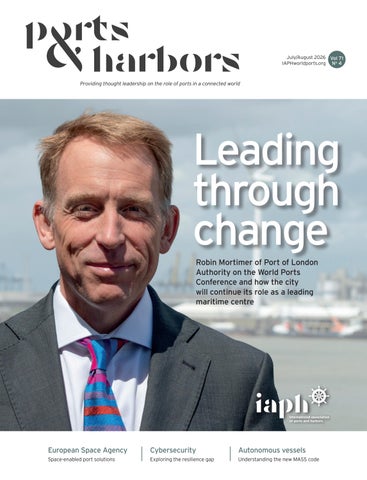
Leading through change Robin Mortimer of Port of London Authority on the World Ports Conference and how the city will continue its role as a leading maritime centre
European Space Agency
Cybersecurity
Autonomous vessels
Space-enabled port solutions
Exploring the resilience gap
Understanding the new MASS code
Port Performance Program - Metrics Tracked
Benchmark global container port and terminal performance with empirical data for competitive insights, fewer delays, cost savings, and lower emissions. Metrics Tracked
Daily Updated Metrics
Historical 2017-2026
•
Port, berth and anchorage hours
•
Vessel endpoint details
•
Call size and vessel size development
•
Start, cargo operations, finish, time splits
•
Berth productivity (BMPH)
•
Crane-moves-per-hour and crane intensity
Historical 2019-2026
•
Peak load days
•
Total container moves; vessel calls; average call size
•
Filter by five vessel size and nine call size ranges
•
Updated monthly for 600+ global container ports
•
Metrics to global, region, country, port, and terminal level
•
Based on standardized and comparable methodology
•
Covers 1,000+ terminals in 500 ports worldwide
Container Port Throughput
Container In-Port Dwell Times (port-level only)
Historical 2020-2026 •
Port hours by call size
Historical 2022-2026
•
Vessel waiting time and percentage of calls waiting
•
Import and export container in-port dwell times
•
Arrival process time
•
Transshipment dwell times
•
Port productivity (PMPH)
•
Empty container turnaround times
•
Same filter and coverage statement as above
•
Min, median, average, max values
Learn more at spglobal.com/PortPerformance
Reach the decision-makers in the ports & terminals industry
Connecting brands with verified buyers and influencers WEB TRAFFIC
EMAIL AUDIENCE
37,500
10,700
AVERAGE MONTHLY PAGE VIEWS
AVERAGE OPEN RATE: 22% AVERAGE CLICK RATE: 3.9%
SOCIAL MEDIA
29,007 ACROSS ALL PLATFORMS
Portsmouth
270 ATTENDEES
Port Strategy is the leading information source for the port executives in the port management industry. It is also the official partner to Coastlink, the short sea shipping conference and the GreenPort Congress, addressing environmental challenges in ports. Audience: Senior port executives from port authorities, terminal operators and equipment suppliers
Sponsored Content
Podcasts
Webinars
Magazines & Special Reports
Social Media
Let’s build your marketing campaign Request your media kit today and discuss your campaign with our team: T (+44) 1329 825 335 E: sales@portstrategy.com/greenport PS_HP_175x116_Audience2026.indd 1
16/07/2026 10:36
1 Vol 71 ǀ No 4 ǀ 2026
CONTENTS 10
2 Editor’s Comment & Contributors Charting a new course in an era marked by change
4 In Conversation With Robin Mortimer Robin Mortimer, CEO, Port of London Authority, talks with Patrick Verhoeven
8 Perspective: Space for ports Industry insight from the European Space Agency
10 Sponsored Statement: TT Club Make every decision count when managing places of refuge
12 Ports Prepare For Autonomous Vessels
18
Implications of the IMO’s Maritime Autonomous Surface Ships Code
16 Interview: Dr Abdullah Al Abri Vice president of sustainablity at SOHAR Port & Freezone
18 Lookout: Guinea Gateway The launch of Port of Morebaya in Guinea
20 Regional Focus: Australasia Investing in smarter infrastructure and technology to improve efficiency and support the energy transition
24 Nine To Five: Jeremy Greenwood
30
A day in the life of the IMO’s head of Maritime Security Section in London
26 Shifting Paradigms In Port Cybersecurity World Bank report explores the resilience gap across global port ecosystems
30 Feature: Wave Energy Can wave power become part of the port decarbonisation toolkit?
32 View From Astern History of navigation exhibition in Antwerp, Belgium
36
36 World Ports Conference: Made in London #IAPH2026 will offer four days of unmatched receptions excursions across London
38 IAPH Info The latest news and events from your association
40 The Review The Response: A Story of Fire and Flood in Britain’s New World of Extremes
EDITOR’S COMMENT Providing thought leadership on the role of ports in a connected world EDITORIAL & CONTENT Editor: Martin Clark editor@ports-and-harbors.com Features Editor: Felicity Landon Publisher Dr. Masahiko Furuichi IAPH Secretary General info@iaphworldports.org Dr. Patrick Verhoeven IAPH Managing Director patrick.verhoeven@iaphworldports.org Regular Correspondents: AJ Keyes, Mike Mundy, Vladislav Vorotnikov Production David Blake, Paul Dunnington production@mercatormedia.com
MARTIN CLARK Editor
SALES & MARKETING t +44 1329 825335 f +44 1329 550192 Marketing marketing@mercatormedia.com
Charting a new course
Chief Executive: Andrew Webster awebster@mercatormedia.com Ports & Harbor magazine is produced and edited bi-monthly by Mercator Media Limited, Spinnaker House, Waterside Gardens, Fareham, Hants PO16 8SD UK t +44 1329 825335 f +44 1329 550192 info@mercatormedia.com www.mercatormedia.com Subscriptions INTERNATIONAL ASSOCIATION OF PORTS AND HARBORS IAPH members enjoy a free subscription to P&H. If your organisation is not a member and you would like a paying subscription to the magazine, please contact the IAPH for more information at: 7th Floor, South Tower, New Pier Takeshiba 1-16-1 Kaigan, Minato-ku Tokyo 105-0022, Japan T: +81 (0) 3-5403-2770 F: +81 (0) 3-5403-7651 E: ph@iaphworldports.org W: www.iaphworldports.org ©Mercator Media Limited 2026. ISSN 1740-2638 (print) ISSN 2633-4232 (online). Ports & Harbor is a trade mark of Mercator Media Ltd. All rights reserved. No part of this magazine can be reproduced without the written consent of Mercator Media Ltd. Registered in England Company Number 2427909. Registered office: c/o Spinnaker House, Waterside Gardens, Fareham, Hampshire, PO16 8SD, UK.
or centuries, ports have adapted to changing patterns of trade, technology and societal shifts. They have weathered industrial revolutions, geopolitical upheaval and economic cycles, continually evolving to meet the demands of a world in motion. Yet there are moments when the pace and scale of change require something more than adaptation alone. They require leadership. That is the backdrop to this year’s World Ports Conference in London, where the theme, Port Leadership in a Brave New World, reflects an industry navigating an increasingly complex operating environment. From the energy transition and cyber resilience to artificial intelligence and autonomous vessels, today’s port leaders are
F
CONTRIBUTORS
HARRY PALMER Risk Assessment Manager Harry Palmer is is a risk assessment manager within TT Club’s Loss Prevention Team, based in London. A chartered civil engineer, he brings over a decade of experience in engineering consultancy, with a particular focus on the ports and terminals sector. ■
3
making decisions that will shape not only their own organisations but also the future competitiveness of the global supply chain. Throughout this issue of P&H, a common thread emerges: long-term thinking has never been more important. Ports have always been built on investment horizons measured in decades rather than years, but today’s decisions are being made against a backdrop where change – evolving technologies, growing environmental expectations, geopolitical tensions – only ever seem to accelerate. Striking the right balance between immediate operational needs and future readiness is becoming one of the defining challenges of the sector. Our cover interview with Robin Mortimer, chief executive of the Port of London Authority, reflects this. London’s maritime history stretches back centuries, yet its focus remains firmly on the future. Investment in new infrastructure, digital capabilities and operational resilience demonstrates how established ports continue to reinvent themselves while maintaining their vital role in supporting regional economies and international trade. Decarbonisation remains one of the industry’s top priorities, as it does for the global economy. Progress is visible through electrification, renewable energy projects and the adoption of lower-carbon fuels, but many of the biggest questions remain unresolved – from the widespread deployment of hydrogen and other alternative fuels to the expansion of shore power infrastructure. In this regard, ports are uniquely positioned to bring together governments, terminal operators, shipping lines and technology providers to help progress this transition, but that will require strong, coordinated leadership.
At the same time, digital transformation also continues to gather pace. Artificial intelligence is moving from concept to practical application, offering opportunities to improve traffic management, optimise operations and support better decision-making. However, increased digitalisation reinforces the importance of cyber security and organisational resilience, issues echoed by the World Bank in this edition. As ports become more connected, ensuring continuity of operations under any circumstances is becoming just as important as embracing the latest innovations. Moving forward, the emergence of autonomous vessels, greater use of data-driven decision-making and a stronger emphasis on environmental stewardship suggest that the responsibilities of ports will continue to expand, rather than shrink. Increasingly, success will be measured not only by cargo throughput or operational efficiency, but also by the ability to support sustainable growth, protect natural ecosystems, as well as develop the next generation of maritime talent to contine this work into the years ahead. These are all topics that will be explored when the global port community gathers in London this November. But if one message emerges from the conversations and articles inside this issue, it is that the industry’s future will not be determined by change itself – this has always been a constant in maritime history. Rather, it will be shaped by the quality of the leadership guiding ports through it. The main conference theme offers a reminder that ports are no longer responding to change, they are increasingly expected to lead it. ■
FELICITY LANDON Freelance journalist
DEAN DAVISON Freelance journalist
Felicity Landon is a journalist and features editor on P&H. A well-known figure in maritime circles, with the depth of knowledge and network of contacts to prove it, Felicity is versatile in her areas of coverage from container, dry and liquid bulk to energy and other areas. ■
Dean Davison has been involved in the port and shipping industry for 35 years, working directly for the Port of Tilbury in the UK, before spending time as a writer for trade publications, based in both London and New York City, and consultant for various engineering and advisory specialists. ■
Get in touch: editor@ports-and-harbors.com
4
5 IN CONVERSATION WITH ROBIN MORTIMER
Leading
through change Robin Mortimer, CEO at Port of London Authority (PLA), talks to IAPH managing director, Patrick Verhoeven, about the World Ports Conference, which takes place in the UK capital this November, and the city’s continuing role as a leading maritime centre MARTIN CLARK
Robin (R), what is the significance of London hosting the IAPH World Ports Conference? R: London remains a global maritime centre and we want to stay that way, so being the headline sponsor of the IAPH conference is important to us. The previous World Ports Conferences here took place on the cusp of major changes in shipping, just like today. In 1965, PLA hosted the event just before containerisation; in 1997, it came just as container vessels grew beyond Panamax size. The 2026 conference provides an opportunity to reflect on how the port sector, and PLA, has adapted to major changes over time, while maintaining a long-term view of the future. That long-term outlook is one of the defining characteristics of our sector.
Q
Q: Patrick (P), would you say this is reflected in the conference themes? P: Yes, I think we’re in a similar position right now, with the energy transition, for instance, and with all the instability and security issues going on in the world. That is reflected in the conference theme – Port Leadership in a Brave New World – exploring how port authorities can continue to show leadership, and drive competitiveness and prosperity for their cities and regions, while navigating these challenges. Q: How are these challenges reflected at PLA? R: The energy transition is a major focus for us. We have a target to reach net zero by 2040 and eliminate our direct emissions by 2027, and we have already achieved more than a 90% reduction through measures such as transitioning our workboat fleet to HVO and investing in electric solutions. The
bigger challenge is supporting wider port decarbonisation, where investment decisions are largely going to be driven by others, particularly on the shipping side. We see an important leadership role in bringing together government, terminals and operators to accelerate initiatives such as shore power, for example. Q: Any notable business trends at PLA for 2026? R: We are seeing significant investment on the Thames. We’ve got London Gateway, the fastest-growing container port in Northern Europe, which is expanding with berths five and six under development. The Port of Tilbury has secured planning consent for Tilbury Three, creating opportunities in bulk cargo and vehicle markets. In terms of trends, market conditions remain challenging across the UK ports sector, but these investments are helping us grow market share, so we’ve bucked the trend. Last year, the Port of London handled more tonnage than at any point since 1973, making it our busiest year in over 50 years. Q: How do you see PLA’s – and London’s – port needs evolving over time? R: Long-term urbanisation trends continue to support London’s role as a major consumer market. While spending on services and digital products has increased, demand for physical goods remains strong, so we expect to remain a significant consumer port. Perhaps the biggest question for us is the energy transition. Around a quarter of our tonnage currently consists of oil products, and over time we expect alternative fuels to replace some of that demand. We are
6
already seeing growth in ethanol imports, but hydrogen-based fuels remain at an early stage, although that’s obviously something to watch in the next 10 years or so. P: The developments at London Gateway and Tilbury show that London still plays an important role in world trade. In 1965 it was one of the largest ports in the world, alongside New York and Rotterdam, and then Asia started off in the late 80s and 90s. But as a shipping hub and a shipping services centre, London remains in the global top league, in terms of maritime insurance, law, financing and brokerage. The presence of the IMO and global shipping organisations further confirm its global hub status. It is a perfect location for our conference because of that combination of a thriving port and a unique maritime ecosystem. Q: In terms of resilience, can you outline current key PLA initiatives? R: We have a new port control centre under construction at the moment, bringing our operations together in one location for the first time, which is very much about building longterm resilience. Alongside that, we have invested in a new Vessel Traffic Service (VTS) system and increased staffing levels to support growing traffic. Together, these improvements will strengthen safety, resilience and operational efficiency.
‘‘
London is a global maritime centre and we want to stay that way, so being headline sponsor of the IAPH World Ports Conference is very important to us ROBIN MORTIMER, CEO at Port of London Authority
P: Regarding technology, cyber is one area ports have certainly accelerated work on since Covid, and it’s especially important for iconic ports like London, LA or Singapore, and given all the geopolitics attached to that. I’d say this is probably the number one issue that ports are dealing with: how to anticipate or recover from a cyber attack, to make sure operations can continue — that’s what I see across the board, whether you’re looking at Asia, Europe, or the Americas. R: Absolutely, it’s right at the top there for us as well. It was a key consideration in our new port control centre, in procuring a new system, one with resilience and integrity. It’s important that you can be confident in your operational systems functioning in any scenario. Pictured: Patrick Verhoeven and Robin Mortimer together recently at London River House, Port of London Authority’s Gravesend headquarters, overlooking the River Thames Photos: Ben Fitzpatrick
7
‘‘
P: At the same time, we are also seeing all businesses operate, including ports. Cyber is one area renewed emphasis on analogue backup We’re doing a lot of work around how we where ports have systems. This was one of the issues that use AI and how we deploy it. It has real certainly accelerated came out of our discussions at the potential, particularly in traffic IAPH Technical Committee meetings management, and can improve work on since Covid in Singapore. You need to have those productivity across back-office functions PATRICK VERHOEVEN, MD, IAPH systems in place as well in case as well as enhance operational decisioneverything is shut down, so your harbour masters can still use making. At the same time, we’re looking at how we continue traditional technology to make sure things keep going. to bring in new people into our workforce, new graduates, new apprentices, and not have those roles taken over by AI, Q: Can you give any examples of how the energy transition but where it serves as an additional tool within that changing is changing PLA? technology landscape. R: Like many ports, we’ve transitioned our workboats to HVO, electrified our vehicle fleet and invested in solar energy. I P: In relation to this, we’re about to launch a technologythink the big leap is going to be when hydrogen becomes a focused mentorship programme at IAPH. It will have six viable economic option. There are some interesting prototype mentors and six mentees — typically chief information models but I think that’s a leap yet to happen. But there is also officers or chief technology officers on the mentor side, and an interesting overlap with autonomous vessels. We are then mentees who are younger people aspiring to have a already exploring remotely-controlled survey vessels in the leadership position within the technology field in ports. We estuary, which could improve efficiency while maintaining aim to launch it over the summer and then start running from safety. Right now, we have only one, the Tamesis, a small September for an initial year, and then evaluate it to see if it survey vessel that is now in operation. will continue. We hope it will help develop future leaders across the sector. P: The IMO recently adopted its code for Maritime Autonomous Surface Ships (MASS) and IAPH was involved in R: One other thing that I’d like to mention is the vital some of that work. The code is important because at some role ports play supporting the natural environment. point you will see a mix of autonomously-driven ships and Most ports are operating in incredibly sensitive natural man-driven ships coming together within a port area, which environments, so our role in sustaining biodiversity creates all sorts of new challenges in terms of safety of and the natural habitats along the river and the land operations and security. So we will look at this code and start beside it is very important. PLA is the first UK port translating it into practical port operations and safety participating in the Biodiversity Net Gain market as a measures for ports. There will also be a session on provider of credits. In Bexley, southeast London, we autonomous vessels at the conference. have developed a scheme that allows developers to purchase biodiversity credits which fund habitat R: One other thing I’d like to mention is the importance of improvements along the Thames. Rather than viewing data in aiding our energy transition work. For example, we biodiversity requirements as a cost, we see them as an have developed a portal that maps all vessel emissions across opportunity to enhance the environment while supporting the port in detail, helping us identify where emissions occur sustainable development. and target operational improvements. One finding was the impact of ship manoeuvring, highlighting opportunities to Q: Do you have any final message for P&H readers? reduce emissions through more efficient traffic management. R: Come to London and come to the conference! We are delighted to be the headline sponsor and I think it will be a Q: Have you observed any trends that could fundamentally fantastic event. London is a global maritime centre and we reshape the industry? want to stay that way, so for the city the IAPH conference is R: I think AI is going to have a fundamental impact in the way very important. ■
8
PERSPECTIVE SPACE-ENABLED SERVICES
Space for ports orts have always served as places of convergence: between sea and land, between public authorities and private operators, and between global supply chains and local communities. These intersections bring growth, value, and diversity, but also increasing complexity. Ports are now being asked to improve efficiency, reduce emissions, strengthen resilience, support new fuels, protect critical infrastructure, combat smuggling, and enable more automated operations – all at the same time. Meeting these demands is not easy. But this is where space-based capabilities can make a practical contribution. For many people, space evokes launchers, astronauts and distant missions to the Moon, Mars and beyond. Yet its most important contribution to the port ecosystem is much closer to everyday operations. Satellites provide the positioning, timing, communications, surveillance and environmental data that
P
already underpin many maritime services. These capabilities are moving beyond a supporting function to become part of the operational backbone of ports and maritime logistics. At the European Space Agency (ESA), this shift is reflected in the work of the Business Applications and Space Solutions (BASS) programme. BASS supports companies and public-sector stakeholders in developing sustainable, commercially viable services that use space assets to address real operational needs. Resilience, infrastructure and trust Ports are simultaneously logistics nodes, energy hubs, border environments, and sources of environmental impact, making them critical assets for national Pictured: A SAR satellite image (captured by Sentinel-1) of the port of Singapore Photo: Contains modified Copernicus Sentinel data (2021-22), processed by ESA
resilience. Their capacity to fulfil these functions increasingly depends on the availability and integrity of digital infrastructure, including satellite-based positioning, navigation and timing (PNT) services, communications and Earth Observation (EO). Global Navigation Satellite Systems (GNSS) are essential to day-to-day port operations, yet they are vulnerable to interference, jamming and spoofing. For ports, this is far from an abstract concern. Reliable positioning and precise time synchronisation underpin vessel traffic services, terminal operations, automated equipment, interconnected digital systems and, increasingly, autonomous and remotely operated vehicles. Space-enabled services can contribute to GNSS resilience by detecting interference, cross-checking position information, combining satellite and terrestrial data, and creating alerts when navigation signals behave abnormally.
9 redundancy and security from the outset. For ports that are becoming more digital, more automated and more dependent on real-time coordination, satellite connectivity is a core component of digital resilience. The same logic and challenges apply to physical infrastructure. Ports are major asset owners, responsible for quays, breakwaters, access channels, terminals, storage facilities, pipelines, roads and rail connections. Traditional inspection methods will remain essential, but Earth Observation satellites data can add a key complementary layer. Earth observation can support the monitoring of ground movement, coastal change, flooding exposure, spills, land use, asset condition and environmental pressures. In some cases, satellites can help identify gradual changes before they become visible on site. In others, they can provide rapid situational awareness after storms, accidents or other disruptions. The same is true for communications. Ports depend on continuous data exchange between vessels, terminals, port authorities, service providers, hinterland operators and public agencies. In most cases, these connections rely heavily on terrestrial infrastructure. This is efficient under nominal operating conditions, but it can create vulnerabilities when ground networks are disrupted by extreme weather, cyber incidents, power outages, cable damage or other local disturbances. Satellite communications can provide an additional layer of resilience. They offer secure, independent communications channels that are not dependent on local terrestrial infrastructure, helping ports maintain situational awareness and operational coordination when ground-based systems are unavailable. When combined with appropriately secured ground nodes and network architectures, satellites can also support trusted mission-critical communications, which are increasingly transitioning from legacy narrowband technologies such as TETRA to broadband networks. This does not mean replacing terrestrial connectivity; rather, it means designing communications systems with
Environmental monitoring and compliance Ports are also central to the maritime sector’s environmental transition. They are directly affected by evolving regulations and by the expectations of cities, coastal communities, cargo owners and shipping lines. At the same time, they have a practical role in enabling cleaner and more efficient operations, from shore power and alternative fuels to digital optimisation and environmental monitoring. Space-based data and services can support this transition in several ways. Earth observation can contribute to the monitoring of air emissions, water quality, coastal habitats, dredging impacts, sediment plumes, underwater radiated noise and changes in land use. In parallel, satellite AIS, the VHF Data Exchange System, meteorological and oceanographic observations, GNSS-based positioning and timing can improve arrival predictions, berth planning, port-call optimisation and resource allocation helping reduce waiting times, fuel consumption and emissions. Turning potential into services ESA’s Business Applications and Space Solutions (BASS) programme supports companies in developing and
ABOUT THE AUTHOR NIL ANGLI leads the Maritime Group in ESA’s Commercialisation and Industry Partnership Directorate, advancing the use of space technologies to support safe and sustainable maritime operations. With a background in satellite engineering and expertise spanning aerospace, security, and maritime management, he is passionate about bridging space innovation with real-world applications
demonstrating services that use space assets to address clearly identified user needs. It combines zero-equity funding with technical guidance, business support and access to ESA expertise and networks. Through feasibility studies and demonstration projects, BASS helps companies progress from promising concepts towards operationally validated and commercially sustainable services. For ports, this creates an opportunity to engage with technology providers at an early stage, influence the design of emerging solutions and test them in realistic operational environments. For companies, ports offer the complex, demanding and multi-stakeholder setting in which services can be tested, refined and brought closer to market. Space-based capabilities will not solve every challenge facing ports. However, they can provide an important layer of intelligence, connectivity, resilience and assurance across port operations and environmental management. Through BASS, ESA is ready to work with ports, industry and institutional partners to translate this potential into practical services that deliver measurable operational, environmental and economic value. ■
10 SPONSORED STATEMENT TT CLUB
Rethinking places of refuge Make every decision count when managing places of refuge, advises Harry Palmer, risk assessment manager at TT Club ort authorities rarely get advance warning: when a distressed ship makes contact the pressure to respond is immediate, the scrutiny is intense and the decisions made in those first hours carry consequences that can last far longer than most people anticipate. Places of refuge incidents are uncommon, but they are never simple, and the ports that handle them well are almost never the ones improvising.
P
Control, not location The language around places of refuge tends to default to geography: where will the ship go, which berth can take it, how quickly can it be brought in? But location is secondary to a more important question: where can effective control be established and sustained? That distinction matters because it changes what a port is trying to achieve. The goal is not to place a ship somewhere. It is to create conditions in which the risk can be assessed, managed and reduced over time. Sometimes that means a berth. Often it does not. Anchorages, sheltered waters and managed offshore positions can all serve as legitimate refuge options and, in many cases, they are more appropriate than an immediate move to port infrastructure. Keeping a hazard away from a densely populated operational environment, while still enabling specialist response and
careful monitoring is not a lesser form of refuge, it is sound risk management. Ports that understand this have more options available to them. Those that equate refuge with berthing find themselves with fewer tools and harder choices. The binary trap There is a persistent tendency to frame refuge decisions as a straight choice between acceptance and refusal. That framing is too narrow and can lead ports into poor decisions in either direction. Refusing a distressed ship can feel like the cautious option. It keeps potential liability at a distance and avoids importing Pictured: Ports need risk-led planning, not improvisation, to safely manage distressed ships seeking refuge Photo: Pixabay
‘‘
Location is secondary to a more important question: where can effective control be established and sustained? a problem into the port environment. But refusal does not make the hazard disappear. It can push the situation into waters that are harder to monitor, where specialist resources are more difficult to deploy and where the consequences of escalation become harder to contain. Granting refuge without proper evaluation, without understanding what the ship is carrying or what condition it is in, is not responsible management. It is
11 safety conditions for everyone involved in the response. Getting that picture wrong, or getting it late, creates significant downstream problems. Space is also a factor that ports tend to underestimate. A distressed ship does not arrive alone. Managing it requires room for damaged or contaminated cargo, hazardous material isolation, waste processing and temporary storage while inspection and disposal decisions are worked through. Without adequate capacity across these areas, a single ship incident can quickly create a port-wide operational problem. Fire adds another layer of complexity as shipboard fires are difficult to assess and harder to control, particularly where the materials involved are unfamiliar or if the fire is in confined or inaccessible spaces. Bringing an active fire risk into a port environment exposes infrastructure and personnel to serious hazard, and the time to identify any gaps in emergency response capability is not after the ship is alongside. That is why engagement with local fire and rescue services needs to go well beyond information sharing. Joint planning, practical exercises and tested arrangements covering access routes, water supply, firefighting, media and air monitoring should all be in place before any incident occurs. simply a different kind of poor decision. What sits between these extremes is judgement: a structured, risk-led assessment of what the situation actually involves and where control can most effectively be achieved. The importance of cargo When a casualty arrives, the natural focus tends to be on the ship itself: its condition, its stability, where it can safely be placed. But in many refuge situations, it is the cargo that defines the true risk profile and that assessment needs to happen early. Materials that are entirely unremarkable under normal conditions can behave very differently when heated, saturated, or structurally compromised. Cargo characteristics shape handling requirements, equipment needs and the
Duration changes everything One of the most consistent planning errors in refuge situations is treating them as short-term events. The assumption that a stabilised ship will depart within days is understandable, but it is frequently wrong. Investigations take time. Cargo operations are complex. Repairs require assessment, procurement and execution. Regulatory processes run at their own pace. The result is that refuge situations often extend into weeks or months and a port that planned for a brief stabilisation exercise can find itself managing a prolonged operational condition it was not configured to sustain. Berth availability, commercial operations, safety cordons, access control and communication strategies all need to be considered with duration in mind from
ABOUT THE AUTHOR HARRY PALMER is a risk assessment manager within TT Club’s Loss Prevention Team, based in London. A Chartered Civil Engineer, he brings over a decade of experience in engineering consultancy, with a particular focus on the ports and terminals sector.
‘‘
In many refuge situations, it is the cargo that defines the true risk profile and that assessment needs to happen early the outset. The planning baseline for a refuge situation is not the first 48 hours. It is the full arc of the incident, however long that turns out to be. Preparation is the differentiator Ports that manage refuge situations well share a common characteristic: they were ready before the call came in. That readiness shows up in several ways: clearly defined decision-making frameworks, established relationships with salvors, insurers and relevant authorities, and pre-identified refuge options that have been evaluated and tested through exercises and scenario planning. The ability to assess accurately, decide clearly and maintain control over time is what separates a port that manages a refuge situation from one that is managed by it. And that operational discipline is not something that can be built in the middle of an incident. It must already exist. ■
12
13
FEATURE AUTONOMOUS SHIPPING
Ports prepare for autonomous vessels The IMO’s Maritime Autonomous Surface Ships (MASS) Code sets out a ‘goal-based framework’ to ensure remotely controlled or autonomous ships are designed and operated to the level of safety, security and environmental protection expected of a conventional ship. How might the world’s ports respond? FELICITY LANDON t won’t be mandatory – yet – but the Maritime Autonomous Surface Ships (MASS) Code formally adopted by the IMO in May is expected to accelerate the push towards autonomous shipping. An Experience Building Phase (EBP) now follows between 2026 and 2028, which will feed into the development of a mandatory code scheduled to enter into force in 2032. Erwin Verstraelen, VP innovation at Port of Antwerp-Bruges, welcomed the new MASS framework and the acknowledgement that steps must be taken in the advance of autonomy. “Adoption of the code is a very important sign that this is the future. That the IMO is willing to come up with regulations to make it possible is an indication of confidence, necessity and willingness,” he told P&H. “The development of autonomous shipping will not be ‘zero to 100’ but will be based on creating use cases that make sense and building them up. Then it will start to spread and scale. There is not only one way to run – it is a question of building trust and when it makes sense it will start to happen. However, I hope the approach will be focused on innovation; take best practices and try to scale them, instead of reflecting for ages on ‘we have to think upfront about how we are going to regulate everything’, because you can’t predict what kind of technology, use or challenges will emerge.” Verstraelen added: “Give authorities like ours [Port Authority of Antwerp-Bruges] the space to demonstrate, scale, ensure it creates a market and establish a clear timeline – without that, the industry loses its appetite to invest. We have learned the hard way – if you asked everybody involved, especially from the legislation angle, ‘can we do it?’, the answer will be ‘no’. Innovate – and show that it works!”
I
Crewing shortages There are two important points to make here. First, autonomous shipping is already here, in specific sectors, on selected routes or engaged in specific tasks. Second, as Verstraelen said: “MASS has numerous levels. It’s important to clarify what people are Pictured: Remote operators monitor and support autonomous vessel operations in real time Photo: Port of Antwerp-Bruges
14
‘‘
MASS has numerous levels. It’s important to clarify what people are talking about when they are using the word autonomous. MASS ranges from autonomous pilotage through to nobody on board talking about when they are using the word autonomous. MASS ranges from autonomous pilotage through to ‘nobody on board’.” The Belgian port authority has already taken a proactive approach to the topic, he said, with the main focus not on fully ‘autonomous’ vessels with no crew, but on remote pilotage enabling reduced crewing. Antwerp-Bruges recognised that there was ‘a need, opportunity and business case’ for supporting the development of autonomous vessels, said Verstraelen, and did some early trials with an inspection vessel. Since then, the major development has been remote pilotage of barges; forty per cent of all the cargo in and out of the port of Antwerp arrives by barge. “The age profile of licensed barge captains is an average of around 60 and goes all the way to 75,” he explained. “More people are leaving the industry than entering it and that isn’t going to change. We had to come up with something innovative, or the modal shift from road to water would not continue, let alone increase to meet sustainability goals. “Barge captains are a hard-to-find resource. If the captain can operate multiple vessels at the same time from a remote operating centre, you can boost capacity.” Proof of concept Seafar, then a small start-up, knocked on the door in 2018 with the tech to remotely pilot vessels but seeking a vessel and a place in which to trial it. The port authority responded. Regulatory challenges were handled head-on, as Verstraelen described: “We went to the Flemish government together with the Flemish waterways, which manages all the rivers and canals in Flanders, promoting remote-piloted shipping as an innovation area; they gave a temporary permit so we could experiment and prove it could be done in a safe and reliable way, and said they would create the legislation based on this. We proved it works and the government issued permits two years earlier than expected, allowing for commercial activities for paying customers. A market was born!” In 2022, Seafar opened its Remote Operating Centre (ROC) in Antwerp, consisting of six control stations and two traffic control structures – the first fully operational ROC for inland shipping worldwide. The system allows for the operation of reduced-crew, semi-autonomous inland vessels. As Seafar noted at the time: “A major accelerator for our enterprise was the opportunity offered to us by the Port of Antwerp.”
Seafar now operates up to 50 barges through the ROC, monitoring and controlling them using onboard cameras, sensors, AIS information, radar, and other tools, so the controller can see everything the captain would see on the bridge. Technical challenges The two-step approach – innovation with temporary permits to prove the tech, followed by permanent permits and eventually legislation – gives assurance to barge operators that they can invest safely in the technology, said Verstraelen. He described the Belgian approach of “finding the boundaries of the legislation and pushing them outwards”. The port authority aligns with partners abroad seeking matching legislation in the Netherlands and Germany, where currently barge operators do not yet have approval for optimised crew. In Belgian waters, the Seafar system enables crew to rest while the barge can sail longer, and the operational efficiency and cost competitiveness of the barge improves, said Verstraelen. Antwerp also supports MASS evolutions for estuary barges and coastal vessels. From the point of view of Antwerp’s Vessel Traffic Services (VTS), communication with a remotely captained barge has to feel the same as if the captain is on board. This is important given the complexity of sailing in a port compared with a river or a canal. Likewise, situational awareness as if on board is key.
‘‘
The Ports and Harbours Bureau in Japan has been conducting demonstration tests by introducing automated mooring systems in ports “Regulators have started considering what kind of information could be provided by VTS to assist a remotely piloted or autonomous vessel to be more situationally aware, while in the opposite direction – a requirement for the autonomous vessel to share information on how its digital systems are performing, a sort of health check – before it is allowed to enter the port,” said Verstraelen. “With a crewed vessel, you don’t ask, “did you have a blackout in your IT system in the past two days?” If a crew is on board, nobody asks that question. As soon as the crew is not on board, it might become an issue. By sharing the digital status of the ship, VTS could know more about what is going on with the autonomous vessel than with a conventional vessel.” He concluded: “Based on all the experience gathered in remote piloted shipping – in the case of Seafar, more than 30,000 operational hours – the harbourmaster has full confidence in the reliability and safety of the technology. Given the pressing crew shortages, the time has come to scale.”
15
Digital environment In Japan, there is recognition that a phased approach is required to prepare for the introduction of autonomous vessels, said Shota Suyama, director for technical standards coordination at the Ports and Harbours Bureau in the Ministry of Land, Infrastructure, Transport and Tourism (MLIT). “For example, the Ports and Harbours Bureau has been conducting demonstration tests by introducing automated mooring systems in actual ports, and the results were compiled into guidelines and published last October. Based on the outlook for the introduction of autonomous vessels, we would like to proceed with measures such as promoting the introduction of automated mooring systems,” he said. Expanding the introduction of automated mooring systems is among the measures in the Ports and Harbours Bureau’s ‘PORT 2030’, which outlines the principles, direction and measures for port policies for the medium to long-term. Studies are under way at Tsuruga Port in Fukui Prefecture regarding the installation of an automatic mooring system. Meanwhile, projects are under way to commercialise unmanned vessels. “One perspective for promoting the widespread adoption of autonomous vessels is the need to
develop a digital environment. The Ports and Harbours Bureau of MLIT operates Cyberport, which handles port logistics procedures, administrative procedures and infrastructure information of port facilities,” said Suyama. “We are considering developing a digital environment by providing digital information on port facilities through enhancements to Cyberport’s functions.” The Ports and Harbours Bureau believes that the biggest challenge to the practical application of autonomous ships is ensuring safety, he added. “The Maritime Bureau of MLIT is leading discussions on safety standards and inspection methods for autonomous ships, with the Ports and Harbours Bureau also participating. In order to ensure safety, we recognise the need to consider issues such as security and the coexistence of conventional vessels and to thoroughly examine the necessary functions of ports, including, for example, a review of port technical standards.” ■ Pictured: The deployment of autonomous barges could ease potential crewing and pilotage shortages Photo: Port of Antwerp-Bruges
Abdullah Al-Abri
16
17 INTERVIEW ABDULLAH AL-ABRI
he geopolitical landscape is reshaping global supply chains at unprecedented speed. For Oman-based SOHAR Port and Freezone, changing trade patterns mean new opportunities. The port is strategically positioned between Dubai and Muscat, making it a key hub for global trade routes between Europe and Asia, and SOHAR aims to combine deep-water infrastructure, cross-border rail connectivity and clean-energy partnerships to strengthen Oman’s position as a strategic gateway between the Gulf, Asia, Africa and Europe. Dr Abdullah Sulaiman Al-Abri is vice president of Sustainability and HSSE at SOHAR Port and Freezone and joined the port in 2024. A mechanical engineer by training, he has held leadership and advisory roles with the International Energy Agency (IEA), the Organisation for Economic Co-operation and Development (OECD), and Petroleum Development Oman (PDO). Since joining the port in May 2024, he’s observed how it has adapted to changing regional trade patterns. He emphasised to P&H that intermodal connectivity was playing a key role. “The most important shift is that resilience is now being designed into logistics networks, rather than treated as a contingency measure.” he enthused, adding that for SOHAR, this means giving customers “more than one route, one mode and one market option”. The organisation’s port and freezone model means cargo can be discharged, stored, processed or manufactured within the same industrial ecosystem before moving onward by sea or road – and in future by rail – reducing handovers, improving visibility and allowing customers to respond faster when regional trade patterns change. Dr Al-Abri is positive about the impact that Hafeet Rail, the Oman-UAE rail connection, should have on SOHAR’s role as a logistics hub. The 238km network will create the first modern, lowemission cross-border rail link between Oman and the UAE. Cargo arriving from Asia, Europe or East Africa can enter
T
Abdullah Al-Abri, SOHAR Port and Freezone’s VP of Sustainability and HSSE talks interconnecting continents and creating the clean energy corridors of the future Oman through a deep-water port and move directly into major consumption and production centres in the UAE, while UAE-based industry gains a maritime gateway through Oman. “Hafeet Rail will be a structural change for regional trade,” he predicted. Dr Al-Abri foresees the possibility of combining large-scale maritime imports with efficient inland distribution to industrial customers in Oman and the UAE. “In practical terms, a vessel can discharge a high-volume commodity at SOHAR, and the cargo can then move by rail to a manufacturing or processing location across the border,” he explained. Shaped by his upbringing in Al-Hamra village, Dr Al-Abri applies a systemsthinking approach to his work, collaborating with institutions across the GCC, Europe, and East Asia. His lifelong commitment to cross-cultural impact is reflected in the organisation’s development of international clean energy partnerships. “Our approach is to move from ambition to bankable, scalable projects through strong international partnerships that accelerate innovation and investment,” he affirmed. “A key example is our collaboration with Swiss research and industry partners through the reFuel.ch initiative to assess the development of sustainablefuel production at SOHAR Port and Freezone.” He elaborated that the first stage under assessment is a pilot facility supported by approximately 25 MW of solar photovoltaic capacity. “The port’s objective is to generate real operating data, test technology integration, and validate the requirements for sustainable water, carbon dioxide supply, storage, certification, and export logistics. Subject to technical and commercial viability, the concept could then scale to approximately 200 MW and ultimately to gigawatt scale.” Dr Al-Abri and his colleagues are also expanding the port’s international
collaboration network; SOHAR recently signed a Memorandum of Understanding with Oman and Netherlands-led collaborative Noorbridge project, to jointly explore the development of green hydrogen and its derivatives.As he sees it, SOHAR’s role extends beyond hosting production facilities. “We will provide an industrial platform that connects renewable power generation, fuel production, storage, handling, and international shipping,” he predicted. Sustainable growth also means looking to Europe for partnership. Where Oman has strong renewable resources and available industrial land and ports positioned on major east–west shipping routes, Europe has significant future demand, industrial users and policy mechanisms intended to support low-carbon fuels. SOHAR benefits from a long-standing relationship with the Port of Rotterdam; the port and freezone is a 50/50 joint venture between Asyad Group and the Dutch port. This provides a foundation for cooperation on port planning, industrial ecosystems and energy logistics. The mutual objective is to establish the infrastructure, standards, partnerships and demand signals that can support multiple clean-energy carriers over time, including hydrogen derivatives, sustainable synthetic fuels, ammonia or methanol. “For SOHAR and Oman, the value of the close cooperation with Rotterdam is twofold,” he explained. “First, the partnership can open access to future export markets. Second, and equally important, it can accelerate industrial decarbonisation inside Oman by attracting technology, investment and expertise.” Here, Dr Al-Abri and SOHAR Port and Freezone seem to be applying the same philosophy that underpins a resilient logistics network: when it comes to sustainable growth, there’s more than one route. ■
18
19 LOOKOUT PORT OF MOREBAYA
Guinea gateway he image shows the first loading of iron ore deposits at the newly constructed Port of Morebaya in Guinea, West Africa. The first mineral exports arrived safely at Rizhao Port in Shandong Province, China, earlier this year. The deepwater marine terminal, located south of the capital, Conakry, forms part of a vast mining and infrastructure development that has placed Guinea in the spotlight as a global producer of high-grade iron ore, a key raw material used in steel production. The Simandou iron ore mega-project — which prompted the creation of the port — is Africa’s largest-ever greenfield mining and infrastructure development, costing in excess of $20 billion. It brings together a consortium of international investors, including Rio Tinto, Chalco Iron Ore Holdings, WCS and Baowu Resources. With the mineral reserves located deep inland across the Simandou mountain range, developing the infrastructure required to transport and export the ore from the far southeast of the country to the Atlantic coast and beyond was a major challenge. In addition to the port itself, located in Guinea’s Forécariah Prefecture, the project includes more than 600 kilometres of railway infrastructure, effectively spanning the length of the country. The export operation relies on a transshipment model, with mined ore transported by rail and loaded onto barges before being transferred to ocean-going vessels. The Simandou infrastructure is designed to support exports of up to 120 million tonnes of iron ore per year and could have a profound impact on Guinea’s economy. The International Monetary Fund has described the project as a ‘game-changer’ for the West African nation, with the potential to double both exports and GDP within a few years. The Simandou development has also delivered upgrades to local roads, power supplies and other supporting infrastructure, benefiting remote communities and other industries across the area. As iron ore production expands over the coming years, the project is expected to strengthen Guinea’s position in global commodity markets while increasing government revenues, employment opportunities and foreign investment across the country. Guinea is also a major producer of bauxite and gold, with China serving as its most important export market. ■
T
Pictured: Iron ore loading operations at Guinea’s new Port of Morebaya Photo: Rio Tinto/SimFer
20
21
REGIONAL FOCUS AUSTRALASIA
Building X resilient ports Ports across Australasia are investing in smarter infrastructure and technology to improve efficiency and support the energy transition DEAN DAVISON odern ports now need to be so much more than mere facilitators of loading or unloading cargo ships. Operators are under increasing pressure to harness digital technologies, accelerate the energy transition, minimise environmental impacts and build greater resilience, while continuing to deliver efficient, competitive and cost-effective services. Ports throughout Australasia are facing these challenges, and there are clear trends forming. This is evident at key locations such as Port of Melbourne (PoM). “PoM operates within a landlord model, with terminal operators leading day-to-day systems, but the broader direction that we have observed across the precinct has been a clear shift toward digitalisation and system-wide resilience,” a PoM spokesperson told P&H. “One prominent example of long-term digitisation is Victoria International Container Terminal, which is the most recently developed terminal within Melbourne, and was built from the ground up as a highly autonomous and digitised terminal.”
M
Pictured: NSW Ports commenced a new three-year Sustainability Strategy in 2026, which prioritises initiatives to remain resilient in a world of change and increased uncertainty Photo: NSW Ports
22 It is important to put the scale of the Australian port industry into perspective. According to Ports Australia, the organisation representing the interests of Australian ports, the nation’s port industry is substantial, particularly within the regional context. Total annual volumes exceed 1.6bn tonnes, representing A$650 billion to gross state product and facilitating over 694,000 jobs. With the port system handling more than 99% of national trade, there is an ongoing, significant responsibility to do so efficiently and effectively. So, what are the individual ports throughout Australia actively doing to meet necessary and long-term objectives? Sustainability priorities Through its key trade gateways of Port Botany and Port Kembla, NSW Ports is already active in initiatives and projects in support of the energy transition, reducing environmental impact and growing resilience. After the port authority’s 2022 Sustainability Strategy was successfully implemented, it now has in place a 2025 Sustainability Strategy covering the financial years from 2026 to 2028.
‘‘
The primary emissions at NSW Ports are from port tenant electricity usage (23%) and ship emissions alongside and manoeuvring to/from berths (40%) “In regard to energy transition and decarbonisation, NSW Ports achieved Net Zero Scope 1 and 2 GHG emissions in FY2025 following ongoing work over a three-year period,” said Marika Calfas, CEO at NSW Ports and IAPH regional vice president for Asia, South East and Oceania. “The next focus is Scope 3 emissions which will involve working with tenants, shipping lines and the broader industry, while also factoring domestic and global policies and transition activities.” But there remain significant challenges ahead. “The primary emissions at our ports are from port tenant electricity usage (23%) and ship emissions alongside and manoeuvring to/from berths (40%),” according to Calfas. “Electrical grid decarbonisation is therefore a key enabler of emissions reduction in NSW.” This will tie into national efforts to increase renewable energy capacity. “Presently about 34% of NSW’s electricity is generated by renewable energy. Government forecasts are for 90% renewable energy by 2035, although achieving this is challenging given the scale of renewable energy (predominantly wind and solar) infrastructure required to be constructed and operational within this time period.” Stakeholder collaboration PoM is facing up to similar challenges and is supporting the energy transition and other long-term objectives, in close collaboration with stakeholders. “Our role is to understand the needs of port users and the port freight supply chain
to transition to new technologies and identify the port infrastructure needs that may be required to support this transition,” a PoM spokesperson said. “To inform future infrastructure planning, PoM has undertaken work on the energy transition and future fuels at the port. This work supports monitoring, investigation and planning for new technologies as they emerge in the port freight supply chain.” PoM has a Net Zero target by 2030 for its own operations, and has already achieved a reduction in Scope 1 and 2 emissions of 62% since 2022. “In July 2024, we commenced a renewable Power Purchase Agreement (PPA), which currently provides more than 60% of our electricity needs from renewable sources, such as solar and wind generated in Victoria State,” the spokesperson added. “We will increase towards 100% renewable electricity by 2030.” The port is planning for future infrastructure and operational needs to align with evolving energy transition requirements, as outlined in its 2055 Port Development Strategy report. This will dovetail with wider efforts to support Australia’s transition toward lower emissions, as well as that of the global shipping industry. “Beyond our own operations, PoM continues working with stakeholders to explore the opportunities that support economic transition to future fuels and commodities and enhance long-term sustainability and operational resilience of the port,” said the spokesperson. Examples include a low-carbon methanol (LCM) bunkering feasibility study. In March 2023, PoM signed an MoU with industry partners Maersk, ANL (part of CMA CGM Group), Svitzer, Stolthaven Terminals, HAMR Energy and ABEL Energy to explore the commercial feasibility of establishing an LCM bunkering hub at the port. A separate MoU has also been signed with global towage operator Svitzer to explore the deployment of next-generation electric tugboats, as well as the clean energy infrastructure required to operate them in Melbourne, Australia’s largest container port. This will also explore the feasibility of a dedicated renewable energy microgrid and high-capacity charging infrastructure. Clean fuel bunkering hub Pilbara Ports, in the north west of the country, encompasses the export facilities of Port of Ashburton, Port of Dampier, Port of Port Hedland and Port of Varanus Island, which includes some of the largest volume cargo-handling terminals in Australia. The recently launched Pilbara Clean Fuel Bunkering Hub project is a major strategic initiative focusing on providing locally produced clean fuels for use as a marine fuel. It will enable port customers (comprising over 7,000 bulk vessel calls to the port terminals annually) to reduce emissions and align with 2050 decarbonisation targets, while also supporting the International Maritime Organisation’s decarbonisation goals, and Australia’s own climate commitments, by helping bulk carriers transition away from fossil fuels. Moreover, the initiative leverages Pilbara’s proximity to ammonia production facilities and shorter transit distances,
23
resulting in lower well-to-wake carbon intensity and a high-quality, commercially viable and sustainable fuel supply. The project has the potential to reduce emissions from iron ore vessels on the Pilbara-to-China corridor by 94%, cutting annual emissions to just 560,000 tonnes, while supplying clean marine fuel supply to support maritime decarbonisation and safe, efficient ship-to-ship (STS) bunkering of low- and zerocarbon fuels, such as liquid ammonia. Across the region Ports in New Zealand and further afield in the Australasia region are undertaking a range of similar initiatives too, in order to address long-term changes and challenges, from energy transition projects to building climate-resilient infrastructure. In New Zealand, the Te Awaparahi Bay reclamation project is a critical initiative for the future of Lyttelton Port and the wider Canterbury area on South Island. The port is aware of the need to expand its infrastructure because it is rapidly approaching its container berth capacity limits, with an inability to successfully receive the expected vessels in service by 2030. As a result, the project will enable Lyttelton to handle up to 850,000 TEU per year and accommodate the largest vessels that visit New Zealand. All reclamation and accompanying works are being undertaken under what the port calls a comprehensive construction environmental plan and a sustainability framework based on international best practices in order to meet the “environmental concerns” of local communities.
The Port of Auckland is also supporting sustainable development, with its subsidiary, Seafuels, signing a shipbuilding contract to enable shipping lines to refuel with more sustainable options. The $50 million project includes a new bunkering (refuelling) vessel which will have the ability to provide two new environmentally friendly fuels, biodiesel and methanol, as well as continuing to supply low-sulphur fuel and marine diesel oil. The new 88.8m vessel will be an IMO Class II Chemical Tanker and is due for delivery in late 2027. PNG Ports in Papua New Guinea is currently undertaking a 16-month project that is seeing existing infrastructure undergo what it classifies as “major marine and land rehabilitation works.” The upgraded port infrastructure is intended to bolster climate and disaster resiliency, as well as support increased cargo volumes and vessel traffic, with operations expected to commence in 2027. In the South Pacific, Fiji Ports is similarly active in both smart port digitalisation and sustainability initiatives. Key projects include enhancing IT border security infrastructure with robust monitoring and response capabilities, as part of its overall digital transformation plan, and the inter-island passenger terminal facility being 100% solar-powered and harvesting rainwater. ■
Pictured: Port of Auckland is expanding its bunkering fleet to provide more fuel choices, such as biodiesel and methanol, as well as low-sulphur fuel and marine diesel oil Photo: Port of Auckland
I enjoy getting a cup of coffee at our amazing IMO café and saying good morning to the staff as they roll into work. There is a great sense of collegiality and kindness amongst the IMO team. It’s a small Secretariat that punches well above its weight.
12:30
My morning commute is usually spent trying to catch up on the latest maritime security news from throughout the world overnight, particularly those that involve threats to seafarers, civilian shipping, or port infrastructure. We have a great network of professionals across the world who help us better understand threats to shipping.
10:00
9:00
ABOUT THE AUTHOR
8:30
24
JEREMY GREENWOOD is head of Maritime Security Section at the International Maritime Organisation (IMO) in London. He is responsible for implementation of IMO instruments on ship and port security and advises on emerging maritime security threats
Nine to five The IMO is the United Nations specialised agency with responsibility for the safety and security of shipping and the prevention of marine and atmospheric pollution by ships. With so much going on, no two days are the same for Jeremy Greenwood
One of our jobs is to ensure the SecretaryGeneral has the most accurate information about threats to ports and ships. Unfortunately, too often, we are drafting a report about a recent incident or threat to shipping. We rely on flag states, port authorities, regional organizations and NGOs to inform us about the state of security in their respective areas. These partnerships ensure we have reliable information.
It’s almost lunchtime. We have one of the best cafeterias in London and lunch is an important occasion at IMO where colleagues get to know each other better and delegates socialise ideas. Also, the talented chefs and staff that spend their days ensuring we are properly fed are some of the nicest and most professional people you’ll meet in London!
A lot of our work depends on the close cooperation of industry professionals. I am probably on a call with one of the many industry groups that have consultative status at IMO to discuss an upcoming IMO meeting or regulatory process. IAPH is one such NGO, contributing its expertise to the future of port and ship safety and security matters.
This is when meetings finish for the day and the Secretariat is busy finalising the day and preparing for the next day to ensure all delegates are productive with their limited time together. It takes an incredible amount of dedication from the Secretariat and close cooperation from delegates to make an IMO meeting successful.
As long as it’s not a meeting week, I’m trying to start my tube ride home (Bakerloo for me)! I also enjoy trying to get a run in after work or some yoga at a local studio. If I’m being honest, however, I’m probably still at work trying to keep up on emails and calls from those in other time zones.
20:30
16:00
I have an amazing team of maritime security professionals who dedicate themselves to international service. This is when we huddle and make sure the team is aligned for whatever challenge is ahead of us this week. With the Strait of Hormuz crisis, we have mastered the art of dividing duties and conquering them to the best of our abilities.
18:00
15:00
If it’s a meeting week, it’s time to tackle afternoon business. For maritime security agenda items, we are responsible for accurate reporting of the meeting discussions and ensuring decisions are carried out. Some of the team will be spread out supporting working groups as they draft new maritime regulations or guidance documents.
17:30
14:00
25
Late dinner! Usually deciding whether we are too lazy to cook and want to go out to eat… and then maybe something really mindless on television. Having moved to London recently for this position, I am always amazed at how much there is to do in the city though. So, it can be hard to stay in!
If you are interested in being featured in this column in a future edition of Ports & Harbors please email: editor@ports-and-harbors.com
26
27
FEATURE CYBERSECURITY
Shifting paradigms in port cybersecurity Cybersecurity has emerged as one of the most significant risks facing ports. A new World Bank report explores the resilience gap across global port ecosystems and highlights the practical steps required to safeguard critical trade infrastructure. SIMONA SULIKOVA, EDOARDO CASAROTTO, SOTIRIA LAGOUVARDOU
he modern port is not what it used to be. Port assets and systems – from cranes and gates to vessel traffic management and cargo-tracking platforms – are increasingly networked, automated and cloud-based. This digital transformation has unlocked significant efficiency gains, but it has also exposed ports to a range of cyber threats. Few studies have examined cybersecurity readiness in the port sector at scale. The World Bank’s report, Cybersecurity in Ports: Shifting from Risk to Resilience, draws on a global survey of 109 port stakeholders, in-depth interviews and desk-based research to provide a comprehensive picture of where ports stand today, and what it will take to close the cyber resilience gap.
T
A threat that is no longer abstract The numbers tell a stark story. In 2023, the average cost of a maritime cyber incident reached $550,000. Yet financial losses are only part of the picture. A cyber incident in a port can disrupt cargo flows, delay shipments and trigger economy-wide consequences far beyond the port gate, even cascading across global supply chains. The IAPH World Ports Tracker showed that port authorities identify cybersecurity threats as the most important risk factor, with 61% of respondents worldwide considering cyber incidents a high risk. Despite this widespread threat recognition, preparedness levels remain uneven. The resilience gap: High-income vs. low- and middle-income economies Similarly to the general digital divide, significant gaps exist between high-income and low- and middle-income countries (LMICs) in their capacity to deal with cyber risks – but no port ecosystem appears fully prepared yet. This gap is highly consequential, given that ports are the fundamental lifelines for essential goods in many LMICs. Governance frameworks and regulatory requirements play an indispensable role in setting expectations and holding actors accountable. Yet policy alone does not Pictured: Digital transformation has unlocked significant efficiency gains for ports but also exposed them to a range of cyber threats Photo: World Bank
28
Cyber Resilient Ports The Promise, The Barriers, The Risks Overcoming policy, process, and capacity constraints to unlock more efficient, safer, and more resilient port operations Cyber Resilient Port: Secure, Efficient, and Connected
Vulnerable Port: High Risk, Low Readiness
Legacy OT Systems
Weak Cyber Governance
The Way Forward to Cyber Resilient Ports Coordinated Port Ecosystem
Strengthen Policy • Binding cyber rules • Clear responsibilities • Mandatory incident reporting
Fragmented Systems
Clear Cyber Governance
Improve Practice Operational Delays
• Proactive approach • Response plans • Regular risk assessments
Overcome Barriers • Training & awareness • Information sharing • Aligning incentives
Weak cybersecurity leaves ports vulnerable to disruptions that generate higher costs and systemic, cross-border risks.
Cyber secure ports are safer, more reliable and more competitive. * IT: Information Technology * OT: Operational Technology
Secure IT and OT Systems Reliable, Efficient Operations
29 guarantee action: fewer than half of port stakeholders surveyed reported full compliance with existing cybersecurity frameworks and in low-income countries the picture is starker still. The real challenge lies not only in the existence of rules, but in bridging the gap between policy and practice. The data is clear: ■ Incident reporting mechanisms: Nearly 85% of port stakeholders in high-income countries have formal reporting mechanisms in place, compared to just over 55% in LMICs. ■ Routine risk assessments: Close to 80% of ports in high-income economies conduct cybersecurity risk assessments regularly, versus only around 56% in lowerincome settings. ■ Business continuity preparedness: While cybersecurity is included in incident response and business continuity plans of 80% of organizations from high-income countries, this drops to around 40% in lower-middle-income countries, and to only 25% in low-income countries. ■ Cybersecurity training: Over 80% of port staff in high-income countries receive regular cybersecurity training. This drops to under 50% in LMICs. Regardless of the level of income and training provided, on average less than 40% of respondents believed that their organisation had the skills required to effectively manage risk and compliance requirements. ■ Collaboration: Participation in information-sharing communities, sectoral, or national platforms for cybersecurity information sharing was low. Less than a third of respondents confirmed their organisation was a part of such a community. These gaps reflect deeper structural challenges: limited budgets, fragmented governance, shortage of specialised technical expertise and, in some cases, an absence of binding national or international requirements tailored to the port sector. Three dimensions of action Meaningful progress on port cybersecurity requires movement on three interconnected dimensions: strengthening policy, improving practice and overcoming barriers. Policy is the foundation. Without clear rules, such as defined responsibilities, minimum cybersecurity requirements, compliance mechanisms, and mandatory incident reporting, terminals and ports are left to self-regulate in a space where market incentives alone are insufficient. Governments and port authorities must establish cybersecurity as a formal element of port governance, procurement and collaboration agreements, not an afterthought. Practice is where policy is put to work. The report calls for ports to maintain up-to-date inventories of all critical IT and operational technology (OT) assets and to conduct regular risk assessments and vulnerability scans. Crucially, cyber resilience is not only the ability to detect and prevent
incidents from happening, but also the ability to respond and recover when incidents do occur. This means developing, testing and rehearsing incident response and business continuity plans, conducting drills and learning from past events. Critically, OT systems – the industrial control systems that operate physical port infrastructure – must be treated with the same rigour as corporate IT.
‘‘
Human, financial and economic barriers continue to limit progress towards resilient supply chains Human, financial, and economic barriers continue to limit progress towards resilient supply chains. Human error and resulting incidents can be reduced through targeted role-based cybersecurity training and a no-blame incident-reporting culture. The report also emphasises aligning private sector incentives with collective resilience goals. For example, embedding cybersecurity requirements in contracts with terminal operators, shipping lines and technology vendors, and developing trusted and standardised information-sharing mechanisms between organisations to improve threat detection and protection. Cyber resilience is a shared responsibility As cybersecurity is both a public and a private good, governments, ports and private operators all have a fundamental role to play in ensuring systemic resilience across supply chains: a challenge that demands an ‘all hands on deck’ approach. It is time for the broader maritime community to treat cyber resilience as a critical infrastructure priority, on par with physical security, environmental compliance, and operational continuity. ■
Read the full report: Cybersecurity in Ports: Shifting from Risk to Resilience available from the World Bank
Mobility and Transport Connectivity Series
Cybersecurity in Ports: Shifting from Risk to Resilience
Read the full report: World Bank. 2026. Cybersecurity
Simona Sulikova, Edoardo Casarotto, Sotiria Lagouvardou work ©Transport World Bank. http://hdl.handle.net/1098 withinResilience. the World Bank’s Global Practice, focusing on climate, digitalisation and efficiency in the maritime sector
30 FEATURE WAVE ENERGY
Riding the wave Can wave power become part of the port decarbonisation toolkit? MARTIN CLARK
s ports continue the transition toward lower-carbon operations, the conversation around renewable energy is expanding. Solar power, wind power and shore-side electrification have become familiar features at many ports around the world. Yet another renewable resource is beginning to attract attention: the energy within ocean waves. Wave energy has been discussed for decades, but commercial deployment remains limited. Technical complexity, harsh offshore environments and high installation costs have slowed progress compared with other renewable technologies. However, a new generation of developers is taking a different approach, seeking to harness wave energy by integrating equipment within existing coastal infrastructure rather than constructing large installations offshore. A number of ports are now exploring what this might look like in practice. Among them is the Port of Los Angeles, which launched a pilot project in 2025 with Eco Wave Power, in partnership with AltaSea and with co-investment from Shell Marine Renewable Energy.
A
While modest in scale, the project is significant because it moves wave energy from theory into a working commercial port environment, allowing engineers and port operators to evaluate how the technology performs under real operating conditions. The initial pilot reached an important milestone in March 2026 when Eco Wave Power submitted its project report to Shell and port executives, under a test agreement signed two years earlier. According to the company, the first phase successfully achieved its planned technical and operational objectives, covering feasibility studies, permitting, installation and operational testing. The original objective was to investigate the feasibility of developing a much larger commercial-scale wave energy installation along the port’s outer breakwater, with a potential generating capacity of up to 60 megawatts (MW). The pilot provides an opportunity to assess not only whether the Pictured: The pilot project at the Port of Los Angeles will provide important operational knowledge of wave energy Photo: Arturo Garcia-Ayala, Eco Wave Power
31 technology works, but also whether it can integrate safely and efficiently within one of the world’s busiest container ports. Wave energy advantages But it reflects a challenge facing ports globally. Growing cargo volumes, increasing electrification of equipment and ambitious decarbonisation targets are driving demand for reliable, locally generated renewable energy. As well as solar, wind and other alternatives, including the prospect of nuclear generation, many ports are examining additional technologies to strengthen energy resilience while reducing dependence on external electricity supplies. Wave energy could become another component within that diversified energy portfolio. Unlike solar generation, wave activity continues through the night, while wave conditions can remain favourable even after local winds have eased. Although output naturally varies with sea conditions, wave energy offers the prospect of complementing other renewable technologies rather than competing directly with them. One reason the Los Angeles project has attracted industry interest is the design philosophy behind the technology it is exploring. Rather than deploying equipment offshore, Eco Wave Power’s system is attached to existing coastal structures including breakwaters, piers, jetties and seawalls. Floating units move with the motion of incoming waves, activating hydraulic cylinders that transfer biodegradable hydraulic fluid to onshore accumulators. The stored hydraulic pressure then drives a hydromotor connected to an electricity generator, with the resulting power supplied directly to the local grid. Keeping the power generation equipment onshore delivers practical advantages. Maintenance becomes simpler than for offshore installations, while access for inspection and repairs is straightforward. The absence of offshore platforms and subsea infrastructure also reduces engineering complexity and lowers operational risk. Operational compatibility Perhaps most importantly from a port’s perspective, the system has been designed to coexist with normal maritime activity. Because only the floating elements are positioned in the water, there is no requirement for large offshore structures that could interfere with vessel traffic, navigation channels or day-to-day port operations. That compatibility with existing infrastructure is central to the project’s appeal, particularly for busy commercial ports. The pilot is also contributing to a broader understanding of how marine-based renewable energy projects can be delivered within active port environments. Alongside technical performance, experience gained through permitting, environmental assessment and infrastructure integration will help shape future projects, not only in Los Angeles but elsewhere. Eco Wave Power has already established a grid-connected
wave energy power station in the Port of Jaffa, Israel, in collaboration with EDF Power Solutions and the Israeli Ministry of Energy. It is also progressing separate projects in Portugal, Taiwan and India. Its planned Portuguese development is expected to begin with a 1 MW installation before expanding under a 20 MW concession agreement, providing another important test of the technology’s commercial potential. As well as ports, the company hopes to support growing energy requirements in artificial intelligence, data centres and digital infrastructure. It was recently featured in an Nvidia corporate blog on how wave energy, AI-powered optimisation, predictive analytics and digital twins can help unlock new sources of clean energy for the next generation of AI infrastructure and data centres. A learning curve For now, the nascent wave energy industry remains at an early stage of commercial development. The sector has faced challenges, including demanding marine conditions, high installation and maintenance costs, insurance requirements and complex consent processes. Many other developers continue to focus on offshore wave energy concepts. For ports, the significance of the Los Angeles project lies less in the immediate amount of electricity generated, than in the operational knowledge it is creating. If wave energy can make productive use of infrastructure already found in ports around the world, while operating safely alongside commercial shipping, it could well provide an additional source of locally generated renewable electricity without placing further pressure on land assets, and contribute to decarbonisation objectives. ■ Pictured: The Eco Wave Power system is designed to attach to existing coastal structures, including breakwaters, piers, jetties and seawalls Photo: Arturo Garcia-Ayala, Eco Wave Power
32 VIEW FROM ASTERN NAVIGATION ININSTRUMENTS COURT SANCTIONS
Finding our bearings In the age of GPS, the history of navigation matters more than ever. An exhibition in Antwerp explores five centuries of maritime innovation and what can be learned from it Dr. CARL DIERICKX Curator, NavigArte Collection very day, thousands of ships enter and leave the world’s ports, guided by satellite navigation, electronic charts and sophisticated bridge systems. Modern shipping depends on technologies that previous generations of mariners could scarcely have imagined. Yet every navigator, whether commanding a seventeenth-century East Indiaman or a twentyfirst-century container vessel, has always faced the same fundamental question: where am I? For centuries, answering that question required a remarkable combination of astronomy, mathematics, cartography, craftsmanship and practical seamanship. Long before the invention of the Global Positioning System (GPS), navigators relied on the Sun, the stars and carefully designed instruments to determine their position at sea and to map the world. Their achievements laid the foundations of global trade and transformed ports into gateways connecting continents. This is the story told by Even Poolshoogte Nemen (“Taking a Sight on Polaris”), an exhibition on display in the Anker room of CEPA Hall, Antwerp, until 30 November 2026. Based on the private NavigArte Collection, in cooperation with VNSM (Friends of New Maritime Museum) and MAS (Museum at the Stream), the exhibition presents more than four centuries of navigation instruments, rare sea charts and scientific books, tracing the evolution of maritime navigation from around 1500 until the Second World War. Unlike many exhibitions that focus primarily on individual objects, Even Poolshoogte Nemen tells a coherent story: how generations of navigators learned to determine their position at sea, how scientific discoveries were translated into practical instruments, and how these innovations enabled safer voyages, expanding trade and opening new routes across the world’s oceans.
E
Pictured: Antwerpia in Brabancia, anonymous, 1520-1540 Photo: Museum aan de Stroom (MAS), Antwerpen
33
34 A port built on navigation The choice of Antwerp as the venue is far from accidental. For centuries, the city has been one of Europe’s great maritime gateways. Its prosperity was never based solely on geography, but equally on the ability of ships to reach the city safely and efficiently. Navigation was not an abstract scientific discipline but an economic necessity. Those who could determine their course, produce accurate charts and improve navigational instruments, directly influenced global commerce. During the sixteenth century, Antwerp became much more than a commercial centre. It developed into an international meeting place where merchants, printers, mathematicians, cartographers, instrument makers and explorers exchanged ideas; scientific innovation travelled alongside cargo. In many respects, the city’s maritime success was built upon knowledge. The forgotten pioneers of navigation When discussing the Age of Discovery, history often highlights Portugal, Spain and, later, the Dutch Republic, or Great Britain. The extraordinary contribution made between 1500 and 1585 by scholars and instrument makers from the Southern Netherlands is less well known – this is between the Age of Discovery and the Golden Age of Amsterdam (VOC). Names such as Gemma Frisius, Gerard Mercator, Abraham Ortelius, Michiel Coignet, Johannes Stadius, the Van Langren family and Petrus Plancius fundamentally transformed navigation during the sixteenth century. Their work laid the foundations of astronomical navigation, modern cartography, mathematical projections and increasingly accurate navigational instruments. Many original works and instruments by these pioneers are represented in the exhibition. Yet their importance extends far beyond academic history. Without their innovations, safer ocean crossings, reliable maritime trade and the expansion of Europe’s great ports would have been impossible. Their ideas travelled from the workshops of Antwerp and Louvain directly onto the decks of merchant vessels and exploration ships. Instruments that changed the World Visitors to the exhibition can follow the technological evolution of navigation through marine quadrants and astrolabes, cross-staffs, Davis backstaffs, octants, sextants, compasses, chronometers, sounding instruments and log reels. Each instrument represents a solution to one of navigation’s greatest challenges: determining latitude, improving observations, measuring time or increasing positional accuracy. With the sextant, a chronometer and up-to-date nautical almanacs the ‘Quest of Longitude’ was solved at the end of the 18th century. Historical sea charts, some ship models of the MAS Pictured top left: Jesse Ramsden T-Frame 12 inch Sextant, 1790 Pictured middle left: Dry compass Joseph Roux, 1750 Pictured left: Mariners Astrolabe, Portuguese, found in La Rochelle 1575-1622 All Photos: NavigArte Collection
35 museum, and rare scientific books place these instruments within their broader historical context, demonstrating that navigation was never the achievement of isolated inventors. It emerged from the interaction between science, craftsmanship, publishing, maritime commerce and practical seamanship. One particularly engaging feature allows visitors to determine the altitude of Polaris themselves using replicas of historical instruments. By repeating the observations made by sailors centuries ago, visitors gain an appreciation of the remarkable skill required before electronic navigation existed. Resilience through redundancy At first glance, an exhibition on historical navigational instruments might appear to be an exercise in nostalgia, but the opposite is true. Incidents involving GNSS jamming and GPS spoofing have reminded the maritime industry that satellite navigation, while extraordinarily reliable, remains fallible. Electronic systems can be disrupted, signals manipulated and positioning temporarily lost. No one advocates replacing modern bridge technology with sextants. Yet understanding the principles of celestial navigation remains an important element of maritime resilience. The fundamental concepts underlying traditional navigation continue to form part of professional maritime education worldwide. There is also an enduring lesson in redundancy: a sextant requires no batteries, Polaris cannot be spoofed and the Sun cannot be jammed. Historical navigation reminds us that technological progress is strongest when supported by knowledge rather than blind dependence on a single system. Preserving Maritime Memory Great ports do more than move cargo, they preserve the knowledge, skills and traditions that made maritime trade possible. The NavigArte Collection was assembled with this objective; rather than collecting rare instruments for their own sake, the collection seeks to explain the evolution of navigation as one continuous story, linking scientific discovery with practical maritime application. In an age when digital technology dominates everyday life, these historical instruments remind us that centuries of careful observation, mathematical ingenuity and craftsmanship still underpin modern navigation. The exhibition therefore speaks not only to historians and collectors but also to today’s maritime professionals. Every container arriving in a modern port is the latest chapter in a story that began when navigators first measured the altitude of Polaris to find their way across open water. ■ More information: https://www.navigarte.be/en/ evenpoolshoogtenemen Pictured right top: Backstaff or Davis Quadrant, John Dobson, 1730 Pictured right middle: Middle: Cross-staff, Johannes Van Keulen 1739 Pictured right: Titlepage Lucas Jansz. Waghenaer ‘Le Nouveau Miroir’ first printed sea-atlas, of 1600 All Photos: NavigArte Collection
36 FEATURE WORLD PORTS CONFERENCE
Made in London #IAPH2026 will connect port professionals like never before – not only at Olympia but also at the IMO, on the Thames, and even beneath a blue whale… MARTIN CLARK
he 2026 IAPH World Ports Conference promises to connect senior port professionals for four days of high-level dialogue with shipowners, investment banks, cargo owners, insurers and regulators. Held 3-6 November at the newly refurbished Olympia in Kensington, London, #IAPH2026 explores the concept of ‘Port leadership in a brave new world’. London is indisputably the intelligence hub of global shipping, but it is also home to unmissable cultural and historical visitor attractions. So, while plenary sessions, panels, business briefings and roundtables promise to keep senior port professionals engaged and informed during their days at Olympia, there’ll be no shortage of opportunities to rest, reflect and connect in the evenings – along with an unmissable river cruise to cap it off on the morning of the conference’s final day.
Reception, held 18:00-20:00 on 3 November at the iconic International Maritime Organization (IMO) Headquarters on Albert Embankment. Sponsored by the Port of London Authority (PLA) – also the headline sponsor of #IAPH2026 – an evening spent at this prestigious venue offers delegates a rare opportunity to step inside one of the most important institutions shaping the future of global shipping and maritime regulation. Guests will be welcomed by Arsenio Dominguez, secretarygeneral of the IMO, before enjoying exclusive access to explore the building’s impressive collection of ship models and maritime artefacts, donated by member states from around the world and reflecting the rich heritage of international seafaring. Set against the stunning backdrop of the River Thames, this elegant evening reception provides the perfect setting to begin
Where shipping’s future is shaped Day one of the conference will be marked by a Welcome Drinks
Pictured: Natural History Museum
T
Photo: © Trustees of the Natural History Museum
37 the conference in style. Delegates can connect with IMO national representatives, industry leaders, speakers, and fellow maritime professionals in a relaxed and welcoming atmosphere. Whether renewing existing relationships or forging new connections, this special reception offers an invaluable opportunity to engage in meaningful conversation and set the tone for the days of discussion, insight, and collaboration ahead. Celebrate with an icon Then, on the evening of 4 November, comes the centrepiece of every edition of the IAPH World Ports Conference – the Conference Gala Dinner. This year it will take place at the UK’s number one visitor attraction: the Natural History Museum. Delegates are invited to an exceptional evening of fine dining, celebration, and high-level networking, surrounded by the museum’s breathtaking architecture and its world-famous historical exhibits. The evening will include a drink’s reception in Fossil Way and a sit-down three-course dinner in Hintze Hall, offering a refined dining experience in one of the capital’s most striking settings – with ‘Hope,’ the skeleton of a majestic juvenile blue whale, soaring above the scene. Guests will enjoy the prestigious IAPH Sustainability Awards Ceremony, celebrating the very highest quality port sustainability projects from around the world and recognising outstanding innovation and leadership in key categories including Digitalisation, Infrastructure, Health Safety and Security, Environmental Care, Community Building, and Climate and Energy. Bringing together senior decision-makers, sponsors, speakers, and delegates, the Gala Dinner offers a rare opportunity to celebrate achievement while strengthening relationships within the global maritime community. It promises a memorable blend of recognition, conversation, and shared experience in a truly iconic London landmark. Expect fireworks on Guy Fawkes Night The final day of the conference sessions will wrap up with a relaxed and informal Drinks Reception sponsored by Lloyd’s Register and held 18:00-20:00 at the historic Thames Rowing Club, set on the banks of the River Thames in Putney’s worldfamous rowing stretch. Founded in 1860, Thames Rowing Club is one of the oldest rowing clubs on the Tideway and has played a significant role in the development of British rowing for over 150 years, with a proud competitive heritage and a long-standing presence at the heart of London’s rowing culture. Taking place on Guy Fawkes Night (also known as Bonfire Night), the evening carries a distinctive sense of British history and tradition, commemorating the foiling of the Gunpowder Plot of 1605 – a moment still marked across the UK with bonfires and fireworks. Within this context, guests will enjoy drinks and light refreshments in a warm, informal riverside setting, offering the ideal space to continue conversations, share insights, and reflect on the week’s discussions. With its rich heritage, and its scenic Thames backdrop – as well as its
historic timing – the reception will provide a fitting opportunity to unwind, reflect, and celebrate the success of a standout week for the global ports and maritime community. A memorable trip on the Thames Finally, on Friday 6 November headline sponsor Port of London Authority (PLA) invites delegates to enjoy a memorable journey along the iconic River Thames. Departing from Woods Quay in the heart of London, this exclusive 2.5-hour river cruise aboard Driftwoods will showcase the capital from its most spectacular vantage point. Travelling east towards Canary Wharf before returning to Central London, conference delegates will enjoy breathtaking views of London’s world-famous landmarks, historic waterfronts, vibrant riverside communities, and thriving maritime gateway. This unique experience offers the perfect opportunity to relax, network, and experience the scale, diversity, and energy of London from the water. Throughout the river trip, guests will enjoy refreshments and an on-board lunch while cruising through the heart of one of the world’s great maritime cities. Join your IAPH, PLA and conference colleagues aboard Driftwoods from 9:45am for a 2.5-hour river trip on the iconic Thames, running approximately 10:00am-12:30pm. It's an apt conclusion to a momentous four days in the UK’s capital; whether you’re visiting the capital for the first time or know it well, these events will provide a perspective on London unlike any other. You can find more information on #IAPH2026, including the agenda, speakers, and accommodation and transport options at www.worldportsconference.com ■ Pictured: IMO Headquarters bathed in blue light Photo: IMO/Dreamstime
38
IAPH INFO
Welcome to New members
IAPH’s Harbor Café open all hours
We are pleased to welcome as new members of the association: Regular Members Deendayal Port Authority Address: India Telephone: 91 2836 233 001 E-mail: manager.bdc@deendayalport.gov.in www.deendayalport.gov.in/en/ Representative: Shri Sushil Kumar Singh, IRSME, Chairman North Queensland Bulk Ports Corporation Limited Address: Australia Telephone: 61 0408 528 602 E-mail: TMarsh@nqbp.com.au https://nqbp.com.au Representative: Brendan Webb, CEO Associate Members Smart Freight Centre Address: Netherlands Telephone: 91 88 79 69 67 16 E-mail: prashant.widge@ smartfreightcentre.org www.smartfreightcentre.org/en/ Representative: Capt. Prashant S. Widge, Director, Maritime and Executive Director, India RINA S.p.A. Address: Italy Telephone: 39 010 53851 E-mail: paola.curigliano@rina.org www.rina.org/en Representative: Carlo Luzzatto, Chief executive officer For a full list of new members, including associate members, please go to: iaphworldports.org
ascinating and insightful interviews with port professionals are yours to enjoy on demand, thanks to the IAPH Harbor Café podcast. Hosted by IAPH membership outreach and networks director Victor Shieh, this informal short-form podcast format features an interview with someone from the world of ports ‘with a genuine story to tell’. Each guest offers their unique perspective on, and experiences of, working in the ports industry – before revealing their preferred beverage, location and soundtrack for a relaxing moment in the Harbor Café. Episodes 7 and 8 were recently released, featuring Ariane Saverys, deputy COO of EXMAR and Lars Jensen, CEO and partner, Vespucci Maritime, respectively. Ariane talks about the maiden voyage of EXMAR’s latest seventh-generation of mid-size gas carriers, which have carried LPG and ammonia for decades. Antwerpen, its first newbuild, recently carried a cargo of low-carbon ammonia out of China, with a difference: the vessel was being propelled
F
by ammonia, an industry first for the liquid bulk segment. Ariane tells the tale of how the vessel was built and discusses what it could mean for shipping and ports in terms of future fuels. Meanwhile, Lars looks back on a quarter of a century in container shipping, beginning at Maersk as the ‘guru of forecasting’ and then looks ahead to his next endeavour: spending 18 months on the ground travelling through 41 African countries via a very old-school travel method. Lars gives his view on why Africa may triple its container trade during the next 20 years, gives his perspective on future fuels for liner shipping and shares his highly original preferred location for a sunset beach drink. Clocking in at around 20 minutes and filled with personal and professional insights, each episode of the IAPH Harbor Café is a perfect addition to your commute or a lunch hour. You can visit IAPH’s Harbor Cafe any time, at Spotify (https://tinyurl.com/HarborCafePod) or SoundCloud (https://soundcloud.com/ voiceover-victor).
EVENTS TIMELINE 2026 9
15
22
SEPTEMBER 9
SEPTEMBER 15
SEPTEMBER 22
#IAPH2026 Webinar Series (online) Health, safety & security webinar (17.00 CEST/08.00 PDT)
IAPH Climate & Energy Committee meeting (online) (17:00-18:30 CEST/ 08.00-09.30 PDT)
IAPH regional forum SE Asia & Oceania In-person event in Sydney, Australia
39
Dr FABIAN STEINMANN Lecturer in organizational resilience and change
Q&A
Dr Fabian Steinmann is a lecturer at the Cranfield School of Management – he speaks to P&H about his appointment as vice chair of the IAPH Risk & Resilience Committee Q: What can you tell us about your background? A: Ships and planes have fascinated me since I was a child. I still remember watching the inland cargo ships on the Rhine or aircraft at the local airport with my family. I went on to study Aerospace Engineering at the University of Stuttgart. During my studies, I developed a strong interest in accident investigation, which gradually evolved into a passion for crisis management and business continuity. I transitioned from engineering into management and pursued a PhD, researching what makes the UK aviation system resilient. In my current role, I work closely with stakeholders from both the maritime and aviation industries, and spending time on ships or at airports still puts a big smile on my face.
Since then, I have remained an active member of the committee, bridging industry and academia by sharing the latest research insights. Q: Why is Risk and Resilience of interest for you? A: We have developed highly efficient systems that deliver remarkable performance. However, their high levels of utilisation have also made them increasingly fragile, where localised events can trigger widespread disruption across the entire system. In the pursuit of efficiency, many functions have also been outsourced, introducing even greater interdependencies. As a result, many of the major risks businesses face today lie beyond an organisation’s direct control, with collaboration playing a critical role. Development of systems that can anticipate, absorb, and adapt to more frequent disruptions in an ever-changing environment is an area that strongly motivates me.
Q: What is your role at Cranfield? A: My role sits at the intersection of research and practice. I analyse how to strengthen the resilience of transport systems, work closely with organisations, and participate in several industry and government working groups. Cranfield is well known for its strong links with industry. We work closely with organisations to address and mitigate complex challenges and deliver technical and leadership training.
Q: What do you see as the major challenges confronting the ports industry in the realm of risk and resilience? A: The world we live in is increasingly volatile. Ports, in particular, must navigate a wide range of challenges, from engaging with emerging technologies and adapting to a changing climate to developing and training the workforce of the future. The risks ports face differ depending on several factors, including the type of cargo they handle, their level of interconnectivity within local and global networks, and their geographical location. In response to these challenges, our team at Cranfield has contributed to the development of the revised ISO 22316 standard on Organizational Resilience. This standard can support organisations in identifying their most significant challenges and prioritising their efforts accordingly.
Q: How did you first become involved with IAPH? A: I first became involved in the maritime industry in the aftermath of the COVID-19 outbreak. Together with colleagues from the University of Antwerp, we examined the resilience of ports during this period. I subsequently joined the IAPH Risk & Resilience Committee, where I had the opportunity to present aspects of my research at the World Ports Conference in Vancouver in 2022.
Q: What do you hope to achieve in your new role? A: I aim to leverage my strong connections within the aviation industry to foster cross-sector learning between aviation and maritime. By encouraging collaboration and facilitating the exchange of knowledge, I hope to support member ports in adopting effective approaches and contributing to the development of practical guidelines. ■
7
2
3
OCTOBER 7
NOVEMBER 2
NOVEMBER 3-6
#IAPH2026 Webinar Series (online) Climate & energy online webinar (17.00 CEST/08.00 PDT)
IAPH Technical Committee Day In-person Technical Committee Day, London
#IAPH2026 World Ports Conference The IAPH flagship conference in London, UK
40
BOOK AUTHOR DAVID SHUKMAN is a former BBC science editor and led its environmental coverage for nearly 20 years, with pioneering live reports from the Amazon to Antarctica. The author of three books, he’s also a regular speaker and contributor to news programmes and podcasts
THE REVIEW
The Response: A Story of Fire and Flood in Britain’s New World of Extremes MARTIN CLARK
✭✭✭✭✭ ormer IAPH president Captain Subramaniam Karuppiah is featured prominently in this new book by David Shukman, the BBC’s first science editor, who led the organisation’s environmental coverage for nearly 20 years. Capt. Subra, general manager of Port Klang Authority in Malaysia, served as IAPH president from 2021 to 2023, during which he focused on key issues such as maritime decarbonisation and postpandemic supply chain resilience. In the book, his recollections of managing Port Klang after a devastating monsoon are documented as part of a wider exploration of how climate change is no longer a distant threat, but something that is already impacting our world. While the focus of the book is on the UK, and a society underprepared to respond to the threats and challenges
F
taking shape, the inclusion of Capt. Subra’s story will be of interest to port industry peers. It is especially relevant at a time when environmental concerns and their knock-on effects on the supply chain weigh heavily on the minds of port managers globally. Port Klang, one of the most important maritime hubs in Asia, is a lifeline for food supplies, commerce and industry. Its temporary closure in December 2021 was widely reported following the monsoon. When the downpour from the storm began, it was so fierce that the port’s crane operators couldn’t see clearly enough out of their cabs to load or unload cargo. Two of the container yards flooded and some containers started to float. The rains coincided with an exceptionally high tide, forcing a temporary halt to operations. It had a profound effect on the
hinterland too. Massive flooding for miles upriver meant half the port’s staff couldn’t get to work, even as the port was getting back on its feet. As Capt. Subra puts it, the floods caused ‘tremors’ across the economy and for the Malaysian government. But Port Klang is not the only example cited in the book, with similar weather disruptions affecting ports in Canada, South Africa, Taiwan and Australia, again with knock-on effects across supply chains. Ultimately, the book’s sobering message is as relevant to Malaysia, and anywhere else in the world, as it is to the UK. The climate crisis is no longer something to prepare for in the future, the author argues; it is happening now, and Britain’s biggest vulnerability is not simply the changing climate but its failure to respond quickly enough. ■
3 – 6 November 2026 London, United Kingdom Headline sponsor
BOOK NOW IAPH has developed into a global alliance, representing 200 ports and 173 port-related businesses across 94 countries. Member ports together, handle well over one third of the world’s sea-borne trade and over 60% of the world container traffic. #IAPH2026 will bring together stakeholders from the global maritime supply chain including port authorities, policy makers, ship and cargo owners and service providers, delivering an international platform for networking, innovation and debate. Silver sponsors:
Bronze sponsors:
For information on attending/sponsoring contact the events team: visit: worldportsconference.com contact: +44 1329 825335 or email: wpc@mercatormedia.com
Networking sponsors:
#IAPH2026
Awards sponsors: