#0118
▶ INSIDE
Winter 2026
World-first MOOC Launch Page 3
Celebrating 10 years of the MS Research Flagship
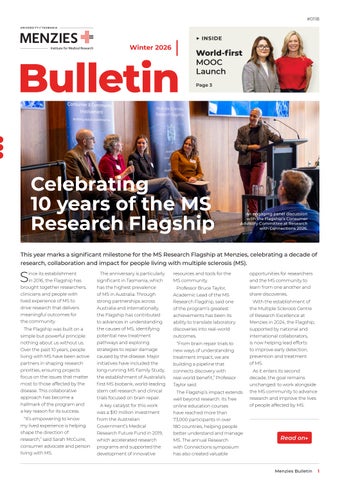
An engaging panel discussion with the Flagship’s Consumer Advisory Committee at Research with Connections 2026.
This year marks a significant milestone for the MS Research Flagship at Menzies, celebrating a decade of research, collaboration and impact for people living with multiple sclerosis (MS).
S
ince its establishment in 2016, the Flagship has brought together researchers, clinicians and people with lived experience of MS to drive research that delivers meaningful outcomes for the community.
The anniversary is particularly significant in Tasmania, which has the highest prevalence of MS in Australia. Through strong partnerships across Australia and internationally, the Flagship has contributed to advances in understanding
The Flagship was built on a simple but powerful principle: nothing about us without us. Over the past 10 years, people living with MS have been active partners in shaping research priorities, ensuring projects focus on the issues that matter most to those affected by the disease. This collaborative approach has become a hallmark of the program and a key reason for its success.
the causes of MS, identifying
“It’s empowering to know my lived experience is helping shape the direction of research,” said Sarah McGuire, consumer advocate and person living with MS.
from the Australian
potential new treatment pathways and exploring strategies to repair damage caused by the disease. Major initiatives have included the long-running MS Family Study, the establishment of Australia’s first MS biobank, world-leading stem cell research and clinical trials focused on brain repair. A key catalyst for this work was a $10 million investment Government’s Medical Research Future Fund in 2019, which accelerated research programs and supported the development of innovative
resources and tools for the MS community. Professor Bruce Taylor, Academic Lead of the MS Research Flagship, said one of the program’s greatest achievements has been its ability to translate laboratory discoveries into real-world outcomes. “From brain repair trials to new ways of understanding treatment impact, we are building a pipeline that connects discovery with real-world benefit,” Professor Taylor said. The Flagship’s impact extends well beyond research. Its free online education courses have reached more than 73,000 participants in over 180 countries, helping people better understand and manage MS. The annual Research with Connections symposium has also created valuable
opportunities for researchers and the MS community to learn from one another and share discoveries. With the establishment of the Multiple Sclerosis Centre of Research Excellence at Menzies in 2024, the Flagship, supported by national and international collaborators, is now helping lead efforts to improve early detection, prevention and treatment of MS. As it enters its second decade, the goal remains unchanged: to work alongside the MS community to advance research and improve the lives of people affected by MS.
Read on▶
Menzies Bulletin
1
Director’s Message
Left to right: Mary-Jane Stolp, CEO MND Victoria, Matt Tilley, CEO Fight MND, Chris Symonds, President of MND Tasmania, Bridget Archer MP, Professor Tracey Dickson, and Premier Jeremy Rockliff.
A decade of MS discovery: celebrating milestones and shaping Tasmania’s health future In years brimming with achievements and milestones, I like to use these Bulletins as an opportunity to pause and celebrate our successes and our bright future as we continue our vital mission for Tasmania. 2026 marks the 10-year anniversary of the establishment of our MS Research Flagship at Menzies - a significant milestone for Tasmania, which has the highest prevalence of MS in Australia. Our Cardiovascular Research Flagship launched what we believe is the world’s first free online course dedicated to stroke prevention: The Preventing Stroke Massive Open Online Course. This wonderful new resource will help build cardiovascular health literacy across Tasmania, Australia and around the world. In July, we joined Premier Jeremy Rockliff; Minister for Health, Mental Health and Wellbeing Bridget Archer; Fight MND and the Motor Neurone Disease Association of Tasmania for the announcement of an $831,000 Tasmanian
Government funding package to support people affected by motor neurone disease (MND) and advance MND research.
make this important work possible.
As always, we would like to acknowledge the vital role our generous community plays in advancing research at Menzies. Philanthropic support enables our researchers to develop and scale innovative programs, generating the evidence needed to secure highly competitive national grant funding.
class research happening right here
If you would like to provide Menzies with your current email address, please email Menzies.Advancement@utas.edu.au or phone 6226 7707. Thank you.
Menzies Bulletin
than $85,000. Thank you for helping
And at the heart (and joints) of our successes is the recent funding boost of over $6 million for our osteoarthritis and cardiovascular health research, which aims to expand access to care and highlights the importance of partnerships and collaboration to improve health outcomes for Tasmania.
Menzies will be increasingly contacting our supporters via email.
2
This year, our Winter Appeal for motor neurone disease research raised more
Soon we will be participating in the inaugural national Medical Research Giving Day on 9 September. We’re proud to be Tasmania’s only medical research institute and to participate in this national event alongside 30+ other institutes, helping raise awareness of the worldin Tasmania. We look forward to sharing more about this and other upcoming events around the state in the months ahead. Kind regards, Tracey Dickson, Director
Keep up with our news Follow us
Would you like to keep up to date with the latest Menzies news? Find us on Facebook and ‘like’ our page.
Read online
You can read all our Bulletins and reports electronically at issuu.com
Research
World-first free online course aims to help prevent stroke Menzies has launched the world’s first free online course dedicated to stroke prevention. The Preventing Stroke Massive Open Online Course (MOOC) is a valuable new resource from our Cardiovascular Research Flagship, designed to build cardiovascular health literacy across Tasmania, Australia and around the world. Developed in collaboration with leading researchers, clinicians and people with lived experience, this co-designed course is for anyone interested in reducing stroke risk, from community members and carers to healthcare professionals and aged care workers. Delivered in a flexible online format, the course provides participants with access to the latest evidence-based research on stroke prevention, as well as practical strategies that can be applied in everyday life. Participants will gain insights into modifiable risk factors such as high blood pressure, smoking, poor diet and physical inactivity, plus access to real-world, actionable strategies for maintaining brain and cardiovascular health.
Left to right: Professor Mark Nelson, Professor Verity Cleland, Matt Picone (lived experience expert), Professor Seana Gall, Hon Rebecca White MP, and Professor James Sharman.
Through its online format, this co-designed course aims to make accurate, accessible information available to anyone seeking to understand stroke better and reduce their own risk and the risk for others. Certificates of completion are available for those undertaking professional development or upskilling, including workers in the aged care sector. Stroke is a major focus for our Cardiovascular Research Flagship, as it is a leading cause of death and disability in Tasmania and around the world. Our research shows that increasing stroke knowledge can help people better understand and reduce their risk, making education a powerful tool for prevention. The Preventing Stroke MOOC is the latest in Menzies’ suite of online courses, including Bush Fires and Your Health, Understanding Multiple Sclerosis (MS), Deciding about Disease Modifying Therapies for MS, Mental Health and MS, and Ageing Well with MS. Visit our website to find out more about our online courses at utas.edu.au/menzies/study
healthier, longer and better lives for Tasmanians? This year, the Best of the Best award was presented to Dr Nicholas Blackburn and Dr Bennet McComish from our MS Research Left to right: Professor Kathryn Burdon, Dr Nicholas Blackburn, Professor Tracey Dickson, Dr Bennet McComish, and Professor Bruce Taylor.
MS research named ‘best of the best’
Flagship for their paper Rare variation in neurological disease genes and its role in multiple sclerosis mimicry and phenotype. While this paper may sound complex, it was born from a fairly simple question: what
Each year, we acknowledge the outstanding research and researchers from our Institute with the 10 of the Best awards.
if a person’s MS diagnosis is
These awards are given to the first authors of the 10 best papers published by Menzies researchers in the prior year, with the top paper receiving the Best of the Best Award.
conditions that look like MS
These papers are selected based on a range of factors; maybe the authors have cracked a long-term challenge, perhaps they
3
Menzies Bulletin
discovered an innovative way to approach a question, maybe they used a large data set to give a more definitive result than ever before. But one question is always the same: does the research contribute to Menzies’ purpose of performing internationally significant medical research leading to
actually something else? In their research, they set out to determine if rare genetic (but aren’t) might be hiding among MS diagnoses. They found that these genetic ‘MS mimics’ are extremely rare. The data showed that from more than 4,300 people diagnosed with MS, only four had signs of another genetic disease. This disease, caused
may explain some, or all, of their MS symptoms. Further, when looking across approximately 1,600 genes known to cause other neurological diseases, they found that people with MS had no more genetic changes in these genes than Australians without MS. This means that while a small number of people may benefit from genetic testing to inform their MS diagnosis or an alternate diagnosis, for most this research offers strong reassurance that their MS diagnosis by a specialist is very likely accurate. This paper was one of the latest pieces of research from the Australian and New Zealand MS Genetics Consortium. This international collaboration brings together MS neurologists and scientists working with DNA samples to explore how our genes contribute to MS.
by a change in their DNA,
Menzies Bulletin
6
Staff profile
Naomi Thomson
How will you be remembered? In Memoriam
Institute Consumer and Community Involvement Manager What brought you to Menzies? I’ve always been impressed and inspired by the work Menzies does and was really excited by the opportunity to be a part of it. My background is in public health, and I’m particularly passionate about ensuring lived experience meaningfully informs health research, policy and system design. Menzies’ strong commitment to consumer and community involvement really appealed to me, and this role was advertised a month after I moved back to Hobart, so the timing felt perfect! I feel very lucky to be here.
One sentence in your Will can fund life-saving medical research. If you would like more information, please contact the Advancement Office on 03 6226 1920. Bequests save lives by funding research. Thank you.
What is your role within the institute? I am the Institute Consumer and Community Involvement Manager. This means I lead and coordinate Menzies’ involvement of consumers and community members in our research, ensuring that lived experience helps shape research priorities, design, delivery and outcomes. I help to build partnerships between researchers and the community, support advisory groups, provide training and guidance and promote involvement opportunities and achievements. Ultimately, my role is to help ensure our research is relevant, inclusive and focused on the issues that matter most to the people it aims to benefit. Why do we call people consumers? The term ‘consumer’ is widely recognised and used across the health and research sectors to describe a person who has lived experience of a health issue and/or accessing healthcare and health systems, either themselves or as a carer, family member or friend. We use this established term because it recognises the broad range of people who can contribute valuable insights to improve health and medical research. Some people prefer other terms, such as ‘person with lived experience’ or ‘lived experience expert’. What is the most interesting aspect of this work? I’m really enjoying learning about all the different research happening at Menzies - it’s truly fascinating. I’m also interested in exploring the many ways consumers and community can be involved in that research and how we can make these opportunities accessible, meaningful, and impactful for everyone involved. What is the part of your work that makes you the proudest? I’m proud whenever I see consumer and community involvement done well - when researchers and consumers both have a positive experience, feel supported, and the research is stronger as a result. I’ve already seen some great examples of this at Menzies, and I’m excited to help build on that work. What do you enjoy doing in your spare time? I love to bake and enjoy hiking around our beautiful island. I’ve also recently inherited a magnificent garden, so most of my spare time is now spent trying to keep it happy and thriving!
Learn more about getting involved in our research here: utas.edu.au/menzies/get-involved
4
Menzies Bulletin
We gratefully acknowledge gifts made from the following estates: Estate of the late Barbara Kathleen Evans Estate of the late Lorraine Ann Pollard Estate of the late Marlene Violet Willey
We gratefully acknowledge gifts made in honour of: Jill Bunce Peter Dunford Bree G Amy Hamlyn-Harris John Kudelka Annette (Anna) Jacqueline Page Johannes Van den Berg W M Wescombe
Community
Menzies Winter Appeal attracts strong community support Thank you to everyone who supported this year’s Menzies Winter Appeal. Together, you’ve helped raise more than $85,000 for vital medical research and welcomed 30 new donors to the Menzies community. This year’s appeal shines a spotlight on the work of Associate Professor Cathy Blizzard and her team, who are working to better understand motor neurone disease (MND), a devastating condition that can take away a person’s ability to move, speak and breathe in a remarkably short time. Research has shown that Tasmanians are around 40 per cent more likely to die from MND than people elsewhere in Australia, making this work especially important for our state. Thanks to the generosity of supporters, Cathy and her team can continue
We’d also like to let you know about another exciting milestone. On 9 September, Menzies will take part in Australia’s first Medical Research Giving Day, a national initiative bringing together over 30 medical research institutes and supporters from across the country to champion life-changing research. We’re proud to be the only Tasmanian medical research institute participating in this inaugural event.
investigating why MND progresses so quickly and explore new ways to slow the disease and improve outcomes for people living with it. As Cathy puts it, “MND is fast, so we have to be faster.”
You can donate here:
And if you’ve been meaning to support the Winter Appeal, it’s not too late. Every gift helps researchers move closer to better treatments and brighter futures for Tasmanians affected by MND.
Thank you for being part of the Menzies community and helping drive research that changes lives.
menzies.utas.edu.au/donate, or give our team a call on 1800 638 124 or +61 3 6226 7707 (9am to 5pm, Monday - Friday).
Join more than 30 medical research institutes helping save lives Medical Research Giving Day September 9 Please scan to donate
Left to right: Luca Brodribb, Jyoti Chuckowree, A/Prof Catherine Blizzard, Anna Nguyen, Kathryn Maskell, Dr Rosie Clark, and Dr Chiing Yap.
Menzies Bulletin
5
Research
Partnerships at the heart (and joints) of medical research in Tasmania A recent funding boost for cardiovascular and osteoarthritis research at Menzies showcases the importance of collaboration in medical research.
Left to right: Dr Laura Sutton, Shell, A/Prof Dawn Aitken, and Ginny Lim. Below: Professor James Sharman.
This year, Menzies received two grants
and enable better access to care, with
to combat challenges, like time and
totalling over $6 million in funding
a vision to address the unsustainable
resourcing constraints, which can
for research into osteoarthritis and
demand for joint replacement surgery
prevent them from measuring blood
cardiovascular health. While the research
in our state.”
pressure accurately.
for these grants looks at two different
The funding will support a coordinated
“Accurate blood pressure measurement
but important areas of health, they have
statewide approach to embed new
is central to how doctors diagnose and
something in common: partnership
interventions and digital technologies
manage patients, guiding decisions about
and collaboration.
into healthcare practice in Tasmania. A
the type and dose of medication that can
major focus will be scaling up the Good
significantly shape a person’s long-term
Life with osteoArthritis from Denmark
health,” Professor Sharman said.
Improving access to high-quality care for knee and hip osteoarthritis in Tasmania Stemming from a long-term partnership between Menzies’ researchers, collaborators at the University, the Tasmanian Department of Health, Primary Health Tasmania and Arthritis
(GLA:D®) exercise and education
gap in blood pressure measurement
partnerships. The grant will also
accuracy and care for people with
implement and evaluate two innovative
hypertension.”
virtual models of care to improve options for rural and remote areas.
and Osteoporosis Tasmania, Associate
A new approach to blood pressure
Professor Dawn Aitken is leading a $5
testing to improve patient care
million Medical Research Future Fund
In partnership with Hypertension
grant that will rapidly expand access
Australia, Primary Health Tasmania and
to high-value osteoarthritis treatments
other organisations, Professor James
in Tasmania.
Sharman has been awarded a $1.1 million
“Osteoarthritis is the most common form of arthritis. It affects one in five
“This project can help fill an important
program through public and private
NHMRC Partnership Grant, aiming to improve the accuracy of blood pressure
It will build on a pilot program led by Professor Sharman in the North West of Tasmania and will support 40 GP clinics across the state and nationally to offer a higher standard of care through AOBP measurements.
“Osteoarthritis is the most common form of arthritis”
Australians over the age of
measurements taken in
Supporting Tasmanians through
45, and is a major cause
general practice (GP)
partnership
of pain, disability and joint
clinics to help reduce the
replacement surgery,”
rates of cardiovascular
Associate Professor
disease.
Aitken said.
A lead researcher from
of any Australian state due to higher levels
our Cardiovascular Research
of socioeconomic disadvantage, chronic
“Despite its widespread burden, there are major barriers to accessing high-quality care for the
Flagship, Professor James Sharman, said clinic blood pressure
Tasmania has the oldest and most rapidly ageing population in Australia and some of the poorest health outcomes
disease and disability. It is through partnership-led research
condition, especially in regional areas such
was frequently not able to be measured
that brings Menzies, community, industry
as Tasmania.
using the best possible method, known as
and government together that we can
Automated Office Blood Pressure (AOBP).
achieve better health and better lives
“The project will use bold system-wide approaches to improve the quality of care
This new project will support GPs
for Tasmanians.
Menzies Bulletin
6
Thank you
for your support
Donate online You can donate online at menzies.utas.edu.au/donate Donate by phone You can donate over the phone by calling us on 1800 638 124 Please post this slip to: Menzies Institute for Medical Research University of Tasmania Reply Paid 77465 Hobart TAS 7000
Yes, I want to invest in a healthier future for all Tasmanians.
100%
of your gift will be used for research in Tasmania.
My gift Please accept my one-off gift of:
Please accept my regular monthly gift of:
$25
$25
$50
$50
or
$100
$100
$250
$250
Other $
Other $
Gifts of $2 and over are tax deductible.
My payment Cheque/money order: Enclosed is my cheque/money order (payable to the Menzies Institute for Medical Research) Credit card: Please debit my
Visa
MasterCard Expiry date
Credit card number
/ Name on card Signature
Please allocate my gift to: The current Menzies appeal Where most needed A specific area of research
My details Title:
Mr
Mrs
Ms
Miss
Other
Name Address Postcode Telephone (
)
Email Please send me information on remembering Menzies in my Will I have already included a gift to Menzies in my Will