

New course aims to help improve understanding of Parkinson’s disease
Earlier this year, we launched a first-of-its-kind Massive Open Online Course (MOOC) to support millions of people living with Parkinson’s globally.
The Parkinson’s MOOC – developed by Menzies and the Wicking Dementia Research and Education Centre – consolidates the latest information about the condition from experts around the world, including people living with Parkinson’s, their family, clinicians and researchers. Information on symptoms, risk factors, medicines, allied health therapies and strategies for living with Parkinson’s is included and it can be undertaken by anyone. It also features accounts from people affected by Parkinson’s and emphasises the importance of evidence-

Having people with Parkinson’s speak about their experiences can help others
based information, in an accessible form.
We’re delighted that it has now reached almost 15,000 people across more than 150 countries.
Professor Michele Callisaya, who drew on her professional expertise as a physiotherapist
and her own experience as a person living with Parkinson’s to build the MOOC, said in addition to delivering important information it tackles common misunderstandings about the condition.
“We’ve had really positive feedback from both clinicians and people living with the condition, including those recently diagnosed to those who have had Parkinson’s for many years,” she says.
“Having people with Parkinson’s speak about
their experiences can help others and make them feel less alone.”
Professor Callisaya co-led the development of the MOOC with Professor Jane Alty, a neurologist who specialises in Parkinson’s.
Professor Callisaya is a recent recipient of a Select Foundation Fellowship, which grants her funding to continue her research to reduce stigma and improve treatments for people living with Parkinson’s and also dementia.
Professor Callisaya says when she was diagnosed, she realised how hard it was to access allied health to provide her with support and treatments, which inspires her to continue her research.
The development of the Parkinson’s MOOC was funded by a generous gift from the Parkinson’s Research Foundation (PRF), an initiative funded by venture philanthropy that aims to accelerate breakthroughs in Parkinson’s research.

I love that we have a direct way to connect with our community
Director’s message
We’re well into 2025 and I’m so excited to share what we’ve been up to.
I’m so pleased that over the past few years I’ve had the opportunity to meet many of our supporters around Tasmania and beyond. And there’ll be more opportunities to come.
This Bulletin will give you information about our free online courses that are a great accessible way to learn about our research and how it
AEDs: A shockingly simple lifesaver
It’s shockingly simple to save a life with an automated external defibrillator (AED).
Devastatingly, only about 10 per cent of the 32,000 Australians who experience out-of-hospital cardiac arrests each year survive. But AEDs can help save more lives – and are designed to be easy to use, even without training. Our Cardiovascular Research Flagship, in partnership with the Heart Foundation and Ambulance Tasmania , has helped establish
a GoodSAM responder network. GoodSAM was founded in 2013 to radically change the response to cardiac arrests. By alerting those trained to nearby cardiac arrests while an ambulance is en-route, earlier CPR and defibrillation has saved many lives.
It allows more community responders to give lifesaving AED care, before ambulances arrive.
Cardiac arrests can happen to anyone, anytime, and quick action can save lives.
To learn more about how to use an AED, please visit www.heartfoundation.org.au/shockingly-simple and join GoodSAM at www.health.tas.gov.au/goodSAM
can help you and the community.
We also have feedback from our supporter survey, which we thank you for participating in, as well as news about our new funding and what our researchers are up to.
Kind regards,
Tracey Dickson Director
Thank you for subscribing to our Bulletin! I love that we have a direct way to connect with our community and the people who support us.
We’ve entered 2025 with a lot of exciting ongoing and new research projects.
Stay tuned for upcoming events around Tassie this year.

Menzies will be increasingly contacting our supporters via email.
If you would like to provide Menzies with your current email address, please email Menzies.Advancement@utas.edu.au or phone 6226 7707. Thank you.
Would you like to keep up to date with the latest Menzies news? Find us on Facebook and ‘like’ our page. You can read all our Bulletins and reports electronically at issuu.com

Revolutionary treatment for premature babies
Professor Peter Dargaville and his team have recently made further groundbreaking steps towards helping premature babies breathe easily.
A million-dollar grant from the National Health and Medical Research Council (NHMRC), and research findings published in the prestigious medical journal The Lancet Global Health, will transform the landscape of neonatal and paediatric oxygen therapy.
Low-flow oxygen therapy via the nose is the most common method of providing oxygen to infants and children. However, newborns, especially those born preterm, are at significant risk of harm from both low and high oxygen levels. The NHMRC Development Grant aims to develop and evaluate a device that automates low-flow oxygen delivery, ensuring precision targeting of safe oxygen levels for infants and young children.
This innovative project holds the promise of
significantly improving the safety and effectiveness of oxygen therapy for the most vulnerable patients –infants and young children. By automating the delivery of low-flow oxygen, the device aims to provide consistent and precise oxygen levels, reducing the risks associated with manual adjustments and ensuring better outcomes.
As the project progresses, it will not only advance medical technology but also pave the way for broader applications in paediatric care, potentially setting new standards for oxygen therapy worldwide.
Helping babies in low and middle-income countries
The Lancet Global Health article reported the results of a trial conducted in two neonatal units in southwest Nigeria. The
study looked at preterm infants with a gestational age of less than 34 weeks or a birthweight under 2kg, who were at least 12 hours old and required oxygen therapy and continuous positive airway pressure because of respiratory insufficiency. Participants were randomly assigned to start with either automated oxygen control or manual oxygen control, with each method being used for two 24-hour periods in a random sequence.
Forty-nine infants were
[It’s] a promising step forward in the quest to provide safer and more effective care for the
most vulnerable patients
Breathing easier: Low-flow oxygen therapy via the nose is the most common method of providing oxygen to infants and children.
included in the study with findings showing a considerable improvement in time in safe oxygen ranges during the period of automated oxygen control compared with manual control. There were no device-related adverse outcomes, and short-term safety outcomes favoured the automated control method.
These findings highlight the potential of automated oxygen to improve the management of oxygen therapy in preterm infants, especially in low-resource settings. By ensuring more consistent and accurate oxygen delivery, this technology could significantly enhance neonatal care and reduce the risks associated with poorly regulated oxygen therapy.
As the healthcare community continues to seek innovative solutions to global health challenges, this study represents a promising step forward in the quest to provide safer and more effective care for the most vulnerable patients.
One shared vision to reduce the impact of multiple sclerosis
Six researchers from our Multiple Sclerosis (MS) Research Flagship have secured a combined $1.2 million in grants from MS Australia for new multiple sclerosis research.
Supporting the MS Research Flagship’s shared vision of reducing the impact of MS on individuals and the community, grant recipients Dr Jessica Fletcher, Dr Nicholas Blackburn, Glen Henson, Dr Valery Fuh-Ngwa, Dr Yi Chao Foong and Dr Julie Campbell are leading pioneering MS studies across disciplines including neurobiology, genetics, neurology, statistics (disease modelling) and health economics.
Dr Fletcher is researching ways to repair damage to the brain in MS by boosting myelin production, which protects nerve cells.
“Our goal is to develop precise treatments that target myelinproducing cells known as oligodendrocytes,” she said.
Dr Blackburn is studying MS families to understand genetic influences on MS development.
“Our study aims to identify genetic changes that contribute to MS development, understand why MS occurs more frequently in some families, and ultimately why it develops at all, even in people with no family history of MS,” he said.

Mr Henson is using health economics to understand the global impact of MS and improve treatment policies.
“Our research aims to enhance quality of life for people with MS by helping doctors make better treatment decisions and supporting government subsidisation of MS therapies,” he said.
Dr Fuh-Ngwa will use data from various MS registries to analyse the evolution of disability status in relapsing MS and compare standard treatments to stem cell treatments.
“We seek to develop new methods to analyse health outcomes and improve MS treatment approaches,” said Dr Fuh-Ngwa, whose project is also part-funded by MSWA.
risks of disease-modifying therapies in older MS patients, to promote more consistent, evidence-based clinical decision making,” he said.
Dr Campbell’s team is investigating whether women and marginalised groups with MS in Australia earn less than men and exploring the reasons behind this wage disparity.
Our research aims to enhance quality of life for people with MS
Dr Foong’s research focuses on improving treatments and monitoring for older people with MS.
“We aim to understand the balance between therapeutic benefits and
“A double burden of wage discrimination exists where disability and gender collide,” she said. “The findings from this study will help to raise awareness and provide evidence to advocate for wage equality.”
Team effort: Clockwise from top left , Dr Nicholas Blackburn, Glen Henson, Dr Julie Campbell, Dr Yi Chao Foong, Dr Valery Fuh-Ngwa, Dr Jessica Fletcher.
How will you be remembered?
In Memoriam
One sentence in your Will can fund life-saving medical research.
If you would like more information, please contact the Advancement Office on 03 6226 1920.
Bequests save lives by funding research. Thank you.
FEEDBACK
SUPPORTER SURVEY
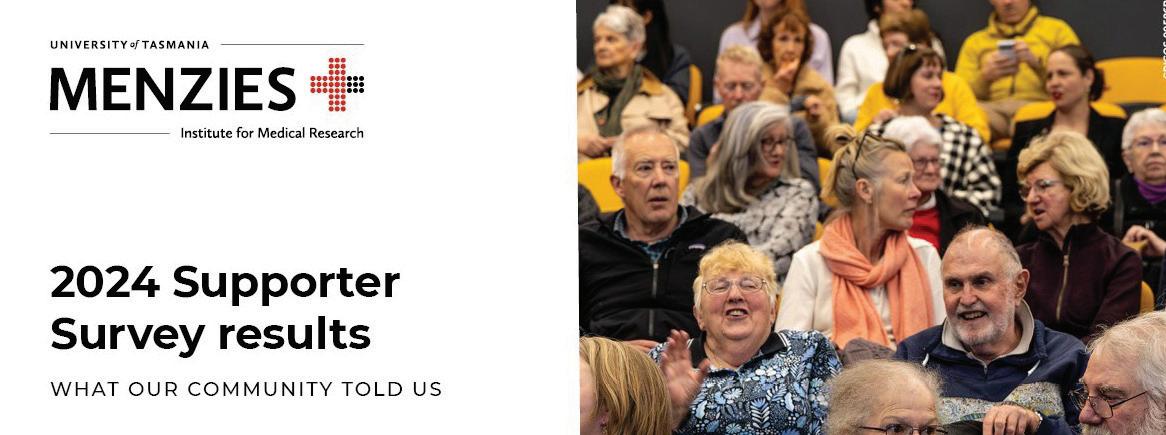
We’d like to share the highlights of our 2024 Supporter Survey.
Thank you for taking the time to complete the questions and for sharing your thoughts. Your feedback will be used to inform the community activities we undertake in 2025 – and beyond.
We gratefully acknowledge gifts made from the following estates:
Estate of the late Thea Rhona Craig Caro
Estate of the late Diane Fleming
Estate of the late Adrian Maxwell Kemp
We gratefully acknowledge gifts made in honour of:
Peter Dunford
Bob Greenhill
John Griggs
Calogero Rigoli
Freda Noel Salter
Daryl Sproule
Steve Tully
Justin Walls
Audrey Whiteway
Kenneth Wills
Allan Witt
We sent the survey to 5,103 of our supporters, and 624 (12%) of you completed it. Here are some of the key findings:
76% of respondents are located in Australia, with 68% currently living in Tasmania.
64% were born or primarily raised in Tasmania.
Respondents ranged in age from 27 to 94, with the average age being 70
Engagement and participation
29% expressed interest in sharing lived experiences with the health conditions we study.
56% would like to get involved in research projects.
52% are willing to participate in research studies.
39% showed interest in volunteering for Menzies.
49% are interested in touring our laboratories and facilities.
We’re delighted that so many members of our community want to get more involved. Because of your enthusiasm, we’re building programs that will open the doors to the community and make our work more accessible.
As an institution committed to inclusivity, Menzies is actively exploring online options to enhance accessibility and ensure broader participation.
The survey results also highlight that the true impact of your donations is often underestimated. Many people don’t fully realise how much of a difference their donations make. Our research heavily depends on preliminary studies, which are essential for securing competitive federal grants. The generous support from individuals and groups in our community plays a crucial role in making this possible.
PARTNERSHIPS BOOST RESEARCH INTO BONE MARROW FAILURE SYNDROMES
Our research into Bone Marrow Failure Syndromes (BMFS) includes strong links to the Alex Gadomski Foundation and Maddie Riewoldt’s Vision. Tragically, both Alex and Maddie died from BMFS at a very young age.
We’re currently recruiting Tasmanians for groundbreaking research into BMFS, a collection of immune system related medical conditions that cause bone marrow stem cells to reduce or stop producing healthy red blood cells, white
blood cells and platelets needed by the body.
This study is open to a wide variety of Tasmanians. You don’t need to have BMFS to donate. By using cutting-edge genetic technology, we aim to uncover the causes of these diseases and develop better treatments.
Participation involves taking a one-time sample of blood, after completing a consent form, and takes about 15 minutes.
For more information, please phone 0408 344 559 or email marrow.map@utas.edu.au
RESEARCHER
PROFILE
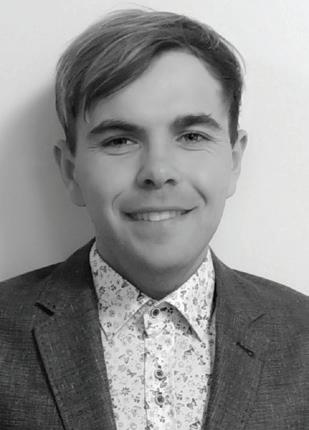
William Reay Postdoctoral Research Fellow
What is the focus of your research?
My research is focused on how the information in our genes can be used to improve treatment of neurological disorders like motor neurone disease (MND) and MS, as well as mental health conditions like schizophrenia and anorexia. We’re developing new ways to use very large genetic datasets to find drug targets for these diseases. We’re particularly interested in the idea of something called “drug repurposing” – meaning using a drug already available but for a new disease not considered previously, which

can be cheaper and quicker to get into the clinic than starting from scratch with a new drug. Through using genetics, we can quickly shortlist which existing drugs out of thousands may be useful for something like MND and accelerate them towards further testing. We can also extend this genetic approach to understand the complexity of brain disorders, which all have many symptoms that extend to other parts of the body. As one gene can have many different functions, genetics can tell us about what causes these different symptoms and reveal
STAFF PROFILE
Community Engagement Officer
What brought you to Menzies?
I recently moved to Tasmania from the Bush Capital (Canberra) and was looking for a new challenge. As I have a keen
ways to improve overall quality of life for people living with these diseases.
What are some of the recent findings from your work?
interest in health and wellbeing, and I love all kinds of research, Menzies seemed like a natural fit.
What is your role within the institute? As a research
We’ve been working with other researchers from around Australia to shortlist existing drugs that could be useful to trial in MND based on what we know about the role of genetics in MND. These results have been exciting as it’s opened up new leads for existing drugs to consider that can be now tested in cells from people with MND to build the evidence for a clinical trial. We also found that some of the drugs recently used in clinical trials overseas for MND may be particularly promising as the genetics suggests those drugs are targeting something important in the disorder. We’re now working to expand institute, it is imperative that we inform, consult and involve the community in our work, and I have the pleasure of doing just that. In my role, I plan and coordinate community engagement for Menzies and facilitate the transfer and communication of cutting-edge research. My work is, of course, impossible without the amazing researchers who
this genetic approach out to multiple sclerosis with the aim to find drugs that can protect and repair the damage done to the brain in multiple sclerosis. Our goal is for MS to be a disease without disability.
What other research-based activities have you been involved with?
This year, I was able to contribute to the development of the genetics module of a new online course being developed by the University of Tasmania to educate people about MND. I think it’s important that people understand that genetics does not mean you are guaranteed to get a disease, but rather disease arises from having a certain mix of genetics and environment, and this will be different for different people. I also recently joined the leadership
share their expertise and knowledge with the wider society.
What is the most interesting aspect of this work?
Undoubtedly, the most interesting part of my work is learning about all the fascinating research that is going on at Menzies. I also enjoy meeting different community partners to see how they fit into the Menzies fabric.
team committee as a representative for early career researchers here at Menzies and I look forward to supporting the great work that we do at our institute.
What do you enjoy doing in your spare time?
I spend a lot of time indoors at work during the day, so I love getting out and exploring all that Tasmania has to offer with my partner on spare weekends. I particularly love the snow, so you’ll find me up Mount Wellington many weekends in winter when there’s snow. I’m also a tennis tragic and regularly play at the Domain Tennis Centre in Hobart. When I do have to be inside, I enjoy playing guitar and I’m a bit of science-fiction nerd.
What is the part of your work that makes you the proudest?
Being able to connect research to community makes me truly happy. Knowing that what we do can genuinely impact people’s lives fills my cup.
What do you enjoy doing in your spare time?
I love stories so I read, write and watch TV shows.
My gift
Please accept my one-off gift of:
$25
$50 $100
$250 Other $
Gifts of $2 and over are tax deductible. or
My payment
Please accept my regular monthly gift of:
$
Cheque/money order: Enclosed is my cheque/money order (payable to the Menzies Institute for Medical Research)
Credit card:
Please debit my Visa MasterCard
Credit card number Name on card Signature Expiry date /
Please allocate my gift to: The current Menzies appeal Where most needed A specific area of research
My details
Title: Mr Mrs Ms Miss Other
Name Address
Telephone ( )
Please send me information on remembering Menzies in my Will I have already included a gift to Menzies in my Will Yes, I want to invest in a healthier future for all Tasmanians. 100% of your gift will be used for research in Tasmania.
Postcode
Donate
Donate by phone
