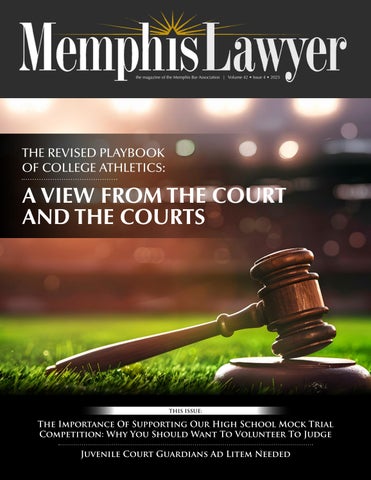
Memphis Lawyer 2025 Issue 4

Page 1


THE REVISED PLAYBOOK OF COLLEGE ATHLETICS:

A VIEW FROM THE COURT AND THE COURTS

Your bank for the legal community

From solo practices to large firms, legal professionals across the Memphis area trust BankTennessee for personal service, tailored banking solutions, and a genuine understanding of their unique needs.

As the premier sponsor of the Memphis Bar Association almost 20 years,

built our reputation as the bank for the legal community — one relationship at a time.

With

26 The Importance of Supporting Our High School Mock Trial Competition: Why You Should Want to Volunteer to Judge

JUDGE J. ROSS DYER

2025 MBA Officers

MEMPHIS LAWYER

the

Memphis Bar Association

Publications Committee

Audrey Calkins, Chair

Terre Fratesi, Vice Chair

Nicole M. Grida

Regina Hillman

Maureen Holland

Anna Vescovo

2025 Board of Directors

Preston Battle

Audrey Calkins

Hallie Flanagan

Malcolm Futhey III

Jack Heflin

Geoffrey Lewis

Joseph McKinney

Hon. Danielle Mitchell

The Memphis Lawyer is a quarterly publication of the Memphis Bar Association, Inc. with a circulation of 2,000. If you are interested in submitting an article for publication or advertising in an upcoming issue, contact info@memphisbar.org. The MBA reserves the right to reject any advertisement or article submitted for publication.

Jerrick Murrell

Ruchee Patel

Danielle Rassoul

Maggie Roney

Abigail Webb Sala

Maggie Stringer

Quinton Thompson

Councilwoman Janika White

Kristina Woo

Section Representatives

Anne Davis

Dan Norwood

Joe Ozment

Toni Parker

MBA STAFF

AWA Representative Misty O'Neal

Law School Representative Regina Hillman

NBA Representative Jackie Richardson

YLD President Brande Boyd

PRESIDENT'S COLUMN

As my term as your 2025 MBA President ends and I look back over the events and accomplishments of the past year, I am overwhelmed with gratitude for all of the leaders, volunteers, and supporters who made this a great Bar year and gave me the opportunity to be a part of it.

Thanks to the dedication of our SLIP co-chairs, Judge Carlyn Addison and Patrick Hillard, their committee, and the worksite volunteers, another group of aspiring young legal minds learned about who we are and what we do as lawyers in Memphis. This MBA time-honored tradition brings unrivaled opportunities to the lives of the high school students who participate in the Program, and the pride and joy on our worksite leaders’ faces at their graduation is truly inspiring.

Thanks to our CLE co-chairs, Abby Sala and Macky Futhey, the MBA put on many excellent CLEs, from educating us on the law applicable to current events to hanging with Penny Hardaway and the Memphis Tigers. Matt May also led the MBA’s efforts to bring paralegals into the fold. Our Sections continued to bring their members together to learn and network, and the John Dice seminar was a great success again this year.

Thanks to our Leadership Forum co-chairs, Lucie Brackin and Terrence Reed (who both also received my President’s Awards), their committee, and many of its alums, we brought back a beloved program, and an outstanding class of new leaders will graduate in the spring. The members of the 2025 Leadership Forum class have learned from experts in networking and client development and joined together to pack thousands of pounds of food for those in need in our community, with more to come as their sessions continue in the new year. We hope that the lessons, relationships, and memories from their time together will stay with them always. We send a special thanks also to the employers and supervisors of the Forum class members. We appreciate your investment in them as they take time away from their day jobs to prepare to be our community’s future leaders. The returns will be worth the investment!

We came full circle in other ways too this year. At our annual Memorial Service in April, Judge Phyllis Gardner led us in remembering those we have lost, and then in November, our Supreme Court led us in welcoming newly

licensed lawyers to our ranks. We celebrated the investitures of some newly appointed state and federal judges, and we admired the portraits of others who are retiring—ever thankful for our judicial members’ contributions.

We enjoyed beautiful views on the Alabama shore, learned, and networked at our annual Bench Bar Conference thanks to our chairs, Earl Houston, Judge Annie Christoff, and Justice Mary Wagner, and their Host and Planning Committees. We celebrated the history and future of leaders of our Association at a fun-filled presidential cocktail reception. Stay tuned for exciting announcements about Bench Bar 2026...which will be at The Henderson in Destin!

Perhaps my most heartfelt thanks go to the members of my Executive Committee: Brande Boyd, Marlinee Iverson, Adam Johnson, Matt May, Jerrick Murrell, Will Perry, Maggie Roney, and Amy Sterling. Together, we did a lot of other important work that most of you never saw, but I can assure you will have lasting benefits for our members for years to come. When I asked these strong leaders to join me on the EC, I was thrilled that they agreed, but my admittedly high expectations were consistently exceeded as we worked together on the business of the Bar.

We closed the year with our Annual Meeting on December 4 at the FedEx Event Center, where we celebrated our Sam A. Myar Memorial Award winner, Natalie Bursi, and our Judge Jerome Turner Lawyer’s Lawyer Award winner, Shea Wellford, whose contributions to our legal community know no bounds. Recognizing their achievements and thanking them for their service was a fitting end to a wonderful year.

As we look ahead to 2026, I hope you will continue to provide our Bar Association with the support you shared this year as President Marlinee Iverson begins her term. She is a true servant-leader, having dedicated her almost 30-year legal career to public service, from the U.S. Attorney’s Office to the longest known tenure as Shelby County Attorney. We are all very fortunate that she has now chosen to serve the MBA in this role. With her returning and newly elected Board members by her side, and the always incredible support of our MBA staff members, Marlinee is sure to lead us to great things in 2026. Happy New Year! 

THE REVISED PLAYBOOK OF COLLEGE ATHLETICS: A VIEW FROM THE COURT AND THE COURTS

With more than 350 member schools, Division I of the NCAA provides opportunities for some 200,000 student-athletes to compete in highlevel college athletics each year. If you have watched a collegiate sporting event within the last year on any sports broadcast network, undoubtedly you have seen the Southeast Conference (SEC) commercial which touts, “It just means more.” The underlying (un)truth of the commercial’s specific assertion—namely, that the roughly 9,000 student-athletes competing within the SEC have a more meaningful collegiate experience than that of the 190,000 student-athletes competing within other Division I conferences (not to mention the additional 140,000 student-athletes competing in Division II and the nearly 200,000 student-athletes competing in Division III)—is certainly debatable. However, given the transformative changes to the collegiate model of sports, which changes reached a climax in 2025, the more interesting exercise would be to examine the commercial’s assertion as applied more broadly to the entire enterprise of collegiate athletics. Does it mean more? In the Spring of 2015, the President of the University of Memphis appointed me to serve as the Faculty Athletics Representative (FAR) to the NCAA.1 Thus, for over a decade, I have witnessed the governance of collegiate athletics from the front row, and I can attest that the magnitude of the recent changes is unprecedented. I care deeply about college sports, both in theory and in practice. As a law professor, I have followed

court decisions for incorporation into my Sports Law curriculum; as the FAR for the University of Memphis, I have watched the changes unfold on the courts, fields, and tracks. Though recent surveys of leaders within college sports reflect significant concern over the current state of affairs,2 the collegiate model of sports—one in which the student-athlete experience remains tied to the core mission of education—has continuing value.

In assessing whether “it means more,” any fan will note that many aspects of college sports have increased—more money, more mobility, more media and merchandising, more rule modifications. Some might even say more madness (and I do not mean the trademarked kind of Madness we experience in March). This article will examine what aspects of college sports are “more” and whether these excesses have created a more meaningful enterprise. I will explain the primary legal challenges to the governing body of college sports, which challenges have resulted in a revised playbook for college athletics. I also will highlight positive changes arising from the rethinking of college sports and will note a few concerning trends that must be addressed. Once the dust settles, I believe the core values of the student-athlete experience will continue to mean as much as they always have.

MORE MONEY

The most noteworthy “more” within collegiate athletics is more money. Based on data collected and reported in a joint project3 by the Knight Commission

1 The NCAA requires all member institutions to include among the primary athletics leadership team a faculty member who reports, not to the Director of Athletics, but directly to the University President, whose external-to-athletics perspective provides academic oversight, liaises between the faculty and the athletic department, and prioritizes matters of student-athlete welfare at the institutional and conference levels.

2 See generally College Sports at a Crossroads: Insights from Division I Campus Leaders, KNIGHT COMM’N. (Oct. 9, 2025), https://www. knightcommission.org/wp-content/uploads/knightcommission_DILeadersSurvey_summaryhandout_1092025.pdf (“There is widespread agreement among leaders responding to this survey that the current framework of Division I is under severe strain.”).

3 Football Bowl Subdivisions, KNIGHT-NEWHOUSE: COLL. ATHLETICS DATABASE, https://knightnewhousedata.org/fbs (last visited Nov. 16, 2025).

on Intercollegiate Sports4 and Syracuse University Newhouse School of Public Communications, the combined revenue among the ten Division I Football Bowl Subdivision (FBS) conferences5 in 2024 was just under $12 billion dollars—almost twice that of the conference’s total revenue in 2014. While ticket sales and student fees have increased in the ten-year period between 2014 to 2024, the primary jumps in revenue are attributable to an increase in both donor contributions (in the new “name, image, and likeness” era) and valuable media rights (representing billions of dollars of revenue paid to the NCAA and the athletic conferences). Ultimately, the recent changes in collegiate athletics have occurred against the backdrop of the NCAA’s management of a multi-billion-dollar sports enterprise.

Not only is the proverbial pie of shared revenues larger, but the way the pie is sliced has changed. Along with the increased revenue within college sports is the previously forbidden practice of paying student-athletes—a practice that prior to 2021 would have resulted in penalties to the institution and ineligibility for the student-athlete based upon forfeiture of his or her amateur athlete status. Exactly how did the collegiate model of the NCAA founded upon the principal of amateurism meet its demise? If we are honest, we must admit that judges have played a greater role in reshaping college sports than the NCAA’s leadership, the Conferences, and colleges and universities that sponsor college sports.

Although challenges to the monopsonistic governance of the NCAA based in federal antitrust law have dated back to the early 1980’s,6 the class action filed by former UCLA basketball player Ed O’Bannon challenging the legality of the NCAA’s prohibition on payments to student-athletes for the commercial use of their name, image, and likeness (NIL) marked the beginning of the

end of amateurism as the defining characteristic of college sports. In 2009, O’Bannon sued the NCAA and the Collegiate Licensing Company (CLC) in federal court, claiming that the NCAA’s amateurism rules constituted an illegal restraint of trade in violation of antitrust laws embedded in the Sherman Act.7 After six years of litigation, in a 2015 decision, the United States Court of Appeals for the Ninth Circuit affirmed the decision of District Judge Claudia Wilken and held the NCAA’s amateurism rules were subject to antitrust scrutiny under the rule of reason and failed under that standard.8

Five years later, in a suit filed by a class of Division I student-athletes led by Shawne Alston, a former running back for West Virginia, the Ninth Circuit considered the NCAA’s restrictions on education-related benefits, which is another restriction based on the principle of amateurism.9 Similar to the holding in O’Bannon, the appellate court held that such restrictions constituted an anti-competitive restraint on trade in violation of the Sherman Act.10 In 2021, the United States Supreme Court unanimously affirmed the Ninth’s Circuit’s decision.11

In its rejection of amateurism as a procompetitive justification for the NCAA’s overly restrictive limitations on compensation to student-athletes, the Alston case technically opened the door for institutions to pay student-athletes only for education-related benefits. Justice Kavanaugh’s concurring opinion, however, reached further than the issue before the Court by considering payments to student-athletes for use of their NIL.12 In agreeing with the majority decision, he signaled his concern that the NCAA’s use of “unpaid student athletes to generate billions in revenue for member institutions” may raise “serious questions about anti-trust laws.”13

Justice Kavanaugh’s concurring opinion has proven to be prophetic. With media coverage of the Alston

4 The Knight Commission on Intercollegiate Sports, constituted in 1989 and comprising leaders among higher education and college sports, is an independent research and advisory group who primary focus is reforming college sports to undergird the educational mission. While the opinions expressed in this article are mine, I owe a debt of gratitude to the Knight Commission for the research and educational programming it offers to Faculty Athletics Representatives. For more about the Knight Commission, see KNIGHT COMM’N. ON INTERCOLLEGIATE ATHLETICS, https://www. knightcommission.org (last visited Nov. 16, 2025).

5 FBS, formerly known as NCAA Division I-A, “is the classification for Division I athletic programs with the highest-profile football competition in college athletics.” See supra n.3.

6 See NCAA v. Bd. Of Regents of Univ. of Okla., 468 U.S. 85 (1984) (holding that the broadcast rights provisions of the NCAA violated federal antitrust laws by giving the NCAA a lock on television revenue from the broadcast of college football games without a procompetitive justification).

7 O’Bannon v. NCAA, 802 F.3d 1049, 1055 (9th Cir. 2015).

8 Id. at 1070-79.

9 In re NCAA Athletic Grant-in-Aid Cap Antitrust Litigation (Alston v. NCAA), 958 F.3d 1239 (9th Cir. 2020).

10 Id. at 1265-66.

11 NCAA v. Alston, 594 U.S. 69 (2021).

12 Id. at 107 (Kavanaugh, J., concurring).

13 Id. at 110 (Kavanaugh, J., concurring).

decision focusing less on the actual holding and more on Justice Kavanaugh’s concurring opinion, the locked door behind which the issue of payments to student-athletes had been relegated since the founding of the NCAA in 1906 was flung open wide. With hindsight, it seems that door was not only opened, but it was removed from its very hinges. As of the writing of this article (November 2025), twenty-eight active lawsuits are currently challenging the NCAA on antitrust grounds.14 Most of these cases challenge the NCAA’s eligibility rules, which place a cap on the number of seasons a student-athlete may play his or her sport at the collegiate level.15 Others challenge NCAA rules restricting student-athletes from receiving cash prizes for athletic competitions.16

The culmination of the antitrust assault against the NCAA came with the June 6, 2025 settlement of the class action lawsuit brought by former and current college athletes, including Grant House, a member of the swim team at Arizona State University.17 House v. NCAA represented a direct challenge to NCAA bylaws restricting a student-athlete’s ability to earn compensation for his or her NIL. The plaintiffs’ case in House actualized the claim suggested by Justice Kavanaugh in his concurring opinion in the Alston case when he opined: “[T]he NCAA’s model of using unpaid student athletes to generate billions in revenue for member institutions raises serious questions about anti-trust laws. In particular, it is highly questionable whether the NCAA and its member colleges can justify not paying student athletes a fair share of the revenues on the circular theory that the defining characteristics of

college sports is that collage sports does not pay student athletes.”18 Perhaps emboldened by this pronouncement, the plaintiffs in House sought both a reparative remedy in the form of back pay to former student-athletes for lost NIL opportunities and a preventive remedy permitting current and future student-athletes to receive NIL compensation both from third parties and as a share of revenue from their home institutions.

While both the NCAA and the plaintiffs’ attorneys supported the reaching of a settlement to end the protracted litigation, the settlement clearly signified a win for the plaintiffs and the definitive end of the NCAA’s requirement of amateurism.19 The terms of the House settlement have provided the revised playbook of college athletics. The four pillars of the House settlement comprise (i) back pay to former student-athletes (who played between 2016 and 2024) in the amount of $2.78 billion to be paid over ten years, with the NCAA shouldering 42% of the damages award and the remaining 58% being borne by the conferences in the form of reduced distributions; (ii) permitting colleges and universities to share revenue with their student-athletes up to a cap of $20.5 million in 2025, with the cap increasing annually; (iii) adoption of roster limits in lieu of scholarship limits for teams, which should generate more scholarship opportunities; and (iv) reporting requirements to monitor both institutional and student-athlete compliance with the settlement through a newly created oversight body, the College Sports Commission.20 In addition, student-athletes may receive third party NIL payments commensurate with market value. These third-party NIL deals (in contrast with

14 The College Sports Litigation Tracker, a project of Boise State University Assistant Professor of Legal Studies Sam C. Ehrlich, is an invaluable tool for remaining informed about the myriad of ongoing litigation. Sam C. Enrlich, Tracking the Court Cases Influencing the Future of College Sports, COLL. SPORTS LITIG. TRACKER, https://www.collegesportslitigationtracker.com (last visited Nov. 16, 2025).

15 As will be discussed below, the NCAA’s eligibility rules allow a total of four seasons of play in five years. These rules have been challenged by studentathletes who seek an extra year of collegiate eligibility as the financial reward for playing college sports may equal or even exceed the student-athlete’s prospects of renumeration at the professional level. See, for example, Pavia v. NCAA, discussed infra at n.23 and accompanying text, where the Vanderbilt University quarterback Diego Pavia challenged NCAA Bylaw 12.8 which counts against his years of Division I eligibility the year he played football in junior college. Pavia v. NCAA, No. 24-6153, 2025 U.S. APP. LEXIS 25450 (6th Cir. Sep. 16, 2025).

16 See Brantmeier v. NCAA, No. 1:24-CV-238, 2025 WL 2108638 (M.D.N.C. July 28, 2025).

17 House v. NCAA, 545 F. Supp. 3d 804 (N.D. Cal. 2021).

18 Alston, 594 U.S. at 110–11 (Kavanaugh, J., concurring).

19 As indicated infra at the text accompanying note 27, some 300 former student-athletes opted out of the House settlement and are still pursuing their NIL claims in a separate lawsuit before a Colorado federal court.

20 The College Sports Commission is a new entity separate from the NCAA created by agreement among the five defendant conferences participating in the House settlement. It has independent authority to oversee and enforce compliance with new rules created as part of the House settlement, including roster limits, revenue-sharing, and NIL deals for student-athletes. For more information on the College Sports Commission, see https://www. collegesportscommission.org/faq. See also infra n.36 and accompanying text.

institutional NIL payments) are not subject to payment caps but are monitored through an online clearinghouse called NIL GO for their valid business purpose and market value. Since its creation, NIL GO has cleared $87 million dollars of third-party NIL deals.21

MORE MOBILITY

Perhaps you have awaited the first exhibition game of your favorite college basketball team, eagerly anticipating the off-season development of your favorite players. But the starting lineup includes no such players. The highprofile names you recognize are the very players against whom you cheered last season. The continuity among team membership, especially in basketball, is gone. The revised student-athlete experience is characterized by more mobility.

Since the 1960s, the NCAA’s eligibility rules supported squad stability by penalizing studentathletes who transferred to a different college with the inability to play immediately upon transfer and the loss of a season of eligibility. This so-called “sit a year, lose a year” rule embodied in NCAA Bylaw 14.5.5.1 has been jettisoned from the NCAA playbook following litigation by the Department of Justice and several states (including Tennessee) attacking the transfereligibility rule as having direct anti-competitive effects in violation of the Sherman Act. The loosening of the NCAA transfer rules, whose prior penalties discouraged student-athletes from changing colleges, now permits almost unlimited transfers. With immediate ability to play upon transfer, student-athletes are spreading their careers across multiple institutions. In fact, thirty-two percent of Division I Football student-athletes entered the 2025 Transfer Portal, which was open from January 2 to 16. Surely this level of unfettered mobility will impact negatively the student-athlete experience of both those transferring and, importantly, of those staying put. The eligibility framework of the NCAA was drafted to parallel the educational model of an undergraduate education spanning four or five academic years. Notwithstanding the messaging of the humorous tee shirts seen on college campuses boldly proclaiming, “COLLEGE: THE BEST 8 YEARS OF MY LIFE,” the college experience culminating in an undergraduate

degree is intended as a four- or five-year preparation for the working world. From my vantage point as a professor, tethering the student-athlete experience to the student-learning experience is correct. Research shows that the value of a college education in Tennessee is $1.4 million.22 However, with the availability of lucrative NIL and revenue sharing payments, some student-athletes have been more profitable in their collegiate years than in their working years post-graduation. The NCAA’s current “four in five seasons” rule allows student-athletes a five-year window in which to play four seasons.

In order to maximize their years of lucrative eligibility as a collegiate athlete, various student-athletes have filed 44 distinct lawsuits against the NCAA aimed at gaining additional seasons of play of Division I college sports. The gist of these lawsuits is that all years of play are not equal and, therefore, certain years of play should not count toward the limit. The NCAA has successfully defended most of these challenges, as courts have generally denied the requested injunction against application of the eligibility rules. However, nine injunctions have been granted, which injunctions have permitted an additional season of competition to the plaintiff. For example, Vanderbilt Quarterback Diego Pavia successfully enjoined the NCAA’s enforcement of its “four in five seasons” rule by arguing that his two seasons of playing football at a junior college should not have used up years of his NCAA eligibility clock.23 Diego Pavia’s successful challenge resulted in his playing an extra season in 2025, a season with positive financial outcomes for both Pavia and his team.

As indicated, not all challenges to the eligibility rules have proved successful. In November of 2025, the Third Circuit Court of Appeals pushed back against the onslaught of challenges to the NCAA eligibility rules by vacating the lower court’s injunction against the NCAA’s enforcement of its seasons-of-eligibility restrictions against Rutgers football player Jett Elad.24 Interestingly, Elad was seeking a seventh season of eligibility after having played three seasons at Ohio University (including the Covid season for which all student-athletes were granted an extra year of eligibility), one season for Garden City Community College (which Elad sought to exclude

21 For rules and procedures related to approval of third-party NIL deals, see COLL. SPORTS COMM’N., https://www.collegesportscommission.org (last visited Nov. 16, 2025).

22 The Haslam College of Business at the University of Tennessee is a treasure trove of data. See https://haslam.utk.edu/wp-content/uploads/2023/08/ Carruthers-TN-Value-of-College-2023-08-08.pdf

23 Pavia v. NCAA, 760 F. Supp. 3d 527 (M.D. Tenn. 2024).

24 Elad v. NCAA, No. 25-1870, 2025 WL 3278106 (3d Cir. Nov. 25, 2025).

from his eligibility clock under the Pavia Rule), and two seasons at UNLV.

Challenges to the NCAA’s eligibility clock have also come from student-athletes seeking to have their years of play at a Division II institution excluded, though with less success. Former Wisconsin football player Nyzier Fourqurean sought to have his two seasons of play at a Division II football program excluded from his eligibility window, thereby giving him four full seasons of play within Division I where the NIL opportunities abound. Fourqurean dropped his lawsuit in late 2025.

Other student-athletes have challenged the NCAA’s redshirt rule, which allows the athlete to take one year off from competition without counting that year toward the eligibility clock. In September 2025, a group of student athletes filed a class action in Tennessee federal court. The Plaintiffs do not challenge the NCAA’s overall restriction of five seasons, but they assert that the redshirt rule functions anticompetitively as it forces the higher performing athletes (who do not benefit from a redshirt year) to forfeit their fifth season of play. The original complaint named Vanderbilt football studentathlete Langston Patterson as the individual plaintiff representing the class.

In each case of these cases, the fundamental argument is that the NCAA’s restrictions on playing opportunities create anticompetitive restraints on trade without an offsetting procompetitive justification. To thwart continuing lawsuits over the “four in five seasons” rule, the NCAA has considered revising the eligibility clock to a flat five seasons of competition, being called the “five-for-five” rule. Such a revision, however, will not be implemented any time soon.25 While the NCAA could loosen its eligibility rules, there is no readily available principle to support why a “five for five” or a “five in six seasons” rule is better than the current “four in five seasons” rule. Notably, the eligibility rules are intended not only to manage opportunities for the current class of student-athletes. They also ensure that current student-athletes exhaust their eligibility and graduate within a time certain so that roster spots are freed for the prospective student-athletes only now in high school. Therefore, in considering whether to loosen eligibility rules, the NCAA must consider not

only the interests of current student-athletes but of future student-athletes as well.

MORE LEGAL CHALLENGES

While the primary (and certainly most publicized) attacks on the NCAA have used the federal antitrust laws to upend the restrictions on access to financial compensation for and transfer mobility of studentathletes, not all current litigation in the realm of college sports rests on antitrust. There are an additional twelve lawsuits involving Title IX26 violations filed by female student-athletes. The House settlement allows athlete compensation, but it does not dictate how the pool of millions of dollars of shared revenue will be divided among the institution’s student-athletes. The question of whether these payments should fall within the reach of Title IX has little guidance and no definitive answer. Arguably, these payments are market-based and commercial in nature and not educational, thereby falling outside of the mandates of Title IX. Pursuant to the House settlement, the distribution of revenue-sharing payments among various teams comes with no dictated formula. Implementation is being left to the good-faith decisions of each institution.

While the impact of the House settlement has been described as comprehensive, some 300 former studentathletes opted out of the House settlement and are pursuing their NIL claims as separate litigation before a Colorado federal court.27 Thus, the right to opt out of the settlement has created more legal challenges for the NCAA.

Additionally, in Johnson v. NCAA, a case that began in 2019 and remains in litigation purgatory, the Third Circuit has held that student-athletes might meet the definition of employee under the Fair Labor Standards Act.28 The theory of the case is that every student-athlete is an employee of its institution and the NCAA is a joint employer. Traditional tests under employment law seek to differentiate employees from independent contractors using the degree of control the employer exercises over the worker. The NCAA contends that student-athletes are a unique classification, being neither employees nor independent contractors. While the legal bases for challenging the NCAA’s restrictive amateurism rules differ when the suit is based on labor-and-employment law rather than antitrust law, the remedy sought remains

25 The Division I Cabinet in its October 2025 meeting decided to maintain the current “four in five seasons” rule. https://www.nytimes.com/ athletic/6741377/2025/10/22/ncaa-will-not-implement-5-for-5-eligibility-rules/

26 Since its enactment in 1972, Title IX has given women athletes the right to equal opportunity in sports in educational institutions that receive federal funds, meaning all colleges and universities.

27 Fontenot v. NCAA, No. 23-cv-03076, pending before Colorado District Court Judge Charlotte N. Sweeney.

28 Johnson v. NCAA, 108 F.4th 163, 180 (3d Cir. 2023).

the same: a greater sharing of the vast revenues from collegiate sports with the student-athletes. Because the lawsuits based in antitrust law reformed the playbook of college athletics, the need to proceed with litigation under the Fair Labor Standards Act is greatly diminished. Student-athletes have not been the only ones filing suit against the NCAA’s regulatory framework. Former Division I volunteer coaches challenged the NCAA volunteer coaches rule, a rule that with hindsight should have been discarded years ago. In late 2025, the NCAA settled two class-action lawsuits (the first filed by volunteer coaches in baseball29 and the other filed by coaches in all other NCAA sports using volunteer coaches30) at a total cost exceeding $352 million.31 The motivation for settlement (rather than proceeding to trial) comes in risk to the defendant of a potential award of treble damages to the successful plaintiff proving an antitrust violation.

MORE LAWS

Whether the legal challenges and the resulting House settlement would have materialized had the NCAA taken the hint embedded in the Alston decision in 2021— namely that the principle of amateurism offered little protection for the NCAA’s anticompetitive rules—is a question to which we may never know the answer. What we do know is that a regulatory void was created by the NCAA’s utter inability or unwillingness to adapt its rules to the changing paradigm by proactively modifying its prohibitions on payments to student-athletes.

This void was quickly filled by state laws. Tennessee, along with many other states, adopted legislation authorizing NIL payments to student-athletes within the state.32 But, these state laws have been inconsistent across each jurisdiction. As institutions in each state competed for the same top athletes, states were motivated to enact the most recruitment-friendly version of NIL legislation. Counsel for student-athletes suing the NCAA have creatively pointed to the presence of state NIL laws to bolster their attacks on the anticompetitive nature of eligibility restrictions. University of Tennessee basketball star Zakai Zeigler sued the NCAA seeking a fifth year of play as a graduate student. His claim was not that he

29 Smart v. NCAA, Case No. 2:22-cv-02125 (E.D. Cal. Sep. 17, 2025).

had wasted a year of eligibility at a junior college or a Division II college. He had played four full seasons at Tennessee. However, he attacked the four-year limit of his collegiate career as violative of Tennessee state law, which provides that the NCAA shall not “[i]nterfere with, prohibit, restrict, or otherwise adversely affect an intercollegiate athlete’s ability to earn compensation.”33

Recently, Congress has entered the ring of rulemaking for college sports. Unfortunately, as with so many issues where leadership dissolves into partisan gridlock, the future of federal legislation is uncertain. Nevertheless, there are two current pieces of federal legislation—one receiving support from each side of the political aisle— that may stabilize the current landscape of college sports.

The Student Compensation and Opportunity through Rights and Endorsements (“SCORE”) Act,34 sponsored by Representative Gus Bilirakis (Republican, Florida), seeks to codify the House settlement by delegating governance of collegiate athletics to the NCAA and the athletic conferences. By empowering these associations (through limited antitrust safe harbors) to regulate college athletics, the SCORE Act would protect the NCAA from an onslaught of continued litigation. In essence, the SCORE Act seeks to stabilize the NIL marketplace by (i) creating a national framework for NIL opportunities, (ii) mandating both educational and health-related benefits to student-athletes (for example, mental health services, medical benefits, career readiness counseling, and degreecompletion assistance), and (iii) explicitly declaring that student-athletes are not employees of their institutions or conferences for purposes of federal employment law. Passage of the SCORE Act would permit the NCAA a safe harbor in which to enact and enforce eligibility rules free from constant challenges under state NIL laws, federal employment laws, and federal antitrust laws.

A second piece of proposed legislation is the Student Athlete Fairness and Enforcement (“SAFE”) Act,35 spearheaded by Senator Marie Cantwell (Democrat, Washington). This legislation is viewed as less deferential to the NCAA, as it would create a new federal oversight body within the Department of Commerce for the

30 Shannon Ray v. NCAA, Case No. 1:23-cv-00425-WBS-CSK, 2025 WL 775753 (E.D. Cal. Mar. 11, 2025).

31 Smart v. NCAA settled in October 2025 for $49.25 million, and Ray v. NCAA settled in November 2025 for $303 million.

32 See Tenn. Code Ann. § 49-7-2802 for Tennessee NIL law, which was first adopted in 2021.

33 Tenn. Code Ann. § 49-7-2803(a)(1); Zeigler v. NCAA, 3:25-cv-226-KAC-JEM, 2025 WL 1671952 (E.D. Tenn. June 12, 2025) (denying motion for preliminary injunction pending outcome of the lawsuit).

34 H.R. 4312, 119th Cong. (as reported in House on Sep. 11, 2025).

35 S. 2932, 119th Cong. (as introduced in Senate Sep. 29, 2025).

enforcement of NIL opportunities and student-athlete health, scholarship, and safety provisions. The SAFE Act does not codify the non-employment status of studentathletes, nor does it offer any antitrust protection to the NCAA against future legal challenges.

Whether federal legislation will offer stability to college sports remains to be seen. Without federal intervention, however, the possible legal challenges to NCAA rules and requirements are limited only by the imagination of plaintiffs’ attorneys. The SCORE Act will likely pass the House and then be met with challenges and potential compromises in the Senate. The NCAA supports the SCORE Act as the best path forward.

MORE GOVERNANCE MODIFICATIONS

Accommodating the NIL and revenue-sharing changes following the House settlement necessitated massive revisions to the NCAA’s rules and regulations. Over 300 Division I Bylaws have been removed from the Division I Manual. A Decision-Making Working Group was tasked with examining and revising the NCAA governance structure. Formerly the enforcement arm of all aspects of collegiate sports, the NCAA’s governance function is now limited to overseeing membership requirements, academic eligibility, and enhancing championships. All big money and recruiting issues that constitute major rule violations, financial compliance with NIL valuations, and roster issues have been largely outsourced to the College Sports Commission, the independent body referred to above.36 The membership institutions of the NCAA will have to trust and abide by the Commission’s decisions. The number of NCAA committees and the maze-like legislative structure have been streamlined. Some decentralization of the power of the NCAA was certainly expected. Weighted voting has expanded to give more control to the Autonomy 4 conferences comprising the SEC, the Big Ten, the Big 12, and the ACC. The leaders of these conferences need to be focused on the collective good of college athletics.

Explaining the updated Division I governance structure, the NCAA’s website boasts an “Increased Student-Athlete Voice and Tie to Academics.”37 Granting a seat at the table to the very student-athletes whom

the NCAA is designed to serve is a positive takeaway from decades of litigation. As is the reaffirmation that college athletics must be tied to education. With a focus on reinforcing the tie between college athletics and the academy, the number of FARs serving on NCAA committees also increased. Having an FAR and studentathletes occupying seats on the governance and each of the sport oversight committees will ensure that an academic lens is applied to committee decision making. While the role of the NCAA might appear diminished, much remains within the ambit of the NCAA as it works together with the other players within the enterprise of college sports. Ideally, the NCAA would serve as the center of the wheel connecting the College Sports Commission, the College Football Playoff (CFP), the United States Olympic and Paralympic Committee (USOPC), and Congress, as each governs interconnected but distinct aspects of sports. Each group should work together to unapologetically promote the collective good of college sports. While the NCAA must feel a bit whiplashed from all the legal assaults and negative media coverage lamenting the failings of college sports, there is no shortage of individuals both within and outside of the NCAA devoted to preserving and improving the student-athlete experience.

MORE CHALLENGES REMAIN

Over the past decade, I have worked at the institutional, conference, and national levels to support the student-athlete experience because I believe in college sports. Participation in the Annual Meeting of the Faculty Athletics Representatives Association (FARA) and 1A FAR38 always offers me a unique lens through which to review where we stand and refocus on challenges still faced. With more money, more mobility, more lawsuits, more laws, and a modified governance structure for the NCAA, the model of college athletics has certainly changed. I am cautiously optimistic that the House settlement coupled with passage of the SCORE Act by Congress will provide much needed stability within the sea of change.

There remain, however, important issues that can derail core values of collegiate sports. The NCAA was founded on principles of health and safety. Health and

36 See supra n.20; see also Question and Answer: Implementation of the House Settlement, NCAA (June 13, 2025), https://ncaaorg.s3.amazonaws.com/ governance/d1/legislation/2024-25/June2025D1Gov_PhaseThreeInstSetQuestionandAnswer.pdf (stating that the Commission “has authority to investigate an alleged violation of NCAA rules developed as part of the settlement agreement” and “is also responsible for prescribing penalties for violation determinations”).

37 NCAA Division I Governance, NCAA, https://www.ncaa.org/sports/2021/5/11/division-i-governance.aspx (last visited Nov. 16, 2025).

38 1A FAR serves as the national organization of Faculty Athletics Representatives at Division I (FBS) Institutions. See About Us, 1A FAC. ATHLETICS REPRESENTATIVES, https://oneafar.org (last visited on Nov. 16, 2025).

safety comprise the mental as well as the physical. We must continue to focus on the mental health of studentathletes. Some contributing factors to mental-health challenges, like the sleep deficiencies reported by many student-athletes, have shown some improvement, but other factors are still impacting mental health negatively. By way of example, the rise in sports gambling, now legal in 38 states, creates added performance pressures on student-athletes. The prevalence of sports betting among college students also presents the question of whether an absolute ban on such activity by studentathletes is the best rule. In the fall of 2025, the NCAA proposed loosening the absolute ban on sports betting to allow student-athletes and athletic department staff to place wagers on only professional sports, while keeping in place the ban on betting on college sports. The NCAA accompanied the proposed rule change with a focus on educating student-athletes about risks associated with gambling, noting that levying penalties on gambling might deter student-athletes from seeking help for addictive behaviors. Additionally, bruised from the onslaught of legal challenges, the NCAA was hesitant to keep in place a ban on legal betting as it might be challenged as yet another illegal restraint on studentathletes. However, the proposal was met with strong opposition from the member institutions. In November of 2025, the NCAA announced that the absolute ban on sports betting (on both collegiate and professional sports) continues in effect. While I believe this bright-line rule against sports betting is in the best interests of studentathletes, it remains to be seen whether the absolute ban would survive a legal challenge, especially against the backdrop of evolving societal views that embrace sports gambling.

More holistically, there is concern among key athletics leaders of NCAA Division I institutions over the revised playbook of college athletics. In fact, 62% of those responding to a summer 2025 survey by the Knight Commission on Intercollegiate Athletics found Division I athletics to be headed in a negative direction, and 76% believed the impact of the House settlement to be largely negative.39

Revisions to the playbook of college athletics will continue. The efficacy of any proposed change should be scrutinized not only for the benefit to the student-athletes

seeking more money or more mobility, but also for the potential detriment to the majority of student-athletes who follow the more “traditional” path of committing to an institution and graduating within 5 years. As each aspect of collegiate sports is examined (and perhaps litigated), we should remind ourselves that the yet unchallenged core of college athletics is academics. Even as Justice Kavanaugh invited challenges to the NCAA’s anticompetitive restrictions on financial compensation to student-athletes, he reaffirmed the NCAA’s authority to issue rules requiring academic eligibility.40 Perhaps all those guiding the enterprise of collegiate sports should take Justice Kavanaugh’s advice this time around and cling more tightly to the academic mission underlying college sports. 

Lynda Wray Black is the Bredesen Professor of Law at the Cecil C. Humphreys School of Law and serves as the Faculty Athletics Representative to the NCAA (“FAR”) for the University of Memphis. Since 2022, Black has served on the University of Memphis President’s Council.

Black is the President of 1A FAR, the national organization of Faculty Athletics Representatives for Division I FBS Institutions. In 2025, as part of the NCAA’s revised governance structure, Black was named to the NCAA Sport Oversight Committee for Men’s and Women’s Tennis. Black also serves in many capacities within the American Conference. From 2021 to 2023, Black served as the Chair of the FAR Committee, and in 2025, she was appointed to both the Academics Committee and the Men’s Basketball Oversight Committee.

Black was among the FARs who in 2016 established the American Conference Academic Consortium, which awards grants to support research furthering studentathlete welfare. To date, the Consortium has awarded over $440,000 in grant funding.

A native of Memphis, Black earned her bachelor’s degree summa cum laude in philosophy at the University of Memphis and her law degree from Yale Law School. She currently teaches Remedies, Secured Transactions, Nonprofit Organizations, and Sports Law at Memphis Law School.

39 See supra n.1.

40 In his concurring opinion in Alston, Justice Kavanaugh stated that “[e]veryone agrees that the NCAA can require college athletes to be enrolled students in good standing.” NCAA v. Alston, 594 U.S. 69, 110 (Kavanaugh, J., concurring).

A Welcoming Place to Land

Lakeside Behavioral Health System provides a supportive environment for adults (ages 18+) to find hope on their recovery journey. For decades, we have been helping professionals in Memphis and the surrounding communities treat and manage substance use and mental health disorders.

Landing Addiction Services

The Landing Addiction Services is tailored to those who need the following:

Treatment options. Lakeside offers residential treatment, acute inpatient care, medicationassisted treatment (MAT), partial hospitalization and intensive outpatient programs (PHP and IOP).

Focus on co-occurring disorders. Mental health issues can complicate substance use recovery. We treat both conditions simultaneously to help achieve long-term results.

Skilled providers. Patients receive counseling from a board-certified psychiatrist, licensed therapists and peer recovery support specialists who understand the challenges and successes of recovery to advance their mental wellbeing.

Landing Mental Health Services

The Landing Mental Health – Adult Professionals is an inpatient program for those struggling with their mental health. We provide an environment where patients can stay connected to family and their career while seeking treatment for conditions such as depression, anxiety and other issues.

Program features include:

• Customized care

• Trauma resolution, motivational interviewing and cognitive behavioral therapy (CBT)

• Equine-assisted learning

There are also intensive outpatient options for individuals with no treatment history who need a more structured setting to advance their mental wellbeing.

Landing

A Conversation with Judge Taylor Bachelor: Grounded in Fairness, Guided by Service

Whenthe Shelby County Commission appointed Judge Taylor Bachelor earlier this year to serve as Judge of Shelby County General Sessions Criminal Court Division 7, her appointment marked both a professional milestone and a community moment worth celebrating. Known for her steady fairness, integrity, and wit, Judge Bachelor represents a thoughtful, balanced approach to justice—one rooted in preparation, perspective, and purpose.

I had the joy of sitting down with my friend Judge Bachelor (whom I have known for years!) for a conversation that was equal parts insightful and full of laughter. We talked about everything from her career journey to community work — and, yes, why a good cup of coffee still ranks as one of her favorite forms of balance.

“A FULL-CIRCLE MOMENT”

Judge Smith: Congratulations on your appointment! How did it feel when the Shelby County Commission made it official?

Judge Bachelor: Thank you, Judge Smith! It was incredibly meaningful. I’ve spent more than a decade preparing for this opportunity—through every role I’ve held, I’ve been intentional about developing the skills and perspective needed to serve effectively on the bench. So while I was certainly humbled by the appointment, I wasn’t shocked. I asked for this job because I knew I was ready.

Judge Smith: That confidence shows—and it’s inspiring.

Judge Bachelor: Thank you! I believe preparation meets purpose in moments like that. It wasn’t about surprise; it was about gratitude and readiness. I felt honored that the Commission had confidence in my ability to serve Shelby County with fairness and integrity.

A CAREER GROUNDED IN SERVICE

Judge Smith: You’ve had a remarkably well-rounded legal career—we were both prosecutors, and then you worked as a defense attorney, magistrate, and now judge. How has your experience tailored your approach to the bench?

Judge Bachelor: Every chapter has given me a different understanding of justice. As a state and federal prosecutor, I learned how to pursue justice with both integrity and restraint. As a defense attorney, I saw firsthand the importance of truly listening to clients and understanding the circumstances that bring people before the court.

My time as a Judicial Commissioner and Magistrate Judge taught me how much fairness and accountability matter at every level. Altogether, those experiences taught me that justice is most effective when it’s balanced with compassion and consistency.

FINDING FAIRNESS IN EVERY CASE

Judge Smith: You’re known for being firm but fair— and you enjoy a laugh or two! That’s something else we have in common! How do you define that balance?

Judge Bachelor: I take that as a compliment! To me, being firm but fair means holding people accountable while never losing sight of their humanity.

Everyone who appears in General Sessions deserves respect and dignity. I want every person who leaves my courtroom—whether they agree with the outcome or

not—to feel that they were heard and treated with care. That’s how you build trust in the system.

THE ROLE OF GENERAL SESSIONS CRIMINAL COURT

Judge Smith: General Sessions Criminal Court is a demanding assignment—it’s often where the criminal justice process begins. How do you see your role in that setting?

Judge Bachelor: You’re exactly right. General Sessions Criminal Court handles everything from misdemeanors—like theft or vandalism—all the way up to the most serious felonies, including first-degree murder and rape. It’s the first stop for nearly every criminal prosecution in Shelby County, and the decisions made in General Sessions have real and lasting consequences for everyone involved.

My goal is to approach every case with fairness, consistency, and respect—whether the case involves a minor offense or a major crime. Each case deserves the same level of attention and care. For many defendants, victims, and families, this courtroom is where they first experience the justice system. I take that responsibility very seriously.

At the same time, I believe that justice should not only hold people accountable but also create opportunities for change. When appropriate, connecting individuals to rehabilitation, education, or workforce resources can help prevent future offenses. It’s about promoting safety and fairness—both inside and outside the courtroom.

LEADERSHIP AND RECOGNITION

Judge Smith: You’ve earned some incredible recognitions: the Massey McGee Trial Advocacy Award and most recently, the 2025 Access to Justice Award. You’re also an American Bar Fellow and Memphis Bar Fellow. What do those honors mean to you?

Judge Bachelor: Each of those honors and humbles me because they reflect values that matter deeply to me: service, integrity, and advocacy.

Being recognized reminds me that my work doesn’t end at the courthouse door. It’s a call to keep improving access to justice, mentoring others, and using my platform to make the law more equitable and approachable.

MENTORSHIP AND PROFESSIONAL GROWTH

Judge Smith: You’ve mentioned the value of mentorship before. Where have you found your greatest mentors in the legal community?

Judge Bachelor: Without a doubt, the Ben F. Jones Chapter of the National Bar Association has been instrumental in my growth. I’ve served in several leadership roles there, and I’ve met mentors who became lifelong friends. That organization has a legacy of lifting as it climbs—and I try to embody that same spirit in my own work.

And though I’m new to the Leo Bearman, Sr. American Inn of Court, I’m already enjoying the conversations and collegiality it fosters among judges and lawyers. It’s a space that reminds me why professionalism and integrity matter as much as intellect.

ROOTED IN COMMUNITY

Judge Smith: You stay busy outside the courtroom too. Tell me about your community work, because I know it’s close to your heart.

Judge Bachelor: Community work keeps me grounded. I serve as a Trustee at St. Paul Church, which means a lot to me personally and spiritually.

I also serve on the boards of several nonprofits: the Shelby County Drug Court Foundation, which supports recovery and restoration; Sisters Network, Inc., which uplifts breast cancer survivors; EcOp, which connects justice-involved individuals to job training and highvalue opportunities; and Young WallStreet, which teaches financial literacy and investing to children.

Each of those roles lets me be part of something that empowers people—and that’s why I do what I do.

FINDING BALANCE

Judge Smith: You mentioned earlier that a good cup of coffee helps you stay balanced. What’s the secret there?

Judge Bachelor: Honestly, coffee is my five-minute reset. It’s not about the caffeine—it’s about the pause. It’s the moment in the morning before emails, hearings, and decisions when I can collect my thoughts and remind myself why I do this work.

Judge Smith: So, coffee as mindfulness?

Judge Bachelor: Exactly! It’s a reminder that even in the middle of all the responsibility, you can take a breath and find calm.

Judge Smith: People ask me this all the time. I think your answer will be a lot like mine. Do you find the bench lonely?

Judge Bachelor: I don’t! I have the time that I need to study the law and prepare. I also see lawyers and litigants in court. I spend time in the community and at legal events, so I have plenty of people time!

LOOKING AHEAD

Judge Smith: What do you hope your legacy will be on the bench?

The Honorable Taylor Bachelor serves as Judge of Shelby County Criminal Court, Division 7. Rooted in Memphis and dedicated to service, Judge Bachelor brings both heart and excellence to her work on and off the bench.

A proud graduate of Tennessee State University and the University of Memphis School of Law, she also attended Memphis Theological Seminary, where she deepened her understanding of faith, purpose, and community. Before being elected to the bench, she built a respected legal career known for integrity, professionalism, and compassion.

Beyond the courtroom, Judge Bachelor is a Memphis Bar Fellow, an American Bar Fellow, and a graduate of the Tennessee Bar Association’s Leadership Law program. She has served on CLE panels for the Memphis Bar Association, Association of Women Attorneys, and Tennessee Bar Association, and has held leadership positions with the National Bar Association’s Ben F. Jones Chapter. She is also

Judge Bachelor: I hope people will remember that I was fair, consistent, and principled. That I treated everyone with dignity. I’ve heard you say that I will be the only impression of the court system that some people will ever have. I want that to be as positive as it can be.

Judge Smith: I think that’s exactly what they’ll say. You’re a wonderful addition to our bench and to our community. I am so proud of you!

Judge Bachelor: That means the world coming from you, Judge Smith. Thank you. 

deeply involved in the Memphis community – mentoring young professionals, supporting youth programs, and partnering with organizations that promote education, equity, and opportunity.

Judge Bachelor’s honors include the 2025 Access to Justice Champion of Justice Award, 2025 Power 30 Award, 2025 Give Her Roses Award, 2016 Dream Keeper Award from St. Mark Missionary Baptist Church, the 2014 Massey McGee Trial Advocacy Award, and she was recently recognized as the 2025 Judge of the Year by the Criminal Law Section of Memphis Bar Association.

Judge Bachelor’s mission is grounded in fairness and accountability – applying the law with consistency while ensuring every person is treated with dignity and justice is served without bias.

Judge Valerie Smith of the Tennessee Court of Appeals interviewed Judge Bachelor for this article.

Understanding the Shifting Immigration Landscape in Memphis

Over the past year, Memphis and West Tennessee have seen a sharp increase in immigration arrests and detentions, which have reshaped the landscape of immigration law in our region. Several developments have driven this change: the growing presence of the Memphis Safe Task Force, the reopening of the West Tennessee Detention Facility in Mason, and a recent decision by the Board of Immigration Appeals (Matter of Yajure Hurtado, 29 I&N Dec. 216 (BIA 2025)) that limits immigration judges’ ability to grant bond to individuals who entered without inspection even if they have since gained legal status.

Together, these factors have created a fast-moving system that funnels many immigrants into detention with limited access to legal counsel and few opportunities for release. Individuals are often transferred between facilities, sometimes out of state, before they can meaningfully consult with an attorney. For many of our clients, this process is disorienting and deeply destabilizing.

Our clients are also navigating an increasingly complex web of administrative changes. Longstanding legal pathways to citizenship are being disrupted or canceled altogether with little-to-no notice, and people who have done everything by the book to gain legal status are finding themselves detained despite their efforts or legal status. Rising filing fees, sometimes without any mechanism to pay, and shifting enforcement priorities have compounded these challenges, placing relief further out of reach for many families who should already be safe under the law.

At the Community Legal Center, our Immigrant Justice Program continues to respond to these evolving realities. Our small team provides direct representation in immigration court and before the United States

Citizenship and Immigration Service, assists with family-based and humanitarian applications, and offers community outreach through Know Your Rights seminars and pro bono consultations. Each case reflects the same underlying mission: to ensure that due process and dignity remain accessible to all, regardless of status or circumstance.

We know many in the Memphis legal community share this same commitment. There are several ways to get involved from volunteering for Know Your Rights sessions or consultations and co-hosting educational events to financially supporting our work so we can take on more detained and complex cases in the future.

Immigration in Memphis is at a turning point. The need for informed, ethical legal advocacy has never been greater, and the Community Legal Center remains steadfast in meeting that need with the partnership and support of colleagues across our legal community. 

To learn more or get involved, visit clcmemphis.org

Colton Bane is the Director of Community Legal Center’s Immigrant Justice Program. He received his undergraduate degree with a major in political science and a minor in history from the University of Memphis. He also attended the University of Memphis Cecil C. Humphreys School of Law, where he received his J.D. in 2020. Colton first began his journey into immigration law practice as a volunteer with the CLC during the spring break of his first year in law school and then interned with the CLC in the summer after his 1L year. By the end of law school, he completed over 300 hours of pro bono immigration work.

Juvenile Court Guardians ad Litem Needed

Shelby County urgently needs additional attorneys from all practice backgrounds to serve as Guardians ad Litem (“GALs”) in Juvenile Court. Our community’s children experience disproportionately high rates of poverty and system involvement. The current GAL/Parent Attorney Panel cannot meet this need. We need more Rule 40 counsel to ensure that children’s rights and needs are fully protected.

THE SCOPE OF NEED

Shelby County continues to face outsized child welfare challenges. Memphis’ child poverty rate remains among the highest in the nation (38.8% in 2024), which intensifies risks of neglect, instability, unmet health and educational needs, and eventual court involvement.

Each dependent and neglect case must have a GAL. Tennessee Supreme Court Rule 40; Tenn. Code Ann. § 371-149. In Fiscal Year 2025, 1,777 dependency petitions were filed—42% by the Department of Children’s Services (“DCS”) and 46% by pro se petitioners. This number does not include petitions to modify or custody petitions that raise dependent and neglect allegations, which may also require a Rule 40 GAL.

GAL ROLE IN DCS-FILED CASES

When DCS files a petition, Child Protective Services (“CPS”) referrals and investigations translate into high caseloads requiring rapid safety decisions and coordinated services. Attorneys appointed as GALs under Tennessee Supreme Court Rule 40 serve a critical stabilizing function by conducting independent investigations, meeting with the child and caregivers, reviewing records and evaluating service needs, and making informed, evidence-based best interest recommendations. GALs ensure that the legal process moves forward efficiently and that children’s safety, permanency, and developmental needs remain central to all decisions.

GAL ROLE IN PRO SE KINSHIP PETITIONS

With DCS prioritizing the highest-risk cases, many relatives and kin caregivers must file petitions on their

own to obtain legal authority necessary to enroll children in school, authorize medical or mental health treatment, and access benefits and supports. Without legal guidance, these pro se petitioners often struggle to complete required procedural steps.

In these cases, the GALs help center the child’s wellbeing and safety, guide the case through proper court procedure, and coordinate services and supports for the child and caregiver. In short, the GAL functions as a system safeguard, ensuring that informal kinship care arrangements can become legally stable, child-centered, and safe.

YOUR CONTRIBUTION MATTERS— AND IT IS ACHIEVABLE

Stepping into GAL practice does not require shifting your entire legal career. The Attorney Supervisor for the GAL/Parent Attorney Panel provides structured orientation, a free CLE on child and adolescent development, and mentorship and ongoing guidance. New attorneys may begin with one DCS case presenting more emergent safety considerations or one pro se kinship case involving more foundational stability issues.

WHY THIS WORK MATTERS

Shelby County’s children are disproportionately affected by poverty and the cascading challenges that follow it. A single skilled lawyer can change a child’s trajectory—unlocking stability, safety, and support at a critical moment. Small commitments, multiplied across our bar, will close the justice gap for Shelby County’s most vulnerable children.

If you are interested in becoming a GAL, please contact Belynda Dwyer at belynda.dwyer@shelbycountytn.gov. 

Belynda Stroud Dwyer has served as the Attorney Supervisor of the Office of the Guardian ad Litem and Parent Attorney Panel for the Memphis and Shelby County Juvenile Court for nearly two decades. The Court appointed her to design and implement the Court’s Guardian ad Litem/Parent Attorney Panel program and oversee the delivery of high-quality legal representation.

She earned her bachelor’s degree with honors from Memphis State University and her Juris Doctor with a distinction in Family and International Law and Business Organizations from the University of Memphis Cecil C. Humphreys School of Law. Before joining Juvenile Court, she spent almost a decade litigating federal and state civil bench and jury trials, including matters involving child welfare.

Belynda is married to retired General Sessions and Drug Court Judge Tim Dwyer, and they are the proud parents of an 18-year-old son.

• High school student in good standing

• Rising sophomore, junior or senior in high school as of August 2026

• Applicants previously accepted into the program are not eligible

• Resident of, or attends school in Shelby County

• Available to work a total of 60 hours

2026 High School Summer Law Intern Program

A Moment with MALS: Meeting the Need Together

Across the Memphis Area, thousands of low-income and elderly people struggle each day with civil legal problems that threaten their families, homes, safety, and financial stability. Unfortunately, the vast majority of them face these challenges alone. This reality underscores a critical need—one that members of the Memphis Bar Association are uniquely positioned and ethically encouraged to meet through pro bono service. To meet the need, Memphis Area Legal Services, Inc. (MALS) needs your support!

Tennessee Supreme Court Rule 8 and Rule of Professional Conduct 6.1 remind us that service to those unable to pay is central to the identity of our profession. RPC 6.1 establishes the expectation that every Tennessee lawyer should aspire to provide at least 50 hours of pro bono legal services each year.

Pro bono service transforms lives. For families facing eviction, victims of domestic violence seeking safety, consumers threatened by predatory debt collection, or parents seeking stability for their children, a lawyer’s presence can be life changing. In many cases, a few hours of advice or representation can determine whether a client remains housed, protected, or financially secure.

Providing pro bono service through MALS is a great way to meet this aspirational pro bono service goal, and there are many ways to serve. You can volunteer at the Second Saturday Legal Advice Clinic (2SLAC) every month at the Benjamin L. Hooks Central Library beginning at 10:00 a.m., the Attorney of the Day Clinic on the first and third Thursday from 1:00 p.m. to 3:00 p.m. at the Judge D’Army Bailey Courthouse, or many of the specialty clinics we sponsor with our community

partners throughout the year. These clinics require only a few hours of your time, and you can pick which clients you want to assist. MALS provides malpractice insurance to all attorneys who volunteer and does not expect you to represent the clients you see after you provide them with limited legal advice at the clinic. If you have never volunteered at one of these clinics, MALS can provide you with training regarding the most common legal issues we see at these clinics. We can also pair you with one of our seasoned volunteer attorneys until you feel comfortable providing limited legal advice on your own.

Our Private Attorney Involvement (PAI) Program also allows attorneys to join our pro bono attorney panel and provide extended representation for individuals who need assistance with consumer law issues like bankruptcy, public benefits, and tax disputes; elder law issues such as conservatorship and estate planning; family law issues like divorce, adoption, child custody, visitation, and support; and housing issues such as failure to make necessary repairs, illegal evictions or ousters, and violations of their fair housing rights.

As with our legal clinics, you can choose which pro

bono clients you represent, and MALS provides you with malpractice coverage for the time you spend representing these individuals. To learn more about our PAI Program; request that MALS provide training to you, your law firm, or legal department; or volunteer to take pro bono cases, please email Heather Staggs, Managing Attorney for Client Services.

RPC 6.1 also shows that a lawyer’s pro bono duty is not limited to time alone: it states that Tennessee lawyers should voluntarily contribute financial support to organizations providing legal services to persons of limited means. This recommendation recognizes that non-profit law firms like MALS cannot rely solely on staff attorneys, government funding, or pro bono support to meet the community’s needs. RPC 6.1 is not only a professional aspiration and a moral commitment; it is a reminder that we who have the privilege of practicing law carry an obligation to those who cannot afford it. By sharing our time, expertise,

and/or financial resources, we help ensure that access to justice for our neighbors is not reserved for those with means but is accessible to all.

Finally, MALS is always looking for attorneys, paralegals, and other professionals to serve on its Board of Directors or Campaign for Equal Justice (which oversees our fundraising efforts) and assist with legal issues that may arise related to the operation of a non-profit law firm. For example, Butler Snow, LLP recently reviewed our employee handbook as a pro bono project and recommended how we should update it. (Shout out to Linda Warren Seely, Larry Crawford, and Liesel Carmen-Burks for making this happen!)

As Justice Sonia Sotomayor said, “We educated, privileged lawyers have a professional and moral duty to represent the underrepresented in our society, to ensure that justice exists for all.” Will you join MALS so we can meet the need together? If we can count on your support, please email me today! 

Nicole M. Grida is the Chief Executive Officer at MALS. In this role, she relies upon her leadership, collaboration, and legal skills to ensure MALS continues to provide excellence in legal advocacy for those in need while finding innovative ways to protect the legal rights of low-income citizens in the West Tennessee counties of Shelby, Fayette, Tipton, and Lauderdale. As a bar association leader and non-profit board member at the local, state, and national levels, Ms. Grida has served as board chair for multiple organizations; chaired committees tasked with vetting judicial candidates, revising bylaws, and creating pathways to leadership for diverse members; and worked directly with staff members to create, refine, and achieve their organizations’ missions, visions, and strategic plans.

Before joining MALS, she was a Partner at Bowman and Brooke, LLP, a national trial firm where she focused her practice on the defense of corporate clients in products liability, toxic tort, and general civil litigation matters. Before returning to private practice in 2022, Nicole handled personal injury and property damage cases nationwide as an in-house attorney for International Paper Company (IP). While at IP, Ms. Grida served on the Steering Committee for IP’s Signature Pro Bono Initiative focused on providing equal justice to Tennessee residents through expungements, voting rights restorations, and driver’s license reinstatements. From 2006 until 2017, she represented individuals, professionals, and businesses in premises liability, products liability, automobile negligence, medical malpractice, legal malpractice, workers’ compensation, and other general civil litigation matters throughout Tennessee during her time as associate attorney at Leitner Williams Dooley and Napolitan, PLC, a regional insurance defense law firm; as field counsel for Liberty Mutual Insurance Company; and as staff counsel for Zurich North America.

OUR HIGH SCHOOL MOCK TRIAL COMPETITION:

WHY YOU SHOULD WANT TO VOLUNTEER TO JUDGE

Whenthe calendar turns to November, most of us start thinking about Thanksgiving, the holiday season, and how can we accomplish all that we need to finish before the end of the year. For hundreds of high school students across Tennessee, November begins the countdown to the Tennessee Bar Association’s release of the high school mock trial case. As the father of a former competitor and coach of a local team, November means the start of daily emails from my team asking if I know when the case will be released and when practice will start. These kids look forward to the district and the state tournaments the most each year.

For those of you who have never been involved in high school mock trial either as a competitor, the parent of a competitor, or a coach, you would be amazed by the amount of work and time these young people put into dissecting the problem, learning the rules of evidence and procedure, putting their case together, and perfecting their craft. And while their hard work shows during competition, the lessons they learn in preparing for and competing in a mock trial round or tournament have a far greater impact on their life than just that one weekend of competition.

In my years as a mock trial parent and coach, I have watched students grow from having trouble standing and speaking in front of their friends at the beginning of the year to strong, confident public speakers by the end of the year. I have witnessed a student terrified of the idea of delivering an opening or closing statement not only grow into an amazing advocate but also deliver a speech in front of their entire school without notes and full of confidence. I have watched other students struggle with complex legal concepts like comparative negligence and how to put a case together become some of the best analytical thinkers and strategists. These students will carry and use the life lessons they learn by participating in high school mock trial for the rest of their lives regardless of whether they enter the legal profession (and most do not).

So why does mock trial matter to you? The Young Lawyer’s Division of the Tennessee Bar Association runs the state competition, and the Young Lawyer’s Division of the Memphis Bar Association runs the Shelby County district competition. Both organizations consider the competition a community service project. According to the Tennessee Bar Association, the high school mock trial competition “strives to give students a fuller understanding of the American justice system by allowing them to experience the legal process firsthand,” and it allows “students [to] develop an awareness and appreciation for the mechanism our society has chosen to resolve its disputes.”

As members of the Bar, we are called on to do more than just represent our clients. We are also the protectors of and advocates for our judicial system. While no rule of professional conduct relates directly to participating in a high school mock trial competition as a coach or a judge, the preamble to the rules places on us a responsibility to be involved in such things by including phrases such as “a common calling to promote justice and the public good”; “an officer of the legal system”; and “a public citizen having special responsibility for the quality of justice.” Tenn. Sup. Ct. R. 8, Preamble. And, for those of you who serve this community and state as judges, you know that the Code of Judicial conduct encourages your

“participat[ion] in activities sponsored by organizations or governmental entities concerned with the law, the legal system, or the administration of justice, and those sponsored by or on behalf of educational, religious, charitable, fraternal, or civic organizations not conducted for profit. . . .” Tenn. Sup. Ct. R. 10, RJC 3.7.

If you have made it this far, I am sure you are asking— what is the point? Well, I am glad you asked. We need your help!

On February 19-22, 2026, the Memphis Bar Association will host the district mock trial competition to see which high schools will go onto the state tournament to represent Shelby County. Over the course of four days, 20 or more teams representing at least 15 different schools (private, public, and homeschool teams) from across Shelby County will compete in four rounds to see which two teams will move on to the state tournament. For most of these teams, the students will have spent over 35 days and nearly 100 hours practicing and preparing their case just for the opportunity to compete four times—with the hope that those four rounds will be good enough to allow them to continue to the state tournament. And those numbers do not account for the time they spend on their own working on their portion of the case.

To pull this tournament off, the MBA needs judges and jurors. In a perfect world, we need three people per trial per round—one person to preside as the judge and two to serve as jurors. That’s a total of at least 30 people per round. I realize that our profession (and life in general) make it hard to give up a Thursday or Friday evening or a Saturday morning or afternoon, but I remind you that the Bar considers this a community service project and that the professional codes that guide us encourage us to participate in such things. Additionally, as noted above, these students put in a great deal of time, effort, and energy into their trials, and as the hosts of this event, we should strive to put on the best tournament possible as a reward for their hard work.

For those who have not judged a mock trial competition before, do not be intimidated! First, the case materials are not extensive. It will not take a great deal of your time to review the case materials and develop an understanding of the case. And I cannot encourage you enough to come with an understanding of the case. The students deserve for us to come prepared. Second, the Bar does an excellent job of explaining the process to you and giving you guidance on scoring each attorney and witness.

The only caveat I would add to the guidance provided by the Bar is that you remember that while these students have spent a great deal of time putting their case together, they are not trained and seasoned lawyers, so they may not try the case the same way you would. They may be comfortable getting close to the jury rail, or they may feel more comfortable just moving around the center of the well. While your style may be different from theirs, I encourage you to focus more on their words, their ability to make and respond to objections, their understanding of the law and the rules of evidence, how witnesses handle being directed, and more importantly, being crossed, and their overall presentation of the case. I can promise you that if you focus on how they designed and presented their case, you will be extremely impressed.

That leads me to the next reason you should volunteer your time—these students are extremely impressive. I cannot count the number of times I have heard a volunteer comment to the students at the end of a round, “Y’all are amazing. I could not have done this in high school” or “Y’all are better than many attorneys I know.” Regardless of whether these compliments are true, they were obviously sincere and based on watching some talented students compete. I guarantee that if you are willing to give of your time to be a judge or juror for one or more of these rounds, you will not only walk away impressed, but you will be rewarded with a few entertaining hours.

Finally, speaking both as a parent of a competitor and a coach, I can tell you that these students appreciate your time and feedback more than you will ever realize. Referring back to our charge to educate the public and promote the judicial system, volunteering your time to be a judge or juror gives back to and educates these students immensely. Despite having just taxed themselves for two hours, the first thing these students want to hear is the feedback from the scoring judges. They don’t just want to know who “won” the round; rather, they want to know and learn about you, the professionals. They want to know what area of the law you focus on, why and how you got interested in the law, and, of course, what a lawyer or judge thought of their case and their performance. They will even bypass conversations with their coaches or their parents to come speak to you, to pick your brain, and to thank you for your time.

So, when you see the MBA requesting judges for the mock trial competition in its weekly emails, don’t scroll past the request and think someone else will volunteer. Go

ahead and sign up here: https://www.signupgenius.com/ go/10C0E45A4AC23A5FEC61-60664502-2026#/ . Instead, contact a friend or colleague who you know coaches a team or has judged in the past and talk to them. Then sign up and encourage your friends and coworkers to do the same. As someone who has been involved in the both the district and state tournaments for several years, I can attest that Shelby County has some of the best high school teams in the state, and we as a Bar should make sure that we put on the best tournament for these students as we can. One way we can ensure that we provide these students with the best experience possible is by making sure that we have three prepared, engaged, and excited judges and jurors for every round. 

Judge J. Ross Dyer, a native Memphian, has served on the Tennessee Court of Criminal Appeals for nine years. Governor Bill Haslam first appointed him to the Court in April 2016, and he was retained by the citizens of Tennessee in August 2022. Before his appointment to the Court, Judge Dyer served as the County Attorney for Shelby County and as an Assistant Attorney General in the Tennessee Attorney General’s Office. Judge Dyer received his J.D. from Cumberland Law School in Birmingham, Alabama, and his B.B.A. from Millsaps College in Jackson, Mississippi. The way forwardTM

Lest We Ever Forget: Advocating for Veterans in the Public Benefits Space

Recent and distant memory of deployment, battlefields, and camaraderie are just a few of the experiences our veterans carry with them as they return home. Often, the hardest battle many of them face is waged not in the combat zone, but on the home front. For many who served and sacrificed, the vestiges of what they faced will be with them for a lifetime to come. As a society, we owe our veterans what they gave to us.

For myself, this sense of gratitude was first instilled in me by watching my own parents—both Air Force veterans—and learning from the example they set for me. Not only was my life shaped by their example of service, but I owe many of the opportunities I received directly to them and the various benefits available to them. For example, a type of GI Bill (the Alabama GI Dependents’ Bill to be precise) funded my undergraduate education.

These types of benefits are available to many veterans and their families, and they provide excellent opportunities for career advancement and adjustment to civilian life for many leaving active duty. Nevertheless, while education benefits are excellent and relatively easy to access, the system has many gaps that make other benefits much more difficult to access for some veterans. Unsurprisingly, veterans who are lower income, nonwhite, disabled, and/or LGBTQ+ identifying have far greater difficulties accessing the services and benefits they need to live meaningful and happy lives.

To help bridge this gap, WTLS may be able to help veterans in obtaining benefits in one of four ways: (1) upgrading discharge status; (2) challenging or upgrading VA disability rating; (3) appealing denials for VA covered services; and (4) assisting with other types of public benefits.

1. UPGRADING DISCHARGE STATUS

As a threshold issue to accessing any benefits, the first hurdle veterans face is often a less than honorable discharge. In most cases, veterans cannot obtain VA benefits unless they have an honorable discharge in their service history. While upgrading discharge status is a mountain the veteran must climb, it is not an impossible

challenge. Some discharges, such as those under previous policies like “Don’t Ask, Don’t Tell,” are eligible for what is essentially an automatic upgrade process. Other discharge upgrades do require challenging the status, and our advocacy can help.

2. CHALLENGING OR UPGRADING VA DISABILITY RATING

When veterans are disabled through injuries or conditions they received in service, they are eligible to collect VA service-connected disability payments. The VA pays these monthly benefits to the veteran, and the amount is based on VA-assigned disability rating (ranging from 10% to 100%). The amount can also change based on the veterans’ number of dependents. From each end of the spectrum, the payment amount varies from $175.51/month for a 10% disability rating with or without dependents or a spouse to $4,600.07 for a 100% disability rating with two dependent parents, a spouse, and two children under age 18. (These rates are from 2025; the VA adjusts them annually.) The correct disability rating can be crucial to ensure that veterans receive the compensation they need to care for themselves and those who rely on them.

We can assist with challenging a disability rating to make sure it accurately reflects the veteran’s impairments. Sometimes, we gather evidence to show the VA how the veteran’s impairments sustained while in service affect his or her daily life. Other times, we challenge the VA’s determination that a veteran’s specific impairment was not actually service-connected. Either way, we can provide assistance and advocacy so that veterans do not have to bear this burden alone.

3. APPEALING DENIALS FOR VA COVERED SERVICES

The VA also serves as the primary medical provider for many veterans. Like many private insurers, sometimes the VA may deny coverage for a needed service, such as a referral. One area where the VA frequently denies coverage is in Aid and Attendance, which is a program that pays family members to be caregivers to veterans with significant health needs. For these and other denials, we can assist veterans in appealing the denial and help to build a strong medical record showing that the covered service is both medically necessary and connected to the veteran’s service.

4. ASSISTING WITH OTHER TYPES OF PUBLIC BENEFITS

Many times, veterans face intersectional issues in accessing other types of public benefits. They often find themselves relying on other aspects of the social safety net to make ends meet. At WTLS, we have a robust public benefits practice, assisting with Social Security, TennCare Medicaid, unemployment compensation, and Supplemental Nutrition Assistance Program benefits. For

veterans, we can provide assistance to help them access as many benefits as possible for which they are eligible. Veterans face many struggles, and the service they gave to our nation was invaluable. We owe them a debt of gratitude we can never repay. Providing a helping hand to those who have had a hard time accessing the benefits they need or are entitled to is truly the least we could do. At WTLS, we are working to assist veterans every single day, and we thank them immensely for what they have sacrificed for us all. 

Cole Adams is a Staff Attorney in the Public Benefits Unit at West Tennessee Legal Services. He represents clients in all types of benefits cases. He is an Authorized Representative before Social Security Administration and an Accredited Representative before the Veterans’ Administration. Previously, Cole was a Staff Attorney for Disability Rights Delaware within Community Legal Aid Society, Inc. in Dover, Delaware. Cole received his undergraduate and law degrees from the University of Alabama. Cole is admitted to practice in Tennessee and Delaware.

A Bright Future: From Foster Care to Policy Change

Looking back, I never would have imagined that speaking up for myself in court and voluntarily submitting to the foster care system would one day lead me to help change the lives of hundreds of young people across Tennessee.

I entered into the Tennessee Department of Children’s Services (DCS) foster care system in an unusual way. My home life became untenable when I was just 15 years old, so I mustered the courage to voluntarily seek DCS assistance. Between the ages of 15 and 18, I lived in at least five different foster homes. From the first proceeding, I thought about what would happen to me when I turned 18, knowing that foster care benefits end at that age. Sure enough, in November 2021, a few months after I turned 18 and lost those benefits, I found myself homeless.

At the time, I was in my senior year of high school, and I had plans to attend college. To stick with that plan, I enrolled in the DCS Extension of Foster Care program, which then provided young people from ages 18 to 21 benefits in the form of a monthly stipend, college enrollment assistance, and education vouchers. Although this program would support me for a few years, I knew the clock was ticking.

With the help of the DCS extension support, I earned a leadership scholarship to Rhodes College, and I later transferred to the University of Memphis. As a full-time college student, I had to juggle many adult responsibilities. I was required to manage housing insecurity during school breaks, while at the same time I needed to pay for my food, car insurance, and other basic necessities of adulthood. I knew that losing support at age 21, during my junior year, could derail everything.

By the time I turned 20, over two years ago, DCS Director Courtney Matthew and her team at DCS encouraged me to advocate for expanded support for youth in the Extension of Foster Care program. I joined with members of the Tennessee Young Adult Advisory Council (YAAC) and other young adults across the state to do just that. We worked together to convince Tennessee lawmakers that ceasing DCS transitional support at age

21 was insufficient to ensure adult independence and success, given the unlikelihood that people of that age have completed their education or have reached a point of financial stability. Expanding support for these young adults would benefit society as a whole by giving them adequate time to become self-sufficient, productive members of society.

On July 1, 2025, our hard-fought effort became reality. On that day, Governor Bill Lee signed into law a bill that expanded Tennessee’s foster care extension program. The new program extended the eligibility two years, from age 21 to age 23. Also, the financial stipend was doubled and the qualifications for the program are more inclusive. These changes allow young people to continue receiving vital support into early adulthood. In addition, the program was renamed the “Bright Futures” program to reflect a message of promise.

Let’s be real—very few people have life all figured out by 21. Most would probably rather forget those years. But ask yourself: at 21, were you truly ready—financially and emotionally—to live completely on your own? Did you have all the life skills you needed? Could you have thrived without financial and emotional support from your family or the people closest to you?

Answering “no” to those questions isn’t shameful. We all need support. But now, imagine being a young person and not having a support system at all. No one to call when things get hard. Unfortunately, that is the reality for many young people across the country and all across Tennessee.

That is what too many foster and former foster youth faced before the expansion of the extension program. They aged out of the system, and they were basically told to figure life out alone without sufficient time to establish a career or a stable income stream. A four-year college degree would be effectively out-of-reach for anyone aging out of benefits at age 21. Even those entering a trade school or other type of vocational program would not have sufficient time to set up a sustainable home life. Cutting off benefits at age 21 did not set anyone up to

succeed. Instead, it set them up to struggle and fail.

But now, since the Bright Futures Program went into effect, Tennessee young adults have two additional years in which to work toward self-sustainability as they mature into adulthood. As for me, knowing that I can receive support until age 23 is a game changer. With these additional two years of support, I can focus on graduating from college, finding a job paying a living wage, and seeking permanent housing. This potential fills me with something I did not have before: Hope.

That hope is what all of us who pushed for this bill want other young people to feel. That is one of the reasons we advocated to change the name from the “Extension of Foster Care” program to the “Bright Futures Program.” We wanted to remove the association with traditional foster care, which causes trauma for many young people. Instead, we wanted the program to represent opportunity and empowerment. We hope this name change will encourage more youth to enroll, so they will not feel pressure to turn to the streets for shelter or to jail cells because the streets were their only teacher.

I was lucky enough to be present when the Governor signed the Bright Futures bill. I even got to keep the Sharpie he used to sign it. On June 30, the eve of the signing, I stayed up until midnight. It was not just to celebrate the law going into effect, but to reflect on my journey up to this point in my life. As I was just 20 years

old at the time, I thought about 15-year-old me—the version of me who never imagined being in a position to help others in the same situation. The version who had to find the courage to seek DCS assistance and speak up for my 15-year-old self in that courtroom. The version who, with the support of those around him, found his voice and used it to help change the lives of others.

That night, I felt pride that I still cannot quite put into words. But most of all, I felt something even more powerful: the belief that when young people are given the chance, we can change lives.

Thanks to the expansion of transitional services in the Bright Futures Program, Tennessee is one step closer to ensuring that every young person, regardless of where they come from, has a shot at a bright future. 

Brandon Washington is a senior at the University of Memphis majoring in political science. A former foster youth and youth advocate, he has helped lead statewide efforts to expand Tennessee’s extended foster care program to age 23. Brandon previously ran for Memphis City Council at age 20, earning over 16,000 votes and becoming the first Black candidate to receive that level of support in his district. He continues to advocate for systems-level change rooted in lived experience.

Bar Scene

Access to Justice Pro Bono CLE & Awards
YLD Annual Meeting
Ethics Bowl
Ethics Bowl
Ethics Bowl
Ethics Bowl
Ethics Bowl
Historical Tour of Memphis Legal Cases with Jimmy Ogle

Bar Scene

Meet the New Judges Reception
John Dice Wellness Seminar
YLD Judicial Mixer at NST

2025 Annual Meeting Recap

PASSING THE GAVEL

2025 President Lauran Stimac passed the gavel to 2026 President Marlinee Iverson during the Annual Meeting on December 4, 2025, at FedEx Event Center at Shelby Farms.

Natalie Bursi presented with the Sam A. Myar Jr. Award

Congratulations to Natalie Bursi, who was presented with the Sam A. Myar, Jr. Award. Bursi is a shareholder at Lewis Thomason. Named for the late Sam Myar, who died in 1959 at the age of 39, the award is presented annually to an attorney younger than 40 years old who has rendered outstanding personal service to the legal profession and to the community.

Shea Wellford presented with the Judge Jerome Turner Lawyer’s Lawyer Award

Congratulations to Shea Wellford, who was presented with the Judge Jerome Turner Lawyer's Lawyer Award, the most prestigious award bestowed upon a Memphis attorney. This honor is presented annually to an attorney who has practiced for more than 15 years and who exemplifies the qualities in the Guidelines of Professional Courtesy and Conduct. Shea is a shareholder at Martin Tate.

CONGRATULATIONS

2025 PRESIDENT’S AWARD

Congratulations to the President's Award recipients Lucie Brackin and Terrence Reed, who were recognized for chairing the MBA Leadership Forum this year.

W. J. MICHAEL CODY ACCESS TO JUSTICE AWARD

MALS Executive Director Nicole Grida presented the W. J. Michael Cody Access to Justice Award to Juedon Kebede.

View more photos from the meeting

CHOOSE VERITEXT’S LEADING EDGE TECHNOLOGIES TO SIMPLIFY YOUR WORKDAY

SCHEDULE TODAY!

Doni Mills | Account Executive

Email: dmills@veritext.com

Direct: (901) 521-3864

Cell: (662) 689-1102

EXHIBIT CAPTURE

See your testimony in action. Capture compelling content by displaying electronic documents to a witness and recording computer interaction in realtime.

EXHIBIT SHARE

Introduce and share electronic exhibits with all local and remote participants through the use of your laptop or iPad. No need to print and ship multiple copies of documents.

ACE “ADVANCED

CASE EXHIBITS”

Ongoing hyperlinked and searchable PDF exhibit list updated after each deposition. No Wi-Fi necessary.

VERITEXT VIRTUAL

Depose witnesses remotely and share exhibits in realtime with many participants. Easily connect with any webcam-equipped device, speakerphone and the internet.

VIDEO TECHNOLOGIES

Employ broadcast-quality legal videography, videostreaming, video synchronization and videoconferencing to enhance testimony.

MYVERITEXT.COM

Schedule depositions and access transcripts and exhibits online from anywhere, anytime for free.

The YLD presented Judge Rhynette Hurd with the 2025 Chancellor Charles A. Rond Award at the YLD Annual Meeting. The Memphis Bar Association’s Young Lawyers’ Division presents the Charles A. Rond Award annually to honor an outstanding judge in Shelby County. The award was established in 1976 in memory of the late Chancellor Charles A. Rond, known for his intelligence, fairness, wise decisions, integrity, and great wit. Judges are nominated by YLD and are evaluated based on their ability, demeanor, integrity, and diligence.

Justice Holly Kirby will retire from the Tennessee Supreme Court effective June 30, 2026. Governor Bill Haslam appointed Justice Kirby to the Tennessee Supreme Court in 2014 and she served as Chief Justice from 2023-2025. Throughout her legal career, Justice Kirby has been known for her commitment to judicial ethics, access to justice, and civic engagement. She achieved many “firsts” in her career. While in private practice, she became the first female partner of the Burch Porter law firm in 1990. At just 38 years old, she was the first woman in Tennessee to serve on the Tennessee Court of Appeals. And she was the first graduate of the University of Memphis to sit on the Tennessee Supreme Court. A lifelong Tennessean, Justice Kirby was born in Memphis and graduated from high school in Columbia, Tennessee. She graduated from both the University of Memphis and the University of Memphis Cecil C. Humphreys School of Law.

Shelby County Chief Public Defender

Phyllis Aluko has announced her retirement effective January 31. Chief Aluko is the first woman to lead the public defender's office and was appointed in 2019. Chief Aluko has dedicated more than 30 years to the Shelby County Public Defender’s Office. It is the third-oldest urban public defender’s office in the country, handling more than 22,000 cases annually.

Juvenile Court has announced the appointment of three new magistrates: Linda Parson Khumalo, Yetunde Okunade Aird, and Marc Reisman.

Magistrate Yetunde Aird brings more than 10 years of diverse practice in family law, juvenile justice, education law, and civil litigation. Her background includes serving as a Medical-Legal Partnership Attorney with Le Bonheur Children’s Hospital and the University of Memphis, litigation attorney for TennCare appeals, and owner of Aird Law Firm, where she managed highvolume and high-conflict cases with a focus on supporting youth and families. She is licensed in both Tennessee and Indiana.

Magistrate Marc E. Reisman has over 20 years of legal experience, including extensive work in family law, appellate practice, mediation, and juvenile justice. His career includes clerking for the Tennessee Court of Criminal Appeals, co-founding a Memphis law firm, serving on the Tennessee Board of Professional Responsibility’s Disciplinary Committee, and volunteering as a mediator for community justice programs. He has also been honored as a Tennessee Supreme Court “Attorney for Justice” for nine consecutive years.

Magistrate Linda Parson Khumalo has decades of experience across criminal defense, civil litigation, education law, and child welfare. Her career includes service as Associate Attorney with the Shelby County Public Defender’s Office, former General Counsel for Memphis City Schools, and Associate General Counsel for the Tennessee Department of Children’s Services. She has also served as a Special Judge, mediator, adjunct professor, Fulbright Scholar, and federal judicial law clerk.

Submit your news and updates

If you are an MBA member in good standing and you’ve moved, been promoted, hired an associate, taken on a partner, or received an award, we’d like to hear from you. We will not print notices of honors determined by other publications (e.g., Super Lawyers, Best Lawyers). Notices are limited to 100 words; they are printed at no cost to members and are subject to editing. E-mail your notice and hi-resolution photo (300 dpi) to kswan@memphisbar.org.

Turn static files into dynamic content formats.

Create a flipbook
Issuu converts static files into: digital portfolios, online yearbooks, online catalogs, digital photo albums and more. Sign up and create your flipbook.