The Classical Teacher | Winter

Page 1


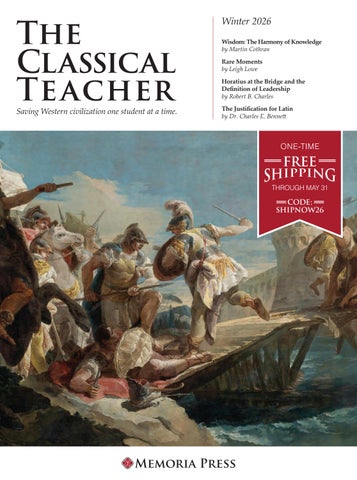
The Classical Teacher

Saving Western civilization one student at a time.

Winter 2026

Wisdom: The Harmony of Knowledge by Martin Cothran

Rare Moments by Leigh Lowe Horatius at the Bridge and the Definition of Leadership by Robert B. Charles

The Justification for Latin by Dr. Charles E. Bennett

ONE-TIME

THROUGH MAY 31

CODE: SHIPNOW26

Teaching As Soulcraft

Ifyou were asked what teaching and learning consist of, could you give a coherent answer? It seems like a simple question, yet many of us would struggle to give a meaningful answer if pressed.

One of the things I have noticed over the years is that some people can walk into a classroom for the first time and immediately connect with their students. Others teach for years and never get very good at it. But most teachers are somewhere in between: They have the ability to become good teachers, but they need both experience and a solid understanding of what good teaching is in order to actualize this potential.

So then, what is good teaching? What is it that a great teacher does? And how can we become good teachers ourselves? The best way to learn how to be a great teacher is to ask a great teacher.

Perhaps the greatest Christian teacher of all time was St. Augustine, who, before his conversion to Christianity, was professor of rhetoric at Milan, the highest academic position in the Roman Empire. Augustine wrote a book called On Christian Doctrine, and in this book he laid out the principles of good Christian instruction. The responsibility of a teacher, he says, is docere, delectare, movere—to teach, to delight, to move. Augustine did not come up with these three modes of teaching all by himself—in addition to being a Christian he was a classical thinker, and he knew the value of learning from his forebears. Augustine's definition is a reformulation of an ancient dictum from Cicero, who himself adapted it from the Greek philosopher Aristotle, whose Rhetoric is considered by many to be the greatest book on persuasion ever written. And what does persuasion have to do with teaching, you might ask? The answer is, of course, everything.

Augustine knew what many earlier thinkers had always known: Teaching is a form of persuasion. The great ancient teachers of rhetoric—Aristotle, Quintilian, Cicero—taught the three modes of persuasion, and these modes of persuasion taught by the ancients are the same rules that apply to the teacher. Aristotle lays out these modes in his Rhetoric. They are logos, ethos, and pathos, popularized by Augustine as to teach, to delight, and to move. We could restate these again by calling them "pushing," "pulling," and "pointing." To teach is to push a learner toward knowledge by explicitly instructing him (logos). To delight is to pull a student toward virtue by the example of our own actions and to engage his heart by setting before him examples of the kind of person we wish him to be in an inspiring way (ethos). And to move is to point a student toward the Good, the True, and the Beautiful things for which he should have affection, and to bring the student to some kind of action or decision ( pathos).

William Bennett, when he was secretary of education, said that education is the "architecture of the soul." The soul, you will remember, is made up of the intellect (logos), the will (ethos), and the imagination ( pathos). This is why it is not an understatement to say that teaching is, most fundamentally, the forming of the souls of your students.

Winter 2026 Contents

Featured Articles

2 Teaching As Soulcraft by Martin Cothran

12 The Justification for Latin by Dr. Charles E. Bennett

20 Horatius at the Bridge and the Definition of Leadership by Robert B. Charles

32 Rare Moments by Leigh Lowe

54 Wisdom: The Harmony of Knowledge by Martin Cothran

70 How to Organize Your Homeschool Day by Kathy Becker

Classical Core Curriculum

35 Read-Aloud Sets and Summer Reading

36 Curriculum Packages and Supplements

42 Curriculum Map Overview

Primary Years

60 Phonics & Reading

61 Spelling

62 Primary Enrichment & Character Building

67 Alphabet, Numbers, & Coloring

74 New American Cursive & Penmanship

Literature, Grammar, & Writing

15 Literature

19 Poetry

76 Writing & English Grammar

Latin, Greek, & French

4 Prima Latina & Latina Christiana

6 Latin Forms Series

8 Latin Supplements

10 Upper School Latin & AP Latin

30 Greek

30 French

Managing Editor | Tanya Charlton

Assistant Editor | Matthew Bradshaw

Classical / Christian Studies

22 D'Aulaires' Greek Myths & Famous Men Series

24 Dorothy Mills' Histories & Classical Studies Supplements

26 Classical Literature & Philosophy

28 Christian Studies

American / Modern Studies

57 Geography

58 American Studies, Medieval History, & Modern European History

Science & Math

66 Arithmetic & Math

68 Science & Nature

Logic & Rhetoric

78 Traditional Logic, Material Logic, & Aristotle's Rhetoric

Art & Music

62 Primary Enrichment

64 Professor Carol: Discovering Music, Exploring America's Musical Heritage, & Early Sacred Music

65 A Classical History of Art, Art Posters & Cards, Creating Art, Reading Music, & Music Appreciation

Resources

31 Resource Books & Pamphlet Series

31 Memoria College Press

80 Memoria Academy

Editorial Director | Dayna Grant

Copy Editor | Ellen R. Anderson

Graphic Designers | Aileen Delgado, Jessica Osborne

Prima Latina: An

Introduction to Christian Latin

by Leigh Lowe | Grades 1-4

Prima Latina is a gentle introduction to Latin specifically designed for students and teachers with no Latin background. It teaches the basic parts of speech while introducing Latin, grounding students in the fundamental concepts of English grammar. Each lesson includes five Latin vocabulary words and English derivatives, a Latin saying, a Latin prayer, and grammar exercises. If you are looking for additional support in teaching your student, the author, Leigh Lowe, has recorded detailed Instructional Videos for every lesson that are sure to delight your young students! Prima Latina transitions seamlessly into Latina Christiana

Latina Christiana:

An Introduction to First Form Latin

3-6

Begin your Latin study here or continue on from Prima Latina. Each lesson consists of a grammar form, ten vocabulary words, English derivatives to help build vocabulary, and a Latin saying that teaches students about their Christian and classical heritage. The Teacher Manual includes a complete copy of the student book with overlaid answers, and provides detailed weekly lesson plans, comprehensive teaching instructions, tests, and weekly quizzes and keys.

$104.68

Introduction to English Grammar

Grades 1-4

Student Workbook $11.85 | Teacher Key $9.25

Help students make connections between the Latin grammar they are learning in Prima Latina and English grammar with these single-page worksheets. We highly recommend this companion book, which can also be used as a standalone review of English grammar to solidify concepts already learned if your student is not doing Prima

$104.88 complete set

(student, teacher, audio, videos, digital flashcards)

(student,

Prima Latina & Latina Christiana Practice Sheets

Grades 1-6

Prima Latina Practice Sheets $6.20

Latina Christiana Practice Sheets $11.80

These books provide guided copywork for each lesson in Prima Latina and Latina Christiana, reinforcing correct spelling, meanings, and grammar forms. It's great practice for students and makes independent work and teacher oversight simple.

Latina Christiana Review Worksheets

Grades 3-6

Review Worksheets $11.85

Review Worksheets Key $6.20

We highly recommend Latina Christiana Review Worksheets as a companion to Latina Christiana Two pages of cumulative review for every lesson of Latina Christiana will ensure your students get weekly reinforcement of old and new concepts.

Latina Christiana Games & Puzzles

Grades 3-6

Games & Puzzles

$14.05

Games & Puzzles Answer Key $6.20

In this activity book we've stuff ed enrichment activities of every kind to help your students practice the vocabulary, grammar, and derivatives in Latina Christiana . Students will fi nd hours of enjoyment playing Latin hangman, solving Latin crossword puzzles, and more!

Desk Charts (8.5"

11") (4 charts total) $15.10

Latina Christiana Grammar Charts
Wall Charts (33" x 17") (4 charts total) $22.70
x

What's Inside Latina Christiana

"I never thought I could teach Latin until I used Latina Christiana. Now, my third grader loves it!" — Jessica, Texas

Student Workbook has 25 lessons + 5 review lessons. Each lesson includes:

• A grammar form

• 10 vocabulary words with corresponding English derivatives

• Latin saying teaching Christian or classical heritage

• Consistent review

Teacher Manual is a complete copy of student workbook with overlaid answers, plus:

• Detailed weekly lesson plans

• Comprehensive teaching instructions

• Tests, quizzes, & keys

Pronunciation Audio is available as a CD/ streaming on our website or app:

• Complete verbal pronunciation of each lesson

• Prayers & songs

Instructional Videos are available as DVDs/ streaming on our website or app:

• Comprehensive coverage of each lesson by a master teacher

• Vocabulary practice and explanation of derivatives

• On-screen notes, illustrations, & diagrams

Latin Forms Series A grammar-based approach to learning Latin.

The Latin Forms Series is based on decades of teaching experience and use in private schools and homeschools around the world. First Form is the ideal text for all beginners, grades 5 and up, or is a great follow-up to Latina Christiana. The uniqueness of the Forms Series lies in two features:

1) A systematic, grammar-first approach to learning Latin that is suitable for the grammar stage student—and all beginners, regardless of age, are in the grammar stage of learning.

2) Extensive workbook exercises that ensure skill mastery and rapid recognition of inflected forms.

Our text and guides help every student (and teacher!) make sense of this difficult subject. A complete set includes:

• 34 two-page lessons in the Student Text are paired with 4-6 pages of Student Workbook exercises, weekly Quizzes, and unit Tests to make sure your students are mastering and retaining what they learn.

• The Pronunciation Audio and Flashcards provide constant practice of grammar forms and vocabulary.

• The scripted Teacher Manual and complete Teacher Key give even the most novice Latin teacher the tools to teach with confidence.

• Instructional Videos are also available, to bring the experience and expertise of a Highlands Latin School master teacher into your home.

First Form Latin: Latin Grammar, Year One by Cheryl Lowe Grades 5+ (Grades 4+ if completed Latina Christiana)

Latin Forms Series

(First Form shown)

$136.89 complete set ea. (all 5 books, audio, videos, digital flashcards) $77.11 basic set ea. (all 5 books + audio)

Text $16.25 ea. | Workbook $17.90 ea.

Teacher Manual $14.05 ea. | Teacher Key $17.90 ea.

Quizzes & Tests $6.20 ea. | Audio $10.00 ea. | Videos $55.00 ea.

Digital Flashcards $15.30 ea. | Physical Flashcards $20.30 ea.

Second Form Latin: Latin Grammar, Year Two by Cheryl Lowe Grades 6+

Third Form Latin: Latin Grammar, Year Three by Cheryl Lowe Grades 7+

First through Third Form Latin Review

Summer Review Courses by Cheryl Lowe | Grades 5+

Student $15.10 ea.

Key $11.85 ea.

Fourth Form Latin: Latin Grammar, Year Four by Cheryl Lowe & Michael Simpson Grades 8+

Students are prone to forget what they have learned from year to year—an especially detrimental loss for the Latin student. To prevent this, Memoria Press has developed these summer courses that feature vocabulary review, form drills, and other exercises, all designed to foster mastery and retention.

Prima Latina Copybook

New American Cursive font

Grades 1-4 | $16.80

This Latin copybook in the New American Cursive font, featuring vocabulary practice and a page to copy each prayer in Prima Latina, is a great way to help your children practice their Latin while developing penmanship skills.

Latin Cursive Copybook

Hymns & Prayers

Grades 4-6 | $16.80

Practice your cursive with Latin sayings and hymns and prayers from Latina Christiana, First Form Latin, and Lingua Angelica

Memoria Press Guides to the National Latin Exam by Cheryl Lowe, Susan Strickland, and Jon Christianson | Grades 5+

Introduction $11.85 | Beginning Latin Exam $17.90

Intermediate Latin Exam $22.65

Intermediate Reading Comprehension Exam $22.65

These guides include the vocabulary, grammar, syntax, Roman history, culture, mythology, and geography commonly found on the National Latin Exam. When paired with previous exams, these guides are perfect preparation for the NLE.

Latin Forms Series Grammar Charts

Wall Charts (33" x 17")

First Form (4 charts) $22.70

Second Form (3 charts) $22.70

Desk Charts (8.5" x 11")

First & Second Form (6 charts) $15.10

Third & Fourth Form (20 charts) $19.00

Latin Recitation CD/DVD

Grades 3+

Audio & Video (includes streaming) $17.35

The entire Latin grammar, presented by Cheryl Lowe. Audio is recitation only. Videos include visual grammar charts.

Latin Grammar Recitation Program

Grades 4+ | $27.15 set (*digital flashcards and handbook)

Flashcards for every grammar form taught and recited in our Latin Forms Series and a handbook with a lesson-by-lesson schedule for coordinating with the recitations in First Form through Fourth Form. *Add on physical flashcards for only $5!

Introduction to Lingua Angelica

Latin Songs & Prayers (Introductory Translation Course) by Cheryl Lowe | Grades 3-6

Student $11.80 ea. | Teacher $6.20 ea.

Song Book* $11.85 | Audio* $12.55

*Used for all Lingua Angelica programs

These introductory worksheets are perfect for introducing students to translation alongside Latina Christiana, First Form Latin, and Second Form Latin. They also help students with memorizing the songs of Christmas and Holy Week, along with several Latin prayers. This book is designed as a supplement for use in the beginning years of a student's Latin education. It is highly recommended for use alongside the Lingua Angelica Song Book and Audio, which includes professional recordings of all songs in the program.

Lingua Angelica I & II

Latin Songs & Prayers (Translation Course) by Cheryl Lowe | Grades 7+

Student $14.05 ea. | Teacher $20.05 ea.

Vocabulary work, interlinear translation exercises, and grammar word study exercises for 28 hymns sung by a six-voice Gregorian chant choir.

Roots of English

Latin & Greek Roots for Beginners

Grades 6-8

$23.75

An introduction to English vocabulary through a study of Latin and Greek roots.

The Book of Roots

Advanced Vocabulary Building from Latin Roots by Paul O'Brien | Grades 8+

Student $27.00

Key $6.20

Your student will learn the definition and etymology of over 1,500 English derivatives, along with prefixes, suffixes, and supplemental Latin vocabulary lists.

Lingua Biblica: Old Testament Stories in Latin

Grades 9+

Student $22.65 | Teacher $22.65

Lingua Biblica is a supplementary Latin program that uses exercises based on the Vulgate to complement the study of any Latin grammar course. Each lesson includes three levels of study that will fortify a student's knowledge of Latin vocabulary and grammar. Level I includes the easiest sentence translations, Level II includes more advanced sentence translations, and Level III includes the entire translation with advanced exercises.

Latin Grammar for the Grammar Stage

All Ages | $17.90

A compendium of Latin grammar forms and a basic introduction to Latin syntax. Includes all conjugations and declensions, making it an easily accessible reference.

Selections from the Vulgate: A Translation Course in Biblical Latin

Grades 9+ | Student $21.95 | Teacher $21.95

St. Jerome translated the Bible into "common Latin" from the original languages, striving not only for accuracy but also simplicity. The resulting Latin Vulgate was a version of the Bible that could be read and understood by people of the time, which also makes it excellent translation practice for Latin students today who have completed a study of the Latin grammar. This course contains ninety passages taken from the original translation by St. Jerome, both prose and poetry, from the creation of the world in Genesis to the Gospels of Matthew, Mark, and Luke. Each reading is accompanied by vocabulary and grammar notes, as well as parsing and analysis exercises to practice a close grammatical reading of each passage of Scripture.

Originally published in 1945, the Henle Latin Series teaches Latin the traditional way. Our Teacher Manuals split the work of Henle Latin First Year over two years, scheduling what to do every step of the way. The Manuals include scripted lessons for the teacher, additional explanations and practice for the student, and a full answer key. The Quizzes & Tests help you measure your mastery along the way.

Note: Though Henle is considered a Catholic text, its superiority as a teaching resource and the outstanding benefits of its Christian perspective also make it appropriate for Protestants.

Henle Latin Second Year

Advanced Christian Latin by Robert

Grades 9+

$72.33 set (text, key, student, quizzes & tests, digital flashcards)

Text $21.99 | Key $7.99

Student Guide $19.00

Quizzes & Tests $11.85

*Digital Flashcards $15.30

After the completion of Henle Latin First Year or Memoria Press' Latin Forms Series, the next step for Latin students is Henle Latin Second Year , which rounds out the Latin grammar and introduces students to the text of Caesar's De Bello Gallico Memoria Press offers a Student Guide with comprehensive guidance for each lesson as well as Quizzes & Tests to assess progress and mastery. These resources contain everything needed to succeed in the course and conquer the first step into the world of authentic Latin texts.

Henle Latin Fourth Year

Advanced Christian Latin by Robert Henle

Grades 11+

$28.48 set (text, key)

Text $21.99 | Key $7.99

Henle Latin Fourth Year leads students through Cicero's Defense of Archias and the first six books of the culmination of Latin poetry, Virgil's Aeneid.

Mueller's text and accompanying Teacher's Guide will lead students through Caesar's account of his wars in Gaul. A perfect text for Latin students who are ready to translate, this program includes vocabulary, footnotes, historical background, and other resources. Our new Student Notebook, Teacher Key, and Quizzes & Tests from Memoria Press provide additional teaching guidelines and instructions to aid students in the translation process!

Henle Latin First Year

Advanced Christian Latin by Robert Henle | Grades 8+

$57.98 Text Set (Henle I text, key, grammar, and digital flashcards)

$81.55 Units I-V Guides and Instructional Videos Set

(I-V teacher manual, quizzes & tests, instructional videos)

$81.55 Units VI-XIV Guides and Instructional Videos Set

(VI-XIV teacher manual, quizzes & tests, instructional videos)

Henle I Text $21.99 | Henle I Key $7.99 | Henle Grammar $16.99

*Henle Latin I Vocabulary Digital Flashcards $17.45

Henle Latin First Year Teacher Manual: Units I-V or VI-XIV $23.75 ea.

Henle Latin First Year Quizzes & Tests: Units I-V or VI-XIV $11.85 ea.

Henle Latin First Year Streaming Instructional Videos: Units I-V or VI-XIV $55.00 ea.

Henle Latin Third Year

Advanced Christian Latin by Robert Henle Grades 10+

$94.89 set (text, key, student, teacher, quizzes & tests, dig. flashcards)

Text $21.99 | Key $7.99

Student Guide $19.00

Teacher Manual $23.75

Quizzes & Tests $11.85

*Digital Flashcards $15.30

Henle Latin Third Year teaches students to reach beyond grammar and grasp the rudiments of rhetoric with the help of Cicero, perhaps Rome's most illustrious orator. Memoria Press' Student Guide, Teacher Manual, and Quizzes & Tests are sources of invaluable support in learning and mastering rhetorical Latin, even without the guidance of an experienced teacher. These texts organize the course into a sensible schedule, offer a wealth of insight to assist students in their exercises, and provide levelappropriate assessments to determine mastery of Latin.

Henle Latin Vocabulary Flashcards

Grades 8+

Henle Latin First Year

Flashcards: Digital $17.45 | Physical $22.45

Henle Latin Second Year

Flashcards: Digital $15.30 | Physical $20.30

Henle Latin Third Year

Flashcards: Digital $15.30 | Physical $20.30

Mueller's Caesar: Selections from De Bello Gallico by

$91.63 set (text, teacher, student, key, quizzes & tests)

Text $45.00 | Teacher Guide $24.00

*Add physical flashcards to any set for only $5!

Student Notebook $12.00 |Key $9.25 | Quizzes & Tests $6.20

How We Help Henle Latin First Year

"I’d tried to tackle the Henle Latin book before and always gave up, but the Memoria Press guides and videos finally made it something I could actually teach." — Laura, Indiana

Henle Latin First Year covers in a single book the same amount of material our Forms Series spreads across four—so it can feel intimidating for families just beginning their Latin journey. Memoria Press materials make the path much easier. We’ve taken everything we’ve learned from years of teaching Henle in real homes and classrooms and translated it into tools that truly serve the homeschool family.

Our Teacher Manuals guide students step by step and offer practical teaching pointers, while the Quizzes & Tests provide readyto-use assessments for every week. Our Instructional Videos (available to stream on our website or app) add the support of a master teacher, bringing clarity and confidence to each lesson.

Pliny: 20 Letters and Suggested Companion Texts

$135.90 set (text, workbook, notebook, teacher's guide, teacher's manual)

Student Text $49.00 | Workbook $33.00

Notebook $12.00 | Teacher's Guide $24.00

Teacher's Manual $33.00

Designed for the new 2026 AP Latin syllabus, this volume includes all required letters by Pliny the Younger, as well as ten additional epistles and companion texts from Eutropius, Rafael Landivar, Seneca, Augustus, and Cicero.

Vergil: Selections and Suggested Companion Texts

$135.90 set (text, workbook, notebook, teacher's guide, teacher's manual)

Student Text $49.00 | Workbook $33.00

Notebook $12.00 | Teacher's Guide $24.00

Teacher's Manual $33.00

Designed for the new 2026 AP Latin syllabus, this volume includes all required passages from Vergil's Aeneid, as well as an additional fifteen lines and companion texts from Catullus, Horace, Ovid, Sulpicia, and Petrach.

he question as to the educational worth of any study must always be a pertinent one. If Latin is not of fundamental importance in the high school curriculum, then large numbers of students are making a prodigious error in pursuing the subject, and the sooner we understand this, the better for our civilization. If, on the other hand, the increase is the result of wise choice or even of wise instinct, we must, while rejoicing at the greater recognition Latin is securing, at the same time admit our own vastly increased responsibility for its wise direction and promotion.

Before considering the special reasons that exist in favor of studying Latin, let us first consider the function of language in general as an instrument of education. The function of education is purportedly to prepare pupils to be useful members of society. To make them such, it is essential that they be taught to understand as fully as possible the nature and character of the national life—social, civil, political, religious—in which they are born or in which their lot is cast. To a certain extent, also, it is essential that they learn to apprehend the nature and character of the larger life of the nation.

What now is the instrument best adapted to the attainment of this end? It is language. Language is the supreme instrument in education, i.e., the higher education, because of its universal nature. It promotes intellectual discipline and brings intellectual power, because the study of language brings us at every turn face to face, as nothing else does, with subjects and questions of intellectual concern and intellectual

interest. Language deals with ideas; it touches perpetually on problems of the relations of man to man, of man to society, and of man to the State. The analysis of language demands refined and precise thinking. So long then as ideas are important, and so long as the underlying conceptions that reflect the national life of a people are important, the supreme value of the mastery of these through language study will continue to be recognized.

By the study of language is meant the study of one's own language, but the study of one's own language is achieved incomparably better by the indirect method of studying another language. Only so can the necessary processes of comparison be effectively instituted. Latin is of value because it confers a mastery over the resources of one's mother tongue. This mastery comes as the direct and necessary result of careful daily translation—a process involving on the one hand a careful consideration and analysis of the thought of the author being read, and on the other a severe and laborious comparison of the value of alternative English words, phrases, and sentences, with the consequent attainment of skill in making the same effective as vehicles of expression. No one, I think, will undertake to deny that the results here claimed are actual, and if actual, it can hardly be denied that they constitute an important justification for the study of Latin.

Training in English, then, as the result of careful translation from Latin, is here set down as the first and most important reason for studying Latin. To my own mind this reason weighs more than all

others combined. Let us examine more in detail how translation from Latin gives such admirable training in English. Translation is a severe exercise. The lexicon or vocabulary tells the meanings of words, and the grammar states the force of inflected forms, but it is only after the pupil, provided with this equipment, has attacked his Latin sentence with a view to translation that the real struggle begins. His vocabulary may have given him a dozen or even twenty meanings under a single verb or noun, and the pupil must reflect and carefully discriminate before he can choose the right word, the one just suited to the context. Further, his Latin sentence may be long, complex, and periodic, entirely different in structure from anything we know in English; such a sentence must be broken up and so arranged as to conform to our English mode of expression. The Latin sentence may have one of those Protean ablative absolutes—an idiom that our English style practically abhors. Every such ablative absolute has to be examined with care prior to an English rendering. It may express time, cause, concession, condition, attendant circumstance, means, or what not, and must be rendered accordingly. Again the Latin sentence may secure by its arrangement of words certain effects of emphasis that English can bring out only by the employment of very different resources. Every teacher knows how difficult translation is and knows that it is serious work—often slow work— but also what it means to the pupil who submits to it. The teacher knows that such a pupil is gaining a mastery over the resources of his mother tongue. He is learning what words mean; the pupil is learning to differentiate related concepts, acquiring sense for form and style, and if he be so fortunate as to be endowed with any native gifts of thought having reached maturity, he has that indispensable equipment of the educated person—the capacity to say what he says with directness, clearness, precision, and effect. There has been a great outcry in recent years about the importance of English, and it has been one with which I think the body of thoughtful persons have in large measure sympathized. All have cheerfully acknowledged the great importance of an ability to use one's native idiom with skill and power. It is because I sympathize so heartily with this sentiment that I enter this defense of translation. It is because translation from Latin to English seems to me such a stimulating, vitalizing exercise, and so helpful to the student who would attain mastery of his own language—it is because of this that I find full justification for the study of Latin.

Dr. Charles E. Bennett (1858-1921) was an influential voice in the defense of classical education and one of the leading Latinists of the twentieth century. Dr. Bennett's wide experience at both the secondary and college level led to his critique of several innovations in Latin instruction that were leading to the general decline in the Latin skills of students of his day. This is excerpted from his The Teaching of Latin in the Secondary School, 1903.

Ideal Latin Sequence

PRIMARY GRAMMAR PREP

Grade 2 Prima Latina

Grades 3-4

Grade 5

Grade 6

Latina Christiana

GRAMMAR STAGE

Master the Latin Grammar

First Form Latin

Second Form Latin

LOGIC STAGE

How to Use the Grammar—Syntax & Translation Skills

Grade 7

Third Form Latin

Grade 8 Fourth Form Latin & Henle I (syntax & Caesar prep)

Grade 9 Henle II (Caesar prep)

RHETORIC STAGE

Read Latin Literature

Grade 10 Mueller's Caesar (covers AP lines from De Bello Gallico)

Grade 11 Henle III (Cicero)

Grade 12 AP Latin

Starting Later? No Problem!

STARTING IN GRADE 4?

Begin with Latina Christiana, completing this in one year instead of two. Then follow the sequence above.

STARTING IN GRADES 5-6?

Begin with First Form Latin and then follow the sequence.

STARTING IN GRADE 7?

You have two options:

1) If you wish to reach Caesar in Grade 12, begin with First Form Latin and then follow the sequence above.

2) If you wish to reach AP Latin in Grade 12, begin with Henle I. We recommend taking two years to complete Henle I and then following the sequence above.

STARTING IN GRADES 8+?

Students starting Latin in Grade 8 or later should begin with Henle I. If you wish to reach AP Latin in Grade 12, you will have to skip or shorten steps in the sequence above, such as skipping Henle III or completing Henle I in one year instead of two.

NEED HELP WITH LATIN?

Check out MemoriaAcademy.com for classes from grades 3-12 with live instruction from master teachers.

WHAT Are We READING?

I loved Anne of Green Gables for its bright, unembarrassed joy in imagination—Anne turns ordinary life into wonder. It's worth reading because it pairs laugh-out-loud mishaps with quiet lessons in virtue: truthfulness, friendship, gratitude, sacrificial love, and the courage to begin again. L. M. Montgomery's prose is musical without being fussy, making it perfect for reading aloud and savoring the language. It's a gentle master class in character formation wrapped in a story you'll genuinely enjoy.

JEFF GRDINA, Video Editor

I just read Foster by Claire Keegan. I can't say too much without giving away the whole book because it's under a hundred pages, but it is an incredibly moving story about a young Irish girl from a poor family who is sent to live with distant relatives. The author doesn't waste a single word. Highly recommend!

KALEE MILLER, Editor and Customer Service Representative

My mornings are somewhat hectic. I try to exercise, get my sleepy toddler out of bed, make breakfast. Recently, I've loved listening to Marcus Aurelius' Meditations through it all. It's a calm, thoughtful way to help me feel grounded as I start the day.

MATTHEW BRADSHAW, Assistant Marketing Director

I first read most of Sir Arthur Conan Doyle's various Sherlock Holmes books in high school, and rereading them is like revisiting an old, albeit mercurial friend. The compelling character dynamics are charmingly familiar and the stories are an enjoyable plunge into intrigue and adventures that explore a perspective of England that is not so prim and polished as the noble circles of Austen, nor so dismal as the lows that are trudged by the unfortunate urchins of Dickens.

CAIT CHRISTIANSON, Illustrator

Grade 1

StoryTime Treasures

$75.68 set

(guides, novels, videos)

More StoryTime Treasures

$98.15 set

(guides, novels, videos)

StoryTime & More StoryTime Treasures

Student Guide $17.90 | Teacher Guide $20.05 | Videos $30.00

Little Bear $5.99 | Frog and Toad Are Friends $5.99

Caps for Sale $9.99 | Make Way for Ducklings $10.99

Student Guide $17.90 | Teacher Guide $20.05 | Videos $30.00

Billy and Blaze $9.99 | Stone Soup $8.99 | Miss Rumphius $8.99

Blaze and the Forest Fire $9.99 | The Story About Ping $5.99

Keep the Lights Burning, Abbie $8.99 | The Little House $9.99

StoryTime & More StoryTime Instructional Videos

$55.00 set (StoryTime Videos & More StoryTime Videos)

StoryTime $30.00 | More StoryTime $30.00

Taught by master teacher Michelle Tefertiller, our new instructional videos will help guide your student through StoryTime Treasures and More StoryTime Treasures. (Note: Videos are included in the above sets).

Grade 2

$119.40 guide set (student & teacher guides)

$186.59 guides + novels set (guides & novels)

Student Guide $13.95 ea.

Teacher Guide $8.15 ea.

Amelia Bedelia $5.99

Prairie School $5.99

The Courage of Sarah Noble $5.99

Little House in the Big Woods $12.99

Sea Story $9.99 | High Hills $9.99

Beatrix Potter novels $8.99 ea.

Recommended Supplement: Literature Dictionary $6.20

Grade 3

$75.36

Grade 4

$100.48

Grade 5

$75.36 guide set (student & teacher guides) $104.13 guides + novels set

and teacher guides & novels)

Grade 6

$100.48

Grade 7

$100.48

Grade 8

$75.36 guide set

Grade 9

$100.48

Grade 10

Grade 11

Grade 12

$100.48 guide set

Mix and match any 10 or more individual Memoria Press literature guides and receive 20% off your literature guide purchase! Use coupon code LITGUIDE at checkout!

Alternate Literature Options

Animal Folk Tales of America Grade 2

Student Guide $13.95

Teacher Guide $8.15

Animal Folk Tales of America $12.95

The Reluctant Dragon Grades 4-6

Student Guide $13.95

Teacher Guide $13.95

Student Guide $13.95

Mr. Popper's Penguins Grades 3-4

Student Guide $13.95 Teacher Guide $13.95

My Side of the Mountain Grades 4-5

Student Guide $13.95 Teacher Guide $13.95 My Side of the Mountain $8.99 A Bear Called Paddington Grades 3-4

The Reluctant Dragon $8.80

Little Women Grades 8-9

Student Guide $13.95

Teacher Guide $13.95 Little Women $16.50

Wuthering Heights Grades 9+

Guide $13.95 A Bear Called Paddington $15.99 The Cricket in Times Square Grades 3-5

The Twenty-One Balloons Grades 5-7

Student Guide $13.95 Teacher Guide $13.95 The Twenty-One Balloons $8.99

Crusoe Grades 9+

Mr. Popper's Penguins $8.99 To Kill a Mockingbird Grades 9+

The Magician's Nephew Grades 5-7

Student Guide $13.95 Teacher Guide $13.95 The Magician's Nephew $12.99

Gatsby Grades

The Adventures of Tom Sawyer Grades 7-8

Student Guide $13.95 Teacher Guide $13.95

The Adventures of Tom Sawyer $10.00

Jane Eyre Grades 9+

The Merchant of Venice Grades 9+

Student Guide $13.95

Teacher Guide $13.95

The Merchant of Venice $7.95

Henry IV, Part 1 Grades 9+

Student Guide $13.95

Teacher Guide $13.95

Henry IV, Part 1 $9.99

Poetry

As You Like It

Grades 9+

Student Guide

Teacher Guide

As You Like It

$13.95

$13.95

$16.00

Henry V Grades 9+

Student Guide $13.95

Teacher Guide $13.95

Henry V $9.99

Poetry for the Primary Stage

Grades K-2 | $10.80

Your child will be delighted by the whimsy and inspired by the beauty of the beloved poems in our Poetry for the Primary Stage anthology. These selections are perfect for family read-aloud time or memorization practice.

Poetry for the Grammar Stage

Grades 3-7 | $50.18 set

(student, teacher, anthology)

Student $17.30 | Teacher $19.45

Anthology $19.00

Our illustrated anthology is the perfect companion for this study guide, which includes vocabulary work and comprehension questions, and beginning concepts of poetry analysis. Poems increase in difficulty as students move through the book in each year of the grammar stage.

Poetry & Short Stories for the Logic Stage: 19th and 20th Centuries

Grades 7+ | $53.83 set (student, teacher, anthology)

Student $18.35 | Teacher $20.50 | Anthology $20.95

Revisit the Old World elegance of Irving's prose and the range of Poe's romanticism. Enjoy the Fireside Poets—Longfellow, Whittier, and Holmes. Rediscover the rich, varied authenticity of American literature with this anthology and study guide.

The British Tradition

Poetry, Prose, & Drama (Book I): The Old English & Medieval Periods

Poetry & Prose (Book II): The Elizabethan to the Neoclassical Age

Poetry (Book III): The Romantic to the Victorian Age Grades 8+

$53.83 set ea. (student, teacher, anthology)

Student $18.35 ea. | Teacher $20.50 ea. | Anthology $20.95 ea. Did you ever wish you didn't have to sort through all the thousands of poems that have been written over the years to find the best of the best? Cheryl Lowe has done the work for you in these British poetry anthologies, from legendary knights to staid Victorians. Use our accompanying study guides to lead students into a deeper understanding of the most important and influential poetry, prose, and drama in the British tradition.

Horatius at the Bridge AND THE Definition of Leadership

ongratulations to all who have so superbly, nobly, and with strength of conviction and singularity of purpose, memorized and then recited publicly the entire epic poem Horatius at the Bridge by Lord Macaulay. This is no small feat. This is a feat with meaning beyond this day, as Horatius' own resolve was. You have done a remarkable thing! May it give you enduring confidence in what you can do in the future, and light your way to more remarkable things. I wonder if you even realize how important this exercise is. You have chosen to highlight, recognize, and reward some timeless truths in this process, and you are doing so at a time when these educational truths are everywhere being put to the test, watered down, disparaged, and set aside. You have all—students, parents, and schools—deliberately set the bar high, and without apology. You have dared to put a real challenge in front of kids, and of course, students have dared to step up and accept it. That—that right there—is the definition of leadership—on both ends of the proposed challenge. Here is a triumph of the human spirit—of selfdiscipline, self-reliance, resolve, persistence, and personal commitment—or in a word, heart. These elements define a true leader, not just a true scholar. I grew up in a little town of five hundred people. By good fortune, I attended Dartmouth College, Oxford University in England, and Columbia Law School. Later, I taught at Harvard University's Extension School. Coming from a family of teachers, I believe in the transformative power of a good education. When I was a young man in England, I found myself taken with the history of Winston Churchill. Thus, on odd days, I would pedal my bicycle from Oxford up to Blenheim, to see Churchill's childhood home, walk the grounds, and wonder what his thoughts had been, decades earlier. Other days, I would cycle up and quietly visit Bladon, where this extraordinary leader, a man of unwavering

conviction and defender of our Western World—if you will, a defender at our own "bridge"—is buried. He is buried simply, under a thin vertical stone, no bigger than this piece of paper. He left as he was born: humbly. In that little village, under that little stone—no hoopla, no gates, no guards—lies the man who with so many other brave men and women of heart rose to defend freedom and to win against the odds in what he called "our finest hour." So, we all owe him a debt and we repay it, in part, by remembering. And remembering what he did.

Churchill, as a young man, was buffeted by the winds of life. Not all things came easily to him—actually few did. As a young student, one of his leading biographers said, he was of "somewhat doubtful provenance." He suffered disappointments in family and challenges as a scholar. The turning point came when a lower-school English teacher, Robert Somervell, heard young Churchill "flawlessly reciting 1,200 lines of Macaulay's Lays of Ancient Rome." Horatius at the Bridge is one of the four poems in that work. According to Roy Jenkins, arguably Churchill's most complete biographer, "for this he gained a prize open to the whole school…." In this act of tenacity, courage, and sheer will, Churchill demonstrated he was made of tougher stuff, mentally and as a matter of character. Although not gifted in all areas, he left Harrow for the Royal Military Academy, Sandhurst. He proved— as we all know—an exceptional leader and writer. He was accepted, in part, because "his memory was phenomenal, as was shown by the Macaulay feat," wrote Jenkins.

So how does this feat translate today? I think just as well, maybe better. The need for such concentration of mind and heart is, if anything, greater today. The ability, will, and stick-to-it-ness that leads a student to accomplish this feat is as strong an indicator of future success as any test or challenge of which I can think. Why? Because we live in highly consequential times, and the qualities most needed are again patience and clear-headedness, courage to accept outsized challenges, and the capacity for singlemindedness—that rare concentration of purpose. Most of all, what is needed in this hour—our hour—is genuine heart and followthrough, the willingness to set a high bar and show the integrity to reach for it. What this poem's recitation does is pull into a student's grasp what he did not know was even within his reach. And that is the triumph of heart, not to mention also the triumph of Horatius, of Churchill, and of those who reach toward an impossible goal.

Not so many years ago I was Colin Powell's assistant secretary of state. I came to that job after working in the White Houses of Ronald Reagan and George Herbert Walker Bush, two exceptional presidents and men, and after serving as counsel to House Speaker Dennis Hastert, another American of good heart and a teacher for sixteen years of his life. In Secretary Powell's service I was charged with a number of things, among them creating a plan of action and setting up training facilities for hundreds of thousands of Iraqi and Afghan police officers. The world is an unsettled place, and there were other missions too. We were trying to seed or promote or help others understand an idea often called the "rule of law." One place we also worked was called Kosovo, a place in southern Europe, part of a country that not too long ago was called Yugoslavia.

And here is where the contents of Macaulay's poem Horatius, the principles that Churchill personified, and the resolve and wit of students who complete this feat all come together. On a moonless night in March 2004, a sudden and terrifying series of events emerged in what we now call "Kosovo." These events swept the country for more than a day, and they called for great courage. In that place at that time, a few Americans were training the Kosovo police. These young American trainers worked for my group within the State Department. These American trainers were men and women, all civilians and all focused on their mission. They did not expect the events of that long March night to occur.

Kosovo—still newly configured at the time—had a series of small villages, literally fenced-off villages, called "Serbian enclaves." These villages were filled with churches—and with people. Meantime, the Albanian Kosovar (largely Muslim) populations lived outside these enclaves. And making matters still more complicated, Kosovo was located in a larger Serbian state. So, if you can imagine the situation, Christian villages were contained within a larger Muslim Kosovo, which was itself contained within a still larger former Serbian Christian state. If I have drawn the picture properly, you can see that a tinderbox of raw emotions existed, since all this existed after a war had been fought between these peoples. Two populations that did not like each other were living at close quarters, ironically situated within each other's territories like Russian nesting dolls. You can see how this would be very awkward.

Here is what happened. A conspiracy erupted among the Kosovo Albanians and a nationwide attack began. It spread quickly, unsettling the Serbian enclaves; many Serbian monasteries and churches were suddenly under real attack. And now we come back to those American trainers who worked for me. There was a choice that had to be made. Would the Americans— who were not in the military but were all civilians—get involved, or would they stand back and watch this night of terror go unanswered? The Americans, of whom I am still very proud, decided to get involved.

They gathered and defended the small enclaves. They succeeded in saving many lives that night, young and old. In a critical moment, a set of bridges was involved. An armed mob of thousands was descending on a Kosovo town called Pristina. The American trainers made an educated guess. They believed that this dangerous mob would have to cross a river—on which there was a key bridge. And so they took old cars over to the bridge and set them ablaze to physically block the bridge. They were not exactly Horatius, but they were heroic and their plan worked. It proved a pivotal and courageous decision. That move stopped the raging mobs, blocked the bridge entirely from passage, and permitted vulnerable people to find refuge and, ultimately, to live. Ironic, is it not, that such a piece of history should so strangely match the distant past? History never actually repeats itself, but it does unfold in patterns and with situations that often resemble each other. How fitting that this one in a sense reflects some of that heroic poem. The spirit of can-do and never-give-up also attended Churchill's leadership, and even now attaches in a small way to the act of memorizing a long and difficult poem. So keep thinking big, taking on the big challenges, and exceeding expectations. This challenge and collective achievement—reciting this long and epic poem, as Churchill once did—is exactly the sort of heart and commitment, scholarship and courage, character and resolve that will always define leadership and leaders. There could not be a better way to identify young men and women of strength and character, determination and intellect, purpose and promise, than to look to those who have committed to reciting, top to bottom, Lord Macaulay's Horatius at the Bridge.

Robert B. Charles is a former assistant secretary of state. He is a friend of the Mangione family and sent this letter to A.J. Mangione, a student at Highlands Latin School, when he was informed that A.J. had memorized all seventy stanzas of Lord Macaulay’s Horatius at the Bridge. This is an exercise that all sixth grade students at HLS are encouraged to attempt. To receive the Winston Churchill Award, submit a video of your student reciting the poem (see p. 27).

Classical Studies

Famous Men of Rome

$113.65 set

(text, student, teacher, digital flashcards, videos)

Grades 4-8

Text $20.05 | eBook

$14.00

Student $20.50 | Teacher $20.50

*Digital Flashcards $12.65 | Videos $55.00

D'Aulaires' Greek Myths

$109.35 set (text, student, teacher, digital flashcards, videos)

Grades 3-8

Text $19.99 | Student $20.50 | Teacher $20.50

*Digital Flashcards $12.65 | Videos $55.00

Myths are everywhere in Western art and literature and are the essential background for a classical education. Th is is an ideal beginning book regardless of age! Each of the 30 lessons presents facts to know, vocabulary, comprehension questions, and a picture review and activities section.

*Add physical flashcards to any set for only $5!

Meet Romans like Horatius, Caesar, and Marcus Aurelius—history's great men of action. Younger students especially will be fascinated by the abundant action and drama of the great city of Rome, its trials and tribulations, its rise and eventual fall. Instructional Videos now available!

Famous Men of Greece

$113.65 set

(text, student, teacher, digital flashcards, videos)

Grades 5-8

Text $20.05 | eBook $14.00

Student $20.50 | Teacher $20.50

*Digital Flashcards $12.65 | Videos $55.00

Classical Studies Suggested Timeline

If you don't begin your classical education until middle or high school, we recommend that you start with Year 5.

Year 1 D'Aulaires' Greek Myths

Year 2 Famous Men of Rome

Year 3 Famous Men of the Middle Ages

Year 4 Famous Men of Greece, The Trojan War, and Horatius at the Bridge

Dive into the lives of the famous Greeks—history's great men of thought. Follow Heracles and Odysseus through journeys of myth, fight with Leonidas and Pericles in legendary wars, deliberate with Aristotle and Socrates. Learn of all those who contributed to the scope of Greek accomplishment that is still known today as "The Greek Miracle." Instructional Videos now available!

Famous Men of the Middle Ages

$62.65 set

(text, student, teacher, digital flashcards)

Grades 5-8

Text $20.05 | eBook $14.00

Student $20.50 | Teacher $20.50

*Digital Flashcards $12.65

Year 5

Iliad, Odyssey, and The Book of the Ancient Greeks

Year 6 The Aeneid and The Book of the Ancient Romans

Year 7 Greek Tragedies (Euripides, Sophocles, Aeschylus)

Year 8 The Divine Comedy

Famous Men of Modern Times

Wind through the "dark ages" by the lights of Clovis, Charlemagne, Alfred the Great, Joan of Arc, and Gutenberg, among many others, and watch as the world transitions from the end of ancient times to the birth of the modern era.

$51.90 set (text, student, teacher) Grades 6-8

Text $20.05 | eBook $14.00

Student $20.50 | Teacher $20.50

And in the last installment of the series, join Suleiman the Magnificent, Sir Isaac Newton, Peter the Great, George Washington, Napoleon Bonaparte, and many more as they fight to lead and forge the emerging modern world.

What's Inside D'Aulaires' Greek Myths

"The study of Latin and the classical civilizations of Greece and Rome has defined classical education for over 2,000 years. The standard has been set; we are not at liberty to change it."

Student Guide includes 25 lessons + 6 review lessons. Each lesson includes:

• Facts to know & vocabulary

• Comprehension questions

• Picture review and activities

• Connections between ancient myths and the modern world Teacher Manual provides:

• Complete answers to every exercise

• Notes and guidance

• Tests and fi nal exam Flashcards reinforce:

• Places, people, & key story details Instructional Videos are available to stream on our website or app:

• Walk students through each lesson

• Highlight characters, themes, and essential background

Classical Studies

Dorothy Mills' Histories

Grades 6+ | $48.88 set ea. (text, student, teacher)

Text $20.10 ea. | *eBook $14.00 ea. | Student $20.50 ea. | Teacher $20.50 ea. (*not available for Renaissance & Reformation)

Combine each text with a Memoria Press Student Guide for a yearlong course. Each guide includes facts to know, vocabulary, comprehension questions, mapwork, and timelines, and the Teacher Guides provide thorough answers as well as unit tests.

The Book of the Ancient World

Let Dorothy Mills take your student on an adventure to explore the geography, culture, architecture, and most prominent peoples of Egypt, Persia, Assyria, Israel, and more. Mills covers not only the valuable history and culture of the ancient peoples, but she also gives students an understanding of the people and neighbors out of which Christianity sprung.

The Book of the Ancient Greeks

The journey continues, starting in Crete and ending in the Hellenistic Age ushered in by Alexander the Great. Your student will learn about the wars and ideas, the art and architecture, the politics and philosophy that have shaped the course of Western civilization since the Greeks laid them out for us.

The Book of the Ancient Romans

Like any good Roman course, this one begins with the she-wolf who nurses in infancy the legendary founders of Rome: Romulus and Remus. The rise and fall of a monarchy, the embrace of a republic with the simultaneous dislike for kings, and finally the rise of the Roman Empire teach unforgettable principles about human nature and society. Includes notes on the Roman culture, political system, and religion.

The Book of the Middle Ages

From the foundation of monasteries to the bell towers of universities, from the crowning of Charlemagne to the execution of Joan of Arc, Mills guides students through the spread of Christendom and the founding of a new civilization on the remnants of the Roman Empire.

Renaissance & Reformation Times

It would be hard to overstate the reverberating effects of this period on modern history. Politics, philosophy, art, theology—virtually no aspect of Western culture was left unchanged by the Renaissance and Reformation. Mills succeeds marvelously in giving readers a neutral ground on which to base their understanding of this time.

Timeline Program

Events from Ancient to Modern Times Grades 3-7

$47.71 set

(sketchbook, handbook, wall cards, digital flashcards)

Timeline Composition & Sketchbook $11.85

Timeline Handbook $11.85

Timeline Wall Cards $16.20

Timeline Digital Flashcards $13.10

Timeline Physical Flashcards $18.10

Students will master a total of 60 events from Greek and Roman history, the Middle Ages, American history, and Christian studies.

Geography & Timeline Review Worksheets

Grade 7

Worksheets $9.25

Key $9.25

To ensure retention and mastery we have created this cumulative review of Memoria Press' States and Capitals , Geography I & II, and Timeline Program .

Classical Literature

The Trojan War

by Olivia Coolidge | Grades 6-8

Text $9.99 | Student $13.95 | Teacher $13.95

This faithful retelling of the events of the Trojan War is wonderful preparation for reading the Iliad and Odyssey in later years. Your student will become familiar with the main characters, the gods and goddesses, and the storyline of Homer's Iliad and Odyssey, presented in simple but captivating prose. Each lesson in the Student Guide has reading notes, vocabulary, comprehension questions, and an enrichment section with discussion topics, writing, art, and mapwork.

The Adventures of Odysseus & The Tale of Troy

by Padraic Colum | Grades 6-8 | $11.90

Padraic Colum introduces young readers to Odysseus, the Greek hero of the Trojan War, who has been away from his home and his family for twenty years.

The Adventures of Odysseus & The Tale of Troy has all the essentials of Homer’s epic: the son, Telemachus, searching for news of his father and learning about the events of the Trojan War; the faithful wife, Penelope, refusing to marry again despite a throng of suitors; and Odysseus himself, struggling against monsters, storms, and the wrath of gods to be reunited with his family and regain his place as king of Ithaka.

The Aeneid for Boys & Girls

by Alfred J. Church | Grades 6-8

$11.90

Alfred Church's retelling of Virgil's Aeneid is a great introduction to the story of Aeneas, who escaped from the burning city of Troy and founded Rome, the New Troy. Reading this first will help prepare students to tackle the more difficult writing of Virgil.

The Iliad & The Odyssey

Samuel Butler translation | Grades 7+

$97.42 set ea. (text, student, teacher, videos)

$174.34 complete set (Iliad and Odyssey sets)

Text $15.15 ea. | eBook $7.00 ea.

Student $14.05 ea. | Teacher $18.35 ea.

Videos $55.00 ea.

Western civilization begins with the two greatest works of the ancient world: the Iliad and the Odyssey . The enormous influence these books have exerted in Western literature and art make them the perfect place to begin your study of Western culture. Samuel Butler's prose translations are both scholarly and easily accessible to students. The reading notes, focus passages, and comprehension and discussion questions in our Student Guides highlight important events, characters, and themes, allowing your student to more deeply understand these seminal works. The Teacher Manuals include additional contextual background information and teaching tips, as well as complete answers to the Student Guides and unit tests.

The Aeneid

David West translation | Grades 8+

$96.06 set (text, student, teacher, videos)

Text $17.00

Student $20.50

Teacher $20.50

Videos $55.00

After Homer, the Aeneid is logically your next Great Book to study. Virgil's epic story of the founding of Rome will come alive when read with the help of our study guide as you continue your quest to master the classics. This is a great preparation for AP Latin also. Our Teacher Manual has inset student pages with teacher notes and background information for each lesson.

Horatius at the Bridge

by Thomas Babington Macaulay | Grades 6+

$37.82 set (text, student, teacher, medal, pin)

Text $9.25 | Student $9.25 | Teacher $11.85

Medal $5.50 | Lapel Pin $3.95

This study of Macaulay's 70-stanza ballad includes vocabulary, maps, character and plot synopses, meter, comprehension questions, teaching guidelines, and quizzes. Send us a recording of your students reciting the poem, and we'll send them a Winston Churchill Award certificate, medal, and lapel pin.

The Divine Comedy

translation

Grades 10+

$65.75 set (text, student, teacher, quizzes & tests)

$118.00 complete set (all books + videos)

Text $22.00 | Student $20.50

Teacher $20.50 | Quizzes & Tests $6.20

Videos $55.00

The Divine Comedy is one of the crown jewels of both Western and Christian literature. This epic, allegorical poem illustrates Dante's spiritual journey of redemption that takes him through the pit of Hell (the Inferno) to the Beatific Vision of God (the Paradiso).

On Obligations

Cicero,

Grades 10+

Text $13.95

Student $20.50

Teacher $20.50

Cicero's work On Obligations played a large role in Western Christendom but is daunting to read alone. Let us accompany your high schooler as he learns the principles of justice, wisdom, beneficence, courage, and propriety.

The Greek Tragedies

Grades 9+

$238.40 complete set

(3 texts, 3 student guides, 3 teacher guides, 3 videos)

The Oresteian Trilogy

Aeschylus was the first of the three great tragic playwrights. Join Orestes as he seeks to avenge his father's murder, but discovers that mercy and litigation are the better ends of justice.

Classical Philosophy

Introduction to Classical Philosophy

11+

$179.21 set (student, teacher, videos, philosophy texts)

The Republic and The Laws

Grades 10+

Text $12.95

Student $21.50

Teacher $23.75

The Republic became the blueprint of the U.S. government almost 2,000 years after it was written. In The Laws, Cicero defends his understanding of the upright moral life. This new, updated edition has added discussion questions and provides substantive teaching notes!

The Oresteian Trilogy by Aeschylus $13.00

The Three Theban Plays by Sophocles $16.00

Medea & Other Plays by Euripides $11.00

Student $20.50 ea. | Teacher $20.50 ea.

Videos $45.00 ea.

The Three Theban Plays

Here is Sophocles' story of Oedipus, fated to unknowingly kill his father and marry his mother. This is the great myth, influencing all subsequent literature.

Medea & Other Plays

Euripides further developed the tragedy, instituting the deus ex machina, a prologue, and greater realism. His heroes are less resolute and more psychological, fraught with internal conflict.

Student $21.50 | Teacher $23.75 | Videos $55.00 | A Shorter Summa $18.95 | The Last Days of Socrates $14.00

The Consolation of Philosophy $16.00 | A History of Philosophy Volume 1 $35.95 | The Nature of the Gods $13.95

Introduction to Classical Philosophy presents the great philosophical questions of Western civilization to students. Rather than treating philosophy as a tool for practical ends, this course treats philosophy as the pursuit of wisdom itself—tackling questions of truth, knowledge, causality, and how one ought to live. Students read primarily from original philosophical texts and trace the development of thought from the ancient Greeks through the High Middle Ages. Each lesson in the Student Guide is carefully structured with guidance for marking the readings, defining key terms, and analyzing arguments, followed by discussion questions and occasional essay assignments. The Teacher Guide includes the complete Student Guide inset with surrounding answers, teaching guidelines, and keys for quizzes and tests. The Instructional Videos are uniquely structured to reflect the Socratic nature of philosophy, combining lecture, guided discussion, and reflective follow-up to model philosophical inquiry in action.

Upper School Christian Studies

The Story of Christianity

Grades 8+

Text $16.99

Student $20.50

Teacher $20.50

Hart gives a scholarly but readable portrait of the rich history of the Christian Church, covering 2,000 years of persecution, belief, discord, and faith. Our study guide walks you through Hart's text with additional background and contextual information, comprehension questions, and discussion questions that tie the history to scriptural passages and explore modern-day issues of faith and belief.

Acts of the Apostles: King James Version

Grades 8+

Text $11.90

Student $19.00

Teacher $20.50

The Acts of the Apostles tells the exciting story of the travels, the teachings, and—in many cases—the martyrdoms of the apostles as they take the message of Jesus Christ from Jerusalem to the ends of the earth in the years immediately following Christ's life, death, and resurrection. This unit study will acquaint students with Christianity's infant stage.

The Wars of the Jews: The Fall of Jerusalem

Text $11.90

Student $19.00

Teacher $21.60

"There will not be left a stone upon a stone." Our children may know of Christ's prophecy, but do they learn about its fulfillment? Josephus is regarded as the most trustworthy source on the destruction of Jerusalem in A.D. 70.

Christian Studies

The Story Bible &

Christian Studies Enrichment

Grades K-2

The Story Bible $34.99

Christian Studies Enrichment $15.10

The Story Bible is written especially for children who are beginning to read. The enrichment guide helps facilitate oral discussion for each Bible lesson.

Christian Studies I-III

Grades 3-6

$181.18 set

Christian Studies I: All Major Bible Stories up to the Entry into Canaan Christian Studies II: The Rise and Fall of Israel and the Period of the Prophets Christian Studies III: All Major New Testament Stories

(Christian Studies I-III student & teacher, Golden Children's Bible, New Testament, Old Testament, and Memory Verse Digital Flashcards)

Student $20.50 ea. | Teacher $23.75 ea. | Golden Children's Bible

$25.99 Memory Verse Digital Flashcards $16.35 | Memory Verse Physical Flashcards $21.35 | Old Testament Digital Flashcards $13.10 Old Testament Physical Flashcards $18.10 | New Testament Digital Flashcards $13.10 | New Testament Physical Flashcards $18.10

Biblical literacy is just as important as cultural, moral, and functional literacy, and the material we use to teach children their faith should be just as rigorous and demanding as any other important subject. Our Christian Studies series is a systematic study of the major events and characters in Salvation History, using The Golden Children's Bible. Students work through a Bible timeline from Creation to Christ, memorize Bible geography, the books of the Bible, people and events in order, and discuss vocabulary and basic theological concepts common to all Christian faith traditions. At the end of this course your student will be thoroughly grounded in the knowledge necessary for advanced Christian studies.

The

Golden Children's Bible

Grades 3-6

$25.99

We chose this Bible to use with our Christian Studies I-III series for its simplified but poetically appealing King James text and beautiful illustrations. The stories are broken into small, digestible chunks, and written on a third-sixth grade reading level.

Student Bible Atlas Grades

3-6

$14.99

This atlas features thirty maps of the Old and New Testaments, an index of place names, and a guide to major archaeological sites of the Middle East. Clear, concise, and colorful, it is a wonderful supplement to our Christian Studies curriculum.

Christian Studies IV: A Chronological Overview of the Bible

Grades 6-8

Text $14.10

Student $20.50

Teacher $23.75

This course takes students back through the highlights of the Bible, and reviews drill questions, memory passages, and more! It can serve as a review course for Christian Studies I-III or as a survey study of the Bible. Our text gives students an overview and background information for each book of the Bible.

History of the Early Church

Grades 9+

Student $20.50

Teacher $23.75

The Early Church $18.00

The History of the Church $20.00

Eusebius, the bishop of Caesarea, wrote the first book to recount the struggles and victories of the first followers of Christ. In this year-long course, Chadwick's The Early Church is used as the main text, and students are directed to Eusebius' The History of the Church when ancient testimony is appropriate.

Text $21.00

Student $20.50

Teacher $21.60

Quizzes & Tests $6.20

City of God , arguably Augustine's greatest book, is the source of some of Western society's greatest and most cherished beliefs. Augustine's book serves as the cultural fountainhead of all that followed, and it is unlikely that it will ever be equaled. The Teacher Guide contains helpful chapter summaries and an answer key for the Student Guide

City of God by St. Augustine, Vernon J. Bourke ed. Grades 10+

The Greek Alphabet

| Grades 3+ | $32.05 set (student, teacher, and digital flashcards)

Student $17.90 | Teacher $11.85 | *Digital Flashcards $7.95

Master the Greek alphabet, letter by letter, before tackling First Form Greek. Our new flashcards are an excellent tool to help students master the sounds and shapes of the Greek alphabet with quick recall.

(Year I shown)

Elementary Greek I-III

| Grades 4-8

$76.87 complete set ea.

(text, workbook, audio, digital flashcards, tests, teacher key)

Text $16.25 ea. | Workbook $17.90 ea.

Tests $6.20 ea. | Teacher Key $17.90 ea.

Audio $10.00 ea. | *Digital Flashcards $12.65 ea.

Designed to be used as a full course for teaching children as young as fourth grade, Elementary Greek may also serve as a self-teaching program for teens and adults. No previous knowledge is necessary, and each concept is covered thoroughly and reviewed regularly throughout the course. Thirty weeks of daily lessons ensure a complete school year of brief, incremental lessons with no additional planning.

French

Greek Alphabet Charts

Wall Charts (left) 22" x 34" (2 charts) $15.10

Desk Charts (right) 8.5" x 11" (2 charts) $10.30

Chart 1: the Greek alphabet; Chart 2: diphthongs, accent marks, pronunciation helps, and syllable names

First & Second Form Greek: Introduction to Hellenistic Greek, Years 1 & 2

Grades 7+

$136.89 complete set ea. (all 5 books, audio, videos, digital flashcards)

$77.11 basic set ea. (all 5 books + audio)

Text $16.25 ea. | Workbook $17.90 ea. | Teacher Manual $14.05 ea. | Teacher Key $17.90 ea. Quizzes & Tests $6.20 ea. | Audio $10.00 ea. | *Digital Flashcards $15.30 ea. | Videos $55.00 ea.

The Greek Forms Series is written for parents and teachers with or without a Greek background. The grammar is presented logically and systematically so that anyone can learn it. Based on the Latin Forms Series, this series has been adapted to account for the differences between Greek and Latin, such as the new alphabet, overlapping sounds, more variation within paradigms, and less regularity with the addition of weekly vocabulary reviews, more frequent recitation, and an "expanded" dictionary entry for Greek verbs. First and Second Form Greek are the first two years of our three-part series, which will cover all of the Greek grammar.

Begin your systematic study of Greek grammar with our clear, concise Student Texts and ample practice exercises in the Student Workbook, including substantial translation exercises in Second Form. Weekly Quizzes & Tests ensure retention of the material, and the Teacher Manuals and Teacher Keys provide lesson plans, additional notes, and a comprehensive answer key. The Pronunciation Audio and Flashcards allow students to practice quick recall for mastery. Instructional Videos are also available.

*Add physical flashcards to any set for only $5!

First Start French I & II: Introduction to the French Language

$52.30

Classical Education Resources

Resource Books

CLASSICAL EDUCATION

• Simply Classical: A Beautiful Education for Any Child by Cheryl Swope $26.00

• A Defense of Latin and Classical Education edited by Cheryl Lowe $10.80

• Climbing Parnassus: A New Apologia for Greek and Latin by Tracy Lee Simmons $19.99

• From Achilles to Christ: Why Christians Should Read the Pagan Classics by Louis Markos $29.99

• From Plato to Christ: How Platonic Thought Shaped the Christian Faith by Louis Markos $32.00

• The Recovery of Real Education: A selection of articles from The Classical Teacher $10.80

• The Great Tradition: Classic Readings on What It Means to Be an Educated Human Being edited by Richard M. Gamble $29.99

• The Well-Educated Mind: A Guide to the Classical Education You Never Had by Susan Wise Bauer $35.00

• The Well-Trained Mind: A Guide to Classical Education at Home by Susan Wise Bauer and Jessie Wise $39.95

• How to Read a Book: The Classic Guide to Intelligent Reading by Mortimer J. Adler and Charles Van Doren $22.99

• Figures of Speech: 60 Ways to Turn a Phrase by Arthur Quinn $49.99

• Rhetoric by Aristotle $8.00

• Medieval Literacy: A Compendium of Medieval Knowledge with the Guidance of C. S. Lewis by James Grote $29.95

• Philosophy 101 by Socrates by Peter Kreeft $12.00

FOR SCHOOLS

• Seven Myths About Education by Daisy Christodoulou $42.95

• Why Knowledge Matters: Rescuing Our Children from Failed Educational Theories by E. D. Hirsch, Jr. $33.00

• The Schools We Need: And Why We Don't Have Them by E. D. Hirsch, Jr. $17.95

• Why Freshmen Fail and How to Avoid It! by Carol Reynolds, Ph.D. $21.95

CHRISTIAN APOLOGETICS & CHURCH HISTORY

• Fundamentals of the Faith: Essays in Christian Apologetics by Peter Kreeft $17.95

• Handbook of Christian Apologetics: Hundreds of Answers to Crucial Questions by Peter Kreeft and Ronald K. Tacelli $36.99

• Socrates Meets Jesus by Peter Kreeft $22.00

• Mere Christianity by C. S. Lewis $17.99

• The Great Divorce by C. S. Lewis $17.99

• The Screwtape Letters by C. S. Lewis $17.99

• The Abolition of Man by C. S. Lewis $17.99

• A Preface to Paradise Lost by C. S. Lewis $39.99

• Early Christian Writings trans. by Andrew Louth and Maxwell Staniforth $15.00

• The Early Church by Henry Chadwick $18.00

• The History of the Church by Eusebius $20.00

PHONICS

• Phonics from A to Z by Wiley Blevins $37.99

Memoria Press Pamphlet Series

$4.95 ea.

Whether you're looking for an elevator pitch for classical education to give a friend, a defense of the place of Latin in classical education, or encouragement in teaching your child to read and write, this series of concise, clear articles in convenient pamphlet format is for you!

What Is Classical Education?

What Is Civilization?

The Liberating Arts How Latin Develops the Mind Why Literature Matters How to Teach Your Child How to Read Latin: The Next Step After Phonics Christian Studies: How to Have Biblically Literate Children

What Is Classical Rhetoric?

A Defense of Penmanship How to Teach Logic

The Grammar of Our Lives Citizens of a Larger World

The Education Illusion

F. Roxburgh, Headmaster of the Stowe School in England in 1930, stated that the purpose of his institution was to produce men who were "acceptable at a dance and invaluable in a shipwreck." This humorous quip conveys a truism about the purpose of a good education. Mr. Roxburgh suggests that a well-educated person should be able to move seamlessly between civility and calamity. With this general idea Roxburgh seems to be echoing the expectation of the ideal medieval knight whom Malory says is the "meekest man that ever ate in the hall and the sternest knight to thy mortal foe…." In his essay, The Necessity of Chivalry, C. S. Lewis also comments on this standard. He says: "The important thing about this ideal is, of course, the double demand it makes on human nature." The perfect knight, he says, "is not a compromise or happy mean between ferocity and meekness; he is fierce to the nth and meek to the nth." Lewis then tells us the important part that's relevant to us: "The man who combines both characters … is a work not of nature but of art." This dual identity is, he says, "…something that needs to be achieved, not something that can be relied upon to happen."

Education is what makes this possible, and our attitude toward rare moments reveals how we think about education. According to both Roxburgh and Lewis, education should prepare a person for the polar moments in life—the extremes. The shipwreck and the dance. The battlefield and the banquet hall. I'd like to suggest that being prepared for and anticipating the rare moments of life is one of the characteristics that distinguishes classical Christian education from modern education. It distinguishes a worldview focused on faith and transcendentals from a worldview focused merely on pragmatism or materialism. Like the perfect knight we, too, understand as Christians that we are supposed to acknowledge our dual identities. We understand that we are in the world but not of it. We recognize that while we do have to meet the demands of earthly living, our hope hangs elsewhere. We, too, have a double demand on our nature. So how do we reconcile this? We look to Lewis to rescue us, and, of course, he does. He tells us plainly: "Aim at Heaven and you will get earth 'thrown in': aim at earth and you will get neither."

Classical Christian education is about formation. Pursuing good ends habitually is what many of the great thinkers from Aristotle to Augustine to Cardinal Newman identified as the purpose of education—orienting our affections and ourselves toward what is True, Good, and Beautiful, and marching steadily toward those ends. We want students well-grounded in the essential and the eternal instead of the secondary and the temporary.

Memoria Press is thoughtful about every component in the curriculum because books form us in real and consequential ways. They inspire conviction and courage. The classics are ceaselessly relevant and eternally formative. That's why they are classic. The curriculum teaches us what to pursue by giving us the best books, with the best lessons, by the best authors as judged by human history. The lessons needed for moral and intellectual growth are there in great repetition. We can see the virtues played out in countless examples. We can also see the consequences of sin over and over again. When writing about books, Lewis reminds us that we don't have the time or circumstances to learn all of the lessons by individual experience, but education gives us this chance. And, hopefully, we are afforded a few victories and spared a few heartbreaks because of it. In pursuing good content, character is formed, and we are, consequently—hopefully—better prepared to answer our callings in the rare moments when they arrive.

If we are to defend civilization we must be steeped in the language of literature and history and Scripture. We must build a home for heroes in our hearts so we can call them up when the enemy appears at the bridge. We hope and pray that we

don't find ourselves in conflict every day, but it's unrealistic to expect that we will never find ourselves embattled. It is precisely in those rare moments, when we find ourselves unsettled or uncertain, that we need to know who we are, what we stand for, and how we are called to love and serve.

So, what do we prioritize—and more importantly, why? We should start by acknowledging the truth: We cannot anticipate the future. We can't really predict what we will need to know in life or when we will need to know it. This helps us with our situation as educators. The solution to the apparent conflict between what we need to know and what we ought to know is realizing that there is no conflict at all. We simply have to properly order our goals. We accept reality and acknowledge that we do live on earth. We do want our students to have knowledge, skills, and abilities. We do want our students to have academic success and a world of opportunities after high school. We do care what students achieve. But we care even more about who they become.

Of course, standardized test scores and college acceptance rates are important—and in these areas our students earn impressive results—but as champions of classical Christian education we recognize these as the material ends of an education that seeks to achieve more. We consider these to be by-products of an education that pursues the development of a soul in pursuit of authentic happiness, of a student committed to becoming who God wants him or her to be, of a person willing and able to perform what Cardinal Newman calls the "definite service" God has committed to him or to her and to no one else. This is why educators should talk about character and wisdom and virtue as often as they do about grades and assignments and books. Education is about more than just careers and productivity. Students are made for more than their contribution to the GDP.

Modern education, with its emphasis on pragmatism, seems to bank on statistics, on tempting fate, and on predicting—if not hoping— that the rare moment will never come. But the truth is, as classical Christian educators we don't really care if the rare moments come or not. We are going to prepare for them anyway because we strive to prioritize what is transcendent and timeless instead of what is merely fashionable and fleeting.

G. K. Chesterton says of fads:

A fad or heresy is the exaltation of something which, even if true, is secondary or temporary in its nature against those things which are essential and eternal, those things which always prove themselves true in the long run. In short, it is the setting up of the mood against the mind.

As Christians we know that we will be asked to serve in ways we didn't expect, to rise to an

occasion we didn't anticipate, or to face a calamity we couldn't have predicted, so we approach education differently. We prepare broadly for a future we cannot see.

This is true for our students, but you might also be able to relate. You, reading in this moment, might be responding to your rare moment, when you are not where you expected to be. You might feel stretched out of your comfort zone, little pangs of doubt pestering you to consider if you are really ready to lead your school or teach your subject or educate your children. This year might offer you that rare moment when you are asked to move seamlessly from civility to calamity. You might be asked to be more courageous, more refined, more faithful, or more persuasive than you thought you could be. This might be the moment for which a broad education has prepared you to do something great.

Preparing for the rare moments means acknowledging an uncertain future. It means preparing for a special moment—even hoping for it—as we march steadfastly along with discipline and fortitude, trusting in a faithful God. In this way, we walk confidently into an unknown future because we just might need to be acceptable at a dance or invaluable in a shipwreck.

Leigh Lowe consults on curriculum, trains teachers, and speaks publicly about classical education and the vision of Memoria Press and Highlands Latin School. Leigh is the daughter-in-law of Cheryl Lowe, founder of Memoria Press and Highlands Latin School. Leigh worked closely with Cheryl for years as a teacher, editor, and writer.

Read-Aloud Sets and Summer Reading

Read-Aloud Sets

K-6th

Reading aloud to your children is one of the best gifts you can give them. The books we have chosen for our supplemental Read-Aloud Sets are beautiful in their art and their prose, and will help your child develop a taste for quality literature from an early age. Kindergarten Read-Aloud Set pictured. For a complete list of books in each set, visit MemoriaPress.com.

To complete the Literature & Enrichment portion of the K-2 curriculum, you will need the weekly read-alouds. You may already own many of these classic books, but you can also gather them at the library or purchase them from us. We schedule Literature ReadAlouds and American Studies Read-Alouds for older students in our 3rd-6th grade Curriculum Manuals. These grammar school sets are supplemental as time and interest permit.

Summer Reading

Reading quality literature is one of the best ways to spend leisure time this summer!

3rd & 4th The Story of the World, Vol. 1 by Susan Wise Bauer $19.95

5th The Story of the World, Vol. 2 by Susan Wise Bauer $19.95

6th The Story of the World, Vol. 3 by Susan Wise Bauer $21.95

7th The Story of the World, Vol. 4 by Susan Wise Bauer $21.95

The Adventures of Tom Sawyer by Mark Twain $10.00

Little Women by Louisa May Alcott $16.50

8th

The Call of the Wild by Jack London $3.99

Mr. Midshipman Hornblower by C. S. Forester $17.99

9th All Creatures Great and Small by James Herriot $18.00

10th Great Expectations by Charles Dickens $11.95

11th The Man Who Was Thursday by G. K. Chesterton $11.99

12th

The Lord of the Rings: The Fellowship of the Ring by J. R. R. Tolkien $17.99

Choose from:

• Jr. Kindergarten Read-Aloud $386.65

• Kindergarten Read-Aloud $407.62

• Kindergarten Science & Enrichment $402.56

• First Grade Read-Aloud $397.58

• First Grade Science & Enrichment $277.56

• Second Grade Read-Aloud $398.55

• Second Grade Science & Enrichment $199.21

• Third Grade Read-Aloud Novels $182.83

• Third Grade Read-Aloud Picture Books $368.61

• Third Grade American $151.74

• Fourth Grade Read-Aloud $143.51

• Fourth Grade American $86.90

• Fifth Grade Read-Aloud $120.84

• Fifth Grade American $73.88

• Sixth Grade Read-Aloud $90.41

• Sixth Grade American $68.90

Summer Reading Journals: Story of the World 1-4

Grades 3-7 | Journal $9.75 ea.

These compact journals are designed to be completed in the grammar school years alongside the assigned summer reading for each volume of Story of the World, which provides an introduction to the time period students will be studying when they return to school. There are 42 days of reading per book, and the journals require students to name the key events, characters, and dates for each chapter.

Tailor your lesson plans!

Purchase individual lesson plans for a specific subject or customize a full-year Curriculum Manual to suit your needs. View samples and a full list of subjects online!

The Classical Core Curriculum is a complete classical Christian curriculum that emphasizes the traditional liberal arts of language and mathematics and the cultural heritage of the Christian West as expressed in the great works of history and literature. The curriculum has an early focus on the basic skills of reading, writing, and arithmetic, and a special emphasis on Latin. Latin is the best way to gain an academic vocabulary and to learn the formal system of grammar, and is, along with math, the best early critical thinking skills training. The study of the cultures of Athens and Rome, as well as biblical and Church history, is designed to provide a basis for a proper understanding of European and American history.

Classical Core Curriculum PRESCHOOL

$240.49 Full Set (all books + Curriculum Manual)

$30 Curriculum Manual Only

• Preschool Curriculum Manual

• The Very Busy Spider

• Prayers for Children

• Good Night, Gorilla

• Jesus Is With Me

• The Tale of Peter Rabbit

• Jesus Hears Me

• Jesus Knows Me

• Big Red Barn

• The Best Mouse Cookie

• Little Fur Family

• Bunny's Noisy Book

• From Head to Toe

• Goodnight Moon

• Polar Bear, Polar Bear, What Do You Hear?

• Brown Bear, Brown Bear, What Do You See?

• Numbers, Colors, Shapes

Classical Core

Curriculum

JR. KINDERGARTEN

$165.29 Full Set (all books + 2-Day Curriculum Manual)

$70.70 Consumable Books Set (for additional students)

$30 Curriculum Manual Only

$386.65 Supplemental Read-Aloud Set

Character Building Supplements:

Myself & Others Book I Core Set $63.23

Myself & Others Book II Core Set $24.83

• Jr. Kindergarten Curriculum Manual

• Counting With Numbers

• Numbers & Colors

• Prayers for Children

• Alphabet Books 1 & 2

• Numbers Coloring Book

• Alphabet Coloring Book

• Alphabet Flashcards

• Richard Scarry's Best Mother Goose Ever

• Big Thoughts for Little People (Devotional)

• Hailstones and Halibut Bones (Poetry)

• The Book of Crafts: Jr. Kindergarten

• Fuzzy Yellow Ducklings

• My Very First Book of Shapes

• ABC: An Amazing Alphabet Book!

• Put Me in the Zoo

• Hand, Hand, Fingers, Thumb

• Cars and Trucks From A to Z

• My First Counting Book

• The Animals' Christmas Eve

• Big Dog ... Little Dog

• Mr. Brown Can Moo! Can You?

• A Children's Treasury of Nursery Rhymes

• 1 Is One

• Alphabet Manuscript Wall Charts 5-Day Junior Kindergarten Curriculum now available! | $242.63 Check out the book list: MemoriaPress.com/JK-5

• My Very Own Scissors Book

Prices subject to change.

Curriculum Manual Only $30

Consumables Only $193.98

Supplemental Read-Aloud Sets also available!

ENRICHMENT

Classical Core Curriculum KINDERGARTEN

Kindergarten Enrichment; Kindergarten Book of Crafts; Kindergarten Art Cards; Animals, Animals; A Child's Book of Poems; Music Enrichment

Numbers Book set; Rod & Staff Arithmetic 1 Student (Part 1), Teacher, and Practice Sheets; Arithmetic Flashcards: Addition & Subtraction; Memoria Math Challenge A

PHONICS & SPELLING

CURRICULUM MANUAL

Lesson Plans for One Year

$716.22 PACKAGE PRICE $544.91

The Story Bible; Christian Studies Enrichment

Classical Phonics; Phonics Flashcards; First Start Reading A-D; First Start Reading Storybooks A-D; Phonics & Reading Streaming Instructional Videos; Christian Liberty Nature Reader, Book K; Scamp and Tramp; Soft and White; Fun in the Sun; Animal Alphabet Coloring Book; Kindergarten Phonics Supplemental Workbook; Manuscript Practice Sheets; Cut & Paste Book

MORNING WORK

Kindergarten Morning Work; Manner of the Week Wall Charts and Flashcards

OPTIONAL

For extra practice as needed.

Primary Phonics Readers, Set 1

*Videos available as streaming only.

PENMANSHIP

Copybook I; Composition & Sketchbook I

SUMMER MODULE

100 Days of Summer Reading Book I and Summer Manuscript

NEED TO CUSTOMIZE? Go to MemoriaPress.com or call (502) 966-9115.

CHRISTIAN
MATH

$672.01

Classical Core Curriculum GRADE 1

LITERATURE

StoryTime Treasures set; More StoryTime Treasures set; Winter on the Farm; Christmas in the Big Woods; Little House Christmas Treasury

*Videos available as streaming only.

PHONICS & SPELLING

First Start Reading Book E; First Start Reading Storybook E; Traditional Spelling I set

*Videos available as streaming only.

MATH

Rod & Staff Arithmetic 1 Student (Part 2); Rod & Staff Arithmetic 2 Student (Unit 1), Teacher (Part 1), and Practice Sheets Book 1; Memoria Math Challenge B

Manual Only $30 Consumables Only $194.80

PENMANSHIP

Lesson Plans for One Year

New American Cursive 1; Copybook II; Composition & Sketchbook II; Cursive Practice Sheets I; Alphabet Wall Poster; Penmanship Tablet ENRICHMENT

First Grade Book of Crafts; First Grade Enrichment; First Grade Art Cards

Read-Aloud Sets also available! Primary Phonics Readers, Sets 2-6

Classical Phonics; Phonics Flashcards; A Child's Book of Poems; Animals, Animals; The Story Bible; Christian Studies Enrichment; Rod & Staff Arithmetic 1 Teacher Manual and Practice Sheets; Arithmetic Flashcards: Addition & Subtraction; Music Enrichment OR RETAIL

100 Days of Summer Reading Book II; Summer Cursive

For extra practice as needed. NEW USER ADD-ON SET $171.50

Language Series

New to Memoria Press? You need these items from prior years.

Curriculum Manual Only $30

Consumables Only $284.06

Supplemental Read-Aloud Sets also available!

SCIENCE

Rod & Staff Patterns of Nature set

Lesson Plans for One Year

MATH

Classical Core Curriculum GRADE 2

AMERICAN/ MODERN

Stories of Great Americans for Little Americans

Prima Latina complete set; Prima Latina Practice Sheets; Introduction to English Grammar

Rod & Staff Arithmetic 2 Student (Units 2-4), Teacher (Part 2), Practice Sheets Book 2, Supplemental Pack, Blossom & Bee Posters; Memoria Math Challenge C; Memoria Math Supplemental Workbook

LITERATURE

Second Grade Literature set; Second Grade Literature Dictionary

NEW USER ADD-ON SET $157.30

New to Memoria Press? You need these items from prior years.

Classical Phonics; Phonics Flashcards; A Child's Book of Poems; Animals, Animals; Music Enrichment; The Story Bible; Christian Studies Enrichment; Arithmetic Flashcards; Arithmetic 2 Student (Unit 1), Practice Sheets Book 1, and Teacher (Part 1)

PHONICS & SPELLING

Traditional Spelling II set

Video, audio, and flashcards available in digital and physical versions!

PENMANSHIP

New American Cursive 2; Copybook Cursive I; Composition & Sketchbook II; Prima Latina Copybook; Penmanship Tablet

*Videos available as streaming only.

MORNING WORK

English Grammar Practice, Second Grade Math Morning Work

OPTIONAL: ACCELERATED MATH

Rod & Staff Arithmetic 3 Student, Teacher (Part 1), Tests; Memoria Math Notebook 2 x 2

ENRICHMENT

Second Grade Enrichment; Second Grade Book of Crafts; Second Grade Art Cards

SUMMER MODULE

100 Days of Summer Reading Book III

Classical Core Curriculum GRADE 3

Introduction to Composition

Rod & Staff Arithmetic 3 Student, Teacher (Parts 1-2), Tests; Memoria Math Notebook 3 x 3; Multiplication Flashcards: 0 to 12; Division Flashcards: 0 to 12; Memoria Math Challenge D

English Grammar Recitation Handbook, Workbook I set and Flashcards; Core Skills Language Arts 3

Traditional Spelling III set

Curriculum Manual Only $30

Consumables Only $168.41

Supplemental Read-Aloud Sets also available!

MATH

Classical Core Curriculum GRADE 4

SPELLING

Traditional Spelling IV set

Rod & Staff Arithmetic 4 Student, Teacher (Parts 1-2), Tests; Memoria Math Notebook 3 x 3; Memoria Math Challenge E CURRICULUM MANUAL

Lesson Plans for One Year

Fourth Grade Literature set; Papa Panov's Special Christmas; Twelve Days of Christmas; A Promise Kept: The Story of Christmas; Good King Wenceslas

WRITING

Classical Composition I: Fable Student, Teacher, Videos

SCIENCE

The Book of Astronomy set

PENMANSHIP

Copybook Cursive II

GRAMMAR

English Grammar Recitation Workbook II set; Core Skills Language Arts 4

Transitioning to the Classical Core Curriculum in Grade 4?

OPTIONAL: ACCELERATED MATH

Rod & Staff Arithmetic 5 Student, Teacher (Part 1), Tests

In our third grade package, students complete half of D'Aulaires' Greek Myths, Latina Christiana, Christian Studies I, and States and Capitals, as well as parts of Poetry for the Grammar Stage, which they will continue to use through seventh grade. The purchase of this package assumes that you have the books that are in our third grade package and have completed the first half of them.

If you are starting the Classical Core Curriculum in fourth grade, we have a discounted transitional package for you: $877.53 Grade 4 for New Users

Visit MemoriaPress.com for a complete book list and more information.

NEED TO CUSTOMIZE?

Go to MemoriaPress.com or call (502) 966-9115.

Video, audio, and flashcards available in digital and physical versions!

Jr. K K 1st 2nd

Alphabet Books; Alphabet Flashcards; Alphabet Coloring Book (p. 67); My Very Own Scissors Book (p. 67); Manuscript Charts (p. 74)

Kindergarten Phonics Supplemental Workbook; Classical Phonics; First Start Reading A-D; 100 Days of Summer Reading I; Phonics Flashcards (p. 60); Animal Alphabet Coloring Book; American Language Readers; Nature Reader K

Traditional Spelling I (p. 61); StoryTime and More StoryTime Treasures Literature Sets (p. 15); 100 Days of Summer Reading II; First Start Reading Book E (p. 60)

Counting With Numbers; Numbers Coloring Book; Numbers & Colors (p. 67)

Books; Memoria Math Challenge A; Rod & Staff Arithmetic 1, Part 1 (pp. 66-67)

& Staff Arithmetic 1, Part 2; Rod & Staff Arithmetic 2, Unit 1; Memoria Math Challenge B

Traditional Spelling II (p. 61); 100 Days of Summer Reading III (p. 60); Second Grade Literature Set (p. 15)
Prima Latina (p. 4)
Prayers for Children; Big Thoughts for Little People
The Story Bible; Christian Studies Enrichment (p. 29)
Numbers
Rod
(pp. 66-67)
Rod & Staff Arithmetic 2, Units 2-4; Memoria Math Challenge C (pp. 66-67)
The Alphabet Books and Numbers & Colors are used for Penmanship practice.
Copybook I; Composition & Sketchbook I; Summer Manuscript (p. 75)
Copybook II; Composition & Sketchbook II; New American Cursive 1; Penmanship Tablet; Alphabet Wall Poster; Cursive Practice Sheets; Summer Cursive (pp. 74-75)
New American Cursive 2 (p. 74); Copybook Cursive I; Composition & Sketchbook II (p. 75); Prima Latina Copybook (p. 8); Penmanship Tablet
Book of Crafts, Jr. K (p. 62); Richard Scarry's Mother Goose; Hailstones and Halibut Bones
Kindergarten Art Cards (p. 65); Kindergarten Enrichment; Book of Crafts, K; Music Enrichment (p. 62); Animals, Animals; A Child's Book of Poems
First Grade Art Cards (p. 65); First Grade Enrichment; First Grade Book of Crafts; Music Enrichment (p. 62); Animals, Animals; A Child's Book of Poems
Second Grade Enrichment; Second Grade Book of Crafts; Music Enrichment (p. 62); Second Grade Art Cards (p. 65); Patterns of Nature; Animals, Animals; A Child's Book of Poems
English Grammar Practice (p. 76); Introduction to English Grammar (p. 4)
Kindergarten Enrichment is used for American/Modern Studies.
First Grade Enrichment is used for American/Modern Studies.
Traditional Spelling III (p. 61); Third Grade Literature Set (p. 14); Poetry for the Grammar Stage (p. 15)
Traditional Spelling IV (p. 61); Fourth Grade Literature Set (p. 15); Poetry for the Grammar Stage (p. 19)
Traditional Spelling V (p. 61); Fifth Grade Literature Set (p. 16); Poetry for the Grammar Stage (p. 19)
Traditional Spelling VI (p. 61); Sixth Grade Literature Set (p. 16); Poetry for the Grammar Stage (p. 19)
Latina Christiana; Latina Christiana Review Worksheets (p. 4); Introduction to Lingua Angelica (p. 8)
First Form Latin (p. 7)
Second Form Latin (p. 7)
D'Aulaires' Book of Greek Myths (p. 22); Timeline Program (p. 25); Golden Children's Bible; Christian Studies I (p. 29)
Famous Men of Rome (p. 22); Golden Children's Bible; Christian Studies II (p. 29)
Famous Men of the Middle Ages (p. 22); Golden Children's Bible; Christian Studies III (p. 29)
Rod & Staff Arithmetic 3; Memoria Math Challenge D (pp. 66-67)
Rod & Staff Arithmetic 4; Memoria Math Challenge E (p. 66-67)
Rod & Staff Arithmetic 5 (p. 67)
& Staff Mathematics 6 (p. 67)
Introduction to Composition (p. 76); New American Cursive 3 (p. 74)
Classical Composition: Fable (p. 76); Copybook Cursive II (p. 75)
Classical Composition: Narrative (p. 76); Copybook Cursive III (p. 75)
Classical Composition: Chreia & Maxim (p. 76); Copybook Cursive IV (p. 75)
Mammals (p. 68)
Book of Astronomy (p. 68)
Book of Insects (p. 68)
Book of Birds (p. 68); Exploring the History of Medicine (p. 74)
Core Skills Language Arts 3; English Grammar Recitation I (p. 76) Core Skills Language Arts 4
English Grammar Recitation II (p. 76)
Core Skills Language Arts 5
English Grammar Recitation III (p. 76); Core Skills Language Arts 6

Grade Literature Set

Grade Literature

Seventh
(p. 16); Poetry for the Grammar Stage (p. 19)
Eighth
Set (p. 16); Poetry & Short Stories for the Logic Stage (p. 19)
Ninth Grade Literature Set (p. 17); The British Tradition I (p. 19); Book of the Middle Ages (p. 25)
Tenth Grade Literature Set (p. 17); The British Tradition II (p. 19)
Third Form Latin (p. 7); Greek Alphabet (p. 30)
Fourth Form Latin (p. 7); Henle I (p. 10); First Form Greek (p. 30) (optional)
Henle Latin II (p. 10); Latin Grammar for the Grammar Stage (p. 9); Second Form Greek (p. 30) (optional)
Caesar: Selections from his Commentarii De Bello Gallico (p. 10)
Famous Men of Greece (p. 22); Horatius at the Bridge (p. 27); Christian Studies IV (p. 29)
Book of the Ancient World & Ancient Greeks (p. 24); Iliad & Odyssey (p. 26)
Book of the Ancient Romans (p. 24); Aeneid (p. 26); Story of Christianity (p. 28)
Greek Tragedies (p. 27); History of the Early Church (p. 29)
Memoria Pre-Algebra (p. 66)
Memoria Algebra I (p. 66)
Memoria Algebra II (p. 66)
VideoText Geometry
Book of Trees (p. 68); Exploring the World of Biology (p. 68) Physical Science (p. 69)
Biology (p. 69)
Chemistry (p. 69)
English Grammar Recitation IV (p. 76); Core Skills Language Arts 7 English Grammar Recitation V (p. 76); Core Skills Language Arts 8
(p. 79)

Q: My kindergartner is already reading. Do we need to do First Start Reading, or should we skip ahead?

A: If you skip phonics in kindergarten you are in danger of leaving gaps in your student's phonics and spelling mastery, which will become evident in the higher levels of reading and spelling. Reading is the first part of phonics mastery; spelling is the second. Many students go into kindergarten capable of reading words and simple stories, but in order to ensure a solid, comprehensive foundation to build on, the focus in kindergarten has to be on phonetic mastery, which will also shore up a student's spelling skills.

That being said, you can make modifications to First Start Reading for an advanced student. You can move more quickly through the lessons, accelerating the pace without skipping any content (but don't skip the flashcard practice, Classical Phonics, or writing pages, all of which aid in phonics mastery). You can read each story fewer times than we typically do—usually once for decoding and comprehension, once for fluency improvement, and once more to focus on expression, volume, and pacing—and master all three concepts in less time. You can also take advantage of the optional lessons in First Start Reading that provide more challenge for an advanced reader.

Young students—even ones who are already reading—will not be bored or frustrated with phonics work if you move forward at their pace and focus their attention on other skills that need work, such as perfecting penmanship or learning to create neat illustrations. Continue to encourage blossoming readers to read books outside the curriculum that are on their advanced level, and continue reading aloud to students as well, about two levels above their reading level.

This was a great question—keep them coming! Send your questions to tanya@memoriapress.com.

The Divine Comedy (p. 27)
Twelfth Grade Literature Set (p. 17); The British Tradition III (p. 19)
Henle Latin III (p. 10)
AP Latin
The Republic and The Laws & On Obligations (p. 27); City of God (p. 29)
Christian Apologetics and Introduction to Classical Philosophy (p. 27)
Precalculus
Calculus
Classical Composition: Thesis & Law (p. 76)
Physics (p. 69)
Anatomy & Physiology with Memoria Academy
Classical Rhetoric (p. 79)
Modern World (p. 58)
Concise History of the
Republic (p. 58)

Classical Core Curriculum GRADE 5

Classical Core Curriculum GRADE

Classical Core Curriculum GRADE

and

available in digital and physical versions!

Classical Core Curriculum GRADE 9

LATIN

Henle Latin Second Year Student Guide, Flashcards, Quizzes & Tests, Text, and Key; Latin Grammar for the Grammar Stage

Traditional Logic I & II complete sets

LITERATURE/POETRY

WRITING

Curriculum Manual Only $30 Consumables Only $229.73

The Book of the Ancient Romans set; The Aeneid set

Classical Composition VI: Encomium, Invective, & Comparison Student, Teacher, Videos

Ninth Grade Literature set; The British Tradition I: Poetry, Prose, & Drama set; The Book of the Middle Ages

SCIENCE

Reading: All Creatures Great and Small

General Biology Text, Digital Resources, and Apprentice's Companion; Biology Coloring Workbook; Science Roots

966-9115.

The Story of Christianity set

Renaissance & Reformation Times set

*Videos available as streaming only.

CHRISTIAN
Novare
MATH
Memoria Algebra II set
Video
flashcards
Summer

Curriculum Manual Only $30 Consumables Only $241.95

CURRICULUM MANUAL

Lesson Plans for One Year

LATIN

Caesar: Selections from his Commentarii De Bello Gallico set

Classical Core Curriculum

CHRISTIAN

History of the Early Church set

& Other Plays

WRITING

Classical Composition VII: Characterization and Classical Composition VIII: Description Student, Teacher, Videos

LITERATURE/POETRY

Tenth Grade Literature set; The British Tradition II: Poetry & Prose set

Novare General Chemistry Text, Digital Resources, Complete Solutions Manual, Student Lab Report Handbook, and Experiments for High School at Home

set; The Three Theban Plays set; The Oresteian Trilogy set

Classical Core Curriculum

Lesson Plans for One Year

Henle Latin Third Year set

Summer Reading: The Man Who Was Thursday

Classical Composition IX: Thesis & Law Student & Teacher

On Obligations set; The Republic and The Laws set MATH

Novare Physics: Modeling Nature Text, Solutions Manual

A History of Europe in the Modern World set

The Eleventh Grade Curriculum Manual includes lesson plans for Precalculus, Seventh Edition by Larson and Hostetler. Unfortunately, this text is out of print and not available from Memoria Press, but you may be able to find it online (ISBN: 9780618643448).

We do not offer a Teacher Manual or Tests for this course. If you need additional support, we highly recommend enrolling in the Memoria Academy Precalculus class. (not included) NEED

Curriculum Manual Only $30 Consumables Only $160.66

CURRICULUM MANUAL

Lesson Plans for One Year

LATIN

Pliny Text, Teacher's Guide, Workbook, Teacher's Manual, and Notebook; Vergil Text, Teacher's Guide, Workbook, Teacher's Manual, and Notebook;

Introduction to Classical Philosophy set

Mere Christianity and Orthodoxy CLASSICAL

*Videos available as streaming only.

LITERATURE

Twelfth Grade Literature

MATH

The Twelfth Grade Curriculum Manual includes lesson plans for Calculus, Eighth Edition by Larson, Hostetler, & Edwards. Unfortunately, this text is out of print and not available from Memoria Press, but you may be able to find it online (ISBN: 9780618503001). We do not offer a Teacher Manual or Tests for this course. If you need additional support, we highly recommend enrolling in the Memoria Academy Calculus class.

AMERICAN/MODERN

A Concise History of the American Republic set

(not included)

Science Recommendation

Science is not included in the twelfth grade package. If you have already completed Biology, Chemistry, and Physics, we recommend enrolling in the Anatomy & Physiology course offered at Memoria Academy.

OPTIONAL

Summer Reading: The Lord of the Rings: The Fellowship of the Ring Video available in digital and physical versions!

NEED TO CUSTOMIZE?

Go to MemoriaPress.com or call (502) 966-9115.

set; The British Tradition III: Poetry set
CHRISTIAN

Ifwe were to choose a symbol for the pride we modern people have in our knowledge, it would likely be the symbol of the atom, which signifies how we place scientific knowledge above everything else. But the ancients had their own symbols for learning, symbols that indicated that for them there was something higher than knowledge. For the Greeks it was the owl—specifically the Owl of Athena—which represented wisdom; for the writer of the biblical book of Proverbs it was Lady Wisdom. The Greek wisdom and the biblical wisdom had different emphases, but both were considered to be above and beyond mere knowledge. All of us have heard these words—"knowledge" and "wisdom"—but if asked to define them and explain how they relate to one another many of us would find it hard to do. What is the difference, then, between information (or knowledge) on the one side and wisdom on the other?

We can turn to Mortimer Adler—head of the Great Books of the Western World movement of the 1950s and 60s—and his Modes of Knowing, and to Aristotle's Final Cause, to help us delineate the difference between these. I will lay out here a five-part distinction between knowing that , knowing what , knowing how , knowing why , and knowing wherefore , and how this helps us understand the relationship of knowledge and wisdom.

Knowing That

The first of these—knowing that—is the mere possession of information, the ability to identify. Knowing that seems too negligible, too trivial, to constitute knowledge. It is the mere holding of a fact in the mind. It is extrinsic to any real understanding of anything and only addresses its facticity—and yet it is a necessary precondition for deeper understanding.

Knowing that involves merely knowing certain extrinsic things about something. For example, if I had a proper scientific vocabulary, I could say that a cat belongs to the kingdom Animalia, phylum Chordata, class Mammalia, order Carnivora, family Felidae, genus Felis, and species Felis catus. Those are all helpful, factual things to know about a cat, and they tell us to what things the term "cat" applies, but do they really tell us what a cat is? No. It is a precondition of understanding, but it is far from knowledge in its true sense. I may be able to categorize a certain thing as a cat or not, but if I know only that, and not what or how or why or wherefore about the cat, I know very little.

Some parts of the natural sciences tend to deal with things in this way. But identifying something and truly knowing it are two different things. Knowing that is only a rudimentary kind of knowledge.

Knowing What

The second way of knowing—knowing what—is something more substantial than just possessing

information or facts about something. Knowing what means that we have some insight into the being of a thing, some actual understanding of it. Rather than asking scientific questions about a thing, knowing what a thing is involves asking deeper philosophical questions about it. Knowing what means knowing something about the actual nature of the thing. If I had the proper philosophical vocabulary, I could say that a cat is a certain kind of sentient, living, material substance, marking it distinct from plants on one side—which are living and material but not sentient—and humans on the other side— who are living, sentient, and material but also rational. I wouldn't do this in casual conversation, of course, (particularly if I wanted my friends to talk to me again), but it is one way of establishing that I know what a cat is. This kind of classification tells us something deeper about a thing beyond simply its physical categorization; it tells us its metaphysical form or structure. This is a deeper kind of knowledge—a kind that tells us not where a cat fits on a man-made chart but where it fits in the world.

Knowing what can also be gained through simple experience. If you have had a cat and played with it and fed it and taken care of it, you have a knowledge of a cat that can only be gained in that way. You know its habits and its personality. There is something deep and significant about it that cannot be comprehended in any statement about the cat.

Knowing How

The third kind of knowledge—knowing how —can be thought of as the "arts" as they were understood in ancient and medieval times, that is, as skills that allow one to do things. An art is an ability, what we might conversationally call "knowhow." There are three kinds of "arts": the manual, the fine, and the liberal arts.

An example of someone knowing a manual art would be an artisan, someone who makes things with his hands (arts which employ the manus, Latin for "hand"), like maybe someone who can build a cage for the cat. An example of someone knowing a liberal art would be a learned person, one who studied grammar and logic and rhetoric, which are the three language arts, along with maybe arithmetic or geometry, two of the four mathematical arts (possibly to write a book about cats). These liberal arts (liber is Latin for "free") develop the intellect and fit a person to be a free citizen. An example of someone knowing a fine art would be a musician, someone who plays or performs or writes music, especially if he does it for no reason other than enjoyment. For example, maybe he wants to write a song about a cat. The fine arts are ends in themselves (or at least when they are done simply for the finis, which is Latin for "end" or "goal"). All three of these arts involve the development of some skill, some know-how.

So far we have talked about information ( that ), which is not really knowledge, and then we proceeded to two kinds of real knowledge: knowing what and knowing how . Knowing what involves possessing some deeper knowlege about a thing and knowing how involves some knowledge of how to do or use a thing.

The Beginning of Wisdom

But wisdom begins to intrude on our analysis of knowledge even before we exit know-how, as we encounter a kind of moral know-how that St. Thomas Aquinas discusses as practical wisdom, or what we often call prudence. This is a kind of know-how that applies to our actions as good human beings. Aristotle thought that this kind of wisdom was inherently moral: It is knowing how to use knowledge for the good. This kind of wisdom is practical in the sense that we use it to determine how to do the right thing. This moral sense of wisdom is a kind of knowledge that we can learn—and train ourselves to do.

Knowing Why

The fourth kind of knowing is knowing why. Knowing why is a kind of knowledge that involves reason in the sense of explanation Knowing what and knowing how are extrinsic explanations. In knowing why we approach more directly the heart of things, to what we think of as wisdom. In knowing the why of something we are investigating the extrinsic thing or force that brought that thing to be, or that makes sense of the thing. If I asked this why question about my cat, I could point to the procreative process that brought it about or other aspects of biology that helped produce it.

Knowing Wherefore

Knowing what caused a thing to exist is part of wisdom, but knowing its reason for existing gets us closer to the aspect of things in which the feeling of wisdom is most strong. Knowing wherefore (which Adler usually discusses together with why, but which I have chosen, like Aristotle, to separate) has to do with a thing's reason for existence in the sense of its purpose—the metaphysical purpose of a thing. Knowing wherefore means knowing the answer to the question, "What a thing is for?"

This reason or purpose is what Aristotle called the "final cause." Philosophers like Aristotle believed that many things do have an intrinsic purpose: They have their wherefore built in to their very being. This purpose is a sort of striving that comes from the thing itself. Plants have this intrinsic purpose, one that causes them to seek sustenance in the soil and carbon dioxide in the air and to propagate themselves by dropping seeds.

The striving for these things allows the plant to grow and reproduce. Animals too have it: They strive by eating and breathing and breeding. But they differ from plants in that they not only live but are aware of their surroundings in a way plants are not. In addition to the kind of striving we see in plants and animals, human beings strive to know other things and to know ourselves. We also desire to know and to glorify God. Plants and animals cannot consciously do these things because they do not have a rational soul. They can know things on a very basic level, but they can never achieve wisdom.

Knowing the explanation of a thing is very different from just being able to identify it. Knowing why is asking something about the reason it has come into existence and its relation to other things. Knowing the why of something explains it and contextualizes it in the total scheme of things—in the physical universe. Humans possess reason, by which we can reflect upon why things are the way they are or why we do things. When we know where a thing is in a chain of causation, we know something philosophical about it that we could not know by merely knowing that or what or how

We become philosophers—wise men—the moment we utter the word "why."

St. Thomas defined wisdom as ordering things rightly. This involves the ability to judge, as when we assess and organize, and to understand the significance of what we know. This is what answering the questions why and wherefore helps us to do. These questions are what distinguish us among all created things. And it is the desire and ability to do these things that brings us most closely to God Himself, the Being who created the ordered cosmos and who is called, in the Greek New Testament, the Logos, the Greek word that means "reason."

We have ordered the different kinds of knowledge in their relation to one another in light of the reason we possess, and in the process, hopefully, we have become more wise.

Martin Cothran is editor of The Classical Teacher, author of Traditional Logic Books I & II, Material Logic, and Classical Rhetoric, and provost of Memoria College.

Geography

States and Capitals

$48.91 set

(text, student, teacher, flashcards, desk charts)

Grades 3-6

Text $11.99

Student $15.10

Teacher $15.10

Flashcards $5.95 | Desk Charts $6.20

Not in set but also available: Wall Maps $25.00 By the end of this course students will be able to map all 50 states and capitals. We recommend that this guide be used with Don't Know Much About the 50 States Desk Charts (new!) include one side labeled and one side blank for practice.

Geography I: The Middle East, North Africa, & Europe

Grades 4+

$78.58 set

(text, student, teacher, digital flashcards + U.S. Review student and teacher)

Geography I Text $18.35 | Geography I Student $16.20

Geography I Teacher $17.30 | U.S. Review Student $6.20

U.S. Review Teacher $9.25 | Geography Digital Flashcards $20.00 | Geography Physical Flashcards $25.00

A unique geography program designed for students pursuing a classical Christian education, this course covers the area that constituted the ancient Roman Empire and the geography relevant to the Bible. Each region is explored in its historical context, providing interesting and thoughtprovoking facts, but the main goal of this course is for students to learn to map the countries and their capitals.

Geography III: Exploring & Mapping the World

Grades 7+

$87.27 set

(text, student, teacher, classroom atlas, digital flashcards*)

Text $20.05 | Student $20.95

Teacher $20.95 | Atlas $15.00

*Geography Flashcards: Digital $20.00 | Physical $25.00

*same as flashcards in Geography I set

Geography II:

Sub-Saharan Africa, Asia, Oceania, & the Americas

Grades 5+

$60.58 set

(text, student, teacher +

Geography I Review student & teacher)

Geography II Text $18.35

Geography II Student $16.20

Geography II Teacher $17.30

Geography I Review Student $6.20

Geography I Review Teacher $9.25

This more advanced geography course solidifies the mapping skills learned in Geography I-II but adds a study of the landforms, topography, famous landmarks, climate, culture, and religion of each continent. This is a perfect prelude to high school history.

Students continue to deepen their understanding of past and present as they learn to map the rest of the countries and capitals not covered in Geography I. At the end of this course, students will have mapped the entire world.

Practice Map Pad: United States notepad of 50 two-sided sheets (11" x 17") | $11.85

The Story of the Thirteen Colonies & the Great Republic

$58.01 set (text, student, teacher)

Grades 5-8

Text $20.05 | Student $20.50 | Teacher $20.50

We have combined Guerber's The Story of the Thirteen Colonies and The Story of the Great Republic into one edited volume that makes for a perfect one-year survey of American history in the middle school years. The guide includes important facts, vocabulary, and comprehension questions, as well as enrichment activities such as mapwork, drawings, research, writing assignments, and more!

American History Outline

Grades 5-8

Student $9.25 | Teacher $6.20

This is a valuable tool for helping students learn to study well. Use this in conjunction with The Story of the Thirteen Colonies & the Great Republic and The Story of the World, Vol. 4 to teach students how to recognize, organize, and retain key pieces of information from what they read.

200 Questions About American History

Grades 5-8

Student $11.85 | Teacher $6.20

Digital Flashcards $12.65

Physical Flashcards $17.65

Compiled from The Story of the Thirteen Colonies & the Great Republic and The Story of the World, Vol. 4. The Flashcards are based on our study guide, but can be used with any good American history course.

A Concise History of the American Republic

$309.60 set (text, student, teacher, quizzes & tests)

Grades 9+ | Text $268.99 | Student $22.70

Teacher $28.00 | Quizzes & Tests $6.20

This year-long course traces the development of the American Republic from its founding through the 1960s. Students examine how the nation has endured conflict, crisis, and change, and how the American story fits within the broader human narrative. The Student Guide includes key terms, dates, figures, and primary source studies, while the Teacher Manual provides chapter summaries, answers, and instructional support.

A History of Europe in the Modern World

$51.21 guide set (student, teacher, quizzes & tests)

Grades 10+

Student $22.70 | Teacher $28.00

Quizzes & Tests

$6.20

Text (12th Ed.) $179.79

This course covers the political, societal, and religious upheavals, particularly in Western Europe, that have shaped and reshaped the continent in the last seven hundred years. Students will study events leading to the rise of Europe through the formation of contemporary Europe, including the French Revolution, Napoleonic Europe, World War I & II, and the Cold War. The texts include helpful maps, timelines, and illustrations. The Student Guide requires students to note Key Terms, Key Figures, Key Dates, and Key Structures, in addition to comprehension questions, short essay questions, and timeline and map activities. The Teacher Manual has answers to the Student Guide plus background information for the teacher, and an overview, summary, and conclusion for each lesson, focusing on the material students need to master.

U.S. Presidents Flashcards

All Ages (4¼'' x 5½")

$17.45

These feature full-color images of every president alongside key details—birth and death dates, term years, party, vice president, major events, and significant roles.

A History of Medieval Europe:

From Constantine to Saint Louis

$113.05 set (text, student, teacher, quizzes & tests) Grades 10+

Text $71.95 | Student $22.70 | Teacher $24.75 Quizzes &

This course covers the tumultuous transformation of Europe in the Dark Ages and the High Middle Ages, from the barbarian invasions and the conversion of Constantine to the Crusades and the rise of feudalism. The study guide helps the student pull out key terms, figures, and events, and provides comprehension and short answer essay questions.

Phonics & Reading

First Start Reading: Phonics, Reading, & Printing

| Grade K

$54.20 set (Books A-D + Teacher Guide)

Student Books (A-D) $8.15 ea.

Teacher Guide for Books A-D $21.60

FSR is a balanced, age-appropriate approach to phonics and reading, with a serious focus on correct pencil grip and letter formation. The program uses the traditional (vowel-consonant) approach to phonics combined with word families. The FSR kindergarten program consists of 4 student books with artist-drawn pictures to color, drawing pages for each letter or phonogram, and over 40 stories. The Teacher Guide leads you through the program and provides helpful assessments and teaching tips.

Kindergarten Phonics & Reading Set

Grade K | $274.30 set

Everything you need to teach your student to read fl uently, including lesson plans!

Classical Phonics

Grades K-2 | $20.05

These phonetically arranged word lists require students to rely on their mastery of letter sounds. Coordinates with First Start Reading, or is a good supplement to any phonics program.

Kindergarten Phonics

Supplemental

Workbook

by Amber Wheat | Grade K | $17.35

Designed to be used in conjunction with First Start Reading to reinforce the phonetic concepts learned each week.

Manuscript Practice Sheets

by Amber Wheat | Grade K | $16.80

Provides the extra practice needed to master manuscript printing. Correlates with the letter students are working on in First Start Reading.

Kindergarten Phonics & Reading Streaming Instructional Videos

$55.00

Let primary specialist Michelle Tefertiller teach your students how to read! These streaming videos use all the books in the Kindergarten Phonics & Reading Set.

First Start Reading Storybooks A-E

Grades K-1

$8.15-$10.85 ea.

These Storybooks feature the same targeted phonetic stories found in First Start Reading, with beautifully illustrated black and white pictures to help students stay engaged as they read.

100 Days of Summer Reading Books I-III

Grades K-2 | $9.25 ea.

Reading is a subject that should continue through the summer to avoid regression. These summer reading journals are a perfect way to encourage young children to continue working on reading fluency. The font size gets smaller for each journal, and each page is divided in half for drawing and writing short summaries. Kindergarten has the unique goal of reading a book a day for 100 days!

Easy Reader Classics

Grades K-2

$63.75 set (17 books) | $3.95 ea.

Classic stories from The Jungle Book, The Wind in the Willows, Tom Sawyer, and Doctor Dolittle have been adapted in these early readers so young children can read good stories on their level.

First Start Reading, Book E

by Michelle

Student Book E $8.15

| Grade 1

Teacher Guide for Book E $11.85

We complete our phonics for reading program at the beginning of first grade with First Start Reading Book E, which includes long vowel teams, sounds of soft c and g, and the three sounds of y

Phonics Flashcards

Grades K-2

(4¼'' x 5½")

$27.00

English spelling is the most complex and irregular of any of the modern Western languages. There are nearly 200 phonograms used to spell our 44 English sounds. These easy-to-use flashcards help your student master the complexities of English phonograms.

Phonics from A to Z

$37.99

Leading phonics expert Wiley Blevins has created a superb manual for teachers who want to go deeper into the subject of phonics and reading.

Traditional Spelling I & II

Instructional Videos

Grades 1-2

Traditional Spelling I, Instructor Julia Lasoi

Traditional Spelling II, Instructor Michelle Tefertiller $55.00 ea.

Join master primary school teachers Julia Lasoi and Michelle Tefertiller for Traditional Spelling! Clear explanations and gentle encouragement will keep your students engaged and give them confidence as they master their spelling words each week. We suggest you watch these interactive lessons alongside your student to prepare for the parent-led activities in the second half of the week, which are scheduled out in each Teacher Manual

Traditional Spelling I-VI

by Cheryl Lowe and Michelle Tefertiller | Grades 1-6

$105.90 I & II set ea.

(student, teacher, practice sheets, videos, supplemental workbook, supplemental workbook key)

$41.95 III set (student, teacher, practice sheets)

$36.06 IV, V, and VI set ea. (student, teacher)

Student $17.90 ea. | Teacher $20.05 ea.

Practice Sheets (I-III only) $6.20 ea.

Supplemental Workbook (I-III only) $9.25 ea.

Supplemental Workbook Key (I-III only) $9.25 ea. Videos (I & II only) $55.00 ea.

This comprehensive, phonetic approach to teaching spelling is the culmination of our phonics program. Once students have mastered reading "consonant-vowel-consonant" words with short vowels in kindergarten they are ready to begin a spelling program. Traditional Spelling is the perfect next step toward reading fluency. Traditional Spelling provides students with an extensive mastery-based study of phonics through sixth grade. Lessons feature a variety of phonetic activities that utilize each week's spelling words, including writing and oral dictation practice, crossword puzzles, color-coded phonogram activities, short stories or riddles on the student's reading level, and Greek and Latin root word exercises.

Primary Enrichment

Enrichment Guides

Classical Core Curriculum supplement

Grades K-2

$22.70 ea.

These supplemental guides coordinate with our Classical Core Kindergarten, First Grade, and Second Grade programs. Each guide includes an overview of each read-aloud book, author and illustrator biographies, oral reading questions, and a simple language lesson, as well as resources for the history, culture, and science lessons, biographies of the artists, and poetry lessons. Lessons from Music Enrichment are scheduled here as well.

Character Building

The Book of Crafts

Classical Core Curriculum supplement

Grades Jr. K-2 | $20.05 ea.

The creative arts are an essential part of primary school education. These activities reinforce number and letter recognition, strengthen fine-motor skills, and foster creativity and confidence. There is a craft project for each read-aloud in Memoria Press' Jr. K-2 curriculum packages, and additional crafts that focus on art concepts. Enjoy each of your creations and the time spent together making them.

Manner of the Week Wall Charts & Flashcards

Grades K+

Wall Charts (11" x 8 ½") $17.90

Digital Flashcards $9.85 | Physical Flashcards $14.85

Be respectful, listen carefully, look for opportunities to include others, chew with your mouth closed—these simple, thoughtful guidelines for good manners are a great aid for your classroom or homeschool. There are 36 manners, one for each week of your school year. Each week, hang up the wall chart as a helpful visual aid and use the short explanations and examples on the flashcards to discuss proper behavior at the dinner table, around the home, and out in public.

Music Enrichment

Classical Core Curriculum supplement

Grades K-2

$15.10

Music Enrichment goes into more detail about each song studied in our Enrichment Guides, including a short backstory on each song and its composer, as well as a few interesting facts and discussion questions. Purchase of this book also includes links to playlists so you can listen to good recordings of each piece.

Kindergarten Morning Work

Grade K

$17.35

Kindergarten Morning Work is designed to practice quick recall of concepts already taught in the Kindergarten Curriculum. It purposefully does not introduce new concepts, but allows young students to build confidence and gives teachers the opportunity to gauge mastery. Two days a week students will review penmanship, phonics, color words, number awareness, and the manner of the week.

Cut & Paste Book

Grade K

$7.10

Fine-motor skills are critical for primary students to master. We have paired this Cut & Paste Book with our kindergarten phonics and reading program so that students can practice their scissors skills, using glue, and tracing letters while working on mastery of beginning phonics sounds. The pages are in the same order that students study the alphabet in First Start Reading, with additional pages for the h-consonant teams of sh, th, ch, and wh as they are introduced.

Scissors Books

Recommended for Ages 3-5

My Very First Scissors Book $7.10

My Very Own Scissors Book $7.10

Help your student develop hand strength, fine-motor skills, and independence with one or both of these books.

Art & Music

Discovering Music: 300 Years of Interaction in Western Music, Arts, History, and Culture (Second Edition)

with Dr. Carol Reynolds | Grades 8+

$170 set

(textbook, student workbook, DVDs, teacher manual download)

Textbook $39.95 | Student Workbook $29.95 | DVDs $106.10

Join Professor Carol as she travels the world using music as the window into political and cultural history. The expanded second edition includes a separate Textbook—now including art and additional information—and a Student Workbook—with more activities, questions, and timelines—which both still correspond perfectly to the first edition DVDs.

Exploring America's Musical Heritage: Through Art, Literature, and Culture

with Dr. Carol Reynolds Grades 5+

$49.95 set (2 DVDs totaling more than 4 hours)

In this course, Professor Carol—along with 38 other historians, scholars, and artists—takes you on a journey through America's musical history. When we sing the songs our greatgrandparents learned around a campfire, read the poems they recited, and study the paintings or quilts they created, we visit the past in a tangible way.

Early Sacred Music: From the Temple through the Middle Ages

with Dr. Carol Reynolds | Grades 8+

$119 set (text, workbook, DVDs)

Text $24.95 | Assignments & Quizzes $22.95

Here you will find a description and explanation of how Christians have worshiped God in song for over a millennium. In addition to the sheer beauty of the songs themselves, you will learn how musical notation developed, who the great Christian composers were, and how historical circumstances affected the musical worship of the Church. DVDs include musical performances and Professor Carol's unparalleled commentary.

Reading Music: Introduction to Music Theory

Text $17.50 | Student $17.50

Teacher $18.50 | Audio $10.00

Open the door for your students into a new, melodic world. This course introduces the concepts of rhythm, meter, and musical notation in short, straightforward lessons in the Student Text and ample practice of concepts in the Student Workbook. The streaming audio tracks provide short clips of all concepts and examples, and the two-color Teacher Guide provides answers and tests.

Art Cards & Posters

Grades K-2

Art Cards K-2 (5" x 7")

$11.85 ea.

Art Posters K-2 (11" x 17")

$36.05 ea.

Music Appreciation

by Patrick Fata | Grades 3+

Student Book $17.90

Audio $10.00

Enrich your child's primary education with beautiful pieces of art from the most influential artistic movements in history, including the Renaissance, Romanticism, Impressionism, and more! These supplements are coordinated with our primary Classical Core Curriculum sets.

A Classical History of Art

Grades 9+

$97.61 set

(student, teacher, digital flashcards, videos)

Student $20.50 | Teacher $20.50

Digital Flashcards

Videos $55.00

$12.45 | Physical Flashcards $17.45

In A Classical History of Art, the timeless qualities of Greek expression inform a succinct and cohesive survey of 5,000 years of Western art. From the prehistoric period to the beginning of modern art, this study demonstrates the significance of classical values in the development of the sculpture, architecture, and painting of the West. Focused on cultivating fruitful and revelatory discussion, this curriculum presents the features, terms, and pertinent discussion questions of each major period, supplemented by close analysis of major works, lessons in visual composition, master copy drawing assignments, and 80 color flashcards. In the Instructional Videos, Kyle Janke walks your student through the course in twelve lessons, with lectures and thoughtful discussion points that complement and supplement the student text. For the educator, student, or curious individual, this course will produce the ardent and enlightening dialogue necessary to direct your interactions with great art.

Creating Art: Lessons & Projects for the Grammar Stage

Grades 3-4

$23.75

This course aims to deepen your student's appreciation of music by grounding the greatest pieces in the canon of Western classical music in their historical context, and by introducing the foundational musical concepts of notation, rhythm, pitch, form, and melody to give a fuller understanding of the inner workings of the pieces and of music in general.

Students will begin with color theory and basic art techniques. They will create projects that relate to literature, science, Mesopotamian and Egyptian art, portraits, landscapes, still life, and much more!

Math

Memoria Math Challenge

Levels A-E | Grades K-4 | Student $19.35 ea. | Teacher $6.20 ea.

Memoria Math Challenge provides students the daily practice and repetition needed to achieve mastery of basic arithmetic skills. Emphasis is placed on speed and accuracy. Level A focuses on writing numbers, counting, and addition to seven and subtraction facts up to six, Level B continues with addition and subtraction facts up to 10, Level C gives students practice with immediate recall of addition and subtraction facts up to 18, and Level D is designed for the year students are learning their multiplication and division facts. Level E (new!) provides continued practice with multiplication and division along with exercises in mixed computation, ciphers, and measurement equivalencies.

Arithmetic Flashcards

Addition & Subtraction, 0 to 18

Digital $9.85

Physical $14.85

Multiplication Flashcards

0 to 12

Digital

$9.85

Physical $14.85

Memoria Pre-Algebra, Algebra I, and Algebra II

Grades 7+

$140.00 Memoria Pre-Algebra set

(text, teacher, solutions key, quizzes & tests, videos)

Student Text $35.00 | Teacher Manual $35.00 | Solutions Key (Student Text, Quizzes, & Tests) $30.00 | Quizzes & Tests $20.00 | Videos $55.00

$164.00 ea. Memoria Algebra I or II set

(text, teacher, solutions key, quizzes & tests, videos)

Student Text $45.00 | Teacher Manual $45.00 | Solutions Key (Student Text, Quizzes, & Tests) $40.00 | Quizzes & Tests $20.00 | Videos $55.00

Division Flashcards

0 to 12

Digital

$9.85

Physical $14.85

The Memoria Algebra Series covers the mathematical discipline of algebra in three books, beginning with Memoria Pre-Algebra. Transition seamlessly from arithmetic to the first principles of algebra in this exhaustive and logically sequenced program that fosters mastery rather than frustration.

$15 Transition to Memoria Algebra II set

(text, teacher & solutions key)

Student Text $7.50 | Teacher Manual & Solutions Key $7.50

This 9-week course (new!) bridges the gap between other algebra programs and Memoria Algebra II, covering topics often missed from other curricula. Complete this course after other Pre-Algebra and Algebra I programs in order to master all prerequisite material for Memoria Algebra II

Rod & Staff Arithmetic

Rod & Staff Math books teach your student number facts and arithmetic skills to mastery using clear, uncluttered lessons and plenty of drill practice.

Grade 1 Arithmetic (3rd Ed.)

Student Part 1

$8.50 | Student Part 2 $8.50

Practice Sheets $21.50

Teacher Manual $25.95

Speed Drills $5.95

Grade 2 Arithmetic (3rd Ed.)

Student Unit 1

$8.50 | Student Unit 2 $8.50

Student Unit 3 $8.50 | Student Unit 4 $8.50

Practice Sheets 1 $9.50 | Practice Sheets 2 $9.50

Supplemental Pack $2.25 | Teacher Manual Units 1-2 $15.25

Teacher Manual Units 3-4 $15.25

Grade 3 Arithmetic (3rd Ed.)

Student $15.50

Teacher Manual Part 1 $15.25

Teacher Manual Part 2 $15.25

Tests $2.75

Alphabet, Numbers, & Coloring

Alphabet Flashcards

Digital $9.85 | Physical $14.85

Grade 4 Arithmetic

Student $17.95 | Speed Drill Packet $9.50

Teacher Manual Part 1 $14.75

Teacher Manual Part 2 $14.75

Tests $2.95 | Speed Drills $5.50

Grade 5 Arithmetic

Student $17.95

Teacher Manual Part 1 $14.75

Teacher Manual Part 2 $14.75

Tests $2.95 | Speed Drills $5.50

Grade 6 Mathematics

Student $17.75

Teacher Manual Part 1 $14.75

Teacher Manual Part 2 $14.75

Tests $2.75 | Quizzes and Speed Tests $5.25

Alphabet Book Part One & Part Two

Recommended for Ages 4-5

$34.70 set (2 books)

Teaches letter recognition, letter formation, and pencil grip. This is a gentle introduction to phonics.

Numbers Book Part One & Part Two

Recommended for Kindergarten

$34.70 set (2 books)

Continued practice with numbers, counting, and patterns for the kindergarten student who is ready to move beyond simple tracing. This a nice supplement to any kindergarten math program.

Deck contains one card for each letter of the alphabet. Each card has the upper- and lowercase letter on one side and a simple illustration on the flip side that allows practice with the beginning letter sound.

Numbers & Colors

Recommended for Ages 4-5

$17.35

This book introduces each number through 15 and color words with tracing and coloring activities.

Coloring Books

Recommended for Ages 4-5

Alphabet $7.10

Numbers $7.10

Practice number and letter recognition while developing fine-motor and coloring skills.

See also: Alphabet Wall Charts and Alphabet Wall Poster (p. 74)

science & nature

Mammals

Grades 3+

$74.39 set

(student, teacher, The World of Mammals, What Is a Mammal?, What Is the Animal Kingdom?)

Student $17.30

Teacher $19.45

The World of Mammals $21.65

What Is a Mammal? $9.95

What Is the Animal Kingdom? $9.95

The young student's natural fascination with animals makes this in-depth study of the habitats, behaviors, and classification of mammals a wonderful grammar school course. Lessons draw from The World of Mammals, What Is the Animal Kingdom?, and What Is a Mammal? and include comprehension questions, drawing exercises, and observation pages.

The Book of Astronomy

Grades 3+

Student $17.30 | Teacher $20.50

Teach your student the story of the sky! This guide covers stars, constellations, the solar system, and the zodiac.

The Book of Insects

Grades 4+

$70.47 set (text, student, teacher, field guide, digital flashcards)

Text $17.90 | Student $17.90 | Teacher $20.05

eBook $12.00 | Peterson Guide $9.99

Digital Flashcards $12.45 | Physical Flashcards $17.45

A narrative approach to the life of insects that takes your student through classification, anatomy, and more!

The Book of Birds

5+

$85.40 set (text, student, teacher, field guide, coloring book, digital flashcards)

Text $20.50 | Student $17.90 | Teacher $20.05

Peterson Guide $11.99 | Coloring Book $11.99

Digital Flashcards $12.45 | Physical Flashcards $17.45

The Book of Birds is a thorough introduction to a fascinating avian world, covering everything from anatomy and the physics of flight to social habits and habitats.

The Book of Trees

by Sean Brooks | Grades 6+

$69.53 set (text, student, teacher, field guide, Tree Book)

Text $17.90 | Student $17.90 | Teacher $20.05

Peterson Guide $9.99

The Tree Book for Kids and Their Grown-Ups $15.95

Do you know that the very gift of breath is the result of the oxygen that trees and plants produce? Or that trees and plants provide the means of sustenance for all life on Earth? The Book of Trees , along with the Student Workbook and Teacher Guide , will teach your student both plant morphology and taxonomy (the different parts and different kinds of plants), as well as photosynthesis and respiration. Other chapters cover flowers and fruits. The second half of the course is dedicated to tree observation and classification.

Nature's Beautiful Order

Grades 6+

Text $21.95 | Student $14.05 | Teacher $15.10

This introduction to natural history instills in the beginning student of biology a love for the beauty and order of the animal kingdom through the eyes of the classical naturalists. Students will be led from the invertebrate animals through the five great vertebrate classes to the culmination of the natural order, a consideration of man as the knowing animal and as a steward of Creation.

John H. Tiner's Science

Grades 5-9

Text $18.99 ea.

Supplemental Student Questions $6.20 ea. Teacher Key & Tests $9.25 ea.

J. H. Tiner's illustrated science books for middle school students are written from a biblical perspective and have won numerous awards. Each includes review questions and activities for every chapter, and Memoria Press has written supplemental questions, unit reviews, and tests for each book.

Choose From:

Exploring the History of Medicine

Exploring Planet Earth

Exploring the World of Mathematics

Exploring the World of Chemistry

Exploring the World of Physics

Exploring the World of Biology

Exploring the World of Astronomy

Novare Science

Grades 6+

See full book and price lists on MemoriaPress.com!

Novare is committed to a mastery-learning paradigm. Accurate explanations and a thorough treatment of the subject matter characterize these courses from start to finish. The Digital Resources download includes quizzes and exams, a teacher key, weekly review guides, and more.

Choose From:

Physical Science

Earth Science

Introductory Physics

General Chemistry

Accelerated Chemistry Physics: Modeling Nature

General Biology

Berean Builders (Elementary Science)

Grades K-7

See full book and price lists on MemoriaPress.com!

Berean's Science In… series off ers a history-based approach to science that works nicely as an optional supplement to Memoria Press' nature science studies in the primary and grammar school years for those students who just simply want more science! Choose from: Science in the Beginning , Science in the Ancient World , Science in the Scientific Revolution , Science in the Age of Reason , Science in the Industrial Age , and Science in the Atomic Age .

Berean Builders (Upper School Science)

Grades 8+

See full book and price lists on MemoriaPress.com!

Berean's Discovering Design with… series offers full-year, laboratory-based high school science courses in Earth Science , Biology , Chemistry , and Physics . Explore the varied layers of the Earth, investigate the diversity of life on Earth from the microscopic to the mammoth, learn how to think like a chemist, and open your eyes to the underlying forces of the physical world around us.

How to Organize Your Homeschool Day

People who have not been in Narnia sometimes think that a thing cannot be good and terrible at the same time. — The Lion, the Witch and the Wardrobe

It’ s the middle of the year and I bet you can't agree with Lewis more! You're sure homeschooling is a good thing, but there are days when it can feel quite terrible. Indeed, it is one of the most difficult tasks you will ever undertake, and one of the most important. It is tempting to be discouraged when the day doesn't go as planned and everyone on social media appears to be coasting through with ease while you struggle to get your kids to sit at the school table and ready to work before 10:00 a.m., but I want to assure you that there is no such thing as the "perfect" day of homeschooling. There is only trying each day to be a little more organized, a little more prepared, a little more patient than the day before.

I've compiled here what an ideal day of homeschooling might look like, but if you find yourself overwhelmed or discouraged at this point in the year, choose just one area that needs improvement and focus on that until it feels more under control. Then, work on improvement in another. Consistency, perseverance, and grace—for your children and for yourself—matter more than perfection.

Wake Early: Rise early and take time to prepare for the day. Making room for quiet time at the start of the day will be of great benefit to everyone. Use this time to gather your thoughts and think through what you will work on with each student and what you need to cover throughout the day and the week.

Morning Prep: It's important that everyone arrives at the table or study area fed, clothed, clean, and ready for the day. Begin at the same time every day so that students know what to expect from the routine. Studies show that students are able to focus better when they are prepared to study. School is a serious endeavor; bright minds and bright faces are required!

Multi-Level Teaching: When siblings are close in age, there is often an opportunity to combine their learning. Why not read literature together? This can save time and is also an easy way to enjoy a great book as a family. How wonderful it is when our children can discuss a book with one another, delving deeply and having meaningful discussions.

Teaching Older Students: As your children enter the teen years they should begin to work independently.

You will still direct their studies, but it's imperative that they begin to take responsibility for their own learning. Instill in your students not only a love for learning but also a sense of discipline. Older students should be able to apply themselves diligently while you work one-on-one with your younger children, but even so, regular discussions about what your older students are studying are essential. You are still the teacher.

Work Habits: Make sure work is done thoroughly and consistently. In homeschooling, the responsibility for life skills training rests solely on your shoulders. Do not let bad work and study habits develop. It is far easier to train good habits than to fix bad ones.

Neatness: Don't sacrifice neatness for getting a job done quickly. Requiring that work be neatly and beautifully completed prepares our children for life. It is easy to let this slide when cares of the day interfere, but you will never regret making neatness a priority.

Completeness: The work of the day is not done until it's done. Finish the job (you will appreciate it tomorrow). This is especially important to remember mid-year. The Memoria Press Curriculum Manuals can help you stay on track.

Family Survival Skills: There are certain steps you can take to help make each day run smoothly:

• Start early—no sleeping in.

• Take short breaks as needed.

• Commit to "at the elbow" teaching for your young c hildren. There is no substitute for this.

• Make schooling hours your priority.

• Expect excellence from your students. Don't fold!

• Work hard, play hard. School hours are for solid hours of study. Playtime will be enjoyed when the work is done.

• Plan your work and work your plan. In a world with no schedule, make sure you have one.

• Rely on the curriculum.

The work of true education takes place one hour at a time, one day at a time, and it's never too late to reset. If a full reset seems daunting, begin with improvement in just one area. Remember, as Anne of Green Gables says, each day "is a new day with no mistakes in it yet."

Kathy Becker has a unique perspective on classical education, having homeschooled her six children before serving as a Head of School at a classical Christian school. She presently serves as the Director of the Memoria Press Schools Division, working to establish and equip classical schools across the country.

Full-Year Curriculum Packages for Students with Special Needs

The Simply Classical Curriculum has been adapted especially for students ages 0-21 who have significant learning challenges. All curriculum packages are fully customizable to fit your needs and goals and your student's strengths and weaknesses. With a slower pace and ample review, the curriculum makes the rich, beautiful content of classical Christian education accessible to all.

Readiness Levels

• My First Words (Ages* 0-2) $132.82

• Level A (Ages 2-3): Readiness, Rhythm, & Rhyme $240.49

• Level C (Ages 4-5): Animals, Alphabet, & Aesop $230.37

Primary Levels

• Level 1 (Ages 5-6): Sentences, Sums, & Stories $392.77

• Level 2 (Ages 6-8): Comprehension, Calculations, $317.55

• Level B (Ages 3-4): Essentials, Etiquette, & Ear Training $195.91

Simply

Classical:

Grammar Levels

• Level 4 (Ages 8-10): Mozart, Maps, & Myths $524.74

• Levels 5 & 6† (Ages 9-12): Grammar, Greece, & Gratitude $724.89

Scholar Levels

• Levels 7 & 8† (Ages 11-14): Poetry, Pleiades, & Promises $572.71

• Levels 9 & 10† (Ages 13-16): Knights, Knaves, & Knowledge $829.72

Advanced Levels

View samples and shop now!

• Levels 11 & 12† (Ages 15-18): History, Homer, & Heroes $571.89

†Available in a one- or two-year pace. Two-year pace price shown.

A Beautiful Education for Any Child

The humanity of the child with special needs—the humanity of any child—must determine the education he receives. In this revolutionary book, Cheryl Swope guides parents, teachers, and schools in implementing the beauty, depth, and richness of a classical education for students with significant learning challenges.

Simply Classical: Copybooks & Cursive

Simply Classical Copybook Series by Cheryl Swope | Ages 5-8, chronological age or skill level

$10.30 ea.

Book 1, Manuscript Book 2, Manuscript or Cursive Book 3, Manuscript or Cursive Book 4, Cursive

Strengthen penmanship, spelling, punctuation, vocabulary, fine-motor skills, and memory through the time-honored tradition of copybooks. Habits of accuracy, neatness, and patience are taught through the truth and comfort of Holy Scripture. Shorter selections help accommodate for writing difficulties while providing the full benefits of copybook and memory work, and the simple, clean pages help students focus on the task at hand.

My Thankfulness Journals

Ages 6-12, chronological age or skill level

Beginner or Intermediate

$9.75 ea. These journals let students practice cursive while thinking about God's daily blessings in their lives. The Intermediate Journal has a smaller font size and less tracing.

Letters & Numbers Desk Charts

Ages 4-7, chronological age or skill level | $15.10 (3 manuscript letter charts, 3 number charts) Reinforce your teaching with desk charts. Bold, targeted letters assist visual discrimination.

Aesop Copybooks

by Cheryl Swope | Ages 9+, chronological age or skill level

Aesop Copybook, Cursive $10.30

Aesop Copybook, Manuscript $10.30

Aesop's Fables $14.99

The Aesop Copybook is a lovely companion to Aesop’s Fables. It will strengthen your student's writing and composition skills while giving the opportunity to contemplate the timeless wisdom of Aesop's fables and learn from the gentle moral instruction they provide.

Simply Classical: Character Building

Myself & Others

Lessons for Social Understanding, Habits, & Manners by Cheryl Swope | Ages 3-13, chronological age or skill level

Simply Classical Prima Latina Copybook by Leigh Lowe

Ages 8+, chronological age or skill level

$16.80

This copybook in the New American Cursive font features Latin vocabulary and prayer copy practice that correlates to the lessons in Prima Latina. These simplified copy exercises are a great way to help your students practice Latin while developing penmanship skills.

My Nature Journal

by

Ages 4-11, chronological age or skill level

$10.30

Savor small moments of wonder with your child as he learns the simple beauty of nature. This book can stand alone as a delightful supplement to any program.

Need help?

Not sure where to start? Visit SimplyClassical.com to take a free readiness assessment or join the discussion on our forum. Or email us at specialneeds@memoriapress.com.

These 14-week sets provide simple, standalone lessons in common courtesy, character, and compassion that often seem neglected today, as well as lessons in developing good safety and health habits. With easy-to-teach instructions, each book provides 4-day lessons that can be taught in as little as 30-60 minutes per day over a single semester or summer. The lessons cover five areas: Rules, Health, Safety, Manners, and Listening.

Simply Classical: Language Arts

Simply Classical Spelling: Books 1 & 2

Ages 6-9, chronological age or skill level

$17.30 ea.

This series gives your struggling writer an incremental, multi-sensory approach with an oral/aural emphasis. Each week includes targeted Word Study exercises to promote linguistic awareness, cognitive flexibility, and improved spelling skills.

√ Improve auditory discrimination

√Increase cognitive flexibility

√Strengthen listening skills

√Build spelling confidence

Simply Classical Writing: Books 1 & 2

Ages 6-9, chronological age or skill level

Student $22.70 ea. | Teacher $11.85 ea. (Book 2 only)

This series combines copybook, grammar rules, and composition into one carefully sequenced series of explicit instruction so students can practice early writing skills with confidence. Choose from Bible Story or Read-Aloud editions.

Simply Classical StoryTime Treasures

$49.36 set (student, teacher, Little Bear, Little Bear's Visit, Caps for Sale, & Blueberries for Sal)

Simply Classical More StoryTime Treasures

$47.78 set (student, teacher, Billy and Blaze, The Story About Ping, Keep the Lights Burning

Ages 6-9, chronological age or skill level

Blossoming readers need more than practice; they need to discover the riches of a good story. With simplified exercises in word study, composition, and oration, these delightful guides provide a joyful introduction to children's literature. Teach essential language arts skills as your students encounter stories of tenderness, bravery, and kindness. These adaptations of the Memoria Press originals have been created especially for struggling learners or students with special needs.

Simply Classical: Enrichment

Simply Classical Crafts 1 & 2

Ages 3-5, chronological age or skill level

$11.85 ea.

These activities reinforce number and letter recognition, strengthen fine-motor skills, and foster creativity and confidence. Book One contains letter crafts from Memoria Press' Jr. K Book of Crafts Book Two contains story crafts from Memoria Press' Jr. K Book of Crafts Enjoy each of your creations and the time spent together making them!

Simply Classical Writing Review

Ages 6-9, chronological age or skill level

$22.70

Use this book as a summer intensive, a supplemental resource alongside Simply Classical Writing , or as a focused review. Students will work with capital letters and end marks, types of sentences, common and proper nouns, parts of speech, and word selection. Each lesson is paired with practice exercises and a thought for further reflection. Exercises can be taught over 2-4 days for younger students, or 1-2 exercises can be covered per day for older or more advanced students.

Simply Classical Enrichment: Level 3

Ages 7-9, chronological age or skill level | $22.70

This guide helps you teach American history, poetry, music, art, and science through the Simply Classical Level 3 American History ReadAloud set, maps, classical music selections, and art cards. Everything is scheduled for you weekly with thoughtful discussion questions, science activities, and topics for art and music appreciation that will enrich your year and expand your child's cultural, scientific, and general knowledge.

Abbie, & Stone Soup)

Choose from:

New American Cursive 1

New American Cursive 2: Scripture & Famous Quotations

New American Cursive 2: Quotations from Famous Americans

New American Cursive 3: Scripture & Lessons on Manners

New American Cursive 3: Famous Quotes & Lessons on Manners

Teach Yourself

Cursive

Grade 5-Adult | $25.75

Whether you are a beginning older student or are fine-tuning your penmanship later in life, these self-guided lessons make learning cursive a pleasure. Practice just 15 minutes a day to get remarkable results.

Create customizable worksheets in the New American Cursive font to integrate handwriting practice with any subject (Windows only). Startwrite Software

$29.95

New American Cursive by Iris

Grades 1+

$25.75 ea.

The New American Cursive (NAC) penmanship program is an easy-to-follow resource for learning cursive. Simplified letter forms and clear instructions teach your student to write in a fast, legible script. Developed by Iris Hatfield, an educator with 55 years of experience in the handwriting field, the workbooks improve the process of teaching handwriting and allow students to start at a younger age.

In NAC 1, learn how to form each letter, step by step, with clear starting dots and direction arrows. Correct pencil grip, paper position, and posture are illustrated throughout. Fifteen minutes of workbook practice a day is all it takes! NAC 2 will continue to teach correct letter forms and how to easily connect each letter. Proper size, spacing, and slant are emphasized in 125 instructional exercises. In NAC 3 you will further enhance cursive skills by practicing your best handwriting while learning about manners and correspondence protocol.

Penmanship Practice with Wisdom Scriptures

Grades 3+

$14.05

This easy-to-use supplemental resource for mastering a legible, attractive cursive enhances the pleasure of writing by practicing a different, inspiring wisdom Scripture verse each day. It also includes 50 helpful penmanship tips to improve cursive skills.

Penmanship Supplements

Alphabet Wall Charts

Available in Manuscript (blue) or Cursive (green) (11'' x 17'') | $17.90 ea.

These visual aids reinforce each letter of the alphabet while young students learn to read and write or practice their penmanship. Each illustration is handdrawn. The cursive charts use the New American Cursive font.

New American Cursive Teaching Charts

by

Grades 1+ | $17.90

The New American Cursive Teaching Charts make great visual aids for the home or classroom. The charts feature letter illustrations for the entire cursive alphabet along with copy words. These charts make an excellent supplement to the New American Cursive program.

Alphabet Wall Poster

Manuscript and New American Cursive (22'' x 34'') | $8.15

This poster lists the entire alphabet in manuscript and cursive. It is the perfect resource if you don't have the space for our Alphabet Wall Charts .

Copybooks I-III

$45.36 set (Copybooks I-III)

$16.80 ea.

Copybooks include memory passages, copybook exercises, and drawing pages, incorporating Scripture from the King James Bible and classic children's poems.

Copybook Cursive I-IV

(New American Cursive font)

Grades 1-6 | $16.80 ea.

Copybook Cursive I is perfect for second graders alongside NAC 2 or older students needing more practice.

Copybook Cursive II includes Scripture passages from Christian Studies I, the 15 brightest stars from Astronomy, and the major gods from D'Aulaires' Greek Myths. In Copybook Cursive III, students practice their penmanship with beautiful memory passages from Christian Studies II

The college-ruled lines of Copybook Cursive IV are perfect for older students honing their penmanship with the Scripture passages from Christian Studies III

Composition & Sketchbooks I-III

Grades K-6

$9.75 ea.

I: 5/8" Ruled for Younger Students

II: 1/2" Ruled for 1st-2nd Grade Students

III: College-Ruled for Older Students

Our Composition & Sketchbooks allow students to write and illustrate compositions.

Summer Penmanship

Grades K-2

Manuscript or Cursive

$16.80 ea.

These workbooks are designed as summer practice for rising first and second graders. They are arranged in lessons to be completed three times a week during the summer.

Cursive Practice

Sheets I-III

(New American Cursive font)

Ages 6+ | $16.80 ea.

Our Cursive Practice Sheets include pages for practicing each cursive letter, Scripture copywork, and blank practice sheets. Book I is a good companion to NAC 1 , Book II is extra practice for NAC 2 , and Book III is wideruled for any older student who needs more practice.

Writing

Bible Heroes

Grades 1-2 | $35.00

Get to know the heroes of the Bible while working through writing exercises that include key word outlining, paraphrasing, and summarizing stories. Teacher's Manual eBook is included.

Adventures in Writing

Grades 3-5 | $35.00

This theme-based writing curriculum will help young students enjoy learning to take notes, summarize narrative stories, write from pictures, and compose creative essays.

Introduction to Composition

Grades 3-4

Student $11.85

Key $11.85

Classical Composition

by James A. Selby | Grades 4-12

$96.22 set ea. (student, teacher, videos)

Student $21.95 ea. | Teacher $29.95 ea.

Videos $55.00 ea. (available for I-VIII)

Introduction to Public Speaking

Grades 6+

$99.00 set

(teacher manual, student packet, portable walls, DVDs)

This twelve-week course for middle and high school empowers teachers to help students become competent and confident public speakers.

Th is introductory program focuses on narration, outlining, dictation, and copywork to help students become more profi cient in listening and writing skills, a great preparation for Classical Composition . Th is yearlong writing course uses focus passages from Charlotte's Web , Farmer Boy , A Bear Called Paddington , Mr. Popper's Penguins , and The Moffats

Classical Composition is our study in the progymnasmata ("the before exercises"), a combination writing and pre-rhetoric program that teaches students the fundamental writing skills of style, arrangement, and invention in clear and systematic lessons. Th e nine stages of Classical Composition will not only teach the art of communication, but are designed to produce what Quintilian once called "the good man, speaking well."

The structured lessons in the Student Guides help students become confident writers as they thoroughly master the incremental skills of each stage. The Teacher Guides provide sample answers for every exercise as well as scripted Chalk Talk. Optional Instructional Videos are also available if you'd like the support of a master teacher to help guide you and your students through the lessons.

Grammar

English Grammar Practice

Grade 2

Student $9.25 | Teacher $11.85

Designed for the final year of primary school, this program is used as morning work or oral practice of many basic aspects of language arts, from capitalization and punctuation to language and reading skills.

English Grammar Recitation I-V

Grades 3-8

English Grammar Recitation Handbook $11.85 Digital Flashcards $12.65 | Physical Flashcards $17.65

Student $14.05 ea. | Teacher $15.10 ea.

Memoria Press' English Grammar Recitation is perfect for the student who needs an English grammar program that coordinates with his study of Latin. 150 grammar questions with answers and examples, designed to be studied and memorized much like a catechism, are compiled in the English Grammar Recitation Handbook. These questions are learned over the course of six years in just thirty minutes a week. Students are given practice exercises in the Student Workbook and the opportunity to practice immediate recall with the Flashcards. The Teacher Guide provides answers to all exercises.

See also: Introduction to English Grammar (p. 4)

Starting late? No problem! Complete Fable and Narrative in one year and get a reduced price of $138.98 for both sets of Student and Teacher Guides and videos.

CLASSICAL COMPOSITION STAGES:

I: Fable (pictured)

II: Narrative

III: Chreia & Maxim

IV: Refutation & Confirmation

V: Common Topic

VI: Encomium, Invective, & Comparison

VII: Characterization (1 semester)

VIII: Description (1 semester)

IX: Thesis & Law

Logic & Rhetoric

Traditional Logic I: Introduction to Formal Logic & Traditional Logic II: Advanced Formal Logic

$81.23 complete set ea. (text, workbook, key, quizzes, videos)

$45.14 basic set ea. (text, workbook, key, quizzes)

Text $16.25 ea. | Workbook $19.00 ea. | Key $11.85 ea.

Videos $55.00 ea. | Quizzes & Tests $6.20 ea.

Material Logic: A Course in How to Think by

$97.48 complete set

(text, workbook, key, quizzes, videos)

$47.98 basic set (text, workbook, key, quizzes)

Text $16.25 | Workbook $19.00 Key $11.85 | Quizzes & Test $6.20 Videos $55.00

Material Logic is a course in how to think. It covers the branch of logic called "informal logic" that deals with the content of argumentation. It can be used as a follow-up to Traditional Logic or simply as an introduction to the rudiments of classical philosophy for high school students. The program covers the ten ways something can exist, the five ways of saying something about something else, definition, and division.

Logic Supplements

Handbook of Christian Apologetics: Hundreds of Answers to Crucial Questions by

$36.99 (optional supplement)

Traditional Logic I and II cover the branch of logic called "formal logic," which is concerned with the form and structure of reasoning. It focuses on the procedural aspect of reasoning, its mechanics, how we properly get from two premises or assumptions to a conclusion. The program is designed to teach students a practical mastery of the art of argument.

Traditional Logic I presents the four kinds of logical statements, the four ways propositions can be opposed, the three ways in which they can be equivalent, and the seven rules for the validity of syllogisms. In Traditional Logic II students will master the use of the nineteen valid categorical argument forms through the memorization of a medieval mnemonic device, and learn the three kinds of hypothetical arguments. Students will study examples of arguments from history and literature.

The Texts explain challenging concepts in clear, concise language. The accompanying Student Workbooks include enough exercises to ensure that the student masters the material before moving on. The Teacher Keys include answers to the workbooks, quizzes, and tests. Instructional Videos are also available if you would like a little help from the author teaching the material.

Classical Rhetoric:

Aristotle's Principles of Persuasion

by Martin Cothran | Grades 9+

$156.37 complete set

(basic set + How to Read a Book & Figures of Speech)

$100.45 basic set

(student, teacher, quizzes, videos, Aristotle's Rhetoric)

Student $29.95 | Teacher $11.85

Quizzes & Tests

$6.20

Videos $55.00 | Aristotle's Rhetoric $8.00 How to Read a Book $19.99 Figures of Speech $49.99

Classical Rhetoric is a guided tour through the first part of the single greatest book on communication ever written: Aristotle's Rhetoric. This course involves a study of the fundamental principles of political philosophy, ethics, and traditional psychology. Your student will not only learn the basics of political speech, but also the elements of good character, the seven reasons people act, and what elicits specific emotions under particular circumstances and why.

Rhetoric Supplements

Turn static files into dynamic content formats.

Create a flipbook
Issuu converts static files into: digital portfolios, online yearbooks, online catalogs, digital photo albums and more. Sign up and create your flipbook.