Bolchazy Carducci Publishers | eLitterae - June 2026, No. 241
eLitterae eNewsletter for Latin Teachers
No. 241 | June 2026 | Donald Sprague, Executive Editor
Editor’s Note
Dear Colleagues,
Last month I shared a little about my mother. It seems only fair that as we look toward Father’s Day, I share a bit about my dad. Only a few years ago did I come to realize that my dad spent his life scarred by the loss of his father. Donald E. Sprague for whom I am named served in the Merchant Marines during World War II and we suspect his ship went down as the victim of a Nazi U-boat. The loss of his father traumatized my dad. He never talked about his dad. I only learned about my grandfather long after my dad’s death from my godfather. My dad’s grief was later doubled with the death of his mother—when he was driving at night and a car came around the rotary going the wrong way. It was 1967, before seatbelt laws, and my grandmother was hurled from the passenger seat into the windshield to her death some hours later. No wonder my dad had some dark days and was difficult.
My dad, like my mom, highly valued education. I followed in his footsteps and attended Boston College High School. He worked evenings cleaning train cars—his mother’s was a railroad family—at Boston’s South Station in order to pay his tuition. I worked at the Star Market in Boston’s Prudential Center for the same reason. Dad was the classic type who focused more on the very few non-A’s rather than all the A’s. My siblings and I learned to take that in stride knowing that he was, nonetheless, proud of our achievements. Dad worked on the New York, New Haven, and Hartford Railroad through college and while pursuing a Master’s in Social Work at Simmons College. While pursuing the latter, he realized that he was earning more money for his young family while working the railroad than he ever would as a social worker. A few years later, one of my mother’s brothers-in-law, a judge, convinced my dad that he would make a good lawyer. And so, Dad pursued a law degree taking classes at night while working as a conductor by day.
Dad’s legal education served me well. One could never make a statement without my dad challenging its foundation. His legal training led to “dinner table interrogation.” At first, of course, I resented that but I quickly learned to be prepared to defend my position with ample support and evidence. Without ever explicitly saying so, my father was training me for high school, college, and my professional life. I took those lessons to heart and they have served me well. After college, Dad encouraged me to consider law school. He averred
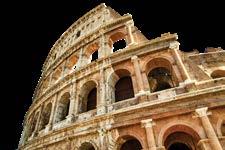
My mother Evelyn O’Connell, my brother Carl, my dad Ronald Sprague—newly minted lawyer—and your author. Photo taken at Suffolk University Law School graduation in spring 1963. Night school lawyers were a new phenomenon. Thus, the photo was published, I believe, in the Boston Record American
that law school provided an excellent education and formed a way of thinking that would be most beneficial to whatever career one chose. As is not uncommon for sons, I chose not to follow my dad to law school. I had always thought teaching was my calling. So, I pursued teaching openings, wanting a job in hand when I walked across the stage at graduation. Some negative motivation played a part as well—I did not want to fight with my dad in order get another financial aid report filled out!
Yes, you can read between the lines. My dad did not manage money well and that was another lifelong lesson I learned from him—to live within one’s means. God bless you, Dad! God bless all fathers and father figures!
If the next part of this note seems familiar or, as Yogi Berra would say, “déjà vu all over again,” spot on!
As we celebrate Father’s Day next month, I thought you might appreciate some ideas for the Latin classroom. In her text A Beginning Latin Christian Reader: De Bonis Cogitationibus, Rose Williams provides a lesson with readings about fathers and children. Two readings from Proverbs in the Jewish scriptures address the relationship between fathers and sons. The section includes an adaptation of the Parable of the Prodigal Son from the Gospel of Luke. From Roman history, Williams presents the story of Cato the Censor educating his son Cato Licinianus as found in Livy’s history Ab Urbe Condita. Latin 2 students will find the Latin of these four selections quite manageable while first-year Latin students at this time of year should also be able to read them without much difficulty. A vocabulary list eases the undertaking. Feel free to download the stories and make copies for your students.
Another way to celebrate dads is to encourage students to create Father’s Day cards. You’ll need some construction paper and markers for this activity. If yours is a laptopendowed class, students can create cards digitally. The complexity of the message will vary on the level of student—from simple messages from Latin 1 students to more involved ones composed by Latin 3 and Latin 4 students. For the upper-level students, they can peruse the proverbs provided as part of Bolchazy-Carducci’s Roman Calendar and choose ones to present as celebrating their fathers.
For classrooms accustomed to conversation Latine, an additional activity to consider is a classroom discussion in which each student is encouraged to share one aspect of their dad or father figure that they especially admire or appreciate.
Caveat, teachers need to be sensitive to the reality that not all students have a dad present in their lives. In such cases, teachers can speak individually to those students and suggest that they address an important nurturing male adult in their lives—a godfather, grandfather, special uncle, male family friend, et alii.
For those of you Latin teachers who are also fathers, all of us at Bolchazy-Carducci Publishers salute you, in anticipation of Father’s Day, for undertaking two such significant nurturing roles—father and teacher!
As the school year draws to a close, the news abounds with stories of graduation ceremonies and speakers. And, of course, your own seniors and eighth graders participate in their own graduation ceremonies and traditions. For my eighth-grade graduation, the school’s very first, we wore maroon caps and gowns, the color traditional for the Sacred Heart, for whom our school was named. Boston College High School called for different garb—black trousers and shoes topped with a tuxedo shirt and white tuxedo jacket. The traditional graduation wear for many Jesuit high schools including Loyola Academy in Wilmette, IL, where I taught for twenty-six years. The commencement season may evoke questions from your students—where did those graduation gowns come from? What does the color of your gown signify, magister/tra? And the like.
This video from the commencement at Simmons University (Boston, MA) features an engaging illustration of various schools’ colors as well as various degrees and their colors. You might consider hitting pause after each professor speaks and ask your students about the significance of each one’s garb. For a discussion on the Latin heritage of the university, feel free to share this enrichment essay, “Connecting with the Post-Ancient World” from Latin for the New Millennium Student Text, Level 2, 2nd Ed. In the LNM Teacher’s Manual, you’ll find additional information about universities in the Middle Ages. Have your Latin 1 students already learned the graduation recognition cum laude to summa cum laude? While many schools have abandoned using Latin in their diplomas, some continue the tradition and some of your students’ parents or grandparents may have Latin diplomas. Have students take photos of the Latin diplomas and share them in class. First-generation students can research the diplomas of their top choices for college while students who have
immigrated to the U.S. can do the same or explore the diplomas awarded by universities in the countries from which they emigrated.
Graduation is a special time. These days, I co-host a luncheon at Williams College for the year’s four Olmsted Prize winners for Outstanding High School Teacher. The recipients are hosted on campus for commencement weekend and formally recognized at Ivy Day activities and at commencement. The lunch, hosted by the Associate Dean for Senior Students, brings together the four honorees, their spouses, the students who nominated them, and the students’ families for an opportunity to celebrate these outstanding teachers. The seniors share a precis of the nominations they wrote on the recipients’ behalf. It is an impactful experience—such talented teachers and talented graduates!
Good wishes to all of you as you and your classes enter the last days of the school year. Your summer break is much deserved. Be sure to take care of yourself—relax, rejuvenate, rest, and restore! Read that book you’ve kept putting off. Get lost in a little BritBox™ or Netflix.
Ex animo, Don
Donald E. Sprague Executive Editor don@bolchazy.com
P.S.
This is the last issue of eLitterae in this format. We’ve decided to employ a more streamlined delivery of material. One week a month, you will receive a letter from the editor in which I will share reflections, teaching tips, suggestions, and the like. In another monthly mailing, we’ll share complimentary worksheets, exercises, and other classroom resources for Latin teachers and students. Announcements about new books, the Roman Calendar, Martia Dementia, webinars, and other pertinent information will be sent in email blasts. So, instead of one sometimes too-lengthy newsletter, you’ll now receive a targeted email three or four times a month. We also hope to share kudos notices and interesting links of classics in the news via Facebook. We think you’ll like the change!
Report on the 61st International Congress on Medieval Studies
The beautiful campus of Western Michigan University in Kalamazoo drew over 1,700 medievalists for the presentations and other programs of the annual International Congress on Medieval Studies (ICMS). Some chose to attend virtual sessions. The current world political climate affected the number of attendees from around the world. The many conversations that took place in the student center atrium as well as the crowds at each evening’s cocktail hour also in the atrium spoke to the extra value of in-person attendance. Participants look forward to catching up with their colleagues, with their former professors and students, and with their doctoral studies classmates.
Sunt: Where the Wild Things Are in Latin. We ran out of the second title midway through day two! Lou published these translations of popular children’s titles as an effort to popularize Latin. The Congress also draws some classicists whose specialty is late antiquity or the medieval period. Several showed interest in Latin for the New Millennium whose Level 2 features post-antique Latin selections. More Latin writings from after the fall of the Roman Empire are extant! Some other classicists liked the idea of building their ancient Greek language enrollments through the use of B-C’s New Testament Greek
Over the past four years serving as the B-C representative for ICMS, it has been a delight to come to know some of the other company reps and to join them for dinner and conversation. One such is Tom Prins of Scholar’s Choice who first attended the Congress fifty years ago. So, when Michael Symonds, the photographer/reporter for the local NPR station WMUK housed at Western Michigan, drawn by such titles as Quomodo Invidiosulus nomine GRINCHUS Christi natalem Abrogaverit: How the Grinch Stole Christmas in Latin and Ubi Fera Sunt, approached me, I immediately encouraged him to speak to Tom. Listen to the radio snippet and read the online story From the Latin Grinch to Germanic lyres: the scholarly but “fun” Medieval Congress kicks off. At Friday’s wine hour, folks gathered in our exhibit hall to honor Tom with a toast and a plaque of recognition. Fifty years ago, Tom was one of four exhibitors! My how the Congress has grown over the decades!
The Congress hosted two exhibit halls in the beautiful WMU Student Center. The Bolchazy-Carducci Publishers booth exhibited in the smaller hall where it joined ISD Distributors and Scholar’s Choice whose extra-large book displays regularly draw attendees. ICMS stands out from the other conferences B-C attends as they are all devoted to the classics while the Congress is all about the medieval period. Don’t forget, however, that Latin reigned as the international language of the Middle Ages. Thus, medievalists are readily drawn to B-C’s pertinent titles like The Other Middle Ages and Bede’s Historia Ecclesiastica. Our founder Lou Bolchazy thoroughly enjoyed ICMS and proudly displayed such titles as The Giving Tree in Latin: Arbor alma and Ubi Fera
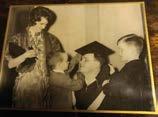
Uninvited guests to ICMS were a number of goose families! Sometimes one came upon them as this photo attests. Other times, one recognized their presence by the droppings they left all over the sidewalks!
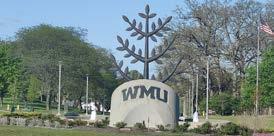
A sculpture in the middle of the gardens outside the student center proudly celebrates Western Michigan University.
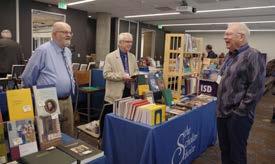
WMUK’s reporter Michael Symonds interviews Tom Prins of Scholar’s Choice.
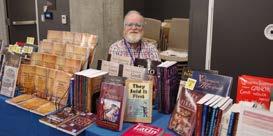
B-C rep Don Sprague tends the B-C booth at ICMS. Photo by Michael Symonds, WMUK.
LATIN FOR THE NEW MILLENNIUM, LEVEL 2
LATIN STORY TO ACCOMPANY REVIEW 5
This story based on Homer’s Odyssey recounts a number of Odysseus’s encounters as he spent ten years trying to reach home.
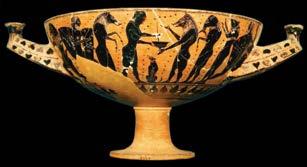
A Greek kylix (wine cup) shows Odysseus’s men turned into animals upon drinking Circe’s magic potion. The vase by the Painter of the Boston Polyphemos dates from the archaic period, ca. 560-550 BCE. The vase is part of the Boston Museum of Fine Art’s collection. Photo by Lucas. License: CC BY 2.0
ERRŌRĒS ULIXIS
1 Trōiā captā, Graecī domum redīvērunt. Prīmō, caelum serēnum fuit, sed Iuppiter tempestātem mīsit ut Graecōs prō eōrum crīminibus, quae in Trōiā capiendā fēcērunt, pūnīret. Nāvēs Graecōrum dispersae sunt. Ulixēs ad Āfricam vectus est, ubi Lōtophagōs, quī tantum lōtōs comedēbant, invēnit. Nautae quī lōtōs comēdērunt nōluērunt revenīre ad nāvēs, sed Ulixēs
5 eōs ad nāvēs trāxit. Tunc nāvigāvit ad terram Laestrȳgonum, quī hominēs comedēbant. Ūndecim ex duodecim nāvibus Ulixis ab Laestrȳgonibus dēlētae sunt, et Ulixēs vix fūgit. Tunc Ulixēs ad Siciliam nāvigāvit, ubi spēluncam invēnit. In spēluncā, Cyclōps habitāvit, mōnstrum horrendum, tantum ūnō oculō praeditum. Cyclōps socium Ulixls comēdit, et Ulixls valdē timuit. Ulixēs cōnsilium cēpit atque vīnum Cyclōpī dedit. Cum Cyclōps vīnum
10 bibisset, dormīvit. Ulixēs tēlum fēcit ex lignō et in ignem posuit, tum tēlō oculum Cyclōpis percussit. Cyclōps excitātus est, sed Ulixem cernere nōn potuit. Ulixēs sociīque suī sub arietēs occultātī sunt et ex spēluncā vēnērunt. Cum nāvem in mare reppulisset, Ulixēs clāmāvit “ego sum Ulixēs, quī tē laesī!” Cyclōps patrem Neptūnum ōrāvit nē Ulixēs domum redīret. Ulixēs ad Aeolum, rēx ventōrum, nāvigāvit, quī sibi sarcinam ventōs habentem dedit.
15 Sed Ulixe dormiente, nautae sarcinam aperuērunt, et nāvis repulsa est ad īnsulam Aeolī. Iterum ex hāc īnsulā, Ulixls Aeaeam nāvigāvit, ubi Circē habitāvit. Circē sociōs Ulixēs in porcōs vertit, sed Ulixēs eam compulit ut in hominēs iterum verteret. Aeaeā, Ulixēs ad īnferōs venit, ubi mātrem, Achillem, Agamemnonemque vīdit. Tunc per fretum nāvigāvit, ubi sunt Scylla Charybdisque. Ulixēs propius Scyllam nāvigāvit nē gurges nāvem suam dēlēret. Scylla
20 sex nautās comēdit. Tum ad Trīnacriam vēnit, ubi sunt vaccae Solīs. Nautae vaccās Solīs comēdērunt, itaque Iuppiter nāvem Ulixis dēlēvit. Nāve dēlētā, Ulixēs sōlus vīxit; omnēs enim nautae in marī mortuī sunt. Tandem Ulixēs Ōgygiam vēnit, ubi cum Calypsōne septem annōs habitābat.
VOCABULA NOVA
Aeaea, Aeaeae, f. – the legendary island home of Circe Aeolus, Aeolī, m. – a deity associated with the weather ariēs, ariētis, m. – ram
Calypso, Calypsonis, f. – nymph who lived on the island of Ogygia
Charybdis, Charybdis, f. – a treacherous whirlpool in the Straits of Messina
Circē, Circēs, f. – woman with magical powers who lived on the island of Aeaea compellō, compellere, compūlī, compulsum – to compel Cyclōps, Cyclōpis, m., – Cyclops, a race of giants, the most famous of whom was Polyphemus
dispergō, dispergere, dispersī, dispersum – to scatter duodecim – twelve frētus, frētī, m. – strait gurges, gurgitis, m. – whirlpool
COMPREHENSION QUESTIONS
horreō, horrēre, horruī – to shudder, dread īnferī, īnferōrum, m. pl. – the Underworld
Laestr ȳgonēs, -onum, m. pl. – the Laestrygonians, a mythological people
Lōtophagī, ōrum, m. pl. – Lotus Eaters, the mythological inhabitants of an island off the coast of Tunisia
lōtus, lōtī, m. – lotus
Ōgygia, Ōgygiae, f. – mythical island home to Calypso porcus, porcī, m. – pig
Scylla, Scyllae, f. – a man-eating water monster
Sicilia, Siciliae, f. – island off the southeastern coast of Italy
Trīnacria, Trīnacriae, f. – from the Greek referencing Sicily as “three-pointed” ūndecim – eleven vacca, vaccae, f. – cow
1. How and why did Jupiter punish the Greeks? What were the consequences of the punishment?
2. What was the result of the encounter with the Lotus Eaters?
3. What did the Lestrygonians do to Odysseus’s men?
4. Explain three ways Odysseus demonstrates his cleverness in this story.
5. Why did the Cyclops call upon Neptune?
6. Explain how the story illustrates the belief that sometimes curiosity backfires.
7. What took place on the island of Aeaea?
8. Explain the logic behind Odysseus’s maneuver when sailing through the Straits of Messina. Cite the pertinent Latin.
9. Why and how did Sol punish Odysseus?
Editor’s Note: Bolchazy-Carducci Publishers is pleased to provide this Latin story for Latin teacher subscribers to use with their own classes only. The PDF version includes the full-color illustration and caption. This is the fifth and last in a series of stories to accompany the five review units of Latin for the New Millennium, Level 2. While complementary to LNM, the stories can serve all second-year Latin students. In addition, nostra culpa, we had neglected to include a PDF link in March for the Latin Story to accompany LNM Level 2, Review 4. Here you go!
Tim Lesinski has loved Latin since he first encountered it in middle school. He has been teaching at Newton North High School, MA, for seven years and previously taught for five years at Newton’s F.A. Day Middle School. He has also served as an instructor for Ascanius: The Youth Classics Institute. Lesinski serves as president of the Massachusetts Classical Association. He is an Eagle Scout and graduate of Thayer Academy. He earned his BA in Greek & Latin and political science from Tufts University and an MAT in Latin and Classical Humanities from Boston College.
2026-27 Classical Conferences and Meetings
ACL — American Classical League
• ACL Institute 2026
• College of William and Mary, Williamsburg, VA
• June 28-30, 2026
• Bolchazy-Carducci Representatives: Bridget Dean, PhD, and Donald Sprague
• Visit ACL Institute
NJCL — National Junior Classical League
• Indiana University, Bloomington, IN
• July 21-26, 2026
• Bolchazy-Carducci Representative: Donald Sprague
• NJCL Website
CAAS — Classical Association of the Atlantic States
• The Hotel DuPont, Wilmington, DE
• October 8-10, 2026
• Bolchazy-Carducci Representative: Donald Sprague
ACTFL — American Council on the Teaching of Foreign Languages
• Henry B. González Convention Center, San Antonio, TX
• November 20-22, 2026
• Bolchazy-Carducci Representative: Donald Sprague
• Learn More
AIA-SCS — Archaeological Institute of America / Society for Classical Studies
• Boston Marriott Copley Place, Boston, MA
• January 7-10, 2027
• Bolchazy-Carducci Representatives: Bridget Dean, PhD, and Donald Sprague
• Learn More
CAMWS — Classical Association of the Middle West and South
• Hotel Cleveland, Autograph Collection, Cleveland, OH
• March 17-20, 2027
• Bolchazy-Carducci Representative: Donald Sprague
• Learn More
CANE — Classical Association of New England
• Smith College, Northampton, MA
• April 2-3, 2027
• Bolchazy-Carducci Representative: Donald Sprague
• Learn More
ICMS — International Congress on Medieval Studies
• Western Michigan University, Kalamazoo, MI
• May 13-15, 2027
• Bolchazy-Carducci Representative: Donald Sprague
• Learn More
Teaching Tips & Resources
NB: A few of the links are behind firewalls but can be viewed via free trial, preview, or the like.
Res Discendae Docendaeque
• Some background on Hilde von Bingen to complement reading selection in LNM 2 workbook.
Res Romanae
• Fourth-century Christian church found in Armenia
• Two-thousand-year-old bread discovered at Roman military camp in Switzerland.
• Archaeologists use AI to reconstruct man killed by Vesuvius while fleeing Pompeii
• Roman shipwreck reveals mysteries of how ships were built and repaired
• Construction site at Pompeii reveals new secrets about Roman concrete.
• Did this Neolithic group invent the celebrated “Roman plaster” 8,000 years prior?
• Herculaneum scroll reveals new insights on Stoicism.
• Digging for a shopping mall unearths Roman estate
• Medical instruments reveal identity of Vesuvius victim at Pompeii.
• Scientists finally understand the storage vessels of Pompeii’s taverns.
• Why were Pompeii victims wearing heavy wool garb in August?
• Archaeologists still ponder the frescoes of Zeus, Helen of Troy, and Apollo.
• Red gemstone found at Roman fort has surprising design
• Tyrian purple buried with Roman babies?!
• Long-lost basilica matches Vitruvius’s formula.
• Bowl commemorates soldier’s service at Hadrian’s Wall.
• Genetics study raises questions about the fall of the Roman Empire
• Early Christian depictions of Christ “in disguise”?
• Earliest “Jesus is God” inscription found in Israel.
Res Hellenicae
• First ancient Greek artifact found in Berlin.
• Archaeologists confirm Vergina tomb holds Philip II’s remains.
• What is the Thucydides Trap that Xi Jinping referenced?
• Scientists identify sticky goo found in a 2,500-year-old jar.
• Frida Kahlo, Diego Rivera, and Greek mythology, oh my!
Res Aegypticae
• Engineering choices helped the Great Pyramid survive earthquakes.
• Egyptian mummy buried with the Iliad!
Res Aliae Antiquae
• Graveyard for ships from Punic times to WWII.
• Handprint from 4,000 years ago!
• Scientists reconstruct face of woman from 3,500 years ago
• The race to decipher the world’s oldest writing system.
• Queen’s “magical” mirror found in British Iron Age hoard.
• Melting mountain ice brings ancient secrets to the surface.
Res Post-Antiquae
• Ancient Christian murals from Nubia inspire gorgeous outfits.
• Seventh-century poem in Old English discovered.
• Notebook from medieval latrine in Germany preserved Latin cursive.
• Mughal master craftsman’s giant astrolabe
Res Pre-Columbianae
• New database of DNA from Indigenous Americans causes significant rethinking about human settlement of South America.
• Potatoes reshaped ancient Andean Indigenous people’s DNA.
eLitterae Subscribers Special 50% Discount
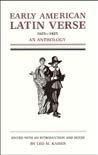
End-of-School-Year Special Early American Latin Verse
This is a perfect set of Latin poems for your summer reading! A poem a day keeps brain wear away! Stock up and save copies for gifts to those students who really love Latin and something unique.
Hardcover $19.00
Special Price $9.50
Enter coupon code eLit0626 on the payment page.
The special offer pricing will be charged at checkout.
This offer is valid for up to ten (10) copies per title, prepaid, no returns.
Discount is not available to distributors. This offer expires July 31, 2026.
(Please note that there will be no adjustments on previous purchases. Offer is nontransferable and subject to change without notice.)
Rose petals at the Pantheon on Pentecost Sunday.
Director Christopher Nolan talks about the Odyssey with Stephen Colbert.
Latin reworking of “Hey Jude”.
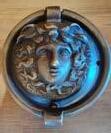
The Medusa head serves as a door knocker on the entrance to Winslow Homer’s studio in Prouts Neck, ME. The docent asserts that Homer chose the figure as one of several means, like a “beware of snakes” sign, to ward off unwanted visitors.
2026 Advanced Placement Summer Institutes for Latin
APSIs provide a great opportunity to collaborate with other AP Latin teachers, examine authentic samples produced by the students on the new exam (this will be the first batch), and discuss instructional strategies on required readings, teacher-choice passages, and the 2026-2027 project passages.
June 15-18: UT Austin, online (Maureen Lamb)
June 22-26: UGA, online (William Lee)
July 6-19: Taft Educational Center, online (William Lee)
July 13-16: Northeastern State University, online (William Lee)
July 27-31: Manhattan University, in-person (Jennie Luongo)
August 3-6: Manhattan University, online (Jennie Luongo)
This information, along with AP Latin consultants’ contact info and registration links, is found in this Google Doc