No. 240 | April 2026 | Donald Sprague, Executive Editor
Editor’s Note
Dear Colleagues,
There’s no love like the love of a mother. As I’m sure you agree, no truer words were ever spoken. For me, they’re especially poignant and pull my mind and heart back to my sister’s wedding in May 1988. My sister had planned to marry the previous year but my mother cajoled her into putting the wedding off for a year. That way, my mom said she could devote her Christmas bonus to the reception and ensure plated service and a room with windows. Alas, the day Mom was to start her new role as hostess at the Harvard Club in Boston’s financial district, she suffered a fatal heart attack. The Irish are wont to note the phenomenon of events that occur in threes. Fortunately, my mom had just completed three significant tasks—she had finished her thank you notes to those who visited my father’s wake six weeks prior; she and my sister had engaged the services of a musical trio and chosen the song list; and they had also completed the guest list for the wedding. Despite family style rather than plated service and a reception hall with no windows, Andrea’s wedding reception was grand. She had a gorgeous threetier wedding cake of butter frosting with a stream of green shamrocks running from top to bottom. When the trio played “There is no love like the love of a mother,” not a dry eye was to be found in the hall!
My mother adored the three of us and worked hard to help make a good life for us and to provide us a good education. Her tips as a cocktail waitress helped pay the tuition at Sacred Heart School, North Quincy, MA, and then helped us through high school—Boston College High School for me, Sacred Heart High School for my brother, and Archbishop Williams High School for my sister. Education, she recognized, is key to making the most of one’s talents. She prized her own high school years at the parish school, St. Columbkille’s in Brighton, MA. There, the good Sisters of St. Joseph provided a comprehensive education including four years of French and Latin. I remember when I was learning to recite the proem to Chaucer’s Canterbury Tales that she could still deliver those lines learned as a high schooler.
Indulge me as I share some very significant lessons that my mother imparted to me. A key lesson that I regularly shared with my students—whatever task you undertake, do your very best. If it’s cleaning toilets, be sure to scrub them fully! “Manners don’t cost a thing.” “If you can’t afford to tip the waiter or waitress (those were pre-server days), you can’t afford to eat out.” That particular lesson
was delivered when Mom learned how we were spending the quarter she gave us on days that work kept her from joining us at church. A breakfast snack of toast and cocoa at Bono’s Drugstore came to exactly a quarter. I don’t recall the amount she then gave us, but it was enough for the collection at church, the snack at Bono’s, and a tip for the server. “Treat everyone with respect.” All lessons I try to live out every day. I especially try to practice the last one, recognizing that all work has dignity.
I remain humbled by the pride my mother took in her son becoming a teacher. I am ever grateful and appreciate the sacrifices she took to ensure we received good educations.
As we celebrate Mother’s Day next month, I thought you might appreciate some ideas for the Latin classroom. In her text A Beginning Latin Christian Reader: De Bonis Cogitationibus, Rose Williams provides a lesson with readings about mothers and children. Two readings present mothers from the Jewish scriptures—the mother of Moses and the mother of Samuel. From Roman history, she features Cornelia Gracchus, the mother of the famous Gracchi brothers. Your Latin 2 students will find the Latin quite manageable, while first-year Latin students at this time of year should also be able to read them without much difficulty. Williams provides a vocabulary list to ease the undertaking. Feel free to download the stories and make copies for your students.
Another way to celebrate moms is to encourage students to create Mother’s Day cards. You’ll need some construction paper and markers for this activity. If yours is a laptop-endowed class, students can create cards digitally. The complexity of the message will vary on the level of student—from simple messages from Latin 1 students to more involved ones composed by Latin 3 and Latin 4 students. For the upper-level students, they can peruse the proverbs provided as part of BolchazyCarducci’s Roman Calendar and choose ones to present as celebrating their mothers.
For classrooms accustomed to conversation Latine, an additional activity to consider is a classroom discussion in which each student is encouraged to share one aspect of their mom that they especially admire or appreciate.
Caveat, teachers need to be sensitive to the reality that not all students have a mom. In such cases, teachers can speak individually to those students and suggest that they address an important nurturing female adult in their lives—a godmother, grandmother, special aunt, female family friend, et aliae.
Classes still in session in June can undertake a similar set of activities for Father’s Day. Watch your email—we’ll send you a set of complimentary Latin readings.
For those Latin teachers who are also mothers, we salute you, in anticipation of Mother’s Day, for undertaking two such significant nurturing roles—mother and teacher! Good wishes to all of you as you and your classes enter the last weeks of the school year. Congratulations on a school year well spent!
Ex animo, Don
Donald E. Sprague Executive Editor don@bolchazy.com
Teaching Tip
Antithesis: The Defining Feature of Pliny’s Prose (A Pliny Appreciation Guide, Part 2)
The second of three essays from “A Pliny Appreciation Guide”
Of all the stylistic devices found in Pliny’s letters, none are quite as prominent as antithesis, which Whitton describes as a “defining feature” that is “at the core of Pliny’s prose style.”[1] Antithesis is when a writer sets two (or more) ideas in opposition to each other, creating a juxtaposition which intensifies each of the ideas. The quote below is not only a good example of antithesis, but also illustrates the technique on a metaphorical level:
…quōrum fulgor et clāritās tenebrīs noctis excitābātur. (6.16.13)
“…[the fires] whose shining and brightness was sharpened by the darkness of night.”
Just as the darkness of night makes the fires seem even brighter, antithesis takes two elements and augments the qualities of each one through juxtaposition with the other.
While this technique has always been a feature of Latin literature, authors grew more and more partial to it in the generations after Augustus. Philologists of the 19th and early 20th century, however, viewed antithesis as “a brilliant and dangerous figure,” effective in moderation, but showing “artifice and affectation” when overused.[2] Therefore, authors who showed a fondness for antithesis, such as Seneca and Pliny, were for centuries characterized as inferior to their “Golden Age” counterparts. Pliny in particular was often criticized for his antithesis-heavy style: Westcott (1899) called his antitheses “somewhat excessive,”[3] while Mayor (1889) decried Pliny’s “extravagant love” for the figure.[4] Modern readers, however, have warmed to Pliny’s judicious and effective use of antithesis, recognizing the “grace and elegance” that it lends to his writing.[5]
In spite of all the efforts to periodize Latin literature by its features, antithesis is not that hard to find in “Golden Age” authors. Pliny would have found many illustrative examples in his idol Cicero:
“Quis clāriōribus virīs quōdam tempore iūcundior, quis turpiōribus coniūnctior? Quis cīvis meliōrum partium aliquandō, quis taetrior hostis huic cīvitātī? Quis in voluptātibus inquinātior, quis in labōribus patientior? Quis in rapācitāte avārior, quis in largītiōne effūsior?” (Cicero, Prō Caeliō 13)
“Who was more pleasant to more distinguished men at one time, yet who was more intimate with more awful men? Who was a citizen of the better parties at one time, yet who was a fouler enemy to this state? Who was more perverted in his pleasures, yet more enduring in his labors? Who was greedier in his avarice, yet more generous in his handouts?”
Note that the antithetical word-pairs are similar in form; the old-fashioned philologists considered this an ideal feature of antithesis.[6] Cicero places comparative adjectives in opposition, sometimes with phonetic similarities (iūcundior/ coniūnctior), and his contrasting ablative nouns are always of the same declension, creating a quasi-rhyming effect (voluptātibus/labōribus, rapācitāte/largītiōne). We see Pliny, who was a great admirer of Cicero, doing the same:
…aut facere scrībenda aut scrībere legenda… (6.16.3)
“...either doing things worthy of being written, or writing things worthy of being read…”
Just like Cicero, Pliny chooses words that are very similar in form—not just an infinitive and a gerundive, but verbs of the same conjugation—which enables the two contrasting ideas to better play off each other.
Looking at Pliny’s antitheses, we also see inspiration from the world of poetry, especially from Martial. Epigrams and epistulae have a lot in common, after all.
Ēsquiliīs domus est, domus est tibi colle Diānae, et tua patricius culmina vīcus habet; hinc viduae Cybelēs, illinc sacrāria Vestae, inde novum, veterem prōspicis inde Iovem.
Dīc ubi conveniam, dīc quā tē parte requīram; quisquis ubīque habitat, Maxime, nusquam habitat. (7.73)
“You have a house on the Esquiline, a house on the hill of Diana, and the patrician neighborhood has your roofs. From one house you see the temple of widowed Cybele; from another, the temple of Vesta; from another, the new Jupiter; from another, the old one. Tell me where I should meet you, tell me in what direction I should look for you: whoever lives everywhere, Maximus, lives nowhere.”
Not only did Pliny have great respect for Martial (as his eulogy for him in letter 3.21 makes clear), his “pointed style” evokes Martial’s poetry, and in fact “some of his letters might
be called ‘epigrams in prose.’”[7] This makes sense: epigrams, like letters, demand brevity, and both genres often rely on antithesis for their rhetorical punch. In the epigram above, we see antitheses in lines 1, 3, and 4, mixing chiasmus and parallel structure, and Martial concludes with a paradoxical antithesis in the form of a sententia (a maxim or proverblike saying). These are all techniques of antithesis that Pliny would employ throughout his letters.
Most commonly, antithesis in Pliny is expressed using asyndeton, which forces the two clashing ideas together:
Iam diēs alibī, illīc nox... (6.16.7)
“Now it was day elsewhere, but there, it was night…”
Elsewhere, he uses polysyndeton:
...aut proficīscentem tē valētūdinis causā in Campāniam prōsequī aut profectam ē vestīgiō subsequī. (6.4.1)
“...either to accompany you as you were departing into Campania for reasons of your health, or to follow in your footsteps after you had departed.”
Or he might use subordination to join the two ideas together:
Properat illūc unde aliī fugiunt... (6.16.10)
“He hurries to where the others are fleeing from….”
When it comes to word order, Pliny usually puts antithesis in a chiasmus:
…utque timōrem eius suā sēcūritāte lēnīret… (6.16.12)
“...and so that he could ease his fear with his own calmness…”
But he sometimes uses parallel structure, with two elements (as in 6.16.3 above), or even three, as below:
Et haec quidem affīrmantibus crēdō; illud affīrmāre aliīs possum. (7.16.10)
“And indeed, I believe those who attest these things; but this other thing I can attest to others.”
When each part of the antithesis is three words or more, Pliny tends to avoid a strict A-B-C, A-B-C parallel structure.[8] Take this example:
...nam cuius litterae tantum habent suāvitātis, huius sermōnibus quantum dulcēdinis inest! (6.7.3)
“...for your letters have as much charm as the sweetness that is found in your conversations!”
Note how Pliny inverts the order of the verb and the genitive (habent suāvitātis / dulcēdinis inest). He even changes the sentence structure between the two pieces of the antithesis, which becomes clear if we put the two elements in a subject-verb-predicate word order:
Subject Verb Predicate litterae habent tantum suāvitātis quantum dulcēdinis inest sermōnibus
Why avoid a literal parallel here? Perhaps Pliny felt that putting the words in the exact same order each time would sound tasteless and overwrought—the “artifice and affectation” of antithesis that philologists of the next millennium would lament. Whatever his reasons, Pliny often mitigates the effects of exact harmony with “intervening
words or formal or syntactical variation,” leaning towards the inconcinnitās that his friend Tacitus was famous for.[9]
Here, Pliny breaks up the exact harmony by using a litotes in the second component of the antithesis:
Iam illud nōnne et magis terribile et nōn minus mīrum est…? (7.27.4)
Now, isn’t it both more frightening and no less amazing…?
And here is one where he inserts a word into the second element:
…nē vacua mēns audīta simulācra et inānēs sibi metūs fingeret. (7.27.7)
“...so that his empty mind would not conjure up for him the ghost he had heard of and pointless fears.”
Note especially the balance of the above antithesis: by slipping the sibi into the second phrase, he can equal out the two parts of the antithesis at seven syllables each. Usually, Pliny keeps the two components of an antithesis at roughly equal length, measured in number of syllables. Though this might seem like an excess of meticulousness, it is clear that the writers of Pliny’s day considered syllable counts in their writing.[10] Equal syllable counts can turn up in longer phrases too:
Erō enim sēcūrior dum legō, statimque timēbō cum lēgerō. (6.4.5)
“For I will be more secure while I read, but I will immediately worry when I have finished reading.”
If an elision occurs between the first two words (as is assumed to happen within a phrase, even in prose[11]), then each part of the antithesis is exactly ten syllables. Add this to the other literary techniques—polyptoton of legō/ lēgerō, phonetic similarity of dum/cum and arguably enim/ statim—and Pliny crafts a subtle and delicate sentence, an appropriate conclusion for this letter to his wife.
I’ll close with just one more example of an antithesis that abounds with other literary devices: anaphora (with apud), as well as both polyptoton and chiasmus (ratiō ratiōnem / timōrem timor). While it can be easy to dismiss Pliny’s idiosyncrasies as literary flair for its own sake, Pliny’s artfulness is never arbitrary. This sentence is instrumental to Pliny’s purpose, which is to craft a narrative which highlights the positive character traits of his uncle, and by extension, himself.
…apud illum quidem ratiō ratiōnem, apud aliōs timōrem timor vīcit. (6.16.6)
“Indeed, in him, one reason won out over the other, but in others, one fear won out over the other.”
I could go on for a long time—there are so many examples in the AP selections alone—but I think that these should be more than sufficient to demonstrate this particular feature of Pliny’s style. Fīnem ergō faciam. But now that you know just how prevalent antithesis is in Pliny’s work, you won’t stop noticing it!
Notes
1. Whitton, Christopher. Pliny the Younger: Epistulae Book II. Cambridge University Press, 2013, p. 21, 24.
2. Waddy, Virginia. Elements in Composition and Rhetoric Van Antwerp, Bragg, and Co., 1889, p. 238–239.
3. Westcott, J. H. Selected Letters of Pliny. G. P. Putnam’s Sons, 1899, p. xxvii.
4. Mayor, John E. B. Pliny’s Letters: Book III. 2nd ed. MacMillan and Co., 1889, p. 236.
5. Conte, Gian Biagio. Latin Literature: A History. Translated by Joseph B. Solodow. Johns Hopkins University Press, 1994, p. 527.
6. Auden, Henry William. Higher Latin Prose. William Blackwood and Sons, 1898, p. 18.
7. von Albrecht, Michael. A History of Latin Literature, vol. 2. E. J. Brill, 1997, p. 1151.
8. Whitton, p. 22.
9. ibid.
10. ibid.
11. Whitton, p. 22, n. 122.
Dan Conway is a Latin teacher at State College Area High School in State College, PA, where he has been teaching for fifteen years. He studied at Penn State, where he earned bachelor’s degrees in World Languages Education and French, as well as an MEd in Curriculum and Instruction. He did his master’s thesis on Latin shelteredvocabulary novellas and turned this research into a website (latinnovelladatabase.blogspot.com), a presentation at CANE 2021, and an article published in The Classical Outlook (96.3). This year, he is teaching IB Latin for the last time and AP Latin for the first time. You can find more of his thoughts on Pliny and other resources he has created at magisterconway.blogspot.com
Classical Association of New England (CANE) Annual Meeting Report
The Department of Classical and Early Mediterranean Studies at Brandeis University hosted the 120th Annual Meeting of CANE. Some one hundred and seventy classicists from across New England trekked to Waltham, MA, for the two-day conference, March 20 to 21, for a program of presentations and workshops that spanned the realm of classics with a healthy representation of pedagogy-related sessions. The CANE conference is a model for collaboration between college instructors and their counterparts in elementary and secondary classrooms. The meetings are always a convivial gathering as members catch up with one another and enthusiastically share their lives and teaching experiences over the previous year. The Mandel Atrium, where refreshments were served and exhibits were displayed, echoed with animated conversation.
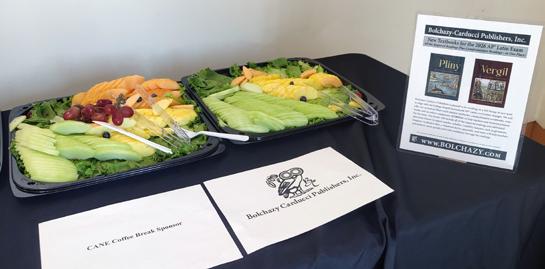
Bolchazy-Carducci is pleased to have been able to sponsor a CANE conference break.
The program included a trifecta of Bolchazy-Carducci authors who have contributed to our materials for the new AP Latin curriculum. David Pellegrino, coauthor with Ella Wallace of Lumina: Pliny and Vergil with Suggested Companion Texts, presented “Reading Latin Poetry Aloud.” Gregory P. Stringer, coauthor of A Pliny Workbook: 20 Letters and Suggested Companion Texts, gave a workshop entitled “Teaching Pliny’s Letters.” Jacqueline Carlon, Stringer’s coauthor and author of Pliny: 20 Letters and Suggested Companion Texts, delivered the workshop “Roman
Marriage and Pliny the Younger’s Letters to Calpurnia.” Attendees were quite pleased with the information provided in the three workshops. And, as one would expect, the presentations generated additional interest in B-C’s set of resources for the AP Latin curriculum. In addition to the three AP Latin material authors, I also enjoyed interacting with B-C authors Bonnie Cato and Scott Smith, current CANE president.
Friday evening’s banquet is consistently a delightful evening. Attendees take great pleasure in the awarding of two awards. The Martha and Matthew Wiencke Teaching Award recognizes outstanding teaching on the secondary, middle, or primary level. This year CANE honored Mary Elizabeth DeCamp, who has helmed the Latin program at Winchester High School in Massachusetts. It has been a delight for me to get to know Mary over the years as she is loyal B-C customer. The Barlow-Beach Distinguished Service Award is given to individuals who are notable for their distinguished service to CANE and to the Classics in New England. It is tradition that the recipient is caught unawares until the citation’s information provides a clue to their identity. This year the award honored Ellen Perry, classical archaeologist at College of the Holy Cross.
This CANE meeting was particularly significant for me as its local host, Classics Professor Caitlin Gillespie, is a Loyola Academy graduate. There, she was a member of the Dumbach Scholars Honors Program, the program
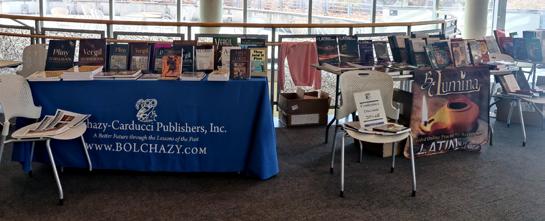
The B-C display, the largest in the main exhibit area, maximized its three tables as well as chairs!
that I founded and directed. It has been gratifying through the years to follow Caitlin’s successes, from delivering the Latin address at Harvard’s commencement to her recent publication Women and Resistance in the Annals of Tacitus. My favorite anecdote about Caitlin is her presentation at the Jesuit Latin Colloquium VI held at Boston College High School. Caitlin delivered her entire talk with her four- or five-month-old Aidan in her arms! Caitlin ran an excellent conference in spite of a fire destroying the Brandeis conference center where she had originally scheduled the gathering. It was especially gratifying to hear student volunteers speak so highly of Caitlin. My favorite—“Several of us are minoring in Professor Gillespie!”
Teaching Tips & Resources
Res Docendae Discendaeque
• Podcasts on ancient history
• Classics in Space: A wonderful resource from Nathalie Roy.
• Climate change to identity: vital lessons in the Metamorphoses.
Res Cogitandae
• Plans for triumphal arch in Washington, D.C.
• Greece combats vandalism and art forgery.
Res Romanae
• Incense residue confirms Pompeii’s place in global trade route .
• Wall paintings in Hispania reveal smart use of costly cinnabar .
• Olive oil production facilities found in North Africa.
• Watch: Ancient wine-making tradition at Pompeii on video.
• Lake in Switzerland yields 1,000 Roman objects
• New metro stop is ancient Rome’s newest attraction.
• Nails found in three Roman burials
• The Roman city in Switzerland that “never was.”
• Roman factory by the River Wear in England.
• Roman camp emerges beneath German garden.
• Roman troops used 2,000-year-old rapid fire “machine gun” against Pompeii.
• Roman villa and “Norfolk Nessie” found in the UK.
• Watch: Hadrian’s Wall—protecting the empire’s northern boundary.
• Watch: The forgotten Hexamilion Wall in Corinth.
• Subway construction in Milan reveals Roman horreum and inscriptions about trade routes.
• The smell of ancient Roman religious rituals
• Bible-era shipwreck yields a treasure of Roman finds in Swiss lake.
• Villa in Sicily yields mosaic of “surprising” footwear
• First known image of a woman fighting wild beasts?
• Extraordinary story—tracking the Romans who survived Mt. Vesuvius’s eruption.
• Ancient Viroconium in the UK, linked to a werewolf legend .
• Colosseum restores southern entrance and gets new pedestrian plaza. Renovation reveals long-lost structures.
• Roman necropolis discovered in Zadar, Croatia.
Res Hellenicae
• Sunken ship linked to Parthenon sculpture yields new clue
• Shipwreck graveyard near ancient Ptolemais.
Res Aegypticae
• Water-filled temple to the god named “ Mud ” found in Egypt.
• Pottery shards ancient Egyptians used like scrap paper
• Nile’s west bank reveals Old Kingdom tombs and artifacts.
• New immersive exhibition on Ramses II.
• Mysterious structure found beneath ancient city.
• Roman emperor depicted as an Egyptian Pharaoh.
• Researchers unearth Christian center’s remains before Muslim conquests.
• Earth-shattering revelation about building the Great Pyramid .
• Listen to Tutankhamun’s trumpets.
Res Aliae Antiquae
• Iron Age hoards from funeral of powerful Celtic queen?
• Archaeologists discover Neolithic trackway in Somerset, England.
• DNA tells us about the Carthaginians.
• Ancient history podcast on the Phoenicians.
• The hidden history of underwater ancient Juliopolis in Turkey.
• 2,000-year-old bodies found seated upright and facing west in France.
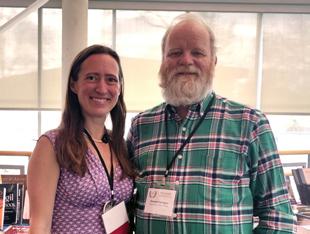
Caitlin Gillespie, CANE local host, Helaine and Alvin Allen Chair in Literature and Assistant Professor in the Department of Classical and Early Mediterranean Studies, Brandeis University, and Don Sprague, Bolchazy-Carducci rep.
• “Unprecedented” ancient structure found in Dijon, France
• First of its kind wagon evidence found in Iron Age treasure trove.
• 3,500-year-old fire remains of Spanish village.
Res Post-Antiquae
• Fifth-century Christian church in Glasgow becomes cultural center.
• 600-year-old city found at lake bottom
• Unique medieval school text
• Medieval monks’ marginalia from a millennium ago.
Res Pre-Columbianae
• Archaeologists find long-rumored underground Inca labyrinth
• Remains of ancient Maya marketplaces found in jungle.
• Did Columbus know Milanese friar’s writings about North America from 150 years prior?
• Teotihuacan murals reveal possible 2,000-year-old UtoAztecan language.
• Sacrificial altar in Mexico from civilization that thrived before the Aztecs.
• New discoveries reveal how San Antonio’s earliest settlers managed water needs.
Classics Tidbits
Classicists Perform
• Andrea Stehle does Shakespeare
• John Gruber-Miller in Jesus Christ Superstar
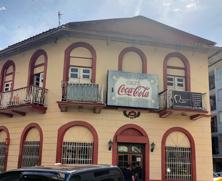
Panamanians describe the century-plus-old Coca Cola restaurant’s façade as “Parthenon-like.”
“Fall of Troy” band


Ian Hochberg contributes to digital media.
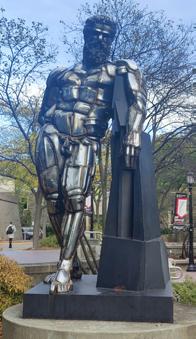
Herakles at Cornell University, Ithaca, NY. Created by the late Jason Seley ’40, a longtime professor at Cornell who served as chairman of the art department and dean of the College of Architecture, Art, and Planning. His sculptures like the eleven-foot Herakles (1981) are made from materials salvaged from junkyards.
A clock from the historic Waltham clock factory now decorating Bistro 781, Waltham.
From a suburban Baltimore protest.
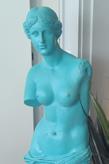
The ubiquitous Venus de Milo makes an aqua appearance at the Williams Inn, Williamstown, MA.
eLitterae Subscribers Special 50% Discount
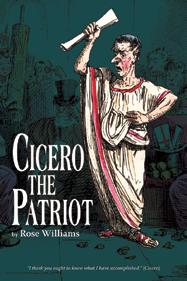
End-of-School-Year Special Cicero the Patriot
Students will enjoy the witty writing of Rose Williams as they learn about the esteemed Cicero! Purchase a bunch to give as prizes or graduation presents.
Paperback $10.00
Special Price $5.00
Enter coupon code eLit0426 on the payment page.
The special offer pricing will be charged at checkout. This offer is valid for up to ten (10) copies per title, prepaid, no returns. Discount is not available to distributors. This offer expires May 31, 2026.
(Please note that there will be no adjustments on previous purchases. Offer is nontransferable and subject to change without notice.)