Teaching Tip
The Decline and Fall of the Periodic Sentence (A Pliny Appreciation Guide, Part 1)
Introduction (Or, How I Learned to Stop Worrying and Love Pliny the Younger)
Starting in the 2025–26 school year, the Advanced Placement (AP) Latin curriculum switched its prose readings from Caesar’s Dē Bellō Gallicō to Pliny the Younger’s Epistulae. For my part, I was excited about this change: one of the reasons I had been a hard “no” on AP for many years was the enormous amounts of Caesar I would have to read and teach. When our school district did away with the International Baccalaureate (IB) program, I saw an opportunity to test out the new AP curriculum with a handful of willing students. I had taught Pliny in the past, and my students and I both found his letters to be enjoyable reading, so I was eager to dive in, read a lot of epistulae, and get to know Pliny as our new friend and correspondent.
Among veteran AP teachers, however, there were some who were not so happy that Caesar was replaced with Pliny. In the AP Latin teachers’ Facebook group, reactions ranged from intimidation to frustration, and the word “hate” was thrown around more than once. As someone who always enjoyed Pliny, I read these gripes with a bit of surprise. Sure, he’s a bit harder than Caesar, but I never found him to be prohibitively difficult. While some of these teachers’ complaints were legitimate, others were almost spiteful and showed a profound lack of understanding of Pliny’s work: “a demoralizing read, real cure for insomnia,” “he has no real style as a writer,” “a slog.” (That last one, to me, was particularly rich coming from a group of teachers who are so used to slogging through Caesar, who would even defend him to the last breath!)
So as someone who has taught and enjoyed Pliny before, I thought I would put together a Pliny appreciation guide based on my notes from previous research, primarily aimed at teachers from whose cold, dead hands Caesar would have to be pried. Each post will highlight a major grammatical, stylistic, or thematic feature of Pliny’s letters. I’m no expert in Pliny at all, and I’m not even his biggest fan. But given the sheer amount of complaining, and even vitriol, from the veterans of Caesar’s legions, someone’s got to stick up for Plīnius noster.
My main sources for this series are Christopher Whitton’s “green-and-yellow” commentary on Book 2 of the Epistulae (Cambridge, 2013)—even though none of the AP selections are from Book 2, his excellent introduction applies to all of Pliny’s letters. I also recommend the introduction to A. N. SherwinWhite’s Fifty Letters of Pliny (Oxford, 1969).
Part 1: The Decline and Fall of the Periodic Sentence
In Latin literature of the so-called “Golden Age,” readers often encounter periodic sentences, where phrases and subordinate clauses pile up to provide context or build tension before the main action of the sentence is finally revealed at the end. Such periodic sentences are common in Caesar, Cicero, and Livy. In the example below, rather than leading with the main action, Caesar’s periodic sentence uses a variety of subordinate clauses and ablatives absolute to frontload the context and circumstances surrounding the attack:
At hostēs, ubi prīmum nostrōs equitēs cōnspexērunt, quōrum erat quīnque mīlium numerus, cum ipsī nōn amplius octingentōs equitēs habērent, quod iī quī frūmentandī causā erant trāns Mosam profectī nōndum redierant, nihil timentibus nostrīs, quod lēgātī eōrum paulō ante ā Caesare discesserant atque is diēs indūtiīs erat ab hīs petītus, impetū factō celeriter nostrōs perturbāvērunt. (Caesar, DBG 4.12)
“But the enemies, when they first spotted our horsemen— which were 5,000 in number, while they had no more than 800 horsemen, because those who had left across the Meuse to forage had not yet returned, and our soldiers were not fearing at all, because the enemies’ envoys had just left Caesar having sought a truce for that day—an attack having been made, quickly alarmed our soldiers.”
In contrast with the periodic sentences of Caesar’s era, Pliny’s style could be described as “additive,” which is to say that Pliny “[presents] information in smaller units that often lead sequentially one to the next: explanations more commonly follow than precede, and information is frequently tacked on after the main clause, or Pliny modifies a statement as if thinking aloud.”[1] Indeed, because of this “plain and logical” construction of sentences, readers might even find that Pliny “uses a syntactical system that seems more normal to the English reader than that of Cicero or Livy”—or even of Caesar.[2]
Here is an example from the AP syllabus:
Properat illūc unde aliī fugiunt, rēctumque cursum rēcta gubernācula in perīculum tenet adeō solūtus metū, ut omnēs illīus malī mōtūs omnēs figūrās ut dēprēnderat oculīs dictāret ēnotāretque. (6.16.10)
“[My uncle] hurries to where the others are fleeing from and holds a straight course and a straight rudder into danger, so free from fear, that he dictated and noted all the movements and all the shapes of that bad thing as he saw them.”
Notice how, unlike Caesar, Pliny begins with the core of the sentence (Properat illūc). In fact, Pliny places the main verb near the start of his sentences frequently: note how in the nine letters on the AP syllabus written by Pliny, five of them begin with a main verb as either the first or second word of the letter.[3] After establishing the primary action of the sentence, Pliny then builds details onto it in an “additive” style. He first gives more information on the place his uncle is going (unde aliī fugiunt), and then more details about the circumstances and his uncle’s actions (rēctumque cursum rēcta gubernācula in perīculum tenet). Finally, he describes his uncle’s state of mind (adeō solūtus metū), and then gives an example that justifies this description (ut omnēs illīus malī mōtūs…). In this sentence, and frequently throughout his letters, Pliny introduces ideas one after the other, producing a casual or off-the-cuff effect. If we picture Pliny writing his letter, we might imagine that he writes down the key event first, as a sort of sketch, and then adds details and descriptions to complete the picture.
Another example of this “additive” sentence structure: Dēserta inde et damnāta sōlitūdine domus tōtaque illī mōnstrō relicta; prōscrībēbātur tamen, seu quis emere seu quis condūcere ignārus tantī malī vellet. (7.23.6)
“The house was then deserted and condemned to solitude, and the whole of it was left to that monster; it was nevertheless put up for sale, in case someone, ignorant of such an evil, wanted to buy or rent it.”
There are two key facts Pliny wishes to convey: the house was abandoned, and the house was put up for sale. Both of these verbs (dēserta and prōscrībēbātur) are at the beginning of their respective clauses. He then proceeds to add more details to each. For the first, he dresses it up with a tricolon crescens to intensify the desolation of the house. In the second, anticipating the reader’s question of why anybody would pay money to live there, he provides a possible reason. (Recall that, as Whitton noted, “explanations more commonly follow than precede” in Pliny.)
In another feature of this “additive” style, Pliny writes with fewer subordinate clauses and participle phrases, preferring instead to use strings of independent clauses, often with asyndeton. This lack of subordination is called parataxis.[4] Take this sentence (which is in fact the longest on the AP syllabus):
Audīrēs ululātūs fēminārum, īnfantum quirītātūs, clāmōrēs virōrum; aliī parentēs aliī līberōs aliī coniugēs vōcibus requīrēbant, vōcibus nōscitābant; hī suum cāsum, illī suōrum miserābantur; erant quī metū mortis mortem precārentur; multī ad deōs manūs tollere, plūrēs nusquam iam deōs ūllōs aeternamque illam et novissimam noctem mundō interpretābantur. (6.20.14)
“You would hear the wails of women, the cries of children, the shouts of men; some were looking for their parents, some for their children, some for their spouses, and recognizing them by voice; some were lamenting their fate, and others the fate of their loved ones; there were those who, for fear of death, were praying for death; many were raising their hands to the gods; many more were understanding that there were no longer any gods anywhere, and that this was the last eternal night for the world.”
Each element of this sentence is an independent clause (except for the relative clause introduced by erant quī, which is not so much a subordinator as a different way of introducing the next item on the list). Notably, there are no participles and no ablatives absolute. Contrast this passage with a periodic sentence in Livy describing a similar scene:
Clāmor omnia variīs terrentium ac paventium vōcibus mixtō mulierum ac puerōrum plōrātū complet. (AUC 5.21)
“Shouting filled everything with various voices of frightening and fearful people, with the wailing of women and children mixed in.”
Livy interrupts the main action—Clāmor omnia complet with two lengthy phrases, including an ablative absolute. Pliny, on the other hand, chooses not to enclose his details within each other; rather, he puts them side-byside sequentially as independent clauses. These kinds of sentences—additive and sequential rather than periodic— were favored by Pliny for their casual, spontaneous effect; reading this sentence, we are meant to imagine that he is simply adding these little vignettes as he thinks of them. Pliny’s sentence structure, like everything else about his style, is in service of the informality (or façade of informality) that is a key feature of the epistolary genre.
Notes
1. Whitton, Christopher. Pliny the Younger: Epistulae Book II Cambridge University Press, 2013, p. 21.
2. Sherwin-White, A. N. Fifty Letters of Pliny. 2nd ed. Oxford University Press, 2000, p. xvii, xix–xx.
3. These are 6.4 (sum), 6.7 (scrībis), 6.16 (petis), 6.20 (ais), and 10.6 (agō). See also Whitton: “As in Cicero’s letters and dialogues, verbs are prone to fall early, though this is no absolute rule: they may be final, juxtaposed mid-sentence, framing a clause, or a combination of these” (p. 21).
4. “Participles are used relatively lightly, and parataxis (lack of subordination) is common” (Whitton, p. 21).
Dan Conway is a Latin teacher at State College Area High School in State College, PA, where he has been teaching for fifteen years. He studied at Penn State, where he earned bachelor’s degrees in World Languages Education and French, as well as an MEd in Curriculum and Instruction. He did his master’s thesis on Latin shelteredvocabulary novellas and turned this research into a website (latinnovelladatabase.blogspot.com), a presentation at CANE 2021, and an article published in The Classical Outlook (96.3). This year, he is teaching IB Latin for the last time and AP Latin for the first time. You can find more of his thoughts on Pliny and other resources he has created at magisterconway.blogspot.com.
NEW B-C Titles for the Revised AP Latin Curriculum
New Material ADDED to Lumina!
To accompany AP Latin Pliny and Vergil Selections a splendid tool for student self-review!
Lumina: Pliny and Vergil online exercises prepare students for the challenges of the AP® Latin Exam. Hundreds of multiple choice questions cover ALL syllabus selections from Vergil’s Aeneid and the letters of Pliny the Younger. These automaticallygraded activities model exam format and provide students with detailed immediate feedback.
Additional multiple choice question sets promote close reading of companion texts, which meet the teacher’s choice component of the new AP® Latin syllabus. These optional readings are included alongside expert commentary in Pliny: 20 Letters and Suggested Companion Texts and Vergil: Selections and Suggested Companion Texts. With Lumina, students receive invaluable support as they read widely from a variety of unadapted Latin texts.
• Detailed multiple choice exercises for all suggested Pliny letters
• Question sets corresponding to the AP Exam’s four project passages
• “Bonus” content that covers people and places of Pliny, characters of the Aeneid, and features of literary language exemplified in the work of both Pliny and Vergil
• All of the old Caesar multiple choice questions have also been included in Lumina: Pliny and Vergil. These are a good option for teachers using Caesar as a teacher’s choice reading or for sight reading practice.
• Immediate feedback so students can self-monitor their mastery of material
To see extra practice examples.
Contact lumina@bolchazy.com to schedule an online demonstration.
NB: B-C has also developed Lumina for Latin for the New Millennium, Level 1 and Level 2 and for the online selflearning program Artes Latinae, Level 1 and Level 2
2026 Classical Conferences and Meetings
CAMWS — Classical Association of the Middle West and South
• 122nd Annual Meeting at the invitation of the Alabama Classical Association
• Renaissance Mobile Riverview Plaza Hotel, Mobile, AL
• March 11–14, 2026
• Bolchazy-Carducci Representatives: Bridget Dean, PhD, and Donald Sprague
• Author Presentation on Friday, March 13, 2026
Session 7: “Sea Monsters: Tempest bearing, Tsunami born” Georgia L. Irby, author, “Exploring the Development of the Sciences: Autodidacts, Polymaths, and Their Theories,” scholarly essay for Latin for the New Millennium, Level 2.
CANE — Classical Association of New England
• 120th Annual Meeting
• Brandeis University, Waltham, MA
• March 20–21, 2026
• Bolchazy-Carducci Representative: Donald Sprague
• Author Presentations on Friday, March 20, 2026
» Workshop 2B: “Reading Latin Poetry Aloud” David Pellegrino, coauthor with Ella Wallace, Lumina: Pliny and Vergil with Suggested Companion Texts; coauthor with Dennis De Young, Caesar and Vergil AP Vocabulary Cards.
» Workshop 4B: “Teaching Pliny’s Letters” Gregory P. Stringer, coauthor with Jacqueline Carlon, A Pliny Workbook: 20 Letters and Suggested Companion Texts.
• Author Presentation on Saturday, March 21, 2026
» Workshop 7B: “Roman Marriage and Pliny the Younger’s Letters to Calpurnia” Jacqueline Carlon, author, Pliny: 20 Letters and Suggested Companion Texts; coauthor with Gregory P. Stringer, A Pliny Workbook: 20 Letters and Suggested Companion Texts.
ICMS — International Congress on Medieval Studies
• 61st Congress
• Western Michigan University, Kalamazoo, MI
• May 14–16, 2026
• Bolchazy-Carducci Representative: Donald Sprague
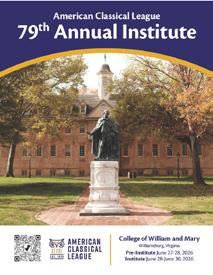
ACL — American Classical League
• ACL Institute 2026
• College of William and Mary, Williamsburg, VA
• June 28–30, 2026
• Bolchazy-Carducci Representatives: Bridget Dean, PhD, and Donald Sprague
NJCL — National Junior Classical League
• Indiana University, Bloomington, IN
• July 21–26, 2026
• Bolchazy-Carducci Representative: Donald Sprague
Celebrating the Second Decade!
Join us for our fifteenth year of providing the classics community this complimentary professional development series of webinars.
Webinars
We have, however, made an exception for the new APrelated webinars. If you have suggestions for webinars, please contact Don Sprague .
What Equipment Do I Need for B-C Webinars?
Webinars about the new AP Latin Recordings of the 2024–2025 webinars introducing the new AP Latin and B-C’s curriculum materials and the Fall 2025 Pliny webinars are available on our new AP Latin page This page also provides information about BolchazyCarducci’s AP titles. Follow us on social media!
The Spring 2026 webinar schedule is printed below!
Bolchazy-Carducci Publishers is pleased to provide complimentary webinars on a variety of subjects, especially pedagogical, of interest to classicists. Some webinars are geared to the Latin for the New Millennium program and to topics generated by the AP® Latin curriculum.
Please note: The Bolchazy-Carducci Publishers Webinar Program is intended to be a live interactive endeavor in which presenter and attendees ask questions, make comments, seek clarification, share examples, etc. Thus, by design and in order to protect the presenter’s intellectual property, B-C does not make recordings available to non-attendees. B-C encourages those interested in a given topic or presenter to plan to attend the live webinar.
To participate in Bolchazy-Carducci Publishers-sponsored webinars you will need high-speed internet access, computer speakers/headphones, a current web browser, and the link to the webinar virtual meeting space, which is provided in your webinar invitation.
Webinars Make for User-Friendly Professional Development
Participation is free. All webinars provide opportunity for participants to ask questions. Learn lots—attend as many presentations as you can. Bolchazy-Carducci Publishers provides documentation for your participation in this professional development opportunity. You can share this with your supervisors. Many webinar presenters provide handouts, etc.
SPRING 2026 WEBINAR SCHEDULE
Tuesday, March 3, 2026
“Latin for the New Millennium 3: A Bridge to Successful Author Readings” 5:00–5:45 pm Central Time
Bridget Dean, PhD, President, Bolchazy-Carducci Publishers
Designed for high school Latin teachers, this session offers practical, classroom-ready strategies for differentiation and for building strong readers of Latin—with a clear eye toward AP Latin and full reading courses. Using Latin for the New Millennium, Level 3 (LNM3) as a central example, Bridget Dean will show how a Level 3 program can support diverse learners while also serving as a proven bridge to advanced Latin study.
The talk will highlight LNM3’s range of Latin readings from multiple authors and periods, including Ovid, Cicero, Horace, and Vergil, its built-in opportunities for differentiation such as scaffolding, and its alignment with key elements of the new AP Latin requirements.
Bridget Dean, PhD, is President of Bolchazy-Carducci Publishers. She holds a PhD and MA in Classics from The Ohio State University and a BA in Classics from the University of WisconsinMadison. She has taught at The Ohio State University and Ohio Wesleyan University and has worked extensively with high school students as a tutor and as an instructor for the Johns Hopkins Center for Talented Youth. She previously served as Editor and Managing Editor at BolchazyCarducci and holds an editing certificate from the University of Chicago’s Graham School. Dean has overseen B-C’s development of Lumina and B-C’s novella series.
communication, curriculum design, and cross-cultural leadership. He earned a BA in Chinese Language and Culture at Heilongjiang University. Barron also holds an MA in TESOL and World Language Education from the University of Georgia and specializes in AI-enhanced instruction, bilingual communication, and highimpact client strategy.
Tuesday, April 21, 2026
“A Reassessment of Clodia”
5:00–5:45 pm Central Time
Douglas Boin, PhD, St. Louis University
Tuesday, March 24, 2026
“Imperial Purple and Imperial Gold: Latin’s Fascinating History during China’s Last Imperial Age”
5:00–5:45 pm Central Time
Alexander (王柏仑) Barron, Wesley International Academy, Atlanta, GA
The Qing dynasty, like all Chinese dynasties, rose out of the ashes of the previous empire, which in this case is the Ming, the last dynasty to be controlled by the ethnic majority. They viewed themselves as an empire tends to do, as the center of the world, or at least the world that mattered. However, the officials had long been aware of an ancient power called 罗 马 or Rome. When the servants of the Pontiff Maximus of this ancient city arrived in the capital, Beijing, they used the language they always had with them: Latin. Latin speakers would serve the Chinese emperor both in times of peace and war, giving him an important perspective on the world outside of the Sino-sphere. From the founding of the dynasty all the way to the text input methods of computers centuries later, China, and especially its government, have used Latin as a way to communicate with the wider world.
Alexander J. Barron is an educator and strategist with a background spanning international teaching, digital marketing, and business development. He is currently a Chinese teacher at Wesley International Academy. A former Scholar in Residence at Heilongjiang University in China, he brings global experience in
“As difficult as her life was to document, it was her courage in the face of extreme hostility—to give more citizens a voice, not just the same old few—that kept me going. She was overlooked and misunderstood by her contemporaries. History largely forgot her.” —Boin on Clodia of Rome (Amazon, Best Books of 2025). One of Rome’s most powerful women, Clodia has been maligned over two thousand years as a promiscuous, husband-murdering harlot―thanks to her starring role in one of Cicero’s most famous speeches in the Forum. But Cicero was lying, in defense of his own property and interests. Like so many women libeled or erased from history, Clodia had a life that was much more interesting, complex, and nuanced than the corrupted version passed down through generations. In this webinar, Boin shares key insights from his celebrated new appraisal. “Freed from the caricature that Cicero painted of her, Clodia serves as a reminder of countless women whose stories have been erased from the historical record. In a Rome whose citizens were engaged in heated debates on imperialism, immigration, and enfranchisement, amidst rising anxieties about women’s role in society, Clodia was an icon―one worth remembering today.”
Author, translator, and essayist, Douglas Boin is a professor of history at Saint Louis University. An internationally recognized authority on the history of the Mediterranean world, he is the author, most recently, of Clodia of Rome (Amazon, Best Books of 2025). His Alaric the Goth: An Outsider’s History of the Fall of Rome, translated into multiple languages, was named a “Best Book of 2020” by The Economist His research is concerned with recovering history’s silences, correcting its distortions, and addressing its omissions. He teaches courses about how to find evidence to document overlooked experiences, how to use story-driven research to present encounters with difference, and about unusual or misunderstood aspects of culture and society in Ancient Rome, like the rise of Christianity and the history of the Goths. Italy, the subject of his articles and books (Late Antiquity: A Social and Cultural History, 2017, Coming Out Christian in the Roman

World, 2015, and Ostia in Late Antiquity, 2013), continues to be the site of his ongoing work, where he directs the Spello Project, an archaeological investigation to document missing chapters in the history of the Umbrian town. His essays and media appearances at Time, The New York Times, The Washington Post and NPR reflect on why the ancient world’s peoples, languages, politics, religions, and beliefs still matter. For more on Boin, SLU history professor reimagines ancient Rome – The University News
Teaching Tips & Resources
Res Romanae
• Love note etched into wall in Pompeii!
• High-tech tools reveal Pompeiian wall inscriptions
• Pompeii’s baths were gross until Romans built an aqueduct.
• From ancient Rome to today, war-makers talk constantly of peace.
• New neighborhood of ancient Rome discovered in city’s outskirts.
• Fabulous find! Archaeologists find Vitruvius’s basilica!
• Ritual of Rome’s temples reimagined in 3D on this video.
• Slideshow of several significant Roman villas
• Archaeologists detect the largest Roman villa in Wales to date.
• Riverbank in England reveals a Roman whetstone factory
• Did patriarchy cause the downfall of the Roman Republic?
• Roman-looking Jesus as the “ Good Shepherd ” found in Turkey.
• How Latin reshaped Europe forever.
• Stretch of the Via Flaminia uncovered.
• Recording of sung Camilla selections from the Aeneid.
Res Hellenicae
• A look at Jews in Greece during the imperial period.
• Greek temple with treasures discovered.
• Byzantine coins in China and Japan
• 4,000-year-old Greek circular labyrinth birthed legend of the Minotaur?
• Scientists find oldest wooden tools to date in Greece.
• Afghanistan crossroads where Hellenism blended with Buddhist influence
• Greece unveils Hellenic heritage platform to transform cultural tourism.
• Particle accelerator reveals Ancient Greek star catalog found covered by medieval manuscript.
Res Aliae Antiquae
• Video traces Phoenician city states’ development of a Mediterranean trade empire.
• South African San rock reveals trance dances and initiation ceremonies.
• Scientists study the environment as cause of the downfall of ancient Harappa in the Indus Valley.
• 4,000-year-old tablet contains predictions including “A king will die.”
• Satellite uncovers rivers of the Bible that point to the Garden of Eden.
Res Post-Antiquae
• Medieval burial includes high-status individuals alongside a fully-harnessed horse
eLitterae Subscribers Special 40% Discount
Black History Month Special
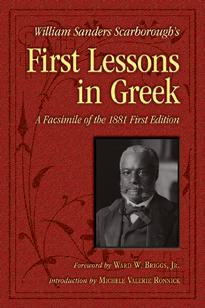
William Sanders Scarborough’s First Lessons in Greek
Scarborough’s First Lessons in Greek is a milestone in the tradition of African American contributions to classics! Every classics classroom should have a copy.
Paperback $24.00
Special Price $14.40
Enter coupon code eLit0226 on the payment page. The special offer pricing will be charged at checkout.
This offer is valid for up to five (5) copies per title, prepaid, no returns.
Discount is not available to distributors.
This offer expires March 21, 2026
(Please note that there will be no adjustments on previous purchases. Offer is nontransferable and subject to change without notice.)
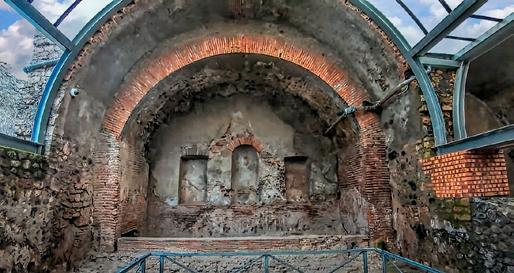
Caldarium of the men’s quarters in the first-century BCE Stabian Baths of Pompeii. Photo by Mary Harrsch. License: CC BY-SA 4.0