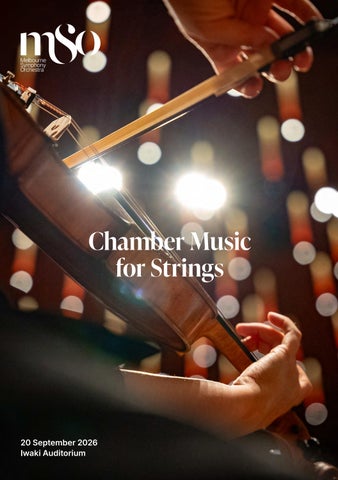
Chamber Music for Strings
20 September 2026 Iwaki Auditorium
MSO CHAMBER SERIES
Chamber Music for Strings Sunday 20 September at 11:00am
Iwaki Auditorium, ABC Southbank Centre
Artists Matthew Tomkins violin Freya Franzen violin Jenny Khafagi viola and curator Fiona Sargeant viola Rachael Tobin cello
Program David Lang Wed for string quartet (1995) [5'] Caroline Shaw Plan & Elevation: The Grounds of Dumbarton Oaks [16’] interval
COVER PHOTO: SAMANTHA MEULEMAN
Brahms String Quintet No. 2 [31’]
Running time: 1 hour and 20 minutes, including a 20-minute interval. Timings listed are approximate.
MSO 2026 Season
3
Matthew Tomkins violin Matthew Tomkins has been a member of the Melbourne Symphony Orchestra since 2000, and in 2010 he was appointed Principal Second Violin. He was born in Canberra but grew up in Creswick, just outside of Ballarat, and began learning the violin at the age of five. His teachers included Marco van Pagee, Spiros Rantos and Mark Mogilevski, and he also holds Engineering and Science degrees from the University of Melbourne. With the MSO he has toured throughout Europe and China and performed with artists as diverse as Nigel Kennedy, Charles Dutoit, KISS and Tim Minchin. He has also been a regular performer in the MSO Chamber Players series. Matthew is well-known to Australian audiences as a member of the Flinders Quartet and is also a core player with the Melbourne Chamber Orchestra. He has tutored regularly for the Australian Youth Orchestra, and teaches chamber music and violin at the University of Melbourne. Position supported by The Gross Foundation.
4
Chamber Series
PHOTOS: LAURA MANARITI
Freya Franzen violin
Jenny Khafagi viola and curator
Freya Franzen began studying violin with Gillian Bailey-Graham in Canberra, later continuing as a pre-tertiary student at the Canberra School of Music and receiving the ACT Board of Secondary Studies Recognition of Excellence Award for Performing Arts (Music). Studying with Goetz Richter and Christopher Kimber, she completed a Music (Performance) degree at the Sydney Conservatorium of Music, graduating with First Class Honours in 2008.
Jenny Khafagi is a Melbourne-based violinist and violist with a passion for chamber music. She was a member of acclaimed contemporary group Syzygy Ensemble for ten years, and has also worked extensively with the Australian Chamber Orchestra’s Inspire Quartet. In Melbourne, she has performed with Inventi Ensemble, Melbourne Chamber Players and the Melbourne Ensemble, as well as the MSO Chamber Players. This year, she joined the Australian String Quartet as guest second violin for their national tour Interwoven.
In 2011, Freya was a Sydney Symphony Orchestra Fellow, a pre-professional performance and mentoring opportunity that further nurtured the keen interest in orchestral repertoire she’d developed through the Canberra Youth Orchestra and AYO National Music Camps. The following year she completed a master’s degree at the Guildhall School of Music and Drama, studying with Stephanie Gonley, and participated in masterclasses with Ulf Hoelscher at the Salzburg Festival. Freya subsequently held a position in the SSO Second Violin section, appeared as a soloist in Malcolm Arnold’s Concerto for two violins in Sydney’s City Recital Hall, and toured internationally with the orchestra. In 2014 she joined the MSO’s Second Violin section. She also plays chamber music and is a founding member of the Melbourne Ensemble. MSO 2026 Season
A frequent guest artist at many of the major Australian music festivals, she has performed with Ensemble Offspring in Sydney and twice held residencies at the Banff Centre in Canada. As an orchestral musician, Jenny has appeared as guest concertmaster with the Queensland Symphony Orchestra, Orchestra Victoria and Auckland Philharmonia, and toured nationally and internationally on viola with the Australian Chamber Orchestra. She appears regularly as Principal Viola with the Melbourne Symphony Orchestra, as Principal Second Violin with the Melbourne Chamber Orchestra, and in 2023 joined the viola section of the MSO. Position supported by Margaret Billson and the late Ted Billson
5
PHOTOS: LAURA MANARITI
Fiona Sargeant viola
Rachael Tobin cello
Fiona Sargeant’s career has been shaped by guidance from renowned mentors such as Hermann Voss, Ulrich Koch, Wolfram Christ and Gérard Caussé. While in Germany, she gained recognition as a finalist in the Maurice Vieux International Viola Competition.
Rachael Tobin is the MSO’s Associate Principal Cello. She studied at the Royal Academy of Music in London, and completed a master’s degree at Mannes College of Music, New York. During this period she performed as a soloist at the Park Lane Group’s New Year Series (London) and played concertos with the London Soloists Chamber Orchestra and the Mannes Symphony Orchestra.
She has held key roles, including Principal Viola with the Orchestre de Chambre de Lausanne, the Det Jyske Ensemble in Denmark, and Associate Principal Viola with the Melbourne Symphony Orchestra. She was also a founding member of the Australian World Orchestra’s viola section, performing with conductors such as Zubin Mehta, Simone Young, Simon Rattle and Alex Briger. Fiona has collaborated with celebrated artists such as pianist Yefim Bronfman and violinist James Ehnes, and performed at prestigious festivals such as the Port Fairy Spring Music Festival, Schwetzingen Festival in Germany and the Casals Festival in Puerto Rico.
She has received the Macklin Bursary, the ABRSM international undergraduate scholarship, the Elder Scholarship and a Centenary Medal for service to the arts, and in 2009 she was a Sydney Symphony Orchestra Fellow. She was a member of the Estonian National Opera Orchestra and has worked with Philharmonia (UK), the Opera Australia Orchestra, and the Sydney and Tasmanian symphony orchestras. Rachael is also a member of the Melbourne Ensemble – a group of MSO colleagues who regularly perform chamber music together.
Her solo repertoire includes works by Bartók, Hoffmeister, Schubert and Bruch, and she has performed with orchestras such as the Orchestre de Chambre de Lausanne and Baden-Baden Philharmonic Orchestra. In the past two years, she has focused on solo viola performances, presenting highly praised recitals at Tempo Rubato in Brunswick.
6
Chamber Series
PHOTO: SAMANTHA MEULEMAN
Chamber Music for Strings When the themes for this year’s concerts were revealed – Brahms and the Americans – I saw an opportunity to program works I’d never presented before, by composers whose music I admired. I discovered David Lang’s music in 2012, when I performed his trance-like Sweet Air with Syzygy Ensemble here in Melbourne. I was then lucky enough to meet him at a new music concert in New York City and to talk with him about his writing. My first encounter with Caroline Shaw’s music was performing her Entr’acte on my first national tour with the Australian Chamber Orchestra in 2023. Her unique sound
MSO 2026 Season
world and gorgeous use of colour had me captivated from the beginning. I first performed Brahms’s String Quintet No. 1 in an art gallery shortly after moving to Melbourne 16 years ago, and I’m delighted to now add his second quintet to my repertoire. This program is also a wonderful chance to bring together a group of friends from the MSO who have never played together in this configuration before – making this, in many ways, a concert of firsts. Jenny Khafagi Curator
7
Where refined luxury meets symphony of culture
A Hotel for the Arts and a proud supporting partner of the Melbourne Symphony Orchestra ACCOMMODATION • RESTAURANT • BAR • EVENTS
8
Chamber Series Book your stay at sofitel-melbourne.com.au
PHOTO: PETER SERLING
union between Lang’s friend conceptual artist Kate Ericson, who was dying of brain cancer, and her partner and collaborator Mel Ziegler. Conceived as four independent lines, the piano original lent itself to transformation for string quartet. Each line is not in itself that interesting, Lang writes, the melodies built largely from small changes – ‘a half step up, a whole step down’. But when superimposed, they oscillate between major and minor, ‘between restfulness and sudden dissonance’, creating a ‘strange equilibrium’ between hope and despair. The effect is subdued and, as directed by the composer, ‘devoid of almost all expression’. Despite this instruction, however, the music is deeply emotional – adding to the inherent tensions and contradictions of the piece.
David Lang (born 1957)
Wed
version for string quartet (1995) At the beginning of Act IV of The Tempest, Prospero conjures up an entertainment – ‘this insubstantial pageant’ – to bless the union of Miranda and Ferdinand. Shakespeare’s cue: ‘soft music.’ For the American Conservatory Theater’s 1996 production, Prospero’s magic was evoked by shadow puppeteer Larry Reed and composer David Lang, with the music performed by the Kronos Quartet. The wedding ‘revels’ – if three people and ethereal spirits can be called a party – were accompanied by floating harmonies and ambiguous rhythms. Not merely ‘soft’ but trance-inducing. You could lose yourself in this music.
Lang creates a fragile sound by keeping all four instruments high in their range – you could play the entire cello part on a soprano recorder. Which makes it all the more striking when, from time to time, the first violin sounds an isolated low note at the bottom of the texture. (In the original version these gestures see the pianist’s right hand cross over the left to play single, bell-like tones.) David Lang is often compared with Philip Glass, but as pianist Feico Deutekom points out, where Glass’s repetition evokes a sense of architecture, Lang’s becomes a ‘metaphor for shortfall’ – a struggle to find adequate expression that sees the performer starting over and over again. Unlike in Shakespeare, this scene doesn’t dissolve and fade but simply ends, unsettled, with an open fifth between first violin and viola – neither major nor minor. Yvonne Frindle © 2026
Wed didn’t begin life in the theatre but as a solo piano work, part of Memory Pieces (1992–1997). And behind this bittersweet music was another wedding, the deathbed MSO 2026 Season
9
ground bass line which supports a different musical concept or character.
Plan & Elevation: The Grounds of Dumbarton Oaks
The Ellipse considers the notion of infinite repetition (I won’t deny a tiny Kierkegaard influence here). One can walk around and around the stone path, beneath the trimmed hornbeams, as I often did as a way to clear my mind while writing.
(born 1982)
I. The Ellipse II. The Cutting Garden III. The Herbaceous Border IV. The Orangery V. The Beech Tree I have always loved drawing architecture when travelling, and some of my favourite lessons in musical composition have occurred by chance in my drawing practice over the years. While writing this string quartet to commemorate the 75th anniversary of Dumbarton Oaks, I returned to these essential ideas of space and proportion – to the challenges of trying to represent them on paper. The title, Plan & Elevation, refers to two standard ways of representing architecture – a horizontal or ‘bird’s eye’ view of the internal layout (plan), and a vertical view of the façade as seen from one side, showing ornamental detail (elevation). This binary is also a gentle metaphor for one’s path in any endeavour – often the actual journey and results are quite different (and perhaps more elevated) than the original plan. I was fortunate to have been the inaugural Dumbarton Oaks Music Fellow in 2014–15. Plan & Elevation examines different parts of the estate’s beautiful grounds and my personal experience in those spaces. Each movement is based on a simple
The Cutting Garden is a fun fragmentation of various string quartets (primarily Ravel, Mozart K. 387, and my own works Entr’acte, Valencia and Punctum), and makes reference to the variety of flowers grown there before they meet their inevitable end as cuttings for display. The Herbaceous Border is spare and strict at first – like the cold geometry of French formal gardens with their clear orthogonals (when viewed from the highest point) – before building to the opposite of order: chaos. The Orangery, evokes the slim, fractured shadows in that room as the light tries to peek through the leaves of the aging fig vine. We end with my favourite spot in the garden, The Beech Tree. It is strong, simple, ancient, elegant and quiet; it needs no introduction. Adapted from a note by Caroline Shaw © 2016 Plan & Elevation was premiered by the Dover Quartet in the Music Room at Dumbarton Oaks on 1 November 2015.
IMAGE: HISTORIC BUILDINGS SURVEY, NATIONAL PARK SERVICE, IRWIN J GUECO (1999)
Caroline Shaw
PHOTO: KAIT MORENO
Johannes Brahms (1833–1897)
String Quintet in G major, Op. 111 for two violins, two violas and cello
Allegro non troppo, ma con brio Adagio Un poco allegretto – Trio – Un poco allegretto Vivace ma non troppo presto
CAROLINE SHAW moves among roles, genres and mediums, trying to imagine a world of sound that has never been heard before but has always existed. She often works in collaboration with others, as producer, composer, violinist and vocalist. She is the recipient of the Pulitzer Prize in Music (Partita for 8 Voices), an honorary doctorate from Yale, five Grammy awards, a Tony nomination and a Thomas J. Watson Fellowship. Shaw has written and produced for artists and ensembles across the musical spectrum, including Rosalía, Renée Fleming, Yo-Yo Ma, Tiler Peck, Nas, Kanye West, the Los Angeles Philharmonic and the New York Philharmonic. Recent projects include Death of a Salesman on Broadway (nominated for a Tony for Best Original Score), Hedda Gabler at the Old Globe, Leonardo Da Vinci (Ken Burns/PBS), Fleishman is in Trouble (FX/Hulu), Rosalía albums Lux and Motomani, Pastoral (Pam Tanowitz), The Crucible (National Theatre), Partita (Justin Peck/New York City Ballet), Moby Dick (Wu Tsang) and LIFE (Gandini Juggling/Merce Cunningham Trust). Her touring projects include shows with Sō Percussion, Ringdown, Attacca Quartet, Roomful of Teeth, Graveyards and Gardens, Gabriel Kahane, Andrew Yee and Kamus Quartet. Her favourite colour is yellow, and her favourite smell is rosemary. MSO 2026 Season
Brahms began his second string quintet in Vienna early in 1890 and completed it midyear at Bad Ischl, the spa in Salzkammergut on the Traun river where, later in life, he habitually spent his summer vacations. Its predecessor (in F major, Op. 88, of 1882) was already a popular concert work, thanks to the advocacy of Brahms’s regular collaborator, the violinist Joseph Joachim. And it was Joachim’s request for a companion piece that set Brahms to composing this second (and final) quintet. Not Joachim, but Arnold Rosé and his Quartet (with an extra viola player) introduced the new work at Vienna’s Bösendorfersaal on 11 November 1890. A decade later, Rosé and his colleagues also gave the premiere of Schoenberg’s sextet Transfigured Night, coincidentally prompting comparisons between these two late romantic string works. Like Transfigured Night, the Adagio of Brahms’s quintet is often performed by string orchestras, and from the first Joachim also thought the quintet’s opening ‘too orchestral’ for just five strings. Elisabeth von Herzogenberg, one of few friends from whom the notoriously prickly Brahms invited (though did not always accept) criticism, warily categorised the work as characteristic of his economical late style, ‘all wonderfully clear and compact; distinct in its manner of expression’.
11
7 – 21 November Hamer Hall, Arts Centre Melbourne Melbourne Recital Centre
Brahms Festival Two weeks dedicated to the life journey of a remarkable musician – at once a vulnerable human being and a masterful composer, always wearing his heart on his manuscript-smudging sleeve. Hear all four symphonies and the two piano concertos when the MSO and Chief Conductor Jaime Martín are joined by pianist Denis Kozhukhin. Ein deutsches Requiem with bass-baritone Sir Bryn Terfel and the MSO Chorus provides a gala conclusion.
Book Now mso.com.au
12
Symphony No. 1 Piano Concerto No. 1
7 November
Chamber Music by Brahms with Natalie Chee (violin), Nicolas Fleury (horn) and Denis Kozhukhin (piano)
10 November
Symphony No. 2 Piano Concerto No. 2
12 November
Symphony No. 3 Symphony No. 4
14 November
Spring Gala: A German Requiem
19 & 21 November Chamber Series
The late Brahms’s economical approach to his material is striking, with even secondary features expected to bear a structural load, like the opening tremolos for the upper strings accompanying the cello’s main theme. Always conjuring up positive images (nothing dark or spectral here), tremolos reappear throughout the first movement, either in their original vibrantly energetic guise, or transformed as a soft, shimmering background for moments of summery lyricism. Brahms interleaves these colouristic moments with regular episodes of muscular contrapuntal writing, in which themes, or fragments of them, are worked-over with the Classical thoroughness of Haydn or early Beethoven. Sometimes one melodic element comes to the fore as the basis for sequential repetition (the same notes repeated at different pitches) in a fashion almost reminiscent of Bach. When Joachim played the piece in Berlin a month after the Vienna premiere, he was surprised that the Adagio, his favourite movement, seemed to give the audience least pleasure. On the other hand, the Allegretto – a lighter piece, alternating minor and major keys, and ‘rustic’ (Hungarian) and ‘urban’ (Viennese) allusions – was applauded so enthusiastically that he was forced to play it again before going on, much against his principles. Elisabeth von Herzogenberg sensed the interdependence of these two pieces, ‘conceived in the spirit of contrast,
MSO 2026 Season
but here in a case of mutual reflection and enhancement’. The Allegretto might be ‘a relief after the grim seriousness of the preceding piece’, but, as she observed, somewhat tongue-in-cheek, ‘does not contain more liveliness than is warranted artistically’. Not having heard the work yet, Herzogenberg admitted it was difficult to imagine the full effect of the finale; hardly surprising, since its 287 detail-packed bars flash past in just five minutes. Risking singling out one feature, however, she noted ‘The second theme is delicious’! Graeme Skinner © 2009
13
Thank You to Our Partners Principal Partner
Major Government Partners
Major Partners
Supporting Government Partners
Supporting Partners
Paul Noonan, Keypoint Law
14
Chamber Series
Training and Education Partners
Trusts and Foundations
Freemasons Foundation Victoria
The Ledger Charitable Trust
Perpetual Foundation – Alan (AGL) Shaw Endowment
Sidney Myer MSO Trust Fund
Broadcast and Production Partners
Venue Partners
MSO 2026 Season
15