February–March 2026
Strauss & Mozart
Season Opening Gala
Also sprach Zarathustra
Stravinsky & Chindamo
Quick Fix at Half Six: The Rite of Spring
February–March 2026
Strauss & Mozart
Season Opening Gala
Also sprach Zarathustra
Stravinsky & Chindamo
Quick Fix at Half Six: The Rite of Spring
The MSO has developed a musical Acknowledgement of Country with composer James Henry to pay our respects to the traditional owners of the land through the language of orchestral music.
James Henry’s position is supported by Cybec Foundation
‘I wrote this piece to reflect the complex journey toward the recognition of Aboriginal people as the traditional custodians of the land. It opens with rhythms inspired by the character of traditional songs found across many parts of Australia. From this texture, a melody emerges, representing the long period during which Aboriginal ownership of land was disregarded. The piece traces both progress and setbacks over time.
‘With the passing of the Victorian Statewide Treaty Bill, there is a renewed sense of optimism among many Aboriginal Victorians. Through Acknowledgement, I seek to convey a feeling of determination and resilience, reflecting the ongoing work to improve the quality of life for Aboriginal people, and to deepen respect for and awareness of our distinct culture, history and enduring connection to Country.’
James Henry 2025–2026 Cybec First Nations Composer in Residence
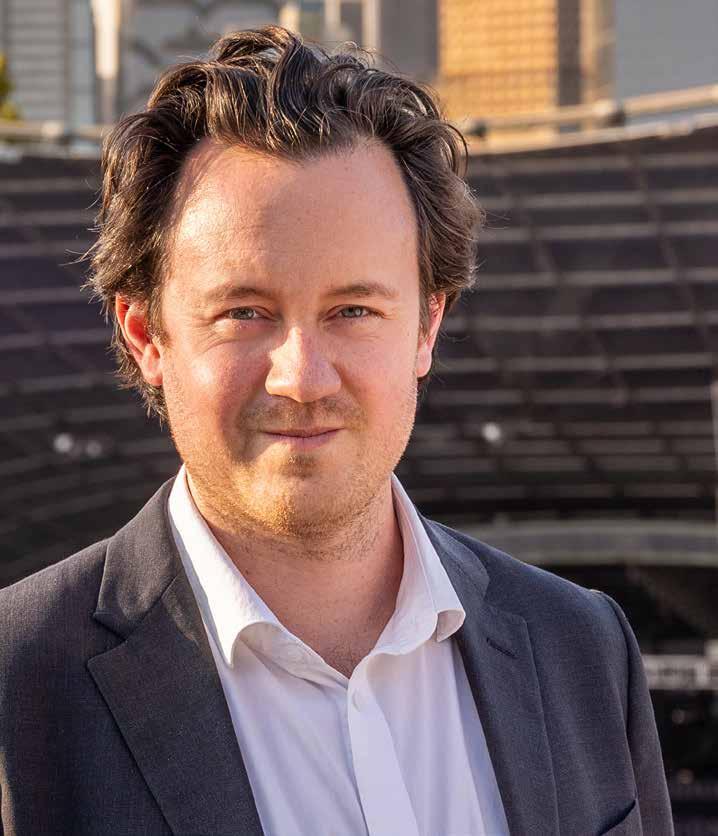
On behalf of the Melbourne Symphony Orchestra, it is my great pleasure to welcome you to this month’s performances.
The beginning of a new season is always an exciting moment for the Orchestra – a time that reflects both our artistic ambition and our commitment to the community we serve. This year is particularly significant as we celebrate the MSO’s 120th anniversary. For more than a century, the Orchestra has been part of the cultural life of Melbourne, bringing people together through shared musical experiences. That legacy is something we’re deeply proud of and equally committed to carrying forward for future generations.
We’re delighted to begin the year with our Chief Conductor Jaime Martín, whose energy and musical leadership continue to shape the sound and spirit of the Orchestra today. Earlier this year we also welcomed Natalie Chee as our new Concertmaster – a role central to the artistic life of any orchestra – and we’re
thrilled to have a musician of her calibre joining the MSO at this exciting moment in our history.
A defining strength of the MSO is the combination of our own outstanding musicians with artists from Australia and around the world. This month we welcome internationally acclaimed performers, including pianist Jean-Yves Thibaudet, while also celebrating Australian voices such as Joe Chindamo oam.
An important part of our vision is ensuring that orchestral music remains accessible and meaningful to as many people as possible. Whether through major performances in the concert hall, concerts in neighbourhood venues, or more flexible formats such as Quick Fix at Half Six, we’re committed to creating opportunities for audiences to engage with music in ways that suit their lives.
We’ve already seen this commitment reflected in what has been an incredible start to 2026, with concerts such as Signature Choir x MSO and MSO x Find Your Voice Collective: SONDER generating an extraordinary response from our community. These projects remind us that music has a unique power to bring people together – creating moments of connection and belonging that extend well beyond the concert hall, and often for something greater than ourselves.
Whether you’re joining us for the first time or returning as a long-standing supporter, thank you for being part of the MSO community. I hope you enjoy our performances.
Edgar Myer MSO Chair
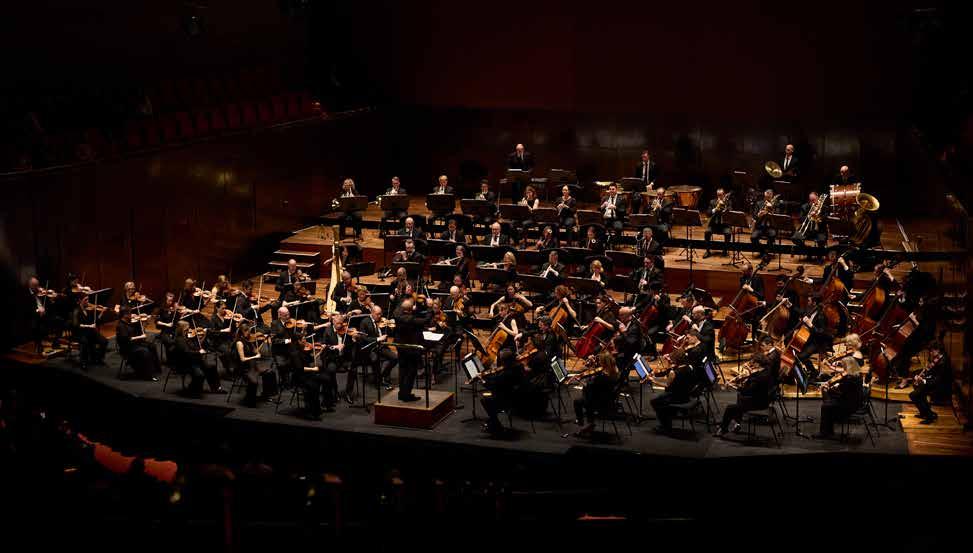
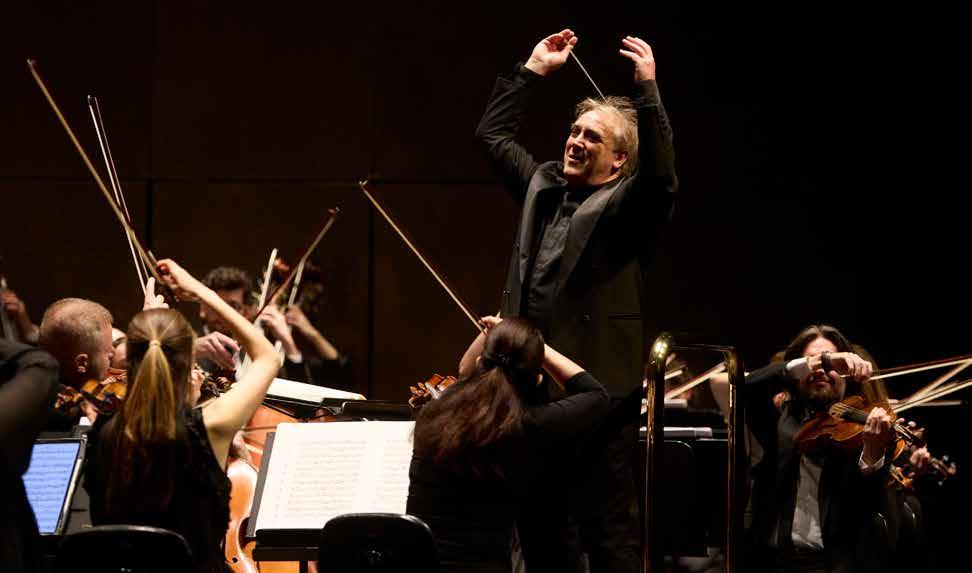
The Melbourne Symphony Orchestra is Australia’s preeminent orchestra, dedicated to creating meaningful experiences that transcend borders and connect communities. Through the shared language of music, the MSO delivers performances of the highest standard, enriching lives and inspiring audiences across the globe.
Woven into the cultural fabric of Victoria for 120 years, the MSO reaches five million people annually through performances, TV, radio, and online broadcasts, as well as critically acclaimed recordings from its newly established recording label.
In 2026, Jaime Martín continues to lead the Orchestra as the MSO Chief Conductor and Artistic Advisor. Maestro Martín leads an Artistic Family that includes Principal Guest Conductor Benjamin Northey, Cybec Assistant Conductor Daniel Corvaia, MSO Chorus Director Warren Trevelyan-Jones, Composer in Residence Joe Chindamo, Cybec Young Composer in Residence Andrew Aronowicz, Cybec First Nations Composer in Residence James Henry, Artist in Residence – Learning & Engagement
Karen Kyriakou, Young Artist in Association Christian Li, and Artistic Ambassadors Tan Dun, Lu Siqing and Xian Zhang.
Learn more about our musicians on the MSO website.
First Violins
Natalie Chee Concertmaster
Tair Khisambeev
Assistant Concertmaster
Peter Edwards
Assistant Principal
Sarah Curro
Dr Harry Imber *
Peter Fellin
Deborah Goodall
Karla Hanna
Dawna Wright and Peter Riedel*
Lorraine Hook
Jolene S Coultas*
Anne-Marie Johnson
David Horowicz*
Kirstin Kenny
Mark Mogilevski
Michelle Ruffolo
Anna Skálová
Kathryn Taylor
Second Violins
Matthew Tomkins
Principal
The Gross Foundation*
Jos Jonker
Associate Principal
Monica Curro
Assistant Principal
Dr Mary-Jane Gething AO*
Mary Allison
Emily Beauchamp
Isin Cakmakçioglu
Tiffany Cheng
Val Dyke*
Freya Franzen
Cong Gu
Andrew Hall
Robert Macindoe
Philippa West
Andrew Dudgeon AM*
Patrick Wong
Cecilie Hall*
Roger Young
For a list of the musicians performing in each concert, please visit mso.com.au/musicians
Shane Buggle and Rosie Callanan*
Violas
Christopher Moore
Principal
Lauren Brigden
Katharine Brockman
Anthony Chataway
Peter T Kempen AM*
William Clark Morris and Helen Margolis*
Aidan Filshie
Suzie and Edgar Myer*
Gabrielle Halloran
Patricia Nilsson
Jenny Khafagi
Margaret Billson and the late Ted Billson*
Fiona Sargeant Cellos
David Berlin
Principal
Rachael Tobin
Associate Principal
Elina Faskhi
Assistant Principal
Rohan de Korte
Andrew Dudgeon AM*
Rebecca Proietto
Peter T Kempen AM*
Angela Sargeant
Caleb Wong
Michelle Wood
Andrew and Theresa Dyer* Double Basses
Jonathon Coco Principal
Rohan Dasika
Acting Associate Principal
Benjamin Hanlon
Acting Assistant Principal
Stephen Newton
Aurora Henrich
Suzanne Lee
* Position supported by
Flutes
Prudence Davis
Principal
Jean Hadges*
Wendy Clarke Associate Principal
Sarah Beggs Piccolo
Andrew Macleod Principal Oboes
Johannes Grosso Principal
Ann Blackburn
Margaret Billson and the late Ted Billson* Cor Anglais
Michael Pisani Principal
Clarinets
David Thomas Principal
Philip Arkinstall Associate Principal
Bass Clarinet
Jonathan Craven Principal
Bassoons
Jack Schiller
Principal
Dr Harry Imber * Elise Millman Associate Principal
Natasha Thomas Patricia Nilsson* Contrabassoon
Brock Imison Principal
Horns
Nicolas Fleury
Principal
Margaret Jackson AC*
Saul Lewis
Principal Third
The late Hon. Michael Watt KC and Cecilie Hall*
Abbey Edlin
The Hanlon Foundation*
Josiah Kop
Kim and Robert Gearon*
Rachel Shaw
Gary McPherson*
Trumpets
Owen Morris Principal
Shane Hooton
Associate Principal
Glenn Sedgwick*
Rosie Turner
Dr John and Diana Frew* Trombones
José Milton Vieira
Principal
Richard Shirley
Bass Trombone
Michael Szabo Principal Tuba
Timothy Buzbee Principal
Timpani
Matthew Thomas Principal Percussion
Shaun Trubiano Principal
John Arcaro
Tim and Lyn Edward*
Robert Cossom
Dr Clem Gruen and Dr Rhyl Wade* Harp
Yinuo Mu Principal
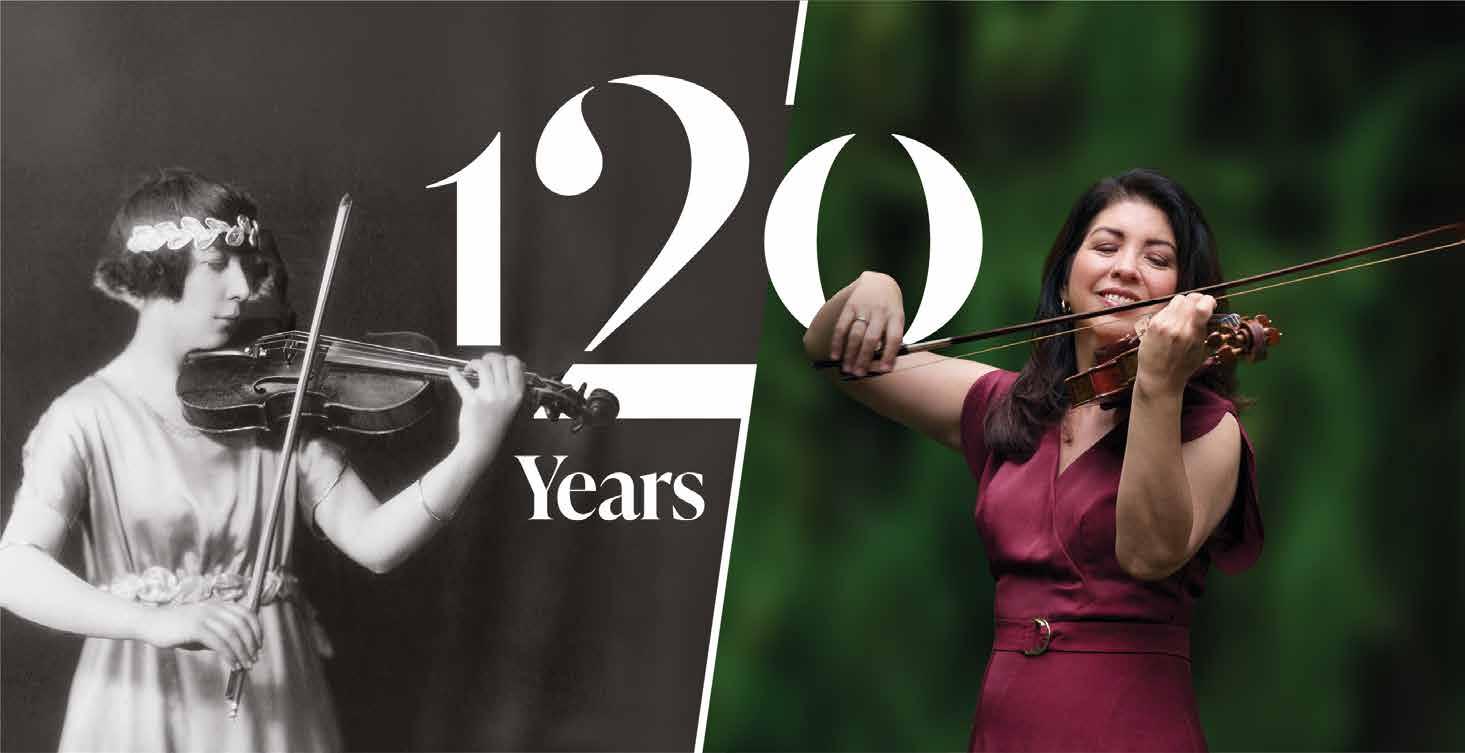
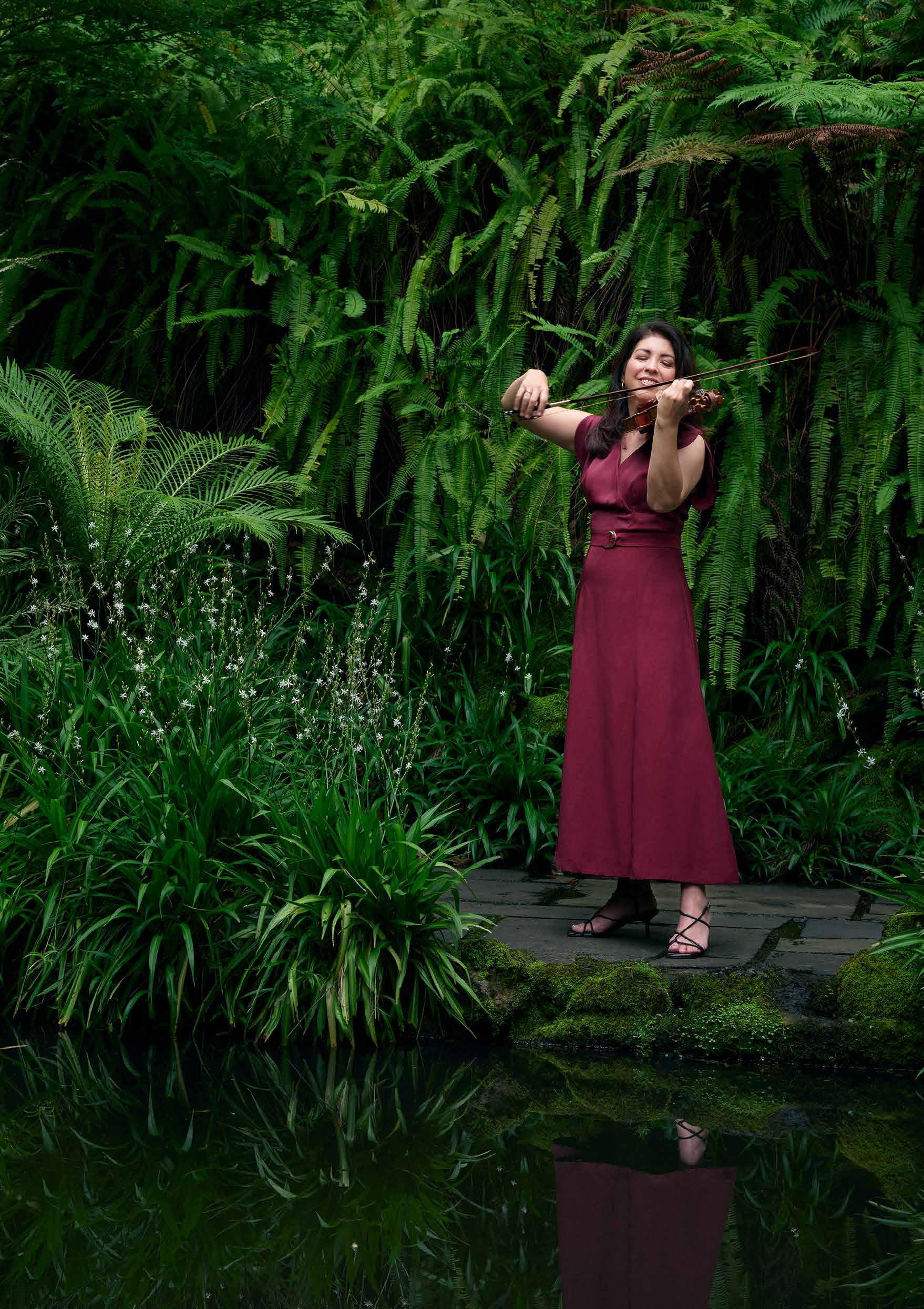
When MSO Concertmaster Natalie Chee leads the orchestra in Strauss & Mozart, she’ll hold a position that one remarkable woman claimed more than a century ago.
With International Women’s Day on Sunday 8 March, we’re taking a moment to celebrate the story of Bertha Jorgensen, who joined the MSO as a musician in 1920 and went on to become the first female concertmaster of a professional orchestra – a trailblazing world first.
The MSO proudly celebrates its 120th anniversary this year. Trace a line through its history and you’ll find these two exceptional women standing at pivotal moments. The MSO had been established for 14 years when Bertha, a prodigious 16-year-old violinist, accepted Alberto Zelman’s invitation to join his ensemble as first violin, later rising to the position of Concertmaster and making history. In 2026, Natalie stands on the shoulders of Bertha’s impressive legacy, carrying it forward for a new generation.
To understand the magnitude of what Bertha achieved, it’s useful to understand her world. Non-Indigenous women in Australia had only recently won the right to vote in federal elections. Most professions remained closed to women and they were not allowed in certain public spaces. The idea of a woman leading an orchestra was almost unthinkable. Yet the MSO, in its infancy, appointed a woman to its most prominent chair.
It was not all smooth sailing. She faced conductors who were openly prejudiced against her gender and slight stature. An article published in 1948 noted that she won them over through ‘professionalism and musical reliability’, refusing to bow to the gender norms of the day. When she broke her wrist ice skating, threatening to end her career, she returned to the violin ‘only through sheer determination.’ She was steadfast, resilient and strong.
Bertha’s legacy
‘Bertha’s story is both fascinating and inspiring,’ says Natalie Chee, who joins the MSO this year as Concertmaster. ‘It’s astonishing that a woman in those times led an orchestra, let alone an orchestra in Australia! I can only imagine the difficulties she must have faced.’
What strikes Natalie most is what Bertha’s appointment says about this progressive city: ‘There are some orchestras in the world who have never had a female leader to this day, and many who have only very recently appointed women in leading roles on any instrument. Bertha’s story says a lot about the MSO and Melbourne in general.’
The MSO’s willingness to appoint Bertha established something special in the DNA of the organisation; a commitment to recognising excellence wherever it appears, and a willingness to lead rather than follow.
Leadership reimagined
When asked how the Concertmaster role has evolved for women, Natalie offers a nuanced perspective.
‘I think the role of concertmaster is very complex. Traditionally it was seen as an authoritarian role, much like the traditional role of a conductor. As society has evolved, so has the way leadership is seen in general.’
She points out that the changes aren’t just about gender, they’re about orchestras themselves evolving.
‘Methods of leadership which were absolutely normal in past generations are no longer feasible or acceptable. The way orchestras are led and run today are much different than they were even a few decades ago.’
It’s fascinating to read Bertha’s very own words from 1947:
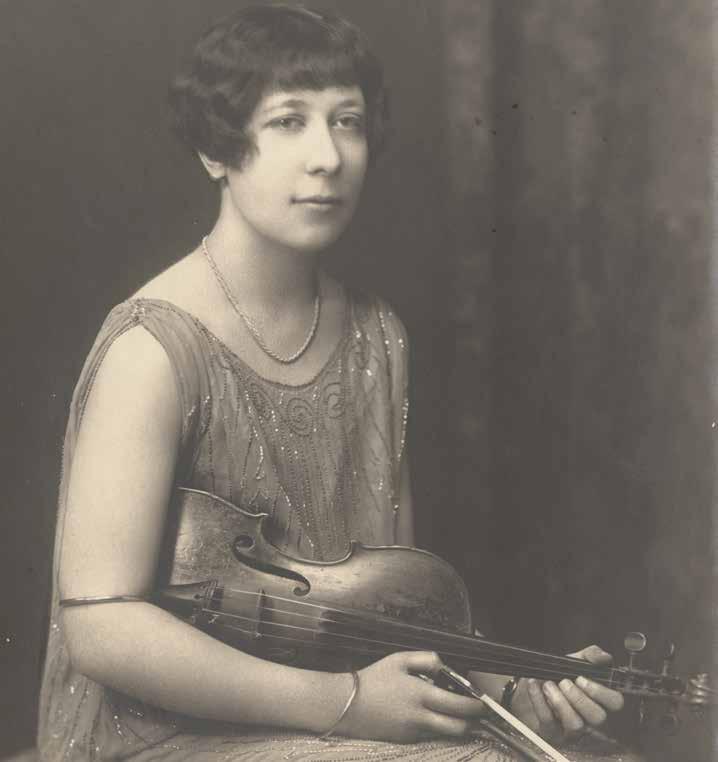
‘Every conductor has his own individual idea of how he thinks it should be played. As leader, I must try to understand how he wants the orchestra to play.’
It sounds presciently similar to Natalie’s own reflections on the skills of a concertmaster in 2026:
‘I see myself as part of a group ... trying to understand what the conductor wants and help facilitate that.’
Playing without boundaries
On 27 and 28 February, audiences will hear Natalie perform the soaring violin solo in Richard Strauss’s Bourgeois gentilhomme – ‘my favourite concertmaster solo piece,’ she says.
‘The music is so joyous and flamboyant. You can literally see the character of the tailor in your mind’s eye – dancing and prancing around. It’s a stunning piece of writing by Strauss and a joy to play.’
120 years, and many generations in between, have seen attitudes and perspectives shift. We have Bertha’s talent and determination to thank for setting the wheels of change in motion.
Nicole Lovelock © 2026
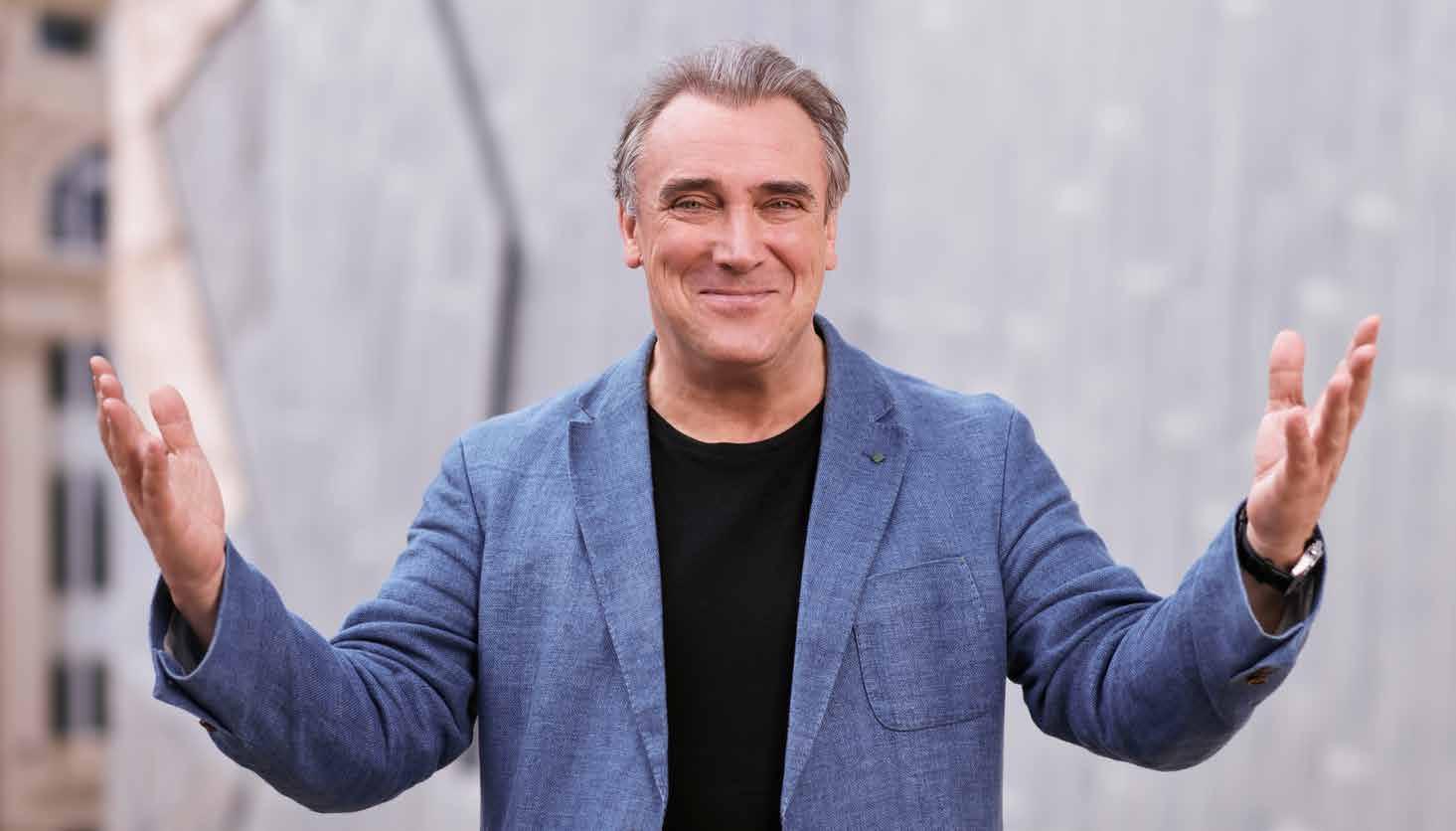
Jaime Martín conductor
MSO CHIEF CONDUCTOR AND ARTISTIC ADVISOR
In addition to his role with the Melbourne Symphony Orchestra, Spanish conductor Jaime Martín is Music Director of the Los Angeles Chamber Orchestra and last season he was named Principal Guest Conductor of the BBC National Orchestra of Wales. He was previously Chief Conductor of the National Symphony Orchestra of Ireland (2019–24), Principal Guest Conductor of the Spanish National Orchestra (2022–24) and Artistic Director and Principal Conductor of Gävle Symphony Orchestra (2013–22).
Having spent many years as a highly regarded flautist, working with the most inspiring conductors of our time, Jaime turned to conducting full time in 2013 and soon became sought after at the highest level. He now regularly conducts major orchestras in the UK, Europe, US and Australasia. Recent highlights include an acclaimed BBC Proms appearance with BBC NOW and an 11-day Beethoven Festival with the MSO, conducting all nine symphonies. In 2025 he also led the MSO
on a tour of the UK and Europe, the orchestra’s first full international tour since 2019, with performances at the Edinburgh International Festival and BBC Proms.
His extensive discography includes recordings with the Gävle Symphony Orchestra, Orquestra de Cadaqués, Barcelona Symphony Orchestra and London Philharmonic Orchestra, as well as releases on the MSO’s recently launched label: Debussy & Strauss, featuring soprano Siobhan Stagg; Gustav Holst: The Planets with Deborah Cheetham Fraillon’s Earth; and two albums of Dvořák symphonies.
Jaime Martín is Artistic Advisor and former Artistic Director of the Santander Festival and a Fellow of the Royal College of Music, London, where he was a flute professor.
Friday 27 February at 7:30pm Frankston Arts Centre
Saturday 28 February at 7:30pm
Elisabeth Murdoch Hall, Melbourne Recital Centre
Artists
Melbourne Symphony Orchestra
Jaime Martín conductor and flute
Natalie Chee violin
J.S. Bach Orchestral Suite No. 3 [20']
W.A. Mozart Flute Concerto No. 1 in G major [25’] interval
R. Strauss Le Bourgeois gentilhomme – Suite [26’]
Pre-concert talk: Learn more about the music with Gianni Posadas-Sen 6:45pm (27 Feb) in Frankston Arts Centre 6:45pm (28 Feb) in Elisabeth Murdoch Hall
Running time: 1 hour and 45 minutes, including a 20-minute interval. Timings listed are approximate.
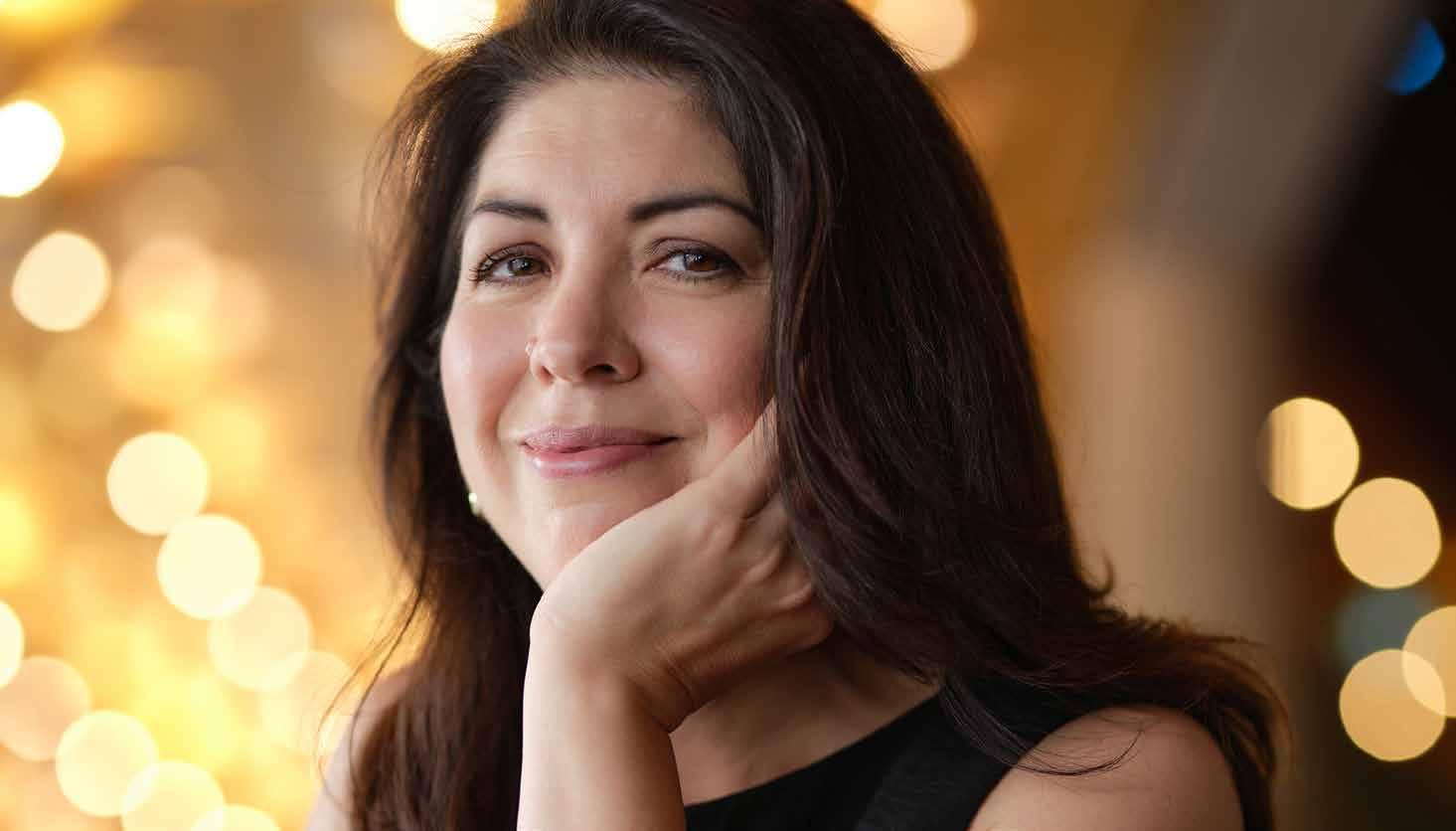
Natalie Chee learned piano then violin as a child and at the age of ten began studying with Alex Todicescu, a professor at the Sydney Conservatorium of Music and member of the Sydney String Quartet. As a student, she won numerous competitions and prizes, including the ABC Young Performer of the Year (1992), and she performed as a soloist with all the Australian symphony orchestras.
While still in high school, she was accepted into the Soloist Class of Igor Ozim in Bern, Switzerland, receiving her Soloist Diploma with High Distinction. During this time, she was invited to join Camerata Bern, which she also directed. She also co-founded the Tiramisu chamber music ensemble and Mozart Piano Quartet, touring North and South America, Europe and Australia with these groups and making several recordings with prominent Swiss and German labels.
Natalie has held the First Concertmaster roles with Camerata Salzburg (appointed 2000), the Stuttgart Radio (SWR)
Symphony Orchestra (2009), and the Gürzenich Orchestra (2019). She was named MSO Concertmaster in 2025 and takes up the role this year.
In addition, she is a regular guest concertmaster and director of orchestras worldwide, including the BBC Symphony Orchestra, Munich Philharmonic, Munich State Opera, Hamburg Radio Orchestra, Swedish Radio Orchestra, Royal Scottish National Orchestra, Toronto Symphony Orchestra, Mahler Chamber Orchestra and the Academy of St Martin in the Fields.
Natalie is also a highly regarded chamber musician, appearing in festivals and concerts throughout Australia and Europe. From 2009 to 2025 she was first violin of the Hegel String Quartet in Stuttgart, and their album From Vienna to Hollywood was named by the German Record Critics Award as one of the four best chamber music recordings in 2022.
The concert is ‘Strauss and Mozart’ but it begins with Bach, and these composers, representing three distinct periods in music, make a congenial grouping. Bach’s style may have fallen out of fashion by the time Mozart was composing his flute concerto at the height of the Classical era, but Mozart could see past that and the greatness of Bach’s music influenced his own works. He even imitated Bach’s use of ‘old’ dance forms, as in the minuetflavoured finale of his G major flute concerto.
Bach’s suites or ouvertures are the nearest he came to composing orchestral music in the modern sense, and the third suite, in
particular, played an important role in the 19th-century Bach revival. Mendelssohn, for example, performed this brilliant work in his concerts in Leipzig in the 1830s, and a 19th-century transcription of the ‘Air on the G string’ ensured it became one of Bach’s greatest hits.
Richard Strauss’s Bourgeois gentilhomme music is full of 20th-century colour and wit but it looks to the past: it’s organised as a suite based on the formal Baroque dance types and it finds stylistic inspiration in the music of Jean-Baptiste Lully, who dominated French opera at the time of Louis XIV.
Johann Sebastian Bach (1685–1750)
Suite No. 3 in D major, BWV 1068
Ouverture
Air
Gavottes I and II
Bourrée
Gigue
It’s thought that Bach’s four orchestral suites or ouvertures were composed, or at least substantially revised, during his last post, in Leipzig, where he had access to the many excellent instrumentalists of the Collegium Musicum. The suites use different ensembles (the second features a solo flute) and the surviving parts of the third suite show that it was conceived for a double orchestra: one group comprising three trumpets and timpani, the other two violins, viola and basso continuo. The two oboes play in unison with the violins throughout, and it’s possible they were an afterthought, intended to give the sound of the strings more bite.
The label ‘ouverture’ is a form of shorthand, then common in Germany, referring to a French-style ouverture followed by a suite of stylised dance movements. Bach is true to his model (as standardised by Jean-Baptiste Lully in his operas) writing a slow, majestic introduction followed by a fast section with intricate imitation between the instruments and a return of the slow introduction to conclude. The brilliant key of D major – so agreeable for trumpets and drums – brings a festive spirit to the music.
The Ouverture is followed by a measured Air that has become excessively famous in a lush Romantic arrangement for violin and piano by August Wilhelmj: the so-called Air on the G String. In Bach’s original conception, for strings alone, it is a far more beautiful piece, with much interest in the interplay of the parts.
The remaining dance movements have their origins in the ballroom, but Bach’s expression and ideas go far beyond the requirements and limitations of dance
music as he exploits their emotional and musical contrasts.
The pair of festive-sounding Gavottes adopt the characteristic feature of beginning each phrase in the middle of the bar and the double orchestra formation is presented in high relief.
The Bourrée is more vigorous, almost earthy, with a lively, skipping character. The closing Gigue with its distinctive skipping rhythms taken from the Celtic jig, makes for a vibrant and lively finale.
David Garrett © 2019
Wolfgang Amadeus Mozart (1756–1791)
Flute Concerto No. 1 in G major, K.313
Allegro maestoso
Adagio non troppo
Rondo (Tempo di menuetto)
Jaime Martín, flute
In October 1777, on his way to Paris, Mozart broke his journey at Mannheim, staying some months. There he made the acquaintance of a wealthy Dutch patron of music who played the flute. This musical amateur (whose name was De Jean or Deschamps) commissioned several flute works from Mozart, including some quartets and two concertos. Mozart fulfilled only part of his contract: he composed one concerto for the impatient De Jean (K.313 in G major); for the second (K.314 in D major) he adapted for flute a concerto he had written for the Salzburg oboist Giuseppe Ferlendis.
It is common to read that Mozart disliked the flute but there’s no evidence of that dislike in the music he wrote for the instrument. The suggestion arises from a letter he wrote home from Mannheim several months after the commission had been offered. Justifying the delay in its completion – and possibly not wanting to
reveal the distractions of his love affair with Aloysia Weber – Mozart told his father that he didn’t always feel like working: ‘And then, as you know, I get fed up when I have to write for the same instrument all the time, and for one I can’t stand at that!’
The commission that had delighted Mozart in December was frustrating him in February. But, as flautist Frans Vester suggests, the sudden hostility was probably directed more to the player (Mozart had no high opinion of De Jean’s playing) than to the instrument.
The Mozart authority Alfred Einstein suggested that De Jean must have objected to the slow movement of this flute concerto as being too difficult, because Mozart had to compose a substitute. From the technical point of view, the first and the third movements of the concerto are more difficult than the second, yet they were not changed. Einstein was referring to a different kind of difficulty:
The slow movement is so personal, one might say so fantastic, so completely individual in character, that the man who commissioned the work evidently did not know what to do with it. Mozart then presumably had to replace it with a simpler, more pastoral or idyllic Andante in C major.
Mozart had taken little notice of De Jean’s request that the concertos should be ‘short and easy’. In spite of the relative delicacy of the solo instrument, the first movement is built on quite a massive scale, the point being to contrast the firmness of the opening subject with the more lyrical and tender melodies which follow.
The slow movement has been generally reckoned the richest and most beautiful in Mozart’s flute concertos. The strings play muted throughout.
The Rondo ‘in the tempo of a minuet’, described by Einstein as ‘a veritable fountain of good spirits and fresh invention’, is graceful and elegant. On the last few pages the flute is allowed to indulge in a greater virtuosity than anywhere earlier in the concerto, but the movement, like some others of Mozart’s in this tempo, ends quietly.
David Garrett © 2002
Richard Strauss (1864–1949)
Le bourgeois Gentilhomme –Suite, Op. 60
Jourdain, the Bourgeois
Menuett (The Dancing Master)
The Fencing Master
Arrival and Dance of the Tailors
Lully’s Minuet
Courante
Arrival of Cléonte (after Lully)
Dorantes and Dorimène (Count and Marquise)
The Banquet (Musical Entertainment and Dance of the Kitchen Boys)
Natalie Chee, violin solo
The life of Strauss’s ‘would-be gentleman’ began in 1670 with Molière’s all-singing, all-dancing comédie-ballet Le Bourgeois gentilhomme, a satire on the aspirations of the wealthy middle class in the time of Louis XIV. To Strauss’s contemporaries, Molière’s play (with music by Jean-Baptiste Lully) was a museum-piece. But in 1911, Hugo von Hofmannsthal – Strauss’s librettist – proposed a ‘little Molière piece’ based on the play. By the following year, the ‘little’ idea had grown into an ambitious integration of theatre and opera.
The four-hour production began with an adaptation of Molière’s play, renamed Der Bürger als Edelmann (The Middleclass Nobleman), followed by a miniature opera, Ariadne auf Naxos, which threatened to dominate the evening just as Lully’s grand
Ballet des Nations had done in the same spot nearly 250 years before. The logistical demands – combined with theatre- and opera-goers’ indifference to each other’s art forms – ensured there wouldn’t be a repeat performance.
The dramatic experiment was split up: Ariadne auf Naxos took its place in the opera repertoire; a revised Bürger als Edelmann flopped in 1918 and was revived just once in Strauss’s lifetime (for his 85th birthday). Only through this orchestral suite has his deft musical portrait of pride and folly survived.
Strauss knew Lully’s music and there are glimpses of the French composer in Strauss’s score. The small orchestra – 36 musicians as in the theatre – suggests the transparency of the baroque sound-world, but this is 17th-century France filtered through a 20th-century imagination.
M. JOURDAIN. There is nothing to compare, in my opinion, with genteel society. There’s no true honour and dignity except among the nobility. I would give my right hand to have been born a count or a marquis.
Jourdain, the Bourgeois establishes the mood with strings, doubled by the piano in the manner of a baroque basso continuo. A coarse brass theme interrupts the repartee; a sweetly lilting arietta is presented by the oboe. In just a few minutes Strauss introduces the blustering would-be gentleman, the wealthy merchant Monsieur Jordain, and his bemused hired tutors. Music, dancing and fencing masters provide a crash course in gentlemanly accomplishments; the philosopher reveals, to his pupil’s amazement, that M. Jourdain has been speaking in prose for 40 years!
Jourdain’s favourite dance is the elegant minuet, although his execution of it is anything but, despite the efforts of The Dancing Master. In music rescued
from Strauss’s abandoned ballet Kythere, the heavy accents on weak beats suggest Jourdain’s clumsiness.
MUSIC MASTER. What is war but discord among nations? If all men studied music wouldn’t it be a means of bringing them to harmony and universal peace?
DANCING MASTER. And what do we say when a man has committed some mistake in his private life or in public affairs? Don’t we say that he made a false step? And doesn’t that come from not knowing how to dance?
The piano emerges from the background for The Fencing Master, which is almost a miniature piano concerto – ‘con bravura!’
Thrusting scales and arpeggios are parried by brass fanfares in a ‘logical demonstration’ of the swordsman’s art.
M. Jourdain is next attended by the tailor and his ‘hopping’ apprentices. The rhythm required for dressing ‘persons of consequence’ is supplied by a sprightly gavotte (also rescued from Kythere), after which the tailor dances a stately polonaise. This spectacular violin solo has been described as Strauss’s ‘Superman’ dressed in wig and stockings; Jourdain makes a gauche imitation to the sound of disturbing brass chords.
Lully’s Minuet was added for the 1918 revision. In Lully’s Bourgeois gentilhomme, the melody was unaccompanied, with the Dancing Master frantically singing instructions: ‘la la la la la, keep time if you please.’ Strauss gives it to the oboe, dressed in modern harmonic colours. The Courante was also added in 1918 for a scene in which guests of dubious character descend on M. Jourdain (they are strangers to him and to Molière). Their elaborate dance whirls with waltzlike grace.
The Arrival of Cléonte evokes the soundworld of Molière and Lully. Intending to win the hand of Jourdain’s daughter,
Cléonte enters disguised as a Turkish nobleman bearing promises of instant elevation to the aristocracy. This grand scene begins with a subdued procession based on one of Lully’s sarabandes. The central section is elegantly raucous, with added piccolo and triangle; the solemn opening theme then returns, coloured by exotic percussion.
Dorantes and Dorimène are the genuine, but not entirely noble, aristocrats in Molière’s play. In music featuring the clarinet and solo violin, emphatic dotted rhythms (alternating long and quick notes) revive the baroque convention for representing a majestic mood. [Compare it to the slow sections of the Ouverture in Bach’s Suite No.3.]
For the feast that M. Jourdain unwittingly hosts to the benefit of Dorantes and Dorimène, Hofmannsthal completely revised Molière’s menu to accommodate up-to-date musical jokes. The Banquet begins when six cooks enter carrying an elaborate meal to a coronation march by Meyerbeer. The Rhine salmon is served to the wave motif from Wagner’s Rheingold; the saddle of mutton to the bleating sheep from Strauss’s own Don Quixote. A dish of songbirds is accompanied by birdsong from Der Rosenkavalier and a sly allusion to Verdi’s ‘La donna è mobile’ (Rigoletto). Finally, the omelette surprises everyone when a kitchen boy jumps from the enormous platter for what Hofmannsthal intended to be a wild erotic dance (à la Salome?). Strauss, however, dishes up a buoyant Viennese waltz – intoxicating, but completely wholesome.
Yvonne Frindle © 2019 Quotations after Molière
The MSO first performed this suite on 8 June 1957, conducted by Kurt Woess. It’s likely then Leader Bertha Jorgensen played the ‘Tailors’ solo.
Thursday 5 March at 7:30pm
Saturday 7 March at 7:30pm
Hamer Hall, Arts Centre Melbourne
Artists
Melbourne Symphony Orchestra
Jaime Martín conductor
Jean-Yves Thibaudet piano
Program
John Williams Star Wars: Suite [11']
Gershwin Concerto in F [31’]
interval
Rachmaninoff Symphonic Dances [35’]
Jaime Martín’s biography can be found on page 10.
Pre-concert talk: Richard Wigley (MSO CEO) in conversation with Nicholas Bochner (Head of Learning & Engagement) 6:45pm in the Stalls Foyer (Level 2) at Hamer Hall
Running time: 1 hours and 50 minutes, including a 20-minute interval. Timings listed are approximate.
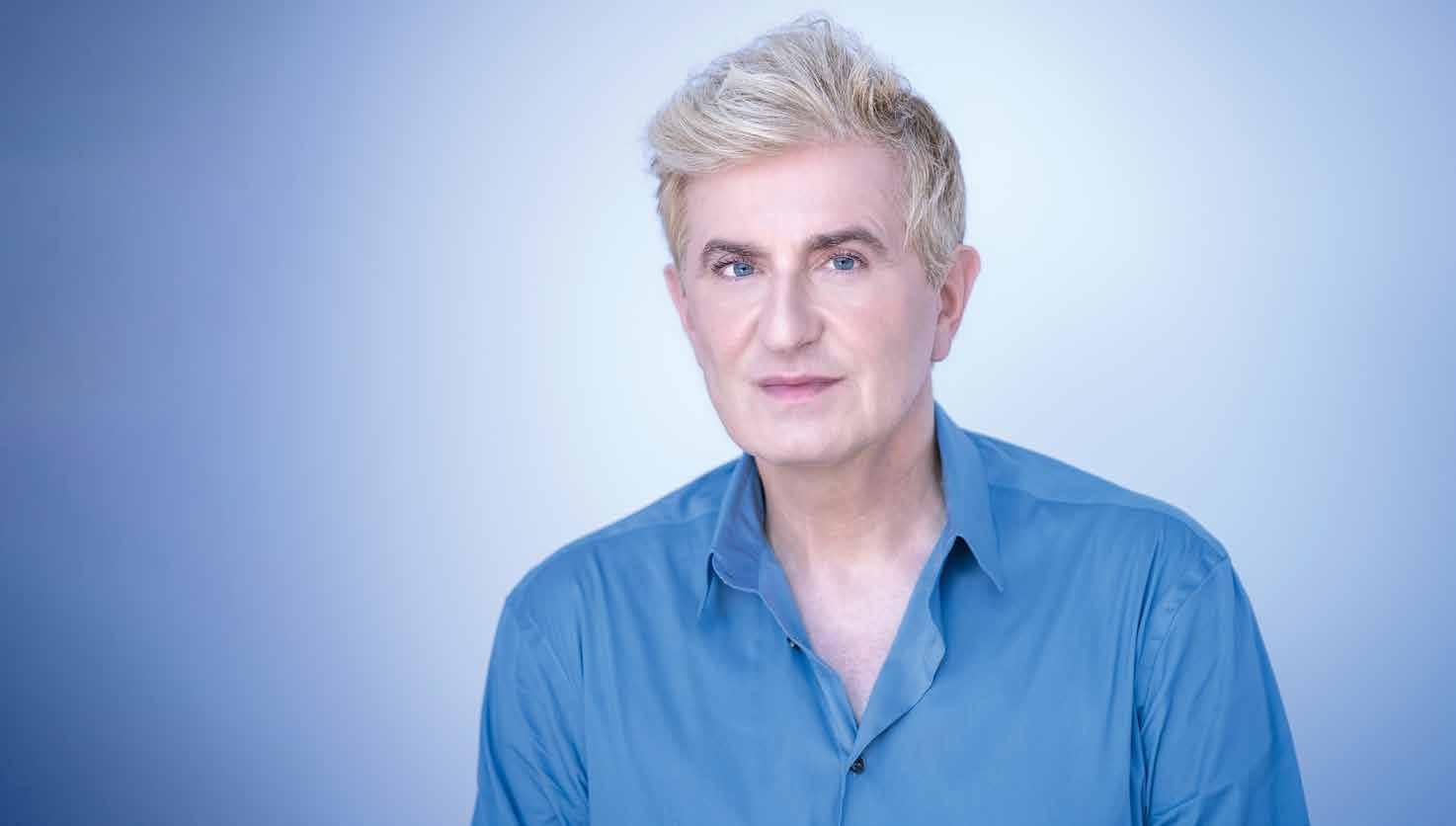
Through elegant musicality and an insightful approach to contemporary and established repertoire, Jean-Yves Thibaudet has earned a reputation as one of the world’s finest pianists. He is especially known for his diverse interests beyond the classical world, including numerous collaborations in film, fashion, and visual art. He is the first-ever Artist-inResidence at the Colburn School, which awards several scholarships in his name.
This season, he appears in concerts and recitals worldwide, in works ranging from Gershwin’s Concerto in F and SaintSaëns’s Piano Concerto No.5 to Bernstein’s Age of Anxiety, Scriabin’s Prometheus and Messiaen’s TurangalîlaSymphonie. He also continues his multiseason focus on Debussy’s Préludes, performing both books in their entirety. He is a champion of Khachaturian’s Piano Concerto, recently performing it with the St Louis Symphony Orchestra and New York Philharmonic. He also joined violinist Lisa Batiashvili and cellist Gautier Capuçon on a European piano trio tour.
A prolific recording artist, he has appeared on more than 70 albums and six film scores, and his extensive catalog has received two Grammy nominations, two ECHO Awards, and Gramophone awards, as well as a German Record Critics’ Award, Diapason d’Or, CHOC du Monde de la Musique, and the Edison Prize. Recent recordings include Khachaturian, a celebration of the Armenian composer including his Piano Concerto, and Gershwin Rhapsody with pianist-singer Michael Feinstein, including four newly discovered Gershwin pieces. He is the soloist on Dario Marianelli’s recently reissued score for the 2005 film Pride and Prejudice (certified Gold by the RIAA in 2025), and his playing can also be heard on Marianelli’s score for Atonement, Alexandre Desplat’s scores for The French Dispatch and Extremely Loud & Incredibly Close, and Aaron Zigman’s score for Wakefield.
Jean-Yves Thibaudet’s concert wardrobe is designed by Dame Vivienne Westwood.
John Williams (born 1932)
Star Wars: Suite
Main Title
Princess Leia’s Theme
The Imperial March (Darth Vader’s Theme)
John Williams is credited with restoring symphonic sound to the movies in the 1970s – putting the orchestra back into the cinema – and for nearly 50 years, orchestras have been returning the compliment by bringing his film music into the concert hall. Williams spearheaded the symphonic revival with The Poseidon Adventure in 1972. Five years later, in Star Wars (A New Hope), not only were audiences given a lush orchestral score, that score was accompanying science fiction! Williams recognised that, despite the space ships and the lightsabers, Star Wars was at heart a work of romantic storytelling. It is, after all, ‘A long time ago in a galaxy far, far away’.
Seeking an emotionally familiar musical language, Williams drew on 19th-century operatic idioms, in particular Richard Wagner’s use of leading motifs for individual characters and concepts.
The visually stunning opening with its signature ‘text crawl’ called for a Main Title that would, as Williams says, ‘smack you right in the eye’. The brass instruments, playing in their most brilliant registers, give the fanfare an idealistic, uplifting but military flare. This contrasts with a lyrical and romantic, but also adventurous, second theme. Flourishes and upward-reaching motifs allude to Luke’s character – idealistic and heroic.
The theme for Princess Leia conveys a protagonist who is beautiful, vulnerable and courageous, and a solo horn brings
nobility as well as lyricism. But this theme is also heard when Obi-Wan dies at the hands of Darth Vader – with Leia a mere onlooker – suggesting, writes Rod Webb, that it also represents the ideal of the lost Republic.
Tonight’s suite ends with Darth Vader’s theme, The Imperial March. Here, Williams sought a strong melodic identification or ‘imprint’, that would always be associated with the character, even if only a fragment is heard. In the case of Darth Vader, explains Williams, the brass convey his military bearing, his authority and his ominous look, while the use of the minor mode ensures the effect is threatening.
Yvonne Frindle © 2026
Concerto in F for piano and orchestra
Allegro
Andante con moto
Allegro agitato
Jean-Yves Thibaudet, piano
Gershwin first crossed the tracks from jazz and popular music to ‘serious’ music with Rhapsody in Blue. It caused a sensation and a controversy, but when the dust had settled, the pungent, memorable tunes and rhythms were still there – the Rhapsody is likely to remain Gershwin’s most popular piece of instrumental music. Gershwin had composed it for Paul Whiteman’s big band, which played what Whiteman, at least, called jazz. Rhapsody in Blue comes off best, many believe (including Jean-Yves Thibaudet, who has recorded it this way), in its original scoring for band rather than in the inflated orchestral version. In fact, the neophyte composer made neither arrangement
himself – he and Whiteman called in the services of the band’s arranger, Ferde Grofé.
That was in 1924. Meanwhile, the jazz craze was sweeping America, and the venerable but still enterprising conductor of the New York Symphony Society, Walter Damrosch, had an idea which would, at one stroke, further his aim of encouraging American composers and bring some jazz flavour into the concert hall. In the spring of 1925, his Society commissioned Gershwin to compose a piano concerto and to appear as soloist in seven concerts with the New York Symphony beginning in December of that year.
It’s said that the brashly self-confident Gershwin, after accepting the commission, had to find out what a ‘concerto’ was. Be that as it may, Gershwin was determined to orchestrate the work himself, and bought a textbook of orchestration. His original title for the work was ‘New York Concerto’, and he began to write it in the Gershwin family home at 103rd Street; or, when that became too crowded with distracting friends and relatives, in the seclusion of a room at the nearby Whitehall Hotel. The Australian-born pianist Ernest Hutcheson, then a staff member and later president of the Juilliard School, made available to Gershwin a studio at out-of-town Chautauqua, where he conducted masterclasses in the summer months, and some of the concerto was composed there.
Gershwin’s original plan for the concerto was expressed in his typically laconic style. The three movements were to be:
1. Rhythm
2. Melody
3. More Rhythm
Because of the title ‘concerto’, much attention has focussed on how Gershwin met conventional demands of form. Critics were quick to point out supposed
‘structural deficiencies’, although some have countered with the claim that Gershwin adopted sonata form in the first movement and rondo form in the third. It is doubtful whether this approach to the concerto is much to the point. Gershwin biographer Charles Schwartz surely has it right: ‘Doing what came naturally to him, Gershwin created his own personal version of a concerto, though hardly one that would conform to textbook models.’ After all, what popular 20th-century concerto do those models fit? Certainly not Rachmaninoff’s.
The Concerto in F is in fact a string of highly effective melodies, involving a certain amount of repetition (including reminiscences of the first movement in the third), not much development, and some quasi-symphonic linking passages between the big tunes. The anxious care Gershwin gave to this work was surely due to his sense that the music would have to stand the test of durability and repetition, not the ephemeral success of a Broadway show. By that test he succeeded: the Concerto in F is the most often played American concerto and one of the most frequently heard concertos of the 20th century.
Among the Carnegie Hall premiere’s mixed audience of jazz buffs, classical elite and Damrosch’s worshipful following of Society ladies, there were those who were shocked, those who were puzzled, and those who were disappointed – because the concerto was not as musically raffish as Rhapsody in Blue. Critic Samuel Chotzinoff caught the reaction which has endured: ‘Of all those writing the music of today…Gershwin alone expresses us.’ The original title, ‘New York Concerto’, is an apt indication of its character: ‘a mixture of New York musical vernacular and the concert hall’ (Schwartz). Gershwin’s own program note makes no claims about the form of the piece, but gives a good description of its contents:
The first movement (Allegro) employs the Charleston rhythm. It is quick and pulsating, representing the young enthusiastic spirit of American life. It begins with a rhythmic motif given out by the kettledrums, supported by other percussion instruments, and with a Charleston motif…The principal theme is announced by the bassoon. Later, a second theme is introduced by the piano.
The second movement (Andante con moto) has a poetic nocturnal atmosphere which has come to be referred to as the American blues, but in a purer form than that in which they are usually treated.
The final movement (Allegro agitato) reverts to the style of the first. It is an orgy of rhythms, starting violently and keeping to the same pace throughout.
David Garrett © 1987/2003
Sergei Rachmaninoff (1873–1943)
Non Allegro
Andante con moto (Tempo di valse) Lento assai – Allegro vivace
Conductor, pianist and composer, Rachmaninoff often complained that he could never maintain all three activities simultaneously. His adult career as a concert pianist left him little time for composition, and for years he wrote next to nothing. Then, much to his surprise, the urge to compose began to reassert itself. A procession of ‘Indian summer’ pieces emerged between 1926 and 1940, many of which are now regarded as among his finest compositions.
‘I don’t know how it happened. It must have been my last spark,’ is how Rachmaninoff described the origins of the Symphonic Dances. Yet the idea of a score for a programmatic ballet had been at the back of his mind since 1915, and
when Michel Fokine choreographed the Rhapsody on a Theme of Paganini for a ballet in 1939, the opportunity to compose an original ballet appealed again to Rachmaninoff’s imagination. He wrote the Dances the following year, giving the three movements the titles Midday, Twilight and Midnight. At this point the work was called ‘Fantastic Dances’.
Rachmaninoff played it over on the piano for Fokine, who was enthusiastic about the music but non-committal about its balletic possibilities. In any case, Fokine’s death a short time later cooled Rachmaninoff’s interest in the ballet idea altogether. He deleted his descriptive movement names and substituted ‘Symphonic’ for ‘Fantastic’ in the title. In its new guise he dedicated the triptych to his favourite orchestra, the Philadelphia, and its chief conductor Eugene Ormandy.
It is a work full of enigmas, which Rachmaninoff does nothing to clarify. In the first movement, there is a transformation from minor to major of a prominent theme from his first symphony, which at that time Rachmaninoff thought was irretrievably lost. (The score was lost, but the symphony was re-constructed from the orchestral parts after his death.)
The premiere of that work in 1897 had been such a fiasco that Rachmaninoff could not compose at all for another three years. But the reference to the symphony in this new piece has a meaning that remains entirely private.
There is also the curious paradox that the word ‘dance’ – with its suggestion of lifeenhancing, joyous activity – is here put at the service of a work that – for all its vigour and sinew – is essentially concerned with endings. Chromaticism darkens the colour of every musical step. The sense of foreboding and finality is particularly strong in the second movement, with its evocations of a spectral ballroom, and in the bell-tolling and chant-intoning that pervade what was
to be not only the last dance of the set, but the last new movement he would ever compose.
The first movement, with its unusual tempo marking Non Allegro (‘Not fast’ –what could he have meant?) begins hesitantly, before a bold, staccato statement of a theme that sounds very much like the plainchant for the dead, ‘Dies irae’, in disguise. It will reappear in different guises throughout the work. This leads to the main part of the movement. From this point on, most of the major musical ideas are introduced by the woodwinds, including the leaping main theme, given to flutes, oboes and clarinets. The major lyrical theme is then given to that infrequent orchestral visitor, the alto saxophone, making its solo appearance with delicately scored accompaniment for winds only. (The saxophone has no other music to play in the work.) Rachmaninoff also employs orchestral piano, and when the lyrical theme is given its second statement by the strings, in an impassioned unison, the piano traces a filigree accompaniment, creating an overall effect of shining brightness. In the coda of this movement, harp and piano together create a glistening, shimmering counterpoint to the plush, chorale-like statement of the motif plucked from the first symphony.
The waltz movement begins with muted trumpet fanfares that have a sinister fairytale quality to them. Woodwind arabesques swirl around them, until a solo violin passage gives way to the main waltz theme, introduced by the oboe and cor
anglais before being taken up by the strings. The ghostly woodwind arabesques continue to decorate this theme until the winds themselves announce the livelier second melody. Although the atmosphere becomes warmer and more passionate at times, it does not lighten, and sometimes becomes quite macabre. It is as if we are experiencing a memory of a ballroom rather than a ball itself.
The finale is the work’s most complex movement. The extensive use of the ‘Dies irae’ (a regular source of material for Rachmaninoff) and the inscription ‘Alliluya’, written in the score above the last motif in the work to be derived from Orthodox chant, suggest the most final of endings mingled with a sense of thanksgiving. [The ‘Alliluya’ is a direct reference to Rachmaninoff’s choral work, All-Night Vigil.] The tolling of the midnight bell that prefaces the movement’s vigorous main section reinforces the view that the work might, after all, be a parable on the three ages of man.
Much of the main Allegro vivace material here is derived from the chant, as is the motif that eventually drives away the ‘Dies irae’ and dominates the work’s forthright conclusion. But this is also the movement in which Rachmaninoff takes time out from the dance, in an extensive central section in which morbidity, regret, passion and tears commingle in a complex and beautifully scored musical design.
Abridged from a note by Phillip Sametz © 1999/2007
Rachmaninoff’s choice of the ‘Dies irae’ chant in the third movement suggests a ‘dance of death’. The 12 chimes of midnight in the introduction enhance the macabre effect. But Rachmaninoff moves well beyond a danse macabre, transforming the sinister tune into music serenely reminiscent of his beloved Russian Orthodox chant. This is the spiritual and musical heritage he celebrated in his great choral masterpiece, the All-Night Vigil, and Rachmaninoff directly quotes music from the Vigil at the point in the score marked ‘Alliluya’. Choosing his own final dance partner, Rachmaninoff abandons Death, for Life.
Thursday 12 March at 7:30pm
Saturday 14 March at 2:00pm
Hamer Hall, Arts Centre Melbourne
Friday 13 March at 7:30pm
Costa Hall, Geelong
Artists
Melbourne Symphony Orchestra
Jaime Martín conductor
María Dueñas violin
Program
Melody Eötvös The Deciding Machine* [12']
Beethoven Violin Concerto [42’]
interval
R. Strauss Also sprach Zarathustra [33’]
* Australian premiere
Jaime Martín’s biography can be found on page 10.
Pre-concert talk: Learn more about the music with Megan Reeve 6:45pm (12 Mar) and 1:45pm (14 Mar) in the Stalls Foyer (Level 2) at Hamer Hall 6:45pm (13 Mar) at Costa Hall
Running time: 2 hours, including a 20-minute interval. Timings listed are approximate.
MSO’s Geelong performance is supported by AWM Electrical, Freemasons Foundation Victoria, the Estate of the late Blanch Brooke Hutchings, and Perpetual Foundation – Alan (AGL) Shaw Endowment
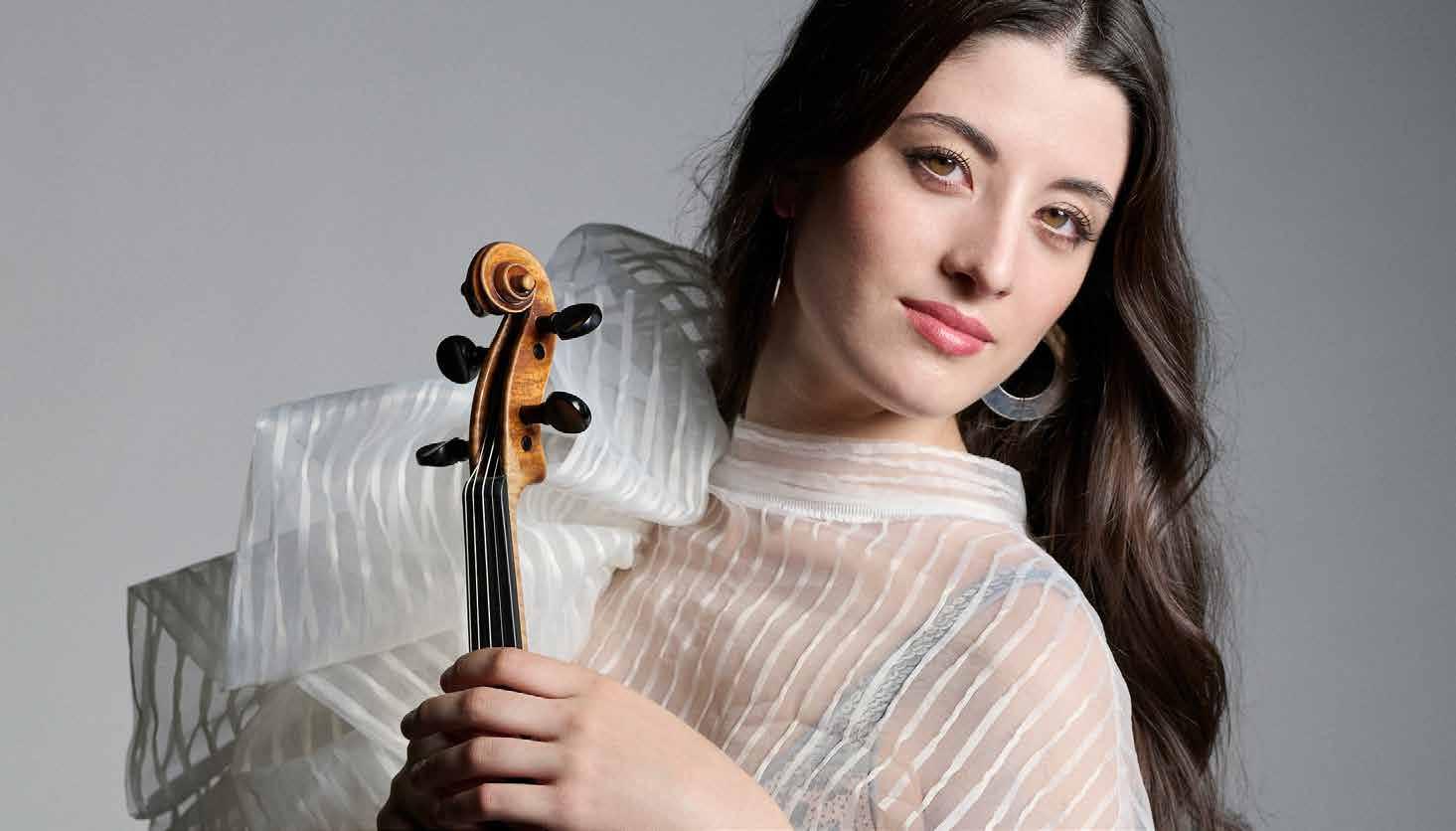
Spanish violinist María Dueñas has established herself as one of today’s most outstanding artists, celebrated for her extraordinary tonal palette and captivating expressiveness.
Her meteoric rise led to an exclusive contract with Deutsche Grammophon, and her 2023 debut album, Beethoven and Beyond, showcased her remarkable interpretation of Beethoven’s Violin Concerto featuring her own cadenzas. This recording, with the Vienna Symphony under Manfred Honeck, earned her the prestigious Opus Klassik award as Young Artist of the Year in 2024, adding to an extraordinary array of prizes at competitions worldwide. In February 2025 she released her second album, an ambitious project centred around Paganini’s 24 Caprices and other works inspired by the composer. This recording earned her both Young Artist of the Year and Instrumentalist of the Year at the 2025 Gramophone Classical Music Awards.
María Dueñas has performed with leading orchestras around the world under
conductors such as Yannick NézetSéguin, Herbert Blomstedt, Christian Thielemann and Gustavo Dudamel. Her creative pursuits extend beyond performance, with compositions of her own and innovative projects such as the film Measures for a Funeral, featuring the rediscovery of Halvorsen’s violin concerto.
Highlights of this season have included a tour with Antonio Pappano and the Chamber Orchestra of Europe and a performance with Semyon Bychkov at the Nobel Prize Concert in Stockholm. She also made her Vienna Philharmonic debut under Karina Canellakis and her New York Philharmonic debut under Manfred Honeck. Another career milestone was the celebration in February of Zubin Mehta’s 90th birthday together with the WestEastern Divan Orchestra.
As a stipendiary of the Deutsche Stiftung Musikleben, María Dueñas performs on a Nicolò Gagliano violin from 17?4.
Melody Eötvös (born 1984)
This concert ends with philosophy of a kind (Thus Spake Zarathustra), but it begins with science in a musical exploration of the life of Ada Lovelace (1815–1852), mathematical pioneer and now feminist icon. The only legitimate child of the Lord Byron, Lovelace pursued what she called ‘poetical science’. At 18 she was introduced to Charles Babbage, who was beginning work on his Analytical Engine, a computing device that would operate via punched cards, not unlike those used in mechanical jacquard looms and street organs. It was Lovelace who published the first algorithm intended for Babbage’s Engine – effectively making her one of the first computer programmers. (The programming language Ada is named for her.)
With The Deciding Machine, composed for the 2021 Grand Teton Music Festival, Australian-born composer Melody Eötvös pays homage to the Engine and above all to ‘the bride of science’, as she describes Lovelace. The 2021 Festival, led by conductor Donald Runnicles, celebrated (belatedly) the 100th anniversary of women’s suffrage in the US. It was no accidental choice for a festival in Wyoming – in 1869, the ‘Equality State’ was the first state in the Union to grant women the right to vote, more than 50 years before suffrage, and had been the first to elect a female governor (in 1825). This prompted thoughts of pioneering women and Lovelace specifically.
In an interview before the premiere, Eötvös described the kernel of music that provided the impetus for this 12-minute work. It begins, she explained, with ‘high, repeated notes, like a code or an alien
language. It starts, stops, modulates, overlaps, and eventually begins to resolve into a recognisable time signature, though one still strained and in conflict with the metre’. This original idea was then treated to constant variation – repeating but with subtle, complex changes, like a machine worrying at a problem, and thus constantly propelling the music forward in a manner both organic and mechanical.
Yvonne Frindle © 2026
EÖTVÖS was born in the Southern Highlands of NSW and began studying music with her parents. At eight she took up cello and at the same time began experimenting with composition.
A graduate of the Queensland Conservatorium and the Royal Academy of Music in London, she holds a doctorate from Indiana University Jacobs and is a Senior Lecturer at the Melbourne Conservatorium of Music.
She has composed more than 20 orchestral works, and in addition to the Grand Teton Music Festival and the MSO, she has been commissioned by the Philadelphia Orchestra, Australian Chamber Orchestra, ANAM, Synergy Percussion, Arcadia Winds, the Melbourne Conservatorium of Music Symphony Orchestra (for a tour to Singapore and Malaysia) and the Flinders String Quartet.
Allegro ma non troppo Larghetto –Rondo (Allegro)
María Dueñas, violin Cadenzas by the soloist
Beethoven’s Violin Concerto stands alone. Completed in 1806, it was the only significant concerto for the violin between those Mozart had written in the 1770s and Felix Mendelssohn’s of 1844. Beethoven had never completed a violin concerto when Franz Clement, the popular concertmaster of the orchestra at the Theater an der Wien, approached him with a commission. The result, completed in the nick of time, was premiered in a benefit concert for the violinist on 23 December 1806. Johann Nepomuk Möser expressed mixed views in his report for a Viennese theatrical journal:
The excellent violinist Klement also played, besides other beautiful pieces, a violin Concerto by Beethofen, which on account of its originality and many beautiful passages, was received with much approbation. Klement’s genuine art and gracefulness, his power and perfect command of the violin – which is his slave – were greeted with deafening applause. As regards Beethofen’s Concerto, the verdict of the experts is unanimous; while they acknowledge that it contains some fine things, they agree that the continuity often seems to be completely disrupted, and that the endless repetition of a few commonplace passages could easily prove wearisome.
According to Möser, Beethoven could have ‘put his undoubtedly great talents to better use’.
Evidently Viennese public – the superficial brilliance of concertos by Viotti and Spohr in their ears – were puzzled by Beethoven’s contribution, even as the performance pleased them. Here was a violin concerto of unprecedented substance. Even though the movements were split up, with the second and third movements played after interval, the sheer duration of the first movement (longer than most contemporary concertos in their entirety) would have given the game away.
Furthermore, the character of the concerto was lyrical and serious rather than brilliant and showy, as if tailor-made for Clement’s playing style – a little old-fashioned and not particularly robust but imbued with ‘elegance and lustre’. The solo part is by no means easy, but Beethoven downplays the ‘confrontation’ between virtuoso and orchestra that’s expected in a concerto. Instead he highlights the dramatic contrasts between the thematic ideas and builds an expansive structure. The effect is of a symphony with the solo violin taking a principal part.
This ‘symphonic’ concerto is announced by five taps from the timpani, a motif which, like a heartbeat, dominates the whole of the first movement (soberly marked Allegro ma non troppo: fast but not too much). As was customary, the orchestra presents the main themes in a long and lyrical exposition, beginning with a radiant theme in the woodwinds, before the solo violin enters with a poised flourish of octaves and its serene interpretation of the same material. The soloist must wait almost until the end of the movement, however, before Beethoven hands over the beautiful second theme, played to rich effect on the lowest string of the violin.
The Larghetto second movement has some of the lyrical character of Beethoven’s early romances for violin and orchestra, together with a quality that Donald Tovey described as ‘sublime
inaction’. Listening to the floating filigree lines of the solo part, it’s easy to imagine the ‘indescribable tenderness’ of Clement’s playing, and equally easy to forget that the soloist never really has the tune.
Clement himself had written a violin concerto, also in D major, which had been premiered in 1805, sharing the program with Beethoven’s Eroica Symphony. No doubt this work provided a technical model for Beethoven, and tradition has it that Clement supplied the leaping refrain for the hunting rondo that concludes Beethoven’s concerto. (The story goes that violinist Yehudi Menuhin’s wife, Diana, added words to this jaunty tune: ‘At last it’s over, at last it’s over!’) This rondo theme is introduced by the solo violin, again using just the low G string, perhaps echoing Clement’s fondness for party tricks: after the first movement of the concerto, Clement played a piece of his own, on one string, holding the violin upside down!
No such gimmick would have been possible between the second and third movements. Beethoven instructs the soloist to use the final trill of the second movement as the launchpad for an improvised cadenza leading directly into the third. This carries the music between the ingeniously orchestrated variations of the Larghetto and the energy of the boisterous finale.
The concerto received a second performance in 1808 but was then more or less neglected until 1844, when the 13-year-old Joseph Joachim performed it in London with Felix Mendelssohn conducting. Since then it has assumed its rightful place, not just as a staple of the repertoire but as a musical touchstone that stands alone, even in the company of the great violin concertos.
Yvonne Frindle © 2019/2025
Richard Strauss (1864–1949)
Also sprach Zarathustra –Symphonic poem, Op. 30
Introduction –Of the Back-worlds-men –Of the Great Longing –Of Joys and Passions –The Funeral Song –Of Science –The Convalescent –The Dance Song –Night Wanderer’s Song
In 1891–92 the usually robust Strauss suffered a period of serious illness, including bouts of pneumonia, bronchitis and pleurisy. In the summer of 1892 he took leave of his duties at the Weimar Opera and travelled extensively through Italy, Greece and Egypt, soaking up the sun, but more importantly enjoying the awesome physical remains of the ancient pagan civilisations in those countries. It was at this time that he began to think about a musical response to some of the ideas of the German philosopher Friedrich Nietzsche, particularly those expressed in his poem Also sprach Zarathustra, though the work’s composition had to wait until 1896.
Zoroaster (as he was known to the ancient Greeks) was a Persian prophet living in the sixth century BCE who taught that the universe, and humankind in particular, is subject to the eternal struggle of two gods, represented by light and darkness; his religion survives among the Parsees of modern India. Nietzsche’s relationship to Zoroastrian ideas is fairly loose, and as Norman Del Mar puts it, he used these ‘as a prop on which to clothe his own ideas on the purpose and destiny of mankind’. The most famous – indeed, notorious – of these is the idea of the Übermensch or Superman. ‘Man,’ in Nietzsche’s words, ‘is a thing to be surmounted…what is the ape to man? A jest or a thing of shame.
So shall man be to the Superman.’ While Nietzsche (and, it must be admitted, the younger Strauss) was disdainful of Christianity’s compassion for weakness, it is drawing a long bow to make Nietzsche responsible for the atrocities of Nazism. Indeed, Nietzsche scholar Joachim Köhler argues that Also sprach Zarathustra, with its celebration of the individual will, partly grew out of the poet’s freeing himself from the dominating personality of the composer Richard Wagner. And Wagner’s widow Cosima, writing to her son-in-law Houston Stewart Chamberlain (whose racist ideas definitely did influence Hitler), condemned Nietzsche’s book for its ‘Jewishness’.
Strauss’s work is, as he said, ‘freely after Fr. Nietzsche’: he takes some of the chapter headings as the defining images for each section of his tone poem. It begins with the famous invocation to the sun (Introduction: Sunrise), with low rumbling accompanying the trumpets’ simple C–G–C theme (which in much of Strauss represents primeval nature). The increasing blaze of full chords establishes C major as one pole of the work (and as Del Mar notes, the sound of the organ at the end of the section adds a liturgical note). Of the Back-worlds-men depicts humanity in its primitive, or rather naïve state (in B minor, significantly – B being the other tonal pole of the piece). Strauss includes those who profess Christianity in this category, quoting a fragment of the plainchant for the Credo to underline his point.
Of the Great Longing, which follows a gorgeous climax for the strings, is a depiction of humanity’s search for something beyond mere superstition, but Strauss’s music dramatises the conflict between nature (the trumpet theme) and humanity’s tendency to create dogma with more hints of plainchant and the unresolved conflict between the keys of
C and B. A new chromatic motif leads into the Of Joys and Passions section with a theme that Strauss described as ‘A flat (brass: dark blue)’. Actually the section tends to be in C minor, linking it to the idea of nature, whereas the following Funeral Song is in B minor, and therefore linked to the idea of man.
Of Science is based on a deeply-voiced fugue that Strauss described as ‘spinechilling’ and Del Mar regards as having a ‘strangely mysterious quality’ despite its dour timbre. In The Convalescent, Nietzsche describes Zoroaster’s spiritual and physical collapse, after which he emerges as the Superman.
The Dance Song of the Superman is, like the ‘Dance of the Seven Veils’ in Salome, a Viennese waltz – a Straussian joke, perhaps. Here poet and composer part company: Strauss’s Zoroaster displays none of the triumphalism that Nietzsche’s does, and the work closes with a mysterious and tranquil Night Wanderer’s Song in which the keys of nature and man still quietly contend.
Gordon Kerry © 2004
Thursday 19 March at 7:30pm
Saturday 21 March at 7:30pm
Hamer Hall, Arts Centre Melbourne
Artists
Melbourne Symphony Orchestra
Benjamin Northey conductor
Jessica Aszodi mezzo-soprano
MSO Chorus
Program
Ravel Pavane pour infante défunte [12']
Joe Chindamo* Are There Any Questions?** [42’]
interval
Stravinsky The Rite of Spring [33’]
* MSO Composer in Residence
** World premiere of an MSO commission, with generous support from Michael Aquilina
CONCERT EVENTS
Pre-concert talk: Joe Chindamo in conversation with Megan Burslem 6:45pm in the Stalls Foyer (Level 2) at Hamer Hall
Running time: 2 hours, including a 20-minute interval. Timings listed are approximate.
MSO PRINCIPAL GUEST
In addition to his role with the Melbourne Symphony Orchestra, Benjamin Northey is the Chief Conductor of the Christchurch Symphony Orchestra and Conductor in Residence of the Sydney Symphony Orchestra, as well as Professor of Conducting at the Sydney Conservatorium of Music and Director of the Australian Conducting Academy. He was previously MSO Associate Conductor (2010–19), Resident Guest Conductor of the Australia Pro Arte Chamber Orchestra (2002–06) and Principal Guest Conductor of the Melbourne Chamber Orchestra (2007–10).
He appears regularly as a guest conductor with all the major Australian symphony orchestras, as well as for Opera Australia, New Zealand Opera, Victorian Opera and State Opera South Australia, and he has conducted concerts with the London, Tokyo, Hong Kong and Malaysian philharmonic orchestras, Mozarteum Orchestra Salzburg, National Symphony Orchestra of Colombia and New Zealand Symphony Orchestra. In 2026, he
conducts the Melbourne, Sydney, Adelaide, West Australian, Tasmanian, Christchurch and Pittsburgh symphony orchestras.
Benjamin is a champion of Australian orchestral music and has premiered dozens of major new works by Australian composers, as well as sitting on board of the Australian Music Centre.
An Aria, Air Music and Art Music awards winner, in 2018 he was voted Limelight magazine’s Australian Artist of the Year. His many recordings can be found on the ABC Classic label.
Benjamin Northey studied conducting at Finland’s Sibelius Academy with Leif Segerstam and Atso Almila before completing his studies at the Stockholm Royal College of Music with Jorma Panula.
He is also a graduate of the Melbourne Conservatorium of Music, where he studied conducting with John Hopkins.
Jessica Aszodi is a mezzo-soprano, writer, educator and performer. Her unusually wide and flexible range enables her to perform repertoire across genres and voice types, and her work crosses between opera, experimental music, improvisation, composition and music theatre. From Mozart and Mahler to Berio, Boulez and popular music styles, she has built up a truly idiosyncratic set of techniques. She has cycled while singing on the stage of the Royal Festival Hall, performed body percussion so fierce it leaves a mark, and mastered a not small number of extremely extended vocal techniques. She has twice been nominated for Green Room awards as Best Female Operatic Performer in both the leading and supporting categories.
Jessica has performed as a soloist with ensembles and opera houses and worldwide, including the London Sinfonietta, Ensemble Musikfabrik, International Contemporary Ensemble (NY), Wiener Volksoper, Nederlands Reisoper, Hamburg State Opera, Pinchgut Opera,
Victorian Opera, Sydney Chamber Opera, the chamber series of the San Diego and Chicago symphony orchestras, and the Tirolean, Melbourne, Sydney and Adelaide symphony orchestras.
Her festival appearances include the Melbourne, Sydney and Adelaide festivals and Vivid Sydney, as well as Darmstadt, Aldeburgh, Tectonics, Tanglewood, Klangspuren, Beethoven Festwoche, Resonant Bodies, Aspen and the Bendigo International Festival of Exploratory Music (BIFEM).
A passionate exponent of new work, she has performed important premieres by collaborators such as Liza Lim, Augusta Read Thomas, Dai Fujkura, Anthony Pateras, Cathy Milliken and Laura Bowler.
Jessica Aszodi holds a doctorate from the Queensland Conservatorium, and her artistic research and teaching focuses on the materiality and politics of embodiment practices in the creation of new vocal performance.
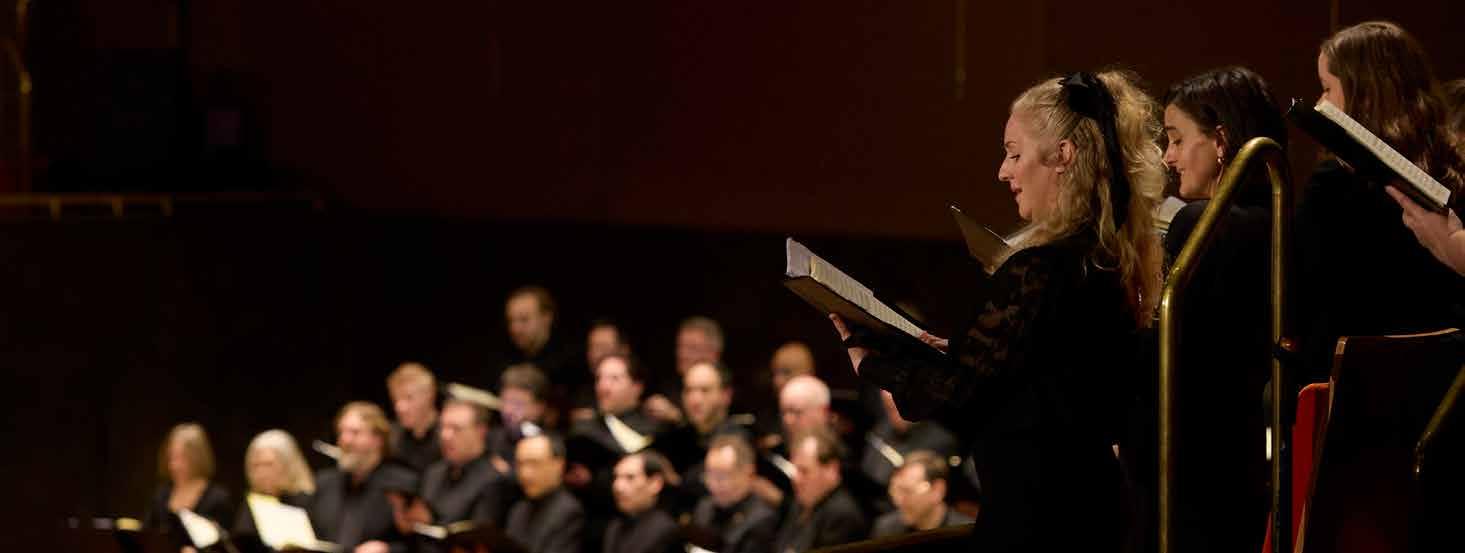
Celebrating more than 60 years of creating inspiring musical moments, the Melbourne Symphony Orchestra Chorus gives voice to the Orchestra’s choral repertoire. The MSO Chorus has performed with the finest conductors including Jaime Martín, Sir Andrew Davis, Edward Gardner, Mark Wigglesworth, Bernard Labadie, Vladimir Ashkenazy, Xian Zhang, Nodoko Okisawa and Simon Halsey.
Committed to developing and performing new Australian and international choral repertoire, the MSO Chorus has commissioned works such as Brett Dean’s Katz und Spatz, Ross Edwards’ Mountain Chant, and Paul Stanhope’s Exile Lamentations, and its recordings have received critical acclaim. The Chorus has performed across Brazil and at the Cultura Inglese Festival in São Paolo, with the Australian Ballet and the Singapore Symphony Orchestra, at the AFL Grand Final and at Anzac Day commemorative ceremonies.

Warren Trevelyan-Jones is regarded as one of the leading choral conductors and choir trainers in Australia. Chorus Director of the Melbourne Symphony Orchestra since 2017, last year he was also appointed Chorus Master of the Tasmanian Symphony Orchestra. From 2008 to 2024 he was Head of Music at St James’, King Street in Sydney, and under his leadership, the Choir of St James’ gained an international reputation through its regular choral services, orchestral masses, concert series, recordings, and interstate and international touring, as well as the commissioning of new works.
Before relocating to Australia in 2008, he enjoyed an extensive career as a vocal soloist and ensemble singer in Europe,
Warren Trevelyan-Jones
including nine years in the Choir of Westminster Abbey, and regular work with the Gabrieli Consort, Collegium Vocale (Ghent), the Kings Consort, Dunedin Consort, the Sixteen, the Tallis Scholars and the Taverner Choir, Consort and Players. He has appeared on more 60 recordings and numerous TV and radio broadcasts, and in many of the worlds’ leading music festivals and concert halls.
Warren is a co-founder of the Consort of Melbourne and, in 2001 with Dr Michael Noone, he founded the Gramophone Award-winning group Ensemble Plus Ultra. He is also an experienced singing teacher and qualified music therapist.
Sopranos
Emma Anvari
Carolyn Archibald
Sheila Baker
Helena Balazs
Aviva Barazani
Tina Battaglia
Giselle Baulch
Eva Butcher
Aliz Cole
Veryan Croggon
Emily Cunningham
Ella Dann-Limon
Keren Evans
Laura Fahey
Rita Fitzgerald
Catherine Folley
Susan Fone
Carolyn Francis
Karina Gough
Penny Huggett
Gina Humphries
Phoebe Irawan
Tania Jacobs
Gwen Kennelly
Judy Longbottom
Caitlin Noble
Katherine O’Shea
Elise Parsonage
Amanda Powell
Tanja Redl
Beth Richardson
Jo Robin
Elizabeth Rusli
Kathryn Scully
Fiona Seers
Jemima Sim
Tracey Thorpe
Katy Turbitt
Jenny Vallins
Tracey Videon
Ariane Vrisakis
Agnes Widjaja
Altos
Satu Aho
Ruth Anderson
Catherine Bickell
Cecilia Bjorkegren
Kate Bramley
Jacqueline Cheng
Alexandra Chubaty
Juliarna Clark
Andrea CliffordJones
Marie Connett
Marie Eleanor-Rapp
Claudia Funder
Jill Giese
Jillian Graham
Sophia Gyger
Madeleine Halls
Ros Harbison
Jennifer Henry
Kristine Hensel
Helen Hill
Julie Lotherington
Christina McCowan
Rosemary McKelvie
Helen Maclean
Charlottte Midson
Nicole Patterson
Kate Rice
Helen Rommelaar
Kerry Roulston
Libby Timcke
Tenors
James Allen
Lucas Azevedo
dos Santos
Kent Borchard
Steve Burnett
Peter Campbell
Jose Diaz
Lyndon Horsburgh
Lilijana Matičevska
Michael Mobach
Marko Montsalud
Jean-Francois
Ravat
Linton Roe
Robert Simpson
Cameron Tait
Stewart Webb
Elliott Westbury
Stephen Wood
Basses
Maurice Amor
Tharanga
Basnayake
Stephen Bordignon
Ross Cullinane
Roger Dargaville
Ted Davies
Elliott Gyger
Luke Hales
Andrew Ham
Tim Kopka
Roderick Lee
Philip McCosker
Stephen Pyk
Josh Teng
Matthew Toulmin
Caleb Triscari
Raoul Zambelli
Maciek Zielinski
Maurice Ravel (1875–1937)
How much notice should we take of composers who become annoyed at the popularity of what they consider their lesser works? Ravel believed he suffered more than most in this regard. There are still many people whose experience of Ravel’s music stops with this Pavane and his Bolero. We may agree with the composer that this is a pity, but need not be too influenced by his later remarks about the Pavane pour une infante défunte (‘rather poor form’ and ‘an inconclusive and conventional work’). It was, after all, the piece that first won Ravel wide recognition. Commissioned and dedicated to the Princesse de Polignac (Winnaretta Singer of the sewing machine fortune), it was composed in 1899 as a piano solo. In that form it looks easy to play but isn’t, and most musicians feel that Ravel improved the piece greatly by orchestrating it in 1910.
Many more or less fanciful interpretations have been given of this piece, seemingly based more on the title than on the music. The idea persists that it is about a dead child, even though the Spanish title infanta refers to a princess of royal blood, of whatever age, who will not inherit the throne. One critic thought the piece could be an illustration of Portrait of a Young Girl by 17th-century Spanish painter Velásquez. Others have imagined a stately dance in front of the bier of a princess (an old Spanish court custom).
But according to Ravel, in devising the (French) title he was thinking only ‘of the pleasure I got from the assonance of the words’. Perhaps he protested too much:
What’s in a name?
Ravel chose his title for this music on the basis of how the words sounded rather than what they meant. So how to translate it? Indeed, should we translate it?
Perhaps it’s enough that the title – like the music – conveys Ravel’s enthusiasm for antique dance forms. The pavane was a stately processional dance from baroque Spain and its intended ‘infante défunte’ emphasises that Spanish link as well as suggesting a mournful nostalgia.
But note Ravel’s old-fashioned choice of French: ‘infante défunte’ (English cognate: defunct) rather than, say, ‘infante morte’. ‘It is not a funeral lament for an infanta who has just died,’ he insisted, ‘but rather the evocation of a pavane that such a princess might have danced, long ago, at the Spanish court.’ To that end, perhaps the most satisfying translation is ‘Pavane for a long-dead princess’.
the title does create the right frame of mind for listeners to this gentle, calm piece, which has something mournful about it.
The ancient dance form, the pavane, was much cultivated in 16th- and 17th-century Spain. Its adoption by Ravel therefore evokes a sense of time long past, and reflects his interest in stylised dance rhythms. In spite of his disclaimers, he felt strongly enough about the piece to insist (when he heard how some musicians treated it) that it should be played calmly and in strict time.
David Garrett © 1988
Joe Chindamo (born 1961)
1. Voices in the Ash
2. Of Wrath Made Holy
3. O Gentle Eye
4. Cantical of the Bound
5. Choir of Glass
6. Divine Dystopia
Jessica Aszodi, mezzo-soprano MSO Chorus
History reminds us that the birth of many works of art owes less to divine inspiration than to the circumstances that make their creation possible. Mozart’s Requiem, for instance, began as a private commission cloaked in mystery rather than a spontaneous act of inspiration. Ravel’s Pavane pour une infante défunte was born of a patron’s request, its title conceived long before the music itself. Patronage, chance meetings and practical necessity have long played as decisive a role in the arts as vision itself.
In that spirit, Are There Any Questions? owes its genesis to Melbourne arts patron Michael Aquilina, who approached me about commissioning a symphony some five years ago. His initiative planted the seed from which the project grew. When I brought the idea to the MSO, they embraced it wholeheartedly, came on board as co-commissioners, and together we expanded the work into a large-scale composition for full orchestra, chorus, mezzo-soprano and organ.
Although Are There Any Questions? draws on the structure and spirit of the traditional Requiem Mass, it is not written for the dead. It is, rather, a lament for something quietly disappearing within the living – the erosion of individuality and interior life in an age of surveillance, distraction and conformity. The ‘self’ that vanishes here is the one capable of private thought, moral
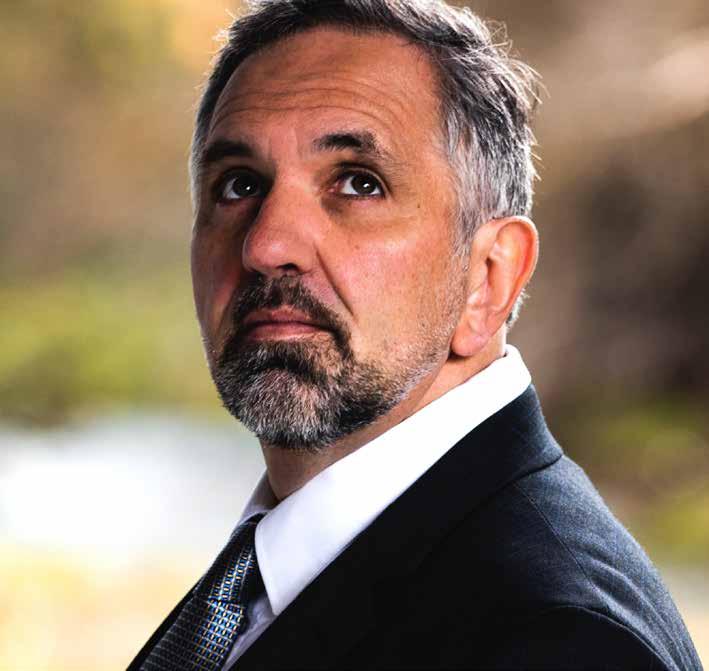
reflection and genuine connection: the human soul under pressure from the machinery of the modern world.
The work sits in conversation with two great dystopian visions: George Orwell’s 1984 and Margaret Atwood’s Handmaid’s Tale, both of which explore how belief, identity and conscience can be reshaped by systems of power. It traces a journey through dystopian tension, exploring the space between memory and imagined extremes, where freedom and coercion meet as mirror and shadow: to embrace one is to enact the other.
The title itself is borrowed from the final line of The Handmaid’s Tale, whose closing words resonated deeply with me. They capture the same tension that animates this work: between erasure and remembrance, submission and the faint, persistent echo of autonomy.
A defining element lies in the contrast between the chorus and the mezzosoprano. In my libretto, the chorus sings entirely in Latin, their texts pared back to stark, slogan-like fragments that echo the ritualised language of totalitarian belief. Against this, the mezzo-soprano sings in English – the voice human, vulnerable, and narrative – offering a solitary reflection within an atmosphere of collective obedience.
At its centre stands the third movement, O Gentle Eye, a dystopian love song from the mezzo-soprano, addressed to an authoritarian figure. Its expression is deliberately ambiguous: devotion, selfpreservation, irony and indoctrination intertwine, leaving the listener unsure where sincerity ends and survival begins.
Across six movements, Are There Any Questions? traces a journey from remembrance to revelation, from ruin to uneasy transfiguration. The music moves between opposites – beauty and distortion, stillness and agitation, intimacy and enormity, order and chaos. The trajectory culminates in Divine Dystopia, where a civilisation’s splendour rises and falls; majesty dissolves into stillness, leaving only echoes behind.
Ultimately, Are There Any Questions? is at once a remembrance and a gesture of defiance – a testament to the human capacity to feel, to doubt, and to preserve who we are amid the pressures of a world inching toward dystopia. Even as the self flickers, the hymn remains – an inheritance of what it means to be human.
Joe Chindamo oam © 2026
JOE CHINDAMO OAM is an Australian composer whose work reveals a distinctive and captivating artistic voice, earning national and international recognition. His music combines cantabile lyricism with a sophisticated harmonic language, architectural clarity and a vivid orchestral palette, resulting in works that are immediately compelling and richly layered.
He is the MSO’s 2026 Composer in Residence, and Are There Any Questions? is the first of his compositions to emerge from his tenure. In October, the MSO will premiere his new Flute Concerto, also commissioned as part of his residency, with soloist Eliza Shephard.
Chindamo’s orchestral output includes Ligeia for trombone and orchestra and Concerto del Motore for clarinet and orchestra (both commissioned by the Adelaide Symphony Orchestra), and his Violin Concerto and Concerto for Orchestra (Tasmanian Symphony Orchestra). His music has been heard across Australia and Europe, including the European premiere of Ligeia under John Wilson with soloist Peter Moore (Principal Trombone, London Symphony Orchestra), and in April, the ASO will premiere Concerto del Motore, with soloist Dean Newcomb.
Melbourne performance highlights have included his Principia Clarinettica (Melbourne Chamber Orchestra and MSO Associate Principal Clarinet Philip Arkinstall), Ligeia (MSO with Jonathan Ramsey, now Principal Trombone of the Berlin Philharmonic), Concerto for Orchestra (MSO with conductor Miguel Harth-Bedoya), and in February, the premiere and broadcast of Machiavelli’s Mirror – A Renaissance Suite for string orchestra, commissioned by the MCO.
He has also been commissioned by leading ensembles such as the Australian Chamber Orchestra, Melbourne Chamber Orchestra, Camerata, Australian String Quartet, Wilma & Friends, Southern Cross Players, Ensemble Offspring and Omega Ensemble.
As pianist and composer, he collaborated extensively with Zoe Black, producing five CDs, two of which were nominated for ARIA awards, reflecting a long-standing partnership celebrated for artistry and imagination.
Joe Chindamo was awarded the Order of Australia in 2022 for service to music and the performing arts, recognising his enduring contribution to Australian musical life.
Igor
Stravinsky
(1882–1971)
PART 1. L’Adoration de la terre (Adoration of the Earth)
Introduction
Les Augures printaniers. Danses des adolescentes (The Augurs of Spring. Dances of the Young Girls)
Jeu du rapt (Ritual of Abduction)
Rondes printanières (Spring Rounds)
Jeux des cités rivales (Games of the Rival Tribes)
Cortège du sage – Le Sage (Procession of the Sage – The Sage)
Danse de la terre (Dance of the Earth)
Introduction
Cercles mystérieux des adolescentes (Mystic Circles of Young Girls)
Glorification de l’élue (Glorification of the Chosen One)
Evocation des ancêtres (Evocation of the Ancestors)
Action rituelle des ancêtres (Ritual of the Ancestors)
Danse sacrale. L’élue (Sacrificial dance. The Chosen One)
The first notes of The Rite of Spring emerge from the middle of the orchestra: a solitary bassoon playing a tortuous melody at the top of its range. Imagine a seedling, striving to pierce the frosty spring soil. At the 1913 premiere – played on a French bassoon with its distinctive reedy sound – it must have sounded strained and difficult, and Stravinsky wanted it so. Today, every bassoonist perfects this solo as a matter of course. You’re more likely to hear this famous musical moment floating into the auditorium than struggling to find its way. (Later in life, Stravinsky said if he’d known how easy the solo would become for bassoonists, he would have transposed it up half a step every ten years!)
A century on, the ballet score at the heart one of the 20th century’s great succès de scandale has become a venerable classic. Even the story of the riot at the premiere is old news. (The riot, incidentally, was provoked more by Vaslav Nijinsky’s choreography than by Igor Stravinsky’s music, which even the dancers could barely hear over the din.) And yet, even
though this music is more than a century old, it hasn’t lost its shock value.
This is in large part because of Stravinsky’s innovative handling of rhythm, but the opening points to an equally important feature of The Rite of Spring: its haunting melodies and striking use of orchestral colours. And those melodies are infused with folk motifs – not necessarily full phrases, but short, brittle fragments, reduced to their essence and repeated in compelling patterns.
Stravinsky, for his part, denied folk influence in The Rite, admitting to only one instance: that opening bassoon solo stems from a Lithuanian folk song. (Russian music scholar Richard Taruskin subsequently established that Stravinsky’s raw material included more than a dozen Lithuanian, Byelorussian, Russian and Ukrainian tunes, nearly all of them related to ancient spring festivities.) Ironically, as Taruskin pointed out, ‘It was precisely the most novel aspects of Stravinsky’s music, its form and rhythm, that were most heavily indebted to folklore.’
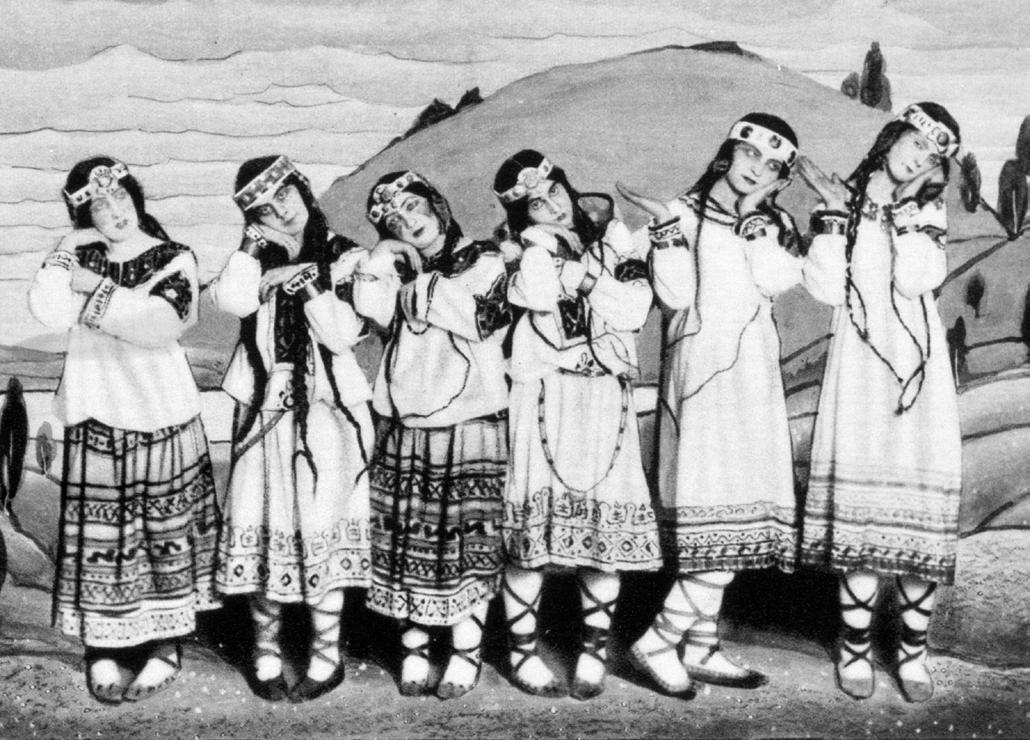
Ultimately, however, the lasting trademark of The Rite of Spring is the elemental, and often savage, rhythm. This spring awakening – conceived by Stravinsky, Nijinsky and the original designer Nicholas Roerich as ‘Scenes from Pagan Russia’ – is ancient and fierce. Stravinsky’s ‘primitive’ harmonies and rhythms have become a familiar part of our musical language, absorbed into sound worlds as diverse as the concert hall, the film studio, and rock power chords, but they still sound undeniably modern and even a little confronting. There’s no need to put on ‘1913 ears’ (or thump the head of your neighbour) in order to experience the essence of The Rite of Spring.
The list of musical numbers mirrors the ballet’s scenario, outlining its terrifying drama of ritual sacrifice, and the larger structure of the music is easily discernible. It falls in two roughly equal parts –The Adoration of the Earth and The Sacrifice – each of which begins quietly and mysteriously (not all of The Rite is brutal) before building to a shattering climax.
Stravinsky’s pounding syncopations begin by emphasising all the wrong beats while basically following a regular metrical scheme, but by the Sacrificial Dance of
Rite of Spring designer Nicholas Roerich matched Nijinsky’s anticlassical, ‘prehistoric’ choreography and Stravinsky’s ‘bloodcurdling’ music with costumes deeply informed by Slavic folklore and ancient ritual.
the Chosen One at the end of the ballet, every bar is in a different time signature, with the beats changing rapidly from groups of three, to two, to five… Stravinsky, who composed at the piano, said of the Sacrificial Dance that at first he knew how to play it, but not how to write it down. And Pierre Monteux, who conducted the premiere, never actually saw the ballet, quite possibly because he didn’t dare take his eyes off the music.
The Rite of Spring made Stravinsky’s name. The 31 year old was already a minor celebrity when the ballet premiered in Paris, but The Rite brought him notoriety. And while the original ballet soon fell out of the repertoire, the music quickly established a place in the concert repertoire. Stravinsky made sure of that, suppressing the original scenario and its pagan Russian setting, and claiming, for example, that the physicality of his hammering chords had inspired the vision of a ‘Great Sacrifice,’ rather than the reverse. ‘I have written a work that is architectonic,’ he said, ‘not anecdotal.’ We might not believe that – this music is too visceral to be purely abstract – but it’s also true that the hypnotic, ritualistic qualities of Stravinsky’s music stand on their own.
Yvonne Frindle © 2023/2026
Monday 23 March at 6:30pm
Hamer Hall, Arts Centre Melbourne
Artists
Melbourne Symphony Orchestra
Benjamin Northey conductor and host
Program
Stravinsky The Rite of Spring [33’]
Introduced by Benjamin Northey
The artist biography and program note for this performance can be found on pages 30 and 37.
Tonight’s onstage introduction will be Auslan interpreted
Running time: 1 hour. Timings listed are approximate.
Quick Fix at Half Six is supported by City of Melbourne.
The MSO’s Auslan interpreted performances receive funding from the Australian Government Department of Health, Disability and Ageing
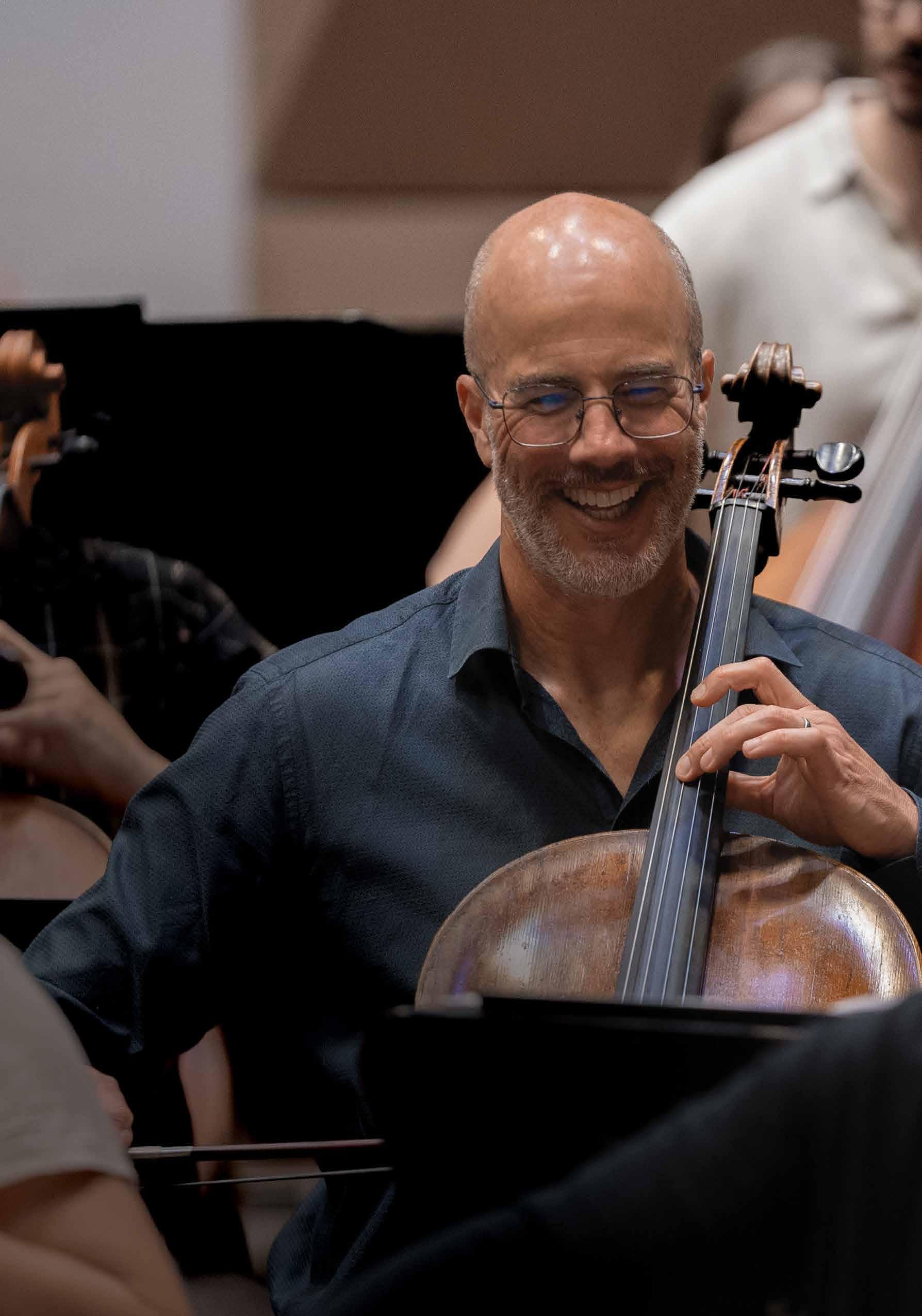
Extend your musical journey through the MSO’s Patron Program.
An annual donation of $500 or above brings you closer to the music and musicians you love. Enjoy behindthe-scenes experiences and exclusive gatherings with MSO musicians and guest artists, while building social connections with other music fans and directly supporting your Orchestra.
Scan the QR code to become an MSO Patron today.
MSO Patron
Her Excellency Professor, the Honourable
Margaret Gardner AC, Governor of Victoria
Honorary Appointments
Chair Emeritus
Dr David Li AM
Life Members
John Gandel AC and Pauline Gandel AC
Jean Hadges ♡
Sir Elton John CBE
Lady Primrose Potter AC
Jeanne Pratt AC
Lady Marigold Southey AC
Michael Ullmer AO and Jenny Ullmer
MSO Ambassador
Geoffrey Rush AC
Artist Chair Benefactors
Chief Conductor Chair Jaime Martín
Supported by the Besen Family Foundation
Cybec Assistant Conductor Chair
Daniel Corvaia
Cybec Foundation
Program Benefactors
MSO Now & Forever Fund: International Engagement Gandel Foundation
Artist Development Programs –
Cybec Foundation
Cybec Young Composer in Residence
Cybec First Nations Composer in Residence
Cybec 21st Century Australian Composers Program
Community and Public Programs
Australian Government Department of Health, Disability and Ageing, AWM Electrical, City of Melbourne, Hansen Little Foundation, Prof. Mary-Jane Gething AO
Student Subsidy Program
Anonymous
Jams in Schools
Melbourne Airport, Department of Education, Victoria – through the Strategic Partnerships Program, AWM Electrical, Jean Hadges, Hume City Council, Marian and EH Flack Trust
Regional Touring
AWM Electrical, Freemasons Foundation Victoria, Sir Andrew and Lady Fairley Foundation, Rural City of Wangaratta, Estate of the late Blanch Brooke Hutchings, Perpetual Foundation – Alan (AGL) Shaw Endowment
Sidney Myer Free Concerts
Sidney Myer MSO Trust Fund and the University of Melbourne, City of Melbourne Event Partnerships Program
MSO Academy
Robert Salzer Foundation
Instrument Fund
Tim and Lyn Edward, Catherine and Fred Gerardson, Pauline and David Lawton, Joe White Bequest
Platinum Patrons ($100,000+)
AWM Electrical Q
Besen Family Foundation
Prof Mary-Jane Gething AO ♡
The Gross Foundation ♡
Dr David Li AM and Angela Li Q
Lady Primrose Potter AC Anonymous (2)
Virtuoso Patrons ($50,000+)
The Aranday Foundation Q
Mrs Jennifer Brukner OAM Q
Tim and Lyn Edward ♡ ♫
Dr Harry Imber ♡
Margaret Jackson AC ♡
Lady Marigold Southey AC Q
The Yulgilbar Foundation Q
Impresario Patrons ($20,000+)
Christine and Mark Armour
Ren Barlow
Shane Buggle and Rosie Callanan ♡ Q
Debbie Dadon AM Q
Edwards Family Trust Q
Catherine and Fred Gerardson
The Hogan Family Foundation
Pauline and David Lawton
Jaime Martín
Paul Noonan
Elizabeth Proust AO and Brian Lawrence ☼
Sage Foundation ☼
The Sun Foundation
Kim Williams AM ♫
Anonymous (1)
Maestro Patrons ($10,000+)
John and Lorraine Bates ☼
Margaret Billson and the late Ted Billson ♡
John Calvert-Jones AM and Janet Calvert-Jones AO Q
Krystyna Campbell-Pretty AM
Jolene S Coultas Q ♡
The Cuming Bequest
Miss Ann Darby in memory of Leslie J Darby
Anthony and Marina Darling Q
Andrew Dudgeon AM ♡
Andrew and Theresa Dyer Q ♡
Val Dyke ♡
The Finkel Foundation Q
Kim and Robert Gearon ♡
The Glenholme Foundation Q
Charles & Cornelia Goode Foundation Q
Cecilie Hall and the late Hon Michael Watt KC ♡ ♫
Hanlon Foundation ♡
Michael Heine Q
David Horowicz ♡ Q
Peter T Kempen AM ♡ Q
Owen and Georgia Kerr Q
Suzanne Kirkham
Peter Lovell
Janet Matton AM & Robin Rowe Q
Rosemary and the late Douglas Meagher ♡
The Myer Foundation
Patricia Nilsson ♡
Dr Justin O’Day and Sally O’Day Q
Ian and Jeannie Paterson
Quin and Lina Scalzo Q
Glenn Sedgwick ♡ Q
Cathy Simpson and John Simpson AM Q
David Smorgon OAM and Kathie Smorgon Q
Straight Bat Private Equity Q
Athalie Williams and Tim Danielson
Lyn Williams AC Q
The Wingate Group Q
Anonymous (2)
Principal Patrons ($5,000+)
Mary Armour
Arnold Bloch Leibler Q
Philip Bacon AO Q
Alexandra Baker
Barbara Bell in memory of Elsa Bell
Julia and Jim Breen
Nigel and Sheena Broughton
Jannie Brown
Chasam Foundation Q
Janet Chauvel and the late Dr Richard Chauvel
John Coppock OAM and Lyn Coppock
David and Kathy Danziger
Mary Davidson and the late Frederick
Davidson AM
Sandra Dent
♡ Chair Sponsor | Q 2025 Europe Tour Circle | ☼ First Nations Circle ♫ Commissioning Circle | ∞ Future MSO
Carol des Cognets
George and Laila Embelton Q
Equity Trustees ☼
Diane and Stephen Fisher
Bill Fleming Q
John and Diana Frew ♡
Carrillo Gantner AC and Ziyin Gantner
Geelong Friends of the MSO
The Glavas Family ♡
Louise Gourlay AM Q
Dr Rhyl Wade and Dr Clem Gruen ♡
Louis J Hamon OAM
Dr Keith Higgins and Dr Jane Joshi
Jo Horgan AM & Peter Wetenhall Q
Geoff and Denise Illing
Dr Alastair Jackson AM Q
Amy and Paul Jasper
John Jones
Konfir Kabo
Merv Keehn and Sue Harlow
Mr Ian Kennedy AM & Dr Sandra Hacker AO
Lucas Family Foundation ♡
Morris and Helen Margolis ♡
Samantha Mark
Allan and Evelyn McLaren
Gary McPherson ♡
The Mercer Family Foundation
Suzie and Edgar Myer ♡
Rupert Myer AO and Annabel Myer
Anne Neil in memory of Murray A. Neil ♡
Sophie Oh
Phillip Prendergast Q
Ralph and Ruth Renard
Jan and Keith Richards
Dr Rosemary Ayton and Professor Sam Ricketson AM
Gillian Ruan Q
The Kate and Stephen Shelmerdine Family Foundation Q
Dr Michael Soon
Gai and David Taylor
P & E Turner
The Upotipotpon Foundation Q
Mary Waldron
Kee Wong and Wai Tang Q
Dawna Wright and Peter Riedel ♡
Peter Yunghanns Q
Igor Zambelli
Shirley and Jeffrey Zajac
Anonymous (5)
Associate Patrons ($2,500+)
Barry and Margaret Amond
Carolyn Baker
Marlyn Bancroft and Peter Bancroft OAM
Janet H Bell
Allen and Kathryn Bloom
Drs Alan and Jennifer Breschkin
Stuart Brown
Dr Lynda Campbell
Oliver Carton
Caroline Davies
Leo de Lange
Martin Foley Q
Barry Fradkin OAM and Dr Pam Fradkin
Anthony Garvey and Estelle O’Callaghan
Janette Gill
R Goldberg and Family
Colin Golvan AM KC and Dr Deborah Golvan
Miss Catherine Gray
Christine Grenda
Susan and Gary Hearst
Sandy Jenkins
Ann Lahore
Halina Lewenberg Charitable Foundation
Dr Jenny Lewis
Liza Lim AM ♫
Andrew Lockwood
Lisa and Brad Matthews
Dr Paul Nisselle AM
Simon O’Brien
George Pappas AO, in memory of Jillian Pappas
Roger Parker and Ruth Parker
Alan and Dorothy Pattison
Liz and Graham Pratt
James Ring
Tom and Elizabeth Romanowski
Dr Ronald and Elizabeth Rosanove
Christopher Menz and Peter Rose
Viorica Samson
Meredith Schilling SC
Marshall Segan in memory of Berek Segan OBE AM and Marysia Segan
Steinicke Family
Jenny Tatchell
Christina Turner
Timothy Walker CBE AM
Janet Whiting AM and Phil Lukies Q
Bob Weis
Anonymous (5)
Dr Sally Adams
Don Adamson
Jessica Agoston Cleary ∞
Applebay Pty Ltd
Margaret Astbury
Geoffrey and Vivienne Baker
Mr Robin Batterham
Kate Beattie
Peter Berry and Amanda Quirk
Rick Berry
William Birch
Richard Bolitho
Boncal Family Foundation
Michael Bowles and Alma Gill
Joyce Bown
Drs John D L Brookes and Lucy V Hanlon
Suzie Brown OAM and the late
Harvey Brown
Roger and Coll Buckle
Jill and Christopher Buckley
Ronald Burnstein
John Chapman and Elisabeth Murphy
Kaye Cleary
Warren and Margaret Collins
Sue Dahn
Mrs Nola Daley
Panch Das and Laurel Young-Das
Michael Davies and Drina Staples
Rick and Sue Deering
John and Anne Duncan
Jane Edmanson OAM
Christopher R Fraser
Chris Freelance
Miles George
David I Gibbs AM and Susie O’Neill
Sonia Gilderdale
Dr Celia Godfrey
Dr Marged Goode
Fred and Alexandra Grimwade Q
Hilary Hall, in memory of Wilma Collie
David Hardy
Cathy Henry
Gwenda Henry
Anthony and Karen Ho
In Memory of Rosemary Hodgson
Anna Holdsworth
Rod Home
Lorraine Hook
Doug Hooley
Katherine Horwood
Penelope Hughes
Shyama Jayaswal
Basil and Rita Jenkins
Wendy Johnson
Sue Johnston
Dr Gint Kalpokas and Dr Michael Upson
Drs Bruce and Natalie Kellett
Dr Anne Kennedy
Akira Kikkawa ∞
Tim Knaggs
Melissa Tonkin & George Kokkinos
Dr Jerry Koliha and Marlene Krelle
Jane Kunstler
Wilson Lai and Anita Wong Q
Kerry Landman
Janet and Ross Lapworth
Rex Lau
Bryan Lawrence
Phil Lewis
David R Lloyd
Elizabeth H Loftus
Chris and Anna Long
Elena Lovu
Sandra Masel in memory of Leigh Masel
Wayne McDonald and Kay Schroer
Andrea McCall
Lesley McMullin Foundation
Dr Eric Meadows
Sylvia Miller
Susan Morgan ∞
Ian Morrey and Geoffrey Minter
Dr Anthony and Dr Anna Morton
Dr Judith S Nimmo
Rosemary O’Connor
Brendan O’Donnell
Phil Parker
Bruce Parncutt AO
Ian Penboss
Peter Priest
Professor Charles Qin OAM and Kate Ritchie
Eli and Lorraine Raskin
Michael Riordan and Geoffrey Bush
Cathy Rogers OAM and Dr Peter Rogers AM
Guy Ross ☼
The Rowe Family
Marie Rowland
Liliane Rusek and Alexander Ushakoff
Martin and Susan Shirley
P Shore
Kieran Sladen
Janet and Alex Starr
Dr Peter Strickland
Bernard Sweeney
Russell Taylor and Tara Obeyesekere
Frank Tisher OAM and Dr Miriam Tisher
Margaret Toomey
Andrew and Penny Torok
Chris and Helen Trueman
Ann and Larry Turner
Dr Elsa Underhill and Professor Malcolm Rimmer
Nicholas and Faith Vann
Jayde Walker ∞
Edward and Paddy White
Willcock Family
Robert and Diana Wilson
George Yeung
Anonymous (19)
Margaret Abbey PSM
Vera Afanasyeva
Jane Allan and Mark Redmond
Jenny Anderson
Doris Au
Lyn Bailey
Robbie Barker
Anne M Bowden
Caroline Bowler
Stephen and Caroline Brain
Robert Bridgart
Miranda Brockman
Dr Robert Brook
Christine Brown
Elizabeth Brown
Phillip Brown
Patricia Buchanan
Marc Buchholz and Stephan Duchesne
Ian Carson AM
Dr Catherine Cherry
Dr Hyein Ellen Cho
Alan and Wendy Chuck
Christine Clough
Robert and Katherine Coco
Dr John Collins
Gregory Crew
Sue Cummings
Dr Catherine Duncan
Dr Matthew Dunn
Ron Elisha
Vivien and Jack Fajgenbaum
Brian Florence
Nadine Fogale
Elizabeth Foster
M C Friday
Simon Gaites
Nikki Gaskell
Lili Gearon
Dr Julia Gellatly
David and Geraldine Glenny
Hugo and Diane Goetze
The late George Hampel AM KC and Felicity Hampel AM SC
Dr Neville Hathaway
Geoff Hayes
Alison Heard
Noela Henderson
Dr Jennifer Henry
C M Herd Endowment
Carole and Kenneth Hinchliff
William Holder
Peter and Jenny Hordern
Gillian Horwood
Oliver Hutton and Weiyang Li
Rob Jackson
Ian Jamieson
Chris and Merryl Jessup
Karen Johnson
Linda Jones
Jennifer Kearney
John Keys
Lesley King
Dr Judith Kinnear
Dr Richard Knafelc and Mr Grevis Beard
Heather Law
Peter Letts
Sarah and Andrew Lindsay
Dr Helen MacLean
Janice Mayfield
Dr James McComish
Joel McGuinness
Gail McKay
Jennifer McKean
Shirley A McKenzie
Richard McNeill
Alison Milne
Professor Heather Mitchell
Lisa Mitchell
Joan Mullumby
Yoko Murakoshi
Rebecca-Kate Nayton
Adrian and Louise Nelson
Marian Neumann
Ed Newbigin
Valerie Newman
Amanda O’Brien
Phil Parker
Sarah Patterson
The Hon Chris Pearce and Andrea Pearce
Jason Peart
Sienna di Pietro and Lewis Pierce
William Ramirez
Geoffrey Ravenscroft
Ian Reddoch
Dr Christopher Rees
Fred and Patricia Russell
Carolyn Sanders
Julia Schlapp
Irene Sutton
Tom Sykes
Allison Taylor
Hugh and Elizabeth Taylor
Lily Tell
Serey Thir
Geoffrey Thomlinson
Mely Tjandra
Rosemary Warnock
Amanda Wasilewski
Amanda Watson
Deborah and Dr Kevin Whithear OAM
David Willersdorf AM and Linda Willersdorf
Dr Kelly and Dr Heathcote Wright
Charles and Jill Wright
Richard Ye
Anonymous (13)
MSO Guardians
Jenny Anderson
David Angelovich
Lesley Bawden
Peter Berry and Amanda Quirk
Tarna Bibron
Joyce Bown
Patricia A Breslin
B J Brown
Jannie Brown
Jenny Brukner and the late John Brukner
Sarah Bullen
Georgie and Phil Burg
Peter A Caldwell
Peter Cameron and Craig Moffatt
Luci and Ron Chambers
Roger Chao
Sandra Dent
James Dipnall
Sophie E Dougall in memory of Libby Harold
Alan Egan JP
Gunta Eglite
Marguerite Garnon-Williams
Dr Clem Gruen and Dr Rhyl Wade
Louis J Hamon OAM
Charles Hardman and Julianne Bambacas
Carol Hay
Dr Jennifer Henry
Graham Hogarth
Rod Home
David Horowicz
Lyndon Horsburgh
Katherine Horwood
Tony Howe
Lindsay Wynne Jacombs
Michael Christopher Scott Jacombs
John Jones
Merv Keehn and Sue Harlow
Pauline and David Lawton
Robyn and Maurice Lichter
Christopher Menz and Peter Rose
Dr Helen MacLean
Andrea McCall
Cameron Mowat
Laurence O’Keefe and Christopher James
David Orr
Matthew O’Sullivan
Rosia Pasteur
Kerryn Pratchett
Penny Rawlins
Margaret Riches
Anne Roussac-Hoyne and Neil Roussac
Michael Ryan and Wendy Mead
Anne Kieni Serpell and Andrew Serpell
Jennifer Shepherd
Suzette Sherazee
Professors Gabriela and George Stephenson
Pamela Swansson
Frank Tisher OAM and Dr Miriam Tisher
Mr and Mrs R P Trebilcock
Christina Helen Turner
Michael Ullmer AO
The Hon Rosemary Varty
Francis Vergona
Mr Steve Vertigan and
Ms Yolande van Oosten
Tam Vu and Dr Cherilyn Tillman
Robert Weiss and Jacqueline Orian
Terry Wills Cooke OAM and the late Marian Wills Cooke
Mark Young
Anonymous (18)
The MSO gratefully acknowledges the support of the following Estates
Norma Ruth Atwell
Angela Beagley
Barbara Bobbe
Michael Francois Boyt
Christine Mary Bridgart
Margaret Anne Brien
Ken Bullen
Deidre and Malcolm Carkeek
Elizabeth Ann Cousins
The Cuming Bequest
Margaret Davies
Blair Doig Dixon
Neilma Gantner
Angela Felicity Glover
The Hon Dr Alan Goldberg AO QC
Derek John Grantham
Delina Victoria Schembri-Hardy
Enid Florence Hookey
Gwen Hunt
Family and Friends of James Jacoby
Audrey Jenkins
Joan Jones
Pauline Marie Johnston
George and Grace Kass
Christine Mary Kellam
C P Kemp
Jennifer Selina Laurent
Sylvia Rose Lavelle
Dr Elizabeth Ann Lewis AM
Peter Forbes MacLaren
Joan Winsome Maslen
Lorraine Maxine Meldrum
Professor Andrew McCredie
Jean Moore
Joan P Robinson
Maxwell and Jill Schultz
Miss Sheila Scotter AM MBE
Marion A I H M Spence
Molly Stephens
Gwennyth St John
Halinka Tarczynska-Fiddian
Jennifer May Teague
Elisabeth Turner
Albert Henry Ullin
Cecilia Edith Umber
Jean Tweedie
Herta and Fred B Vogel
Diana Whitehead
Dorothy Wood
Joyce Winsome Woodroffe
The MSO honours the memory of Life Members
The late Marc Besen AC and the late Eva Besen AO
John Brockman OAM
The Hon Alan Goldberg AO QC
Bertha Jorgensen MBE
Harold Mitchell AC
Roger Riordan AM
Ila Vanrenen
Listing current as of 2 February 2026
The MSO relies on the generosity of our community to help us enrich lives through music, foster artistic excellence, and reach new audiences. Thank you for your support.
♡ Chair Sponsors – supporting the beating heart of the MSO.
Q 2025 Europe Tour Circle patrons –elevating the MSO on the world stage.
☼ First Nations Circle patrons –supporting First Nations artist development and performance initiatives.
♫ Commissioning Circle patrons –contributing to the evolution of our beloved art form.
∞ Future MSO patrons – the next generation of giving.
The MSO welcomes support at any level. Donations of $2 and over are tax deductible.
MSO Board
Chair
Edgar Myer
Co-Deputy Chairs
Martin Foley
Farrel Meltzer
Board Directors
Shane Buggle
Tony Grybowski
Lorraine Hook
Chris Howlett
Joel McGuinness
Gary McPherson
Lisa Mitchell
Meredith Schilling SC Mary Waldron
Company Secretary
Randal Williams
MSO Artistic Family
Jaime Martín
Chief Conductor and Artistic Advisor
Benjamin Northey Principal Guest Conductor
Daniel Corvaia Cybec Assistant Conductor
Sir Andrew Davis CBE † Conductor Laureate (2013–2024)
Hiroyuki Iwaki † Conductor Laureate (1974–2006)
Warren Trevelyan-Jones MSO Chorus Director
Karen Kyriakou Artist in Residence –Learning and Engagement
Christian Li Young Artist in Association
Joe Chindamo Composer in Residence
Andrew Aronowicz Cybec Young Composer in Residence
James Henry Cybec First Nations Composer in Residence
Xian Zhang, Lu Siqing, Tan Dun Artistic Ambassadors
MSO Staff
Richard Wigley
Chief Executive Officer
ARTISTIC OPERATIONS
Simonette Turner Director of Orchestra & Operations
Meg Bowker Orchestra Manager
Ffion Edwards Orchestra Manager
Callum Moncrieff Head of Operations
Renn Picard Production Lead
Andrew Robinson Production Lead
Nicholas Cooper Operations Lead
Katharine Bartholomeusz-Plows Head of Artistic Planning
Keturah Haisman Artistic & Engagement Manager
Veronika Reeves Artistic Administrator
Julia Potter
Artistic Coordinator
Jennifer Collins Principal Librarian
Glynn Davies Orchestra Librarian
Meg Baker
Chorus Administrator
Nicholas Bochner
Head of Learning & Engagement
Erica Dawkins Learning & Engagement Lead
Fergus Inder Jams Program Coordinator
Erika Noguchi
Executive Producer, MSO Presents
Monica Curro MSO+ Creative Director
Suzanne Dembo Chief Operating Officer
Amy Jackett
Assistant to the Chief Operating Officer
Caroline Buckley Head of Strategic Priorities
Sally Hern Head of Digital Experience
Christina Chiam Head of Development
Charlotte Crocker Philanthropy Programs Lead
Isobel Lake Grants & Reporting Lead
Keith Clancy Donor Liaison
Nellie McLean Head of Partnerships
Nina Dubecki
Events & Partnerships Lead
Jayde Walker Director of Brand & Communications
Phil Paschke
Senior Manager, Content & Digital
Samantha Meuleman
Digital Content Lead
Prue Bassett Publicity Manager
Beckie Peel Social Media Coordinator
Dylan Stewart Director of Marketing & Sales
Shannon Toyne Head of Marketing & Sales
Laura Mitton
Campaign Marketing Manager
Claudia Biaggini Senior Marketing Coordinator
Leah Toyne Marketing Administrator
Alison Kearney Customer Experience Manager
Ben Wallace
Box Office Manager
Nicole Rees
CRM & insights Manager
Sam Harvey CRM & Data Specialist
Marta Arquero
Ticketing & Customer Experience Coordinator
Box Office Attendants
Angela, Ashley, Bec, Ben, Bradd, Christine, Emil, Grace, Jessica, Josh, Kara, Kez, Leah, Lucy, Maeve, Sasha, Stephanie
Anita Drake Chief Financial Officer
Sonia Yakub Senior Management Accountant
Laura Estupiñan Accountant
Matthew Bagi Project Officer
Holly Wighton People & Culture Lead
Aileen Eyou People & Culture Administration Officer
Principal Partner
Major Government Partners
Major Partners
Supporting Government Partners
Australian Government Department of Health, Disability and Ageing
Supporting Partners
Paul Noonan, Keypoint Law
Training and Education Partners
Trusts and Foundations
Broadcast and Production Partners

Venue Partners